September 10, 2009 mail@randhirmishra.com
Agenda The Higher Education (HE)Sector Challenges The value of SEI CMM to IT industry Why is the SEI CMM relevant for HE Evaluating educational institutes From CMM to 5i framework 5i framework Explained Framework components Implementation Approach Possible challenges Conclusion mail@randhirmishra.com
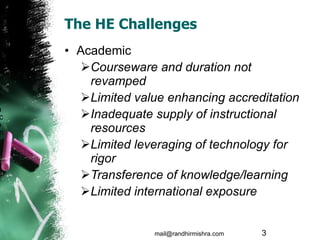
The HE Challenges Academic Courseware and duration not revamped Limited value enhancing accreditation Inadequate supply of instructional resources  Limited leveraging of technology for rigor Transference of knowledge/learning Limited international exposure mail@randhirmishra.com
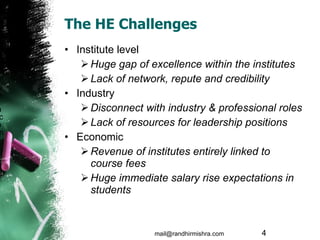
The HE Challenges Institute level Huge gap of excellence within the institutes  Lack of network, repute and credibility Industry Disconnect with industry & professional roles Lack of resources for leadership positions  Economic Revenue of institutes entirely linked to course fees Huge immediate salary rise expectations in students mail@randhirmishra.com
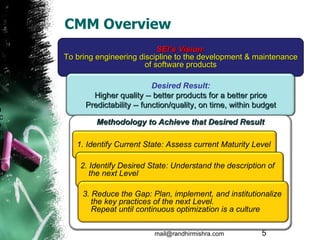
CMM Overview mail@randhirmishra.com  SEI’s Vision: To bring engineering discipline to the development & maintenance of software products Methodology to Achieve that Desired Result Desired Result: Higher quality -- better products for a better price Predictability -- function/quality, on time, within budget 1. Identify Current State: Assess current Maturity Level 2. Identify Desired State: Understand the description of the next Level 3. Reduce the Gap: Plan, implement, and institutionalize the key practices of the next Level. Repeat until continuous optimization is a culture
SEI CMM in the IT industry A model to assess the maturity (i.e. strength) of the processes to develop and support IT Higher process maturity: higher performance Higher CMM level process - higher quality faster, less cost, and greater consistency SEI CMM is a proven model for performance India - an IT hub Due to CMM: MNC clients assured that it could compete on quality & cost mail@randhirmishra.com
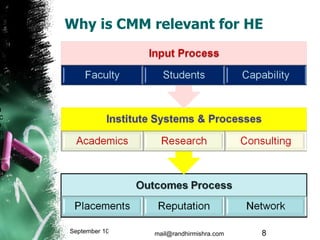
Why is CMM relevant for HE Can CMM provide a means by which HE institutions can assess their ability to perform the process successfully, and guide them to improve their process capability  HE is driven by a series of processes Input process Internal Systems Outcome processes September 10, 2009 mail@randhirmishra.com
Why is CMM relevant for HE September 10, 2009 mail@randhirmishra.com
Current Assessment Inadequate Regulations and compliances More of a minimum infrastructure bench marks Does not help institutions evolve Rankings and exams Dip stick assessment can’t capture consistency Do not assess transference of learning recall/understanding NOT learning Quality of faculty & academics needs monitoring opportunistic behaviour by institutions September 10, 2009 mail@randhirmishra.com
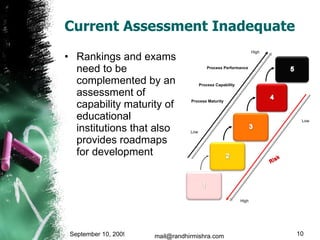
Current Assessment Inadequate Rankings and exams need to be complemented by an assessment of capability maturity of educational institutions that also provides roadmaps for development September 10, 2009 mail@randhirmishra.com  Process Maturity Process Capability Process Performance Low High Risk High Low
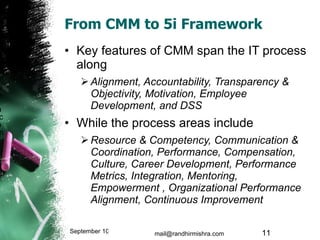
From CMM to 5i Framework Key features of CMM span the IT process along  Alignment, Accountability, Transparency & Objectivity, Motivation, Employee Development, and DSS While the process areas include  Resource & Competency, Communication & Coordination, Performance, Compensation, Culture, Career Development, Performance Metrics, Integration, Mentoring, Empowerment , Organizational Performance Alignment, Continuous Improvement September 10, 2009 mail@randhirmishra.com
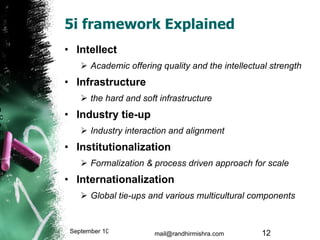
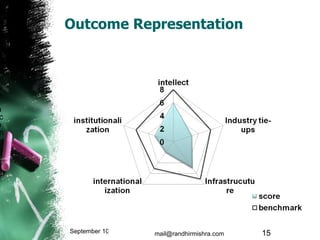
5i framework Explained Intellect Academic offering quality and the intellectual strength Infrastructure the hard and soft infrastructure  Industry tie-up Industry interaction and alignment  Institutionalization Formalization & process driven approach for scale Internationalization Global tie-ups and various multicultural components September 10, 2009 mail@randhirmishra.com
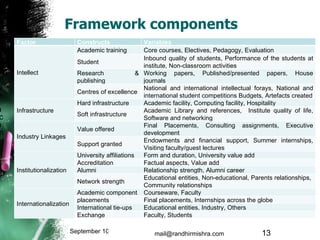
Framework components September 10, 2009 mail@randhirmishra.com  Factor Constructs Variables Intellect Academic training Core courses, Electives, Pedagogy, Evaluation Student Inbound quality of students, Performance of the students at institute, Non-classroom activities Research & publishing Working papers, Published/presented papers, House journals Centres of excellence National and international intellectual forays, National and international student competitions Budgets, Artefacts created Infrastructure Hard infrastructure Academic facility, Computing facility, Hospitality Soft infrastructure Academic Library and references,  Institute quality of life, Software and networking Industry Linkages Value offered Final Placements, Consulting assignments, Executive development  Support granted Endowments and financial support, Summer internships, Visiting faculty/guest lectures Institutionalization University affiliations Form and duration, University value add Accreditation Factual aspects, Value add Alumni  Relationship strength, Alumni career Network strength Educational entities, Non-educational, Parents relationships,  Community relationships Internationalization Academic component Courseware, Faculty placements Final placements, Internships across the globe International tie-ups Educational entities, Industry, Others Exchange Faculty, Students
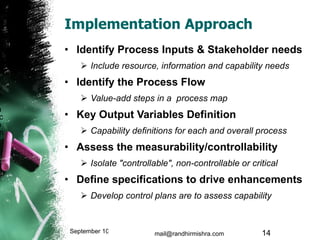
Implementation Approach Identify Process Inputs & Stakeholder needs Include resource, information and capability needs Identify the Process Flow Value-add steps in a  process map Key Output Variables Definition  Capability definitions for each and overall process  Assess the measurability/controllability Isolate "controllable", non-controllable or critical Define specifications to drive enhancements Develop control plans are to assess capability September 10, 2009 mail@randhirmishra.com
Outcome Representation September 10, 2009 mail@randhirmishra.com
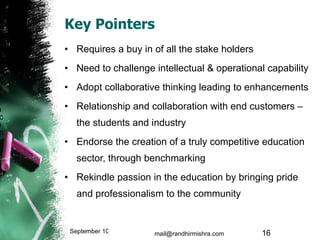
Key Pointers Requires a buy in of all the stake holders Need to challenge intellectual & operational capability Adopt collaborative thinking leading to enhancements Relationship and collaboration with end customers – the students and industry Endorse the creation of a truly competitive education sector, through benchmarking Rekindle passion in the education by bringing pride and professionalism to the community September 10, 2009 mail@randhirmishra.com
Concluding Remarks ERP needed Process reengineering to ensure that technology didn’t make inefficiency run faster Adoption of technology in education is perhaps faced with the same dilemma… September 10, 2009
[email_address]   September 10, 2009

Randhir A Maturity Model For Education

  • 1.
    September 10, 2009mail@randhirmishra.com
  • 2.
    Agenda The HigherEducation (HE)Sector Challenges The value of SEI CMM to IT industry Why is the SEI CMM relevant for HE Evaluating educational institutes From CMM to 5i framework 5i framework Explained Framework components Implementation Approach Possible challenges Conclusion mail@randhirmishra.com
  • 3.
    The HE ChallengesAcademic Courseware and duration not revamped Limited value enhancing accreditation Inadequate supply of instructional resources Limited leveraging of technology for rigor Transference of knowledge/learning Limited international exposure mail@randhirmishra.com
  • 4.
    The HE ChallengesInstitute level Huge gap of excellence within the institutes Lack of network, repute and credibility Industry Disconnect with industry & professional roles Lack of resources for leadership positions Economic Revenue of institutes entirely linked to course fees Huge immediate salary rise expectations in students mail@randhirmishra.com
  • 5.
    CMM Overview mail@randhirmishra.com SEI’s Vision: To bring engineering discipline to the development & maintenance of software products Methodology to Achieve that Desired Result Desired Result: Higher quality -- better products for a better price Predictability -- function/quality, on time, within budget 1. Identify Current State: Assess current Maturity Level 2. Identify Desired State: Understand the description of the next Level 3. Reduce the Gap: Plan, implement, and institutionalize the key practices of the next Level. Repeat until continuous optimization is a culture
  • 6.
    SEI CMM inthe IT industry A model to assess the maturity (i.e. strength) of the processes to develop and support IT Higher process maturity: higher performance Higher CMM level process - higher quality faster, less cost, and greater consistency SEI CMM is a proven model for performance India - an IT hub Due to CMM: MNC clients assured that it could compete on quality & cost mail@randhirmishra.com
  • 7.
    Why is CMMrelevant for HE Can CMM provide a means by which HE institutions can assess their ability to perform the process successfully, and guide them to improve their process capability HE is driven by a series of processes Input process Internal Systems Outcome processes September 10, 2009 mail@randhirmishra.com
  • 8.
    Why is CMMrelevant for HE September 10, 2009 mail@randhirmishra.com
  • 9.
    Current Assessment InadequateRegulations and compliances More of a minimum infrastructure bench marks Does not help institutions evolve Rankings and exams Dip stick assessment can’t capture consistency Do not assess transference of learning recall/understanding NOT learning Quality of faculty & academics needs monitoring opportunistic behaviour by institutions September 10, 2009 mail@randhirmishra.com
  • 10.
    Current Assessment InadequateRankings and exams need to be complemented by an assessment of capability maturity of educational institutions that also provides roadmaps for development September 10, 2009 mail@randhirmishra.com Process Maturity Process Capability Process Performance Low High Risk High Low
  • 11.
    From CMM to5i Framework Key features of CMM span the IT process along Alignment, Accountability, Transparency & Objectivity, Motivation, Employee Development, and DSS While the process areas include Resource & Competency, Communication & Coordination, Performance, Compensation, Culture, Career Development, Performance Metrics, Integration, Mentoring, Empowerment , Organizational Performance Alignment, Continuous Improvement September 10, 2009 mail@randhirmishra.com
  • 12.
    5i framework ExplainedIntellect Academic offering quality and the intellectual strength Infrastructure the hard and soft infrastructure Industry tie-up Industry interaction and alignment Institutionalization Formalization & process driven approach for scale Internationalization Global tie-ups and various multicultural components September 10, 2009 mail@randhirmishra.com
  • 13.
    Framework components September10, 2009 mail@randhirmishra.com Factor Constructs Variables Intellect Academic training Core courses, Electives, Pedagogy, Evaluation Student Inbound quality of students, Performance of the students at institute, Non-classroom activities Research & publishing Working papers, Published/presented papers, House journals Centres of excellence National and international intellectual forays, National and international student competitions Budgets, Artefacts created Infrastructure Hard infrastructure Academic facility, Computing facility, Hospitality Soft infrastructure Academic Library and references, Institute quality of life, Software and networking Industry Linkages Value offered Final Placements, Consulting assignments, Executive development Support granted Endowments and financial support, Summer internships, Visiting faculty/guest lectures Institutionalization University affiliations Form and duration, University value add Accreditation Factual aspects, Value add Alumni Relationship strength, Alumni career Network strength Educational entities, Non-educational, Parents relationships, Community relationships Internationalization Academic component Courseware, Faculty placements Final placements, Internships across the globe International tie-ups Educational entities, Industry, Others Exchange Faculty, Students
  • 14.
    Implementation Approach IdentifyProcess Inputs & Stakeholder needs Include resource, information and capability needs Identify the Process Flow Value-add steps in a process map Key Output Variables Definition Capability definitions for each and overall process Assess the measurability/controllability Isolate "controllable", non-controllable or critical Define specifications to drive enhancements Develop control plans are to assess capability September 10, 2009 mail@randhirmishra.com
  • 15.
    Outcome Representation September10, 2009 mail@randhirmishra.com
  • 16.
    Key Pointers Requiresa buy in of all the stake holders Need to challenge intellectual & operational capability Adopt collaborative thinking leading to enhancements Relationship and collaboration with end customers – the students and industry Endorse the creation of a truly competitive education sector, through benchmarking Rekindle passion in the education by bringing pride and professionalism to the community September 10, 2009 mail@randhirmishra.com
  • 17.
    Concluding Remarks ERPneeded Process reengineering to ensure that technology didn’t make inefficiency run faster Adoption of technology in education is perhaps faced with the same dilemma… September 10, 2009
  • 18.
    [email_address] September 10, 2009