
CIO FORUM 2008 Part 1: Summative Perspective on the Discussions Regarding Skills Development, Graduate and Internships Programs
There are differences in the academic and industry perspectives pertaining to internships and expectations
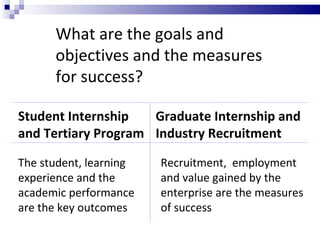
Student Internship and Tertiary Program Graduate Internship and Industry Recruitment The student, learning experience and the academic performance are the key outcomes Recruitment,  employment and value gained by the enterprise are the measures of success What are the goals and objectives and the measures for success?
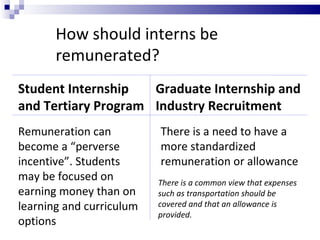
Student Internship and Tertiary Program Graduate Internship and Industry Recruitment How should interns be remunerated? Remuneration can become a “perverse incentive”. Students may be focused on earning money than on learning and curriculum options There is a need to have a more standardized remuneration or allowance  There is a common view that expenses such as transportation should be covered and that an allowance is provided.
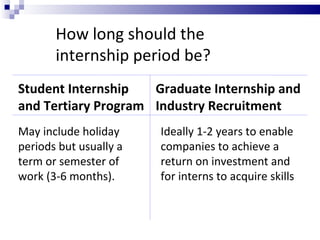
Student Internship and Tertiary Program Graduate Internship and Industry Recruitment How long should the internship period be? May include holiday periods but usually a term or semester of work (3-6 months). Ideally 1-2 years to enable companies to achieve a return on investment and for interns to acquire skills
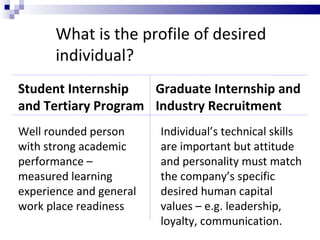
Student Internship and Tertiary Program Graduate Internship and Industry Recruitment What is the profile of desired individual? Well rounded person with strong academic performance – measured learning experience and general work place readiness Individual’s technical skills are important but attitude and personality must match the company’s specific desired human capital values – e.g. leadership, loyalty, communication.
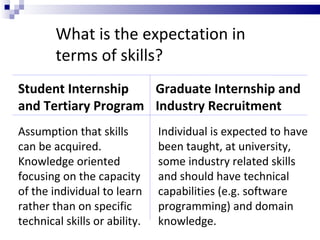
Student Internship and Tertiary Program Graduate Internship and Industry Recruitment What is the expectation in terms of skills? Assumption that skills can be acquired. Knowledge oriented focusing on the capacity of the individual to learn rather than on specific technical skills or ability.  Individual is expected to have been taught, at university, some industry related skills and should have technical capabilities (e.g. software programming) and domain knowledge.
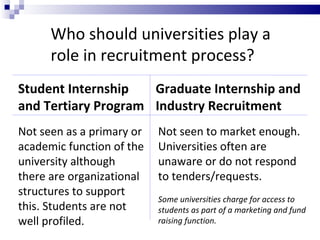
Student Internship and Tertiary Program Graduate Internship and Industry Recruitment Who should universities play a role in recruitment process? Not seen as a primary or academic function of the university although there are organizational structures to support this. Students are not well profiled. Not seen to market enough. Universities often are unaware or do not respond to tenders/requests.  Some universities charge for access to students as part of a marketing and fund raising function.
Student Internship and Tertiary Program Graduate Internship and Industry Recruitment What can companies do to improve their internship programs? Interns must be engaged in real work. Employers to be compassionate and extend opportunities. Challenge to “adopt” students like concerned parents. Internship Programs take effort but can work. Requires individuals committed to mentorship and coaching. Anticipate churn and plan to retain for 1-2 years.
Graduate qualifications  with certification  is the trend for ICT student development and  graduate recruitment Government’s Skills Development (ASGISA) have set certification targets Industry technology providers and tertiary institutions are partnering
Key Skills in the Region High demands in call centre and technical support operations Lack in IT management, project management, implementation and service delivery support Individuals with both business and technical aptitude, knowledge and skills IT sales and marketing Certified skills (e.g. SAP, Oracle, Microsoft, Open Source)
CIO FORUM 2008 Part 2: Discussion on IT Professional Which of the following statements do you find most relevant in terms of what defines an IT Professional?
The demand for business and IT alignment is helping to define the IT professional as … Humble. Arrogance is undesirable. Technical knowledge is only respected when communicated in the business context.
The value proposition of IT to business is defining the IT professional as … A problem solver that addresses the technical solution as well as the broader business problem – at a strategic and operational level.
The IT professional needs to take ownership and accountability because … IT is not just a back office or supporting function but impacts the performance of the business as a whole and is at the front lines, experiencing the pressures on the business in terms of revenue generation, administration, operations, production, logistics, etc.
Programming has become a competency rather than something that defines an IT professional because … a professional programmer adds a limited value to the business as a whole and can become a liability – an overhead that requires input in order to gain outputs.
The growing complexity and hybrid nature of technology environments is defining the IT professional as … a knowledge worker that has experience across a wide range of technologies and solutions. Specialization is based on a functional domain rather than on a technology platform.
The IT professional is … Other comments …

CIO Academic Forum Feedback 2008

  • 1.
    CIO FORUM 2008Part 1: Summative Perspective on the Discussions Regarding Skills Development, Graduate and Internships Programs
  • 2.
    There are differencesin the academic and industry perspectives pertaining to internships and expectations
  • 3.
    Student Internship andTertiary Program Graduate Internship and Industry Recruitment The student, learning experience and the academic performance are the key outcomes Recruitment, employment and value gained by the enterprise are the measures of success What are the goals and objectives and the measures for success?
  • 4.
    Student Internship andTertiary Program Graduate Internship and Industry Recruitment How should interns be remunerated? Remuneration can become a “perverse incentive”. Students may be focused on earning money than on learning and curriculum options There is a need to have a more standardized remuneration or allowance There is a common view that expenses such as transportation should be covered and that an allowance is provided.
  • 5.
    Student Internship andTertiary Program Graduate Internship and Industry Recruitment How long should the internship period be? May include holiday periods but usually a term or semester of work (3-6 months). Ideally 1-2 years to enable companies to achieve a return on investment and for interns to acquire skills
  • 6.
    Student Internship andTertiary Program Graduate Internship and Industry Recruitment What is the profile of desired individual? Well rounded person with strong academic performance – measured learning experience and general work place readiness Individual’s technical skills are important but attitude and personality must match the company’s specific desired human capital values – e.g. leadership, loyalty, communication.
  • 7.
    Student Internship andTertiary Program Graduate Internship and Industry Recruitment What is the expectation in terms of skills? Assumption that skills can be acquired. Knowledge oriented focusing on the capacity of the individual to learn rather than on specific technical skills or ability. Individual is expected to have been taught, at university, some industry related skills and should have technical capabilities (e.g. software programming) and domain knowledge.
  • 8.
    Student Internship andTertiary Program Graduate Internship and Industry Recruitment Who should universities play a role in recruitment process? Not seen as a primary or academic function of the university although there are organizational structures to support this. Students are not well profiled. Not seen to market enough. Universities often are unaware or do not respond to tenders/requests. Some universities charge for access to students as part of a marketing and fund raising function.
  • 9.
    Student Internship andTertiary Program Graduate Internship and Industry Recruitment What can companies do to improve their internship programs? Interns must be engaged in real work. Employers to be compassionate and extend opportunities. Challenge to “adopt” students like concerned parents. Internship Programs take effort but can work. Requires individuals committed to mentorship and coaching. Anticipate churn and plan to retain for 1-2 years.
  • 10.
    Graduate qualifications with certification is the trend for ICT student development and graduate recruitment Government’s Skills Development (ASGISA) have set certification targets Industry technology providers and tertiary institutions are partnering
  • 11.
    Key Skills inthe Region High demands in call centre and technical support operations Lack in IT management, project management, implementation and service delivery support Individuals with both business and technical aptitude, knowledge and skills IT sales and marketing Certified skills (e.g. SAP, Oracle, Microsoft, Open Source)
  • 12.
    CIO FORUM 2008Part 2: Discussion on IT Professional Which of the following statements do you find most relevant in terms of what defines an IT Professional?
  • 13.
    The demand forbusiness and IT alignment is helping to define the IT professional as … Humble. Arrogance is undesirable. Technical knowledge is only respected when communicated in the business context.
  • 14.
    The value propositionof IT to business is defining the IT professional as … A problem solver that addresses the technical solution as well as the broader business problem – at a strategic and operational level.
  • 15.
    The IT professionalneeds to take ownership and accountability because … IT is not just a back office or supporting function but impacts the performance of the business as a whole and is at the front lines, experiencing the pressures on the business in terms of revenue generation, administration, operations, production, logistics, etc.
  • 16.
    Programming has becomea competency rather than something that defines an IT professional because … a professional programmer adds a limited value to the business as a whole and can become a liability – an overhead that requires input in order to gain outputs.
  • 17.
    The growing complexityand hybrid nature of technology environments is defining the IT professional as … a knowledge worker that has experience across a wide range of technologies and solutions. Specialization is based on a functional domain rather than on a technology platform.
  • 18.
    The IT professionalis … Other comments …