Presentation By:
Abhishek Gupta
Jyoti Sawana
 Started by ‘Ran’bir Singh & Gur‘bax’
Singh in 1937.

 They sold the company to their cousin
“Mohan Singh” in 1952.

 Company went public in 1973.

 Entered the US markets in 1998, other
major countries- Brazil, Russia, China
and Europe.
 Indian Multinational Pharmaceutical
company incorporated in 1961.

 “Daiichi Sankyo” acquired a
controlling interest (50.1%) in 2008.

 Exports to 125 countries, with
manufacturing facilities available in 8
of them.
 Former CEO, Malvinder Singh and his
brother sold their share of Ranbaxy for $2
Billion in 2008 to Daiichi- Sankyo.

 Current CEO of Ranbaxy: Mr. Arun Sawhney.

 Ranbaxy generated a revenue of $2 Billion in
2012, EBITDA- $290 Million in 2012.

 Listed in the NSE(RANBAXY) and the
BSE(500359).
 Currently Ranbaxy has 11 plants in India:
Mohali, Punjab
Toansa, Punjab
Dewas, MP
Paonta Sahib, HP
Okhla, New Delhi
Jejuri, Maharashtra
Ponda, Goa
Paonta Sahib, HP(2nd Plant)
Ghirongi, MP
Mohali, Punjab(2nd Plant)
Baddi, HP
 Apart from these, Ranbaxy has a number
of externally hired laboratories in India as
well.
 WHISTLE BLOWERS:- In 200405, Dinesh Thakur and Rajinder
Kumar blew the whistle on Ranbaxy’s
fabrication of drug test reports.
 As a result, in 2008, Ranbaxy
Laboratories ltd. was issued 2 warning
letters by the FDA and an import alert
on 2 Indian manufacturing plants
(Dewas & Poanta Sahib).
 Later the same year, the USFDA
banned all products from the
Toansa, Poanta Sahib plants.
 February 2012, three batches of the
proton-pump inhibitor
Pantoprazole were recalled in the
Netherlands due to the presence of
impurities.

 November 2012, Ranbaxy halted
production and recalled forty-one lots
of Atorvastatin due to glass particles
being found in some bottles.
 In May 2013, the company pleaded
guilty to felony charges related to drug
safety and agreed to pay $500 million
in civil and criminal fines under the
settlement agreement with the US
department of justice.

 As per the Whistleblower
agreement, Dinesh Thakur received
$48.1 million for his efforts in bringing
Ranbaxy to justice.
 September 2013, further problems
were reported, including apparent
human hair in a tablet, oil spots on
other tablets, toilet facilities without
running water, and a failure to instruct
employees to wash their hands after
using the toilet.
 Due to the above, Ranbaxy is
prohibited from manufacturing FDAregulated drugs at the Mohali facility
until the company complies with U.S.
drug manufacturing requirements.
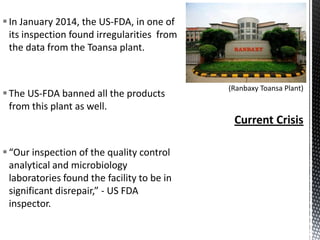
 In January 2014, the US-FDA, in one of
its inspection found irregularities from
the data from the Toansa plant.

 The US-FDA banned all the products
from this plant as well.

 “Our inspection of the quality control
analytical and microbiology
laboratories found the facility to be in
significant disrepair,” - US FDA
inspector.
 Ranbaxy’s Toansa factory, with its
inception in 1986, is one of the oldest
active pharmaceutical ingredient (API)
manufacturing facilities in the country.
Till the latest US ban was imposed on
the unit, it was catering to over 70 per
cent of Ranbaxy’s captive requirement
for API or raw material used in
medicine formulations.

 US FDA Form 483 highlighted eight
serious deviations in Ranbaxy’s Toansa
factory. These included presence of
flies through broken windows, building
up of melting ice in refrigerator where
drug samples were stored, nonmaintenance of analytical
instruments, etc.
 "While we continue to assess the
overall business impact on all aspects
in our value chain, our direct sales
impact because of the Toansa facility
issue will be limited." - Arun Sawhney
(CEO, Ranbaxy)
 "What we know publicly is that the
company has spent a lot of money
upgrading its facilities, which is a part
of the solution, The bigger issue is
changing the culture of the
company, which will take inspired
leadership, not just external
consultants.” – Dinesh Thakur(Former
Employee, Whistleblower)
 “This is a complete cover-up act by the
management. The management must
look for the right kind of solutions to
address the problem, instead of
shifting the blame on employees.” a
company employee told Business
Standard, on conditions of anonymity.
 “We are supporting and focusing on
this action as a matter of high
priority, For further approach to solve a
series of problems, we think we need a
comprehensive policy after this. We
want to go back and prepare a more
aggressive, more drastic response.”
Daiichi Sankyo Senior Executive Officer
Manabu Sakai
 CBS News
 Fox News
 CNN
 The Economic Times
 Business-Standard
 Fortune Magazine- Investigative article
“Dirty Medicine”
 Wikipedia
 Reuters
 Money Control.com
 BSE
 Ranbaxy website
 DD News- “The Big Picture”
Any Questions?
Thank You!

Ranbaxy crisis

  • 1.
  • 2.
     Started by‘Ran’bir Singh & Gur‘bax’ Singh in 1937.  They sold the company to their cousin “Mohan Singh” in 1952.  Company went public in 1973.  Entered the US markets in 1998, other major countries- Brazil, Russia, China and Europe.
  • 3.
     Indian MultinationalPharmaceutical company incorporated in 1961.  “Daiichi Sankyo” acquired a controlling interest (50.1%) in 2008.  Exports to 125 countries, with manufacturing facilities available in 8 of them.
  • 4.
     Former CEO,Malvinder Singh and his brother sold their share of Ranbaxy for $2 Billion in 2008 to Daiichi- Sankyo.  Current CEO of Ranbaxy: Mr. Arun Sawhney.  Ranbaxy generated a revenue of $2 Billion in 2012, EBITDA- $290 Million in 2012.  Listed in the NSE(RANBAXY) and the BSE(500359).
  • 5.
     Currently Ranbaxyhas 11 plants in India: Mohali, Punjab Toansa, Punjab Dewas, MP Paonta Sahib, HP Okhla, New Delhi Jejuri, Maharashtra Ponda, Goa Paonta Sahib, HP(2nd Plant) Ghirongi, MP Mohali, Punjab(2nd Plant) Baddi, HP  Apart from these, Ranbaxy has a number of externally hired laboratories in India as well.
  • 7.
     WHISTLE BLOWERS:-In 200405, Dinesh Thakur and Rajinder Kumar blew the whistle on Ranbaxy’s fabrication of drug test reports.  As a result, in 2008, Ranbaxy Laboratories ltd. was issued 2 warning letters by the FDA and an import alert on 2 Indian manufacturing plants (Dewas & Poanta Sahib).  Later the same year, the USFDA banned all products from the Toansa, Poanta Sahib plants.
  • 8.
     February 2012,three batches of the proton-pump inhibitor Pantoprazole were recalled in the Netherlands due to the presence of impurities.  November 2012, Ranbaxy halted production and recalled forty-one lots of Atorvastatin due to glass particles being found in some bottles.
  • 9.
     In May2013, the company pleaded guilty to felony charges related to drug safety and agreed to pay $500 million in civil and criminal fines under the settlement agreement with the US department of justice.  As per the Whistleblower agreement, Dinesh Thakur received $48.1 million for his efforts in bringing Ranbaxy to justice.
  • 10.
     September 2013,further problems were reported, including apparent human hair in a tablet, oil spots on other tablets, toilet facilities without running water, and a failure to instruct employees to wash their hands after using the toilet.  Due to the above, Ranbaxy is prohibited from manufacturing FDAregulated drugs at the Mohali facility until the company complies with U.S. drug manufacturing requirements.
  • 12.
     In January2014, the US-FDA, in one of its inspection found irregularities from the data from the Toansa plant.  The US-FDA banned all the products from this plant as well.  “Our inspection of the quality control analytical and microbiology laboratories found the facility to be in significant disrepair,” - US FDA inspector.
  • 13.
     Ranbaxy’s Toansafactory, with its inception in 1986, is one of the oldest active pharmaceutical ingredient (API) manufacturing facilities in the country. Till the latest US ban was imposed on the unit, it was catering to over 70 per cent of Ranbaxy’s captive requirement for API or raw material used in medicine formulations.  US FDA Form 483 highlighted eight serious deviations in Ranbaxy’s Toansa factory. These included presence of flies through broken windows, building up of melting ice in refrigerator where drug samples were stored, nonmaintenance of analytical instruments, etc.
  • 15.
     "While wecontinue to assess the overall business impact on all aspects in our value chain, our direct sales impact because of the Toansa facility issue will be limited." - Arun Sawhney (CEO, Ranbaxy)  "What we know publicly is that the company has spent a lot of money upgrading its facilities, which is a part of the solution, The bigger issue is changing the culture of the company, which will take inspired leadership, not just external consultants.” – Dinesh Thakur(Former Employee, Whistleblower)
  • 16.
     “This isa complete cover-up act by the management. The management must look for the right kind of solutions to address the problem, instead of shifting the blame on employees.” a company employee told Business Standard, on conditions of anonymity.  “We are supporting and focusing on this action as a matter of high priority, For further approach to solve a series of problems, we think we need a comprehensive policy after this. We want to go back and prepare a more aggressive, more drastic response.” Daiichi Sankyo Senior Executive Officer Manabu Sakai
  • 17.
     CBS News Fox News  CNN  The Economic Times  Business-Standard  Fortune Magazine- Investigative article “Dirty Medicine”  Wikipedia  Reuters  Money Control.com  BSE  Ranbaxy website  DD News- “The Big Picture”
  • 18.
  • 19.