R&D & Good Clinical Practice


                Myron Pyzyk, M.S.
            Marenon Health Group
                   January, 2010
                      1/19/2010
Agenda
• Introduction
• Learning Objectives
• Evolution of Good Clinical Practice Guidelines (GCP)
   – History of GCP and current standards
   – Stakeholders in GCP
   – Understanding GCP issues within Clinical Trial Process
• Identification of current regulatory and ethical issues in
  clinical research
   – Current regulatory and ethical issues in clinical research
   – Applications of the regulations to practice


    Presentation to                                 1/19/2010
Agenda

• The Clinical Trial Process
  – Roles involved in the Clinical Trial Process
  – Ensuring adequate source documentation
  – Informed consent process; including a role-play and
    interactive discussion
  – Succeeding with IRBs
  – „How-to‟ guide to adequate source documentation
• Defining the major steps and phases of the drug
  development process

   Presentation to                       1/19/2010
Learning Objectives

• Review of Good Clinical Practice Guidelines
• Understand the overall impact of GCP on the
  clinical trial process including the respective
  roles and responsibilities of the Investigator and
  the Sponsor
• Understand the impact of GCP on overall study
  quality (e.g., source documentation, informed
  consent, IRB, etc.)
• Review the overall drug development process
   Presentation to                    1/19/2010
Drug Development Process


                   1/19/2010
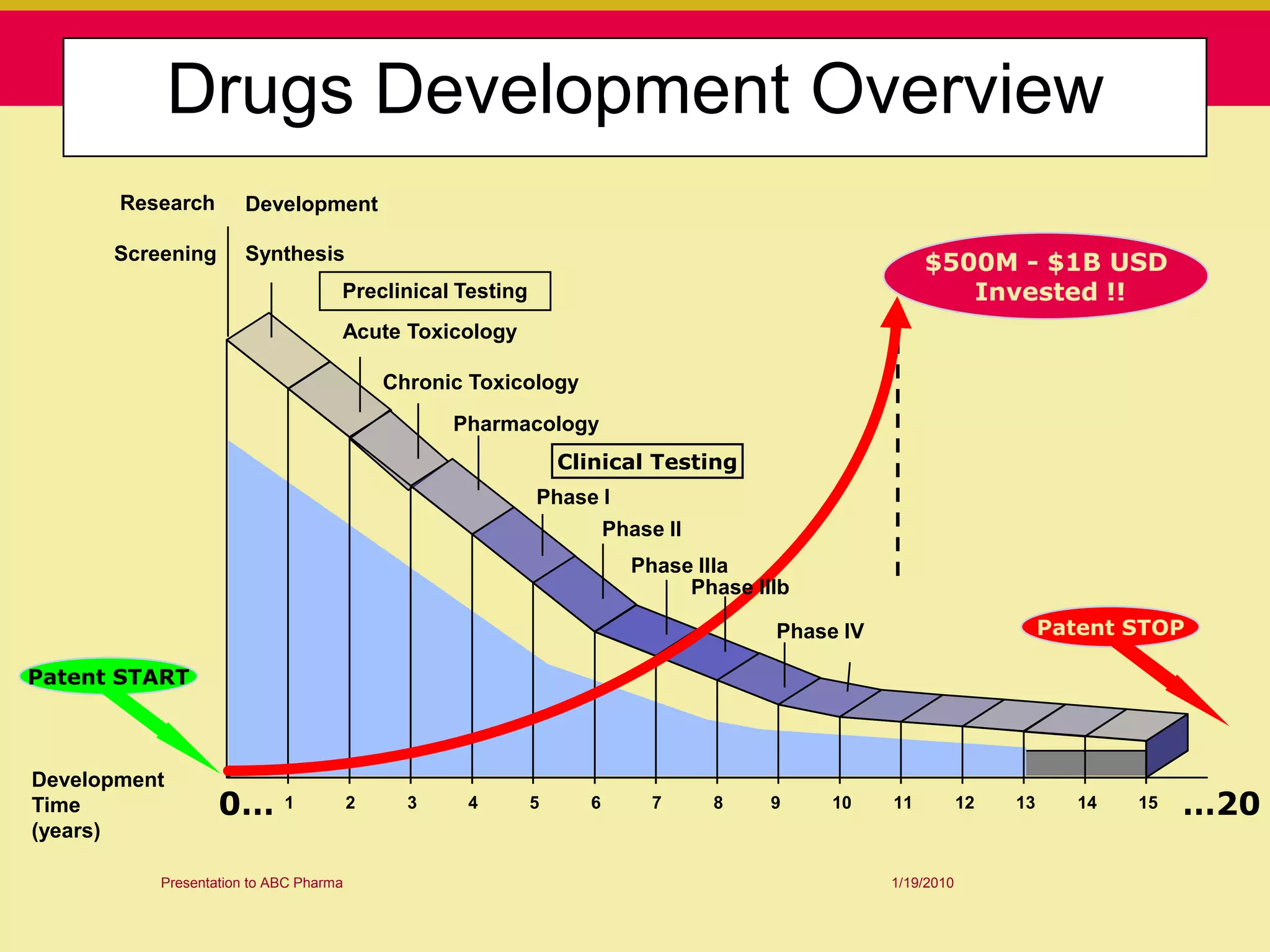
Drugs Development Overview
       Research       Development

      Screening       Synthesis                                                                    $500M - $1B USD
                                   Preclinical Testing                                                Invested !!
                                   Acute Toxicology

                                           Chronic Toxicology
                                                 Pharmacology
                                                             Clinical Testing
                                                         Phase I
                                                                    Phase II
                                                                      Phase IIIa
                                                                           Phase IIIb

                                                                                   Phase IV                         Patent STOP

Patent START


Development
Time              0…       1           2     3    4      5      6        7     8   9    10    11          12   13      14   15   …20
(years)

          Presentation to ABC Pharma                                                          1/19/2010
Developing New Drugs

• Potential “blockbuster”
  e.g. first effective therapy for a common and/or chronic
    disease and/or life-saving treatment
• Market size is LARGE
  – Broad patient population
  – Multiple therapeutic indications
         • Several products across several companies
         • Similar products on the market or in development
• Drug poor fit in manufacturer product portfolio
  – License or sell to another company sponsor

   Presentation to ABC Pharma                       1/19/2010
Pre-Clinical Drug Discovery

• Screening (Medicinal Chemistry)
  – Pharmacological and biological screening models
  – Computer modeling
  – Serendipity (Luck counts or “Do you feel lucky?”)
• Synthesize
  – Compounds that fit the biological target (e.g.,
    receptor)
        • ~ 1 out of 100,000 may reach market
• Screening
  – Assess likelihood of safety and efficacy in humans
    using in vitro and in vivo testing
    Presentation to ABC Pharma                  1/19/2010
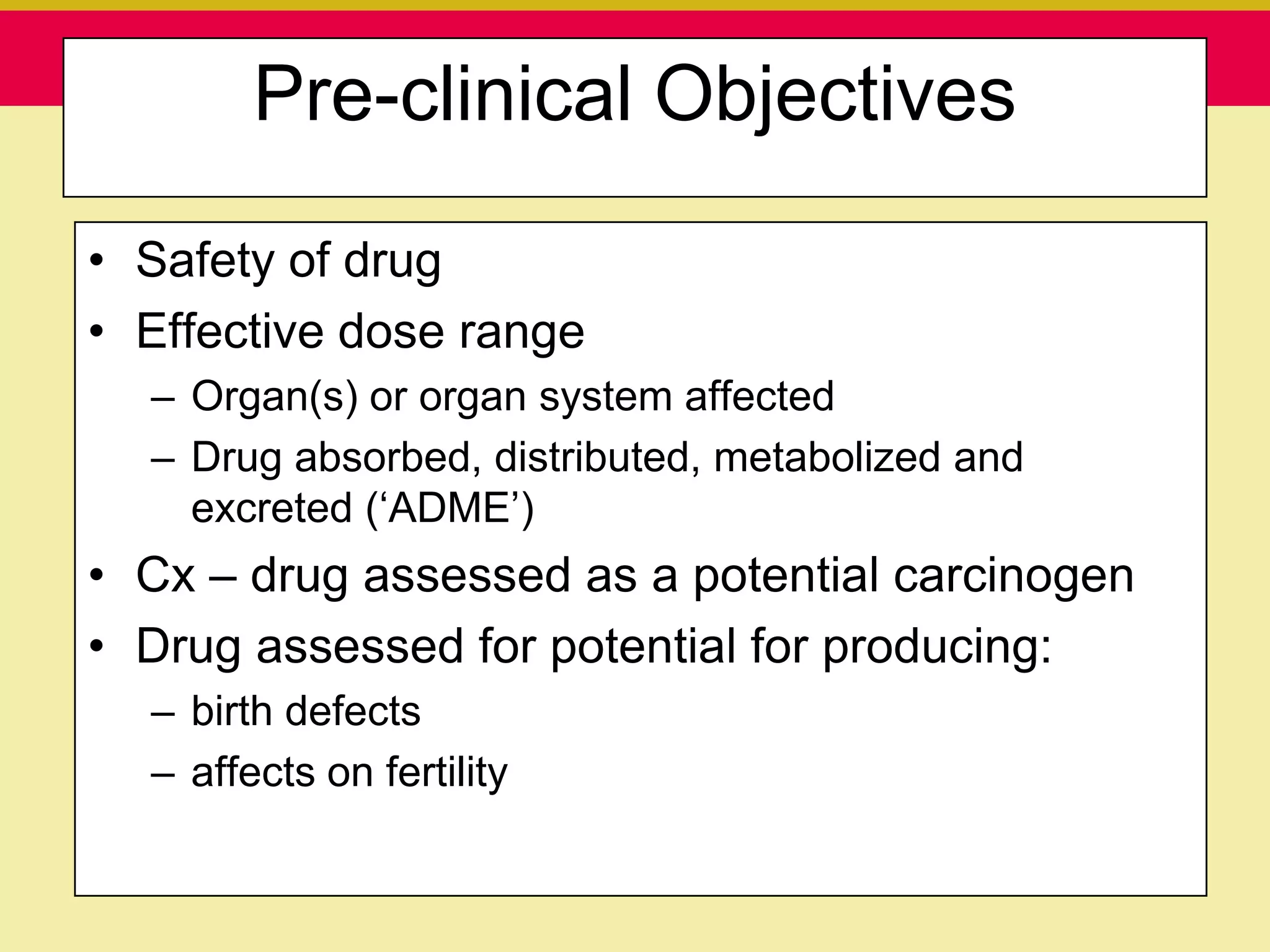
Pre-clinical Objectives

• Safety of drug
• Effective dose range
  – Organ(s) or organ system affected
  – Drug absorbed, distributed, metabolized and
    excreted („ADME‟)
• Cx – drug assessed as a potential carcinogen
• Drug assessed for potential for producing:
  – birth defects
  – affects on fertility

   Presentation to ABC Pharma           1/19/2010
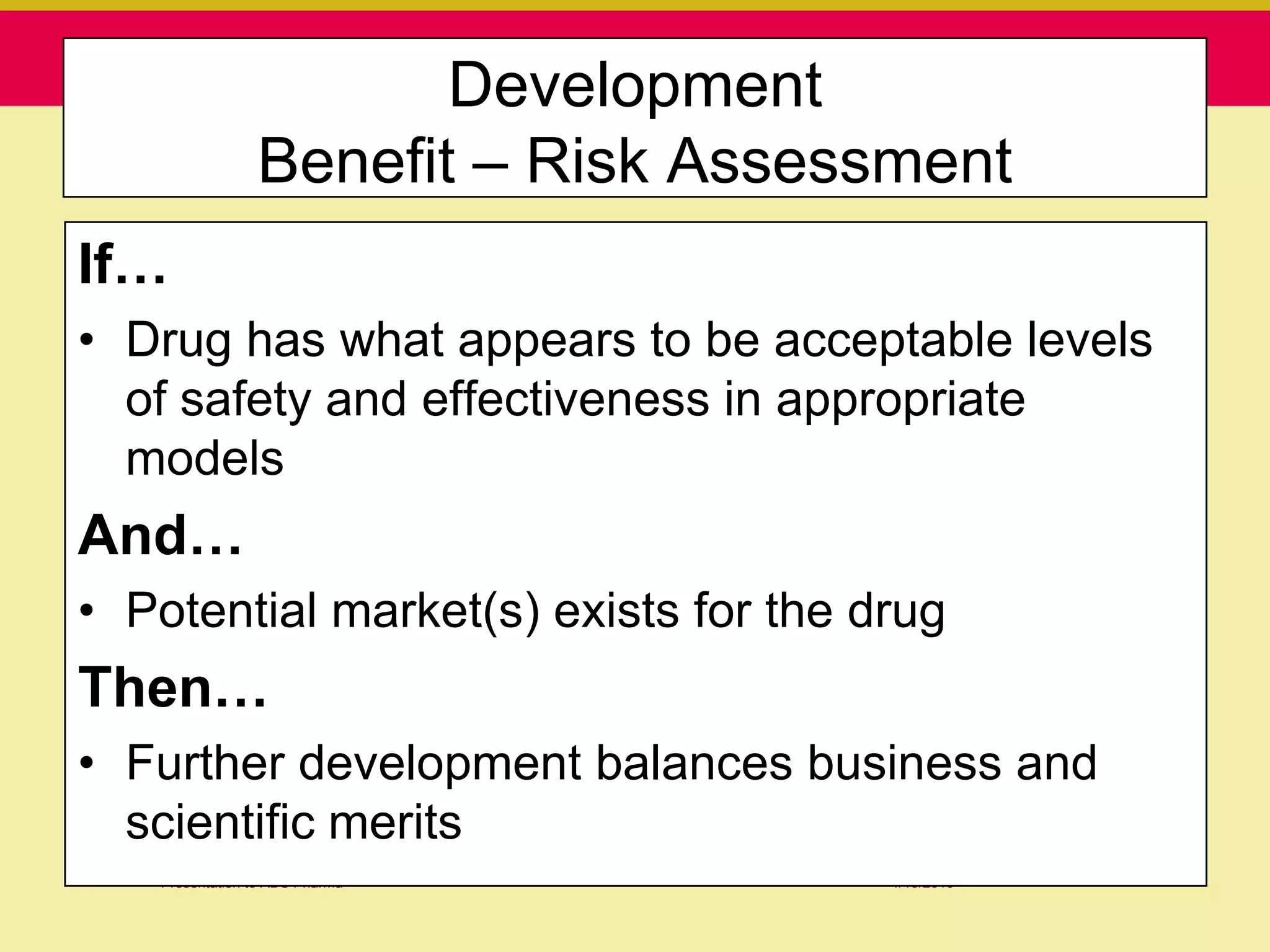
Development
                Benefit – Risk Assessment
If…
• Drug has what appears to be acceptable levels
  of safety and effectiveness in appropriate
  models
And…
• Potential market(s) exists for the drug
Then…
• Further development balances business and
  scientific merits
   Presentation to ABC Pharma         1/19/2010
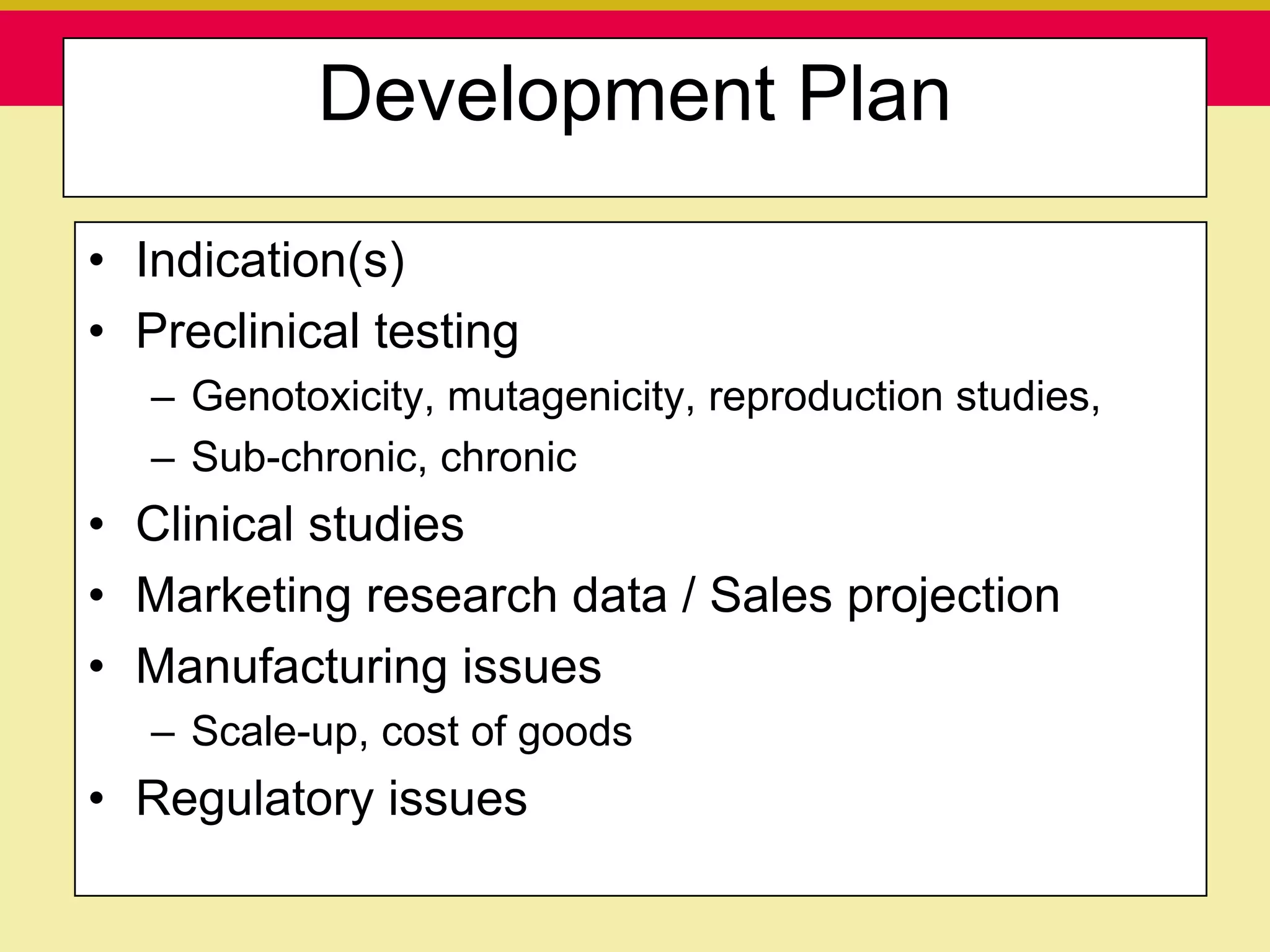
Development Plan

• Indication(s)
• Preclinical testing
   – Genotoxicity, mutagenicity, reproduction studies,
   – Sub-chronic, chronic
• Clinical studies
• Marketing research data / Sales projection
• Manufacturing issues
   – Scale-up, cost of goods
• Regulatory issues
   Presentation to ABC Pharma             1/19/2010
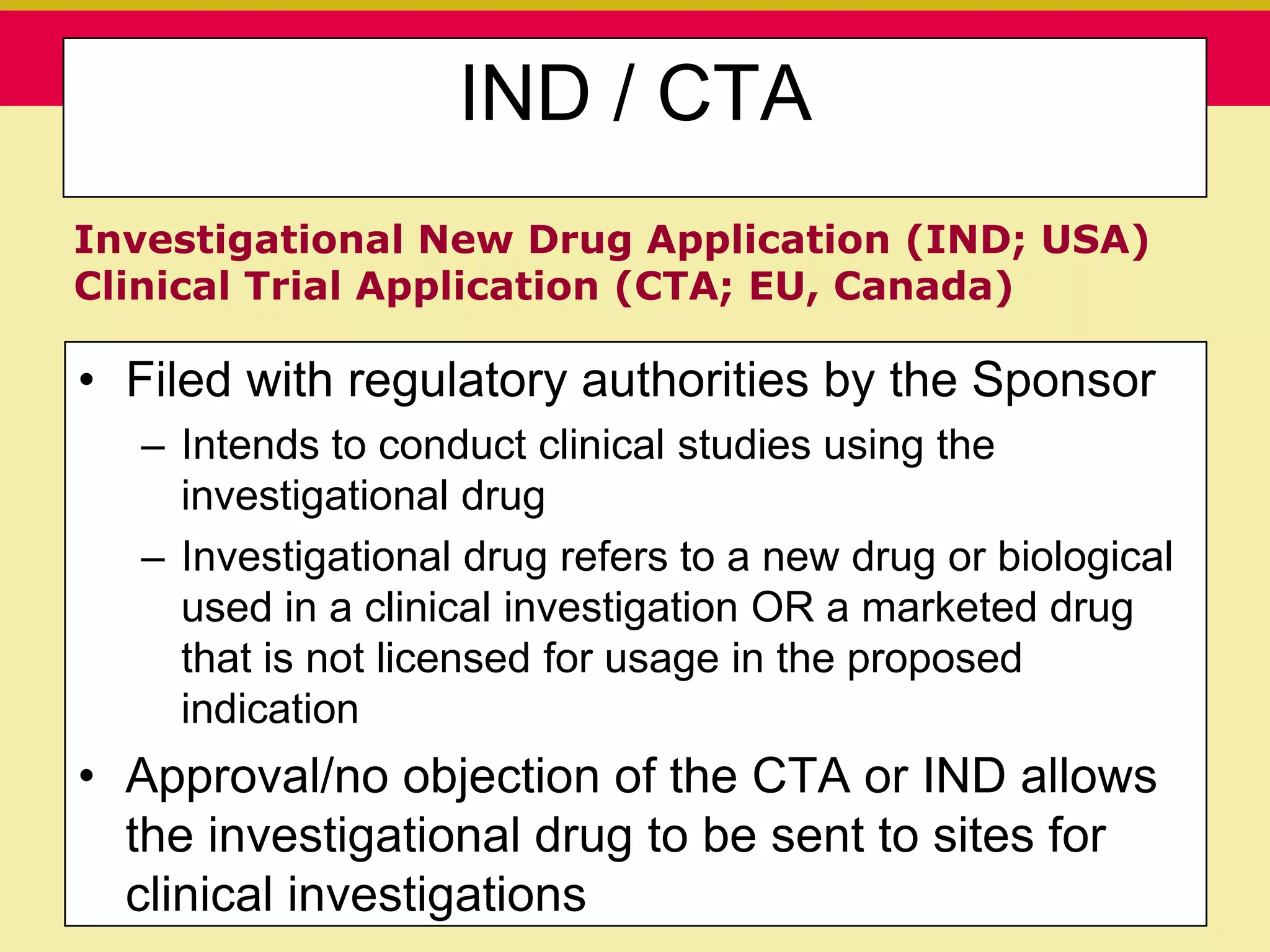
IND / CTA
Investigational New Drug Application (IND; USA)
Clinical Trial Application (CTA; EU, Canada)

• Filed with regulatory authorities by the Sponsor
  – Intends to conduct clinical studies using the
    investigational drug
  – Investigational drug refers to a new drug or biological
    used in a clinical investigation OR a marketed drug
    that is not licensed for usage in the proposed
    indication
• Approval/no objection of the CTA or IND allows
  the investigational drug to be sent to sites for
  clinical investigations
   Presentation to ABC Pharma               1/19/2010
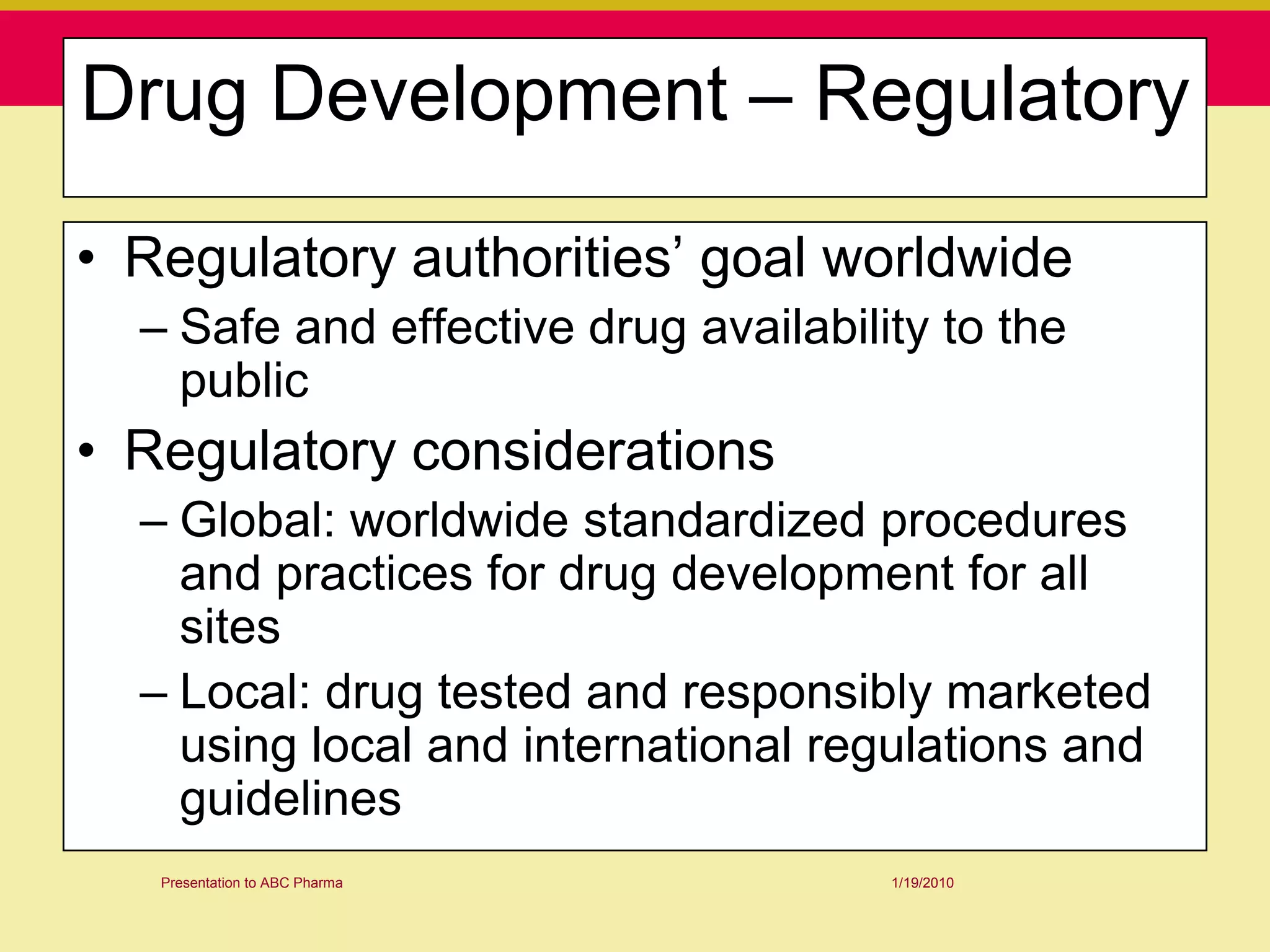
Drug Development – Regulatory

• Regulatory authorities‟ goal worldwide
  – Safe and effective drug availability to the
    public
• Regulatory considerations
  – Global: worldwide standardized procedures
    and practices for drug development for all
    sites
  – Local: drug tested and responsibly marketed
    using local and international regulations and
    guidelines
   Presentation to ABC Pharma         1/19/2010
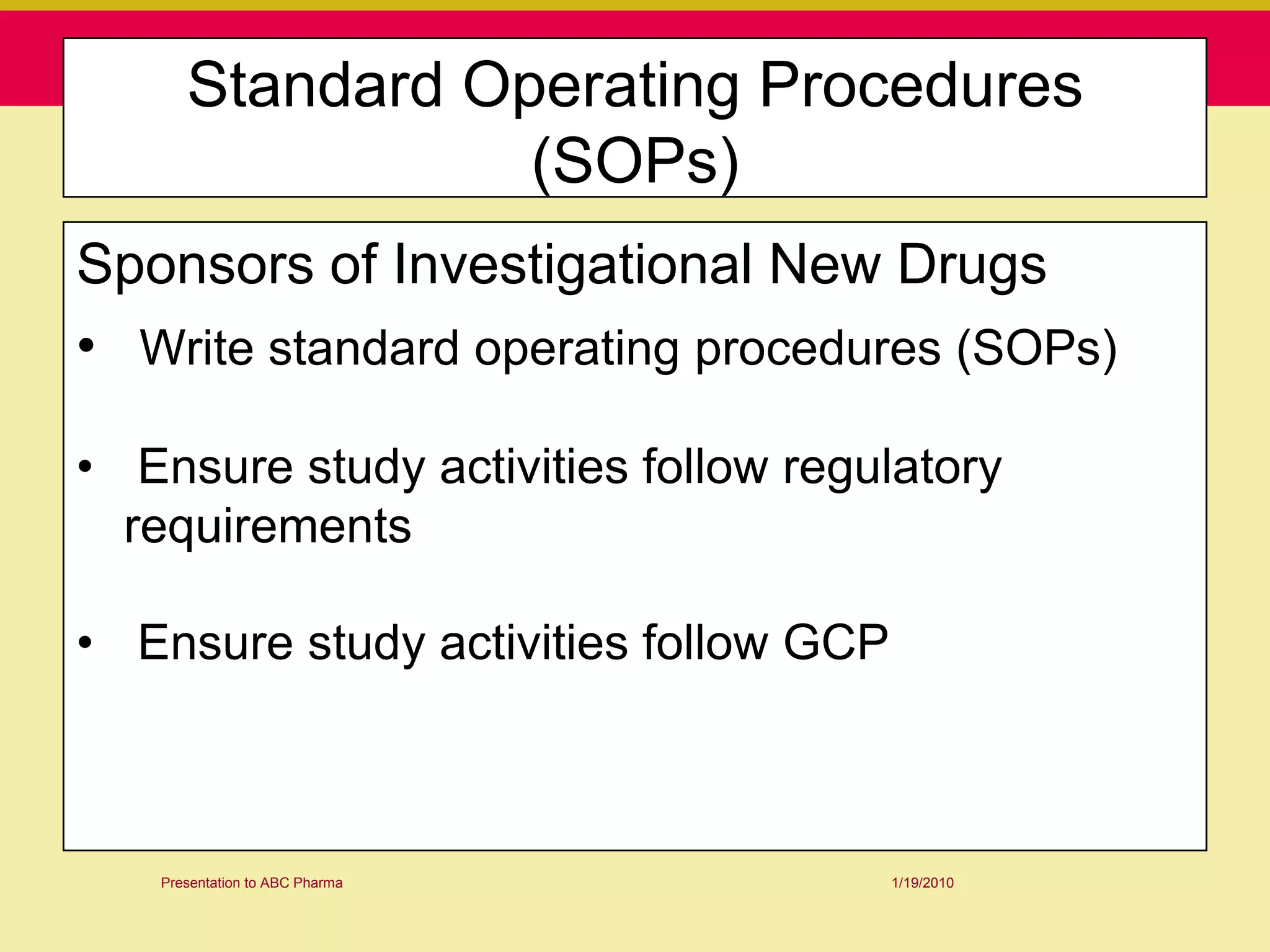
Standard Operating Procedures
                 (SOPs)
Sponsors of Investigational New Drugs
• Write standard operating procedures (SOPs)

• Ensure study activities follow regulatory
  requirements

• Ensure study activities follow GCP


   Presentation to ABC Pharma          1/19/2010
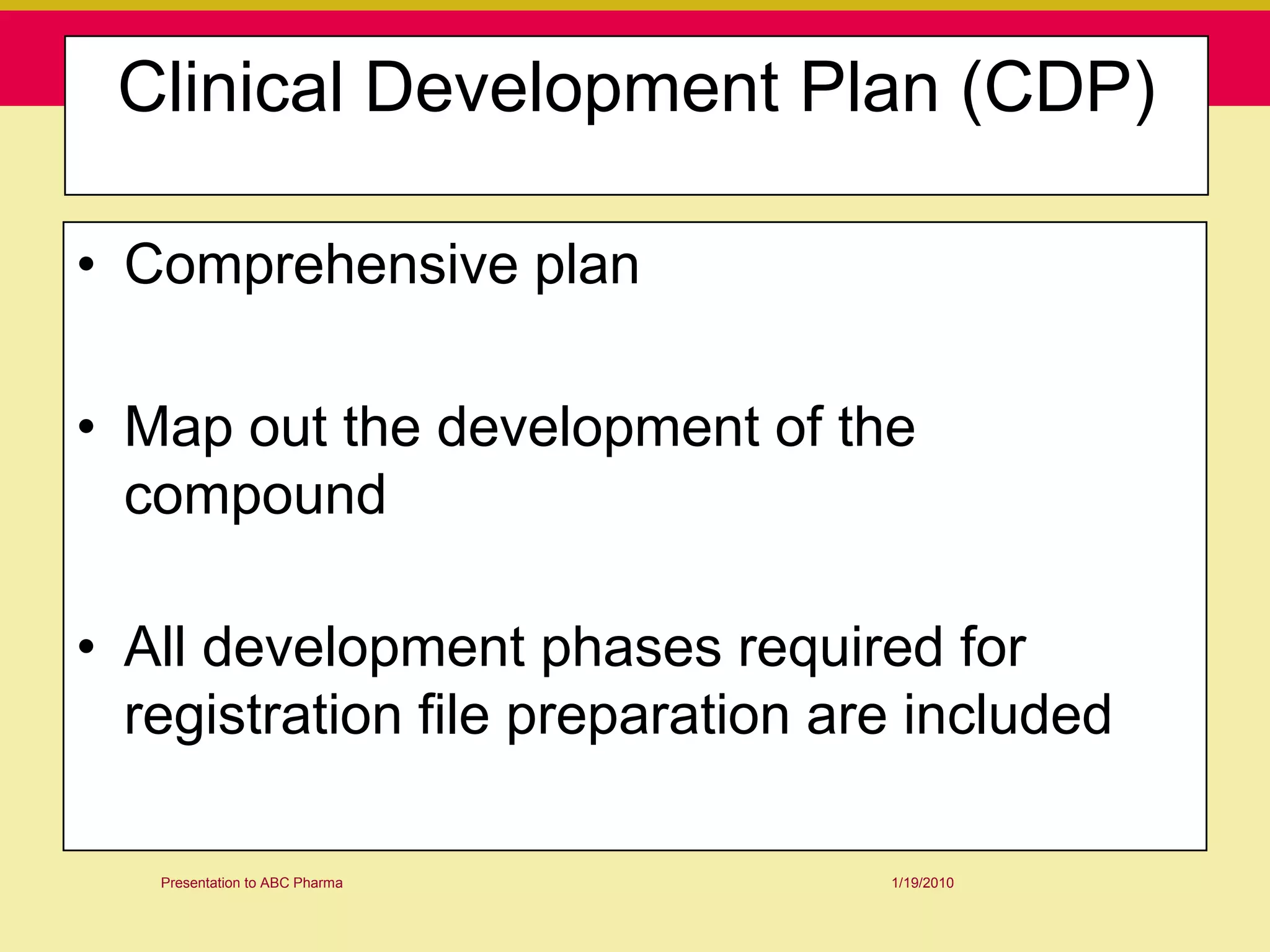
Clinical Development Plan (CDP)

• Comprehensive plan

• Map out the development of the
  compound

• All development phases required for
  registration file preparation are included

   Presentation to ABC Pharma     1/19/2010
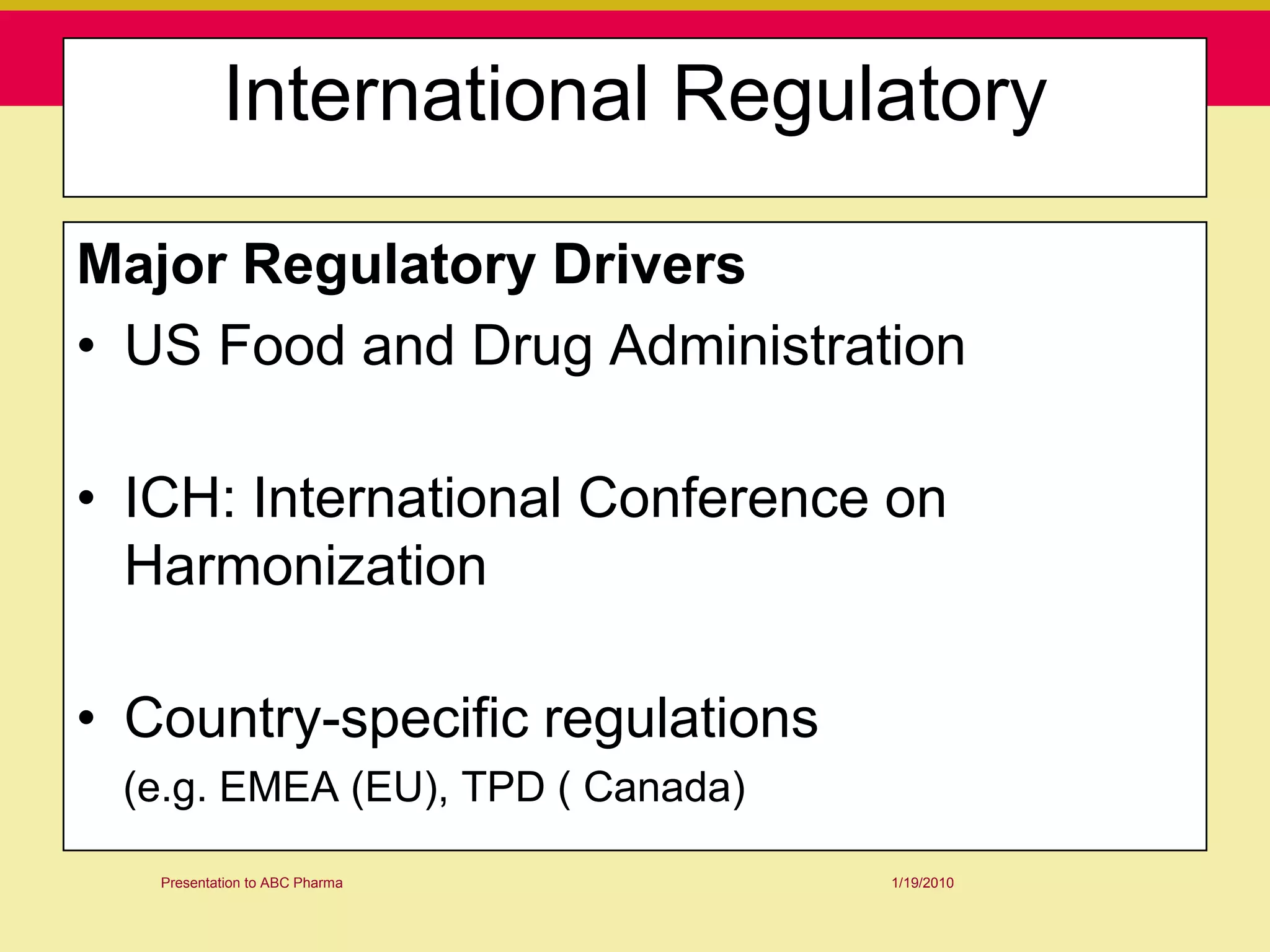
International Regulatory

Major Regulatory Drivers
• US Food and Drug Administration

• ICH: International Conference on
  Harmonization

• Country-specific regulations
 (e.g. EMEA (EU), TPD ( Canada)

   Presentation to ABC Pharma     1/19/2010
Phases of Clinical Research


                     1/19/2010
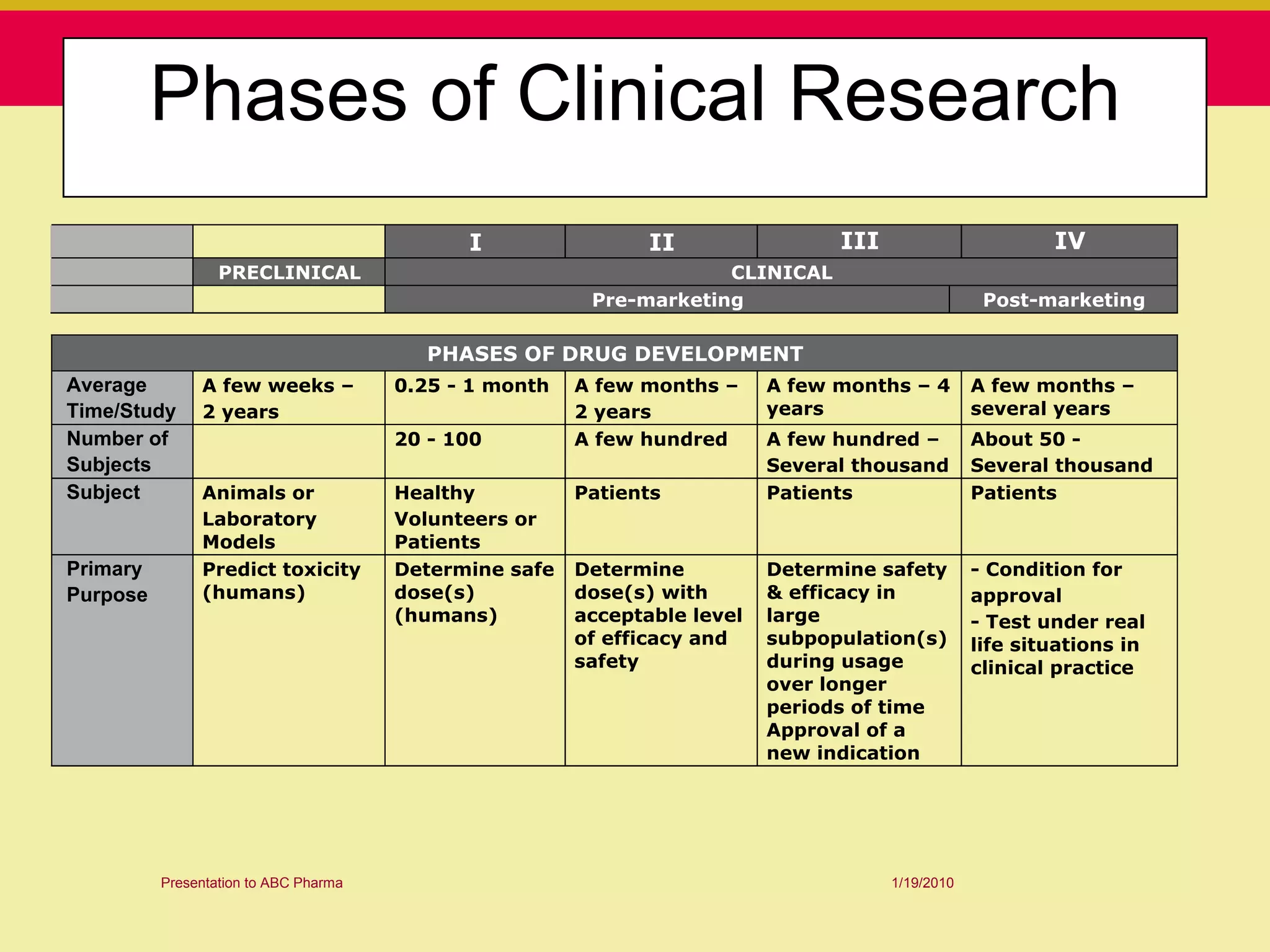
Phases of Clinical Research
                                             I                 II                III                       IV
                  PRECLINICAL                                        CLINICAL
                                                         Pre-marketing                              Post-marketing

                                         PHASES OF DRUG DEVELOPMENT
Average        A few weeks –           0.25 - 1 month   A few months –     A few months – 4        A few months –
Time/Study     2 years                                  2 years            years                   several years
Number of                              20 - 100         A few hundred      A few hundred –         About 50 -
Subjects                                                                   Several thousand        Several thousand
Subject        Animals or              Healthy          Patients           Patients                Patients
               Laboratory              Volunteers or
               Models                  Patients
Primary        Predict toxicity        Determine safe   Determine          Determine safety        - Condition for
Purpose        (humans)                dose(s)          dose(s) with       & efficacy in           approval
                                       (humans)         acceptable level   large                   - Test under real
                                                        of efficacy and    subpopulation(s)        life situations in
                                                        safety             during usage            clinical practice
                                                                           over longer
                                                                           periods of time
                                                                           Approval of a
                                                                           new indication


          Presentation to ABC Pharma                                                   1/19/2010
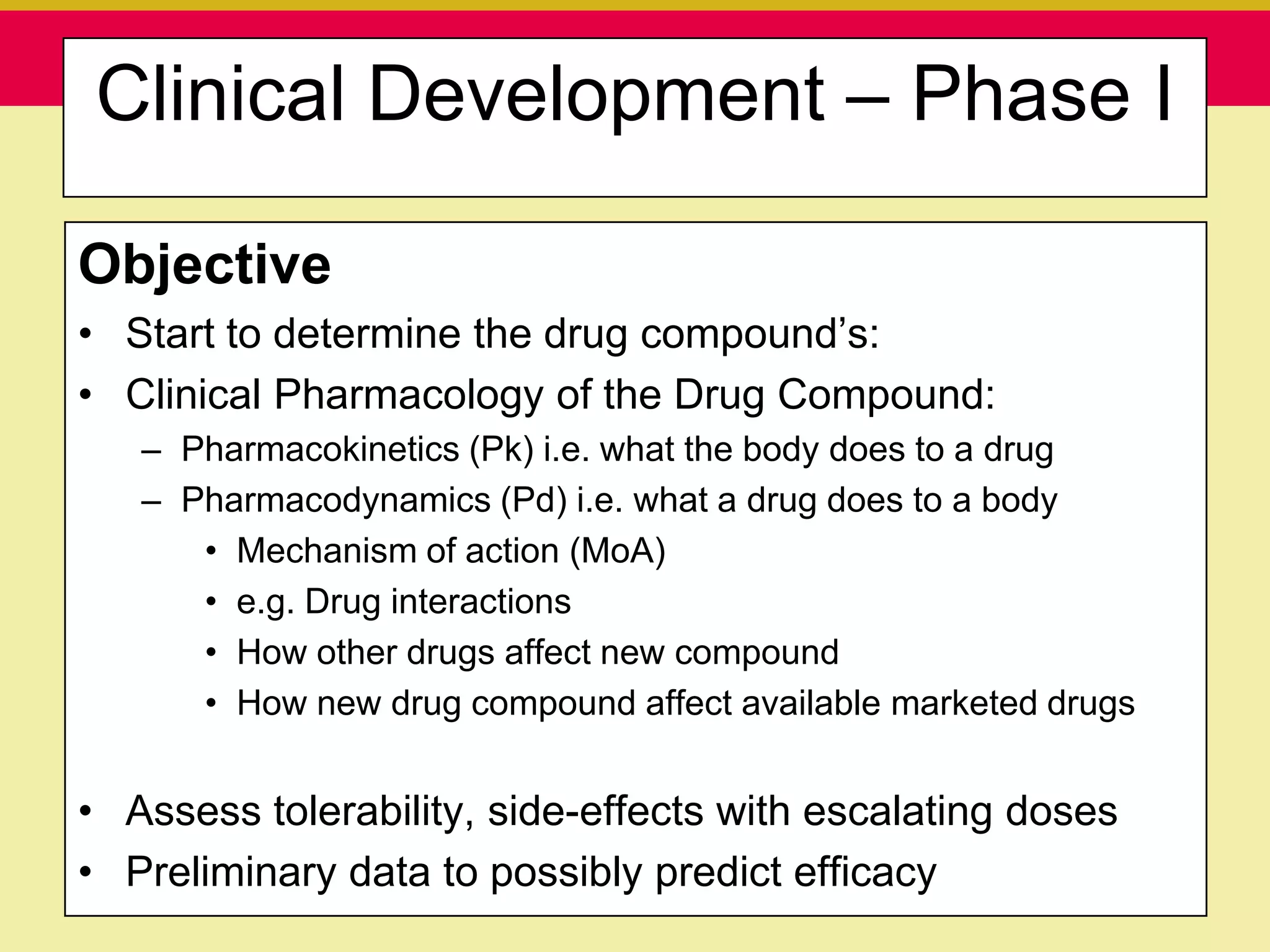
Clinical Development – Phase I

Objective
• Start to determine the drug compound‟s:
• Clinical Pharmacology of the Drug Compound:
   – Pharmacokinetics (Pk) i.e. what the body does to a drug
   – Pharmacodynamics (Pd) i.e. what a drug does to a body
      • Mechanism of action (MoA)
      • e.g. Drug interactions
      • How other drugs affect new compound
      • How new drug compound affect available marketed drugs


• Assess tolerability, side-effects with escalating doses
• Preliminary data to possibly predict efficacy
    Presentation to ABC Pharma                1/19/2010
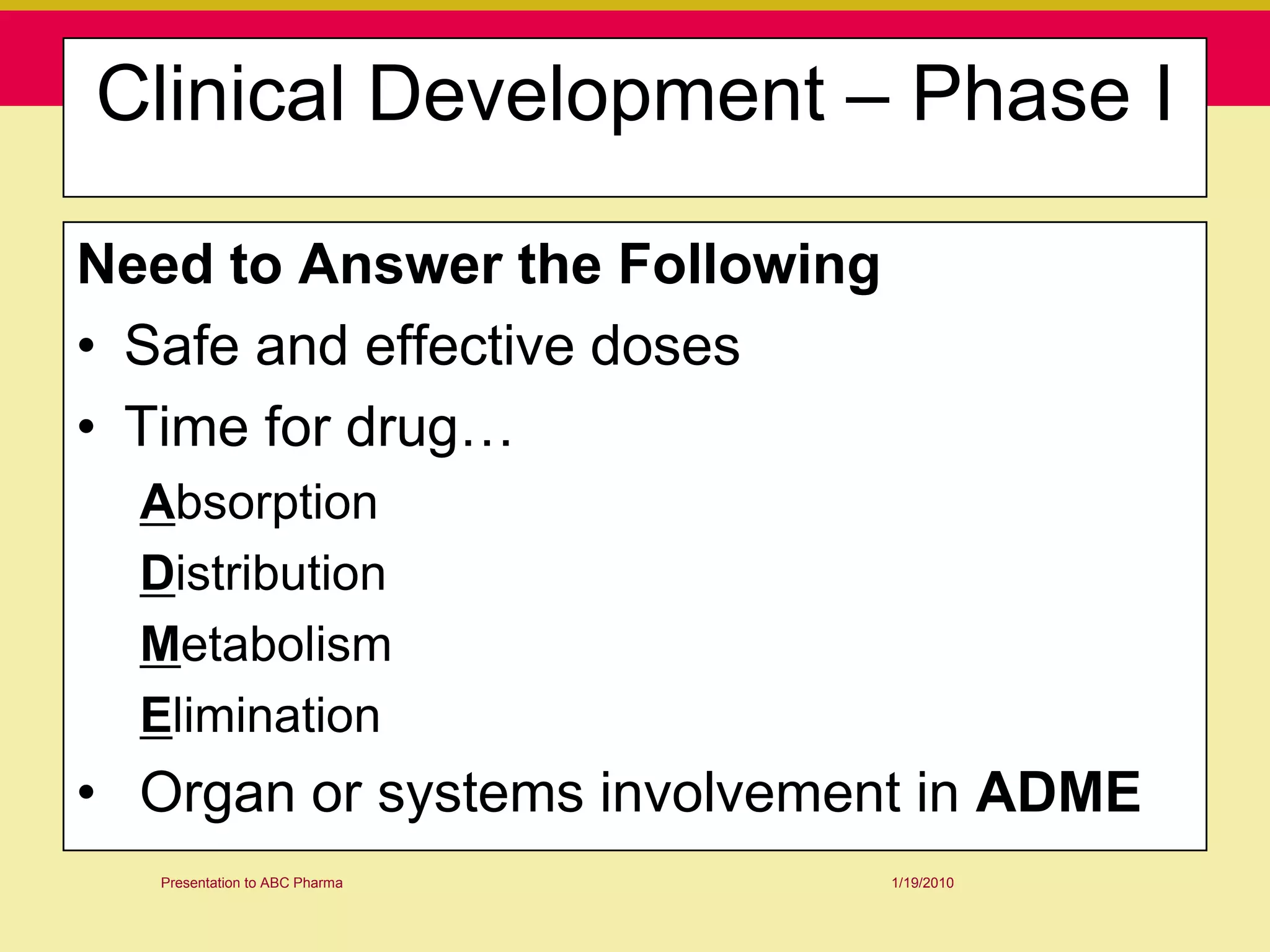
Clinical Development – Phase I

Need to Answer the Following
• Safe and effective doses
• Time for drug…
  Absorption
  Distribution
  Metabolism
  Elimination
• Organ or systems involvement in ADME
   Presentation to ABC Pharma   1/19/2010
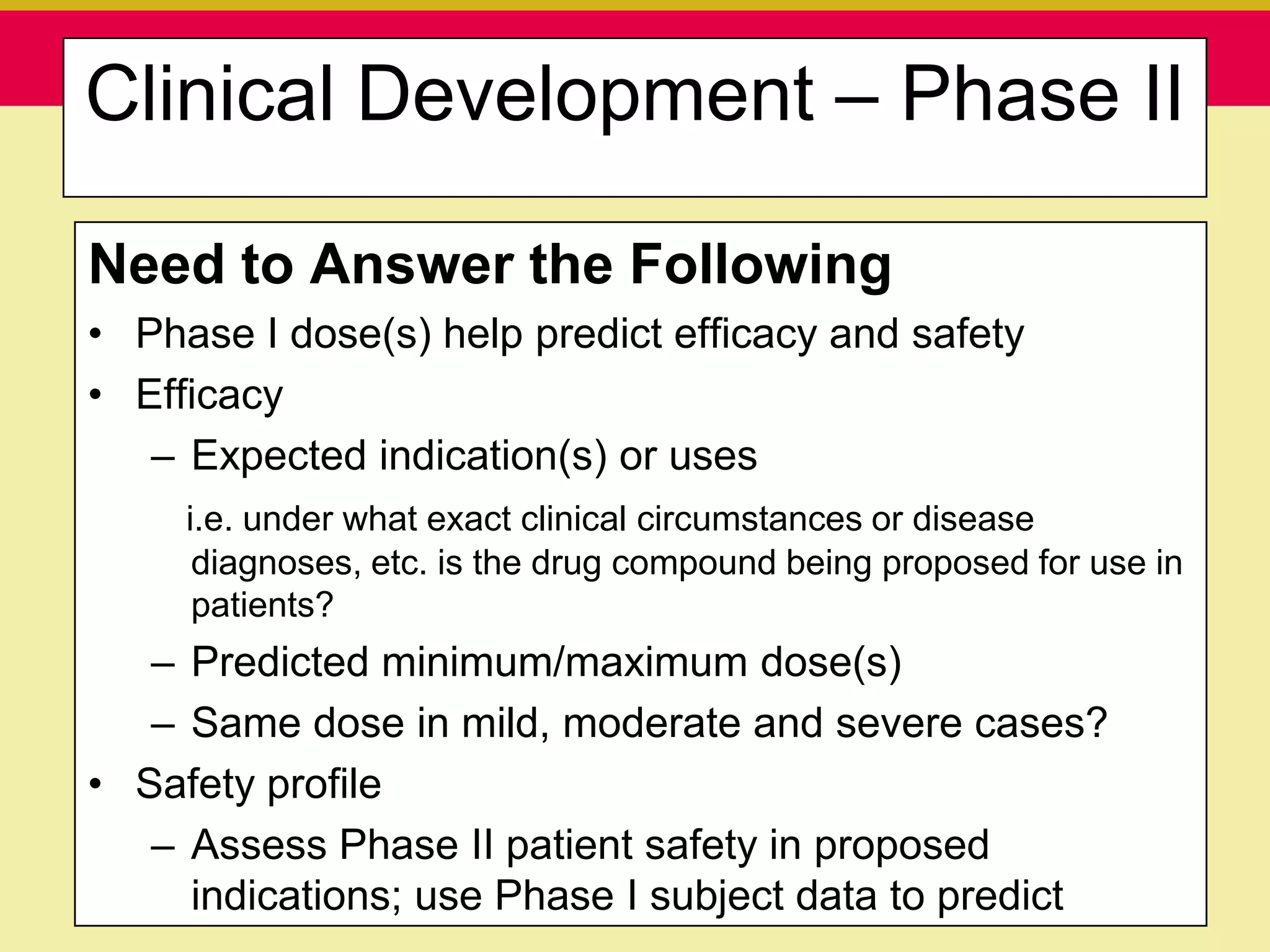
Clinical Development – Phase II

Need to Answer the Following
• Phase I dose(s) help predict efficacy and safety
• Efficacy
   – Expected indication(s) or uses
      i.e. under what exact clinical circumstances or disease
       diagnoses, etc. is the drug compound being proposed for use in
       patients?
   – Predicted minimum/maximum dose(s)
   – Same dose in mild, moderate and severe cases?
• Safety profile
   – Assess Phase II patient safety in proposed
   Presentation to ABC Pharma                     1/19/2010
     indications; use Phase I subject data to predict
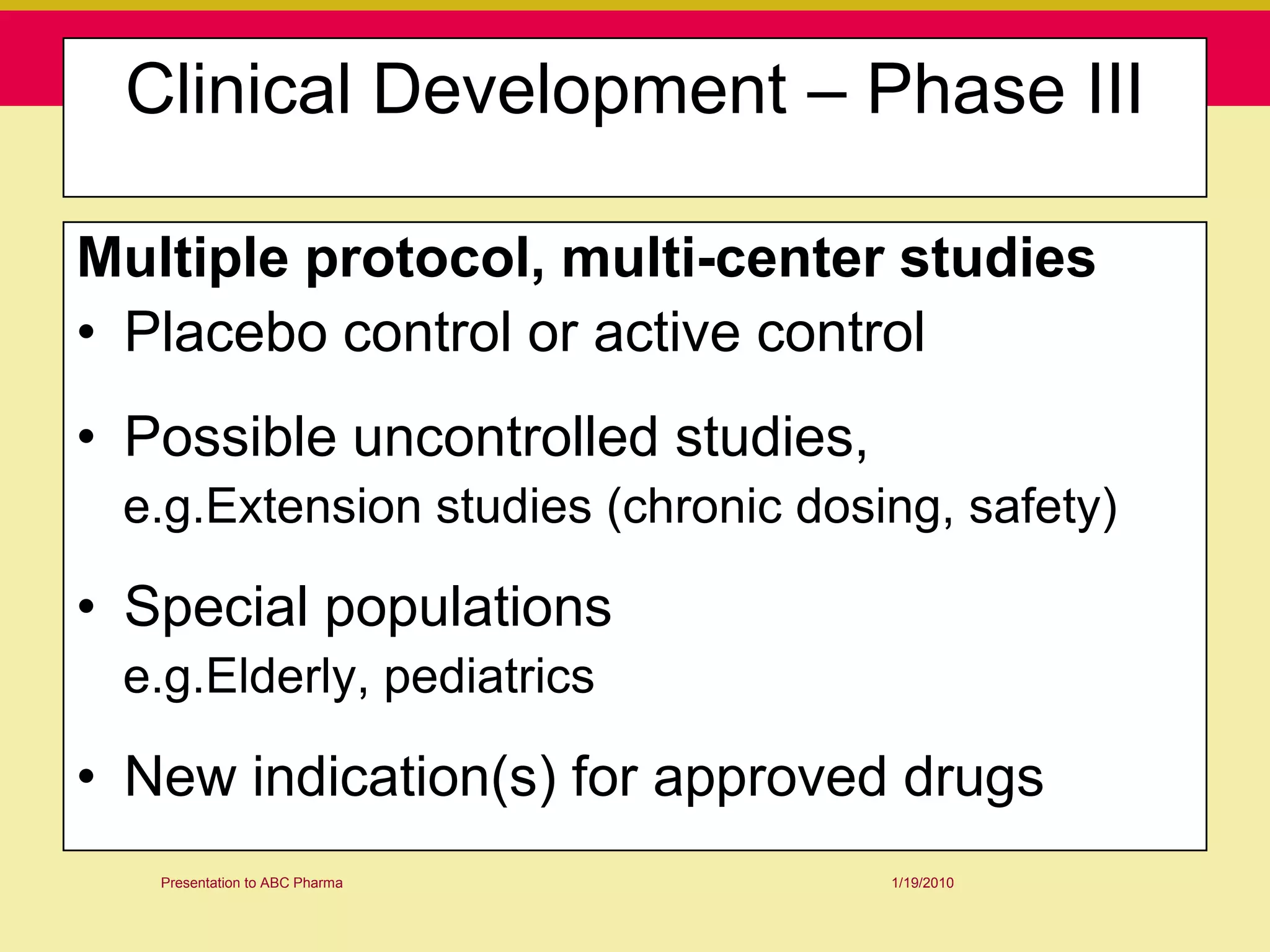
Clinical Development – Phase III

Multiple protocol, multi-center studies
• Placebo control or active control
• Possible uncontrolled studies,
 e.g.Extension studies (chronic dosing, safety)

• Special populations
 e.g.Elderly, pediatrics

• New indication(s) for approved drugs
   Presentation to ABC Pharma       1/19/2010
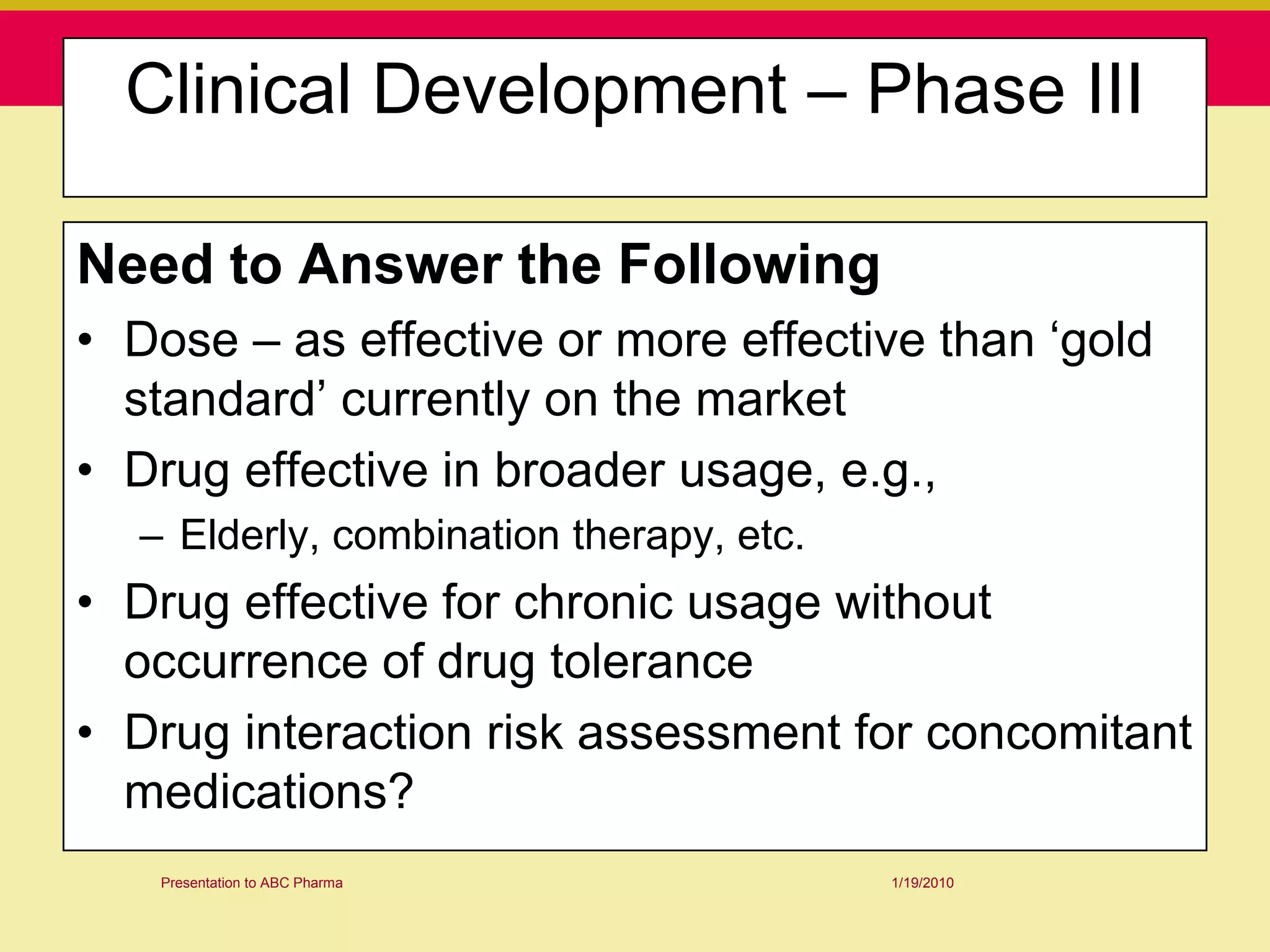
Clinical Development – Phase III

Need to Answer the Following
• Dose – as effective or more effective than „gold
  standard‟ currently on the market
• Drug effective in broader usage, e.g.,
  – Elderly, combination therapy, etc.
• Drug effective for chronic usage without
  occurrence of drug tolerance
• Drug interaction risk assessment for concomitant
  medications?
   Presentation to ABC Pharma            1/19/2010
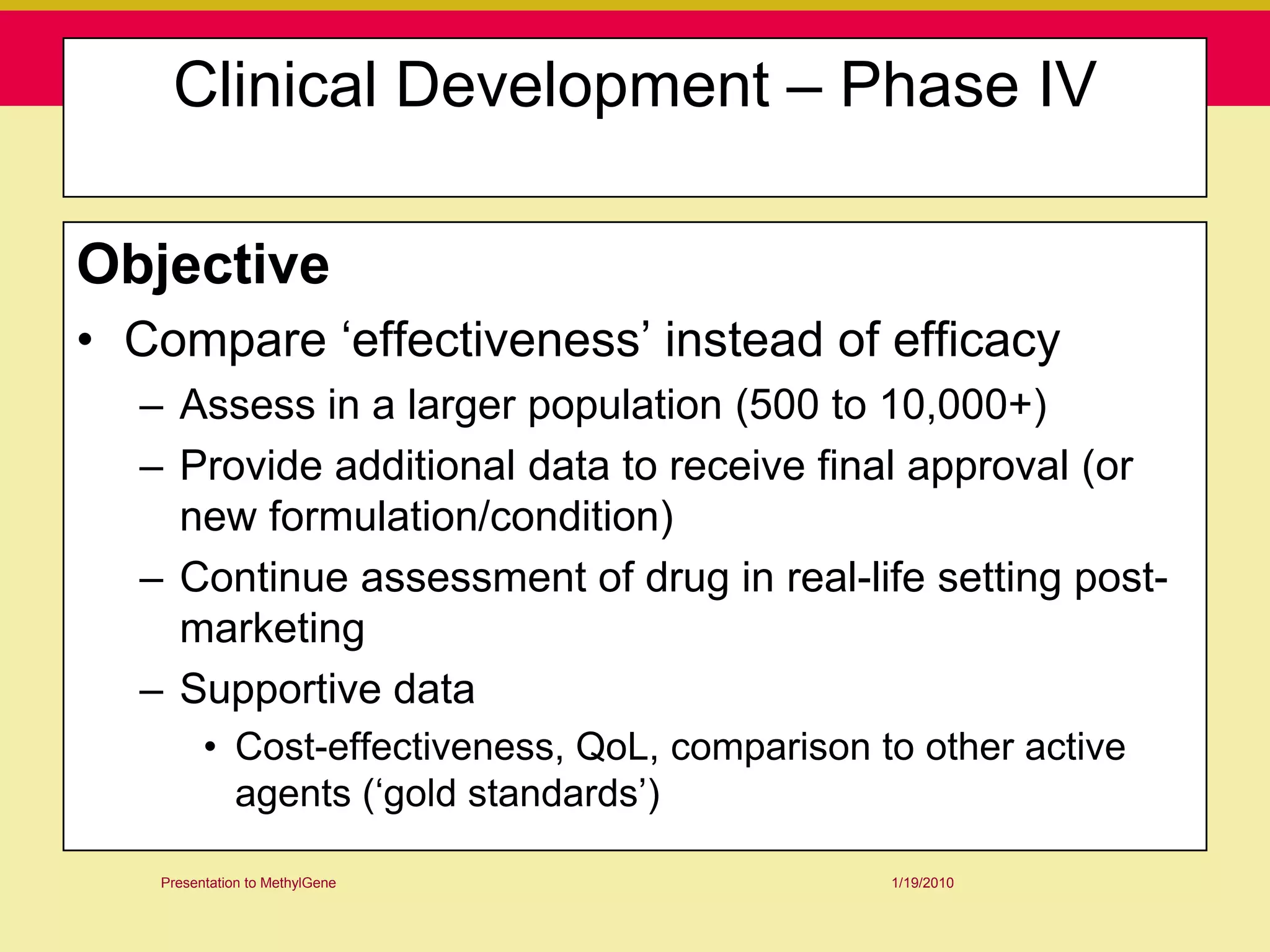
Clinical Development – Phase IV

Objective
• Compare „effectiveness‟ instead of efficacy
  – Assess in a larger population (500 to 10,000+)
  – Provide additional data to receive final approval (or
    new formulation/condition)
  – Continue assessment of drug in real-life setting post-
    marketing
  – Supportive data
         • Cost-effectiveness, QoL, comparison to other active
           agents („gold standards‟)

   Presentation to MethylGene                   1/19/2010
Good Clinical Practice


                  1/19/2010
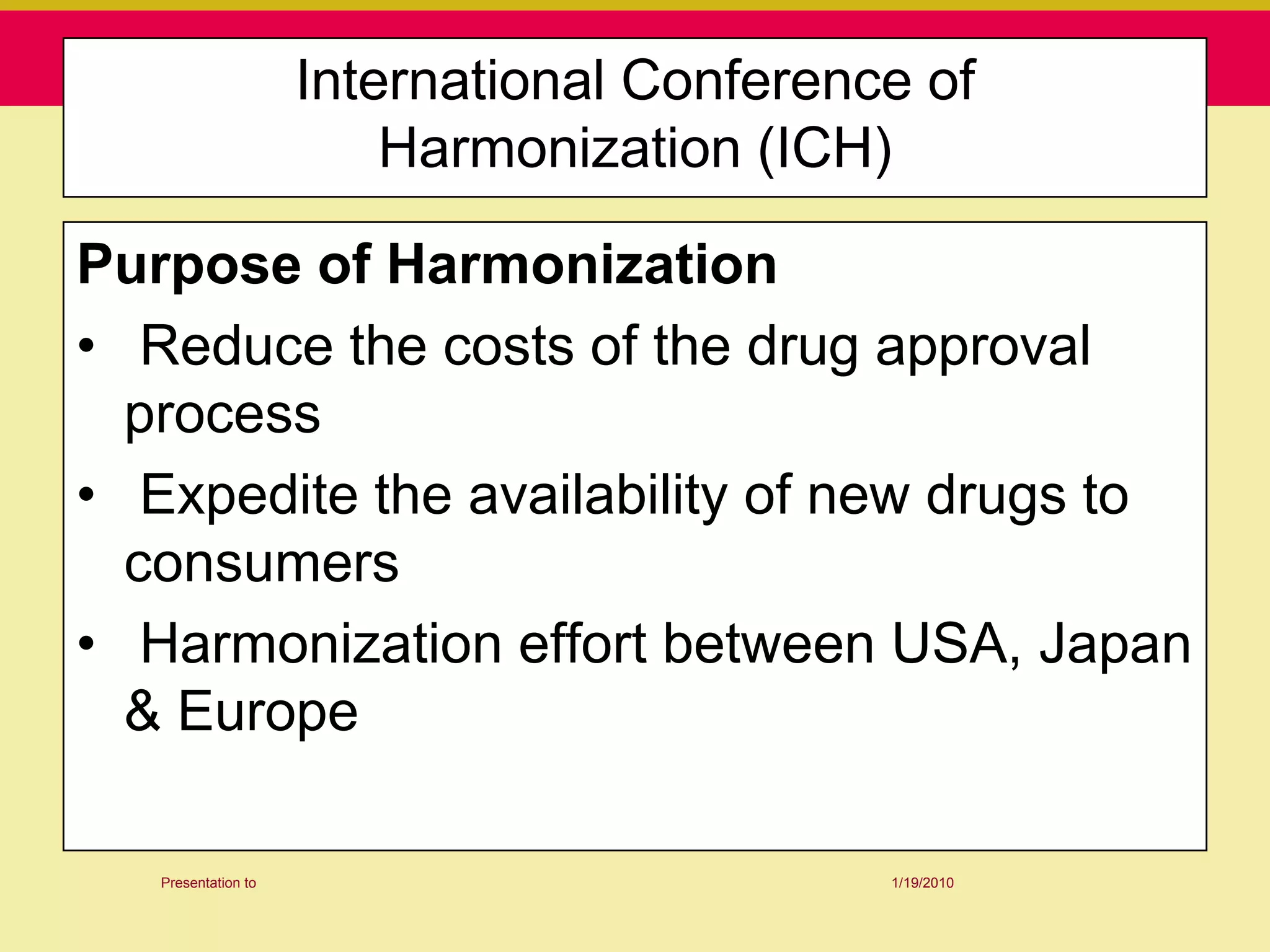
International Conference of
                         Harmonization (ICH)

Purpose of Harmonization
• Reduce the costs of the drug approval
  process
• Expedite the availability of new drugs to
  consumers
• Harmonization effort between USA, Japan
  & Europe

   Presentation to                          1/19/2010
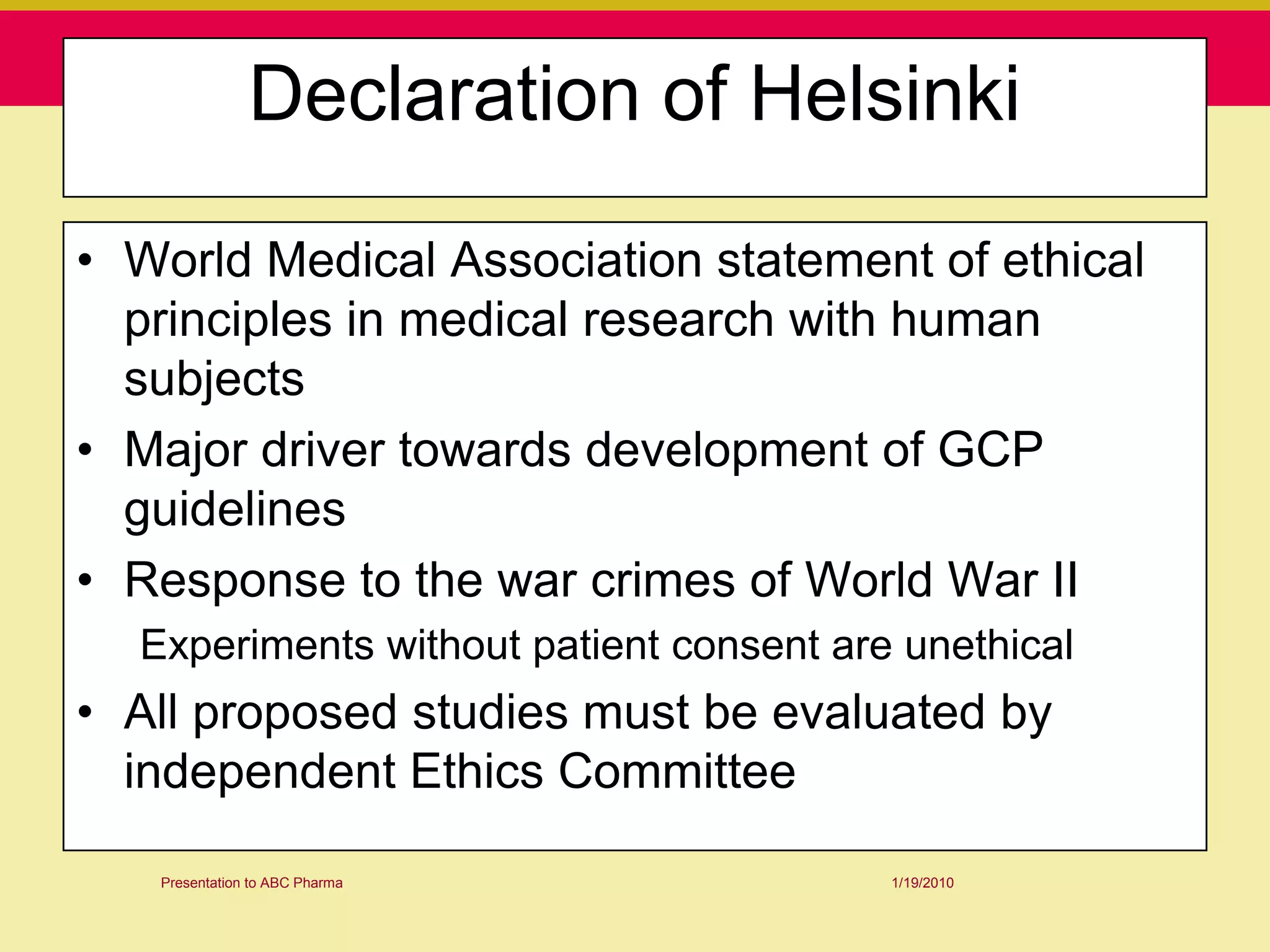
Declaration of Helsinki

• World Medical Association statement of ethical
  principles in medical research with human
  subjects
• Major driver towards development of GCP
  guidelines
• Response to the war crimes of World War II
  Experiments without patient consent are unethical
• All proposed studies must be evaluated by
  independent Ethics Committee

   Presentation to ABC Pharma            1/19/2010
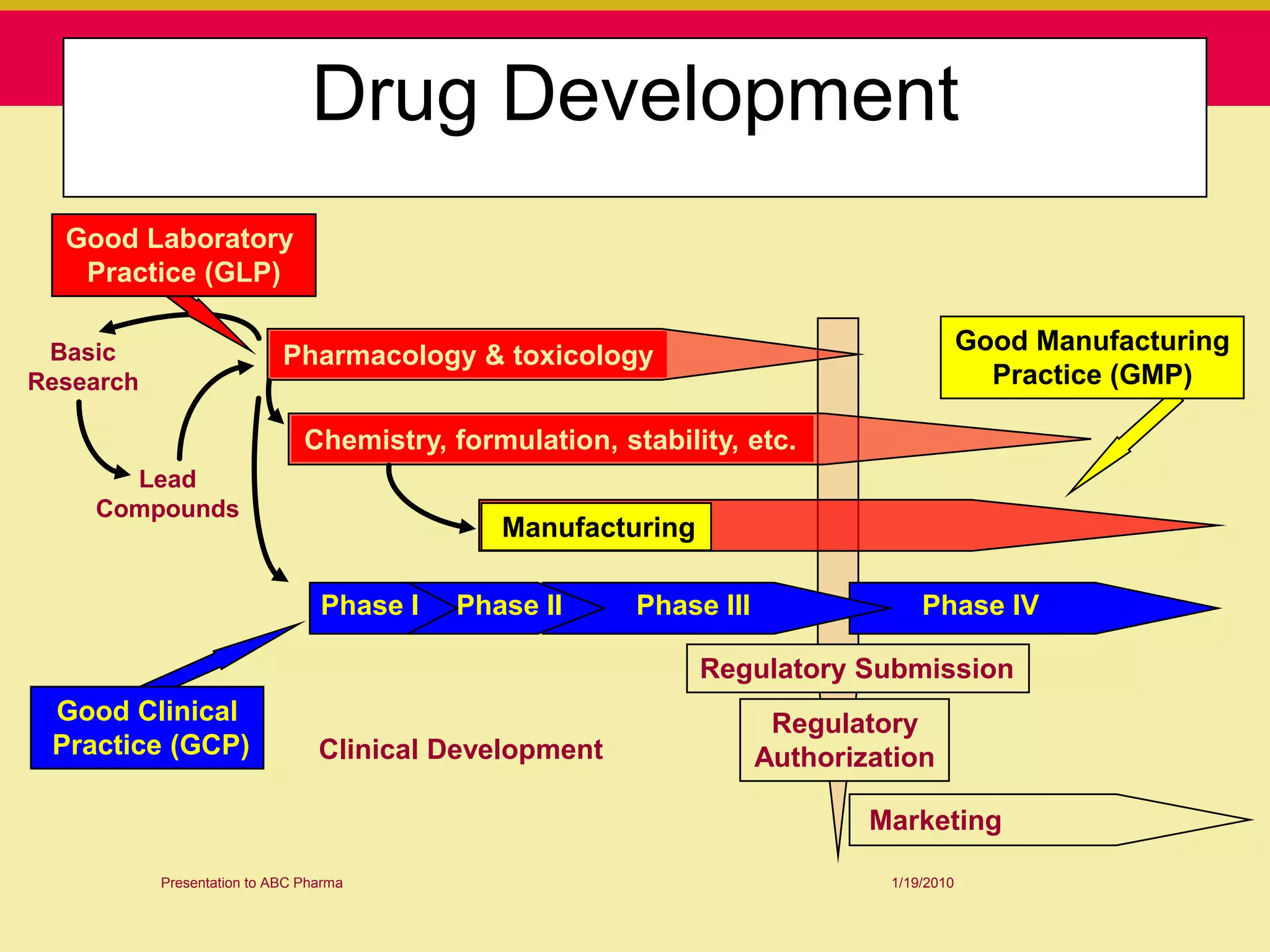
Drug Development
  Good Laboratory
   Practice (GLP)

 Basic                                                                                    Good Manufacturing
                            Pharmacology & toxicology
Research                                                                                    Practice (GMP)

                               Chemistry, formulation, stability, etc.
      Lead
    Compounds
                                              Manufacturing

                                 Phase I   Phase II      Phase III                Phase IV

                                                              Regulatory Submission
 Good Clinical                                                        Regulatory
 Practice (GCP)                  Clinical Development                Authorization

                                                                             Marketing

           Presentation to ABC Pharma                                         1/19/2010
Good Clinical Practice

What are GCP Guidelines?
• International systematic approach
• Ensuring the scientific quality and ethical
  standard
  – Designing, conducting, recording and
    reporting of studies involving human subjects


   Presentation to ABC Pharma       1/19/2010
GCP Principles

• Compliance with the GCP Guidelines
  standards
  – Study subject rights are protected
  – Data/reported results are credible, accurate


  Presentation to ABC Pharma                1/19/2010
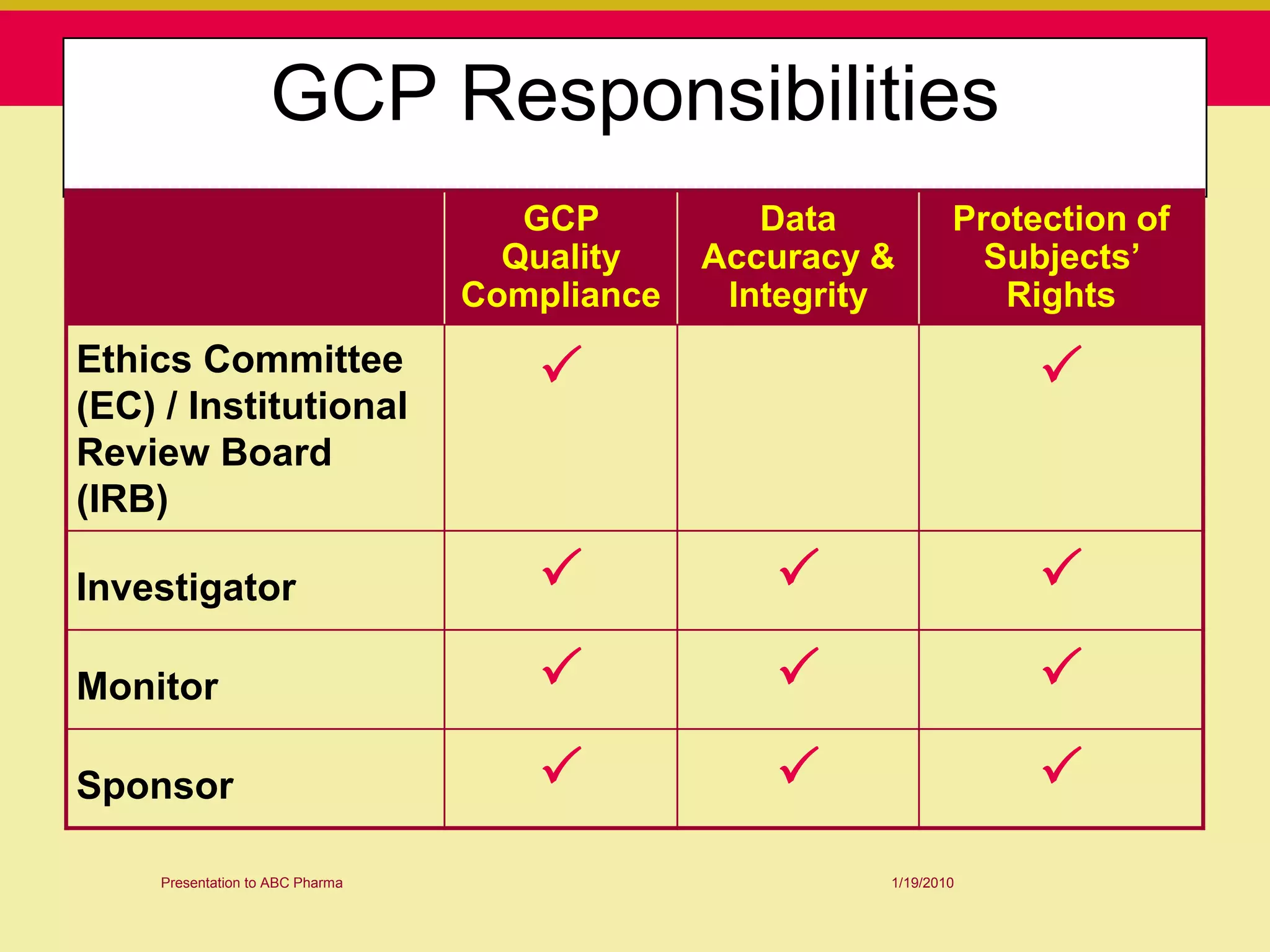
GCP Responsibilities
                                     GCP          Data          Protection of
                                    Quality    Accuracy &         Subjects’
                                  Compliance    Integrity          Rights
Ethics Committee                                                    
(EC) / Institutional
Review Board
(IRB)

Investigator                                                       
Monitor                                                            
Sponsor                                                            
     Presentation to ABC Pharma                         1/19/2010
Investigator Responsibilities

•   Patient informed consent
•   Site approvals
•   Drug administration and accountability
•   Relevant data
•   AE reporting


     Presentation to ABC Pharma   1/19/2010
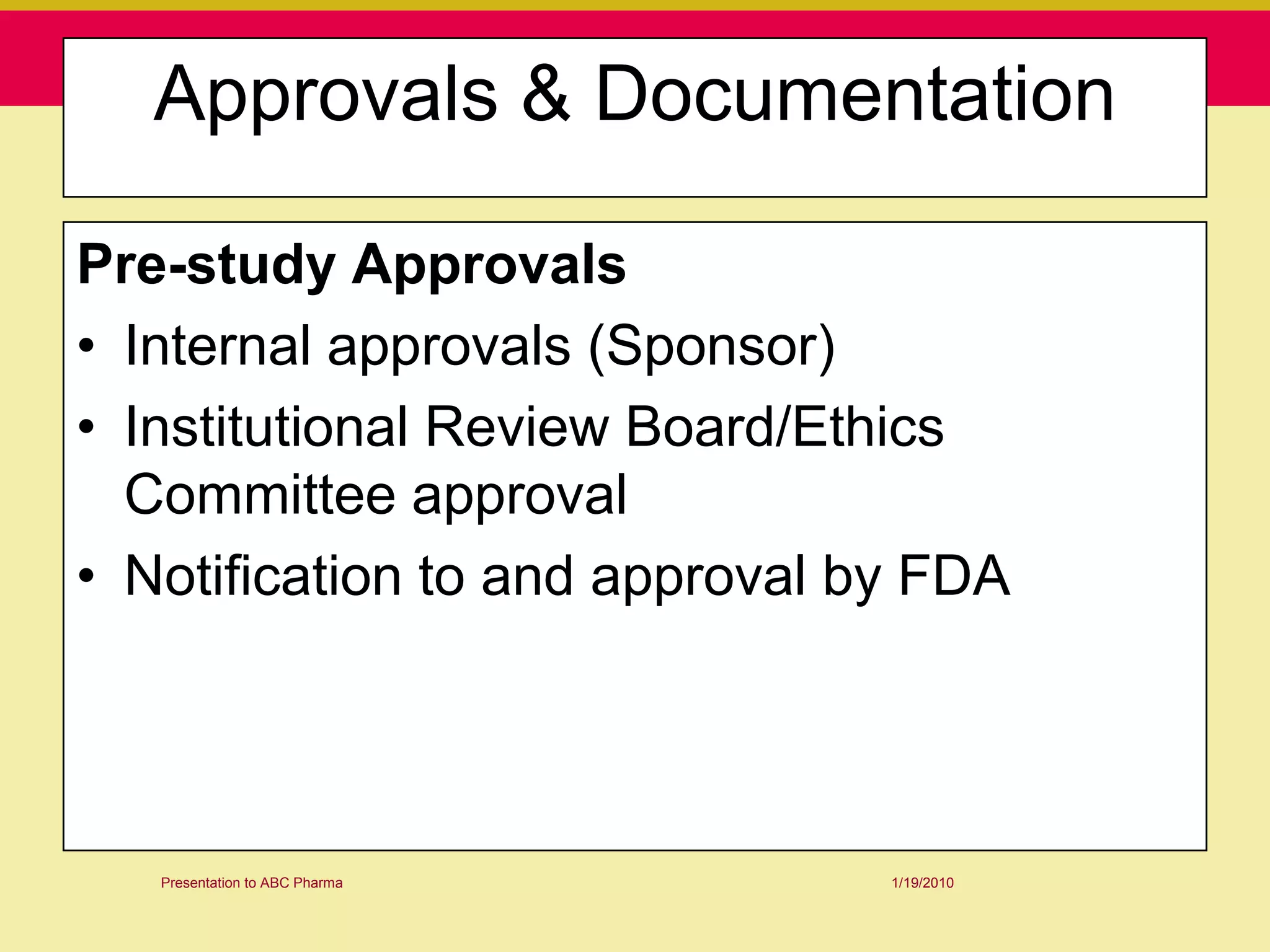
Approvals & Documentation

Pre-study Approvals
• Internal approvals (Sponsor)
• Institutional Review Board/Ethics
  Committee approval
• Notification to and approval by FDA


   Presentation to ABC Pharma   1/19/2010
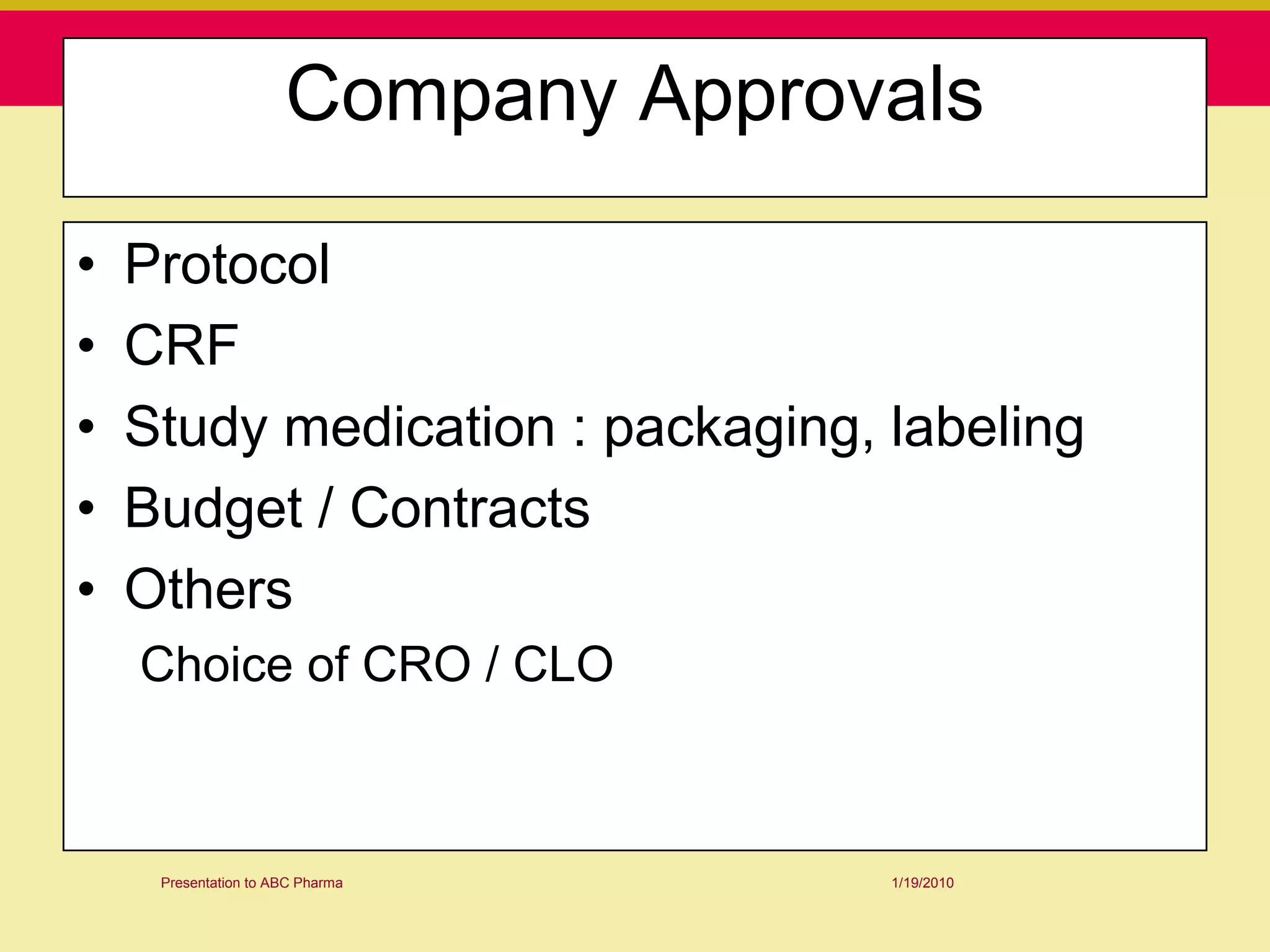
Company Approvals

•   Protocol
•   CRF
•   Study medication : packaging, labeling
•   Budget / Contracts
•   Others
    Choice of CRO / CLO


     Presentation to ABC Pharma     1/19/2010
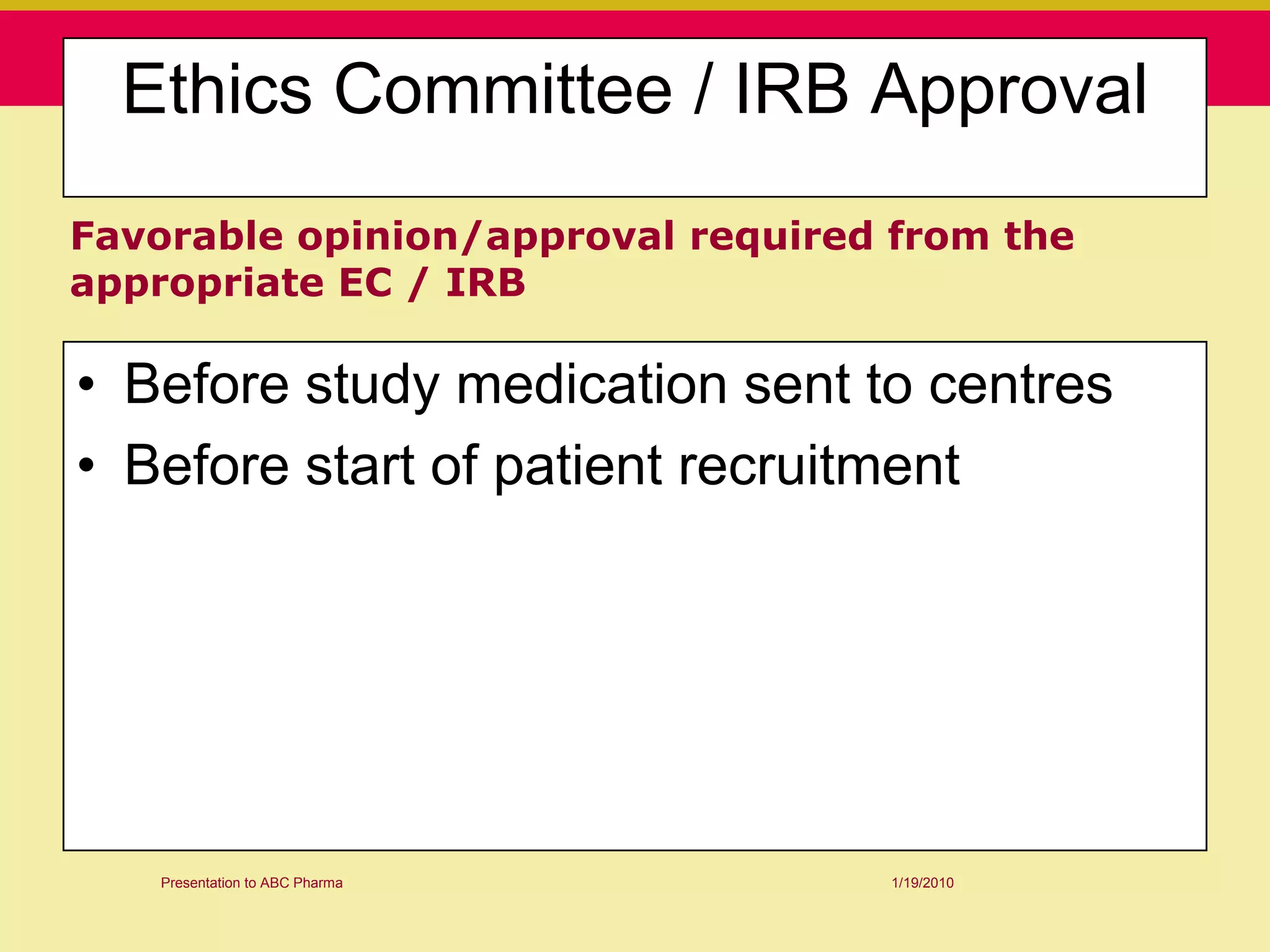
Ethics Committee / IRB Approval
Favorable opinion/approval required from the
appropriate EC / IRB

• Before study medication sent to centres
• Before start of patient recruitment


   Presentation to ABC Pharma      1/19/2010
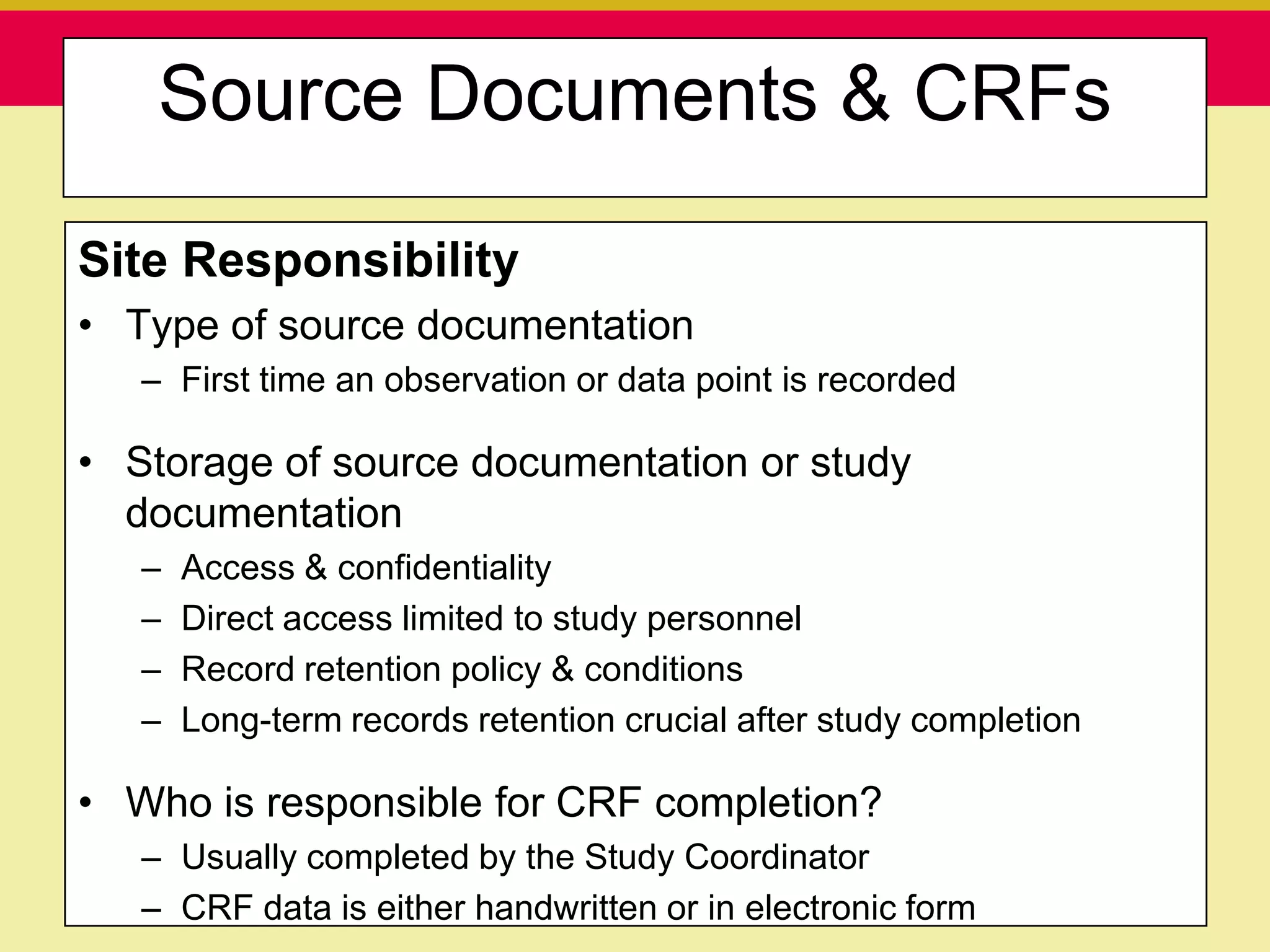
Source Documents & CRFs

Site Responsibility
• Type of source documentation
   – First time an observation or data point is recorded

• Storage of source documentation or study
  documentation
   –   Access & confidentiality
   –   Direct access limited to study personnel
   –   Record retention policy & conditions
   –   Long-term records retention crucial after study completion

• Who is responsible for CRF completion?
   – Usually completed by the Study Coordinator
    Presentation to ABC Pharma                      1/19/2010

   – CRF data is either handwritten or in electronic form
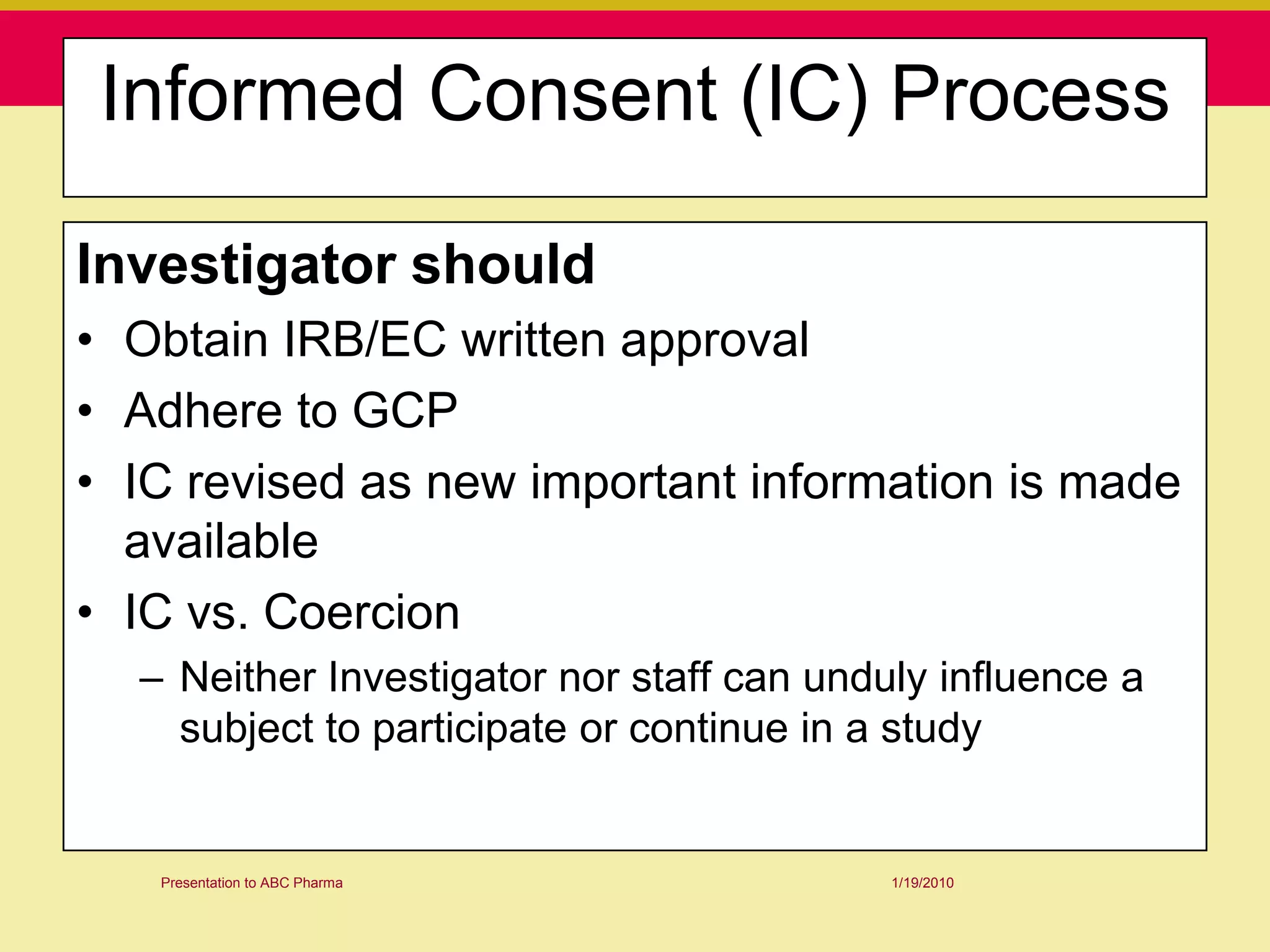
Informed Consent (IC) Process

Investigator should
• Obtain IRB/EC written approval
• Adhere to GCP
• IC revised as new important information is made
  available
• IC vs. Coercion
  – Neither Investigator nor staff can unduly influence a
    subject to participate or continue in a study


   Presentation to ABC Pharma              1/19/2010
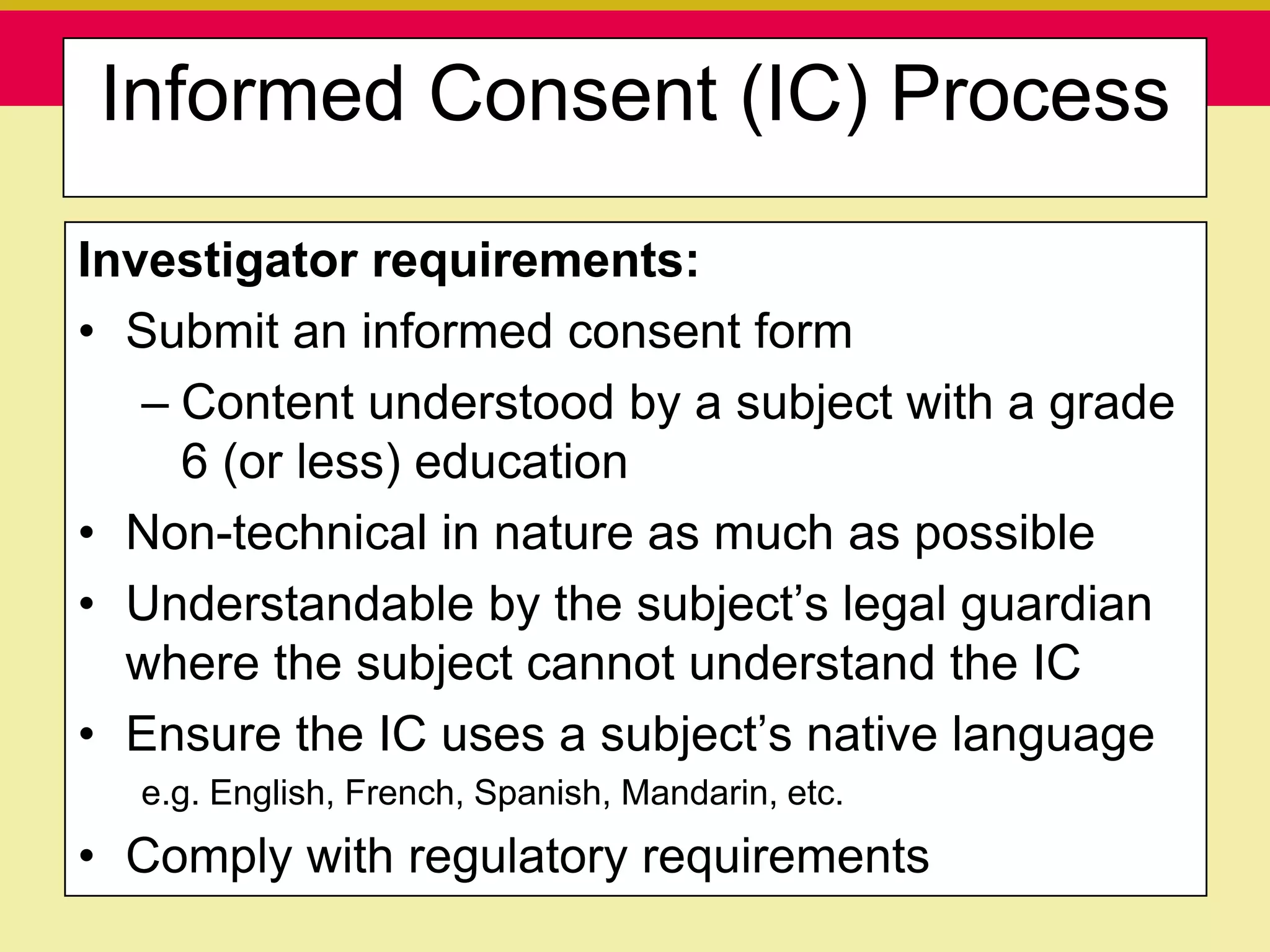
Informed Consent (IC) Process

Investigator requirements:
• Submit an informed consent form
   – Content understood by a subject with a grade
     6 (or less) education
• Non-technical in nature as much as possible
• Understandable by the subject‟s legal guardian
  where the subject cannot understand the IC
• Ensure the IC uses a subject‟s native language
  e.g. English, French, Spanish, Mandarin, etc.
• Comply with regulatory requirements
   Presentation to ABC Pharma                     1/19/2010
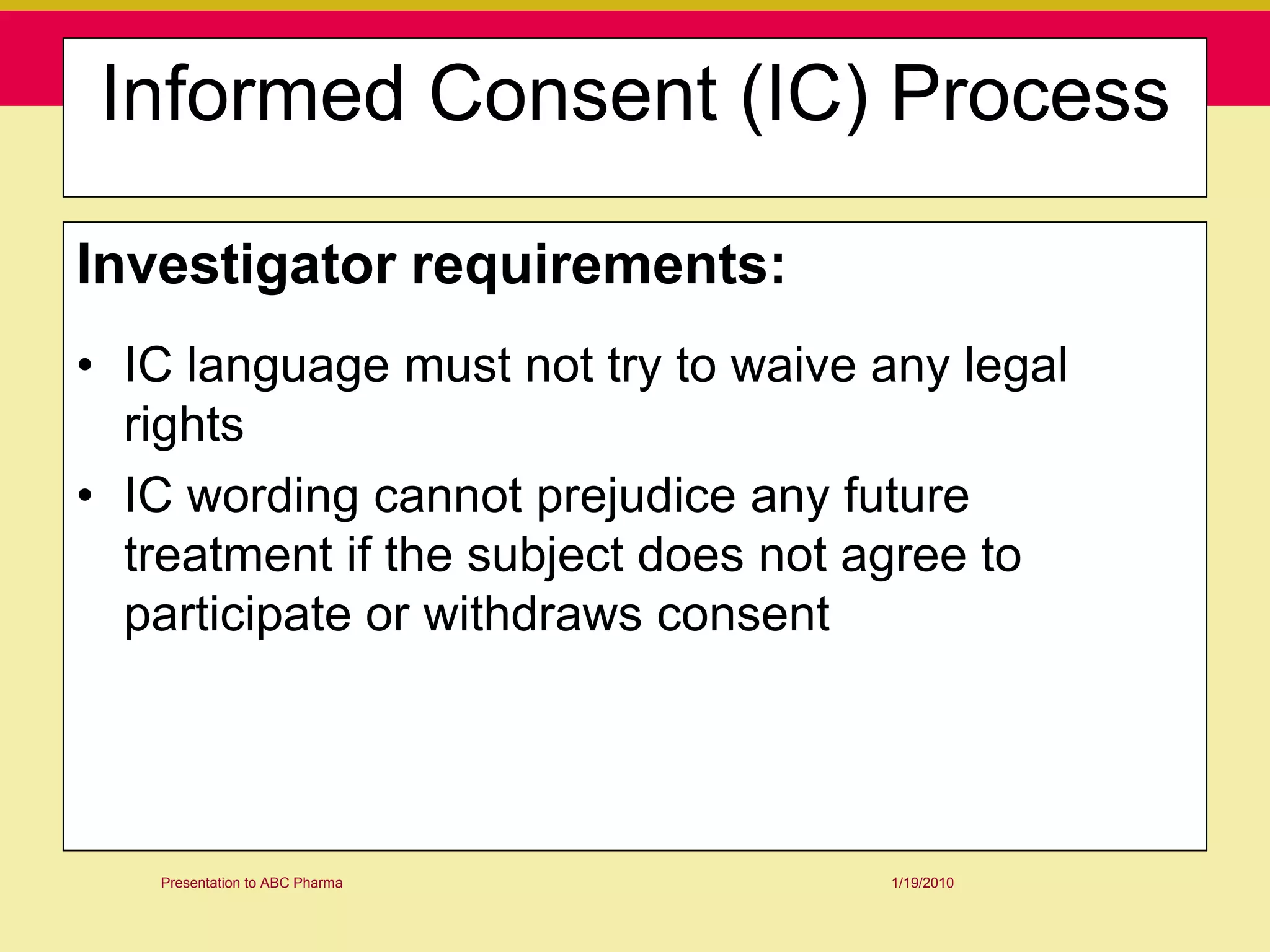
Informed Consent (IC) Process

Investigator requirements:
• IC language must not try to waive any legal
  rights
• IC wording cannot prejudice any future
  treatment if the subject does not agree to
  participate or withdraws consent


   Presentation to ABC Pharma       1/19/2010
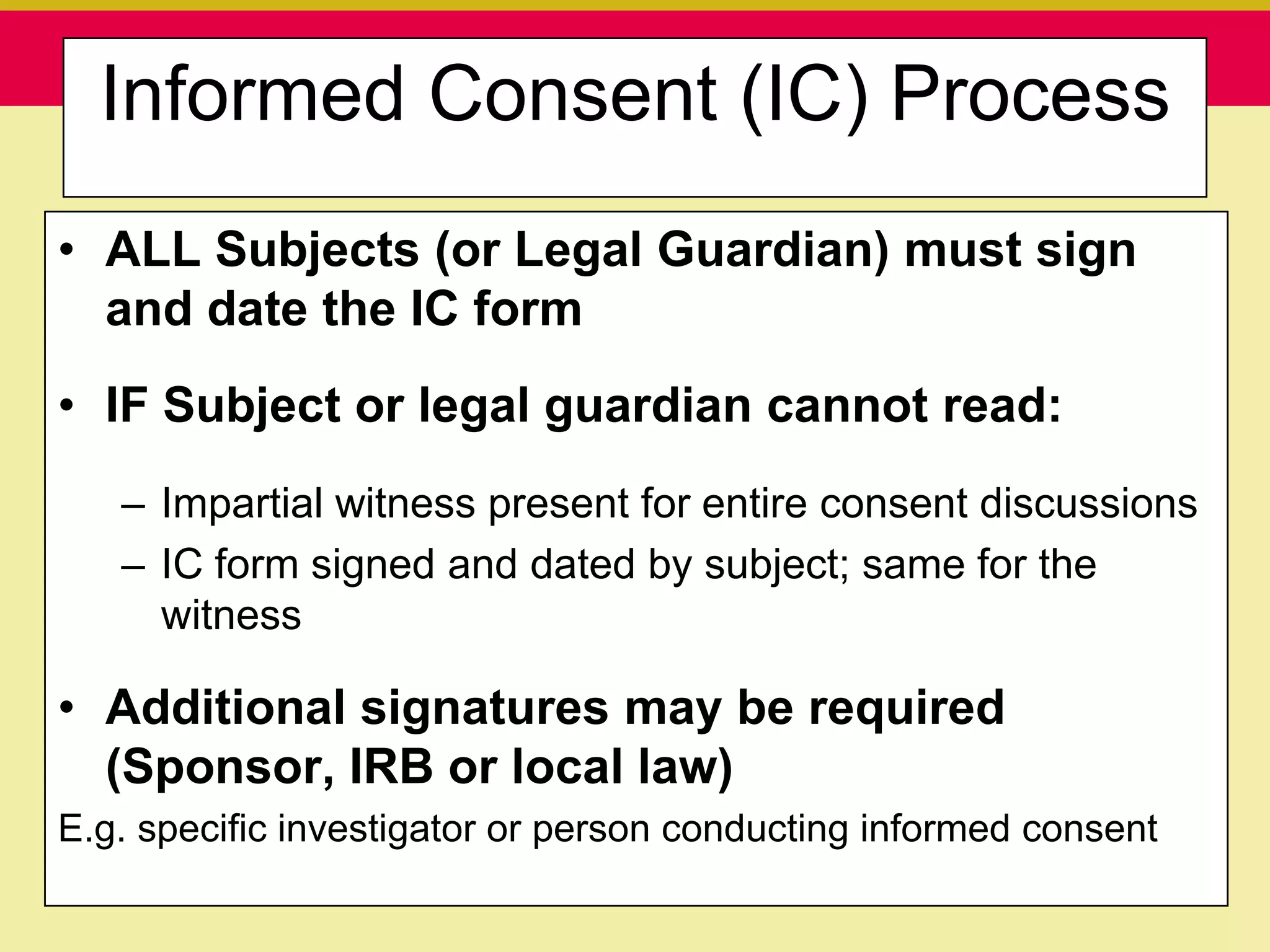
Informed Consent (IC) Process
• ALL Subjects (or Legal Guardian) must sign
  and date the IC form
• IF Subject or legal guardian cannot read:
   – Impartial witness present for entire consent discussions
   – IC form signed and dated by subject; same for the
     witness

• Additional signatures may be required
  (Sponsor, IRB or local law)
E.g. specific investigator or person conducting informed consent
      Presentation to ABC Pharma                1/19/2010
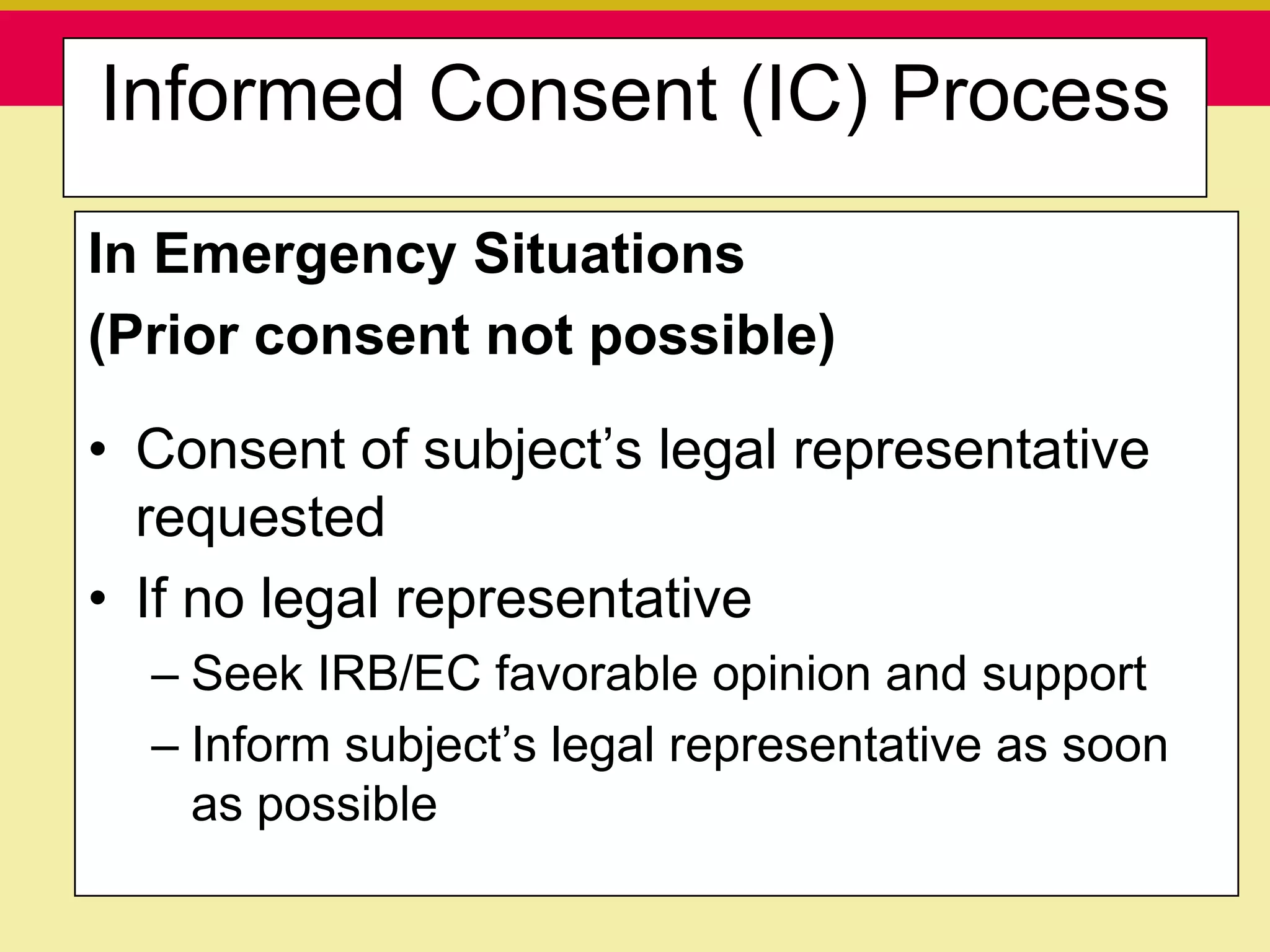
Informed Consent (IC) Process
In Emergency Situations
(Prior consent not possible)

• Consent of subject‟s legal representative
  requested
• If no legal representative
  – Seek IRB/EC favorable opinion and support
  – Inform subject‟s legal representative as soon
    as possible
  Presentation to ABC Pharma        1/19/2010
Informed Consent
                                  < Exercise >
• Role-play and interactive discussion at
  end of presentation
• To follow…


   Presentation to ABC Pharma                    1/19/2010
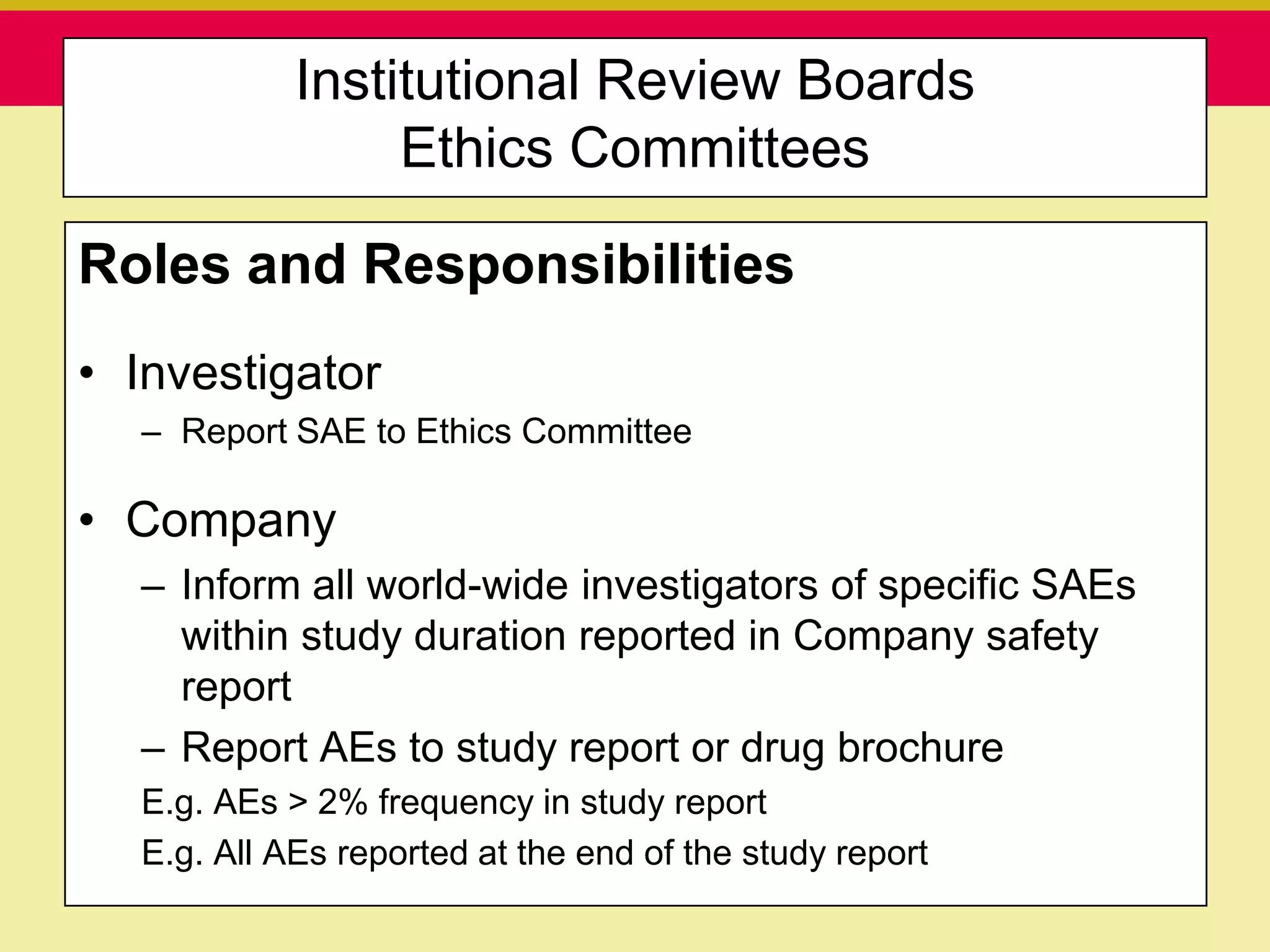
Institutional Review Boards
                           Ethics Committees

Roles and Responsibilities
• Investigator
  – Report SAE to Ethics Committee

• Company
  – Inform all world-wide investigators of specific SAEs
    within study duration reported in Company safety
    report
  – Report AEs to study report or drug brochure
  E.g. AEs > 2% frequency in study report
  E.g. All AEs reported at the end of the study report
   Presentation to ABC Pharma                      1/19/2010
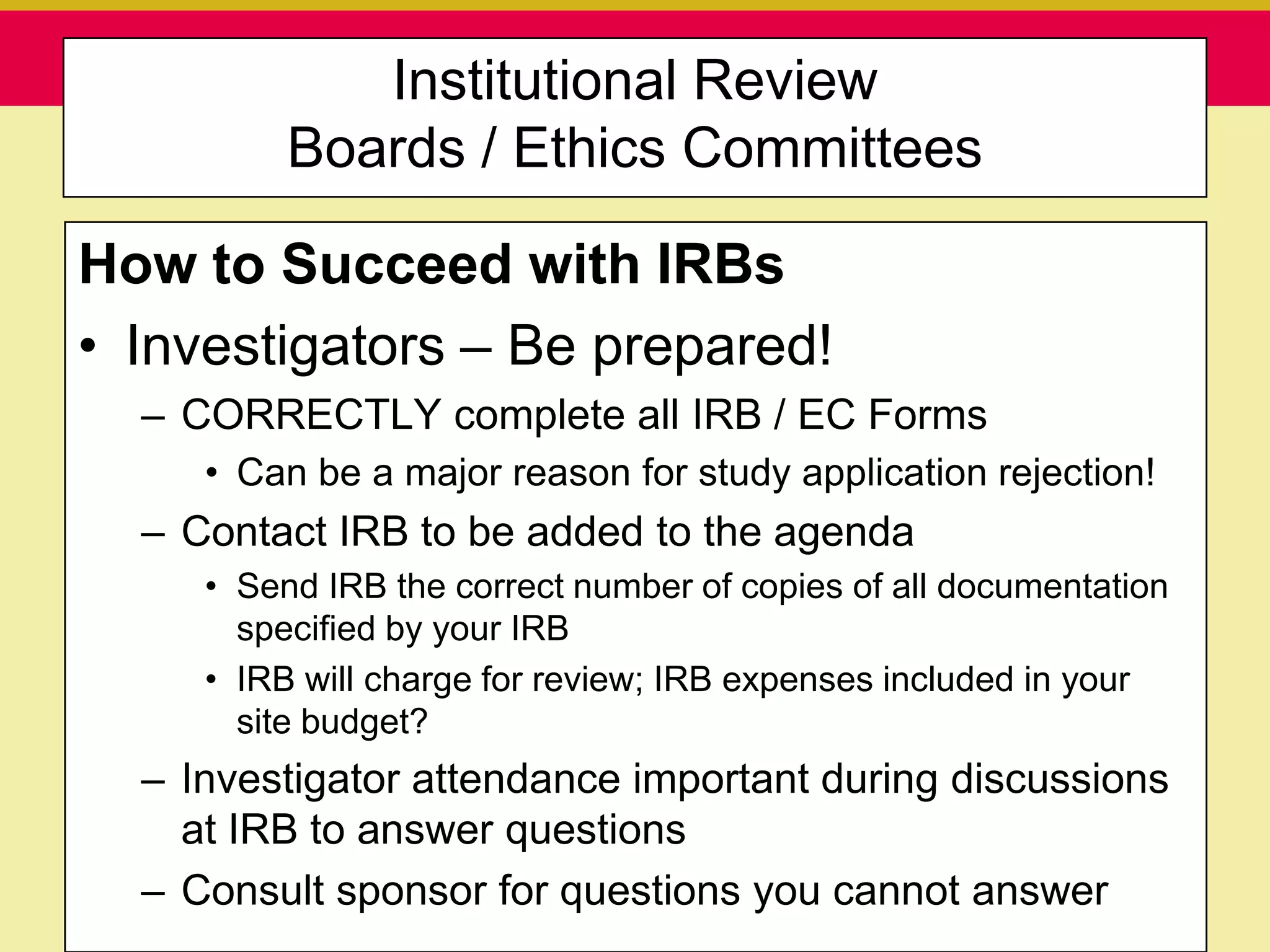
Institutional Review
                     Boards / Ethics Committees

How to Succeed with IRBs
• Investigators – Be prepared!
  – CORRECTLY complete all IRB / EC Forms
         • Can be a major reason for study application rejection!
  – Contact IRB to be added to the agenda
         • Send IRB the correct number of copies of all documentation
           specified by your IRB
         • IRB will charge for review; IRB expenses included in your
           site budget?
  – Investigator attendance important during discussions
    at IRB to answer questions
  – Consult sponsor for questions you cannot answer
   Presentation to ABC Pharma                      1/19/2010
Conclusion
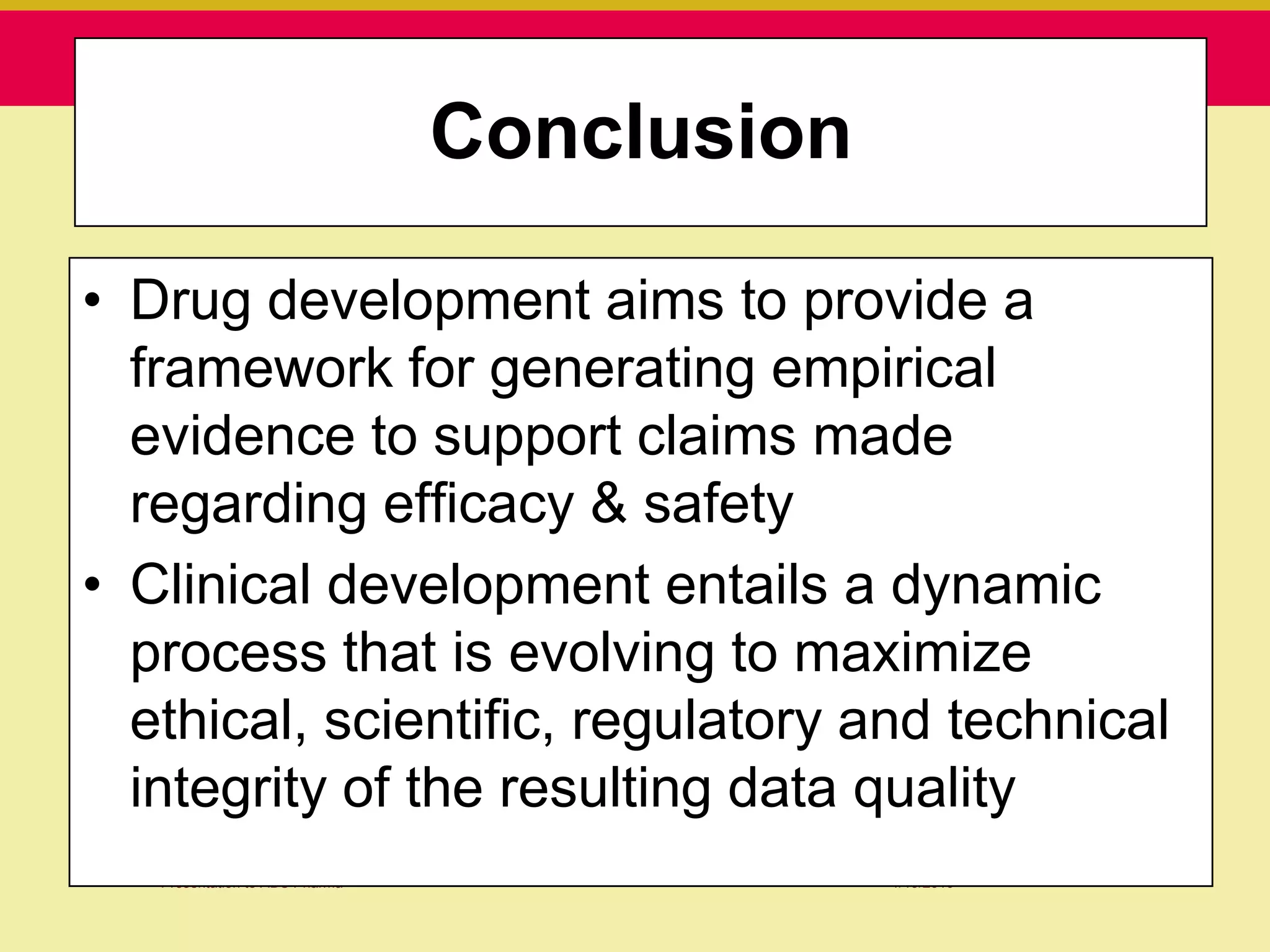
                                Conclusion

• Drug development aims to provide a
  framework for generating empirical
  evidence to support claims made
  regarding efficacy & safety
• Clinical development entails a dynamic
  process that is evolving to maximize
  ethical, scientific, regulatory and technical
  integrity of the resulting data quality
   Presentation to ABC Pharma                1/19/2010

R&D and Good Clinical Practice (GCP) 011910

  • 1.
    R&D & GoodClinical Practice Myron Pyzyk, M.S. Marenon Health Group January, 2010 1/19/2010
  • 2.
    Agenda • Introduction • LearningObjectives • Evolution of Good Clinical Practice Guidelines (GCP) – History of GCP and current standards – Stakeholders in GCP – Understanding GCP issues within Clinical Trial Process • Identification of current regulatory and ethical issues in clinical research – Current regulatory and ethical issues in clinical research – Applications of the regulations to practice Presentation to 1/19/2010
  • 3.
    Agenda • The ClinicalTrial Process – Roles involved in the Clinical Trial Process – Ensuring adequate source documentation – Informed consent process; including a role-play and interactive discussion – Succeeding with IRBs – „How-to‟ guide to adequate source documentation • Defining the major steps and phases of the drug development process Presentation to 1/19/2010
  • 4.
    Learning Objectives • Reviewof Good Clinical Practice Guidelines • Understand the overall impact of GCP on the clinical trial process including the respective roles and responsibilities of the Investigator and the Sponsor • Understand the impact of GCP on overall study quality (e.g., source documentation, informed consent, IRB, etc.) • Review the overall drug development process Presentation to 1/19/2010
  • 5.
  • 6.
    Drugs Development Overview Research Development Screening Synthesis $500M - $1B USD Preclinical Testing Invested !! Acute Toxicology Chronic Toxicology Pharmacology Clinical Testing Phase I Phase II Phase IIIa Phase IIIb Phase IV Patent STOP Patent START Development Time 0… 1 2 3 4 5 6 7 8 9 10 11 12 13 14 15 …20 (years) Presentation to ABC Pharma 1/19/2010
  • 7.
    Developing New Drugs •Potential “blockbuster” e.g. first effective therapy for a common and/or chronic disease and/or life-saving treatment • Market size is LARGE – Broad patient population – Multiple therapeutic indications • Several products across several companies • Similar products on the market or in development • Drug poor fit in manufacturer product portfolio – License or sell to another company sponsor Presentation to ABC Pharma 1/19/2010
  • 8.
    Pre-Clinical Drug Discovery •Screening (Medicinal Chemistry) – Pharmacological and biological screening models – Computer modeling – Serendipity (Luck counts or “Do you feel lucky?”) • Synthesize – Compounds that fit the biological target (e.g., receptor) • ~ 1 out of 100,000 may reach market • Screening – Assess likelihood of safety and efficacy in humans using in vitro and in vivo testing Presentation to ABC Pharma 1/19/2010
  • 9.
    Pre-clinical Objectives • Safetyof drug • Effective dose range – Organ(s) or organ system affected – Drug absorbed, distributed, metabolized and excreted („ADME‟) • Cx – drug assessed as a potential carcinogen • Drug assessed for potential for producing: – birth defects – affects on fertility Presentation to ABC Pharma 1/19/2010
  • 10.
    Development Benefit – Risk Assessment If… • Drug has what appears to be acceptable levels of safety and effectiveness in appropriate models And… • Potential market(s) exists for the drug Then… • Further development balances business and scientific merits Presentation to ABC Pharma 1/19/2010
  • 11.
    Development Plan • Indication(s) •Preclinical testing – Genotoxicity, mutagenicity, reproduction studies, – Sub-chronic, chronic • Clinical studies • Marketing research data / Sales projection • Manufacturing issues – Scale-up, cost of goods • Regulatory issues Presentation to ABC Pharma 1/19/2010
  • 12.
    IND / CTA InvestigationalNew Drug Application (IND; USA) Clinical Trial Application (CTA; EU, Canada) • Filed with regulatory authorities by the Sponsor – Intends to conduct clinical studies using the investigational drug – Investigational drug refers to a new drug or biological used in a clinical investigation OR a marketed drug that is not licensed for usage in the proposed indication • Approval/no objection of the CTA or IND allows the investigational drug to be sent to sites for clinical investigations Presentation to ABC Pharma 1/19/2010
  • 13.
    Drug Development –Regulatory • Regulatory authorities‟ goal worldwide – Safe and effective drug availability to the public • Regulatory considerations – Global: worldwide standardized procedures and practices for drug development for all sites – Local: drug tested and responsibly marketed using local and international regulations and guidelines Presentation to ABC Pharma 1/19/2010
  • 14.
    Standard Operating Procedures (SOPs) Sponsors of Investigational New Drugs • Write standard operating procedures (SOPs) • Ensure study activities follow regulatory requirements • Ensure study activities follow GCP Presentation to ABC Pharma 1/19/2010
  • 15.
    Clinical Development Plan(CDP) • Comprehensive plan • Map out the development of the compound • All development phases required for registration file preparation are included Presentation to ABC Pharma 1/19/2010
  • 16.
    International Regulatory Major RegulatoryDrivers • US Food and Drug Administration • ICH: International Conference on Harmonization • Country-specific regulations (e.g. EMEA (EU), TPD ( Canada) Presentation to ABC Pharma 1/19/2010
  • 17.
    Phases of ClinicalResearch 1/19/2010
  • 18.
    Phases of ClinicalResearch I II III IV PRECLINICAL CLINICAL Pre-marketing Post-marketing PHASES OF DRUG DEVELOPMENT Average A few weeks – 0.25 - 1 month A few months – A few months – 4 A few months – Time/Study 2 years 2 years years several years Number of 20 - 100 A few hundred A few hundred – About 50 - Subjects Several thousand Several thousand Subject Animals or Healthy Patients Patients Patients Laboratory Volunteers or Models Patients Primary Predict toxicity Determine safe Determine Determine safety - Condition for Purpose (humans) dose(s) dose(s) with & efficacy in approval (humans) acceptable level large - Test under real of efficacy and subpopulation(s) life situations in safety during usage clinical practice over longer periods of time Approval of a new indication Presentation to ABC Pharma 1/19/2010
  • 19.
    Clinical Development –Phase I Objective • Start to determine the drug compound‟s: • Clinical Pharmacology of the Drug Compound: – Pharmacokinetics (Pk) i.e. what the body does to a drug – Pharmacodynamics (Pd) i.e. what a drug does to a body • Mechanism of action (MoA) • e.g. Drug interactions • How other drugs affect new compound • How new drug compound affect available marketed drugs • Assess tolerability, side-effects with escalating doses • Preliminary data to possibly predict efficacy Presentation to ABC Pharma 1/19/2010
  • 20.
    Clinical Development –Phase I Need to Answer the Following • Safe and effective doses • Time for drug… Absorption Distribution Metabolism Elimination • Organ or systems involvement in ADME Presentation to ABC Pharma 1/19/2010
  • 21.
    Clinical Development –Phase II Need to Answer the Following • Phase I dose(s) help predict efficacy and safety • Efficacy – Expected indication(s) or uses i.e. under what exact clinical circumstances or disease diagnoses, etc. is the drug compound being proposed for use in patients? – Predicted minimum/maximum dose(s) – Same dose in mild, moderate and severe cases? • Safety profile – Assess Phase II patient safety in proposed Presentation to ABC Pharma 1/19/2010 indications; use Phase I subject data to predict
  • 22.
    Clinical Development –Phase III Multiple protocol, multi-center studies • Placebo control or active control • Possible uncontrolled studies, e.g.Extension studies (chronic dosing, safety) • Special populations e.g.Elderly, pediatrics • New indication(s) for approved drugs Presentation to ABC Pharma 1/19/2010
  • 23.
    Clinical Development –Phase III Need to Answer the Following • Dose – as effective or more effective than „gold standard‟ currently on the market • Drug effective in broader usage, e.g., – Elderly, combination therapy, etc. • Drug effective for chronic usage without occurrence of drug tolerance • Drug interaction risk assessment for concomitant medications? Presentation to ABC Pharma 1/19/2010
  • 24.
    Clinical Development –Phase IV Objective • Compare „effectiveness‟ instead of efficacy – Assess in a larger population (500 to 10,000+) – Provide additional data to receive final approval (or new formulation/condition) – Continue assessment of drug in real-life setting post- marketing – Supportive data • Cost-effectiveness, QoL, comparison to other active agents („gold standards‟) Presentation to MethylGene 1/19/2010
  • 25.
  • 26.
    International Conference of Harmonization (ICH) Purpose of Harmonization • Reduce the costs of the drug approval process • Expedite the availability of new drugs to consumers • Harmonization effort between USA, Japan & Europe Presentation to 1/19/2010
  • 27.
    Declaration of Helsinki •World Medical Association statement of ethical principles in medical research with human subjects • Major driver towards development of GCP guidelines • Response to the war crimes of World War II Experiments without patient consent are unethical • All proposed studies must be evaluated by independent Ethics Committee Presentation to ABC Pharma 1/19/2010
  • 28.
    Drug Development Good Laboratory Practice (GLP) Basic Good Manufacturing Pharmacology & toxicology Research Practice (GMP) Chemistry, formulation, stability, etc. Lead Compounds Manufacturing Phase I Phase II Phase III Phase IV Regulatory Submission Good Clinical Regulatory Practice (GCP) Clinical Development Authorization Marketing Presentation to ABC Pharma 1/19/2010
  • 29.
    Good Clinical Practice Whatare GCP Guidelines? • International systematic approach • Ensuring the scientific quality and ethical standard – Designing, conducting, recording and reporting of studies involving human subjects Presentation to ABC Pharma 1/19/2010
  • 30.
    GCP Principles • Compliancewith the GCP Guidelines standards – Study subject rights are protected – Data/reported results are credible, accurate Presentation to ABC Pharma 1/19/2010
  • 31.
    GCP Responsibilities GCP Data Protection of Quality Accuracy & Subjects’ Compliance Integrity Rights Ethics Committee   (EC) / Institutional Review Board (IRB) Investigator    Monitor    Sponsor    Presentation to ABC Pharma 1/19/2010
  • 32.
    Investigator Responsibilities • Patient informed consent • Site approvals • Drug administration and accountability • Relevant data • AE reporting Presentation to ABC Pharma 1/19/2010
  • 33.
    Approvals & Documentation Pre-studyApprovals • Internal approvals (Sponsor) • Institutional Review Board/Ethics Committee approval • Notification to and approval by FDA Presentation to ABC Pharma 1/19/2010
  • 34.
    Company Approvals • Protocol • CRF • Study medication : packaging, labeling • Budget / Contracts • Others Choice of CRO / CLO Presentation to ABC Pharma 1/19/2010
  • 35.
    Ethics Committee /IRB Approval Favorable opinion/approval required from the appropriate EC / IRB • Before study medication sent to centres • Before start of patient recruitment Presentation to ABC Pharma 1/19/2010
  • 36.
    Source Documents &CRFs Site Responsibility • Type of source documentation – First time an observation or data point is recorded • Storage of source documentation or study documentation – Access & confidentiality – Direct access limited to study personnel – Record retention policy & conditions – Long-term records retention crucial after study completion • Who is responsible for CRF completion? – Usually completed by the Study Coordinator Presentation to ABC Pharma 1/19/2010 – CRF data is either handwritten or in electronic form
  • 37.
    Informed Consent (IC)Process Investigator should • Obtain IRB/EC written approval • Adhere to GCP • IC revised as new important information is made available • IC vs. Coercion – Neither Investigator nor staff can unduly influence a subject to participate or continue in a study Presentation to ABC Pharma 1/19/2010
  • 38.
    Informed Consent (IC)Process Investigator requirements: • Submit an informed consent form – Content understood by a subject with a grade 6 (or less) education • Non-technical in nature as much as possible • Understandable by the subject‟s legal guardian where the subject cannot understand the IC • Ensure the IC uses a subject‟s native language e.g. English, French, Spanish, Mandarin, etc. • Comply with regulatory requirements Presentation to ABC Pharma 1/19/2010
  • 39.
    Informed Consent (IC)Process Investigator requirements: • IC language must not try to waive any legal rights • IC wording cannot prejudice any future treatment if the subject does not agree to participate or withdraws consent Presentation to ABC Pharma 1/19/2010
  • 40.
    Informed Consent (IC)Process • ALL Subjects (or Legal Guardian) must sign and date the IC form • IF Subject or legal guardian cannot read: – Impartial witness present for entire consent discussions – IC form signed and dated by subject; same for the witness • Additional signatures may be required (Sponsor, IRB or local law) E.g. specific investigator or person conducting informed consent Presentation to ABC Pharma 1/19/2010
  • 41.
    Informed Consent (IC)Process In Emergency Situations (Prior consent not possible) • Consent of subject‟s legal representative requested • If no legal representative – Seek IRB/EC favorable opinion and support – Inform subject‟s legal representative as soon as possible Presentation to ABC Pharma 1/19/2010
  • 42.
    Informed Consent < Exercise > • Role-play and interactive discussion at end of presentation • To follow… Presentation to ABC Pharma 1/19/2010
  • 43.
    Institutional Review Boards Ethics Committees Roles and Responsibilities • Investigator – Report SAE to Ethics Committee • Company – Inform all world-wide investigators of specific SAEs within study duration reported in Company safety report – Report AEs to study report or drug brochure E.g. AEs > 2% frequency in study report E.g. All AEs reported at the end of the study report Presentation to ABC Pharma 1/19/2010
  • 44.
    Institutional Review Boards / Ethics Committees How to Succeed with IRBs • Investigators – Be prepared! – CORRECTLY complete all IRB / EC Forms • Can be a major reason for study application rejection! – Contact IRB to be added to the agenda • Send IRB the correct number of copies of all documentation specified by your IRB • IRB will charge for review; IRB expenses included in your site budget? – Investigator attendance important during discussions at IRB to answer questions – Consult sponsor for questions you cannot answer Presentation to ABC Pharma 1/19/2010
  • 45.
    Conclusion Conclusion • Drug development aims to provide a framework for generating empirical evidence to support claims made regarding efficacy & safety • Clinical development entails a dynamic process that is evolving to maximize ethical, scientific, regulatory and technical integrity of the resulting data quality Presentation to ABC Pharma 1/19/2010