Present by
Ronak Patel
REGISTER ABSTRACTION LAYER
Register Abstraction Layer
What is RAL(Register Abstraction Layer) ?
 The UVM register model provides a way of tracking the
register content of a DUT and a convenience layer for
accessing register and memory locations within the DUT.
 Basically, It is a method of verifying Register of DUT.
 If Client DUT have maximum scenario covered by register
that time we need to verified all Register of DUT and “test
the corner scenario for Register”
 Some time client need to verified only Register of DUT
that time also we need a RAL model in UVM.
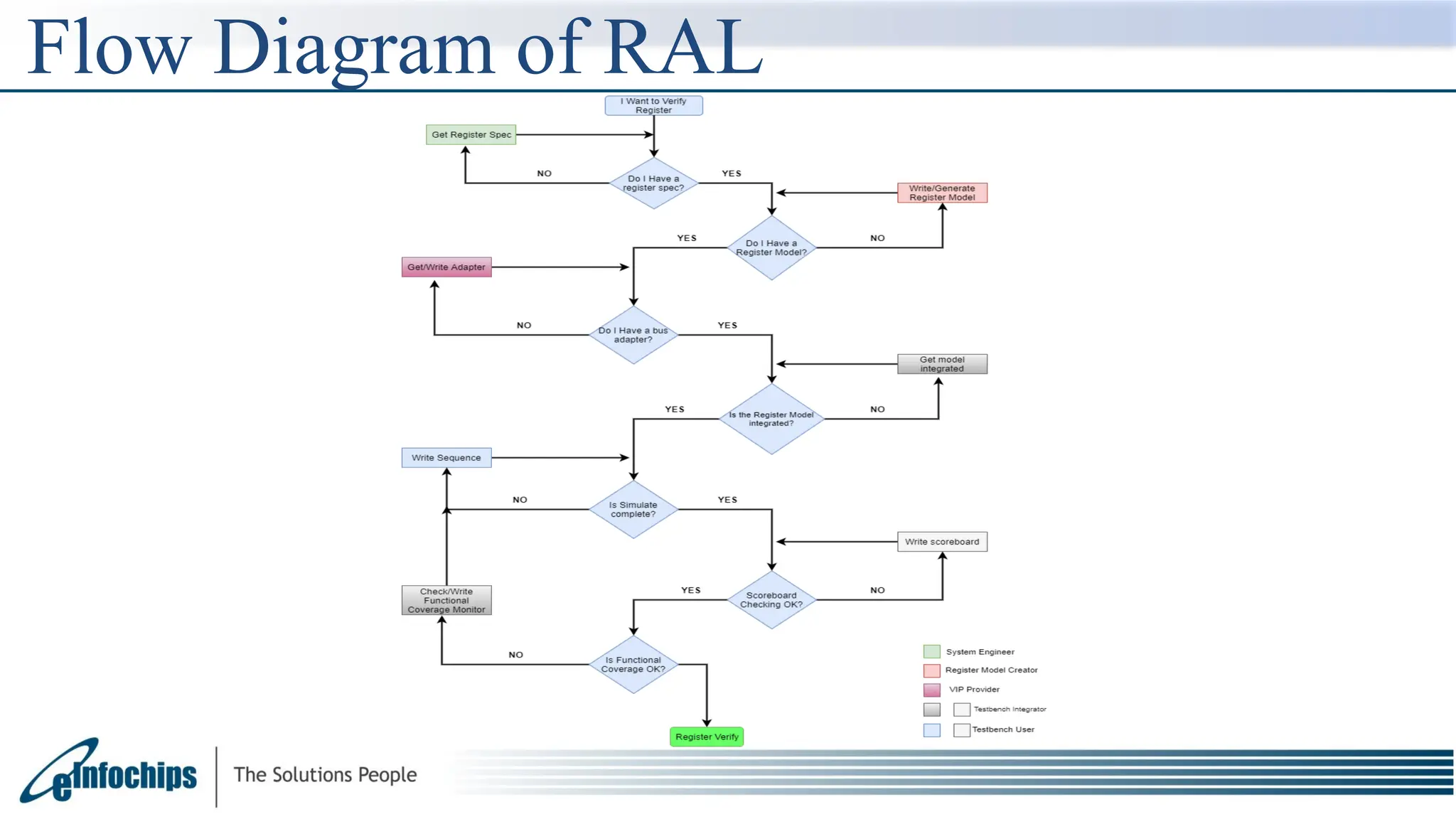
Flow Diagram of RAL
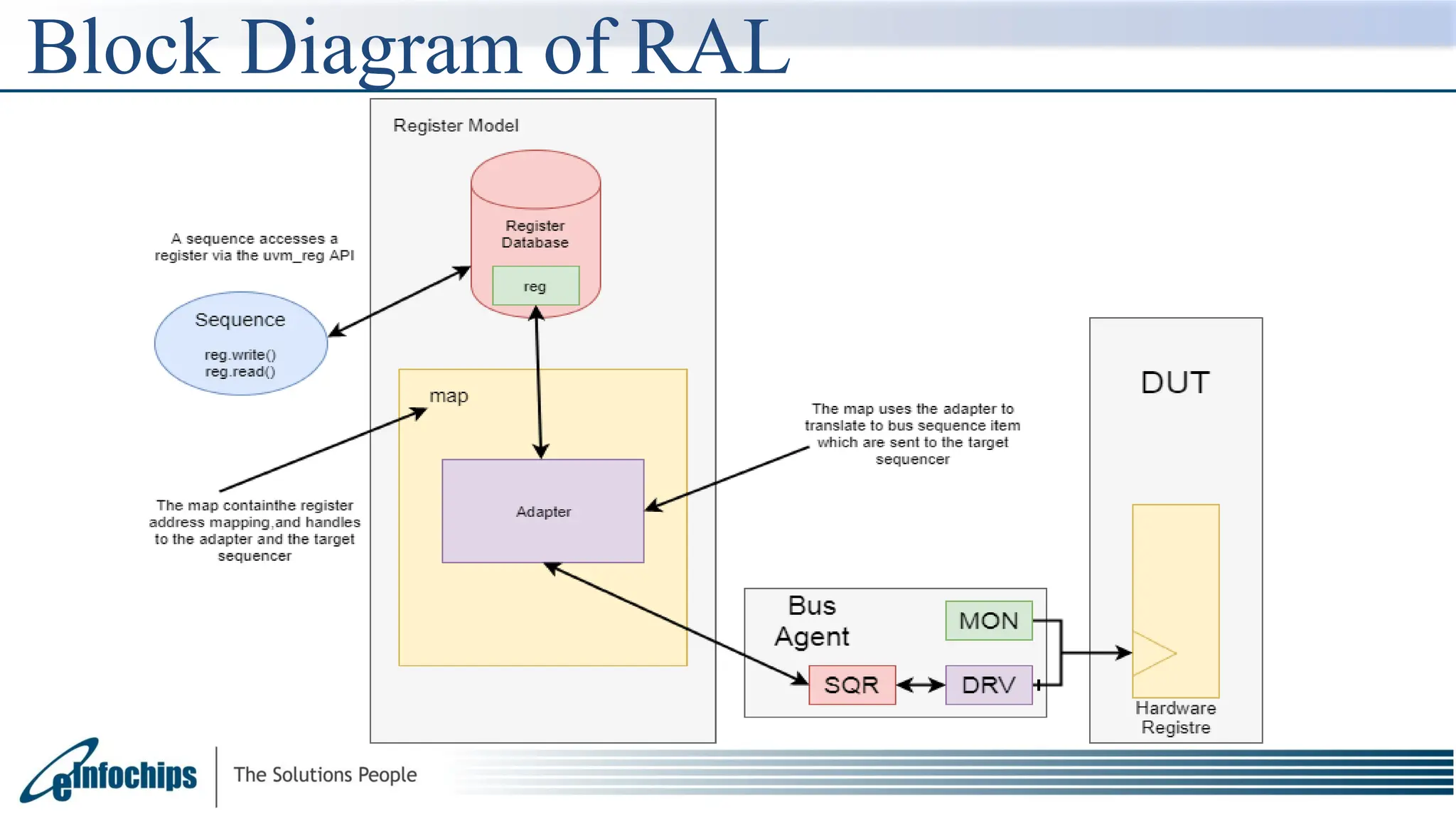
Block Diagram of RAL
Continue..
Main Component of RAL
1. Adapter
2. Predictor
3. Database of Register
Main Concept of RAL
1. Front-door Access
2. Back-door Access
Adapter
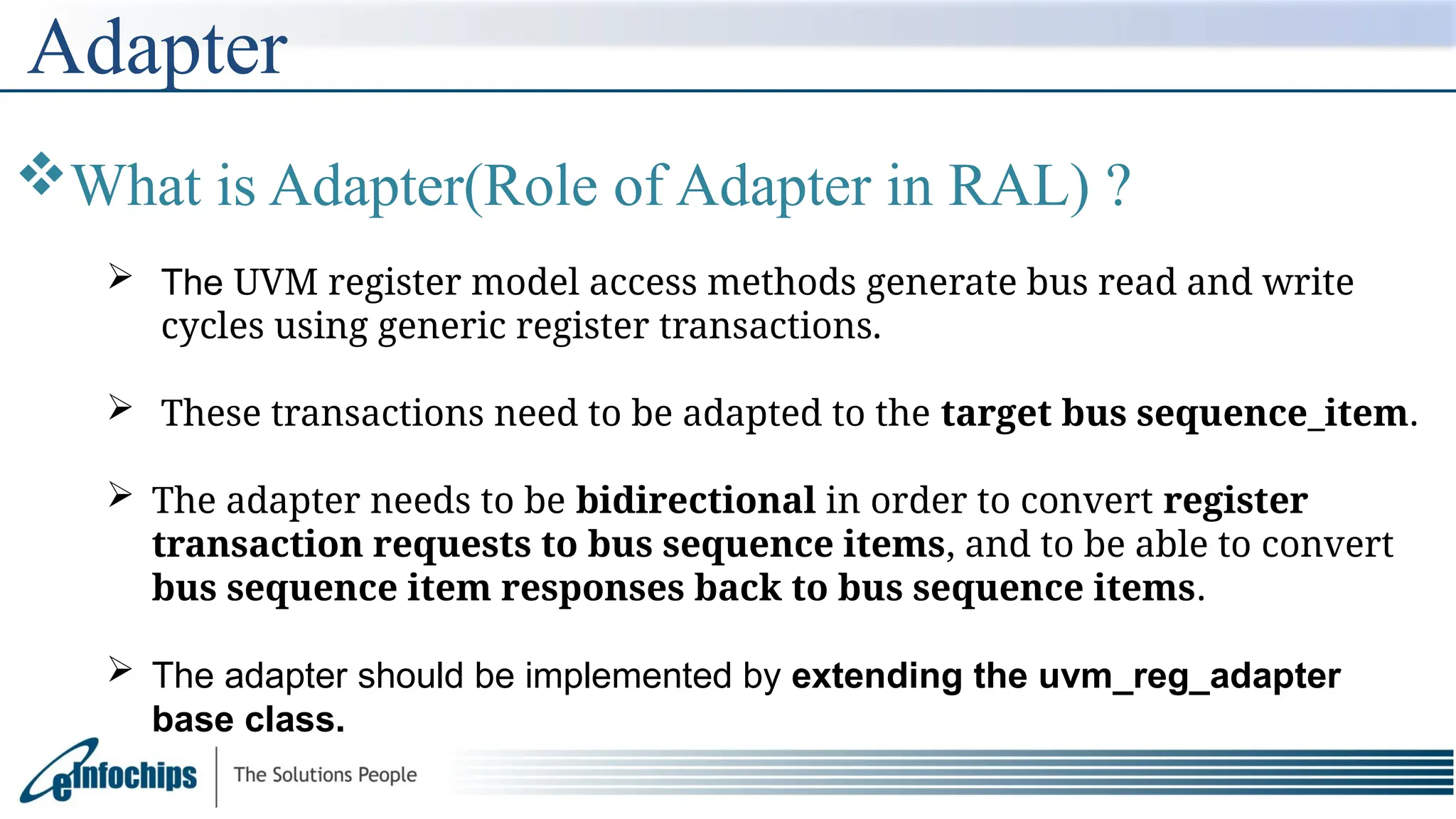
What is Adapter(Role of Adapter in RAL) ?
 The UVM register model access methods generate bus read and write
cycles using generic register transactions.
 These transactions need to be adapted to the target bus sequence_item.
 The adapter needs to be bidirectional in order to convert register
transaction requests to bus sequence items, and to be able to convert
bus sequence item responses back to bus sequence items.
 The adapter should be implemented by extending the uvm_reg_adapter
base class.
Implementing An Adapter
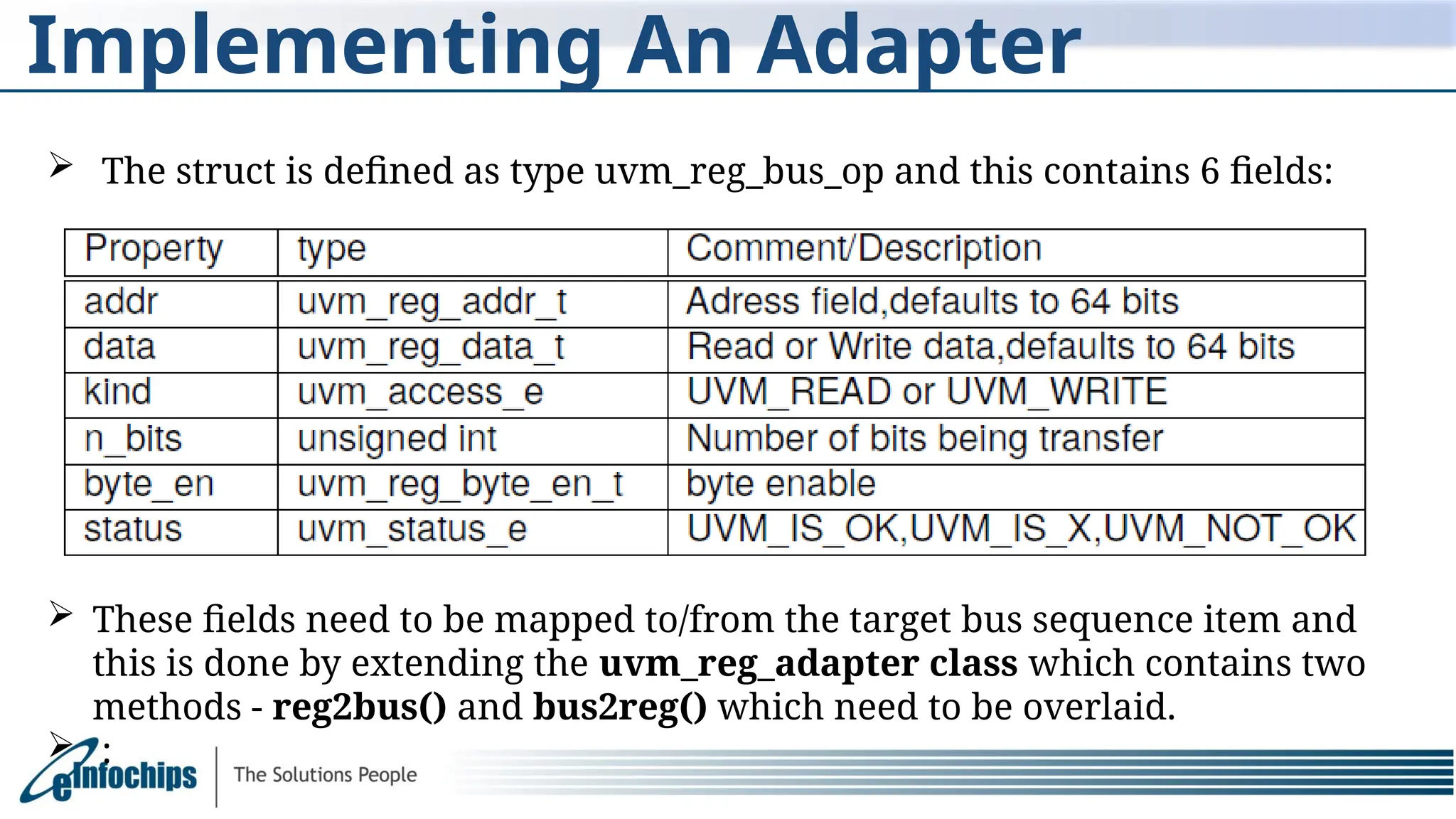
 The struct is defined as type uvm_reg_bus_op and this contains 6 fields:
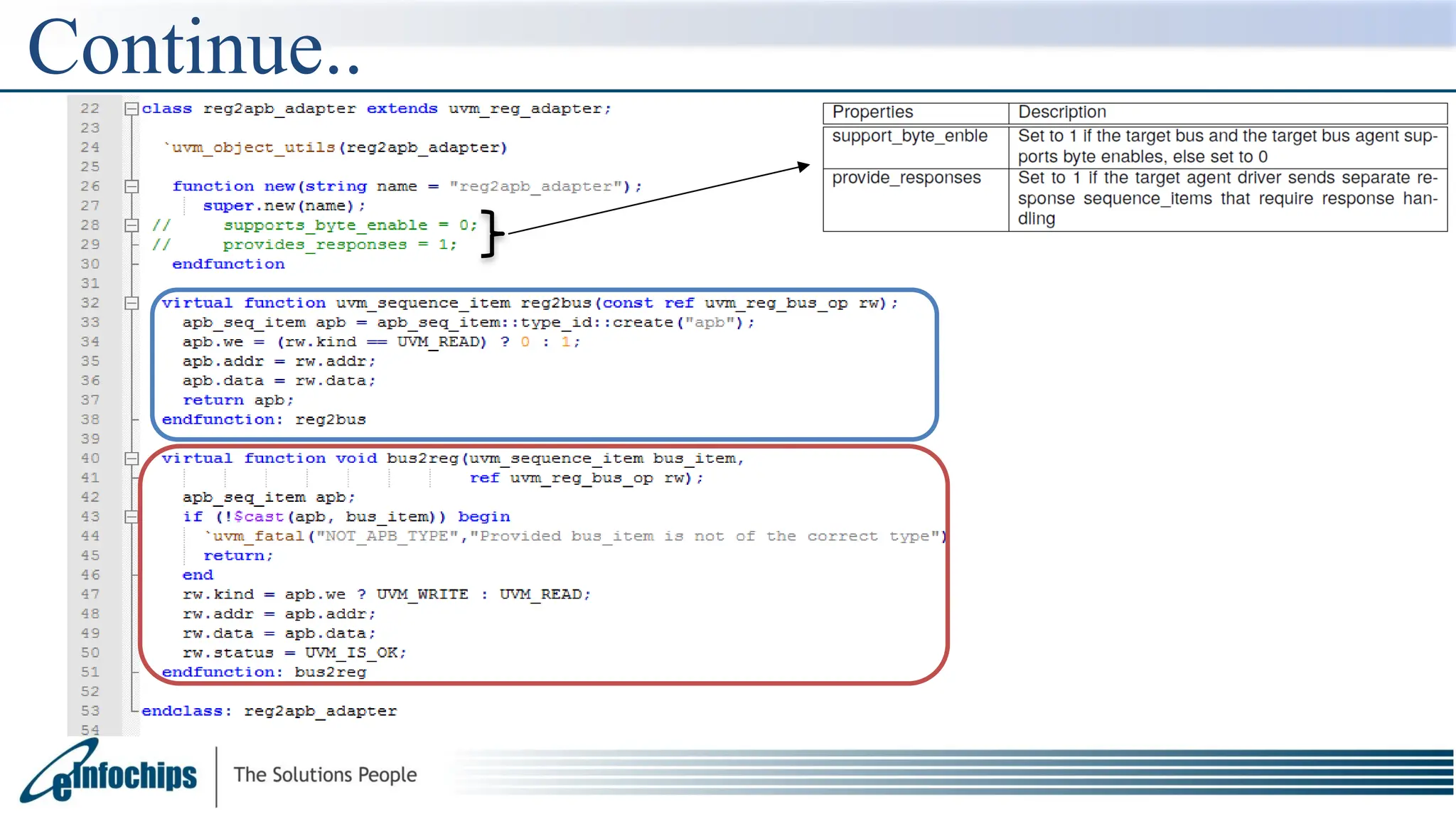
 These fields need to be mapped to/from the target bus sequence item and
this is done by extending the uvm_reg_adapter class which contains two
methods - reg2bus() and bus2reg() which need to be overlaid.
 :
Continue..
Predictor
 Using predictor UVM predict a value of register using two type of
access,
1. Front-door Access
2. Back-door Access
 Right now we have focus on Front-door Access,
 components or sequences that use the register model,
• The register model has to be constructed and its handle
passed around using a configuration object or a resource.
 Components and sequences are then able to use the register model
handle to call methods to access data stored within it, or to access the
DUT.
Continue..
 Front-door Access,
• The register model supports front door accesses to the DUT
by generating generic register transactions which are
converted to target bus agent specific sequence_items
before being sent to the target bus agents sequencer,
• And by converting any returned response information back
from bus agent sequence_items into register
transactions.
 In Predictor RAL Model have a three option,
1. Auto Predictor
2. Explicit Prediction
3. Passive Prediction
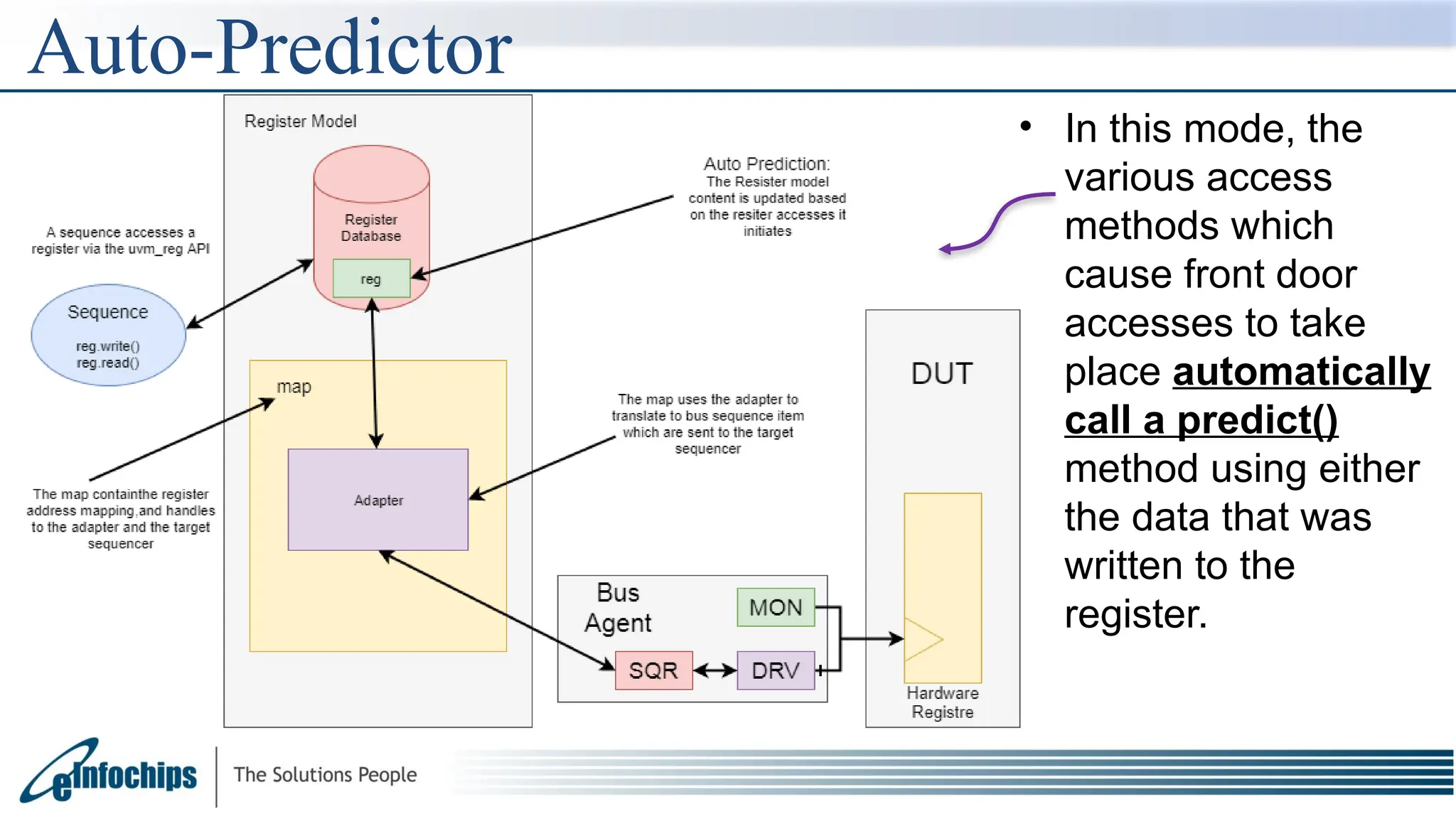
Auto-Predictor
• In this mode, the
various access
methods which
cause front door
accesses to take
place automatically
call a predict()
method using either
the data that was
written to the
register.
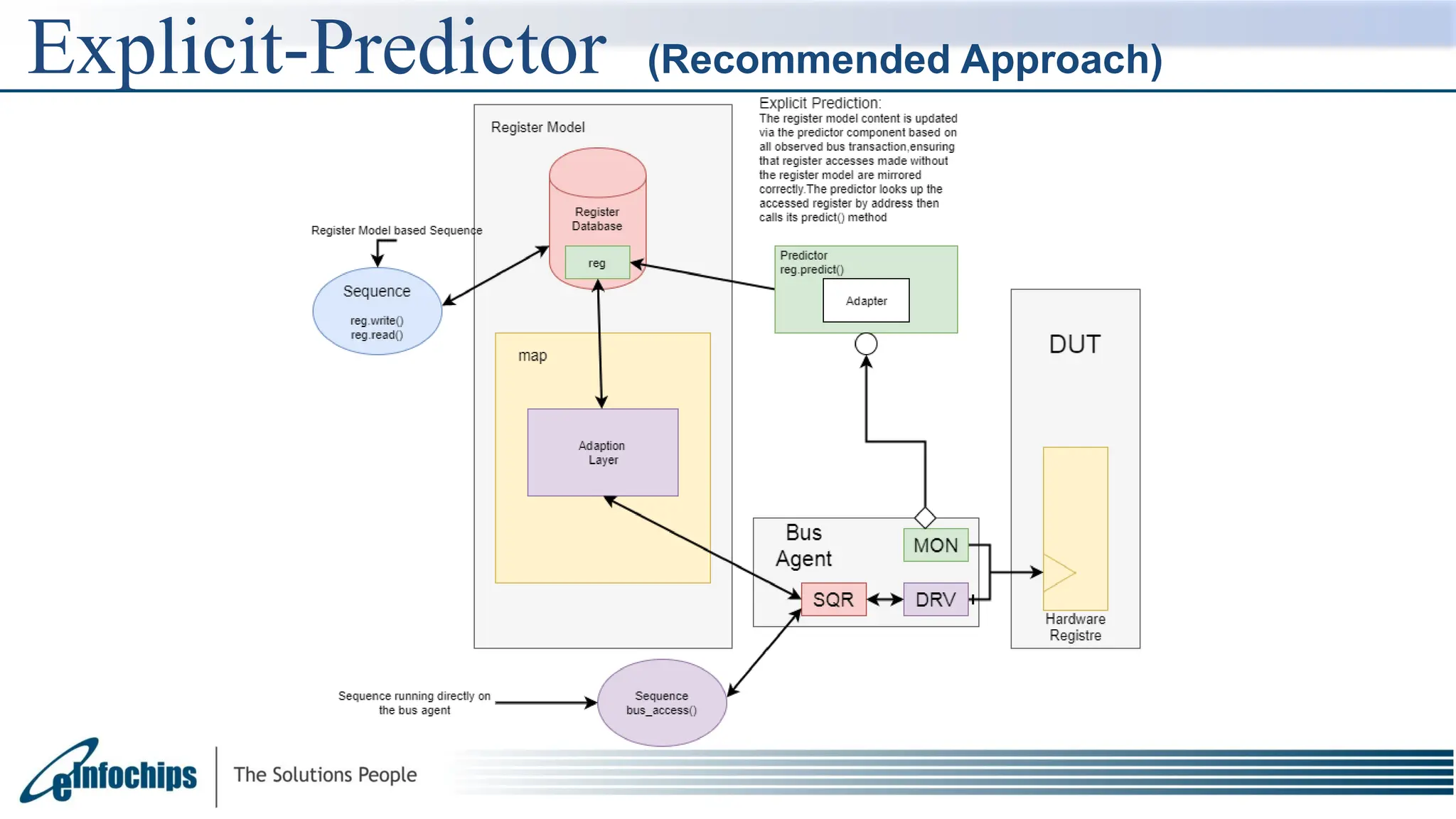
Explicit-Predictor (Recommended Approach)
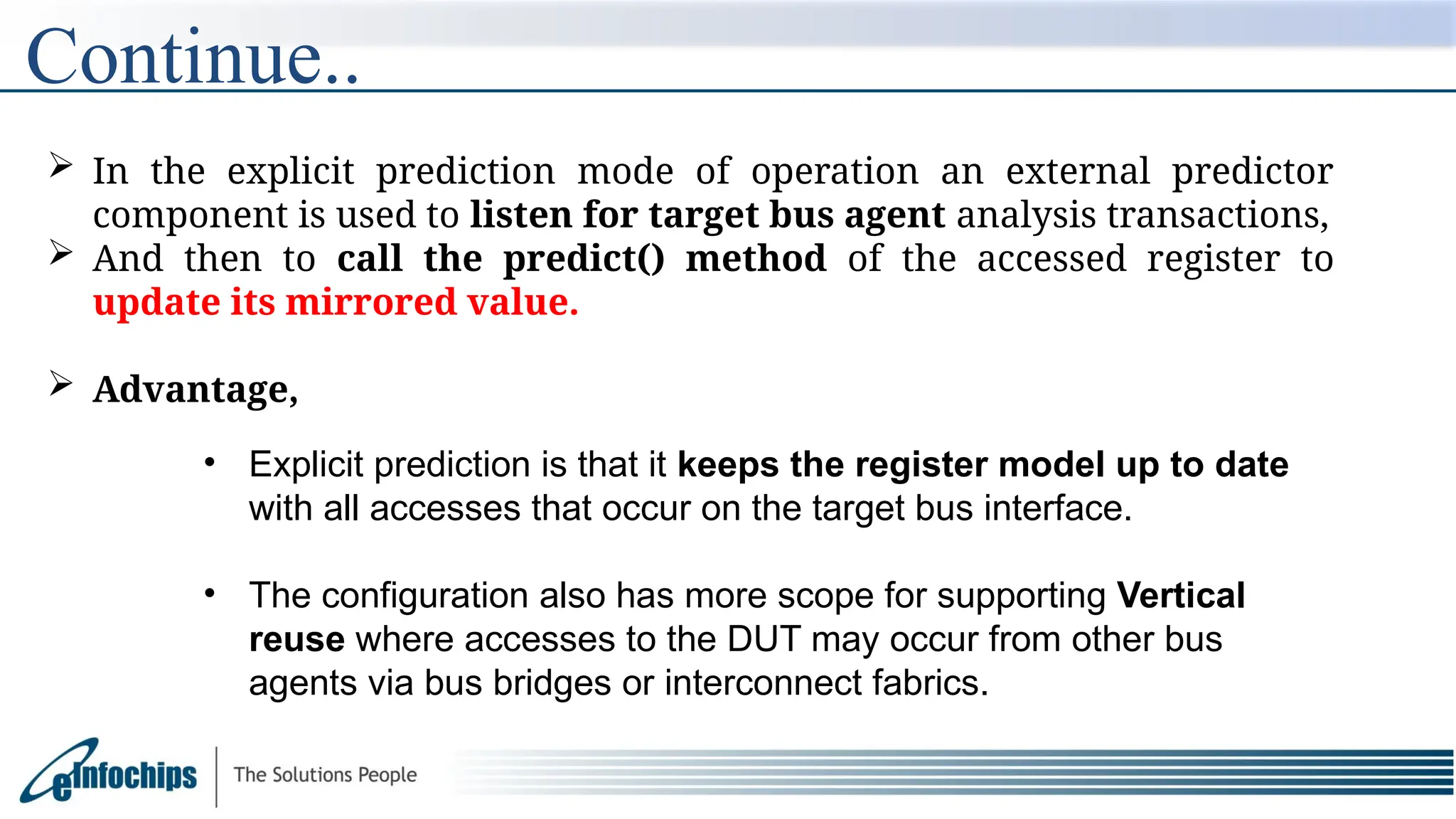
 In the explicit prediction mode of operation an external predictor
component is used to listen for target bus agent analysis transactions,
 And then to call the predict() method of the accessed register to
update its mirrored value.
 Advantage,
Continue..
• Explicit prediction is that it keeps the register model up to date
with all accesses that occur on the target bus interface.
• The configuration also has more scope for supporting Vertical
reuse where accesses to the DUT may occur from other bus
agents via bus bridges or interconnect fabrics.
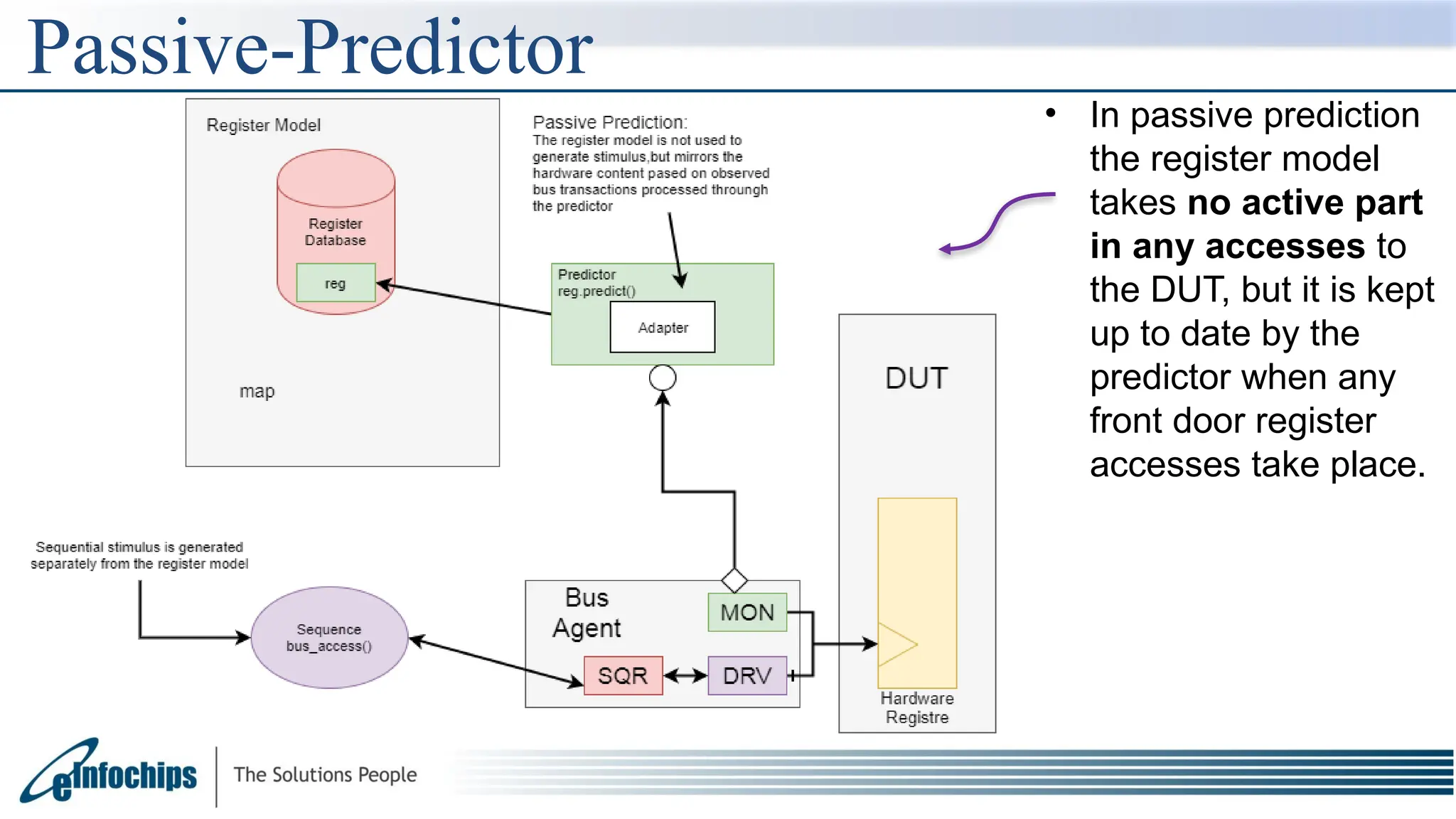
Passive-Predictor
• In passive prediction
the register model
takes no active part
in any accesses to
the DUT, but it is kept
up to date by the
predictor when any
front door register
accesses take place.
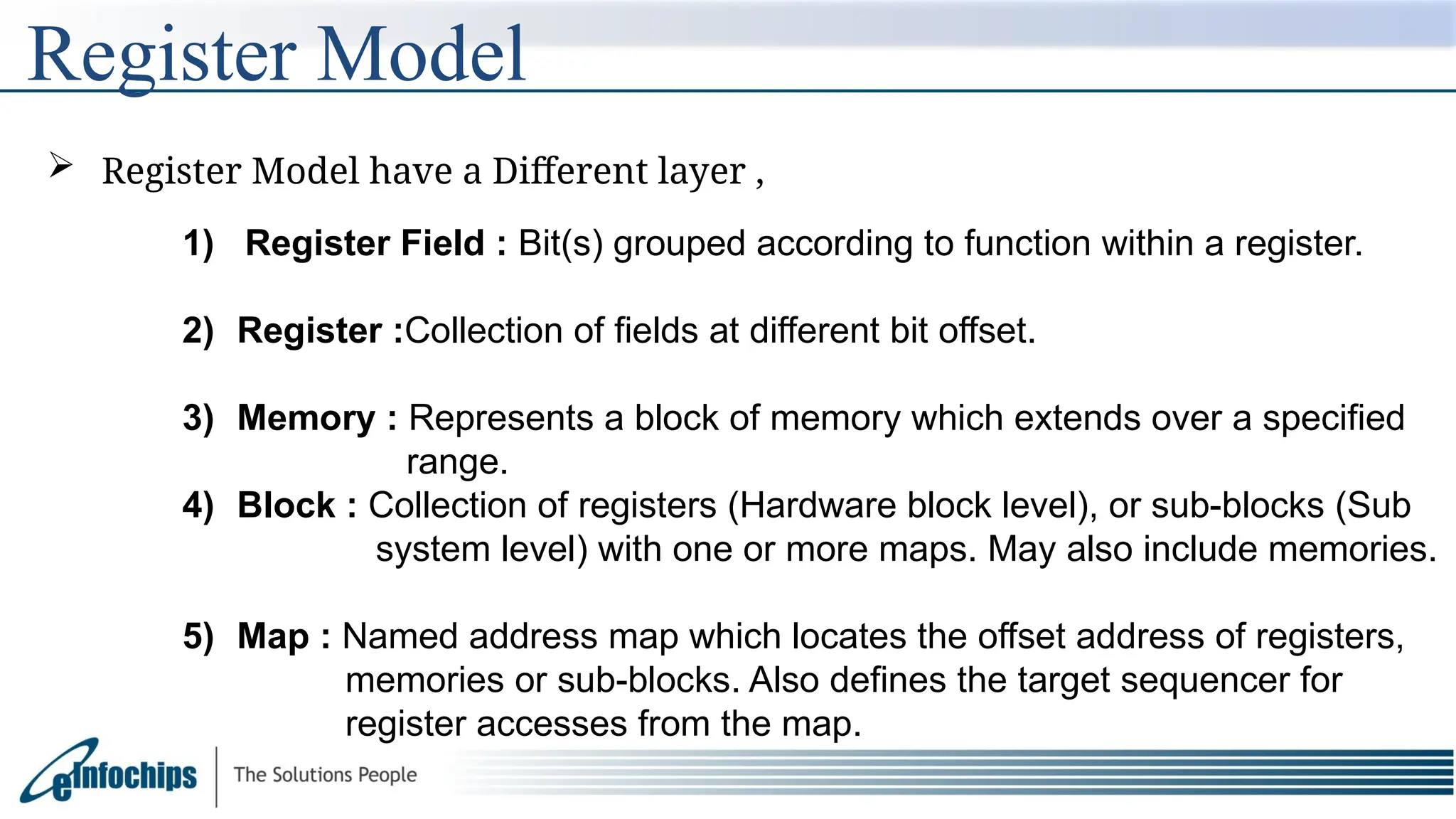
Register Model
 Register Model have a Different layer ,
1) Register Field : Bit(s) grouped according to function within a register.
2) Register :Collection of fields at different bit offset.
3) Memory : Represents a block of memory which extends over a specified
range.
4) Block : Collection of registers (Hardware block level), or sub-blocks (Sub
system level) with one or more maps. May also include memories.
5) Map : Named address map which locates the offset address of registers,
memories or sub-blocks. Also defines the target sequencer for
register accesses from the map.
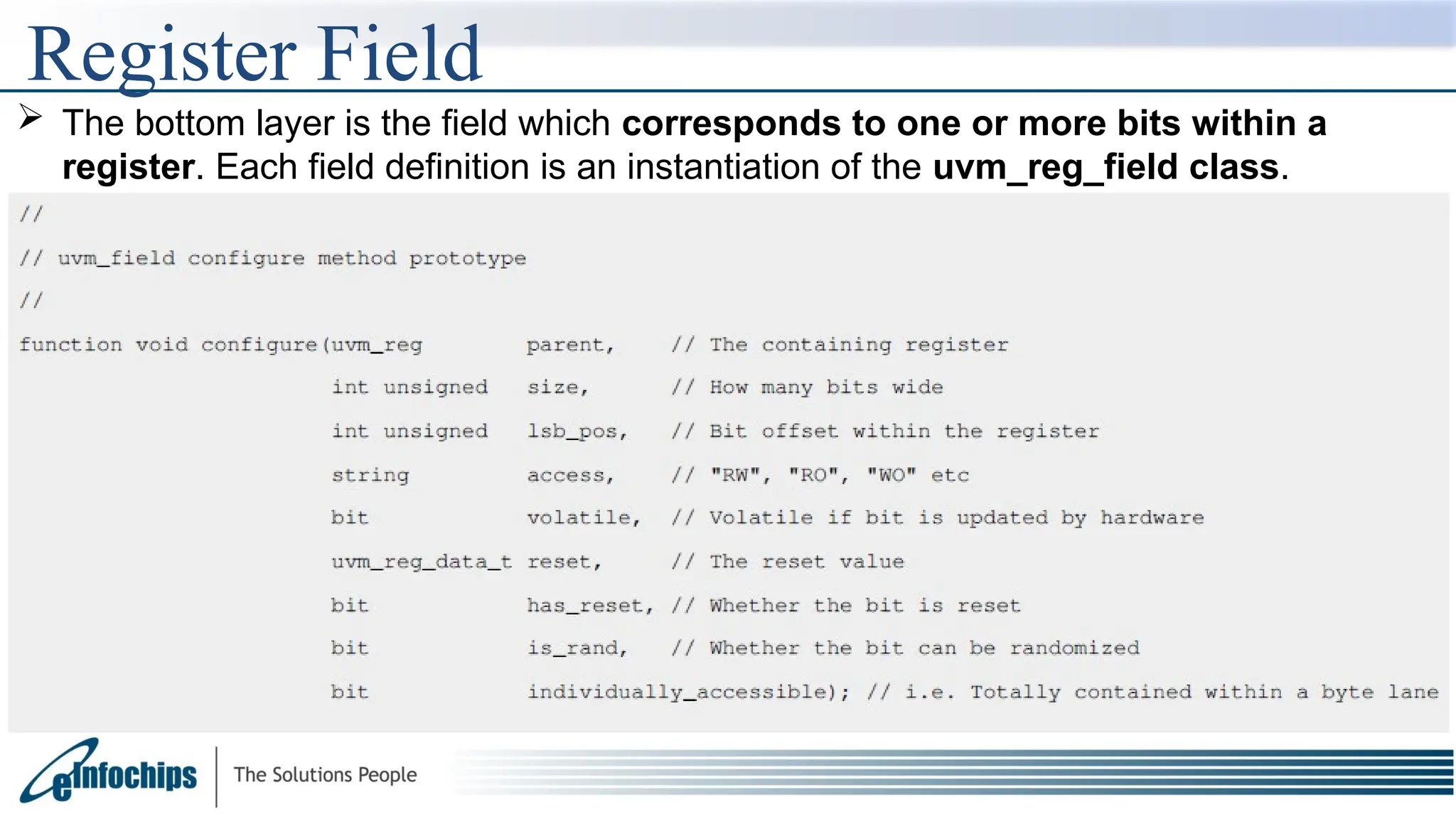
Register Field
 The bottom layer is the field which corresponds to one or more bits within a
register. Each field definition is an instantiation of the uvm_reg_field class.
Register
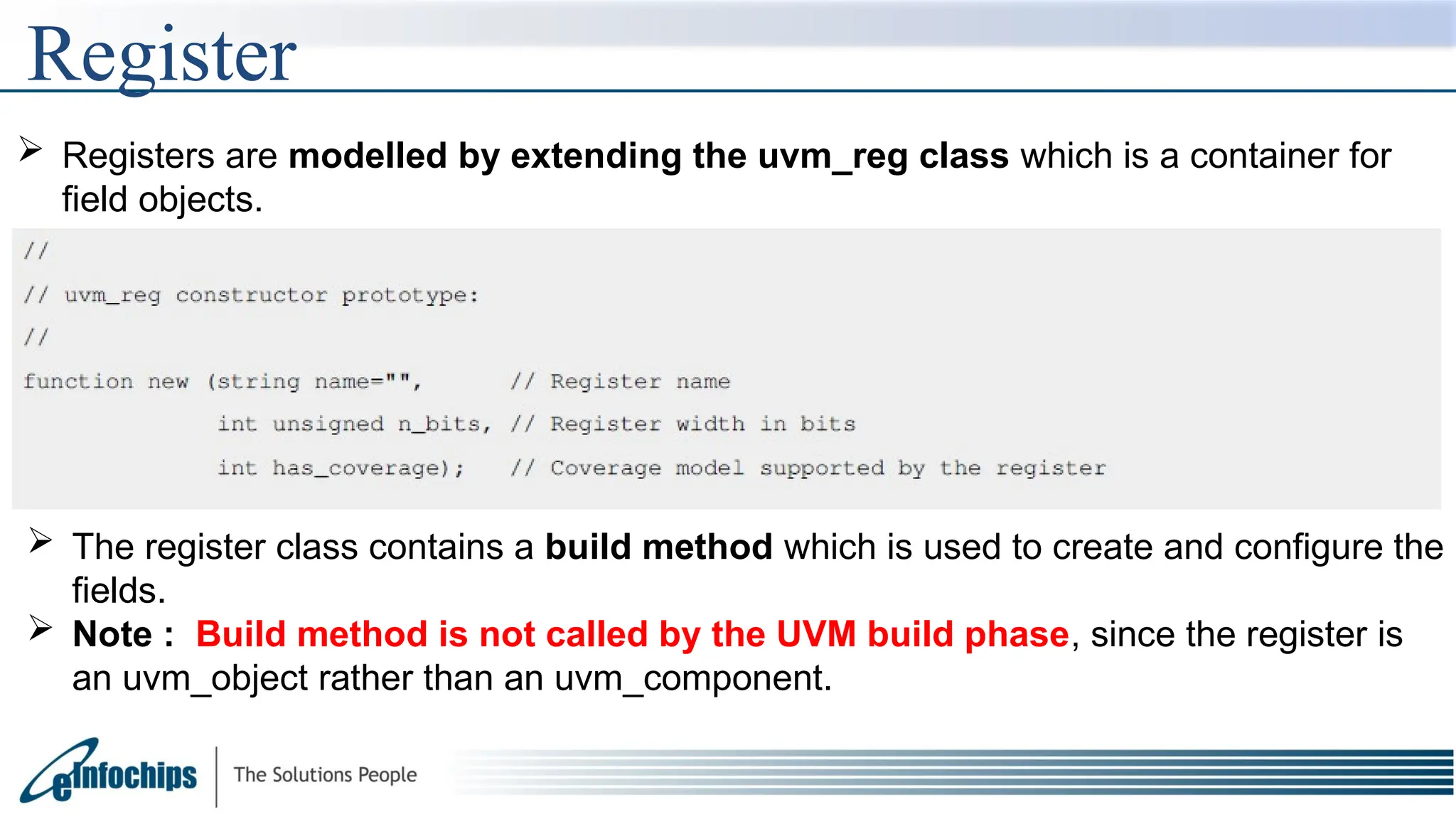
 Registers are modelled by extending the uvm_reg class which is a container for
field objects.
 The register class contains a build method which is used to create and configure the
fields.
 Note : Build method is not called by the UVM build phase, since the register is
an uvm_object rather than an uvm_component.
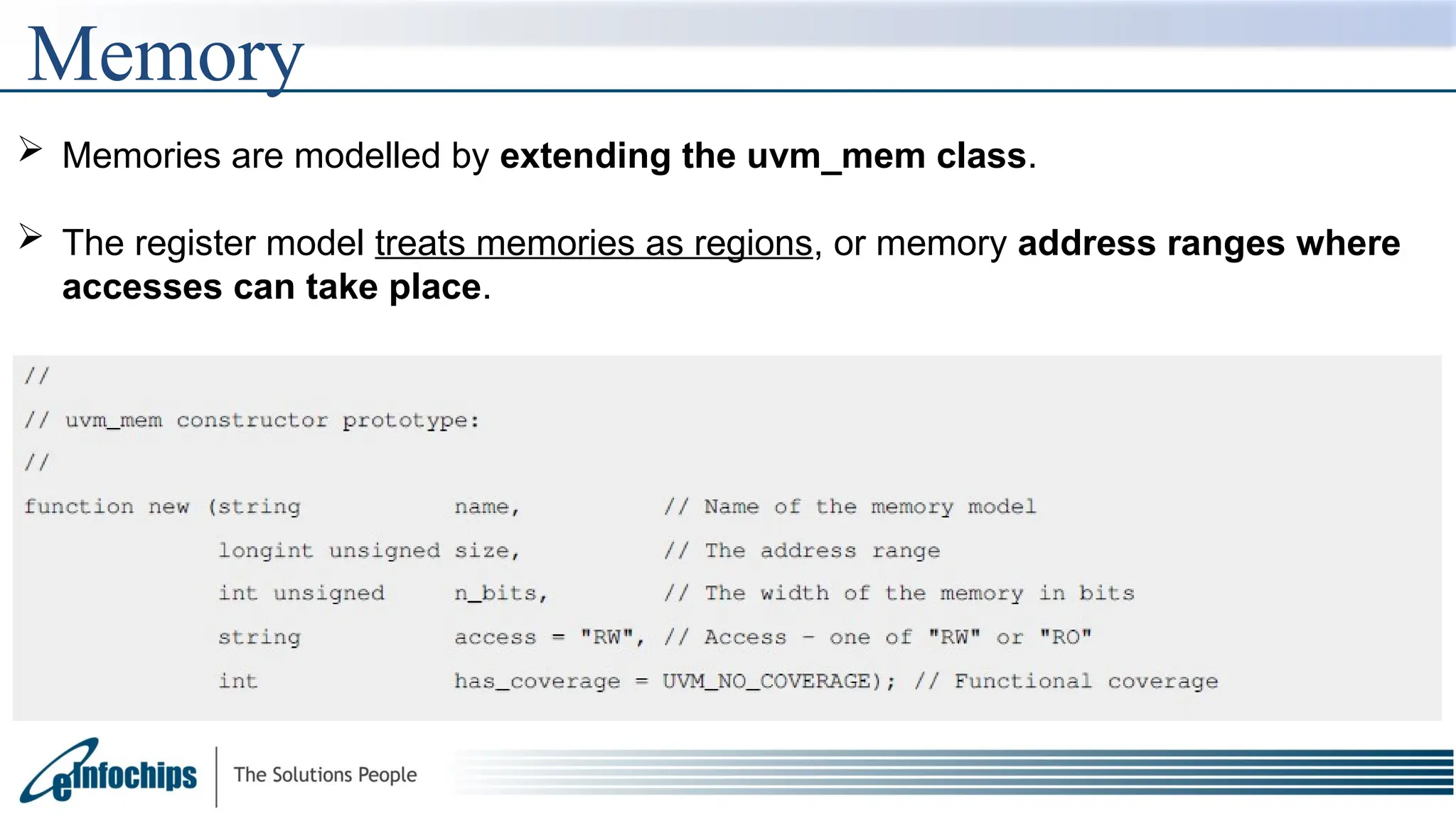
Memory
 Memories are modelled by extending the uvm_mem class.
 The register model treats memories as regions, or memory address ranges where
accesses can take place.
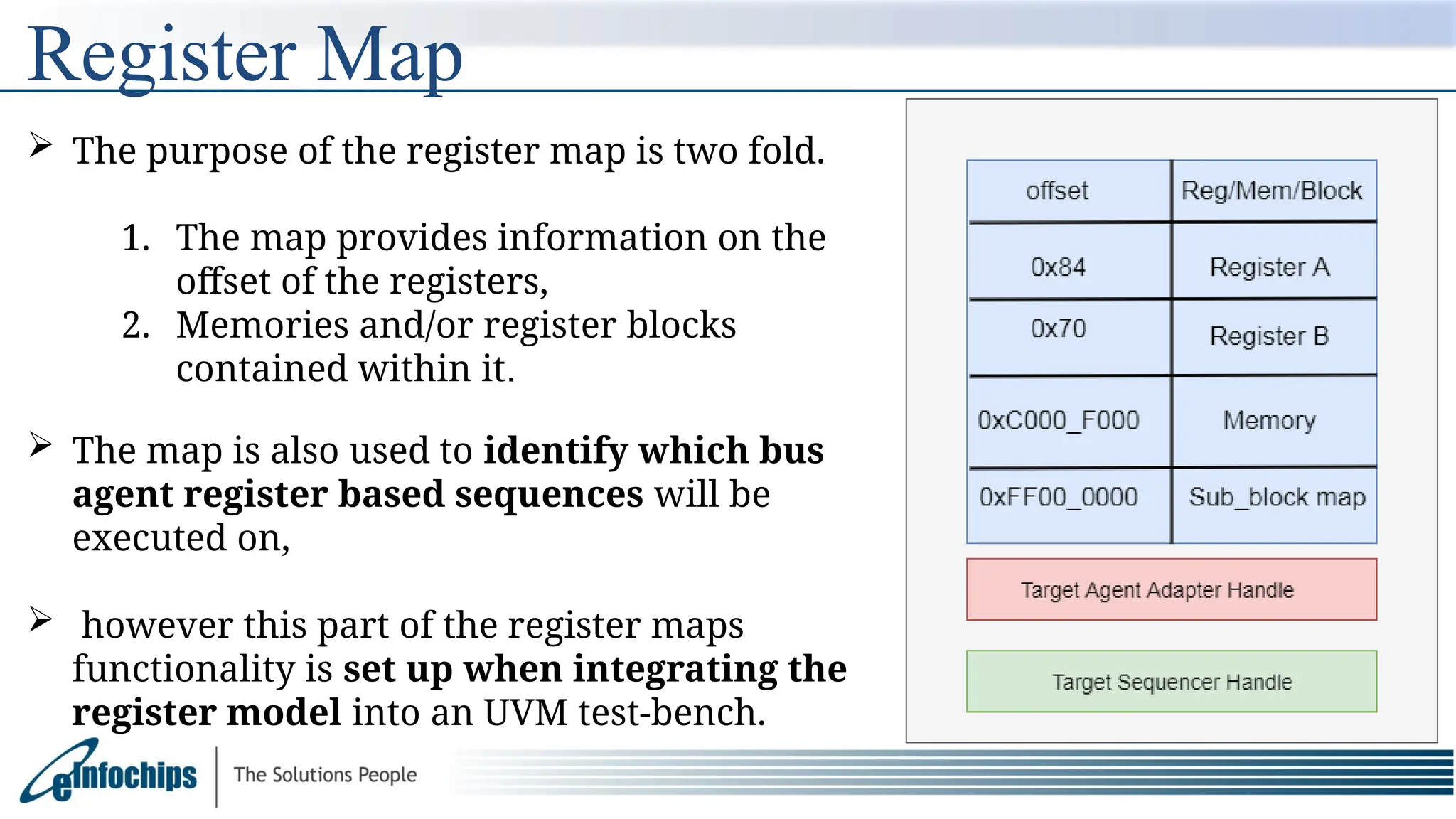
Register Map
 The purpose of the register map is two fold.
1. The map provides information on the
offset of the registers,
2. Memories and/or register blocks
contained within it.
 The map is also used to identify which bus
agent register based sequences will be
executed on,
 however this part of the register maps
functionality is set up when integrating the
register model into an UVM test-bench.
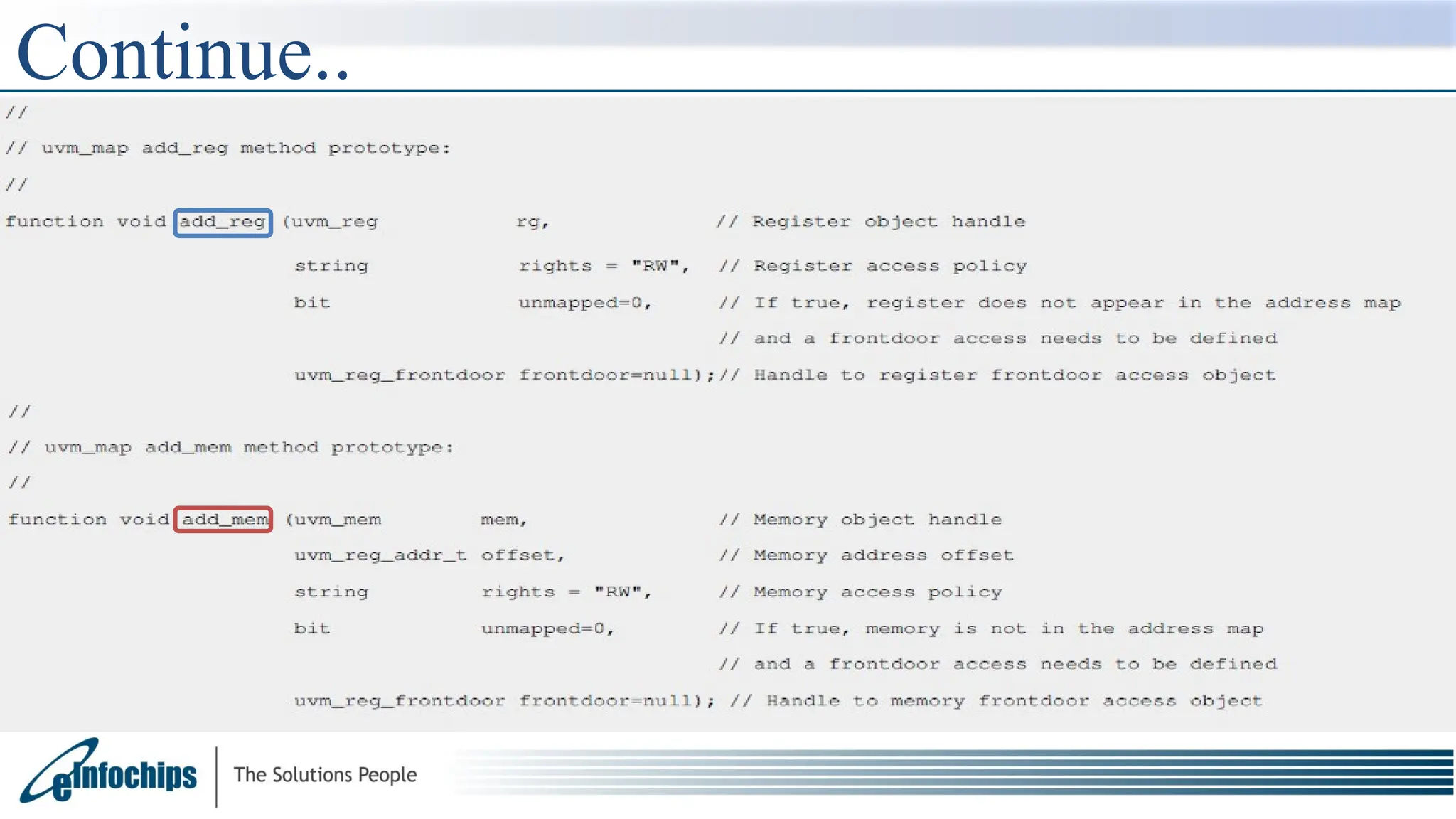
Continue..
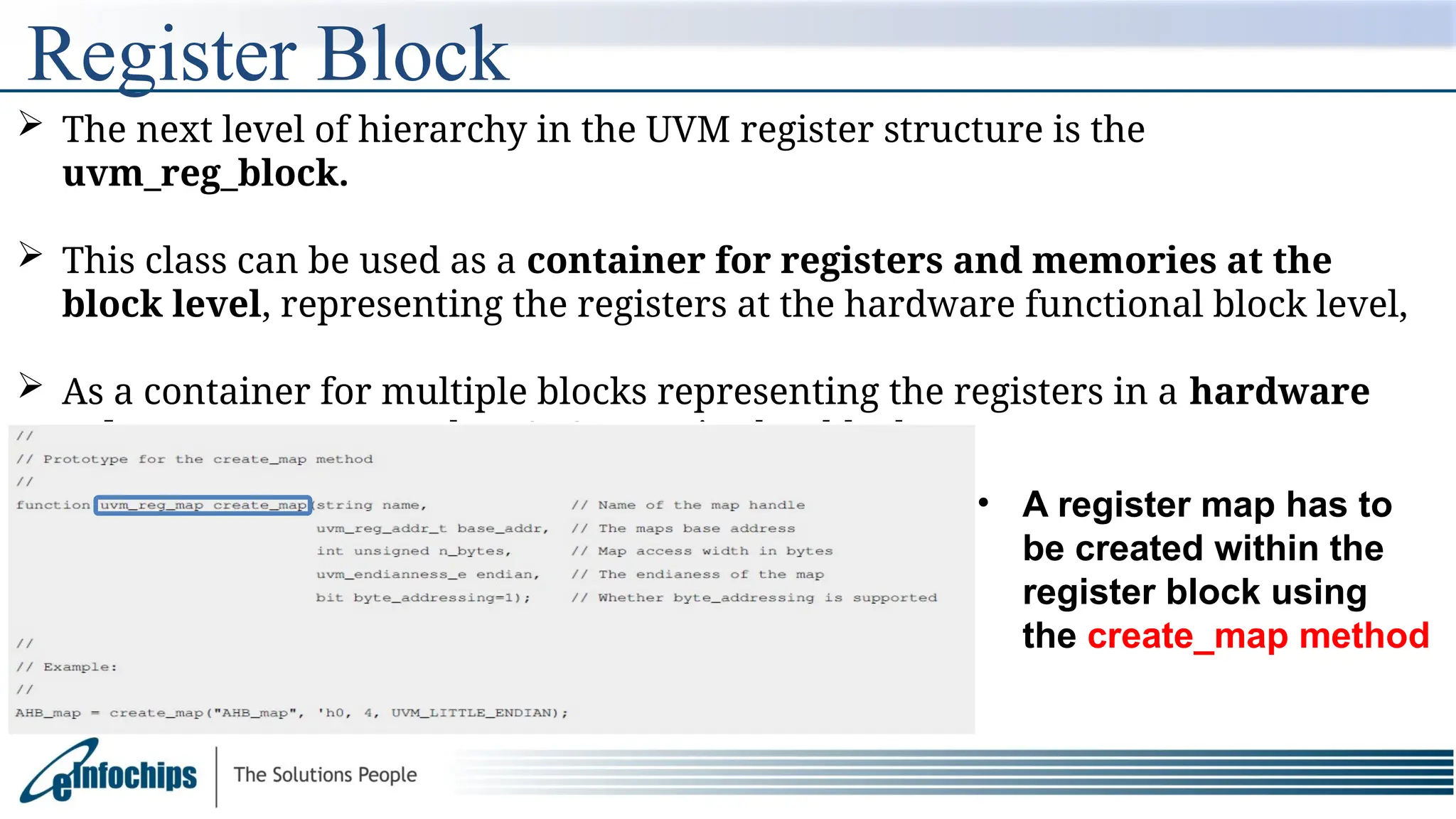
Register Block
 The next level of hierarchy in the UVM register structure is the
uvm_reg_block.
 This class can be used as a container for registers and memories at the
block level, representing the registers at the hardware functional block level,
 As a container for multiple blocks representing the registers in a hardware
sub-system or a complete SoC organised as blocks.
• A register map has to
be created within the
register block using
the create_map method
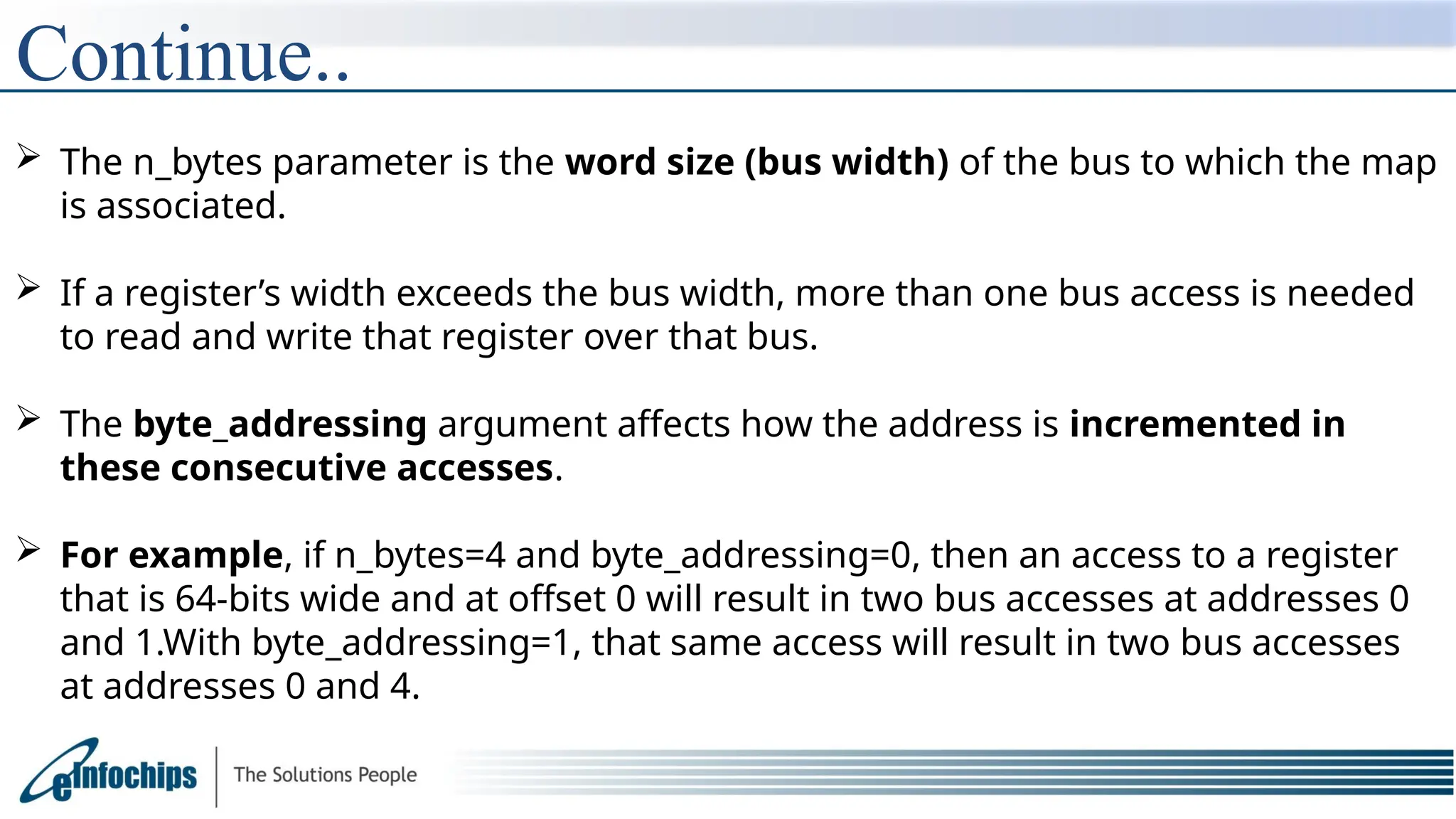
 The n_bytes parameter is the word size (bus width) of the bus to which the map
is associated.
 If a register’s width exceeds the bus width, more than one bus access is needed
to read and write that register over that bus.
 The byte_addressing argument affects how the address is incremented in
these consecutive accesses.
 For example, if n_bytes=4 and byte_addressing=0, then an access to a register
that is 64-bits wide and at offset 0 will result in two bus accesses at addresses 0
and 1.With byte_addressing=1, that same access will result in two bus accesses
at addresses 0 and 4.
Continue..
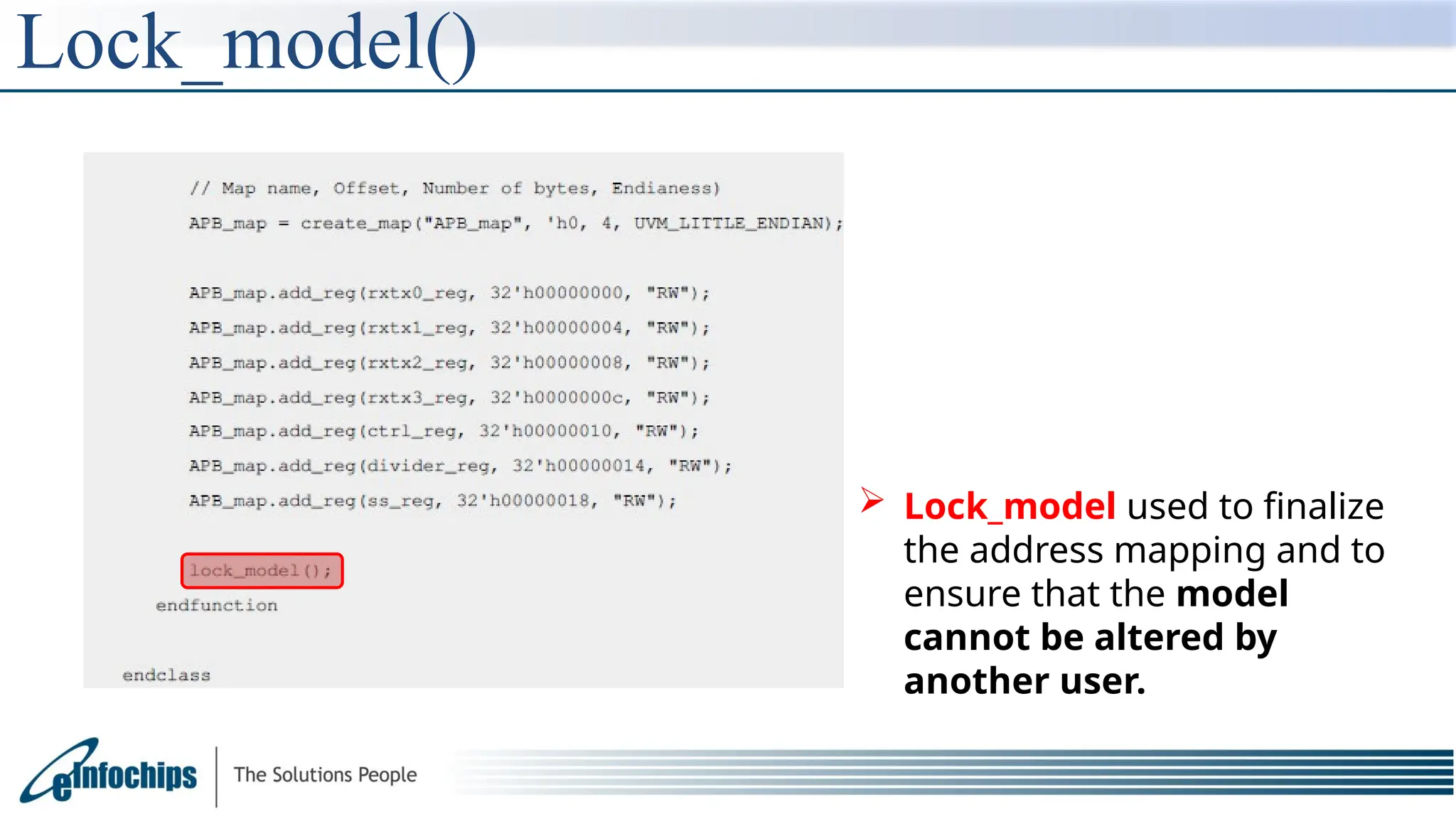
Lock_model()
 Lock_model used to finalize
the address mapping and to
ensure that the model
cannot be altered by
another user.
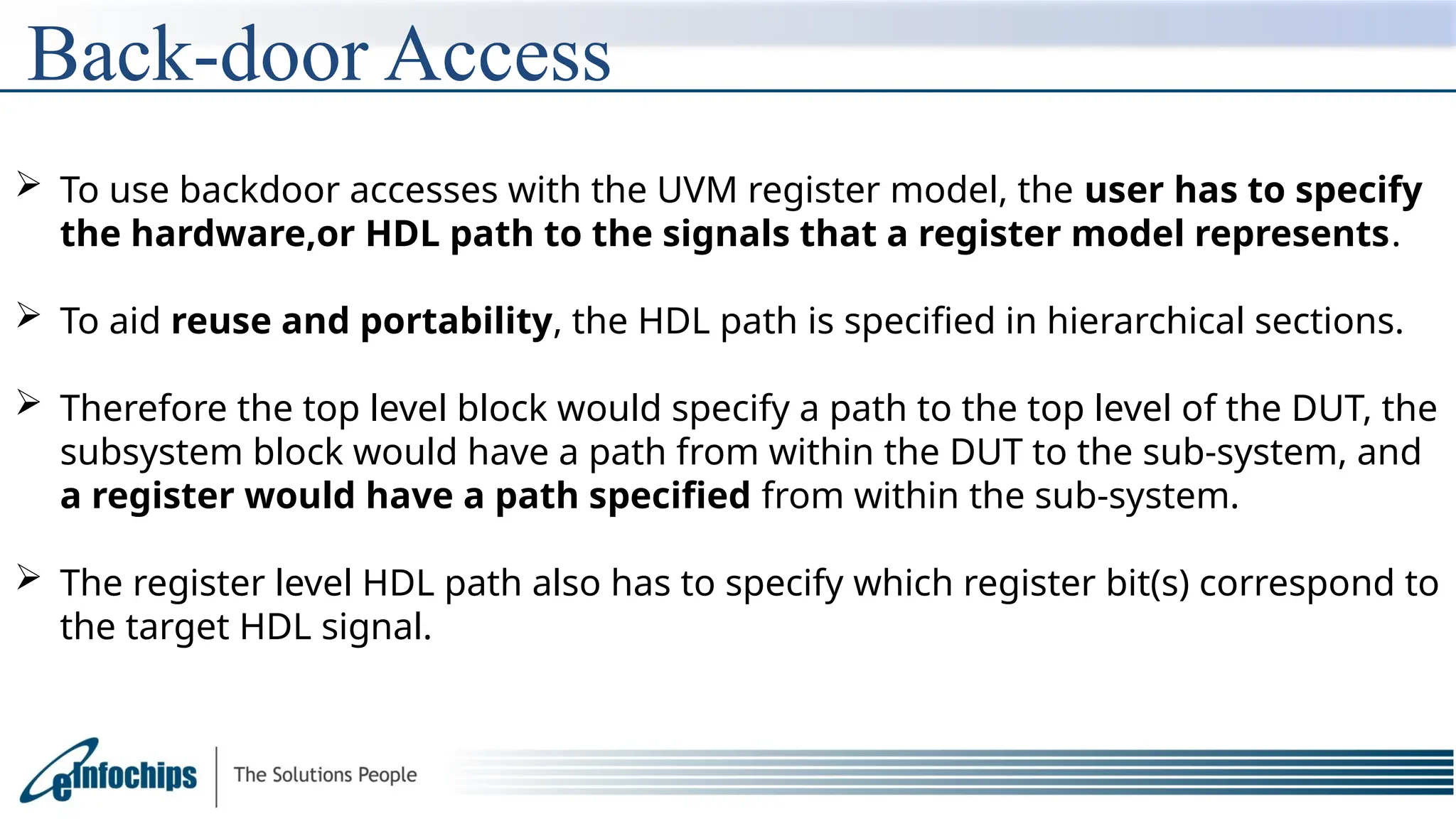
Back-door Access
 To use backdoor accesses with the UVM register model, the user has to specify
the hardware,or HDL path to the signals that a register model represents.
 To aid reuse and portability, the HDL path is specified in hierarchical sections.
 Therefore the top level block would specify a path to the top level of the DUT, the
subsystem block would have a path from within the DUT to the sub-system, and
a register would have a path specified from within the sub-system.
 The register level HDL path also has to specify which register bit(s) correspond to
the target HDL signal.
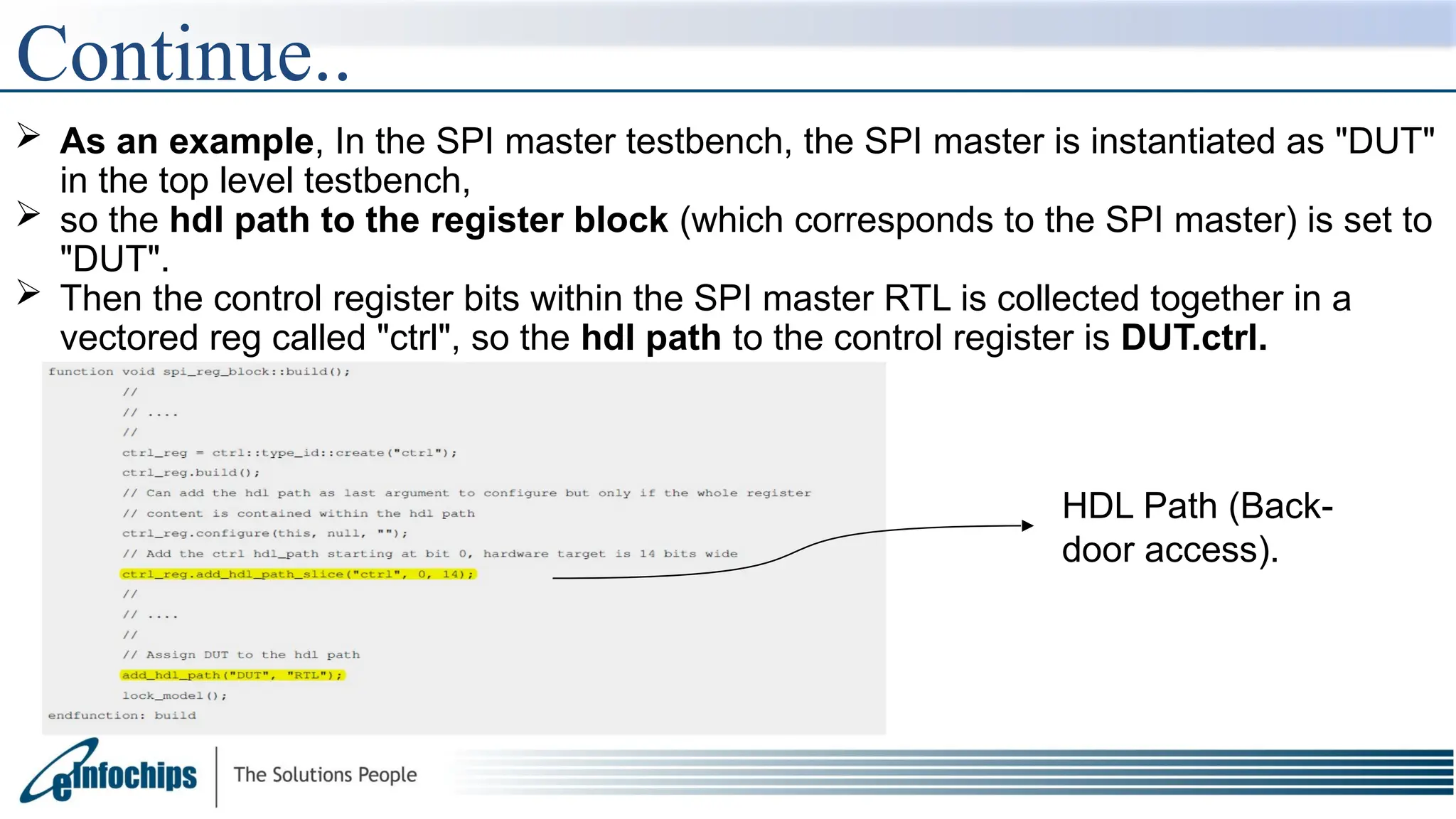
 As an example, In the SPI master testbench, the SPI master is instantiated as "DUT"
in the top level testbench,
 so the hdl path to the register block (which corresponds to the SPI master) is set to
"DUT".
 Then the control register bits within the SPI master RTL is collected together in a
vectored reg called "ctrl", so the hdl path to the control register is DUT.ctrl.
Continue..
HDL Path (Back-
door access).
Continue..
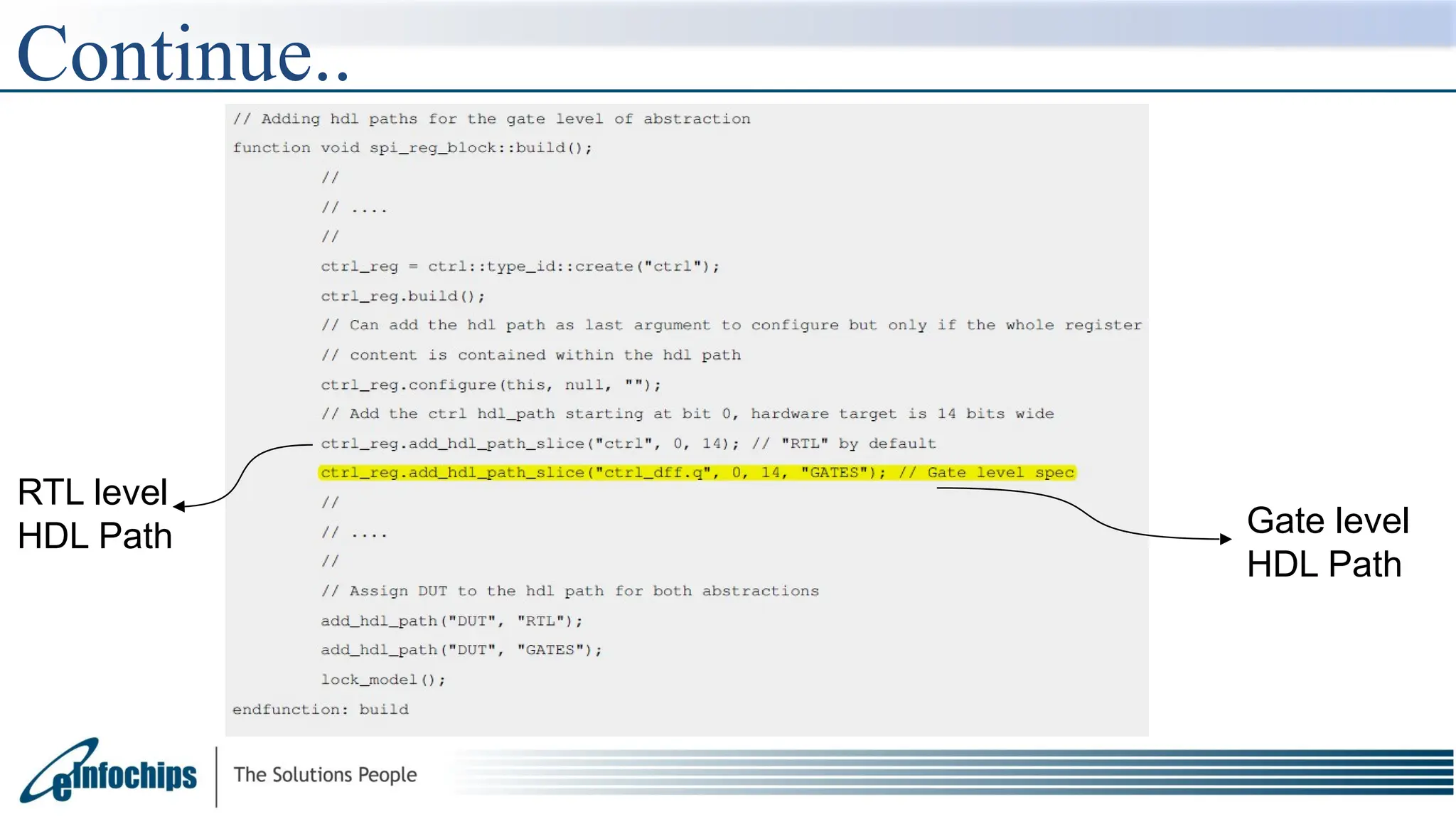
Gate level
HDL Path
RTL level
HDL Path
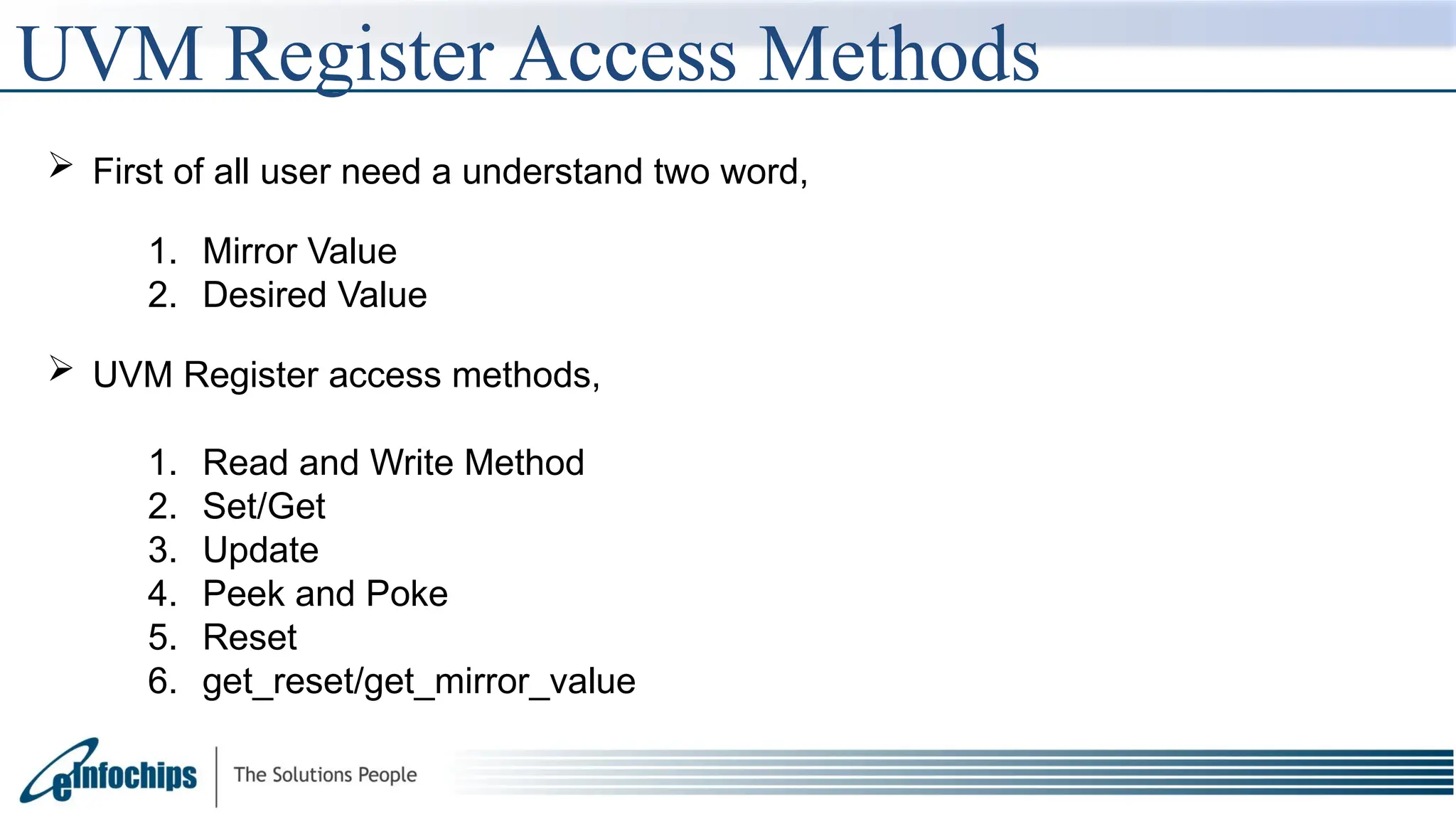
UVM Register Access Methods
 First of all user need a understand two word,
1. Mirror Value
2. Desired Value
 UVM Register access methods,
1. Read and Write Method
2. Set/Get
3. Update
4. Peek and Poke
5. Reset
6. get_reset/get_mirror_value
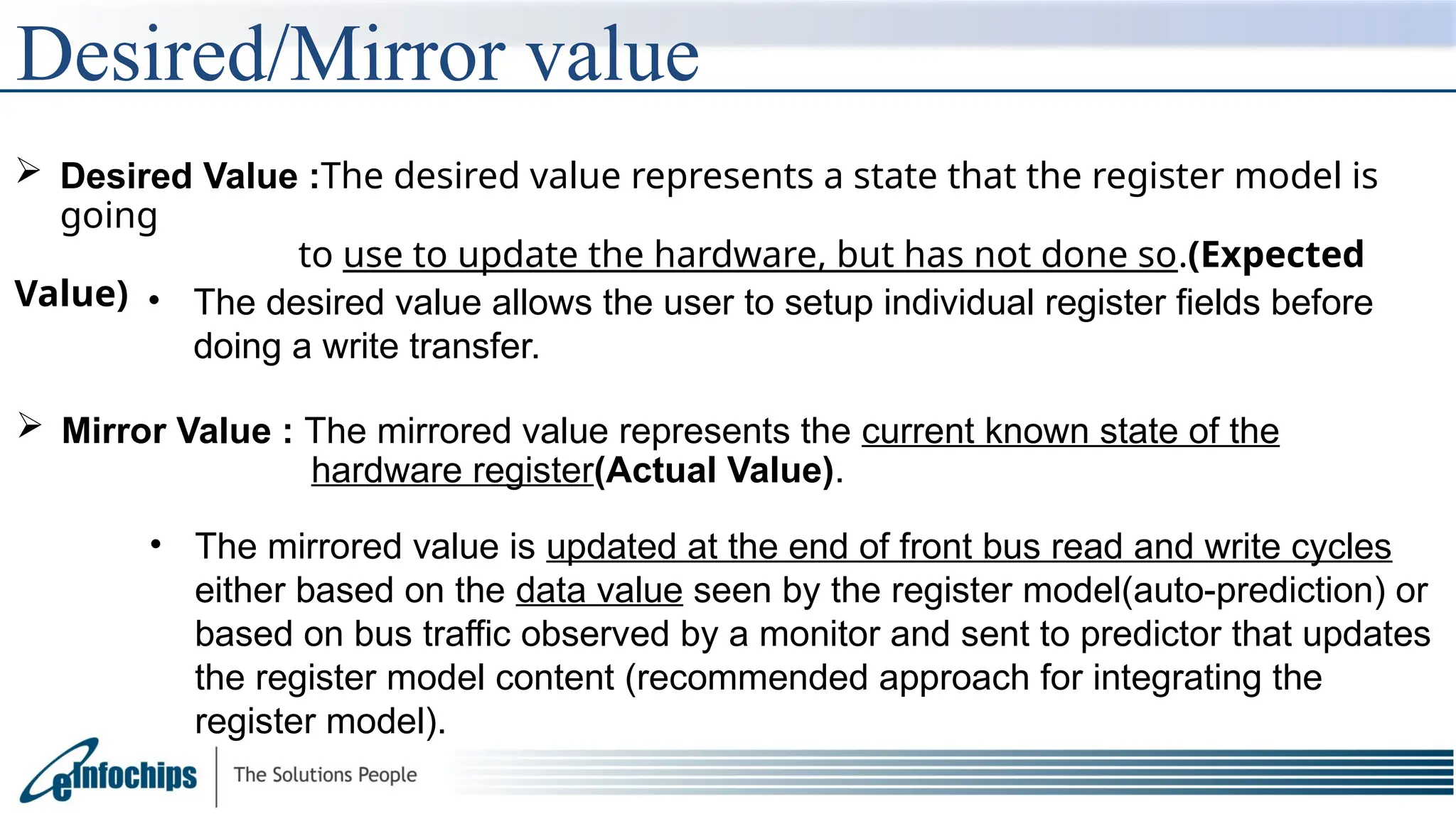
Desired/Mirror value
 Desired Value :The desired value represents a state that the register model is
going
to use to update the hardware, but has not done so.(Expected
Value)
 Mirror Value : The mirrored value represents the current known state of the
hardware register(Actual Value).
• The desired value allows the user to setup individual register fields before
doing a write transfer.
• The mirrored value is updated at the end of front bus read and write cycles
either based on the data value seen by the register model(auto-prediction) or
based on bus traffic observed by a monitor and sent to predictor that updates
the register model content (recommended approach for integrating the
register model).
Read Method
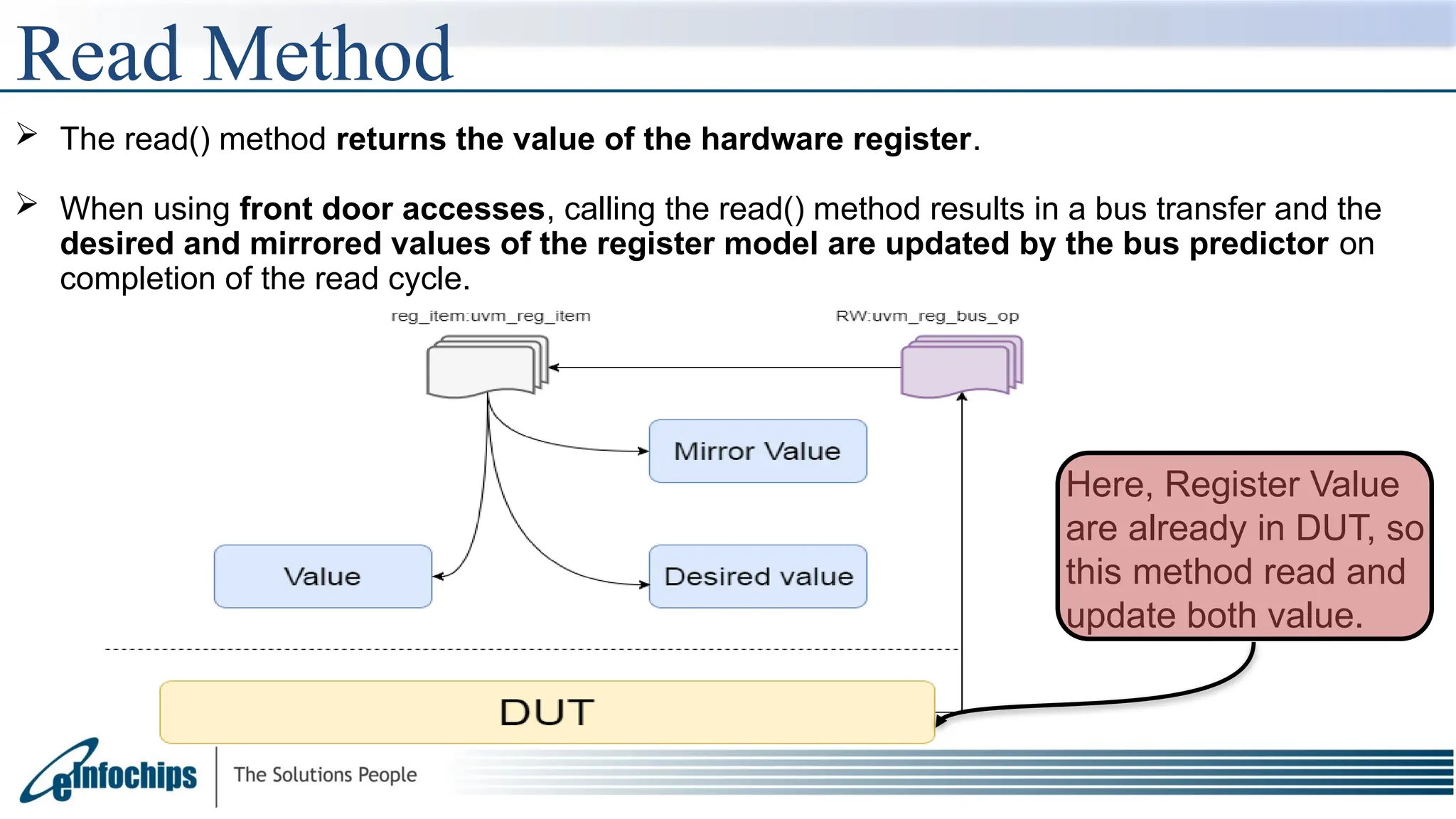
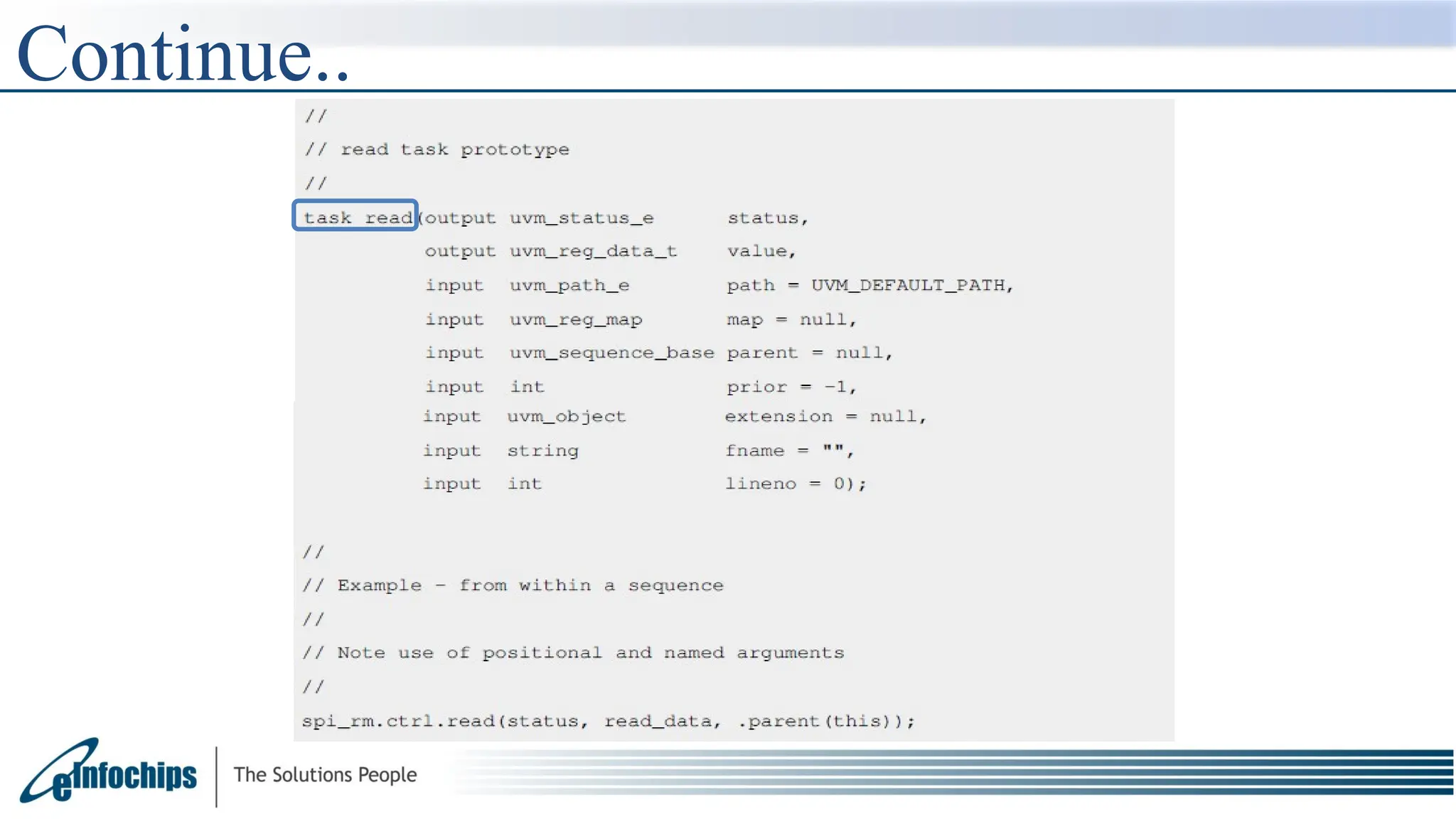
 The read() method returns the value of the hardware register.
 When using front door accesses, calling the read() method results in a bus transfer and the
desired and mirrored values of the register model are updated by the bus predictor on
completion of the read cycle.
Here, Register Value
are already in DUT, so
this method read and
update both value.
Continue..
Write Method
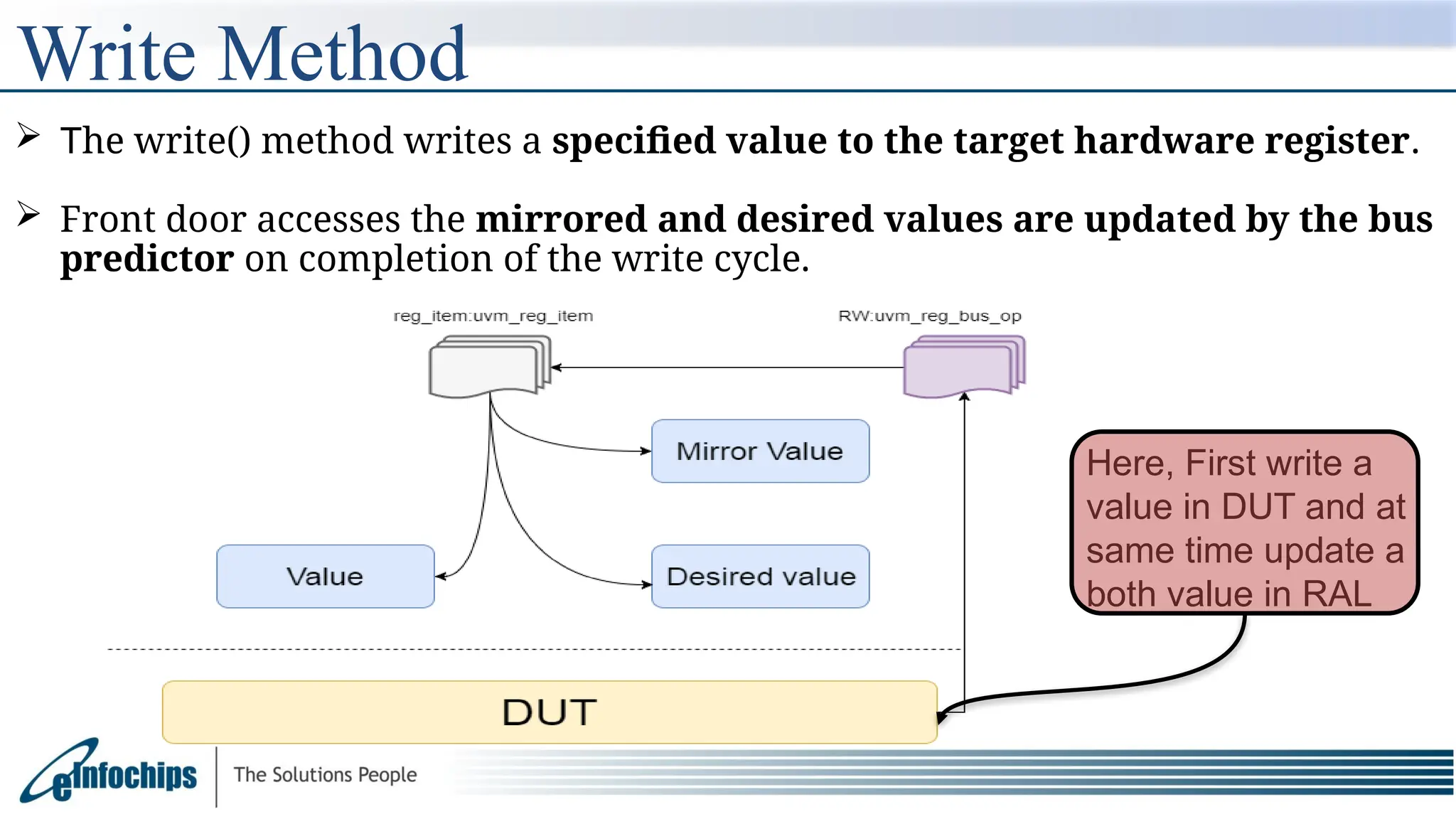
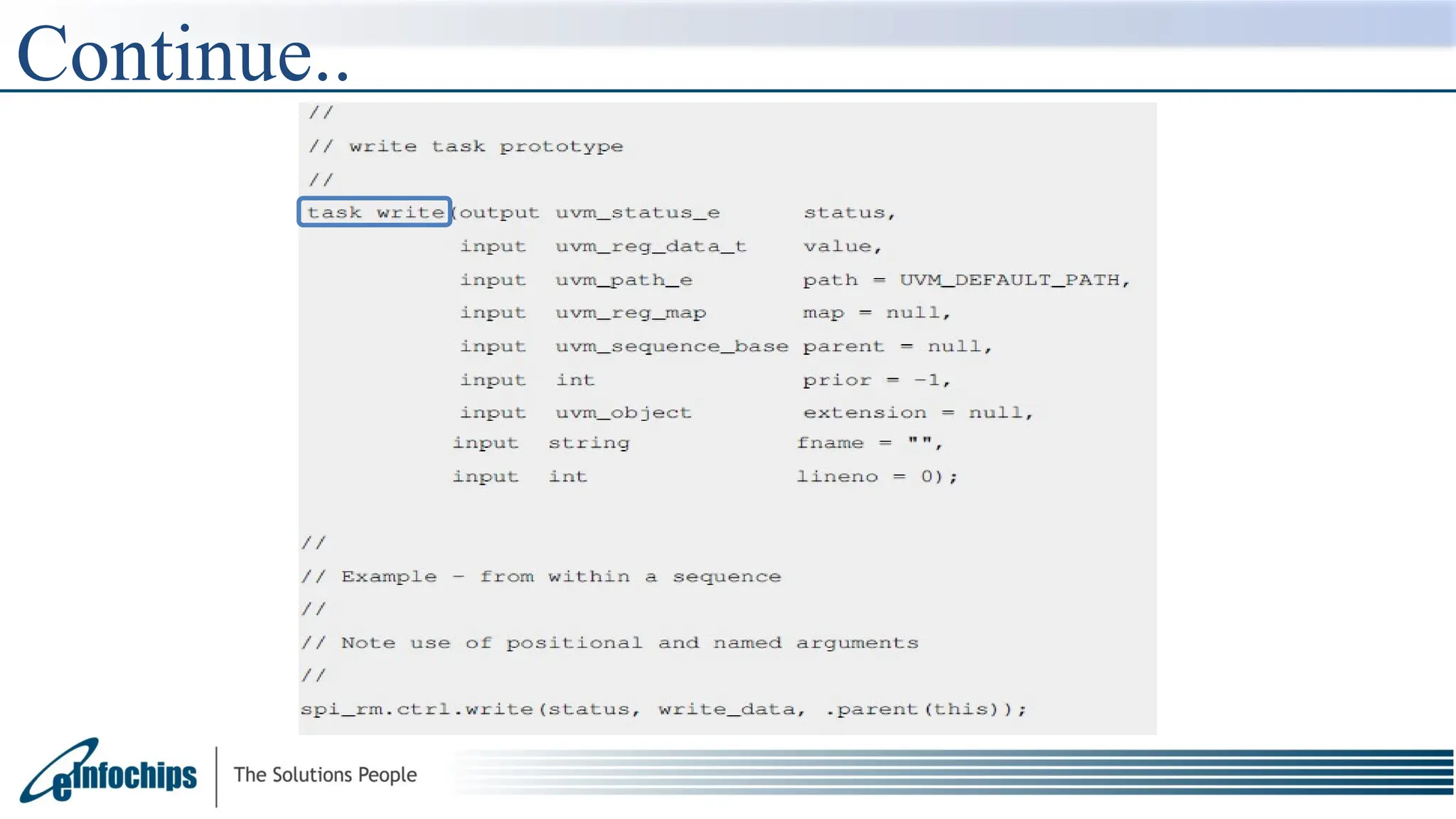
 The write() method writes a specified value to the target hardware register.
 Front door accesses the mirrored and desired values are updated by the bus
predictor on completion of the write cycle.
Here, First write a
value in DUT and at
same time update a
both value in RAL
Continue..
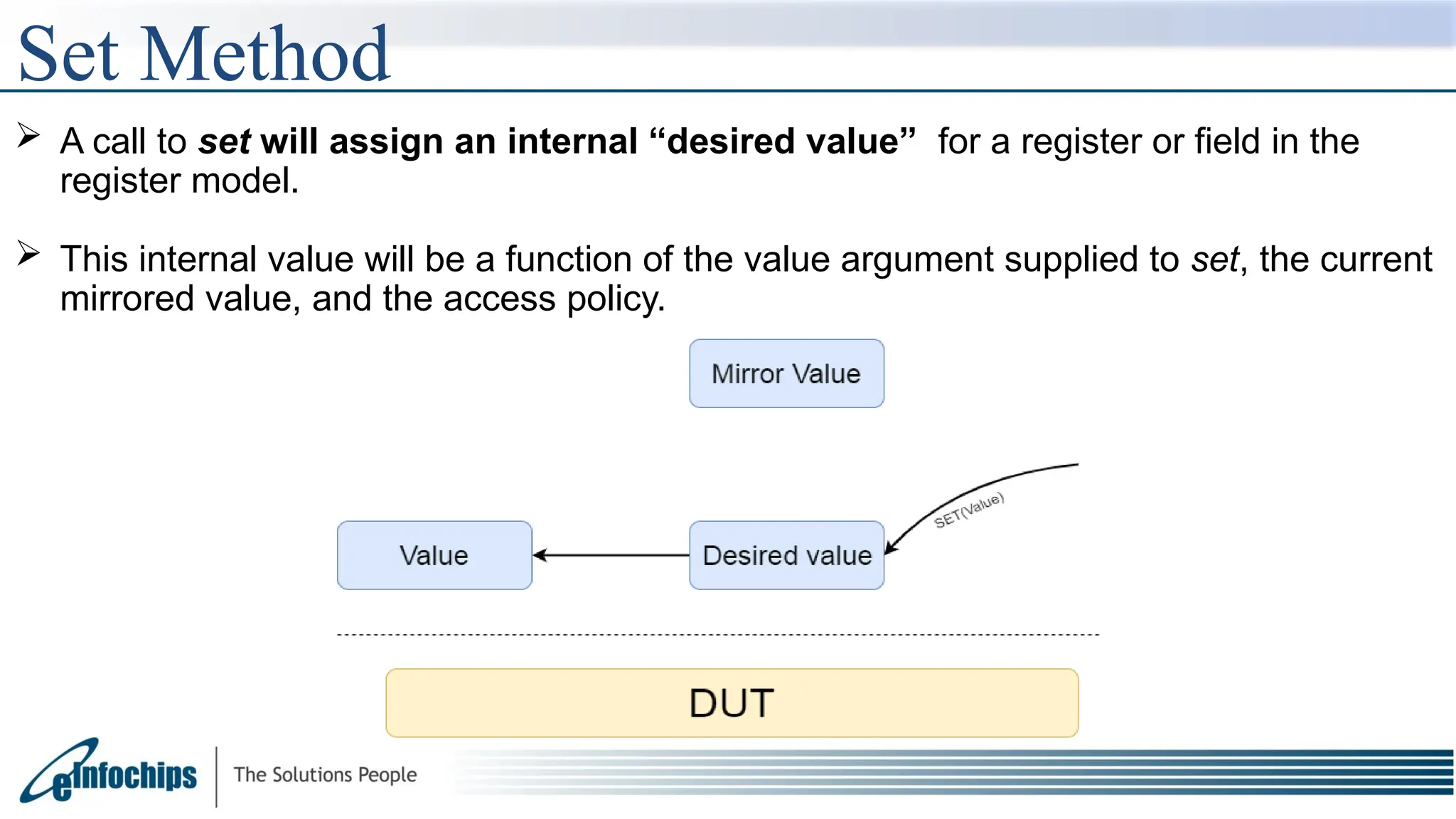
Set Method
 A call to set will assign an internal “desired value” for a register or field in the
register model.
 This internal value will be a function of the value argument supplied to set, the current
mirrored value, and the access policy.
Continue..
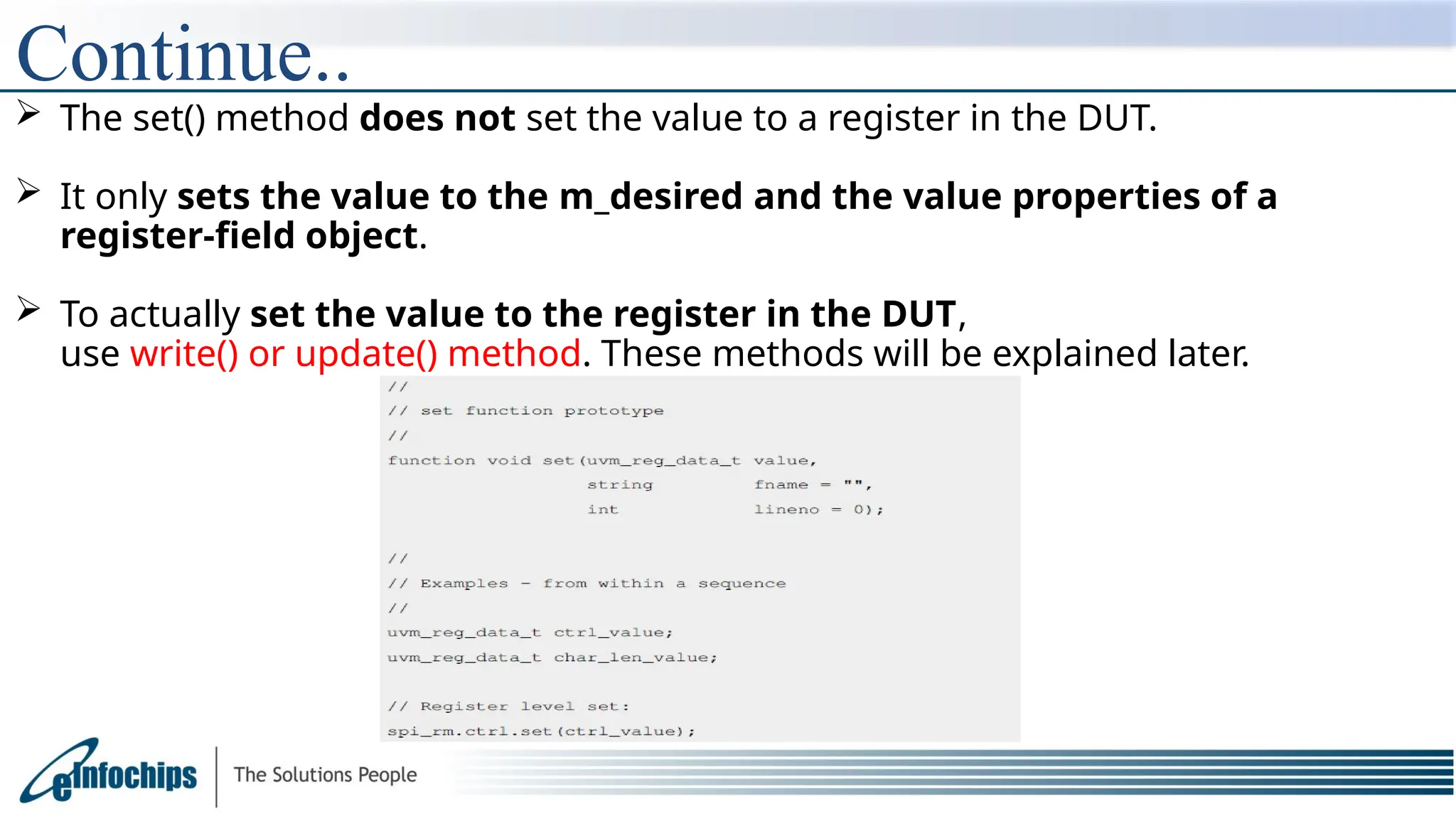
 The set() method does not set the value to a register in the DUT.
 It only sets the value to the m_desired and the value properties of a
register-field object.
 To actually set the value to the register in the DUT,
use write() or update() method. These methods will be explained later.
Get Method
 The get() method returns the calculated desired value of a register or a field.
The get_reset() retrieves
the value of
the m_reset[kind]
propery
The get_mirrored_value()
method retrieves the
value of
the m_mirrored property.
Continue..
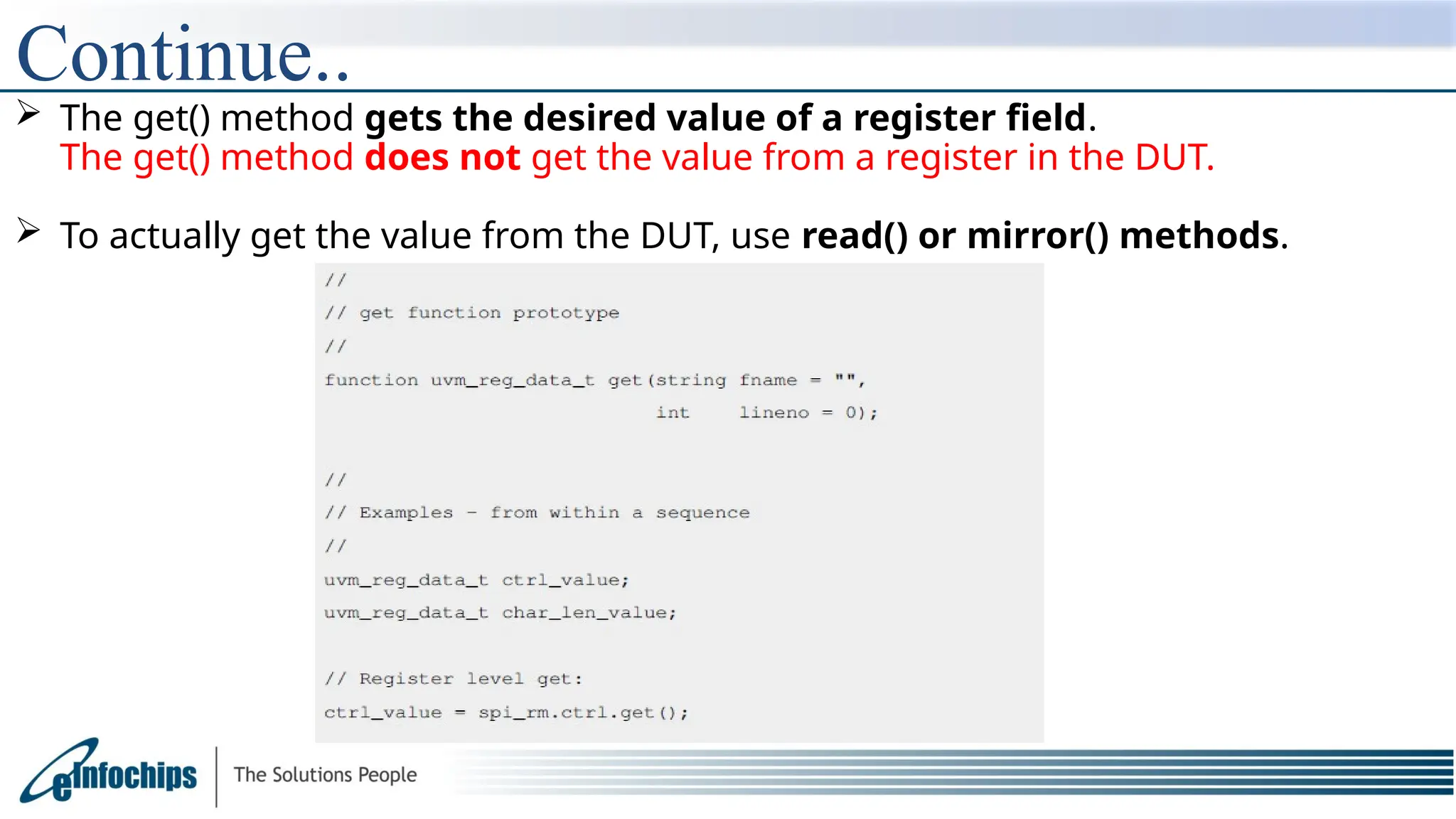
 The get() method gets the desired value of a register field.
The get() method does not get the value from a register in the DUT.
 To actually get the value from the DUT, use read() or mirror() methods.
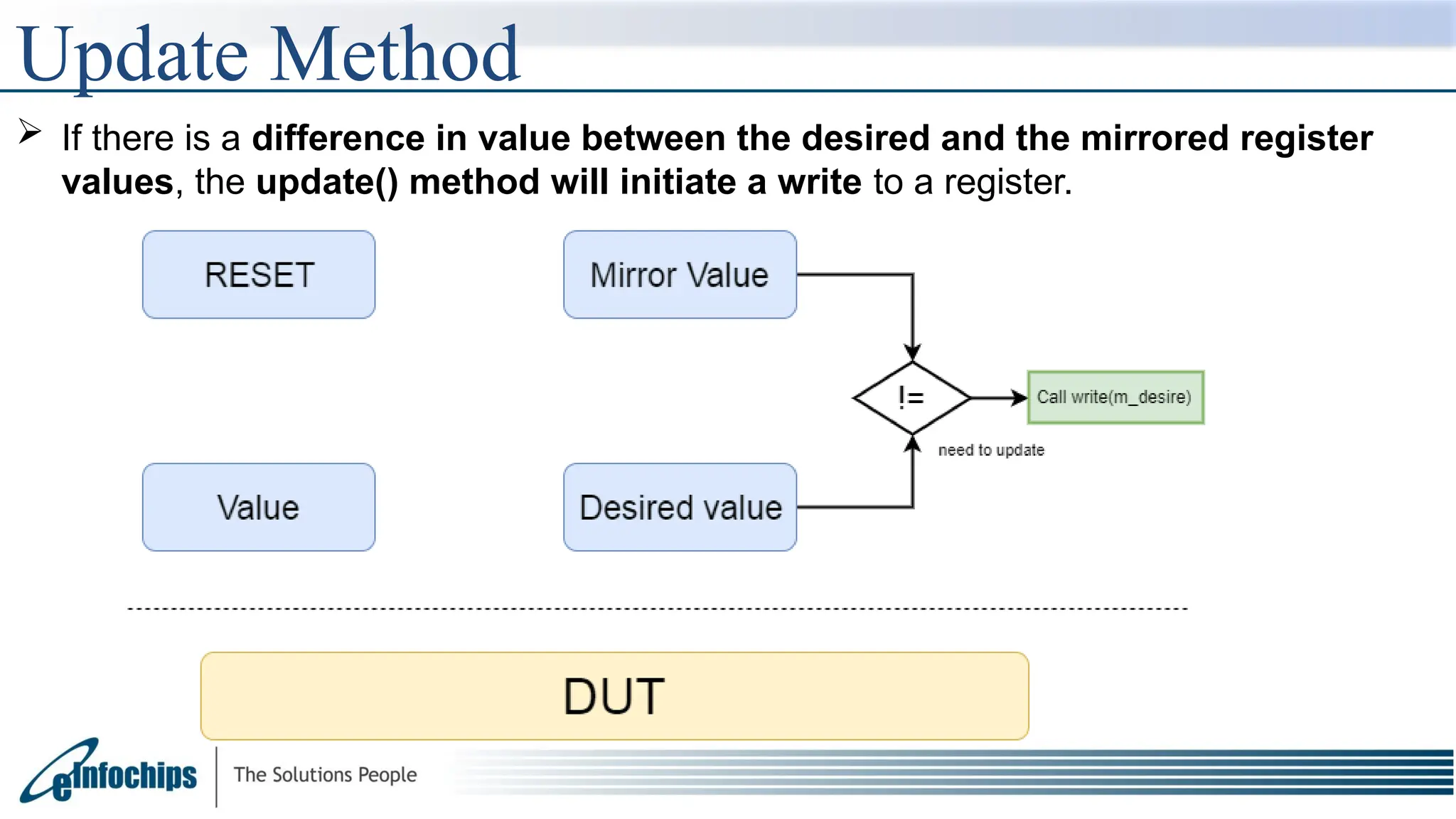
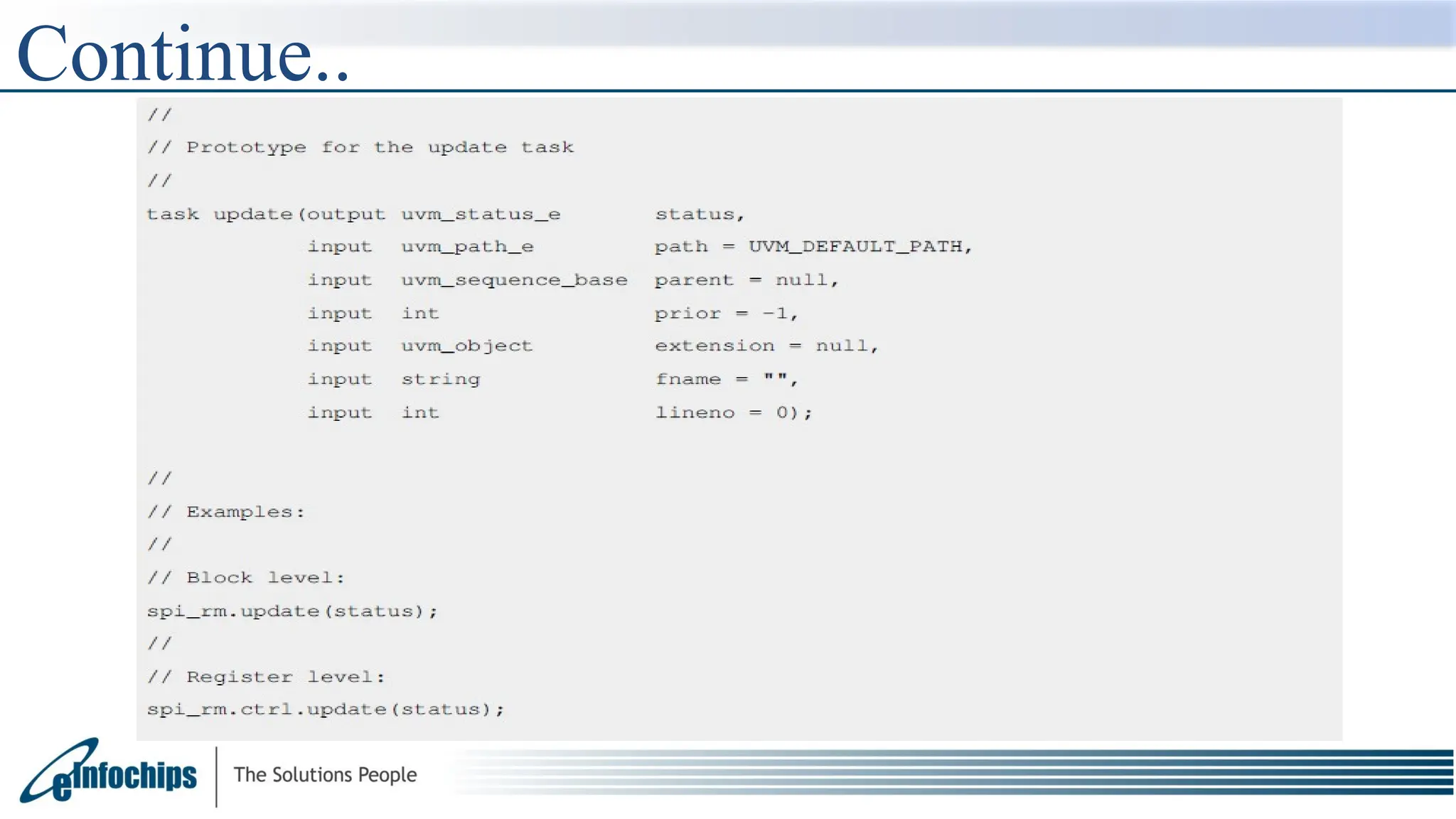
Update Method
 If there is a difference in value between the desired and the mirrored register
values, the update() method will initiate a write to a register.
Continue..
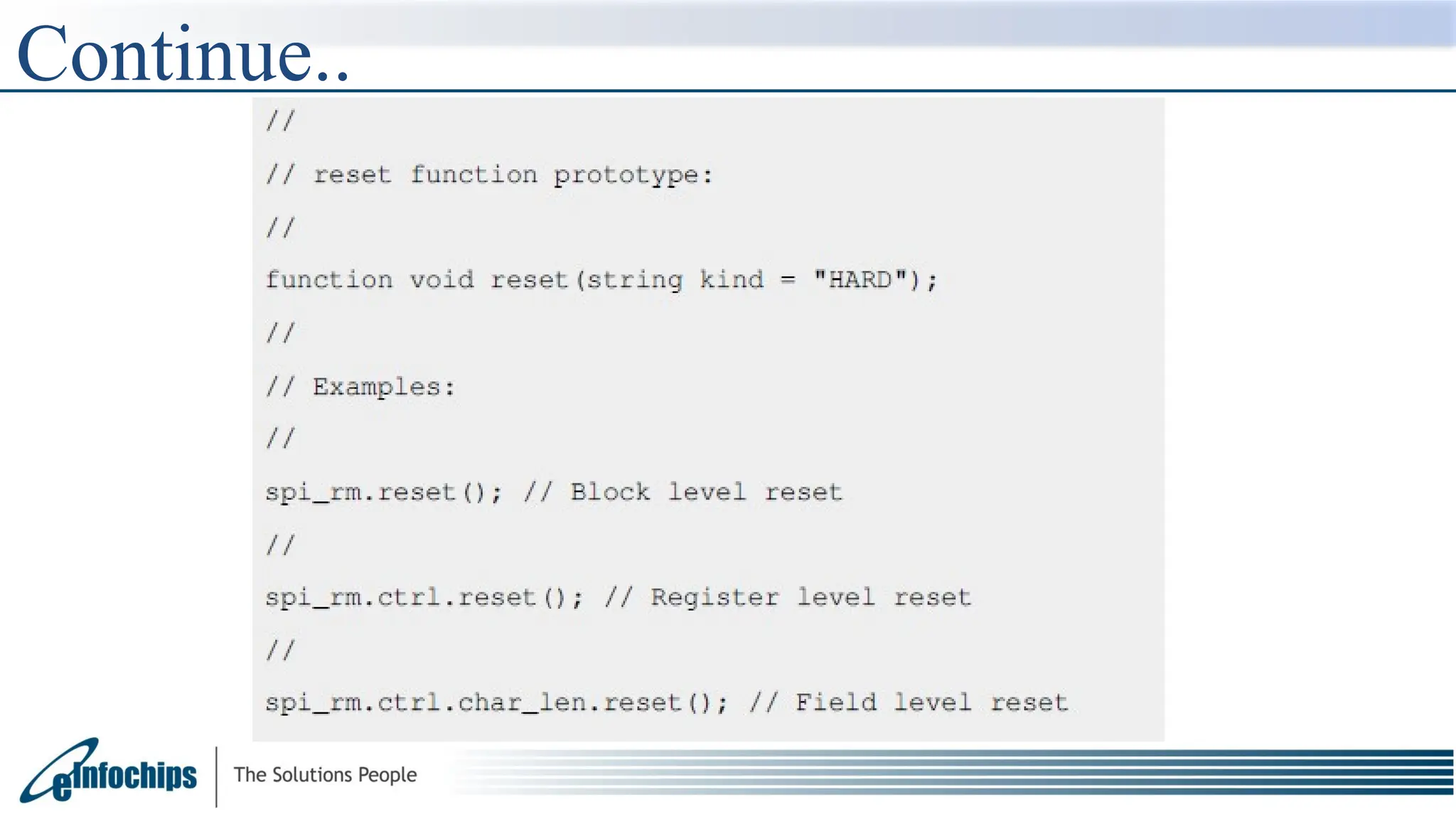
Reset Method
 The reset() method resets the properties of a register field, if
the m_reset[kind] exists.
 The default kind is "HARD". If the m_reset[kind] does not exist,
the reset() method does nothing.
 Note that the reset() method does not reset a register in the DUT. It only resets
the properties of a register-field object.
Continue..
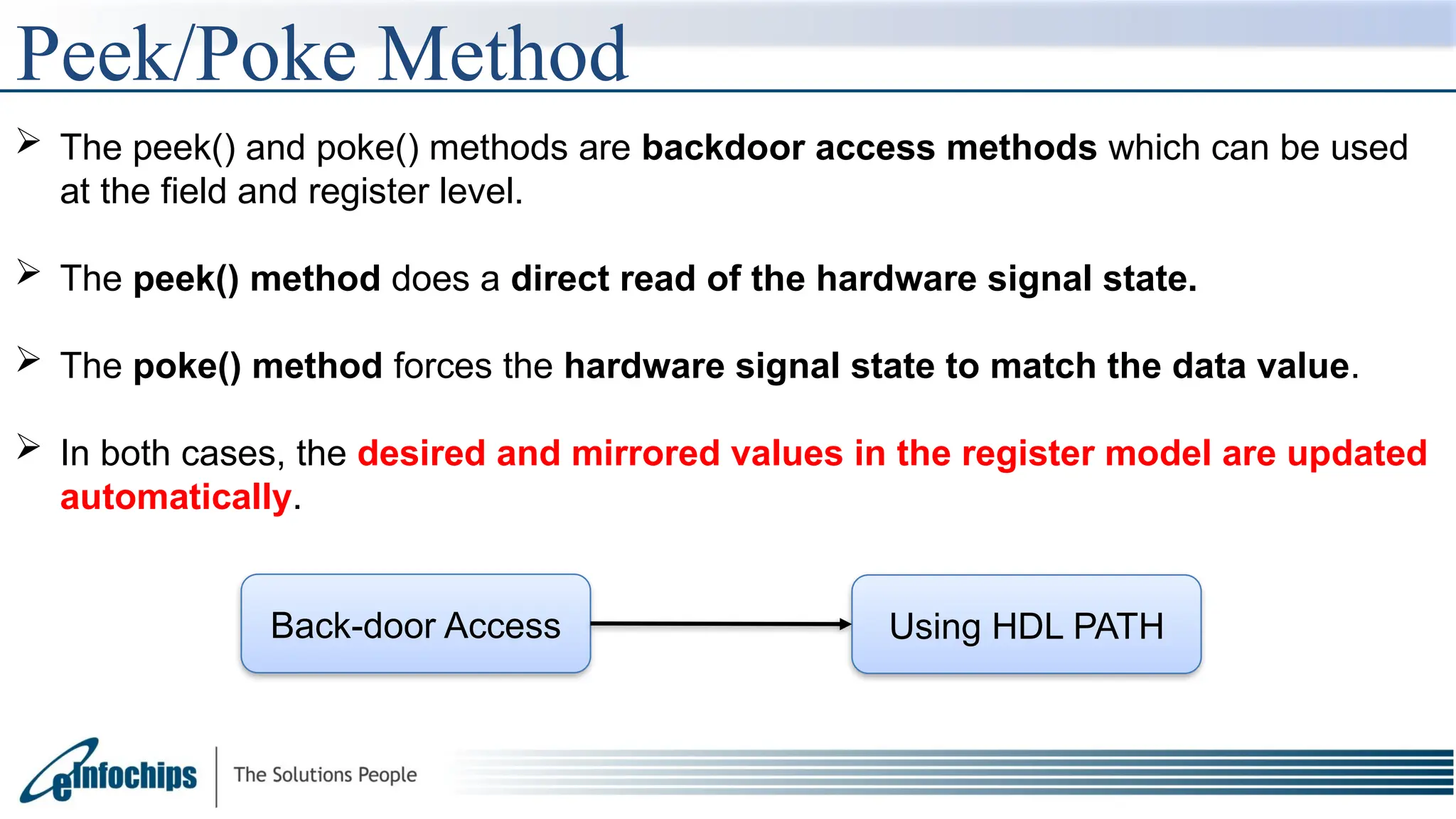
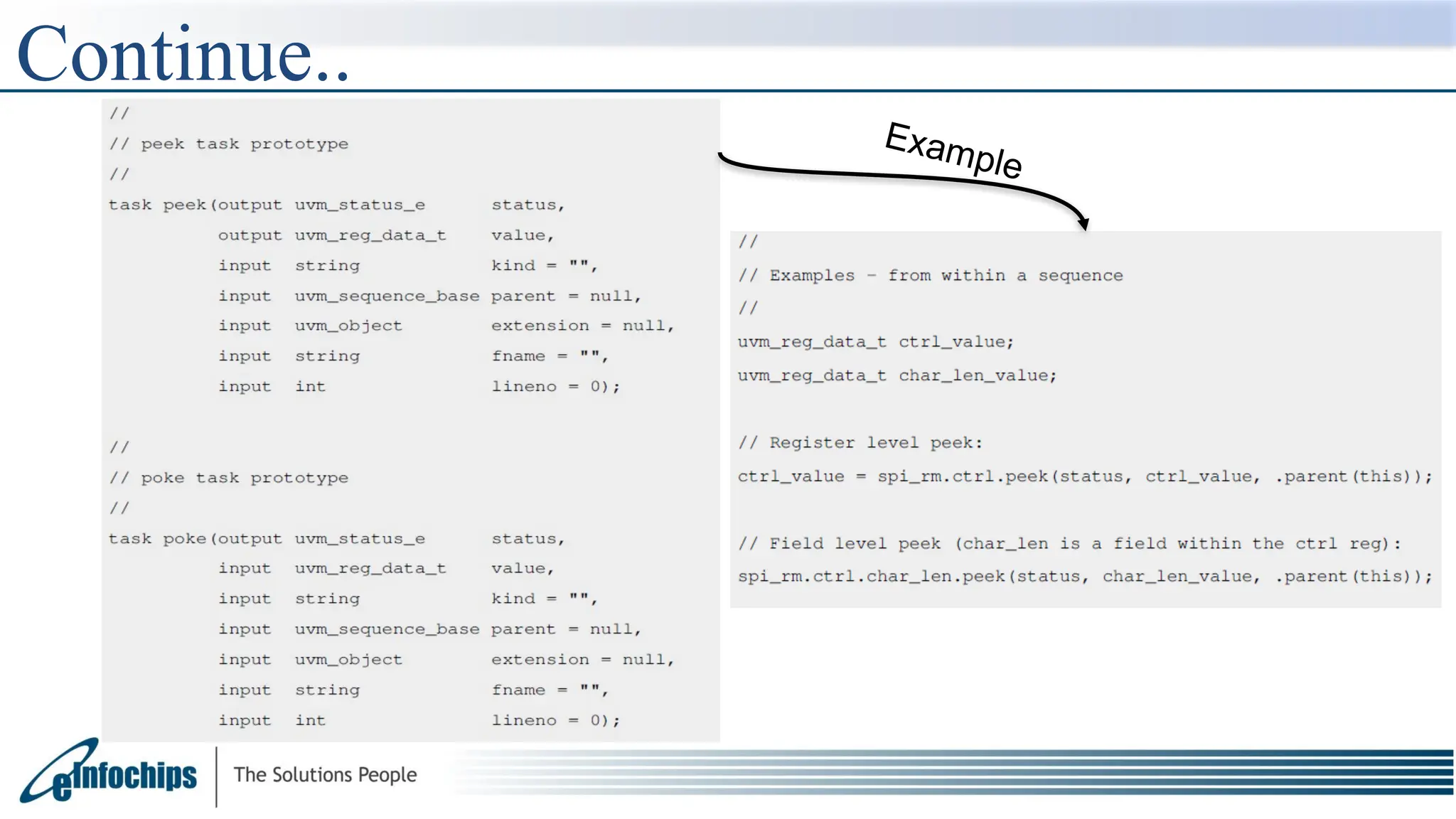
Peek/Poke Method
 The peek() and poke() methods are backdoor access methods which can be used
at the field and register level.
 The peek() method does a direct read of the hardware signal state.
 The poke() method forces the hardware signal state to match the data value.
 In both cases, the desired and mirrored values in the register model are updated
automatically.
Back-door Access Using HDL PATH
Continue..
Example
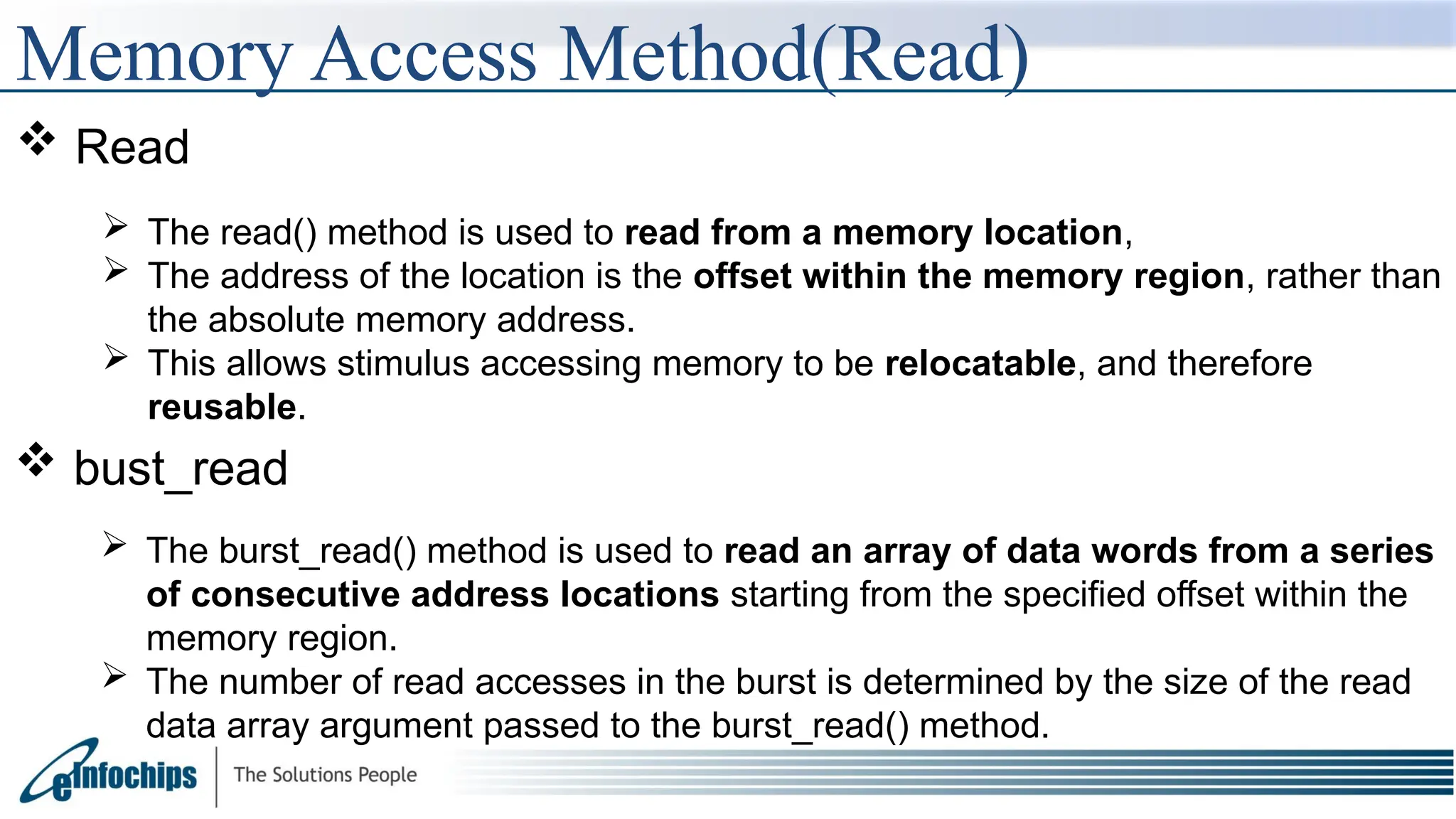
Memory Access Method(Read)
 Read
 The read() method is used to read from a memory location,
 The address of the location is the offset within the memory region, rather than
the absolute memory address.
 This allows stimulus accessing memory to be relocatable, and therefore
reusable.
 bust_read
 The burst_read() method is used to read an array of data words from a series
of consecutive address locations starting from the specified offset within the
memory region.
 The number of read accesses in the burst is determined by the size of the read
data array argument passed to the burst_read() method.
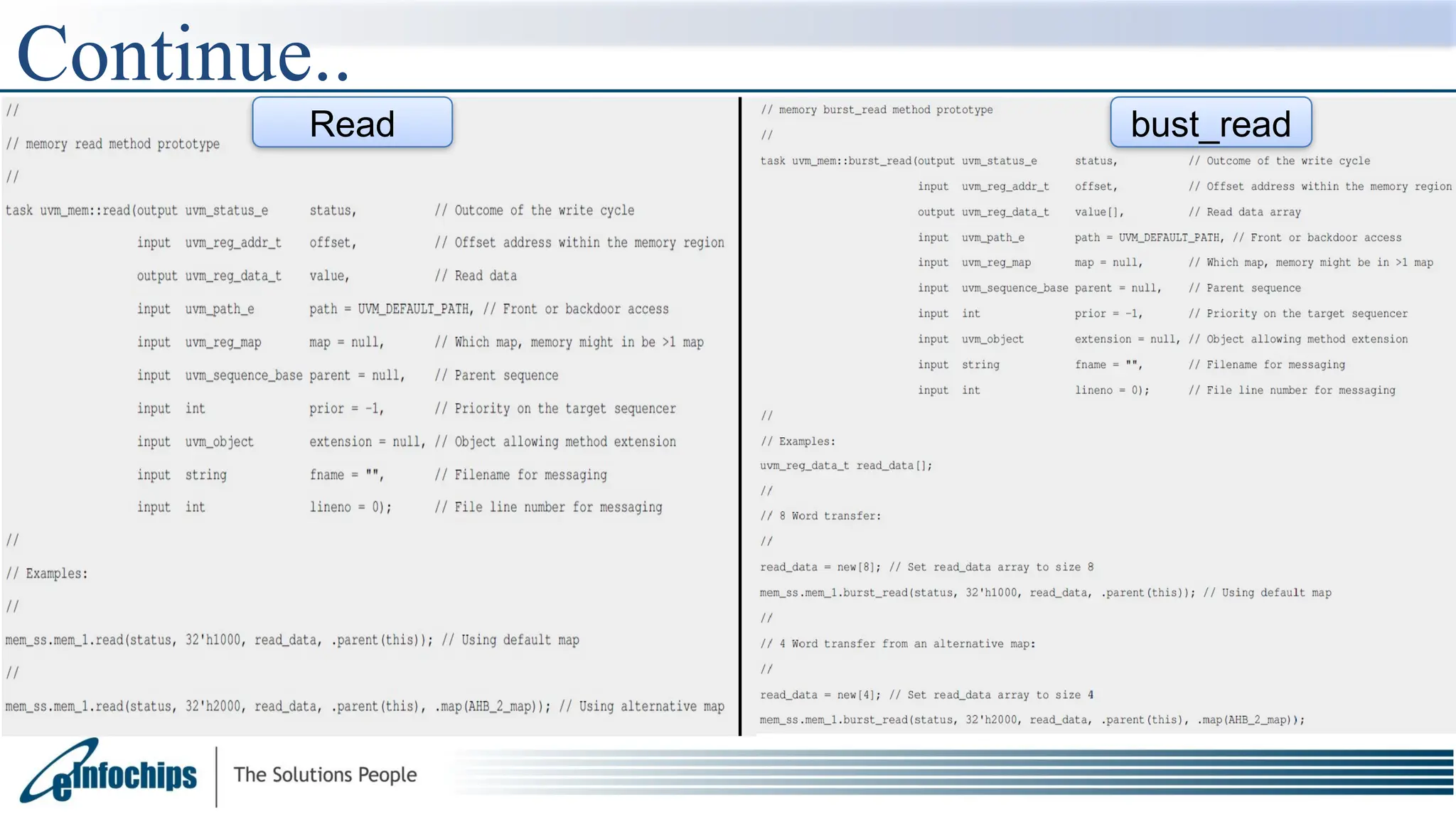
Continue..
Read bust_read
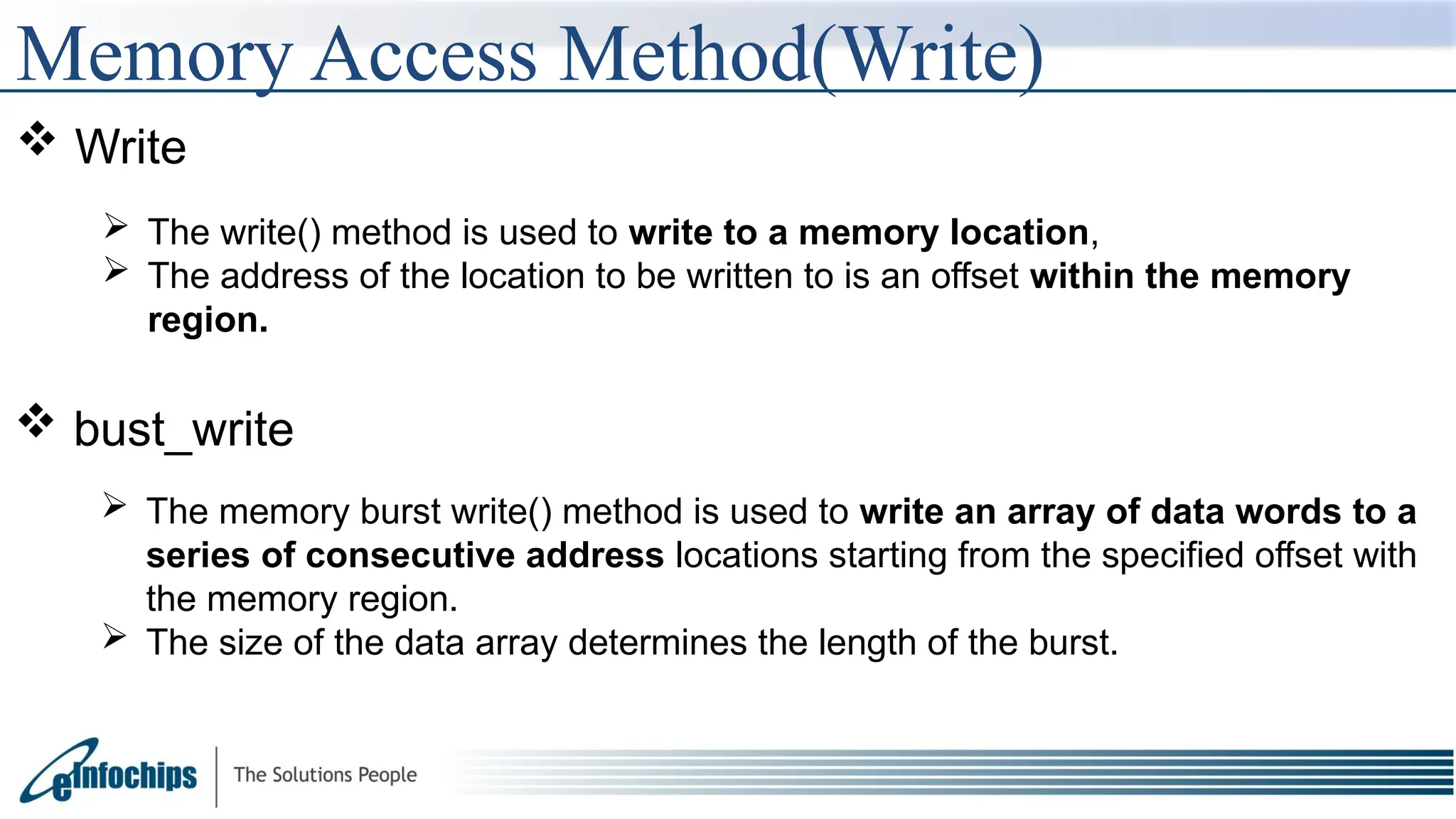
 Write
 The write() method is used to write to a memory location,
 The address of the location to be written to is an offset within the memory
region.
 bust_write
 The memory burst write() method is used to write an array of data words to a
series of consecutive address locations starting from the specified offset with
the memory region.
 The size of the data array determines the length of the burst.
Memory Access Method(Write)
Continue..
write bust_write
THANK YOU
Question/Answer

ral_ral_presentation Ral introduction and detailed information

  • 1.
  • 2.
    Register Abstraction Layer Whatis RAL(Register Abstraction Layer) ?  The UVM register model provides a way of tracking the register content of a DUT and a convenience layer for accessing register and memory locations within the DUT.  Basically, It is a method of verifying Register of DUT.  If Client DUT have maximum scenario covered by register that time we need to verified all Register of DUT and “test the corner scenario for Register”  Some time client need to verified only Register of DUT that time also we need a RAL model in UVM.
  • 3.
  • 4.
  • 5.
    Continue.. Main Component ofRAL 1. Adapter 2. Predictor 3. Database of Register Main Concept of RAL 1. Front-door Access 2. Back-door Access
  • 6.
    Adapter What is Adapter(Roleof Adapter in RAL) ?  The UVM register model access methods generate bus read and write cycles using generic register transactions.  These transactions need to be adapted to the target bus sequence_item.  The adapter needs to be bidirectional in order to convert register transaction requests to bus sequence items, and to be able to convert bus sequence item responses back to bus sequence items.  The adapter should be implemented by extending the uvm_reg_adapter base class.
  • 7.
    Implementing An Adapter The struct is defined as type uvm_reg_bus_op and this contains 6 fields:  These fields need to be mapped to/from the target bus sequence item and this is done by extending the uvm_reg_adapter class which contains two methods - reg2bus() and bus2reg() which need to be overlaid.  :
  • 8.
  • 9.
    Predictor  Using predictorUVM predict a value of register using two type of access, 1. Front-door Access 2. Back-door Access  Right now we have focus on Front-door Access,  components or sequences that use the register model, • The register model has to be constructed and its handle passed around using a configuration object or a resource.  Components and sequences are then able to use the register model handle to call methods to access data stored within it, or to access the DUT.
  • 10.
    Continue..  Front-door Access, •The register model supports front door accesses to the DUT by generating generic register transactions which are converted to target bus agent specific sequence_items before being sent to the target bus agents sequencer, • And by converting any returned response information back from bus agent sequence_items into register transactions.  In Predictor RAL Model have a three option, 1. Auto Predictor 2. Explicit Prediction 3. Passive Prediction
  • 11.
    Auto-Predictor • In thismode, the various access methods which cause front door accesses to take place automatically call a predict() method using either the data that was written to the register.
  • 12.
  • 13.
     In theexplicit prediction mode of operation an external predictor component is used to listen for target bus agent analysis transactions,  And then to call the predict() method of the accessed register to update its mirrored value.  Advantage, Continue.. • Explicit prediction is that it keeps the register model up to date with all accesses that occur on the target bus interface. • The configuration also has more scope for supporting Vertical reuse where accesses to the DUT may occur from other bus agents via bus bridges or interconnect fabrics.
  • 14.
    Passive-Predictor • In passiveprediction the register model takes no active part in any accesses to the DUT, but it is kept up to date by the predictor when any front door register accesses take place.
  • 15.
    Register Model  RegisterModel have a Different layer , 1) Register Field : Bit(s) grouped according to function within a register. 2) Register :Collection of fields at different bit offset. 3) Memory : Represents a block of memory which extends over a specified range. 4) Block : Collection of registers (Hardware block level), or sub-blocks (Sub system level) with one or more maps. May also include memories. 5) Map : Named address map which locates the offset address of registers, memories or sub-blocks. Also defines the target sequencer for register accesses from the map.
  • 16.
    Register Field  Thebottom layer is the field which corresponds to one or more bits within a register. Each field definition is an instantiation of the uvm_reg_field class.
  • 17.
    Register  Registers aremodelled by extending the uvm_reg class which is a container for field objects.  The register class contains a build method which is used to create and configure the fields.  Note : Build method is not called by the UVM build phase, since the register is an uvm_object rather than an uvm_component.
  • 18.
    Memory  Memories aremodelled by extending the uvm_mem class.  The register model treats memories as regions, or memory address ranges where accesses can take place.
  • 19.
    Register Map  Thepurpose of the register map is two fold. 1. The map provides information on the offset of the registers, 2. Memories and/or register blocks contained within it.  The map is also used to identify which bus agent register based sequences will be executed on,  however this part of the register maps functionality is set up when integrating the register model into an UVM test-bench.
  • 20.
  • 21.
    Register Block  Thenext level of hierarchy in the UVM register structure is the uvm_reg_block.  This class can be used as a container for registers and memories at the block level, representing the registers at the hardware functional block level,  As a container for multiple blocks representing the registers in a hardware sub-system or a complete SoC organised as blocks. • A register map has to be created within the register block using the create_map method
  • 22.
     The n_bytesparameter is the word size (bus width) of the bus to which the map is associated.  If a register’s width exceeds the bus width, more than one bus access is needed to read and write that register over that bus.  The byte_addressing argument affects how the address is incremented in these consecutive accesses.  For example, if n_bytes=4 and byte_addressing=0, then an access to a register that is 64-bits wide and at offset 0 will result in two bus accesses at addresses 0 and 1.With byte_addressing=1, that same access will result in two bus accesses at addresses 0 and 4. Continue..
  • 23.
    Lock_model()  Lock_model usedto finalize the address mapping and to ensure that the model cannot be altered by another user.
  • 24.
    Back-door Access  Touse backdoor accesses with the UVM register model, the user has to specify the hardware,or HDL path to the signals that a register model represents.  To aid reuse and portability, the HDL path is specified in hierarchical sections.  Therefore the top level block would specify a path to the top level of the DUT, the subsystem block would have a path from within the DUT to the sub-system, and a register would have a path specified from within the sub-system.  The register level HDL path also has to specify which register bit(s) correspond to the target HDL signal.
  • 25.
     As anexample, In the SPI master testbench, the SPI master is instantiated as "DUT" in the top level testbench,  so the hdl path to the register block (which corresponds to the SPI master) is set to "DUT".  Then the control register bits within the SPI master RTL is collected together in a vectored reg called "ctrl", so the hdl path to the control register is DUT.ctrl. Continue.. HDL Path (Back- door access).
  • 26.
  • 27.
    UVM Register AccessMethods  First of all user need a understand two word, 1. Mirror Value 2. Desired Value  UVM Register access methods, 1. Read and Write Method 2. Set/Get 3. Update 4. Peek and Poke 5. Reset 6. get_reset/get_mirror_value
  • 28.
    Desired/Mirror value  DesiredValue :The desired value represents a state that the register model is going to use to update the hardware, but has not done so.(Expected Value)  Mirror Value : The mirrored value represents the current known state of the hardware register(Actual Value). • The desired value allows the user to setup individual register fields before doing a write transfer. • The mirrored value is updated at the end of front bus read and write cycles either based on the data value seen by the register model(auto-prediction) or based on bus traffic observed by a monitor and sent to predictor that updates the register model content (recommended approach for integrating the register model).
  • 29.
    Read Method  Theread() method returns the value of the hardware register.  When using front door accesses, calling the read() method results in a bus transfer and the desired and mirrored values of the register model are updated by the bus predictor on completion of the read cycle. Here, Register Value are already in DUT, so this method read and update both value.
  • 30.
  • 31.
    Write Method  Thewrite() method writes a specified value to the target hardware register.  Front door accesses the mirrored and desired values are updated by the bus predictor on completion of the write cycle. Here, First write a value in DUT and at same time update a both value in RAL
  • 32.
  • 33.
    Set Method  Acall to set will assign an internal “desired value” for a register or field in the register model.  This internal value will be a function of the value argument supplied to set, the current mirrored value, and the access policy.
  • 34.
    Continue..  The set()method does not set the value to a register in the DUT.  It only sets the value to the m_desired and the value properties of a register-field object.  To actually set the value to the register in the DUT, use write() or update() method. These methods will be explained later.
  • 35.
    Get Method  Theget() method returns the calculated desired value of a register or a field. The get_reset() retrieves the value of the m_reset[kind] propery The get_mirrored_value() method retrieves the value of the m_mirrored property.
  • 36.
    Continue..  The get()method gets the desired value of a register field. The get() method does not get the value from a register in the DUT.  To actually get the value from the DUT, use read() or mirror() methods.
  • 37.
    Update Method  Ifthere is a difference in value between the desired and the mirrored register values, the update() method will initiate a write to a register.
  • 38.
  • 39.
    Reset Method  Thereset() method resets the properties of a register field, if the m_reset[kind] exists.  The default kind is "HARD". If the m_reset[kind] does not exist, the reset() method does nothing.  Note that the reset() method does not reset a register in the DUT. It only resets the properties of a register-field object.
  • 40.
  • 41.
    Peek/Poke Method  Thepeek() and poke() methods are backdoor access methods which can be used at the field and register level.  The peek() method does a direct read of the hardware signal state.  The poke() method forces the hardware signal state to match the data value.  In both cases, the desired and mirrored values in the register model are updated automatically. Back-door Access Using HDL PATH
  • 42.
  • 43.
    Memory Access Method(Read) Read  The read() method is used to read from a memory location,  The address of the location is the offset within the memory region, rather than the absolute memory address.  This allows stimulus accessing memory to be relocatable, and therefore reusable.  bust_read  The burst_read() method is used to read an array of data words from a series of consecutive address locations starting from the specified offset within the memory region.  The number of read accesses in the burst is determined by the size of the read data array argument passed to the burst_read() method.
  • 44.
  • 45.
     Write  Thewrite() method is used to write to a memory location,  The address of the location to be written to is an offset within the memory region.  bust_write  The memory burst write() method is used to write an array of data words to a series of consecutive address locations starting from the specified offset with the memory region.  The size of the data array determines the length of the burst. Memory Access Method(Write)
  • 46.
  • 47.