One Week Course
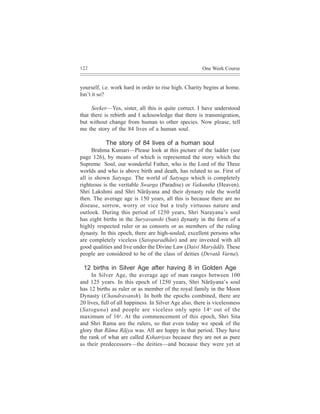
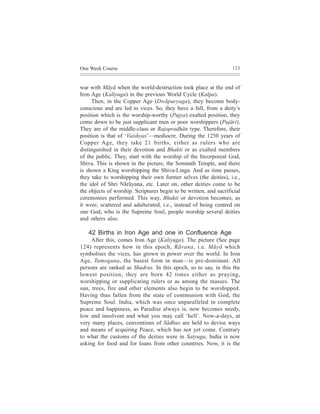
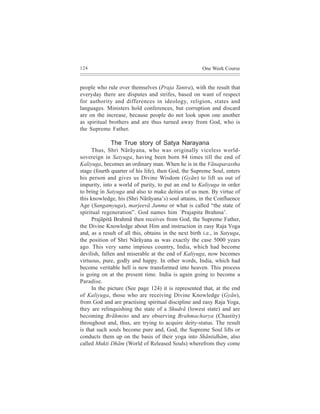
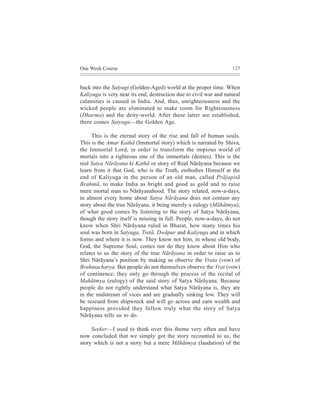
For attainment of Complete Purity, Peace
             and Prosperity


                   Script by :
         Raja Yogi B.K. Jagadish Chander


        Prajapita Brahma Kumaris
       Ishwariya Vishwa-Vidyalaya
     Pandav Bhawan, Mount Abu, Rajasthan.
One-Week Course of
                  Godly Knowledge

T     he study or recitation of sacred texts for one week continuously
    is considered in India to be of special sanctity and of great spiritual
merit. Here, it is customary for the religious-minded people to arrange
for one-week recitation of a scripture, styling it as ‘Shrimad Bhagwat
Week’ or ‘The Gita Week’. It would be worth-while to know how and
when this practice or tradition of holding seven-day religious
congregations for reading out the legends or scriptures started.
      Commonsense and experience explain that in the beginning when
God, the Knowledgeful, delivered Holy Knowledge to the mankind
through the corporeal medium of Prajãpita Brahmã, also known as
‘Adam’ in other principal religions, the Brahmins (spiritual progeny of
Brahma or Adam) took about a week to impart the essence of that
divine knowledge to others by word of mouth. Much later, when that
ancient knowledge was put to writing in the form of voluminous scriptures
or legends, the orthodox people took to the practice of week-long
recitation of those books by dividing the whole mass of written material
of a particular scripture into seven parts. As time passed, people of
other faiths, such as the Sikhs also adopted this old tradition of week-
long reading-aloud of their own sacred books.
      But, when the practice of week-long recitation of scriptures or
mythological tales started, then the essence of the original righteous
knowledge, revealed by God Himself, had gone into oblivion and the
real, righteous and soul-conscious Brahmins, regenerated by God through
Brahmã’s mouth (i.e., by means of oral discourses) had become non-
existent. Then, neither the seekers had that zest and earnestness nor
they put into practice the spiritual discipline and code of righteous conduct
that had been prescribed for a person having aspiration to listen to seven-
day discourse. Barely the tradition of reading aloud of the scriptures for
one week continuously remained to be.
      Now, the time has reached its tail-end of Kaliyuga and ‘Shiva’,
the Knowledgeful Incorporeal God, has been revealing again, since the
past several years, that original, primeval, real knowledge or divine
wisdom. That very Holy Knowledge is discoursed in brief by the
Brahmins now regenerated through the mouth of Prajãpita Brahmã, to
those who seek it. That Godly Knowledge, based on practical experience,
and being discoursed orally, has been compiled and edited into the form
of this book written in common language and easy-to-understand style.
It is hoped that the seekers-after-truth would study it with their mind set
on attainment of virtue and truth and would derive the maximum benefit
by studying it over again and would further think of learning the practice
of Yoga and the valuable hints for being able to score a victory over the
vices and would set to sincere endeavours for a life of complete purity
and firm Yoga.
       It should be noted that observance of certain spiritual principles is
absolutely necessary for deriving full benefit out of the study of this
book—‘ONE-WEEK COURSE’. One should observe chastity
(Brahmacharya), should look on all living beings as so many ‘Souls’,
should take only Sattwic diet, should abstain from meals prepared by
vicious people and should shun bad company. There is not an iota of
doubt that one who observes these principles willingly, sincerely and
fully, will benefit a lot from the exhilarating Divine Knowledge embodied
in the following pages of this book.
       As a matter of fact, it is demanded of a keen spiritual aspirant that
he should try to practise soul-consciousness continuously and set his
mind to continuous remembrance of God, the most beloved Father and
should keep his mind busy with the study, recapitulation, and rumination
of this wonderful knowledge and also with the effort to inculcate Divine
Qualities in himself. He should observe more silence and should speak
less and at low pitch and should not allow himself to be affected by any
vice or any evil thought. This would make the study of real akhand
patha (continuous reading) and this is how the Akhand Patha or
Sãptahik Pãtha (One Week Study) originated. Without continuous
practise of soul-consciousness and remembrance of God, it would not
be truly an ‘Akhand Pãtha’ because the very essence or object of this
study is the attainment of soul-consciousness and fixity in Yoga.
       It is sincerely hoped that by hearing, reading, recapitulating and
practising this Knowledge and Yoga in the aforesaid manner, man would
attain purity, peace and bliss and would feel himself a highly blessed
and lucky person.

                                                                 —Author
CONTENTS
                                                                                      Page

 Introduction to Ishwariya Vishwa-Vidyalaya of
 Brahma Kumaris ...................................................................... 9

(1) The aims and objects of this Ishwariya Vishwa-Vidyalaya.
(2) The need for this Institution. (3) What service is this Institution
doing? (4) Why is it called a ‘Vishwa-Vidyalaya’? (5) The significance
of the word ‘Brahma Kumaris’. (6) What is the proof that this Institution
gives knowledge revealed by God Himself? (7) Visitors’ Introduction
Form.


 FIRST DAY — What am I?...................................................27

(1) What is a soul? What are mind, intellect and samskarãs?
(2) Where in the body does the soul dwell? (3) What is the form of the
soul and where it has come from? (4) Mystery of Three World revealed.
(5) Does the soul have physical rebirths?


 SECOND DAY — Who is God? Has God any form?
 Can we see Him? ................................................................... 47

(1) Why are there divergent beliefs about God? (2) Who is God and
what divine form has He? (3) The real meaning of the word ‘Nirãkãr’.
(4) The Divine Name of God. (5) The attributes of God and His
relationship with other souls. (6) If God is not Omnipresent, how is He
All-Knowledgeful? (7) If God is not Omnipresent, how does He create,
sustain and destroy the world? (8) If mankind had known that Shiva is
God, the World-History would have been different.


 THIRD DAY — What does God do and what does
 He not do? ............................................................................... 75

(1) Is it God who creates bodies and makes the rain fall? (2) Was this
world created by God? (3) What part does God play in this eternal
World Drama? (4) When does the world need God to act? (5) How
does God transmute man into deity? (6) Difference between Shiva and
Shankara. (7) The descent of God into the body of an incognito person.
(8) The name of that person in whose body God Shiva embodies Himself.
(9) The significance of the period, called the ‘Confluence Age’. (10)
World-Destruction—when and how? (11) How is the world sustained
through Vishnu? (12) The most esoteric knowledge about the identical
repetition of World History. (13) The duration of one World-Cycle.


 FOURTH DAY — God’s creation — The Human
 World depicted as an Inverted Tree ................................... 97

(1) History of Golden Age and Silver Age. (2) Establishment of other
religions. (3) Short history of Iron Age. (4) Extreme decay of religion
and the invention of Moosals or Missiles for the destruction of the
world. (5) When does God incarnate and in what carnate form? (6)
What Period are we passing now? (7) Does a soul ever merge in God?
(8) Shivaratri—The festival celebrated to commemorate God’s Divine
Birth.


 FIFTH DAY: The story of rise and fall of human souls.
 Does a human soul transmigrate into
 animal species? .................................................................... 118

(1) Human souls do not transmigrate into other species to undergo reform.
(2) Human soul can be intellectually a beast but not in physical form.
(3) Continuous increase in human population disproves the theory of
the change of species. (4) Newspaper reports. (5) The story of 84 lives
of a human soul. (6) The True story of Satya Narayana. (7) Does the
soul go to Heavenly Abode after death? (8) What does ‘Marjeeva
Janam’ mean?


 SIXTH DAY — Revelations about the Real name
 of the Religion of the people of Bharat and
 their Scripture? ................................................................... 134

(1) The real name of the religion of the people of India. (2) The name of
the scripture of followers of Adi Sanãtan Devi-Devatã Dharma. (3)
Does Gita contain the Sermons of the deity Krishna or God Shiva? (4)
Did the God-Sermonizer of Gita goad Arjuna for a violent battle? (5) Is
it necessary to know who was the real Sermonizer of Gita? (6) The
harms because of ignorance about the Sermonizer of Gita? (7) Why
does a rosary contain 108 beads? (8) What efforts have we to make
now? (9) Vaijayanti Mala or Rosary.


 SEVENTH DAY — The ancient-most Easy Raja
 Yoga of India ......................................................................... 151

(1) The meaning of ‘Yoga’. (2) The knowledge of our relationship with
God. (3) What do we attain by having a link with God?
(4) Withdraw yourself from sense-organs like a tortoise. (5) Is
Remembrance of God difficult to practise? (6) How to Practise yoga?


 EIGHTH DAY: Huge Contrast between the teachings
 of God and the teachings of men. ..................................... 173

(1) The benefit one gets by understanding the picture of Three Worlds.
(2) The benefits one gets by learning about the Acts of God, and about
the World-Wheel. (3) What do we gain by acquiring the knowledge of
World Tree or Kalpa Tree? (4) The use of knowing the story of 84
lives? (5) The attainment that comes of understanding the name of our
Religion and the Gita-Sermonizer, and the secret of the Rosary of 108
beads. (6) What leads us to believe that this Knowledge is being revealed
by God Himself?


 A class at the Ishwariya Vishwa-Vidyalaya ....................... 195
Introduction to Ishwariya
        Vishwa-Vidyalaya of Prajapita
               Brahma Kumaris

N     ow-a-days, at the numerous schools and universities of the
     world, students learn certain secular subjects such as language,
history, geography, science, civics, laws, customs and traditions of their
land. This helps them in some ways and, through higher studies in these
subjects, they attain some status also such as that of a professor, a
doctor, a lawyer or an engineer. Thereby, they acquire some happiness
too, but that is not in full measure and all round* but is only trivial and
short-lived. The aim of spiritual education at this Divine Vishwa-Vidyalaya
is to enable people to divinise themselves so that they can attain the
highest stage or status like that of Shri Nãrãyana and Shri Lakshmi, the
famous deities who had all kinds of happiness, in full measure. The
object of this education is to guide man to attain Release (Mukti) from
all kinds of sufferings and to be a devata (deity), i.e. to have divine
qualities. Therefore, great stress is laid, here, on character-building
and on cultivating in one’s self, divine qualities and on following the
divine line (Divya Mariyada). By means of this education, man receives
guidance and the might to be able to overcome sex-lust, anger, greed,
attachment and arrogance, and thus to rise from the depths of
degradation to the pinnacle of Purity. In other words, practical training
is imparted here to help man achieve complete purity of thought, word
and deed.

                   The Aims and Objects of this Ishwariya
                            Vishwa-Vidyalaya
      It is known to all that vices** or evil acts bring sorrows and
sufferings in our lives. We have, therefore, to replace these vices by
divine qualities and have to become holy. Without purity or righteousness
of conduct, it is impossible to have true happiness and lasting peace and
to lead a life absolutely free of all kinds of sufferings.
      But, in order to attain purity or uprightness of character, we need
not leave our hearth and home and community-life, like ascetics
*Health, Beauty, Wealth, good friends and relatives and good character are some of the
factors that bring a man happiness. One does not attain all these, in full measure, through
University education.
**Sex-lust, Anger, Greed, Attachment, Pride and Laziness are the six main vices.
8                                                         One Week Course


(Sannyasis) to jungles. Certainly, we need not adopt such a course. In
fact, the word ‘purity’ implies that we should remain untouched by evil
while living with our family and community even as a lotus remains
untouched by the mire in which it grows. But, to-day, man has not the
knowledge which would teach him how to be pure and taintless, nor he
has the necessary will power and spiritual strength to overcome the
vices. To fulfil this necessity, Divine Knowledge is given here that enables
one to know the self(soul), the Supreme Soul or God and also the full
course of the cycle of the universe or, in other words, the story of the
soul’s 84 lives in the World Cycle, and thus to know all about the past,
the present and the future and to attain self-realisation and God-
realisation. Here is also taught the easy Raj Yoga by means of which
man, having linked his soul to the Supreme Soul, achieves, in practical
life, deep peace, spiritual might, transcendental bliss and untold happiness
and, having scotched the Karmic debt and evil doings of his past many
lives, becomes completely pure, calm and happy for ever. At this Vishwa-
Vidyalaya men, women and children, in fact whole families, are receiving
instruction in Divine Knowledge and Yoga and are attaining purity and
supesensuous happiness.

                      The need for this Institution
      The Seeker—Dear Sister, there are, these days, so many religious
institutions, I would, therefore, like to know what is peculiar to this
institutions? How did there arise the need for this particular religious
organisation? Other religious societies also urge on us the need to
renounce vices. So, is there anything new and special about this Brahma
Kumaris’ Movement?
      Brahma Kumari—No doubt, there are very many religious
organisations preaching ‘Dharma’(Religion). But ‘Dharma’ truly means
‘Dharna’, i.e., attainment of Purity and inculcation of divine qualities in
the self and the acquisition of higher values in one’s life. Now one has
to judge whether with the advent of these numerous religious societies,
man’s life has improved; or do we notice ever-increasing strife and
degeneration all around us? Has man’s conduct and character been
satisfactorily elevated by his affiliation to religious institutions or the
moral values are being neglected in practical life?
      Now, this institution, known as ‘Prajapita Brahma Kumaris
Ishwariya Vishwa Vidyalaya’, is making earnest and concerted efforts
One Week Course                                                           9


to build man’s character to bring about transformation in his behaviour
and to ennoble his conduct. Here, we do not merely sermonize or advise
people to give up vices but everyone is given practical guidance and
individual attention to enable him to achieve this aim. Here, sincere and
sustained efforts are made to help man render righteous his habits of
food, his thought, speech and action and his ways of life. If you listen to
the experiences of those who have been attending the spiritual classes
for some time now, you will be able to appreciate the difference between
how they led their lives before they came in touch with this institution
and how greatly changed these men and women have become since.
You will find how a noteworthy transformation has taken place and
how, while living with their kith and kin, they are getting rid of the vices
and are leading a life of purity and peace.
      You say that there are numerous religious organisations in the world,
but I would ask you to carefully review the current world-situation and
judge whether there is not a great decay in Religion (Oece&-iueeefve)
and aversion to religious belief. You must have observed that people
today go to temples and worship Shri Lakshmi and Shri Narayana, Shri
Sita and Shri Rama and other gods and goddesses or they go to churches
and mosques but they do not have any virtues in themselves; rather,
they are full of vices. While singing hymns of praise upto the deities, or
unto God or unto some prophet these people say, “Lord, Thou art
possessed of all good qualities, thou art completely viceless, thou art
model of what excellent soul ought to be...”, but they are themselves
possessed of all evil qualities, are thoroughly vicious and are the very
opposite of excellence. They perform the prescribed rituals1 but they
do not improve their character or actions. They are caught in the meshes
of custom and false conventional propriety2 and remain unhappy inspite
of pilgrimages and austerities and similar observances. They recite
sacred songs of Peace3 but, soon after, abandon themselves to anger
and disquiet.
      Tell me where is the spiritual outlook today which people ought to
have? Where is the mutual regard and love? Well, man has made
advances in science and has landed on the Moon, but, from the point of
view of morals, high ideals, righteous dealings and good conduct, man
has definitely gone down. In short, true Religion has mostly vanished.

1.Karma Kanda             2.Aasuri Maryada   3.Meeefvle Hee"
10                                                         One Week Course


      So, the aim of this Divine Vishwa-Vidyalaya or Brahma Kumaris
Ishwariya Vishwa-Vidyalaya is to make re-known and to re-establish
the righteous way of life, i.e., the Religion of the Devatas that has been
lost and to bring in, thereby, the deity-civilisation. From this standpoint,
this institution does not propagate any new faith, but it is training people
to put, once again, into practice the religion that was once of the holy
and the righteous, such as of Shri Lakshmi and Shri Narayana, of Shri
Rama and Shri Sita, but on which people have now turned their backs.
But, because that Knowledge for higher practical life has since long
been forgotten, so the whole of it will appear to you to be quite new
when you will listen to it though it is really very ancient. In whatever
you are taught here, you will discover antiquity in it and you will also
find a strange newness or freshness. Secondly, you will be told the
story of the beginning, the mid-period and the end of all religions, so that
men of all denominations can benefit from it, for, here, man is taught to
be firmly established in purity and peace which is the real religion or
intrinsic character (Swadharma) of the soul.

          Why is it known as Ishwariya Vishwa-Vidyalaya?
       You can easily understand that the task of transformation of the
present extremely vicious society into super-righteous one, or the work
of re-establishment of the original religion of the deities of yore, is beyond
the power and ken of man however high he may be. It can be done only
by God, and we should let you know clearly that this work is being done
by Him now and that we are but His instruments, acting according to
His directions. He, the Supreme Soul, the World-Father is, in fact, the
Doer, the Director, the Guide or the Drawing Force, for He is the only
one known as ‘the Ocean of Knowledge’, the ‘Almighty’ and ‘the
Redeemer of the sinful’. This Vishwa-Vidyalaya is run on lines laid
down by Him—the Incorporeal God-Father. In fact, it is His in all
respects. That is why it is known as Ishwariya Vishwa-Vidyalaya. How
it is so, will be clear to you as you study further.

    Seeker—In what way does the work done by this Vishwa-
Vidyalaya help the Government and the society?

                 What service is this Institution doing?
     Brahma Kumari—We are contributing to the solution of our national
One Week Course                                                           11


difficulties and problems in our own manner and according to divine
methods. For instance, the greatest problem of the day is that of over-
population. On account of excessive increase in population, people
get neither a full meal nor employment nor house to live in. Over-
population is one of the causes of dearness. Even bribery and adulteration
are due to over-population to a certain extent because people resort to
unfair means to feed their growing families or large number of children.
      Now, this Ishwariya Vishwa-Vidyalaya gives practical guidance
for maintaining Brahmacharya, i.e., chastity. Those men and women
who have been attending the classes here for some time and have been
following the teachings, observe the rules of purity and chastity, i.e.,
Brahmacharya without fail. Thus, without having to spend a single
penny, the work of Birth-Control is being done here, resulting in great
good to their health and to their spiritual progress.
      There is, to-day, another problem, i.e. of indiscipline and
corruption. This Vishwa-Vidyalaya teaches people to adhere to
discipline in their spiritual and social behaviour and to righteousness in
thought, word and deed.
      One of the perturbing problems of today is that of food. Here,
people are taught to have control over their senses. So, they control
their taste also. They observe some rules of food. They are not like
gluttons always to be found eating one thing or another; they take only
what is sattvic and necessary. Since they don’t eat often, but eat only
moderately and since they do not take things prepared in the market,
they do not waste food, of which the country feels shortage at present.
      Then there is the problem of poverty. Those who receive spiritual
education here, do not waste money over smoking, drinking, eating dainty-
bits, or tit-bits, or over cinemas and fashions. Their living is simple; they
don’t squander money over useless customs and rituals. Thus, their
financial condition improves not only because they are now safe from
extravagance but also because they are hard-working. They discard
indolence, because here this also is considered a vice or an evil.
      Thus, by observing caution in matters of eating, by adopting
Brahmacharya, by taking to vicelessness and simple-living, and by dint
of the spiritual joy that comes from God’s Knowledge, Yoga and Purity,

it also becomes possible to maintain good health. Of course, ill-health
due to old Karmic debts is another thing.
      Again, we find here a solution to the serious problems of National
12                                                        One Week Course


Integration also. Here, man is given coaching for inculcation into
himself, of the qualities of tolerance, love, Ahimsa (non-violence)
calmness, freedom from anger, spiritual outlook, fortitude, etc., which
contribute to unity. Besides this, he is given the understanding that all
souls, whatever their opinions or religious affiliations be, are children of
one and the same Father, the Supreme Soul, and have come from the
same World—Paramdhaam(the world of souls) and that, in their original
nature or religion, all souls are pure and peaceful. Moreover, the
knowledge that is given here about God is of universal nature and helps
bring about integration.
     You know that ‘World Peace’ is another burning problem of today.
People, now-a-days, long for World Peace, but the longing for World
Peace can be fulfilled only when there is peace in the life of individuals.
We are solving this problem also because the students of this Vishwa-
Vidyalaya live a life free of vices and this brings them peace.
     Seeker—Sister, this Institution is really doing noble work. But, will
you please tell me why you call it a Vishwa-Vidyalaya?

                Why is it called a “Vishwa-Vidyalaya”?
      Brahma Kumari—Here, useful knowledge about the beginning,
the mid-period and the end of the World History is given. Having
understood what the self is and what God, the Soul-Father, is, and what
the secret of the creation of this world of human beings is, man becomes
able to conquer Maayaa, i.e., the evil in him, and, thus to earn title to
the rulership of the whole viceless world, i.e., heaven, in his next life.
He earns the deity-status of lasting happiness, equal to that of the world-
sovereign Shri Lakshmi and World-sovereign Shri Narayana who ruled
the world when it was in its Golden Age. Nowhere else is given the
knowledge of the beginning-to-end history of the world, the knowledge
of the world-Cycle of numerous births(embodiments) of the soul, or of
the establishment, sustenance and destruction of the world. Here, one
also learns about the world-Father of all souls, who is the giver of
happiness and peace, and is the Redeemer of the sinful. Having learnt
this, one will also know how, in the days of yore, deities, such as Shri
Lakshmi and Shri Narayana enjoyed the undivided fortunes of the World.
There was mutual love then and there were no strifes then. After having
had peace and happiness in the Golden Age1 and Silver Age2, the deities,
at the commencement of the Copper Age3, reversed their way, i.e.,
One Week Course                                                              13


took to vices and, therefore, were no longer ‘deities’. Then, at that time,
sorrow and peacelessness appeared on the world-scene and other faiths
and other religions were established. These latter also have now reached
the lowest level and have fully decayed. Now, the Iron-Age4 is about to
end to make room for Satyuga— the Golden Age. Here, the teaching
is supported with the help of illustrative maps and charts and is imparted
systematically and regularly just as in schools and colleges. Throughout
the teachings, the aim is the same, namely that, man may again be able
to attain purity and divine virtues and that Ram Rajya or the Swaraj of
deities may again come to be established. So, this Knowledge is a must
for all alike, because by means of it, every soul, of whatever religious
denomination it be, learns the history of its cycle of life, and achieves
transcendental peace and happiness which are desired so much by the
world at present.
      Seeker—How long does it take one to learn the subjects, known
as ‘Easy Divine Knowledge’ and ‘Easy Rajyoga’?

                     The time required for its study
      Brahma Kumari—It takes a week or so to understand the gist of
what is told here about the Creator and His Creation, i.e., about the
Supreme Soul, the soul and the Cycle of the Universe (the Srishti Chakra)
and about the easy way of Rajyoga. He who abstains from thought-
polluting food and bad company and observes the spiritual rules
scrupulously and has true zest, does surely grasp the essence of this
Knowledge and of Easy Rajyoga in about a week’s time. By adopting
at least some of the methods of overcoming vice, he starts on the path
of Purity. But it certainly takes much more time to translate these
teachings in practical day-to-day life, to scotch and eradicate all the evil
latencies of the past bad actions by means of the flame of Yoga and to
acquire divine qualities instead and reach the heights of Yoga, and to
attain, by dint of practice, the complete fulfillment of the soul. When the
soul drinks the essence of God’s Knowledge and gets bliss, power and
peace through Yoga, then man continues to enjoy daily the nectar of
Divine Knowledge and the practice of Yoga. Then the soul receives
daily the injection of Knowledge and, of its own accord, it works hard to
wash off the dirt, gathered over the centuries, and to enjoy sweet

1.Sat Yuga       2. Treta Yuga     3. Dwapur Yuga             4. Kali Yuga
14                                                      One Week Course


communion with God till the end of life.
       Secondly, man needs good company to be able to translate God’s
Knowledge into action. Therefore, even after this one week’s course,
continuance of this company where God’s knowledge is given, helps
keep up effort. You can well understand that now, when God, our most
beloved Father, grants us the treasures of knowledge for our own sake,
it is only the unfortunate who would not aspire to have it. So, when one
finds that this Knowledge is easy and interesting and that there is no
Gurudom or hierarchy of the Gurus or spiritual bosses here, no asking
for donations or subscriptions, no rituals, neither Hatha Yoga nor
Pranayama (enforced restraint of one’s breath) nor any set postures
to adopt for austerities, no memorising of songs nor recitation of Mantras
(holy formula) no mode of blind faith nor the necessity of leaving our
house and home, but here one only listens to sweet talk of Him, His
abode and His works, who will not, provided he loves Him, benefit from
all this? Why cannot man find an hour or so everyday to devote to
making his life sublime and bright like a diamond, when he is told the
story of the ups and downs of the soul and is helped in eradicating the
thorn-like vices in easy manner, in an atmosphere of love, simplicity,
righteousness and soul-consciousness, in order to have ties of love with
Him?
       Seeker—Yes, dear sister, this Knowledge and the method of
imparting it, seems to be very good. But, we were told that only women
and girls can attend this Vishwa-Vidyalaya. Is it so?

              Are only ladies allowed as students here?
     Brahma Kumari—No, all who aspire for God’s Knowledge are
welcome. Men and women, all are souls, the children of God. Hence,
all may come because all have equal rights to draw upon His treasures
of Knowledge.

          The significance of the words ‘Brahma Kumaris’
     Seeker—But, why is it called Brahma Kumaris Ishwariya
Vishwa-Vidyalaya? Some people think that because of the name it bears,
only girls can receive education here. Will you tell me what meaning
‘Brahma Kumari’ has in connection with this school?
     Brahma Kumari—The term, Brahma Kumaris, means: ‘the
daughters of Brahma’. It is through Brahma that the Incorporeal
One Week Course                                                         15


Supreme Father creates the Golden-Aged (Satyugi) world of Purity.
From this point of view, all men and women are Brahma’s children or, in
other words, Brahma Kumaris and Brahma Kumars, who should
live together as loving brothers and sisters belonging to one and the
same divine family. Others call Brahma as Adam or Baba-e-Ãdham,
but because of the ignorance of deity-religion established through Brahma,
the divine father or founder of this first religious dynasty of the world,
people are at war with one another like unprincipled, helpless beings.
The incorporeal Supreme Soul gives Knowledge about Himself through
the corporeal medium of Brahma (Adam) and He establishes the first
religion, namely the Deity-Religion also through Brahma at the time of
creation. So, Prajapita Brahma is the Progenitor of the human dynasty.
Therefore, at this school, you are told that the incorporeal Supreme
Soul is the Father-on-High of all souls, that Prajapita Brahma is the first
Divine Father of all mankind and that, therefore, we should live together
like brothers and sisters.
      Through Prajapita Brahma, God has imparted Knowledge to man
and taught him virtues. Only those who receive Knowledge through
Brahma and observe Brahmacharya and other rules are called the
‘adopted spiritual children of Brahma,’ and become automatically
‘Brahma Kumaris’ and ‘Brahma Kumars’. Even though in a very
general manner, all are Brahma Kumars and Brahma Kumaris, yet
strictly speaking, only those are rightly to be regarded as such who
adopt the good ways taught by God through the corporeal medium of
Brahma, follow in practice, God’s Knowledge and practise Rajyoga
and Karma Yoga.
      Now, I am sure that you understand how those who adopt this
Godly Knowledge, obtained through Brahma, are called by these religious
names. Here, the word ‘Kumar’ does not imply any adolescent youth
or a girl, but one who observes Brahmacharya as a child naturally
does and who is, like a child, simple in his ways, whether young or old in
years, is a ‘Kumar’ or a ‘Kumari’ from spiritual point of view. A King’s
son even though grown into manhood is a ‘Raj Kumar’—a, prince. So
also he who follows God-Fatherly guidance and advice received through
the corporeal medium of Brahma observes continence, is straight-forward
like a child and is really a student, such a one is called a ‘Kumar’.
      There are Kumars as well as Kumaris in this Vishwa-Vidyalaya.
If you receive instruction in Godly Knowledge and easy Rajyoga and
16                                                        One Week Course


be holy and yogi, you will also become, by spiritual adoption, a spiritual
child of ‘Brahma’, i.e., a ‘Brahma Kumar’. Isn’t it that all those who
acquire God’s Knowledge through Brahma and practise it, come into
the family of Brahma and shall be called ‘Brahma Kumars’?
      And, as women and girls or mothers and sisters are in larger number
than men practising it, and as this Knowledge is imparted by mostly
mothers and sisters to people, it is called ‘Brahma Kumaris Ishwariya
Vishwa-Vidyalaya’. Builders of other faiths, e.g., Shankaracharya, gave
knowledge to men, not only neglecting the uplift of women but also
looking down upon them. But God does, through Prajapita Brahma,
uplift mothers and virgins by making them practise this Knowledge.
They have, by nature, comparatively deep faith in God and have greater
ability to put into practice the principles of religion besides possessing
humility, tolerance and the spirit of service. Brahma’s daughter Saraswati,
and other Shiv-Shaktis have been regarded as extra-ordinarily proficient.
That history is repeating itself again. It can be seen that men too, in
sufficient numbers, acquire this Divine Knowledge and, in fact, this
Godly Knowledge is meant for men as well as women who live in
families and are discharging their social responsibilities, i.e., they belong
to the Pravritti Marga, though the fact still remains that more women
are the means of spreading this Knowledge.

      Seeker—All this is good. Now-a-days, women are recognised to
be better than men as teachers of children. Women bestow loving care
on them and work hard. Similarly, for imparting spiritual knowledge,
women are, no doubt, by nature, more suitable, now, will you please tell
me who is the founder of this Vidyalaya, and what is the basis or
source of Knowledge you give here?
      Brahma Kumari—God’s Knowledge is given by God alone. Men
can train people to become doctors, engineers, advocates, etc., but it is
only God who knows how to train men to become deities, i.e. completely
divinised beings. God alone can tell us about the course of the cycle of
the Universe. He alone knows the past, the present and the future in
full and establishes the Golden Age and sustains this world. So, it is God
or the Knowledgeful Supreme Soul (Paramatma) who gives us this
Knowledge. We do not use the term Paramatma for any corporeal
being, but only for Him, who is the Ocean of Knowledge, Peace and
Bliss and is not subject to birth and death as other beings are. We apply
One Week Course                                                          17


this term only to Him who is the Redeemer of the sinful, is eternal
Father of all souls, and is Jyoti-swarup, i.e., a self-luminous, incorporeal
Being. He has blessed us with the divine vision of His own self (Swarupa)
and the vision of three deities and of heaven and has also given us, in
advance, the insight and visualisation of the coming world-destruction.
By giving us purity of intellect, He has enabled us to experience this
wonderful Knowledge and the mental happiness it brings. So, we say
that this Knowledge is based on God’s own mighty words, its source is
the revelations made by God and the divine visions (Sakshatkar) blessed
by God and it is corroborated by experience, practice and logic.
      Seeker—But the Jyoti-swarup Paramaatmaa (God, the Effulgent
and Incorporeal Being) must be imparting Knowledge through a
corporeal medium. Who is the medium in this case?
      Brahma Kumari—You are right in thinking that, in order to divulge
knowledge to people, Incorporeal God has to adopt a corporeal medium.
The human being appointed for this purpose is named or designated as
‘Prajapita Brahma’ because of his spiritual functions. The giver of
Knowledge is the refulgent Supreme Soul, Shiva, Himself who is the
ocean of Knowledge, but He delivers discourses of Knowledge through
Brahma’s mouth. Prajapita Brahma also acquires this Knowledge as
we do. He also tries to be elevated to the status of Shri Narayana as we
are making efforts to become deities. Shiva, who is the Father of all
souls and who, as Sadguru (True preceptor or spiritual Guide), grants
Beatitude and Redemption to all souls, is the One that gives the Divine
Knowledge to Prajapita Brahma and to us. After spiritual adoption, God
has named him ‘Prajapita Brahma’ and has named us ‘Brahmins’,
meaning, ‘Brahma’s mouth born children’ or those who become holy.
Anyone, who practises this Divine Knowledge and becomes pure in
thought, word and deed can be said to have been transformed from the
Shudra state to the Brahmin state, i.e. from impure to a pure way of
life.
      You can very well see that in the world as it is to-day, people have
become unprincipled and their notions have become unrighteous and
their mentality bad. All are now chained down by the vices and have
become degenerate. Wickedness, sorrow and unrest are rampant. So,
you should think for a while to decide if we should not consider the
passing period of history to be the age of the utmost decline of Dharma—
Moral, ethical and spiritual values. You can see very well, clear signs
18                                                       One Week Course


and symptoms of a great destruction that shall soon engulf the world.
Don’t you know of the devastating power of the stock-piled Atom Bombs
and Hydrogen Bombs? Or, you think that they are there only for show
or that these are only play-things. Let me point out that these are not
ordinary weapons. These missiles and bombs are the Moosals and the
Agneyastras, i.e., the Missiles and the incendiary arrows which were
used 5000 years ago as weapons of destruction and are mentioned in
the Mahabharata, the well-known Legend. The scientists who have
made these weapons are veritably the present-day ‘Yadavas’ spoken
of in the Mahabharata.
      Furthermore, you can see that, in Bharat, people are trying to create
conditions of chaos and anarchy by dividing and inciting the masses on
the basis of difference in language, religion, politics, beliefs, etc., and
are thus leading the country to internecine war. Almost daily do we
hear of the emergence of a new ‘sena’, agitation or strike. Really, all
these will bring a great catastrophe and would bring about dissolution
and unrighteousness that prevails to-day, but most people are unable to
understand this for the saying goes that “when destruction is at hand,
people’s judgment becomes clouded and the intellect deviates from the
path leading to God.*
      You should know that simultaneously with this, preparations for
the re-establishment, in full, of Dharma, i.e. moral and spiritual values
must be going on and God must be giving again, as He has done before,
the Divine Knowledge as stated in the Gita. Has He not Himself declared
that whenever Dharma becomes defunct and righteousness suffers
severely, He brings about the extermination of all unrighteousness and
irreligiousness and, in order to set up again the true Dharma, He Himself
comes to give us Divine Knowledge and teaches us easy Sovereign
Yoga. So, quite in accordance with what He has said, He comes from
Paramdhaam and descends on the body of Prajapita Brahma to bless
us with Divine Knowledge. Think over this for a while, I know, this will
take you some time to realise this because, in order to understand this,
you would first require to know who the Supreme Soul is, where is
Paramdhaam located, what does descent-of-God (Avtaran) really
means and what is the story of the births of Prajapita Brahma.
      We are making efforts to elevate ourselves into the highest stage
of purity (Satopradhan Avasthaa) and we are working together with
Prajapita Brahma to re-establish the Golden Age and the world of Purity.
One Week Course                                                        19


It would be a nice thing if you also set yourself to the task of attaining
complete purity and thus participate in the efforts of creating the new
world-order.

     Seeker—Why not? Purity is good for one’s ownself also. But how
will you convince anyone that the knowledge you are getting here is
discoursed directly by God Himself through a corporeal medium?
 What is the proof that this Institution gives knowledge revealed by
                             God Himself?
      Brahma Kumari—Well, you may go through one-week course
and practise and experience it, too, and then you would be in a position
to decide for yourself. After studying this Knowledge for about a week
without any prejudice and observing the prescribed rules during the
course of study, you will yourself find that this knowledge about God is
correct, that with the help of this, man can see the three divisions of
Time and can, in an incredibly easy manner, get in communion with Him
and can obtain from Him the infinite source of peace and bliss, and can
thus, living at home among his people over-come the vices which the
sages of old held to be “unconquerable”. Then you will be able to
appreciate that the giver of this knowledge is much greater than any
sage or saint and that He must be none other but the omnipotent Supreme
Soul who is the Redeemer of all and is the Ocean of Knowledge. Well,
you have so far been having the knowledge based on the contemplation
of human beings; now you may study this Divine Knowledge and also
act upon it for some time, and then judge for yourself where the truth
lies.
      The Seeker—Sister, there is no doubt that there is great distress in
the world to-day. The symptoms of the approaching destruction also
are not hidden from those who care to see. I would certainly like to
learn about God and His divine ways. Would you please tell me something
more about this Institution—how long this organisation has been in
existence, whether it has its branches anywhere and where its
Headquarters are?


* efJeveeMekeÀeues efJeHejerle yegef×
20                                                       One Week Course


                When was this Institution established?
      Brahma Kumari—It was established by the Incorporeal God, the
World-Father, through the Corporeal medium of Prajapita Brahma in
1937. In India and abroad, this has 4000 centres for teaching this Divine
Knowledge and its headquarters are in Mount Abu, in Rajasthan. For
about sixteen years, brothers and sisters practised intensely the easy
Raj Yoga, i.e. the Supreme Meditation, and rose high enough by dint of
that practice and were later directed by God Shiva to give the benefit of
this Knowledge and meditation to others. It was in 1953 that some
centres for teaching this Divine Knowledge were opened.
      The Seeker—Who are the Teachers at all these Centres, and what
is the daily routine there?

                           The Daily Routine
      Brahma Kumari—Only those versatile and experienced sisters,
who have understood the Godly Knowledge imparted through Prajapita
Brahma and who observe chastity (Brahmacharya) and follow fully
the rules of right-doings, can render spiritual service to society by means
of this excellent Knowledge and Raja Yoga. They have dedicated
themselves wholly, for the establishment of Ram Rajya in the real sense
of the world. As a result of this, the lives of many people have become
sublime. By means of this Divine Knowledge, the aims of the
Government in respect of birth-control, prohibition, eradication of
corruption and lawlessness and the bringing in of honesty, good conduct
and unity, etc., are being fulfilled in a divine manner.
      Those who benefit by this teaching, be it a whole family or an
individual, attend the centre at about 5.30 a.m. and there they practise
easy Raj Yoga. After meditation for about half an hour, they are given
the Divine Knowledge that the Supreme Soul Shiva gives by taking, for
a while the body of Prajapita Brahma as the medium. Then all go home
to do their house-hold work or to attend their professional duties. But
they have before themselves the ideal that, while doing their usual worldly
duties, they have to maintain soul-consciousness, i.e., they have to
consider themselves souls and not bodies and that they have to remain
in the sweet remembrance of the Blissful, Almighty God so that this
enables them to keep from sin and it cleans them of the Karmic debts
and the effects of vicious actions done in previous lives because the
One Week Course                                                          21


destruction of the world is impending. Even while living at home in the
same family as married conjugals, they observe continence and practise
meditation as much as they can and they do not eat meals prepared by
those who are vicious, fallen or given to vice. They try to keep a chart
of their daily spiritual endeavours and, before going to bed, look up the
chart to see whether they are progressing well. Next day, they tell their
teacher where they have failed and, after receiving proper coaching,
they remove their defects. Thus, they work in order to lift themselves
out of impurity and to advance towards the goal of complete Purity and
to go on purifying their outlook and their habits or, in other words, making
their thoughts, words and deeds fully righteous.
      Those who cannot attend in the morning, come in the evening.
Women come in the afternoon also. Thus, work at the centre goes on
almost without break. Individual attention is given so that Samskaaras
are duly transformed.
      As to new entrants, they, first learn this Divine Knowledge in a
one-week course. Only after that they are admitted to the morning
classes.
      Besides this, the Institution gives this message of God to all and
sundry by means of spiritual exhibitions, projector shows and lectures
and through printed literature. The message is: “Be Holy now and,
considering yourselves `souls’, meditate on God.”

                 Does the Institution charge any fees?
     The Seeker—Have students to pay any fees?
     Brahma Kumari—No fees have to be paid. Only the five vices
have to be given away. The rich as well as the poor have the right to
receive this Knowledge.

     The Seeker—Then how does the Institution meet its expenses?

             How does the Institution meet its expenses?
     Brahma Kumari—Here, no fees is charged nor subscriptions asked
for. But, those who, by means of this Divine Knowledge and Easy
Yoga, become virtuous, voluntarily make contributions. Since all who
study here, consider God as the Supreme Father and Prajapita Brahma
as their Spiritual Father (therefore they are known as Brahma Kumars
and Brahma Kumaris), they consider this their spiritual family. The
22                                                        One Week Course


Institution is, therefore, run on the lines of a family. So, the question of
asking for the fees or collecting donations does not arise. The students,
as members of a spiritual family, co-operate with one another in all
possible ways, and as much as they can, so that this Divine Knowledge
may reach all alike and that others may also be able to make their lives
sublime. They think that by helping in this noble cause physically, mentally
and monetarily, they would be doing something good to brighten their
own future also. Besides, these service-centres have been opened at
the request of people who see to the financial side of these centres.
      Moreover, as has already been explained, one’s outlook and ways
of life are greatly transformed by the teachings of this Institution. If, for
example, one used to spend big amounts on smoking, meaningless rituals,
unnecessary customs, fashions and seeing cinema-shows, one now saves
that amount for good purposes because one is enabled here to give up
easily smoking and other bad habits and to lead a simple, holy and
peaceful life. One, therefore, naturally thinks of spending at least a part
of the money thus saved for the spiritual service of mankind and, so,
makes voluntary contributions to meet the monetary requirements for
the work of the Institution.

    The Seeker—The principles are very good. May I know the rules
of membership?

                 What are the rules for Membership?
     Brahma Kumari—We do not ask anyone to pay any fees. But
those become automatically and truly members who attend lessons
regularly, practise easy Raj Yoga, observe strictly the rule of
Brahmacharya, take only Sattwic food and abstain from smoking and
drinking and, at the same time, make efforts to be holy in thought, word
and deed.

     The Seeker—This is correct. I have understood what the rules
are. Kindly take me through this seven-days course in Godly Knowledge
and then guide me into the ways of Purity.
     Brahma Kumari—With pleasure. From tomorrow you will please
attend here for one hour between 7 A.M. and 10 A.M. or between 4
P.M. and 8 P.M. regularly for one week at the time fixed by you. You
have to fill in some particulars in a Form so that knowing what your
One Week Course                                                     23


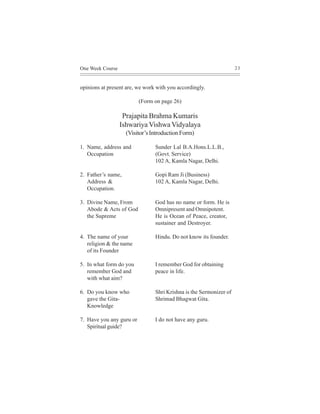
opinions at present are, we work with you accordingly.

                          (Form on page 26)

                   Prajapita Brahma Kumaris
                  Ishwariya Vishwa Vidyalaya
                    (Visitor’s Introduction Form)

1. Name, address and            Sunder Lal B.A.Hons.L.L.B.,
   Occupation                   (Govt. Service)
                                102 A, Kamla Nagar, Delhi.

2. Father’s name,               Gopi Ram Ji (Business)
   Address &                    102 A, Kamla Nagar, Delhi.
   Occupation.

3. Divine Name, From            God has no name or form. He is
   Abode & Acts of God          Omnipresent and Omnipotent.
   the Supreme                  He is Ocean of Peace, creator,
                                sustainer and Destroyer.

4. The name of your             Hindu. Do not know its founder.
   religion & the name
   of its Founder

5. In what form do you          I remember God for obtaining
   remember God and             peace in life.
   with what aim?

6. Do you know who              Shri Krishna is the Sermonizer of
   gave the Gita-               Shrimad Bhagwat Gita.
   Knowledge

7. Have you any guru or         I do not have any guru.
   Spiritual guide?
Since how long? What
   benefit have you derived
   from his guidance.?

8. Purpose of your visit?     To meet God and attain peace.


                                               Signature & Date:
First Day

                       WHAT AM I?
     Brahma Kumari— May I know your name?
     Seeker— My name is Sunder Lal.

    Brahma Kumari— This is not ‘your’ own name. Please tell me
what ‘your name is?
    Seeker— Believe me, sister, my name is ‘Sunder Lal’.

     Brahma Kumari— No, brother, this is not ‘your’ name. This is
the name that your body bears because this was given when this body
was born. But ‘you’ are not this body; you are an eternal soul now
abiding in this body. Isn’t it?
     Seeker— Yes, this is what the holy book Gita also says, but we
worldly men know not the self or we easily forget it.

       Brahma Kumari— Isn’t it a matter of surprise that man does not
know his real self! If you ask a small boy what his (body’s) name is,
what his father’s name is and where his abode is, even he will answer
all these simple questions. But, what a wonder it is that man does not
know who he really is, nor does he know who his Supreme Father is. It
is because of this basic ignorance that he is in a sorry plight.
       You meet a number of people to-day and ask them individually:
‘What are you, sir?’ You will find that one of them says that he is a
doctor while another one avows that he is an advocate and a third one
answers that he is an engineer. This makes it evident that none, today
realises that, in reality, these are the professional names which they got
much later than they became manifest into their respective bodies and
that each one of them is, in fact, distinct from this body which each one
employs to do the duties of his profession. It is a simple thing to
understand that, when they had not yet taken to any profession, i.e.,
when they were yet in their childhood, even then they had their own
existence and when they will give up their professions and when their
body shall have grown old, even then also they shall not cease to exist.
It is clear, therefore, that people do not give the right reply in regard to
who they, in reality are, apart from the body which they employ for
several kinds of business or work.
26                                                         One Week Course


      During conversation at all hours of the day, man says, “I am engaged
in such and such business at such and such place” and so on, but he
does not know who it is that uses this single letter `I’ for itself.
      In reality, ‘I’ and ‘my’ or ‘mine’ signify two separate entities. ‘I’
means the soul, and mine is the body wherein the soul resides. You are
sitting in a room, you won’t say: “I am the room.” Similarly, ‘you’ are
not the body, your body is but a tabernacle, or, say your cottage. A
driver, seated in his car, drives it but is himself separate from it. In the
same manner the soul is the driver incharge of the body which serves
as a carriage also to the soul. The soul it is that hears by means of the
ears, speaks through the mouth and sees with the eyes. Therefore, you
are a ‘soul’ and not a ‘body’. The body and its organs are the means
of action. The soul is a diamond, the body being the casket for it.

      Seeker— Yes, sister, I am a religious-minded man. I also believe
that the life-principle is different from the lifeless Matter or that there is
a conscient entity, different from the body. You have rightly reminded
me that I am not a body but a soul.

                                What am I?
      Brahma Kumari— Yes, but you should now practically live with
this faith.
      It is common Knowledge that the body is made of five elements.
But a religious-minded man, even while engaged in actions, should think
thus: “this body is a composite machine or assembly of instruments by
means of which I speak, hear, see, work and move about, but I am
different from it though I employ it (body). Just as a person who speaks
with the help of a telephone or listens to a call with the help of that
instrument, has his entity different from that of the telephone—he himself
being a living person who has the faculties or characteristics of feeling,
thinking, willing, and making effort, even so, the conscious entity in the
body which uses the word `I’ is different from the body which has
mouth, ears, etc., as its components. So I am an entity different from
my body. I am not the eyes, the ears or the mouth but I see with my
eyes, speak through the mouth, hear with the ears and am their master.
I am a soul, eternal and immortal. The body is mortal; I have got it to do
actions and to experience the result of my actions. I am eternal and I
am the doer and the experiencer.
One Week Course                                                        27


     When the soul leaves the body, the body is declared to be ‘dead’.
Then people set about cremating it because, its valuable owner, the
soul, having left, the body is of no use. When the soul has relinquished
the body, people say, “The light has gone, that which lived in it has
departed and the drama is over.”

               What is a soul? What are mind, intellect
                           and Samskaras?

      The soul is a living or a sentient thing. It is said to be conscient
(®esleve) or living because it can think and reflect and can experience
pleasure and pain, so also bliss and peace, and it can bestir itself and
make efforts and actions, good or bad. So, the soul is not separate or
distinct from the mind, the intellect (Buddhi) and predispositions
(Samskaras). ‘Mind’ is the name given to the soul’s own faculty or
function of experiencing pleasure or pain or of desiring and willing;
intellect (Buddhi) is the name applied to the soul’s own ability to reason
out things or to take decisions or to cognise and know; the Samskaras
mean the effect produced on the soul by the soul’s good or bad actions,
already done. We can also say that the outlook, tendencies or habits
that a man comes to acquire as a result of his actions or the attitude
that the soul comes to have is what we mean by Samskaras or one’s
nature (Swabhaava).
      To regard the mind, the intellect (Buddhi) and the predispositions
(Samskaaras) as different from or unrelated to the soul, would mean
that we regard the soul to be an insentient and inconscient thing (Jad,
peæ[). This would be wrong for, in fact, the major point of difference
between the conscient soul and the insentient matter is this that Matter
does not have any characteristics of desire, thinking, sensation, feeling,
cogitation, effort or experience whereas the soul possesses these
characteristics. The soul which uses its will, experience and efforts to
good purposes and in righteous ways, is regarded as an elevated soul
(Mahaatma), noble soul or ‘a holy soul.’ The soul which has bad will,
ill-feeling or vicious efforts is called a sinful soul (Paapaatma), wicked
soul (Duraatmaa) or ‘a fallen soul’ (Patit Atma). It is due to the soul
itself being good or bad that the saying goes that “the soul is its own
enemy as well.”
      So, it should be understood that people, who regarded the mind as
28                                                        One Week Course


an entity different from the soul, wrongly blame the mind for their own
bad actions, generally using these words: “the mind is very flighty, it
cannot be controlled, it is very mischievous and wicked. They do so in
order to absolve themselves of all blame by putting all blame on the
mind. But their belief and utterances are wrong because in fact, it is the
soul that has become degraded, and has now to be purified. So, one
should not speak thus like a helpless man, “What can I do, the mind
deceives me easily, it cannot be held in check, it makes me unsteady...
it takes me to the evil,” etc., etc. One should rather believe that “it is I
(the soul) who thinks good or bad and that I have now decided that,
henceforth, I shall not do any bad action. If, on account of my old
habits, I tend to be bad or to entertain dirty thoughts, I shall make full
efforts to stem the tide by means of the power of Knowledge, and shall
render my outlook, tendencies, attitude and actions truly pure. Up till
now, I considered the mind, the Buddhi and the Samskaaras to be
separate from the soul and I have been giving them latitude and, as a
result, have been reaping sorrow and disquiet in my lifes, but now I
have realised that it is I who does the thinking, and shall, therefore
never, never entertain any bad thoughts, much less any evil act.”

      Seeker— All through the ages, we were told that the mind and
intellect (Buddhi) are separate from the soul and that they constitute
the subtle body, made of subtle Matter.
      Brahma Kumari— But you should just think for a moment whether
Matter can at all have the desire for bliss or feel happy and experience
peace and love and can decide between right and wrong. Isn’t matter
incapable of thinking or feeling? Isn’t it lifeless?

     Seeker— Yes, that is what I also think. But people say that, because
in the state of salvation, there is neither any desire nor any thought, so,
it means that a time comes when the soul gets rid of mind. So, the mind
is an entity separate from the soul.
     Brahma Kumari— When a soul attains the state of salvation, the
mind does not perish but lies dormant in the soul; it is there in the soul in
an unmanifest state or in the seed-form. The soul, in the state of salvation,
has not to do any action and it does not have a body for performing
action; so, the mind remains unmanifest or, ‘asleep,’ if you may like to
say so. Otherwise, if in the state of salvation of the soul, mind were not
One Week Course                                                          29


there, how could the soul be considered sentient or conscient(®esleve),
and how could the soul come into the world and on what basis could it
take the first birth?
     Let us consider another point. You know that all theists regard God
as the Ocean of Knowledge, of peace and of love, and it will also be
admitted that Buddhi is the receptacle of all knowledge or, to put it in
better words, knowledge is Buddhi and the mind is the the mainstay of
peace, bliss, love etc. Thus, it is clear that the Supreme Soul who is the
inexhaustible source of knowledge, peace, bliss and love, is not separate
from the mind and the Buddhi which are, in His case, be it noted very
clearly, of supreme excellence and perfectly stable, whereas other souls
have only partly knowledge (Alpa Gyan) and limited capacities; they
are not free from ups and downs and are not staid in the same degree.
Owing to their limited knowledge, souls also indulge into unrighteous
actions and, as a result thereof, they also experience sorrow,
peacelessness, discord, malice, etc. So, all this is experienced by the
soul itself and not by any instrument which people name as ‘mind’ and
which they wrongly believe, is different from the soul and is made of
inert Matter.
     You know that when a person hears a case in a court and gives his
verdict, he is called a ‘judge’; when the same one goes home and loves
his children, they call him ‘father’ and when he sits with his friends,
they call him their ‘friend’. One and the same person is named variously
according to relationship or to profession or to his actions. Similarly,
when the soul thinks over a problem or situation facing it, we say that
our intellect (Buddhi) has arrived at this decision. So, the soul has a
desire or volition or willingness to do a thing, we say that our mind
desires this; when the soul thinks over a problem or situation facing it,
we say that our intellect (Buddhi) has arrived at this decision. So, the
soul’s own volition, will, thoughts and experiences are named as ‘mind’
and the soul’s reasoning, deliberation, judgement, grasping of ideas,
knowledge and memory are known by the name ‘intellect’ (Buddhi).

     Seeker— Some are of the opinion that it is the brain that thinks,
desires and gets the body to work. How far is this correct?
     Brahma Kumari— The brain is the control-room of the soul. Just
as the driver of a car, though seated in it at one place, uses the different
parts of the mechanism, and makes the car run or stop and regulates its
30                                                                  One Week Course


speed, turns it backwards and watches the on coming pedestrians or
vehicles, in the same way the soul employs the brain to control the
movements of the body and it employs as it wishes any one or more
parts of it. Just as eyes are the means the soul has for looking at things,
and the mouth is the organ to speak with, in the same way, brain is the
machine by means of which the soul thinks, remembers, receives
messages from or gives directions to the sense-organs. The brain is the
meeting-place of all nerves, which carry sensations from all parts of the
body to brain which functions like a control-room and makes the body
work. It is in the brain that the soul, through the nerves, puts the body to
work and experiences physical sensations, pleasure and pain or happiness
and sorrow. But, the brain is separate from the soul, brain is a complex
thing made of Matter whereas the soul has the life-principal or
consciousness.
     Seeker— Where in the body is the soul located?

                               Where in the body does the soul dwell?
      Brahma Kumari— The soul abides in the middle of the forehead.
That’s why there is the custom of marking this spot with a tika (sacred
dot). As a matter of fact, we have really to be firmly seated in the
original pure nature of the soul, but the ritualistic devotees instead put a
mark there on the seat of the soul. The fashion of putting a dot-mark
(Bindi) on the forehead, prevalent among the women, also is infact
originally due to the ancient and original belief that the dot-like soul
abides there.
      The saying is common that ‘in the centre of the forehead shines a
wonderful star’*. When men cannot reason out things and want to
bestir their intellect, they touch this place with their hand. When they
are not contented with their lot and want to point to their bad luck, then
also they place their hand there for the very simple reason that the soul,
which is the doer as well as the experiencer, dwells here.

                                What is the form of the soul and where
                                          it has come from?
     This refulgent soul is very subtle, it is like an atom. Just as a star,
shining in the sky appears to us on this earth to be only a bright point,

* Ye=keÀgefì ceW ®ecekeÀlee nw SkeÀ Depeye efmeleeje ~
One Week Course                                                           31


even so, the soul which is a self-luminous point or a shining dot, resides
in the middle of the forehead. As long as it is there in the body, the brain
and other vital parts of the body work and the man is alive. But when
the soul leaves its perch, the place becomes dead silent. All the stir and
activity of the brain and the sense-organs goes phut; it comes to a
standstill. The brain may be regarded as soul’s foremost or main
instrument or the control-room for its own manifestation or for getting
work done by the sense-organs which are like servants to the soul. The
heart is the life-line which functions as the supply-centre to distribute
the life-giving nourishment. When the brain, which acts as the deliberative
section and the information centre, or the body, which is the vital
assembly of instruments for the soul for actions and for experiencing
the fruit of actions, receives a fatal blow or suffers an intolerable loss
and injury or, when the account of actions and their effects to be
experienced in this life is run out, the soul, like a bird, leaves this cage
made of skin and bones and it flies away taking with it its samskaaras
and, bound as it is by the result of its actions, it takes to another cage of
flesh and bones.
      The question is wherefrom has this living (conscient) and immortal
being, called ‘soul’ come into the world which the religious-minded people
call as ‘a passing-room’ (Musafir Khana) or, an inn (Sarai) and where
has it to go at last? Wherefrom has it descended on this world—the
great field-of-activity or amphitheatre of action? Wherefrom has it come
into this body which is a compendium of sense-organs, and where shall
it go after its part in the drama is over? Which is its real Home or
resting-place that it has now forgotten? This soul (purusha), different
as it is from Matter, must have come from some region to play its own
part or to observe the parts of others.

   The Mystery of Three Worlds revealed—Soul has come from
                Paramdham into this foreign land
     In order to know the original Abode or Home from where the soul
has come, it is necessary to have the knowledge of the Three Worlds.
The Supreme Soul, you might know, is praised as the ‘Lord of the Three
World’s (Trilokinath). But do you know which those three Worlds are
and from which one of these has the soul come to appear on the stage
32                                           One Week Course


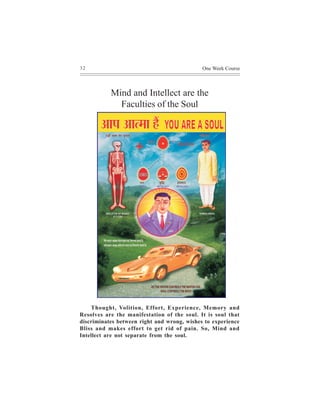
           Mind and Intellect are the
             Faculties of the Soul


    Thought, Volition, Effort, Experience, Memory and
Resolves are the manifestation of the soul. It is soul that
discriminates between right and wrong, wishes to experience
Bliss and makes effort to get rid of pain. So, Mind and
Intellect are not separate from the soul.
One Week Course                                         33


             I C RO E L
             N O P RA
                SOUL
               WORLD


                                   SUBTLE
                                   ANGELIC
                                   WORLD


                  PHYSICAL
                  UNIVERSE


    There are three worlds in all -- the world of corporeal
beings, subtle beings (Deities or Angels) and incorporeal
souls. God has blessed us with a vision of these. On top is
shown the Soul World.
34                                                        One Week Course


of this our world?
      Please look at this illustration of the Three Worlds. The Supreme
Soul, Our Father on High, has shown us all this by granting us divine
sight and we have got this picture drawn on the basis of that divine
revelation and vision. At the bottom of this illustration, you will find
human world in the form of an inverted tree. This world exists in a very
very small portion of ether. This is called the world of ‘Human
Beings.’(ceveg<³e-me=ef<ì). This is also called the Gross World,’ the
Corporeal World or the Karma Kshetra (the field for action) or a huge
Drama Stage because when the soul enters into this world, it wears a
terrestrial or gross body of flesh and bones; it acts here and plays a
happy or sad part. The soul reaps as it sows; it gets as it acts. Birth and
death, pleasure and pain, good and bad actions, thoughts and words and
sound—all these are to be found in this world. Always, without break, a
Movie-talkie World Drama is enacted here. But beyond the sun and the
                                 stars of this Human World, beyond the
                                 highest expanse of ether, there is a world
                                 where Brahma, Vishnu and Shankar abide
                                 in their respective subtle regions. This is
                                 called the Subtle World, i.e., the world of
                                 the deities, because the deities, that dwell
                                 there, have not like us, the gross bodies
                                 but subtle, self-luminous bodies which
                                 cannot be seen with the gross or physical
                                 eye. That world can be seen only with
                                 the divine eye. There is no birth or death,
                                 no pain, neither speech nor sound. There
                                 they speak, but without making any sound.
                                 There is only motion; that is a Movie World
and no talkie.
      Beyond this, there is another world, which is called by different
names—Paramdham (The Supreme Abode), Brahmaloka or Parloka
(The Highest World). Here, there is neither any gross body nor any
subtle one, neither thought nor word nor action. Therefore, there is
neither pain nor pleasure, neither birth nor death. There is Peace and
Peace alone. Hence it is called Shantidham (the World of Peace).
Muktidham (the Abode of the Liberated), Nirvanadham (the World of
the Released). There is a subtle Light which pervades that world and is
One Week Course                                                         35


called ‘Brahm’. That Light is not conscient but is the sixth element of
non-living Matter; it is above Satoguna, Rajoguna or Tamoguna—
the three modes of Matter.
      The Supreme Soul, i.e., the Supreme Father Shiva, who Himself is
eternal and unborn and who knows all about the wheel of soul’s
transmigration and the Three aspects of time, has revealed to us the
great truth that beyond the sun and the stars, there in Brahmlok in the
infinite divine light called Brahm (ye´ïe) souls abide in incorporeal form
as detached from the bodies and above birth and death and pleasure
and pain, without any thoughts and, in a state which is called the state of
Redemption (Mukti). It is from there that souls come to the theatre,
that is the world, to play their respective parts and they put on bodies
like actors put on their costumes. Just as a Meteor falls on the earth, so
does the soul leave Muktidham and enter this world when it thinks of
enjoying itself in this world. It takes a gross body inside the mother’s
womb as its perch. When it takes physical birth and performs actions, it
reaps the fruit thereof as time goes.

     Having understood these esoteric points of Divine Knowledge, you
should realise your real self and your Home above. Here I will give you
a story as an illustration how the soul deflected from its original nature.

           How the soul deviated from its original nature?
     There was a Raja whose palace stood near a forest. It happened
that the prince while playing was kidnapped by wolf. Having fallen
among them, he was brought up by them and grew up. After a long time
had passed, the Raja went for hunting and chanced to see a child among
a crowd of wolves. He concluded that they had lifted the child. The
Raja, on horse-back, chased them, and having released the child from
them, and seating him on the horse-back, came back to the city.
     The prince had grown up. His appearance and habits had changed.
His hair and nails were long and dirty, and his face was begrimed with
dust. He talked like them as if he had, in their company, become one of
them. It flashed on the Raja’s mind that it was the very same Raj Kumar
that had disappeared long ago. The Raja arrived at his palace. Those
who saw him agreed with the Raja that the child was the Raj Kumar.
The Kumar was given a thorough wash and was then clothed in clean
and bright clothes. He was put to a tutor who taught him how to talk
36                                                         One Week Course


and behave, i.e., conduct himself well. The tutor worked with him to
make him understand thoroughly that he was not a wolf or a beast who
lives in a jungle but a prince whose father rules over the city and the
forest both. Some time after this schooling, the prince moved about and
behaved differently, and used to be feeling deeply that he was a prince.
His mode of life thus changed entirely.
      So, the human soul is the child of Supreme Soul who is the Lord of
the Three Worlds and the Creator of the Deities also. But, after coming
into contact with a body, i.e., its sense-organs, it has identified itself
with body and has got attached to the objects of senses and has become
vicious and involved in the ways of the flesh. Thus have the modes of
life suffered a change. The behaviour, conduct, eating habits and ways
have become unrighteous. But, now, God awakens us by saying, “O
Soul, you are really My Child, i.e. the child of Trilokinath. You once
enjoyed purity, peace and prosperity in lordly, golden palaces in the
heaven. But because of your long association with the body in the course
of several lives, you became attached to the body and, having forgotten
what you really are, have identified yourself with the body.”

    Seeker—Does the soul have only one physical birth or many births?
Many people do not believe in transmigration, re-incarnation or rebirth.
They say that none has seen what the next birth will be nor does anyone
know what previous life had been. The present one is everything.

                 Does the soul have physical rebirths?
      Brahma Kumari—Surely, the soul transmigrates. You must have
observed that while one soul is born in a cultural, civilised, educated and
rich family, another soul is born to uncultured, uncivilised, uneducated
and poor parents. Why is this so? Everything that happens has a cause;
so, does this difference not prove that every soul has yet to reap the
result of its actions that have not had their effect in the past, and that, on
leaving that body, the soul has taken an another body according to its
past actions and samskaras? Some are born to rich, others as healthy,
some as males and others as females, i.e, one is born in a situation
different from the other. Should not we conclude that this is due to their
past actions?

     Seeker—Should we take it that whatever pain or pleasure we
One Week Course                                                            37


have in this life is due to the result of our actions in past lives?
     Brahma Kumari—What we experience now is partly due to the
actions of past life and partly to those of the present one.

      Seeker—If the soul transmigrates, why does it not remember its
past life?
      Brahma Kumari—Not to speak of the past life, even of the present
one we forget so much. Just as the soul has the ability to remember,
even so it is liable to forget also. You see that some people forget events
which are only a month or two old. Similarly after having slept for a
period or after an accident or injury to the brain, after a shock, after a
fainting fit or even after change of place, company and circumstances,
people forget many foregone things. Likewise, death also is an
occurrence after which soul forgets many a thing, and even if it retains
a part of it, the child, because of being a tender and undeveloped one,
cannot express the things it remembers from the past life. You must be
aware that some time after birth, the child weeps and then it smiles.
Even if there is not anyone or anything present before its eyes, it weeps
or smiles when it cannot recognise anyone nor can know anything about
the affairs of the house. It is clear that it is reminded of the events of its
past life, but it is not yet fit to express itself in words.
      Moreover, in the newspapers also, from time to time we are told
about some children, who, when they grow, tell us some facts about
their past life and these facts have been verified to be true. Some children
even say what caused their death in the past, who their parents were
and where they lived.
      Well, all children cannot say what they were in their past life. In
fact, it is good not to remember the events of the past life as otherwise
there will be much disorder in the world. For instance, if anyone is going
down the street and on seeing a person recollects that he had killed him
in the previous life, he will set aside everything else and proceed to fight
with him. A boy going to school is suddenly reminded of his past and
recognises two persons, a man and a woman, as having been in his
previous life, his loving parents. He will at once forget his school, catch
hold of them and insist on his being taken to their (or his old) home while
his parents-in-this-life might be searching for him. So, not to remember
the events of the past life is an advantage as otherwise man will be
simply bewildered and recollection of what happened in his past life will
38                                                       One Week Course


simply obstruct his endeavours today and his enjoyment of their fruit.

      Seeker—How should one accept that the accounts of our ‘past’
actions are yet to be paid and cleared and that we had former lives
also?
      Brahma Kumari—I have already explained to you that the
difference between the birth of one person and that of another, in regard
to the circumstances in which each is born and the difference between
the status and nature of the families to which they are born, etc., clearly
proves that the old scores are not yet paid off. Secondly, the presence
of lust in one or the Sanskaras of anger in another person also proves
that he must have done similar actions in his previous life which resulted
in his present aptitude or tendencies.

      Thirdly, one and the same person may be a source of comfort and
happiness to one man but may be a source of harm and discomfort to
another without any apparent cause in the present life. This also proves
that there have been previous births and we have carried with us some
of the Karmic debts which we are still to pay.
      Further, two children of the same parents differ from each other in
a good many ways. Though the parents are the same and the food the
children get is about the same, there is yet a difference between their
respective Samskãras, nature, efforts, and fortune or luck. What can
account for this, except one’s actions in the past lives and one’s
samskarãs, i.e. habits and predispositions formed because of actions in
previous lives.
      Again, you can see that there are some who even in their young
age, achieve extra-ordinary proficiency in some branch of knowledge
or art while others, inspite of the best efforts of their tutors and their
parents, remain stupid. Someone becomes a very famous musician,
others easily memorise the whole scripture and become noted scholars
and there are still others who remain illiterate though these last ones
may turn into clever businessmen. It is clear that in the present life men
are upheld easily towards those arts or occupations which they had in
their previous lives.
      Furthermore, man’s desire for salvation or for peace and happiness
or his fear of death indicates that the soul had in some of its previous
lives, enjoyed complete peace and happiness and now, after having
One Week Course                                                           39


many times experienced sufferings, it longs for salvation. All these things
prove that there is metempsychosis (Hegvepe&vce) or rebirth. Without
any coaching, the child sucks the milk from its mother. This shows that
it had previous lives and has previous knowledge, experience or practice
of this.

      Seeker—Those who belong to Hinduism or the Adi Sanatan
Dharma, believe in rebirth but, some people of other faiths are of the
opinion that the soul having been born once is not born again but is there
in the grave. On the day of Judgement, i.e., when there is final destruction
of the world, God resurrects or exhumes them and awards them
according to their deeds and takes them back to the world of the souls.
               Does the soul remain in grave till the Day
                            of Judgement?
       Brahma Kumari—Yes, some people believe in this way, but the
truth is otherwise. The fact is that after having taken birth once in the
Human World, the soul undergoes transmigration till the end of the Kalpa
(one cycle of the world time). At the end of the cycle, the soul is in a
state of ignorance or darkness; that is what has been expressed in the
idiomatic language by saying that ‘the soul remains in the grave.’ Then
God descends into this world, gives us divine knowledge and thereby
lifts us out of the grave, i.e., He wakes us up from the sleep of ignorance,
and takes Home, which is the world of incorporeal souls. Those who
have not become pure by then, receive the results of their actions and,
having thus cleared their accounts, are taken there. But now-a-days
people don’t understand what idea is really meant to be conveyed by
the words, “entered in the grave.” They, therefore, conclude that the
soul takes corporeal birth only once.

             How is the World Population on the increase
                         if souls are unborn?
      Please, consider, how could the population of the world increase if
there were no rebirths? Increase in population everyday makes it clear
that the souls which came into the world in the past have been undergoing
transmigration while other souls also continue coming down from the
soul world, i.e. the Paramdhãm.
      In fact, belief in transmigration is also necessary for the improvement
40                                                        One Week Course


of man’s conduct; otherwise, he will not be mindful of whether the
actions he is doing are good or bad. If a man is a disbeliever of the
doctrine of rebirth, he would not mind doing harm to others in this life so
as to seek his own enjoyment and, so, this would remove moral binding
on him and would give him free license to indulge in all sorts of actions.
Man would feel inclined to cease doing bad actions if he is given the
belief that he would have to reap the fruit of his actions in the next life
if not in this life.

      Seeker—Yes, this is correct. Transmigration is a fact, and this is
now quite plain to me.
      Brahma Kumari—Besides, without accepting the fact of
transmigration, you would not be able to understand how the soul has
reached the present sad, vicious and unquiet state. The soul is basically
pure and peaceful and that is why it longs to get back to peace. Clearly,
owing to certain causes, it has come down from its position of purity
and peace which it had in previous lives to the present plight. The causes
of its fall are the five vices, their root cause being ‘body-consciousness.
Because of these causes which affected the soul in its past lives, it has
become unhappy. So you should recognise the real nature of the soul
and should try to regain the original state of purity and peace. Therefore,
have the faith that you are a soul and that you should be holy.

           Body-consciousness is the root cause of all evils
      The sum and substance of all that has been said by me to-day is
that you should have the firm belief that you are a soul and should shake
off all sense of the body. The presence, now-a-days, of the vices of
sex-lust, anger, greed, attachment and egotism is due to body-
consciousness. People say: “we very much wish to throw out these
vices, but these vices do not let us be.” How can they get rid of these
vices? So long as there is body-consciousness i.e, so long as one does
not feel thoroughly that he is a soul, but a body, these vices would
continue to be. You would agree that when one looks at the `body’ of a
person, i.e., looks with the thought that the body is beautiful and is of the
form of a female and so on, then sex-lust is born in him. Similarly, when
one feels that, from the view-point of body, he is `older in years than a
certain other person and that, even then the later does not have regard
for what he says,’ one flies into rage because of his body-consciousness.
One Week Course                                                            41


Again, man feels attachment to his bodily relations; be it his child or
wife, because he continues looking at them from the point of view of
the body. And, then for the sake of these bodily relatives, to whom he
feels attached, he indulges in greed. Thus body-consciousness and the
resultant vices have made men very unhappy, but still man does not
obtain release from these for the simple reason that he does not truly
and deeply maintain the consciousness that he is `a soul’ not a body.

                     The Easy Way to Vicelessness
      So, the lesson is that when you meet a man, look at his forehead,
thinking firmly that you are a soul speaking through your mouth and, he
also is a soul, hearing with his ears. Whatever you do, you should think
thus, “I am a soul, doing this work.” By thinking this, you will be benefitted
in the sense that vices or the vicious thoughts that pester you will not
raise their head again but will be transformed into new thoughts, making
the soul pure by this process.

             The Way to attain Light and Might from God
       You know that people remember God in order to acquire peace
and spiritual power but they do not know the first important thing, namely,
who they themselves are. One who does not know himself, how will he
know his Father and how will he be able to establish with Him the link
and communion or love and relationship and, so, how will he get peace
and power from God? Even a gross example would illustrate this spiritual
truth. You know that when we wish to link our house-wiring to the
cables of the power-house, we have to remove the rubber-covering of
both the wires. Then alone the current comes. If the rubber is not
removed at the junction, the electric current will not come even if the
two wires are tightly interlinked. There will be neither light nor power.
Exactly in the same manner, as long as there is the veil (sheath) of
body-consciousness and man believes God to be a bodied being or a
deity-in-body, he cannot get the full current. Therefore, giving up body-
consciousness and regarding yourself as a soul, a luminous entity,
remember God and observe how from that Power-House, which
symbolises ever-lasting source of peace and bliss and is the omnipotent
Supreme Soul, you attain peace, power and bliss. By remembering that
you are a soul, you will be able to remember God, the Soul-Father, and
it is by dint of this remembrance that you will be linked to Him, and you
42                                                        One Week Course


will earn peace and power.

                     Summing up the First Lesson
      From now onwards, please remember that this your body is but a
clothing for you who are a soul. Meeting your friends and relatives, look
upon them as so many souls. They are souls. Aren’t they? The
relationship between one body and another is to cease sooner or later;
so, looking at their bodies is looking at one’s clothes without noticing the
real thing. The real thing enveloped in these clothes is what is called
‘the soul’. We souls are related with souls. If you observe with the eye
of Divine Knowledge, you would consider others as souls and, so, neither
attachment nor infatuation nor similar feelings will arise. Nor will sex-
lust and other vices taint your outlook. So, learn this first important
lesson thoroughly. Please tell me tomorrow how long during the day
you maintained this spiritual outlook and remained soul-conscious.

    Tomorrow, I shall give you an introduction of the Supreme Soul,
who is the Father on High. Shouldn’t you learn who He is? For want of
knowledge of Him people have become, as it were, helpless orphans!

      Tomorrow, you may tell me how long you remained soul-conscious
and whether you made efforts to keep your mind safe from vices and
thus translated into practice, what you have learnt up till now. Besides
this, you may write answers to the following questions so that I can
know whether you have understood everything correctly and clearly.
Otherwise, I would make the points clearer still.


                                Questions
1.   What is a soul?
2.   Why is the soul considered a conscient entity?
3.   What are the mind, the intellect (Buddhi) and the
     impressions(Samskaras)?
4.   Where is the original Home of the soul?
5.   What are the main proofs of transmigration?
One Week Course                                        43


6.   How does body-consciousness give rise to vices?
44                                              One Week Course


                     Body-Conscious Man


    What is the use of the study of the scriptures if the body-
consciousness and vices in man do not disappear?
One Week Course                                                         45
  Second Day

                        Who is God?
   Has God any Form? Can we see Him?
      Brahma Kumari—Did you write the name, residence and
profession of your father in the Introduction form that you were asked
to fill up the day before yesterday?

     Seeker— Yes, I did.

    Brahma Kumari—If your brother or sister be asked to tell the
name, residence and profession of your father, will their answers be the
same or different?

    Seeker—Sister, their answers will certainly be the same as mine.
When the facts I have given about my father are none other than these,
why should there be any substantial difference between their statements
and mine?

     Brahma Kumari—I agree with your argument but I put to you a
proposition to consider on these lines.
     Yesterday, I told you that you are not a body but a soul donning this
body as a man would wear his clothes. Similarly, all other embodied
beings also are really souls. Now, souls say that there is only one Supreme
Soul, “God is one”—thus goes the common saying. But you will also
notice that one man speaks differently from another about God’s name,
form, abode, etc., The beliefs of one sect do not tally with those of the
other. This shows that they do not have correct knowledge of God
based on true experience and revelations made by God Himself. The
contradiction in belief and variation in their concepts about God had led
many to doubt in the very existence of God.

    Seeker—Yes, you are right. There should be one true concept of
God. Since God is one and the truth also must be one, statements about
God, if they are based on truth must not contradict each other.
             Why are there divergent beliefs about God?
     Brahma Kumari—The fact of there being several concepts or
46                                                      One Week Course


beliefs shows that people do not correctly know about God, the Father
of all souls. One such belief commonly held is that God is formless. If
you think over it impartially for a while, you will come to the conclusion
that it is wrong for, nothing can exist without a form. The belief that
God is without a form, is not substantiated by religious practice as well.
You know that people in their prayer, address God, saying: “We are
thirsting for a glimpse of you, Our Lord”, or “May you bless us with a
vision of you, O, God”. Now, if God be formless, then it won’t be possible
to meet him at all. So, doesn’t it look to be strange to think that we
cannot meet Him, whom we call our Supreme Father? We love God so
much, we invoke Him often and go through spiritual exercises—what
for? Why do we try for Him who has no form at all, i.e., who is non-
existent? Thus, some proper thinking would make it clear that God is
not without form but, for want of the eye of knowledge, man cannot see
Him.
      Suppose, you ask someone what he is searching for, and he replies,
“That thing has no form.” Then you ask him, “where that thing is, how
it looks, and what characteristics it has”, and the man replies: “It is
without any characteristics.” You will turn in upon him; you will say,
“Then you are foolish in looking for the thing. Why do you rack your
brains over a thing which has neither name, nor form nor quality
whatsoever, nor any other marks?”

     Seeker—That’s right but, sister, this example applies well to earthly
objects. And the Supreme Soul is not an earthly thing or a terrestrial
thing.

     Brahma Kumari—You should then say that God has no earthly
form; He is not a model made of Matter. If instead you say that God
has no form, not even transcendental then it would mean that you believe
that He does not exist.

    Seeker—Well, then please tell me what form He has? Pray, give
me some right type of acquaintance of Him.

                 Who is God and what form He has?
     Brahma Kumari—First of all, you should know what He is. The
term ‘Supreme Soul’ (Paramãtmã) means that He is the supreme among
One Week Course                                                         47


all souls. It implies that He also is ‘a soul’, though He is the Highest of
all. About Him, it is said that He is above birth and death. Clearly,
therefore, this cannot be said about any being who has a body, whether
a human body or the one that belongs to some other species. Moreover,
He is the Supreme Father of all. Now He, who is the Father of all, must
have no father. So, the fact that He is known as the Supreme Father
also points out that He does not have a body. Since He is incorporeal,
that is why it is said that He has no ears but He hears, He has no
physical eyes but He can see and He has no feet and yet He moves or
walks.
      Also, that’s the reason why all people say that God is Light, a Jyoti
(Effulgence personified) or Noor (a self-luminous object). But they do
not know what form that Light has. Today, I wish to tell you on the basis
of my experience that, just as a soul is a point-of-light (Jyoti Bindu),
even so the Father of souls i.e., the Supreme Soul also is a point-of-
Light (Jyoti Bindu). There is difference between Him and the other
souls in respect of qualities. God is changeless, being the Ocean of
Peace, bliss and love. He is above birth and death and is immune to
pleasure and pain, whereas the other souls are in the vortex of birth and
death and pleasure and pain. But, in form, the soul and the Supreme
Soul are alike even as we find that, in this gross world, the young one
and its parents have the same form, a child has the same human form
as resembles the form of its parents. So, let it be clear in the mind that
God is not formless but is like the souls, a point-of-Light.
      Seeker—I hear this for the first time from you, sister!

      Brahma Kumari—Yes, but you may have observed that all religions
have images, idols or memorials, bearing one name or another, to
represent this form of Light that God has. Everywhere in Bharat, from
Srinagar in the North to Kanya Kumari in the South, images of this
form that Shiva has, are found installed; these images are without face
or ears or feet or body which fact clearly points out that it is the Symbol
of an incorporeal Being. At one place, it is called ‘Vishwanath’ (meaning
the Lord of the Universe), at another ‘Amarnath’ (the Father of souls),
at a third place it is named Mukteshwara (the Bestower of Liberation)
and it bears the name Papkateshwara (meaning the Expiator of sins)
at a fourth place. All these names prove that these images represent
the Divine Form of God, because none else but the Supreme Soul is the
48                                                        One Week Course


Lord of the world, the Lord of the immortal souls, the Bestower of
liberation and the Destroyer of sins. He is God of all Deities, and, being
Rama’s God, is rightly remembered as Rameshwara. Being Krishna’s
Lord, His memory as Gopeshwara is preserved in a town called
Vrindavan, by means of an idol, called ‘Gopeshwara’.
      Outside Bharat, there is, in Mecca, an image having this form; the
followers of Islam call this image as “Sang-e-Aswad”. People of Bharat
call it `Meccaeshwara’. Even these days, Muslims who go to Mecca
for a Haj (pilgrimage), kiss this holy stone. Yet it is not known to them
why there is this custom of kissing this sacred stone and whose memorial
or image it is. Though the Muslims do not worship any idols yet they do
not know why this image or idol stands there and is held to be sacred or
worship-worthy.
      Christ, the founder of Christianity also said, “God is Light.” Guru
Nanak, the founder of Sikhism also sang the praise of Him who is `All-
Light’ and is incorporeal. In olden days, the jews held a stone of this
shape in their hands while taking a solemn oath and it is also believed
that Moses had vision of this form of God when he saw a Flame behind
the bush. I tell you all this about the form of God so that you may be
able to stabilise the mind in the remembrance or consciousness of Him
and Him alone who is Nirakãr and all-effulgent (Jyoti-Swarupa).

     Seeker—But, if God, the Self-luminous Being is Nirãkar (i.e.
Incorporeal or Non-anthropomorphic), how can we consider Him to
have any form?

               The real meaning of the word ‘Nirakãr’
      Brahma Kumari—I shall give you an example to illustrate my
point. You see, if we say, “This room is big one,” we say so in comparison
to a particular small room. But if we compare the same room with a
very big room, then about this very room we will have to say, “It is a
small room.” Thus, it is clear that the terms, `big’, `small’, `thin’, `fat’
etc. are relative terms. Similarly, what is regarded as `Nirakar’ is so
only by comparison with objects having gross or subtle physical form. I
told you yesterday also that those beings who have gross body as men
and women have, are known as `Sãkãr’ or `corporeal’ beings. The
deities Brahma, Vishnu and Shankar who are eternal, i.e., who have
One Week Course                                                          49


self-luminous or angelic body are, called `Sukshmãkari’ i.e. Subtle,
Angelic or Astral in form and Shiva, the Incorporeal Being is such a
soul that it has neither a gross nor a subtle body, and, is therefore,
relatively called `Nirãkãr’. So, Nirãkãr is one who does not have the
physical form or one who has no outline as of a body. In English
terminology, the equivalent of the word `Nirãkãr’ is `incorporeal’ or
`non-anthropomorphic’, i.e., one who does not have the form of a human
body or limbs, but is bodiless. So, though without a bodily shape, God
has His own imperishable form, which is a point-of-Light, whose gross
and enlarged representation is Shiva-Linga,* though people do not know
what the Linga stands for.
      Take another example. When a lamp is lighted or a candle is burning,
the form of the flame or the light emitted is like that of an egg, i.e.,
Shiva Linga. Even so, God is a Divine Flame; He has a form which is
subtler than the subtlest. We cannot see it with the physical eye. It
needs the divine eye to see it. All seeds and eggs, i.e., all the ‘creators’
also have oval forms. So, God, who is the creator or the conscient Seed
of this Human World-Tree, also has an extremely subtle and minute,
seed-like form, i.e., He is an oval point of Light.

    Seeker—We have, uptil now, heard and held that God is
omnipresent. Now, how can that which is omnipresent, have a form?

                  God, the Father, is not Omnipresent
     Brahma Kumari—Does a father prevade his children? No,
Likewise, God is the Father of all souls; He is not omnipresent. If He
were omnipresent, His qualities also would be found everywhere. We
cannot think of a contingency in which sugar is present everywhere in
milk but the sweetness is not, or fire has pervaded a thing but the warmth
has not. To-day, we see that, in all people, vices, pain and peacelessness
are present, i.e. Maya (Nescience and evil) is present. If God were
omnipresent, purity, peace and happiness ought to be found everywhere
but these are not found.

     Seeker—But, why do people say that God has no form?


*The word `Linga' means a symbol.
50                                                          One Week Course


     Brahma Kumari—Because they do not know Him as otherwise.
He, whom we call ‘our Father’ has certainly a form. Sweetness has no
form, but sugar has. Qualities have no form, but the thing that possesses
these qualities has a form. Similarly, peace, bliss, purity, etc., are formless
but He, who is the inexhaustible source of these, has surely a form. He
bears a name; He has His abode and has His actions to perform. I
guess you are thinking of what name God has.

                        The Divine Name of God
      Just as God’s form is unique when compared with that of us, the
bodied beings, so also is His name. Our names are the names given to
our respective bodies after these were born; our names do not speak of
our qualities and actions; they are simply proper nouns and are not
attributive names. Very often, actions of most of us are at variance with
what our names connote. One called ‘Amir Chand’ (literally meaning, a
rich man) may happen to be Fakir Chand, i.e. indigent or beggar. Another
one called Shanti Swarup (meaning: ‘the peaceful one’) may be given
to frequent fits of anger. One known as Mr.Black may be, in fact, white
in complexion.
      You may please note that the name God has, is based on His qualities
and actions. His main and self-revealed name is—‘Shiva.’ ‘Shiva’ means:
‘doer of good’. God does good to all and, therefore, is called—Shiva.
All souls ask for salvation and beatitude, i.e., peace and happiness from
Him. People remember Him by other expressive names, among which,
Papkateshwara (The Destroyer of sins), Mukteshwara, (The Lord
Redeemer), Amarnath (The Father of souls), Somnãth (Giver of Soma
i.e. Elixir), Maha-Kaleshwara (The Destroyer of the world) are special
ones. ‘Shiva’ and other names tell us about His qualities and the
relationship we have with Him.

               The attributes of God and His relationship
                            with other souls
      Seeker—How do we come to know His qualities and His
relationship with us form the names He has?
      Brahma Kumari—From also the worldly point of view, the father,
the teacher and the preceptor of a man are considered to some extent,
to be his well-wishers and they do good to him. Likewise, the name
One Week Course                                                         51


‘Shiva’ (meaning: the doer of good) implies that God is the Supreme
Father, the Supreme Teacher and the true Preceptor of the souls of
human beings. Many people call Him ‘the Supreme Father’ but one
thing they do not know about God is that He who is the ocean of
knowledge, descends into this world to impart Divine Knowledge to
mankind, when the time for this comes, and thus He acts as a Teacher
and Preceptor to mankind. Unless He acts as a Teacher and the true
Spiritual Guide, none else is competent to lead souls to redemption or
beatitude. That means, He becomes also their Teacher and Sadguru
(Spiritual Guide) for, otherwise without His acting with the souls in these
two relationships, man can never have lasting blessedness.
      Now, you might be thinking of how one can explain God’s qualities
and actions from His name.
      A little thinking would lead you to the conclusion that only He who
is eternally good and sempiternally happy, can do complete good to
others and can absolve them of what is evil. And, in order to bless
others or to absolve them of what is bad, Divine Knowledge and spiritual
might is required to be given to them because it is owing to want of
knowledge and power that man is led to vice which results in evil. So,
‘Shiva’ as the name of the Supreme Father, proves that He is
blessedness itself, i.e., He is ever-liberated, ever pure, all-powerful and
Knowledgeful. He Himself has these attributes and that is why He
gives divine knowledge to human beings and redeems them from all
and thus blesses them completely. He is the Ocean of happiness, peace
and bliss and that is why people ask for their welfare, i.e., for the boons
of happiness, peace and bliss from Him.
      So, think for yourself how great is His name! And, yet people say
that He is alien to any name.* In reality, He is not alien to name, but His
name is unique when compared with names of us all.
      Again, just consider, how intimately we are related to God—who
is our Supreme Father, Supreme Teacher and Supreme Preceptor. But
you might have noticed that people do not feel the joy they should because
of this high relationship. We observe that a millionaire’s son feels
elevated to think that he is the son of a very rich man. If he has not that
excitement or if he is clothed in tatters rather than in a neat and good
dress and is not shod well, we conclude that he is not on good terms
with his father even though he is a millionaire’s son. Either his father
has disowned him or he is a disobedient son and has snapped the
52                                                        One Week Course


relationship. Exactly in the same manner, you are the child of Him who
is the Lord of the Three Worlds and is the Supreme Father and the
Supreme Soul. You call Him your Father. But, where in your life is the
rapture to point to your being His child? From the pain, peacelessness
and viciousness rampant here in man’s life, isn’t it correct to conclude
that man’s links with Him, who grants peace and happiness, have been
snapped? How else can we explain that while the father is the Ocean
of peace, the son is peaceless and that father is the giver of happiness
while the son is unhappy? Man might, every-day, without fail, invoke
the Supreme Father, but now-a-days, there is not any living tie, binding
us to Him in our actions. How strange it is that men of today know,
recognise and remember their material (worldly) relations and draw
pleasure from this relationship, but have forgotten that there is any lasting
and complete good to be gained from Him, our Supreme Father. So
much have they moved away that now they have ceased to remember
who their Father is. They only say that He is present everywhere.
      Seeker—Do you mean to say that, actually, God is not
omnipresent? Has He any particular abode where He dwells?

                             The Divine Abode of God
      Brahma Kumari—Yes, God dwells where the souls dwell in the
state of Release. He is not omnipresent in this corporeal world. Men
themselves say that this world is a caravan serai. This shows clearly
that we have come from somewhere, which goes by the name of
Brahmlok or Paramdhãm. The region, where the souls live, is the
region where their Father lives. When any one says, “I do not belong to
this village, my real home is in another village,” this means that his
father also belongs to that village. Generally, the Father’s home (or
village) is also the children’s. So the Supreme Father of all souls abides
in Brahmlok and, when Dharma* is totally disregarded, He descends
into this world of human beings and gives the souls Divine Knowledge
and teaches them Raj Yoga. Neither one’s Father nor one’s Teacher
can be omnipresent. When people themselves say that this world is but
a caravan serai or an inn which belongs really to none**, how can it be
the home of the Supreme Soul?

       Seeker—Having heard what you said to elucidate your point, it
*Jen veece mes v³eeje nw ~
One Week Course                                                                             53


appears to me that God is our Supreme Father and has His own Abode,
but I do not quite understand how we can consider wrong the basis on
which He is regarded as omnipresent. People say that God is an entity
that can be experienced; He is not any gross thing and, He is formless
also. A breeze touches us and we feel it, but it is formless and so is the
case with God. No one has seen Him.

      Brahma Kumari—If, as you say, no one has seen Him, why has
the Shivalinga come to be an image or a memorial of Him? If He
cannot be seen, why do people long to have a sight of Him? Why is He
called by such names, as ‘Jyotiswarupa, or Jyotirlingum’ (a pillar of
Light)? Why has He been described in the Gita as the unmanifest, i.e.,
divine and radiant (Avyakta-Moorta) in form? It should be clear that
God has a form, which can be seen only by means of the divine eye,
and that is why we ask of God to grant us the boon of divine sight
(Divya Drishti). Amongst us, several souls have experienced or seen
that divine and refulgent form.
      You say that you feel Him as you feel pleasure and pain, and like
these feelings He has no form. But think for a while that pleasure and
pain are not any tangible (visible) objects but these are the names for
the different states of the soul. Here the object is the soul, and pleasure
and pain are due to its different states or experiences. Neither states
nor experiences have what is called form; it is only an object like the
soul that has a form. Just as the soul is a very minute point of Light, so
is God also. The qualities of bliss, peace, etc. that there are in Him, are
formless.
      ‘Cold’ is not a tangible object. It is another name for the absence
of heat which is the real thing, whose form is like that of waves. Air has
form, but it has not any solid or stable form. It takes form according to
the vessel or the pot in which it is, i.e., its form changes from one vessel
to another. When it is in a football, it assumes the form of a ball, To say
that air has no form at all, because it is subtle, unstable and without any
colour, is to betray one’s ignorance. The correct thing would be to say
that air has a colourless form which is subtle and unstable. There are
good many things which have a subtle form and which cannot be seen
with the naked eye, but that does not mean that they are formless.

*Moral Law              **³en ogefve³ee jwve-yemesje nw~ ve ³en Iej lesje nw ve cesje nw~
54                                                      One Week Course


                If God is not omnipresent, how is He
                         All-Knowledgeful?
     Seeker—Sister, what you have just said is clear to me. But I have
one question to ask on this topic. Sister, we all know that things that
have a form, have limitations. So, if God has some form, He also must
have limitations. Now, the question is that if God has limitations because
of form, how can He have infinite or perfect knowledge in Him? And,
you will agree with me that He whose knowledge is imperfect, cannot
be the Supreme Soul. Is it not, therefore, wrong to hold that He has
form?

      Brahma Kumari—The quantum of knowledge possessed by a
person is not dependent on the size of his soul. If one has greater
knowledge than the other, we cannot say that the soul of the former is
larger in size than the latter’s soul. Therefore, God who is, from the
point of Knowledge, the greatest Being, i.e. unsurpassable, is not the
largest in size; He is not omnipresent.
      Secondly, it is not necessary that the knower and the object to be
known be of the same size. For instance, it is not necessary for anyone
to be as big as a room in which he wants to see each and every thing
lying. He need not be pervading all the persons there if he is to see and
know them all. On the other hand, he can, even if seated in a corner,
see the whole of the room by means of his small eyes. What is necessary
for an observer to see things round about him is that his vision should be
good, there should be no disease or abnormality in his eyes, he should
be able to understand things rightly, and there should be no obstruction,
impediment or viel between his eyes and the object. It is thus plain that
God, who is Yogeswara, perfectly wise and completely virtuous and
has Divine Eye or Sight so that death, ignorance, actions, etc. cannot
hinder His vision, knows by means of His eternal Eye of Knowledge
anything and everything, even though He abides in the Incorporeal
World—Brahmaloka.
      I repeat that it is not necessary to be pervading an object in order
to see or know it. What is needed is Knowledge and the seeing eye, and
both these are eternally with God. Therefore, He knows everything, but
He is not omnipresent.
      When we say that a certain soul knows little, we do not mean to
One Week Course                                                55


                   Supreme Father of All Souls


     The temple of Amarnath, Rameshwaram and Gopeshwara
etc. are indicative of the fact that God Shiva is the Creater and
the Over-Lord of these also. The Black-Stone, called Sang-e-
Aswad in the Mecca also is a symbol of God Shiva. Some
Buddhists in Japan concentrate their mind on a stone of this
shape. Christ and Nanak also say that God is light. All this shows
that God is Self-Luminous point.
56                                                          One Week Course


say that it is present in very few things. But, by this it is meant that it has
limited knowledge; it knows only a few things, a few individuals and a
few of the events of the world. The saying that God knows everything
does not mean that He pervades everything but it means that He,
being above birth and death, knows the whole of the history of the
world, and, having divine sight, knows all souls and all religions. It is
wrong, therefore, to believe that He is present in everything and every
individual.
     You know that a father, without having to pervade his children,
knows their life-history. An engineer has not to permeate a machine in
order to know every part of it. A student of geography, without being
omnipresent in his country, knows the conditions prevailing there. He
who knows a drama has not to be omnipresent in the actors in order to
know their actions, their emotions and the different parts they play. So
also, without being omnipresent in the three worlds or in all the souls,
God knows the full story of the souls, His children, and complete history
and geography of the three worlds. He knows the whole story of the
Drama of the world of human beings from its beginning to its end.

      Seeker—If the Supreme Soul is not omnipresent, He must not be
knowing anything about the different thoughts in the minds of all souls
and, therefore, He cannot reward or punish them as a result of their
actions. But all theists believe that, as He awards to human beings the
fruits of their actions, so, He must be omnipresent.

      Brahma Kumari—Man can, by telepathy, know what thoughts
are there in another man’s mind, but because of his this ability, you
cannot say that he is present in their minds. Similarly, by means of
television, we can see a drama played or a lecture being delivered
elsewhere as if all this is happening in our presence. Likewise, a scientist,
sitting in his laboratory, can see with a telescope, a distant planet or star.
Again, you might be aware that, now-a-days, telephones are being
manufactured which, while we are talking to someone at a distant place,
gives us a photograph of the person who is talking at the other end.
Furthermore, we know that pictures of this our earth can be taken with
scientific instruments in a spaceship, miles high up in the sky, while here
a scientist, seated in a corner of his control room, can control the direction
of this space-ship, can talk to him who is in the ship and can also take
One Week Course                                                          57


his photographs. When by means of instruments, scientists can see
things lying far away, can talk to people who are in other countries and
can take pictures of things and men from very distant points, what
validity is there in the argument that God, who possesses the highest
powers must be omnipresent in order to see things or to know individuals?

                God’s Knowledge is due to Prescience
      God has fore-knowledge of the history of the world because it is
all pre-ordained and it repeats identically after every cycle. So, it should
be understood that God is Knowledgeful not because of His
omnipresence but because of His prescience of the events of world-
history which are predetermined. To God, the future and the past also
are as clear as the present. This is so because God has extra-ordinary
Vision and is above birth and death and forgetfulness. By prevading a
place or an individual soul, only the present can be known but not the
future. The events of the future can be known in the present only when
these are pre-determined. Because He knows three divisions of Time
and because the World Drama is without a beginning and repeats itself,
that is why God knows all events and the soul of all religions and all
dynasties. So, though God is omniscient, He is not omnipresent.

       How does God create, sustain and destroy the World?
     Seeker—Sister, if God is not omnipresent, how can He be
omniscient? Moreover, if He is not omnipresent, He cannot be Almighty
and if He is not Almighty, how does He effect the three acts, namely
the Act of creation, and sustenance of the new world and the act of
destruction of the old world?

      Brahma Kumari—I have already clearly explained that even though
God is omnipotent, He is not omnipresent. You can see that a few scientists
have manufactured such powerful bombs and other deadly weapons
that they can bring about a great destruction of the world and, believe
me, they will do so after a few years. But obviously, these few scientists
do not pervade the whole world. Owing to their own Samskãrãs and
impelled, as it were, by the force of the events to be, the body-conscious
scientists, swollen with pride, manufactured incendiary bombs, missiles,
atom bombs, and Brahmastaras of Mahabharat fame and by means of
these, world destruction can be easily accomplished without their being
58                                                            One Week Course


omnipresent. Moreover, the fact remains that the coming destruction
has cast its shadow on the intellect of men and, so, their judgement is
gone awry and, therefore, at this end of Kaliyuga, vicious men in Bharat
also are getting ready to fight bitterly among themselves on the basis of
differences in respect of language, religion, politics, region, etc., etc.
      So, as a result of this, here in India, too there will be great destruction.
The Natural Calamities and the fury of the five elements of Matter will
help this, because by the explosion of atomic and hydrogen bombs, the
sudden release of stupendous energy sets up a chain of action and
reaction in Nature and causes great upheaval, devastation calamities
and tremendous changes. It should thus be clear that, to affect destruction,
the Supreme Father or the Supreme Soul does not have to be omnipresent.
For, the men and matter serve as Divine Instruments towards this end.
      Here, let me clarify an important point. People, now-a-days, believe
that God destroys the world completely so that the whole of Matter is
reduced to atoms. Their view is wrong. This world has no beginning
and no dissolution. It is no doubt subject to change, but is never all
reduced to atoms. At the end of a cycle of the world, when unrighteous
people increase excessively in numbers, it suffers huge destruction but
not total annihilation. This fact is supported by the Gitã also.
      Because the world is not all reduced to atoms, there is no need to
create the sun, stars or the earth again. The only thing needed is to
exterminate evil, and to re-establish righteousness, i.e., to replace vice
by virtue. This work is done by Shiva, the Supreme Soul, by descending,
in a divine manner, on the person of Prajapita Brahma and by expressing
through his medium the real Knowledge (Gyan) and Yoga so that human
beings, by dint of Yoga and Divine Knowledge, bring righteousness back
into this world and fill it with purity and happiness thereby. Thus putting
an end to the Iron Age, they bring back the Golden Age, i.e. transform
the old world into a new one by virtue of the Divine Knowledge discoursed
by God. It is clear, therefore, that God creates a new world out of the
old one by rejuvenating the old one by means of the nectar of Knowledge.
He establishes a righteous world and gets the unrighteous one destroyed
in a manner in which men and Nature also participate. So, it is wrong to
assume that He is omnipresent.

                   Does, God not dwell in every body?
     Seeker—Right, but there is yet another question, sister! When we
One Week Course                                                         59


think of doing a bad action, the inner voice very often says, “Don’t do
this.” Is not this the voice of God who is in us?

      Brahma Kumari—Do you mean that the Soul contemplates only
evil things? Are all good thoughts, that arise in us, due to God? If so, it
means that the soul is, by nature always impure. This is wrong. The
truth is that, in the soul, there are good as well as bad Samskãrãs or
proclivities. All the conflict is between these two camps. There are
traces of good thoughts also in the soul so that if the soul makes earnest
endeavours, it becomes better and great. All efforts would have been in
vain if there had not been any latencies in the soul.
      Now I ask a question: If God is omnipresent, then, after the soul
has left the body, God must still remain to be there. But why then does
not there appear to be any life in the body? Is the life-force or conscious
energy of God so feeble that, as soon as the soul leaves the body, God’s
vital spark is not felt?

    Seeker—Well, I have no answer. But, sister, to think of God as
having a very minute form is to detract from His greatness.

      Brahma Kumari—No, brother, to think of God as all-pervading is
to turn away from His greatness. If any all-pervading entity i.e., a thing
as extensive as the world, does a great deed, there is no greatness
implied. Greatness lies there where a minute entity does a very great
deed.

     Seeker—But all scriptures say that He is omnipresent.

     Brahma Kumari—According to man’s views on which these
scriptures re-based, it may be that, God is omnipresent, but The Bhagwad
Gitã, the crown of all scriptures, says clearly enough that He is not so.
The Gita is the compendium of the great sayings (Mahãvakyãs) of
Bhagwãn (God) Himself, and we should believe in what God says
about His own self. If human beings knew what He really is, He would
not have had to desend, inspite of the existence of the Vedãs and other
scriptures, and say, “This Yoga and Divine Knowledge have mostly
vanished, and I have come to tell you again about these.” This shows
clearly that, despite the existence of the Vedãs, The Upanishads, etc.,
60                                                     One Week Course


the real knowledge of God had disappeared.

    Seeker—How does the Gita make it clear that God is not
omnipresent?

      Brahma Kumari—The Gita is based on the idea that God, the
Supreme Soul, descends into this world. If He were all pervading, the
question of His descent would not arise. So, the very basic tenet of
Gita, viz. that God comes into this world, makes it clear that God is not
omnipresent. In the Gita, God also says, “My Supreme Abode is there
where the light of the Sun or the stars does not reach and which is
formed of subtle Light not perceptible to these gross eyes, and is beyond
the farthest expanse of Ether-unmanifest element.” He has also said,
“I take a divine birth. I have entered into this human body.. but deluded
persons do not recognise Me having come into this ordinary person’s
body.” “This world is like an inverted tree, I am its divine Seed, which
abides in what is called Brahmloka,—The farthest and highest region,
far beyond the light of the Sun and the stars.”

    Seeker—But, in the Gitã, there are some saying which point to
God’s being omnipresent.

     Brahma Kumari—The Gita was written very long after God gave
this Knowledge. And, there have been interpolations into it by men.

    Seeker—How can we agree that sayings relating to His
omnipresence are interpolations?

     Brahma Kumari—Because these sayings run counter to the
fundamental great sayings.* In other words, these are contradictory to
the real meaning. Those statements which run counter to the idea
contained in the important sayings are to be considered as additions or
insertions made later and based on human beings’ views. These are
some of the important and basic things which we must keep in mind
while separating true sermons from the interpolation—use of the term,
Bhagwãn,’ the phrase: ‘Bhagwãnuvach’ (God said), and the version:
‘My abode is beyond where the light of the Sun and the stars are
perceptible” and “I take on a human form when Moral (Dharmã) has
One Week Course                                                                      61


declined” and “I take divine birth (Divya Janma)”

      Seeker—Yes, it is stated in Manusmirti that when on any point,
two scriptures give two different opinions or when between two scholars
there is a difference of opinion, man must employ his own reason to
determine the accuracy of one or the other. Besides, I have observed
that protagonists of the Arya Samaj consider those sayings of the Gita
as interpolations which recur quite often there. The Mahabharata, of
which the Gita is believed to be a part, is considered by most people to
be prolix. But, most people again believe that the original verses of The
Gitã are small in number. Whatever the facts are, man must exercise
his reasoning faculty. On further thought I find the opinion expressed by
you to be right.

    Brahma Kumari—These are, in reality, matters of one’s own
experience and not merely of logic. Amongst us, some of Brahma’s
mouth-born children,* do have glimpses of God as a Point of-Light. We
have several times seen Brahmlokã also. The Supreme Soul is the
Supreme Father, Supreme Teacher and the True Preceptor of us all. Can
father be pervading his children, or a teacher his pupils? To consider our
most beloved Father omnipresent is to betray perversion of our
judgement. But the surprise is that people regard the idea of omnipresence
as a high philosophy! When human beings desire to obtain salvation and
go to Brahmlokã, why should the ever-free** Supreme Soul be
pervading this world which is hemmed in by the strings of painful life?
Why should He be all-pervading in this world of human beings when
He, Shiva, the Supreme Soul, is the Creator of Brahma, Vishnu and
Shankar who also reside in their respective regions above this world of
ours? Does He, whom all of us when remembering Him not abide high
up? Surely, He is farther than the farthest.^
      As a lover sees his beloved everywhere or just as Meera saw Shri
Krishna everywhere, so too devotees in the ecstasy of love, say, ‘We
see God everywhere.” But this does not mean that God is truly
omnipresent. He is the most beloved Father, abiding in His Supreme
Abode (Param Dham), which is all-pure, but, when remembered by

*Certain words or verses are known as Mahavakyas. These are the basic concepts that help
determine the meanings of other verses also.
62                                                             One Week Course


devotees with deep emotion, He can appear anywhere in less than a
split second to give them a glimpse or vision of Himself in order to fulfil
their desire but this makes many devotees to wrongly conclude that
God is everywhere. As lover, one can feel or experience one’s beloved
anywhere but actually the beloved is not everywhere. Likewise, God is
not everywhere or in everyone of us. But, the remembrance or picture
of Him can be in each one of us.

    Seeker—Sister, what you say appears to be right. But I find all
people saying that He is in every little thing we find in the world.

               To consider God to be omnipresent in a serpent
                         and a dog is to insult Him
      Brahma Kumari—If you give thought to it, you will admit that to
regard God as omnipresent is, in a way, to insult Him, because thereby
you consider Him to be in all insects, animals and other species of
beings, however low these be. It is foolish to think of the Supreme
Father as such. The very stones that man tramples upon while walking,
the dust particles which are swept with the broom or just swept to be
milled up and thrown out, the offal that is so repulsive, the mad dog
from whom men for their safety run away, the venomous snake which
no one would like to see even in a dream—taking God to be present in
these also, point to bankruptcy of one’s wits. He, who is the highest of
all the souls in the Three Worlds, who grants salvation and beatitude
and purifies sinners and removes all our sorrow and gives us happiness
and is our Supreme Father—to regard Him as pervading the tortoise,
the alligator, the ass, the dog, etc., is to denigrate and insult Him and to
earn nothing but sin! Sending Him down to be present in 84 lacs of
species is to turn one’s back on Him! Is He not the giver of good and of
blessedness? Is He not our Supreme Father and Supreme Preceptor?
If He is, it amounts to ungratefulness to think of Him as omnipresent.
One should simply be ashamed of regarding Him as present in dross
and dirt. Do those who regard God as omnipresent ever remember the
reptiles and other animals in whom, according to them, He is present?
Do they establish communion or yoga with them? Do they ever think of
*Those men and women who, on hearing Divine Knowledge revealed by God Shiva through
Brahma's mouth, have been rejuvenated or spiritually reborn.
**meoe cegkeÌle HejelHej
One Week Course                                                        63


an owl? Fie upon them! How greatly alienated is man from God! He
does not know Him, but He considers Him to be everywhere! He is
ignorant, but says, “Wherever I cast my eyes, I see you”.* He himself
is given to sex-lust, anger and other vices, but calls himself a wise man
and says that the soul is the Supreme Soul.

     Seeker—Now I understand well. I agree that to consider God to
be pervading even in repulsive things is derogatory to our beloved Father
and is, in other words like turning away from Him.

 If mankind had known that Shiva is God, the World-history would
                      have been different.
      Brahma Kumari—Knowing Him is knowing the main thing. If
human beings understood that Shiva is the Supreme Father of all souls,
the history of the world would be different. The Muslims who invaded
Bharat and plundered the temple of Somnath, would not have attacked
Bharat but would have regarded it a place of supreme pilgrimage where
the Supreme Father took divine birth. Alas, they do not know that the
holy stone** in Mecca is, in reality, a memorial of the Supreme Soul,
who is the Supreme Father of all! When the inhabitants of Bharat do
not know Him but call Him all-pervading, how can others know him?
On the one hand, the people of Bharat celebrate Shivratri, the divine-
birth-day of Shiva, while on the other, they say that He is omnipresent.
Mark that He who made a paradise of Bharat is not rightly known! Had
people known Him rightly, the Government representatives would, before
taking the Prime Minister or a high dignitary of a foreign country to the
Samadhi^ of Bapu Gandhi, would take him to a temple of Shiva, because
Shiva grants salvation and bliss and is the Saviour of all. By the name
‘Shiva’ we do not mean the stone image nor do we say you should
worship it. We do not ‘worship’ our Father. We say that we should
know and cognise Him, have faith in Him, lovefully remember Him and
obey Him.
      You, have just had, from me, an exposition of God’s meaningful
name, lightful form, divine abode and qualities which are all divine. Hold
all this dearly in your mind and try to be remembering Him. But, by
holding God to be omnipresent, nameless and formless, you will not only
not be able to remember Him well but your mind will wander away and
you will think of artificial way and restraints of Hatha Yogã in order to
64                                                                   One Week Course


stop the ingress of vicious thoughts. But the Knowledge I have passed
on to you, as given us by God Himself, when understood well, will
restore to you the correct remembrance of Him even as a letter bearing
correct address reaches its destination.
     In order to achieve that state, you should, first of all, remember
God well and call to mind the truth that you are a soul, a point-of-light,
and a child of the Supreme Soul, who is the Father on high. No sooner
you entertain the thought that you are his child than your intellect (Buddhi)
will get fixed on Him, and your mind will drink in the sweetness of His
qualities, “My Supreme Father, Shiva, is a vast unending source of Divine
Knowledge, peace, bliss, and love; He is omnipotent, the over-Lord of
the Three Worlds, Saviour of the Sinners, and the bestower of salvation
and blessedness, the benevolent doer of good to all, Supreme Teacher
and the True Preceptor.” Thus, in the Soul will be experiences of the
feelings of peace, power and bliss for the simple reason that the state of
a man’s mind is determined by the sentiments it has.

       Seeker—How, sister? Will you please explain this.

     Brahma Kumari—Yes, I will give an example to illustrate this.
Suppose there is a man who is, this moment, enjoying himself fully in
the company of his friends. But in the midst of this enjoyment, he receives
a telegram from his brother saying that his dear mother has passed
away. He will lose all sense of enjoyment, joy having turned into mourning
for him. All this has happened because the sense of merriment has
been washed off from his mind and mourning has taken its place.
     In the same manner when man remembers Him, who is the
everlasting fountain-head of peace, bliss and love, his state of mind will
become peaceful and blissful. You may practise thinking of Him as both
your Father and your Mother abiding in the Highest Region of divine
Light (Param Dham) and as the never-ending store of qualities
mentioned above and then see for yourself whether in your life there
has not been a healthy change.


*efpeOej osKelee n@bt GOej let ner let nw ~
**It is known, in Arabic language as `Sang-e-Aswad'
^The place where ashes of Gandhiji lie in rest under a raised platform.
One Week Course                                                       65


      Seeker—Yes, I want a change for the better, I have been to many
spiritual guides (gurus), have worshipped a lot in temples, performed
prayers (Sandhya) Yagnas* and other ceremonies well enough, but
vices do not let go of me and true peace does not come to me. How I
wish it come!

      Brahma Kumari—Do not forget that you are a child of Him who
is the Ocean of peace. The necklace of peace is round your neck. Only
you have forgotten yourself and your Supreme Father, and so have
been driven from pillar to post. Otherwise, you retain your claim to
whatever divine heritage, God, your Supreme Father has. Now that you
call God your Father, it is your birthright to draw upon His vast and
inexhaustible treasures of peace and prosperity. What is the need of
asking for peace from gurus and idols? In this connection, I am reminded
of an illustration.
      It is said that once a beggar came to the palace of a king who, was


    [Just as a letter bearing correct address reaches the right
place, even so, one can have correct remembrance of God if
one knows the correct name, form, abode etc., of God.]
66                                                    One Week Course


at that time, in his prayers. When he saw the king at prayers, he kept
quiet and sat outside, very near his prayer-room. The king caught sight
of the beggar.
     While at prayers, the king was addressing God in these words, “O
my Lord, you are the Bestower of peace and prosperity. It is you who
have given me this sovereignty. I am a beggar at your door. Nothing is


mine, my Lord! Whatever I have, is of your giving. Grant me peace of
mind, O’lord”
     The beggar being seated just outside, heard all this. He had come
to ask for alms, but when he found the king himself begging things from
God and saying to Him, “Whatever I have, is given by you, O Lord,” he
thought he need not ask the king. Why shouldn’t He begs of Him who
bestows things on the king? Having thought thus, without asking for
One Week Course                                                         67


anything from the king, he left the palace. The king noticed that the
beggar was going back. He called the beggar to him and asked him not
to go. But the beggar was not to step now. He said, “O king, I have
seen that you also beg of God. Why should I ask from you? I too shall
beg of Him, who is the Almighty Father.”
     So, brother, instead of making entreaties to gurus and idols, why
don’t you establish relationship with God who has infinite peace and
bliss to give, who is omnipotent and who is the Saviour of all and the
Supreme Soul. The illustration I have given is about a devotee who did
not name Divine Knowledge of God. But you have now got Knowledge
of the Supreme Father and you have been told that you are His child.
As such, you have no need to ask His favours or to entreat Him, Children
of the Mighty Father do not beg. Since Your link with Him is broken,
you feel want. Otherwise, how can it be that, you being the child of one
who has an infinite fund of peace, should have to be going about in
search of peace? So, Shiva, the Father, commands, “Dear child, you
should disengage yourself in all respects even from the gurus, and take
shelter in Me.* Forge a love-link with Me and I and all My property
shall belong to you. Do not grieve; I shall tell you the easy way of
getting absolved of your sins, shall take you with Me to the Region of
Light and Peace (Param Dham), where peace resides, and then shall
invest you with purity and other divine qualities to send you to paradise
(swarga), where you shall enjoy deity-sovereignty.” So brother, if you
desire true and lasting peace, remember Him.
     By the sacred and whole-hearted remembrance of Him will be
burnt up the stock of vicious acts (Vikarmas), which have been
accumulated during the past lives and have burdened your life with
sorrow and disquiet. Divine qualities will then appear in your life because
you will have obtained release from bad resolves and proclivities
(samskãras) which are the root-cause of sorrow.

      Seeker—You have told me very beneficial spiritual truths, sister!

    Brahma Kumari—All this knowledge is God’s gift for you. If God
were omnipresent, there would be no need for Knowledge. If He were
omnipresent, you would not have to be searching for peace. God, the

*Offering of oblations to the `Holy Fire'
68                                                       One Week Course


Ocean of Peace, being omnipresent and your searching for Peace—
these two cannot go together. Peace is obtained by employing your
mind and intellect (Buddhi) to remember Him, and linking yourself to
Him by love and remembrance. There would have been no need specially
to remember Him if He were present everywhere, for we remember
only that which has some form and some relationship with us and which
is not present around us or everywhere. Therefore, you apply the divine
method I have explained and see the result that accrues. You have had
the experience of following mundane gurus, now you may as well try
in this direction also. In my life too there was sorrow and disquiet. But
when I obtained the divine knowledge being revealed by God Himself,
my life underwent a change, the stock of my past vicious actions began
to deplenish, so to say, and now I have happiness and peace and that is
why I advise you to bring happiness into your life and livingly hold
communion with your dear Father and turn to good account your this
present life which is the very last life in this cycle, and obtain from Him
your birthright of purity, peace and prosperity.

     Seeker—Yes, Practice of meditation or consciousness of God is
the chief thing. This alone will do all the good. Surely, I shall practise
according as you have taught me and I will let you know how I fare in
the effort.

      Brahma Kumari—Please do not say, “I shall practise.” Start the
practice this very moment, because Time is fleeting Each moment that
passes without soul-consciousness and consciousness of God, goes in
vain. Death may come any moment. One cannot say how long one is to
live. Don’t they say, `Much time has already passed and very little is
left; so, awaken, O Narayana, for every moment that passes takes
away from what is left of life.* Keeping this in view, engage at once in
these spiritual endeavours and you will find your life considerably divine
and happy. Please start right now.
      Have the constant faith that you are ‘a soul’,—a twinkling star.
Take your mind to the Region of Divine Light (Param Dham) which is
beyond the Sun and the stars. Where the Peace reigns supreme. Connect
your mind or Buddhi lovingly with Him who is the Lightful Supreme

*meJe&Oecee&ve   Heefjl³epe ceeceskebÀ MejCeb ye´pe ~
One Week Course                                                         69


Soul and who is in that world of peace, i.e. the Soul World. Let your
mind think unwaveringly of His divine qualities and also the relationship
or connections you have formed with Him. Please note that you have
not to remember Him by means or recitation of songs, mantras, etc., or
by mental repetition of religious formulas. You have to stabilise yourself,
in a highly subtle or ethereal manner, in the remembrance of Him.
      In this way, you should practise holding Him in your memory. Your
happiness will thereby increase. Then you should keep a day’s chart to
note how much you remembered Him, and whether you did any bad
action, or had any bad thoughts. You would please show to me that
chart tomorrow. I shall give suggestions for improvement.

                               Questions
1.   What is the divine name and divine form of God and where is His
     divine abode?
2.   What relationship do we have with Him?
3.   How should we remember Him?
4.   Give some four important arguments to prove that God is not
     omnipresent.
5.   What does the world ‘Nirakãr’ in fact mean?
(In every body there is an individual soul and not an all-
pervading God. The soul reaps as it sows. To God it is that
people pray for wealth, health, happiness and wisdom;
therefore, to consider God to be permeating in a donkey, a
dog, a crocodile, a beggar praying for a penny in God's name
or a physical wreck crying to God for the boon of health, is to
think low of God. God is the Redeemer of sinners and is the
Bestower of Peace and Happiness so, if God were
Omnipresent, not a single living being would be sinful. God
does not pervade this world; He comes into this world when
there is extreme decay of moral in man and there is
degeneration of Religion and He then re-establishes
righteousness and blesses all with the boons of Peace and
Happiness. By having a proper understanding of God's acts,
one would surely acquire the right belief that God is not
Omnipresent but dwells in Supreme Abod (Param Dham).
When we say that such a such person is an elevated or higher
soul (Mahãtmã), we do not mean that, as a soul, it is present
over a longer area. Rather, what we actually mean is that it
has more purity and good qualities as compared to other souls.
Even so, the world `Supreme-Soul' (Paramãtma) does not
connote that God is all-pervading but it means that God is
the Highest Being in respect of purity, might and virtues.)
Third Day

                  What God does and what
                     does He not do?
     Brahma Kumari—You have, in your introduction form clearly stated
the occupation of your worldly or bodily father. But what have you
written with respect to your Super mundane Father i.e. about the divine
acts of God who is the Souls’ Father?

     Seeker—I have stated that it is God who is conducting the affairs
of this world and that, everywhere, His will is being done. There is a
proverb also in this regard which says, “Everything is moving according
to God’s ordinance. God is the real Doer, we are all His instruments.
There is nothing that rests with man.”* Sister dear, what can man, a
small creature, do? Without God’s bidding not even a leaf moves. That’s
God’s greatness.

                            Is every event prompted by God?
      Brahma Kumari—Do you mean to say that a thief pilfers, a robber
robs and a murderer commits murder, all with the prompting of God? It
is this that proves God’s greatness? If all these are the acts of God, then
the Government of this country need not have any courts, laws and
prisons. For, if God goads men to commit murders and dacoities, then
why should man be punished or hanged? It is really strange that you
think that every blade of grass is moved by God’s power and that, in this
lies God’s greatness! Didn’t you ever think that since God is great, His
deeds also must be great and divine? How can then actions like dacoity,
theft, murder, moving of grass, etc., etc., be attributed to God who is the
highest among the high and the noblest among the noble and is supremely
divine? God has clearly said that His actions are Divine (Divya), and
you know that God is named as ‘Shiva’, meaning: one whose actions
are the most propitious, the most auspicious and completely beneficial
(Kalyãnkari). He is also known and remembered as ‘the Giver of
Peace and the Bestower of Happiness’* and, therefore, you should


*keÀjve-keÀjeJeve DeeHes ner DeeHe, ceeveg<e kesÀ kegÀí veeneR neLe~
72                                                       One Week Course


bear it in mind that His actions must be extra-ordinary and, so, would it
not be wrong to believe that every act and movement on this earth is
prompted by God?

       Seeker—Yes, it would be wrong. Murder or theft cannot be the
acts of God directly or indirectly, nor does God need to impart movement
to the leaves of trees and grass as these are moved by the wind that
blows and not by the will of God. Previously also, whenever I heard the
saying: ‘God is the spirit behind every act’, or that ‘God gets things
done as He likes,’ the question used to engage my mind as to how could
God be the Doer or Director of criminal and sinful acts? I used to ask
myself, if God is the real force behind such acts, then why should man
be punished for no fault of his own? So, sister, I agree with you that all
acts are not God’s act, nor are they due to God’s mighty goading but, as
it is generally believed and said, God performs only three functions, viz.,
the Creation, Sustenance and Destruction.

      Brahma Kumari—”Creation, Sustenance and Destruction”— you
have rightly named the three Divine Acts of God; but are you clear in
your mind as to what these three words imply? How does God, the
Incorporeal Being, perform these acts? What does He create and when?
What do we exactly mean by ‘Sustenance’ and when, how and why
does ‘Destruction’ take place?
      Seeker—I believe that an infant’s body which a soul gets in a
mother’s womb is created there by God. It is one reason why God is
called the ‘Lord Creator’. The formation of clouds in the sky, the shining
of the sun, the falling of rain—these and such other acts are also the
Acts of God. That is why people adore Him in these words—‘O Lord,
it is Thou who makest the sun shine and the rain fall. It is Thou who
createst the world and thou art the Bountiful Lord who givest us all.”**
So, He is called the ‘Creator’ because it is He who has created all this
big universe, streams, brooks and all things included.
        Is it God who creates bodies and makes the rain fall?
           Brahma Kumari—You have said what you have heard. But you
should exercise your reason a little and judge whether such a belief is
correct. Everyone knows that a child is born of the sex-indulgence
*megKe-oelee Meeefvle-oelee~
*let metjpe ®ecekeÀlee nw, let Je<ee& yejmeelee nw~
letves ³en mebmeej yevee³ee, let ner meye keÀe oelee nw~~
One Week Course                                                         73


which is looked on as a vice or a sin by all sanyãsins and holy persons
and from which they not only themselves keep away but advise others
also to abstain. They ask all to observe the vow of Brahmacharya.
Even the doctors would explain the fact that a child’s body is born of
the sexual act of its parents. Then, why should you involve God’s name
in this act which is considered vicious? Don’t you know that people
rather pray to God to help them get rid of this vice?* It is well-known
that the mother who bears the child, suffers pains before delivery and
also at the time of child’s birth. But, God is believed to be the Bestower
of Health and Happiness and the Remover of pains and
sufferings(megKe-keÀllee&; ogKe-nllee&). Keeping this in mind, you
should think whether we should consider God to be the Creator of a
child’s body. The procreators of a child’s body are the child’s parents
and that is why the ‘Creator’ is called by the name ‘Father’ also. If God
were the giver of such a birth in a mother’s womb, which is compared
to a jail, then the ‘Bhaktas’ (Devotees) and ‘sanyasis’ (Recluses) would
not pray—‘Lord, liberate us from the wheel of birth and death’.
Decidedly, God’s acts are much higher and capable of bringing happiness
to man and are praise-worthy. So, the birth that God gives must be of a
different kind.
      In the same way, it is not God’s job to make the clouds. Even small
children are taught in schools these days that it is due to the sun’s heat
that the water of the seas and rivers becomes vapour, which, when it
rises up in the sky, becomes a cloud. So, these and such others are the
works of Nature which too has various forms of energy like heat,
electricity and sound. To consider the acts of Nature or energy released
from elements as the acts of God, shows man’s ignorance.
      You must be knowing that when rain-water rushes down a hill or
when snow on top of a mountain melts down in the form of water, it
finds its channel or course into the plains and thus forms what is called
a ‘river’. Rivers sometimes change their course and thus take a heavy
toll of life and, in their fury, devastate villages and towns; would it,
therefore, be correct to say that God creates rivers and brooks?
      Similarly, sun-rise or day-break is due to the rotation of the earth.
The earth, the moon and the sun keep in their orbits and positions because
of certain forces of attraction and repulsion. Therefore, to consider the

*efJe<e³e efJekeÀej efceìeDees, HeeHe njes osJee~
74                                                        One Week Course


different forms of forces of Nature and various kinds of elemental energy
as the work of God is to betray one’s ignorance about the difference
between God and Nature. It is because of these acts having been wrongly
attributed to God that many people have become atheists, because the
study of science has given them the right understanding that such acts
are the work of the forces of Nature and not of any living entity, called
‘God’.

                   Was this world created by God?
      It has been explained to you very well that God is (Incorporeal)
Nirakar. He has neither hands nor feet, i.e., He has no organs or
instruments of action. And, you know that to create or to make any
gross thing, organs or instruments are required to give the thing its proper
shape, etc., So, keeping these basic facts in your mind, tell me whether
it is correct to believe that God, the Incorporeal Being, created this
gross world and its objects having diverse forms and compositions? If
in answer to this question, it be said that God first created His own
gross body or His own Corporeal Form and then He engaged Himself
in the work of creating this world, then this answer would also have the
same weakness because to create a gross body or a corporeal form for
Himself also, God would require some organs, instruments or material
means but, as has been already explained, God is Incorporeal, i.e. without
any instruments in the form of hands, etc. You should, therefore,
remember that this world was not created in any gross sense. The
world has no beginning and is a play between Matter and Souls (Prakriti
and Purusha) Matter and Nature (Prakriti) has its own power and
functions, and God, the Highest Being, has His own functions, different
from these. God is the Creator, no doubt, but not in the sense as you
have made Him out to be.
      Similarly, people do not rightly know what is meant by the functions
of Sustenance and Destruction. Do you know what the terms
‘Sustenance’ and ‘Destruction’ imply?

      Seeker—Sister, surely it is God who sustains and brings up all. It
is none else but God who gives us wealth and food that we get.
Therefore, He is known as the Great Provider (Devve-peue keÀe oelee)
or the Sustainer-of-life(peerJeve-oelee). It is He who has given us water,
air, etc., gratis because of His bountiful and generous nature!
One Week Course                                                           75


      And, sister, ‘Destruction as an act of God means that man dies by
His command. So, when a man dies, his kith and kin say; “It was to be,
because God willed it so.” Some of the mourners even say: “God also is
unjust; He has taken away our beloved child from us!” But whether
what they say is true, I don’t know. I would like you to kindly throw light
on this topic. I was impressed to hear your explanation of what ‘creation’
means: I agree that God does not have to create a crocodile, a scorpion,
a snake or other animals and insects. All beings are born of the union of
sexes. Insects are born in the muck or mullock; how then is one justified
to say that God creates these insects? If these insects were God’s
creation, then why should men kill them? So, sister, please tell me whether
the traditional view, I have explained, is correct or the truth is otherwise?

      Brahma Kumari—You should also think over this and find out
what your reason says. You see that a labourer works hard for eight
hours and earns, say, four rupees as wages and feeds his family. Shall
we say that God feeds his children and grants him his wages? Now-a-
days, millions of people do not get a full meal or enough clothes to cover
their bodies so as to protect themselves from the vagaries of weather.
Is this God’s way of giving ‘Sustenance’ and subsistence? No, certainly
not. Man reaps the fruits of his own actions done in this world. Everyone,
thus, earns for himself. One person is born in a rich family, another in a
poor one. This is due to man’s own actions done in his previous life;
God has no hand in it.
      In the same way, water, air, fire, etc., have been in existence since
eternity. Every scientist would tell you that Matter can neither be created
nor destroyed; only its form can be changed and it can only be split up
or reconstituted. So, you should know that God is called ‘Provider’,
‘Bountiful’ or ‘Sustainer’ (oelee, o³eeueg, Heeueve nej) not because
He has given us free the use of water and air, but because His boon is
such that, without it, man cannot have true peace and constant happiness
even though water and air be abundantly provided. In the absence of
the boons that God gives, water, air and other forms of Matter cause
misery to man in the forms of flood, deluge, storms, earthquakes,
cyclones, etc., etc.
      When a person dies, we cannot rightly say that this has happened
because of God’s act of destruction or that it is God who has deprived
us of that person. If we at all say this, we wrongly blame God for no act
76                                                       One Week Course


of His. Let us suppose that a man dies of cholera. Are we justified to
say that God put an end to his life? No. The man died because he was
intemperate or of insalubrious habits or his digestion was weak or
deficient and, so, he contracted cholera and, as a result, his body pained
the soul so much that it gave up the body. It could also be said that the
soul had experienced the joy and sorrow of this world through this body
as a result of some of his past actions and that there was nothing left for
the soul to reap and experience through that body any more and the
time was up and, so, the body became unfit and unserviceable and, as
they say, the man died. So, why blame God and why bring Him into the
picture? Someone slays another and, so, the latter dies. Would you say
that God put him to death? Certainly not!
      Hence, it should be clear that God’s functions of Creation,
Sustenance and Destruction have a meaning different from what is
popularly known. God’s functions are all worthy of praise and are such
as bring happiness to all. God is known as the Supreme benefactor
(Kalyãnkãri) and, naturally, when He performs His actions, the whole
world attains whatever is good.

     Seeker—That’s quite right. Kindly let me know what are the acts
that God does?

                   What part does God play in this
                      Eternal World Drama?
      Brahma Kumari—God’s Divine name Immortal form, Eternal
Abode and extra-ordinary Attributes have already been revealed to
you. Now, in order to understand God’s Divine Acts, you would have to
grasp the essential facts about the cycle of this human-world drama,
because God’s actions pertain to this world and have to be understood
as related to the crisis, to the actors and to the time and place of this
Drama.
      So, please look at this illustration of the World Drama Wheel (Page
56). In the middle of it, you will find the Fylfot (Swastika) which divides
Time into four equal parts. Religious people consider the Swastika to
be very auspicious and they draw it before the commencement of any
big work though they do not understand what its real meaning and its
importance are.
      In the first part of this Wheel of Time, marked by Swastika, is
One Week Course                                                         77


shown Golden Age (Satyuga). Here, the arm of the Swastika is pointing
to the right because the right arm symbolises what is good or what
brings about goodness. In these early times, when the cycle started,
people of the Sanatan Dharma were possessed of divine qualities and
nature and they enjoyed complete purity, 100% peace and complete
prosperity. That is why you find that, even today, if a person has good
nature, people say; “He is like a deity or like the people of Satyuga.”
So too, when anyone is characterless and harms others or if one
prematurely dies, or if there is scarcity of food and money, people say:
“Dear friend, this is no matter of surprise because we are in Kaliyuga,
and these things are nothing unusual in this Age. After all, the present is
not Satyuga that we should expect people to be honest and righteous or
things to be pure, unadulterated and (excellent) Satopradhãn*.” From
all such common sayings that have been passed on from one generation
to another, it is clear that the age called Satyuga was extremely good
and the people of that era were really the deities.
      Then came Silver Age (Tretayuga). In this era too, people were
possessed of purity, peace and prosperity to a very high degree. But the
degree (Kalã) of their divine qualities had decreased a little, say, they
were two degrees less divine than the people of Golden Age who were
divine to the extent of 16 degrees. Therefore, the arm of Swastika that
indicates this epoch is bent downwards because souls in this era had
come down from the state of super-righteousness (Satopradhan)* to
what is just righteous (Sato-Samanya)**.
      Next came Copper Age (Dwãpuryuga). Now the souls of the
Solar Dynasty of Golden Age and Lunar Dynasty of Silver Age, having
experienced beatitude and fruition for many a life, turned to Vãm Mãrga
— the path of vices or unrighteousness. That explains why the third
arm of the Swastika points to the left, i.e., the arm is reversed because
the left hand symbolises what is impure or inauspicious. Now, owing to
the fall of the Ancient Deity Religion (Adi Sanãtan Devatãs Dharma)
other religions began to crop up. Islam, established by Abraham,
Buddhism founded by the Buddha and Christianity, preached by Jesus
Christ, are the main ones among them. People then were second-grade
(Rajopradhan)^ by their nature, qualities and actions. Since mankind
was now divided because of various religions, strifes and disputes started

*meleesHe´Oeeve
78                                                              One Week Course


to appear and the five vices brought sorrow and disquiet in homes.
     Steadily, the unrighteous doings, i.e., the actions done under the
sway of one or the other of these five vices, led the world to more and
more impurity and sufferings and the world came under the yoke of
Iron Age. Strifes, wars, bellicosity and the resulting peacelessness which
had begun showing in Dwapuryuga, increased rapidly in frequency
and intensity in Kaliyuga. Therefore, the fourth arm of Swastika is
shown raising itself up to indicate the rise in conflicts, clashes and
calamities. Then, a stage comes when ignorance, lassitude, stupor
(Tamoguna)^^, moral turpitude and sin become predominant. People
become devilish by nature and religion becomes utterly degenerate.

                  When does the world need God to act?
     When Iron Age (Kaliyuga) thus comes to its end, God has to
come into the world and perform His actions so as to re-establish Golden
Age, (Satyuga), to regenerate man once again into deity and to re-build
the foundations of the Adi Sanatan Deity Religion and to re-impart
happiness to the suffering humanity; for, God is the only Soul left that
never gets defiled and is never overcome by delusion or sufferings. If
God does not act at such a critical hour, then who else would bring back
Satyuga? When the last phase of Kaliyuga has ended, who would
transmute men into deities, who would plant the sapling of the real and
highest Dharma and who else would re-establish peace and happiness
in the world? Does it lie in the hands or power of any Iron-aged human
being, be he a recluse or a saint of a high order, to lead the world to
Satyuga or to transmute a whole section of mankind into deities? No.
This tremendous task of uplifting the extremely vicious and degenerate
men of Iron Age can be done only by God, the Almighty, who is higher
than the deities, i.e., who is the Supreme Soul whom people adore as
the ‘Redeemer of the Fallen’ (Heeflele HeeJeve) and as ‘the Supreme
Lord of the deities (osJeeW keÀe osJe) also.

                  How does God transmute man into deity?
     In order to uplift man from the lowest rung of moral degeneration
and peacelessness to the highest point of purity and happiness, or in
other words, to transform an utterly depraved and corrupt human being

*meleesHe´Oeeve     **meleesmeeceev³e   jpeesHe´Oeeve
                                        ^               ^^leceesiegCe
One Week Course                                                          79


into a thoroughly noble one, called ‘Narayana’, God-Father Shiva makes
his intellect divine and his judgment righteous, because it is surely due to
man’s intellect having been debased or his judgement having been defiled
that his thoughts, words and deeds have become unrighteous and it is
due to his actions having become bad that he is suffering badly. Now,
the intellect of a man can be divinised by receiving Divine Knowledge
and by turning the intellect away from vices and towards God who is
the Purifier and whose remembrance has the peculiar power. Therefore,
what God does for the redemption of mankind is simply this that He
teaches man Godly Knowledge and easy Raj Yoga because none else
can rightly give us the knowledge of God than God Himself can. That is
why God alone is adored as the ‘Bestower of Divine Intellect’ (efoJ³e
yegef× keÀe oelee) and the ‘Giver of the Eye of wisdom’(%eeve-
®e#eg efJeOeelee).
      But as has been repeatedly pointed out, God is Incorporeal. As an
Incorporeal Being, God cannot teach His knowledge. For transmission
of His knowledge, God requires a medium; He requires an organ of
speech. So, just as human beings listen to discourses on Godly
Knowledge by means of their ears, God has to impart the Divine
Knowledge by the use of a mouth. But, God cannot take a corporeal
birth because He is above birth and death; He has no stock of any past
actions, of which He should reap the fruit by taking any corporeal form.
He is the Mother-Father of all mankind and, therefore, He is not to
have any worldly mother and father. He cannot be born as a human
baby and be fed and fondled and guarded by men and to have mortal
relations with them, because He is (above wordly actions and their
fruit) Karmãteet. So, the question remains: How does God convey His
knowledge to the mankind?

                   God Creates Three Deities—
         Difference between Shiva and Shankara explained
     The answer is that, in order to accomplish the work of creation,
sustenance and destruction, God, first of all, creates three subtle deities,
called ‘Brahma’, ‘Vishnu’ and ‘Shankara’. He is, therefore, called
‘Trimurti’, meaning thereby the Creator of the Divine Triad (see picture on
page 58). But since people do not know these recondite truth to-day,
they wrongly think that Shiva and Shankara are one and the same person.
The fact, however, is that Shankara is a deity created by God Shiva to
80                                                        One Week Course


represent how the world, ultimately gets destroyed. Shiva Himself is
incorporeal whereas Shankara has an angelic body.

     Seeker—Oh, I see. Shankara and Shiva are two different Beings!
This difference has been made out to me only for the first time to-day.
Previously, I used to ask myself why the images of Shivalinga and
Shankara are of two different shapes.

     Brahma Kumari—But now you follow that the oval-shaped image,
called ‘Shivalinga’ is the image of the Supreme Soul Shiva whereas the
image of Shankara is the form of a body.

               The descent of God into the body of an
                         incognito person
     Well, I was telling you that, after having created the three deities,
the Supreme Father Shiva descends from His Supreme Abode (Param
Dhãm) into the body of a mediocre man for, I have already explained
that He, the Incorporeal Being, requires a human organ of speech to
reveal Divine Knowledge. Such a descent or advent of God into a human
being’s body is known as God’s supernatural or Divine Birth (efoJ³e
pevce) or the Divine Presence of God in a particular man’s body
(HejkeÀe³e He´JesMe). Evidently, God’s Birth is not ordinary as that
of human beings; God, by controlling Matter or Nature, is born in an
unearthly and supernatural manner. What God does is that He descends
from His Supreme Abode daily for some time. He makes the intellect
of an aged man the seat of His glory and, lording over him, He uses the
mouth of the man for revealing Godly knowledge, and for explaining the
way to victory over the vices and to cultivate divine qualities in life and,
having done this, He goes back.

     The name of the person in whose body God Shiva embodies
                               Himself
      God Shiva gives the Divine name ‘Prajapita Brahma’ to the person
in whose body He descends. Those who obtain God’s knowledge as
revealed through the mouth of this man, Brahma, are called ‘Brahmins’
or ‘Dwijas’, meaning: the twice-born’. Everyone has an ordinary birth,
i.e. the physical birth given by one’s parents. But when a man obtains
One Week Course                                                         81


Divine Knowledge from God and his life is metamorphosed considerably,
i.e. his soul gets elevated, he is said to have had a new birth which
means a spiritual awakening. For instance, when a man recovers from
an old, severe illness and attains health, people say: This man has had a
new birth, so to say. In the same manner, if a man does not forget old
things and does not give up bad, old habits, people say to him: “Gentleman,
consider yourself as having died and now take a new birth.”* They
mean to advise him to forget about his past and strive a new for a good
character and sound behaviour. Likewise, when the men and women of
Iron Age, having lived in vices for generations, discard vices and other
dirty habits and become pure and morally reclaimed, they are said to be
reborn. Such a birth is called Marjeeva Janma (cejpeerJeepevce), i.e.,
spiritual rejuvenation or moral regeneration. Because of giving such a
birth to human souls, God is called the Father, the Creator and the
Redeemer, as, otherwise, the souls are immortal and there is no question
of their being created or born. So, you should note that regenerating the
soul by giving it Divine Knowledge and enabling it to establish itself
firmly in such consciousness as is implied by these words; ‘I am a
Soul’, the Immortal child of the Supreme Soul, and then spiritually
adopting the souls as His children, is what we call the work of ‘creation’
that God does. Only those men and women who follow God’s direction
and become purified, attain deity-status in their next birth in Golden Age
that ensues soon after.
      I think, I have made it amply clear that it is by Godly Knowledge
and easy Raj Yoga that God creates or establishes the Golden Age or
new, viceless order. The act of ‘Creation’ does not mean constructing
something out of nothing but it means the moral reconstruction of mankind
or the re-establishment of the ancient-most Deity Religion. And, you
would be pleased to know or, perhaps, surprised to know that God Shiva,
the Supreme Father, is doing as well as getting this work done now
through Brahma and the Brahmins.

                The Significance of the period, called the
                           ‘Confluence Age’
    The time when God does this act of creation is called the ‘Sangam
Yuga' i.e., the period of confluence of the ending phase of Iron Age

peerles-peer-cej keÀj ve³ee pevce uees~
*
82                                                     One Week Course


(Kaliyuga) and the starting phase of Golden Age (Satyuga). Generally,
people have heard something about the four ages, viz, Golden Age,
Silver Age, Copper Age and Iron Age; but they do not know anything
about the most important and the most auspicious of all epochs i.e. the
Confluence Age, the period when God, the Highest Being, descends on
the World Drama-Stage and meets us human beings, His beloved
children, and gives us the most precious boons of Redemption (Mukti)
and Beatitude (Jeevanmukti). In fact, most of the festivals of Bharat
are related directly or indirectly to that period.
      For instance, the Kumbha Melã is, in reality, associated with the
Confluence-age because it was then what God, who is known as the
Ocean of the Nectar of Knowledge, gave it in a nutshell to mankind to
transform them into immortal deities. The phase ‘Knowledge in a
Nutshell’ is translated into the Indian vernacular as ‘Ghãgar men Sãgar’
or the ‘Urn (Kumbhã) of the Nectar of Knowledge’ and, so, the very
name of the festival refers to the period, called ‘Sangam’ or to the
Nectar of Knowledge that God gives.
      The Confluence-age is also the ‘Amrit Vela’ or the ‘Brahma
Muhoorta’ in the true sense of the words for, though we generally
consider the confluence of the last phase of night and the first phase of
the day as ‘Amrit Vela’ or Brahma Muhoorta, yet in reality, the terms
refer to the confluence of the ending phase of Iron Age and the starting
phase of Golden Age. Iron Age is the Night due to ignorance and stupor
and Golden Age is the Day due to bright character of the people and
because it is when these two meet that God gives Amrit (The Nectar of
Divine Knowledge) and guides them and, ultimately, takes the souls
back to Brahmaloka—the world of liberated Souls, that is why even
to-day, people pray to God thus: “Oh God, takes us back Home to be
with you.” People call God as the Liberator and Guide. It is because of
this function that God is the real Spiritual Guide or Preceptor (Sadguru)
of mankind. He is the Supreme Teacher also because He gives us
knowledge about Himself, the Creator and teaches us the history of the
world—the creation.

     Seeker—You mean to say that God incarnates in this world only
once a Kalpa (cycle of five epochs)? Is it wrong to believe as they say
that He descends into this world at the end of every epoch (Yuga)?
One Week Course                                                          83


      Brahma Kumari—Why should God incarnate in Golden Age and
Silver Age when religion is there in the practical life of the people, i.e.,
when people are moral and righteous beings? The decay in religion, as
I explained to you, just starts with the Copper Age (Dwãpuryuga). So,
if God were to incarnate, say, at the end of Copper Age to establish the
Deity Religion or the path of complete purity, and were to destroy
irreligiousness and viciousness, then, after Copper Age, the age of
righteousness, i.e., Golden Age would ensue but the chronological order
is that Copper Age is followed by Iron Age. So, it should be borne in
mind that when Dharma suffers very badly, when the Deity Religion
has extremely decayed and man becomes utterly devilish by nature,
then God Shiva, the Father, descends into this world.

      Seeker—I see. This exposition quite appeals to my mind. But,
sister, how does God Shiva effect the destruction of irreligiousness and
vicious groups or devilish sects of people?

                  World Destruction-when and how?
     Brahma Kumari—The destruction of the old, Iron-Aged, vicious
world through the agency of Natural Calamities, world war and
internecine strife is essential; for, otherwise, complete peace and
happiness cannot be brought back to the world. The day breaks when
the night ends. Likewise, when all the symptoms of Iron Age vanish,
then only there is room for Golden Age to enter.

      Seeker—You mean that after Destruction there will be no trace
or trail of vices and peacelessness left in Golden Age?

      Brahma Kumari—Exactly so. The world during Golden Age and
Silver Age has cent percent purity, peace and prosperity and, so, it is
called ‘Paradise’ or Garden of Allah, or Heaven (Swarga or
Vaikuntha), and compared to it, the world as in Copper Age and Iron
Age, is the veritable Hell or Narak. The human population in Iron Age
is very large where as it is comparatively very very small in Golden Age
but people do not know where most of the souls go and stay after the
Iron Age is ended. Now, God Shiva has revealed that they go to the
world of liberated souls (cegefkeÌleOeece) or Brahmaloka as a result
of the world destruction. So, the act of destruction is a blessing in
84                                                       One Week Course


disguise; it is an act of doing good to mankind or conferring liberation on
the souls. The souls that desire salvation, attain it through this act of
world-destruction. And, God Shiva because of granting us salvation, is
called ‘Mukteshwara’—the Liberator God.
     In addition to performing the act of establishment of the new world
order (called Satyuga) through Prajapita Brahma and the act of ending
the old world order (called Kaliyuga) through the deity Shankara, i.e.
in addition to the acts of bestowing Fruition (Jeevan Mukti) and
Liberation (Mukti) on mankind, God-Father Shiva gets the act of
Sustenance or governance of the world of Golden-Age and Silver-Age
done through Vishnu.

             How is the world sustained through Vishnu?
       In order to understand the function of sustenance or governance,
it is necessary for you to first understand what the four arms of Vishnu
denote and what the four adornments (DeuebkeÀej) in the hands of
Vishnu represent.

     Seeker—Are the four adornments in Vishnu’s hands symbolic?

      Brahma Kumari—Yes, The conch (MebKe) in Vishnu’s hands
stands for purity of speech, the discus or the wheel (®ekeÀ´) symbolises
the knowledge (oMe&ve) of the self (mJe) and of the world-wheel.
The lotus (keÀceue) represents purity of actions or uprightness of
practical life and the spirit of detachment. The mace (ieoe) denotes
victory over the five vices—sex-lust, anger, greed, attachment and
arrogance.
      Two of the arms of Vishnu represent Shri Nãrayãna and the rest
two represent Shri Lakshmi. The halo or the crown of light of Vishnu is
symbolic of piety and peace and the crown of gold, bedecked with
jewels, is an emblem of sovereignty or prosperity.
      Thus, by blessing souls with right understanding of the significance
of these symbols of Vishnu and by giving them exhilarating visions of
Vishnu, the four-armed, God Shiva exhorts mankind to adopt Vishnu as
their ideal and He inspires them to take to purity of speech (symbolised
by conch), attain the knowledge of the self and the world-drama wheel
(represented by the discus), hold on to purity in practical life (of which
lotus is the symbol) and thus to win complete victory over vices
One Week Course                                                              85


(symbolised by the mace) and He explains to them that, if they do so,
they would attain Double-crowned sovereignty in Heaven. So, all those
who receive Godly Knowledge and learn easy Sovereign Yoga through
Prajapita Brahma, they make their spiritual endeavours with the object
of being raised to the Double-crowned deity status, such as that of Shri
Lakshmi and Shri Narayana. Having this ideal in view, they do righteous
and virtuous deeds and work for complete purity.
      As a result of this, they attain deity-status, i.e., the stage of complete
purity, peace and prosperity for 21 lives in Golden Age and Silver Age.
Hence, there is a well-known saying also in this regard which avows
that man attains happiness for twenty-one generations.* In Golden
Age, Shri Lakshmi and Shri Nãrãyana and their Surya-vanshi Dynasty
rules the world and in Silver Age, Shri Sita and Shri Rama and their
descendants of Chandrãvansh govern the world. Now, since constant
and complete happiness in Golden Age and Silver Age is attained by
adopting Vishnu as the ideal during the Confluence Age, therefore, it is
said that ‘Vishnu sustains the world during Golden Age and Silver Age’.
Further, since the world during Golden Age is governed by Vishnu’s
corporeal manifestations, Shri Lakshmi and Shri Nãrãyana and their
other Vaishnava descendants and, in Silver Age it is governed and
sustained by Shri Sita and Shri Rama and their Vaishnava dynasty and,
in those days, there is no poverty, no want and no sufferings, but
everything is easily and automatically available. It has been said that
the world in Golden Age and Silver Age is sustained by Vishnu. Now-a-
days, we have Nagarpals (Mayors) in cities and Rajyapals (Governors)
in States and, soon, the Government would be appointing Lokapãls
also, but everyone knows that a Rajyapãl is so named not because he
provides everyone in the State with free food or free air and water.
Even so, when we say that God sustains or governs the world through
Vishnu, one should not think that, through Vishnu, God provides free air,
water, food, etc. to all living beings. What we really mean is that by
attaining purity in the sense in which Vishnu’s emblems signify, people
in Golden Age and Silver Age, automatically, get sustenance and means
of livelihood and, being descendants of Vishnu, they enjoy unlimited
happiness during the reign of Shri Lakshmi and Shri Narayana and of
Shri Sita and Shri Rama.
      The cycle of five epochs, comprising Golden-Age, Silver-Age,
Copper-Age and Iron-Age and the Confluence Age that I have explained
86                                                                            One Week Course


to you, is repeated exactly everytime after it has turned full wheel and
you should know that, just as you have been given the knowledge of
God, the Creator, and of world, the creation, to-day, exactly in the same
manner, in the same circumstances, in this very corporeal form, in these
very words and at this very time, you will get this knowledge of Shiva
again after one full cycle!

    Seeker—That sounds fastidious! Sister, how will it be repeated
exactly in the same manner? Will I have this very name, the same
corporeal form, the same parents and relatives and everything round
about me the same? How will this come about?

               The most esoteric knowledge about the identical
                         repetition of world-history
     Brahma Kumari—Well, do you agree with me that during every
cycle, the souls who are the actors on this world-drama stage will be
the same because they are immortal and because no new souls are to
be created and added to the existing number since the souls are eternal?

       Seeker—Yes.

      Brahma Kumari—Then. You should believe with me that each
soul will act the same part in the next cycle also since, in the soul itself
is indelibly ingrained the part that it has played life after life in the previous
cycle or that it has to repeat cycle after cycle. Just as in a tape record
or a gramophone record, a whole song or drama is recorded and it
repeats everytime the record is played, even so, a soul’s role in this
world drama is recorded in the soul itself which is only a self-luminous,
conscient point. How mysterious this appears to be!! In the very very
small, sentient entity, called the ‘soul’ is engraved, as if, the part it plays
minute after minute in its numerous lives—this is the strange nature of
the soul! The soul replays this part once every 5000 years because
each one of the four Yugas of this world-drama being equal to 1250
years, the duration of one World Cycle (Kalpa) is only 5000 years.

                           The Duration of one World Cycle

*21 HegjKes lej peeles nw DeLeJee 21 Heeæ[er kesÀ efueS megKe efceuelee nw~
One Week Course                                                          87


     Seeker—But, sister, people who are well-versed in Shastras
(scriptures) say that the age of Dwãpuryuga is twice that of Kaliyuga
and that the duration of Tretãyuga is thrice and that of Satyuga is four
time the age of Kaliyuga.

      Brahma Kumari—But what is the basis or reason for doubling or
trebling the age of certain Yugas? The age of Yugas does not vary;
only the degree of Dharma or righteousness varies from Yuga to Yuga.
So, it can be rightly said that, in Dwapuryuga Dharma or Virtue is
twice as high as it is in Kaliyuga, and in Tretayuga, it is three times or
more as compared to that in Kaliyuga and, in Satyuga, Dharma or
purity is four times or, say, complete in all aspects. The Swastika (Fylfot)
also indicates that each epoch is of the same duration, for, the arms of
Swastika divide the cycle into four equal parts. Moreover, God-Father
Shiva has explained that Dwãpuryuga (the age of duality and rifts—
the Copper Age) commenced when the ancient Deity Religion got
dwindled and emaciated and the second religion, namely Islam Religion,
was established by Abraham and the descendants of the Deity Dynasty
took to the vitiated way of life (Jeece ceeie&) and that only 2500 years
have passed since then till now, i.e. till the end of Kaliyuga and that,
this period of 2500 years has been the period of sorrow and sufferings.
The period of happiness, peace and purity that preceded this was also
of 2500 years, and therefore, the world cycle (Kalpa) which comprises
of happiness and sorrow, both running over equal periods, is of 5000
years. This does not mean that 5000 years before, the world did not
exist. There was no deluge then. No. The world is eternal, it has been
existing since time without beginning and it will never totally vanish, but
the history of this world repeats again and again after a cycle of every
5000 years.

     Seeker—There seems to be some logic in what you say, but the
people who are competent authorities on scriptures, say that the age of
four Yugas put together is more than 400 crore years.

      Brahma Kumari—Yes, but they also take Kaliyuga to be of 1200
years’ duration. However, there are other things in their calculation.
First, they wrongly believe that, as compared with Kaliyuga, and the
other three yugas are, in their usually accepted order, two, three and
88                                                      One Week Course


four times longer and this. I have already explained it is not compatible
with reasoning and with God’s own revelations. Secondly, they consider
each of such years to be equal to 360 solar years. i.e. 360 human calendar
years, and call that year as Divine Year (Divya Varsh). This also is
utterly wrong for, though, at the North Pole and the South Pole, a day
and a night are each of six months’ duration, and both these make a day
which they call a ‘Divine day’ (Divya Din) at the poles only, yet there
is no such thing as a Divine year anywhere. Therefore, the multiplication
of each year of Kaliyuga by 360 is wrong and to consider the age of
Dwapuryuga as twice, that of Tretãyuga as thrice and of Satyuga as
four times the age of Kaliyuga is also a blunder committed by the men
following the scriptures, and it is this that has led them to believe that
the age of the world cycle is four hundred and thirty two crores of
years. If however, you omit the wrong belief in a Divine Year (Divya
Varsha) and do not consider the age of Dwãpur, Tretã and Satyuga as
double, tripple and four times that of Kaliyuga, you will be very near
the correct figure of 5000 years.

    Seeker—Some time back, some one had told me that though
‘Divine Day’ (Divya Din) is mentioned, no such thing as Divine Year
(Divya Varsha) is given in the scriptures also.

      Brahma Kumari—Yes, but whatever people may say, the age of
a Kalpa (World Cycle) and the real import of God’s three actions. viz.
Creation, Sustenance and Destruction can be rightly told by God Himself,
for it is He who performs these actions and who is above birth and
death also. A human being, whosoever he be, is not competent to reveal
the truth about this all. And, brother, I have just stated, in easy terms,
the knowledge we got from God Himself who says that the duration of
a Kalpa or World Cycle is 5000 years.
      Moreover, if you reason out things for yourself, you will find that
the weapons called the ‘Moosals’ and ‘Brahmastras’ which were
existent during the time of the war known as the Mahabharata War and
which had brought about the annihilation of the Yadavas (Westerners),
etc., have again been invented and stock-piled in very large number
today for the same purpose of destruction and, I must tell you on the
basis of experience that God the Knowledgeful, has incarnated too so
as to re-impart the Gita Knowledge.
One Week Course                                                            89


      Furthermore, if a Kalpa lasted for four hundred and odd crores of
years, then God, the World Father, won’t have been able to make us
understand the beginning-to-end history of the world and, therefore,
human souls would have become too miserable to imagine because we
find that even during the last 5000 years, things have degenerated so
rapidly and to such a pitch! If it be believed that about 40 thousand
years of Kaliyuga are still left, then we can imagine what would be the
plight of this world! Would people be able to withstand the shock of
moral rot and misery which the passing of years would bring in their
trail?
      There is another point to consider. The population of Christians
has, only in the course of 2000 years, risen to about a hundred crores. If
the age of a Kalpa were over four hundred crores of years, then the
population pertaining to the first religion of the world, viz. the Adi Sanatan
Deity Religion, would have been too large to be counted. But do we
find it so large to-day? No.
      So, we arrive at the conclusion that the Karma Sanyasis or those
who propagate these views of the scriptures, have been preaching all
wrong ideas and highly exaggerated view of the duration of a Kalpa,
and this had done a great harm to mankind. Today, the situation is that
though atom and hydrogen bombs have already been stockpiled in a
very large number for the destruction of the world, and though the
world-population has swollen up to the point of explosion, yet people all
over seem to have been lulled to deep slumber of ignorance and sloth,
as they have been told and led to believe that Kaliyuga is yet in its early
infancy and that it has about 400 thousand years more to live yet!!
      Now the object behind my giving you this knowledge about the
world-wheel and its repetition has been to enable you to understand
clearly this important fact that God Shiva, the most beloved Father, has
descended again into the world for our liberation and has been giving
Divine Wisdom since some time past. So, it is time that you shook off
sloth for, if you make full efforts now for the elevation of yourself (soul),
your noble role, thus attained, would repeat Kalpa after Kalpa and
thus, your high success would be sure and secure. If you do not make
efforts towards your divinisation right now, you would be a big loser
Kalpa after Kalpa. Further, don’t be misled by the false view that
Kaliyuga is yet a small child; rather, keep yourself awake with the
thought that Kaliyuga has its legs in the grave now. Taking this realistic
90                                                       One Week Course


view, make earnest, sincere and sustained endeavours to purify yourself
and to establish yourself in constant Yoga.
     The result of your efforts in the past many lives, based on the false
belief that God is Omnipresent, is evident to you. Now, if you make
efforts on the basis of Godly revelations about God’s Divine name,
form, abode, etc., and if, regarding Him as the most beloved Father, you
establish spiritual link with Him, then you would see for yourself what a
tremendous transformation it brings in your life and what a valuable
gain accrues from it. By putting the tenets of Godly Knowledge into
your practical life, you on the basis of your own personal experience,
would come to possess firm faith that God does have a Divine name
and a Divine form of His own and that He is not Omnipresent.

     Seeker—Well, sister, what you have said is quite rational and
reasonable. If a man wants sugar, he rightly goes to a grocer’s or a
ration shop; if he needs fruit, he goes to a fruit vendor and, if he wishes
to have some jewellery, he steps into a jeweller’s showroom and, having
gone to the proper person and proper place, the man gets satisfaction.
The man’s satisfaction shows that he made a proper approach, he
contacted the right person at the right place and at the right time.
Likewise, if a man meditates on God Shiva regarding Him as the Self-
luminous Father who is of the form of a point of Divine Light and who
abides in Brahmaloka and, by way of this meditation he attains
unprecedented purity, peace and bliss and spiritual might, then, seeing
him satisfied, we should definitely conclude that these particulars about
God are perfectly true and that God is certainly not omnipresent.

     Brahma Kumari—Correct! I wish you to practise the meditation
and please write down the answers to the following questions at your
leisure at home and then show them to me tomorrow:-


                               Questions

1.   What is the real import of ‘Creation’ ‘Sustenance’ and destruction
     as God’s Divine acts?
One Week Course                                                       91


2.   Is all the world-history the result of God’s goadings and are all
     actions in the world being done due to God’s promptings? Or, it is
     the individual souls who are performing acts according to their
     own resolves and are reaping the fruits of them also?

3.   What leads you to believe that God is not Omnipresent? Give some
     four strong reasons for this belief of yours.

4.   In what respects does Shiva differ from Shankara?

5.   Is the Soul the same thing as God or they have their entity distinct
     and separate from Him?

6.   Why is God Shiva known as ‘Trimurti?

7.   When does God descend into this world and why?

8.   What is meant by ‘Divine Birth’ of God?
92                                                  One Week Course
  Fourth Day

     God’s Creation — The Human
       World Depicted as an
           Inverted Tree
     Brahma Kumari—Yesterday, I explained to you the main plot
and some bye-plots of the wonderful World Drama as also the fact
that this World Drama repeats again and again. I hope you
remember this.

     Seeker—Yes, The riddle: ‘What is this world?’ was solved for
me; and I have now understood how the Wheel of Time, consisting
of five epochs, has been revolving since eternity. I now clearly know
what time it is by the World Clock now.

     Brahma Kumari—That’s good. But there are so many more
facts about this world which have yet to be divulged unto you, and
I shall take up some of the points to-day.

     Seeker—Thank You.

     Brahma Kumari—You might be knowing that the monist or
Karma Sannyasis say that this world is merely an illusion; it is an
empty show; it has only a dream-like existence. They deny the
actual existence of this world. But now God, the all-Knowledgeful,
has explained that this world is not an illusion; rather, it actually
exists and has a systematic history and geography also and is based
on certain laws also. God, as one who knows all the three aspects
of Time and is the Creator of this world, has narrated unto us the
main events of its past, analysed its present-day conditions and
fore-told its future. All this is very important for a man to know.
     In order to elucidate the growth of this world and to illustrate
the world-developments, God has compared this world with a Tree
which may be called ‘the Geneological Tree of mankind’. It is also
known as ‘Kalpa Tree’ because it depicts the history of the whole
Kalpa (World’s full cycle), i.e. the beginning, mid-period and end
One Week Course                                                   93


of all the important religio-political dynasties of the world.


                  KALPA TREE OR WORLD TREE


    Seeker—How’s that?

      Brahma Kumari—Have a look at this illustration, called ‘The
Kalpa Tree’ (See above). Its origin was shown to us by God Father
Shiva, the Seer of Time, by blessing us with divine vision and divine
intellect. To make it easy and interesting for us to understand, God
Father Shiva gave us guidance to sketch this Tree just as a teacher
uses some maps, drawings and illustrations to make it easy and
interesting for the students to learn certain truths.
94                                                                       One Week Course


                        History of Golden Age and Silver Age
      In order to elucidate this wonderful Tree, I shall start from its
trunk. The first and the oldest world-religion, which should be called
the Ancient Deity Religion (Adi Sanãtan Devi-Devatã Dharma) is
shown here in the form of its trunk. In the beginning, there was
only one religion, i.e. the religion of the deities, and there was only
one dynasty, called the Sun Dynasty (Suryavansh). In the beginning
of the Golden Age, there was the deity-sovereignty of Shri Lakshmi
and Shri Narayana which set in vogue all righteous traditions and
customs. The masses were, like their rulers, viceless and possessed
of divine qualities, and were doubly non-violent, for neither through
anger nor sex-lust did they ever violate the rules of non-violence.
Because they were completely viceless and did good actions, so,
even the elements were perfectly under their control. That is, there
was then no elemental fury, neither ill health nor want of money or
food. All the elements were clean and excellent (Satopradhãn) and,
therefore, were instruments of happiness. Since there was complete
purity, peace and prosperity in that Age, kings and queens and
their righteous subjects are shown to be invested with two Crowns—
one a halo of light and the other a crown of jewels. They are called
‘deities’ (Devatã) because they were naturally holy, habitually
righteous and instinctively spiritual and viceless. To the names of
these deities people prefix the title ‘Shri’ and they regard their every
limb above vices, comparing it with a lotus which is always above
the mud in which it stands. “The deities have lotus-like eyes and
lotus-like hands” — this is what they say. There was such great
mutual regard and love in those days, that it is said of the age that
“a lion and a goat drank from the same stream.” There was unlimited
wealth in India in those days. Hence the saying: “the land flowed
then with milk and ghee.” India was a golden sparrow and the gold
and silver were so plentiful that people used to decorate their houses
with sheets of these metals and set these sheets with gems. Even
the servants in those good old days were happy and prosperous
beyond our imagination. Since people in that Age led viceless lives,
they lived long and there was no case of premature death. They
willingly gave up the body when they had reached a ripe old Age.
That is why it is said that Death never laid its hand on them* nor
*keÀeue veneR meleelee Lee Deewj DekeÀeues ce=l³eg veneR nesleer Leer~
One Week Course                                                      95


they died by accident, disease, natural calamity or prematurely.
India of those days was a veritable Vaikuntha or Swarga. Because
all people were at the peak of purity and divine virtues, they are
regarded as 16 degrees pure, i.e. absolutely viceless, righteous to
the fullest extent and like the full moon when it is at its brightest.

      When the souls of these deities of Golden Age had, life after
life in Heaven, enjoyed happiness for a period of 1250 years, they
lost two degrees of prosperity out of the sixteen that is held to be
the highest. Then came what is called Silver Age (Tretãyuga). The
souls of this age were pure only upto 14 degrees (fourteen Kalãs).
The rule of the Moon Dynasty started then. Even then there were
no vices at all but the divine qualities were no longer at the highest
because they had declined by two degrees. Even then there was
sovereignty of complete peace and happiness. At the
commencement of this Age, Shri Sita and Shri Rama ruled the
empire. Like the rulers, the masses were virtuous. The memory of
Rama Rajya is still highly cherished and sung, and the saying goes:

                     When Rama was the king,
              like him were the subjects and the elite;

               Then prosperous were the people for,
                 they upheld Religion and Right.

     Today, too, people long for Rãma Rãjya. But people have heard
and, strangely enough, believe that, in Golden Age, there lived
two demons, Hiranyakashyapa, and Hiranyaksya and that in Silver
Age, there was a demon, named Ravana, who kidnaped Rama’s
queen Sita. These are not history; these simply reveal certain spiritual
truths, as there cannot have existed Hiranyakashyapa and
Hiranyaksha in Golden Age or Ravana in Silver Age. How can
demons ever be existent in the dominions of Shri Lakshmi and
Shri Narayana, i.e. of deities? Demons dare not and cannot have
sight of deities. How could degraded beings, called demons, effect
entry in the virtuous world i.e. heaven or in the world of Satyuga?
Heaven is not for the Demon and his ilk.
96                                                  One Week Course


     Seeker—Do you mean to say that, in the Golden Age and
Silver Age, there were no devils? Why do people still celebrate
Dussehra connecting it with Tretãyuga—The Silver Age?

     Brahma Kumari—Think for a while if there can at all be a man
with ten heads. Can anybody sleep continuously for six months?
Do they not say so about Kumbhakarana? I shall tell you later on
what the real significance of all this is. The inhabitants of Lanka
(Ceylon) do not believe Ravana to be a historical character. In fact,
the ten heads of Ravana symbolise the five vices in men and as
many in women. In short, Ravana is a representation of Maya, i.e.
of the vices, prevalent in the society.

     Seeker—I also consider a ten-headed human being an
impossibility. There are other things also which my mind is unable
to accept. That Sita was born from under the ground—is all so
very puzzling to me. Similarly, the story of Hiranyaksha and
Hiranyakashyapa, as given in Shrimad Bhagwat, is strange and does
not appear to be historically true. The word, ‘Ravana’ means: ‘that
who makes one weep.’ Vice it is that makes one sorrowful and
weep. Hence, it seems to me correct that the ten heads of Ravana,
as you, say stand for the presence of the five vices in man and five
vices in woman. Dear Sister, when you explain in great detail these
truths, I shall try fully to understand these.
     You have now made me learn the history, in essence, of Golden
Age and Silver Age. What happened when these two epochs had
passed?

     Brahma Kumari—Copper Age followed the Silver Age. By the
end of Silver Age, the souls of the Sun Dynasty and the Moon
Dynasty, who had, of course, transmigrated through several lives,
had become attached to the things that are of the earth and are
related to the body. They had become body-conscious. Sex-lust,
anger, greed, attachment and egotism had, to some extent, begun
to cast their shadows on them. And they had thus fallen from the
state of purity and worthiness and become vicious and unworthy.
As they forget their true selves and broke with purity, natural laws
came to be violated. Even Nature deviated from her usual course,
One Week Course                                                    97


having thus begun to harm them, even though slightly.
     Inspite of this, people did have faith in their religion. But
because of there being no Divine Knowledge (Gyan), they took to
Bhakti. First of all came the worship of Shiva, the Supreme Soul.
Because people were very affluent, the temples they built were
very grand, having been inlaid with gold and set with jewels. By
degrees, worship of Vishnu, Shri Lakshmi and Shri Narayana, Shri
Sita and Shri Rama, came in vogue. People began to write the
Vedas and other holy books and spend money and time over
sacrifices, Hatha Yoga, austerities, pilgrimages and rituals. Now the
purity and virtue that were in the Golden Age and the Silver Age
were things of the past and were only remembered in sayings and
sung in songs and narrated in the form of stories. Inspite of their
devotion, worship, etc., people could not only not find release from
the five vices, but they got bogged down deeper and deeper
everyday in vices. They went lower and lower, and a good many
separate cults like those of Shaivas, Vaishnavas, Shãktas, and several
panths and sects were formed. Difference in opinion, schism in
religions, debates on Shãstrãs and disputes of all sorts increased.
People had already become second grade in purity (Rajoguni), and
their worship continued taking various forms, getting laid over with
innumerable earthly desires.

              Establishment of other Religions
      Owing to the decline of this one real Adi Sanãtan Devi Devatã
Dharma, a good many faiths began appearing like branches coming
forth from the World-Tree. About 2,500 years ago, Abraham
founded Islam, then Buddhism was founded by Budha, about 2,000
years ago, Jesus Christ founded Christianity, one thousand and
five hundred years ago, Shankaracharya established the class of
recluses and hermits (Karma Sanyasis) and, about 1,400 years ago,
Mohammed established the Muslim Religion. In this way, souls
affiliated to different faiths have been coming down from the Soul
World (Param Dhãm) on to this stage of the world. The population,
which was about nine lacs at the start of the Golden Age, increased
considerably. At first, there was only one Religion, but now there
are many religions, many kingdoms and languages and dynasties.
Thus grew mutual strife, divisions and disunity and this shape of
98                                                   One Week Course


affairs continued for 1250 years.

     Seeker—What happened afterwards?

                Short History of the Iron Age
     Brahma Kumari—After Copper Age, which lasted for 1250
years, came Iron Age (Kaliyuga) and more branches and twigs
appeared in the Tree, i.e. the Human World. The number of
branches grew with further growth of this Tree. Problems, difference
of views and disputes began to increase. Those who once belonged
to the ancient Deity Religion in India were now over-powered by
Tamoguna, i.e., by vices and darkness. They continued taking to
wicked ways and became very vicious and impious. The worship
of the elements of Nature came in, and the majority made their
religion a means of earning money. There was quite a crop of
dissensions due to religious, communal and sectarian differences.
Women came to be regarded only as an instrument of sexual
pleasure. Instead of the respect and status they enjoyed in the
Golden Age and Silver Age, they now received contempt only.
Nature became instrumental in causing distress to man. Disease,
grief, old age, premature death, death by accident, etc. afflicted
mankind.

     Islam, Buddhism, Christianity and other religions which were
founded in the Copper Age (Dwapuryuga), have, after passing
through their first three stages, reached the fourth, which is that of
utter degradation. Christ had said that, if anyone struck man on
one cheek, he should show the other cheek to him, but from the
mind of Christians, non-violence is gone now? They are, these days,
busy manufacturing bombs. All this applies to other religions also;
all religions have now become outworn. The history of religion
and governments from the very beginning of Golden Age to the
end of Iron Age I have, in this matter, briefly set forth according as
we have got it from Shiva, the Supreme Soul.

     Seeker—What happens in situations like these?
One Week Course                                                       99


    Extreme Decay of Religion and the Invention of
       Moosals for the Destruction of the World
     Brahma Kumari—When, in this way, all the religions reach their
lowest level, i.e., when they are in a state of darkness, and all people,
men and women, become diabolic, setting up, as it were, a
community of friends, there is misery and uproar. This is the time
of wickedness and irreligion. Then two hostile ruling camps—the
Russian and the American—are formed. These two make atomic
and hydrogen bombs, which in the language of the Epic,
Mahabharata, are called Brahmãstras and Agneãstras and missiles
which were then known as Moosals. They are given to sensual
pleasures, acquire bad qualities and, fighting at last among
themselves, bring about a great destruction of the world. In the
language of the Mahabharata, such persons as these are called
‘Yãdavas’. Therein, it is said that missiles came forth from the womb
of the ‘Yãdavas’, and, fighting one another, they brought ruin upon
themselves. But, can missiles spring from the inside of a human
body and bring about destruction? When we say that our friend, so
and so, cannot keep secret in his womb, our words are not to be
taken literally. What we mean is that our that friend cannot keep a
secret and that the secret sooner than later is spoken out. The secret
is there in the intellect, but in the idiom, the word ‘womb’ is used.
So also, the Yãdavas do not, because none can, draw missiles out
of their wombs, but by dint of their intellect, they make them a
reality. Those who make them are called ‘scientists’. Americans
and Russians are the two main people that manufacture them and
these are the Yãdavas of the above mentioned well-known story. In
the picture of the Kalpa Tree, they are shown as two wild cats fighting
between themselves for world sovereignty and then meeting their
death.
     On the other hand, the people of India become body-conscious,
ready to cause bloodshed on the score of differences in languages,
views, politics, faiths, castes and states. Having become ungodly in
their mental make-up, they discard divine ways and bring about
confusion and disorder. They violate the laws, disobey the
Government and, attacking one another, they are, as it were, bent
upon destroying their own substance. The people of India, where,
once upon a time, there was amity even between the lion and the
100                                                  One Week Course


goat, have now become blood-thirsty. Virgins themselves seek their
own mates and ask to be married. Modesty among women is fast
disappearing. Man takes women to be a means of sensual pleasures.
India becomes very indigent and needy. Under these circumstances,
people, who have fallen into evil ways, form senãs (semi-military
organisations) only to fight other senãs, or among themselves, and
then die. Where there was milk and honey in abundance, we find
a shambles, because holiness has vanished. Instead of behaving
like brothers, people look upon one another as so many different
beings and, therefore, they deal with each other as enemies. Being
guided wholly by feelings of nepotism, unrighteousness, lawlessness,
selfishness, attachment, adulteration and bribery, they desire to lay
their hands on others’ possessions by any means. They discard all
feelings of mutual love and fight like demons. Such impious,
irreligious, cruel and ungodly people as these are metaphorically
named, ‘Kauravas.’ Ordinarily too, those who are body-conscious
and weaned away from God and Religion are ‘Kauravas’ and,
particularly, those of the Congress, under whose rule things like
these are happening and who have contributed much to corruption,
ideological divisions and dissensions and who have taken no
measures to educate people in the ways of righteous and honest
living.

When does God incarnate and in what carnate form?
     But, in order to re-establish the ancient religion of the deities
that existed in the Golden Age, Shiva, the Supreme Soul, descends
on the intellect of that very mediocre person who was Shri Nãrãyana
at the start of the Golden Age and who, after a course of
transmigrations in the Silver Age, Copper Age and Iron Age went
down from the position of worthiness to that of a supplicant and
who is now in the form of a mediocre man, not viceless though a
very good devotee. Having embodied Himself in his person, Shiva
names him ‘Prajapita Brahma’ and, through him, gives us real Godly
Knowledge and teaches easy Raj Yoga: He then teaches the
inhabitants of India to be completely viceless and most righteous.
Only those who act upto this knowledge, persue a course in loving
devotion to God, and become pure and do service to others by
means of this very knowledge and Yoga, only they deserve to be
One Week Course                                                     101


called ‘Brahmã Kumãrs’ and ‘Brahmã Kumãris’, i.e. Brãhmins born
of Brahma’s lotus like mouth, through which they receive knowledge
about God. They are the real and non-violent Pãndavas. In this
very life, they make efforts to rise from their ordinary position of
men to that of deities which means evolving into excellent souls in
order to be like Shri Nãrãyana. That’s why the short period between
the end of Iron Age and the advent of Golden Age is called by the
name, Confluence Age, ‘Sangãmayuga’ or ‘Purushottamãyuga’, the
period when men can rise to heights of excellence. During this
auspicious and highly beneficial period, Shiva, the Supreme Soul,
descends here to make India veritable paradise or heaven once
again. In the picture of the Kalpa Tree, below the trunk, at the point
where the old tree and the new part of the new Tree of the Human
World meet, you see them in meditation. Is it not that God thus
purifies the human beings of the old, impious world and transmutes
them into pious ones, creating thereby the Golden-Aged world?
     When this task of converting the impious world into a pious
one is about to be completed, Yãdavas, i.e., the people of America,
Russia and Europe, fight among themselves and the body conscious
people of India, i.e. the Kauravas, engage in fights and bring about
the destruction of the world. Afterwards, the population of the world
decreases very considerably. Nature’s fury, in the form, say, of floods,
earth-quakes, fires and famines, helps destruction. The souls that
leave their bodies at this time, return to the Soul World (Paramdhãm),
which is also known as Brahmaloka. Before they attain salvation,
there is the Divine Adjudicator’s Court (Dharamrãj Ka Darbar).
They have necessarily to suffer severe punishment (of course, in a
subtle manner) for those bad actions whose results have yet to be
experienced. Only after this has taken place, do these souls return
to the Soul World (Brahmloka) and abide there in the state of
Release.
     But those souls that had burnt up their past sins by means of
Godly Knowledge and Yoga (truely learnt and rightly practised),
who had purged themselves of impurities and had acquired divine
qualities and had served others by leading them a purification by
means of Yoga and had worked well to win victory over the vices,
they are very lucky. They have not only not to suffer any punishment
in (Dharmraj ki Puri) The region of the Divine Adjudicator, but they
102                                                    One Week Course


proceed majestically to the Soul World (Paramdhãm). Having stayed
there for some time in the state of release, these enter Golden Age
at its very start and have uninterrupted, stable and happy enjoyment
in the land of the blessed and the free. Thus, this world goes on
because, when the present world of human beings decays like an
old, rotten tree, then, before it is destroyed, God grafts on it a new
world, so that, truely speaking, the world is never completely
annihilated.

             What period are we passing now?
      The present is a highly propitious period, called ‘The
Confluence Age’ (Sangamyuga). Much of it has already passed and
little is left now. Out of the period now left, there is much less
available for learning this Supreme Godly Knowledge from Him
and for practising Yoga. Even yet you can strive to rise from mere
man to be like Shri Narayana. Otherwise it would be too late!

     Seeker—I have now understood that the ideal of my life is to
achieve Liberation (Mukti) and also Fruition or Blessedness
(Jeevanmukti) which, in other words, means the status of a deity in
the heaven. For this, I shall put in my best. You tell me that after the
destruction of the world, souls live in the Soul World—Brahmaloka—
in the state of freedom and are born in the world in the next World
Cycle at their preordained times. Does this mean that, even after
salvation, the soul has to come back to the world? Does the soul
have to return to the world even after getting salvation?

     Brahma Kumari—If you just think over this problem, you will
understand that the Drama of the world will be ended for good if
souls remained in Brahmloka—the Soul World—for even after,
because not only will no souls be made (created), but this Drama is
enacted by the immortal souls that have been there since eternity.
You might say that there was no need for the Drama to be
performed. God does not need it; it is the souls who need it. Desire
is the quality of the soul. Just as the soul longs for salvation, so
does it, at some time or the other, desire enjoyment or happiness
in this world. Otherwise, the world as it is, wouldn’t exist at all.
     Secondly, you should consider that salvation implies Release,
One Week Course                                                         103


which means freedom from bondage. Release points to a previous
state in which the soul had been in bondage. Again, the use of the
word, ‘bondage’ indicates a previous state of freedom-from-bonds,
which the soul now desires to attain. It is clear, therefore, that,
having migrated from its (former) state of freedom to one of
subjection or bondage, the soul gets release, and then will again
pass on to blessedness to go again, after some time, into bondage.
This is what we mean by ‘The Drama of the souls’ victory and
defeat.’
      Also, how would it be possible for the human-population in
this world to increase steadily if the souls, once they are in The
Soul World (Muktidhãm) are to stay there for good? The daily
increase in population ought to tell you that souls that have appeared
in human form in this world will transmigrate while others will be
coming down from The Soul World (Brahmloka) to the stage of this
world from time to time. This last shows that souls in the state of
Liberation or Mukti come down to take terrestrial forms.
      Please consider whether salvation is a state to be achieved or
it is an eternal quality natural to the soul. If it were an inborn and
eternal feature of the soul, then the soul would, like the Supreme
Soul, be free from the ties of pleasure and pain and the bondage of
birth and death. There would then be no difference between the
Supreme Soul and the other souls, and there would be no World
Drama as it is. But it is clear to all that the soul is subject to
transmigration and to pleasure or pain, and it does actions, it longs
for Mukti and strives for it also, and as the salvation is not inbred in
the soul; it is not a permanent characteristic of it. The soul attains
liberation by communion with God (who is ever-free) or as a boon
from Him. The very desire for salvation shows that the soul has
already had experience of it but, at present, it is absent. The sum
and substance of all this is that the present state of the soul is different
from what it was formerly. The former state will be recovered but
will not last for ever. You may think over this point in this way also;
‘Has the soul been in bondage ever since the beginning of Time or
there was a time when it was free?’ If the bonds have existed since
eternity, then the soul cannot shake them off (i.e., the soul cannot
attain salvation) because that which has existed since eternity is
not going to die. But, no one will say that the bonds are eternal
104                                                     One Week Course


and that it is impossible to be rid of them. That’s why we all strive
to be released from them. So, it is clear that these bonds are not
eternal and that there was a time when these did not exist and the
soul, therefore, was free. So, it is a point to ponder over that, if the
soul that was originally free (Mukta) and was in Brahmãloka,—The
Soul World, came into this Human World and got involved into
pleasure and pain in this Kalpa (World Cycle), there is no reason
why, after attaining salvation and returning to The Soul World now,
it will not come back again into this Human World?
      I have already told you that, in every soul, there lies merged
the part that it has to play and that, like the Drama that is eternal
and is repeated, the soul’s part also is repeated in every cycle of
5000 years. So, it should be clear to you that the souls come here
to repeat their part again in this repetitive World Drama. Not to
speak of the souls, the Supreme Soul also comes once in this world
at the time when Dharma has gone defunct. Imagine a boy tired of
play, or defeated in play. He is somewhat dejected and tired and
sleeps, but, he does not wish to sleep for ever, and gets up again to
play. Similarly, the soul, while at the stage of this world, gets defeated
by Nescience (Maya) and, after having worked continuously during
many lives, becomes sad and, finding itself in a cage as it were,
wishes for Release. Some time later, when the moment for its role
in this World Drama comes, the soul would again desire to engage
in play in this earth-stage because its instinct to play is as basic as
the instinct for Release.
      In Golden Age and Silver Age, there is not the slightest symptom
of pain, because complete happiness reigns in that period. In Copper
Age, there is pain, but it is ordinary in degree. In early Iron Age,
there is much sorrow. But it is only three to four centuries before
the end of Iron Age that the period of great suffering begins, the
last hundred years or so out of these being extremely bad. More
than half of the period of the Drama is one of happiness and the
soul wishes to enjoy happiness here in this world. So, involvement
in this world is, be it noted what the soul desires. But because there
is a sea of troubles in the world of to-day, the soul now hungers for
Mukti so much so that it does not like to come back to this world.
But, having at last obtained Release, it will again wish to return to
this world to play its part getting pleasure at first and, later, pleasure
One Week Course                                                    105


mixed with pain. So, it should be clear that the soul is eternally an
actor, having started playing its part since eternity and having
attained Release innumerable number of times.

    Seeker—Does this mean that the soul does not merge in the
Supreme Soul?

              Does a soul ever merge in God?
      Brahma Kumari—Does an actor ever fuse into the director or
into the knower of the play? If the soul and the Supreme Soul
became one with each other, how can we take the soul to be
immortal? I have already told you that souls have, each one of
them, their individuality. Each one has its own tendencies, and its
own part of play. No two souls are alike from this point of view.
That is why, as is observed, in physique, in pecuniary circumstances
and in Samskaras and sentiments, all men differ from one another
because the souls inhabiting these bodies are different from one
another. So, it is wrong to say that the soul merges into the Supreme
Soul. The soul goes to the elemental region of light, called Brahm
Tatwa and stays in the state of Release. Then its mind, intellect and
the Samskaras are there in a sub-conscious or un-conscious state
and, hence, not manifest. It is according to these characteristics
that the soul takes on a body when it comes again into this world.
      Today, you have had an exposition of what is meant by the
Kalpa Tree. The saying goes: ‘The Kalpa Tree easily fulfils man’s all
wishes. In reality, it is this very Kalpa Tree, about which this saying
is in vogue, because he who studies this Kalpa Tree and understands
the whole history of the world of human beings and strives to
become holy and stabilised in communion with Him, such a one
does certainly see all his wishes fulfilled, because he attains the
kingdom of heaven where no wish remains unfulfilled. This is called
Kalpa Tree because, by means of it we learn all about a Kalpa, i.e.,
the Cycle of the World.

    Seeker—By Kalpa, do we not mean the period of the four
Yugas together?

     Brahma Kumari—You have not at all reckoned the fifth Yuga,
106                                                    One Week Course


i.e., the most auspicious Confluence Period or what is called the
Purushottama Sangamayuga. In reality, this is the only period when
man achieves all that is good. In the other periods, souls play their
part on the stage of the world, may be solely of pleasure or of both
pleasure and pain, but it is in this period, called the Sangamayuga,
that Shiva, the Supreme Soul, comes to do good to the world. It is
in commemoration of His coming into this world that festivals or
occasions are celebrated in India.

           Shivaratri—The festival celebrated to
             commemorate God’s Divine birth
     The Shivratri Festival also is associated with this epoch, i.e.
the Purushottama Sangama Yuga, because God radiates knowledge
into this world like the Sun radiates its light, and He removes the
darkness of ignorance that had enveloped the world, so as to usher
in the day-light of Satyuga. But the people of today do not know
anything about this, the best period, i.e., Purushottama Sangamayuga
or about Shiva, the Highest, the Supreme Soul, and, therefore,
they do not know the greatness of Shivaratri which is the best of all
festivals. If people now come to know that Shiva is none other
than the Supreme Soul, the Father on High, that Shivratri
commemorates His divine birth in the human body of Prajapita
Brahma, then people of all faiths would celebrate it as the greatest
festival and would recognise the land, called India, as the place
where Shiva descended from Paramdhãm and would, consequently,
regard it as the holiest centre of Pilgrimage. But, it is painful to find
that the people of India say that God is omnipresent and, thereby,
they themselves annul the importance of Shivaratri. For, if God is
omnipresent, He cannot take any Divine Birth; he cannot take an
incarnation, or the question of His descent from Paramdhãm into
this world does not arise.
     Here in India, grand celebration of the birthdays of many Saints,
Mahatmas, Sanyãsis, political leaders, etc., are held for days together,
but Shivaratri is not recognised by all. It is because they know
nothing about Shiva and Shivaratri. They take it to be the festival
of a particular community or they wrongly associate it with the
deity Shankara. Mark, to what a great extent people have forgotten
Him, who is the Supreme Soul and Supreme Father and the
One Week Course                                                     107


Redeemer of sinners, who comes from Paramdhãm and transforms
India into a Paradise, grants Liberation (Mukti) and Blessedness
(Jiwan Mukti) to mankind. He who transforms man’s life from a
trifle to one of excellence, i.e., makes deities of mere men, His highly
significant birthday has been forgotten, and the jubilee of the birthday
has been forgotten, and the jubilee of the birthday of men, who, as
compared to God, are very ordinary souls, is celebrated instead!!

     Seeker—You have indeed said rightly that, if everyone knew
that Shiva is the Supreme Soul, men of all faiths would celebrate
this day, with great enthusiasm and India would be held in high
regard. Dear sister, the history of the world illustrated by means of
this picture is very interesting.

     Brahma Kumari—It is good that you have thoroughly
understood the knowledge it illustrates but would you let me know
what conclusions you have reached in the matter of leading your
own life? Now that you have had knowledge about the four epochs
and also about the present epoch, i.e. of Sangamayuga, and have
received precise Knowledge about the Kauravas, Pãndavas and the
Yãdavas, what do you propose to do to start your endeavours?

    Seeker—It is that we have to be holy now in this Sangamayuga
because Shiva, the Supreme Soul, is establishing a righteous world
and He has explained to us the importance of purity.

    The Lessons we can draw from the explanation
                 of the Kalpa Tree
     Brahma Kumari—You have also understood that we are at the
very last part of the last life out of the many lives already spent in
this cycle. Whether one is young or old, the world is nearing
destruction. Atomic bombs and hydrogen bombs have already been
manufactured and people are forming armies to fight wars amongst
themselves while in India ideological differences are become severe.
On the other hand, the Supreme Father, Shiva, is purifying the
fallen souls through Prajapita Brahma. On our part, we have to
burn out, by means of the fire of yoga, the sins that we have
committed since the start of Copper Age (Dwãpuryuga) because of
108                                                   One Week Course


our ignorance and body-consciousness. We have now to acquire
the power of Knowledge, Purity and yoga and to contribute, by
means of these, to God’s work of re-establishing the Golden Age
(Satyuga). In this way alone will India become Paradise and our
lives sublime. At this time, the world has become a battle-field, like
the Kurukshetra of yore where we have to engage in a war against
evil. So, we have truly to become like the Pãndavas and have to
employ Divine Knowledge (Gyãn), as an arrow is employed to aim
at a target, wearing the armour of yoga, and, thus, with all our
might, we have to fight the vices. If you, for the sake of religion,
fight Mãyã with these weapons, you will earn deity sovereignty.

     Seeker—Yes, I shall set about this high endeavour. Now that
the great destruction is near, we should be holy.

     Brahma Kumari—By reflecting upon this exposition of the Kalpa
Tree, you will find many points of Divine wisdom in order to make
your life holy and to acquire peace and divine virtue.

      Seeker—How is that possible?

         Brahma Kumari—For instance, you have been given the
understanding that, in this world of human beings, there is diversity
and disparity. Two leaves are never alike nor two branches, though
these come from one and the same tree. So also, no two persons
are alike. From time immemorial, all souls have been individual.
They are not, as some might think, different forms of one and the
same soul, namely the Supreme Soul, or of what they call ‘Brahma.’
(ye´ndcee) It bespeaks ignorance to think of the present impious set of
people as manifestations of Bhagwan (God). Theirs’ are the soul
that have fallen because of their own unrighteous actions. The
Supreme Soul is distinct from them; He is the Redeemer of the
sinners. He never undergoes a fall. The qualities, actions and nature
of a soul are different, at least to some extent, from those of any of
the other souls. It is only in the Golden Age (Satyuga) and Silver
Age (Tretãyuga) that they are all like-minded as the trunk of a tree
which is only one.
         Therefore, having learnt this recondite truth, you should not
One Week Course                                                  109


lose verve or your temper to see that the views of others do not
agree with yours. Now that you have realised that, since the coming
of the Copper Age (Dwãpuryuga), Mãyã has brought about disparity
and, in the present vicious world, people have acute differences, so
much so that even in the followers of one and the same religion
there is dissension and friction, you have no cause to be pained or
shocked. You know now that the Golden-Aged Sovereignty of deities
is being re-established and that unity of views comes to exist only
among the deities of Golden Age (Satyuga) who are viceless and
who adopt the divine ways of life. Therefore, if at any time,
anybody’s views run counter to ours, we should not be disturbed
or engaged in a quarrel. We should, on the contrary, be calm and
manly. We should remain untouched by the degraded world around
us, like the lotus that is not touched by the mud that surrounds it.
      God is now setting up one Law* as, otherwise, there would
be as many ways as there are men. We have now to follow God’s
good Law, which is the highest code, because man-made laws have
only increased sorrows. The laws of vicious men will take us towards
vices and thus debase us, but the law that lifts us out of vice and
makes us holy is naturally the law of God who does good to all.
Ignoring the many and various Godless views of people, we should
listen only to what God says, because thereby, our love for Him
increases. Taking all beings as various forms of God and carrying
out their suggestions, as if these are God’s own commands, is to
welcome the means of one’s own degradation because people are
now affiliated to Mãyã; they do not follow God’s directions, leave
aside their false claim that they are all manifestations of God.

     Seeker—You are right. The atmosphere these days is vitiated.
People are busy in talking all the time about Mãyã, i.e. the vices.
The fact that diversity of views is, as explained by you, natural in
the Iron Age (Kaliyuga) and that we are striving to be in the Golden-
Aged (Satyuga) world, where there is unity of views, these give
peace of mind and keep us away from discord and contention.

     Brahma Kumari—Besides, you must have understood from

* Maryada
110                                                  One Week Course


the explanation of the Kalpa Tree that Bhakti, worship, austerities,
sacrifices, rituals and holy scriptures came into existence in the
Copper Age (Dwãpuryuga) when men had forgotten that they are
souls and had come down from the heights of purity. It is in this
very epoch that the system of adopting Gurus (preceptors) and
going on pilgrimages was born. But, even then, the Golden Age
(Satyuga) did not come back to this world, and the world did not
become holy and the people did not recover unity, love, soul-
consciousness or divine qualities. On the contrary, strifes were on
the increase because of religion, and people have debased
themselves by getting more and more devoted to body-
consciousness, sensual pleasures and vices. In every home, in spite
of so-called Bhakti, there is anger, greed, attachment, pride and
addiction to Sex-Lust. In other words, despite Bhakti and the
adoption of several preceptors, man has not only not obtained
Beatitude but has degenerated. God is the Supreme Preceptor; He
alone can grant ultimate Fruition. He is called the embodiment of
Truth. It is He who descends at the end of The Iron Age (Kaliyuga)
when Dharma has declined awfully, and gives Knowledge and
teaches easy Rajyoga in our very last life in this world, makes us
holy and takes us to Muktidhãm by destroying all evil. It is He who
establishes peace in the whole world and the virtuous sovereignty
of the deities, which we call Rama Raj. From Him we get the nectar
of Knowledge; He teaches us true Raja Yoga and gives peace,
prosperity and purity to the whole mankind. Inspite of all our Bhakti,
sacrifices, study of scriptures, rituals, Hatha Yoga that we did, and
the preceptors we accepted through a long period of several lives,
we have not succeeded in becoming truly righteous, i.e. deities,
and have not conquered evil but have all along been tied down by
our own actions and fettered by wicked tendencies. We should
now abandon these and should fix our intellect (Buddhi) and mind
on the Incorporeal Shiva, the Supreme Soul, from whom all light
emanates. We should take a pledge and work unflinchingly upon
the faith that He is the only Benefactor who is called Shiva and
who is the one and the only Supreme Soul. There is none else to
grant us Release and to eradicate our sins. He is the ocean of Peace
and Bliss. We should, therefore, be in communion with Him alone.
He is remembered as the One Saviour of sinners. He pilots us
One Week Course                                                      111


through life and is the Helmsman who takes us safe to the port: He
is the Truth. Thus, by these names and by others he is remembered.
Is it not then clear that none else, whether an ascetic, also called
Guru or a Sannyasi, can grant us the ultimate Fruition? He, Shiva,
comes to protect even the saints, Sãdhus, or ascetics. Therefore,


                  What is the use of such Bhakti?


      (Of what use is Bhakti if one performs it regularly without
getting release from vices, body-consciousness, jealousy and hatred
and has eyes still bearing the taint of sex-lust? If one does not
attain Godly Knowledge even when God has incarnated and,
instead, continues to perform Puja when He is giving Godly
Knowledge, what use are all his efforts? If one does not make efforts
to purify the self, now that God Shiva has descended to reward
him with Knowledge for the worship which he has been performing
life-after-life, of what use is all his thinking and his life?)


cease going on pilgrimages; fix your mind firmly on remembering
Him, who is all-sacred, placed in Himself. Instead of offering
oblations at sacrificial fires, which are all earthly, awaken in yourself
‘the fire of Knowledge’ and offer into it all the vices. Then alone
will He, whom we try to approach by oblations, be pleased with
us. You should now do good to yourself by means of Godly
Knowledge and easy intellectual communion with Him.
112                                                  One Week Course


     Please note that several different vices and defects arise from
body-consciousness like defective branches from a bad seed. The
tree of divine qualities grows from the seed of faith in soul-
consciousness. Therefore, be stable in soul-consciousness and your
life will blossom into divine virtues.

     You must have, from your study of this Kalpa Tree, learnt an
esoteric truth that since the time man became body-conscious, his
decline has been going on, ideological differences, diversity of ways,
and vice, and consequent sorrows have come. I have, therefore, to
repeat it very often that you should practise soul-consciousness.
One Week Course                                                   113
    Fifth Day

   The Story of rise and fall of
    human souls;Does a human
     soul transmigrate into
         animal species?
     Brahma Kumari—I have related to you the history of the whole
of the Kalpa which comprises the epochs* Sat, Tretã, Dwãpur, Kali
and Sangam Yuga. During the whole of this World Cycle (Kalpa),
man is born 84 times and always as a human being and does not
have 84 lac (8.4 million) births. Man’s soul is not born in any of the
other species, say, of birds and animals. So, the history deals with
the rise and fall of man’s soul.

     Seeker—This is quite new thing you are telling me. Up till now
I had heard and held that the soul might go into the human form
only after it has passed through 84 lacs of births in other species,
and that the birth in the form of a human being is extremely difficult
to attain and is, therefore as precious as a rare diamond. Sister, the
opinion commonly held is that, for the soul, birth in a non-human
species is for reaping pain and misery.

     Brahma Kumari—If the non-human species are the only ones
where pain and sorrow are to be borne by soul, then why should
the soul have at all to suffer in human form after having passed
through the purgatory of 84 lacs of births? It ought to have complete
happiness in human form. But we observe that, in human form
also, the souls experience pain as well as pleasure. So, the view
that the soul has to enter the world of birds and animals in order to
suffer pain is illogical.

       Souls experience pain in Human species also
     You have seen that, among men, there are many kinds of
sufferings and more intense at that, than among the other species.
*Golden, Silver, Copper, Iron and Confluence Age.
114                                                   One Week Course


A few examples that I would just give you, would make this very
clear. The increase in taxes levied by the Government, the worries
due to rising prices, the burden of expenditure involved on clothes,
food, education, and in observance of customs—to meet these,
man has always to worry and to be laying by money. Birds and
animals are safe from these worries. They have not to worry about
prestige, clothes, housing, furniture and servants. No litigation or
election campaigns, no examinations or fear of police—they are
not bothered by such kinds of sufferings. It is only human beings
who have to endure such worries and pain and anxiety and have
to fulfil their needs, desires, longings, implied or explicit, and have
to face thousand and one disappointments. All these cause vexations
to man. Besides these, Nature, in the form of earth-quakes, floods,
etc., and animate beings like reptiles, cause grief to them. When
we find that souls of human beings suffer various kinds of pain and
disquiet, how can we say that they are to receive punishment only
when, after departing from the human body, they go into that of
other species? On the contrary, we find that many birds and animals
are happier than even human beings. For example, people spend a
lot of money on race-horses and domestic dogs. Rich men’s dogs
move about in cars, and have milk and bread, whereas in the world
today there are millions of men who are tormented with hunger or
are begging from door to door for crumbs. People treat them as if
they are lower than dogs. They scold them, even push them out
and ridicule them. Some dogs cost more than even human beings
would. Human beings are engaged as servants to train race-horses,
and there are stable-boys and doctors also to look after these horses.
Several people have to work to rear horses, to serve them and to
look after them. But, there are men who are not lucky enough to
get medicine or milk. So, it is clear that human souls experience
pleasure and pain even while in the human body and so do the
other souls in their respective species. To think that the soul changes
in its species in its various lives is utterly wrong.
      There is also the fact that there is greater possibility of the
experience of pain while the soul is in a human body, because men
are more sensitive than animals. For instance, a human being is
deeply pained and his heart may break, if in a meeting of his friends
and admirers, he hears a few insulting remarks, whereas an ass
One Week Course                                                      115


may not care even when you beat it. It is clear, therefore, that man’s
soul need not transmigrate into other species in order to suffer
pain. The truth is that, being rational and sensitive, man feels bitterly
even over a trifle.

     Seeker—Birds and animals have fewer organs of actions and
less reasoning power. The bull has no organ of speech, and the ass
is dull. From these instances, people conclude that men’s souls have
to go, for the punishment of their bad actions, into bodies other
than human.

           There may be deficiency of organs in
                  human species also
     Brahma Kumari—But, you must have observed that, among
human beings also, there are those who have fewer organs of
actions, i.e. there are men who are blind, lame, deaf and dumb.
So, when among them we find deficiency of organs or lopsidedness,
we have no reason to think that man’s soul changes the kind of its
tabernacle or species. Besides, we find that in cases where the
Karmendriyas (organs of action) are many, men are greatly inclined
to gratification of the senses. Such a one, being equipped with
several organs is, now-a-days, more sensual than even an animal.

     Seeker—They say that the Government imprisons a criminal
so that, in addition to suffering other kinds of punishment, he may
mend himself by being denied scope to indulge in his criminal
tendencies, which may thus gradually lose their hold on him and
he be rid of them. Similarly, in order to eliminate his bad tendencies,
Nature’s scheme is to change the soul’s habitation or species.

       Human souls do not transmigrate into other
              species to undergo reform
     Brahma Kumari—In prison, the criminal, by contact with other
criminals, does not mend himself but becomes worse. That is why
his friends and relations try their best to see that he is not put in
prison as he is likely thereby to be a confirmed criminal. Man’s
reform comes by way of education, and not by imprisonment. This
116                                                    One Week Course


is what also the Government recognises.
     Suppose for a moment that your view, that a Soul with thievish
tendencies will be a cat in the next birth, is correct. But, you would
admit that a cat also steals milk for itself and that, this way, no
reform has been effected. Now let us suppose that the thief’s soul
does not come in the form of a cat, but of a lion, in which state as
a lion it does not need to commit theft. Evidently, the case is still
worse: the former thievish tendencies being already there, the
tendency to attack and to kill and to eat man will be acquired and
accentuated. You might say that a thief’s soul will not transmigrate
into a lion’s form but into a pigeon’s form. You know that a thief is
very clever and runs away at sight of a police-man, but when he is
face to face with him, he tries to escape his clutches, even resorting
to fight; but a pigeon is unsophisticated and closes its eyes at the
sight of a cat! How can a thief’s soul have acquired the guilelessness
of a pigeon? This change of species is not ‘Reform’, because to the
thievish tendencies is added the fear. You will now tell men that
you cannot say, in which species, other than human, a thief’s soul
will be born next. But, then how do you know that the
transplantation of the thief’s soul takes place into non-human
species?

      Seeker—Nobody has proofs to say that a certain person’s soul
has gone to a certain species. But, it is certain that if a man knows
that, as a result of his misdeeds, he will be born next in a very low
species, say, of an ass, of a pariah or street-dog, he will strive not to
commit any bad actions.

     Brahma Kumari—Far better than this would be when man,
seeing other men in pain or sorrow, learns to be safe from misdeeds
and to be good. A wise man will be prompted to keep away from
bad things even when he sees that, among human beings, there
are persons who are crippled, paralytic, blind, or lame of legs,
leprous, dumb, poor, mad or stupid. He clearly sees among human
beings themselves what the result of bad actions is. Therefore, he
can draw a lesson from his observation of the suffering in human
species rather than from his false belief in transmigration into other
species. The soul has or has not gone into an animal’s form by way
One Week Course                                                      117


of punishment—he does not see this. What he does not see, he
doubts greatly. Therefore, in order that man may learn to keep
from evil, it is not necessary to tell him that his soul will otherwise
go into forms other than human.
     In order to reform him, he has to be taught that any bad actions
of his will necessarily result in grief to him as a human being, and
that he has therefore to be careful what he does.

     Seeker—You have said that all souls are as minute as atoms
and are, in form, point-of-light. So, the soul should be able to enter
even the smallest being when it leaves a human body. Then what
is the reason to prevent the soul entering any other species?

                   As the seed, so is the fruit
      Brahma Kumari—The seeds of the Peepal and the Bargad
(Banyan) tree are about the same in size and appearance? Why
does not then a banyan tree grow from a Peepal seed? Clearly, this
is not a question of size or appearance. The truth is that these two
seeds have their own separate dormant faculties. These are of two
different kinds. As the seed is, so is the tree and also its fruit. The
kernel of a mango will not produce chillies. Exactly in this way,
every species has its own souls. Souls of human beings cannot
inhabit the bodies of animals or birds. You have already been told
that the mind, intellect, (Buddhi) and the Sanskãras are not separate
from the soul, but in the soul itself there are the potentialities of the
part it has to play. Man’s soul, is therefore, different from the souls
of other species in respect of intrinsic qualities.

   Man was never a beast, nor he can ever become a
     beast, but he has become worse than a beast
     Man can be more addicted to sex-lust and anger and more
wicked than animals; he can be more vicious than a monkey and
more violent than a lion as is the case with him now. But man’s soul
does not transmigrate into bodies of other species, because the
souls that are in human bodies are of a separate class. Vices can
make a man fiendish, whereas when he becomes holy, he will
become a deity. But, man’s soul cannot just go over to live in a
non-human body.
118                                                     One Week Course


     Seeker—Bhaktas say that man’s lot after death is determined
by what he was at the time of death. If one remembers his wife at
that time, his soul would be transported to the body of a pig or a
fowl.

      Human soul can be intellectually a beast but
                not in physical form
      Brahma Kumari—But God says that man’s soul carries with
itself all the inclinations due to his thoughts and attitude at the time
of his death, and is born again only as a human being. If a human
soul is bent on satisfying its sex-lust, it is not born as a dog, but the
fact is that, in the next birth, wearing the human body, this desire
for sex will be predominant in the soul. And that is what we observe
very easily: some people have one kind of vice whereas others
have a different kind of addiction.
      So, the truth is that, as a result of its impressions, attitudes and
bad inclinations, a human soul does not get a body like that of an
animal to live in, but it gets an animal’s stupidity: it does not get
animal shape but an animal-like mind. It does not get an animal’s
bodily cast, but its thoughts, outlook and actions can be like an
animal’s. Its actions and tendencies do not result in change of species
in the next existence; it is its luck and its nature that do certainly
undergo change. The soul does not leave the human body for, say,
a monkey’s, but inhabiting a human body in its next birth, it acts
worse than a monkey would.

 Continuous increase in human population disproves
           the theory of change of species
      You know that the population is increasing at an enormous
rate. If, on account of vile actions or tendencies, the soul were born
in animal’s or a bird’s body the population would not have increased
so much but would have decreased very considerably, because in
the present epoch, i.e. in Kaliyuga, most souls have, no doubt,
vices and bad latencies and do bad actions. Hence, inspite of bad
Samskãras and equally bad actions, men’s souls are born in human
form and the fact remains that mankind is, everyday, becoming
more and more addicted to vices and, hence, they are becoming
increasingly subject to sorrows.
One Week Course                                                   119


     This is the real Kalpa Tree. It has a great philosophical
significance: It explains how the world starts with one religion,
called The Aryan Religion, Deity Religion or `The Primeval Divine
Religion' and, later, has so many branches and sub-branches in
the form of Islam, Buddhism, Christianity, etc. Today, its original
roots have almost vanished as there are no more any devis and
devtas, i.e. living goddesses and gods while there are other religions
in existence. Now, it has lived one Kalpa and is being replanted.
120                                                  One Week Course


                      News-paper reports
     You might have read in the news papers, the news about a girl
who says that, in her past life, she lived in such and such town and
had human parents there. No one has, at any time, uptill now, said
that in her previous life she was a lioness and lived in such and
such den in such and such forest. It has been stated in the news-
papers that a certain man said that, in his previous life, he was such
and such a woman’s husband and that he had killed his wife. Please
think over this for a while. If a murderer can get a human form in
the next birth, now can we support the passage of a man’s soul
after death to an animal’s body when his actions may have been
less heinous?
     Well, in any case, I have given you the good news, that, in
your next birth, you will not go into a form other than human; you
may believe it or not. But acquiring Godly Knowledge, a man’s
happiness should increase. It is not really knowledge to think that
we shall go over to other species. This is expressing false fear only.

     Seeker—Sister, what you say is right and it appeals to me.
Why should I now believe that man changes species? Being a human
being naturally makes us happy. But, all the same, I have still to
know, how animals and birds will all get happiness or have salvation
if they remain for ever in their own species?

     Brahma Kumari—If man is good, the whole world is good; if
he falls, the whole world is degraded. In Satyuga and Tretãyuga,
man is completely pure, and the world is then—Swarga, i.e.
Paradise. Animals, birds, in fact all creatures are thoroughly happy,
far far happier than the happiest man of today, because that is
veritable Heaven. Therefore, please do not worry about animals
but think of yourself. If you become holy and righteous these
creatures will also be changed for better and will be happy because
of the influences you and human beings will exercise over them by
dint of your purity. And, when the present world is ended, the souls
of all human beings will get Mukti and, obviously, these creatures
also will get it. Without worrying over this, you should learn the
story of your 84 births and endeavour to obtain Mukti and to rise
from mere man to be a deity, like Shri Nãrãyana. First be kind to
One Week Course                                               121


      THE STORY OF 84 LIVES OF HUMAN SOULS


    This illustration shows that, originally, human souls had
complete purity, peace and prosperity and that they became defiled
and peaceless later.
122                                                     One Week Course


yourself, i.e. work hard in order to rise high. Charity begins at home.
Isn’t it so?

     Seeker—Yes, sister, all this is quite correct. I have understood
that there is rebirth and I acknowledge that there is transmigration,
but without change from human to other species. Now please, tell
me the story of the 84 lives of a human soul.

           The story of 84 lives of a human soul
      Brahma Kumari—Please look at this picture of the ladder (see
page 126), by means of which is represented the story which the
Supreme Soul, our wonderful Father, who is the Lord of the Three
worlds and who is above birth and death, has related to us. First of
all is shown Satyuga. The world of Satyuga which is completely
righteous is the veritable Swarga (Paradise) or Vaikuntha (Heaven).
Shri Lakshmi and Shri Nãrãyana and their dynasty rule the world
then. The average age is 150 years, all this is because there are no
disease, sorrow, worry or vice but a truly virtuous nature and
outlook. During this period of 1250 years, Shri Narayana’s soul
has eight births in the Suryavanshi (Sun) dynasty in the form of a
highly respected ruler or as consorts or as members of the ruling
dynasty. In this epoch, there are high-souled, excellent persons who
are completely viceless (Satoparadhãn) and are invested with all
good qualities and live under the Divine Law (Daivi Maryãdã). These
people are considered to be of the class of deities (Devatã Varna).

 12 births in Silver Age after having 8 in Golden Age
     In Silver Age, the average age of man ranges between 100
and 125 years. In this epoch of 1250 years, Shri Nãrãyana’s soul
has 12 births as ruler or as member of the royal family in the Moon
Dynasty (Chandravansh). In both the epochs combined, there are
20 lives, full of all happiness. In Silver Age also, there is vicelessness
(Satoguna) and people are viceless only upto 14 o out of the
maximum of 16o. At the commencement of this epoch, Shri Sita
and Shri Rama are the rulers, so that even today we speak of the
glory that Rãma Rãjya was. All are happy in that period. They have
the rank of what are called Kshatriyas because they are not as pure
as their predecessors—the deities—and because they were yet at
One Week Course                                                    123


war with Mãyã when the world-destruction took place at the end of
Iron Age (Kaliyuga) in the previous World Cycle (Kalpa).
     Then, in the Copper Age (Dwãpuryuga), they become body-
conscious and are led to vices. So, they have a fall, from a deity’s
position which is the worship-worthy (Pujya) exalted position, they
come down to be just supplicant men or poor worshippers (Pujãri).
They are of the middle-class or Rajopradhãn type. Therefore, their
position is that of ‘Vaishyas’—mediocre. During the 1250 years of
Copper Age, they take 21 births, either as rulers who are
distinguished in their devotion and Bhakti or as exalted members
of the public. They, start with the worship of the Incorporeal God,
Shiva. This is shown in the picture, the Somnath Temple, and there
is shown a King worshipping the Shiva-Linga. And as time passes,
they take to worshipping their own former selves (the deities), i.e.,
the idol of Shri Nãrãyana, etc. Later on, other deities come to be
the objects of worship. Scriptures begin to be written, and sacrificial
ceremonies performed. This way, Bhakti or devotion becomes, as
it were, scattered and adulterated, i.e., instead of being centred on
one God, who is the Supreme Soul, people worship several deities
and others also.

   42 Births in Iron Age and one in Confluence Age
     After this, comes Iron Age (Kaliyuga). The picture (See page
124) represents how in this epoch, Rãvana, i.e. Mãyã which
symbolises the vices, has grown in power over the world. In Iron
Age, Tamoguna, the basest form in man—is pre-dominant. All
persons are ranked as Shudras. In this epoch, so to say, in this the
lowest position, they are born 42 times either as praying,
worshipping or supplicating rulers or as among the masses. The
sun, trees, fire and other elements also begin to be worshipped.
Having thus fallen from the state of communion with God, the
Supreme Soul. India, which was once unparalleled in complete
peace and happiness, as Paradise always is, now becomes needy,
low and insolvent and what you may call ‘hell’. Now-a-days, at
very many places, conventions of Sãdhus are held to devise ways
and means of acquiring Peace, which has not yet come. Contrary
to what the customs of the deities were in Satyuga, India is now
asking for food and for loans from other countries. Now, it is the
124                                                    One Week Course


people who rule over themselves (Praja Tantra), with the result that
everyday there are disputes and strifes, based on want of respect
for authority and differences in ideology, religion, states and
languages. Ministers hold conferences, but corruption and discard
are on the increase, because people do not look upon one another
as spiritual brothers and are thus turned away from God, who is
the Supreme Father.

              The True story of Satya Narayana
     Thus, Shri Nãrãyana, who was originally viceless world-
sovereign in Satyuga, having been born 84 times till the end of
Kaliyuga, becomes an ordinary man. When he is in the Vãnaparastha
stage (fourth quarter of his life), then God, the Supreme Soul, enters
his person and gives us Divine Wisdom (Gyãn) to lift us out of
impurity, into a world of purity, to put an end to Kaliyuga in order
to bring in Satyuga and also to make deities of us men. By virtue of
this knowledge, his (Shri Nãrãyana’s) soul attains, in the Confluence
Age (Sangamyuga), marjeevã Janma or what is called “the state of
spiritual regeneration”. God names him `Prajapita Brahma’.
     Prajãpitã Brahmã then receives from God, the Supreme Father,
the Divine Knowledge about Him and instruction in easy Raja Yoga
and, as a result of all this, obtains in the next birth i.e., in Satyuga,
the position of Shri Nãrãyana as was exactly the case 5000 years
ago. This very same impious country, India, which had become
devilish, fallen and miserable at the end of Kaliyuga, now becomes
virtuous, pure, godly and happy. In other words, India, which had
become veritable hell is now transformed into heaven. This process
is going on at the present time. India is again going to become a
Paradise.
     In the picture (See page 124) it is represented that, at the end
of Kaliyuga, those who are receiving Divine Knowledge (Gyãn),
from God and are practising spiritual discipline and easy Raja Yoga,
they are relinquishing the state of a Shudrã (lowest state) and are
becoming Brãhmins and are observing Brahmacharya (Chastity)
throughout and, thus, are trying to acquire deity-status. The result
is that such souls become pure and, God, the Supreme Soul lifts or
conducts them up on the basis of their yoga into Shãntidhãm, also
called Mukti Dhãm (World of Released Souls) wherefrom they come
One Week Course                                                    125


back into the Satyugi (Golden-Aged) world at the proper time. When
Kaliyuga is very near its end, destruction due to civil war and natural
calamities is caused in India. And, thus, unrighteousness and the
wicked people are eliminated to make room for Righteousness
(Dharma) and the deity-world. After these latter are established,
there comes Satyuga—the Golden Age.

     This is the eternal story of the rise and fall of human souls.
This is the Amar Kathã (Immortal story) which is narrated by Shiva,
the Immortal Lord, in order to transform the impious world of
mortals into a righteous one of the immortals (deities). This is the
real Satya Nãrãyana ki Kathã or story of Real Nãrãyana because we
learn from it that God, who is the Truth, embodies Himself at the
end of Kaliyuga in the person of an old man, called Prãjapitã
Brahmã, to make India as bright and good as gold and to raise
mere mortal man to Nãrãyanahood. The story related, now-a-days,
in almost every home about Satya Nãrãyana does not contain any
story about the true Nãrãyana, it being merely a eulogy (Mãhãtmya),
of what good comes by listening to the story of Satya Nãrãyana,
though the story itself is missing in full. People, now-a-days, do not
know when Shri Nãrãyana ruled in Bharat, how many times his
soul was born in Satyuga, Tretã, Dwãpur and Kaliyuga and in which
forms and where it is now. They know not him, in whose old body,
God, the Supreme Soul, comes nor do they know about Him who
relates to us the story of the true Nãrãyana in order to raise us to
Shri Nãrãyana’s position by making us observe the Vrata (vow) of
Brahmacharya. But people do not themselves observe the Vrat (vow)
of continence; they only go through the process of the recital of
Mahãtmya (eulogy) of the said story of Satya Nãrãyana. Because
people do not rightly understand what Satya Nãrãyana is, they are
in the midstream of vices and are gradually sinking low. They will
be rescued from shipwreck and will go across and earn wealth and
happiness provided they follow truly what the story of Satya
Nãrãyana tells us to do.

     Seeker—I used to think over this theme very often and have
now concluded that we simply got the story recounted to us, the
story which is not a story but a mere Mãhãtmya (laudation) of the
126                                                                        One Week Course


ceremony as also that of the story and the Prasãd (sanctified
eatables) we get at the end of the recital. No one had told us then
what was really the story that had drawn from man all praise of its
greatness and what the vow was which the listeners as well as the
narrators should observe. Nor had we had from anyone knowledge
about the old Brãhmin in whose form God appeared in the story.
Having now heard it from you in the right manner, I am very happy.

     Brahma Kumari—Thank you, You have had some happiness
from the mere narration. You will now have the fullest benefit only
when you observe the vow or Vrat of Brahmacharya (continence)
and receive yourself the Prasãd or gift of Divine Knowledge,
distribute it to others, hear this story daily and relate it to others
also everyday. Not only this, but you will try to raise yourself to the
position of Narayana by dint of Yoga, because in this period that
we are now passing through, we have reached the last part of the
very last of our 84 lives. You have to break with the past, regenerate
yourself and work hard to find your place in Swarga. For this
purpose, be good and noble, acquire divine qualities and be pure
in thought, word and deed.

     Seeker—Yes, I will surely work hard. Please tell me what is
meant by saying: “we should take a Marjiva Janam?* When anyone
dies, is it correct to say that he has gone to heaven or swarga”?

      Does the soul go to Heavenly Abode after death?
     Brahma Kumari—If all those who departed from this body,
went to Swarga, surely there must be quite a big crowd there and,
owing to great increase in population, sufferings, would also be
there. But I have already told you that, in Satyuga and Tretayuga,
there exist complete peace and happiness in the world. As the ruler,
so his people—all are possessed of all divine qualities. Swarga is,
therefore, not anywhere in the upper regions. It is from the
standpoint of the conduct of life and happiness that we compare
Satyuga and Tretayuga on the one hand with Dwapur and Kaliyuga
on the other and find the former higher than the latter, and therefore

*Literally, it means: to die while alive and to take a new birth in this very life.
One Week Course                                                   127


call it swarga which is named ‘Vaikuntha’ also. So, people in
Dwapuryuga and Kaliyuga are degenerated and unhappy and the
world is, therefore, called by the name, Naraka. Thus it should be
clear that in Satyuga and Tretayuga when souls cast off the bodies
(at death), they are re-born in Swarga (Heaven) because they are
entirely viceless. But those souls, that pass away in Dwapur and
Kaliyuga, are re-born in the Yugas in which they died because they
are bound by all their actions—at this point—to people of that
time. Traces of some of their Vasanaas (evil tendencies) and vices
are there in these souls which have not completely overcome the
vices and are, therefore, not fitted with all the divine qualities of
Swarga, it is wrong to say of those who die either in Dwapuryuga
and Kaliyuga that they have gone to heaven.
     Truly speaking, those who say this, do really know that he has
not gone to heaven. They say this only to do honour to the
deceased. Otherwise, if they really believed that his soul had reached
heaven, they would not light any deepak (earthen lamp) for him,
nor perform Shradh, (offering of food to the dead on fixed days)
nor weep over his death. They should be happy if he, who departed
from this sorrowful mortal world, has gone to Heaven. Why should
Shradha be performed with materials obtained in this vicious, rotten
world for him who must be getting good thing in Swarga (heaven)?

           What does ‘Marjeeva Janam’ mean?
      Now about how we speak of Marjeeva Janam—‘dying while
alive’. You have observed that when anyone dies, people light a
lamp so that the departed one does not have to wander or lose his
way. When his body is being taken out of the city, his feet point
towards the cremation ground and his head in the direction of the
city, but its position is reversed when they are near the crematorium.
So, dying while alive means that before our death comes i.e., at
this very moment we should ‘turn our back upon the town and
own face to the cremation ground’. This means that we should not
be affected by the things of the world even though we see it around
ourselves; we should extricate ourselves from the vices and not get
caught in the meshes of attachment. We should become fully
detached and thus kindle the light of our soul with Divine
Knowledge. What guidance is it to the soul to get earthen lamps
128                                                    One Week Course


lighted by the survivors when it has left the body? To light the soul’s
way to Swarga, what is needed is the light of Divine Knowledge
that can be kindled only when a person is alive. Besides this, you
know that a soul, after leaving a body, does not generally remember
the associations and experience of the light that is gone. It builds
new links and, as it were, opens a new account also of its actions.
The sum and substance of all this is that, having ignored these
bodily ties with things or persons, cutting off all links that Buddhi
has made, we have to forge a spiritual link with God the Supreme
Soul, and thus become ‘Brahmins’ in the true sense of the world.
Having thus resigned your life though alive in body, you will be a
denizen of Swarga, discarding old Samskaras and developing divine
tendencies. That is what I had meant to convey to you by the
phrase ‘Marjeeva Janama’.
     When anyone is nearing death, people pour the water of the
river Ganges (Ganga) in his mouth and recite the Gita to him. But
now is the last life of us all. The whole of the world is, so to say, on
its death-bed. So please hear God’s sermons of the Gita and take
gladly the nectar of Divine Knowledge that is flowing from Him like
a refreshing and pure stream—the Ganges.

   Seeker—Yes, most surely I shall take everyday the nectar of
Knowledge and acquire divine qualities.
One Week Course                                                    129
   Sixth Day

   Revelations about the real
   name of the Religion of the
   people of Bharat and about
         their Scripture
    Brahma Kumari—You have, in your Introduction Form, stated
your religion to be Hinduism.

     Seeker—Yes, why not? All of us are called the Hindus.

     Brahma Kumari—The inhabitants of Japan are called the
Japanese. Should we, therefore, regard their religion as ‘Japanese
Religion’? If the people living in France are called the French, should
we consider the name of their religion to be ‘French’? This is wrong.
Foreigners called the river Sindhu by the name ‘Indus’, and the
people living on both the banks of the river and near about came
to be called the ‘Hindus’, or ‘Indians’. This cannot mean that our
religion draws its name from the name of our country. Should we
adopt the name that others give to our religion? Do we not have
our own name for our Religion? Do we know and adopt it or not?
Generally, religion gets its name from the name of him who
establishes that religion. For instance, religion established by
Buddha is called Buddhism, and that founded by Jesus Christ is
called Christianity. Or, it may be that the name of a religion is
determined by its most important tenet. But, in no case is the name
of any religion derived from the name of a country. Now you may
consider a while that Buddhism was founded by Buddha and
Christianity was founded by Christ, and you should then be able to
say who founded what you call ‘the Hindu Religion’ and when.

     Seeker—No one knows who was the founder of this religion
and when it was founded. They say that it has been there from
times immemorial, though reason says that someone must have
established it at some time in the past, but I do not know anything
about this.
130                                                    One Week Course


      Brahma Kumari—What a pity it is that we do not know the real
name of the religion we profess nor that of its founder, much less
his life-history and the time of its establishment! People who profess
other religions know who founded their respective religions, what
the founder’s life is and when it was established. For instance, the
Christians know that 1996, years ago it was set up by Christ; they
also know the events of his life. But, because our religion is the
oldest, we have forgotten who the founder was and when he set it
up, though it is worth one’s a while to think over the fact that it
must have been established by someone at some point of time.

     Seeker—I also agree with you that even if this religion is as old
as the beginning of Satyuga, it must have been founded by someone
at some time.

 The real name of the religion of the people of India
      Brahma Kumari—And so, God the Supreme Soul and Supreme
Father, has while giving us knowledge about the cycle of the world
and the Kalpa Tree, to which this world is likened, explained to us
that the real name of our religion is Adi Sanatan Devi-Devata Dharma.
It is called Adi (Foremost) because it has existed since the
commencement of Satyuga and it is called Sanatan (Ancient-most
and eternal) because when, at the end of Kaliyuga, it is completely
disregarded, God re-establishes it, and thus it does not suffer death
even though the world meets destruction. The terms, ‘Devi-Devata
are attached to this name to indicate that the first followers of this
religion, i.e. the followers living in the first two epochs, Satyuga and
Tretayuga, were so good as to be called ‘deities’. Their ways and
habits were all clean and virtuous and they were equipped with
divine virtues. All this I have already told you. Also I have explained
to you that, in the transition period between the end of Kaliyuga
and the beginning of Satyuga, this the best religion was established
by Shiva, the Supreme Soul, through Prajapita Brahma.

     Seeker—Yes, I now remember you told me all this. But some
people say that our religion is called ‘Arya Dharma’ while some
others call it ‘Adi Sanatan Dharma’.
One Week Course                                                       131


      Brahma Kumari—The term ‘Adi Sanatan’ points to time, i.e. to
its antiquity. But the terms ‘Devi Devata’* is essential, because our
ancestors, e.g. Shri Lakshmi and Shri Narayana, Shri Radha and
Shri Krishna, Shri Sita and Shri Rama possessed divine qualities
and sublime nature. In the Gita, God says that there are, in the
world, two kinds of people, the divine and the satanic and that He
puts an end to the community of the wicked and re-establishes a
world of the virtuous. This is what is meant by the destruction of
irreligion and the establishment of true religion. So, the real name
of the religion set up by God was Adi Sanatan Devi-Devata Dharma.
When we regard our ancestors, Shri Sita and Shri Rama, Shri Radha
and Shri Krishna as deities, their religion obviously becomes our
religion.
      Secondly, there is the fact that this name inspires us to cultivate,
in ourselves, the same divine qualities that our ancestors were
invested with, and also to act righteously, as, otherwise, it would
be a shame to ourselves if we, who are affiliated to deity-religion,
should take to devilish ways. Only those are to be called ‘Arya’
who are wise and good, though the term ‘Arya’, does not clearly
express the degree or the extent of wisdom, goodness and nobility.
On the contrary, one understands from the term, ‘Devi Devata’,
how far or how much of purity and other qualities are indicated so
that they come to be called: ‘deities’, i.e., they are not given to
vices, they are not worshippers but are viceless and worthy of
worship. Now-a-days, strangely enough, even those who are
overpowered with anger or lust, declare: “We are Arya.” Of course
the term `Arya’ is significant, but the term ‘Devi-Devata’ is more
appropriate and more lucid. The places, where the idols of Shri
Lakshmi, Shri Narayana, and Shri Sita and Shri Rama, are installed
are called Devalayas or Devasthans, i.e., the temple of the gods.
Hence, Devi-Devata is a more appropriate name. The use of the
term ‘Devi’ before ‘Devata’, and of ‘Shri Lakshmi’ before ‘Shri
Narayana,’ shows that, according to this religion, women held a
high position. But, now-a-days, people do not know anything about
the real name of their religion or about their scripture. By the way,
do you know what is the name of the sacred book of your religion

*It means; the First, Foremost and Eternal Deity-Religion.
132                                                 One Week Course


and whose gospels are there in them?

    Seeker—I think that the Upanishad, the Puranas and the six
Shastras are our sacred books.

     Brahma Kumari—But, as a rule, every religion has only one
scripture, which is a collection of the sayings or teachings of its
founder. The Christians have one Bible, the Muslims their one Quran
and the Buddhists have Dhammapada as the most important holy
book of their religion. And why are there, in our religion, so many
sacred books?
     Our religion was founded by God Himself through Prajapita
Brahma. Will you tell me in which of these books is to be found the
gospel of God? Only that book is our scripture which begins with
the words: ‘Bhagwan says,’ and the name of which scripture proves
that in it are to be found the sayings of Bhagwan (God Himself).

      Name of the Scripture of followers of Adi Sanatan
                   Devi-Devata Dharma
     Such a one is only The Gitã, the name of which really is Shrimad
Bhagwad Gitã, meaning: “God’s great utterances on knowledge.”
God being the speaker, the phrase. Bhagwãn says’ is used in this
book. Bhagwãn (God) says in The Gitã: “Whenever religion, which
gives divine glory, is disregarded, I come into this world to put an
end to irreligion and to reestablish True Religion.” But people of
to-day know not the name of the religion that was established by
God, i.e. by Bhagwãn, who is mentioned in the Gitã.

    Seeker—But, the sayings in The Gita are those of Shri Krishna
Bhagwãn?

  Does Gita contain the sermons of the deity Krishna
                    or God Shiva?
    Brahma Kumari—Keeping in mind all that you have been taught
about God, the Supreme Soul, His name, form, abode, acts, etc.—
would you consider Shri Krishna to be Bhagwãn (God i.e., the
Supreme Soul), or to be a Devatã (a deity)? You have learnt that
God neither is born nor dies nor is reared like a child, nor He has
One Week Course                                                     133


anyone as His father or mother or teacher, because He is Himself
the Supreme Father of all, has nothing to do with experience of
pleasure or pain and is above and beyond the sphere of action. On
the other hand, Shri Krishna was born as others are born and he
had parents and a tutor also. You have also been told that Bhagwãn
is the Creator of the deities—Brahma, Vishnu and Shankar and is,
therefore, Trimurti, but Shri Krishna was Vishnu in the corporeal
form, and can only be a Devatã (deity). Through Prajãpita Brahma,
Bhagwãn (God) brings about the establishment of divine religion;
through Shankar, He gets the vicious and irreligious people
destroyed and, through Vishnu, He accomplishes the sustenance
of people belonging to the Golden-Aged and Silver-Aged religion
and righteousness. So, Shri Krishna, who is Vishnu in human form,
can only be instrumental in sustaining Religion, but not in establishing
it or in eradicating Irreligion.
      God is one. He is not a corporeal Being. He is the self-luminous
Point-of-light and the Supreme Father of souls, whatever their
religious persuasions be. Can Shri Krishna then be called the
Supreme Father of all souls? No. Has God a wife or children as Shri
Narayãnã had? No.
      God is above pleasure and pain, though it is He who grants us
prosperity. But can we consider Krishna to be above pleasure and
pain? No.
      Bhagwãn Himself says, “I am the Seed of this World Tree.”
Should we regard Krishna as the Seed of the World Tree of human
beings or should we regard Shiva as the Seed when we know that
Shiva who is the Supreme Soul and is the Father of the Universe
and is the conscient Point of-Light, that descends on the person of
Prajãpitã Brahmã? Again, Bhagwãn says, “I am the unborn; My
birth and deeds are all supermundance and divine.” I have already
made it clear to you that by this kind of divine birth is meant the
Par-Kãya Pravesh, i.e., the embodying of the soul in another’s body.
But, Shri Krishna’s birth was not of this type. Will you then take
Shri Krishna to be a Devatã (deity) or Bhagwãn (God)? do you
think that the deity Shri Krishna was the Gita-sermonizer, or you
now believe that Gita-Knowledge was given by Bhagwãn Himself?

     Seeker—I agree that God is one He is effulgent and is Trimurti,
134                                                  One Week Course


and is the over-Lord of the deities also. I agree that the Gitã is
called ‘Bhagwad Gitã’ and, therefore, I have now grasped the fact
that the knowledge there is in The Gitã must have been given by
Shiva, who is the Supreme Father. But, there is one thing to consider.
Could it not be that Shiva, the Supreme Soul, descended on the
person of Shri Krishna and gave this Knowledge in Dwãpuryuga?

      Brahma Kumari—Just think for a while that if Bhagwãn had
descended at the end of Dwãpuryuga and had accomplished the
work of re-establishment of righteousness and of destroying
unrighteousness, then Dwãpuryuga should have been followed by
Satyuga—the epoch of true religion and of deities. But you know
that it is Kaliyuga, the Age of unrighteousness and evil that follows
Dwãpuryuga. Would you then believe that, after the coming of God,
by whom the Deity Religion was established, and irreligion, which
is the religion of the wicked, was destroyed, Kaliyuga, the age of
decline, came? This way, we do not find His descent and His deeds
in this world to have been beneficial nor would we then notice any
greatness in Him. Undoubtedly, God is the Redeemer of the sinful,
He uplifts men to the status of deities, removes their sorrows and
brings happiness. Hence, His deeds here on earth should be
followed by an age of purity, peace and propserity, which is what is
meant by Satyuga—The Golden Age. That is why you have been
already told that God comes only towards the end of Kaliyuga
when Dharma has suffered very badly and that Satyuga then
commences as a result of God’s deeds. This means that He comes
at the Confluence of Kaliyuga and Satyuga.

    Seeker—Yes, I now remember that you call this period
‘Sangamyuga’ or ‘Purushottamayuga’, i.e., the most propitious period
when men become excellent (Purushottama) or divine.

     Brahma Kumari—I have also told you that by giving us
Knowledge, God makes men to be like Shri Nãrãyana and women
like Shri Lakshmi. In other words, He elevates mankind to the status
of deities. So, if you take Shri Krishna to be God, whom will you
then take to be a deity? those men, who have a double crown and
who possess divine virtues are the ones who are called—‘deities.
One Week Course                                                         135


Therefore, the status of Shri Krishna or that of Shri Nãrãyana is the
result of the Gita-Knowledge, given by Bhagwãn or God; Shri
Krishna himself is not God. God is the giver of the boon of sovereign
status of Swarga, i.e. Vaikuntha (heaven) and Shri Krishna is thus
the Nãth, i.e., ruler or say the prince of Vaikuntha.
     You have been told very clearly that the people in Satyuga
belong to the class of deities. Shri Krishna, being a deity, lived in
Satyuga. After his Swayamvara i.e. nuptials, he was named Shri
Nãrãyana. That is why you do not find anywhere any account of
Shri Narayana’s childhood. While singing of Shri Krishna, devotees
say: ‘Shri Krishna Gobind Haray Muraray, Hay Nãth Nãrãyan
Vasudeva*: (Shri Krishna is also called Shri Nãrãyana).
     Hence, Shri Krishna and Shri Nãrãyana are one and the same
person. So, it should be clear that Shri Krishna lived not in
Dwãpuryuga but in the righteous world, called Satyuga. Even today,
you see that on the occasion of deepavali festival which is associated
with Shri Lakshmi and Shri Nãrãyana, people clean their houses,
put on new clothes and light earthen lamps everywhere in their
houses. This custom points to the fact that Shri Lakshmi and Shri
Nãrãyana, ruled the world when everyone’s soul was brightly lighted
and the mind—the abode of feelings—was clean, i.e. when there
was Satyuga or Golden Age.
     Having considered all this, would you ever believe that Shri
Krishna, who is Shri Nãrãyana, will, or can, ever appear in the
impure world of Dwãpuryuga? I know, you would not. Shri Krishna
is such that the vicious people cannot touch him, the wicked cannot
have even a sight of him, he cannot be born in the world of the
philistines who are unenlightened. Shri Krishna was eminently
righteous, and the best of men. He was born when Satyuga
commenced. In Dwãpuryuga, those who originally belonged to the
class of deities, take to vices and, in that atmosphere, one cannot
have the divine form as Shri Krishna had. So, it is clear that Shri
Krishna was not born in Dwãpuryuga but he was born at the
commencement of Satyuga, and that God, in order to give His
sermons of the Gita, descended not on the divine person of him
who wears a crown bedecked with peacock-feathers and who is

*ÞeerkeÀ=<Ce   ieesefJevo njs cegjejs, ns veeLe veeje³eCe JeemegosJeë
136                                                  One Week Course


extraordinarily beautiful and who is a deity par excellence, but on
the ordinary human form of Prajãpitã Brahmã in Sangamyuga. Has
not God Himself said, “My children, I am the unmanifest Supreme
Soul, descended on the person of ordinary human being, and many
deluded persons wrongly take Me to be a gross being? Shri Krishna’s
form was highly divine. If he appeared today, anyone who saw
him would, at once, bend his head before Him and be completely
bewitched.
     You must know this great truth that Shiva, the Supreme soul,
descends on the person of Prajãpitã Brahmã in order to give people
Gita-knowledge. This very person, called Brahmã was, at the start
of Satyuga, Shri Krishna, i.e., Shri Nãrãyana and was, at the time
of God’s descent, passing through his 84th life in the Cycle, as an
old man in the Vãnaparastha state. I have already told you the
story of his 84 lives, and, as part of the story, I have told you that
Prajãpitã Brahmã, mentioned above, obtained the status of Shri
Krishna who is Shri Nãrãyana, as a result of his having practically
lived the Knowledge given by God of The Gitã. Thus, The Gitã is
the mother of Shri Krishna also and the God-Sermonizer of Gitã is
Shiva, the Supreme Father of Shri Krishna also.

     Seeker—Sister, I agree that (i) God is the only one who is the
Ocean of Knowledge, (ii) is conscient, eternal Light, (iii) does not
have to be born or to die, (iv) does not incarnate as a child and (v)
has, therefore, no parents or teacher. He comes at the end of
Kaliyuga when religion is derided, and Satyuga should naturally
follow His coming into the world. I have grasped also the fact that
He enters the person of an ordinary man, whom He names Prajãpitã
Brahmã. If He had come in the form of Shri Krishna, the deity,
then ‘Arjuna’ of Gita-fame would have recognised Him in the very
beginning and there would then have been no such contigency as
that of Shisupal having reviled or railed at Him. As a result of my
having understood the fact of 84 lives, as described by you, I believe
that Shri Krishna, in other words, Shri Narayana, is an ordinary
human being in his 84th life when Shiva, the Supreme Soul,
descends on his person and restores him to the status of Shri
Nãrãyana. But, even after reflection, there are two things that I do
not understand. If God, who is mentioned in The Gitã, entered the
One Week Course                                                    137


body of Prajãpitã Brahmã, did Bhagwãn Shiva become Arjuna’s
Charioteer and make Arjuna fight the battle of Kurukshetra? The
other thing to consider is that if Shri Krishna is to be regarded as
the first prince of Satyuga, we shall have to admit that he came
earlier than Shri Rama. Please throw more light on these two points.

      Did the God-sermonizer of Gita goad Arjuna
                 for a violent battle?
      Brahma Kumari—Your questions are genuine. Let us take it
this way. If Bhagwãn descended in this world to re-establish deity
sovereignty, i.e., deity-religion, was He there a charioteer in order
to fight a gory battle? Would a father make his children fight among
themselves? Does a Mahãtmã (high soul) ever exhort people to
fight? Would you take the Supreme Soul, the Supreme Father who
is higher than the highest soul, to have been instrumental in bringing
about bloodshed? The most important characteristic of Dharma is
non-violence. Can He who preaches violence ever set up any high
religion, not to speak of deity religion? People entreat God for grant
of right discrimination and divine qualities-child, you are the apple
of My eye; every moment of Creator of deities; so, He does not
degrade people by preaching wars, violence, hate, anger or
opposition. You should, therefore, remember that, when God
descended, all people were uncultured, fallen from the heights of
Yoga and Dharma, fought among themselves and had made this
whole world one vast battlefield. This Karmakshetra or world of
activity is the real Kurukshetra (the field where the Kurus are
engaged) which had, at the time, become actually battle-field for
the very simple reason that, in every home, then there were strifes
and disputes. So, the Supreme Soul, having then descended on
the person of Prajãpitã Brahmã, had taught us to fight Mãyã (Evil)
which consists of the vices of sex-lust, anger, etc. This is the real
fight for Dharma, and it is by means of this fight, and not through a
bloody war that unhampered sovereignty of Swarga (heavenly
kingdom) is accomplished.
      You must understand also the truth that the body is recognised
by all people as the ‘Rath’, i.e., a chariot or vehicle, which the soul
rides. There is already in the body of Prajapita Brahma a human
soul, and the embodying of Bhagwãn Shiva in that body is a divine
138                                                             One Week Course


entry, which is expressed, in other words, as God’s becoming a
Rathi, Sãrathi or Charioteer of Arjuna. This means that, in his body,
taken as a chariot, the Supreme Soul also is a rider. But, because
people do not understand the real meaning of the words used to
express these highly abstruse points of religion, they have given
wrong rendering of things, so much so that they have demolished
or obliterated the Gita-Knowledge.
     Besides this, when I expounded unto you the story of the 84
lives and the truths about the whole course of the creation of the
world, I made it clear to you that people in Satyuga are possessed
of merit of the highest degree, i.e., 16 degrees (16 kalãs) while
those in Tretãyuga are two degrees less, i.e. of only fourteen degrees.
Hence, Shri Krishna, of sixteen degrees, preceeds Shri Rama of
fourteen. But the pity is that people in general do not know this.

     Seeker—These secrets that I have learnt today are, to me, quite
new and abstruse. These are truths, but very difficult to grasp.
Therefore, I ask myself if they are so necessarily to be learnt. Would
it mean any difference to ourselves as house-holders if we knew
them or did not know them? Has this question, whether Shiva or
Shri Krishna is the Bhagwãn mentioned in The Gita, and bearing on
our lives? All that we wish for is purity, peace and prosperity; so I
ask: has this question anything to do with our attainment of these
boons?

          Is it necessary to know who was the real
                     Sermonizer of Gita?
        Brahma Kumari—Yes. The question is very intimately connected
with that of the acquirement of purity, peace and prosperity. By
resolving this question, man will come to deserve salvation as well
as beatitude. You will ask: ‘how?’
        I shall explain it to you. In The Gita, Bhagwan says: “Dear child,
remember only Me (cevceveeYeJe)... I will release you from all sins (Denced
lJee meJe&HeeHesY³ees cees#eef³e<³eeefce).” The question arises: who said this — Shri
Krishna, the deity or the Supreme Soul `Shiva’ who is the source
of Light? How can one be freed from the bonds of this body and
obtain salvation by remembering him who is himself a bodied being,
though a deity? Secondly, the Supreme Soul alone can redeem the
One Week Course                                                   139


fallen and can destroy sin. None else can exterminate sin. He is
unique, and what He does cannot be done by any other. Therefore,
it has to be elucidated that the Knowledge that is given in The Gitã
was imparted by Him, who is the Father-on-High of all souls, who
is conscient Light, the Giver of salvation and blessedness, the
Creator of Brahma, Vishnu and Shankara, the Ocean of Knowledge,
the Saviour of the sinners, Himself being never born in human
form, the Supreme Soul Shiva. Remember Him; from Him alone
you will obtain salvation and blessedness which, in other words,
mean the status of a deity like that of Nãrãyana who is Shri Krishna
in early life.
     Thirdly, there in The Gitã, God says, “My supreme abode is far
beyond the sun, moon and stars; I am the Seed of the immortal
Tree of the world. The wheel of the world rotates under My
supervision and guidance. I am the uncreated. Yet, I am born but
in a divine, unearthly manner.” All this and the other sayings of
God do not apply to Shri Krishna or his birth. Therefore, it is
necessary specially for the inhabitants of Bharat to be told that the
Knowledge of The Gita was imparted by the Supreme Soul. Isn’t
The Gita recited in every home? Isn’t it quoted at every religious
congregation to illustrate points? But, as they do not know to whom
the word `Bhagwãn’ is applied, they remember Shri Krishna whereas
Shri Krishna is truly the off-spring of The Gitã. He is an example of
what can be achieved by means of The Gita. Shri Krishna is
completely pure, but he is not Papkateshwara or Mukteshwara, i.e.,
he cannot exterminate sins nor can grant liberation. He is the Nãth
or lord of Vaikuntha but, He who is the maker of the Lord of Vaikuntha
is none other than Bhagwãn Shiva, the Supreme Father of all. If we
do not remember Him, we cannot obtain the high fruits of Gita-
Knowledge.

       The harms because of ignorance about the
                 Sermonizer of Gita
     Thus, by proclaiming Shri Krishna as the master of Gitã, though
the fact is that he is child of Gitã and Bhagwãn Shiva is the real
Master, man has been acquiring only an increasing load of iniquity
during his past many lives. That is why unrighteousness and sorrow
have also increased. This is one such great error as had made people
140                                                  One Week Course


distort the real meaning of Gita and has caused misery to themselves
and has turned Bharat into hell. Shiva, the original Sermonizer of
the Gita, which is the foremost of the scriptures of the world, having
been supplanted by Shri Krishna, who, as a soul, is Shiva’s child,
the very foundation and sense of the Gitã has been demolished.
The mother, that is Gita, having been invalidated, her children i.e.
the other sacred books, have also been consequently thrown
overboard. The glory, that the Gita is, has declined as a result of
Bhagwãn’s name being replaced by that of a human being with
divine qualities. Having thus turned their back upon Ishwara, they
have started remembering a man with divine attributes!
      Please think of what a great loss has been caused to us by not
knowing about the real sermonizer of our holy book. If the people
of India as well as those of the rest of the world knew that the
knowledge that there is in The Gita, was imparted by the Supreme
Father of all souls, incorporeal God Shiva, through Prajãpitã Brahmã
i.e. through Adam, the first man, all mankind would accept The
Gitã as the best and the highest religious book. Knowing these
teachings of the Gita to have been given by God Himself, they
would act up to them and have only one view of Him so that no
one would turn atheist. But, since the people of India erringly
consider the scripture, which is named ‘Bhagwad Gitã’ and in which
the words, Bhagwãn says’ are clearly given to be the scripture of
Shri Krishna, i.e. of a Devatã (a deity), people of other faiths also
consider it to be a holy book of only deity-religion or of an Ancient
religion and not, as it really is, a compendium of God’s own sayings.
If even now all people came to learn the truth that this Knowledge
was imparted really by the Supreme Soul, through Prajãpitã
Brahmã, on whose person He descended here in Bharat, they
would, whatever their religious persuasions be, take Bharat to be
their most important place of pilgrimage, and all the friction that
exists these days between one man and another (though they be
brothers all) for want of true knowledge of God, would come to an
end. Everyone of us would then look up to the Supreme Father
and establish his right to have God-Fatherly birthright to Salvation
and Beatitude.
      If people of Bharat knew that, by entering the person of an
ordinary human being, the Supreme Soul Himself imparted this
One Week Course                                                  141


Knowledge of The Gita at the time of confluence of Kaliyuga and
Satyuga, they would know the time of His descent and know the
human medium used by Him and thus be benefited by the
Knowledge contained in The Gita. But, instead, they now wrongly
nurse a hope that God, the Gita-sermonizer, will appear in the
form of Shri Krishna. They do not know that, at first, God (Shiva)
descends on the person of Brahma at the time when religion has
suffered severely, and, thereafter, when righteousness has been set
up again, Bharat becomes the paradise in which Shri Krishna walks
on the earth. You can now judge for yourself what a difference it
has made in our lives not to have acquired this Knowledge.

      Seeker—You have expressed the exact truth when you said
that if people knew that it was Shiva, the Father of all souls, who
gave us real and original Gita-knowledge, through Prajãpitã
Brahmã, by means of which Paradise was established and that
Shri Krishna was the first prince of Swarga, the whole of mankind
would accept The Gitã as their holiest scripture and Bharat as their
best place of pilgrimage. I have no doubt that there would be
emotional integration all over the world, making it bright and good
if all souls regarded Shiva, the Point-of-Light, as their Supreme
Father and, Prajapita Brahma, i.e. Adam as their first Divine Father
(Dharma Pita) and The Gitã as the treasure of the sayings of the
Supreme Soul. It is a fact that we cannot otherwise carry and obey
the commands of God who has given us The Gita and we would
not, therefore, be able to attain Mukti and Jiwan-Mukti.
      There is one more thing I still do not understand. The Purãnas
say that Shri Krishna had 16108 queen-consorts; he used to steal
the garments of the Gopis, and did several other similar things. Is
there any truth in all this, or is it all false?

     Brahma Kumari—The blame laid on him thereby is all untrue.
The truth is something else. I have already told you that, in order
to enable us to overcome the vices, Bhagwãn Shiva teaches us to
fight by means of Gyãn (Knowledge) for the sake of Dharma
(Righteousness). He fills the quiver of our intellect with Knowledge,
keen as the arrows that go straight and sure and He invests us with
the armour of yoga and fits us out with the shield of true
142                                                     One Week Course


understanding of the world-cycle.

          Why does a rosary contain 108 beads?
      Among those who battle with mãyã, i.e. the vices, there are
108 who are fully victorious. Even today, in commemoration of
them, Bhaktas use a rosary of 108 beads. This rosary is called
Vaijayanti Mãlã, and is therefore, a symbol with which to remember
their complete conquest of Mãyã by dint of the power that there is
in Gyan and Yoga. You must have seen that over and above these
108 beads, there is one dual bead also there which is called Meru.
That bead stands for Brahmã and Saraswati, through whom the
Supreme Soul teaches us Gyãn and Yogã. On top of all, there is a
flower-like thing, which stands for him who is Shiva, the Supreme
Soul, distinct from the souls who teaches them Knowledge and
thus leads them to victory. Shiva is indeed ‘Shri Shri 108 World-
Preceptor’ (Þeer Þeer 108 peieoiegjÀ) because He alone is the preceptor of
the whole world and enables 108 souls to become victorious souls,
like Shri Lakshmi and Shri Narayana, and be qualified to be deities.
But, because people do not understand this great truth, certain
people have the audacity to adopt this title for themselves and,
thereby, lead people away from the Supreme Soul, our Father, who
is in truth ‘Shri Shri 108 Jagadguru’.
      So, it is these 108 souls of human beings, who have defeated
Mãyã that become kings or queens of the world all over. You must
have heard the saying; ‘he who conquers Maya, conquers the
world’. The near relations, dear friends or the families of these 108
deity-souls number 16000, who also have, in Sangamyuga received
from Shiva, the Supreme Soul, Gita-knowledge and become pure.
So 16108 is considered an auspicious number, because it indicates
first-rate souls in high royal families of the deities of Swarga. The
truth is that Bhagwãn, the Supreme Soul, taught 108 souls the way
to win victory over Mãyã and made them rulers in Swarga or
members of the ruling family. But, as time passed, the truth ceased
to be known and Shri Krishna’s name replaced that of God (Shiva)
as the giver of Gita-Knowledge, with the result that people wrongly
believed Shri Krishna to have 16108 queens. Just think for a while,
if at all the immaculate and most virtuous Shri Krishna had 16108
queens? This stigma, stuck on to him, is baseless. People of a very
One Week Course                                                      143


low mentality have blamed him, who is a very pure deity.
Consequently, those who hear it, and read about it are getting
degraded.
      Similarly, the body is regarded as the garment of the Soul.
God gave to Gopis Knowledge of the Kalpa Tree and rid the souls,
that have bathed in the waters of Knowledge, of all awareness of
their bodies which cover their souls, and has thus made them soul-
conscious, without any taint of the body or its adjuncts. But the
illiterate and the perverted blame Shri Krishna, saying that he stole
the garments of the Gopies; He, being of the highest moral calibre
and a holy prince among men, what a great sin it is to blame Him
thus!

     Seeker—Yes, I see how they have very wrongly interpreted a
high truth, degraded others by putting wrong constructions on it
and having also defamed their own, the highest religion, turned
them to be apostate. Truly speaking, the Knowledge that has been
given by God Shiva, the Supreme Soul, opens the eye of men. All
of us should know these truths.

            What efforts have we to make now?
      Brahma Kumari—You may also now understand how we can
elevate ourselves by knowing these truths. I have, today, told you
that the real name of our religion is Adi Sanãtan Devi Devatã Dharma.
But, having forgotten this, we have begun calling ourselves “Hindus”
and are content ourselves with only singing the glory of the deities
and worshipping them. They worship them, saying to them: “You
possess all good qualities, you are completely worthy, completely
virtuous and examples of what men ought to be.” About their own
selves, they say, “we are supplicants, we are degraded, lustful,
crooks,” etc. But, now that you have come to know the real name
of your religion, you have yourself to strive to become a deity, hold
on firmly to your faith i.e. you have to acquire divine qualities and
be immune to sex-lust and the other vices.
      Secondly, I have told you today that the Gitã is the only scripture
of our religion and that the Knowledge stated therein was imparted
by Shiva, the Supreme Soul. His are the great sayings, among which
144                                                         One Week Course


“Remember Me”* is one. Shiva descends in Sangamyuga on the
person of Prajãpitã Brahmã and it is He alone who can make us fit
for the status of a deity, like Shri Krishna. Having learnt all this, we
should wean ourselves away from the numberless `holy’ books,
today, and at the present time, which is called existing Sangamyuga,
we should receive and act up to the Knowledge that God, the
Supreme Soul, gives us through Prajapita Brahma. This Knowledge,
given in The Gitã, is given to us to make us deities like Shri Nãrãyana.
Having received the Knowledge, we have to acquire all good
qualities and excellence to a high degree, and be absolutely viceless,
and be examples or the best among all, to be called Maryãda
Purushottama. While explaining to you the significance of the
Vaijayanti Mãlã I told you that the 108 beads that make this rosary
are a memorial to those who won complete victory over Mãyã, i.e.
the vices. Knowing all this, we have ourselves to be living examples
of how we earn a place in the rosary of excellent souls. That, in
short, means that we, by our own efforts, have to conquer Mãyã
and thus become the victorious children of Shiva.

             Seeker—Yes, sister, I shall certainly work hard to this end.


* cevcevee   YeJe
One Week Course                                            145


            VAIJAYANTI MALA OR ROSARY


    (The beads of the rosary signify the 108 souls who won a
complete victory over Maya. The dual bead represents Brahma
and Saraswati and the Flower at the top stands for the Supreme
Soul, God Father Shiva, who enabled the souls to win victory.)
146                                                       One Week Course
  Seventh Day

          The Ancient-most Easy
                Raj Yoga
        Brahma Kumari—The aim of the discourse I have given on the
soul, the Supreme Soul, the whole course of the cycle of the world,
the real name of the ancient religion of India and of the scripture
containing the teachings of God Himself is to enable the listener to
eradicate the sense of attachment and to acquire true cognition of
the self and God.
        In other words, the aim of all this teaching is to enable one to
rid one’s self of any attachment to the body and objects of all
bodily senses, and also to all worldly relationships, and thereby, to
stabilise one-self in the remembrance of the soul and the Father of
all souls, i.e., the Supreme Soul.
        Stability in the Soul-consciousness and God-consciousness will
bring peace and bliss to the soul. By this means, all the latencies,
i.e., Samskaras of vicious actions of the past lives will be destroyed
because intellectual communion with God is like fire. Yoga washes
off all dirt from the soul; bathing in the Ganges or other rivers can
remove the dirt of the body only. Without Yoga, the soul that is
fallen cannot be purified.
        Yoga is the only true ‘Satsang’ (melmebie) because, by it alone, the
soul gets into link or association (mebie) with God, who is the truth (meled
Deewj mel³e). By dint of Yoga, man controls his otherwise fickle sense-
organs and overcomes the diverse, vile thoughts and thus defeats
Mãyã. Yoga has such great force that, under its influence, even the
elements of Nature are brought to Satoguna and the right path, and
peace is established in the world.
        Hence, you should grasp the essence of this Godly Knowledge
and become a Yogi, because by means of yoga, the soul gets
immense joy of an extraordinary kind from its union with the
Supreme Soul.

    Seeker—In fact, I wish to learn the very yoga, I am dying for it.
Kindly tell me what is meant by ‘yoga’ and what are its methods.
One Week Course                                                       147


                     The meaning of ‘yoga’
      Brahma Kumari—The word, ‘yoga’ means: ‘connection’. What
is there to connect? With whom to connect it? ‘The soul to the
Supreme Soul’ is the answer.
      People might continue saying that the Supreme Soul is their
Father but with Him there exists no practical connection or
relationship on their part. If the soul had been practically connected
or associated with the omnipotent Lord, who is the Master of the
Three Worlds and the Ocean of Peace, the, soul would not have
been in the sorry state or pitiable condition that it is in at present. In
the world around us, we observe that the son of a king is always in
a state of exhilaration with the idea that he is the king’s son, comes
of a high family, and the heritage of the king’s estate and title are
his birthright, and so on and so forth. Similarly, the son of a governor
has his own ideas to inspirit him. But, man’s soul is bereft of any
ardour which he should, in fact, have in his life and its doings by
dint of the knowledge that the soul is the child of the Almighty
Father, who is the Lord of the Three Worlds and is the Ocean of
Knowledge and the Giver of sovereignty in heaven.
      If the soul remembered this and had also enthusiasm of this
kind, it would not require to be told to be well-grounded in
remembrance of God and to be thus linked to Him. Does any
prince need to be told to remember his father? No. The prince does
naturally remember his father. That’s why he considers himself to
be a member of the royal family and is always in high spirits because
he is the heir-apparent. But, as man has, for a long time past, during
the course of his transmigrations, forgotten the Supreme Father, he
has to be exhorted to practise remembering Him thus to have link
with him.
      There is another point to consider. The prince sees with his
eyes his father, his property and his royal inheritance and, so, he
remembers his father, but the Supreme Soul, who is the Father of
the souls is subtle and cannot be seen with these gross eyes, and
the salvation and the deity-sovereignty which is obtained by His
grace cannot at this time be seen by these gross eyes. Therefore,
man very often forgets God, the Father, and forgets Salvation (Mukti)
and Blessedness (Jiwanmukti) which, as his birthright, are to be
achieved through Him, for the very simple reason that, in these
148                                                   One Week Course


matters, endeavour of a subtle kind is needed.
     On the other hand, he, who had acquired the Eye of
Knowledge, has always moving before him the prospect of Salvation
and Blessedness, which mean undivided sovereignty in heaven.
By means of his Buddhi, it is always visible to him that preparations
for the destruction of the present vicious world are being made
simultaneously with the work that is going on for re-establishment
of the viceless world of Satyuga—The Golden Age. Observing that
the ship of this Iron-Aged unrighteous world is sinking, he detaches
his mind and intellect from this world and, in good time, assures
himself of safety by going on board God’s ship of Knowledge (Gyãn).
To him, the present evil world and its pleasures of the senses, are
all unsubstantial, moribund and devilish. His mind passes ever and
anon to the Love-born remembrance of Him who lifts us, souls,
from out of sin, confers on us true Fruition, steers our course and
ferries us out of the ocean of vices over to Heaven. His intellect
reposes itself in Brahmloka and Swarga (heaven). He likes not to be
in the midst of this dirty world. My experience tells me that if man
understands thoroughly five points, his mind will rest in
remembrance of God and this remembrance of God and the stability
in that remembrance are what is meant by Yoga.

    Seeker—What are those five things which help one in steady
remembrance of God?

      The knowledge of our relationship with God
     Brahma Kumari—Among these points, that which comes first
is to learn what our relationship with the Supreme Soul is.
Knowledge of this relationship is essential to remembrance. In his
dealings in life, man remembers every now and then only those
who are bound to him by ties of one kind or another. The closer
the relationship, the more easily one is reminded of it—without
any effort, as it were. When practising communion with God, you
are suddenly reminded of something other than Him; why? On
reflection, you will realise that, even at that time, you have in your
mind the consciousness of one relationship or the other, say, of
mother, wife, children, friends etc. So, relationship is the lever that
can lift us on to the state of Yoga.
One Week Course                                                   149


      Therefore, if we desire to drink in bliss by means of single-
minded and firm devotion to Him, the Supreme Soul, we must
ponder well over the fact that the frequently recurring memory of
these worldly relations, e.g., of wife and children, is there because
of the bonds built up by our own worldly dealings in the present
life. But, in reality, my memory should be fastened most and
fastened unshakably on God, the Supreme Father and truest Friend,
Shiva. It is the subconscious memories of our bodily or earthly
relatives that push us on into the cycle of transmigrations and tie us
down with the claims of our own actions, whereas remembrance of
God liberates us from the bonds of actions done in our so many
existences in the cycle. So, we should have Him always in our
thoughts. From our parents, in this life, we do acquire some
happiness or inheritance, but it is ephemeral and, from them it is
that we learn addiction to vice also, because, as children we imitate
them! Strangely enough, we are always considered to be in debt to
our children. But our mental link with God, the Father, washes
down all taints of the mind and restores to us the soul’s longlost
treasures of purity, peace and prosperity. It is, therefore, essential
that we remember Him because connection, link or association
with Him is the only supremely beneficent love-bond, in praise of
which there is the verse:

             Thou art our Mother and Father Supreme
             Benevolent thou art, our Friend Supreme
           The Teacher of Knowledge and Yoga Supreme
                Thou art our All, O Lord Supreme!

     God, the Supreme Soul, says for our own welfare; “Dear child,
you are the apple of My eye; every moment of these so many lives
of yours, you have remembered your earthly relationships; loved
them duly and have had experience of being with them. You have
seen things for yourself. Now in this, the very last, very small part
of the last life, you should remember Me truly and with love, after
having known Me. Dear ones, if you cannot remember Me while
you are busy with your daily routine of transactions with others
and while looking after your household, you should, after having
spent eight hours pursuing your vocation and, from six to eight
150                                                                                  One Week Course


hours in rest and sleep, utilise the remaining eight hours in loveful
remembrance of Me. These eight hours which one otherwise wastes
in useless thoughts and pursuits, you should usefully spend in
thoughts of Me. Then observe what great benefit you derive from
this. You are My beloved children. Why should you find it difficult
to be truly Mine? My lovely children, during these several lives of
yours, you have sung of Me thus at the time of your devotional
prayers:
      “Thou art our Mother and Father and we art Thy children.”*
At other time, you sang: “Thou art our Father and Mother in one,
our Master as well as Friend, and the only one who art our Lord.”**
But, when I exhort you to remember Me because you love me and
are My kin, you do not find this period of eight hours to spend with
Me! Is this your love for Me or your kinship with Me? Is this how
you have cognised Me? Did you invoke Me to be related to me in
this manner? Are you so deeply attached to self and pelf that you
have alienated your Supreme Father from your love and kinship?
You remember this bodily frame of yours, born of sexlust and made
of flesh and blood, but you cannot remember Me, the Eternal
Supreme Soul. Is this the kind of wisdom or understanding you
have?”
      If we have, clearly before us, our relationship with God as also
His commands, we shall every now and then be reminded of Him,
because the only true link that redeems us, souls, is with Him.

     Seeker—Sister dear, undoubtedly, the Supreme Soul is the only
true friend of us souls. Now-a-days, we have forgotten the relation
that we bear to Him and the sweet memory of Him does not arise
and brim up in us. Now I am fully convinced that we should love
Him profoundly, for He is our Father. He is all the world to us, and
my love and all my feelings are drawn towards Him. What comes
next to bear?

          What do we attain by having a link with God?
         Brahma Kumari—The second point to understand is: what do

*legce ceele-efHelee nce yeeuekeÀ lesjs
** ef H eleg - ceeleg , mene³ekeÀ mJeeceer meKee,   legcneR SkeÀ veeLe nceejs nes!
One Week Course                                                        151


we gain from linking ourselves to Him, and by obeying His
commands? Man would sacrifice even his life to achieve his object.
For gain alone does man strive hard. Why are office-goers reminded
of their office when it is 9 A.M.? Does anyone ask them to remember
their office and prepare to go there? No, because they know that
they would get their salary if they went to office, or if they attended
their business only then they would make money. It is the idea of
gain or income that, at nine in the morning, the office goer is
reminded of his office and the shopkeeper of his shop. You have
observed a good many times that, when the train arrives at a station,
then, even if it be midnight, the sound of the words, Garam Chãye
(Hot tea), reaches you. Why does not the vendor go to sleep at
that hour? The reason is simply this that now is the time for him to
make money and, keeping awake will bring in profits, while he
may go to sleep afterwards.
     Even a young boy loves to make gains or to have something.
Suppose, he likes mangoes very much. When his father is about to
leave for office, he says that he would accompany him. The father
says, “No, my dear child, I am now going to office; I can’t take you
there.” But, when the boy persists, the father says, “Let me go; I
shall get mangoes for you.” The boy then lets him go, and remains
the whole day thinking of when his father would return home and
bring mangoes. Even while playing, several times he thinks of
whether his father has come and brought mangoes for him. Don’t
you thus see that hope of getting what he desires makes him think
of his father?
     So, if a human soul, like a son, has this knowledge rooted in
him that, from the Supreme Father, the soul obtains world-
sovereignty, replete with happiness and peace to last for 21 lives,
and that it also gets purity, peace and spiritual force and other
similar benefits in the present life, surely it would be reminded of
the Supreme Soul, who is the Supreme Father. When man
remembers his office, where, after having put in eight hours’ work
daily for one full month, he gets his salary, which may be about
four hundred or even about three thousand rupees, why shouldn’t
he truly and sincerely remember God, in whose remembrance are
to be obtained not only the bliss that there is in a Yogi’s life, unlimited
joy derived from righteous actions and true spiritual happiness, but
152                                                     One Week Course


also deity-sovereignty to last him for the whole period of 21
successive lives, when he has no trouble about earning a living and
when there is nothing left to be desired? What else should man
aspire for when he has peace in the present life, besides salvation
and sovereignty in the next life, in the Paradise?
     In Dwãpur yuga and Kaliyuga, it has happened that some Rajas
abandoning their empire, went to forests in quest of peace. It is for
getting peace that man renounces his hearth and home and
remembers God. But when he does not know anything about God,
who is the Ocean of peace or the Tower of silence, how can the
consciousness of God be engraved on the tablet of his mind?
Therefore, what is needed is Knowledge about God.

             Knowledge of our duty and of time
                   helps us to be yogis
       Now-a-days, man’s mind does not get firmly fixed on God
because he knows nothing about foremost duty nor anything about
the present or the future. Knowledge of the times and of one’s
duties is deeply connected with one’s efforts towards remembrance
of God.
       Please reflect on the example I have given you just now, of a
man who is at once reminded of his shop at the hour of nine in the
morning. As a rule, everyone understands it as his duty to feed his
wife and children. But if, on any day, his son falls very ill, he gives
up all thought of attending his business, for he believes that his first
duty is to get medicine for his son and to attend on him. So, when
it is time for him to go to office, he says to himself: “At this difficult
moment when it is the question of life and death for the boy, I
won’t go to office today as it is my foremost duty to attend on
him.”
       Mark, how and why, to-day, he considers it necessary to stay
at home, whereas, yesterday, he thought it his duty to attend his
business. The man, who was, uptil yesterday, reminded of his office
when it struck nine, is today reminded of his duty to go to the
doctor’s clinic to get medicine—all this because there has been a
change in the situation. Similarly, shouldn’t man come to remember
God if he was convinced that the situation at present was one of
crisis of moral values, emaciation of religion and the whole world
One Week Course                                                     153


was faced these days with a grave situation because atomic and
hydrogen bombs and a good many other weapons had been
manufactured only as instruments of world-destruction and the
present, through which we are passing, is what is called Purushottam
Sangamyuga, when we should do our best to rise from the position
of ordinary men to that of Shri Narayana? When he understands
that Supreme Father, Shiva, has Himself come to make us holy
and see us turned Yogis, will he excuse himself by saying, “I have
no time to spare as the duties of the household leave me little
leisure”? Certainly not. He will realise that Death might come any
moment and that he has to abandon everything he has in order to
go to Paramdham. Therefore, knowing that he is at the fag-end of
his last life, he will remember God. He will thus learn that his highest
duty is to be in link with God, as the present time is meant to be
usefully utilized for this purpose. This period of the confluence (of
Kaliyuga and Satyuga) is called, by the name, Brahma muhurta*
and the Amrit Vela** — season of drinking nectar. If this time is let
pass as it goes, you have lost all opportunity of moulding your life
into a priceless thing!
      Take an example. The nearer the time of the train by which a
man is to travel, the more strongly is his attention being drawn
towards the station. He sets about arranging his things, and asks
one person to get a scooter and another to take his things out. And
to anyone who, at that moment, mentions anything that is out of
season or not related to his present affairs, he says, “I am going
out, my friend.” His intellect is, as it were, drawn away from every
other thing and fixed on the station and the train, so that he does
not miss the train. Similarly, when man knows that this time is the
last portion of his last life on earth, and very little is left now and
that he has to go to Paramdhãm which is the abode of his Creator,
in other words—the world where his soul rests in the state of Release-
surely, in this situation, will he have in his mind the loveful
remembrance of the Supreme Soul, his Supreme Father, and of
Paramdhãm and of what his soul really is.
      Death cometh soon or late. We ourselves call this world a
Caravan Sarai. (Musãfir Khãna) We cannot settle here for ever. We

*ye´ ï eeceg n t l e&   ** Dece=le   Jesuee~
154                                                  One Week Course


are weary of the sun! We have had enough of this unrighteous
world and we want of it no more! Now is the time to depart, and,
naturally, we are reminded of Him whom we have to meet, and of
the place where we go to meet Him.

     Seeker—Sister dear, even while I was listening to you, I felt I
was weaning away from the world, and was marching, in a subtle
manner, towards Him who is in Paramdhãm, and had almost arrived
there.

    Brahma Kumari—Now you find how our remembrance of God
should go on. There are many other points, by reflecting on which
man’s soul begins to work hard to remember the Supreme Soul.

We ought to know that God is the Bestower of Divine
            Wisdom and is the Saviour
     It is a matter of common experience that if a man is given right
and valuable advice by anyone, his (latter’s) memory is aroused
often in the former’s mind. Whenever this man is confronted with
a grave problem or a serious situation, he says that if that person
were present, he would have given him good advice. How often
Nehru remembered Gandhi Ji in this manner! He felt that if Gandhi
Ji were alive, he (Nehru) would consult him and obtain his advice.
Similarly, if a drowning man is saved by someone who has plunged
to rescue him, he will never forget his rescuer. A penniless man
who is given money by someone and thus saved from an otherwise
desperate situation, will always be singing praises of his friend. You
may now judge for yourself whether there is any better counsellor
than God. His counsels do always good of the highest kind. That is
why He is called ‘Shiva’ which means: “He who does good.” His
advice, which is also known as ‘Shrimat’ or Divine Wisdom, is
excellent. “God’s counsel,” and “divine eye” are other expressions
used for it. It is God alone who comes to draw us out of the river of
viciousness, and He is now doing this work. He it is who grants us,
who are otherwise poor and helpless, the Kingdom of Heaven and
lasting happiness. Why should we then not remember Him?
One Week Course                                                    155


                           God is the most Beautiful Being
      We remember Him also who is Beautiful. Beauty is a thing
that bewitches man and draws his mind and understanding again
to itself. But beauty of body and other things is subject to gradual
decline and death last of all. Disease, grief, death, and gratification
of senses kill beauty and, therefore, he who clings to it, comes at
last to grief. On the contrary, it is the Supreme Soul, our Supreme
Father, who is absolutely and truly beautiful. His beauty is spotless;
it never suffers change or decline. He is universally admitted to be
true, good and beautiful.* He is the great charmer. Rich devotees
would give all they have to have a glimpse of Him even if it be for
a moment only. What a wonder! By acting up to what He says, a
woman shines as brightly as Shri Lakshmi and man becomes as
resplendent as Shri Nãrãyana, i.e. as Shri Krishna, the lord of
Heaven. Deities are incomparably beautiful. They do not have to
use any artificial means to be so. If people of today see, by dint of
the divine sight, Shri Lakshmi, Shri Nãrãyana, Shri Sita, Shri Rãma
or any other deity of Paradise, they will be swept off their feet in a
trice. Can we think of anyone or anything more beautiful than God,
who makes us radiantly beautiful? From Him we get the boon of
immense beauty of the soul as well as the body. Having grasped all
this, who will not remember Him—the most beautiful creator of
Beauty—continuously, or even now and again?
      If you reflect deeply on the five points that I have expounded
to you, you will be rid of attachments and possessed of the true
memory of yourself. He is a Karma-yogi who, while busy doing his
daily jobs, remembers Him, after having learnt about His divine
name, form, abode, actions etc., Karma-yoga does not mean simply
doing your work without the feeling or desire for reward, but putting
yourself in tune with God while you are doing your daily work.

   Withdraw yourself from sense-organs like a tortoise
      When you have done with the day’s business, you should bring
to rest all your sense-organs just as a tortoise takes rest drawing
itself in its shell. This means that when you are not required to
employ your body in the business of the day, you should consider
*mel³eb   - efMeJeb - megvojced~
156                                                 One Week Course


yourself a soul, separate from the body and sit accordingly in this
unique spirit. We have to withdraw and assemble together not only
our sense-organs but also our mind. That is, we have to relieve our
mind from the different ideas of things done or still to do and stay
well in remembrance of the Supreme Soul.

     Seeker—You have made me understand all this very well. But,
how can we employ our Buddhi in remembrance of God? Is it not
very difficult to employ the mind and the Buddhi thus?

      Practice of remembrance: Is Remembrance of
                 God difficult to practise?
     Brahma Kumari—Is it at all necessary for you to ask about
how we should remember Him? Ever since man was born and
began transmigration, he has practised remembrance of one person
or the other. In early years, a child’s ties of affection and memory
are limited to its parents and sisters or brothers. Very frequently,
the child remembers its parents only, so much so that if anyone
else goes to take it up, it begins to weep. Later, when it is a few
years older and is able to skip about and play, his attention is
deflected a little from his parents and goes to that extent towards
his mates. And as he grows still older, he turns his attention to his
class-fellows besides his playmates of the neighbourhood. Having
completed his studies and having entered married life, his mind is
now greatly aligned to his wife. When he has children, his attention
bends towards them (children) in preference to his wife. This clearly
One Week Course                                                        157


shows that during the past lives, man has had practice in forgetting
either entirely or partially one thing in order to remember another.
He has learnt very well how to loosen his ties to one thing or person
in order to have strong ties with another. Everyone naturally has
the knack of making a retreat from one associate and proceeding
to another.
     How is it then difficult for you to put your intellect to the work
of remembering God? Who taught you to employ your Buddhi in
matters of your earthly relatives and links that are short-lived?
Evidently, none did. So, how strange it is that you ask me how you
should remember the Supreme Soul, who is both Father and Mother,
when you have yourself learnt to remember your parents, associates,
friends, teachers, etc., and love them spontaneously! Strange
indeed!
     Just as a boy draws himself away from his parents and sets to
remember his classmates or friends, or just as a woman turns her
attention away from her parents and plants it firmly on her husband,
so have we now to call our mind away from this body and all these
bodily links, and transfer it to the remembrance of God, the Supreme
Father.
     There is nothing that is difficult about this. The difficulty exists
only for those who do not know God, nor anything about His name,
form, abode, His relationship with us, etc., etc. It is certainly difficult
for those who believe that He is nameless and formless and is,
according to them, omnipresent. You have now obtained the
essential knowledge about God. If you now withdraw yourself from
all your sense-organs and establish yourself in the faith that you
are a soul, distinct from your body; you will be reminded of the
Supreme Soul. As long as you live in the consciousness of your
body, you will remember only your body and the structure woven
around it, i.e. merely earthly connections. On the contrary, when
you firmly believe yourself to be a soul, you will naturally put in
mind the Supreme Father of the soul, i.e. the Supreme Soul, Shiva,
who is also the Supreme Teacher and the Supreme Preceptor.

    Seeker—You have stated the point absolutely correct. As long
as we have before us the bodily frame and remember it, we
remember the bodily links that it has formed, whereas when we live
158                                                  One Week Course


in the conviction that we are souls, the memory of the Supreme
Soul, who is the Father of all souls, will come to us. But I should
like to know what we should say or do at the time of remembering
Him, and, if at that time, any feelings other than this arise, what we
should do?

                    How to Practise Yoga?
     Brahma Kumari—Whenever one remembers any person or
thing, one is reminded of all that person or thing is, and what one’s
association therewith is. Hence, when, at the very start, you have a
feeling that you are now here to remember God, your mind will at
once be transported to the highest world of eternal Light, which is
His abode. The qualities of Shiva, the Supreme Soul, a Point-of-
Light in the lightful Shantidhãma will come to your memory, as also
the alignments you have with the Supreme Soul Shiva.
     This means that you have not to utter any sound or syllable,
nor recite mentally any formula or maxim, but, you have to let
yourself easily remember Him, or be conscious of Him, the Supreme
Soul, who is in the Incorporeal World, in the way in which the
memory of any of your worldly relations or ties comes to you. You
will then recollect in some such manner as: “I am a soul... I am a
child of the Supreme Soul. He is Jyoti-Bindu—a Point-of-Light, He
lives in Paramdham where there pervades Light everywhere and...in
reality, I am an inhabitant of that very World. God, the Supreme
Father, is an inexhaustible repository of knowledge, peace, bliss
and love and is omnipotent and is the Redeemer of the sinful....
He it is who bestows blessedness on all... How very fortunate I am
that I have now got right knowledge of Him!...
     “Beloved Shiva Baba, I am now yours in all respects! You are
the Benefactor of all mankind. I shall now do your bidding, which
is the best for me. Father, you are guiding and taking us, to
Paramdhãm and are making us fit for sovereignty in Heaven. You
are working wonders in that, in your unbounded compassion for
me, you are making me purer and purer every moment and have
come down here from Paramdhãm to teach me and thus grant me
health, wealth and happiness that shall last me for 21 lives or 2500
years... Dear Father, You are giving me peace and prosperity that
cannot be measured.... Man’s mind will be bathed in ecstasy and
One Week Course                                                       159


he will feel that he is distinct from the body and is as light as the air.
He will, in course of time, feel that his old, dirty tendencies are
losing hold of him and will, ultimately, let him be. In the state of
Yoga, the soul will feel that it is bathing in light and might that are
gushing like water from a fountain so that this light and might that
he is obtaining from God, are being radiated through him to the
world at large.
     In the preliminary stage of practice in remembering God, latent
tendencies will come to the surface because man’s mind has, for
several life-times in the past, lost its moorings and meanders and
thus got into the habit of wobbling. But, if you remember Him
according to the method delineated above, these latencies will be
brushed aside. Bad thoughts can be neutralised by good ones or
by Knowledge. So, by means of these good thoughts and by
remembrance of God, you can make short work of the worthless
thoughts. When futile thoughts of all kinds start up, do not be
flustered over their appearance nor be swept down with the current,
but you should forthwith start thinking of the qualities and deeds
of God. Thus will feelings of the contrary kind be, automatically,
halted and, after due practice, your remembrance of Him will
become free, easy, natural and unhindered.

     Spiritual Discipline or Divine Rules for a Yogi
     Only he, who observes Spiritual discipline and divine rules,
will profit by the knowledge I have given you about God, the
Supreme Soul, and about the method of practising blissful
remembrance of Him. He, who disregards these rules, cannot
experience the true joy of a yogi’s life or the transcendental joys
that flow from true Gyãn (Divine Knowledge) or the peace that
accrues from a life of purity or the bliss that lies in re-union of one’s
soul with the Supreme Soul. In order, therefore, to achieve stability
in communion with God and in application of Knowledge in life,
one must follow the divine rules or the code of spiritual conduct.

                  Brahmacharya or Celibacy
    The most essential and the most useful of these rules is to
observe Chastity. Sex-Lust is man’s enemy and the worst enemy of
yogi. The lascivious man is attached to his body and runs after
160                                                      One Week Course


sensual pleasures, but the yogi dissociates himself from his body
and longs with all his heart for a meeting with the Supreme Soul,
the incorporeal Supreme Father. Sex-Lust appears to him to be the
gateway to Hell, and is as poison; even to think of sex-lust is to him
an act of impiety.
     Now that very little time is left for world-destruction to come
about and all sensual thoughts will per force be ended and we will
be separated from this our body and those who are related to us
on the basis of this body, and we have it as our aim to enter the
righteous world, called Swarga, where sex-lust does not exist at all,
why shouldn’t we give it up ourselves and become eligible for the
status of a deity in Heaven?

         So, Shiva, the Supreme Father, now says:

      “Dear children, you have had pleasures of the senses for a
long time during these several lives of yours. Can you not, for my
sake, remain pure in this the last part (that extends for just three
years) of this last life of yours in this Cycle? Is it that sex-lust, which
is really baneful, appears to you to be so sweet that you do not
desire to achieve immortality by drinking the nectar of Knowledge?
My children, I have come to pull you out of the whirlpool of
sensuality and to purify you and rescue you from the sea of sorrows.
It is you who during this long period of your several lives invoked
Me, saying: `Remove my vices and take away my sins.’* But, now
that I am here to take you out of this impious world, a veritable
house of sins, into a righteous godly world, are you not going to
abandon all this dirtiness along with your distressing habits, outlook
and impressions? You have, for long, had the inheritance of only
the venom of vice. Have now the inheritance of purity from me,
your supremely pure Father. Take note that I have come to establish
the heavenly pure world. By becoming pure, work with Me and I
will make you the master of heaven. See the other side also. Death
is approaching; all that you see around you is soon going to get
destroyed, and when Destruction comes, all regrets will be in vain.
The whole world is passing through a period of great emergency,

*efJe<e³e-efJekeÀej   efceìeDees HeeHe njes osJee~
One Week Course                                                    161


and so I now ordain that you must not indulge in sex-lust as
otherwise I will ask you to remember that I am the Supreme
Adjudicator, i.e. Dharamrãj also.”
     Since this is God’s command, we should carry it out
unhesitatingly. When there is an emergency in a country, the
Government issues an ordinance, which all people have to follow,
willy-nilly. Shouldn’t we heartily follow God’s commands announced
by Him as these are for our own good. Shouldn’t we qualify
ourselves for deity-sovereignty by being chaste for just seven years,
and also thereby render the greatest service in the cause of purifying
Bhãrat?

                                                ‘Righteous Food’
      Without being chaste, man cannot acquire the strength to
overcome the other vices and cannot face the troubles that crop up
in the path of godliness. Hence, we have to be chaste in all respects,
i.e., in thought, word and deed.
      (ii)Besides maintaining chastity, it is very necessary for a yogi
to remember that the food he takes is righteous, for it surely has its
effect on one’s mind. This axiom is commonly expressed in the
saying: “As you eat, so shall you think”, and “as the water you
take, so will your speech be”.* Because we are striving to become
deities, what we take should be absolutely righteous, i.e. Sattwic.
Do the worshippers make offerings of onions, garlic, meat, eggs,
cigarettes or bidis to God? No, never! They never even think of
doing so. As we are using our best endeavours to become pure, we
should give up the evil kind of food that unregenerates, take and
have instead only what is congenial and helpful to our spiritual
endeavours. We should abstain from anything that tends to debase
us. Besides this, we have to see that we do not eat food cooked by
him who is uncultured in spiritual lore or is given to vice or who is
not a yogi at all. What a pleasure it is to have food at the hands of
one whose life is almost spotless and who is attuned to God and
thus to derive deep bliss in a state of purity, power, peace and
sweetness in order to make our life superlatively good!


*pew m ee   Devve Jewmee ceve, pewmee Heeveer Jewmeer JeeCeer~
162                                                    One Week Course


               Daily study of God’s Knowledge
     In order to become stable in yoga and thus to march ahead, it
is obligatory to receive daily the ministrations of Gyãn (Divine
Knowledge). To quicken the flame of yoga, Gyãn is needed as,
besides a wick, oil is needed for a lamp. That is why the students
come here daily early morning to receive Knowledge which is like
nectar and by means of which all doubts are removed, spiritual
faith is strengthened and good sentiments gather force and the
soul is safe from evil. So, we should daily receive Knowledge as
one would have a daily wash.

                       Righteous company
     The kind of company one keeps, influences one’s mind.
Badness, inherent in bad company, is in itself a great defect. Man
should, therefore, have contacts with only those who converse on
topics of Gyãn (Divine Knowledge), have interest in communication
with God, love Him and wish to progress towards righteousness.
Even though you have dealings and transactions with people, you
should not take interest in their useless or dirty talk, but should
always set your mind in tune with the Supreme Soul, who is the
Truth. Otherwise, when you are at your daily practice of yoga, the
evil things heard of or about, on that day, will stand in your way.

                   Constant practice of Yoga
     To attain to heights in yoga, it is necessary also that, in spite of
your engagement in various daily jobs, you should find time at
suitable intervals to be placidly set in contemplation of your soul
and practise remembering God. We observe that when the doctor
advises a patient to take a certain medicine every three hours, he
(the patient) will follow the prescription, however much engaged
he be in urgent business, only for the sake of getting rid of the
disease. Now that we also desire to be cured of the spiritual disease
in the form of mental distraction that has held us in vices for
generations, we should, ever and anon, at least from five to seven
minutes every hour, practise to attain the firm remembrance of the
Supreme Soul.
One Week Course                                                   163


         Inculcation of Purity and Divine Virtues
      If we do not have practice of this kind often enough our
remembrance cannot be duly matured. Therefore, we have to
acquire divine qualities like contentment, sweetness, coolness,
fortitude, humility, cheerfulness, inwardliness, straightforwardness,
sobriety, tolerance, surrender to God and purity in thought, word
and deed. He will be a great yogi and later become a great deity
according to the extent of his achievement of these divine virtues
in the way he leads his life.
      Having understood all this, you should practise yoga and
acquire real happiness and make your life sublime.

      Seeker—Your lesson of today on yoga has made me very happy
and I have acquired tranquillity. Now that we have to practise yoga
even while doing our other work or business, have we to sit in any
particular way in order to do so? Kindly tell me about this point
also.

      Brahma Kumari—No, not at all. Have you to take a special
kind of seat or adopt a special posture when you remember your
friend? You never do that. Similarly, you may sit in any place or
manner convenient to you and remember God with love, zest, and
conviction and with proper cognition of Him. What is needed is
that the mind is suitably posted. The body may be in a comfortable
position, but what use is it if the mind is unsettled? What use if the
eyes are closed while inwardly the mind might be wandering from
one thing to another and looking on emptiness? Casting off all
artificiality and ceremony, remember the Supreme Father in the
manner in which you remember your ‘bodily’ father. Yes, and if
there is seated in front of you anyone who is well attuned to God,
draw whatever spirituality you can from his eyes, because you will
receive from this wellset soul’s eyes, help in arriving at a proper
spiritual footing.

                  Various names of this yoga
    You can practise remembering God even while you are going
about the day’s business. That is why this yoga is called Karma
Yoga. This is also called Gyãn yoga, because this kind of yoga is
164                                                             One Week Course


based on the Knowledge that we have come to acquire about the
soul, the Supreme Soul and the course of the wheel of the world.
Buddhi yoga is another name for it because in this practice we have
to stabilise ourselves in communion with Him by employing our
Buddhi. And, this kind of yoga we call Rãjã yoga also, because by
practising it, man attains to deity-sovereignty in Heaven and, thus
he becomes ‘a ruler of those who are Rãjas’.* It is called Raja yoga
for another reason also: it is the highest kind of yoga, the kind of all
yogas, and can be practised by those also who have to rule over
dominions. There is yet another name, viz. Sahaj yoga, because for
purpose of this yoga it is not necessary to adopt any definite physical
posture, nor control and regulate our breath, nor take to any hard
exercises inausterity. And it is also called Sannyãs yoga, because to
practise it duly we have to renounce mentally—and not outwardly—
the whole of the world around us.
     At the end of 5000 years, Incorporeal God Shiva descends
incognito into the body of this man. He reveals Divine Knowledge
and Raja Yoga that had gone into oblivion through his lotus mouth.
He (Brahma) is an example in respect of purity and divine qualities.
     This illustration shows that Brahmacharya, daily study of divine
qualities are necessary for stabilising mind in Raja Yoga.

   Contrast between this Yoga and other kinds of Yoga
     To succeed in this form of yoga, man has not to exercise
renunciation of the type that the so-called Karma-Sannyãsis do.
They (i.e. the latter) leave their hearth and home, and thus render
their wives helpless and their children orphans. They do not face
the situation of the world and, while living in this world, cannot
achieve victory over vices. But, in this easy Raja-yoga, we have to
be attuned to God even while during our routine duties. The Karma-
Sannyãsis** merely abandon their homes, whereas we have, while
yet living in our homes, to abstract ourselves from all thoughts of
our body and have also to keep our mind detached from things
and persons associated with our body. We have to completely
overcome the vices and have to cultivate divine virtues in ourselves.

*jepeeDeeW keÀe Yeer jepee~
** os n meef n le, os n kes À meJe&   mecyevOeeW mes GHejece~
One Week Course                         165


                  PILLARS OF RAJYOAGA
166                                               One Week Course


                    GOD FATHER SHIVA


At the end of 5000 years, Incorporeal God Shiva descends incognito
into the body of this man. He reveals divine knowledge and Raja
Yoga that had gone into oblivion through his lotus mouth. He
(Brahma) is an example in respect of purity and divine qualities.
One Week Course                                                    167


Through this mental renunciation of the wide world, this yoga leads
us to unlimited achievements, which mean ‘sovereignty of the whole
world.’ A Karma Sannyãsi either regards himself as ‘Shiva’ or
practises yoga with Brahma Tattwa (ye´ïe lelJe) whereas in the ways of
Sahaj Rãja Yoga, true communion is established between the souls
and the Parent Soul, and, surrendering to Him all that we are, we
have to discharge our duties as trustees. Hence, those who practise
yoga in this latter manner, obtain from God, the Supreme Father,
their heritage of happiness in heaven to last them for as long as 21
lives. On the contrary, the achievements of karma sannyasis and
Hatha yogis are for a lifetime or a little more and are, therefore,
short-lived, for the simple reason that they are not in spiritual
communion with God. Therefore, their past bad Karmas do not
get destroyed and they consequently have to be reborn in this world
and to adopt Sannyãs every time they are born. But if we, in this
last life of ours and but once in a Kalpa, practise this mental
renunciation as also easy Rãja yoga taught us by Shiva, the Supreme
Soul, we shall be saved for one-half of a Kalpa the necessity of
being born in this sorrowful world to parents given to vice. Not
only this, but we acquire salvation and are born among the deities
by dint of yoga, in the world of complete happiness, also called
Swarga, having thus understood the excellence of this yoga that
makes man excellent, you should put in your best to become a
first-rate soul.

     Seeker—I will do so gladly. The yogi’s life is the best. Sister, I
will certainly become a good yogi. Om Shãnti!

    Brahma Kumari—Om Shãnti! Write answers to the following
questions at your leisure:

     (1) Is it necessary to become a recluse for being a Yogi?
     (2) What are the essential principles for a yogi?
     (3) How to meditate?
168                                                   One Week Course
  Eighth Day

      Huge contrast between the
       teachings of God and the
           teachings of men
      What do we attain through
          Godly Knowledge?
     Brahma Kumari—Yesterday, I asked you to describe in words
as you have observed, the difference between what you had heard
about the soul, the Supreme Soul, etc., before you came over here
and what you have learnt from me here. I also asked you to state
what changes had taken place in you since you had these lessons
for seven days and what suggestion you got to purify and elevate
yourself. Have you made out a note on these?

     Seeker—Yes. Though I have been taught many good things
that have brought about change in my life, I have here with me a
note on the main points only.

      Brahma Kumari—Please read these out.

      Seeker—On the first day, you expatiated on the subject of the
soul. Before my induction here I had been told that the soul was
immune from the fruits of action. But here I have learnt that it is the
soul that is affected by action and experiences pleasure and pain,
peace and unrest. Having learnt all this, I have begun now to heed
my actions with a view to reforming and elevating myself.
      At first I believed that the mind and the intellect were separate
from the soul. I used to hold the mind responsible for all that I did
and I used always to say: “My mind is very fickle. Alas, my intellect
is vitiated.” But now I have profited a great deal. Whenever a vicious
thought arises, I put a brake on it, because I am reminded that it is
I that am making this thought work, and, as I am the master, I don’t
want to let such thoughts work. At once that silly thought comes to
a halt. Previously, these unholy thoughts moved above without let
One Week Course                                                     169


or hindrance, and taking myself to be a weakling and keeping aloof,
I sat supine, and wasted my time. But, this is not so now as I feel
peace of mind. I think only thus: “I am all-peace, I am the master,
and if I don’t want dirty thoughts, never will these be here and
about unless I allow.” If one says this to oneself, vicious thoughts
die away.
      There is another thing. Previously, I held that in all beings,
there is only one soul, and all are the images of God. On account
of this, my Buddhi did not turn to one God. That happened because
I did not consider Him to be separate from me. Since you gave me
the clear understanding that all are not what they call ‘forms or
shapes of God,’ and that each animate body is inhabited by an
individual soul which has no beginning and no end and that all are
the children of God, who is apart from them, since then I have
looked upon all as ‘brother souls’ who belong to one and the same
world, called Paramdhãm. By understanding that we are all brothers,
my attention naturally turns towards the Father, viz., the Father of
all souls, because I have acquired clear and special knowledge about
Him.

       The Benefit one gets by understanding the
               picture of Three worlds
    Brahma Kumari—Does your mind now advert or not to
Paramdhãm from where all of us have come? Has your mind
consequently begun to be rid of attachment to this world?

     Seeker—Yes, this is surely one of the benefits that I have derived.
I have now begun to feel that even while I am living in this world
and doing my duties, I am apart from this world. Now I do not lose
memory of the fact that this world is a caravan serai, a temporary
abode from where I have to go to Paramdhãm, my Home.

   Brahma Kumari—That is good. Let’s see what else you have
made a note of.

     Seeker—Sister dear, on the second day, you gave me
introduction to God. Having learnt all about the name, form, abode,
etc. of the Supreme Soul, I have gained a lot because I have found
170                                                    One Week Course


a resting-place for my intellect and mind. Formerly, I regarded God
as formless, nameless and omnipresent. There was, then no means
of concentrating my mind upon anything. One would suggest that
I fix my eyes and mind on the top of my nose, while another would
say I should concentrate on my forehead or on the picture of some
deity. But these are merely parts of one’s body, and no purpose
would be served by concentration on these things. Now I have
known my Creator; my mind now finds itself settled, though to a
small extent in the remembrance of the Supreme Soul, who resides
in Paramdhãm, who is a Point-of-Light, who is ever-free and the
Ocean of Peace. Thereby, I find peace of mind.
      There is another thing you have taught me. It is that our
relationship with God is like that of a child to its father. From this, I
have acquired unbounded joy, Personally, while at prayers, I used
to say, “My Lord, I am a supplicant, I am a sinner, I am your slave,”
and even after having said all this, I continued to be sinful. I used
to entreat God, my Master, to be kind to me, His servant, I became
peaceful, but only for a short time, on the contrary, now I feel
exhilarated because I am a child of Shiva, `the Supreme Father,
who is the Almighty Over-Lord of the Three Worlds, the Ocean of
Peace and the Saviour of the sinners. Remembering all this, I keep
safe from evil ways because I think and think always that as I am
the child of the Highest Father, I belong to God’s family, and my
actions should never be wicked. In the past, I begged for peace
and happiness, but now, inspired with the thought that I am a child
of God, and that I have a right to the heritage of peace and
happiness, which God gives us out of His property. I am, thereby,
in a state of intoxication, as it were, and day after day, I am rising
higher and higher.

   Brahma Kumari—What have you gained from learning about
God’s name?

     Seeker—You have told me that the Supreme Soul is called
‘Shiva’ which means: “the Doer of good.” From this, I have learnt
that as our Father does good to all, so should we also do the same.
We should never, never think of doing harm to anybody. The
application of this lesson has meant that no feeling of jealousy or
One Week Course                                                 171


enmity, nor any desire to harm anybody arise in me. Even if at all
any ill-feeling appears, it vanishes by the mere thought of Shiva.
After having understood what Shiva’s other names like
Papakateshwara and Mukteswara signify, the belief has been deeply
rooted in me that He is the only refuge we should seek, that He will
absolve us of our sins and grant us liberation. Now I acknowledge
only one soul to be God, i.e., Bhagwãn whereas, previously, I
sometimes thought Rama and sometimes Shri Krishna to be
Bhagwãn, and so on and so forth. You explained to me how other
religions have also their memorials to Shiva, and talked about other
memorials indicated by the names, Rameshwaram, Gopeshwaram,
etc. given to Him. I have thus set my faith firmly on only One, and
have now found what is the difference between God on the one
hand and deities and men on the other. Now I acknowledge Shri
Krishna and Shri Rama to be ‘deities’ and am trying to acquire the
divine qualities that they possessed, but all along I remember God.
The so-called ‘Gurus’ used to give me wrong advice, making me
repeat to myself often times that I am Shiva.* But, I cannot bring
myself to believe that I am Shiva.

    The benefit one gets by learning about Acts of God
                and about the World-Wheel
    Brahma Kumari—That is all good. What have you gathered
from third day’s lesson?

     Seeker—On the third day, you gave me knowledge about God’s
deeds. Before this, I believed that it is God who awards pleasure as
well as pain, and that whatever happens is brought or prompted by
God. But now I have learnt that the Supreme Soul is our Father,
and Father never harms His children. Pleasure or pain—in either
case this is a consequence of our own actions. God removes all
sorrow and gives us joy instead. His deeds are high. Hence I do
not blame God as I used to do before, when I said that He causes
sorrow also. Now I have found out when it is that God comes into
this world and removes sorrows and confers happiness on us. I
have received right knowledge about all His acts of Creation,

*efMeJeesDendce~
172                                                  One Week Course


Sustenance of this creation and its Destruction. Now I have
understood rightly how great He is. Previously, I held that God
does not descend into this world, but, having known about the
wheel of the world wherein Satyugã, Tretãyugã, Dwãpuryugã and
Kaliyugã follow one after the other in this order, I have learnt that
the present is the period of transition to excellence and that God
descends here to establish for us, His children, righteous (Satyugi)
world and that we, on our part, have to become to be able to work
with Him and thus make our future bright. So, I have now taken a
vow to be chaste and am now practising meditation on God. Having
learnt what the World-Clock says, I am now awake. Formerly, I
believed that Kaliyuga was in its infancy and, consequently, I was
steeped in ignorance and lassitude. But now I learn that the days
of Kaliyuga are numbered.

     Brahma Kumari—Have you. After having understood the
working of this huge Drama in the form of this world, grasped that
all of us are actors on the stage of this earth and have acted without
break our individual role since the very beginning of Time? Have
you grasped well that the World Drama is to end soon and that we
have to return to Paramdhãm after having relinquished the costume
which is in the form of the body? Are you also working hard to
become a Swadarshan Chakra-Dhari, now that you have been given
knowledge of Swadarshan Chakra?

     Seeker—Yes, sister, I have understood it and am accordingly
putting in my best efforts.

     Brahma Kumari—Now that you have, as you say, had all this
knowledge, do you remember that you are not the body, which is
but your garment and that you have to go to Paramdhãm? Secondly,
have you not understood the recondite truth about the great World
Drama, its hero, heroine and principal actors therein and also the
truth that this drama is repeated once in every World Cycle?

    Seeker—Sister dear, what I have learnt is this: Prajapita Brahma
and Saraswati, who are called Adam and Eve in other religious
books, are its hero and heroine, while Shri Krishna, Shri Rama,
One Week Course                                                        173


Ibrahim, the Buddha, Christ, etc., are the principal actors, and that
this drama is repeated identically every 5000 years. Thus I have
learnt that I should do good deeds for if my actions are bad now,
these bad actions will be repeated in every cycle with the result that
I shall, for ever, play a very base part.

    What do we gain by acquiring the knowledge of
             World Tree or Kalpa Tree?
     On the fourth day, I received lessons on the Kalpa Tree.
Previously, I was told that this world is an illusion, a dream. But I
have now learnt the story of the course of the Kalpa—from its
beginning to the very end, and thus acquired what is called the
Third eye which is the eye of knowledge about the Creator and His
creation.
     I have, therefore, arrived at the conclusion that there is variety
in this world. I do not lose temper but keep calm when I meet
people with entirely different dispositions or holding views opposed
to mine. Looking at this huge Drama as a neutral observer (Sakshi),
I keep happy. There is another thing I have learnt. It is that on to
the old World-Tree will be grafted shortly the tree of the New World.
This is the right and propitious time for this purpose and this time is
called Brahma Muhurta. Hence, I have made a point of drinking
daily the nectar of Knowledge.
     I have now learnt the significance of Shivarãtri. Shivarãtri is
really the present time, which is the confluence of the end of
Kaliyuga, and the start of Satyuga when Shiva, the Supreme Soul,
descends into the world. We have now to awaken our soul! This
awakening on the occasion of Shivaratri is the real vigil. And,
keeping the vow of chastity is the real vow.
     Previously I celebrated the festival of Shivaratri every year,
but had not the right knowledge about when Shiva comes, what
‘Rãtri’ (i.e., night) means and wherein lies the importance of
Shivarãtri. Those who call themselves Sãdhus or Sannyãsis, gave us
wrong advice. They used to ask us to recite the formula—‘I am
Shiva’(efMeJeesDenced). Now I realise how bad and foolish it is to consider
myself ‘Shiva who in fact is the Supreme Father, Supreme Teacher
and Supreme Preceptor of all souls and is the giver of Mukti and
Jeewanmukti.
174                                                    One Week Course


    Brahma Kumari—What have you learnt about the idea
underlying the story of 84 births that you heard about on the fifth
day?

        The use of knowing the story of 84 lives?
      Seeker—From the story of 84 births which you elucidated by
means of the picture of the Ladder, I have now understood the
true story of Satya Nãrãyana, or Amar kathã and of the true rituals.
I have learnt that from the start of Dwãpuryugã, the decline of the
soul began and by, getting involved in vices, the soul has been
doing bad actions, so that, to-day, it has to carry the burden of evil
actions done during the last 63 lives. We have now to return to
Paramdhãm, but not without having made a bonfire of our past evil
deeds and without having become pure. You have also told me
that I can obtain Liberation and Beatitude if I end all my bad actions
of the past by means of yoga in only this one life.
      Formerly, I believed that one had to be born in 84 lac different
species, and that only after efforts made in the course of a
considerable number of lives might one reach God and be liberated.
But now I am happy that this present life of mine is my last life in
the Cycle and by complete practice of Yoga in this one life will I
achieve my aim.
      Besides, I have come to learn that man’s soul does not have
to transmigrate in 84 lacs of species but is born only as a human
being and only 84 times at that. I am, therefore, very cheerful
because I have learnt that a human being can become a deity. I
am, therefore, striving to acquire divine attributes to qualify myself
for a deity’s status.

The attainment that comes of understanding the name
       of our Religion and the Gita-Sermonizer
      Sister dear, in your sixth day’s lesson, you explained to me
that the name of our Religion is Aadi Sanãtan Devi-Devatã Dharma,
and that it was founded by God through Prajapita Brahmã in
Sangamyugã. But before I learnt this, I had the belief that ‘Hinduism’
was the name of our religion, without knowing who founded it and
when. Now that our religion is that of deities, I give full attention to
the task of improving myself and being as good as a deity.
One Week Course                                                     175


     I regarded the Vedas, the Upanishads, the Puranas, etc. as
our scriptures, but now, as you have taught me, I hold that The Gitã
is our scripture and that God Himself is giving us sermons of The
Gitã. What a joy! Formerly, I asked myself if it was only to Arjuna
that God gave sermons and if we could not be so lucky as to hear
these sermons from the lips of God Himself at the time of His descent
on earth. I am now that lucky soul!
     The revelation that Bhagwãn, i.e. God, mentioned in The Gitã,
did not make them fight a war in which blood was shed but made
them fight battles against Mãyã, has prompted me now to fight
Mãyã, (ignorance and vices). I once asked myself if it was God
Himself who taught violence. Did Arjuna make Bhagwãn (God)
work as his charioteer even after he had understood who He was?
Now, these and similar questions are solved for me.

    Brahma Kumari—What clarifications have you got so far as
yoga is concerned?

      Seeker—I have realised that Shiva, the Supreme Soul, who is
unmanifest and is the Seed of the world, is ‘God’ spoken of in The
Gitã, and the words: “Think of Me”* and “turn your mind towards
Me and meditate on me” are His Mantras, or Mahãvakyas i.e. great
saying. Now I do not hold spiritual communion with any corporeal
being, but remember only Him who is the Supreme Soul and has a
self-luminous form. At first, I acknowledged Shri Krishna, i.e. Shri
Narayana to be God. Now I acknowledged them to be exalted
deities and our ideals. I am trying actually to acquire divine qualities
like theirs. The whole of the meaning of The Gitã is to me clear as
crystal, because I have obtained correct knowledge about God,
the Gita-sermonizer. Besides, you have made me understand fully
that the story of Shri Krishna having had 16108 queens and other
such stories are a slur without any truth in them. Time there was
when, having read in The Gitã about sex-lust being a bad enemy, I
asked myself how Shri Krishna could have had so many queens
and thousands of children. I have now clearly understood that the
number 16108 has a significance of its own. Thus have all the

*cevcevee   YeJe
176                                                    One Week Course


feelings of denigration of deities been wiped away; and now, towards
them I have grown in me feelings of affection and honour and
piety.

      The gain that accrues from the knowledge of the
             secret of the Rosary of 108 beads
    Brahma Kumari—What inspiration have you received from
what I told you on the sixth day about the rosary of 108 beads?

    Seeker—I have come to the conclusion that by keeping count
of mind as one would count one’s beads, and by moulding the
mind, I cease to be a lifeless, inert bead, and become a living bead
and shall work energetically to defeat Mãyã. Sister dear, can’t I
become a completely victorious child, dear to God?

     Brahma Kumari—Why shouldn’t you be able to become
victorious? What cannot be achieved by means of one’s
endeavours? If you work wholeheartedly, you will rise to heights. I
hope you have thoroughly understood what I told you on the subject
of practice of Yoga on the seventh day.

      Seeker—Yes. You have told me that yoga consists in stabilising
oneself in the remembrance of the Supreme Soul. Formerly, I
regarded yoga as a highly abstruse and technical process. I thought
that, for purpose of yoga, I would have to renounce my house and
home, and repair to a forest and go through the gamut of
Prãnayãma, (regulation of breath), Aasanas (physical postures) and
other austerities. I considered these difficult and, therefore, did not
execute them. But all along I had an intense desire to be able to
enjoy the bliss that a yogi has. Hearing about the difficulties involved
in Hatha yoga, Patãnjali yoga, etc., I dared not be anywhere near
them. I always thought that it was very difficult to meet our Supreme
God-Father. Now I find interest in practising the kind of yoga, the
meaning and the methods of which you have elucidated. I am
drawn nearer and nearer to it as I go on practising it. Truly, it is a
deep joy!
      I used to be told about several kinds of yoga. In The Gitã,
there is mention of Karma Yoga and Sannyãs Yogã. Now I have
One Week Course                                                    177


understood all about them and have learnt about real yoga.
     The thing for us to know is: What is the aim of yoga. Who
practises yoga and with whom? What is meant by Yoga? I am happy,
I have now been given true understanding of all this. I find in myself
a vast difference. I cannot express in words how happy I am.

    Brahma Kumari—I also am happy to learn about your spiritual
happiness and about purity in your ways. Before I started giving
you this one-week course, I acquainted you with everything about
Brahma Kumaris Ishwariya Vishwa-Vidyalaya. Have you clearly
understood all about it?

     Seeker—Yes, I have, sister dear. I have grasped truth with the
aid of experience. From you at first I received the knowledge. From
others also I got some knowledge.

    Brahma Kumari—Please let me know what you have learnt by
experience.

      Seeker—First, I have found that one becomes and feels that
one is a student. Here we are taught, lesson by lesson, in an easy
systematic manner. I am glad that I am back in the age of
studentship. O! joy that this position we receive and, what is more
important, spiritual education, which is in itself unique. It is also a
very encouraging feature that individual instruction is given,
considerable work is done with each student and his difficulties
and problems are resolved. In this way, Knowledge takes root and
there is a transformation in life. We realise also that there someone
to whom we have to render accounts, who will teach us and who
watches us from above. Hence, we are very careful what we do, so
that we come off well when asked the next time: “Do you understand
yourself? What is your state of mind? Have you committed any
mistake? Have you been in remembrance of God? We also receive
guidance in order to surmount the obstacles that may come in the
way of our spiritual progress. Naturally, we shall march ahead. What
a great change have I experienced in the course of only one week!
      Secondly, one’s soul gets satisfaction by getting knowledge of
itself, of the Supreme Soul, the World-Cycle and Yoga. I have read
178                                                  One Week Course


several Shãstras and Purãnas, that made confusion worse
confounded. I took lessons at many places, but not all things became
clear to me. So, I attended sometimes one spiritual assembly and
sometimes another, to have a discourse. I came here also. And,
now my mind is calm and staid. I do not think of going anywhere
else; I think only of making efforts; my mind does not wander any
longer now.
      Thirdly, I find the atmosphere here to be very pure and the
instructions such that life is highly elevated. Whatever instructions
they give, go to my heart. I had heard that here there was something
like magic being worked. Some people went so far as to say that a
kind of collyrium was being applied. The magic of Godly Knowledge
is indeed to be found here. Well, truly does one get here the thing
that opens one’s eyes to Knowledge. Those who have not had the
full course of seven days’ lessons cannot understand what kind of
magic is here, by means of which man gets drawn deeply towards
God and how his habits undergo a huge transformation, leading
him to purity.
      Lastly, the company I find here is very good. Just as I am
using my best endeavour to rise high, so are others—my colleagues
in this respect—doing so in their own way. Everyone has an eye to
living a sublime life. Such a company as this is very helpful. The
company of those who are on the decline, brings decay, and the
world in general is deteriorating. Being here means increase in
fortitude. By being or working together, we become spirited enough
to conquer Mãyã, And, that, in itself, is a great thing. Such
companionship is, now-a-days, rare. Undoubtedly, there is
improvement to be made when one is in the company of those
who observe chastity, exercise proper abstinence in matters of diet,
and are always engaged in keeping righteous in thought, word and
deed, doing service to others, learning to be simple-hearted and
acquiring other divine virtues.

     Brahma Kumari—It is good that you have understood all this
and gained from this knowledge. I should like to know if there is
anything left to be clarified, or about which you have questions still
to be answered. You will, of course, understand the smaller questions
that crop up now and then in the course of your endeavours. But,
One Week Course                                                   179


if there is any important one, please tell me. Will you let me know
if, after receiving this knowledge, you are convinced that it is being
imparted by God Himself through the instrumentality of Prajãpitã
Brahmã, and that He has founded this Brahma Kumaris Ishwariya
Vishwa-Vidyalaya? If you have any questions on this point, please
speak out. What conclusions have you arrived at by comparing
God-given suggestions with those given by men or stated in books,
called the Shastras?

     Seeker—There is all the difference in the world between what
I have learnt now and what I had heard from the saints or read
about in the Shastras. I have reflected on it dispassionately and
have had some experience. At first I thought that this knowledge
was being imparted by only a high-souled person and not by God
himself. But, as I proceeded and practised it in life, I found it very
logical, and thus I have found purity, peace and happiness. So, I
have come to this conclusion that this true knowledge is given by
Him who is Truth and who has taught us Gyãn and yoga which
bring purity and peace in our lives. At times, no doubt, I ask myself
how one should realise that Shiva, the Supreme Soul it is that
descends on the person of Prajãpitã Brahmã. Strangely enough,
there are some holy men who say that they are the incarnations of
God. How should one ascertain the Truth?

    What leads us to believe that this Knowledge is
           being revealed by God Himself?
      Brahma Kumari—I have once before made it clear to you that
no woman gives birth to God nor does He, as a child, ever germinate
from man’s sperm, but He simply enters the body of a human being.
This is the best method of recognising how the Supreme Soul comes
into this world. Some people, saints and hermits, so-called Gurus,
etc., who announce themselves as incarnations of God cannot say
that they have not been born to any human being. Even if they
avert that God has entered their body, they cannot, with any show
of reason or appropriate logic, say wherefrom God has descended,
what His Form is, for what divine purpose He has come, how He
will accomplish it, what His plans for the future are, and so on and
so forth. Please tell me, first of all, whether you believe in God’s
180                                                    One Week Course


embodying Himself in the body of a human being.

     Seeker—I believe in the principle of what is Parkaya Pravesh. It
happens sometimes that an unholy soul enters the body of a man.
Besides, you know how well-known is the story of Parkaya Pravesh
effected by Shankaracharya. People of the Sanatanist, Vedantist
and Arya Samajist faiths believe in it. In his biography, it is stated
that Raja (King) Amruk died while hunting in a forest and, with a
view to having experience of a house-holder, he shook off His
(Sannyasi’s) mortal coil and his soul entered Amruk’s dead body
and the newly riser Raja went back to the city. Seeing him returned
soon, everyone became happy. On the other hand, his disciples
kept watch over Shankaracharya’s original bodily frame till its rightful
owner, the soul, returned into it.

    Brahma Kumari—How did the inhabitants of the city
understand that in the Raja’s body a new soul had come?

      Seeker—First, the queens observed that he who was the Raja
(King) at that time displayed tendencies of detachment from the
world and that these tendencies and habits were entirely different
from the (real) Raja Amruk’s; the Raja loved luxurious food and
sensual pleasures, but the queens now noticed too great a change.
They thought that, in any case, another soul had entered his body.
His ministers also noticed that the Raja was no longer his old self.
Now his faculty of judgement was excellent and his habits expressed
disillusionment with the world and its ways. The chief minister was
a little advanced spiritually. He suspected that that was not the
Raja’s soul, and that the soul of a great sage, one who knows
something about the soul, had entered his body. In order to ascertain
things, he detailed his men to search for Shankaracharya’s body.
      It has come under people’s observation that when an unholy
soul enters the body of a human being, that being behaves differently
from what he was previously. One can conclude from such a sudden
and easy change the entry of another soul.

     Brahma Kumari—Yes, now keeping this in your mind, please
reflect on the point I am going to explain to you. Well, one thing is
One Week Course                                                      181


clear that one cannot see God, the Supreme Soul, with these gross
eyes. You cannot, in this manner, see even the soul that inhabits
your body. But from the fact of there being life in your body, you
conclude that in it there is the soul. We can learn what kind of soul
inhabits a person’s body from the behaviour, actions, tendencies,
habits, etc. of that person. If the attitude and actions appear good,
you say that the person is Mahatma (a high soul). You have yourself
said that the Raja’s minister, marked the quality of detachment
and world-weariness in the Raja’s actions and concluded that a
hermit’s soul had effected Parkaya Pravesh (entrance into an other
man’s body), and it was a recluse’s soul that had entered the Raja’s
body. Isn’t it exactly so?

     Seeker—Yes, God is a divine entity. We cannot see Him with
these eyes. We can know Him by means of the eye of Knowledge
just as Raja Amruk’s minister, who was a spiritual sage, understood
that the soul a hermit had entered the Raja’s body.

     Brahma Kumari—Similarly, the Par-kaya Pravesh of the
Supreme Soul can be determined in an identical manner. That is
why I have, first of all, told you that men, saints, hermits, etc. cannot
say that the Supreme Soul has entered their bodies; and, even if
they say so, they cannot give us any knowledge about Him. I now
wish to draw your attention to the point that if there is such a
phenomenon as Par-kaya Pravesh in any one’s person, you will
observe the following five special marks:-

      (1) At the time when God enters the body of anyone, you will
find in him the qualities of the Supreme Soul, and not any of his
own as a human being. The knowledge that there is in His
utterances, is beyond the ken and powers of that man. So, his
associates, who love God, think that he has in him another soul
working. God Himself gives us His own introduction as He speaks
through the mouth of the person and relates very logically the story
of that man’s different lives in the course of transmigrations. Hearing
God’s utterances thus, he, in whose body He has entered, acquires
knowledge about his own self as also about Him, and moulds his
life in accordance with His dictates. There is no one in the world
182                                                   One Week Course


who would be able to act the part of a narrator of his own story of
different lives, and also give knowledge of the other soul that has
entered his person.

     Seeker—When God enters the person of a human being, what
qualities or marks are noticed in the knowledge imparted by Him?

      Brahma Kumari—God is the inexhaustible source of
Knowledge, the Over-Lord of the Three worlds, the Redeemer of
the sinners and knows the past, the present and the future. Therefore,
the Knowledge coming to us from that person’s mouth is
undoubtedly different from that given by other persons. As The
Gita says, He teaches us yoga and give us Gyan (Knowledge or
wisdom) that had been lost as if laid up in obscurity by mortals. In
His utterance is ingrained the knowledge of all the three sequences
of Time and of the Three worlds.
      No other soul can give us knowledge, based on experience, of
the Three worlds. Never can any man say that he will take us to
Paramdham. None other than He can tell us what is to be learnt
about the establishment of the new world, the destruction or about
the course of 84 births of the soul. This applies also to the knowledge
of Wheel of the World which is likened to an inverted Tree. No one
else can declare in advance, as He does, that the destruction of the
world is near at hand, and that things like this will happen. None
can give souls the understanding as He does, of the historical
justification or the spiritual necessity of the world-destruction or
other such events nor can one be able to see all that for ourselves
by blessing us with the divine eye. None but He can give us the
guarantee that he shall make deities of us mere mortals, and none
can say that He has come to establish a deity-community, and that
he shall make deities of us mere mortals, and none can say that He
has come to establish a deity-community, and that he shall make
heaven of Bharat and absolve us of all our sins. None else can say:
“I am the Immortal Seed of the World Tree; I am the over-Lord of
even the worship-worthy deities,” Excepting God, none dare make
such a declaration, nor would he have the right manner of saying
all this. Even if anyone said so, he would never be able to stick to
his utterances, nor even clarify what he has said. No mortal can
One Week Course                                                    183


give us knowledge of the life-course of the deities. How can a man
take us to Paramdham, free us from sins, and transform mortals
into deities? He cannot even give sound replies to these questions.
He will never have the ability to give us assurances of this kind. He
can’t say that he is ever-free and that he redeems or delivers people
from sins, and that they should ever be in remembrance of Him.
These weighty pronouncements cannot be anyone’s except God’s
because none else has the authority to make them. Even if anyone
made an attempt, it would fail.
      Besides this, there is the point that God does not have to be
initiated, instructed or taught by anyone. He need not study any
Shastras scriptures, or be moved deeply by any event to have
vairagya (dispassion) in order to be able to impart knowledge. He
is in Himself the Ocean, i.e. an unlimited Store of Knowledge. He
is the absolute Master of all Knowledge. Because of His absolute
authority. He gives true Knowledge to all without any hitch,
hesitation or fear. That which you have learnt here is not to be
found in any of the shastras. It is quite another matter if these books
support here and there this Knowledge, which was not known to
him who is now Prajapita Brahma, because he had not learnt it
from any man. Was there anyone who had this Knowledge before
it came to us through Prajapita Brahma? To some extent, we know
what kind of life he led previously. In him there was not this
Knowledge at all. It is being imparted by the Supreme Soul, the
repository of all Knowledge. We are being taught by Him. And, we
have experienced how this is so.

     Seeker—What I have learnt here has made me learn all about
the Three Worlds and about Time in its three stages. I had not
heard this before. There is in all this a link. It is cogent, and there
are no inner contradictions. Previously, nowhere did I receive clear,
unambiguous and methodical teachings in respect of Paramdham,
the inverted World-Tree and the World Wheel. Though I did come
across words and pharases like, inverted tree’, Wheel of the World’,
‘Paramdham’, ‘Daivi Sampradaya’, (deity-community) and
‘establishment of Dharma’, no one gave me clear and rational
knowledge about these on the basis of one’s own experience and
by means of illustrations, maps and charts or by logical methods.
184                                                  One Week Course


Therefore, it is after proper understanding of Gyan and after deep
reflection on it that I believe that God Himself must be the one to
impart this Knowledge and that He knows Time in all its stages,
holds away over the Three World and, being the Supreme Soul is
the beau ideal of deities also.

    Sister dear, I have still a question to ask. Will you tell me in
which language God imparts knowledge?

     Brahma Kumari—Please recall the example of
Shankaracharya’s Par-kaya Pravesh. When he entered the body of
the dead ruler, which language did he (Shankaracharya) use?

     Seeker—The same language that was the ruler’s when he was
alive.

      Brahma Kumari—You should know that the Supreme Soul also
speaks the language of the man whose body He enters so that that
man also understand what is said by Him. The sense organs are
the man’s. God speaks in simple and common language, which is
Hindi, as at the present day, which is understood by many people
and by means of which thoughts may be expressed with ease and
clarity. But there is one thing to mark. Shankaracharya’s soul entered
the Raja’s dead body from which the Raja’s soul had departed,
but Shiva, the Supreme Soul, enters that human body where there
is already a soul which in this case is Brahma’s Soul and it does not
enter to settle there for good. So, it requires profound wisdom to
understand how the two souls are there side by side.

     Seeker—You have explained to me one way of cognizing this
Par-kaya Pravesh. It is that the knowledge imparted by God through
this person is such that it relates the Three Worlds, all the Three
aspects of time and to 84 births and is logical and profound and is
such as cannot be given by any soul which has limited knowledge
and which is subject to metempsychosis. What was the other point
you intended to talk of?
One Week Course                                                     185


                  Purity and Moral Excellence
      Brahma Kumari—God alone is called ‘the Saviour of the
sinners’. Shiva is known as the ‘sworn enemy of sex-lust’.* He
destroys its root and branch. One of the main ways of cognizing
Him is to observe that when He descends. He drives out sex-lust
from man, as it were, by boring it out of his body and all along
exhorts men to defeat and chase out sex-lust even though he leads
the life of a house-holder, for, through their efforts, he has to set up
a holy or righteous world of deities where the force of purity and
‘yoga’ is pre-eminent. He places before mankind, as no human
being can, the high and clearly visible ideal of non-violence and
divine qualities. By this means, man’s soul obtains in this very life
complete purity and transcendental joy, because the Supreme Soul
confers purity, peace and happiness on us.
      People, in general, say that it is impossible for householders to
overcome lustful desires and the even saints of ancient times could
not control sex-lust. They go so far as to say that desires of this
kind have come down to us from times beyond memory and that
no harm is done if we indulge in sexual gratification with moderation.
But, by embodying Himself in a human being’s body, God, on the
contrary, fashions man so as to make him victor over sex-lust and
imparts to him excellent Knowledge which gives him bliss and peace
here and ensures heavenly happiness.
      Thus, you will see that, in Godly Knowledge, there is embeded
the acme of excellent moral conduct. Body-consciousness is by
that means taken to pieces and man becomes soul-conscious. Even
though he lives with his wife, he is either not overcome by sexual
desires or comes of with flying colours in his battle with them, or, at
least, has the courage to give a good fight to them.
      By the kind of yoga taught us by God, man’s mind acquires
equanimity and begins to turn further away from materiality. To
Him is thereby administered such a physic of the hollowness of this
world and the fact of the coming destruction that he is completely
surfeited with the world. His outlook becomes more and more
spiritual, his food is changed to pure and sattwic, type, his life is
properly disciplined his dealings become righteous and his sense

*keÀeceeefj   ~
186                                                  One Week Course


organs are controlled. His Buddhi is weaned away from sensuality
and gets linked with God. Sweetness comes in his habits, while he
is ever-ready to serve people with Gyãn i.e. God’s Knowledge and
he is set on leading a holy life, pure as the lotus. Please consider
whether you do not find these special features in this Godly
Knowledge. Also, please from your own judgement after hearing
the experiences of those others, men and women both, who attend
here, as to how they are becoming holier and holier everyday and
what improvement their is in their life in general Who or what is it
that has made even couples highly righteous, or in other words,
has invested them with chastity and has made them virtuous in all
their doings?

     Seeker—Sister dear, I too am feeling that way. In this short
period of seven days, I have undergone a change. I have heard
from a few colleagues here their experiences, and I am impressed
specially by the general atmosphere here and by the excellence of
their dealings. You have rightly pointed out that it is beyond any
human being to grant householders, victory over sex-lust and other
vices and thus make them stand firm in chastity and purity.
Undoubtedly, God alone has the ability to enable us to conquer
sex-lust and other vices. I may tell you here that it deprives them of
sexual gratification. On the contrary, this very thing bespeaks its
excellence and, in this respect, it proves that there is God’s hand in
the work that this institution is doing. Without being chaste one
cannot understand God or be in remembrance of Him. This is what
also all the shãstras (scriptures) say. What is the third point?

          Feeling of spiritual brotherhood under
                    Fatherhood of God
     Brahma Kumari—It goes without saying that one who bestows
paternal love and patrimony on his children is their father. A teacher
is he who instructs. Similarly, the benevolent God, about whom we
say in songs that He is born Father and Mother and so many other
things besides, is cognized to be He who looks upon all beings as
so many souls, considers them His immortal children and showers
on them such pure and salutary love as a father gives his children
or a teacher his pupils. To the souls of human beings, He gives
One Week Course                                                                               187


healthful knowledge with such loving sympathy that they are being
quite easily lifted out of mire of vices and thus experience the bliss
of union with Him. To a certain extent, they have a fore-taste of the
world of Satyuga, Called Swarga, which is established by God
himself. He only has the privilege of experiencing this spiritual joy
who has attained soul-consciousness, by abandoning body-
consciousness, has remained safe from sex-lust, which is his sworn
enemy, and is linked to God by love of Him. You will, therefore,
agree that no soul other than the Supreme Soul will regard all souls
as His children or be able to give them that happiness which they
have in their relationship with Him as their teacher and Sadguru.
You also will have experience of it as you proceed.

     Seeker—In fact, it is this spiritual happiness obtained from God
that I desired. Here too I find soul-consciousness and holy love
among brothers and sisters. Among real brothers in the world there
is not that love which is selfless. It is God, the Ocean of Love, that
has made them so loving. This is how I see it.

                        Spiritual Elevation of women folk
     Brahma Kumari—Fourthly, when God descends into this world,
He uplifts specially mothers and virgins. The Sãdhus and saints have
been comdemning women. They say that women lead man to hell;
they are venomous harpies or like shackles round men’s feet and
deserve to be whipped. They abandon women and go to forests.
Their view is that a woman’s guru, (spiritual guide) is her husband.
Being themselves body-conscious, they are afraid of the company
of women. But, God is ever-resting in His own incorporeal form
and soul-conscious stage and does good to all men—as well as
women. In spite of the treatment meted out to women, they have
in them more of devotion, love of God and of their religion and
tolerance than men have. They apply Godly Knowledge in their
conduct more than men, and that is why along with Bhagwãn, there
are mentioned the Gopis or Shiva Shaktis.
     But the difficulty is that these men having perverted knowledge
have described Shiva-Shaktis in vicious and ugly forms and have
1.   veejer vejkeÀ keÀe Üej nw~            2.   veejer ceveg<³e kesÀ Hee@bJe ceW petlee nw~
3.   veejer veeefieve nw~                  4.   veejer lee]{vee kesÀ ³eesi³e nw~
188                                                    One Week Course


given out strange stories about the ways of the Gopis and thus
blurred and distorted their image in people’s minds. In reality Gopis
are these women who, having understood the very great secrets
(ieesHeveer³e jnm³e) of Godly knowledge, are devoted exclusively to God,
have resigned themselves wholly to His will and, having risen above
the feeling of body-consciousness and Grundyism, have rendered
their life fruitful through love of God and are trying to achieve
deity-sovereignty in Heaven. Those are called Shiva-Shaktis who
obtain the might (that there is in knowledge and purity) by intellectual
communion with God Almighty, and kill away the demon-like vices
by the weapons of Knowledge. In reality, Gopis and Shiva Shaktis
are synonymous—; 108 Gopis and Shiva-Shaktis are one and the
same. But people have described ‘love’ and the ‘fight with vices’
separately, as if these are separate from each other. In short, what
I mean to tell you is that when God descends and enters the body
of anyone here and gives us Gyãn, this special feature, mentioned
above, is to be met with, and Brahma Kumari Saraswati’s name
and the part she has played are very well-known.

                  Bestowal of Divine Visions
     Fifthly: God grants us visions (Sãkshãtkar) by giving us divine
sight. But, even for this purpose, purity is essential. In the Gitã, it
has been clearly stated that God made Arjuna have a vision, and
told him: “I can enter the body of a human being; I am God speaking
through this body. He added: “You are very dear to Me and that is
why I am giving you divine eye to have this vision.” It is, therefore,
clear that God enables only that person to have visions who has in
him the tendencies of devotion to Him; or who earns this vision as
a result of his past actions or grants the faculty to whomever he
considers suitable for this purpose. No body can compel Him to
grant visions. Amongst us, there are many sisters and brothers who
have several times had divine visions of God i.e. the Supreme Soul
and of Paramdhãm (World of souls), and of the subtle deity Brahma,
and of God’s entry into a human body.
     Isn’t it a fact that you regarded God as omnipresent? According
to the view you held once you believed that God’s there in everyone
of us. And when we declare that He enters the body of Prajãpitã
Brahmã, why should you raise your eyebrows? At the time when
One Week Course                                                189


you considered Him all-pervading. You never questioned the
concept of omnipresence.

    Seeker—You have made everything clear as crystal, and I am
now thoroughly convinced. No doubt, all this can be understood
by means of the Eye of Knowledge. So, I agree that this Ishwariya
Vishwa-Vidyalaya has been founded by Shiva, the Supreme Soul
Himself by descending in another man’s body in His own divine
manner.

      I am given to understand that what God in His divine
embodiment in Prajãpitã Brahmã’s body says, are called, Murlies,
copies of which you get. When shall I be given the opportunity of
listening the Murlies and attending to class?

     Brahma Kumari—Please come tomorrow, when I shall read to
you from a copy of the Murli and shall tell you what is done in the
class. Afterwards, you can also attend the class.
A class at the God-Fatherly
190                    One Week Course


       Vishwa-Vidyalaya
    Seeker—Sister dear, you told me yesterday that you would tell
me something about the class and then permit me to attend it.

      Brahma Kumari—Yes, our morning class starts at 5 A.M. After
having their bath etc., the students start for the centre and are there
in the class at five, and practise loving remembrance of Shiva who
is the Supreme Father and who has a self-luminous form. This is
called the Raja Yoga class, which put in other words, means
Transcendental Meditation or the Pilgrimage of Godly
Remembrance. This lasts about three quarters of an hour. Because
all those students who attend, observe the rules of Brahmacharya,
and Sãttwic food and other rules and are spiritually in accord with
one another, so, they get wrapped in remembrance of the Supreme
Soul, who is all-light and, as a result of this, a spiritual and hallowed
atmosphere is formed which is quite agreeable and conducive to
this Practice.

                  Any recitation or chanting
     Seeker—Do the people there use, anything like music or
community tune or recitation of Om so as to help them in their
whole-hearted concentration? It is said that even Meera made use
of a tune to help her during her remembrance of Shri Krishna, also
known as Girdhar Gopal. Some hermits sit near the banks of a
river at a place where is heard the sound that waves make while
they fall rushing down the hill—a sound that makes the hermits
deaf to the noises of the world.

      Brahma Kumari—Here is played a record of a devotional song
or a tune. Meditating on the spiritual meaning of the song, the
students fix their minds on God in loving remembrance. Themselves
they do not even utter any sound, but, starting from the knowledge
that there is in the song, they reflect with subtle inwardliness on the
high qualities and Swarup of the Supreme Soul as also on His love
and the relationship we have with him. This way, the tune or the
song is not indispensable, because it is only a help, which we shall
have to relinquish, as after all we souls have to go where there is no
One Week Course                                                    191


sound and have therefore to practise continuous remembrance of
Him in silence. Isn’t it a fact that while doing our other business, we
cannot always have the help of song, music, etc.? Here, a student
does not, and need not, recite Om audibly, but hold on—mentally,
no doubt—to the meaning that the word Om has. This, in other
words means that one finds a footing in the contemplation that “I
am a soul and a child of the father on High, also called the Supreme
Soul”. It is in this deep sense that we are firmly seated.

      The choice of Place and the Position of Eyes
     Seeker—Some people are of the opinion that we should practise
Yoga in a lonely and sequestered place and should shut our eyes at
that time.

     Brahma Kumari—In a forest, there may be no human beings,
but there are surely birds and beasts and trees to be seen. Does it,
therefore, make any difference in respect of solitariness if human
beings are nowhere to be seen while there are birds and beasts?
The fact of the matter is that mind should be sequestered, i.e.,
should have in it the memory only of the Supreme Soul, who has
His self-luminous spiritual form. This demands deep and firm love,
and this love is there when, by means of Gyãn, (determined wisdom)
all sense of attachments is washed off from the mind and real love
of God is thus awakened.
     Keeping the eyes closed bespeaks immaturity. Truly speaking,
if even with both the eyes open, the third eye, i.e. the Eye of
Knowledge is open, our mind will never go astray. On the basis of
the Godly Knowledge we get, while seated in normal manner, we
become deeply attached to Him. Why shouldn’t we be drawn
towards Him when He has granted us the most precious treasure
of Knowledge, which has elevated us and brought purity and peace
in our lives? If, by practice, we get used to remembering God with
our eyes, open we can derive joy from the remembrance of God
even while we are otherwise busy with going about our daily
dealings. If we shut our eyes, the link of remembrance will be
snapped as soon as the class is over and we open our eyes.
     Again, if anyone, engaged in this kind of remembrance, went
to the market with eyes shut, he would collide with a tonga or a
192                                                   One Week Course


car. Instead of yoga which means spiritual union, there will be Viyoga,
i.e. grief in his home due to earthly separation! Hence it is not
necessary to close one’s eyes when one has to remember Him
even at the time of doing other things. What you have to note all
along is that while you are looking at the world around, you shut
the mind’s eye. Instead, you should start on the path of sentiments
that Godly knowledge instils in you.

     Seeker—This is right. You have already explained a little of this
to me once. But, is it not a fact that a new entrant to a class cannot
understand that here is Yoga being practised, because there is neither
Pranãyamã, nor any difficult posture has been adopted neither any
singing of hymns nor shutting one’s eyes nor recitation of any sacred
word or formula (Mantra)?

                       No Outward Show
     Brahma Kumari—We have not to show to others that we are
practising meditation. Of our own free will we sit in meditation on
God, to eradicate vices and to burn away our Vikarmas of the past
lives and to make such divine earning that will last for ever. We
make this effort for our own good and for establishing peace in the
whole world. Does anyone, remembering his father, have to
demonstrate or display that he is doing so?

     Seeker—No. What you say is correct. If we make efforts, we
do so for our own sake. We may see anyone shut his eyes, adopt a
specific posture, continue to exercise and regulate his breath while
his mind may be roaming and rambling about. This is called, a
false show, and does not deserve to be called ‘yoga’. On the other
hand, it is very good to sit, as one normally does, and practise
Yoga or remember God. Sister, besides God-ward songs or
devotional tunes, do you have any other such thing at that time?

                            Other Aids
      Brahma Kumari—At the time of meditation in class, we usually
have red light to serve as symbol of the other-worldly light that
there is in Brahmaloka. It is useful because no sooner the student
sits than his mind forgets the world outside and is drawn towards
One Week Course                                                      193


the Supreme Father who resides in Brahmloka which is full of that
supracosmic light. You have observed that at crosses of the roads,
the red signal indicates stopping of traffic towards the other direction.
The railway guard also shows up the red flag or the red light to ask
the driver to stop the train. When repairs are being made to roads
or at the public places, the labourers hang a red light or set up a red
flag so that any vehicle that comes that way takes a diversionary
route or stops. Here also, in the same manner, the red light shown
here symbolizes the direction that we should not allow traffic in
tendencies unconnected with things spiritual, nor allow movement
of feelings temporal, and should thereby settle our minds on blissful,
peaceful and energizing remembrance of our Father, the Supreme
Soul. We have to by-pass the world surrounded by ether (Aakãsh
Tattwa) and settle the soul in the insentient, self-luminous principle
in Brahmaloka, in a state of release from action and its fruits.
     Didn’t you say that there should be an uninhabited place where
a yogi should practise yoga? Brahmaloka is in reality the truly
uninhabited region where there are neither corporeal being nor
trees nor other vegetation. There, in that all-pervading supracosmic
Light, called ‘Brahm’ (ye´ïe)is the abode of the most beloved Supreme
Father, who is the everlasting source of peace, bliss, and love. There
is neither sound nor action, there is peace and peace alone. This
red light reminds us of that Region of Peace. So, as good as one
steps in the yoga class, his conviction is firm that he is a soul, a
child of the Supreme Soul, all-peaceful, and pure in its original
form and a denizen of Brahmaloka.

    Seeker—This is a very extraordinary method. It will also try
and see.

      Brahma Kumari—Yes, you must learn by your own experience.
After the class has had this practice of yoga or transcendental
meditation for about three quarters of an hour, instruction in
knowledge begins. When intellectual communion with God has
become more or less stable, students are able to understand and
apply well the Godly knowledge they get in the class. The student
understands knowledge thoroughly and, by dint of his unclouded
intellect, grasps subtle mysteries.
194                                                    One Week Course


      How Godly Knowledge is imparted at the class?
     The sister who instructs students in the class, reads from a
copy script, explains points and asks questions thereon to make
sure that the students heard attentively and understood correctly.
The script that she reads from, contains those great sayings which
have been vouchsafed on any of the previous days, early in the
morning, by Shiva, the Supreme Father, through Prajãpitã Brahmã
into whose body He enters in a divine manner. These very sayings
of God are first noted and then cyclostyled at our headquarters in
Abu and copies thereof sent to all service-centres of this Vishwa-
Vidyalaya. These are the divine and melodious notes of Knowledge
and give spiritual joy. This Murli, i.e. Godly discourse is so charming
that it attunes souls to God, who is the Supreme Soul and our
Father on High.
     In addition to this, there is now and then a discussion, or
instruction by question and answer, or just a dialogue or a discourse.
The instructor also acquaints the students very usefully with
Knowledge based on her own spiritual endeavours and experiences.
Thus the class lasts till 7 A.M.
     Last of all, the students sit in specifically adequate concentration
for ten to fifteen minutes, their mind well-established in the
remembrance of God so that after the class, they may carry with
themselves this very remembrance and continue it during the time
they are doing their household and other business. By this means,
the state of their mind remains exalted throughout the day. They
have joy which is neither on sea nor on land: they take good care
to be righteous and, while doing their duties, never feel wearied,
for they maintain all along, a spiritual outlook. Even when they are
facing situations in or outside their homes, they have zest, energy
and spiritual force, and feel these qualities to be present in them.

          A class on inculcation of Divine Virtues
      In addition to this, there is, once in a week, a class for what is
called Dharnã. On this occasion, all students described freely their
difficulties and shortcoming in their endeavours, and the instructor
explains to them God-given methods of removing these defects
and obstacles. The student also says how much time he spent in
yoga, whether he fared well in all respects, and whether there was
One Week Course                                                    195


not any slip in thought, word or action and whether any vicious
thoughts did not slip in. If these came in, how did he drive them
away and in how much time? Which of the divine qualities did he
endeavour in this one week to acquire? Which are the bad qualities
still to be ended?
      Every Thursday, we offer Bhoga to Shiva, the Almighty God.
On that day, all without exception, sit for a longer period than
usual in meditation on Him, the Supreme Soul. Of course, all that
we have and we are, belongs to the Incorporeal Supreme Soul—
the Father—who is neither born nor dies. But, at the same time,
owing to our deep love of Him and, finding this to be a means of
being able to be in spiritual communion with Him—our Soul-Father
Shiva, the Supreme Soul, we offer Bhoga. Some of the sisters do
have divine visions also and, very often, they bring to us from God
His messages. His instructions, His valuable advice and even His
warnings and cautions.
      Thus, all persons whatever their age be, consider themselves
students and, with spiritual outlook, acquire this position, according
to his or her own endeavours and spiritual stage and purity.
According to this system, the greater an individual’s endeavours,
the holier his life and the higher is his status. All students maintain
discipline and follow the rules prescribed by this Ishwariya Vishwa-
Vidyalaya. They translate the teachings in their practical life and
are regular. If anyone is unable to attend, the instructor is duly
informed. If he goes out of station, he enjoys the benefits of
instruction by correspondence so that his spiritual efforts are not
stopped or his studentship ended.
      Every student tries to give benefit to others by introducing
them to this Godly Knowledge according to what he himself has
learnt or heard from the teacher and the ways which have been
helpful to him in meditation. We do not tell anyone that this
knowledge is a formula to be kept secret and therefore, not to be
divulged. On the contrary, we exhort people to consider it obligatory
to impart this Godly knowledge to others so that they may also get
acquainted with it, their soul may be awakened any way, thereby,
obtain peace and bliss.

     Seeker—Undoubtedly, all that you have brought me is
196                                                 One Week Course


conducive to my welfare. I will follow the rules and regulations of
this Ishwariya Vishwa-Vidyalaya. Please allow me to mind this from
tomorrow.

     Brahma Kumari—Yes, you may attend class in the morning,
and stay after class or come in the evening for a few days to learn
a few important things left to be explained. Just now I will read out
to you a ‘Murli’.

      Seeker—Are there any other point still to be explained?

     Brahma Kumari—Yes, a good many; humility, tolerance,
inwardliness, etc., which are divine qualities, have to be acquired
in life without leaving out any. This has to be explained to you,
how, in addition to this, you have to understand the true spiritual
significance of the important festivals observed in Bharat,
viz..Rakshã Bandhan, Shri Krishnã Janamãshtmi, Dussehrã,
Deepãvali, Shivaratri, Holi, etc... You have also to know the whole
of the history of this Ishwariya Vishwa-Vidyalaya and of the
difficulties that came in the way of its establishment, how these
were surmounted and how each one of us has been in his or her
individual capacity, passing tests in our onward march. This is an
instructive story. Knowing this story, you will learn something about
Prajapita Brahma, whom we call our spiritual father, i.e. you will
know about what he was, before Shiva, the Supreme Soul, entered
his person. You have to understand a good many things more about
Godly Knowledge, as you have had from me only the essence of it
up till now.

     Seeker—Yes, I will. Knowledge is the means of giving happiness
to the soul.

      Brahma Kumari—Now listen to the ‘Murli’. While listening to
it, you should consider yourself a soul and be settled in remembrance
of God, the Supreme Soul. It says, “The goal we have to reach is
high. We should remember our ‘Father’ (Baba) even while doing
our other business.”
One Week Course                                                    197


    Can you tell me for whom the word ‘Father’ (‘Bãbã’ or ‘Bãp’)
stand?

     Seeker—For Shiva, the Supreme Soul or the Parent Soul.

     Brahma Kumari—That is right. Now listen further: “We should
remember God even while doing our other business. One must
have good practice to do well, as otherwise when we forget Him,
we are liable to do bad actions. If, suppose, some persons, having
lost their temper, quarrel among themselves, we should understand
that they do not, at that time, remember God. Hence, we have to
engage our Buddhi in the task of remembering Him in order that
we do not become subject to vices. We should try to see that we
are soul-conscious because body-consciousness does give rise to
one kind of bad act or another. This kind of remembrance will
make you calm and sweet. Your mind will be rid of the Five Vices.
You will acquire spiritual might”. “We have to do our daily routine
and, at the same time, remember God. The time is not far when
you shall have become completely withdrawn into your ownself.
Then, you will remember Him and Him alone.. “When you came
from Paramdhãm into this world, you remembered no one. When
you were born and grew, you came to learn that these are your
parents and those others are your relations. You have now to go
back in the same style in which you have come here...” “....We
must remember that we are, all of us, His Children. A true yogi is
he in whom the memory of God, and of none else, subsists.”
     “Life hangs by a thread. You should try to see that there is
considerable peace at home, because you, My children, are getting
from Me the inheritance of Peace. Hence you should bloom like
flowers, though you be surrounded by thorns. Remember that it is
the soul that carries with itself all impressions of acts, good and
bad.” So, our beloved Father, the Ocean of Knowledge, says to all
soul, His children, “Acquire good tendencies. Take to heart all the
knowledge that I have given and cultivate it in yourself. Then the
soul will carry this knowledge wherever it goes. Just as I, the Supreme
Soul, am there in Paramdhãm with My knowledge, so will your
Knowledge be there with you souls...”
198                                               One Week Course


     Will you now summarise the portion that I have just now read
out to you from the Murli?

    Seeker—Sister, dear, we are told that we should consider and
be accordingly convinced that we are souls. Secondly, we should
remember the Supreme Soul, who is the Supreme Father. Thirdly,
we should purify our resolves and tendencies of all dross. Lastly,
we should be peaceful.

    Brahma Kumari—This is correct. So, this is how Murli reads,
each student brings his note-book and pen, and makes note of
important points. You should also bring your pen and book
tomorrow. Here is a copy of the Daily Chart. Prepare copies of it,
and make entries to explain your daily endeavours.

Rajyoga meditation course

  • 1.
    One Week Course Forattainment of Complete Purity, Peace and Prosperity Script by : Raja Yogi B.K. Jagadish Chander Prajapita Brahma Kumaris Ishwariya Vishwa-Vidyalaya Pandav Bhawan, Mount Abu, Rajasthan.
  • 2.
    One-Week Course of Godly Knowledge T he study or recitation of sacred texts for one week continuously is considered in India to be of special sanctity and of great spiritual merit. Here, it is customary for the religious-minded people to arrange for one-week recitation of a scripture, styling it as ‘Shrimad Bhagwat Week’ or ‘The Gita Week’. It would be worth-while to know how and when this practice or tradition of holding seven-day religious congregations for reading out the legends or scriptures started. Commonsense and experience explain that in the beginning when God, the Knowledgeful, delivered Holy Knowledge to the mankind through the corporeal medium of Prajãpita Brahmã, also known as ‘Adam’ in other principal religions, the Brahmins (spiritual progeny of Brahma or Adam) took about a week to impart the essence of that divine knowledge to others by word of mouth. Much later, when that ancient knowledge was put to writing in the form of voluminous scriptures or legends, the orthodox people took to the practice of week-long recitation of those books by dividing the whole mass of written material of a particular scripture into seven parts. As time passed, people of other faiths, such as the Sikhs also adopted this old tradition of week- long reading-aloud of their own sacred books. But, when the practice of week-long recitation of scriptures or mythological tales started, then the essence of the original righteous knowledge, revealed by God Himself, had gone into oblivion and the real, righteous and soul-conscious Brahmins, regenerated by God through Brahmã’s mouth (i.e., by means of oral discourses) had become non- existent. Then, neither the seekers had that zest and earnestness nor they put into practice the spiritual discipline and code of righteous conduct that had been prescribed for a person having aspiration to listen to seven- day discourse. Barely the tradition of reading aloud of the scriptures for one week continuously remained to be. Now, the time has reached its tail-end of Kaliyuga and ‘Shiva’, the Knowledgeful Incorporeal God, has been revealing again, since the past several years, that original, primeval, real knowledge or divine wisdom. That very Holy Knowledge is discoursed in brief by the Brahmins now regenerated through the mouth of Prajãpita Brahmã, to those who seek it. That Godly Knowledge, based on practical experience, and being discoursed orally, has been compiled and edited into the form
  • 3.
    of this bookwritten in common language and easy-to-understand style. It is hoped that the seekers-after-truth would study it with their mind set on attainment of virtue and truth and would derive the maximum benefit by studying it over again and would further think of learning the practice of Yoga and the valuable hints for being able to score a victory over the vices and would set to sincere endeavours for a life of complete purity and firm Yoga. It should be noted that observance of certain spiritual principles is absolutely necessary for deriving full benefit out of the study of this book—‘ONE-WEEK COURSE’. One should observe chastity (Brahmacharya), should look on all living beings as so many ‘Souls’, should take only Sattwic diet, should abstain from meals prepared by vicious people and should shun bad company. There is not an iota of doubt that one who observes these principles willingly, sincerely and fully, will benefit a lot from the exhilarating Divine Knowledge embodied in the following pages of this book. As a matter of fact, it is demanded of a keen spiritual aspirant that he should try to practise soul-consciousness continuously and set his mind to continuous remembrance of God, the most beloved Father and should keep his mind busy with the study, recapitulation, and rumination of this wonderful knowledge and also with the effort to inculcate Divine Qualities in himself. He should observe more silence and should speak less and at low pitch and should not allow himself to be affected by any vice or any evil thought. This would make the study of real akhand patha (continuous reading) and this is how the Akhand Patha or Sãptahik Pãtha (One Week Study) originated. Without continuous practise of soul-consciousness and remembrance of God, it would not be truly an ‘Akhand Pãtha’ because the very essence or object of this study is the attainment of soul-consciousness and fixity in Yoga. It is sincerely hoped that by hearing, reading, recapitulating and practising this Knowledge and Yoga in the aforesaid manner, man would attain purity, peace and bliss and would feel himself a highly blessed and lucky person. —Author
  • 4.
    CONTENTS Page Introduction to Ishwariya Vishwa-Vidyalaya of Brahma Kumaris ...................................................................... 9 (1) The aims and objects of this Ishwariya Vishwa-Vidyalaya. (2) The need for this Institution. (3) What service is this Institution doing? (4) Why is it called a ‘Vishwa-Vidyalaya’? (5) The significance of the word ‘Brahma Kumaris’. (6) What is the proof that this Institution gives knowledge revealed by God Himself? (7) Visitors’ Introduction Form. FIRST DAY — What am I?...................................................27 (1) What is a soul? What are mind, intellect and samskarãs? (2) Where in the body does the soul dwell? (3) What is the form of the soul and where it has come from? (4) Mystery of Three World revealed. (5) Does the soul have physical rebirths? SECOND DAY — Who is God? Has God any form? Can we see Him? ................................................................... 47 (1) Why are there divergent beliefs about God? (2) Who is God and what divine form has He? (3) The real meaning of the word ‘Nirãkãr’. (4) The Divine Name of God. (5) The attributes of God and His relationship with other souls. (6) If God is not Omnipresent, how is He All-Knowledgeful? (7) If God is not Omnipresent, how does He create, sustain and destroy the world? (8) If mankind had known that Shiva is God, the World-History would have been different. THIRD DAY — What does God do and what does He not do? ............................................................................... 75 (1) Is it God who creates bodies and makes the rain fall? (2) Was this world created by God? (3) What part does God play in this eternal
  • 5.
    World Drama? (4)When does the world need God to act? (5) How does God transmute man into deity? (6) Difference between Shiva and Shankara. (7) The descent of God into the body of an incognito person. (8) The name of that person in whose body God Shiva embodies Himself. (9) The significance of the period, called the ‘Confluence Age’. (10) World-Destruction—when and how? (11) How is the world sustained through Vishnu? (12) The most esoteric knowledge about the identical repetition of World History. (13) The duration of one World-Cycle. FOURTH DAY — God’s creation — The Human World depicted as an Inverted Tree ................................... 97 (1) History of Golden Age and Silver Age. (2) Establishment of other religions. (3) Short history of Iron Age. (4) Extreme decay of religion and the invention of Moosals or Missiles for the destruction of the world. (5) When does God incarnate and in what carnate form? (6) What Period are we passing now? (7) Does a soul ever merge in God? (8) Shivaratri—The festival celebrated to commemorate God’s Divine Birth. FIFTH DAY: The story of rise and fall of human souls. Does a human soul transmigrate into animal species? .................................................................... 118 (1) Human souls do not transmigrate into other species to undergo reform. (2) Human soul can be intellectually a beast but not in physical form. (3) Continuous increase in human population disproves the theory of the change of species. (4) Newspaper reports. (5) The story of 84 lives of a human soul. (6) The True story of Satya Narayana. (7) Does the soul go to Heavenly Abode after death? (8) What does ‘Marjeeva Janam’ mean? SIXTH DAY — Revelations about the Real name of the Religion of the people of Bharat and their Scripture? ................................................................... 134 (1) The real name of the religion of the people of India. (2) The name of the scripture of followers of Adi Sanãtan Devi-Devatã Dharma. (3)
  • 6.
    Does Gita containthe Sermons of the deity Krishna or God Shiva? (4) Did the God-Sermonizer of Gita goad Arjuna for a violent battle? (5) Is it necessary to know who was the real Sermonizer of Gita? (6) The harms because of ignorance about the Sermonizer of Gita? (7) Why does a rosary contain 108 beads? (8) What efforts have we to make now? (9) Vaijayanti Mala or Rosary. SEVENTH DAY — The ancient-most Easy Raja Yoga of India ......................................................................... 151 (1) The meaning of ‘Yoga’. (2) The knowledge of our relationship with God. (3) What do we attain by having a link with God? (4) Withdraw yourself from sense-organs like a tortoise. (5) Is Remembrance of God difficult to practise? (6) How to Practise yoga? EIGHTH DAY: Huge Contrast between the teachings of God and the teachings of men. ..................................... 173 (1) The benefit one gets by understanding the picture of Three Worlds. (2) The benefits one gets by learning about the Acts of God, and about the World-Wheel. (3) What do we gain by acquiring the knowledge of World Tree or Kalpa Tree? (4) The use of knowing the story of 84 lives? (5) The attainment that comes of understanding the name of our Religion and the Gita-Sermonizer, and the secret of the Rosary of 108 beads. (6) What leads us to believe that this Knowledge is being revealed by God Himself? A class at the Ishwariya Vishwa-Vidyalaya ....................... 195
  • 7.
    Introduction to Ishwariya Vishwa-Vidyalaya of Prajapita Brahma Kumaris N ow-a-days, at the numerous schools and universities of the world, students learn certain secular subjects such as language, history, geography, science, civics, laws, customs and traditions of their land. This helps them in some ways and, through higher studies in these subjects, they attain some status also such as that of a professor, a doctor, a lawyer or an engineer. Thereby, they acquire some happiness too, but that is not in full measure and all round* but is only trivial and short-lived. The aim of spiritual education at this Divine Vishwa-Vidyalaya is to enable people to divinise themselves so that they can attain the highest stage or status like that of Shri Nãrãyana and Shri Lakshmi, the famous deities who had all kinds of happiness, in full measure. The object of this education is to guide man to attain Release (Mukti) from all kinds of sufferings and to be a devata (deity), i.e. to have divine qualities. Therefore, great stress is laid, here, on character-building and on cultivating in one’s self, divine qualities and on following the divine line (Divya Mariyada). By means of this education, man receives guidance and the might to be able to overcome sex-lust, anger, greed, attachment and arrogance, and thus to rise from the depths of degradation to the pinnacle of Purity. In other words, practical training is imparted here to help man achieve complete purity of thought, word and deed. The Aims and Objects of this Ishwariya Vishwa-Vidyalaya It is known to all that vices** or evil acts bring sorrows and sufferings in our lives. We have, therefore, to replace these vices by divine qualities and have to become holy. Without purity or righteousness of conduct, it is impossible to have true happiness and lasting peace and to lead a life absolutely free of all kinds of sufferings. But, in order to attain purity or uprightness of character, we need not leave our hearth and home and community-life, like ascetics *Health, Beauty, Wealth, good friends and relatives and good character are some of the factors that bring a man happiness. One does not attain all these, in full measure, through University education. **Sex-lust, Anger, Greed, Attachment, Pride and Laziness are the six main vices.
  • 8.
    8 One Week Course (Sannyasis) to jungles. Certainly, we need not adopt such a course. In fact, the word ‘purity’ implies that we should remain untouched by evil while living with our family and community even as a lotus remains untouched by the mire in which it grows. But, to-day, man has not the knowledge which would teach him how to be pure and taintless, nor he has the necessary will power and spiritual strength to overcome the vices. To fulfil this necessity, Divine Knowledge is given here that enables one to know the self(soul), the Supreme Soul or God and also the full course of the cycle of the universe or, in other words, the story of the soul’s 84 lives in the World Cycle, and thus to know all about the past, the present and the future and to attain self-realisation and God- realisation. Here is also taught the easy Raj Yoga by means of which man, having linked his soul to the Supreme Soul, achieves, in practical life, deep peace, spiritual might, transcendental bliss and untold happiness and, having scotched the Karmic debt and evil doings of his past many lives, becomes completely pure, calm and happy for ever. At this Vishwa- Vidyalaya men, women and children, in fact whole families, are receiving instruction in Divine Knowledge and Yoga and are attaining purity and supesensuous happiness. The need for this Institution The Seeker—Dear Sister, there are, these days, so many religious institutions, I would, therefore, like to know what is peculiar to this institutions? How did there arise the need for this particular religious organisation? Other religious societies also urge on us the need to renounce vices. So, is there anything new and special about this Brahma Kumaris’ Movement? Brahma Kumari—No doubt, there are very many religious organisations preaching ‘Dharma’(Religion). But ‘Dharma’ truly means ‘Dharna’, i.e., attainment of Purity and inculcation of divine qualities in the self and the acquisition of higher values in one’s life. Now one has to judge whether with the advent of these numerous religious societies, man’s life has improved; or do we notice ever-increasing strife and degeneration all around us? Has man’s conduct and character been satisfactorily elevated by his affiliation to religious institutions or the moral values are being neglected in practical life? Now, this institution, known as ‘Prajapita Brahma Kumaris Ishwariya Vishwa Vidyalaya’, is making earnest and concerted efforts
  • 9.
    One Week Course 9 to build man’s character to bring about transformation in his behaviour and to ennoble his conduct. Here, we do not merely sermonize or advise people to give up vices but everyone is given practical guidance and individual attention to enable him to achieve this aim. Here, sincere and sustained efforts are made to help man render righteous his habits of food, his thought, speech and action and his ways of life. If you listen to the experiences of those who have been attending the spiritual classes for some time now, you will be able to appreciate the difference between how they led their lives before they came in touch with this institution and how greatly changed these men and women have become since. You will find how a noteworthy transformation has taken place and how, while living with their kith and kin, they are getting rid of the vices and are leading a life of purity and peace. You say that there are numerous religious organisations in the world, but I would ask you to carefully review the current world-situation and judge whether there is not a great decay in Religion (Oece&-iueeefve) and aversion to religious belief. You must have observed that people today go to temples and worship Shri Lakshmi and Shri Narayana, Shri Sita and Shri Rama and other gods and goddesses or they go to churches and mosques but they do not have any virtues in themselves; rather, they are full of vices. While singing hymns of praise upto the deities, or unto God or unto some prophet these people say, “Lord, Thou art possessed of all good qualities, thou art completely viceless, thou art model of what excellent soul ought to be...”, but they are themselves possessed of all evil qualities, are thoroughly vicious and are the very opposite of excellence. They perform the prescribed rituals1 but they do not improve their character or actions. They are caught in the meshes of custom and false conventional propriety2 and remain unhappy inspite of pilgrimages and austerities and similar observances. They recite sacred songs of Peace3 but, soon after, abandon themselves to anger and disquiet. Tell me where is the spiritual outlook today which people ought to have? Where is the mutual regard and love? Well, man has made advances in science and has landed on the Moon, but, from the point of view of morals, high ideals, righteous dealings and good conduct, man has definitely gone down. In short, true Religion has mostly vanished. 1.Karma Kanda 2.Aasuri Maryada 3.Meeefvle Hee"
  • 10.
    10 One Week Course So, the aim of this Divine Vishwa-Vidyalaya or Brahma Kumaris Ishwariya Vishwa-Vidyalaya is to make re-known and to re-establish the righteous way of life, i.e., the Religion of the Devatas that has been lost and to bring in, thereby, the deity-civilisation. From this standpoint, this institution does not propagate any new faith, but it is training people to put, once again, into practice the religion that was once of the holy and the righteous, such as of Shri Lakshmi and Shri Narayana, of Shri Rama and Shri Sita, but on which people have now turned their backs. But, because that Knowledge for higher practical life has since long been forgotten, so the whole of it will appear to you to be quite new when you will listen to it though it is really very ancient. In whatever you are taught here, you will discover antiquity in it and you will also find a strange newness or freshness. Secondly, you will be told the story of the beginning, the mid-period and the end of all religions, so that men of all denominations can benefit from it, for, here, man is taught to be firmly established in purity and peace which is the real religion or intrinsic character (Swadharma) of the soul. Why is it known as Ishwariya Vishwa-Vidyalaya? You can easily understand that the task of transformation of the present extremely vicious society into super-righteous one, or the work of re-establishment of the original religion of the deities of yore, is beyond the power and ken of man however high he may be. It can be done only by God, and we should let you know clearly that this work is being done by Him now and that we are but His instruments, acting according to His directions. He, the Supreme Soul, the World-Father is, in fact, the Doer, the Director, the Guide or the Drawing Force, for He is the only one known as ‘the Ocean of Knowledge’, the ‘Almighty’ and ‘the Redeemer of the sinful’. This Vishwa-Vidyalaya is run on lines laid down by Him—the Incorporeal God-Father. In fact, it is His in all respects. That is why it is known as Ishwariya Vishwa-Vidyalaya. How it is so, will be clear to you as you study further. Seeker—In what way does the work done by this Vishwa- Vidyalaya help the Government and the society? What service is this Institution doing? Brahma Kumari—We are contributing to the solution of our national
  • 11.
    One Week Course 11 difficulties and problems in our own manner and according to divine methods. For instance, the greatest problem of the day is that of over- population. On account of excessive increase in population, people get neither a full meal nor employment nor house to live in. Over- population is one of the causes of dearness. Even bribery and adulteration are due to over-population to a certain extent because people resort to unfair means to feed their growing families or large number of children. Now, this Ishwariya Vishwa-Vidyalaya gives practical guidance for maintaining Brahmacharya, i.e., chastity. Those men and women who have been attending the classes here for some time and have been following the teachings, observe the rules of purity and chastity, i.e., Brahmacharya without fail. Thus, without having to spend a single penny, the work of Birth-Control is being done here, resulting in great good to their health and to their spiritual progress. There is, to-day, another problem, i.e. of indiscipline and corruption. This Vishwa-Vidyalaya teaches people to adhere to discipline in their spiritual and social behaviour and to righteousness in thought, word and deed. One of the perturbing problems of today is that of food. Here, people are taught to have control over their senses. So, they control their taste also. They observe some rules of food. They are not like gluttons always to be found eating one thing or another; they take only what is sattvic and necessary. Since they don’t eat often, but eat only moderately and since they do not take things prepared in the market, they do not waste food, of which the country feels shortage at present. Then there is the problem of poverty. Those who receive spiritual education here, do not waste money over smoking, drinking, eating dainty- bits, or tit-bits, or over cinemas and fashions. Their living is simple; they don’t squander money over useless customs and rituals. Thus, their financial condition improves not only because they are now safe from extravagance but also because they are hard-working. They discard indolence, because here this also is considered a vice or an evil. Thus, by observing caution in matters of eating, by adopting Brahmacharya, by taking to vicelessness and simple-living, and by dint of the spiritual joy that comes from God’s Knowledge, Yoga and Purity, it also becomes possible to maintain good health. Of course, ill-health due to old Karmic debts is another thing. Again, we find here a solution to the serious problems of National
  • 12.
    12 One Week Course Integration also. Here, man is given coaching for inculcation into himself, of the qualities of tolerance, love, Ahimsa (non-violence) calmness, freedom from anger, spiritual outlook, fortitude, etc., which contribute to unity. Besides this, he is given the understanding that all souls, whatever their opinions or religious affiliations be, are children of one and the same Father, the Supreme Soul, and have come from the same World—Paramdhaam(the world of souls) and that, in their original nature or religion, all souls are pure and peaceful. Moreover, the knowledge that is given here about God is of universal nature and helps bring about integration. You know that ‘World Peace’ is another burning problem of today. People, now-a-days, long for World Peace, but the longing for World Peace can be fulfilled only when there is peace in the life of individuals. We are solving this problem also because the students of this Vishwa- Vidyalaya live a life free of vices and this brings them peace. Seeker—Sister, this Institution is really doing noble work. But, will you please tell me why you call it a Vishwa-Vidyalaya? Why is it called a “Vishwa-Vidyalaya”? Brahma Kumari—Here, useful knowledge about the beginning, the mid-period and the end of the World History is given. Having understood what the self is and what God, the Soul-Father, is, and what the secret of the creation of this world of human beings is, man becomes able to conquer Maayaa, i.e., the evil in him, and, thus to earn title to the rulership of the whole viceless world, i.e., heaven, in his next life. He earns the deity-status of lasting happiness, equal to that of the world- sovereign Shri Lakshmi and World-sovereign Shri Narayana who ruled the world when it was in its Golden Age. Nowhere else is given the knowledge of the beginning-to-end history of the world, the knowledge of the world-Cycle of numerous births(embodiments) of the soul, or of the establishment, sustenance and destruction of the world. Here, one also learns about the world-Father of all souls, who is the giver of happiness and peace, and is the Redeemer of the sinful. Having learnt this, one will also know how, in the days of yore, deities, such as Shri Lakshmi and Shri Narayana enjoyed the undivided fortunes of the World. There was mutual love then and there were no strifes then. After having had peace and happiness in the Golden Age1 and Silver Age2, the deities, at the commencement of the Copper Age3, reversed their way, i.e.,
  • 13.
    One Week Course 13 took to vices and, therefore, were no longer ‘deities’. Then, at that time, sorrow and peacelessness appeared on the world-scene and other faiths and other religions were established. These latter also have now reached the lowest level and have fully decayed. Now, the Iron-Age4 is about to end to make room for Satyuga— the Golden Age. Here, the teaching is supported with the help of illustrative maps and charts and is imparted systematically and regularly just as in schools and colleges. Throughout the teachings, the aim is the same, namely that, man may again be able to attain purity and divine virtues and that Ram Rajya or the Swaraj of deities may again come to be established. So, this Knowledge is a must for all alike, because by means of it, every soul, of whatever religious denomination it be, learns the history of its cycle of life, and achieves transcendental peace and happiness which are desired so much by the world at present. Seeker—How long does it take one to learn the subjects, known as ‘Easy Divine Knowledge’ and ‘Easy Rajyoga’? The time required for its study Brahma Kumari—It takes a week or so to understand the gist of what is told here about the Creator and His Creation, i.e., about the Supreme Soul, the soul and the Cycle of the Universe (the Srishti Chakra) and about the easy way of Rajyoga. He who abstains from thought- polluting food and bad company and observes the spiritual rules scrupulously and has true zest, does surely grasp the essence of this Knowledge and of Easy Rajyoga in about a week’s time. By adopting at least some of the methods of overcoming vice, he starts on the path of Purity. But it certainly takes much more time to translate these teachings in practical day-to-day life, to scotch and eradicate all the evil latencies of the past bad actions by means of the flame of Yoga and to acquire divine qualities instead and reach the heights of Yoga, and to attain, by dint of practice, the complete fulfillment of the soul. When the soul drinks the essence of God’s Knowledge and gets bliss, power and peace through Yoga, then man continues to enjoy daily the nectar of Divine Knowledge and the practice of Yoga. Then the soul receives daily the injection of Knowledge and, of its own accord, it works hard to wash off the dirt, gathered over the centuries, and to enjoy sweet 1.Sat Yuga 2. Treta Yuga 3. Dwapur Yuga 4. Kali Yuga
  • 14.
    14 One Week Course communion with God till the end of life. Secondly, man needs good company to be able to translate God’s Knowledge into action. Therefore, even after this one week’s course, continuance of this company where God’s knowledge is given, helps keep up effort. You can well understand that now, when God, our most beloved Father, grants us the treasures of knowledge for our own sake, it is only the unfortunate who would not aspire to have it. So, when one finds that this Knowledge is easy and interesting and that there is no Gurudom or hierarchy of the Gurus or spiritual bosses here, no asking for donations or subscriptions, no rituals, neither Hatha Yoga nor Pranayama (enforced restraint of one’s breath) nor any set postures to adopt for austerities, no memorising of songs nor recitation of Mantras (holy formula) no mode of blind faith nor the necessity of leaving our house and home, but here one only listens to sweet talk of Him, His abode and His works, who will not, provided he loves Him, benefit from all this? Why cannot man find an hour or so everyday to devote to making his life sublime and bright like a diamond, when he is told the story of the ups and downs of the soul and is helped in eradicating the thorn-like vices in easy manner, in an atmosphere of love, simplicity, righteousness and soul-consciousness, in order to have ties of love with Him? Seeker—Yes, dear sister, this Knowledge and the method of imparting it, seems to be very good. But, we were told that only women and girls can attend this Vishwa-Vidyalaya. Is it so? Are only ladies allowed as students here? Brahma Kumari—No, all who aspire for God’s Knowledge are welcome. Men and women, all are souls, the children of God. Hence, all may come because all have equal rights to draw upon His treasures of Knowledge. The significance of the words ‘Brahma Kumaris’ Seeker—But, why is it called Brahma Kumaris Ishwariya Vishwa-Vidyalaya? Some people think that because of the name it bears, only girls can receive education here. Will you tell me what meaning ‘Brahma Kumari’ has in connection with this school? Brahma Kumari—The term, Brahma Kumaris, means: ‘the daughters of Brahma’. It is through Brahma that the Incorporeal
  • 15.
    One Week Course 15 Supreme Father creates the Golden-Aged (Satyugi) world of Purity. From this point of view, all men and women are Brahma’s children or, in other words, Brahma Kumaris and Brahma Kumars, who should live together as loving brothers and sisters belonging to one and the same divine family. Others call Brahma as Adam or Baba-e-Ãdham, but because of the ignorance of deity-religion established through Brahma, the divine father or founder of this first religious dynasty of the world, people are at war with one another like unprincipled, helpless beings. The incorporeal Supreme Soul gives Knowledge about Himself through the corporeal medium of Brahma (Adam) and He establishes the first religion, namely the Deity-Religion also through Brahma at the time of creation. So, Prajapita Brahma is the Progenitor of the human dynasty. Therefore, at this school, you are told that the incorporeal Supreme Soul is the Father-on-High of all souls, that Prajapita Brahma is the first Divine Father of all mankind and that, therefore, we should live together like brothers and sisters. Through Prajapita Brahma, God has imparted Knowledge to man and taught him virtues. Only those who receive Knowledge through Brahma and observe Brahmacharya and other rules are called the ‘adopted spiritual children of Brahma,’ and become automatically ‘Brahma Kumaris’ and ‘Brahma Kumars’. Even though in a very general manner, all are Brahma Kumars and Brahma Kumaris, yet strictly speaking, only those are rightly to be regarded as such who adopt the good ways taught by God through the corporeal medium of Brahma, follow in practice, God’s Knowledge and practise Rajyoga and Karma Yoga. Now, I am sure that you understand how those who adopt this Godly Knowledge, obtained through Brahma, are called by these religious names. Here, the word ‘Kumar’ does not imply any adolescent youth or a girl, but one who observes Brahmacharya as a child naturally does and who is, like a child, simple in his ways, whether young or old in years, is a ‘Kumar’ or a ‘Kumari’ from spiritual point of view. A King’s son even though grown into manhood is a ‘Raj Kumar’—a, prince. So also he who follows God-Fatherly guidance and advice received through the corporeal medium of Brahma observes continence, is straight-forward like a child and is really a student, such a one is called a ‘Kumar’. There are Kumars as well as Kumaris in this Vishwa-Vidyalaya. If you receive instruction in Godly Knowledge and easy Rajyoga and
  • 16.
    16 One Week Course be holy and yogi, you will also become, by spiritual adoption, a spiritual child of ‘Brahma’, i.e., a ‘Brahma Kumar’. Isn’t it that all those who acquire God’s Knowledge through Brahma and practise it, come into the family of Brahma and shall be called ‘Brahma Kumars’? And, as women and girls or mothers and sisters are in larger number than men practising it, and as this Knowledge is imparted by mostly mothers and sisters to people, it is called ‘Brahma Kumaris Ishwariya Vishwa-Vidyalaya’. Builders of other faiths, e.g., Shankaracharya, gave knowledge to men, not only neglecting the uplift of women but also looking down upon them. But God does, through Prajapita Brahma, uplift mothers and virgins by making them practise this Knowledge. They have, by nature, comparatively deep faith in God and have greater ability to put into practice the principles of religion besides possessing humility, tolerance and the spirit of service. Brahma’s daughter Saraswati, and other Shiv-Shaktis have been regarded as extra-ordinarily proficient. That history is repeating itself again. It can be seen that men too, in sufficient numbers, acquire this Divine Knowledge and, in fact, this Godly Knowledge is meant for men as well as women who live in families and are discharging their social responsibilities, i.e., they belong to the Pravritti Marga, though the fact still remains that more women are the means of spreading this Knowledge. Seeker—All this is good. Now-a-days, women are recognised to be better than men as teachers of children. Women bestow loving care on them and work hard. Similarly, for imparting spiritual knowledge, women are, no doubt, by nature, more suitable, now, will you please tell me who is the founder of this Vidyalaya, and what is the basis or source of Knowledge you give here? Brahma Kumari—God’s Knowledge is given by God alone. Men can train people to become doctors, engineers, advocates, etc., but it is only God who knows how to train men to become deities, i.e. completely divinised beings. God alone can tell us about the course of the cycle of the Universe. He alone knows the past, the present and the future in full and establishes the Golden Age and sustains this world. So, it is God or the Knowledgeful Supreme Soul (Paramatma) who gives us this Knowledge. We do not use the term Paramatma for any corporeal being, but only for Him, who is the Ocean of Knowledge, Peace and Bliss and is not subject to birth and death as other beings are. We apply
  • 17.
    One Week Course 17 this term only to Him who is the Redeemer of the sinful, is eternal Father of all souls, and is Jyoti-swarup, i.e., a self-luminous, incorporeal Being. He has blessed us with the divine vision of His own self (Swarupa) and the vision of three deities and of heaven and has also given us, in advance, the insight and visualisation of the coming world-destruction. By giving us purity of intellect, He has enabled us to experience this wonderful Knowledge and the mental happiness it brings. So, we say that this Knowledge is based on God’s own mighty words, its source is the revelations made by God and the divine visions (Sakshatkar) blessed by God and it is corroborated by experience, practice and logic. Seeker—But the Jyoti-swarup Paramaatmaa (God, the Effulgent and Incorporeal Being) must be imparting Knowledge through a corporeal medium. Who is the medium in this case? Brahma Kumari—You are right in thinking that, in order to divulge knowledge to people, Incorporeal God has to adopt a corporeal medium. The human being appointed for this purpose is named or designated as ‘Prajapita Brahma’ because of his spiritual functions. The giver of Knowledge is the refulgent Supreme Soul, Shiva, Himself who is the ocean of Knowledge, but He delivers discourses of Knowledge through Brahma’s mouth. Prajapita Brahma also acquires this Knowledge as we do. He also tries to be elevated to the status of Shri Narayana as we are making efforts to become deities. Shiva, who is the Father of all souls and who, as Sadguru (True preceptor or spiritual Guide), grants Beatitude and Redemption to all souls, is the One that gives the Divine Knowledge to Prajapita Brahma and to us. After spiritual adoption, God has named him ‘Prajapita Brahma’ and has named us ‘Brahmins’, meaning, ‘Brahma’s mouth born children’ or those who become holy. Anyone, who practises this Divine Knowledge and becomes pure in thought, word and deed can be said to have been transformed from the Shudra state to the Brahmin state, i.e. from impure to a pure way of life. You can very well see that in the world as it is to-day, people have become unprincipled and their notions have become unrighteous and their mentality bad. All are now chained down by the vices and have become degenerate. Wickedness, sorrow and unrest are rampant. So, you should think for a while to decide if we should not consider the passing period of history to be the age of the utmost decline of Dharma— Moral, ethical and spiritual values. You can see very well, clear signs
  • 18.
    18 One Week Course and symptoms of a great destruction that shall soon engulf the world. Don’t you know of the devastating power of the stock-piled Atom Bombs and Hydrogen Bombs? Or, you think that they are there only for show or that these are only play-things. Let me point out that these are not ordinary weapons. These missiles and bombs are the Moosals and the Agneyastras, i.e., the Missiles and the incendiary arrows which were used 5000 years ago as weapons of destruction and are mentioned in the Mahabharata, the well-known Legend. The scientists who have made these weapons are veritably the present-day ‘Yadavas’ spoken of in the Mahabharata. Furthermore, you can see that, in Bharat, people are trying to create conditions of chaos and anarchy by dividing and inciting the masses on the basis of difference in language, religion, politics, beliefs, etc., and are thus leading the country to internecine war. Almost daily do we hear of the emergence of a new ‘sena’, agitation or strike. Really, all these will bring a great catastrophe and would bring about dissolution and unrighteousness that prevails to-day, but most people are unable to understand this for the saying goes that “when destruction is at hand, people’s judgment becomes clouded and the intellect deviates from the path leading to God.* You should know that simultaneously with this, preparations for the re-establishment, in full, of Dharma, i.e. moral and spiritual values must be going on and God must be giving again, as He has done before, the Divine Knowledge as stated in the Gita. Has He not Himself declared that whenever Dharma becomes defunct and righteousness suffers severely, He brings about the extermination of all unrighteousness and irreligiousness and, in order to set up again the true Dharma, He Himself comes to give us Divine Knowledge and teaches us easy Sovereign Yoga. So, quite in accordance with what He has said, He comes from Paramdhaam and descends on the body of Prajapita Brahma to bless us with Divine Knowledge. Think over this for a while, I know, this will take you some time to realise this because, in order to understand this, you would first require to know who the Supreme Soul is, where is Paramdhaam located, what does descent-of-God (Avtaran) really means and what is the story of the births of Prajapita Brahma. We are making efforts to elevate ourselves into the highest stage of purity (Satopradhan Avasthaa) and we are working together with Prajapita Brahma to re-establish the Golden Age and the world of Purity.
  • 19.
    One Week Course 19 It would be a nice thing if you also set yourself to the task of attaining complete purity and thus participate in the efforts of creating the new world-order. Seeker—Why not? Purity is good for one’s ownself also. But how will you convince anyone that the knowledge you are getting here is discoursed directly by God Himself through a corporeal medium? What is the proof that this Institution gives knowledge revealed by God Himself? Brahma Kumari—Well, you may go through one-week course and practise and experience it, too, and then you would be in a position to decide for yourself. After studying this Knowledge for about a week without any prejudice and observing the prescribed rules during the course of study, you will yourself find that this knowledge about God is correct, that with the help of this, man can see the three divisions of Time and can, in an incredibly easy manner, get in communion with Him and can obtain from Him the infinite source of peace and bliss, and can thus, living at home among his people over-come the vices which the sages of old held to be “unconquerable”. Then you will be able to appreciate that the giver of this knowledge is much greater than any sage or saint and that He must be none other but the omnipotent Supreme Soul who is the Redeemer of all and is the Ocean of Knowledge. Well, you have so far been having the knowledge based on the contemplation of human beings; now you may study this Divine Knowledge and also act upon it for some time, and then judge for yourself where the truth lies. The Seeker—Sister, there is no doubt that there is great distress in the world to-day. The symptoms of the approaching destruction also are not hidden from those who care to see. I would certainly like to learn about God and His divine ways. Would you please tell me something more about this Institution—how long this organisation has been in existence, whether it has its branches anywhere and where its Headquarters are? * efJeveeMekeÀeues efJeHejerle yegef×
  • 20.
    20 One Week Course When was this Institution established? Brahma Kumari—It was established by the Incorporeal God, the World-Father, through the Corporeal medium of Prajapita Brahma in 1937. In India and abroad, this has 4000 centres for teaching this Divine Knowledge and its headquarters are in Mount Abu, in Rajasthan. For about sixteen years, brothers and sisters practised intensely the easy Raj Yoga, i.e. the Supreme Meditation, and rose high enough by dint of that practice and were later directed by God Shiva to give the benefit of this Knowledge and meditation to others. It was in 1953 that some centres for teaching this Divine Knowledge were opened. The Seeker—Who are the Teachers at all these Centres, and what is the daily routine there? The Daily Routine Brahma Kumari—Only those versatile and experienced sisters, who have understood the Godly Knowledge imparted through Prajapita Brahma and who observe chastity (Brahmacharya) and follow fully the rules of right-doings, can render spiritual service to society by means of this excellent Knowledge and Raja Yoga. They have dedicated themselves wholly, for the establishment of Ram Rajya in the real sense of the world. As a result of this, the lives of many people have become sublime. By means of this Divine Knowledge, the aims of the Government in respect of birth-control, prohibition, eradication of corruption and lawlessness and the bringing in of honesty, good conduct and unity, etc., are being fulfilled in a divine manner. Those who benefit by this teaching, be it a whole family or an individual, attend the centre at about 5.30 a.m. and there they practise easy Raj Yoga. After meditation for about half an hour, they are given the Divine Knowledge that the Supreme Soul Shiva gives by taking, for a while the body of Prajapita Brahma as the medium. Then all go home to do their house-hold work or to attend their professional duties. But they have before themselves the ideal that, while doing their usual worldly duties, they have to maintain soul-consciousness, i.e., they have to consider themselves souls and not bodies and that they have to remain in the sweet remembrance of the Blissful, Almighty God so that this enables them to keep from sin and it cleans them of the Karmic debts and the effects of vicious actions done in previous lives because the
  • 21.
    One Week Course 21 destruction of the world is impending. Even while living at home in the same family as married conjugals, they observe continence and practise meditation as much as they can and they do not eat meals prepared by those who are vicious, fallen or given to vice. They try to keep a chart of their daily spiritual endeavours and, before going to bed, look up the chart to see whether they are progressing well. Next day, they tell their teacher where they have failed and, after receiving proper coaching, they remove their defects. Thus, they work in order to lift themselves out of impurity and to advance towards the goal of complete Purity and to go on purifying their outlook and their habits or, in other words, making their thoughts, words and deeds fully righteous. Those who cannot attend in the morning, come in the evening. Women come in the afternoon also. Thus, work at the centre goes on almost without break. Individual attention is given so that Samskaaras are duly transformed. As to new entrants, they, first learn this Divine Knowledge in a one-week course. Only after that they are admitted to the morning classes. Besides this, the Institution gives this message of God to all and sundry by means of spiritual exhibitions, projector shows and lectures and through printed literature. The message is: “Be Holy now and, considering yourselves `souls’, meditate on God.” Does the Institution charge any fees? The Seeker—Have students to pay any fees? Brahma Kumari—No fees have to be paid. Only the five vices have to be given away. The rich as well as the poor have the right to receive this Knowledge. The Seeker—Then how does the Institution meet its expenses? How does the Institution meet its expenses? Brahma Kumari—Here, no fees is charged nor subscriptions asked for. But, those who, by means of this Divine Knowledge and Easy Yoga, become virtuous, voluntarily make contributions. Since all who study here, consider God as the Supreme Father and Prajapita Brahma as their Spiritual Father (therefore they are known as Brahma Kumars and Brahma Kumaris), they consider this their spiritual family. The
  • 22.
    22 One Week Course Institution is, therefore, run on the lines of a family. So, the question of asking for the fees or collecting donations does not arise. The students, as members of a spiritual family, co-operate with one another in all possible ways, and as much as they can, so that this Divine Knowledge may reach all alike and that others may also be able to make their lives sublime. They think that by helping in this noble cause physically, mentally and monetarily, they would be doing something good to brighten their own future also. Besides, these service-centres have been opened at the request of people who see to the financial side of these centres. Moreover, as has already been explained, one’s outlook and ways of life are greatly transformed by the teachings of this Institution. If, for example, one used to spend big amounts on smoking, meaningless rituals, unnecessary customs, fashions and seeing cinema-shows, one now saves that amount for good purposes because one is enabled here to give up easily smoking and other bad habits and to lead a simple, holy and peaceful life. One, therefore, naturally thinks of spending at least a part of the money thus saved for the spiritual service of mankind and, so, makes voluntary contributions to meet the monetary requirements for the work of the Institution. The Seeker—The principles are very good. May I know the rules of membership? What are the rules for Membership? Brahma Kumari—We do not ask anyone to pay any fees. But those become automatically and truly members who attend lessons regularly, practise easy Raj Yoga, observe strictly the rule of Brahmacharya, take only Sattwic food and abstain from smoking and drinking and, at the same time, make efforts to be holy in thought, word and deed. The Seeker—This is correct. I have understood what the rules are. Kindly take me through this seven-days course in Godly Knowledge and then guide me into the ways of Purity. Brahma Kumari—With pleasure. From tomorrow you will please attend here for one hour between 7 A.M. and 10 A.M. or between 4 P.M. and 8 P.M. regularly for one week at the time fixed by you. You have to fill in some particulars in a Form so that knowing what your
  • 23.
    One Week Course 23 opinions at present are, we work with you accordingly. (Form on page 26) Prajapita Brahma Kumaris Ishwariya Vishwa Vidyalaya (Visitor’s Introduction Form) 1. Name, address and Sunder Lal B.A.Hons.L.L.B., Occupation (Govt. Service) 102 A, Kamla Nagar, Delhi. 2. Father’s name, Gopi Ram Ji (Business) Address & 102 A, Kamla Nagar, Delhi. Occupation. 3. Divine Name, From God has no name or form. He is Abode & Acts of God Omnipresent and Omnipotent. the Supreme He is Ocean of Peace, creator, sustainer and Destroyer. 4. The name of your Hindu. Do not know its founder. religion & the name of its Founder 5. In what form do you I remember God for obtaining remember God and peace in life. with what aim? 6. Do you know who Shri Krishna is the Sermonizer of gave the Gita- Shrimad Bhagwat Gita. Knowledge 7. Have you any guru or I do not have any guru. Spiritual guide?
  • 24.
    Since how long?What benefit have you derived from his guidance.? 8. Purpose of your visit? To meet God and attain peace. Signature & Date:
  • 25.
    First Day WHAT AM I? Brahma Kumari— May I know your name? Seeker— My name is Sunder Lal. Brahma Kumari— This is not ‘your’ own name. Please tell me what ‘your name is? Seeker— Believe me, sister, my name is ‘Sunder Lal’. Brahma Kumari— No, brother, this is not ‘your’ name. This is the name that your body bears because this was given when this body was born. But ‘you’ are not this body; you are an eternal soul now abiding in this body. Isn’t it? Seeker— Yes, this is what the holy book Gita also says, but we worldly men know not the self or we easily forget it. Brahma Kumari— Isn’t it a matter of surprise that man does not know his real self! If you ask a small boy what his (body’s) name is, what his father’s name is and where his abode is, even he will answer all these simple questions. But, what a wonder it is that man does not know who he really is, nor does he know who his Supreme Father is. It is because of this basic ignorance that he is in a sorry plight. You meet a number of people to-day and ask them individually: ‘What are you, sir?’ You will find that one of them says that he is a doctor while another one avows that he is an advocate and a third one answers that he is an engineer. This makes it evident that none, today realises that, in reality, these are the professional names which they got much later than they became manifest into their respective bodies and that each one of them is, in fact, distinct from this body which each one employs to do the duties of his profession. It is a simple thing to understand that, when they had not yet taken to any profession, i.e., when they were yet in their childhood, even then they had their own existence and when they will give up their professions and when their body shall have grown old, even then also they shall not cease to exist. It is clear, therefore, that people do not give the right reply in regard to who they, in reality are, apart from the body which they employ for several kinds of business or work.
  • 26.
    26 One Week Course During conversation at all hours of the day, man says, “I am engaged in such and such business at such and such place” and so on, but he does not know who it is that uses this single letter `I’ for itself. In reality, ‘I’ and ‘my’ or ‘mine’ signify two separate entities. ‘I’ means the soul, and mine is the body wherein the soul resides. You are sitting in a room, you won’t say: “I am the room.” Similarly, ‘you’ are not the body, your body is but a tabernacle, or, say your cottage. A driver, seated in his car, drives it but is himself separate from it. In the same manner the soul is the driver incharge of the body which serves as a carriage also to the soul. The soul it is that hears by means of the ears, speaks through the mouth and sees with the eyes. Therefore, you are a ‘soul’ and not a ‘body’. The body and its organs are the means of action. The soul is a diamond, the body being the casket for it. Seeker— Yes, sister, I am a religious-minded man. I also believe that the life-principle is different from the lifeless Matter or that there is a conscient entity, different from the body. You have rightly reminded me that I am not a body but a soul. What am I? Brahma Kumari— Yes, but you should now practically live with this faith. It is common Knowledge that the body is made of five elements. But a religious-minded man, even while engaged in actions, should think thus: “this body is a composite machine or assembly of instruments by means of which I speak, hear, see, work and move about, but I am different from it though I employ it (body). Just as a person who speaks with the help of a telephone or listens to a call with the help of that instrument, has his entity different from that of the telephone—he himself being a living person who has the faculties or characteristics of feeling, thinking, willing, and making effort, even so, the conscious entity in the body which uses the word `I’ is different from the body which has mouth, ears, etc., as its components. So I am an entity different from my body. I am not the eyes, the ears or the mouth but I see with my eyes, speak through the mouth, hear with the ears and am their master. I am a soul, eternal and immortal. The body is mortal; I have got it to do actions and to experience the result of my actions. I am eternal and I am the doer and the experiencer.
  • 27.
    One Week Course 27 When the soul leaves the body, the body is declared to be ‘dead’. Then people set about cremating it because, its valuable owner, the soul, having left, the body is of no use. When the soul has relinquished the body, people say, “The light has gone, that which lived in it has departed and the drama is over.” What is a soul? What are mind, intellect and Samskaras? The soul is a living or a sentient thing. It is said to be conscient (®esleve) or living because it can think and reflect and can experience pleasure and pain, so also bliss and peace, and it can bestir itself and make efforts and actions, good or bad. So, the soul is not separate or distinct from the mind, the intellect (Buddhi) and predispositions (Samskaras). ‘Mind’ is the name given to the soul’s own faculty or function of experiencing pleasure or pain or of desiring and willing; intellect (Buddhi) is the name applied to the soul’s own ability to reason out things or to take decisions or to cognise and know; the Samskaras mean the effect produced on the soul by the soul’s good or bad actions, already done. We can also say that the outlook, tendencies or habits that a man comes to acquire as a result of his actions or the attitude that the soul comes to have is what we mean by Samskaras or one’s nature (Swabhaava). To regard the mind, the intellect (Buddhi) and the predispositions (Samskaaras) as different from or unrelated to the soul, would mean that we regard the soul to be an insentient and inconscient thing (Jad, peæ[). This would be wrong for, in fact, the major point of difference between the conscient soul and the insentient matter is this that Matter does not have any characteristics of desire, thinking, sensation, feeling, cogitation, effort or experience whereas the soul possesses these characteristics. The soul which uses its will, experience and efforts to good purposes and in righteous ways, is regarded as an elevated soul (Mahaatma), noble soul or ‘a holy soul.’ The soul which has bad will, ill-feeling or vicious efforts is called a sinful soul (Paapaatma), wicked soul (Duraatmaa) or ‘a fallen soul’ (Patit Atma). It is due to the soul itself being good or bad that the saying goes that “the soul is its own enemy as well.” So, it should be understood that people, who regarded the mind as
  • 28.
    28 One Week Course an entity different from the soul, wrongly blame the mind for their own bad actions, generally using these words: “the mind is very flighty, it cannot be controlled, it is very mischievous and wicked. They do so in order to absolve themselves of all blame by putting all blame on the mind. But their belief and utterances are wrong because in fact, it is the soul that has become degraded, and has now to be purified. So, one should not speak thus like a helpless man, “What can I do, the mind deceives me easily, it cannot be held in check, it makes me unsteady... it takes me to the evil,” etc., etc. One should rather believe that “it is I (the soul) who thinks good or bad and that I have now decided that, henceforth, I shall not do any bad action. If, on account of my old habits, I tend to be bad or to entertain dirty thoughts, I shall make full efforts to stem the tide by means of the power of Knowledge, and shall render my outlook, tendencies, attitude and actions truly pure. Up till now, I considered the mind, the Buddhi and the Samskaaras to be separate from the soul and I have been giving them latitude and, as a result, have been reaping sorrow and disquiet in my lifes, but now I have realised that it is I who does the thinking, and shall, therefore never, never entertain any bad thoughts, much less any evil act.” Seeker— All through the ages, we were told that the mind and intellect (Buddhi) are separate from the soul and that they constitute the subtle body, made of subtle Matter. Brahma Kumari— But you should just think for a moment whether Matter can at all have the desire for bliss or feel happy and experience peace and love and can decide between right and wrong. Isn’t matter incapable of thinking or feeling? Isn’t it lifeless? Seeker— Yes, that is what I also think. But people say that, because in the state of salvation, there is neither any desire nor any thought, so, it means that a time comes when the soul gets rid of mind. So, the mind is an entity separate from the soul. Brahma Kumari— When a soul attains the state of salvation, the mind does not perish but lies dormant in the soul; it is there in the soul in an unmanifest state or in the seed-form. The soul, in the state of salvation, has not to do any action and it does not have a body for performing action; so, the mind remains unmanifest or, ‘asleep,’ if you may like to say so. Otherwise, if in the state of salvation of the soul, mind were not
  • 29.
    One Week Course 29 there, how could the soul be considered sentient or conscient(®esleve), and how could the soul come into the world and on what basis could it take the first birth? Let us consider another point. You know that all theists regard God as the Ocean of Knowledge, of peace and of love, and it will also be admitted that Buddhi is the receptacle of all knowledge or, to put it in better words, knowledge is Buddhi and the mind is the the mainstay of peace, bliss, love etc. Thus, it is clear that the Supreme Soul who is the inexhaustible source of knowledge, peace, bliss and love, is not separate from the mind and the Buddhi which are, in His case, be it noted very clearly, of supreme excellence and perfectly stable, whereas other souls have only partly knowledge (Alpa Gyan) and limited capacities; they are not free from ups and downs and are not staid in the same degree. Owing to their limited knowledge, souls also indulge into unrighteous actions and, as a result thereof, they also experience sorrow, peacelessness, discord, malice, etc. So, all this is experienced by the soul itself and not by any instrument which people name as ‘mind’ and which they wrongly believe, is different from the soul and is made of inert Matter. You know that when a person hears a case in a court and gives his verdict, he is called a ‘judge’; when the same one goes home and loves his children, they call him ‘father’ and when he sits with his friends, they call him their ‘friend’. One and the same person is named variously according to relationship or to profession or to his actions. Similarly, when the soul thinks over a problem or situation facing it, we say that our intellect (Buddhi) has arrived at this decision. So, the soul has a desire or volition or willingness to do a thing, we say that our mind desires this; when the soul thinks over a problem or situation facing it, we say that our intellect (Buddhi) has arrived at this decision. So, the soul’s own volition, will, thoughts and experiences are named as ‘mind’ and the soul’s reasoning, deliberation, judgement, grasping of ideas, knowledge and memory are known by the name ‘intellect’ (Buddhi). Seeker— Some are of the opinion that it is the brain that thinks, desires and gets the body to work. How far is this correct? Brahma Kumari— The brain is the control-room of the soul. Just as the driver of a car, though seated in it at one place, uses the different parts of the mechanism, and makes the car run or stop and regulates its
  • 30.
    30 One Week Course speed, turns it backwards and watches the on coming pedestrians or vehicles, in the same way the soul employs the brain to control the movements of the body and it employs as it wishes any one or more parts of it. Just as eyes are the means the soul has for looking at things, and the mouth is the organ to speak with, in the same way, brain is the machine by means of which the soul thinks, remembers, receives messages from or gives directions to the sense-organs. The brain is the meeting-place of all nerves, which carry sensations from all parts of the body to brain which functions like a control-room and makes the body work. It is in the brain that the soul, through the nerves, puts the body to work and experiences physical sensations, pleasure and pain or happiness and sorrow. But, the brain is separate from the soul, brain is a complex thing made of Matter whereas the soul has the life-principal or consciousness. Seeker— Where in the body is the soul located? Where in the body does the soul dwell? Brahma Kumari— The soul abides in the middle of the forehead. That’s why there is the custom of marking this spot with a tika (sacred dot). As a matter of fact, we have really to be firmly seated in the original pure nature of the soul, but the ritualistic devotees instead put a mark there on the seat of the soul. The fashion of putting a dot-mark (Bindi) on the forehead, prevalent among the women, also is infact originally due to the ancient and original belief that the dot-like soul abides there. The saying is common that ‘in the centre of the forehead shines a wonderful star’*. When men cannot reason out things and want to bestir their intellect, they touch this place with their hand. When they are not contented with their lot and want to point to their bad luck, then also they place their hand there for the very simple reason that the soul, which is the doer as well as the experiencer, dwells here. What is the form of the soul and where it has come from? This refulgent soul is very subtle, it is like an atom. Just as a star, shining in the sky appears to us on this earth to be only a bright point, * Ye=keÀgefì ceW ®ecekeÀlee nw SkeÀ Depeye efmeleeje ~
  • 31.
    One Week Course 31 even so, the soul which is a self-luminous point or a shining dot, resides in the middle of the forehead. As long as it is there in the body, the brain and other vital parts of the body work and the man is alive. But when the soul leaves its perch, the place becomes dead silent. All the stir and activity of the brain and the sense-organs goes phut; it comes to a standstill. The brain may be regarded as soul’s foremost or main instrument or the control-room for its own manifestation or for getting work done by the sense-organs which are like servants to the soul. The heart is the life-line which functions as the supply-centre to distribute the life-giving nourishment. When the brain, which acts as the deliberative section and the information centre, or the body, which is the vital assembly of instruments for the soul for actions and for experiencing the fruit of actions, receives a fatal blow or suffers an intolerable loss and injury or, when the account of actions and their effects to be experienced in this life is run out, the soul, like a bird, leaves this cage made of skin and bones and it flies away taking with it its samskaaras and, bound as it is by the result of its actions, it takes to another cage of flesh and bones. The question is wherefrom has this living (conscient) and immortal being, called ‘soul’ come into the world which the religious-minded people call as ‘a passing-room’ (Musafir Khana) or, an inn (Sarai) and where has it to go at last? Wherefrom has it descended on this world—the great field-of-activity or amphitheatre of action? Wherefrom has it come into this body which is a compendium of sense-organs, and where shall it go after its part in the drama is over? Which is its real Home or resting-place that it has now forgotten? This soul (purusha), different as it is from Matter, must have come from some region to play its own part or to observe the parts of others. The Mystery of Three Worlds revealed—Soul has come from Paramdham into this foreign land In order to know the original Abode or Home from where the soul has come, it is necessary to have the knowledge of the Three Worlds. The Supreme Soul, you might know, is praised as the ‘Lord of the Three World’s (Trilokinath). But do you know which those three Worlds are and from which one of these has the soul come to appear on the stage
  • 32.
    32 One Week Course Mind and Intellect are the Faculties of the Soul Thought, Volition, Effort, Experience, Memory and Resolves are the manifestation of the soul. It is soul that discriminates between right and wrong, wishes to experience Bliss and makes effort to get rid of pain. So, Mind and Intellect are not separate from the soul.
  • 33.
    One Week Course 33 I C RO E L N O P RA SOUL WORLD SUBTLE ANGELIC WORLD PHYSICAL UNIVERSE There are three worlds in all -- the world of corporeal beings, subtle beings (Deities or Angels) and incorporeal souls. God has blessed us with a vision of these. On top is shown the Soul World.
  • 34.
    34 One Week Course of this our world? Please look at this illustration of the Three Worlds. The Supreme Soul, Our Father on High, has shown us all this by granting us divine sight and we have got this picture drawn on the basis of that divine revelation and vision. At the bottom of this illustration, you will find human world in the form of an inverted tree. This world exists in a very very small portion of ether. This is called the world of ‘Human Beings.’(ceveg<³e-me=ef<ì). This is also called the Gross World,’ the Corporeal World or the Karma Kshetra (the field for action) or a huge Drama Stage because when the soul enters into this world, it wears a terrestrial or gross body of flesh and bones; it acts here and plays a happy or sad part. The soul reaps as it sows; it gets as it acts. Birth and death, pleasure and pain, good and bad actions, thoughts and words and sound—all these are to be found in this world. Always, without break, a Movie-talkie World Drama is enacted here. But beyond the sun and the stars of this Human World, beyond the highest expanse of ether, there is a world where Brahma, Vishnu and Shankar abide in their respective subtle regions. This is called the Subtle World, i.e., the world of the deities, because the deities, that dwell there, have not like us, the gross bodies but subtle, self-luminous bodies which cannot be seen with the gross or physical eye. That world can be seen only with the divine eye. There is no birth or death, no pain, neither speech nor sound. There they speak, but without making any sound. There is only motion; that is a Movie World and no talkie. Beyond this, there is another world, which is called by different names—Paramdham (The Supreme Abode), Brahmaloka or Parloka (The Highest World). Here, there is neither any gross body nor any subtle one, neither thought nor word nor action. Therefore, there is neither pain nor pleasure, neither birth nor death. There is Peace and Peace alone. Hence it is called Shantidham (the World of Peace). Muktidham (the Abode of the Liberated), Nirvanadham (the World of the Released). There is a subtle Light which pervades that world and is
  • 35.
    One Week Course 35 called ‘Brahm’. That Light is not conscient but is the sixth element of non-living Matter; it is above Satoguna, Rajoguna or Tamoguna— the three modes of Matter. The Supreme Soul, i.e., the Supreme Father Shiva, who Himself is eternal and unborn and who knows all about the wheel of soul’s transmigration and the Three aspects of time, has revealed to us the great truth that beyond the sun and the stars, there in Brahmlok in the infinite divine light called Brahm (ye´ïe) souls abide in incorporeal form as detached from the bodies and above birth and death and pleasure and pain, without any thoughts and, in a state which is called the state of Redemption (Mukti). It is from there that souls come to the theatre, that is the world, to play their respective parts and they put on bodies like actors put on their costumes. Just as a Meteor falls on the earth, so does the soul leave Muktidham and enter this world when it thinks of enjoying itself in this world. It takes a gross body inside the mother’s womb as its perch. When it takes physical birth and performs actions, it reaps the fruit thereof as time goes. Having understood these esoteric points of Divine Knowledge, you should realise your real self and your Home above. Here I will give you a story as an illustration how the soul deflected from its original nature. How the soul deviated from its original nature? There was a Raja whose palace stood near a forest. It happened that the prince while playing was kidnapped by wolf. Having fallen among them, he was brought up by them and grew up. After a long time had passed, the Raja went for hunting and chanced to see a child among a crowd of wolves. He concluded that they had lifted the child. The Raja, on horse-back, chased them, and having released the child from them, and seating him on the horse-back, came back to the city. The prince had grown up. His appearance and habits had changed. His hair and nails were long and dirty, and his face was begrimed with dust. He talked like them as if he had, in their company, become one of them. It flashed on the Raja’s mind that it was the very same Raj Kumar that had disappeared long ago. The Raja arrived at his palace. Those who saw him agreed with the Raja that the child was the Raj Kumar. The Kumar was given a thorough wash and was then clothed in clean and bright clothes. He was put to a tutor who taught him how to talk
  • 36.
    36 One Week Course and behave, i.e., conduct himself well. The tutor worked with him to make him understand thoroughly that he was not a wolf or a beast who lives in a jungle but a prince whose father rules over the city and the forest both. Some time after this schooling, the prince moved about and behaved differently, and used to be feeling deeply that he was a prince. His mode of life thus changed entirely. So, the human soul is the child of Supreme Soul who is the Lord of the Three Worlds and the Creator of the Deities also. But, after coming into contact with a body, i.e., its sense-organs, it has identified itself with body and has got attached to the objects of senses and has become vicious and involved in the ways of the flesh. Thus have the modes of life suffered a change. The behaviour, conduct, eating habits and ways have become unrighteous. But, now, God awakens us by saying, “O Soul, you are really My Child, i.e. the child of Trilokinath. You once enjoyed purity, peace and prosperity in lordly, golden palaces in the heaven. But because of your long association with the body in the course of several lives, you became attached to the body and, having forgotten what you really are, have identified yourself with the body.” Seeker—Does the soul have only one physical birth or many births? Many people do not believe in transmigration, re-incarnation or rebirth. They say that none has seen what the next birth will be nor does anyone know what previous life had been. The present one is everything. Does the soul have physical rebirths? Brahma Kumari—Surely, the soul transmigrates. You must have observed that while one soul is born in a cultural, civilised, educated and rich family, another soul is born to uncultured, uncivilised, uneducated and poor parents. Why is this so? Everything that happens has a cause; so, does this difference not prove that every soul has yet to reap the result of its actions that have not had their effect in the past, and that, on leaving that body, the soul has taken an another body according to its past actions and samskaras? Some are born to rich, others as healthy, some as males and others as females, i.e, one is born in a situation different from the other. Should not we conclude that this is due to their past actions? Seeker—Should we take it that whatever pain or pleasure we
  • 37.
    One Week Course 37 have in this life is due to the result of our actions in past lives? Brahma Kumari—What we experience now is partly due to the actions of past life and partly to those of the present one. Seeker—If the soul transmigrates, why does it not remember its past life? Brahma Kumari—Not to speak of the past life, even of the present one we forget so much. Just as the soul has the ability to remember, even so it is liable to forget also. You see that some people forget events which are only a month or two old. Similarly after having slept for a period or after an accident or injury to the brain, after a shock, after a fainting fit or even after change of place, company and circumstances, people forget many foregone things. Likewise, death also is an occurrence after which soul forgets many a thing, and even if it retains a part of it, the child, because of being a tender and undeveloped one, cannot express the things it remembers from the past life. You must be aware that some time after birth, the child weeps and then it smiles. Even if there is not anyone or anything present before its eyes, it weeps or smiles when it cannot recognise anyone nor can know anything about the affairs of the house. It is clear that it is reminded of the events of its past life, but it is not yet fit to express itself in words. Moreover, in the newspapers also, from time to time we are told about some children, who, when they grow, tell us some facts about their past life and these facts have been verified to be true. Some children even say what caused their death in the past, who their parents were and where they lived. Well, all children cannot say what they were in their past life. In fact, it is good not to remember the events of the past life as otherwise there will be much disorder in the world. For instance, if anyone is going down the street and on seeing a person recollects that he had killed him in the previous life, he will set aside everything else and proceed to fight with him. A boy going to school is suddenly reminded of his past and recognises two persons, a man and a woman, as having been in his previous life, his loving parents. He will at once forget his school, catch hold of them and insist on his being taken to their (or his old) home while his parents-in-this-life might be searching for him. So, not to remember the events of the past life is an advantage as otherwise man will be simply bewildered and recollection of what happened in his past life will
  • 38.
    38 One Week Course simply obstruct his endeavours today and his enjoyment of their fruit. Seeker—How should one accept that the accounts of our ‘past’ actions are yet to be paid and cleared and that we had former lives also? Brahma Kumari—I have already explained to you that the difference between the birth of one person and that of another, in regard to the circumstances in which each is born and the difference between the status and nature of the families to which they are born, etc., clearly proves that the old scores are not yet paid off. Secondly, the presence of lust in one or the Sanskaras of anger in another person also proves that he must have done similar actions in his previous life which resulted in his present aptitude or tendencies. Thirdly, one and the same person may be a source of comfort and happiness to one man but may be a source of harm and discomfort to another without any apparent cause in the present life. This also proves that there have been previous births and we have carried with us some of the Karmic debts which we are still to pay. Further, two children of the same parents differ from each other in a good many ways. Though the parents are the same and the food the children get is about the same, there is yet a difference between their respective Samskãras, nature, efforts, and fortune or luck. What can account for this, except one’s actions in the past lives and one’s samskarãs, i.e. habits and predispositions formed because of actions in previous lives. Again, you can see that there are some who even in their young age, achieve extra-ordinary proficiency in some branch of knowledge or art while others, inspite of the best efforts of their tutors and their parents, remain stupid. Someone becomes a very famous musician, others easily memorise the whole scripture and become noted scholars and there are still others who remain illiterate though these last ones may turn into clever businessmen. It is clear that in the present life men are upheld easily towards those arts or occupations which they had in their previous lives. Furthermore, man’s desire for salvation or for peace and happiness or his fear of death indicates that the soul had in some of its previous lives, enjoyed complete peace and happiness and now, after having
  • 39.
    One Week Course 39 many times experienced sufferings, it longs for salvation. All these things prove that there is metempsychosis (Hegvepe&vce) or rebirth. Without any coaching, the child sucks the milk from its mother. This shows that it had previous lives and has previous knowledge, experience or practice of this. Seeker—Those who belong to Hinduism or the Adi Sanatan Dharma, believe in rebirth but, some people of other faiths are of the opinion that the soul having been born once is not born again but is there in the grave. On the day of Judgement, i.e., when there is final destruction of the world, God resurrects or exhumes them and awards them according to their deeds and takes them back to the world of the souls. Does the soul remain in grave till the Day of Judgement? Brahma Kumari—Yes, some people believe in this way, but the truth is otherwise. The fact is that after having taken birth once in the Human World, the soul undergoes transmigration till the end of the Kalpa (one cycle of the world time). At the end of the cycle, the soul is in a state of ignorance or darkness; that is what has been expressed in the idiomatic language by saying that ‘the soul remains in the grave.’ Then God descends into this world, gives us divine knowledge and thereby lifts us out of the grave, i.e., He wakes us up from the sleep of ignorance, and takes Home, which is the world of incorporeal souls. Those who have not become pure by then, receive the results of their actions and, having thus cleared their accounts, are taken there. But now-a-days people don’t understand what idea is really meant to be conveyed by the words, “entered in the grave.” They, therefore, conclude that the soul takes corporeal birth only once. How is the World Population on the increase if souls are unborn? Please, consider, how could the population of the world increase if there were no rebirths? Increase in population everyday makes it clear that the souls which came into the world in the past have been undergoing transmigration while other souls also continue coming down from the soul world, i.e. the Paramdhãm. In fact, belief in transmigration is also necessary for the improvement
  • 40.
    40 One Week Course of man’s conduct; otherwise, he will not be mindful of whether the actions he is doing are good or bad. If a man is a disbeliever of the doctrine of rebirth, he would not mind doing harm to others in this life so as to seek his own enjoyment and, so, this would remove moral binding on him and would give him free license to indulge in all sorts of actions. Man would feel inclined to cease doing bad actions if he is given the belief that he would have to reap the fruit of his actions in the next life if not in this life. Seeker—Yes, this is correct. Transmigration is a fact, and this is now quite plain to me. Brahma Kumari—Besides, without accepting the fact of transmigration, you would not be able to understand how the soul has reached the present sad, vicious and unquiet state. The soul is basically pure and peaceful and that is why it longs to get back to peace. Clearly, owing to certain causes, it has come down from its position of purity and peace which it had in previous lives to the present plight. The causes of its fall are the five vices, their root cause being ‘body-consciousness. Because of these causes which affected the soul in its past lives, it has become unhappy. So you should recognise the real nature of the soul and should try to regain the original state of purity and peace. Therefore, have the faith that you are a soul and that you should be holy. Body-consciousness is the root cause of all evils The sum and substance of all that has been said by me to-day is that you should have the firm belief that you are a soul and should shake off all sense of the body. The presence, now-a-days, of the vices of sex-lust, anger, greed, attachment and egotism is due to body- consciousness. People say: “we very much wish to throw out these vices, but these vices do not let us be.” How can they get rid of these vices? So long as there is body-consciousness i.e, so long as one does not feel thoroughly that he is a soul, but a body, these vices would continue to be. You would agree that when one looks at the `body’ of a person, i.e., looks with the thought that the body is beautiful and is of the form of a female and so on, then sex-lust is born in him. Similarly, when one feels that, from the view-point of body, he is `older in years than a certain other person and that, even then the later does not have regard for what he says,’ one flies into rage because of his body-consciousness.
  • 41.
    One Week Course 41 Again, man feels attachment to his bodily relations; be it his child or wife, because he continues looking at them from the point of view of the body. And, then for the sake of these bodily relatives, to whom he feels attached, he indulges in greed. Thus body-consciousness and the resultant vices have made men very unhappy, but still man does not obtain release from these for the simple reason that he does not truly and deeply maintain the consciousness that he is `a soul’ not a body. The Easy Way to Vicelessness So, the lesson is that when you meet a man, look at his forehead, thinking firmly that you are a soul speaking through your mouth and, he also is a soul, hearing with his ears. Whatever you do, you should think thus, “I am a soul, doing this work.” By thinking this, you will be benefitted in the sense that vices or the vicious thoughts that pester you will not raise their head again but will be transformed into new thoughts, making the soul pure by this process. The Way to attain Light and Might from God You know that people remember God in order to acquire peace and spiritual power but they do not know the first important thing, namely, who they themselves are. One who does not know himself, how will he know his Father and how will he be able to establish with Him the link and communion or love and relationship and, so, how will he get peace and power from God? Even a gross example would illustrate this spiritual truth. You know that when we wish to link our house-wiring to the cables of the power-house, we have to remove the rubber-covering of both the wires. Then alone the current comes. If the rubber is not removed at the junction, the electric current will not come even if the two wires are tightly interlinked. There will be neither light nor power. Exactly in the same manner, as long as there is the veil (sheath) of body-consciousness and man believes God to be a bodied being or a deity-in-body, he cannot get the full current. Therefore, giving up body- consciousness and regarding yourself as a soul, a luminous entity, remember God and observe how from that Power-House, which symbolises ever-lasting source of peace and bliss and is the omnipotent Supreme Soul, you attain peace, power and bliss. By remembering that you are a soul, you will be able to remember God, the Soul-Father, and it is by dint of this remembrance that you will be linked to Him, and you
  • 42.
    42 One Week Course will earn peace and power. Summing up the First Lesson From now onwards, please remember that this your body is but a clothing for you who are a soul. Meeting your friends and relatives, look upon them as so many souls. They are souls. Aren’t they? The relationship between one body and another is to cease sooner or later; so, looking at their bodies is looking at one’s clothes without noticing the real thing. The real thing enveloped in these clothes is what is called ‘the soul’. We souls are related with souls. If you observe with the eye of Divine Knowledge, you would consider others as souls and, so, neither attachment nor infatuation nor similar feelings will arise. Nor will sex- lust and other vices taint your outlook. So, learn this first important lesson thoroughly. Please tell me tomorrow how long during the day you maintained this spiritual outlook and remained soul-conscious. Tomorrow, I shall give you an introduction of the Supreme Soul, who is the Father on High. Shouldn’t you learn who He is? For want of knowledge of Him people have become, as it were, helpless orphans! Tomorrow, you may tell me how long you remained soul-conscious and whether you made efforts to keep your mind safe from vices and thus translated into practice, what you have learnt up till now. Besides this, you may write answers to the following questions so that I can know whether you have understood everything correctly and clearly. Otherwise, I would make the points clearer still. Questions 1. What is a soul? 2. Why is the soul considered a conscient entity? 3. What are the mind, the intellect (Buddhi) and the impressions(Samskaras)? 4. Where is the original Home of the soul? 5. What are the main proofs of transmigration?
  • 43.
    One Week Course 43 6. How does body-consciousness give rise to vices?
  • 44.
    44 One Week Course Body-Conscious Man What is the use of the study of the scriptures if the body- consciousness and vices in man do not disappear?
  • 45.
    One Week Course 45 Second Day Who is God? Has God any Form? Can we see Him? Brahma Kumari—Did you write the name, residence and profession of your father in the Introduction form that you were asked to fill up the day before yesterday? Seeker— Yes, I did. Brahma Kumari—If your brother or sister be asked to tell the name, residence and profession of your father, will their answers be the same or different? Seeker—Sister, their answers will certainly be the same as mine. When the facts I have given about my father are none other than these, why should there be any substantial difference between their statements and mine? Brahma Kumari—I agree with your argument but I put to you a proposition to consider on these lines. Yesterday, I told you that you are not a body but a soul donning this body as a man would wear his clothes. Similarly, all other embodied beings also are really souls. Now, souls say that there is only one Supreme Soul, “God is one”—thus goes the common saying. But you will also notice that one man speaks differently from another about God’s name, form, abode, etc., The beliefs of one sect do not tally with those of the other. This shows that they do not have correct knowledge of God based on true experience and revelations made by God Himself. The contradiction in belief and variation in their concepts about God had led many to doubt in the very existence of God. Seeker—Yes, you are right. There should be one true concept of God. Since God is one and the truth also must be one, statements about God, if they are based on truth must not contradict each other. Why are there divergent beliefs about God? Brahma Kumari—The fact of there being several concepts or
  • 46.
    46 One Week Course beliefs shows that people do not correctly know about God, the Father of all souls. One such belief commonly held is that God is formless. If you think over it impartially for a while, you will come to the conclusion that it is wrong for, nothing can exist without a form. The belief that God is without a form, is not substantiated by religious practice as well. You know that people in their prayer, address God, saying: “We are thirsting for a glimpse of you, Our Lord”, or “May you bless us with a vision of you, O, God”. Now, if God be formless, then it won’t be possible to meet him at all. So, doesn’t it look to be strange to think that we cannot meet Him, whom we call our Supreme Father? We love God so much, we invoke Him often and go through spiritual exercises—what for? Why do we try for Him who has no form at all, i.e., who is non- existent? Thus, some proper thinking would make it clear that God is not without form but, for want of the eye of knowledge, man cannot see Him. Suppose, you ask someone what he is searching for, and he replies, “That thing has no form.” Then you ask him, “where that thing is, how it looks, and what characteristics it has”, and the man replies: “It is without any characteristics.” You will turn in upon him; you will say, “Then you are foolish in looking for the thing. Why do you rack your brains over a thing which has neither name, nor form nor quality whatsoever, nor any other marks?” Seeker—That’s right but, sister, this example applies well to earthly objects. And the Supreme Soul is not an earthly thing or a terrestrial thing. Brahma Kumari—You should then say that God has no earthly form; He is not a model made of Matter. If instead you say that God has no form, not even transcendental then it would mean that you believe that He does not exist. Seeker—Well, then please tell me what form He has? Pray, give me some right type of acquaintance of Him. Who is God and what form He has? Brahma Kumari—First of all, you should know what He is. The term ‘Supreme Soul’ (Paramãtmã) means that He is the supreme among
  • 47.
    One Week Course 47 all souls. It implies that He also is ‘a soul’, though He is the Highest of all. About Him, it is said that He is above birth and death. Clearly, therefore, this cannot be said about any being who has a body, whether a human body or the one that belongs to some other species. Moreover, He is the Supreme Father of all. Now He, who is the Father of all, must have no father. So, the fact that He is known as the Supreme Father also points out that He does not have a body. Since He is incorporeal, that is why it is said that He has no ears but He hears, He has no physical eyes but He can see and He has no feet and yet He moves or walks. Also, that’s the reason why all people say that God is Light, a Jyoti (Effulgence personified) or Noor (a self-luminous object). But they do not know what form that Light has. Today, I wish to tell you on the basis of my experience that, just as a soul is a point-of-light (Jyoti Bindu), even so the Father of souls i.e., the Supreme Soul also is a point-of- Light (Jyoti Bindu). There is difference between Him and the other souls in respect of qualities. God is changeless, being the Ocean of Peace, bliss and love. He is above birth and death and is immune to pleasure and pain, whereas the other souls are in the vortex of birth and death and pleasure and pain. But, in form, the soul and the Supreme Soul are alike even as we find that, in this gross world, the young one and its parents have the same form, a child has the same human form as resembles the form of its parents. So, let it be clear in the mind that God is not formless but is like the souls, a point-of-Light. Seeker—I hear this for the first time from you, sister! Brahma Kumari—Yes, but you may have observed that all religions have images, idols or memorials, bearing one name or another, to represent this form of Light that God has. Everywhere in Bharat, from Srinagar in the North to Kanya Kumari in the South, images of this form that Shiva has, are found installed; these images are without face or ears or feet or body which fact clearly points out that it is the Symbol of an incorporeal Being. At one place, it is called ‘Vishwanath’ (meaning the Lord of the Universe), at another ‘Amarnath’ (the Father of souls), at a third place it is named Mukteshwara (the Bestower of Liberation) and it bears the name Papkateshwara (meaning the Expiator of sins) at a fourth place. All these names prove that these images represent the Divine Form of God, because none else but the Supreme Soul is the
  • 48.
    48 One Week Course Lord of the world, the Lord of the immortal souls, the Bestower of liberation and the Destroyer of sins. He is God of all Deities, and, being Rama’s God, is rightly remembered as Rameshwara. Being Krishna’s Lord, His memory as Gopeshwara is preserved in a town called Vrindavan, by means of an idol, called ‘Gopeshwara’. Outside Bharat, there is, in Mecca, an image having this form; the followers of Islam call this image as “Sang-e-Aswad”. People of Bharat call it `Meccaeshwara’. Even these days, Muslims who go to Mecca for a Haj (pilgrimage), kiss this holy stone. Yet it is not known to them why there is this custom of kissing this sacred stone and whose memorial or image it is. Though the Muslims do not worship any idols yet they do not know why this image or idol stands there and is held to be sacred or worship-worthy. Christ, the founder of Christianity also said, “God is Light.” Guru Nanak, the founder of Sikhism also sang the praise of Him who is `All- Light’ and is incorporeal. In olden days, the jews held a stone of this shape in their hands while taking a solemn oath and it is also believed that Moses had vision of this form of God when he saw a Flame behind the bush. I tell you all this about the form of God so that you may be able to stabilise the mind in the remembrance or consciousness of Him and Him alone who is Nirakãr and all-effulgent (Jyoti-Swarupa). Seeker—But, if God, the Self-luminous Being is Nirãkar (i.e. Incorporeal or Non-anthropomorphic), how can we consider Him to have any form? The real meaning of the word ‘Nirakãr’ Brahma Kumari—I shall give you an example to illustrate my point. You see, if we say, “This room is big one,” we say so in comparison to a particular small room. But if we compare the same room with a very big room, then about this very room we will have to say, “It is a small room.” Thus, it is clear that the terms, `big’, `small’, `thin’, `fat’ etc. are relative terms. Similarly, what is regarded as `Nirakar’ is so only by comparison with objects having gross or subtle physical form. I told you yesterday also that those beings who have gross body as men and women have, are known as `Sãkãr’ or `corporeal’ beings. The deities Brahma, Vishnu and Shankar who are eternal, i.e., who have
  • 49.
    One Week Course 49 self-luminous or angelic body are, called `Sukshmãkari’ i.e. Subtle, Angelic or Astral in form and Shiva, the Incorporeal Being is such a soul that it has neither a gross nor a subtle body, and, is therefore, relatively called `Nirãkãr’. So, Nirãkãr is one who does not have the physical form or one who has no outline as of a body. In English terminology, the equivalent of the word `Nirãkãr’ is `incorporeal’ or `non-anthropomorphic’, i.e., one who does not have the form of a human body or limbs, but is bodiless. So, though without a bodily shape, God has His own imperishable form, which is a point-of-Light, whose gross and enlarged representation is Shiva-Linga,* though people do not know what the Linga stands for. Take another example. When a lamp is lighted or a candle is burning, the form of the flame or the light emitted is like that of an egg, i.e., Shiva Linga. Even so, God is a Divine Flame; He has a form which is subtler than the subtlest. We cannot see it with the physical eye. It needs the divine eye to see it. All seeds and eggs, i.e., all the ‘creators’ also have oval forms. So, God, who is the creator or the conscient Seed of this Human World-Tree, also has an extremely subtle and minute, seed-like form, i.e., He is an oval point of Light. Seeker—We have, uptil now, heard and held that God is omnipresent. Now, how can that which is omnipresent, have a form? God, the Father, is not Omnipresent Brahma Kumari—Does a father prevade his children? No, Likewise, God is the Father of all souls; He is not omnipresent. If He were omnipresent, His qualities also would be found everywhere. We cannot think of a contingency in which sugar is present everywhere in milk but the sweetness is not, or fire has pervaded a thing but the warmth has not. To-day, we see that, in all people, vices, pain and peacelessness are present, i.e. Maya (Nescience and evil) is present. If God were omnipresent, purity, peace and happiness ought to be found everywhere but these are not found. Seeker—But, why do people say that God has no form? *The word `Linga' means a symbol.
  • 50.
    50 One Week Course Brahma Kumari—Because they do not know Him as otherwise. He, whom we call ‘our Father’ has certainly a form. Sweetness has no form, but sugar has. Qualities have no form, but the thing that possesses these qualities has a form. Similarly, peace, bliss, purity, etc., are formless but He, who is the inexhaustible source of these, has surely a form. He bears a name; He has His abode and has His actions to perform. I guess you are thinking of what name God has. The Divine Name of God Just as God’s form is unique when compared with that of us, the bodied beings, so also is His name. Our names are the names given to our respective bodies after these were born; our names do not speak of our qualities and actions; they are simply proper nouns and are not attributive names. Very often, actions of most of us are at variance with what our names connote. One called ‘Amir Chand’ (literally meaning, a rich man) may happen to be Fakir Chand, i.e. indigent or beggar. Another one called Shanti Swarup (meaning: ‘the peaceful one’) may be given to frequent fits of anger. One known as Mr.Black may be, in fact, white in complexion. You may please note that the name God has, is based on His qualities and actions. His main and self-revealed name is—‘Shiva.’ ‘Shiva’ means: ‘doer of good’. God does good to all and, therefore, is called—Shiva. All souls ask for salvation and beatitude, i.e., peace and happiness from Him. People remember Him by other expressive names, among which, Papkateshwara (The Destroyer of sins), Mukteshwara, (The Lord Redeemer), Amarnath (The Father of souls), Somnãth (Giver of Soma i.e. Elixir), Maha-Kaleshwara (The Destroyer of the world) are special ones. ‘Shiva’ and other names tell us about His qualities and the relationship we have with Him. The attributes of God and His relationship with other souls Seeker—How do we come to know His qualities and His relationship with us form the names He has? Brahma Kumari—From also the worldly point of view, the father, the teacher and the preceptor of a man are considered to some extent, to be his well-wishers and they do good to him. Likewise, the name
  • 51.
    One Week Course 51 ‘Shiva’ (meaning: the doer of good) implies that God is the Supreme Father, the Supreme Teacher and the true Preceptor of the souls of human beings. Many people call Him ‘the Supreme Father’ but one thing they do not know about God is that He who is the ocean of knowledge, descends into this world to impart Divine Knowledge to mankind, when the time for this comes, and thus He acts as a Teacher and Preceptor to mankind. Unless He acts as a Teacher and the true Spiritual Guide, none else is competent to lead souls to redemption or beatitude. That means, He becomes also their Teacher and Sadguru (Spiritual Guide) for, otherwise without His acting with the souls in these two relationships, man can never have lasting blessedness. Now, you might be thinking of how one can explain God’s qualities and actions from His name. A little thinking would lead you to the conclusion that only He who is eternally good and sempiternally happy, can do complete good to others and can absolve them of what is evil. And, in order to bless others or to absolve them of what is bad, Divine Knowledge and spiritual might is required to be given to them because it is owing to want of knowledge and power that man is led to vice which results in evil. So, ‘Shiva’ as the name of the Supreme Father, proves that He is blessedness itself, i.e., He is ever-liberated, ever pure, all-powerful and Knowledgeful. He Himself has these attributes and that is why He gives divine knowledge to human beings and redeems them from all and thus blesses them completely. He is the Ocean of happiness, peace and bliss and that is why people ask for their welfare, i.e., for the boons of happiness, peace and bliss from Him. So, think for yourself how great is His name! And, yet people say that He is alien to any name.* In reality, He is not alien to name, but His name is unique when compared with names of us all. Again, just consider, how intimately we are related to God—who is our Supreme Father, Supreme Teacher and Supreme Preceptor. But you might have noticed that people do not feel the joy they should because of this high relationship. We observe that a millionaire’s son feels elevated to think that he is the son of a very rich man. If he has not that excitement or if he is clothed in tatters rather than in a neat and good dress and is not shod well, we conclude that he is not on good terms with his father even though he is a millionaire’s son. Either his father has disowned him or he is a disobedient son and has snapped the
  • 52.
    52 One Week Course relationship. Exactly in the same manner, you are the child of Him who is the Lord of the Three Worlds and is the Supreme Father and the Supreme Soul. You call Him your Father. But, where in your life is the rapture to point to your being His child? From the pain, peacelessness and viciousness rampant here in man’s life, isn’t it correct to conclude that man’s links with Him, who grants peace and happiness, have been snapped? How else can we explain that while the father is the Ocean of peace, the son is peaceless and that father is the giver of happiness while the son is unhappy? Man might, every-day, without fail, invoke the Supreme Father, but now-a-days, there is not any living tie, binding us to Him in our actions. How strange it is that men of today know, recognise and remember their material (worldly) relations and draw pleasure from this relationship, but have forgotten that there is any lasting and complete good to be gained from Him, our Supreme Father. So much have they moved away that now they have ceased to remember who their Father is. They only say that He is present everywhere. Seeker—Do you mean to say that, actually, God is not omnipresent? Has He any particular abode where He dwells? The Divine Abode of God Brahma Kumari—Yes, God dwells where the souls dwell in the state of Release. He is not omnipresent in this corporeal world. Men themselves say that this world is a caravan serai. This shows clearly that we have come from somewhere, which goes by the name of Brahmlok or Paramdhãm. The region, where the souls live, is the region where their Father lives. When any one says, “I do not belong to this village, my real home is in another village,” this means that his father also belongs to that village. Generally, the Father’s home (or village) is also the children’s. So the Supreme Father of all souls abides in Brahmlok and, when Dharma* is totally disregarded, He descends into this world of human beings and gives the souls Divine Knowledge and teaches them Raj Yoga. Neither one’s Father nor one’s Teacher can be omnipresent. When people themselves say that this world is but a caravan serai or an inn which belongs really to none**, how can it be the home of the Supreme Soul? Seeker—Having heard what you said to elucidate your point, it *Jen veece mes v³eeje nw ~
  • 53.
    One Week Course 53 appears to me that God is our Supreme Father and has His own Abode, but I do not quite understand how we can consider wrong the basis on which He is regarded as omnipresent. People say that God is an entity that can be experienced; He is not any gross thing and, He is formless also. A breeze touches us and we feel it, but it is formless and so is the case with God. No one has seen Him. Brahma Kumari—If, as you say, no one has seen Him, why has the Shivalinga come to be an image or a memorial of Him? If He cannot be seen, why do people long to have a sight of Him? Why is He called by such names, as ‘Jyotiswarupa, or Jyotirlingum’ (a pillar of Light)? Why has He been described in the Gita as the unmanifest, i.e., divine and radiant (Avyakta-Moorta) in form? It should be clear that God has a form, which can be seen only by means of the divine eye, and that is why we ask of God to grant us the boon of divine sight (Divya Drishti). Amongst us, several souls have experienced or seen that divine and refulgent form. You say that you feel Him as you feel pleasure and pain, and like these feelings He has no form. But think for a while that pleasure and pain are not any tangible (visible) objects but these are the names for the different states of the soul. Here the object is the soul, and pleasure and pain are due to its different states or experiences. Neither states nor experiences have what is called form; it is only an object like the soul that has a form. Just as the soul is a very minute point of Light, so is God also. The qualities of bliss, peace, etc. that there are in Him, are formless. ‘Cold’ is not a tangible object. It is another name for the absence of heat which is the real thing, whose form is like that of waves. Air has form, but it has not any solid or stable form. It takes form according to the vessel or the pot in which it is, i.e., its form changes from one vessel to another. When it is in a football, it assumes the form of a ball, To say that air has no form at all, because it is subtle, unstable and without any colour, is to betray one’s ignorance. The correct thing would be to say that air has a colourless form which is subtle and unstable. There are good many things which have a subtle form and which cannot be seen with the naked eye, but that does not mean that they are formless. *Moral Law **³en ogefve³ee jwve-yemesje nw~ ve ³en Iej lesje nw ve cesje nw~
  • 54.
    54 One Week Course If God is not omnipresent, how is He All-Knowledgeful? Seeker—Sister, what you have just said is clear to me. But I have one question to ask on this topic. Sister, we all know that things that have a form, have limitations. So, if God has some form, He also must have limitations. Now, the question is that if God has limitations because of form, how can He have infinite or perfect knowledge in Him? And, you will agree with me that He whose knowledge is imperfect, cannot be the Supreme Soul. Is it not, therefore, wrong to hold that He has form? Brahma Kumari—The quantum of knowledge possessed by a person is not dependent on the size of his soul. If one has greater knowledge than the other, we cannot say that the soul of the former is larger in size than the latter’s soul. Therefore, God who is, from the point of Knowledge, the greatest Being, i.e. unsurpassable, is not the largest in size; He is not omnipresent. Secondly, it is not necessary that the knower and the object to be known be of the same size. For instance, it is not necessary for anyone to be as big as a room in which he wants to see each and every thing lying. He need not be pervading all the persons there if he is to see and know them all. On the other hand, he can, even if seated in a corner, see the whole of the room by means of his small eyes. What is necessary for an observer to see things round about him is that his vision should be good, there should be no disease or abnormality in his eyes, he should be able to understand things rightly, and there should be no obstruction, impediment or viel between his eyes and the object. It is thus plain that God, who is Yogeswara, perfectly wise and completely virtuous and has Divine Eye or Sight so that death, ignorance, actions, etc. cannot hinder His vision, knows by means of His eternal Eye of Knowledge anything and everything, even though He abides in the Incorporeal World—Brahmaloka. I repeat that it is not necessary to be pervading an object in order to see or know it. What is needed is Knowledge and the seeing eye, and both these are eternally with God. Therefore, He knows everything, but He is not omnipresent. When we say that a certain soul knows little, we do not mean to
  • 55.
    One Week Course 55 Supreme Father of All Souls The temple of Amarnath, Rameshwaram and Gopeshwara etc. are indicative of the fact that God Shiva is the Creater and the Over-Lord of these also. The Black-Stone, called Sang-e- Aswad in the Mecca also is a symbol of God Shiva. Some Buddhists in Japan concentrate their mind on a stone of this shape. Christ and Nanak also say that God is light. All this shows that God is Self-Luminous point.
  • 56.
    56 One Week Course say that it is present in very few things. But, by this it is meant that it has limited knowledge; it knows only a few things, a few individuals and a few of the events of the world. The saying that God knows everything does not mean that He pervades everything but it means that He, being above birth and death, knows the whole of the history of the world, and, having divine sight, knows all souls and all religions. It is wrong, therefore, to believe that He is present in everything and every individual. You know that a father, without having to pervade his children, knows their life-history. An engineer has not to permeate a machine in order to know every part of it. A student of geography, without being omnipresent in his country, knows the conditions prevailing there. He who knows a drama has not to be omnipresent in the actors in order to know their actions, their emotions and the different parts they play. So also, without being omnipresent in the three worlds or in all the souls, God knows the full story of the souls, His children, and complete history and geography of the three worlds. He knows the whole story of the Drama of the world of human beings from its beginning to its end. Seeker—If the Supreme Soul is not omnipresent, He must not be knowing anything about the different thoughts in the minds of all souls and, therefore, He cannot reward or punish them as a result of their actions. But all theists believe that, as He awards to human beings the fruits of their actions, so, He must be omnipresent. Brahma Kumari—Man can, by telepathy, know what thoughts are there in another man’s mind, but because of his this ability, you cannot say that he is present in their minds. Similarly, by means of television, we can see a drama played or a lecture being delivered elsewhere as if all this is happening in our presence. Likewise, a scientist, sitting in his laboratory, can see with a telescope, a distant planet or star. Again, you might be aware that, now-a-days, telephones are being manufactured which, while we are talking to someone at a distant place, gives us a photograph of the person who is talking at the other end. Furthermore, we know that pictures of this our earth can be taken with scientific instruments in a spaceship, miles high up in the sky, while here a scientist, seated in a corner of his control room, can control the direction of this space-ship, can talk to him who is in the ship and can also take
  • 57.
    One Week Course 57 his photographs. When by means of instruments, scientists can see things lying far away, can talk to people who are in other countries and can take pictures of things and men from very distant points, what validity is there in the argument that God, who possesses the highest powers must be omnipresent in order to see things or to know individuals? God’s Knowledge is due to Prescience God has fore-knowledge of the history of the world because it is all pre-ordained and it repeats identically after every cycle. So, it should be understood that God is Knowledgeful not because of His omnipresence but because of His prescience of the events of world- history which are predetermined. To God, the future and the past also are as clear as the present. This is so because God has extra-ordinary Vision and is above birth and death and forgetfulness. By prevading a place or an individual soul, only the present can be known but not the future. The events of the future can be known in the present only when these are pre-determined. Because He knows three divisions of Time and because the World Drama is without a beginning and repeats itself, that is why God knows all events and the soul of all religions and all dynasties. So, though God is omniscient, He is not omnipresent. How does God create, sustain and destroy the World? Seeker—Sister, if God is not omnipresent, how can He be omniscient? Moreover, if He is not omnipresent, He cannot be Almighty and if He is not Almighty, how does He effect the three acts, namely the Act of creation, and sustenance of the new world and the act of destruction of the old world? Brahma Kumari—I have already clearly explained that even though God is omnipotent, He is not omnipresent. You can see that a few scientists have manufactured such powerful bombs and other deadly weapons that they can bring about a great destruction of the world and, believe me, they will do so after a few years. But obviously, these few scientists do not pervade the whole world. Owing to their own Samskãrãs and impelled, as it were, by the force of the events to be, the body-conscious scientists, swollen with pride, manufactured incendiary bombs, missiles, atom bombs, and Brahmastaras of Mahabharat fame and by means of these, world destruction can be easily accomplished without their being
  • 58.
    58 One Week Course omnipresent. Moreover, the fact remains that the coming destruction has cast its shadow on the intellect of men and, so, their judgement is gone awry and, therefore, at this end of Kaliyuga, vicious men in Bharat also are getting ready to fight bitterly among themselves on the basis of differences in respect of language, religion, politics, region, etc., etc. So, as a result of this, here in India, too there will be great destruction. The Natural Calamities and the fury of the five elements of Matter will help this, because by the explosion of atomic and hydrogen bombs, the sudden release of stupendous energy sets up a chain of action and reaction in Nature and causes great upheaval, devastation calamities and tremendous changes. It should thus be clear that, to affect destruction, the Supreme Father or the Supreme Soul does not have to be omnipresent. For, the men and matter serve as Divine Instruments towards this end. Here, let me clarify an important point. People, now-a-days, believe that God destroys the world completely so that the whole of Matter is reduced to atoms. Their view is wrong. This world has no beginning and no dissolution. It is no doubt subject to change, but is never all reduced to atoms. At the end of a cycle of the world, when unrighteous people increase excessively in numbers, it suffers huge destruction but not total annihilation. This fact is supported by the Gitã also. Because the world is not all reduced to atoms, there is no need to create the sun, stars or the earth again. The only thing needed is to exterminate evil, and to re-establish righteousness, i.e., to replace vice by virtue. This work is done by Shiva, the Supreme Soul, by descending, in a divine manner, on the person of Prajapita Brahma and by expressing through his medium the real Knowledge (Gyan) and Yoga so that human beings, by dint of Yoga and Divine Knowledge, bring righteousness back into this world and fill it with purity and happiness thereby. Thus putting an end to the Iron Age, they bring back the Golden Age, i.e. transform the old world into a new one by virtue of the Divine Knowledge discoursed by God. It is clear, therefore, that God creates a new world out of the old one by rejuvenating the old one by means of the nectar of Knowledge. He establishes a righteous world and gets the unrighteous one destroyed in a manner in which men and Nature also participate. So, it is wrong to assume that He is omnipresent. Does, God not dwell in every body? Seeker—Right, but there is yet another question, sister! When we
  • 59.
    One Week Course 59 think of doing a bad action, the inner voice very often says, “Don’t do this.” Is not this the voice of God who is in us? Brahma Kumari—Do you mean that the Soul contemplates only evil things? Are all good thoughts, that arise in us, due to God? If so, it means that the soul is, by nature always impure. This is wrong. The truth is that, in the soul, there are good as well as bad Samskãrãs or proclivities. All the conflict is between these two camps. There are traces of good thoughts also in the soul so that if the soul makes earnest endeavours, it becomes better and great. All efforts would have been in vain if there had not been any latencies in the soul. Now I ask a question: If God is omnipresent, then, after the soul has left the body, God must still remain to be there. But why then does not there appear to be any life in the body? Is the life-force or conscious energy of God so feeble that, as soon as the soul leaves the body, God’s vital spark is not felt? Seeker—Well, I have no answer. But, sister, to think of God as having a very minute form is to detract from His greatness. Brahma Kumari—No, brother, to think of God as all-pervading is to turn away from His greatness. If any all-pervading entity i.e., a thing as extensive as the world, does a great deed, there is no greatness implied. Greatness lies there where a minute entity does a very great deed. Seeker—But all scriptures say that He is omnipresent. Brahma Kumari—According to man’s views on which these scriptures re-based, it may be that, God is omnipresent, but The Bhagwad Gitã, the crown of all scriptures, says clearly enough that He is not so. The Gita is the compendium of the great sayings (Mahãvakyãs) of Bhagwãn (God) Himself, and we should believe in what God says about His own self. If human beings knew what He really is, He would not have had to desend, inspite of the existence of the Vedãs and other scriptures, and say, “This Yoga and Divine Knowledge have mostly vanished, and I have come to tell you again about these.” This shows clearly that, despite the existence of the Vedãs, The Upanishads, etc.,
  • 60.
    60 One Week Course the real knowledge of God had disappeared. Seeker—How does the Gita make it clear that God is not omnipresent? Brahma Kumari—The Gita is based on the idea that God, the Supreme Soul, descends into this world. If He were all pervading, the question of His descent would not arise. So, the very basic tenet of Gita, viz. that God comes into this world, makes it clear that God is not omnipresent. In the Gita, God also says, “My Supreme Abode is there where the light of the Sun or the stars does not reach and which is formed of subtle Light not perceptible to these gross eyes, and is beyond the farthest expanse of Ether-unmanifest element.” He has also said, “I take a divine birth. I have entered into this human body.. but deluded persons do not recognise Me having come into this ordinary person’s body.” “This world is like an inverted tree, I am its divine Seed, which abides in what is called Brahmloka,—The farthest and highest region, far beyond the light of the Sun and the stars.” Seeker—But, in the Gitã, there are some saying which point to God’s being omnipresent. Brahma Kumari—The Gita was written very long after God gave this Knowledge. And, there have been interpolations into it by men. Seeker—How can we agree that sayings relating to His omnipresence are interpolations? Brahma Kumari—Because these sayings run counter to the fundamental great sayings.* In other words, these are contradictory to the real meaning. Those statements which run counter to the idea contained in the important sayings are to be considered as additions or insertions made later and based on human beings’ views. These are some of the important and basic things which we must keep in mind while separating true sermons from the interpolation—use of the term, Bhagwãn,’ the phrase: ‘Bhagwãnuvach’ (God said), and the version: ‘My abode is beyond where the light of the Sun and the stars are perceptible” and “I take on a human form when Moral (Dharmã) has
  • 61.
    One Week Course 61 declined” and “I take divine birth (Divya Janma)” Seeker—Yes, it is stated in Manusmirti that when on any point, two scriptures give two different opinions or when between two scholars there is a difference of opinion, man must employ his own reason to determine the accuracy of one or the other. Besides, I have observed that protagonists of the Arya Samaj consider those sayings of the Gita as interpolations which recur quite often there. The Mahabharata, of which the Gita is believed to be a part, is considered by most people to be prolix. But, most people again believe that the original verses of The Gitã are small in number. Whatever the facts are, man must exercise his reasoning faculty. On further thought I find the opinion expressed by you to be right. Brahma Kumari—These are, in reality, matters of one’s own experience and not merely of logic. Amongst us, some of Brahma’s mouth-born children,* do have glimpses of God as a Point of-Light. We have several times seen Brahmlokã also. The Supreme Soul is the Supreme Father, Supreme Teacher and the True Preceptor of us all. Can father be pervading his children, or a teacher his pupils? To consider our most beloved Father omnipresent is to betray perversion of our judgement. But the surprise is that people regard the idea of omnipresence as a high philosophy! When human beings desire to obtain salvation and go to Brahmlokã, why should the ever-free** Supreme Soul be pervading this world which is hemmed in by the strings of painful life? Why should He be all-pervading in this world of human beings when He, Shiva, the Supreme Soul, is the Creator of Brahma, Vishnu and Shankar who also reside in their respective regions above this world of ours? Does He, whom all of us when remembering Him not abide high up? Surely, He is farther than the farthest.^ As a lover sees his beloved everywhere or just as Meera saw Shri Krishna everywhere, so too devotees in the ecstasy of love, say, ‘We see God everywhere.” But this does not mean that God is truly omnipresent. He is the most beloved Father, abiding in His Supreme Abode (Param Dham), which is all-pure, but, when remembered by *Certain words or verses are known as Mahavakyas. These are the basic concepts that help determine the meanings of other verses also.
  • 62.
    62 One Week Course devotees with deep emotion, He can appear anywhere in less than a split second to give them a glimpse or vision of Himself in order to fulfil their desire but this makes many devotees to wrongly conclude that God is everywhere. As lover, one can feel or experience one’s beloved anywhere but actually the beloved is not everywhere. Likewise, God is not everywhere or in everyone of us. But, the remembrance or picture of Him can be in each one of us. Seeker—Sister, what you say appears to be right. But I find all people saying that He is in every little thing we find in the world. To consider God to be omnipresent in a serpent and a dog is to insult Him Brahma Kumari—If you give thought to it, you will admit that to regard God as omnipresent is, in a way, to insult Him, because thereby you consider Him to be in all insects, animals and other species of beings, however low these be. It is foolish to think of the Supreme Father as such. The very stones that man tramples upon while walking, the dust particles which are swept with the broom or just swept to be milled up and thrown out, the offal that is so repulsive, the mad dog from whom men for their safety run away, the venomous snake which no one would like to see even in a dream—taking God to be present in these also, point to bankruptcy of one’s wits. He, who is the highest of all the souls in the Three Worlds, who grants salvation and beatitude and purifies sinners and removes all our sorrow and gives us happiness and is our Supreme Father—to regard Him as pervading the tortoise, the alligator, the ass, the dog, etc., is to denigrate and insult Him and to earn nothing but sin! Sending Him down to be present in 84 lacs of species is to turn one’s back on Him! Is He not the giver of good and of blessedness? Is He not our Supreme Father and Supreme Preceptor? If He is, it amounts to ungratefulness to think of Him as omnipresent. One should simply be ashamed of regarding Him as present in dross and dirt. Do those who regard God as omnipresent ever remember the reptiles and other animals in whom, according to them, He is present? Do they establish communion or yoga with them? Do they ever think of *Those men and women who, on hearing Divine Knowledge revealed by God Shiva through Brahma's mouth, have been rejuvenated or spiritually reborn. **meoe cegkeÌle HejelHej
  • 63.
    One Week Course 63 an owl? Fie upon them! How greatly alienated is man from God! He does not know Him, but He considers Him to be everywhere! He is ignorant, but says, “Wherever I cast my eyes, I see you”.* He himself is given to sex-lust, anger and other vices, but calls himself a wise man and says that the soul is the Supreme Soul. Seeker—Now I understand well. I agree that to consider God to be pervading even in repulsive things is derogatory to our beloved Father and is, in other words like turning away from Him. If mankind had known that Shiva is God, the World-history would have been different. Brahma Kumari—Knowing Him is knowing the main thing. If human beings understood that Shiva is the Supreme Father of all souls, the history of the world would be different. The Muslims who invaded Bharat and plundered the temple of Somnath, would not have attacked Bharat but would have regarded it a place of supreme pilgrimage where the Supreme Father took divine birth. Alas, they do not know that the holy stone** in Mecca is, in reality, a memorial of the Supreme Soul, who is the Supreme Father of all! When the inhabitants of Bharat do not know Him but call Him all-pervading, how can others know him? On the one hand, the people of Bharat celebrate Shivratri, the divine- birth-day of Shiva, while on the other, they say that He is omnipresent. Mark that He who made a paradise of Bharat is not rightly known! Had people known Him rightly, the Government representatives would, before taking the Prime Minister or a high dignitary of a foreign country to the Samadhi^ of Bapu Gandhi, would take him to a temple of Shiva, because Shiva grants salvation and bliss and is the Saviour of all. By the name ‘Shiva’ we do not mean the stone image nor do we say you should worship it. We do not ‘worship’ our Father. We say that we should know and cognise Him, have faith in Him, lovefully remember Him and obey Him. You, have just had, from me, an exposition of God’s meaningful name, lightful form, divine abode and qualities which are all divine. Hold all this dearly in your mind and try to be remembering Him. But, by holding God to be omnipresent, nameless and formless, you will not only not be able to remember Him well but your mind will wander away and you will think of artificial way and restraints of Hatha Yogã in order to
  • 64.
    64 One Week Course stop the ingress of vicious thoughts. But the Knowledge I have passed on to you, as given us by God Himself, when understood well, will restore to you the correct remembrance of Him even as a letter bearing correct address reaches its destination. In order to achieve that state, you should, first of all, remember God well and call to mind the truth that you are a soul, a point-of-light, and a child of the Supreme Soul, who is the Father on high. No sooner you entertain the thought that you are his child than your intellect (Buddhi) will get fixed on Him, and your mind will drink in the sweetness of His qualities, “My Supreme Father, Shiva, is a vast unending source of Divine Knowledge, peace, bliss, and love; He is omnipotent, the over-Lord of the Three Worlds, Saviour of the Sinners, and the bestower of salvation and blessedness, the benevolent doer of good to all, Supreme Teacher and the True Preceptor.” Thus, in the Soul will be experiences of the feelings of peace, power and bliss for the simple reason that the state of a man’s mind is determined by the sentiments it has. Seeker—How, sister? Will you please explain this. Brahma Kumari—Yes, I will give an example to illustrate this. Suppose there is a man who is, this moment, enjoying himself fully in the company of his friends. But in the midst of this enjoyment, he receives a telegram from his brother saying that his dear mother has passed away. He will lose all sense of enjoyment, joy having turned into mourning for him. All this has happened because the sense of merriment has been washed off from his mind and mourning has taken its place. In the same manner when man remembers Him, who is the everlasting fountain-head of peace, bliss and love, his state of mind will become peaceful and blissful. You may practise thinking of Him as both your Father and your Mother abiding in the Highest Region of divine Light (Param Dham) and as the never-ending store of qualities mentioned above and then see for yourself whether in your life there has not been a healthy change. *efpeOej osKelee n@bt GOej let ner let nw ~ **It is known, in Arabic language as `Sang-e-Aswad' ^The place where ashes of Gandhiji lie in rest under a raised platform.
  • 65.
    One Week Course 65 Seeker—Yes, I want a change for the better, I have been to many spiritual guides (gurus), have worshipped a lot in temples, performed prayers (Sandhya) Yagnas* and other ceremonies well enough, but vices do not let go of me and true peace does not come to me. How I wish it come! Brahma Kumari—Do not forget that you are a child of Him who is the Ocean of peace. The necklace of peace is round your neck. Only you have forgotten yourself and your Supreme Father, and so have been driven from pillar to post. Otherwise, you retain your claim to whatever divine heritage, God, your Supreme Father has. Now that you call God your Father, it is your birthright to draw upon His vast and inexhaustible treasures of peace and prosperity. What is the need of asking for peace from gurus and idols? In this connection, I am reminded of an illustration. It is said that once a beggar came to the palace of a king who, was [Just as a letter bearing correct address reaches the right place, even so, one can have correct remembrance of God if one knows the correct name, form, abode etc., of God.]
  • 66.
    66 One Week Course at that time, in his prayers. When he saw the king at prayers, he kept quiet and sat outside, very near his prayer-room. The king caught sight of the beggar. While at prayers, the king was addressing God in these words, “O my Lord, you are the Bestower of peace and prosperity. It is you who have given me this sovereignty. I am a beggar at your door. Nothing is mine, my Lord! Whatever I have, is of your giving. Grant me peace of mind, O’lord” The beggar being seated just outside, heard all this. He had come to ask for alms, but when he found the king himself begging things from God and saying to Him, “Whatever I have, is given by you, O Lord,” he thought he need not ask the king. Why shouldn’t He begs of Him who bestows things on the king? Having thought thus, without asking for
  • 67.
    One Week Course 67 anything from the king, he left the palace. The king noticed that the beggar was going back. He called the beggar to him and asked him not to go. But the beggar was not to step now. He said, “O king, I have seen that you also beg of God. Why should I ask from you? I too shall beg of Him, who is the Almighty Father.” So, brother, instead of making entreaties to gurus and idols, why don’t you establish relationship with God who has infinite peace and bliss to give, who is omnipotent and who is the Saviour of all and the Supreme Soul. The illustration I have given is about a devotee who did not name Divine Knowledge of God. But you have now got Knowledge of the Supreme Father and you have been told that you are His child. As such, you have no need to ask His favours or to entreat Him, Children of the Mighty Father do not beg. Since Your link with Him is broken, you feel want. Otherwise, how can it be that, you being the child of one who has an infinite fund of peace, should have to be going about in search of peace? So, Shiva, the Father, commands, “Dear child, you should disengage yourself in all respects even from the gurus, and take shelter in Me.* Forge a love-link with Me and I and all My property shall belong to you. Do not grieve; I shall tell you the easy way of getting absolved of your sins, shall take you with Me to the Region of Light and Peace (Param Dham), where peace resides, and then shall invest you with purity and other divine qualities to send you to paradise (swarga), where you shall enjoy deity-sovereignty.” So brother, if you desire true and lasting peace, remember Him. By the sacred and whole-hearted remembrance of Him will be burnt up the stock of vicious acts (Vikarmas), which have been accumulated during the past lives and have burdened your life with sorrow and disquiet. Divine qualities will then appear in your life because you will have obtained release from bad resolves and proclivities (samskãras) which are the root-cause of sorrow. Seeker—You have told me very beneficial spiritual truths, sister! Brahma Kumari—All this knowledge is God’s gift for you. If God were omnipresent, there would be no need for Knowledge. If He were omnipresent, you would not have to be searching for peace. God, the *Offering of oblations to the `Holy Fire'
  • 68.
    68 One Week Course Ocean of Peace, being omnipresent and your searching for Peace— these two cannot go together. Peace is obtained by employing your mind and intellect (Buddhi) to remember Him, and linking yourself to Him by love and remembrance. There would have been no need specially to remember Him if He were present everywhere, for we remember only that which has some form and some relationship with us and which is not present around us or everywhere. Therefore, you apply the divine method I have explained and see the result that accrues. You have had the experience of following mundane gurus, now you may as well try in this direction also. In my life too there was sorrow and disquiet. But when I obtained the divine knowledge being revealed by God Himself, my life underwent a change, the stock of my past vicious actions began to deplenish, so to say, and now I have happiness and peace and that is why I advise you to bring happiness into your life and livingly hold communion with your dear Father and turn to good account your this present life which is the very last life in this cycle, and obtain from Him your birthright of purity, peace and prosperity. Seeker—Yes, Practice of meditation or consciousness of God is the chief thing. This alone will do all the good. Surely, I shall practise according as you have taught me and I will let you know how I fare in the effort. Brahma Kumari—Please do not say, “I shall practise.” Start the practice this very moment, because Time is fleeting Each moment that passes without soul-consciousness and consciousness of God, goes in vain. Death may come any moment. One cannot say how long one is to live. Don’t they say, `Much time has already passed and very little is left; so, awaken, O Narayana, for every moment that passes takes away from what is left of life.* Keeping this in view, engage at once in these spiritual endeavours and you will find your life considerably divine and happy. Please start right now. Have the constant faith that you are ‘a soul’,—a twinkling star. Take your mind to the Region of Divine Light (Param Dham) which is beyond the Sun and the stars. Where the Peace reigns supreme. Connect your mind or Buddhi lovingly with Him who is the Lightful Supreme *meJe&Oecee&ve Heefjl³epe ceeceskebÀ MejCeb ye´pe ~
  • 69.
    One Week Course 69 Soul and who is in that world of peace, i.e. the Soul World. Let your mind think unwaveringly of His divine qualities and also the relationship or connections you have formed with Him. Please note that you have not to remember Him by means or recitation of songs, mantras, etc., or by mental repetition of religious formulas. You have to stabilise yourself, in a highly subtle or ethereal manner, in the remembrance of Him. In this way, you should practise holding Him in your memory. Your happiness will thereby increase. Then you should keep a day’s chart to note how much you remembered Him, and whether you did any bad action, or had any bad thoughts. You would please show to me that chart tomorrow. I shall give suggestions for improvement. Questions 1. What is the divine name and divine form of God and where is His divine abode? 2. What relationship do we have with Him? 3. How should we remember Him? 4. Give some four important arguments to prove that God is not omnipresent. 5. What does the world ‘Nirakãr’ in fact mean?
  • 70.
    (In every bodythere is an individual soul and not an all- pervading God. The soul reaps as it sows. To God it is that people pray for wealth, health, happiness and wisdom; therefore, to consider God to be permeating in a donkey, a dog, a crocodile, a beggar praying for a penny in God's name or a physical wreck crying to God for the boon of health, is to think low of God. God is the Redeemer of sinners and is the Bestower of Peace and Happiness so, if God were Omnipresent, not a single living being would be sinful. God does not pervade this world; He comes into this world when there is extreme decay of moral in man and there is degeneration of Religion and He then re-establishes righteousness and blesses all with the boons of Peace and Happiness. By having a proper understanding of God's acts, one would surely acquire the right belief that God is not Omnipresent but dwells in Supreme Abod (Param Dham). When we say that such a such person is an elevated or higher soul (Mahãtmã), we do not mean that, as a soul, it is present over a longer area. Rather, what we actually mean is that it has more purity and good qualities as compared to other souls. Even so, the world `Supreme-Soul' (Paramãtma) does not connote that God is all-pervading but it means that God is the Highest Being in respect of purity, might and virtues.)
  • 71.
    Third Day What God does and what does He not do? Brahma Kumari—You have, in your introduction form clearly stated the occupation of your worldly or bodily father. But what have you written with respect to your Super mundane Father i.e. about the divine acts of God who is the Souls’ Father? Seeker—I have stated that it is God who is conducting the affairs of this world and that, everywhere, His will is being done. There is a proverb also in this regard which says, “Everything is moving according to God’s ordinance. God is the real Doer, we are all His instruments. There is nothing that rests with man.”* Sister dear, what can man, a small creature, do? Without God’s bidding not even a leaf moves. That’s God’s greatness. Is every event prompted by God? Brahma Kumari—Do you mean to say that a thief pilfers, a robber robs and a murderer commits murder, all with the prompting of God? It is this that proves God’s greatness? If all these are the acts of God, then the Government of this country need not have any courts, laws and prisons. For, if God goads men to commit murders and dacoities, then why should man be punished or hanged? It is really strange that you think that every blade of grass is moved by God’s power and that, in this lies God’s greatness! Didn’t you ever think that since God is great, His deeds also must be great and divine? How can then actions like dacoity, theft, murder, moving of grass, etc., etc., be attributed to God who is the highest among the high and the noblest among the noble and is supremely divine? God has clearly said that His actions are Divine (Divya), and you know that God is named as ‘Shiva’, meaning: one whose actions are the most propitious, the most auspicious and completely beneficial (Kalyãnkari). He is also known and remembered as ‘the Giver of Peace and the Bestower of Happiness’* and, therefore, you should *keÀjve-keÀjeJeve DeeHes ner DeeHe, ceeveg<e kesÀ kegÀí veeneR neLe~
  • 72.
    72 One Week Course bear it in mind that His actions must be extra-ordinary and, so, would it not be wrong to believe that every act and movement on this earth is prompted by God? Seeker—Yes, it would be wrong. Murder or theft cannot be the acts of God directly or indirectly, nor does God need to impart movement to the leaves of trees and grass as these are moved by the wind that blows and not by the will of God. Previously also, whenever I heard the saying: ‘God is the spirit behind every act’, or that ‘God gets things done as He likes,’ the question used to engage my mind as to how could God be the Doer or Director of criminal and sinful acts? I used to ask myself, if God is the real force behind such acts, then why should man be punished for no fault of his own? So, sister, I agree with you that all acts are not God’s act, nor are they due to God’s mighty goading but, as it is generally believed and said, God performs only three functions, viz., the Creation, Sustenance and Destruction. Brahma Kumari—”Creation, Sustenance and Destruction”— you have rightly named the three Divine Acts of God; but are you clear in your mind as to what these three words imply? How does God, the Incorporeal Being, perform these acts? What does He create and when? What do we exactly mean by ‘Sustenance’ and when, how and why does ‘Destruction’ take place? Seeker—I believe that an infant’s body which a soul gets in a mother’s womb is created there by God. It is one reason why God is called the ‘Lord Creator’. The formation of clouds in the sky, the shining of the sun, the falling of rain—these and such other acts are also the Acts of God. That is why people adore Him in these words—‘O Lord, it is Thou who makest the sun shine and the rain fall. It is Thou who createst the world and thou art the Bountiful Lord who givest us all.”** So, He is called the ‘Creator’ because it is He who has created all this big universe, streams, brooks and all things included. Is it God who creates bodies and makes the rain fall? Brahma Kumari—You have said what you have heard. But you should exercise your reason a little and judge whether such a belief is correct. Everyone knows that a child is born of the sex-indulgence *megKe-oelee Meeefvle-oelee~ *let metjpe ®ecekeÀlee nw, let Je<ee& yejmeelee nw~ letves ³en mebmeej yevee³ee, let ner meye keÀe oelee nw~~
  • 73.
    One Week Course 73 which is looked on as a vice or a sin by all sanyãsins and holy persons and from which they not only themselves keep away but advise others also to abstain. They ask all to observe the vow of Brahmacharya. Even the doctors would explain the fact that a child’s body is born of the sexual act of its parents. Then, why should you involve God’s name in this act which is considered vicious? Don’t you know that people rather pray to God to help them get rid of this vice?* It is well-known that the mother who bears the child, suffers pains before delivery and also at the time of child’s birth. But, God is believed to be the Bestower of Health and Happiness and the Remover of pains and sufferings(megKe-keÀllee&; ogKe-nllee&). Keeping this in mind, you should think whether we should consider God to be the Creator of a child’s body. The procreators of a child’s body are the child’s parents and that is why the ‘Creator’ is called by the name ‘Father’ also. If God were the giver of such a birth in a mother’s womb, which is compared to a jail, then the ‘Bhaktas’ (Devotees) and ‘sanyasis’ (Recluses) would not pray—‘Lord, liberate us from the wheel of birth and death’. Decidedly, God’s acts are much higher and capable of bringing happiness to man and are praise-worthy. So, the birth that God gives must be of a different kind. In the same way, it is not God’s job to make the clouds. Even small children are taught in schools these days that it is due to the sun’s heat that the water of the seas and rivers becomes vapour, which, when it rises up in the sky, becomes a cloud. So, these and such others are the works of Nature which too has various forms of energy like heat, electricity and sound. To consider the acts of Nature or energy released from elements as the acts of God, shows man’s ignorance. You must be knowing that when rain-water rushes down a hill or when snow on top of a mountain melts down in the form of water, it finds its channel or course into the plains and thus forms what is called a ‘river’. Rivers sometimes change their course and thus take a heavy toll of life and, in their fury, devastate villages and towns; would it, therefore, be correct to say that God creates rivers and brooks? Similarly, sun-rise or day-break is due to the rotation of the earth. The earth, the moon and the sun keep in their orbits and positions because of certain forces of attraction and repulsion. Therefore, to consider the *efJe<e³e efJekeÀej efceìeDees, HeeHe njes osJee~
  • 74.
    74 One Week Course different forms of forces of Nature and various kinds of elemental energy as the work of God is to betray one’s ignorance about the difference between God and Nature. It is because of these acts having been wrongly attributed to God that many people have become atheists, because the study of science has given them the right understanding that such acts are the work of the forces of Nature and not of any living entity, called ‘God’. Was this world created by God? It has been explained to you very well that God is (Incorporeal) Nirakar. He has neither hands nor feet, i.e., He has no organs or instruments of action. And, you know that to create or to make any gross thing, organs or instruments are required to give the thing its proper shape, etc., So, keeping these basic facts in your mind, tell me whether it is correct to believe that God, the Incorporeal Being, created this gross world and its objects having diverse forms and compositions? If in answer to this question, it be said that God first created His own gross body or His own Corporeal Form and then He engaged Himself in the work of creating this world, then this answer would also have the same weakness because to create a gross body or a corporeal form for Himself also, God would require some organs, instruments or material means but, as has been already explained, God is Incorporeal, i.e. without any instruments in the form of hands, etc. You should, therefore, remember that this world was not created in any gross sense. The world has no beginning and is a play between Matter and Souls (Prakriti and Purusha) Matter and Nature (Prakriti) has its own power and functions, and God, the Highest Being, has His own functions, different from these. God is the Creator, no doubt, but not in the sense as you have made Him out to be. Similarly, people do not rightly know what is meant by the functions of Sustenance and Destruction. Do you know what the terms ‘Sustenance’ and ‘Destruction’ imply? Seeker—Sister, surely it is God who sustains and brings up all. It is none else but God who gives us wealth and food that we get. Therefore, He is known as the Great Provider (Devve-peue keÀe oelee) or the Sustainer-of-life(peerJeve-oelee). It is He who has given us water, air, etc., gratis because of His bountiful and generous nature!
  • 75.
    One Week Course 75 And, sister, ‘Destruction as an act of God means that man dies by His command. So, when a man dies, his kith and kin say; “It was to be, because God willed it so.” Some of the mourners even say: “God also is unjust; He has taken away our beloved child from us!” But whether what they say is true, I don’t know. I would like you to kindly throw light on this topic. I was impressed to hear your explanation of what ‘creation’ means: I agree that God does not have to create a crocodile, a scorpion, a snake or other animals and insects. All beings are born of the union of sexes. Insects are born in the muck or mullock; how then is one justified to say that God creates these insects? If these insects were God’s creation, then why should men kill them? So, sister, please tell me whether the traditional view, I have explained, is correct or the truth is otherwise? Brahma Kumari—You should also think over this and find out what your reason says. You see that a labourer works hard for eight hours and earns, say, four rupees as wages and feeds his family. Shall we say that God feeds his children and grants him his wages? Now-a- days, millions of people do not get a full meal or enough clothes to cover their bodies so as to protect themselves from the vagaries of weather. Is this God’s way of giving ‘Sustenance’ and subsistence? No, certainly not. Man reaps the fruits of his own actions done in this world. Everyone, thus, earns for himself. One person is born in a rich family, another in a poor one. This is due to man’s own actions done in his previous life; God has no hand in it. In the same way, water, air, fire, etc., have been in existence since eternity. Every scientist would tell you that Matter can neither be created nor destroyed; only its form can be changed and it can only be split up or reconstituted. So, you should know that God is called ‘Provider’, ‘Bountiful’ or ‘Sustainer’ (oelee, o³eeueg, Heeueve nej) not because He has given us free the use of water and air, but because His boon is such that, without it, man cannot have true peace and constant happiness even though water and air be abundantly provided. In the absence of the boons that God gives, water, air and other forms of Matter cause misery to man in the forms of flood, deluge, storms, earthquakes, cyclones, etc., etc. When a person dies, we cannot rightly say that this has happened because of God’s act of destruction or that it is God who has deprived us of that person. If we at all say this, we wrongly blame God for no act
  • 76.
    76 One Week Course of His. Let us suppose that a man dies of cholera. Are we justified to say that God put an end to his life? No. The man died because he was intemperate or of insalubrious habits or his digestion was weak or deficient and, so, he contracted cholera and, as a result, his body pained the soul so much that it gave up the body. It could also be said that the soul had experienced the joy and sorrow of this world through this body as a result of some of his past actions and that there was nothing left for the soul to reap and experience through that body any more and the time was up and, so, the body became unfit and unserviceable and, as they say, the man died. So, why blame God and why bring Him into the picture? Someone slays another and, so, the latter dies. Would you say that God put him to death? Certainly not! Hence, it should be clear that God’s functions of Creation, Sustenance and Destruction have a meaning different from what is popularly known. God’s functions are all worthy of praise and are such as bring happiness to all. God is known as the Supreme benefactor (Kalyãnkãri) and, naturally, when He performs His actions, the whole world attains whatever is good. Seeker—That’s quite right. Kindly let me know what are the acts that God does? What part does God play in this Eternal World Drama? Brahma Kumari—God’s Divine name Immortal form, Eternal Abode and extra-ordinary Attributes have already been revealed to you. Now, in order to understand God’s Divine Acts, you would have to grasp the essential facts about the cycle of this human-world drama, because God’s actions pertain to this world and have to be understood as related to the crisis, to the actors and to the time and place of this Drama. So, please look at this illustration of the World Drama Wheel (Page 56). In the middle of it, you will find the Fylfot (Swastika) which divides Time into four equal parts. Religious people consider the Swastika to be very auspicious and they draw it before the commencement of any big work though they do not understand what its real meaning and its importance are. In the first part of this Wheel of Time, marked by Swastika, is
  • 77.
    One Week Course 77 shown Golden Age (Satyuga). Here, the arm of the Swastika is pointing to the right because the right arm symbolises what is good or what brings about goodness. In these early times, when the cycle started, people of the Sanatan Dharma were possessed of divine qualities and nature and they enjoyed complete purity, 100% peace and complete prosperity. That is why you find that, even today, if a person has good nature, people say; “He is like a deity or like the people of Satyuga.” So too, when anyone is characterless and harms others or if one prematurely dies, or if there is scarcity of food and money, people say: “Dear friend, this is no matter of surprise because we are in Kaliyuga, and these things are nothing unusual in this Age. After all, the present is not Satyuga that we should expect people to be honest and righteous or things to be pure, unadulterated and (excellent) Satopradhãn*.” From all such common sayings that have been passed on from one generation to another, it is clear that the age called Satyuga was extremely good and the people of that era were really the deities. Then came Silver Age (Tretayuga). In this era too, people were possessed of purity, peace and prosperity to a very high degree. But the degree (Kalã) of their divine qualities had decreased a little, say, they were two degrees less divine than the people of Golden Age who were divine to the extent of 16 degrees. Therefore, the arm of Swastika that indicates this epoch is bent downwards because souls in this era had come down from the state of super-righteousness (Satopradhan)* to what is just righteous (Sato-Samanya)**. Next came Copper Age (Dwãpuryuga). Now the souls of the Solar Dynasty of Golden Age and Lunar Dynasty of Silver Age, having experienced beatitude and fruition for many a life, turned to Vãm Mãrga — the path of vices or unrighteousness. That explains why the third arm of the Swastika points to the left, i.e., the arm is reversed because the left hand symbolises what is impure or inauspicious. Now, owing to the fall of the Ancient Deity Religion (Adi Sanãtan Devatãs Dharma) other religions began to crop up. Islam, established by Abraham, Buddhism founded by the Buddha and Christianity, preached by Jesus Christ, are the main ones among them. People then were second-grade (Rajopradhan)^ by their nature, qualities and actions. Since mankind was now divided because of various religions, strifes and disputes started *meleesHe´Oeeve
  • 78.
    78 One Week Course to appear and the five vices brought sorrow and disquiet in homes. Steadily, the unrighteous doings, i.e., the actions done under the sway of one or the other of these five vices, led the world to more and more impurity and sufferings and the world came under the yoke of Iron Age. Strifes, wars, bellicosity and the resulting peacelessness which had begun showing in Dwapuryuga, increased rapidly in frequency and intensity in Kaliyuga. Therefore, the fourth arm of Swastika is shown raising itself up to indicate the rise in conflicts, clashes and calamities. Then, a stage comes when ignorance, lassitude, stupor (Tamoguna)^^, moral turpitude and sin become predominant. People become devilish by nature and religion becomes utterly degenerate. When does the world need God to act? When Iron Age (Kaliyuga) thus comes to its end, God has to come into the world and perform His actions so as to re-establish Golden Age, (Satyuga), to regenerate man once again into deity and to re-build the foundations of the Adi Sanatan Deity Religion and to re-impart happiness to the suffering humanity; for, God is the only Soul left that never gets defiled and is never overcome by delusion or sufferings. If God does not act at such a critical hour, then who else would bring back Satyuga? When the last phase of Kaliyuga has ended, who would transmute men into deities, who would plant the sapling of the real and highest Dharma and who else would re-establish peace and happiness in the world? Does it lie in the hands or power of any Iron-aged human being, be he a recluse or a saint of a high order, to lead the world to Satyuga or to transmute a whole section of mankind into deities? No. This tremendous task of uplifting the extremely vicious and degenerate men of Iron Age can be done only by God, the Almighty, who is higher than the deities, i.e., who is the Supreme Soul whom people adore as the ‘Redeemer of the Fallen’ (Heeflele HeeJeve) and as ‘the Supreme Lord of the deities (osJeeW keÀe osJe) also. How does God transmute man into deity? In order to uplift man from the lowest rung of moral degeneration and peacelessness to the highest point of purity and happiness, or in other words, to transform an utterly depraved and corrupt human being *meleesHe´Oeeve **meleesmeeceev³e jpeesHe´Oeeve ^ ^^leceesiegCe
  • 79.
    One Week Course 79 into a thoroughly noble one, called ‘Narayana’, God-Father Shiva makes his intellect divine and his judgment righteous, because it is surely due to man’s intellect having been debased or his judgement having been defiled that his thoughts, words and deeds have become unrighteous and it is due to his actions having become bad that he is suffering badly. Now, the intellect of a man can be divinised by receiving Divine Knowledge and by turning the intellect away from vices and towards God who is the Purifier and whose remembrance has the peculiar power. Therefore, what God does for the redemption of mankind is simply this that He teaches man Godly Knowledge and easy Raj Yoga because none else can rightly give us the knowledge of God than God Himself can. That is why God alone is adored as the ‘Bestower of Divine Intellect’ (efoJ³e yegef× keÀe oelee) and the ‘Giver of the Eye of wisdom’(%eeve- ®e#eg efJeOeelee). But as has been repeatedly pointed out, God is Incorporeal. As an Incorporeal Being, God cannot teach His knowledge. For transmission of His knowledge, God requires a medium; He requires an organ of speech. So, just as human beings listen to discourses on Godly Knowledge by means of their ears, God has to impart the Divine Knowledge by the use of a mouth. But, God cannot take a corporeal birth because He is above birth and death; He has no stock of any past actions, of which He should reap the fruit by taking any corporeal form. He is the Mother-Father of all mankind and, therefore, He is not to have any worldly mother and father. He cannot be born as a human baby and be fed and fondled and guarded by men and to have mortal relations with them, because He is (above wordly actions and their fruit) Karmãteet. So, the question remains: How does God convey His knowledge to the mankind? God Creates Three Deities— Difference between Shiva and Shankara explained The answer is that, in order to accomplish the work of creation, sustenance and destruction, God, first of all, creates three subtle deities, called ‘Brahma’, ‘Vishnu’ and ‘Shankara’. He is, therefore, called ‘Trimurti’, meaning thereby the Creator of the Divine Triad (see picture on page 58). But since people do not know these recondite truth to-day, they wrongly think that Shiva and Shankara are one and the same person. The fact, however, is that Shankara is a deity created by God Shiva to
  • 80.
    80 One Week Course represent how the world, ultimately gets destroyed. Shiva Himself is incorporeal whereas Shankara has an angelic body. Seeker—Oh, I see. Shankara and Shiva are two different Beings! This difference has been made out to me only for the first time to-day. Previously, I used to ask myself why the images of Shivalinga and Shankara are of two different shapes. Brahma Kumari—But now you follow that the oval-shaped image, called ‘Shivalinga’ is the image of the Supreme Soul Shiva whereas the image of Shankara is the form of a body. The descent of God into the body of an incognito person Well, I was telling you that, after having created the three deities, the Supreme Father Shiva descends from His Supreme Abode (Param Dhãm) into the body of a mediocre man for, I have already explained that He, the Incorporeal Being, requires a human organ of speech to reveal Divine Knowledge. Such a descent or advent of God into a human being’s body is known as God’s supernatural or Divine Birth (efoJ³e pevce) or the Divine Presence of God in a particular man’s body (HejkeÀe³e He´JesMe). Evidently, God’s Birth is not ordinary as that of human beings; God, by controlling Matter or Nature, is born in an unearthly and supernatural manner. What God does is that He descends from His Supreme Abode daily for some time. He makes the intellect of an aged man the seat of His glory and, lording over him, He uses the mouth of the man for revealing Godly knowledge, and for explaining the way to victory over the vices and to cultivate divine qualities in life and, having done this, He goes back. The name of the person in whose body God Shiva embodies Himself God Shiva gives the Divine name ‘Prajapita Brahma’ to the person in whose body He descends. Those who obtain God’s knowledge as revealed through the mouth of this man, Brahma, are called ‘Brahmins’ or ‘Dwijas’, meaning: the twice-born’. Everyone has an ordinary birth, i.e. the physical birth given by one’s parents. But when a man obtains
  • 81.
    One Week Course 81 Divine Knowledge from God and his life is metamorphosed considerably, i.e. his soul gets elevated, he is said to have had a new birth which means a spiritual awakening. For instance, when a man recovers from an old, severe illness and attains health, people say: This man has had a new birth, so to say. In the same manner, if a man does not forget old things and does not give up bad, old habits, people say to him: “Gentleman, consider yourself as having died and now take a new birth.”* They mean to advise him to forget about his past and strive a new for a good character and sound behaviour. Likewise, when the men and women of Iron Age, having lived in vices for generations, discard vices and other dirty habits and become pure and morally reclaimed, they are said to be reborn. Such a birth is called Marjeeva Janma (cejpeerJeepevce), i.e., spiritual rejuvenation or moral regeneration. Because of giving such a birth to human souls, God is called the Father, the Creator and the Redeemer, as, otherwise, the souls are immortal and there is no question of their being created or born. So, you should note that regenerating the soul by giving it Divine Knowledge and enabling it to establish itself firmly in such consciousness as is implied by these words; ‘I am a Soul’, the Immortal child of the Supreme Soul, and then spiritually adopting the souls as His children, is what we call the work of ‘creation’ that God does. Only those men and women who follow God’s direction and become purified, attain deity-status in their next birth in Golden Age that ensues soon after. I think, I have made it amply clear that it is by Godly Knowledge and easy Raj Yoga that God creates or establishes the Golden Age or new, viceless order. The act of ‘Creation’ does not mean constructing something out of nothing but it means the moral reconstruction of mankind or the re-establishment of the ancient-most Deity Religion. And, you would be pleased to know or, perhaps, surprised to know that God Shiva, the Supreme Father, is doing as well as getting this work done now through Brahma and the Brahmins. The Significance of the period, called the ‘Confluence Age’ The time when God does this act of creation is called the ‘Sangam Yuga' i.e., the period of confluence of the ending phase of Iron Age peerles-peer-cej keÀj ve³ee pevce uees~ *
  • 82.
    82 One Week Course (Kaliyuga) and the starting phase of Golden Age (Satyuga). Generally, people have heard something about the four ages, viz, Golden Age, Silver Age, Copper Age and Iron Age; but they do not know anything about the most important and the most auspicious of all epochs i.e. the Confluence Age, the period when God, the Highest Being, descends on the World Drama-Stage and meets us human beings, His beloved children, and gives us the most precious boons of Redemption (Mukti) and Beatitude (Jeevanmukti). In fact, most of the festivals of Bharat are related directly or indirectly to that period. For instance, the Kumbha Melã is, in reality, associated with the Confluence-age because it was then what God, who is known as the Ocean of the Nectar of Knowledge, gave it in a nutshell to mankind to transform them into immortal deities. The phase ‘Knowledge in a Nutshell’ is translated into the Indian vernacular as ‘Ghãgar men Sãgar’ or the ‘Urn (Kumbhã) of the Nectar of Knowledge’ and, so, the very name of the festival refers to the period, called ‘Sangam’ or to the Nectar of Knowledge that God gives. The Confluence-age is also the ‘Amrit Vela’ or the ‘Brahma Muhoorta’ in the true sense of the words for, though we generally consider the confluence of the last phase of night and the first phase of the day as ‘Amrit Vela’ or Brahma Muhoorta, yet in reality, the terms refer to the confluence of the ending phase of Iron Age and the starting phase of Golden Age. Iron Age is the Night due to ignorance and stupor and Golden Age is the Day due to bright character of the people and because it is when these two meet that God gives Amrit (The Nectar of Divine Knowledge) and guides them and, ultimately, takes the souls back to Brahmaloka—the world of liberated Souls, that is why even to-day, people pray to God thus: “Oh God, takes us back Home to be with you.” People call God as the Liberator and Guide. It is because of this function that God is the real Spiritual Guide or Preceptor (Sadguru) of mankind. He is the Supreme Teacher also because He gives us knowledge about Himself, the Creator and teaches us the history of the world—the creation. Seeker—You mean to say that God incarnates in this world only once a Kalpa (cycle of five epochs)? Is it wrong to believe as they say that He descends into this world at the end of every epoch (Yuga)?
  • 83.
    One Week Course 83 Brahma Kumari—Why should God incarnate in Golden Age and Silver Age when religion is there in the practical life of the people, i.e., when people are moral and righteous beings? The decay in religion, as I explained to you, just starts with the Copper Age (Dwãpuryuga). So, if God were to incarnate, say, at the end of Copper Age to establish the Deity Religion or the path of complete purity, and were to destroy irreligiousness and viciousness, then, after Copper Age, the age of righteousness, i.e., Golden Age would ensue but the chronological order is that Copper Age is followed by Iron Age. So, it should be borne in mind that when Dharma suffers very badly, when the Deity Religion has extremely decayed and man becomes utterly devilish by nature, then God Shiva, the Father, descends into this world. Seeker—I see. This exposition quite appeals to my mind. But, sister, how does God Shiva effect the destruction of irreligiousness and vicious groups or devilish sects of people? World Destruction-when and how? Brahma Kumari—The destruction of the old, Iron-Aged, vicious world through the agency of Natural Calamities, world war and internecine strife is essential; for, otherwise, complete peace and happiness cannot be brought back to the world. The day breaks when the night ends. Likewise, when all the symptoms of Iron Age vanish, then only there is room for Golden Age to enter. Seeker—You mean that after Destruction there will be no trace or trail of vices and peacelessness left in Golden Age? Brahma Kumari—Exactly so. The world during Golden Age and Silver Age has cent percent purity, peace and prosperity and, so, it is called ‘Paradise’ or Garden of Allah, or Heaven (Swarga or Vaikuntha), and compared to it, the world as in Copper Age and Iron Age, is the veritable Hell or Narak. The human population in Iron Age is very large where as it is comparatively very very small in Golden Age but people do not know where most of the souls go and stay after the Iron Age is ended. Now, God Shiva has revealed that they go to the world of liberated souls (cegefkeÌleOeece) or Brahmaloka as a result of the world destruction. So, the act of destruction is a blessing in
  • 84.
    84 One Week Course disguise; it is an act of doing good to mankind or conferring liberation on the souls. The souls that desire salvation, attain it through this act of world-destruction. And, God Shiva because of granting us salvation, is called ‘Mukteshwara’—the Liberator God. In addition to performing the act of establishment of the new world order (called Satyuga) through Prajapita Brahma and the act of ending the old world order (called Kaliyuga) through the deity Shankara, i.e. in addition to the acts of bestowing Fruition (Jeevan Mukti) and Liberation (Mukti) on mankind, God-Father Shiva gets the act of Sustenance or governance of the world of Golden-Age and Silver-Age done through Vishnu. How is the world sustained through Vishnu? In order to understand the function of sustenance or governance, it is necessary for you to first understand what the four arms of Vishnu denote and what the four adornments (DeuebkeÀej) in the hands of Vishnu represent. Seeker—Are the four adornments in Vishnu’s hands symbolic? Brahma Kumari—Yes, The conch (MebKe) in Vishnu’s hands stands for purity of speech, the discus or the wheel (®ekeÀ´) symbolises the knowledge (oMe&ve) of the self (mJe) and of the world-wheel. The lotus (keÀceue) represents purity of actions or uprightness of practical life and the spirit of detachment. The mace (ieoe) denotes victory over the five vices—sex-lust, anger, greed, attachment and arrogance. Two of the arms of Vishnu represent Shri Nãrayãna and the rest two represent Shri Lakshmi. The halo or the crown of light of Vishnu is symbolic of piety and peace and the crown of gold, bedecked with jewels, is an emblem of sovereignty or prosperity. Thus, by blessing souls with right understanding of the significance of these symbols of Vishnu and by giving them exhilarating visions of Vishnu, the four-armed, God Shiva exhorts mankind to adopt Vishnu as their ideal and He inspires them to take to purity of speech (symbolised by conch), attain the knowledge of the self and the world-drama wheel (represented by the discus), hold on to purity in practical life (of which lotus is the symbol) and thus to win complete victory over vices
  • 85.
    One Week Course 85 (symbolised by the mace) and He explains to them that, if they do so, they would attain Double-crowned sovereignty in Heaven. So, all those who receive Godly Knowledge and learn easy Sovereign Yoga through Prajapita Brahma, they make their spiritual endeavours with the object of being raised to the Double-crowned deity status, such as that of Shri Lakshmi and Shri Narayana. Having this ideal in view, they do righteous and virtuous deeds and work for complete purity. As a result of this, they attain deity-status, i.e., the stage of complete purity, peace and prosperity for 21 lives in Golden Age and Silver Age. Hence, there is a well-known saying also in this regard which avows that man attains happiness for twenty-one generations.* In Golden Age, Shri Lakshmi and Shri Nãrãyana and their Surya-vanshi Dynasty rules the world and in Silver Age, Shri Sita and Shri Rama and their descendants of Chandrãvansh govern the world. Now, since constant and complete happiness in Golden Age and Silver Age is attained by adopting Vishnu as the ideal during the Confluence Age, therefore, it is said that ‘Vishnu sustains the world during Golden Age and Silver Age’. Further, since the world during Golden Age is governed by Vishnu’s corporeal manifestations, Shri Lakshmi and Shri Nãrãyana and their other Vaishnava descendants and, in Silver Age it is governed and sustained by Shri Sita and Shri Rama and their Vaishnava dynasty and, in those days, there is no poverty, no want and no sufferings, but everything is easily and automatically available. It has been said that the world in Golden Age and Silver Age is sustained by Vishnu. Now-a- days, we have Nagarpals (Mayors) in cities and Rajyapals (Governors) in States and, soon, the Government would be appointing Lokapãls also, but everyone knows that a Rajyapãl is so named not because he provides everyone in the State with free food or free air and water. Even so, when we say that God sustains or governs the world through Vishnu, one should not think that, through Vishnu, God provides free air, water, food, etc. to all living beings. What we really mean is that by attaining purity in the sense in which Vishnu’s emblems signify, people in Golden Age and Silver Age, automatically, get sustenance and means of livelihood and, being descendants of Vishnu, they enjoy unlimited happiness during the reign of Shri Lakshmi and Shri Narayana and of Shri Sita and Shri Rama. The cycle of five epochs, comprising Golden-Age, Silver-Age, Copper-Age and Iron-Age and the Confluence Age that I have explained
  • 86.
    86 One Week Course to you, is repeated exactly everytime after it has turned full wheel and you should know that, just as you have been given the knowledge of God, the Creator, and of world, the creation, to-day, exactly in the same manner, in the same circumstances, in this very corporeal form, in these very words and at this very time, you will get this knowledge of Shiva again after one full cycle! Seeker—That sounds fastidious! Sister, how will it be repeated exactly in the same manner? Will I have this very name, the same corporeal form, the same parents and relatives and everything round about me the same? How will this come about? The most esoteric knowledge about the identical repetition of world-history Brahma Kumari—Well, do you agree with me that during every cycle, the souls who are the actors on this world-drama stage will be the same because they are immortal and because no new souls are to be created and added to the existing number since the souls are eternal? Seeker—Yes. Brahma Kumari—Then. You should believe with me that each soul will act the same part in the next cycle also since, in the soul itself is indelibly ingrained the part that it has played life after life in the previous cycle or that it has to repeat cycle after cycle. Just as in a tape record or a gramophone record, a whole song or drama is recorded and it repeats everytime the record is played, even so, a soul’s role in this world drama is recorded in the soul itself which is only a self-luminous, conscient point. How mysterious this appears to be!! In the very very small, sentient entity, called the ‘soul’ is engraved, as if, the part it plays minute after minute in its numerous lives—this is the strange nature of the soul! The soul replays this part once every 5000 years because each one of the four Yugas of this world-drama being equal to 1250 years, the duration of one World Cycle (Kalpa) is only 5000 years. The Duration of one World Cycle *21 HegjKes lej peeles nw DeLeJee 21 Heeæ[er kesÀ efueS megKe efceuelee nw~
  • 87.
    One Week Course 87 Seeker—But, sister, people who are well-versed in Shastras (scriptures) say that the age of Dwãpuryuga is twice that of Kaliyuga and that the duration of Tretãyuga is thrice and that of Satyuga is four time the age of Kaliyuga. Brahma Kumari—But what is the basis or reason for doubling or trebling the age of certain Yugas? The age of Yugas does not vary; only the degree of Dharma or righteousness varies from Yuga to Yuga. So, it can be rightly said that, in Dwapuryuga Dharma or Virtue is twice as high as it is in Kaliyuga, and in Tretayuga, it is three times or more as compared to that in Kaliyuga and, in Satyuga, Dharma or purity is four times or, say, complete in all aspects. The Swastika (Fylfot) also indicates that each epoch is of the same duration, for, the arms of Swastika divide the cycle into four equal parts. Moreover, God-Father Shiva has explained that Dwãpuryuga (the age of duality and rifts— the Copper Age) commenced when the ancient Deity Religion got dwindled and emaciated and the second religion, namely Islam Religion, was established by Abraham and the descendants of the Deity Dynasty took to the vitiated way of life (Jeece ceeie&) and that only 2500 years have passed since then till now, i.e. till the end of Kaliyuga and that, this period of 2500 years has been the period of sorrow and sufferings. The period of happiness, peace and purity that preceded this was also of 2500 years, and therefore, the world cycle (Kalpa) which comprises of happiness and sorrow, both running over equal periods, is of 5000 years. This does not mean that 5000 years before, the world did not exist. There was no deluge then. No. The world is eternal, it has been existing since time without beginning and it will never totally vanish, but the history of this world repeats again and again after a cycle of every 5000 years. Seeker—There seems to be some logic in what you say, but the people who are competent authorities on scriptures, say that the age of four Yugas put together is more than 400 crore years. Brahma Kumari—Yes, but they also take Kaliyuga to be of 1200 years’ duration. However, there are other things in their calculation. First, they wrongly believe that, as compared with Kaliyuga, and the other three yugas are, in their usually accepted order, two, three and
  • 88.
    88 One Week Course four times longer and this. I have already explained it is not compatible with reasoning and with God’s own revelations. Secondly, they consider each of such years to be equal to 360 solar years. i.e. 360 human calendar years, and call that year as Divine Year (Divya Varsh). This also is utterly wrong for, though, at the North Pole and the South Pole, a day and a night are each of six months’ duration, and both these make a day which they call a ‘Divine day’ (Divya Din) at the poles only, yet there is no such thing as a Divine year anywhere. Therefore, the multiplication of each year of Kaliyuga by 360 is wrong and to consider the age of Dwapuryuga as twice, that of Tretãyuga as thrice and of Satyuga as four times the age of Kaliyuga is also a blunder committed by the men following the scriptures, and it is this that has led them to believe that the age of the world cycle is four hundred and thirty two crores of years. If however, you omit the wrong belief in a Divine Year (Divya Varsha) and do not consider the age of Dwãpur, Tretã and Satyuga as double, tripple and four times that of Kaliyuga, you will be very near the correct figure of 5000 years. Seeker—Some time back, some one had told me that though ‘Divine Day’ (Divya Din) is mentioned, no such thing as Divine Year (Divya Varsha) is given in the scriptures also. Brahma Kumari—Yes, but whatever people may say, the age of a Kalpa (World Cycle) and the real import of God’s three actions. viz. Creation, Sustenance and Destruction can be rightly told by God Himself, for it is He who performs these actions and who is above birth and death also. A human being, whosoever he be, is not competent to reveal the truth about this all. And, brother, I have just stated, in easy terms, the knowledge we got from God Himself who says that the duration of a Kalpa or World Cycle is 5000 years. Moreover, if you reason out things for yourself, you will find that the weapons called the ‘Moosals’ and ‘Brahmastras’ which were existent during the time of the war known as the Mahabharata War and which had brought about the annihilation of the Yadavas (Westerners), etc., have again been invented and stock-piled in very large number today for the same purpose of destruction and, I must tell you on the basis of experience that God the Knowledgeful, has incarnated too so as to re-impart the Gita Knowledge.
  • 89.
    One Week Course 89 Furthermore, if a Kalpa lasted for four hundred and odd crores of years, then God, the World Father, won’t have been able to make us understand the beginning-to-end history of the world and, therefore, human souls would have become too miserable to imagine because we find that even during the last 5000 years, things have degenerated so rapidly and to such a pitch! If it be believed that about 40 thousand years of Kaliyuga are still left, then we can imagine what would be the plight of this world! Would people be able to withstand the shock of moral rot and misery which the passing of years would bring in their trail? There is another point to consider. The population of Christians has, only in the course of 2000 years, risen to about a hundred crores. If the age of a Kalpa were over four hundred crores of years, then the population pertaining to the first religion of the world, viz. the Adi Sanatan Deity Religion, would have been too large to be counted. But do we find it so large to-day? No. So, we arrive at the conclusion that the Karma Sanyasis or those who propagate these views of the scriptures, have been preaching all wrong ideas and highly exaggerated view of the duration of a Kalpa, and this had done a great harm to mankind. Today, the situation is that though atom and hydrogen bombs have already been stockpiled in a very large number for the destruction of the world, and though the world-population has swollen up to the point of explosion, yet people all over seem to have been lulled to deep slumber of ignorance and sloth, as they have been told and led to believe that Kaliyuga is yet in its early infancy and that it has about 400 thousand years more to live yet!! Now the object behind my giving you this knowledge about the world-wheel and its repetition has been to enable you to understand clearly this important fact that God Shiva, the most beloved Father, has descended again into the world for our liberation and has been giving Divine Wisdom since some time past. So, it is time that you shook off sloth for, if you make full efforts now for the elevation of yourself (soul), your noble role, thus attained, would repeat Kalpa after Kalpa and thus, your high success would be sure and secure. If you do not make efforts towards your divinisation right now, you would be a big loser Kalpa after Kalpa. Further, don’t be misled by the false view that Kaliyuga is yet a small child; rather, keep yourself awake with the thought that Kaliyuga has its legs in the grave now. Taking this realistic
  • 90.
    90 One Week Course view, make earnest, sincere and sustained endeavours to purify yourself and to establish yourself in constant Yoga. The result of your efforts in the past many lives, based on the false belief that God is Omnipresent, is evident to you. Now, if you make efforts on the basis of Godly revelations about God’s Divine name, form, abode, etc., and if, regarding Him as the most beloved Father, you establish spiritual link with Him, then you would see for yourself what a tremendous transformation it brings in your life and what a valuable gain accrues from it. By putting the tenets of Godly Knowledge into your practical life, you on the basis of your own personal experience, would come to possess firm faith that God does have a Divine name and a Divine form of His own and that He is not Omnipresent. Seeker—Well, sister, what you have said is quite rational and reasonable. If a man wants sugar, he rightly goes to a grocer’s or a ration shop; if he needs fruit, he goes to a fruit vendor and, if he wishes to have some jewellery, he steps into a jeweller’s showroom and, having gone to the proper person and proper place, the man gets satisfaction. The man’s satisfaction shows that he made a proper approach, he contacted the right person at the right place and at the right time. Likewise, if a man meditates on God Shiva regarding Him as the Self- luminous Father who is of the form of a point of Divine Light and who abides in Brahmaloka and, by way of this meditation he attains unprecedented purity, peace and bliss and spiritual might, then, seeing him satisfied, we should definitely conclude that these particulars about God are perfectly true and that God is certainly not omnipresent. Brahma Kumari—Correct! I wish you to practise the meditation and please write down the answers to the following questions at your leisure at home and then show them to me tomorrow:- Questions 1. What is the real import of ‘Creation’ ‘Sustenance’ and destruction as God’s Divine acts?
  • 91.
    One Week Course 91 2. Is all the world-history the result of God’s goadings and are all actions in the world being done due to God’s promptings? Or, it is the individual souls who are performing acts according to their own resolves and are reaping the fruits of them also? 3. What leads you to believe that God is not Omnipresent? Give some four strong reasons for this belief of yours. 4. In what respects does Shiva differ from Shankara? 5. Is the Soul the same thing as God or they have their entity distinct and separate from Him? 6. Why is God Shiva known as ‘Trimurti? 7. When does God descend into this world and why? 8. What is meant by ‘Divine Birth’ of God?
  • 92.
    92 One Week Course Fourth Day God’s Creation — The Human World Depicted as an Inverted Tree Brahma Kumari—Yesterday, I explained to you the main plot and some bye-plots of the wonderful World Drama as also the fact that this World Drama repeats again and again. I hope you remember this. Seeker—Yes, The riddle: ‘What is this world?’ was solved for me; and I have now understood how the Wheel of Time, consisting of five epochs, has been revolving since eternity. I now clearly know what time it is by the World Clock now. Brahma Kumari—That’s good. But there are so many more facts about this world which have yet to be divulged unto you, and I shall take up some of the points to-day. Seeker—Thank You. Brahma Kumari—You might be knowing that the monist or Karma Sannyasis say that this world is merely an illusion; it is an empty show; it has only a dream-like existence. They deny the actual existence of this world. But now God, the all-Knowledgeful, has explained that this world is not an illusion; rather, it actually exists and has a systematic history and geography also and is based on certain laws also. God, as one who knows all the three aspects of Time and is the Creator of this world, has narrated unto us the main events of its past, analysed its present-day conditions and fore-told its future. All this is very important for a man to know. In order to elucidate the growth of this world and to illustrate the world-developments, God has compared this world with a Tree which may be called ‘the Geneological Tree of mankind’. It is also known as ‘Kalpa Tree’ because it depicts the history of the whole Kalpa (World’s full cycle), i.e. the beginning, mid-period and end
  • 93.
    One Week Course 93 of all the important religio-political dynasties of the world. KALPA TREE OR WORLD TREE Seeker—How’s that? Brahma Kumari—Have a look at this illustration, called ‘The Kalpa Tree’ (See above). Its origin was shown to us by God Father Shiva, the Seer of Time, by blessing us with divine vision and divine intellect. To make it easy and interesting for us to understand, God Father Shiva gave us guidance to sketch this Tree just as a teacher uses some maps, drawings and illustrations to make it easy and interesting for the students to learn certain truths.
  • 94.
    94 One Week Course History of Golden Age and Silver Age In order to elucidate this wonderful Tree, I shall start from its trunk. The first and the oldest world-religion, which should be called the Ancient Deity Religion (Adi Sanãtan Devi-Devatã Dharma) is shown here in the form of its trunk. In the beginning, there was only one religion, i.e. the religion of the deities, and there was only one dynasty, called the Sun Dynasty (Suryavansh). In the beginning of the Golden Age, there was the deity-sovereignty of Shri Lakshmi and Shri Narayana which set in vogue all righteous traditions and customs. The masses were, like their rulers, viceless and possessed of divine qualities, and were doubly non-violent, for neither through anger nor sex-lust did they ever violate the rules of non-violence. Because they were completely viceless and did good actions, so, even the elements were perfectly under their control. That is, there was then no elemental fury, neither ill health nor want of money or food. All the elements were clean and excellent (Satopradhãn) and, therefore, were instruments of happiness. Since there was complete purity, peace and prosperity in that Age, kings and queens and their righteous subjects are shown to be invested with two Crowns— one a halo of light and the other a crown of jewels. They are called ‘deities’ (Devatã) because they were naturally holy, habitually righteous and instinctively spiritual and viceless. To the names of these deities people prefix the title ‘Shri’ and they regard their every limb above vices, comparing it with a lotus which is always above the mud in which it stands. “The deities have lotus-like eyes and lotus-like hands” — this is what they say. There was such great mutual regard and love in those days, that it is said of the age that “a lion and a goat drank from the same stream.” There was unlimited wealth in India in those days. Hence the saying: “the land flowed then with milk and ghee.” India was a golden sparrow and the gold and silver were so plentiful that people used to decorate their houses with sheets of these metals and set these sheets with gems. Even the servants in those good old days were happy and prosperous beyond our imagination. Since people in that Age led viceless lives, they lived long and there was no case of premature death. They willingly gave up the body when they had reached a ripe old Age. That is why it is said that Death never laid its hand on them* nor *keÀeue veneR meleelee Lee Deewj DekeÀeues ce=l³eg veneR nesleer Leer~
  • 95.
    One Week Course 95 they died by accident, disease, natural calamity or prematurely. India of those days was a veritable Vaikuntha or Swarga. Because all people were at the peak of purity and divine virtues, they are regarded as 16 degrees pure, i.e. absolutely viceless, righteous to the fullest extent and like the full moon when it is at its brightest. When the souls of these deities of Golden Age had, life after life in Heaven, enjoyed happiness for a period of 1250 years, they lost two degrees of prosperity out of the sixteen that is held to be the highest. Then came what is called Silver Age (Tretãyuga). The souls of this age were pure only upto 14 degrees (fourteen Kalãs). The rule of the Moon Dynasty started then. Even then there were no vices at all but the divine qualities were no longer at the highest because they had declined by two degrees. Even then there was sovereignty of complete peace and happiness. At the commencement of this Age, Shri Sita and Shri Rama ruled the empire. Like the rulers, the masses were virtuous. The memory of Rama Rajya is still highly cherished and sung, and the saying goes: When Rama was the king, like him were the subjects and the elite; Then prosperous were the people for, they upheld Religion and Right. Today, too, people long for Rãma Rãjya. But people have heard and, strangely enough, believe that, in Golden Age, there lived two demons, Hiranyakashyapa, and Hiranyaksya and that in Silver Age, there was a demon, named Ravana, who kidnaped Rama’s queen Sita. These are not history; these simply reveal certain spiritual truths, as there cannot have existed Hiranyakashyapa and Hiranyaksha in Golden Age or Ravana in Silver Age. How can demons ever be existent in the dominions of Shri Lakshmi and Shri Narayana, i.e. of deities? Demons dare not and cannot have sight of deities. How could degraded beings, called demons, effect entry in the virtuous world i.e. heaven or in the world of Satyuga? Heaven is not for the Demon and his ilk.
  • 96.
    96 One Week Course Seeker—Do you mean to say that, in the Golden Age and Silver Age, there were no devils? Why do people still celebrate Dussehra connecting it with Tretãyuga—The Silver Age? Brahma Kumari—Think for a while if there can at all be a man with ten heads. Can anybody sleep continuously for six months? Do they not say so about Kumbhakarana? I shall tell you later on what the real significance of all this is. The inhabitants of Lanka (Ceylon) do not believe Ravana to be a historical character. In fact, the ten heads of Ravana symbolise the five vices in men and as many in women. In short, Ravana is a representation of Maya, i.e. of the vices, prevalent in the society. Seeker—I also consider a ten-headed human being an impossibility. There are other things also which my mind is unable to accept. That Sita was born from under the ground—is all so very puzzling to me. Similarly, the story of Hiranyaksha and Hiranyakashyapa, as given in Shrimad Bhagwat, is strange and does not appear to be historically true. The word, ‘Ravana’ means: ‘that who makes one weep.’ Vice it is that makes one sorrowful and weep. Hence, it seems to me correct that the ten heads of Ravana, as you, say stand for the presence of the five vices in man and five vices in woman. Dear Sister, when you explain in great detail these truths, I shall try fully to understand these. You have now made me learn the history, in essence, of Golden Age and Silver Age. What happened when these two epochs had passed? Brahma Kumari—Copper Age followed the Silver Age. By the end of Silver Age, the souls of the Sun Dynasty and the Moon Dynasty, who had, of course, transmigrated through several lives, had become attached to the things that are of the earth and are related to the body. They had become body-conscious. Sex-lust, anger, greed, attachment and egotism had, to some extent, begun to cast their shadows on them. And they had thus fallen from the state of purity and worthiness and become vicious and unworthy. As they forget their true selves and broke with purity, natural laws came to be violated. Even Nature deviated from her usual course,
  • 97.
    One Week Course 97 having thus begun to harm them, even though slightly. Inspite of this, people did have faith in their religion. But because of there being no Divine Knowledge (Gyan), they took to Bhakti. First of all came the worship of Shiva, the Supreme Soul. Because people were very affluent, the temples they built were very grand, having been inlaid with gold and set with jewels. By degrees, worship of Vishnu, Shri Lakshmi and Shri Narayana, Shri Sita and Shri Rama, came in vogue. People began to write the Vedas and other holy books and spend money and time over sacrifices, Hatha Yoga, austerities, pilgrimages and rituals. Now the purity and virtue that were in the Golden Age and the Silver Age were things of the past and were only remembered in sayings and sung in songs and narrated in the form of stories. Inspite of their devotion, worship, etc., people could not only not find release from the five vices, but they got bogged down deeper and deeper everyday in vices. They went lower and lower, and a good many separate cults like those of Shaivas, Vaishnavas, Shãktas, and several panths and sects were formed. Difference in opinion, schism in religions, debates on Shãstrãs and disputes of all sorts increased. People had already become second grade in purity (Rajoguni), and their worship continued taking various forms, getting laid over with innumerable earthly desires. Establishment of other Religions Owing to the decline of this one real Adi Sanãtan Devi Devatã Dharma, a good many faiths began appearing like branches coming forth from the World-Tree. About 2,500 years ago, Abraham founded Islam, then Buddhism was founded by Budha, about 2,000 years ago, Jesus Christ founded Christianity, one thousand and five hundred years ago, Shankaracharya established the class of recluses and hermits (Karma Sanyasis) and, about 1,400 years ago, Mohammed established the Muslim Religion. In this way, souls affiliated to different faiths have been coming down from the Soul World (Param Dhãm) on to this stage of the world. The population, which was about nine lacs at the start of the Golden Age, increased considerably. At first, there was only one Religion, but now there are many religions, many kingdoms and languages and dynasties. Thus grew mutual strife, divisions and disunity and this shape of
  • 98.
    98 One Week Course affairs continued for 1250 years. Seeker—What happened afterwards? Short History of the Iron Age Brahma Kumari—After Copper Age, which lasted for 1250 years, came Iron Age (Kaliyuga) and more branches and twigs appeared in the Tree, i.e. the Human World. The number of branches grew with further growth of this Tree. Problems, difference of views and disputes began to increase. Those who once belonged to the ancient Deity Religion in India were now over-powered by Tamoguna, i.e., by vices and darkness. They continued taking to wicked ways and became very vicious and impious. The worship of the elements of Nature came in, and the majority made their religion a means of earning money. There was quite a crop of dissensions due to religious, communal and sectarian differences. Women came to be regarded only as an instrument of sexual pleasure. Instead of the respect and status they enjoyed in the Golden Age and Silver Age, they now received contempt only. Nature became instrumental in causing distress to man. Disease, grief, old age, premature death, death by accident, etc. afflicted mankind. Islam, Buddhism, Christianity and other religions which were founded in the Copper Age (Dwapuryuga), have, after passing through their first three stages, reached the fourth, which is that of utter degradation. Christ had said that, if anyone struck man on one cheek, he should show the other cheek to him, but from the mind of Christians, non-violence is gone now? They are, these days, busy manufacturing bombs. All this applies to other religions also; all religions have now become outworn. The history of religion and governments from the very beginning of Golden Age to the end of Iron Age I have, in this matter, briefly set forth according as we have got it from Shiva, the Supreme Soul. Seeker—What happens in situations like these?
  • 99.
    One Week Course 99 Extreme Decay of Religion and the Invention of Moosals for the Destruction of the World Brahma Kumari—When, in this way, all the religions reach their lowest level, i.e., when they are in a state of darkness, and all people, men and women, become diabolic, setting up, as it were, a community of friends, there is misery and uproar. This is the time of wickedness and irreligion. Then two hostile ruling camps—the Russian and the American—are formed. These two make atomic and hydrogen bombs, which in the language of the Epic, Mahabharata, are called Brahmãstras and Agneãstras and missiles which were then known as Moosals. They are given to sensual pleasures, acquire bad qualities and, fighting at last among themselves, bring about a great destruction of the world. In the language of the Mahabharata, such persons as these are called ‘Yãdavas’. Therein, it is said that missiles came forth from the womb of the ‘Yãdavas’, and, fighting one another, they brought ruin upon themselves. But, can missiles spring from the inside of a human body and bring about destruction? When we say that our friend, so and so, cannot keep secret in his womb, our words are not to be taken literally. What we mean is that our that friend cannot keep a secret and that the secret sooner than later is spoken out. The secret is there in the intellect, but in the idiom, the word ‘womb’ is used. So also, the Yãdavas do not, because none can, draw missiles out of their wombs, but by dint of their intellect, they make them a reality. Those who make them are called ‘scientists’. Americans and Russians are the two main people that manufacture them and these are the Yãdavas of the above mentioned well-known story. In the picture of the Kalpa Tree, they are shown as two wild cats fighting between themselves for world sovereignty and then meeting their death. On the other hand, the people of India become body-conscious, ready to cause bloodshed on the score of differences in languages, views, politics, faiths, castes and states. Having become ungodly in their mental make-up, they discard divine ways and bring about confusion and disorder. They violate the laws, disobey the Government and, attacking one another, they are, as it were, bent upon destroying their own substance. The people of India, where, once upon a time, there was amity even between the lion and the
  • 100.
    100 One Week Course goat, have now become blood-thirsty. Virgins themselves seek their own mates and ask to be married. Modesty among women is fast disappearing. Man takes women to be a means of sensual pleasures. India becomes very indigent and needy. Under these circumstances, people, who have fallen into evil ways, form senãs (semi-military organisations) only to fight other senãs, or among themselves, and then die. Where there was milk and honey in abundance, we find a shambles, because holiness has vanished. Instead of behaving like brothers, people look upon one another as so many different beings and, therefore, they deal with each other as enemies. Being guided wholly by feelings of nepotism, unrighteousness, lawlessness, selfishness, attachment, adulteration and bribery, they desire to lay their hands on others’ possessions by any means. They discard all feelings of mutual love and fight like demons. Such impious, irreligious, cruel and ungodly people as these are metaphorically named, ‘Kauravas.’ Ordinarily too, those who are body-conscious and weaned away from God and Religion are ‘Kauravas’ and, particularly, those of the Congress, under whose rule things like these are happening and who have contributed much to corruption, ideological divisions and dissensions and who have taken no measures to educate people in the ways of righteous and honest living. When does God incarnate and in what carnate form? But, in order to re-establish the ancient religion of the deities that existed in the Golden Age, Shiva, the Supreme Soul, descends on the intellect of that very mediocre person who was Shri Nãrãyana at the start of the Golden Age and who, after a course of transmigrations in the Silver Age, Copper Age and Iron Age went down from the position of worthiness to that of a supplicant and who is now in the form of a mediocre man, not viceless though a very good devotee. Having embodied Himself in his person, Shiva names him ‘Prajapita Brahma’ and, through him, gives us real Godly Knowledge and teaches easy Raj Yoga: He then teaches the inhabitants of India to be completely viceless and most righteous. Only those who act upto this knowledge, persue a course in loving devotion to God, and become pure and do service to others by means of this very knowledge and Yoga, only they deserve to be
  • 101.
    One Week Course 101 called ‘Brahmã Kumãrs’ and ‘Brahmã Kumãris’, i.e. Brãhmins born of Brahma’s lotus like mouth, through which they receive knowledge about God. They are the real and non-violent Pãndavas. In this very life, they make efforts to rise from their ordinary position of men to that of deities which means evolving into excellent souls in order to be like Shri Nãrãyana. That’s why the short period between the end of Iron Age and the advent of Golden Age is called by the name, Confluence Age, ‘Sangãmayuga’ or ‘Purushottamãyuga’, the period when men can rise to heights of excellence. During this auspicious and highly beneficial period, Shiva, the Supreme Soul, descends here to make India veritable paradise or heaven once again. In the picture of the Kalpa Tree, below the trunk, at the point where the old tree and the new part of the new Tree of the Human World meet, you see them in meditation. Is it not that God thus purifies the human beings of the old, impious world and transmutes them into pious ones, creating thereby the Golden-Aged world? When this task of converting the impious world into a pious one is about to be completed, Yãdavas, i.e., the people of America, Russia and Europe, fight among themselves and the body conscious people of India, i.e. the Kauravas, engage in fights and bring about the destruction of the world. Afterwards, the population of the world decreases very considerably. Nature’s fury, in the form, say, of floods, earth-quakes, fires and famines, helps destruction. The souls that leave their bodies at this time, return to the Soul World (Paramdhãm), which is also known as Brahmaloka. Before they attain salvation, there is the Divine Adjudicator’s Court (Dharamrãj Ka Darbar). They have necessarily to suffer severe punishment (of course, in a subtle manner) for those bad actions whose results have yet to be experienced. Only after this has taken place, do these souls return to the Soul World (Brahmloka) and abide there in the state of Release. But those souls that had burnt up their past sins by means of Godly Knowledge and Yoga (truely learnt and rightly practised), who had purged themselves of impurities and had acquired divine qualities and had served others by leading them a purification by means of Yoga and had worked well to win victory over the vices, they are very lucky. They have not only not to suffer any punishment in (Dharmraj ki Puri) The region of the Divine Adjudicator, but they
  • 102.
    102 One Week Course proceed majestically to the Soul World (Paramdhãm). Having stayed there for some time in the state of release, these enter Golden Age at its very start and have uninterrupted, stable and happy enjoyment in the land of the blessed and the free. Thus, this world goes on because, when the present world of human beings decays like an old, rotten tree, then, before it is destroyed, God grafts on it a new world, so that, truely speaking, the world is never completely annihilated. What period are we passing now? The present is a highly propitious period, called ‘The Confluence Age’ (Sangamyuga). Much of it has already passed and little is left now. Out of the period now left, there is much less available for learning this Supreme Godly Knowledge from Him and for practising Yoga. Even yet you can strive to rise from mere man to be like Shri Narayana. Otherwise it would be too late! Seeker—I have now understood that the ideal of my life is to achieve Liberation (Mukti) and also Fruition or Blessedness (Jeevanmukti) which, in other words, means the status of a deity in the heaven. For this, I shall put in my best. You tell me that after the destruction of the world, souls live in the Soul World—Brahmaloka— in the state of freedom and are born in the world in the next World Cycle at their preordained times. Does this mean that, even after salvation, the soul has to come back to the world? Does the soul have to return to the world even after getting salvation? Brahma Kumari—If you just think over this problem, you will understand that the Drama of the world will be ended for good if souls remained in Brahmloka—the Soul World—for even after, because not only will no souls be made (created), but this Drama is enacted by the immortal souls that have been there since eternity. You might say that there was no need for the Drama to be performed. God does not need it; it is the souls who need it. Desire is the quality of the soul. Just as the soul longs for salvation, so does it, at some time or the other, desire enjoyment or happiness in this world. Otherwise, the world as it is, wouldn’t exist at all. Secondly, you should consider that salvation implies Release,
  • 103.
    One Week Course 103 which means freedom from bondage. Release points to a previous state in which the soul had been in bondage. Again, the use of the word, ‘bondage’ indicates a previous state of freedom-from-bonds, which the soul now desires to attain. It is clear, therefore, that, having migrated from its (former) state of freedom to one of subjection or bondage, the soul gets release, and then will again pass on to blessedness to go again, after some time, into bondage. This is what we mean by ‘The Drama of the souls’ victory and defeat.’ Also, how would it be possible for the human-population in this world to increase steadily if the souls, once they are in The Soul World (Muktidhãm) are to stay there for good? The daily increase in population ought to tell you that souls that have appeared in human form in this world will transmigrate while others will be coming down from The Soul World (Brahmloka) to the stage of this world from time to time. This last shows that souls in the state of Liberation or Mukti come down to take terrestrial forms. Please consider whether salvation is a state to be achieved or it is an eternal quality natural to the soul. If it were an inborn and eternal feature of the soul, then the soul would, like the Supreme Soul, be free from the ties of pleasure and pain and the bondage of birth and death. There would then be no difference between the Supreme Soul and the other souls, and there would be no World Drama as it is. But it is clear to all that the soul is subject to transmigration and to pleasure or pain, and it does actions, it longs for Mukti and strives for it also, and as the salvation is not inbred in the soul; it is not a permanent characteristic of it. The soul attains liberation by communion with God (who is ever-free) or as a boon from Him. The very desire for salvation shows that the soul has already had experience of it but, at present, it is absent. The sum and substance of all this is that the present state of the soul is different from what it was formerly. The former state will be recovered but will not last for ever. You may think over this point in this way also; ‘Has the soul been in bondage ever since the beginning of Time or there was a time when it was free?’ If the bonds have existed since eternity, then the soul cannot shake them off (i.e., the soul cannot attain salvation) because that which has existed since eternity is not going to die. But, no one will say that the bonds are eternal
  • 104.
    104 One Week Course and that it is impossible to be rid of them. That’s why we all strive to be released from them. So, it is clear that these bonds are not eternal and that there was a time when these did not exist and the soul, therefore, was free. So, it is a point to ponder over that, if the soul that was originally free (Mukta) and was in Brahmãloka,—The Soul World, came into this Human World and got involved into pleasure and pain in this Kalpa (World Cycle), there is no reason why, after attaining salvation and returning to The Soul World now, it will not come back again into this Human World? I have already told you that, in every soul, there lies merged the part that it has to play and that, like the Drama that is eternal and is repeated, the soul’s part also is repeated in every cycle of 5000 years. So, it should be clear to you that the souls come here to repeat their part again in this repetitive World Drama. Not to speak of the souls, the Supreme Soul also comes once in this world at the time when Dharma has gone defunct. Imagine a boy tired of play, or defeated in play. He is somewhat dejected and tired and sleeps, but, he does not wish to sleep for ever, and gets up again to play. Similarly, the soul, while at the stage of this world, gets defeated by Nescience (Maya) and, after having worked continuously during many lives, becomes sad and, finding itself in a cage as it were, wishes for Release. Some time later, when the moment for its role in this World Drama comes, the soul would again desire to engage in play in this earth-stage because its instinct to play is as basic as the instinct for Release. In Golden Age and Silver Age, there is not the slightest symptom of pain, because complete happiness reigns in that period. In Copper Age, there is pain, but it is ordinary in degree. In early Iron Age, there is much sorrow. But it is only three to four centuries before the end of Iron Age that the period of great suffering begins, the last hundred years or so out of these being extremely bad. More than half of the period of the Drama is one of happiness and the soul wishes to enjoy happiness here in this world. So, involvement in this world is, be it noted what the soul desires. But because there is a sea of troubles in the world of to-day, the soul now hungers for Mukti so much so that it does not like to come back to this world. But, having at last obtained Release, it will again wish to return to this world to play its part getting pleasure at first and, later, pleasure
  • 105.
    One Week Course 105 mixed with pain. So, it should be clear that the soul is eternally an actor, having started playing its part since eternity and having attained Release innumerable number of times. Seeker—Does this mean that the soul does not merge in the Supreme Soul? Does a soul ever merge in God? Brahma Kumari—Does an actor ever fuse into the director or into the knower of the play? If the soul and the Supreme Soul became one with each other, how can we take the soul to be immortal? I have already told you that souls have, each one of them, their individuality. Each one has its own tendencies, and its own part of play. No two souls are alike from this point of view. That is why, as is observed, in physique, in pecuniary circumstances and in Samskaras and sentiments, all men differ from one another because the souls inhabiting these bodies are different from one another. So, it is wrong to say that the soul merges into the Supreme Soul. The soul goes to the elemental region of light, called Brahm Tatwa and stays in the state of Release. Then its mind, intellect and the Samskaras are there in a sub-conscious or un-conscious state and, hence, not manifest. It is according to these characteristics that the soul takes on a body when it comes again into this world. Today, you have had an exposition of what is meant by the Kalpa Tree. The saying goes: ‘The Kalpa Tree easily fulfils man’s all wishes. In reality, it is this very Kalpa Tree, about which this saying is in vogue, because he who studies this Kalpa Tree and understands the whole history of the world of human beings and strives to become holy and stabilised in communion with Him, such a one does certainly see all his wishes fulfilled, because he attains the kingdom of heaven where no wish remains unfulfilled. This is called Kalpa Tree because, by means of it we learn all about a Kalpa, i.e., the Cycle of the World. Seeker—By Kalpa, do we not mean the period of the four Yugas together? Brahma Kumari—You have not at all reckoned the fifth Yuga,
  • 106.
    106 One Week Course i.e., the most auspicious Confluence Period or what is called the Purushottama Sangamayuga. In reality, this is the only period when man achieves all that is good. In the other periods, souls play their part on the stage of the world, may be solely of pleasure or of both pleasure and pain, but it is in this period, called the Sangamayuga, that Shiva, the Supreme Soul, comes to do good to the world. It is in commemoration of His coming into this world that festivals or occasions are celebrated in India. Shivaratri—The festival celebrated to commemorate God’s Divine birth The Shivratri Festival also is associated with this epoch, i.e. the Purushottama Sangama Yuga, because God radiates knowledge into this world like the Sun radiates its light, and He removes the darkness of ignorance that had enveloped the world, so as to usher in the day-light of Satyuga. But the people of today do not know anything about this, the best period, i.e., Purushottama Sangamayuga or about Shiva, the Highest, the Supreme Soul, and, therefore, they do not know the greatness of Shivaratri which is the best of all festivals. If people now come to know that Shiva is none other than the Supreme Soul, the Father on High, that Shivratri commemorates His divine birth in the human body of Prajapita Brahma, then people of all faiths would celebrate it as the greatest festival and would recognise the land, called India, as the place where Shiva descended from Paramdhãm and would, consequently, regard it as the holiest centre of Pilgrimage. But, it is painful to find that the people of India say that God is omnipresent and, thereby, they themselves annul the importance of Shivaratri. For, if God is omnipresent, He cannot take any Divine Birth; he cannot take an incarnation, or the question of His descent from Paramdhãm into this world does not arise. Here in India, grand celebration of the birthdays of many Saints, Mahatmas, Sanyãsis, political leaders, etc., are held for days together, but Shivaratri is not recognised by all. It is because they know nothing about Shiva and Shivaratri. They take it to be the festival of a particular community or they wrongly associate it with the deity Shankara. Mark, to what a great extent people have forgotten Him, who is the Supreme Soul and Supreme Father and the
  • 107.
    One Week Course 107 Redeemer of sinners, who comes from Paramdhãm and transforms India into a Paradise, grants Liberation (Mukti) and Blessedness (Jiwan Mukti) to mankind. He who transforms man’s life from a trifle to one of excellence, i.e., makes deities of mere men, His highly significant birthday has been forgotten, and the jubilee of the birthday has been forgotten, and the jubilee of the birthday of men, who, as compared to God, are very ordinary souls, is celebrated instead!! Seeker—You have indeed said rightly that, if everyone knew that Shiva is the Supreme Soul, men of all faiths would celebrate this day, with great enthusiasm and India would be held in high regard. Dear sister, the history of the world illustrated by means of this picture is very interesting. Brahma Kumari—It is good that you have thoroughly understood the knowledge it illustrates but would you let me know what conclusions you have reached in the matter of leading your own life? Now that you have had knowledge about the four epochs and also about the present epoch, i.e. of Sangamayuga, and have received precise Knowledge about the Kauravas, Pãndavas and the Yãdavas, what do you propose to do to start your endeavours? Seeker—It is that we have to be holy now in this Sangamayuga because Shiva, the Supreme Soul, is establishing a righteous world and He has explained to us the importance of purity. The Lessons we can draw from the explanation of the Kalpa Tree Brahma Kumari—You have also understood that we are at the very last part of the last life out of the many lives already spent in this cycle. Whether one is young or old, the world is nearing destruction. Atomic bombs and hydrogen bombs have already been manufactured and people are forming armies to fight wars amongst themselves while in India ideological differences are become severe. On the other hand, the Supreme Father, Shiva, is purifying the fallen souls through Prajapita Brahma. On our part, we have to burn out, by means of the fire of yoga, the sins that we have committed since the start of Copper Age (Dwãpuryuga) because of
  • 108.
    108 One Week Course our ignorance and body-consciousness. We have now to acquire the power of Knowledge, Purity and yoga and to contribute, by means of these, to God’s work of re-establishing the Golden Age (Satyuga). In this way alone will India become Paradise and our lives sublime. At this time, the world has become a battle-field, like the Kurukshetra of yore where we have to engage in a war against evil. So, we have truly to become like the Pãndavas and have to employ Divine Knowledge (Gyãn), as an arrow is employed to aim at a target, wearing the armour of yoga, and, thus, with all our might, we have to fight the vices. If you, for the sake of religion, fight Mãyã with these weapons, you will earn deity sovereignty. Seeker—Yes, I shall set about this high endeavour. Now that the great destruction is near, we should be holy. Brahma Kumari—By reflecting upon this exposition of the Kalpa Tree, you will find many points of Divine wisdom in order to make your life holy and to acquire peace and divine virtue. Seeker—How is that possible? Brahma Kumari—For instance, you have been given the understanding that, in this world of human beings, there is diversity and disparity. Two leaves are never alike nor two branches, though these come from one and the same tree. So also, no two persons are alike. From time immemorial, all souls have been individual. They are not, as some might think, different forms of one and the same soul, namely the Supreme Soul, or of what they call ‘Brahma.’ (ye´ndcee) It bespeaks ignorance to think of the present impious set of people as manifestations of Bhagwan (God). Theirs’ are the soul that have fallen because of their own unrighteous actions. The Supreme Soul is distinct from them; He is the Redeemer of the sinners. He never undergoes a fall. The qualities, actions and nature of a soul are different, at least to some extent, from those of any of the other souls. It is only in the Golden Age (Satyuga) and Silver Age (Tretãyuga) that they are all like-minded as the trunk of a tree which is only one. Therefore, having learnt this recondite truth, you should not
  • 109.
    One Week Course 109 lose verve or your temper to see that the views of others do not agree with yours. Now that you have realised that, since the coming of the Copper Age (Dwãpuryuga), Mãyã has brought about disparity and, in the present vicious world, people have acute differences, so much so that even in the followers of one and the same religion there is dissension and friction, you have no cause to be pained or shocked. You know now that the Golden-Aged Sovereignty of deities is being re-established and that unity of views comes to exist only among the deities of Golden Age (Satyuga) who are viceless and who adopt the divine ways of life. Therefore, if at any time, anybody’s views run counter to ours, we should not be disturbed or engaged in a quarrel. We should, on the contrary, be calm and manly. We should remain untouched by the degraded world around us, like the lotus that is not touched by the mud that surrounds it. God is now setting up one Law* as, otherwise, there would be as many ways as there are men. We have now to follow God’s good Law, which is the highest code, because man-made laws have only increased sorrows. The laws of vicious men will take us towards vices and thus debase us, but the law that lifts us out of vice and makes us holy is naturally the law of God who does good to all. Ignoring the many and various Godless views of people, we should listen only to what God says, because thereby, our love for Him increases. Taking all beings as various forms of God and carrying out their suggestions, as if these are God’s own commands, is to welcome the means of one’s own degradation because people are now affiliated to Mãyã; they do not follow God’s directions, leave aside their false claim that they are all manifestations of God. Seeker—You are right. The atmosphere these days is vitiated. People are busy in talking all the time about Mãyã, i.e. the vices. The fact that diversity of views is, as explained by you, natural in the Iron Age (Kaliyuga) and that we are striving to be in the Golden- Aged (Satyuga) world, where there is unity of views, these give peace of mind and keep us away from discord and contention. Brahma Kumari—Besides, you must have understood from * Maryada
  • 110.
    110 One Week Course the explanation of the Kalpa Tree that Bhakti, worship, austerities, sacrifices, rituals and holy scriptures came into existence in the Copper Age (Dwãpuryuga) when men had forgotten that they are souls and had come down from the heights of purity. It is in this very epoch that the system of adopting Gurus (preceptors) and going on pilgrimages was born. But, even then, the Golden Age (Satyuga) did not come back to this world, and the world did not become holy and the people did not recover unity, love, soul- consciousness or divine qualities. On the contrary, strifes were on the increase because of religion, and people have debased themselves by getting more and more devoted to body- consciousness, sensual pleasures and vices. In every home, in spite of so-called Bhakti, there is anger, greed, attachment, pride and addiction to Sex-Lust. In other words, despite Bhakti and the adoption of several preceptors, man has not only not obtained Beatitude but has degenerated. God is the Supreme Preceptor; He alone can grant ultimate Fruition. He is called the embodiment of Truth. It is He who descends at the end of The Iron Age (Kaliyuga) when Dharma has declined awfully, and gives Knowledge and teaches easy Rajyoga in our very last life in this world, makes us holy and takes us to Muktidhãm by destroying all evil. It is He who establishes peace in the whole world and the virtuous sovereignty of the deities, which we call Rama Raj. From Him we get the nectar of Knowledge; He teaches us true Raja Yoga and gives peace, prosperity and purity to the whole mankind. Inspite of all our Bhakti, sacrifices, study of scriptures, rituals, Hatha Yoga that we did, and the preceptors we accepted through a long period of several lives, we have not succeeded in becoming truly righteous, i.e. deities, and have not conquered evil but have all along been tied down by our own actions and fettered by wicked tendencies. We should now abandon these and should fix our intellect (Buddhi) and mind on the Incorporeal Shiva, the Supreme Soul, from whom all light emanates. We should take a pledge and work unflinchingly upon the faith that He is the only Benefactor who is called Shiva and who is the one and the only Supreme Soul. There is none else to grant us Release and to eradicate our sins. He is the ocean of Peace and Bliss. We should, therefore, be in communion with Him alone. He is remembered as the One Saviour of sinners. He pilots us
  • 111.
    One Week Course 111 through life and is the Helmsman who takes us safe to the port: He is the Truth. Thus, by these names and by others he is remembered. Is it not then clear that none else, whether an ascetic, also called Guru or a Sannyasi, can grant us the ultimate Fruition? He, Shiva, comes to protect even the saints, Sãdhus, or ascetics. Therefore, What is the use of such Bhakti? (Of what use is Bhakti if one performs it regularly without getting release from vices, body-consciousness, jealousy and hatred and has eyes still bearing the taint of sex-lust? If one does not attain Godly Knowledge even when God has incarnated and, instead, continues to perform Puja when He is giving Godly Knowledge, what use are all his efforts? If one does not make efforts to purify the self, now that God Shiva has descended to reward him with Knowledge for the worship which he has been performing life-after-life, of what use is all his thinking and his life?) cease going on pilgrimages; fix your mind firmly on remembering Him, who is all-sacred, placed in Himself. Instead of offering oblations at sacrificial fires, which are all earthly, awaken in yourself ‘the fire of Knowledge’ and offer into it all the vices. Then alone will He, whom we try to approach by oblations, be pleased with us. You should now do good to yourself by means of Godly Knowledge and easy intellectual communion with Him.
  • 112.
    112 One Week Course Please note that several different vices and defects arise from body-consciousness like defective branches from a bad seed. The tree of divine qualities grows from the seed of faith in soul- consciousness. Therefore, be stable in soul-consciousness and your life will blossom into divine virtues. You must have, from your study of this Kalpa Tree, learnt an esoteric truth that since the time man became body-conscious, his decline has been going on, ideological differences, diversity of ways, and vice, and consequent sorrows have come. I have, therefore, to repeat it very often that you should practise soul-consciousness.
  • 113.
    One Week Course 113 Fifth Day The Story of rise and fall of human souls;Does a human soul transmigrate into animal species? Brahma Kumari—I have related to you the history of the whole of the Kalpa which comprises the epochs* Sat, Tretã, Dwãpur, Kali and Sangam Yuga. During the whole of this World Cycle (Kalpa), man is born 84 times and always as a human being and does not have 84 lac (8.4 million) births. Man’s soul is not born in any of the other species, say, of birds and animals. So, the history deals with the rise and fall of man’s soul. Seeker—This is quite new thing you are telling me. Up till now I had heard and held that the soul might go into the human form only after it has passed through 84 lacs of births in other species, and that the birth in the form of a human being is extremely difficult to attain and is, therefore as precious as a rare diamond. Sister, the opinion commonly held is that, for the soul, birth in a non-human species is for reaping pain and misery. Brahma Kumari—If the non-human species are the only ones where pain and sorrow are to be borne by soul, then why should the soul have at all to suffer in human form after having passed through the purgatory of 84 lacs of births? It ought to have complete happiness in human form. But we observe that, in human form also, the souls experience pain as well as pleasure. So, the view that the soul has to enter the world of birds and animals in order to suffer pain is illogical. Souls experience pain in Human species also You have seen that, among men, there are many kinds of sufferings and more intense at that, than among the other species. *Golden, Silver, Copper, Iron and Confluence Age.
  • 114.
    114 One Week Course A few examples that I would just give you, would make this very clear. The increase in taxes levied by the Government, the worries due to rising prices, the burden of expenditure involved on clothes, food, education, and in observance of customs—to meet these, man has always to worry and to be laying by money. Birds and animals are safe from these worries. They have not to worry about prestige, clothes, housing, furniture and servants. No litigation or election campaigns, no examinations or fear of police—they are not bothered by such kinds of sufferings. It is only human beings who have to endure such worries and pain and anxiety and have to fulfil their needs, desires, longings, implied or explicit, and have to face thousand and one disappointments. All these cause vexations to man. Besides these, Nature, in the form of earth-quakes, floods, etc., and animate beings like reptiles, cause grief to them. When we find that souls of human beings suffer various kinds of pain and disquiet, how can we say that they are to receive punishment only when, after departing from the human body, they go into that of other species? On the contrary, we find that many birds and animals are happier than even human beings. For example, people spend a lot of money on race-horses and domestic dogs. Rich men’s dogs move about in cars, and have milk and bread, whereas in the world today there are millions of men who are tormented with hunger or are begging from door to door for crumbs. People treat them as if they are lower than dogs. They scold them, even push them out and ridicule them. Some dogs cost more than even human beings would. Human beings are engaged as servants to train race-horses, and there are stable-boys and doctors also to look after these horses. Several people have to work to rear horses, to serve them and to look after them. But, there are men who are not lucky enough to get medicine or milk. So, it is clear that human souls experience pleasure and pain even while in the human body and so do the other souls in their respective species. To think that the soul changes in its species in its various lives is utterly wrong. There is also the fact that there is greater possibility of the experience of pain while the soul is in a human body, because men are more sensitive than animals. For instance, a human being is deeply pained and his heart may break, if in a meeting of his friends and admirers, he hears a few insulting remarks, whereas an ass
  • 115.
    One Week Course 115 may not care even when you beat it. It is clear, therefore, that man’s soul need not transmigrate into other species in order to suffer pain. The truth is that, being rational and sensitive, man feels bitterly even over a trifle. Seeker—Birds and animals have fewer organs of actions and less reasoning power. The bull has no organ of speech, and the ass is dull. From these instances, people conclude that men’s souls have to go, for the punishment of their bad actions, into bodies other than human. There may be deficiency of organs in human species also Brahma Kumari—But, you must have observed that, among human beings also, there are those who have fewer organs of actions, i.e. there are men who are blind, lame, deaf and dumb. So, when among them we find deficiency of organs or lopsidedness, we have no reason to think that man’s soul changes the kind of its tabernacle or species. Besides, we find that in cases where the Karmendriyas (organs of action) are many, men are greatly inclined to gratification of the senses. Such a one, being equipped with several organs is, now-a-days, more sensual than even an animal. Seeker—They say that the Government imprisons a criminal so that, in addition to suffering other kinds of punishment, he may mend himself by being denied scope to indulge in his criminal tendencies, which may thus gradually lose their hold on him and he be rid of them. Similarly, in order to eliminate his bad tendencies, Nature’s scheme is to change the soul’s habitation or species. Human souls do not transmigrate into other species to undergo reform Brahma Kumari—In prison, the criminal, by contact with other criminals, does not mend himself but becomes worse. That is why his friends and relations try their best to see that he is not put in prison as he is likely thereby to be a confirmed criminal. Man’s reform comes by way of education, and not by imprisonment. This
  • 116.
    116 One Week Course is what also the Government recognises. Suppose for a moment that your view, that a Soul with thievish tendencies will be a cat in the next birth, is correct. But, you would admit that a cat also steals milk for itself and that, this way, no reform has been effected. Now let us suppose that the thief’s soul does not come in the form of a cat, but of a lion, in which state as a lion it does not need to commit theft. Evidently, the case is still worse: the former thievish tendencies being already there, the tendency to attack and to kill and to eat man will be acquired and accentuated. You might say that a thief’s soul will not transmigrate into a lion’s form but into a pigeon’s form. You know that a thief is very clever and runs away at sight of a police-man, but when he is face to face with him, he tries to escape his clutches, even resorting to fight; but a pigeon is unsophisticated and closes its eyes at the sight of a cat! How can a thief’s soul have acquired the guilelessness of a pigeon? This change of species is not ‘Reform’, because to the thievish tendencies is added the fear. You will now tell men that you cannot say, in which species, other than human, a thief’s soul will be born next. But, then how do you know that the transplantation of the thief’s soul takes place into non-human species? Seeker—Nobody has proofs to say that a certain person’s soul has gone to a certain species. But, it is certain that if a man knows that, as a result of his misdeeds, he will be born next in a very low species, say, of an ass, of a pariah or street-dog, he will strive not to commit any bad actions. Brahma Kumari—Far better than this would be when man, seeing other men in pain or sorrow, learns to be safe from misdeeds and to be good. A wise man will be prompted to keep away from bad things even when he sees that, among human beings, there are persons who are crippled, paralytic, blind, or lame of legs, leprous, dumb, poor, mad or stupid. He clearly sees among human beings themselves what the result of bad actions is. Therefore, he can draw a lesson from his observation of the suffering in human species rather than from his false belief in transmigration into other species. The soul has or has not gone into an animal’s form by way
  • 117.
    One Week Course 117 of punishment—he does not see this. What he does not see, he doubts greatly. Therefore, in order that man may learn to keep from evil, it is not necessary to tell him that his soul will otherwise go into forms other than human. In order to reform him, he has to be taught that any bad actions of his will necessarily result in grief to him as a human being, and that he has therefore to be careful what he does. Seeker—You have said that all souls are as minute as atoms and are, in form, point-of-light. So, the soul should be able to enter even the smallest being when it leaves a human body. Then what is the reason to prevent the soul entering any other species? As the seed, so is the fruit Brahma Kumari—The seeds of the Peepal and the Bargad (Banyan) tree are about the same in size and appearance? Why does not then a banyan tree grow from a Peepal seed? Clearly, this is not a question of size or appearance. The truth is that these two seeds have their own separate dormant faculties. These are of two different kinds. As the seed is, so is the tree and also its fruit. The kernel of a mango will not produce chillies. Exactly in this way, every species has its own souls. Souls of human beings cannot inhabit the bodies of animals or birds. You have already been told that the mind, intellect, (Buddhi) and the Sanskãras are not separate from the soul, but in the soul itself there are the potentialities of the part it has to play. Man’s soul, is therefore, different from the souls of other species in respect of intrinsic qualities. Man was never a beast, nor he can ever become a beast, but he has become worse than a beast Man can be more addicted to sex-lust and anger and more wicked than animals; he can be more vicious than a monkey and more violent than a lion as is the case with him now. But man’s soul does not transmigrate into bodies of other species, because the souls that are in human bodies are of a separate class. Vices can make a man fiendish, whereas when he becomes holy, he will become a deity. But, man’s soul cannot just go over to live in a non-human body.
  • 118.
    118 One Week Course Seeker—Bhaktas say that man’s lot after death is determined by what he was at the time of death. If one remembers his wife at that time, his soul would be transported to the body of a pig or a fowl. Human soul can be intellectually a beast but not in physical form Brahma Kumari—But God says that man’s soul carries with itself all the inclinations due to his thoughts and attitude at the time of his death, and is born again only as a human being. If a human soul is bent on satisfying its sex-lust, it is not born as a dog, but the fact is that, in the next birth, wearing the human body, this desire for sex will be predominant in the soul. And that is what we observe very easily: some people have one kind of vice whereas others have a different kind of addiction. So, the truth is that, as a result of its impressions, attitudes and bad inclinations, a human soul does not get a body like that of an animal to live in, but it gets an animal’s stupidity: it does not get animal shape but an animal-like mind. It does not get an animal’s bodily cast, but its thoughts, outlook and actions can be like an animal’s. Its actions and tendencies do not result in change of species in the next existence; it is its luck and its nature that do certainly undergo change. The soul does not leave the human body for, say, a monkey’s, but inhabiting a human body in its next birth, it acts worse than a monkey would. Continuous increase in human population disproves the theory of change of species You know that the population is increasing at an enormous rate. If, on account of vile actions or tendencies, the soul were born in animal’s or a bird’s body the population would not have increased so much but would have decreased very considerably, because in the present epoch, i.e. in Kaliyuga, most souls have, no doubt, vices and bad latencies and do bad actions. Hence, inspite of bad Samskãras and equally bad actions, men’s souls are born in human form and the fact remains that mankind is, everyday, becoming more and more addicted to vices and, hence, they are becoming increasingly subject to sorrows.
  • 119.
    One Week Course 119 This is the real Kalpa Tree. It has a great philosophical significance: It explains how the world starts with one religion, called The Aryan Religion, Deity Religion or `The Primeval Divine Religion' and, later, has so many branches and sub-branches in the form of Islam, Buddhism, Christianity, etc. Today, its original roots have almost vanished as there are no more any devis and devtas, i.e. living goddesses and gods while there are other religions in existence. Now, it has lived one Kalpa and is being replanted.
  • 120.
    120 One Week Course News-paper reports You might have read in the news papers, the news about a girl who says that, in her past life, she lived in such and such town and had human parents there. No one has, at any time, uptill now, said that in her previous life she was a lioness and lived in such and such den in such and such forest. It has been stated in the news- papers that a certain man said that, in his previous life, he was such and such a woman’s husband and that he had killed his wife. Please think over this for a while. If a murderer can get a human form in the next birth, now can we support the passage of a man’s soul after death to an animal’s body when his actions may have been less heinous? Well, in any case, I have given you the good news, that, in your next birth, you will not go into a form other than human; you may believe it or not. But acquiring Godly Knowledge, a man’s happiness should increase. It is not really knowledge to think that we shall go over to other species. This is expressing false fear only. Seeker—Sister, what you say is right and it appeals to me. Why should I now believe that man changes species? Being a human being naturally makes us happy. But, all the same, I have still to know, how animals and birds will all get happiness or have salvation if they remain for ever in their own species? Brahma Kumari—If man is good, the whole world is good; if he falls, the whole world is degraded. In Satyuga and Tretãyuga, man is completely pure, and the world is then—Swarga, i.e. Paradise. Animals, birds, in fact all creatures are thoroughly happy, far far happier than the happiest man of today, because that is veritable Heaven. Therefore, please do not worry about animals but think of yourself. If you become holy and righteous these creatures will also be changed for better and will be happy because of the influences you and human beings will exercise over them by dint of your purity. And, when the present world is ended, the souls of all human beings will get Mukti and, obviously, these creatures also will get it. Without worrying over this, you should learn the story of your 84 births and endeavour to obtain Mukti and to rise from mere man to be a deity, like Shri Nãrãyana. First be kind to
  • 121.
    One Week Course 121 THE STORY OF 84 LIVES OF HUMAN SOULS This illustration shows that, originally, human souls had complete purity, peace and prosperity and that they became defiled and peaceless later.
  • 122.
    122 One Week Course yourself, i.e. work hard in order to rise high. Charity begins at home. Isn’t it so? Seeker—Yes, sister, all this is quite correct. I have understood that there is rebirth and I acknowledge that there is transmigration, but without change from human to other species. Now please, tell me the story of the 84 lives of a human soul. The story of 84 lives of a human soul Brahma Kumari—Please look at this picture of the ladder (see page 126), by means of which is represented the story which the Supreme Soul, our wonderful Father, who is the Lord of the Three worlds and who is above birth and death, has related to us. First of all is shown Satyuga. The world of Satyuga which is completely righteous is the veritable Swarga (Paradise) or Vaikuntha (Heaven). Shri Lakshmi and Shri Nãrãyana and their dynasty rule the world then. The average age is 150 years, all this is because there are no disease, sorrow, worry or vice but a truly virtuous nature and outlook. During this period of 1250 years, Shri Narayana’s soul has eight births in the Suryavanshi (Sun) dynasty in the form of a highly respected ruler or as consorts or as members of the ruling dynasty. In this epoch, there are high-souled, excellent persons who are completely viceless (Satoparadhãn) and are invested with all good qualities and live under the Divine Law (Daivi Maryãdã). These people are considered to be of the class of deities (Devatã Varna). 12 births in Silver Age after having 8 in Golden Age In Silver Age, the average age of man ranges between 100 and 125 years. In this epoch of 1250 years, Shri Nãrãyana’s soul has 12 births as ruler or as member of the royal family in the Moon Dynasty (Chandravansh). In both the epochs combined, there are 20 lives, full of all happiness. In Silver Age also, there is vicelessness (Satoguna) and people are viceless only upto 14 o out of the maximum of 16o. At the commencement of this epoch, Shri Sita and Shri Rama are the rulers, so that even today we speak of the glory that Rãma Rãjya was. All are happy in that period. They have the rank of what are called Kshatriyas because they are not as pure as their predecessors—the deities—and because they were yet at
  • 123.
    One Week Course 123 war with Mãyã when the world-destruction took place at the end of Iron Age (Kaliyuga) in the previous World Cycle (Kalpa). Then, in the Copper Age (Dwãpuryuga), they become body- conscious and are led to vices. So, they have a fall, from a deity’s position which is the worship-worthy (Pujya) exalted position, they come down to be just supplicant men or poor worshippers (Pujãri). They are of the middle-class or Rajopradhãn type. Therefore, their position is that of ‘Vaishyas’—mediocre. During the 1250 years of Copper Age, they take 21 births, either as rulers who are distinguished in their devotion and Bhakti or as exalted members of the public. They, start with the worship of the Incorporeal God, Shiva. This is shown in the picture, the Somnath Temple, and there is shown a King worshipping the Shiva-Linga. And as time passes, they take to worshipping their own former selves (the deities), i.e., the idol of Shri Nãrãyana, etc. Later on, other deities come to be the objects of worship. Scriptures begin to be written, and sacrificial ceremonies performed. This way, Bhakti or devotion becomes, as it were, scattered and adulterated, i.e., instead of being centred on one God, who is the Supreme Soul, people worship several deities and others also. 42 Births in Iron Age and one in Confluence Age After this, comes Iron Age (Kaliyuga). The picture (See page 124) represents how in this epoch, Rãvana, i.e. Mãyã which symbolises the vices, has grown in power over the world. In Iron Age, Tamoguna, the basest form in man—is pre-dominant. All persons are ranked as Shudras. In this epoch, so to say, in this the lowest position, they are born 42 times either as praying, worshipping or supplicating rulers or as among the masses. The sun, trees, fire and other elements also begin to be worshipped. Having thus fallen from the state of communion with God, the Supreme Soul. India, which was once unparalleled in complete peace and happiness, as Paradise always is, now becomes needy, low and insolvent and what you may call ‘hell’. Now-a-days, at very many places, conventions of Sãdhus are held to devise ways and means of acquiring Peace, which has not yet come. Contrary to what the customs of the deities were in Satyuga, India is now asking for food and for loans from other countries. Now, it is the
  • 124.
    124 One Week Course people who rule over themselves (Praja Tantra), with the result that everyday there are disputes and strifes, based on want of respect for authority and differences in ideology, religion, states and languages. Ministers hold conferences, but corruption and discard are on the increase, because people do not look upon one another as spiritual brothers and are thus turned away from God, who is the Supreme Father. The True story of Satya Narayana Thus, Shri Nãrãyana, who was originally viceless world- sovereign in Satyuga, having been born 84 times till the end of Kaliyuga, becomes an ordinary man. When he is in the Vãnaparastha stage (fourth quarter of his life), then God, the Supreme Soul, enters his person and gives us Divine Wisdom (Gyãn) to lift us out of impurity, into a world of purity, to put an end to Kaliyuga in order to bring in Satyuga and also to make deities of us men. By virtue of this knowledge, his (Shri Nãrãyana’s) soul attains, in the Confluence Age (Sangamyuga), marjeevã Janma or what is called “the state of spiritual regeneration”. God names him `Prajapita Brahma’. Prajãpitã Brahmã then receives from God, the Supreme Father, the Divine Knowledge about Him and instruction in easy Raja Yoga and, as a result of all this, obtains in the next birth i.e., in Satyuga, the position of Shri Nãrãyana as was exactly the case 5000 years ago. This very same impious country, India, which had become devilish, fallen and miserable at the end of Kaliyuga, now becomes virtuous, pure, godly and happy. In other words, India, which had become veritable hell is now transformed into heaven. This process is going on at the present time. India is again going to become a Paradise. In the picture (See page 124) it is represented that, at the end of Kaliyuga, those who are receiving Divine Knowledge (Gyãn), from God and are practising spiritual discipline and easy Raja Yoga, they are relinquishing the state of a Shudrã (lowest state) and are becoming Brãhmins and are observing Brahmacharya (Chastity) throughout and, thus, are trying to acquire deity-status. The result is that such souls become pure and, God, the Supreme Soul lifts or conducts them up on the basis of their yoga into Shãntidhãm, also called Mukti Dhãm (World of Released Souls) wherefrom they come
  • 125.
    One Week Course 125 back into the Satyugi (Golden-Aged) world at the proper time. When Kaliyuga is very near its end, destruction due to civil war and natural calamities is caused in India. And, thus, unrighteousness and the wicked people are eliminated to make room for Righteousness (Dharma) and the deity-world. After these latter are established, there comes Satyuga—the Golden Age. This is the eternal story of the rise and fall of human souls. This is the Amar Kathã (Immortal story) which is narrated by Shiva, the Immortal Lord, in order to transform the impious world of mortals into a righteous one of the immortals (deities). This is the real Satya Nãrãyana ki Kathã or story of Real Nãrãyana because we learn from it that God, who is the Truth, embodies Himself at the end of Kaliyuga in the person of an old man, called Prãjapitã Brahmã, to make India as bright and good as gold and to raise mere mortal man to Nãrãyanahood. The story related, now-a-days, in almost every home about Satya Nãrãyana does not contain any story about the true Nãrãyana, it being merely a eulogy (Mãhãtmya), of what good comes by listening to the story of Satya Nãrãyana, though the story itself is missing in full. People, now-a-days, do not know when Shri Nãrãyana ruled in Bharat, how many times his soul was born in Satyuga, Tretã, Dwãpur and Kaliyuga and in which forms and where it is now. They know not him, in whose old body, God, the Supreme Soul, comes nor do they know about Him who relates to us the story of the true Nãrãyana in order to raise us to Shri Nãrãyana’s position by making us observe the Vrata (vow) of Brahmacharya. But people do not themselves observe the Vrat (vow) of continence; they only go through the process of the recital of Mahãtmya (eulogy) of the said story of Satya Nãrãyana. Because people do not rightly understand what Satya Nãrãyana is, they are in the midstream of vices and are gradually sinking low. They will be rescued from shipwreck and will go across and earn wealth and happiness provided they follow truly what the story of Satya Nãrãyana tells us to do. Seeker—I used to think over this theme very often and have now concluded that we simply got the story recounted to us, the story which is not a story but a mere Mãhãtmya (laudation) of the
  • 126.
    126 One Week Course ceremony as also that of the story and the Prasãd (sanctified eatables) we get at the end of the recital. No one had told us then what was really the story that had drawn from man all praise of its greatness and what the vow was which the listeners as well as the narrators should observe. Nor had we had from anyone knowledge about the old Brãhmin in whose form God appeared in the story. Having now heard it from you in the right manner, I am very happy. Brahma Kumari—Thank you, You have had some happiness from the mere narration. You will now have the fullest benefit only when you observe the vow or Vrat of Brahmacharya (continence) and receive yourself the Prasãd or gift of Divine Knowledge, distribute it to others, hear this story daily and relate it to others also everyday. Not only this, but you will try to raise yourself to the position of Narayana by dint of Yoga, because in this period that we are now passing through, we have reached the last part of the very last of our 84 lives. You have to break with the past, regenerate yourself and work hard to find your place in Swarga. For this purpose, be good and noble, acquire divine qualities and be pure in thought, word and deed. Seeker—Yes, I will surely work hard. Please tell me what is meant by saying: “we should take a Marjiva Janam?* When anyone dies, is it correct to say that he has gone to heaven or swarga”? Does the soul go to Heavenly Abode after death? Brahma Kumari—If all those who departed from this body, went to Swarga, surely there must be quite a big crowd there and, owing to great increase in population, sufferings, would also be there. But I have already told you that, in Satyuga and Tretayuga, there exist complete peace and happiness in the world. As the ruler, so his people—all are possessed of all divine qualities. Swarga is, therefore, not anywhere in the upper regions. It is from the standpoint of the conduct of life and happiness that we compare Satyuga and Tretayuga on the one hand with Dwapur and Kaliyuga on the other and find the former higher than the latter, and therefore *Literally, it means: to die while alive and to take a new birth in this very life.
  • 127.
    One Week Course 127 call it swarga which is named ‘Vaikuntha’ also. So, people in Dwapuryuga and Kaliyuga are degenerated and unhappy and the world is, therefore, called by the name, Naraka. Thus it should be clear that in Satyuga and Tretayuga when souls cast off the bodies (at death), they are re-born in Swarga (Heaven) because they are entirely viceless. But those souls, that pass away in Dwapur and Kaliyuga, are re-born in the Yugas in which they died because they are bound by all their actions—at this point—to people of that time. Traces of some of their Vasanaas (evil tendencies) and vices are there in these souls which have not completely overcome the vices and are, therefore, not fitted with all the divine qualities of Swarga, it is wrong to say of those who die either in Dwapuryuga and Kaliyuga that they have gone to heaven. Truly speaking, those who say this, do really know that he has not gone to heaven. They say this only to do honour to the deceased. Otherwise, if they really believed that his soul had reached heaven, they would not light any deepak (earthen lamp) for him, nor perform Shradh, (offering of food to the dead on fixed days) nor weep over his death. They should be happy if he, who departed from this sorrowful mortal world, has gone to Heaven. Why should Shradha be performed with materials obtained in this vicious, rotten world for him who must be getting good thing in Swarga (heaven)? What does ‘Marjeeva Janam’ mean? Now about how we speak of Marjeeva Janam—‘dying while alive’. You have observed that when anyone dies, people light a lamp so that the departed one does not have to wander or lose his way. When his body is being taken out of the city, his feet point towards the cremation ground and his head in the direction of the city, but its position is reversed when they are near the crematorium. So, dying while alive means that before our death comes i.e., at this very moment we should ‘turn our back upon the town and own face to the cremation ground’. This means that we should not be affected by the things of the world even though we see it around ourselves; we should extricate ourselves from the vices and not get caught in the meshes of attachment. We should become fully detached and thus kindle the light of our soul with Divine Knowledge. What guidance is it to the soul to get earthen lamps
  • 128.
    128 One Week Course lighted by the survivors when it has left the body? To light the soul’s way to Swarga, what is needed is the light of Divine Knowledge that can be kindled only when a person is alive. Besides this, you know that a soul, after leaving a body, does not generally remember the associations and experience of the light that is gone. It builds new links and, as it were, opens a new account also of its actions. The sum and substance of all this is that, having ignored these bodily ties with things or persons, cutting off all links that Buddhi has made, we have to forge a spiritual link with God the Supreme Soul, and thus become ‘Brahmins’ in the true sense of the world. Having thus resigned your life though alive in body, you will be a denizen of Swarga, discarding old Samskaras and developing divine tendencies. That is what I had meant to convey to you by the phrase ‘Marjeeva Janama’. When anyone is nearing death, people pour the water of the river Ganges (Ganga) in his mouth and recite the Gita to him. But now is the last life of us all. The whole of the world is, so to say, on its death-bed. So please hear God’s sermons of the Gita and take gladly the nectar of Divine Knowledge that is flowing from Him like a refreshing and pure stream—the Ganges. Seeker—Yes, most surely I shall take everyday the nectar of Knowledge and acquire divine qualities.
  • 129.
    One Week Course 129 Sixth Day Revelations about the real name of the Religion of the people of Bharat and about their Scripture Brahma Kumari—You have, in your Introduction Form, stated your religion to be Hinduism. Seeker—Yes, why not? All of us are called the Hindus. Brahma Kumari—The inhabitants of Japan are called the Japanese. Should we, therefore, regard their religion as ‘Japanese Religion’? If the people living in France are called the French, should we consider the name of their religion to be ‘French’? This is wrong. Foreigners called the river Sindhu by the name ‘Indus’, and the people living on both the banks of the river and near about came to be called the ‘Hindus’, or ‘Indians’. This cannot mean that our religion draws its name from the name of our country. Should we adopt the name that others give to our religion? Do we not have our own name for our Religion? Do we know and adopt it or not? Generally, religion gets its name from the name of him who establishes that religion. For instance, religion established by Buddha is called Buddhism, and that founded by Jesus Christ is called Christianity. Or, it may be that the name of a religion is determined by its most important tenet. But, in no case is the name of any religion derived from the name of a country. Now you may consider a while that Buddhism was founded by Buddha and Christianity was founded by Christ, and you should then be able to say who founded what you call ‘the Hindu Religion’ and when. Seeker—No one knows who was the founder of this religion and when it was founded. They say that it has been there from times immemorial, though reason says that someone must have established it at some time in the past, but I do not know anything about this.
  • 130.
    130 One Week Course Brahma Kumari—What a pity it is that we do not know the real name of the religion we profess nor that of its founder, much less his life-history and the time of its establishment! People who profess other religions know who founded their respective religions, what the founder’s life is and when it was established. For instance, the Christians know that 1996, years ago it was set up by Christ; they also know the events of his life. But, because our religion is the oldest, we have forgotten who the founder was and when he set it up, though it is worth one’s a while to think over the fact that it must have been established by someone at some point of time. Seeker—I also agree with you that even if this religion is as old as the beginning of Satyuga, it must have been founded by someone at some time. The real name of the religion of the people of India Brahma Kumari—And so, God the Supreme Soul and Supreme Father, has while giving us knowledge about the cycle of the world and the Kalpa Tree, to which this world is likened, explained to us that the real name of our religion is Adi Sanatan Devi-Devata Dharma. It is called Adi (Foremost) because it has existed since the commencement of Satyuga and it is called Sanatan (Ancient-most and eternal) because when, at the end of Kaliyuga, it is completely disregarded, God re-establishes it, and thus it does not suffer death even though the world meets destruction. The terms, ‘Devi-Devata are attached to this name to indicate that the first followers of this religion, i.e. the followers living in the first two epochs, Satyuga and Tretayuga, were so good as to be called ‘deities’. Their ways and habits were all clean and virtuous and they were equipped with divine virtues. All this I have already told you. Also I have explained to you that, in the transition period between the end of Kaliyuga and the beginning of Satyuga, this the best religion was established by Shiva, the Supreme Soul, through Prajapita Brahma. Seeker—Yes, I now remember you told me all this. But some people say that our religion is called ‘Arya Dharma’ while some others call it ‘Adi Sanatan Dharma’.
  • 131.
    One Week Course 131 Brahma Kumari—The term ‘Adi Sanatan’ points to time, i.e. to its antiquity. But the terms ‘Devi Devata’* is essential, because our ancestors, e.g. Shri Lakshmi and Shri Narayana, Shri Radha and Shri Krishna, Shri Sita and Shri Rama possessed divine qualities and sublime nature. In the Gita, God says that there are, in the world, two kinds of people, the divine and the satanic and that He puts an end to the community of the wicked and re-establishes a world of the virtuous. This is what is meant by the destruction of irreligion and the establishment of true religion. So, the real name of the religion set up by God was Adi Sanatan Devi-Devata Dharma. When we regard our ancestors, Shri Sita and Shri Rama, Shri Radha and Shri Krishna as deities, their religion obviously becomes our religion. Secondly, there is the fact that this name inspires us to cultivate, in ourselves, the same divine qualities that our ancestors were invested with, and also to act righteously, as, otherwise, it would be a shame to ourselves if we, who are affiliated to deity-religion, should take to devilish ways. Only those are to be called ‘Arya’ who are wise and good, though the term ‘Arya’, does not clearly express the degree or the extent of wisdom, goodness and nobility. On the contrary, one understands from the term, ‘Devi Devata’, how far or how much of purity and other qualities are indicated so that they come to be called: ‘deities’, i.e., they are not given to vices, they are not worshippers but are viceless and worthy of worship. Now-a-days, strangely enough, even those who are overpowered with anger or lust, declare: “We are Arya.” Of course the term `Arya’ is significant, but the term ‘Devi-Devata’ is more appropriate and more lucid. The places, where the idols of Shri Lakshmi, Shri Narayana, and Shri Sita and Shri Rama, are installed are called Devalayas or Devasthans, i.e., the temple of the gods. Hence, Devi-Devata is a more appropriate name. The use of the term ‘Devi’ before ‘Devata’, and of ‘Shri Lakshmi’ before ‘Shri Narayana,’ shows that, according to this religion, women held a high position. But, now-a-days, people do not know anything about the real name of their religion or about their scripture. By the way, do you know what is the name of the sacred book of your religion *It means; the First, Foremost and Eternal Deity-Religion.
  • 132.
    132 One Week Course and whose gospels are there in them? Seeker—I think that the Upanishad, the Puranas and the six Shastras are our sacred books. Brahma Kumari—But, as a rule, every religion has only one scripture, which is a collection of the sayings or teachings of its founder. The Christians have one Bible, the Muslims their one Quran and the Buddhists have Dhammapada as the most important holy book of their religion. And why are there, in our religion, so many sacred books? Our religion was founded by God Himself through Prajapita Brahma. Will you tell me in which of these books is to be found the gospel of God? Only that book is our scripture which begins with the words: ‘Bhagwan says,’ and the name of which scripture proves that in it are to be found the sayings of Bhagwan (God Himself). Name of the Scripture of followers of Adi Sanatan Devi-Devata Dharma Such a one is only The Gitã, the name of which really is Shrimad Bhagwad Gitã, meaning: “God’s great utterances on knowledge.” God being the speaker, the phrase. Bhagwãn says’ is used in this book. Bhagwãn (God) says in The Gitã: “Whenever religion, which gives divine glory, is disregarded, I come into this world to put an end to irreligion and to reestablish True Religion.” But people of to-day know not the name of the religion that was established by God, i.e. by Bhagwãn, who is mentioned in the Gitã. Seeker—But, the sayings in The Gita are those of Shri Krishna Bhagwãn? Does Gita contain the sermons of the deity Krishna or God Shiva? Brahma Kumari—Keeping in mind all that you have been taught about God, the Supreme Soul, His name, form, abode, acts, etc.— would you consider Shri Krishna to be Bhagwãn (God i.e., the Supreme Soul), or to be a Devatã (a deity)? You have learnt that God neither is born nor dies nor is reared like a child, nor He has
  • 133.
    One Week Course 133 anyone as His father or mother or teacher, because He is Himself the Supreme Father of all, has nothing to do with experience of pleasure or pain and is above and beyond the sphere of action. On the other hand, Shri Krishna was born as others are born and he had parents and a tutor also. You have also been told that Bhagwãn is the Creator of the deities—Brahma, Vishnu and Shankar and is, therefore, Trimurti, but Shri Krishna was Vishnu in the corporeal form, and can only be a Devatã (deity). Through Prajãpita Brahma, Bhagwãn (God) brings about the establishment of divine religion; through Shankar, He gets the vicious and irreligious people destroyed and, through Vishnu, He accomplishes the sustenance of people belonging to the Golden-Aged and Silver-Aged religion and righteousness. So, Shri Krishna, who is Vishnu in human form, can only be instrumental in sustaining Religion, but not in establishing it or in eradicating Irreligion. God is one. He is not a corporeal Being. He is the self-luminous Point-of-light and the Supreme Father of souls, whatever their religious persuasions be. Can Shri Krishna then be called the Supreme Father of all souls? No. Has God a wife or children as Shri Narayãnã had? No. God is above pleasure and pain, though it is He who grants us prosperity. But can we consider Krishna to be above pleasure and pain? No. Bhagwãn Himself says, “I am the Seed of this World Tree.” Should we regard Krishna as the Seed of the World Tree of human beings or should we regard Shiva as the Seed when we know that Shiva who is the Supreme Soul and is the Father of the Universe and is the conscient Point of-Light, that descends on the person of Prajãpitã Brahmã? Again, Bhagwãn says, “I am the unborn; My birth and deeds are all supermundance and divine.” I have already made it clear to you that by this kind of divine birth is meant the Par-Kãya Pravesh, i.e., the embodying of the soul in another’s body. But, Shri Krishna’s birth was not of this type. Will you then take Shri Krishna to be a Devatã (deity) or Bhagwãn (God)? do you think that the deity Shri Krishna was the Gita-sermonizer, or you now believe that Gita-Knowledge was given by Bhagwãn Himself? Seeker—I agree that God is one He is effulgent and is Trimurti,
  • 134.
    134 One Week Course and is the over-Lord of the deities also. I agree that the Gitã is called ‘Bhagwad Gitã’ and, therefore, I have now grasped the fact that the knowledge there is in The Gitã must have been given by Shiva, who is the Supreme Father. But, there is one thing to consider. Could it not be that Shiva, the Supreme Soul, descended on the person of Shri Krishna and gave this Knowledge in Dwãpuryuga? Brahma Kumari—Just think for a while that if Bhagwãn had descended at the end of Dwãpuryuga and had accomplished the work of re-establishment of righteousness and of destroying unrighteousness, then Dwãpuryuga should have been followed by Satyuga—the epoch of true religion and of deities. But you know that it is Kaliyuga, the Age of unrighteousness and evil that follows Dwãpuryuga. Would you then believe that, after the coming of God, by whom the Deity Religion was established, and irreligion, which is the religion of the wicked, was destroyed, Kaliyuga, the age of decline, came? This way, we do not find His descent and His deeds in this world to have been beneficial nor would we then notice any greatness in Him. Undoubtedly, God is the Redeemer of the sinful, He uplifts men to the status of deities, removes their sorrows and brings happiness. Hence, His deeds here on earth should be followed by an age of purity, peace and propserity, which is what is meant by Satyuga—The Golden Age. That is why you have been already told that God comes only towards the end of Kaliyuga when Dharma has suffered very badly and that Satyuga then commences as a result of God’s deeds. This means that He comes at the Confluence of Kaliyuga and Satyuga. Seeker—Yes, I now remember that you call this period ‘Sangamyuga’ or ‘Purushottamayuga’, i.e., the most propitious period when men become excellent (Purushottama) or divine. Brahma Kumari—I have also told you that by giving us Knowledge, God makes men to be like Shri Nãrãyana and women like Shri Lakshmi. In other words, He elevates mankind to the status of deities. So, if you take Shri Krishna to be God, whom will you then take to be a deity? those men, who have a double crown and who possess divine virtues are the ones who are called—‘deities.
  • 135.
    One Week Course 135 Therefore, the status of Shri Krishna or that of Shri Nãrãyana is the result of the Gita-Knowledge, given by Bhagwãn or God; Shri Krishna himself is not God. God is the giver of the boon of sovereign status of Swarga, i.e. Vaikuntha (heaven) and Shri Krishna is thus the Nãth, i.e., ruler or say the prince of Vaikuntha. You have been told very clearly that the people in Satyuga belong to the class of deities. Shri Krishna, being a deity, lived in Satyuga. After his Swayamvara i.e. nuptials, he was named Shri Nãrãyana. That is why you do not find anywhere any account of Shri Narayana’s childhood. While singing of Shri Krishna, devotees say: ‘Shri Krishna Gobind Haray Muraray, Hay Nãth Nãrãyan Vasudeva*: (Shri Krishna is also called Shri Nãrãyana). Hence, Shri Krishna and Shri Nãrãyana are one and the same person. So, it should be clear that Shri Krishna lived not in Dwãpuryuga but in the righteous world, called Satyuga. Even today, you see that on the occasion of deepavali festival which is associated with Shri Lakshmi and Shri Nãrãyana, people clean their houses, put on new clothes and light earthen lamps everywhere in their houses. This custom points to the fact that Shri Lakshmi and Shri Nãrãyana, ruled the world when everyone’s soul was brightly lighted and the mind—the abode of feelings—was clean, i.e. when there was Satyuga or Golden Age. Having considered all this, would you ever believe that Shri Krishna, who is Shri Nãrãyana, will, or can, ever appear in the impure world of Dwãpuryuga? I know, you would not. Shri Krishna is such that the vicious people cannot touch him, the wicked cannot have even a sight of him, he cannot be born in the world of the philistines who are unenlightened. Shri Krishna was eminently righteous, and the best of men. He was born when Satyuga commenced. In Dwãpuryuga, those who originally belonged to the class of deities, take to vices and, in that atmosphere, one cannot have the divine form as Shri Krishna had. So, it is clear that Shri Krishna was not born in Dwãpuryuga but he was born at the commencement of Satyuga, and that God, in order to give His sermons of the Gita, descended not on the divine person of him who wears a crown bedecked with peacock-feathers and who is *ÞeerkeÀ=<Ce ieesefJevo njs cegjejs, ns veeLe veeje³eCe JeemegosJeë
  • 136.
    136 One Week Course extraordinarily beautiful and who is a deity par excellence, but on the ordinary human form of Prajãpitã Brahmã in Sangamyuga. Has not God Himself said, “My children, I am the unmanifest Supreme Soul, descended on the person of ordinary human being, and many deluded persons wrongly take Me to be a gross being? Shri Krishna’s form was highly divine. If he appeared today, anyone who saw him would, at once, bend his head before Him and be completely bewitched. You must know this great truth that Shiva, the Supreme soul, descends on the person of Prajãpitã Brahmã in order to give people Gita-knowledge. This very person, called Brahmã was, at the start of Satyuga, Shri Krishna, i.e., Shri Nãrãyana and was, at the time of God’s descent, passing through his 84th life in the Cycle, as an old man in the Vãnaparastha state. I have already told you the story of his 84 lives, and, as part of the story, I have told you that Prajãpitã Brahmã, mentioned above, obtained the status of Shri Krishna who is Shri Nãrãyana, as a result of his having practically lived the Knowledge given by God of The Gitã. Thus, The Gitã is the mother of Shri Krishna also and the God-Sermonizer of Gitã is Shiva, the Supreme Father of Shri Krishna also. Seeker—Sister, I agree that (i) God is the only one who is the Ocean of Knowledge, (ii) is conscient, eternal Light, (iii) does not have to be born or to die, (iv) does not incarnate as a child and (v) has, therefore, no parents or teacher. He comes at the end of Kaliyuga when religion is derided, and Satyuga should naturally follow His coming into the world. I have grasped also the fact that He enters the person of an ordinary man, whom He names Prajãpitã Brahmã. If He had come in the form of Shri Krishna, the deity, then ‘Arjuna’ of Gita-fame would have recognised Him in the very beginning and there would then have been no such contigency as that of Shisupal having reviled or railed at Him. As a result of my having understood the fact of 84 lives, as described by you, I believe that Shri Krishna, in other words, Shri Narayana, is an ordinary human being in his 84th life when Shiva, the Supreme Soul, descends on his person and restores him to the status of Shri Nãrãyana. But, even after reflection, there are two things that I do not understand. If God, who is mentioned in The Gitã, entered the
  • 137.
    One Week Course 137 body of Prajãpitã Brahmã, did Bhagwãn Shiva become Arjuna’s Charioteer and make Arjuna fight the battle of Kurukshetra? The other thing to consider is that if Shri Krishna is to be regarded as the first prince of Satyuga, we shall have to admit that he came earlier than Shri Rama. Please throw more light on these two points. Did the God-sermonizer of Gita goad Arjuna for a violent battle? Brahma Kumari—Your questions are genuine. Let us take it this way. If Bhagwãn descended in this world to re-establish deity sovereignty, i.e., deity-religion, was He there a charioteer in order to fight a gory battle? Would a father make his children fight among themselves? Does a Mahãtmã (high soul) ever exhort people to fight? Would you take the Supreme Soul, the Supreme Father who is higher than the highest soul, to have been instrumental in bringing about bloodshed? The most important characteristic of Dharma is non-violence. Can He who preaches violence ever set up any high religion, not to speak of deity religion? People entreat God for grant of right discrimination and divine qualities-child, you are the apple of My eye; every moment of Creator of deities; so, He does not degrade people by preaching wars, violence, hate, anger or opposition. You should, therefore, remember that, when God descended, all people were uncultured, fallen from the heights of Yoga and Dharma, fought among themselves and had made this whole world one vast battlefield. This Karmakshetra or world of activity is the real Kurukshetra (the field where the Kurus are engaged) which had, at the time, become actually battle-field for the very simple reason that, in every home, then there were strifes and disputes. So, the Supreme Soul, having then descended on the person of Prajãpitã Brahmã, had taught us to fight Mãyã (Evil) which consists of the vices of sex-lust, anger, etc. This is the real fight for Dharma, and it is by means of this fight, and not through a bloody war that unhampered sovereignty of Swarga (heavenly kingdom) is accomplished. You must understand also the truth that the body is recognised by all people as the ‘Rath’, i.e., a chariot or vehicle, which the soul rides. There is already in the body of Prajapita Brahma a human soul, and the embodying of Bhagwãn Shiva in that body is a divine
  • 138.
    138 One Week Course entry, which is expressed, in other words, as God’s becoming a Rathi, Sãrathi or Charioteer of Arjuna. This means that, in his body, taken as a chariot, the Supreme Soul also is a rider. But, because people do not understand the real meaning of the words used to express these highly abstruse points of religion, they have given wrong rendering of things, so much so that they have demolished or obliterated the Gita-Knowledge. Besides this, when I expounded unto you the story of the 84 lives and the truths about the whole course of the creation of the world, I made it clear to you that people in Satyuga are possessed of merit of the highest degree, i.e., 16 degrees (16 kalãs) while those in Tretãyuga are two degrees less, i.e. of only fourteen degrees. Hence, Shri Krishna, of sixteen degrees, preceeds Shri Rama of fourteen. But the pity is that people in general do not know this. Seeker—These secrets that I have learnt today are, to me, quite new and abstruse. These are truths, but very difficult to grasp. Therefore, I ask myself if they are so necessarily to be learnt. Would it mean any difference to ourselves as house-holders if we knew them or did not know them? Has this question, whether Shiva or Shri Krishna is the Bhagwãn mentioned in The Gita, and bearing on our lives? All that we wish for is purity, peace and prosperity; so I ask: has this question anything to do with our attainment of these boons? Is it necessary to know who was the real Sermonizer of Gita? Brahma Kumari—Yes. The question is very intimately connected with that of the acquirement of purity, peace and prosperity. By resolving this question, man will come to deserve salvation as well as beatitude. You will ask: ‘how?’ I shall explain it to you. In The Gita, Bhagwan says: “Dear child, remember only Me (cevceveeYeJe)... I will release you from all sins (Denced lJee meJe&HeeHesY³ees cees#eef³e<³eeefce).” The question arises: who said this — Shri Krishna, the deity or the Supreme Soul `Shiva’ who is the source of Light? How can one be freed from the bonds of this body and obtain salvation by remembering him who is himself a bodied being, though a deity? Secondly, the Supreme Soul alone can redeem the
  • 139.
    One Week Course 139 fallen and can destroy sin. None else can exterminate sin. He is unique, and what He does cannot be done by any other. Therefore, it has to be elucidated that the Knowledge that is given in The Gitã was imparted by Him, who is the Father-on-High of all souls, who is conscient Light, the Giver of salvation and blessedness, the Creator of Brahma, Vishnu and Shankara, the Ocean of Knowledge, the Saviour of the sinners, Himself being never born in human form, the Supreme Soul Shiva. Remember Him; from Him alone you will obtain salvation and blessedness which, in other words, mean the status of a deity like that of Nãrãyana who is Shri Krishna in early life. Thirdly, there in The Gitã, God says, “My supreme abode is far beyond the sun, moon and stars; I am the Seed of the immortal Tree of the world. The wheel of the world rotates under My supervision and guidance. I am the uncreated. Yet, I am born but in a divine, unearthly manner.” All this and the other sayings of God do not apply to Shri Krishna or his birth. Therefore, it is necessary specially for the inhabitants of Bharat to be told that the Knowledge of The Gita was imparted by the Supreme Soul. Isn’t The Gita recited in every home? Isn’t it quoted at every religious congregation to illustrate points? But, as they do not know to whom the word `Bhagwãn’ is applied, they remember Shri Krishna whereas Shri Krishna is truly the off-spring of The Gitã. He is an example of what can be achieved by means of The Gita. Shri Krishna is completely pure, but he is not Papkateshwara or Mukteshwara, i.e., he cannot exterminate sins nor can grant liberation. He is the Nãth or lord of Vaikuntha but, He who is the maker of the Lord of Vaikuntha is none other than Bhagwãn Shiva, the Supreme Father of all. If we do not remember Him, we cannot obtain the high fruits of Gita- Knowledge. The harms because of ignorance about the Sermonizer of Gita Thus, by proclaiming Shri Krishna as the master of Gitã, though the fact is that he is child of Gitã and Bhagwãn Shiva is the real Master, man has been acquiring only an increasing load of iniquity during his past many lives. That is why unrighteousness and sorrow have also increased. This is one such great error as had made people
  • 140.
    140 One Week Course distort the real meaning of Gita and has caused misery to themselves and has turned Bharat into hell. Shiva, the original Sermonizer of the Gita, which is the foremost of the scriptures of the world, having been supplanted by Shri Krishna, who, as a soul, is Shiva’s child, the very foundation and sense of the Gitã has been demolished. The mother, that is Gita, having been invalidated, her children i.e. the other sacred books, have also been consequently thrown overboard. The glory, that the Gita is, has declined as a result of Bhagwãn’s name being replaced by that of a human being with divine qualities. Having thus turned their back upon Ishwara, they have started remembering a man with divine attributes! Please think of what a great loss has been caused to us by not knowing about the real sermonizer of our holy book. If the people of India as well as those of the rest of the world knew that the knowledge that there is in The Gita, was imparted by the Supreme Father of all souls, incorporeal God Shiva, through Prajãpitã Brahmã i.e. through Adam, the first man, all mankind would accept The Gitã as the best and the highest religious book. Knowing these teachings of the Gita to have been given by God Himself, they would act up to them and have only one view of Him so that no one would turn atheist. But, since the people of India erringly consider the scripture, which is named ‘Bhagwad Gitã’ and in which the words, Bhagwãn says’ are clearly given to be the scripture of Shri Krishna, i.e. of a Devatã (a deity), people of other faiths also consider it to be a holy book of only deity-religion or of an Ancient religion and not, as it really is, a compendium of God’s own sayings. If even now all people came to learn the truth that this Knowledge was imparted really by the Supreme Soul, through Prajãpitã Brahmã, on whose person He descended here in Bharat, they would, whatever their religious persuasions be, take Bharat to be their most important place of pilgrimage, and all the friction that exists these days between one man and another (though they be brothers all) for want of true knowledge of God, would come to an end. Everyone of us would then look up to the Supreme Father and establish his right to have God-Fatherly birthright to Salvation and Beatitude. If people of Bharat knew that, by entering the person of an ordinary human being, the Supreme Soul Himself imparted this
  • 141.
    One Week Course 141 Knowledge of The Gita at the time of confluence of Kaliyuga and Satyuga, they would know the time of His descent and know the human medium used by Him and thus be benefited by the Knowledge contained in The Gita. But, instead, they now wrongly nurse a hope that God, the Gita-sermonizer, will appear in the form of Shri Krishna. They do not know that, at first, God (Shiva) descends on the person of Brahma at the time when religion has suffered severely, and, thereafter, when righteousness has been set up again, Bharat becomes the paradise in which Shri Krishna walks on the earth. You can now judge for yourself what a difference it has made in our lives not to have acquired this Knowledge. Seeker—You have expressed the exact truth when you said that if people knew that it was Shiva, the Father of all souls, who gave us real and original Gita-knowledge, through Prajãpitã Brahmã, by means of which Paradise was established and that Shri Krishna was the first prince of Swarga, the whole of mankind would accept The Gitã as their holiest scripture and Bharat as their best place of pilgrimage. I have no doubt that there would be emotional integration all over the world, making it bright and good if all souls regarded Shiva, the Point-of-Light, as their Supreme Father and, Prajapita Brahma, i.e. Adam as their first Divine Father (Dharma Pita) and The Gitã as the treasure of the sayings of the Supreme Soul. It is a fact that we cannot otherwise carry and obey the commands of God who has given us The Gita and we would not, therefore, be able to attain Mukti and Jiwan-Mukti. There is one more thing I still do not understand. The Purãnas say that Shri Krishna had 16108 queen-consorts; he used to steal the garments of the Gopis, and did several other similar things. Is there any truth in all this, or is it all false? Brahma Kumari—The blame laid on him thereby is all untrue. The truth is something else. I have already told you that, in order to enable us to overcome the vices, Bhagwãn Shiva teaches us to fight by means of Gyãn (Knowledge) for the sake of Dharma (Righteousness). He fills the quiver of our intellect with Knowledge, keen as the arrows that go straight and sure and He invests us with the armour of yoga and fits us out with the shield of true
  • 142.
    142 One Week Course understanding of the world-cycle. Why does a rosary contain 108 beads? Among those who battle with mãyã, i.e. the vices, there are 108 who are fully victorious. Even today, in commemoration of them, Bhaktas use a rosary of 108 beads. This rosary is called Vaijayanti Mãlã, and is therefore, a symbol with which to remember their complete conquest of Mãyã by dint of the power that there is in Gyan and Yoga. You must have seen that over and above these 108 beads, there is one dual bead also there which is called Meru. That bead stands for Brahmã and Saraswati, through whom the Supreme Soul teaches us Gyãn and Yogã. On top of all, there is a flower-like thing, which stands for him who is Shiva, the Supreme Soul, distinct from the souls who teaches them Knowledge and thus leads them to victory. Shiva is indeed ‘Shri Shri 108 World- Preceptor’ (Þeer Þeer 108 peieoiegjÀ) because He alone is the preceptor of the whole world and enables 108 souls to become victorious souls, like Shri Lakshmi and Shri Narayana, and be qualified to be deities. But, because people do not understand this great truth, certain people have the audacity to adopt this title for themselves and, thereby, lead people away from the Supreme Soul, our Father, who is in truth ‘Shri Shri 108 Jagadguru’. So, it is these 108 souls of human beings, who have defeated Mãyã that become kings or queens of the world all over. You must have heard the saying; ‘he who conquers Maya, conquers the world’. The near relations, dear friends or the families of these 108 deity-souls number 16000, who also have, in Sangamyuga received from Shiva, the Supreme Soul, Gita-knowledge and become pure. So 16108 is considered an auspicious number, because it indicates first-rate souls in high royal families of the deities of Swarga. The truth is that Bhagwãn, the Supreme Soul, taught 108 souls the way to win victory over Mãyã and made them rulers in Swarga or members of the ruling family. But, as time passed, the truth ceased to be known and Shri Krishna’s name replaced that of God (Shiva) as the giver of Gita-Knowledge, with the result that people wrongly believed Shri Krishna to have 16108 queens. Just think for a while, if at all the immaculate and most virtuous Shri Krishna had 16108 queens? This stigma, stuck on to him, is baseless. People of a very
  • 143.
    One Week Course 143 low mentality have blamed him, who is a very pure deity. Consequently, those who hear it, and read about it are getting degraded. Similarly, the body is regarded as the garment of the Soul. God gave to Gopis Knowledge of the Kalpa Tree and rid the souls, that have bathed in the waters of Knowledge, of all awareness of their bodies which cover their souls, and has thus made them soul- conscious, without any taint of the body or its adjuncts. But the illiterate and the perverted blame Shri Krishna, saying that he stole the garments of the Gopies; He, being of the highest moral calibre and a holy prince among men, what a great sin it is to blame Him thus! Seeker—Yes, I see how they have very wrongly interpreted a high truth, degraded others by putting wrong constructions on it and having also defamed their own, the highest religion, turned them to be apostate. Truly speaking, the Knowledge that has been given by God Shiva, the Supreme Soul, opens the eye of men. All of us should know these truths. What efforts have we to make now? Brahma Kumari—You may also now understand how we can elevate ourselves by knowing these truths. I have, today, told you that the real name of our religion is Adi Sanãtan Devi Devatã Dharma. But, having forgotten this, we have begun calling ourselves “Hindus” and are content ourselves with only singing the glory of the deities and worshipping them. They worship them, saying to them: “You possess all good qualities, you are completely worthy, completely virtuous and examples of what men ought to be.” About their own selves, they say, “we are supplicants, we are degraded, lustful, crooks,” etc. But, now that you have come to know the real name of your religion, you have yourself to strive to become a deity, hold on firmly to your faith i.e. you have to acquire divine qualities and be immune to sex-lust and the other vices. Secondly, I have told you today that the Gitã is the only scripture of our religion and that the Knowledge stated therein was imparted by Shiva, the Supreme Soul. His are the great sayings, among which
  • 144.
    144 One Week Course “Remember Me”* is one. Shiva descends in Sangamyuga on the person of Prajãpitã Brahmã and it is He alone who can make us fit for the status of a deity, like Shri Krishna. Having learnt all this, we should wean ourselves away from the numberless `holy’ books, today, and at the present time, which is called existing Sangamyuga, we should receive and act up to the Knowledge that God, the Supreme Soul, gives us through Prajapita Brahma. This Knowledge, given in The Gitã, is given to us to make us deities like Shri Nãrãyana. Having received the Knowledge, we have to acquire all good qualities and excellence to a high degree, and be absolutely viceless, and be examples or the best among all, to be called Maryãda Purushottama. While explaining to you the significance of the Vaijayanti Mãlã I told you that the 108 beads that make this rosary are a memorial to those who won complete victory over Mãyã, i.e. the vices. Knowing all this, we have ourselves to be living examples of how we earn a place in the rosary of excellent souls. That, in short, means that we, by our own efforts, have to conquer Mãyã and thus become the victorious children of Shiva. Seeker—Yes, sister, I shall certainly work hard to this end. * cevcevee YeJe
  • 145.
    One Week Course 145 VAIJAYANTI MALA OR ROSARY (The beads of the rosary signify the 108 souls who won a complete victory over Maya. The dual bead represents Brahma and Saraswati and the Flower at the top stands for the Supreme Soul, God Father Shiva, who enabled the souls to win victory.)
  • 146.
    146 One Week Course Seventh Day The Ancient-most Easy Raj Yoga Brahma Kumari—The aim of the discourse I have given on the soul, the Supreme Soul, the whole course of the cycle of the world, the real name of the ancient religion of India and of the scripture containing the teachings of God Himself is to enable the listener to eradicate the sense of attachment and to acquire true cognition of the self and God. In other words, the aim of all this teaching is to enable one to rid one’s self of any attachment to the body and objects of all bodily senses, and also to all worldly relationships, and thereby, to stabilise one-self in the remembrance of the soul and the Father of all souls, i.e., the Supreme Soul. Stability in the Soul-consciousness and God-consciousness will bring peace and bliss to the soul. By this means, all the latencies, i.e., Samskaras of vicious actions of the past lives will be destroyed because intellectual communion with God is like fire. Yoga washes off all dirt from the soul; bathing in the Ganges or other rivers can remove the dirt of the body only. Without Yoga, the soul that is fallen cannot be purified. Yoga is the only true ‘Satsang’ (melmebie) because, by it alone, the soul gets into link or association (mebie) with God, who is the truth (meled Deewj mel³e). By dint of Yoga, man controls his otherwise fickle sense- organs and overcomes the diverse, vile thoughts and thus defeats Mãyã. Yoga has such great force that, under its influence, even the elements of Nature are brought to Satoguna and the right path, and peace is established in the world. Hence, you should grasp the essence of this Godly Knowledge and become a Yogi, because by means of yoga, the soul gets immense joy of an extraordinary kind from its union with the Supreme Soul. Seeker—In fact, I wish to learn the very yoga, I am dying for it. Kindly tell me what is meant by ‘yoga’ and what are its methods.
  • 147.
    One Week Course 147 The meaning of ‘yoga’ Brahma Kumari—The word, ‘yoga’ means: ‘connection’. What is there to connect? With whom to connect it? ‘The soul to the Supreme Soul’ is the answer. People might continue saying that the Supreme Soul is their Father but with Him there exists no practical connection or relationship on their part. If the soul had been practically connected or associated with the omnipotent Lord, who is the Master of the Three Worlds and the Ocean of Peace, the, soul would not have been in the sorry state or pitiable condition that it is in at present. In the world around us, we observe that the son of a king is always in a state of exhilaration with the idea that he is the king’s son, comes of a high family, and the heritage of the king’s estate and title are his birthright, and so on and so forth. Similarly, the son of a governor has his own ideas to inspirit him. But, man’s soul is bereft of any ardour which he should, in fact, have in his life and its doings by dint of the knowledge that the soul is the child of the Almighty Father, who is the Lord of the Three Worlds and is the Ocean of Knowledge and the Giver of sovereignty in heaven. If the soul remembered this and had also enthusiasm of this kind, it would not require to be told to be well-grounded in remembrance of God and to be thus linked to Him. Does any prince need to be told to remember his father? No. The prince does naturally remember his father. That’s why he considers himself to be a member of the royal family and is always in high spirits because he is the heir-apparent. But, as man has, for a long time past, during the course of his transmigrations, forgotten the Supreme Father, he has to be exhorted to practise remembering Him thus to have link with him. There is another point to consider. The prince sees with his eyes his father, his property and his royal inheritance and, so, he remembers his father, but the Supreme Soul, who is the Father of the souls is subtle and cannot be seen with these gross eyes, and the salvation and the deity-sovereignty which is obtained by His grace cannot at this time be seen by these gross eyes. Therefore, man very often forgets God, the Father, and forgets Salvation (Mukti) and Blessedness (Jiwanmukti) which, as his birthright, are to be achieved through Him, for the very simple reason that, in these
  • 148.
    148 One Week Course matters, endeavour of a subtle kind is needed. On the other hand, he, who had acquired the Eye of Knowledge, has always moving before him the prospect of Salvation and Blessedness, which mean undivided sovereignty in heaven. By means of his Buddhi, it is always visible to him that preparations for the destruction of the present vicious world are being made simultaneously with the work that is going on for re-establishment of the viceless world of Satyuga—The Golden Age. Observing that the ship of this Iron-Aged unrighteous world is sinking, he detaches his mind and intellect from this world and, in good time, assures himself of safety by going on board God’s ship of Knowledge (Gyãn). To him, the present evil world and its pleasures of the senses, are all unsubstantial, moribund and devilish. His mind passes ever and anon to the Love-born remembrance of Him who lifts us, souls, from out of sin, confers on us true Fruition, steers our course and ferries us out of the ocean of vices over to Heaven. His intellect reposes itself in Brahmloka and Swarga (heaven). He likes not to be in the midst of this dirty world. My experience tells me that if man understands thoroughly five points, his mind will rest in remembrance of God and this remembrance of God and the stability in that remembrance are what is meant by Yoga. Seeker—What are those five things which help one in steady remembrance of God? The knowledge of our relationship with God Brahma Kumari—Among these points, that which comes first is to learn what our relationship with the Supreme Soul is. Knowledge of this relationship is essential to remembrance. In his dealings in life, man remembers every now and then only those who are bound to him by ties of one kind or another. The closer the relationship, the more easily one is reminded of it—without any effort, as it were. When practising communion with God, you are suddenly reminded of something other than Him; why? On reflection, you will realise that, even at that time, you have in your mind the consciousness of one relationship or the other, say, of mother, wife, children, friends etc. So, relationship is the lever that can lift us on to the state of Yoga.
  • 149.
    One Week Course 149 Therefore, if we desire to drink in bliss by means of single- minded and firm devotion to Him, the Supreme Soul, we must ponder well over the fact that the frequently recurring memory of these worldly relations, e.g., of wife and children, is there because of the bonds built up by our own worldly dealings in the present life. But, in reality, my memory should be fastened most and fastened unshakably on God, the Supreme Father and truest Friend, Shiva. It is the subconscious memories of our bodily or earthly relatives that push us on into the cycle of transmigrations and tie us down with the claims of our own actions, whereas remembrance of God liberates us from the bonds of actions done in our so many existences in the cycle. So, we should have Him always in our thoughts. From our parents, in this life, we do acquire some happiness or inheritance, but it is ephemeral and, from them it is that we learn addiction to vice also, because, as children we imitate them! Strangely enough, we are always considered to be in debt to our children. But our mental link with God, the Father, washes down all taints of the mind and restores to us the soul’s longlost treasures of purity, peace and prosperity. It is, therefore, essential that we remember Him because connection, link or association with Him is the only supremely beneficent love-bond, in praise of which there is the verse: Thou art our Mother and Father Supreme Benevolent thou art, our Friend Supreme The Teacher of Knowledge and Yoga Supreme Thou art our All, O Lord Supreme! God, the Supreme Soul, says for our own welfare; “Dear child, you are the apple of My eye; every moment of these so many lives of yours, you have remembered your earthly relationships; loved them duly and have had experience of being with them. You have seen things for yourself. Now in this, the very last, very small part of the last life, you should remember Me truly and with love, after having known Me. Dear ones, if you cannot remember Me while you are busy with your daily routine of transactions with others and while looking after your household, you should, after having spent eight hours pursuing your vocation and, from six to eight
  • 150.
    150 One Week Course hours in rest and sleep, utilise the remaining eight hours in loveful remembrance of Me. These eight hours which one otherwise wastes in useless thoughts and pursuits, you should usefully spend in thoughts of Me. Then observe what great benefit you derive from this. You are My beloved children. Why should you find it difficult to be truly Mine? My lovely children, during these several lives of yours, you have sung of Me thus at the time of your devotional prayers: “Thou art our Mother and Father and we art Thy children.”* At other time, you sang: “Thou art our Father and Mother in one, our Master as well as Friend, and the only one who art our Lord.”** But, when I exhort you to remember Me because you love me and are My kin, you do not find this period of eight hours to spend with Me! Is this your love for Me or your kinship with Me? Is this how you have cognised Me? Did you invoke Me to be related to me in this manner? Are you so deeply attached to self and pelf that you have alienated your Supreme Father from your love and kinship? You remember this bodily frame of yours, born of sexlust and made of flesh and blood, but you cannot remember Me, the Eternal Supreme Soul. Is this the kind of wisdom or understanding you have?” If we have, clearly before us, our relationship with God as also His commands, we shall every now and then be reminded of Him, because the only true link that redeems us, souls, is with Him. Seeker—Sister dear, undoubtedly, the Supreme Soul is the only true friend of us souls. Now-a-days, we have forgotten the relation that we bear to Him and the sweet memory of Him does not arise and brim up in us. Now I am fully convinced that we should love Him profoundly, for He is our Father. He is all the world to us, and my love and all my feelings are drawn towards Him. What comes next to bear? What do we attain by having a link with God? Brahma Kumari—The second point to understand is: what do *legce ceele-efHelee nce yeeuekeÀ lesjs ** ef H eleg - ceeleg , mene³ekeÀ mJeeceer meKee, legcneR SkeÀ veeLe nceejs nes!
  • 151.
    One Week Course 151 we gain from linking ourselves to Him, and by obeying His commands? Man would sacrifice even his life to achieve his object. For gain alone does man strive hard. Why are office-goers reminded of their office when it is 9 A.M.? Does anyone ask them to remember their office and prepare to go there? No, because they know that they would get their salary if they went to office, or if they attended their business only then they would make money. It is the idea of gain or income that, at nine in the morning, the office goer is reminded of his office and the shopkeeper of his shop. You have observed a good many times that, when the train arrives at a station, then, even if it be midnight, the sound of the words, Garam Chãye (Hot tea), reaches you. Why does not the vendor go to sleep at that hour? The reason is simply this that now is the time for him to make money and, keeping awake will bring in profits, while he may go to sleep afterwards. Even a young boy loves to make gains or to have something. Suppose, he likes mangoes very much. When his father is about to leave for office, he says that he would accompany him. The father says, “No, my dear child, I am now going to office; I can’t take you there.” But, when the boy persists, the father says, “Let me go; I shall get mangoes for you.” The boy then lets him go, and remains the whole day thinking of when his father would return home and bring mangoes. Even while playing, several times he thinks of whether his father has come and brought mangoes for him. Don’t you thus see that hope of getting what he desires makes him think of his father? So, if a human soul, like a son, has this knowledge rooted in him that, from the Supreme Father, the soul obtains world- sovereignty, replete with happiness and peace to last for 21 lives, and that it also gets purity, peace and spiritual force and other similar benefits in the present life, surely it would be reminded of the Supreme Soul, who is the Supreme Father. When man remembers his office, where, after having put in eight hours’ work daily for one full month, he gets his salary, which may be about four hundred or even about three thousand rupees, why shouldn’t he truly and sincerely remember God, in whose remembrance are to be obtained not only the bliss that there is in a Yogi’s life, unlimited joy derived from righteous actions and true spiritual happiness, but
  • 152.
    152 One Week Course also deity-sovereignty to last him for the whole period of 21 successive lives, when he has no trouble about earning a living and when there is nothing left to be desired? What else should man aspire for when he has peace in the present life, besides salvation and sovereignty in the next life, in the Paradise? In Dwãpur yuga and Kaliyuga, it has happened that some Rajas abandoning their empire, went to forests in quest of peace. It is for getting peace that man renounces his hearth and home and remembers God. But when he does not know anything about God, who is the Ocean of peace or the Tower of silence, how can the consciousness of God be engraved on the tablet of his mind? Therefore, what is needed is Knowledge about God. Knowledge of our duty and of time helps us to be yogis Now-a-days, man’s mind does not get firmly fixed on God because he knows nothing about foremost duty nor anything about the present or the future. Knowledge of the times and of one’s duties is deeply connected with one’s efforts towards remembrance of God. Please reflect on the example I have given you just now, of a man who is at once reminded of his shop at the hour of nine in the morning. As a rule, everyone understands it as his duty to feed his wife and children. But if, on any day, his son falls very ill, he gives up all thought of attending his business, for he believes that his first duty is to get medicine for his son and to attend on him. So, when it is time for him to go to office, he says to himself: “At this difficult moment when it is the question of life and death for the boy, I won’t go to office today as it is my foremost duty to attend on him.” Mark, how and why, to-day, he considers it necessary to stay at home, whereas, yesterday, he thought it his duty to attend his business. The man, who was, uptil yesterday, reminded of his office when it struck nine, is today reminded of his duty to go to the doctor’s clinic to get medicine—all this because there has been a change in the situation. Similarly, shouldn’t man come to remember God if he was convinced that the situation at present was one of crisis of moral values, emaciation of religion and the whole world
  • 153.
    One Week Course 153 was faced these days with a grave situation because atomic and hydrogen bombs and a good many other weapons had been manufactured only as instruments of world-destruction and the present, through which we are passing, is what is called Purushottam Sangamyuga, when we should do our best to rise from the position of ordinary men to that of Shri Narayana? When he understands that Supreme Father, Shiva, has Himself come to make us holy and see us turned Yogis, will he excuse himself by saying, “I have no time to spare as the duties of the household leave me little leisure”? Certainly not. He will realise that Death might come any moment and that he has to abandon everything he has in order to go to Paramdham. Therefore, knowing that he is at the fag-end of his last life, he will remember God. He will thus learn that his highest duty is to be in link with God, as the present time is meant to be usefully utilized for this purpose. This period of the confluence (of Kaliyuga and Satyuga) is called, by the name, Brahma muhurta* and the Amrit Vela** — season of drinking nectar. If this time is let pass as it goes, you have lost all opportunity of moulding your life into a priceless thing! Take an example. The nearer the time of the train by which a man is to travel, the more strongly is his attention being drawn towards the station. He sets about arranging his things, and asks one person to get a scooter and another to take his things out. And to anyone who, at that moment, mentions anything that is out of season or not related to his present affairs, he says, “I am going out, my friend.” His intellect is, as it were, drawn away from every other thing and fixed on the station and the train, so that he does not miss the train. Similarly, when man knows that this time is the last portion of his last life on earth, and very little is left now and that he has to go to Paramdhãm which is the abode of his Creator, in other words—the world where his soul rests in the state of Release- surely, in this situation, will he have in his mind the loveful remembrance of the Supreme Soul, his Supreme Father, and of Paramdhãm and of what his soul really is. Death cometh soon or late. We ourselves call this world a Caravan Sarai. (Musãfir Khãna) We cannot settle here for ever. We *ye´ ï eeceg n t l e& ** Dece=le Jesuee~
  • 154.
    154 One Week Course are weary of the sun! We have had enough of this unrighteous world and we want of it no more! Now is the time to depart, and, naturally, we are reminded of Him whom we have to meet, and of the place where we go to meet Him. Seeker—Sister dear, even while I was listening to you, I felt I was weaning away from the world, and was marching, in a subtle manner, towards Him who is in Paramdhãm, and had almost arrived there. Brahma Kumari—Now you find how our remembrance of God should go on. There are many other points, by reflecting on which man’s soul begins to work hard to remember the Supreme Soul. We ought to know that God is the Bestower of Divine Wisdom and is the Saviour It is a matter of common experience that if a man is given right and valuable advice by anyone, his (latter’s) memory is aroused often in the former’s mind. Whenever this man is confronted with a grave problem or a serious situation, he says that if that person were present, he would have given him good advice. How often Nehru remembered Gandhi Ji in this manner! He felt that if Gandhi Ji were alive, he (Nehru) would consult him and obtain his advice. Similarly, if a drowning man is saved by someone who has plunged to rescue him, he will never forget his rescuer. A penniless man who is given money by someone and thus saved from an otherwise desperate situation, will always be singing praises of his friend. You may now judge for yourself whether there is any better counsellor than God. His counsels do always good of the highest kind. That is why He is called ‘Shiva’ which means: “He who does good.” His advice, which is also known as ‘Shrimat’ or Divine Wisdom, is excellent. “God’s counsel,” and “divine eye” are other expressions used for it. It is God alone who comes to draw us out of the river of viciousness, and He is now doing this work. He it is who grants us, who are otherwise poor and helpless, the Kingdom of Heaven and lasting happiness. Why should we then not remember Him?
  • 155.
    One Week Course 155 God is the most Beautiful Being We remember Him also who is Beautiful. Beauty is a thing that bewitches man and draws his mind and understanding again to itself. But beauty of body and other things is subject to gradual decline and death last of all. Disease, grief, death, and gratification of senses kill beauty and, therefore, he who clings to it, comes at last to grief. On the contrary, it is the Supreme Soul, our Supreme Father, who is absolutely and truly beautiful. His beauty is spotless; it never suffers change or decline. He is universally admitted to be true, good and beautiful.* He is the great charmer. Rich devotees would give all they have to have a glimpse of Him even if it be for a moment only. What a wonder! By acting up to what He says, a woman shines as brightly as Shri Lakshmi and man becomes as resplendent as Shri Nãrãyana, i.e. as Shri Krishna, the lord of Heaven. Deities are incomparably beautiful. They do not have to use any artificial means to be so. If people of today see, by dint of the divine sight, Shri Lakshmi, Shri Nãrãyana, Shri Sita, Shri Rãma or any other deity of Paradise, they will be swept off their feet in a trice. Can we think of anyone or anything more beautiful than God, who makes us radiantly beautiful? From Him we get the boon of immense beauty of the soul as well as the body. Having grasped all this, who will not remember Him—the most beautiful creator of Beauty—continuously, or even now and again? If you reflect deeply on the five points that I have expounded to you, you will be rid of attachments and possessed of the true memory of yourself. He is a Karma-yogi who, while busy doing his daily jobs, remembers Him, after having learnt about His divine name, form, abode, actions etc., Karma-yoga does not mean simply doing your work without the feeling or desire for reward, but putting yourself in tune with God while you are doing your daily work. Withdraw yourself from sense-organs like a tortoise When you have done with the day’s business, you should bring to rest all your sense-organs just as a tortoise takes rest drawing itself in its shell. This means that when you are not required to employ your body in the business of the day, you should consider *mel³eb - efMeJeb - megvojced~
  • 156.
    156 One Week Course yourself a soul, separate from the body and sit accordingly in this unique spirit. We have to withdraw and assemble together not only our sense-organs but also our mind. That is, we have to relieve our mind from the different ideas of things done or still to do and stay well in remembrance of the Supreme Soul. Seeker—You have made me understand all this very well. But, how can we employ our Buddhi in remembrance of God? Is it not very difficult to employ the mind and the Buddhi thus? Practice of remembrance: Is Remembrance of God difficult to practise? Brahma Kumari—Is it at all necessary for you to ask about how we should remember Him? Ever since man was born and began transmigration, he has practised remembrance of one person or the other. In early years, a child’s ties of affection and memory are limited to its parents and sisters or brothers. Very frequently, the child remembers its parents only, so much so that if anyone else goes to take it up, it begins to weep. Later, when it is a few years older and is able to skip about and play, his attention is deflected a little from his parents and goes to that extent towards his mates. And as he grows still older, he turns his attention to his class-fellows besides his playmates of the neighbourhood. Having completed his studies and having entered married life, his mind is now greatly aligned to his wife. When he has children, his attention bends towards them (children) in preference to his wife. This clearly
  • 157.
    One Week Course 157 shows that during the past lives, man has had practice in forgetting either entirely or partially one thing in order to remember another. He has learnt very well how to loosen his ties to one thing or person in order to have strong ties with another. Everyone naturally has the knack of making a retreat from one associate and proceeding to another. How is it then difficult for you to put your intellect to the work of remembering God? Who taught you to employ your Buddhi in matters of your earthly relatives and links that are short-lived? Evidently, none did. So, how strange it is that you ask me how you should remember the Supreme Soul, who is both Father and Mother, when you have yourself learnt to remember your parents, associates, friends, teachers, etc., and love them spontaneously! Strange indeed! Just as a boy draws himself away from his parents and sets to remember his classmates or friends, or just as a woman turns her attention away from her parents and plants it firmly on her husband, so have we now to call our mind away from this body and all these bodily links, and transfer it to the remembrance of God, the Supreme Father. There is nothing that is difficult about this. The difficulty exists only for those who do not know God, nor anything about His name, form, abode, His relationship with us, etc., etc. It is certainly difficult for those who believe that He is nameless and formless and is, according to them, omnipresent. You have now obtained the essential knowledge about God. If you now withdraw yourself from all your sense-organs and establish yourself in the faith that you are a soul, distinct from your body; you will be reminded of the Supreme Soul. As long as you live in the consciousness of your body, you will remember only your body and the structure woven around it, i.e. merely earthly connections. On the contrary, when you firmly believe yourself to be a soul, you will naturally put in mind the Supreme Father of the soul, i.e. the Supreme Soul, Shiva, who is also the Supreme Teacher and the Supreme Preceptor. Seeker—You have stated the point absolutely correct. As long as we have before us the bodily frame and remember it, we remember the bodily links that it has formed, whereas when we live
  • 158.
    158 One Week Course in the conviction that we are souls, the memory of the Supreme Soul, who is the Father of all souls, will come to us. But I should like to know what we should say or do at the time of remembering Him, and, if at that time, any feelings other than this arise, what we should do? How to Practise Yoga? Brahma Kumari—Whenever one remembers any person or thing, one is reminded of all that person or thing is, and what one’s association therewith is. Hence, when, at the very start, you have a feeling that you are now here to remember God, your mind will at once be transported to the highest world of eternal Light, which is His abode. The qualities of Shiva, the Supreme Soul, a Point-of- Light in the lightful Shantidhãma will come to your memory, as also the alignments you have with the Supreme Soul Shiva. This means that you have not to utter any sound or syllable, nor recite mentally any formula or maxim, but, you have to let yourself easily remember Him, or be conscious of Him, the Supreme Soul, who is in the Incorporeal World, in the way in which the memory of any of your worldly relations or ties comes to you. You will then recollect in some such manner as: “I am a soul... I am a child of the Supreme Soul. He is Jyoti-Bindu—a Point-of-Light, He lives in Paramdham where there pervades Light everywhere and...in reality, I am an inhabitant of that very World. God, the Supreme Father, is an inexhaustible repository of knowledge, peace, bliss and love and is omnipotent and is the Redeemer of the sinful.... He it is who bestows blessedness on all... How very fortunate I am that I have now got right knowledge of Him!... “Beloved Shiva Baba, I am now yours in all respects! You are the Benefactor of all mankind. I shall now do your bidding, which is the best for me. Father, you are guiding and taking us, to Paramdhãm and are making us fit for sovereignty in Heaven. You are working wonders in that, in your unbounded compassion for me, you are making me purer and purer every moment and have come down here from Paramdhãm to teach me and thus grant me health, wealth and happiness that shall last me for 21 lives or 2500 years... Dear Father, You are giving me peace and prosperity that cannot be measured.... Man’s mind will be bathed in ecstasy and
  • 159.
    One Week Course 159 he will feel that he is distinct from the body and is as light as the air. He will, in course of time, feel that his old, dirty tendencies are losing hold of him and will, ultimately, let him be. In the state of Yoga, the soul will feel that it is bathing in light and might that are gushing like water from a fountain so that this light and might that he is obtaining from God, are being radiated through him to the world at large. In the preliminary stage of practice in remembering God, latent tendencies will come to the surface because man’s mind has, for several life-times in the past, lost its moorings and meanders and thus got into the habit of wobbling. But, if you remember Him according to the method delineated above, these latencies will be brushed aside. Bad thoughts can be neutralised by good ones or by Knowledge. So, by means of these good thoughts and by remembrance of God, you can make short work of the worthless thoughts. When futile thoughts of all kinds start up, do not be flustered over their appearance nor be swept down with the current, but you should forthwith start thinking of the qualities and deeds of God. Thus will feelings of the contrary kind be, automatically, halted and, after due practice, your remembrance of Him will become free, easy, natural and unhindered. Spiritual Discipline or Divine Rules for a Yogi Only he, who observes Spiritual discipline and divine rules, will profit by the knowledge I have given you about God, the Supreme Soul, and about the method of practising blissful remembrance of Him. He, who disregards these rules, cannot experience the true joy of a yogi’s life or the transcendental joys that flow from true Gyãn (Divine Knowledge) or the peace that accrues from a life of purity or the bliss that lies in re-union of one’s soul with the Supreme Soul. In order, therefore, to achieve stability in communion with God and in application of Knowledge in life, one must follow the divine rules or the code of spiritual conduct. Brahmacharya or Celibacy The most essential and the most useful of these rules is to observe Chastity. Sex-Lust is man’s enemy and the worst enemy of yogi. The lascivious man is attached to his body and runs after
  • 160.
    160 One Week Course sensual pleasures, but the yogi dissociates himself from his body and longs with all his heart for a meeting with the Supreme Soul, the incorporeal Supreme Father. Sex-Lust appears to him to be the gateway to Hell, and is as poison; even to think of sex-lust is to him an act of impiety. Now that very little time is left for world-destruction to come about and all sensual thoughts will per force be ended and we will be separated from this our body and those who are related to us on the basis of this body, and we have it as our aim to enter the righteous world, called Swarga, where sex-lust does not exist at all, why shouldn’t we give it up ourselves and become eligible for the status of a deity in Heaven? So, Shiva, the Supreme Father, now says: “Dear children, you have had pleasures of the senses for a long time during these several lives of yours. Can you not, for my sake, remain pure in this the last part (that extends for just three years) of this last life of yours in this Cycle? Is it that sex-lust, which is really baneful, appears to you to be so sweet that you do not desire to achieve immortality by drinking the nectar of Knowledge? My children, I have come to pull you out of the whirlpool of sensuality and to purify you and rescue you from the sea of sorrows. It is you who during this long period of your several lives invoked Me, saying: `Remove my vices and take away my sins.’* But, now that I am here to take you out of this impious world, a veritable house of sins, into a righteous godly world, are you not going to abandon all this dirtiness along with your distressing habits, outlook and impressions? You have, for long, had the inheritance of only the venom of vice. Have now the inheritance of purity from me, your supremely pure Father. Take note that I have come to establish the heavenly pure world. By becoming pure, work with Me and I will make you the master of heaven. See the other side also. Death is approaching; all that you see around you is soon going to get destroyed, and when Destruction comes, all regrets will be in vain. The whole world is passing through a period of great emergency, *efJe<e³e-efJekeÀej efceìeDees HeeHe njes osJee~
  • 161.
    One Week Course 161 and so I now ordain that you must not indulge in sex-lust as otherwise I will ask you to remember that I am the Supreme Adjudicator, i.e. Dharamrãj also.” Since this is God’s command, we should carry it out unhesitatingly. When there is an emergency in a country, the Government issues an ordinance, which all people have to follow, willy-nilly. Shouldn’t we heartily follow God’s commands announced by Him as these are for our own good. Shouldn’t we qualify ourselves for deity-sovereignty by being chaste for just seven years, and also thereby render the greatest service in the cause of purifying Bhãrat? ‘Righteous Food’ Without being chaste, man cannot acquire the strength to overcome the other vices and cannot face the troubles that crop up in the path of godliness. Hence, we have to be chaste in all respects, i.e., in thought, word and deed. (ii)Besides maintaining chastity, it is very necessary for a yogi to remember that the food he takes is righteous, for it surely has its effect on one’s mind. This axiom is commonly expressed in the saying: “As you eat, so shall you think”, and “as the water you take, so will your speech be”.* Because we are striving to become deities, what we take should be absolutely righteous, i.e. Sattwic. Do the worshippers make offerings of onions, garlic, meat, eggs, cigarettes or bidis to God? No, never! They never even think of doing so. As we are using our best endeavours to become pure, we should give up the evil kind of food that unregenerates, take and have instead only what is congenial and helpful to our spiritual endeavours. We should abstain from anything that tends to debase us. Besides this, we have to see that we do not eat food cooked by him who is uncultured in spiritual lore or is given to vice or who is not a yogi at all. What a pleasure it is to have food at the hands of one whose life is almost spotless and who is attuned to God and thus to derive deep bliss in a state of purity, power, peace and sweetness in order to make our life superlatively good! *pew m ee Devve Jewmee ceve, pewmee Heeveer Jewmeer JeeCeer~
  • 162.
    162 One Week Course Daily study of God’s Knowledge In order to become stable in yoga and thus to march ahead, it is obligatory to receive daily the ministrations of Gyãn (Divine Knowledge). To quicken the flame of yoga, Gyãn is needed as, besides a wick, oil is needed for a lamp. That is why the students come here daily early morning to receive Knowledge which is like nectar and by means of which all doubts are removed, spiritual faith is strengthened and good sentiments gather force and the soul is safe from evil. So, we should daily receive Knowledge as one would have a daily wash. Righteous company The kind of company one keeps, influences one’s mind. Badness, inherent in bad company, is in itself a great defect. Man should, therefore, have contacts with only those who converse on topics of Gyãn (Divine Knowledge), have interest in communication with God, love Him and wish to progress towards righteousness. Even though you have dealings and transactions with people, you should not take interest in their useless or dirty talk, but should always set your mind in tune with the Supreme Soul, who is the Truth. Otherwise, when you are at your daily practice of yoga, the evil things heard of or about, on that day, will stand in your way. Constant practice of Yoga To attain to heights in yoga, it is necessary also that, in spite of your engagement in various daily jobs, you should find time at suitable intervals to be placidly set in contemplation of your soul and practise remembering God. We observe that when the doctor advises a patient to take a certain medicine every three hours, he (the patient) will follow the prescription, however much engaged he be in urgent business, only for the sake of getting rid of the disease. Now that we also desire to be cured of the spiritual disease in the form of mental distraction that has held us in vices for generations, we should, ever and anon, at least from five to seven minutes every hour, practise to attain the firm remembrance of the Supreme Soul.
  • 163.
    One Week Course 163 Inculcation of Purity and Divine Virtues If we do not have practice of this kind often enough our remembrance cannot be duly matured. Therefore, we have to acquire divine qualities like contentment, sweetness, coolness, fortitude, humility, cheerfulness, inwardliness, straightforwardness, sobriety, tolerance, surrender to God and purity in thought, word and deed. He will be a great yogi and later become a great deity according to the extent of his achievement of these divine virtues in the way he leads his life. Having understood all this, you should practise yoga and acquire real happiness and make your life sublime. Seeker—Your lesson of today on yoga has made me very happy and I have acquired tranquillity. Now that we have to practise yoga even while doing our other work or business, have we to sit in any particular way in order to do so? Kindly tell me about this point also. Brahma Kumari—No, not at all. Have you to take a special kind of seat or adopt a special posture when you remember your friend? You never do that. Similarly, you may sit in any place or manner convenient to you and remember God with love, zest, and conviction and with proper cognition of Him. What is needed is that the mind is suitably posted. The body may be in a comfortable position, but what use is it if the mind is unsettled? What use if the eyes are closed while inwardly the mind might be wandering from one thing to another and looking on emptiness? Casting off all artificiality and ceremony, remember the Supreme Father in the manner in which you remember your ‘bodily’ father. Yes, and if there is seated in front of you anyone who is well attuned to God, draw whatever spirituality you can from his eyes, because you will receive from this wellset soul’s eyes, help in arriving at a proper spiritual footing. Various names of this yoga You can practise remembering God even while you are going about the day’s business. That is why this yoga is called Karma Yoga. This is also called Gyãn yoga, because this kind of yoga is
  • 164.
    164 One Week Course based on the Knowledge that we have come to acquire about the soul, the Supreme Soul and the course of the wheel of the world. Buddhi yoga is another name for it because in this practice we have to stabilise ourselves in communion with Him by employing our Buddhi. And, this kind of yoga we call Rãjã yoga also, because by practising it, man attains to deity-sovereignty in Heaven and, thus he becomes ‘a ruler of those who are Rãjas’.* It is called Raja yoga for another reason also: it is the highest kind of yoga, the kind of all yogas, and can be practised by those also who have to rule over dominions. There is yet another name, viz. Sahaj yoga, because for purpose of this yoga it is not necessary to adopt any definite physical posture, nor control and regulate our breath, nor take to any hard exercises inausterity. And it is also called Sannyãs yoga, because to practise it duly we have to renounce mentally—and not outwardly— the whole of the world around us. At the end of 5000 years, Incorporeal God Shiva descends incognito into the body of this man. He reveals Divine Knowledge and Raja Yoga that had gone into oblivion through his lotus mouth. He (Brahma) is an example in respect of purity and divine qualities. This illustration shows that Brahmacharya, daily study of divine qualities are necessary for stabilising mind in Raja Yoga. Contrast between this Yoga and other kinds of Yoga To succeed in this form of yoga, man has not to exercise renunciation of the type that the so-called Karma-Sannyãsis do. They (i.e. the latter) leave their hearth and home, and thus render their wives helpless and their children orphans. They do not face the situation of the world and, while living in this world, cannot achieve victory over vices. But, in this easy Raja-yoga, we have to be attuned to God even while during our routine duties. The Karma- Sannyãsis** merely abandon their homes, whereas we have, while yet living in our homes, to abstract ourselves from all thoughts of our body and have also to keep our mind detached from things and persons associated with our body. We have to completely overcome the vices and have to cultivate divine virtues in ourselves. *jepeeDeeW keÀe Yeer jepee~ ** os n meef n le, os n kes À meJe& mecyevOeeW mes GHejece~
  • 165.
    One Week Course 165 PILLARS OF RAJYOAGA
  • 166.
    166 One Week Course GOD FATHER SHIVA At the end of 5000 years, Incorporeal God Shiva descends incognito into the body of this man. He reveals divine knowledge and Raja Yoga that had gone into oblivion through his lotus mouth. He (Brahma) is an example in respect of purity and divine qualities.
  • 167.
    One Week Course 167 Through this mental renunciation of the wide world, this yoga leads us to unlimited achievements, which mean ‘sovereignty of the whole world.’ A Karma Sannyãsi either regards himself as ‘Shiva’ or practises yoga with Brahma Tattwa (ye´ïe lelJe) whereas in the ways of Sahaj Rãja Yoga, true communion is established between the souls and the Parent Soul, and, surrendering to Him all that we are, we have to discharge our duties as trustees. Hence, those who practise yoga in this latter manner, obtain from God, the Supreme Father, their heritage of happiness in heaven to last them for as long as 21 lives. On the contrary, the achievements of karma sannyasis and Hatha yogis are for a lifetime or a little more and are, therefore, short-lived, for the simple reason that they are not in spiritual communion with God. Therefore, their past bad Karmas do not get destroyed and they consequently have to be reborn in this world and to adopt Sannyãs every time they are born. But if we, in this last life of ours and but once in a Kalpa, practise this mental renunciation as also easy Rãja yoga taught us by Shiva, the Supreme Soul, we shall be saved for one-half of a Kalpa the necessity of being born in this sorrowful world to parents given to vice. Not only this, but we acquire salvation and are born among the deities by dint of yoga, in the world of complete happiness, also called Swarga, having thus understood the excellence of this yoga that makes man excellent, you should put in your best to become a first-rate soul. Seeker—I will do so gladly. The yogi’s life is the best. Sister, I will certainly become a good yogi. Om Shãnti! Brahma Kumari—Om Shãnti! Write answers to the following questions at your leisure: (1) Is it necessary to become a recluse for being a Yogi? (2) What are the essential principles for a yogi? (3) How to meditate?
  • 168.
    168 One Week Course Eighth Day Huge contrast between the teachings of God and the teachings of men What do we attain through Godly Knowledge? Brahma Kumari—Yesterday, I asked you to describe in words as you have observed, the difference between what you had heard about the soul, the Supreme Soul, etc., before you came over here and what you have learnt from me here. I also asked you to state what changes had taken place in you since you had these lessons for seven days and what suggestion you got to purify and elevate yourself. Have you made out a note on these? Seeker—Yes. Though I have been taught many good things that have brought about change in my life, I have here with me a note on the main points only. Brahma Kumari—Please read these out. Seeker—On the first day, you expatiated on the subject of the soul. Before my induction here I had been told that the soul was immune from the fruits of action. But here I have learnt that it is the soul that is affected by action and experiences pleasure and pain, peace and unrest. Having learnt all this, I have begun now to heed my actions with a view to reforming and elevating myself. At first I believed that the mind and the intellect were separate from the soul. I used to hold the mind responsible for all that I did and I used always to say: “My mind is very fickle. Alas, my intellect is vitiated.” But now I have profited a great deal. Whenever a vicious thought arises, I put a brake on it, because I am reminded that it is I that am making this thought work, and, as I am the master, I don’t want to let such thoughts work. At once that silly thought comes to a halt. Previously, these unholy thoughts moved above without let
  • 169.
    One Week Course 169 or hindrance, and taking myself to be a weakling and keeping aloof, I sat supine, and wasted my time. But, this is not so now as I feel peace of mind. I think only thus: “I am all-peace, I am the master, and if I don’t want dirty thoughts, never will these be here and about unless I allow.” If one says this to oneself, vicious thoughts die away. There is another thing. Previously, I held that in all beings, there is only one soul, and all are the images of God. On account of this, my Buddhi did not turn to one God. That happened because I did not consider Him to be separate from me. Since you gave me the clear understanding that all are not what they call ‘forms or shapes of God,’ and that each animate body is inhabited by an individual soul which has no beginning and no end and that all are the children of God, who is apart from them, since then I have looked upon all as ‘brother souls’ who belong to one and the same world, called Paramdhãm. By understanding that we are all brothers, my attention naturally turns towards the Father, viz., the Father of all souls, because I have acquired clear and special knowledge about Him. The Benefit one gets by understanding the picture of Three worlds Brahma Kumari—Does your mind now advert or not to Paramdhãm from where all of us have come? Has your mind consequently begun to be rid of attachment to this world? Seeker—Yes, this is surely one of the benefits that I have derived. I have now begun to feel that even while I am living in this world and doing my duties, I am apart from this world. Now I do not lose memory of the fact that this world is a caravan serai, a temporary abode from where I have to go to Paramdhãm, my Home. Brahma Kumari—That is good. Let’s see what else you have made a note of. Seeker—Sister dear, on the second day, you gave me introduction to God. Having learnt all about the name, form, abode, etc. of the Supreme Soul, I have gained a lot because I have found
  • 170.
    170 One Week Course a resting-place for my intellect and mind. Formerly, I regarded God as formless, nameless and omnipresent. There was, then no means of concentrating my mind upon anything. One would suggest that I fix my eyes and mind on the top of my nose, while another would say I should concentrate on my forehead or on the picture of some deity. But these are merely parts of one’s body, and no purpose would be served by concentration on these things. Now I have known my Creator; my mind now finds itself settled, though to a small extent in the remembrance of the Supreme Soul, who resides in Paramdhãm, who is a Point-of-Light, who is ever-free and the Ocean of Peace. Thereby, I find peace of mind. There is another thing you have taught me. It is that our relationship with God is like that of a child to its father. From this, I have acquired unbounded joy, Personally, while at prayers, I used to say, “My Lord, I am a supplicant, I am a sinner, I am your slave,” and even after having said all this, I continued to be sinful. I used to entreat God, my Master, to be kind to me, His servant, I became peaceful, but only for a short time, on the contrary, now I feel exhilarated because I am a child of Shiva, `the Supreme Father, who is the Almighty Over-Lord of the Three Worlds, the Ocean of Peace and the Saviour of the sinners. Remembering all this, I keep safe from evil ways because I think and think always that as I am the child of the Highest Father, I belong to God’s family, and my actions should never be wicked. In the past, I begged for peace and happiness, but now, inspired with the thought that I am a child of God, and that I have a right to the heritage of peace and happiness, which God gives us out of His property. I am, thereby, in a state of intoxication, as it were, and day after day, I am rising higher and higher. Brahma Kumari—What have you gained from learning about God’s name? Seeker—You have told me that the Supreme Soul is called ‘Shiva’ which means: “the Doer of good.” From this, I have learnt that as our Father does good to all, so should we also do the same. We should never, never think of doing harm to anybody. The application of this lesson has meant that no feeling of jealousy or
  • 171.
    One Week Course 171 enmity, nor any desire to harm anybody arise in me. Even if at all any ill-feeling appears, it vanishes by the mere thought of Shiva. After having understood what Shiva’s other names like Papakateshwara and Mukteswara signify, the belief has been deeply rooted in me that He is the only refuge we should seek, that He will absolve us of our sins and grant us liberation. Now I acknowledge only one soul to be God, i.e., Bhagwãn whereas, previously, I sometimes thought Rama and sometimes Shri Krishna to be Bhagwãn, and so on and so forth. You explained to me how other religions have also their memorials to Shiva, and talked about other memorials indicated by the names, Rameshwaram, Gopeshwaram, etc. given to Him. I have thus set my faith firmly on only One, and have now found what is the difference between God on the one hand and deities and men on the other. Now I acknowledge Shri Krishna and Shri Rama to be ‘deities’ and am trying to acquire the divine qualities that they possessed, but all along I remember God. The so-called ‘Gurus’ used to give me wrong advice, making me repeat to myself often times that I am Shiva.* But, I cannot bring myself to believe that I am Shiva. The benefit one gets by learning about Acts of God and about the World-Wheel Brahma Kumari—That is all good. What have you gathered from third day’s lesson? Seeker—On the third day, you gave me knowledge about God’s deeds. Before this, I believed that it is God who awards pleasure as well as pain, and that whatever happens is brought or prompted by God. But now I have learnt that the Supreme Soul is our Father, and Father never harms His children. Pleasure or pain—in either case this is a consequence of our own actions. God removes all sorrow and gives us joy instead. His deeds are high. Hence I do not blame God as I used to do before, when I said that He causes sorrow also. Now I have found out when it is that God comes into this world and removes sorrows and confers happiness on us. I have received right knowledge about all His acts of Creation, *efMeJeesDendce~
  • 172.
    172 One Week Course Sustenance of this creation and its Destruction. Now I have understood rightly how great He is. Previously, I held that God does not descend into this world, but, having known about the wheel of the world wherein Satyugã, Tretãyugã, Dwãpuryugã and Kaliyugã follow one after the other in this order, I have learnt that the present is the period of transition to excellence and that God descends here to establish for us, His children, righteous (Satyugi) world and that we, on our part, have to become to be able to work with Him and thus make our future bright. So, I have now taken a vow to be chaste and am now practising meditation on God. Having learnt what the World-Clock says, I am now awake. Formerly, I believed that Kaliyuga was in its infancy and, consequently, I was steeped in ignorance and lassitude. But now I learn that the days of Kaliyuga are numbered. Brahma Kumari—Have you. After having understood the working of this huge Drama in the form of this world, grasped that all of us are actors on the stage of this earth and have acted without break our individual role since the very beginning of Time? Have you grasped well that the World Drama is to end soon and that we have to return to Paramdhãm after having relinquished the costume which is in the form of the body? Are you also working hard to become a Swadarshan Chakra-Dhari, now that you have been given knowledge of Swadarshan Chakra? Seeker—Yes, sister, I have understood it and am accordingly putting in my best efforts. Brahma Kumari—Now that you have, as you say, had all this knowledge, do you remember that you are not the body, which is but your garment and that you have to go to Paramdhãm? Secondly, have you not understood the recondite truth about the great World Drama, its hero, heroine and principal actors therein and also the truth that this drama is repeated once in every World Cycle? Seeker—Sister dear, what I have learnt is this: Prajapita Brahma and Saraswati, who are called Adam and Eve in other religious books, are its hero and heroine, while Shri Krishna, Shri Rama,
  • 173.
    One Week Course 173 Ibrahim, the Buddha, Christ, etc., are the principal actors, and that this drama is repeated identically every 5000 years. Thus I have learnt that I should do good deeds for if my actions are bad now, these bad actions will be repeated in every cycle with the result that I shall, for ever, play a very base part. What do we gain by acquiring the knowledge of World Tree or Kalpa Tree? On the fourth day, I received lessons on the Kalpa Tree. Previously, I was told that this world is an illusion, a dream. But I have now learnt the story of the course of the Kalpa—from its beginning to the very end, and thus acquired what is called the Third eye which is the eye of knowledge about the Creator and His creation. I have, therefore, arrived at the conclusion that there is variety in this world. I do not lose temper but keep calm when I meet people with entirely different dispositions or holding views opposed to mine. Looking at this huge Drama as a neutral observer (Sakshi), I keep happy. There is another thing I have learnt. It is that on to the old World-Tree will be grafted shortly the tree of the New World. This is the right and propitious time for this purpose and this time is called Brahma Muhurta. Hence, I have made a point of drinking daily the nectar of Knowledge. I have now learnt the significance of Shivarãtri. Shivarãtri is really the present time, which is the confluence of the end of Kaliyuga, and the start of Satyuga when Shiva, the Supreme Soul, descends into the world. We have now to awaken our soul! This awakening on the occasion of Shivaratri is the real vigil. And, keeping the vow of chastity is the real vow. Previously I celebrated the festival of Shivaratri every year, but had not the right knowledge about when Shiva comes, what ‘Rãtri’ (i.e., night) means and wherein lies the importance of Shivarãtri. Those who call themselves Sãdhus or Sannyãsis, gave us wrong advice. They used to ask us to recite the formula—‘I am Shiva’(efMeJeesDenced). Now I realise how bad and foolish it is to consider myself ‘Shiva who in fact is the Supreme Father, Supreme Teacher and Supreme Preceptor of all souls and is the giver of Mukti and Jeewanmukti.
  • 174.
    174 One Week Course Brahma Kumari—What have you learnt about the idea underlying the story of 84 births that you heard about on the fifth day? The use of knowing the story of 84 lives? Seeker—From the story of 84 births which you elucidated by means of the picture of the Ladder, I have now understood the true story of Satya Nãrãyana, or Amar kathã and of the true rituals. I have learnt that from the start of Dwãpuryugã, the decline of the soul began and by, getting involved in vices, the soul has been doing bad actions, so that, to-day, it has to carry the burden of evil actions done during the last 63 lives. We have now to return to Paramdhãm, but not without having made a bonfire of our past evil deeds and without having become pure. You have also told me that I can obtain Liberation and Beatitude if I end all my bad actions of the past by means of yoga in only this one life. Formerly, I believed that one had to be born in 84 lac different species, and that only after efforts made in the course of a considerable number of lives might one reach God and be liberated. But now I am happy that this present life of mine is my last life in the Cycle and by complete practice of Yoga in this one life will I achieve my aim. Besides, I have come to learn that man’s soul does not have to transmigrate in 84 lacs of species but is born only as a human being and only 84 times at that. I am, therefore, very cheerful because I have learnt that a human being can become a deity. I am, therefore, striving to acquire divine attributes to qualify myself for a deity’s status. The attainment that comes of understanding the name of our Religion and the Gita-Sermonizer Sister dear, in your sixth day’s lesson, you explained to me that the name of our Religion is Aadi Sanãtan Devi-Devatã Dharma, and that it was founded by God through Prajapita Brahmã in Sangamyugã. But before I learnt this, I had the belief that ‘Hinduism’ was the name of our religion, without knowing who founded it and when. Now that our religion is that of deities, I give full attention to the task of improving myself and being as good as a deity.
  • 175.
    One Week Course 175 I regarded the Vedas, the Upanishads, the Puranas, etc. as our scriptures, but now, as you have taught me, I hold that The Gitã is our scripture and that God Himself is giving us sermons of The Gitã. What a joy! Formerly, I asked myself if it was only to Arjuna that God gave sermons and if we could not be so lucky as to hear these sermons from the lips of God Himself at the time of His descent on earth. I am now that lucky soul! The revelation that Bhagwãn, i.e. God, mentioned in The Gitã, did not make them fight a war in which blood was shed but made them fight battles against Mãyã, has prompted me now to fight Mãyã, (ignorance and vices). I once asked myself if it was God Himself who taught violence. Did Arjuna make Bhagwãn (God) work as his charioteer even after he had understood who He was? Now, these and similar questions are solved for me. Brahma Kumari—What clarifications have you got so far as yoga is concerned? Seeker—I have realised that Shiva, the Supreme Soul, who is unmanifest and is the Seed of the world, is ‘God’ spoken of in The Gitã, and the words: “Think of Me”* and “turn your mind towards Me and meditate on me” are His Mantras, or Mahãvakyas i.e. great saying. Now I do not hold spiritual communion with any corporeal being, but remember only Him who is the Supreme Soul and has a self-luminous form. At first, I acknowledged Shri Krishna, i.e. Shri Narayana to be God. Now I acknowledged them to be exalted deities and our ideals. I am trying actually to acquire divine qualities like theirs. The whole of the meaning of The Gitã is to me clear as crystal, because I have obtained correct knowledge about God, the Gita-sermonizer. Besides, you have made me understand fully that the story of Shri Krishna having had 16108 queens and other such stories are a slur without any truth in them. Time there was when, having read in The Gitã about sex-lust being a bad enemy, I asked myself how Shri Krishna could have had so many queens and thousands of children. I have now clearly understood that the number 16108 has a significance of its own. Thus have all the *cevcevee YeJe
  • 176.
    176 One Week Course feelings of denigration of deities been wiped away; and now, towards them I have grown in me feelings of affection and honour and piety. The gain that accrues from the knowledge of the secret of the Rosary of 108 beads Brahma Kumari—What inspiration have you received from what I told you on the sixth day about the rosary of 108 beads? Seeker—I have come to the conclusion that by keeping count of mind as one would count one’s beads, and by moulding the mind, I cease to be a lifeless, inert bead, and become a living bead and shall work energetically to defeat Mãyã. Sister dear, can’t I become a completely victorious child, dear to God? Brahma Kumari—Why shouldn’t you be able to become victorious? What cannot be achieved by means of one’s endeavours? If you work wholeheartedly, you will rise to heights. I hope you have thoroughly understood what I told you on the subject of practice of Yoga on the seventh day. Seeker—Yes. You have told me that yoga consists in stabilising oneself in the remembrance of the Supreme Soul. Formerly, I regarded yoga as a highly abstruse and technical process. I thought that, for purpose of yoga, I would have to renounce my house and home, and repair to a forest and go through the gamut of Prãnayãma, (regulation of breath), Aasanas (physical postures) and other austerities. I considered these difficult and, therefore, did not execute them. But all along I had an intense desire to be able to enjoy the bliss that a yogi has. Hearing about the difficulties involved in Hatha yoga, Patãnjali yoga, etc., I dared not be anywhere near them. I always thought that it was very difficult to meet our Supreme God-Father. Now I find interest in practising the kind of yoga, the meaning and the methods of which you have elucidated. I am drawn nearer and nearer to it as I go on practising it. Truly, it is a deep joy! I used to be told about several kinds of yoga. In The Gitã, there is mention of Karma Yoga and Sannyãs Yogã. Now I have
  • 177.
    One Week Course 177 understood all about them and have learnt about real yoga. The thing for us to know is: What is the aim of yoga. Who practises yoga and with whom? What is meant by Yoga? I am happy, I have now been given true understanding of all this. I find in myself a vast difference. I cannot express in words how happy I am. Brahma Kumari—I also am happy to learn about your spiritual happiness and about purity in your ways. Before I started giving you this one-week course, I acquainted you with everything about Brahma Kumaris Ishwariya Vishwa-Vidyalaya. Have you clearly understood all about it? Seeker—Yes, I have, sister dear. I have grasped truth with the aid of experience. From you at first I received the knowledge. From others also I got some knowledge. Brahma Kumari—Please let me know what you have learnt by experience. Seeker—First, I have found that one becomes and feels that one is a student. Here we are taught, lesson by lesson, in an easy systematic manner. I am glad that I am back in the age of studentship. O! joy that this position we receive and, what is more important, spiritual education, which is in itself unique. It is also a very encouraging feature that individual instruction is given, considerable work is done with each student and his difficulties and problems are resolved. In this way, Knowledge takes root and there is a transformation in life. We realise also that there someone to whom we have to render accounts, who will teach us and who watches us from above. Hence, we are very careful what we do, so that we come off well when asked the next time: “Do you understand yourself? What is your state of mind? Have you committed any mistake? Have you been in remembrance of God? We also receive guidance in order to surmount the obstacles that may come in the way of our spiritual progress. Naturally, we shall march ahead. What a great change have I experienced in the course of only one week! Secondly, one’s soul gets satisfaction by getting knowledge of itself, of the Supreme Soul, the World-Cycle and Yoga. I have read
  • 178.
    178 One Week Course several Shãstras and Purãnas, that made confusion worse confounded. I took lessons at many places, but not all things became clear to me. So, I attended sometimes one spiritual assembly and sometimes another, to have a discourse. I came here also. And, now my mind is calm and staid. I do not think of going anywhere else; I think only of making efforts; my mind does not wander any longer now. Thirdly, I find the atmosphere here to be very pure and the instructions such that life is highly elevated. Whatever instructions they give, go to my heart. I had heard that here there was something like magic being worked. Some people went so far as to say that a kind of collyrium was being applied. The magic of Godly Knowledge is indeed to be found here. Well, truly does one get here the thing that opens one’s eyes to Knowledge. Those who have not had the full course of seven days’ lessons cannot understand what kind of magic is here, by means of which man gets drawn deeply towards God and how his habits undergo a huge transformation, leading him to purity. Lastly, the company I find here is very good. Just as I am using my best endeavour to rise high, so are others—my colleagues in this respect—doing so in their own way. Everyone has an eye to living a sublime life. Such a company as this is very helpful. The company of those who are on the decline, brings decay, and the world in general is deteriorating. Being here means increase in fortitude. By being or working together, we become spirited enough to conquer Mãyã, And, that, in itself, is a great thing. Such companionship is, now-a-days, rare. Undoubtedly, there is improvement to be made when one is in the company of those who observe chastity, exercise proper abstinence in matters of diet, and are always engaged in keeping righteous in thought, word and deed, doing service to others, learning to be simple-hearted and acquiring other divine virtues. Brahma Kumari—It is good that you have understood all this and gained from this knowledge. I should like to know if there is anything left to be clarified, or about which you have questions still to be answered. You will, of course, understand the smaller questions that crop up now and then in the course of your endeavours. But,
  • 179.
    One Week Course 179 if there is any important one, please tell me. Will you let me know if, after receiving this knowledge, you are convinced that it is being imparted by God Himself through the instrumentality of Prajãpitã Brahmã, and that He has founded this Brahma Kumaris Ishwariya Vishwa-Vidyalaya? If you have any questions on this point, please speak out. What conclusions have you arrived at by comparing God-given suggestions with those given by men or stated in books, called the Shastras? Seeker—There is all the difference in the world between what I have learnt now and what I had heard from the saints or read about in the Shastras. I have reflected on it dispassionately and have had some experience. At first I thought that this knowledge was being imparted by only a high-souled person and not by God himself. But, as I proceeded and practised it in life, I found it very logical, and thus I have found purity, peace and happiness. So, I have come to this conclusion that this true knowledge is given by Him who is Truth and who has taught us Gyãn and yoga which bring purity and peace in our lives. At times, no doubt, I ask myself how one should realise that Shiva, the Supreme Soul it is that descends on the person of Prajãpitã Brahmã. Strangely enough, there are some holy men who say that they are the incarnations of God. How should one ascertain the Truth? What leads us to believe that this Knowledge is being revealed by God Himself? Brahma Kumari—I have once before made it clear to you that no woman gives birth to God nor does He, as a child, ever germinate from man’s sperm, but He simply enters the body of a human being. This is the best method of recognising how the Supreme Soul comes into this world. Some people, saints and hermits, so-called Gurus, etc., who announce themselves as incarnations of God cannot say that they have not been born to any human being. Even if they avert that God has entered their body, they cannot, with any show of reason or appropriate logic, say wherefrom God has descended, what His Form is, for what divine purpose He has come, how He will accomplish it, what His plans for the future are, and so on and so forth. Please tell me, first of all, whether you believe in God’s
  • 180.
    180 One Week Course embodying Himself in the body of a human being. Seeker—I believe in the principle of what is Parkaya Pravesh. It happens sometimes that an unholy soul enters the body of a man. Besides, you know how well-known is the story of Parkaya Pravesh effected by Shankaracharya. People of the Sanatanist, Vedantist and Arya Samajist faiths believe in it. In his biography, it is stated that Raja (King) Amruk died while hunting in a forest and, with a view to having experience of a house-holder, he shook off His (Sannyasi’s) mortal coil and his soul entered Amruk’s dead body and the newly riser Raja went back to the city. Seeing him returned soon, everyone became happy. On the other hand, his disciples kept watch over Shankaracharya’s original bodily frame till its rightful owner, the soul, returned into it. Brahma Kumari—How did the inhabitants of the city understand that in the Raja’s body a new soul had come? Seeker—First, the queens observed that he who was the Raja (King) at that time displayed tendencies of detachment from the world and that these tendencies and habits were entirely different from the (real) Raja Amruk’s; the Raja loved luxurious food and sensual pleasures, but the queens now noticed too great a change. They thought that, in any case, another soul had entered his body. His ministers also noticed that the Raja was no longer his old self. Now his faculty of judgement was excellent and his habits expressed disillusionment with the world and its ways. The chief minister was a little advanced spiritually. He suspected that that was not the Raja’s soul, and that the soul of a great sage, one who knows something about the soul, had entered his body. In order to ascertain things, he detailed his men to search for Shankaracharya’s body. It has come under people’s observation that when an unholy soul enters the body of a human being, that being behaves differently from what he was previously. One can conclude from such a sudden and easy change the entry of another soul. Brahma Kumari—Yes, now keeping this in your mind, please reflect on the point I am going to explain to you. Well, one thing is
  • 181.
    One Week Course 181 clear that one cannot see God, the Supreme Soul, with these gross eyes. You cannot, in this manner, see even the soul that inhabits your body. But from the fact of there being life in your body, you conclude that in it there is the soul. We can learn what kind of soul inhabits a person’s body from the behaviour, actions, tendencies, habits, etc. of that person. If the attitude and actions appear good, you say that the person is Mahatma (a high soul). You have yourself said that the Raja’s minister, marked the quality of detachment and world-weariness in the Raja’s actions and concluded that a hermit’s soul had effected Parkaya Pravesh (entrance into an other man’s body), and it was a recluse’s soul that had entered the Raja’s body. Isn’t it exactly so? Seeker—Yes, God is a divine entity. We cannot see Him with these eyes. We can know Him by means of the eye of Knowledge just as Raja Amruk’s minister, who was a spiritual sage, understood that the soul a hermit had entered the Raja’s body. Brahma Kumari—Similarly, the Par-kaya Pravesh of the Supreme Soul can be determined in an identical manner. That is why I have, first of all, told you that men, saints, hermits, etc. cannot say that the Supreme Soul has entered their bodies; and, even if they say so, they cannot give us any knowledge about Him. I now wish to draw your attention to the point that if there is such a phenomenon as Par-kaya Pravesh in any one’s person, you will observe the following five special marks:- (1) At the time when God enters the body of anyone, you will find in him the qualities of the Supreme Soul, and not any of his own as a human being. The knowledge that there is in His utterances, is beyond the ken and powers of that man. So, his associates, who love God, think that he has in him another soul working. God Himself gives us His own introduction as He speaks through the mouth of the person and relates very logically the story of that man’s different lives in the course of transmigrations. Hearing God’s utterances thus, he, in whose body He has entered, acquires knowledge about his own self as also about Him, and moulds his life in accordance with His dictates. There is no one in the world
  • 182.
    182 One Week Course who would be able to act the part of a narrator of his own story of different lives, and also give knowledge of the other soul that has entered his person. Seeker—When God enters the person of a human being, what qualities or marks are noticed in the knowledge imparted by Him? Brahma Kumari—God is the inexhaustible source of Knowledge, the Over-Lord of the Three worlds, the Redeemer of the sinners and knows the past, the present and the future. Therefore, the Knowledge coming to us from that person’s mouth is undoubtedly different from that given by other persons. As The Gita says, He teaches us yoga and give us Gyan (Knowledge or wisdom) that had been lost as if laid up in obscurity by mortals. In His utterance is ingrained the knowledge of all the three sequences of Time and of the Three worlds. No other soul can give us knowledge, based on experience, of the Three worlds. Never can any man say that he will take us to Paramdham. None other than He can tell us what is to be learnt about the establishment of the new world, the destruction or about the course of 84 births of the soul. This applies also to the knowledge of Wheel of the World which is likened to an inverted Tree. No one else can declare in advance, as He does, that the destruction of the world is near at hand, and that things like this will happen. None can give souls the understanding as He does, of the historical justification or the spiritual necessity of the world-destruction or other such events nor can one be able to see all that for ourselves by blessing us with the divine eye. None but He can give us the guarantee that he shall make deities of us mere mortals, and none can say that He has come to establish a deity-community, and that he shall make deities of us mere mortals, and none can say that He has come to establish a deity-community, and that he shall make heaven of Bharat and absolve us of all our sins. None else can say: “I am the Immortal Seed of the World Tree; I am the over-Lord of even the worship-worthy deities,” Excepting God, none dare make such a declaration, nor would he have the right manner of saying all this. Even if anyone said so, he would never be able to stick to his utterances, nor even clarify what he has said. No mortal can
  • 183.
    One Week Course 183 give us knowledge of the life-course of the deities. How can a man take us to Paramdham, free us from sins, and transform mortals into deities? He cannot even give sound replies to these questions. He will never have the ability to give us assurances of this kind. He can’t say that he is ever-free and that he redeems or delivers people from sins, and that they should ever be in remembrance of Him. These weighty pronouncements cannot be anyone’s except God’s because none else has the authority to make them. Even if anyone made an attempt, it would fail. Besides this, there is the point that God does not have to be initiated, instructed or taught by anyone. He need not study any Shastras scriptures, or be moved deeply by any event to have vairagya (dispassion) in order to be able to impart knowledge. He is in Himself the Ocean, i.e. an unlimited Store of Knowledge. He is the absolute Master of all Knowledge. Because of His absolute authority. He gives true Knowledge to all without any hitch, hesitation or fear. That which you have learnt here is not to be found in any of the shastras. It is quite another matter if these books support here and there this Knowledge, which was not known to him who is now Prajapita Brahma, because he had not learnt it from any man. Was there anyone who had this Knowledge before it came to us through Prajapita Brahma? To some extent, we know what kind of life he led previously. In him there was not this Knowledge at all. It is being imparted by the Supreme Soul, the repository of all Knowledge. We are being taught by Him. And, we have experienced how this is so. Seeker—What I have learnt here has made me learn all about the Three Worlds and about Time in its three stages. I had not heard this before. There is in all this a link. It is cogent, and there are no inner contradictions. Previously, nowhere did I receive clear, unambiguous and methodical teachings in respect of Paramdham, the inverted World-Tree and the World Wheel. Though I did come across words and pharases like, inverted tree’, Wheel of the World’, ‘Paramdham’, ‘Daivi Sampradaya’, (deity-community) and ‘establishment of Dharma’, no one gave me clear and rational knowledge about these on the basis of one’s own experience and by means of illustrations, maps and charts or by logical methods.
  • 184.
    184 One Week Course Therefore, it is after proper understanding of Gyan and after deep reflection on it that I believe that God Himself must be the one to impart this Knowledge and that He knows Time in all its stages, holds away over the Three World and, being the Supreme Soul is the beau ideal of deities also. Sister dear, I have still a question to ask. Will you tell me in which language God imparts knowledge? Brahma Kumari—Please recall the example of Shankaracharya’s Par-kaya Pravesh. When he entered the body of the dead ruler, which language did he (Shankaracharya) use? Seeker—The same language that was the ruler’s when he was alive. Brahma Kumari—You should know that the Supreme Soul also speaks the language of the man whose body He enters so that that man also understand what is said by Him. The sense organs are the man’s. God speaks in simple and common language, which is Hindi, as at the present day, which is understood by many people and by means of which thoughts may be expressed with ease and clarity. But there is one thing to mark. Shankaracharya’s soul entered the Raja’s dead body from which the Raja’s soul had departed, but Shiva, the Supreme Soul, enters that human body where there is already a soul which in this case is Brahma’s Soul and it does not enter to settle there for good. So, it requires profound wisdom to understand how the two souls are there side by side. Seeker—You have explained to me one way of cognizing this Par-kaya Pravesh. It is that the knowledge imparted by God through this person is such that it relates the Three Worlds, all the Three aspects of time and to 84 births and is logical and profound and is such as cannot be given by any soul which has limited knowledge and which is subject to metempsychosis. What was the other point you intended to talk of?
  • 185.
    One Week Course 185 Purity and Moral Excellence Brahma Kumari—God alone is called ‘the Saviour of the sinners’. Shiva is known as the ‘sworn enemy of sex-lust’.* He destroys its root and branch. One of the main ways of cognizing Him is to observe that when He descends. He drives out sex-lust from man, as it were, by boring it out of his body and all along exhorts men to defeat and chase out sex-lust even though he leads the life of a house-holder, for, through their efforts, he has to set up a holy or righteous world of deities where the force of purity and ‘yoga’ is pre-eminent. He places before mankind, as no human being can, the high and clearly visible ideal of non-violence and divine qualities. By this means, man’s soul obtains in this very life complete purity and transcendental joy, because the Supreme Soul confers purity, peace and happiness on us. People, in general, say that it is impossible for householders to overcome lustful desires and the even saints of ancient times could not control sex-lust. They go so far as to say that desires of this kind have come down to us from times beyond memory and that no harm is done if we indulge in sexual gratification with moderation. But, by embodying Himself in a human being’s body, God, on the contrary, fashions man so as to make him victor over sex-lust and imparts to him excellent Knowledge which gives him bliss and peace here and ensures heavenly happiness. Thus, you will see that, in Godly Knowledge, there is embeded the acme of excellent moral conduct. Body-consciousness is by that means taken to pieces and man becomes soul-conscious. Even though he lives with his wife, he is either not overcome by sexual desires or comes of with flying colours in his battle with them, or, at least, has the courage to give a good fight to them. By the kind of yoga taught us by God, man’s mind acquires equanimity and begins to turn further away from materiality. To Him is thereby administered such a physic of the hollowness of this world and the fact of the coming destruction that he is completely surfeited with the world. His outlook becomes more and more spiritual, his food is changed to pure and sattwic, type, his life is properly disciplined his dealings become righteous and his sense *keÀeceeefj ~
  • 186.
    186 One Week Course organs are controlled. His Buddhi is weaned away from sensuality and gets linked with God. Sweetness comes in his habits, while he is ever-ready to serve people with Gyãn i.e. God’s Knowledge and he is set on leading a holy life, pure as the lotus. Please consider whether you do not find these special features in this Godly Knowledge. Also, please from your own judgement after hearing the experiences of those others, men and women both, who attend here, as to how they are becoming holier and holier everyday and what improvement their is in their life in general Who or what is it that has made even couples highly righteous, or in other words, has invested them with chastity and has made them virtuous in all their doings? Seeker—Sister dear, I too am feeling that way. In this short period of seven days, I have undergone a change. I have heard from a few colleagues here their experiences, and I am impressed specially by the general atmosphere here and by the excellence of their dealings. You have rightly pointed out that it is beyond any human being to grant householders, victory over sex-lust and other vices and thus make them stand firm in chastity and purity. Undoubtedly, God alone has the ability to enable us to conquer sex-lust and other vices. I may tell you here that it deprives them of sexual gratification. On the contrary, this very thing bespeaks its excellence and, in this respect, it proves that there is God’s hand in the work that this institution is doing. Without being chaste one cannot understand God or be in remembrance of Him. This is what also all the shãstras (scriptures) say. What is the third point? Feeling of spiritual brotherhood under Fatherhood of God Brahma Kumari—It goes without saying that one who bestows paternal love and patrimony on his children is their father. A teacher is he who instructs. Similarly, the benevolent God, about whom we say in songs that He is born Father and Mother and so many other things besides, is cognized to be He who looks upon all beings as so many souls, considers them His immortal children and showers on them such pure and salutary love as a father gives his children or a teacher his pupils. To the souls of human beings, He gives
  • 187.
    One Week Course 187 healthful knowledge with such loving sympathy that they are being quite easily lifted out of mire of vices and thus experience the bliss of union with Him. To a certain extent, they have a fore-taste of the world of Satyuga, Called Swarga, which is established by God himself. He only has the privilege of experiencing this spiritual joy who has attained soul-consciousness, by abandoning body- consciousness, has remained safe from sex-lust, which is his sworn enemy, and is linked to God by love of Him. You will, therefore, agree that no soul other than the Supreme Soul will regard all souls as His children or be able to give them that happiness which they have in their relationship with Him as their teacher and Sadguru. You also will have experience of it as you proceed. Seeker—In fact, it is this spiritual happiness obtained from God that I desired. Here too I find soul-consciousness and holy love among brothers and sisters. Among real brothers in the world there is not that love which is selfless. It is God, the Ocean of Love, that has made them so loving. This is how I see it. Spiritual Elevation of women folk Brahma Kumari—Fourthly, when God descends into this world, He uplifts specially mothers and virgins. The Sãdhus and saints have been comdemning women. They say that women lead man to hell; they are venomous harpies or like shackles round men’s feet and deserve to be whipped. They abandon women and go to forests. Their view is that a woman’s guru, (spiritual guide) is her husband. Being themselves body-conscious, they are afraid of the company of women. But, God is ever-resting in His own incorporeal form and soul-conscious stage and does good to all men—as well as women. In spite of the treatment meted out to women, they have in them more of devotion, love of God and of their religion and tolerance than men have. They apply Godly Knowledge in their conduct more than men, and that is why along with Bhagwãn, there are mentioned the Gopis or Shiva Shaktis. But the difficulty is that these men having perverted knowledge have described Shiva-Shaktis in vicious and ugly forms and have 1. veejer vejkeÀ keÀe Üej nw~ 2. veejer ceveg<³e kesÀ Hee@bJe ceW petlee nw~ 3. veejer veeefieve nw~ 4. veejer lee]{vee kesÀ ³eesi³e nw~
  • 188.
    188 One Week Course given out strange stories about the ways of the Gopis and thus blurred and distorted their image in people’s minds. In reality Gopis are these women who, having understood the very great secrets (ieesHeveer³e jnm³e) of Godly knowledge, are devoted exclusively to God, have resigned themselves wholly to His will and, having risen above the feeling of body-consciousness and Grundyism, have rendered their life fruitful through love of God and are trying to achieve deity-sovereignty in Heaven. Those are called Shiva-Shaktis who obtain the might (that there is in knowledge and purity) by intellectual communion with God Almighty, and kill away the demon-like vices by the weapons of Knowledge. In reality, Gopis and Shiva Shaktis are synonymous—; 108 Gopis and Shiva-Shaktis are one and the same. But people have described ‘love’ and the ‘fight with vices’ separately, as if these are separate from each other. In short, what I mean to tell you is that when God descends and enters the body of anyone here and gives us Gyãn, this special feature, mentioned above, is to be met with, and Brahma Kumari Saraswati’s name and the part she has played are very well-known. Bestowal of Divine Visions Fifthly: God grants us visions (Sãkshãtkar) by giving us divine sight. But, even for this purpose, purity is essential. In the Gitã, it has been clearly stated that God made Arjuna have a vision, and told him: “I can enter the body of a human being; I am God speaking through this body. He added: “You are very dear to Me and that is why I am giving you divine eye to have this vision.” It is, therefore, clear that God enables only that person to have visions who has in him the tendencies of devotion to Him; or who earns this vision as a result of his past actions or grants the faculty to whomever he considers suitable for this purpose. No body can compel Him to grant visions. Amongst us, there are many sisters and brothers who have several times had divine visions of God i.e. the Supreme Soul and of Paramdhãm (World of souls), and of the subtle deity Brahma, and of God’s entry into a human body. Isn’t it a fact that you regarded God as omnipresent? According to the view you held once you believed that God’s there in everyone of us. And when we declare that He enters the body of Prajãpitã Brahmã, why should you raise your eyebrows? At the time when
  • 189.
    One Week Course 189 you considered Him all-pervading. You never questioned the concept of omnipresence. Seeker—You have made everything clear as crystal, and I am now thoroughly convinced. No doubt, all this can be understood by means of the Eye of Knowledge. So, I agree that this Ishwariya Vishwa-Vidyalaya has been founded by Shiva, the Supreme Soul Himself by descending in another man’s body in His own divine manner. I am given to understand that what God in His divine embodiment in Prajãpitã Brahmã’s body says, are called, Murlies, copies of which you get. When shall I be given the opportunity of listening the Murlies and attending to class? Brahma Kumari—Please come tomorrow, when I shall read to you from a copy of the Murli and shall tell you what is done in the class. Afterwards, you can also attend the class.
  • 190.
    A class atthe God-Fatherly 190 One Week Course Vishwa-Vidyalaya Seeker—Sister dear, you told me yesterday that you would tell me something about the class and then permit me to attend it. Brahma Kumari—Yes, our morning class starts at 5 A.M. After having their bath etc., the students start for the centre and are there in the class at five, and practise loving remembrance of Shiva who is the Supreme Father and who has a self-luminous form. This is called the Raja Yoga class, which put in other words, means Transcendental Meditation or the Pilgrimage of Godly Remembrance. This lasts about three quarters of an hour. Because all those students who attend, observe the rules of Brahmacharya, and Sãttwic food and other rules and are spiritually in accord with one another, so, they get wrapped in remembrance of the Supreme Soul, who is all-light and, as a result of this, a spiritual and hallowed atmosphere is formed which is quite agreeable and conducive to this Practice. Any recitation or chanting Seeker—Do the people there use, anything like music or community tune or recitation of Om so as to help them in their whole-hearted concentration? It is said that even Meera made use of a tune to help her during her remembrance of Shri Krishna, also known as Girdhar Gopal. Some hermits sit near the banks of a river at a place where is heard the sound that waves make while they fall rushing down the hill—a sound that makes the hermits deaf to the noises of the world. Brahma Kumari—Here is played a record of a devotional song or a tune. Meditating on the spiritual meaning of the song, the students fix their minds on God in loving remembrance. Themselves they do not even utter any sound, but, starting from the knowledge that there is in the song, they reflect with subtle inwardliness on the high qualities and Swarup of the Supreme Soul as also on His love and the relationship we have with him. This way, the tune or the song is not indispensable, because it is only a help, which we shall have to relinquish, as after all we souls have to go where there is no
  • 191.
    One Week Course 191 sound and have therefore to practise continuous remembrance of Him in silence. Isn’t it a fact that while doing our other business, we cannot always have the help of song, music, etc.? Here, a student does not, and need not, recite Om audibly, but hold on—mentally, no doubt—to the meaning that the word Om has. This, in other words means that one finds a footing in the contemplation that “I am a soul and a child of the father on High, also called the Supreme Soul”. It is in this deep sense that we are firmly seated. The choice of Place and the Position of Eyes Seeker—Some people are of the opinion that we should practise Yoga in a lonely and sequestered place and should shut our eyes at that time. Brahma Kumari—In a forest, there may be no human beings, but there are surely birds and beasts and trees to be seen. Does it, therefore, make any difference in respect of solitariness if human beings are nowhere to be seen while there are birds and beasts? The fact of the matter is that mind should be sequestered, i.e., should have in it the memory only of the Supreme Soul, who has His self-luminous spiritual form. This demands deep and firm love, and this love is there when, by means of Gyãn, (determined wisdom) all sense of attachments is washed off from the mind and real love of God is thus awakened. Keeping the eyes closed bespeaks immaturity. Truly speaking, if even with both the eyes open, the third eye, i.e. the Eye of Knowledge is open, our mind will never go astray. On the basis of the Godly Knowledge we get, while seated in normal manner, we become deeply attached to Him. Why shouldn’t we be drawn towards Him when He has granted us the most precious treasure of Knowledge, which has elevated us and brought purity and peace in our lives? If, by practice, we get used to remembering God with our eyes, open we can derive joy from the remembrance of God even while we are otherwise busy with going about our daily dealings. If we shut our eyes, the link of remembrance will be snapped as soon as the class is over and we open our eyes. Again, if anyone, engaged in this kind of remembrance, went to the market with eyes shut, he would collide with a tonga or a
  • 192.
    192 One Week Course car. Instead of yoga which means spiritual union, there will be Viyoga, i.e. grief in his home due to earthly separation! Hence it is not necessary to close one’s eyes when one has to remember Him even at the time of doing other things. What you have to note all along is that while you are looking at the world around, you shut the mind’s eye. Instead, you should start on the path of sentiments that Godly knowledge instils in you. Seeker—This is right. You have already explained a little of this to me once. But, is it not a fact that a new entrant to a class cannot understand that here is Yoga being practised, because there is neither Pranãyamã, nor any difficult posture has been adopted neither any singing of hymns nor shutting one’s eyes nor recitation of any sacred word or formula (Mantra)? No Outward Show Brahma Kumari—We have not to show to others that we are practising meditation. Of our own free will we sit in meditation on God, to eradicate vices and to burn away our Vikarmas of the past lives and to make such divine earning that will last for ever. We make this effort for our own good and for establishing peace in the whole world. Does anyone, remembering his father, have to demonstrate or display that he is doing so? Seeker—No. What you say is correct. If we make efforts, we do so for our own sake. We may see anyone shut his eyes, adopt a specific posture, continue to exercise and regulate his breath while his mind may be roaming and rambling about. This is called, a false show, and does not deserve to be called ‘yoga’. On the other hand, it is very good to sit, as one normally does, and practise Yoga or remember God. Sister, besides God-ward songs or devotional tunes, do you have any other such thing at that time? Other Aids Brahma Kumari—At the time of meditation in class, we usually have red light to serve as symbol of the other-worldly light that there is in Brahmaloka. It is useful because no sooner the student sits than his mind forgets the world outside and is drawn towards
  • 193.
    One Week Course 193 the Supreme Father who resides in Brahmloka which is full of that supracosmic light. You have observed that at crosses of the roads, the red signal indicates stopping of traffic towards the other direction. The railway guard also shows up the red flag or the red light to ask the driver to stop the train. When repairs are being made to roads or at the public places, the labourers hang a red light or set up a red flag so that any vehicle that comes that way takes a diversionary route or stops. Here also, in the same manner, the red light shown here symbolizes the direction that we should not allow traffic in tendencies unconnected with things spiritual, nor allow movement of feelings temporal, and should thereby settle our minds on blissful, peaceful and energizing remembrance of our Father, the Supreme Soul. We have to by-pass the world surrounded by ether (Aakãsh Tattwa) and settle the soul in the insentient, self-luminous principle in Brahmaloka, in a state of release from action and its fruits. Didn’t you say that there should be an uninhabited place where a yogi should practise yoga? Brahmaloka is in reality the truly uninhabited region where there are neither corporeal being nor trees nor other vegetation. There, in that all-pervading supracosmic Light, called ‘Brahm’ (ye´ïe)is the abode of the most beloved Supreme Father, who is the everlasting source of peace, bliss, and love. There is neither sound nor action, there is peace and peace alone. This red light reminds us of that Region of Peace. So, as good as one steps in the yoga class, his conviction is firm that he is a soul, a child of the Supreme Soul, all-peaceful, and pure in its original form and a denizen of Brahmaloka. Seeker—This is a very extraordinary method. It will also try and see. Brahma Kumari—Yes, you must learn by your own experience. After the class has had this practice of yoga or transcendental meditation for about three quarters of an hour, instruction in knowledge begins. When intellectual communion with God has become more or less stable, students are able to understand and apply well the Godly knowledge they get in the class. The student understands knowledge thoroughly and, by dint of his unclouded intellect, grasps subtle mysteries.
  • 194.
    194 One Week Course How Godly Knowledge is imparted at the class? The sister who instructs students in the class, reads from a copy script, explains points and asks questions thereon to make sure that the students heard attentively and understood correctly. The script that she reads from, contains those great sayings which have been vouchsafed on any of the previous days, early in the morning, by Shiva, the Supreme Father, through Prajãpitã Brahmã into whose body He enters in a divine manner. These very sayings of God are first noted and then cyclostyled at our headquarters in Abu and copies thereof sent to all service-centres of this Vishwa- Vidyalaya. These are the divine and melodious notes of Knowledge and give spiritual joy. This Murli, i.e. Godly discourse is so charming that it attunes souls to God, who is the Supreme Soul and our Father on High. In addition to this, there is now and then a discussion, or instruction by question and answer, or just a dialogue or a discourse. The instructor also acquaints the students very usefully with Knowledge based on her own spiritual endeavours and experiences. Thus the class lasts till 7 A.M. Last of all, the students sit in specifically adequate concentration for ten to fifteen minutes, their mind well-established in the remembrance of God so that after the class, they may carry with themselves this very remembrance and continue it during the time they are doing their household and other business. By this means, the state of their mind remains exalted throughout the day. They have joy which is neither on sea nor on land: they take good care to be righteous and, while doing their duties, never feel wearied, for they maintain all along, a spiritual outlook. Even when they are facing situations in or outside their homes, they have zest, energy and spiritual force, and feel these qualities to be present in them. A class on inculcation of Divine Virtues In addition to this, there is, once in a week, a class for what is called Dharnã. On this occasion, all students described freely their difficulties and shortcoming in their endeavours, and the instructor explains to them God-given methods of removing these defects and obstacles. The student also says how much time he spent in yoga, whether he fared well in all respects, and whether there was
  • 195.
    One Week Course 195 not any slip in thought, word or action and whether any vicious thoughts did not slip in. If these came in, how did he drive them away and in how much time? Which of the divine qualities did he endeavour in this one week to acquire? Which are the bad qualities still to be ended? Every Thursday, we offer Bhoga to Shiva, the Almighty God. On that day, all without exception, sit for a longer period than usual in meditation on Him, the Supreme Soul. Of course, all that we have and we are, belongs to the Incorporeal Supreme Soul— the Father—who is neither born nor dies. But, at the same time, owing to our deep love of Him and, finding this to be a means of being able to be in spiritual communion with Him—our Soul-Father Shiva, the Supreme Soul, we offer Bhoga. Some of the sisters do have divine visions also and, very often, they bring to us from God His messages. His instructions, His valuable advice and even His warnings and cautions. Thus, all persons whatever their age be, consider themselves students and, with spiritual outlook, acquire this position, according to his or her own endeavours and spiritual stage and purity. According to this system, the greater an individual’s endeavours, the holier his life and the higher is his status. All students maintain discipline and follow the rules prescribed by this Ishwariya Vishwa- Vidyalaya. They translate the teachings in their practical life and are regular. If anyone is unable to attend, the instructor is duly informed. If he goes out of station, he enjoys the benefits of instruction by correspondence so that his spiritual efforts are not stopped or his studentship ended. Every student tries to give benefit to others by introducing them to this Godly Knowledge according to what he himself has learnt or heard from the teacher and the ways which have been helpful to him in meditation. We do not tell anyone that this knowledge is a formula to be kept secret and therefore, not to be divulged. On the contrary, we exhort people to consider it obligatory to impart this Godly knowledge to others so that they may also get acquainted with it, their soul may be awakened any way, thereby, obtain peace and bliss. Seeker—Undoubtedly, all that you have brought me is
  • 196.
    196 One Week Course conducive to my welfare. I will follow the rules and regulations of this Ishwariya Vishwa-Vidyalaya. Please allow me to mind this from tomorrow. Brahma Kumari—Yes, you may attend class in the morning, and stay after class or come in the evening for a few days to learn a few important things left to be explained. Just now I will read out to you a ‘Murli’. Seeker—Are there any other point still to be explained? Brahma Kumari—Yes, a good many; humility, tolerance, inwardliness, etc., which are divine qualities, have to be acquired in life without leaving out any. This has to be explained to you, how, in addition to this, you have to understand the true spiritual significance of the important festivals observed in Bharat, viz..Rakshã Bandhan, Shri Krishnã Janamãshtmi, Dussehrã, Deepãvali, Shivaratri, Holi, etc... You have also to know the whole of the history of this Ishwariya Vishwa-Vidyalaya and of the difficulties that came in the way of its establishment, how these were surmounted and how each one of us has been in his or her individual capacity, passing tests in our onward march. This is an instructive story. Knowing this story, you will learn something about Prajapita Brahma, whom we call our spiritual father, i.e. you will know about what he was, before Shiva, the Supreme Soul, entered his person. You have to understand a good many things more about Godly Knowledge, as you have had from me only the essence of it up till now. Seeker—Yes, I will. Knowledge is the means of giving happiness to the soul. Brahma Kumari—Now listen to the ‘Murli’. While listening to it, you should consider yourself a soul and be settled in remembrance of God, the Supreme Soul. It says, “The goal we have to reach is high. We should remember our ‘Father’ (Baba) even while doing our other business.”
  • 197.
    One Week Course 197 Can you tell me for whom the word ‘Father’ (‘Bãbã’ or ‘Bãp’) stand? Seeker—For Shiva, the Supreme Soul or the Parent Soul. Brahma Kumari—That is right. Now listen further: “We should remember God even while doing our other business. One must have good practice to do well, as otherwise when we forget Him, we are liable to do bad actions. If, suppose, some persons, having lost their temper, quarrel among themselves, we should understand that they do not, at that time, remember God. Hence, we have to engage our Buddhi in the task of remembering Him in order that we do not become subject to vices. We should try to see that we are soul-conscious because body-consciousness does give rise to one kind of bad act or another. This kind of remembrance will make you calm and sweet. Your mind will be rid of the Five Vices. You will acquire spiritual might”. “We have to do our daily routine and, at the same time, remember God. The time is not far when you shall have become completely withdrawn into your ownself. Then, you will remember Him and Him alone.. “When you came from Paramdhãm into this world, you remembered no one. When you were born and grew, you came to learn that these are your parents and those others are your relations. You have now to go back in the same style in which you have come here...” “....We must remember that we are, all of us, His Children. A true yogi is he in whom the memory of God, and of none else, subsists.” “Life hangs by a thread. You should try to see that there is considerable peace at home, because you, My children, are getting from Me the inheritance of Peace. Hence you should bloom like flowers, though you be surrounded by thorns. Remember that it is the soul that carries with itself all impressions of acts, good and bad.” So, our beloved Father, the Ocean of Knowledge, says to all soul, His children, “Acquire good tendencies. Take to heart all the knowledge that I have given and cultivate it in yourself. Then the soul will carry this knowledge wherever it goes. Just as I, the Supreme Soul, am there in Paramdhãm with My knowledge, so will your Knowledge be there with you souls...”
  • 198.
    198 One Week Course Will you now summarise the portion that I have just now read out to you from the Murli? Seeker—Sister, dear, we are told that we should consider and be accordingly convinced that we are souls. Secondly, we should remember the Supreme Soul, who is the Supreme Father. Thirdly, we should purify our resolves and tendencies of all dross. Lastly, we should be peaceful. Brahma Kumari—This is correct. So, this is how Murli reads, each student brings his note-book and pen, and makes note of important points. You should also bring your pen and book tomorrow. Here is a copy of the Daily Chart. Prepare copies of it, and make entries to explain your daily endeavours.