

Rainwater Harvesting Overview
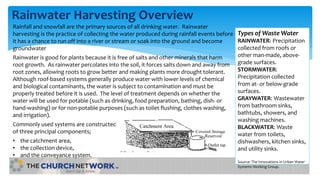
Types of Waste Water
RAINWATER: Precipitation
collected from roofs or
other man-made, above-
grade surfaces.
STORMWATER:
Precipitation collected
from at- or below-grade
surfaces.
GRAYWATER: Wastewater
from bathroom sinks,
bathtubs, showers, and
washing machines.
BLACKWATER: Waste
water from toilets,
dishwashers, kitchen sinks,
and utility sinks.
Source: The Innovations in Urban Water
Systems Working Group.
Rainfall and snowfall are the primary sources of all drinking water. Rainwater
harvesting is the practice of collecting the water produced during rainfall events before
it has a chance to run off into a river or stream or soak into the ground and become
groundwater
Rainwater is good for plants because it is free of salts and other minerals that harm
root growth. As rainwater percolates into the soil, it forces salts down and away from
root zones, allowing roots to grow better and making plants more drought tolerant.
Although roof-based systems generally produce water with lower levels of chemical
and biological contaminants, the water is subject to contamination and must be
properly treated before it is used. The level of treatment depends on whether the
water will be used for potable (such as drinking, food preparation, bathing, dish- or
hand-washing) or for non-potable purposes (such as toilet flushing, clothes washing,
and irrigation).
Commonly used systems are constructed
of three principal components;
• the catchment area,
• the collection device,
• and the conveyance system.
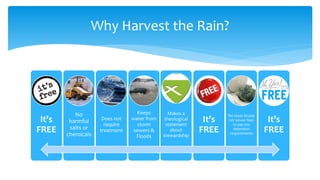
It’s
FREE
No
harmful
salts or
chemicals
Does not
require
treatment
Keeps
water from
storm
sewers &
Floods
Makes a
theological
statement
about
stewardship
It’s
FREE
No taxes to pay
nor sewer fees
to pay nor
detention
requirements
It’s
FREE
Why Harvest the Rain?
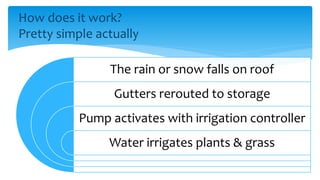
The rain or snow falls on roof
Gutters rerouted to storage
Pump activates with irrigation controller
Water irrigates plants & grass
How does it work?
Pretty simple actually
What does it cost?
Simple systems:
 Above ground storage
 Existing irrigation system
 NO CODE ISSUES
 Filters and pumps on grid
 2500 gallons - $3000 one time
 Maintenance annual $200
Complex (downtown / historic building)
 Below ground storage
 All new irrigation system
 Government hostile about loss of
revenues
 $25,000 - $100,000
 Maintenance annual $2000
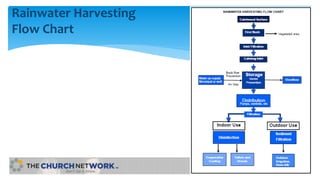
Rainwater Harvesting
Flow Chart
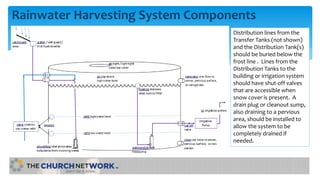
Rainwater Harvesting System Components
Distribution lines from the
Transfer Tanks (not shown)
and the Distribution Tank(s)
should be buried below the
frost line . Lines from the
Distribution Tanks to the
building or irrigation system
should have shut-off valves
that are accessible when
snow cover is present. A
drain plug or cleanout sump,
also draining to a pervious
area, should be installed to
allow the system to be
completely drained if
needed.
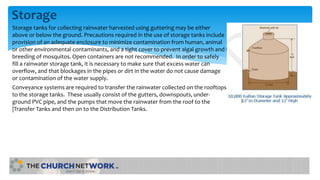
Storage
Storage tanks for collecting rainwater harvested using guttering may be either
above or below the ground. Precautions required in the use of storage tanks include
provision of an adequate enclosure to minimize contamination from human, animal
or other environmental contaminants, and a tight cover to prevent algal growth and the
breeding of mosquitos. Open containers are not recommended. In order to safely
fill a rainwater storage tank, it is necessary to make sure that excess water can
overflow, and that blockages in the pipes or dirt in the water do not cause damage
or contamination of the water supply.
Conveyance systems are required to transfer the rainwater collected on the rooftops
to the storage tanks. These usually consist of the gutters, downspouts, under-
ground PVC pipe, and the pumps that move the rainwater from the roof to the
|Transfer Tanks and then on to the Distribution Tanks.
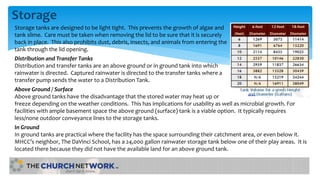
Storage
Storage tanks are designed to be light tight. This prevents the growth of algae and
tank slime. Care must be taken when removing the lid to be sure that it is securely
back in place. This also prohibits dust, debris, insects, and animals from entering the
tank through the lid opening.
Distribution and Transfer Tanks
Distribution and transfer tanks are an above ground or in ground tank into which
rainwater is directed. Captured rainwater is directed to the transfer tanks where a
transfer pump sends the water to a Distribution Tank.
Above Ground / Surface
Above ground tanks have the disadvantage that the stored water may heat up or
freeze depending on the weather conditions. This has implications for usability as well as microbial growth. For
facilities with ample basement space the above ground (surface) tank is a viable option. It typically requires
less/none outdoor conveyance lines to the storage tanks.
In Ground
In ground tanks are practical where the facility has the space surrounding their catchment area, or even below it.
MHCC’s neighbor, The DaVinci School, has a 24,000 gallon rainwater storage tank below one of their play areas. It is
located there because they did not have the available land for an above ground tank.
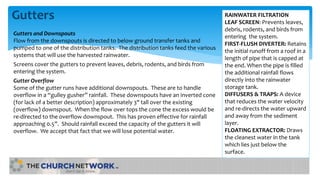
Gutters
Gutters and Downspouts
Flow from the downspouts is directed to below ground transfer tanks and
pumped to one of the distribution tanks. The distribution tanks feed the various
systems that will use the harvested rainwater.
Screens cover the gutters to prevent leaves, debris, rodents, and birds from
entering the system.
Gutter Overflow
Some of the gutter runs have additional downspouts. These are to handle
overflow in a “gulley gusher” rainfall. These downspouts have an inverted cone
(for lack of a better description) approximately 3" tall over the existing
(overflow) downspout. When the flow over tops the cone the excess would be
re-directed to the overflow downspout. This has proven effective for rainfall
approaching 0.5”. Should rainfall exceed the capacity of the gutters it will
overflow. We accept that fact that we will lose potential water.
RAINWATER FILTRATION
LEAF SCREEN: Prevents leaves,
debris, rodents, and birds from
entering the system.
FIRST-FLUSH DIVERTER: Retains
the initial runoff from a roof in a
length of pipe that is capped at
the end. When the pipe is filled
the additional rainfall flows
directly into the rainwater
storage tank.
DIFFUSERS & TRAPS: A device
that reduces the water velocity
and re-directs the water upward
and away from the sediment
layer.
FLOATING EXTRACTOR: Draws
the cleanest water in the tank
which lies just below the
surface.
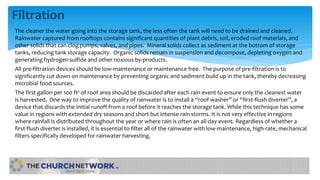
Filtration
The cleaner the water going into the storage tank, the less often the tank will need to be drained and cleaned.
Rainwater captured from rooftops contains significant quantities of plant debris, soil, eroded roof materials, and
other solids that can clog pumps, valves, and pipes. Mineral solids collect as sediment at the bottom of storage
tanks, reducing tank storage capacity. Organic solids remain in suspension and decompose, depleting oxygen and
generating hydrogen sulfide and other noxious by-products.
All pre-filtration devices should be low-maintenance or maintenance free. The purpose of pre-filtration is to
significantly cut down on maintenance by preventing organic and sediment build up in the tank, thereby decreasing
microbial food sources.
The first gallon per 100 ft² of roof area should be discarded after each rain event to ensure only the cleanest water
is harvested. One way to improve the quality of rainwater is to install a “roof washer” or “first-flush diverter”, a
device that discards the initial runoff from a roof before it reaches the storage tank. While this technique has some
value in regions with extended dry seasons and short but intense rain storms. It is not very effective in regions
where rainfall is distributed throughout the year or where rain is often an all-day event. Regardless of whether a
first-flush diverter is installed, it is essential to filter all of the rainwater with low-maintenance, high-rate, mechanical
filters specifically developed for rainwater harvesting.
Filtration
Leaf Screens
The best first defense in keeping debris out of a rainwater harvesting system is a leaf screen along the
gutter or in the downspout. Leaf screens must be regularly cleaned to be effective. If not maintained,
leaf screens can become clogged and prevent rainwater from flowing into the tank.
Downspout Filters
The funnel-type downspout filter is typically made of PVC and fitted with an aluminum or stainless steel screen.
This type of filter offers the advantage of easy accessibility for cleaning.
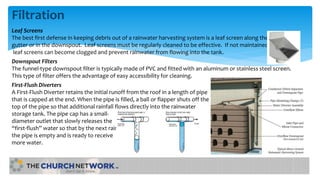
First-Flush Diverters
A First-Flush Diverter retains the initial runoff from the roof in a length of pipe
that is capped at the end. When the pipe is filled, a ball or flapper shuts off the
top of the pipe so that additional rainfall flows directly into the rainwater
storage tank. The pipe cap has a small-
diameter outlet that slowly releases the
“first-flush” water so that by the next rain
the pipe is empty and is ready to receive
more water.
Filtration
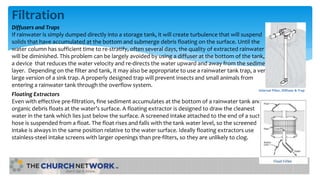
Diffusers and Traps
If rainwater is simply dumped directly into a storage tank, it will create turbulence that will suspend
solids that have accumulated at the bottom and submerge debris floating on the surface. Until the
water column has sufficient time to re-stratify, often several days, the quality of extracted rainwater
will be diminished. This problem can be largely avoided by using a diffuser at the bottom of the tank,
a device that reduces the water velocity and re-directs the water upward and away from the sediment
layer. Depending on the filter and tank, it may also be appropriate to use a rainwater tank trap, a very
large version of a sink trap. A properly designed trap will prevent insects and small animals from
entering a rainwater tank through the overflow system.
Floating Extractors
Even with effective pre-filtration, fine sediment accumulates at the bottom of a rainwater tank and
organic debris floats at the water’s surface. A floating extractor is designed to draw the cleanest
water in the tank which lies just below the surface. A screened intake attached to the end of a suction
hose is suspended from a float. The float rises and falls with the tank water level, so the screened
intake is always in the same position relative to the water surface. Ideally floating extractors use
stainless-steel intake screens with larger openings than pre-filters, so they are unlikely to clog.
Internal Filter, Diffuser & Trap
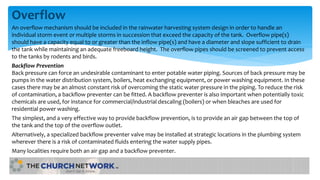
Overflow
An overflow mechanism should be included in the rainwater harvesting system design in order to handle an
individual storm event or multiple storms in succession that exceed the capacity of the tank. Overflow pipe(s)
should have a capacity equal to or greater than the inflow pipe(s) and have a diameter and slope sufficient to drain
the tank while maintaining an adequate freeboard height. The overflow pipes should be screened to prevent access
to the tanks by rodents and birds.
Backflow Prevention
Back pressure can force an undesirable contaminant to enter potable water piping. Sources of back pressure may be
pumps in the water distribution system, boilers, heat exchanging equipment, or power washing equipment. In these
cases there may be an almost constant risk of overcoming the static water pressure in the piping. To reduce the risk
of contamination, a backflow preventer can be fitted. A backflow preventer is also important when potentially toxic
chemicals are used, for instance for commercial/industrial descaling (boilers) or when bleaches are used for
residential power washing.
The simplest, and a very effective way to provide backflow prevention, is to provide an air gap between the top of
the tank and the top of the overflow outlet.
Alternatively, a specialized backflow preventer valve may be installed at strategic locations in the plumbing system
wherever there is a risk of contaminated fluids entering the water supply pipes.
Many localities require both an air gap and a backflow preventer.
Backup Integration
To effectively manage rainwater utilization, it is important to know how much water remains in storage. A variety of
devices that use mechanical or electronic means to accurately measure and display the water level in a rainwater
tank. The more sophisticated systems can manage backup (from city water system) and by operating valves and
pumps in response to the measured water level. The most reliable backup method is direct backup where the backup
source (city water supply) supplements the rainwater supply when needed.
The safest backup method is a float backup, named for a small float valve. When the rainwater tank level is below a
pre-set low level, the float valve opens a connection to the city water supply which replenishes the tank to a pre-set
high level. The backflow preventer is required to separate harvested rainwater from the main potable water
distribution lines. An air gap located above the overflow provides additional assurance that there will be no cross-
contamination.
If using the city water supply as a backup source it is advisable to have a separate irrigation water meter installed.
Most cities bill assuming water and sewer amounts the same. Installing the irrigation water meter saves the sewer
cost of water used for irrigation. (Also consider running the supply lines for the HVAC system from the irrigation
water meter as waste water from this system is expelled as evaporate, OR diverting HVAC run-off to the rainwater
harvesting system to avoid the sewer charges for disposing of this water.)
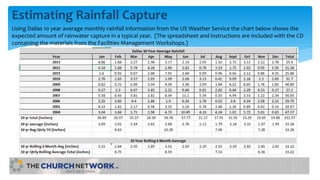
Estimating Rainfall Capture
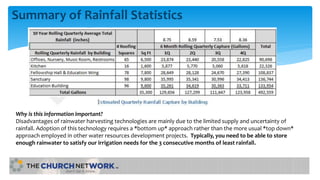
Using Dallas 10 year average monthly rainfall information from the US Weather Service the chart below shows the
expected amount of rainwater capture in a typical year. (The spreadsheet and instructions are included with the CD
containing the materials from the Facilities Management Workshops.)
Summary of Rainfall Statistics
Why is this information important?
Disadvantages of rainwater harvesting technologies are mainly due to the limited supply and uncertainty of
rainfall. Adoption of this technology requires a *bottom up* approach rather than the more usual *top down*
approach employed in other water resources development projects. Typically, you need to be able to store
enough rainwater to satisfy our irrigation needs for the 3 consecutive months of least rainfall.
Summary of Rainfall Statistics
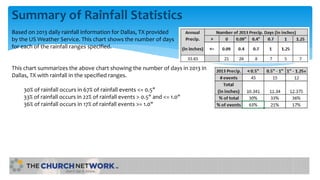
Based on 2013 daily rainfall information for Dallas, TX provided
by the US Weather Service. This chart shows the number of days
for each of the rainfall ranges specified.
This chart summarizes the above chart showing the number of days in 2013 in
Dallas, TX with rainfall in the specified ranges.
30% of rainfall occurs in 67% of rainfall events <= 0.5"
33% of rainfall occurs in 22% of rainfall events > 0.5" and <= 1.0"
36% of rainfall occurs in 17% of rainfall events >= 1.0"
Rainwater Marking and Labeling
Rainwater Pipe Marking
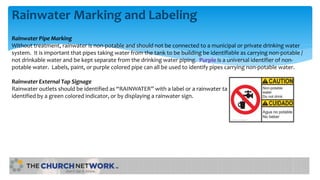
Without treatment, rainwater is non-potable and should not be connected to a municipal or private drinking water
system. It is important that pipes taking water from the tank to be building be identifiable as carrying non-potable /
not drinkable water and be kept separate from the drinking water piping. Purple is a universal identifier of non-
potable water. Labels, paint, or purple colored pipe can all be used to identify pipes carrying non-potable water.
Rainwater External Tap Signage
Rainwater outlets should be identified as “RAINWATER” with a label or a rainwater tap
identified by a green colored indicator, or by displaying a rainwater sign.
Rainwater Harvesting System Maintenance
Activity Frequency
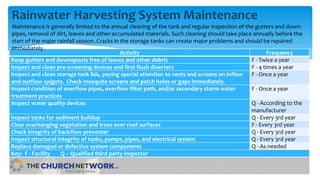
Keep gutters and downspouts free of leaves and other debris F - Twice a year
Inspect and clean pre-screening devices and first flush diverters F - 4 times a year
Inspect and clean storage tank lids, paying special attention to vents and screens on inflow
and outflow spigots. Check mosquito screens and patch holes or gaps immediately.
F - Once a year
Inspect condition of overflow pipes, overflow filter path, and/or secondary storm water
treatment practices
F - Once a year
Inspect water quality devices Q - According to the
manufacturer
Inspect tanks for sediment buildup Q - Every 3rd year
Clear overhanging vegetation and trees over roof surfaces F - Every 3rd year
Check integrity of backflow preventer Q - Every 3rd year
Inspect structural integrity of tanks, pumps, pipes, and electrical system Q - Every 3rd year
Replace damaged or defective system components Q - As needed
Key: F - Facility Q – Qualified third party inspector
Maintenance is generally limited to the annual cleaning of the tank and regular inspection of the gutters and down-
pipes, removal of dirt, leaves and other accumulated materials. Such cleaning should take place annually before the
start of the major rainfall season. Cracks in the storage tanks can create major problems and should be repaired
immediately.
Addendum
Parking Lots
New materials are available as an alternative to concrete or asphalt for parking lots and walkways. Permeable
surfaces that are rated for use by municipal vehicles (trash collection, fire engines) all rainwater to percolate into the
ground. This can be harvested.
One advantage of a permeable surface is that, depending on the location and installation, it can reduce the amount
of run-off into the city sewers which could mean a savings on the water bill.
New Construction / LEED
Water is on the way to becoming the new oil. It is in ever scarcer supply. As caretakers of God’s creation
communities of faith can incorporate rainwater harvesting in the design of new facilities.
Buildings with Historical Designation
Making changes to buildings with an historical designation presents its own unique set of problems. I had to work
closely with the NYC Landmarks Commission when doing restoration work at Judson Memorial Church in NYC. Their
overriding concern is that any restoration or repair should duplicate the original.
With reference to rainwater harvesting you would have to make sure that the gutters and downspouts are of the
same type as the original. That said, you still have control of the direction the water flows. It can be redirected to
concentrate collection. Depending on the location storage tanks could be located underground or in the basement.
Definition of Terms
Air Gap: Used as a part of a backflow preventer this is an atmospheric space between the outlet of a pipe that fills
a tank and the maximum water level in the tank. The vertical difference between the pipe outlet and the water
must be large enough to prevent water from backing up into the pipe.
Backflow: The undesirable reversal of flow of a liquid, gas or solid into the potable water supply. A backflow
preventer keeps this from happening.
Blackwater: Waste water from toilets, dishwashers, kitchen sinks, and utility sinks.
Calculating Rainwater Harvest
Catchment Area: Any surface from which rainwater is collected. Parking lots are often also used as a catchment
area. Many municipalities require the capture of rainwater run-off as a way of reducing the amount of water
entering the sewer system and needing treatment.
Contaminant: Any chemical, microbe, or other material that is not found in pure water and
that can make water unsuitable for its intended use. Some contaminants only affect
aesthetic qualities such as the appearance, taste, or odor of the water, while others can
produce adverse health effects if present in high concentrations.
Culvert: An in ground vertical concrete shaft used to collect rainwater from a scupper.
The water is directed to a Transfer Tank.
Definition of Terms
Debris: A contaminant that you can see. Debris can include leaves and twigs, dust and dirt, bird and animal
droppings, and insects.
Distribution Tank: An above ground tank that receives water from multiple Transfer Tanks. Rainwater stored here is
used to supply irrigation and non-potable water needs.
Downspout: (or downpipe) is a vertical pipe for carrying rainwater from a rain gutter to ground level. There the
water is directed to a sewer, rainwater harvesting, or let into the ground through seepage.
Graywater: Wastewater from bathroom sinks, bathtubs, showers, and washing machines.
Gutter: The metal channels that are attached to the roof edges and used to draw water down and away from the
building and its foundation. Most gutters consist of gutter sections, drop outlets and downspouts.
Irrigation: Watering exterior plants and vegetation.
Irrigation Water Meter: A separate water meter used only for measuring irrigation use. Having this meter eliminates
having to pay the sewer costs for water used for irrigation.
Non-Potable Water: Water that may have received some treatment but not enough to make it safe for potable use.
Non-potable water can be used for irrigation and flushing toilets.
Overflow: The highest level that water in a tank is permitted to attain.
Definition of Terms
Potable Water: Water used for human consumption, for washing dishes and utensils that are used to prepare or
consume food or beverages, for bathing, or for any other purpose that might result in ingestion of water.
Pump: Mechanical device necessary to distribute the harvested rainwater from the Transfer Tanks to the Distribution
Tanks and from the Distribution Tanks to the buildings or irrigation system.
Rainwater: Precipitation collected from roofs or other man-made, above-grade surfaces.
Rainwater Harvesting: The accumulation and deposition of rainwater for reuse on-site, rather than allowing it to
runoff. Uses include water for garden, water for livestock, water for irrigation, water for domestic use with proper
treatment, and indoor heating for houses etc.
Scupper: Any opening in the side of a building, as in a parapet, for draining off rain water. It does not
direct the flow of water to the gutter. Rather, it directs the water flow off the roof directly to the ground
away from the windows / building.
Storm Water: Precipitation collected from at- or below-grade surfaces.
Transfer Tank: An above ground (surface) or underground tank into which rainwater is directed. A pump then directs
the water to the Distribution Tank.
Treated Water: Water that has been filtered and disinfected and is safe for potable use.
Untreated Water: Water that has not received enough treatment to make it safe for potable use.
Acknowledgements
We would like to thank the following people for their help in preparing / reviewing / revising this document.
The following Midway Hills Christian Church members are actively participating in our Disciples Home Missions Green
Chalice Green Team:
• Rev. Arthur Stewart, Sr. Pastor, ex officio
• Paul Johnson, Co-Chair, Building committee
• Stephen Studnicka , Co-Chair, Building committee
• Gary Springer, MHCC board member
• Evans Mank
• Logan Geigner
• Kristi Daniels
Dallas County Master Gardeners
(http://www.dallascountymastergardeners.org/)
• Ann Lamb
• Lisa Centala
• Jim Dempsey
Sources
Rainwater Handbook, Conservation Technology
http://www.conservationtechnology.com/documents/RainwaterHandbook0911.pdf
B-6240: Rainwater Harvesting: System Planning, Texas A&M AgriLife Extension
http://www.agrilifebookstore.org/product-p/b-6240.htm
EPA Municipal Handbook – Rainwater Harvesting, EPA-833-F-08-010
http://water.epa.gov/infrastructure/greeninfrastructure/upload/gi_munichandbook_harvesting.pdf
Rainwater Harvesting, Wikipedia
http://en.wikipedia.org/wiki/Rainwater_harvesting
Rainwater Tank Design and Installation Handbook, Australian Government National Water Commission
http://www.nwc.gov.au/__data/assets/pdf_file/0016/10753/RAINWATER_handbooknwc_logo.pdf
An Introduction to Rainwater Harvesting, Global Development Research Council
http://www.gdrc.org/uem/water/rainwater/index.html
Oregon Smart Guide – Rainwater Harvesting, Oregon Dept. of Consumer & Business Services, Building Codes Division
http://www.bcd.oregon.gov/pdf/3660.pdf
Dist. of Columbia Storm Water Management Guide – Chapter 3.2, Rainwater Harvesting, Dist. of Columbia Water Dept.
http://ddoe.dc.gov/sites/default/files/dc/sites/ddoe/publication/attachments/Ch3.2RainwaterHarvesting_0.pdf
US Climate Data – Dallas 2013 Daily Rainfall, US Weather Service
http://www.usclimatedata.com/climate/dallas-dfw-intl-arpt/texas/united-states/ustx0328
Suggested Reading and Web Sites
Rainwater Harvesting and Utilization, An Introductory Guide for Decision Makers, Global Development Research
Council
http://www.gdrc.org/uem/water/rainwater/rainwaterguide.pdf
Texas Manual on Rainwater Harvesting, Texas Water Development Board
http://www.ecy.wa.gov/programs/wr/hq/pdf/texas_rw_harvestmanual_3rdedition.pdf
Rainwater Harvesting Potential and Guidelines for Texas, Texas Water Development Board
http://www.twdb.state.tx.us/innovativewater/rainwater/doc/RainwaterCommitteeFinalReport.pdf
Georgia Rainwater Harvesting Guidelines 2009, State of Georgia
http://www.usclimatedata.com/climate/dallas-dfw-intl-arpt/texas/united-states/ustx0328
Facts about Texas Water, Lone Star Chapter, The Sierra Club
http://texas.sierraclub.org/press/facts.asp
Introduction to Rainwater Harvesting, Rain Bird Corporation
http://www.rainbird.com/landscape/resources/webinars/Rainwater%20Harvesting.pdf

Rainwater Harvesting White Paper

  • 2.
    Rainwater Harvesting Overview Typesof Waste Water RAINWATER: Precipitation collected from roofs or other man-made, above- grade surfaces. STORMWATER: Precipitation collected from at- or below-grade surfaces. GRAYWATER: Wastewater from bathroom sinks, bathtubs, showers, and washing machines. BLACKWATER: Waste water from toilets, dishwashers, kitchen sinks, and utility sinks. Source: The Innovations in Urban Water Systems Working Group. Rainfall and snowfall are the primary sources of all drinking water. Rainwater harvesting is the practice of collecting the water produced during rainfall events before it has a chance to run off into a river or stream or soak into the ground and become groundwater Rainwater is good for plants because it is free of salts and other minerals that harm root growth. As rainwater percolates into the soil, it forces salts down and away from root zones, allowing roots to grow better and making plants more drought tolerant. Although roof-based systems generally produce water with lower levels of chemical and biological contaminants, the water is subject to contamination and must be properly treated before it is used. The level of treatment depends on whether the water will be used for potable (such as drinking, food preparation, bathing, dish- or hand-washing) or for non-potable purposes (such as toilet flushing, clothes washing, and irrigation). Commonly used systems are constructed of three principal components; • the catchment area, • the collection device, • and the conveyance system.
  • 3.
    It’s FREE No harmful salts or chemicals Does not require treatment Keeps waterfrom storm sewers & Floods Makes a theological statement about stewardship It’s FREE No taxes to pay nor sewer fees to pay nor detention requirements It’s FREE Why Harvest the Rain?
  • 4.
    The rain orsnow falls on roof Gutters rerouted to storage Pump activates with irrigation controller Water irrigates plants & grass How does it work? Pretty simple actually
  • 5.
    What does itcost? Simple systems:  Above ground storage  Existing irrigation system  NO CODE ISSUES  Filters and pumps on grid  2500 gallons - $3000 one time  Maintenance annual $200 Complex (downtown / historic building)  Below ground storage  All new irrigation system  Government hostile about loss of revenues  $25,000 - $100,000  Maintenance annual $2000
  • 6.
  • 7.
    Rainwater Harvesting SystemComponents Distribution lines from the Transfer Tanks (not shown) and the Distribution Tank(s) should be buried below the frost line . Lines from the Distribution Tanks to the building or irrigation system should have shut-off valves that are accessible when snow cover is present. A drain plug or cleanout sump, also draining to a pervious area, should be installed to allow the system to be completely drained if needed.
  • 8.
    Storage Storage tanks forcollecting rainwater harvested using guttering may be either above or below the ground. Precautions required in the use of storage tanks include provision of an adequate enclosure to minimize contamination from human, animal or other environmental contaminants, and a tight cover to prevent algal growth and the breeding of mosquitos. Open containers are not recommended. In order to safely fill a rainwater storage tank, it is necessary to make sure that excess water can overflow, and that blockages in the pipes or dirt in the water do not cause damage or contamination of the water supply. Conveyance systems are required to transfer the rainwater collected on the rooftops to the storage tanks. These usually consist of the gutters, downspouts, under- ground PVC pipe, and the pumps that move the rainwater from the roof to the |Transfer Tanks and then on to the Distribution Tanks.
  • 9.
    Storage Storage tanks aredesigned to be light tight. This prevents the growth of algae and tank slime. Care must be taken when removing the lid to be sure that it is securely back in place. This also prohibits dust, debris, insects, and animals from entering the tank through the lid opening. Distribution and Transfer Tanks Distribution and transfer tanks are an above ground or in ground tank into which rainwater is directed. Captured rainwater is directed to the transfer tanks where a transfer pump sends the water to a Distribution Tank. Above Ground / Surface Above ground tanks have the disadvantage that the stored water may heat up or freeze depending on the weather conditions. This has implications for usability as well as microbial growth. For facilities with ample basement space the above ground (surface) tank is a viable option. It typically requires less/none outdoor conveyance lines to the storage tanks. In Ground In ground tanks are practical where the facility has the space surrounding their catchment area, or even below it. MHCC’s neighbor, The DaVinci School, has a 24,000 gallon rainwater storage tank below one of their play areas. It is located there because they did not have the available land for an above ground tank.
  • 10.
    Gutters Gutters and Downspouts Flowfrom the downspouts is directed to below ground transfer tanks and pumped to one of the distribution tanks. The distribution tanks feed the various systems that will use the harvested rainwater. Screens cover the gutters to prevent leaves, debris, rodents, and birds from entering the system. Gutter Overflow Some of the gutter runs have additional downspouts. These are to handle overflow in a “gulley gusher” rainfall. These downspouts have an inverted cone (for lack of a better description) approximately 3" tall over the existing (overflow) downspout. When the flow over tops the cone the excess would be re-directed to the overflow downspout. This has proven effective for rainfall approaching 0.5”. Should rainfall exceed the capacity of the gutters it will overflow. We accept that fact that we will lose potential water. RAINWATER FILTRATION LEAF SCREEN: Prevents leaves, debris, rodents, and birds from entering the system. FIRST-FLUSH DIVERTER: Retains the initial runoff from a roof in a length of pipe that is capped at the end. When the pipe is filled the additional rainfall flows directly into the rainwater storage tank. DIFFUSERS & TRAPS: A device that reduces the water velocity and re-directs the water upward and away from the sediment layer. FLOATING EXTRACTOR: Draws the cleanest water in the tank which lies just below the surface.
  • 11.
    Filtration The cleaner thewater going into the storage tank, the less often the tank will need to be drained and cleaned. Rainwater captured from rooftops contains significant quantities of plant debris, soil, eroded roof materials, and other solids that can clog pumps, valves, and pipes. Mineral solids collect as sediment at the bottom of storage tanks, reducing tank storage capacity. Organic solids remain in suspension and decompose, depleting oxygen and generating hydrogen sulfide and other noxious by-products. All pre-filtration devices should be low-maintenance or maintenance free. The purpose of pre-filtration is to significantly cut down on maintenance by preventing organic and sediment build up in the tank, thereby decreasing microbial food sources. The first gallon per 100 ft² of roof area should be discarded after each rain event to ensure only the cleanest water is harvested. One way to improve the quality of rainwater is to install a “roof washer” or “first-flush diverter”, a device that discards the initial runoff from a roof before it reaches the storage tank. While this technique has some value in regions with extended dry seasons and short but intense rain storms. It is not very effective in regions where rainfall is distributed throughout the year or where rain is often an all-day event. Regardless of whether a first-flush diverter is installed, it is essential to filter all of the rainwater with low-maintenance, high-rate, mechanical filters specifically developed for rainwater harvesting.
  • 12.
    Filtration Leaf Screens The bestfirst defense in keeping debris out of a rainwater harvesting system is a leaf screen along the gutter or in the downspout. Leaf screens must be regularly cleaned to be effective. If not maintained, leaf screens can become clogged and prevent rainwater from flowing into the tank. Downspout Filters The funnel-type downspout filter is typically made of PVC and fitted with an aluminum or stainless steel screen. This type of filter offers the advantage of easy accessibility for cleaning. First-Flush Diverters A First-Flush Diverter retains the initial runoff from the roof in a length of pipe that is capped at the end. When the pipe is filled, a ball or flapper shuts off the top of the pipe so that additional rainfall flows directly into the rainwater storage tank. The pipe cap has a small- diameter outlet that slowly releases the “first-flush” water so that by the next rain the pipe is empty and is ready to receive more water.
  • 13.
    Filtration Diffusers and Traps Ifrainwater is simply dumped directly into a storage tank, it will create turbulence that will suspend solids that have accumulated at the bottom and submerge debris floating on the surface. Until the water column has sufficient time to re-stratify, often several days, the quality of extracted rainwater will be diminished. This problem can be largely avoided by using a diffuser at the bottom of the tank, a device that reduces the water velocity and re-directs the water upward and away from the sediment layer. Depending on the filter and tank, it may also be appropriate to use a rainwater tank trap, a very large version of a sink trap. A properly designed trap will prevent insects and small animals from entering a rainwater tank through the overflow system. Floating Extractors Even with effective pre-filtration, fine sediment accumulates at the bottom of a rainwater tank and organic debris floats at the water’s surface. A floating extractor is designed to draw the cleanest water in the tank which lies just below the surface. A screened intake attached to the end of a suction hose is suspended from a float. The float rises and falls with the tank water level, so the screened intake is always in the same position relative to the water surface. Ideally floating extractors use stainless-steel intake screens with larger openings than pre-filters, so they are unlikely to clog. Internal Filter, Diffuser & Trap
  • 14.
    Overflow An overflow mechanismshould be included in the rainwater harvesting system design in order to handle an individual storm event or multiple storms in succession that exceed the capacity of the tank. Overflow pipe(s) should have a capacity equal to or greater than the inflow pipe(s) and have a diameter and slope sufficient to drain the tank while maintaining an adequate freeboard height. The overflow pipes should be screened to prevent access to the tanks by rodents and birds. Backflow Prevention Back pressure can force an undesirable contaminant to enter potable water piping. Sources of back pressure may be pumps in the water distribution system, boilers, heat exchanging equipment, or power washing equipment. In these cases there may be an almost constant risk of overcoming the static water pressure in the piping. To reduce the risk of contamination, a backflow preventer can be fitted. A backflow preventer is also important when potentially toxic chemicals are used, for instance for commercial/industrial descaling (boilers) or when bleaches are used for residential power washing. The simplest, and a very effective way to provide backflow prevention, is to provide an air gap between the top of the tank and the top of the overflow outlet. Alternatively, a specialized backflow preventer valve may be installed at strategic locations in the plumbing system wherever there is a risk of contaminated fluids entering the water supply pipes. Many localities require both an air gap and a backflow preventer.
  • 15.
    Backup Integration To effectivelymanage rainwater utilization, it is important to know how much water remains in storage. A variety of devices that use mechanical or electronic means to accurately measure and display the water level in a rainwater tank. The more sophisticated systems can manage backup (from city water system) and by operating valves and pumps in response to the measured water level. The most reliable backup method is direct backup where the backup source (city water supply) supplements the rainwater supply when needed. The safest backup method is a float backup, named for a small float valve. When the rainwater tank level is below a pre-set low level, the float valve opens a connection to the city water supply which replenishes the tank to a pre-set high level. The backflow preventer is required to separate harvested rainwater from the main potable water distribution lines. An air gap located above the overflow provides additional assurance that there will be no cross- contamination. If using the city water supply as a backup source it is advisable to have a separate irrigation water meter installed. Most cities bill assuming water and sewer amounts the same. Installing the irrigation water meter saves the sewer cost of water used for irrigation. (Also consider running the supply lines for the HVAC system from the irrigation water meter as waste water from this system is expelled as evaporate, OR diverting HVAC run-off to the rainwater harvesting system to avoid the sewer charges for disposing of this water.)
  • 16.
    Estimating Rainfall Capture UsingDallas 10 year average monthly rainfall information from the US Weather Service the chart below shows the expected amount of rainwater capture in a typical year. (The spreadsheet and instructions are included with the CD containing the materials from the Facilities Management Workshops.)
  • 17.
    Summary of RainfallStatistics Why is this information important? Disadvantages of rainwater harvesting technologies are mainly due to the limited supply and uncertainty of rainfall. Adoption of this technology requires a *bottom up* approach rather than the more usual *top down* approach employed in other water resources development projects. Typically, you need to be able to store enough rainwater to satisfy our irrigation needs for the 3 consecutive months of least rainfall.
  • 18.
    Summary of RainfallStatistics Based on 2013 daily rainfall information for Dallas, TX provided by the US Weather Service. This chart shows the number of days for each of the rainfall ranges specified. This chart summarizes the above chart showing the number of days in 2013 in Dallas, TX with rainfall in the specified ranges. 30% of rainfall occurs in 67% of rainfall events <= 0.5" 33% of rainfall occurs in 22% of rainfall events > 0.5" and <= 1.0" 36% of rainfall occurs in 17% of rainfall events >= 1.0"
  • 19.
    Rainwater Marking andLabeling Rainwater Pipe Marking Without treatment, rainwater is non-potable and should not be connected to a municipal or private drinking water system. It is important that pipes taking water from the tank to be building be identifiable as carrying non-potable / not drinkable water and be kept separate from the drinking water piping. Purple is a universal identifier of non- potable water. Labels, paint, or purple colored pipe can all be used to identify pipes carrying non-potable water. Rainwater External Tap Signage Rainwater outlets should be identified as “RAINWATER” with a label or a rainwater tap identified by a green colored indicator, or by displaying a rainwater sign.
  • 20.
    Rainwater Harvesting SystemMaintenance Activity Frequency Keep gutters and downspouts free of leaves and other debris F - Twice a year Inspect and clean pre-screening devices and first flush diverters F - 4 times a year Inspect and clean storage tank lids, paying special attention to vents and screens on inflow and outflow spigots. Check mosquito screens and patch holes or gaps immediately. F - Once a year Inspect condition of overflow pipes, overflow filter path, and/or secondary storm water treatment practices F - Once a year Inspect water quality devices Q - According to the manufacturer Inspect tanks for sediment buildup Q - Every 3rd year Clear overhanging vegetation and trees over roof surfaces F - Every 3rd year Check integrity of backflow preventer Q - Every 3rd year Inspect structural integrity of tanks, pumps, pipes, and electrical system Q - Every 3rd year Replace damaged or defective system components Q - As needed Key: F - Facility Q – Qualified third party inspector Maintenance is generally limited to the annual cleaning of the tank and regular inspection of the gutters and down- pipes, removal of dirt, leaves and other accumulated materials. Such cleaning should take place annually before the start of the major rainfall season. Cracks in the storage tanks can create major problems and should be repaired immediately.
  • 21.
    Addendum Parking Lots New materialsare available as an alternative to concrete or asphalt for parking lots and walkways. Permeable surfaces that are rated for use by municipal vehicles (trash collection, fire engines) all rainwater to percolate into the ground. This can be harvested. One advantage of a permeable surface is that, depending on the location and installation, it can reduce the amount of run-off into the city sewers which could mean a savings on the water bill. New Construction / LEED Water is on the way to becoming the new oil. It is in ever scarcer supply. As caretakers of God’s creation communities of faith can incorporate rainwater harvesting in the design of new facilities. Buildings with Historical Designation Making changes to buildings with an historical designation presents its own unique set of problems. I had to work closely with the NYC Landmarks Commission when doing restoration work at Judson Memorial Church in NYC. Their overriding concern is that any restoration or repair should duplicate the original. With reference to rainwater harvesting you would have to make sure that the gutters and downspouts are of the same type as the original. That said, you still have control of the direction the water flows. It can be redirected to concentrate collection. Depending on the location storage tanks could be located underground or in the basement.
  • 22.
    Definition of Terms AirGap: Used as a part of a backflow preventer this is an atmospheric space between the outlet of a pipe that fills a tank and the maximum water level in the tank. The vertical difference between the pipe outlet and the water must be large enough to prevent water from backing up into the pipe. Backflow: The undesirable reversal of flow of a liquid, gas or solid into the potable water supply. A backflow preventer keeps this from happening. Blackwater: Waste water from toilets, dishwashers, kitchen sinks, and utility sinks. Calculating Rainwater Harvest Catchment Area: Any surface from which rainwater is collected. Parking lots are often also used as a catchment area. Many municipalities require the capture of rainwater run-off as a way of reducing the amount of water entering the sewer system and needing treatment. Contaminant: Any chemical, microbe, or other material that is not found in pure water and that can make water unsuitable for its intended use. Some contaminants only affect aesthetic qualities such as the appearance, taste, or odor of the water, while others can produce adverse health effects if present in high concentrations. Culvert: An in ground vertical concrete shaft used to collect rainwater from a scupper. The water is directed to a Transfer Tank.
  • 23.
    Definition of Terms Debris:A contaminant that you can see. Debris can include leaves and twigs, dust and dirt, bird and animal droppings, and insects. Distribution Tank: An above ground tank that receives water from multiple Transfer Tanks. Rainwater stored here is used to supply irrigation and non-potable water needs. Downspout: (or downpipe) is a vertical pipe for carrying rainwater from a rain gutter to ground level. There the water is directed to a sewer, rainwater harvesting, or let into the ground through seepage. Graywater: Wastewater from bathroom sinks, bathtubs, showers, and washing machines. Gutter: The metal channels that are attached to the roof edges and used to draw water down and away from the building and its foundation. Most gutters consist of gutter sections, drop outlets and downspouts. Irrigation: Watering exterior plants and vegetation. Irrigation Water Meter: A separate water meter used only for measuring irrigation use. Having this meter eliminates having to pay the sewer costs for water used for irrigation. Non-Potable Water: Water that may have received some treatment but not enough to make it safe for potable use. Non-potable water can be used for irrigation and flushing toilets. Overflow: The highest level that water in a tank is permitted to attain.
  • 24.
    Definition of Terms PotableWater: Water used for human consumption, for washing dishes and utensils that are used to prepare or consume food or beverages, for bathing, or for any other purpose that might result in ingestion of water. Pump: Mechanical device necessary to distribute the harvested rainwater from the Transfer Tanks to the Distribution Tanks and from the Distribution Tanks to the buildings or irrigation system. Rainwater: Precipitation collected from roofs or other man-made, above-grade surfaces. Rainwater Harvesting: The accumulation and deposition of rainwater for reuse on-site, rather than allowing it to runoff. Uses include water for garden, water for livestock, water for irrigation, water for domestic use with proper treatment, and indoor heating for houses etc. Scupper: Any opening in the side of a building, as in a parapet, for draining off rain water. It does not direct the flow of water to the gutter. Rather, it directs the water flow off the roof directly to the ground away from the windows / building. Storm Water: Precipitation collected from at- or below-grade surfaces. Transfer Tank: An above ground (surface) or underground tank into which rainwater is directed. A pump then directs the water to the Distribution Tank. Treated Water: Water that has been filtered and disinfected and is safe for potable use. Untreated Water: Water that has not received enough treatment to make it safe for potable use.
  • 25.
    Acknowledgements We would liketo thank the following people for their help in preparing / reviewing / revising this document. The following Midway Hills Christian Church members are actively participating in our Disciples Home Missions Green Chalice Green Team: • Rev. Arthur Stewart, Sr. Pastor, ex officio • Paul Johnson, Co-Chair, Building committee • Stephen Studnicka , Co-Chair, Building committee • Gary Springer, MHCC board member • Evans Mank • Logan Geigner • Kristi Daniels Dallas County Master Gardeners (http://www.dallascountymastergardeners.org/) • Ann Lamb • Lisa Centala • Jim Dempsey
  • 26.
    Sources Rainwater Handbook, ConservationTechnology http://www.conservationtechnology.com/documents/RainwaterHandbook0911.pdf B-6240: Rainwater Harvesting: System Planning, Texas A&M AgriLife Extension http://www.agrilifebookstore.org/product-p/b-6240.htm EPA Municipal Handbook – Rainwater Harvesting, EPA-833-F-08-010 http://water.epa.gov/infrastructure/greeninfrastructure/upload/gi_munichandbook_harvesting.pdf Rainwater Harvesting, Wikipedia http://en.wikipedia.org/wiki/Rainwater_harvesting Rainwater Tank Design and Installation Handbook, Australian Government National Water Commission http://www.nwc.gov.au/__data/assets/pdf_file/0016/10753/RAINWATER_handbooknwc_logo.pdf An Introduction to Rainwater Harvesting, Global Development Research Council http://www.gdrc.org/uem/water/rainwater/index.html Oregon Smart Guide – Rainwater Harvesting, Oregon Dept. of Consumer & Business Services, Building Codes Division http://www.bcd.oregon.gov/pdf/3660.pdf Dist. of Columbia Storm Water Management Guide – Chapter 3.2, Rainwater Harvesting, Dist. of Columbia Water Dept. http://ddoe.dc.gov/sites/default/files/dc/sites/ddoe/publication/attachments/Ch3.2RainwaterHarvesting_0.pdf US Climate Data – Dallas 2013 Daily Rainfall, US Weather Service http://www.usclimatedata.com/climate/dallas-dfw-intl-arpt/texas/united-states/ustx0328
  • 27.
    Suggested Reading andWeb Sites Rainwater Harvesting and Utilization, An Introductory Guide for Decision Makers, Global Development Research Council http://www.gdrc.org/uem/water/rainwater/rainwaterguide.pdf Texas Manual on Rainwater Harvesting, Texas Water Development Board http://www.ecy.wa.gov/programs/wr/hq/pdf/texas_rw_harvestmanual_3rdedition.pdf Rainwater Harvesting Potential and Guidelines for Texas, Texas Water Development Board http://www.twdb.state.tx.us/innovativewater/rainwater/doc/RainwaterCommitteeFinalReport.pdf Georgia Rainwater Harvesting Guidelines 2009, State of Georgia http://www.usclimatedata.com/climate/dallas-dfw-intl-arpt/texas/united-states/ustx0328 Facts about Texas Water, Lone Star Chapter, The Sierra Club http://texas.sierraclub.org/press/facts.asp Introduction to Rainwater Harvesting, Rain Bird Corporation http://www.rainbird.com/landscape/resources/webinars/Rainwater%20Harvesting.pdf