Guided By: Presented By:
 Prof. Dr .M.V.Vaidya 1) Vitthal Jadhav
2) Shubham Suryawanshi
DEVELOPERS
 Vitthal Jadhav
 Shubham Suryawanshi
ABSTRACT
 The main aim of the project was to develop a website
which would facilitate the reservation of online train
tickets through an effective and yet simple GUI for a
normal passenger intending to travel in trains. Apart
from reserving tickets, through our system a passenger
can compare online fares ‘from’ one city ‘to’ other
cities.
MODULES
 Booking: The system can book online tickets of the
passengers, where they want to go.
 Cancellation: The passengers can cancel their train
tickets as usually.
 Passenger Details: The System stores all the
necessary information of the passengers.
MODULES
 Trains: It shows the train schedule such as bus time,
arrival and departure time etc.
Search:
 This is provided the search options of the system that
can search any related information of the system.
Report:
 This shows the reports in different fields of the system.
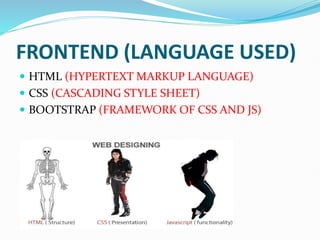
FRONTEND (LANGUAGE USED)
 HTML (HYPERTEXT MARKUP LANGUAGE)
 CSS (CASCADING STYLE SHEET)
 BOOTSTRAP (FRAMEWORK OF CSS AND JS)
BACKEND
 PYTHON DJANGO
 SQLITE (DATABASE)
SOFTWARE USED
 PYTHON INTERPRETER
 PYCHARM IDE (INTEGRATED DEVELOPMENT ENVIRONMENT)
 NOTEPAD++ OR ANY OTHER TEXT EDITOR
 CHROME OR ANY OTHER BROWSER
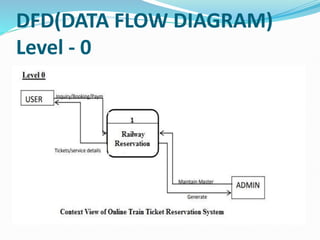
DFD(DATA FLOW DIAGRAM)
Level - 0
DFD(DATA FLOW DIAGRAM)
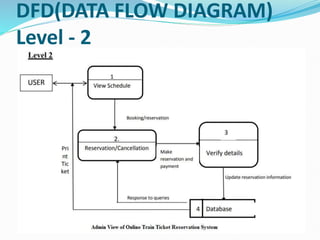
Level - 2
DFD(DATA FLOW DIAGRAM)
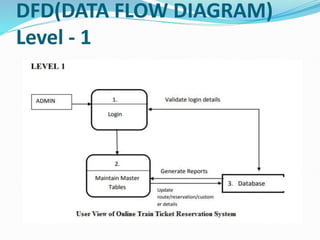
Level - 1
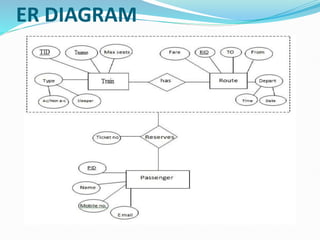
ER DIAGRAM
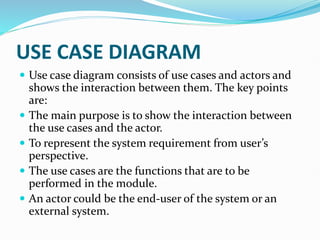
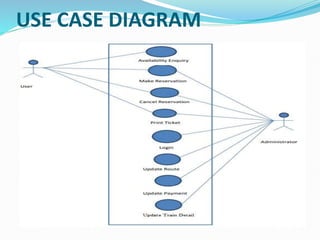
 Use case diagram consists of use cases and actors and
shows the interaction between them. The key points
are:
 The main purpose is to show the interaction between
the use cases and the actor.
 To represent the system requirement from user’s
perspective.
 The use cases are the functions that are to be
performed in the module.
 An actor could be the end-user of the system or an
external system.
USE CASE DIAGRAM
USE CASE DIAGRAM
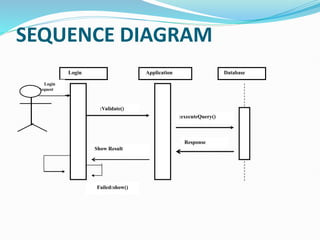
SEQUENCE DIAGRAM
Login Application Database
Login
:Request
:Validate()
:executeQuery()
Response
Show Result
Failed:show()
CONCLUSION & FUTURE SCOPE
FUTURE SCOPE
 This web application involves almost all the features of the
online train ticket booking. The future implementation will
be online help for the customers and chatting with website
administrator.
CONCLUSION
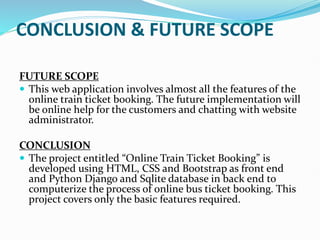
 The project entitled “Online Train Ticket Booking” is
developed using HTML, CSS and Bootstrap as front end
and Python Django and Sqlite database in back end to
computerize the process of online bus ticket booking. This
project covers only the basic features required.
BIBLIOGRAPHY
 FOR PYTHON INSTALLATION
 https://www.python.org

 FOR HTML , CSS ANF PYTHON BASICS
 www.w3schools.com
 www.javatpoint.com
 https://www.geeksforgeeks.org/python-django/
 REFERENCE BOOKS
 Two scoops of Django for 1.11 by Daniel Greenfeld’s and
Audrey Greenfield
 Lightweight Django by Elman and Mark Lavin
THANKYOU

Railway Reservation System.pptx

  • 2.
    Guided By: PresentedBy:  Prof. Dr .M.V.Vaidya 1) Vitthal Jadhav 2) Shubham Suryawanshi
  • 3.
  • 4.
    ABSTRACT  The mainaim of the project was to develop a website which would facilitate the reservation of online train tickets through an effective and yet simple GUI for a normal passenger intending to travel in trains. Apart from reserving tickets, through our system a passenger can compare online fares ‘from’ one city ‘to’ other cities.
  • 5.
    MODULES  Booking: Thesystem can book online tickets of the passengers, where they want to go.  Cancellation: The passengers can cancel their train tickets as usually.  Passenger Details: The System stores all the necessary information of the passengers.
  • 6.
    MODULES  Trains: Itshows the train schedule such as bus time, arrival and departure time etc. Search:  This is provided the search options of the system that can search any related information of the system. Report:  This shows the reports in different fields of the system.
  • 7.
    FRONTEND (LANGUAGE USED) HTML (HYPERTEXT MARKUP LANGUAGE)  CSS (CASCADING STYLE SHEET)  BOOTSTRAP (FRAMEWORK OF CSS AND JS)
  • 8.
  • 9.
    SOFTWARE USED  PYTHONINTERPRETER  PYCHARM IDE (INTEGRATED DEVELOPMENT ENVIRONMENT)  NOTEPAD++ OR ANY OTHER TEXT EDITOR  CHROME OR ANY OTHER BROWSER
  • 10.
  • 11.
  • 12.
  • 13.
  • 14.
     Use casediagram consists of use cases and actors and shows the interaction between them. The key points are:  The main purpose is to show the interaction between the use cases and the actor.  To represent the system requirement from user’s perspective.  The use cases are the functions that are to be performed in the module.  An actor could be the end-user of the system or an external system. USE CASE DIAGRAM
  • 15.
  • 16.
    SEQUENCE DIAGRAM Login ApplicationDatabase Login :Request :Validate() :executeQuery() Response Show Result Failed:show()
  • 17.
    CONCLUSION & FUTURESCOPE FUTURE SCOPE  This web application involves almost all the features of the online train ticket booking. The future implementation will be online help for the customers and chatting with website administrator. CONCLUSION  The project entitled “Online Train Ticket Booking” is developed using HTML, CSS and Bootstrap as front end and Python Django and Sqlite database in back end to computerize the process of online bus ticket booking. This project covers only the basic features required.
  • 18.
    BIBLIOGRAPHY  FOR PYTHONINSTALLATION  https://www.python.org   FOR HTML , CSS ANF PYTHON BASICS  www.w3schools.com  www.javatpoint.com  https://www.geeksforgeeks.org/python-django/  REFERENCE BOOKS  Two scoops of Django for 1.11 by Daniel Greenfeld’s and Audrey Greenfield  Lightweight Django by Elman and Mark Lavin
  • 19.