
Rahul Bajaj
2nd year, B.Arch.
Architecture & Planning Dept.
MANIT, BHOPAL
Abstract
A simplistic view of the role is that architects create architectures, and
their responsibilities encompass all that is involved in doing so. This would
include:
 articulating the architectural vision
 conceptualizing and experimenting with alternative architectural
approaches
 creating models and component and interface specification documents and
 validating the architecture against requirements and assumptions.
Now a days ,when we have so many civil engineers and decorators
or interior decorators as well with us. Then…
 what is the need of an architect?
 what actually an architect can do? and
 for what purposes we precisely need an architect?
These are the various questions which generally strikes our head when we
need any supervisor to make our dreams realistic.
 Architecture is actually an art of designing spaces which suits the user, goes
with the atmosphere, is user friendly and gives positive psycho-physical
response. An architect is multi-tasking person.

 Ancient, traditional cultures and languages used the same word for both builder
and architect. Construction was an integrated craft.
 With the industrial revolution came new materials, machines, techniques,
regulations, etc. And along with all this came a proliferation of highly
specialized subcontractors, who handled each specialized problem.
 The specialized details of construction became matters for experts while the
role of the architect became more clearly focused on providing overall
conception of structures, and managing the relationship between the client and
the builder/contractor.
Technology
As an architect, you need a thorough knowledge of your
 organization’s products,
 relevant technologies and
 development processes.

But the architect does not have to write just any code to show that he
or she is still getting exposure to the technology and staying current with the
moving frontier of "hard problems" that must be solved to make this system fly.
Either the architect has to have very good relationships with
designer/developers who do work on this frontier relationships that translate
through active discussions and open sharing into real insight or the architect
has to work there herself.
Ideally, the architect is seen as useful by developers, not just as a
political shield, but as a technical problem solver.
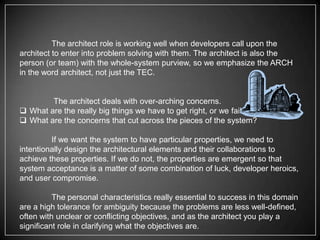
The architect role is working well when developers call upon the
architect to enter into problem solving with them. The architect is also the
person (or team) with the whole-system purview, so we emphasize the ARCH
in the word architect, not just the TEC.

The architect deals with over-arching concerns.
 What are the really big things we have to get right, or we fail?
 What are the concerns that cut across the pieces of the system?
If we want the system to have particular properties, we need to
intentionally design the architectural elements and their collaborations to
achieve these properties. If we do not, the properties are emergent so that
system acceptance is a matter of some combination of luck, developer heroics,
and user compromise.

The personal characteristics really essential to success in this domain
are a high tolerance for ambiguity because the problems are less well-defined,
often with unclear or conflicting objectives, and as the architect you play a
significant role in clarifying what the objectives are.
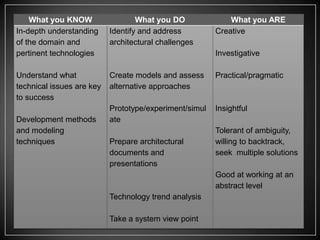
What you KNOW
In-depth understanding
of the domain and
pertinent technologies

What you DO
Identify and address
architectural challenges

Understand what
technical issues are key
to success

Create models and assess
alternative approaches

Practical/pragmatic

Prototype/experiment/simul
ate

Insightful

Development methods
and modeling
techniques

What you ARE
Creative

Investigative

Prepare architectural
documents and
presentations

Tolerant of ambiguity,
willing to backtrack,
seek multiple solutions
Good at working at an
abstract level

Technology trend analysis
Take a system view point
Business Strategy
To succeed in this aspect of the architect role…
 You need a solid understanding of your organization’s business strategy and
the rationale behind it, as well as your company or division’s business
practices, planning cycles, and decision making processes.
 You have a good understanding of the business context of your organization.
You understand your competitors, their products, strategies and product
generation processes.
 You are familiar with the key factors in the business environment that affect
your organization’s success, and you are able to distill all these business
factors into architectural requirements and architectural choices.
 But the overriding characteristic that fuels your success in this domain is that
of an entrepreneurial visionary who can translate well between the business
and technical domains.
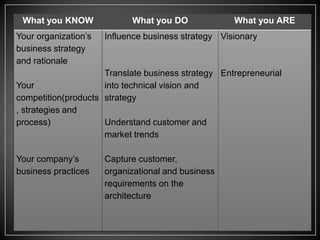
What you KNOW
Your organization’s
business strategy
and rationale

What you DO

What you ARE

Influence business strategy Visionary

Translate business strategy Entrepreneurial
Your
into technical vision and
competition(products strategy
, strategies and
process)
Understand customer and
market trends
Your company’s
business practices

Capture customer,
organizational and business
requirements on the
architecture
Organizational Politics
Our view of organizational politics, just like the politics of nations and
states, is too often sullied by manipulative, power-grubbing behavior of a few
individuals. The best of politics is, however, about working to achieve
consensus, to effectively align people through integration of interests, and
persuasion and influence rather than authority or dominance.
For the architect, this often means defending the technical integrity of a
system, while acknowledging the organizational factors that have a necessary
bearing on the nature of the solution. Architectures have many and diverse
stakeholders.
You really need to understand both the business and personal
objectives of key players, and get them personally committed to the success of
the architecture. This means listening, networking, articulating and selling a
vision, and doing all this continuously over the life of the project.
Leadership
The domain of competency which organizes all the others and gives
them dynamic force, is leadership. An architecture team without leadership goes
nowhere. It thrashes and diverges. A leader is required to infuse the team with a
common vision, and to motivate the core team and associated teams to do their
best work.
This requires dedication and passion, and a strong belief that you can lead the
effort. You must see yourself, and others must see you, as a credible leader.
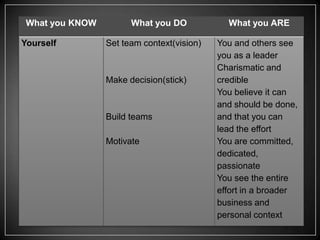
What you KNOW
Yourself

What you DO
Set team context(vision)

Make decision(stick)

Build teams
Motivate

What you ARE
You and others see
you as a leader
Charismatic and
credible
You believe it can
and should be done,
and that you can
lead the effort
You are committed,
dedicated,
passionate
You see the entire
effort in a broader
business and
personal context
Conclusion
As we have seen, the architect role is very challenging. A lot of
what this role is about is not technical, so if this is what you enjoy doing—
great! If not, you may not want the role of senior architect.
Before choosing the role, you should also be aware that there are
other risks that you should consider. You will have more responsibility
without corresponding authority and control; you will encounter a lot of
resistance and disappointments—
However, if the challenges inherent in architecting are the kind that appeals
to you, then the role has great rewards...
Success in the architect role depends on skills and characteristics not
typically emphasized in university curricula or the on-the-job training.
References
MANIT Library
Internet ,Wikipedia,etc.

THANK YOU

Where an Architect stands in society.

  • 1.
    Rahul Bajaj 2nd year,B.Arch. Architecture & Planning Dept. MANIT, BHOPAL
  • 2.
    Abstract A simplistic viewof the role is that architects create architectures, and their responsibilities encompass all that is involved in doing so. This would include:  articulating the architectural vision  conceptualizing and experimenting with alternative architectural approaches  creating models and component and interface specification documents and  validating the architecture against requirements and assumptions. Now a days ,when we have so many civil engineers and decorators or interior decorators as well with us. Then…  what is the need of an architect?  what actually an architect can do? and  for what purposes we precisely need an architect? These are the various questions which generally strikes our head when we need any supervisor to make our dreams realistic.
  • 3.
     Architecture isactually an art of designing spaces which suits the user, goes with the atmosphere, is user friendly and gives positive psycho-physical response. An architect is multi-tasking person.  Ancient, traditional cultures and languages used the same word for both builder and architect. Construction was an integrated craft.  With the industrial revolution came new materials, machines, techniques, regulations, etc. And along with all this came a proliferation of highly specialized subcontractors, who handled each specialized problem.  The specialized details of construction became matters for experts while the role of the architect became more clearly focused on providing overall conception of structures, and managing the relationship between the client and the builder/contractor.
  • 4.
    Technology As an architect,you need a thorough knowledge of your  organization’s products,  relevant technologies and  development processes. But the architect does not have to write just any code to show that he or she is still getting exposure to the technology and staying current with the moving frontier of "hard problems" that must be solved to make this system fly. Either the architect has to have very good relationships with designer/developers who do work on this frontier relationships that translate through active discussions and open sharing into real insight or the architect has to work there herself. Ideally, the architect is seen as useful by developers, not just as a political shield, but as a technical problem solver.
  • 5.
    The architect roleis working well when developers call upon the architect to enter into problem solving with them. The architect is also the person (or team) with the whole-system purview, so we emphasize the ARCH in the word architect, not just the TEC. The architect deals with over-arching concerns.  What are the really big things we have to get right, or we fail?  What are the concerns that cut across the pieces of the system? If we want the system to have particular properties, we need to intentionally design the architectural elements and their collaborations to achieve these properties. If we do not, the properties are emergent so that system acceptance is a matter of some combination of luck, developer heroics, and user compromise. The personal characteristics really essential to success in this domain are a high tolerance for ambiguity because the problems are less well-defined, often with unclear or conflicting objectives, and as the architect you play a significant role in clarifying what the objectives are.
  • 6.
    What you KNOW In-depthunderstanding of the domain and pertinent technologies What you DO Identify and address architectural challenges Understand what technical issues are key to success Create models and assess alternative approaches Practical/pragmatic Prototype/experiment/simul ate Insightful Development methods and modeling techniques What you ARE Creative Investigative Prepare architectural documents and presentations Tolerant of ambiguity, willing to backtrack, seek multiple solutions Good at working at an abstract level Technology trend analysis Take a system view point
  • 7.
    Business Strategy To succeedin this aspect of the architect role…  You need a solid understanding of your organization’s business strategy and the rationale behind it, as well as your company or division’s business practices, planning cycles, and decision making processes.  You have a good understanding of the business context of your organization. You understand your competitors, their products, strategies and product generation processes.  You are familiar with the key factors in the business environment that affect your organization’s success, and you are able to distill all these business factors into architectural requirements and architectural choices.  But the overriding characteristic that fuels your success in this domain is that of an entrepreneurial visionary who can translate well between the business and technical domains.
  • 8.
    What you KNOW Yourorganization’s business strategy and rationale What you DO What you ARE Influence business strategy Visionary Translate business strategy Entrepreneurial Your into technical vision and competition(products strategy , strategies and process) Understand customer and market trends Your company’s business practices Capture customer, organizational and business requirements on the architecture
  • 9.
    Organizational Politics Our viewof organizational politics, just like the politics of nations and states, is too often sullied by manipulative, power-grubbing behavior of a few individuals. The best of politics is, however, about working to achieve consensus, to effectively align people through integration of interests, and persuasion and influence rather than authority or dominance. For the architect, this often means defending the technical integrity of a system, while acknowledging the organizational factors that have a necessary bearing on the nature of the solution. Architectures have many and diverse stakeholders. You really need to understand both the business and personal objectives of key players, and get them personally committed to the success of the architecture. This means listening, networking, articulating and selling a vision, and doing all this continuously over the life of the project.
  • 10.
    Leadership The domain ofcompetency which organizes all the others and gives them dynamic force, is leadership. An architecture team without leadership goes nowhere. It thrashes and diverges. A leader is required to infuse the team with a common vision, and to motivate the core team and associated teams to do their best work. This requires dedication and passion, and a strong belief that you can lead the effort. You must see yourself, and others must see you, as a credible leader.
  • 11.
    What you KNOW Yourself Whatyou DO Set team context(vision) Make decision(stick) Build teams Motivate What you ARE You and others see you as a leader Charismatic and credible You believe it can and should be done, and that you can lead the effort You are committed, dedicated, passionate You see the entire effort in a broader business and personal context
  • 12.
    Conclusion As we haveseen, the architect role is very challenging. A lot of what this role is about is not technical, so if this is what you enjoy doing— great! If not, you may not want the role of senior architect. Before choosing the role, you should also be aware that there are other risks that you should consider. You will have more responsibility without corresponding authority and control; you will encounter a lot of resistance and disappointments— However, if the challenges inherent in architecting are the kind that appeals to you, then the role has great rewards... Success in the architect role depends on skills and characteristics not typically emphasized in university curricula or the on-the-job training.
  • 13.