Radiosensitizers
Dr Jyoti Sharma (Short seminar)
• Radio sensitization is a physical, chemical or pharmacological intervention that
increases the lethal effect of radiation when administered in conjunction with it
• It make tumour cells more sensitive to radiotherapy.
Mechanisms of radio sensitization
1) DNA sensitivity (direct & indirect means) :--
Counteracting tumour hypoxia
 Increase in initial radiation damage
Cell cycle redistribution
2) Modulate biological response of irradiated cells
Inhibition of cellular repair
 Overcoming accelerated repopulation
 Targeting molecular events assosciated with radiation response
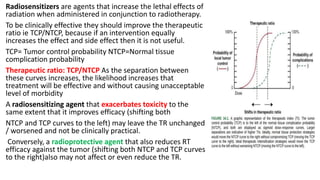
Radiosensitizers are agents that increase the lethal effects of
radiation when administered in conjunction to radiotherapy.
To be clinically effective they should improve the therapeutic
ratio ie TCP/NTCP, because if an intervention equally
increases the effect and side effect then it is not useful.
TCP= Tumor control probability NTCP=Normal tissue
complication probability
Therapeutic ratio: TCP/NTCP As the separation between
these curves increases, the likelihood increases that
treatment will be effective and without causing unacceptable
level of morbidity
A radiosensitizing agent that exacerbates toxicity to the
same extent that it improves efficacy (shifting both
NTCP and TCP curves to the left) may leave the TR unchanged
/ worsened and not be clinically practical.
Conversely, a radioprotective agent that also reduces RT
efficacy against the tumor (shifting both NTCP and TCP curves
to the right)also may not affect or even reduce the TR.
Types of radiosensitizers
• Physical: -
• Hyperthermia
• Hyperbaric oxygen
• Surgical debulking
• Chemical: -
• Blood transfusion and EPO
• Carbogen +/- Nicotinamide
• Non-Hypoxic cell sensitizers – halogenated pyrimidines
• Hypoxic cell sensitizers
• Hypoxic cell cytotoxins
• Biological modifiers
• Chemotherapeutic agents
Hyperthermia
• Hippocrates (470–377 BC), in one of his aphorisms,
states, “Those who cannot be cured by medicine can
be cured by surgery. Those who cannot be cured by
surgery can be cured by fire [hyperthermia]. Those
who cannot be cured by fire, they are indeed
incurable.”
• Heat kills cells in a predictable and repeatable way.
Figure shows a series of survival curves for cells
exposed for various periods of time to a range of
temperatures from 41.5° to 46.5° C.
• The cell survival curves for heat are similar in shape
to those obtained for x-rays (i.e., an initial shoulder
followed by an exponential region) except that the
time of exposure to the elevated temperature
replaces the absorbed dose of x-ray
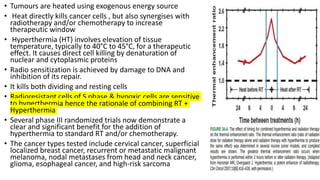
• Tumours are heated using exogenous energy source
• Heat directly kills cancer cells , but also synergises with
radiotherapy and/or chemotherapy to increase
therapeutic window
• Hyperthermia (HT) involves elevation of tissue
temperature, typically to 40°C to 45°C, for a therapeutic
effect. It causes direct cell killing by denaturation of
nuclear and cytoplasmic proteins
• Radio sensitization is achieved by damage to DNA and
inhibition of its repair.
• It kills both dividing and resting cells
• Radioresistant cells of S phase & hypoxic cells are sensitive
to hyperthermia hence the rationale of combining RT +
Hyperthermia
• Several phase III randomized trials now demonstrate a
clear and significant benefit for the addition of
hyperthermia to standard RT and/or chemotherapy.
• The cancer types tested include cervical cancer, superficial
localized breast cancer, recurrent or metastatic malignant
melanoma, nodal metastases from head and neck cancer,
glioma, esophageal cancer, and high-risk sarcoma
Hyperbaric oxygen
Well oxygenated cells (partial pressure of oxygen or PO2 > 10 mm Hg) are
approximately 2.5 times more sensitive to a given dose of ionizing radiation than
their hypoxic counterparts.
Clinical data clearly demonstrate the existence of tumor hypoxia in head and
neck cancer & cervical cancer and extremely strong correlations between
hypoxia and both infield treatment failure and overall survival.
Therapeutic attempts to overcome the deleterious effect of tumor hypoxia have
followed three general lines of investigation:
• increased delivery of oxygen to tumor,
• preferential sensitization of hypoxic cells with oxygen-mimetic agents
• cytotoxic agents that selectively target hypoxic tumor cells.
• Hemoglobin concentration is the major determinant of the oxygen delivery
capability of blood to tissue.
• Hemoglobin oxygen saturation exceeds 90% when the arterial PO2 is >70 mm Hg.
• Still, oxygen is relatively insoluble in plasma under normo-baric conditions.
• Under hyperbaric conditions, considerable quantities of oxygen can be dissolved
into plasma and thus be potentially available for delivery to hypoxic tissues.
• 1950s to the 1970s:- Clinical trials of hyperbaric oxygen (HBO) and RT were
conducted
• No benefit : central nervous system,lung, bladder
• Benefit in O.S & LC : carcinoma of the cervix and head
• The cumbersome logistics associated with HBO delivery in conjunction with
RT necessitated the utilization of nonconventional hypo-fractionated
treatment regimens.
• This reality has prevented HBO from being incorporated into routine clinical
use.
Blood transfusion & EPO
• Anaemia is a very powerful adverse prognostic factor in various malignancies,
including carcinomas of the lung , cervix, and head and neck.
• Polarographic electrode oxygen measurements in head and neck cancer have
demonstrated that anaemic patients are significantly more likely to have poorly
oxygenated tumors than nonanemic patients, but significant tumor hypoxia has also
been detected in patients who are not anaemic.
• Whether correction or prevention of anaemia with blood transfusions or
erythropoiesis-stimulating agents can improve treatment outcomes has been
investigated in multiple studies.
• Blood transfusions in cervical cancer : Initial publication from Princess Margaret
Hospital showing an improvement in pelvic control and cure rates associated with
correction of anaemia. However, subsequent publications from the same group
showed no survival benefit to transfusion when the data were critically re-examined
and analyzed on an intent-to-treat basis. = CONTROVERSIAL role
• Head and neck cancer patients, studies suggest that blood transfusions may have a
negative effect on survival
• EPO may stimulate tumor growth and in one randomized study it had adverse impact
as compared to placebo.
Allosteric modifiers of haemoglobin structure
• Allosteric modifiers of hemoglobin structure have been identified that can shift
the oxy-hemoglobin dissociation curve to the right and increase O2 delivery to
hypoxic tissue.
• E.G RSR13, (efaproxiral) has been tested in animal models and shown to
improve tumor oxygenation and enhance the effectiveness of RT.
• Tried in brain mets along with WBRT in ca lung and ca breast. A planned subset
analysis suggested significant improvement in median survival time in breast
cancer patients with sufficient levels of efaproxiral in their erythrocytes.
Carbogen+/- nicotinamide
• If pure oxygen in inhaled it can lead to constriction of blood vessels, thus
paradoxically increasing hypoxia.
• Carbogen: - 95% oxygen + 5% CO2
• The rationale for CO2 addition in the gas breathing mixture is the generation of
a mild acidosis that shifts the oxy-hemoglobin association curve to the right,
facilitating more unloading of oxygen into the most hypoxic tissues.
• There is another form of hypoxia known as acute hypoxia, in which local
regions of hypoxia are caused by the intermittent closing down of blood
vessels. Nicotinamide, a vitamin B3 analogue, prevents these transient
fluctuations in tumor blood flow
• Polarographic electrode assessments in cervix and head and neck cancer have
demonstrated that carbogen breathing and nicotinamide administration
improve tumor oxygenation in some patients.
• A combination of nicotinamide to overcome acute hypoxia and carbogen
breathing to overcome chronic hypoxia is the basis of the accelerated
radiotherapy, carbogen, and nicotinamide (ARCON) trials under way at several
European centers.
• The trials are also accelerated and hyperfractionated to avoid tumor
proliferation and damage to late-responding normal tissues.
• Summary of the ARCON treatment:
• Accelerated, to overcome proliferation
• Hyperfractionated RT, to spare late-responding normal tissues
• Carbogen breathing, to overcome chronic hypoxia
• Nicotinamide, to overcome acute hypoxia
Sensitization of Hypoxic Cells
• Electron-affinic compounds can oxidize radiation-induced
free radical damage in the cell to produce increased kill.
The use of these agents would be particularly attractive in
the hypoxic tumor microenvironment, where low oxygen
concentrations impair the effectiveness of RT.
• 2-nitroimidazoles: - misonidazole, etanidazole (less toxic)
• 5-nitroimidazoles: - nimorazole (DAHANCA conducted a
phase III trial of nimorazole (1.2 g/m2 vs. placebo) for
squamous cell cancer of the supraglottic larynx and
pharynx. There was a statistically significant
improvement in locoregional tumor control but not for
survival.
• The use of nimorazole has become the standard of care
(SOC) in Denmark but has not been adopted in other
countries.
• Much less toxic so that very large doses could be given
.
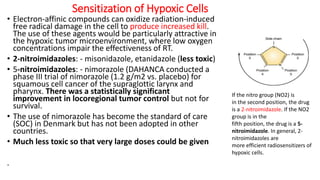
If the nitro group (NO2) is
in the second position, the drug
is a 2-nitroimidazole. If the NO2
group is in the
fifth position, the drug is a 5-
nitroimidazole. In general, 2-
nitroimidazoles are
more efficient radiosensitizers of
hypoxic cells.
• Adams and his colleagues listed properties of clinically useful Hypoxic cell
sensitizer :-
1. Selectively sensitize hypoxic cells at concentrations that would result in
acceptable normal tissue toxicity
2. Chemically stable & not subject to rapid metabolic break down
3. Highly soluble in water or lipids & must be capable of diffusing a considerable
distance through a non-vascularized cell mass to reach the hypoxic cell (in
tumor >200 micrometre from nearest capillary)
4. It should be effective at relatively low daily dose /# used in conventional
fractionated radiotherapy
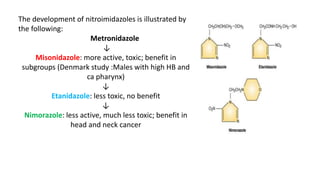
The development of nitroimidazoles is illustrated by
the following:
Metronidazole
↓
Misonidazole: more active, toxic; benefit in
subgroups (Denmark study :Males with high HB and
ca pharynx)
↓
Etanidazole: less toxic, no benefit
↓
Nimorazole: less active, much less toxic; benefit in
head and neck cancer
HYPOXIC CYTOTOXINS
• These are the drugs that preferentially radio-sensitize hypoxic cells & selectively
kill hypoxic cells.
• It was pointed out at an early stage that the greater reductive environment of
tumors might be exploited by developing drugs that are reduced preferentially
to cytotoxic species in the hypoxic regions of tumors.
• Five classes of agents in this category are known:
1. Quinone antibiotics e.g MMC
2. Nitroaromatic compounds : TOXIC to normal tissues: not used
3. Benzotriazine di-N-oxides e.g Tirapazamine
4. Dinitrobenzamide modified nitrogen mustard
5. 2-Nitroimidazole attached to dibromo isophosphoramide
Mitomycin C
Mitomycin C (MMC) is an alkylating agent metabolized in regions of low oxygen
concentration and preferentially cytotoxic to hypoxic cells.
MMC plays an integral role in conjunction with RT and 5-FU (fluorouracil) in the
definitive nonsurgical management of squamous cell carcinomas of the anal
canal.
It inhibits DNA – DNA cross linking, DNA depolymerization
Dose limiting toxicity – cumulative myelosuppression.
Porfiromycin, a derivative of MMC, provides greater differential cytotoxicity
between hypoxic and oxygenated cells in vitro
BUT III trial paradoxically showed superiority of Mitomycin C over the
Porfiromycin.
Tirapazamine
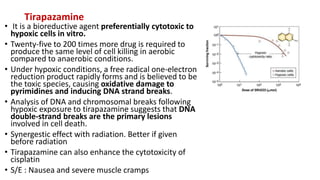
• It is a bioreductive agent preferentially cytotoxic to
hypoxic cells in vitro.
• Twenty-five to 200 times more drug is required to
produce the same level of cell killing in aerobic
compared to anaerobic conditions.
• Under hypoxic conditions, a free radical one-electron
reduction product rapidly forms and is believed to be
the toxic species, causing oxidative damage to
pyrimidines and inducing DNA strand breaks.
• Analysis of DNA and chromosomal breaks following
hypoxic exposure to tirapazamine suggests that DNA
double-strand breaks are the primary lesions
involved in cell death.
• Synergestic effect with radiation. Better if given
before radiation
• Tirapazamine can also enhance the cytotoxicity of
cisplatin
• S/E : Nausea and severe muscle cramps
• During the last 5 years, several other targeted therapeutics have entered
clinical testing:
• PR-104, a novel hypoxia-activated DNA crosslinking agent,
• TH-302, a hypoxia-activated dibromo isophosphoramide mustard.
• Unfortunately, clinical testing of these molecules has not demonstrated
statistically significant efficacy to achieve FDA approval.
Biologic Modifiers of Radiation Response
Overexpression of the epidermal growth factor receptor 1 (EGFR-1) is associated
with an adverse outcome in squamous head and neck cancer.
Cetuximab (C225) is a chimeric monoclonal antibody to EGFR.
Preclinical studies have demonstrated that cetuximab sensitizes cells to the
cytotoxic effects of ionizing irradiation.
Preliminary studies demonstrated that this drug could be safely administered in
conjunction with a course of RT for head and neck cancer
Phase III trial by Bonner et al concluded that for patients with LASCCHN,
cetuximab plus radiotherapy significantly improves overall survival at 5 years
Vs RT alone.
Chemotherapy
• Chemotherapeutic agents are often utilized in conjunction with radiation therapy for
their radiosensitizing effect.
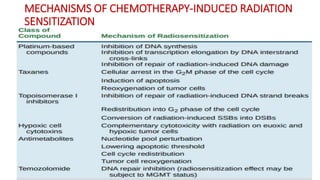
• Concurrent chemoradiation with platinum agents, particularly cisplatin, improves
survival in numerous malignancies including head and neck cancer, cervical cancer
and lung cancer.
• Multiple potential mechanisms for platinum-induced radio-sensitization have been
proposed like :--
 blocking DNA repair
 inducing cell cycle arrest
Taxanes : widely employed along with RT in Rx of head and neck cancer , lung cancer,
and oesophageal cancer.
These drugs facilitate radiation induced cell killing by synchronizing cell cycle and
causing cell cycle arrest in the radiosensitive G2/M phase.
Fluoropyrimidines such as 5-fluorouracil are commonly administered concurrently with
radiation therapy for gastrointestinal malignancies because of their radiosensitizing
effect.
Slowed repair of radiation induced double-strand breaks and alteration of cell cycle
progression by fluoropyrimidines likely result in radio sensitization.
MECHANISMS OF CHEMOTHERAPY-INDUCED RADIATION
SENSITIZATION
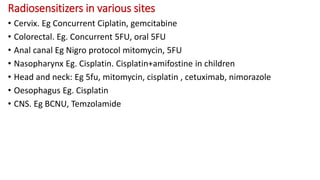
Radiosensitizers in various sites
• Cervix. Eg Concurrent Ciplatin, gemcitabine
• Colorectal. Eg. Concurrent 5FU, oral 5FU
• Anal canal Eg Nigro protocol mitomycin, 5FU
• Nasopharynx Eg. Cisplatin. Cisplatin+amifostine in children
• Head and neck: Eg 5fu, mitomycin, cisplatin , cetuximab, nimorazole
• Oesophagus Eg. Cisplatin
• CNS. Eg BCNU, Temzolamide
Thank you

Radiosensitizers

  • 1.
  • 2.
    • Radio sensitizationis a physical, chemical or pharmacological intervention that increases the lethal effect of radiation when administered in conjunction with it • It make tumour cells more sensitive to radiotherapy. Mechanisms of radio sensitization 1) DNA sensitivity (direct & indirect means) :-- Counteracting tumour hypoxia  Increase in initial radiation damage Cell cycle redistribution 2) Modulate biological response of irradiated cells Inhibition of cellular repair  Overcoming accelerated repopulation  Targeting molecular events assosciated with radiation response
  • 3.
    Radiosensitizers are agentsthat increase the lethal effects of radiation when administered in conjunction to radiotherapy. To be clinically effective they should improve the therapeutic ratio ie TCP/NTCP, because if an intervention equally increases the effect and side effect then it is not useful. TCP= Tumor control probability NTCP=Normal tissue complication probability Therapeutic ratio: TCP/NTCP As the separation between these curves increases, the likelihood increases that treatment will be effective and without causing unacceptable level of morbidity A radiosensitizing agent that exacerbates toxicity to the same extent that it improves efficacy (shifting both NTCP and TCP curves to the left) may leave the TR unchanged / worsened and not be clinically practical. Conversely, a radioprotective agent that also reduces RT efficacy against the tumor (shifting both NTCP and TCP curves to the right)also may not affect or even reduce the TR.
  • 4.
    Types of radiosensitizers •Physical: - • Hyperthermia • Hyperbaric oxygen • Surgical debulking • Chemical: - • Blood transfusion and EPO • Carbogen +/- Nicotinamide • Non-Hypoxic cell sensitizers – halogenated pyrimidines • Hypoxic cell sensitizers • Hypoxic cell cytotoxins • Biological modifiers • Chemotherapeutic agents
  • 5.
    Hyperthermia • Hippocrates (470–377BC), in one of his aphorisms, states, “Those who cannot be cured by medicine can be cured by surgery. Those who cannot be cured by surgery can be cured by fire [hyperthermia]. Those who cannot be cured by fire, they are indeed incurable.” • Heat kills cells in a predictable and repeatable way. Figure shows a series of survival curves for cells exposed for various periods of time to a range of temperatures from 41.5° to 46.5° C. • The cell survival curves for heat are similar in shape to those obtained for x-rays (i.e., an initial shoulder followed by an exponential region) except that the time of exposure to the elevated temperature replaces the absorbed dose of x-ray
  • 6.
    • Tumours areheated using exogenous energy source • Heat directly kills cancer cells , but also synergises with radiotherapy and/or chemotherapy to increase therapeutic window • Hyperthermia (HT) involves elevation of tissue temperature, typically to 40°C to 45°C, for a therapeutic effect. It causes direct cell killing by denaturation of nuclear and cytoplasmic proteins • Radio sensitization is achieved by damage to DNA and inhibition of its repair. • It kills both dividing and resting cells • Radioresistant cells of S phase & hypoxic cells are sensitive to hyperthermia hence the rationale of combining RT + Hyperthermia • Several phase III randomized trials now demonstrate a clear and significant benefit for the addition of hyperthermia to standard RT and/or chemotherapy. • The cancer types tested include cervical cancer, superficial localized breast cancer, recurrent or metastatic malignant melanoma, nodal metastases from head and neck cancer, glioma, esophageal cancer, and high-risk sarcoma
  • 7.
    Hyperbaric oxygen Well oxygenatedcells (partial pressure of oxygen or PO2 > 10 mm Hg) are approximately 2.5 times more sensitive to a given dose of ionizing radiation than their hypoxic counterparts. Clinical data clearly demonstrate the existence of tumor hypoxia in head and neck cancer & cervical cancer and extremely strong correlations between hypoxia and both infield treatment failure and overall survival. Therapeutic attempts to overcome the deleterious effect of tumor hypoxia have followed three general lines of investigation: • increased delivery of oxygen to tumor, • preferential sensitization of hypoxic cells with oxygen-mimetic agents • cytotoxic agents that selectively target hypoxic tumor cells. • Hemoglobin concentration is the major determinant of the oxygen delivery capability of blood to tissue.
  • 8.
    • Hemoglobin oxygensaturation exceeds 90% when the arterial PO2 is >70 mm Hg. • Still, oxygen is relatively insoluble in plasma under normo-baric conditions. • Under hyperbaric conditions, considerable quantities of oxygen can be dissolved into plasma and thus be potentially available for delivery to hypoxic tissues. • 1950s to the 1970s:- Clinical trials of hyperbaric oxygen (HBO) and RT were conducted • No benefit : central nervous system,lung, bladder • Benefit in O.S & LC : carcinoma of the cervix and head • The cumbersome logistics associated with HBO delivery in conjunction with RT necessitated the utilization of nonconventional hypo-fractionated treatment regimens. • This reality has prevented HBO from being incorporated into routine clinical use.
  • 9.
    Blood transfusion &EPO • Anaemia is a very powerful adverse prognostic factor in various malignancies, including carcinomas of the lung , cervix, and head and neck. • Polarographic electrode oxygen measurements in head and neck cancer have demonstrated that anaemic patients are significantly more likely to have poorly oxygenated tumors than nonanemic patients, but significant tumor hypoxia has also been detected in patients who are not anaemic. • Whether correction or prevention of anaemia with blood transfusions or erythropoiesis-stimulating agents can improve treatment outcomes has been investigated in multiple studies. • Blood transfusions in cervical cancer : Initial publication from Princess Margaret Hospital showing an improvement in pelvic control and cure rates associated with correction of anaemia. However, subsequent publications from the same group showed no survival benefit to transfusion when the data were critically re-examined and analyzed on an intent-to-treat basis. = CONTROVERSIAL role • Head and neck cancer patients, studies suggest that blood transfusions may have a negative effect on survival • EPO may stimulate tumor growth and in one randomized study it had adverse impact as compared to placebo.
  • 10.
    Allosteric modifiers ofhaemoglobin structure • Allosteric modifiers of hemoglobin structure have been identified that can shift the oxy-hemoglobin dissociation curve to the right and increase O2 delivery to hypoxic tissue. • E.G RSR13, (efaproxiral) has been tested in animal models and shown to improve tumor oxygenation and enhance the effectiveness of RT. • Tried in brain mets along with WBRT in ca lung and ca breast. A planned subset analysis suggested significant improvement in median survival time in breast cancer patients with sufficient levels of efaproxiral in their erythrocytes.
  • 11.
    Carbogen+/- nicotinamide • Ifpure oxygen in inhaled it can lead to constriction of blood vessels, thus paradoxically increasing hypoxia. • Carbogen: - 95% oxygen + 5% CO2 • The rationale for CO2 addition in the gas breathing mixture is the generation of a mild acidosis that shifts the oxy-hemoglobin association curve to the right, facilitating more unloading of oxygen into the most hypoxic tissues. • There is another form of hypoxia known as acute hypoxia, in which local regions of hypoxia are caused by the intermittent closing down of blood vessels. Nicotinamide, a vitamin B3 analogue, prevents these transient fluctuations in tumor blood flow • Polarographic electrode assessments in cervix and head and neck cancer have demonstrated that carbogen breathing and nicotinamide administration improve tumor oxygenation in some patients.
  • 12.
    • A combinationof nicotinamide to overcome acute hypoxia and carbogen breathing to overcome chronic hypoxia is the basis of the accelerated radiotherapy, carbogen, and nicotinamide (ARCON) trials under way at several European centers. • The trials are also accelerated and hyperfractionated to avoid tumor proliferation and damage to late-responding normal tissues. • Summary of the ARCON treatment: • Accelerated, to overcome proliferation • Hyperfractionated RT, to spare late-responding normal tissues • Carbogen breathing, to overcome chronic hypoxia • Nicotinamide, to overcome acute hypoxia
  • 13.
    Sensitization of HypoxicCells • Electron-affinic compounds can oxidize radiation-induced free radical damage in the cell to produce increased kill. The use of these agents would be particularly attractive in the hypoxic tumor microenvironment, where low oxygen concentrations impair the effectiveness of RT. • 2-nitroimidazoles: - misonidazole, etanidazole (less toxic) • 5-nitroimidazoles: - nimorazole (DAHANCA conducted a phase III trial of nimorazole (1.2 g/m2 vs. placebo) for squamous cell cancer of the supraglottic larynx and pharynx. There was a statistically significant improvement in locoregional tumor control but not for survival. • The use of nimorazole has become the standard of care (SOC) in Denmark but has not been adopted in other countries. • Much less toxic so that very large doses could be given . If the nitro group (NO2) is in the second position, the drug is a 2-nitroimidazole. If the NO2 group is in the fifth position, the drug is a 5- nitroimidazole. In general, 2- nitroimidazoles are more efficient radiosensitizers of hypoxic cells.
  • 14.
    • Adams andhis colleagues listed properties of clinically useful Hypoxic cell sensitizer :- 1. Selectively sensitize hypoxic cells at concentrations that would result in acceptable normal tissue toxicity 2. Chemically stable & not subject to rapid metabolic break down 3. Highly soluble in water or lipids & must be capable of diffusing a considerable distance through a non-vascularized cell mass to reach the hypoxic cell (in tumor >200 micrometre from nearest capillary) 4. It should be effective at relatively low daily dose /# used in conventional fractionated radiotherapy
  • 15.
    The development ofnitroimidazoles is illustrated by the following: Metronidazole ↓ Misonidazole: more active, toxic; benefit in subgroups (Denmark study :Males with high HB and ca pharynx) ↓ Etanidazole: less toxic, no benefit ↓ Nimorazole: less active, much less toxic; benefit in head and neck cancer
  • 16.
    HYPOXIC CYTOTOXINS • Theseare the drugs that preferentially radio-sensitize hypoxic cells & selectively kill hypoxic cells. • It was pointed out at an early stage that the greater reductive environment of tumors might be exploited by developing drugs that are reduced preferentially to cytotoxic species in the hypoxic regions of tumors. • Five classes of agents in this category are known: 1. Quinone antibiotics e.g MMC 2. Nitroaromatic compounds : TOXIC to normal tissues: not used 3. Benzotriazine di-N-oxides e.g Tirapazamine 4. Dinitrobenzamide modified nitrogen mustard 5. 2-Nitroimidazole attached to dibromo isophosphoramide
  • 17.
    Mitomycin C Mitomycin C(MMC) is an alkylating agent metabolized in regions of low oxygen concentration and preferentially cytotoxic to hypoxic cells. MMC plays an integral role in conjunction with RT and 5-FU (fluorouracil) in the definitive nonsurgical management of squamous cell carcinomas of the anal canal. It inhibits DNA – DNA cross linking, DNA depolymerization Dose limiting toxicity – cumulative myelosuppression. Porfiromycin, a derivative of MMC, provides greater differential cytotoxicity between hypoxic and oxygenated cells in vitro BUT III trial paradoxically showed superiority of Mitomycin C over the Porfiromycin.
  • 18.
    Tirapazamine • It isa bioreductive agent preferentially cytotoxic to hypoxic cells in vitro. • Twenty-five to 200 times more drug is required to produce the same level of cell killing in aerobic compared to anaerobic conditions. • Under hypoxic conditions, a free radical one-electron reduction product rapidly forms and is believed to be the toxic species, causing oxidative damage to pyrimidines and inducing DNA strand breaks. • Analysis of DNA and chromosomal breaks following hypoxic exposure to tirapazamine suggests that DNA double-strand breaks are the primary lesions involved in cell death. • Synergestic effect with radiation. Better if given before radiation • Tirapazamine can also enhance the cytotoxicity of cisplatin • S/E : Nausea and severe muscle cramps
  • 19.
    • During thelast 5 years, several other targeted therapeutics have entered clinical testing: • PR-104, a novel hypoxia-activated DNA crosslinking agent, • TH-302, a hypoxia-activated dibromo isophosphoramide mustard. • Unfortunately, clinical testing of these molecules has not demonstrated statistically significant efficacy to achieve FDA approval.
  • 20.
    Biologic Modifiers ofRadiation Response Overexpression of the epidermal growth factor receptor 1 (EGFR-1) is associated with an adverse outcome in squamous head and neck cancer. Cetuximab (C225) is a chimeric monoclonal antibody to EGFR. Preclinical studies have demonstrated that cetuximab sensitizes cells to the cytotoxic effects of ionizing irradiation. Preliminary studies demonstrated that this drug could be safely administered in conjunction with a course of RT for head and neck cancer Phase III trial by Bonner et al concluded that for patients with LASCCHN, cetuximab plus radiotherapy significantly improves overall survival at 5 years Vs RT alone.
  • 21.
    Chemotherapy • Chemotherapeutic agentsare often utilized in conjunction with radiation therapy for their radiosensitizing effect. • Concurrent chemoradiation with platinum agents, particularly cisplatin, improves survival in numerous malignancies including head and neck cancer, cervical cancer and lung cancer. • Multiple potential mechanisms for platinum-induced radio-sensitization have been proposed like :--  blocking DNA repair  inducing cell cycle arrest Taxanes : widely employed along with RT in Rx of head and neck cancer , lung cancer, and oesophageal cancer. These drugs facilitate radiation induced cell killing by synchronizing cell cycle and causing cell cycle arrest in the radiosensitive G2/M phase. Fluoropyrimidines such as 5-fluorouracil are commonly administered concurrently with radiation therapy for gastrointestinal malignancies because of their radiosensitizing effect. Slowed repair of radiation induced double-strand breaks and alteration of cell cycle progression by fluoropyrimidines likely result in radio sensitization.
  • 22.
    MECHANISMS OF CHEMOTHERAPY-INDUCEDRADIATION SENSITIZATION
  • 23.
    Radiosensitizers in varioussites • Cervix. Eg Concurrent Ciplatin, gemcitabine • Colorectal. Eg. Concurrent 5FU, oral 5FU • Anal canal Eg Nigro protocol mitomycin, 5FU • Nasopharynx Eg. Cisplatin. Cisplatin+amifostine in children • Head and neck: Eg 5fu, mitomycin, cisplatin , cetuximab, nimorazole • Oesophagus Eg. Cisplatin • CNS. Eg BCNU, Temzolamide
  • 24.