Aim RADIAL 2013

Non Occlusive Radial artery
Injury and Long term effects
Dr Sudhir Rathore
MD, MRCP(UK),FACC, FESC
Consultant Interventional Cardiologist
Frimley Park Hospital NHS Foundation Trust, Surrey &
St George’s Hospital, London, UK
Conflict of Interest
 No

conflict of interest in relation to this
presentation.
Background: Significance









Transradial access is rapidly becoming alternative and
preferred vascular access site.
Radial artery is medium sized muscular artery.
Repeated coronary procedures needs patent and healthy
radial artery.
Radial artery is being used increasingly as a conduit for
coronary revascularisation.
Creation of arteriovenous fistulae for haemodialysis.
Transradial access potentially results in injury to radial
artery and can range from endothelial dysfunction to RA
occlusion.
All efforts must be made to minimise radial artery injury
following TRA.
Non Occlusive RA injury: Historical


Non-occlusive radial artery injury: Reported in around 50% of the
RA in the form of neo-intimal hyperplasia, radial artery stenosis etc.



Nagai et al (1999): Early- segmental stenosis (22%), no flow ( 9%).
Late : segmental stenosis (1%), diffuse stenosis ( 22%) and no flow
(5%).



Wakeyama et al (2003): IVUS: LA of 5.05±1.26mm² in the repeatTRI group vs. LA of 5.62±1.35mm² in the first-TRI group, p=0.032
and MLD of 2.37±0.31mm in the repeat-TRI group vs. MLD of
2.51±0.33mm in the first-TRI group, p=0.028), whereas the intimamedia cross sectional area (IMcsa) and intima-media thickness
(IMT) were significantly greater than those in first-TRI patients.



Edmundson and Mann: Repeat procedure group and control group
(6.7±0.8mm2 vs. 5.0±0.7mm2, p<0.01).
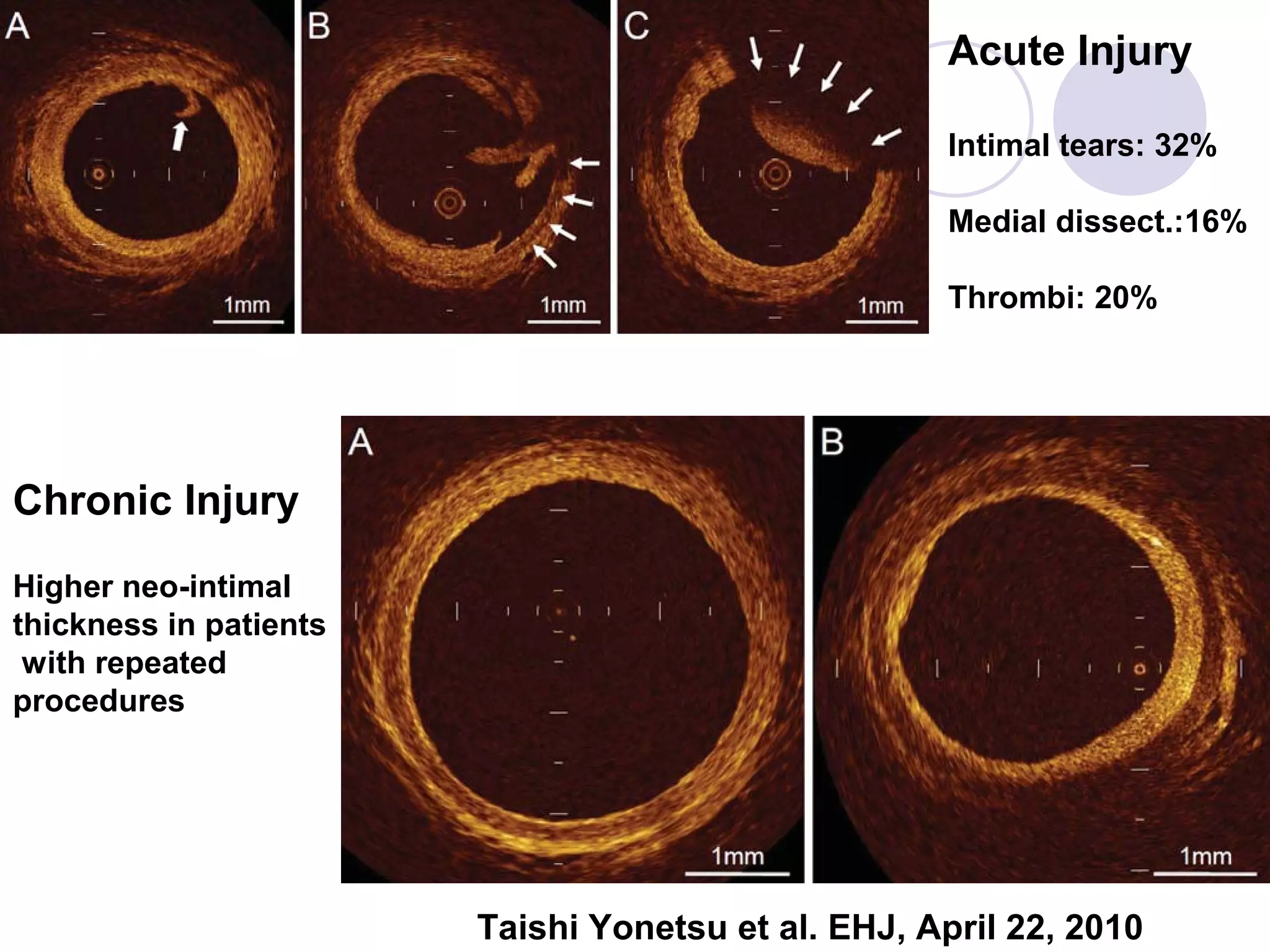
Acute Injury
Intimal tears: 32%
Medial dissect.:16%
Thrombi: 20%

Chronic Injury
Higher neo-intimal
thickness in patients
with repeated
procedures

Taishi Yonetsu et al. EHJ, April 22, 2010
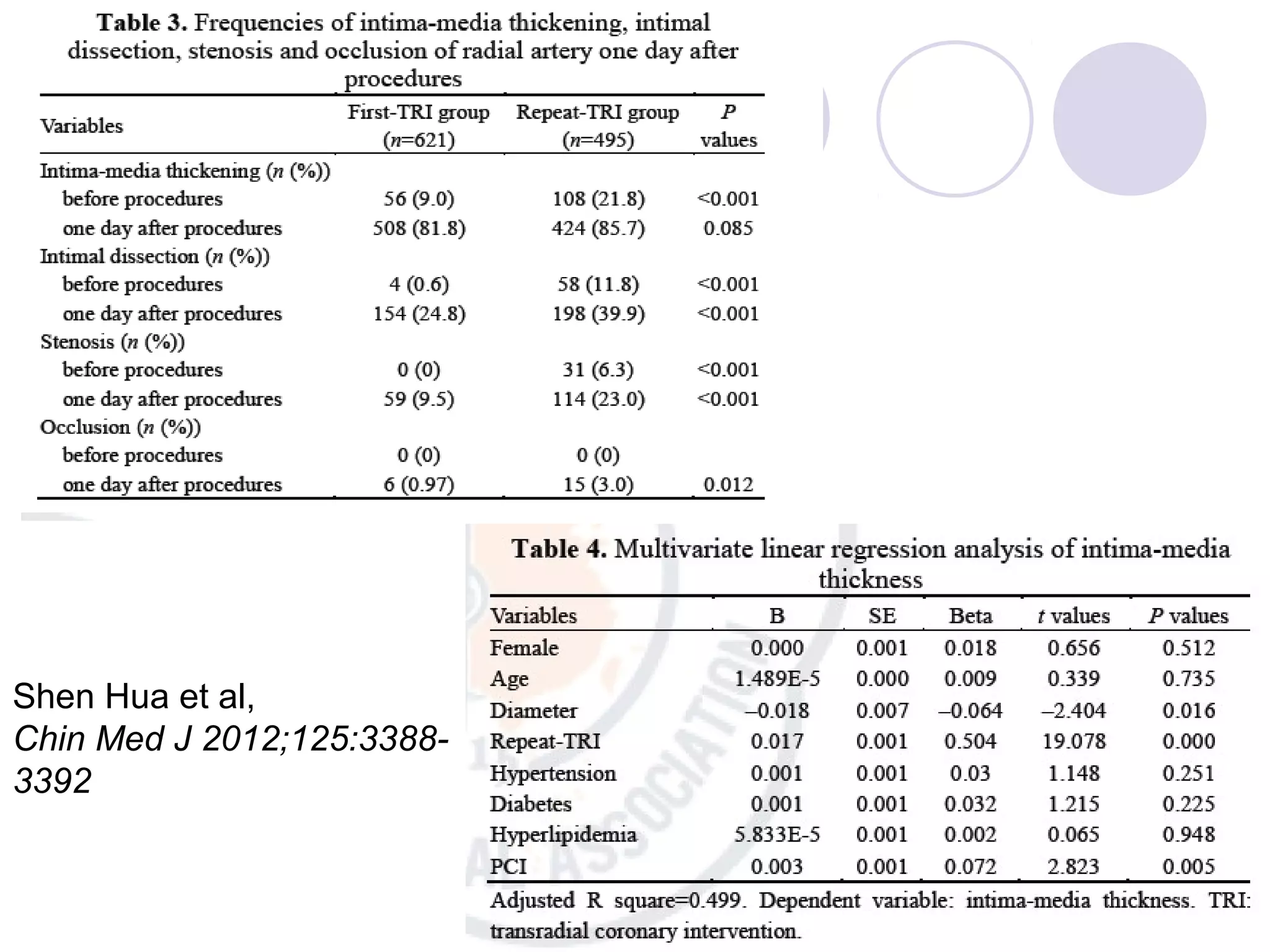
Shen Hua et al,
Chin Med J 2012;125:33883392
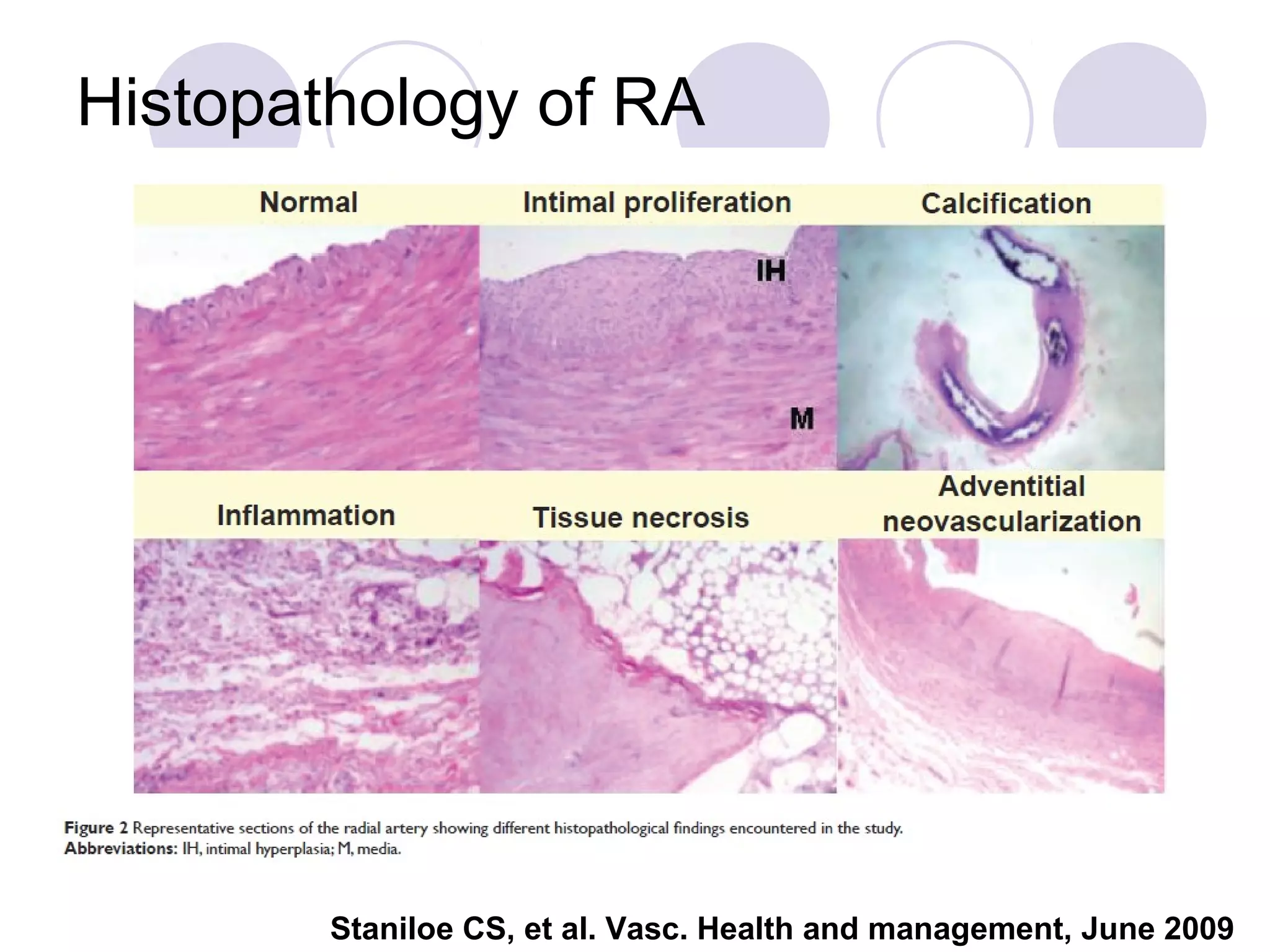
Histopathology of RA

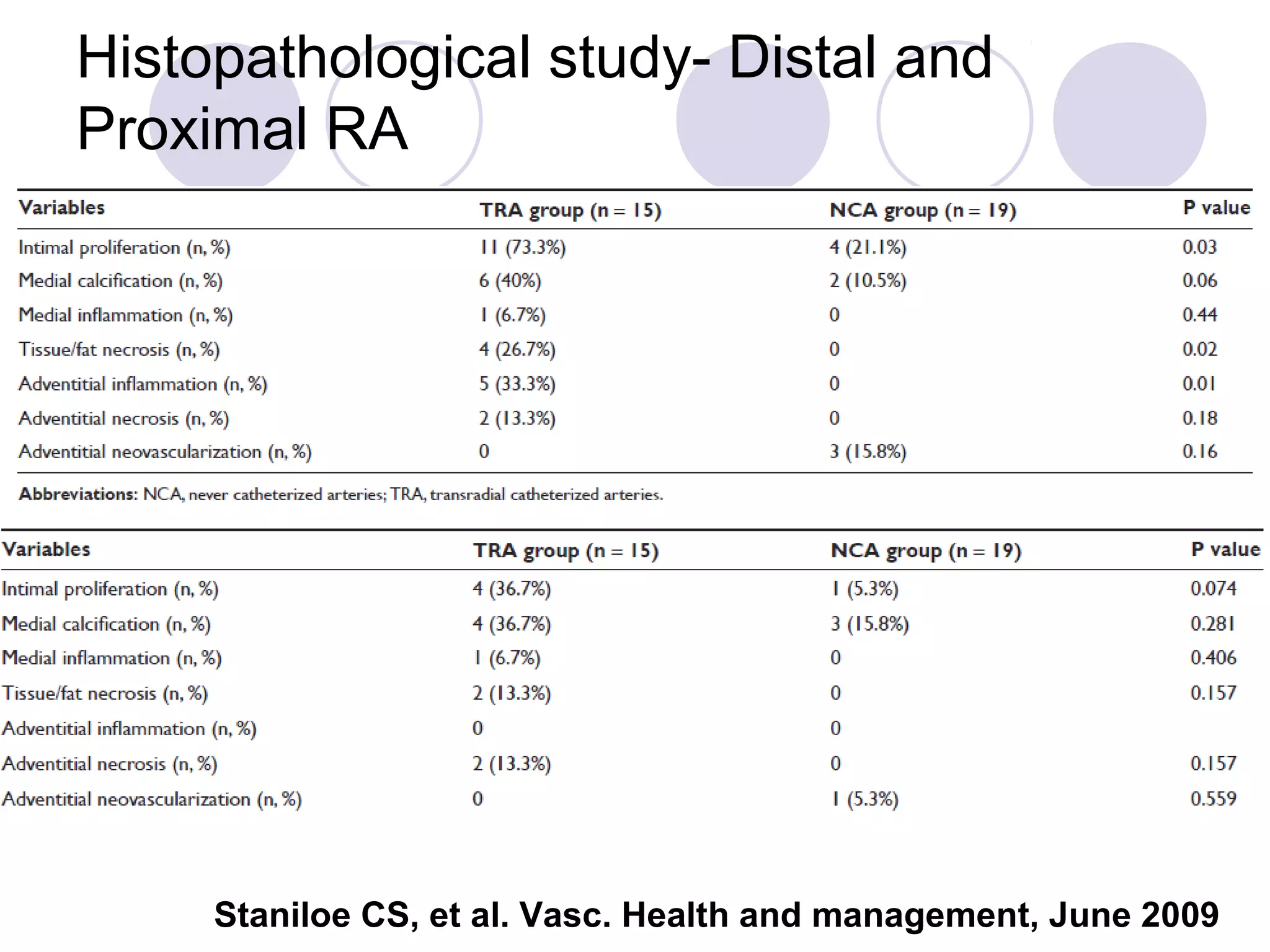
Staniloe CS, et al. Vasc. Health and management, June 2009
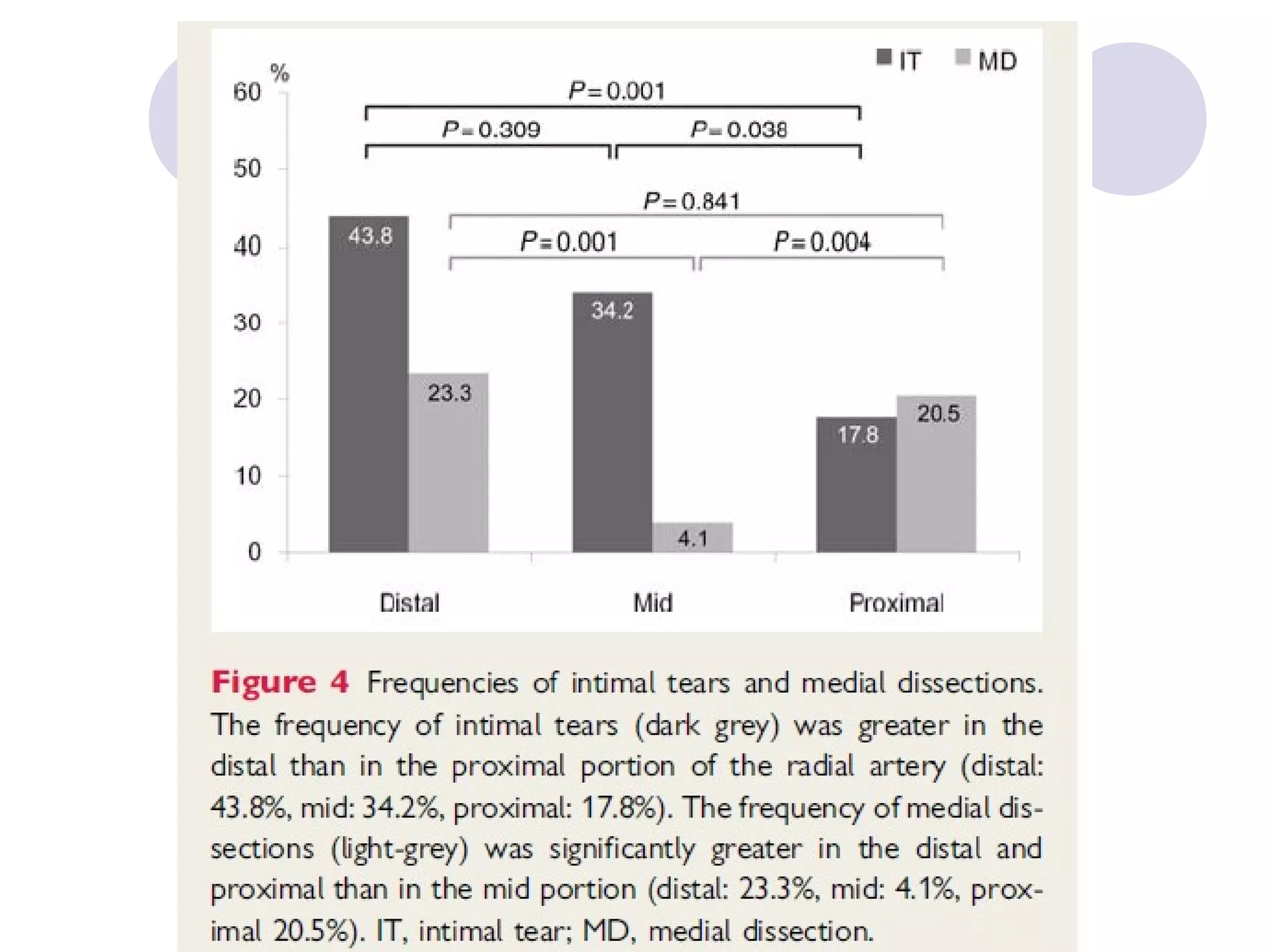
Histopathological study- Distal and
Proximal RA

Staniloe CS, et al. Vasc. Health and management, June 2009
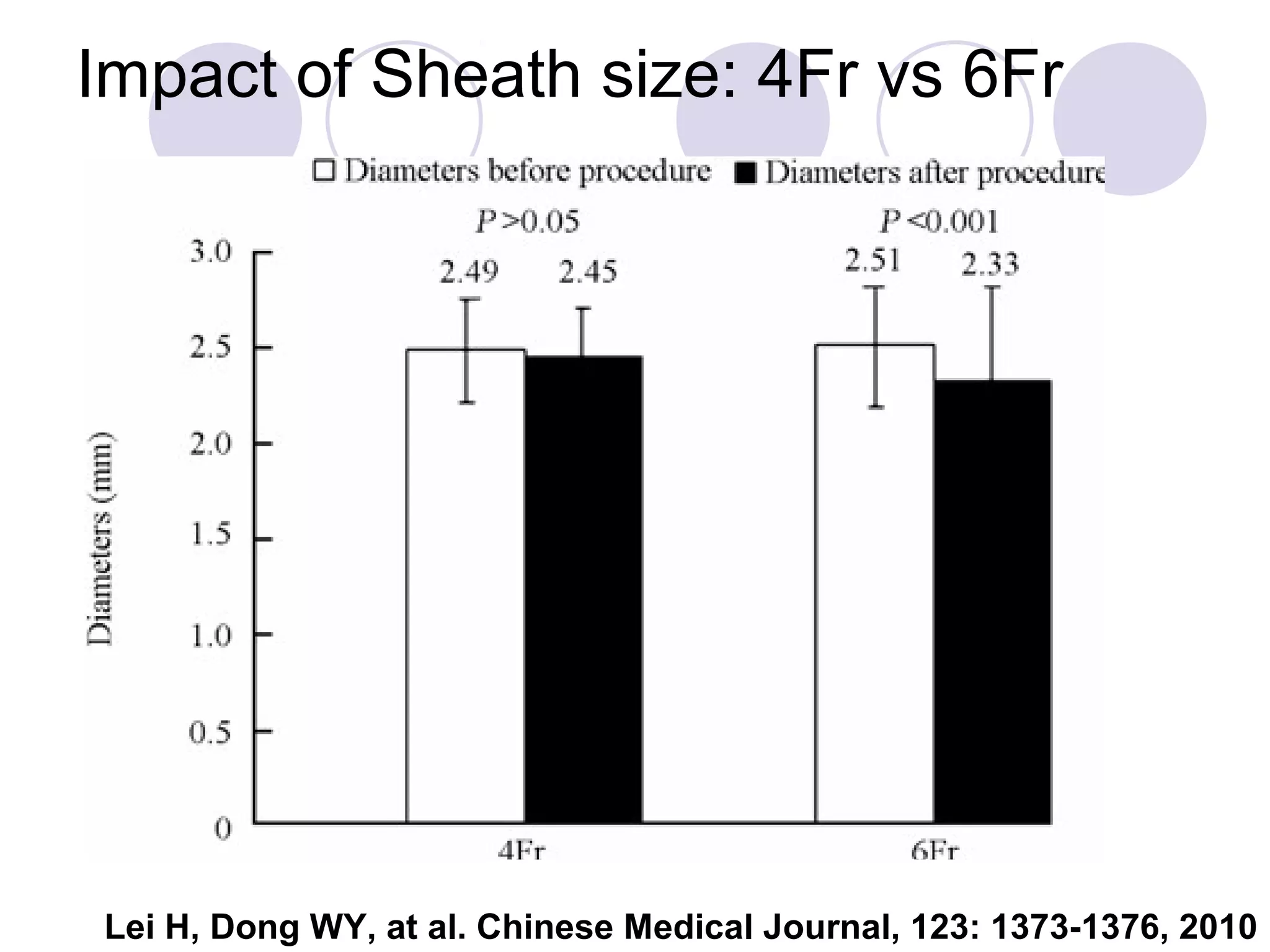
Impact of Sheath size: 4Fr vs 6Fr

Lei H, Dong WY, at al. Chinese Medical Journal, 123: 1373-1376, 2010
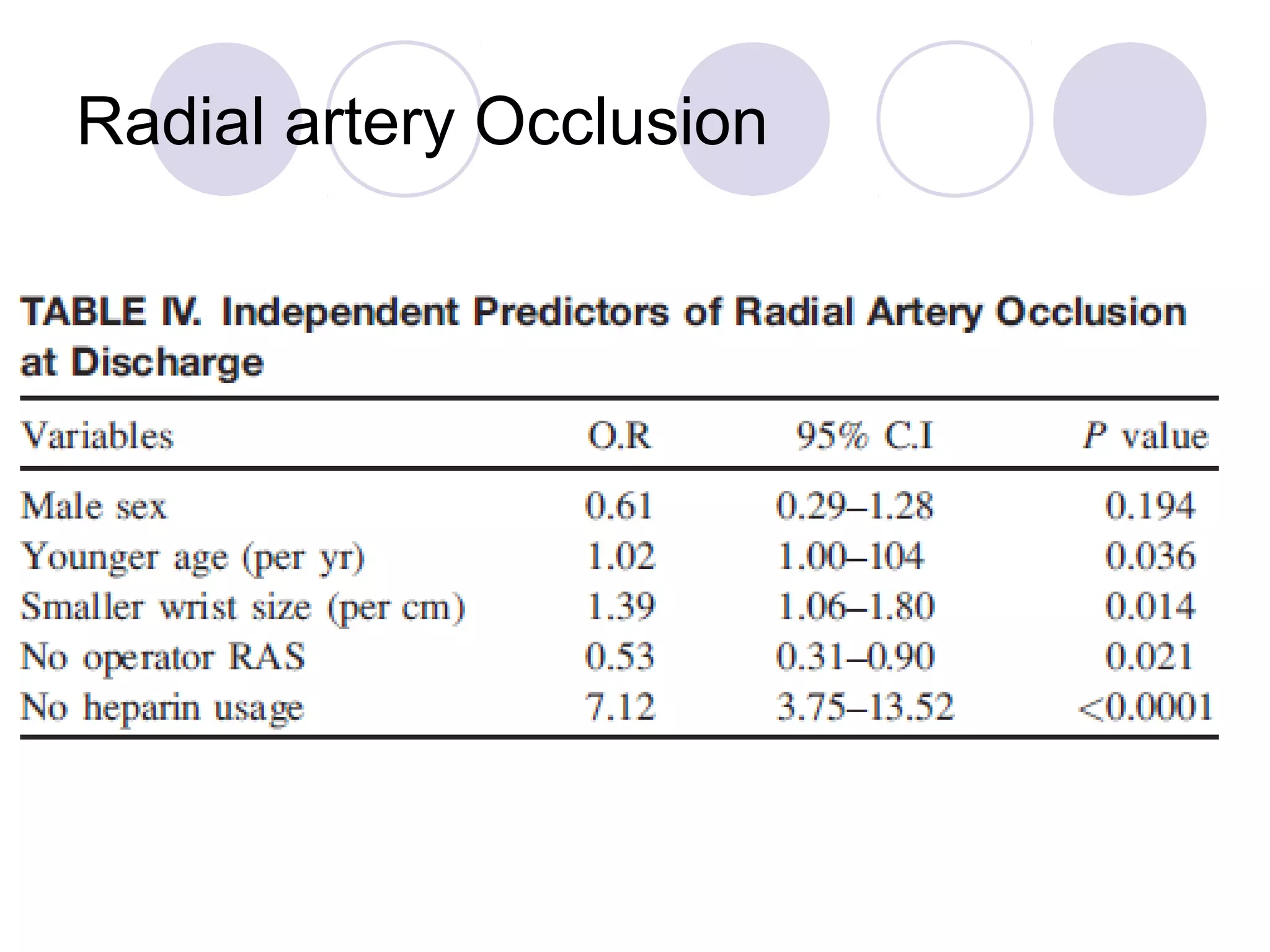
Radial artery Occlusion
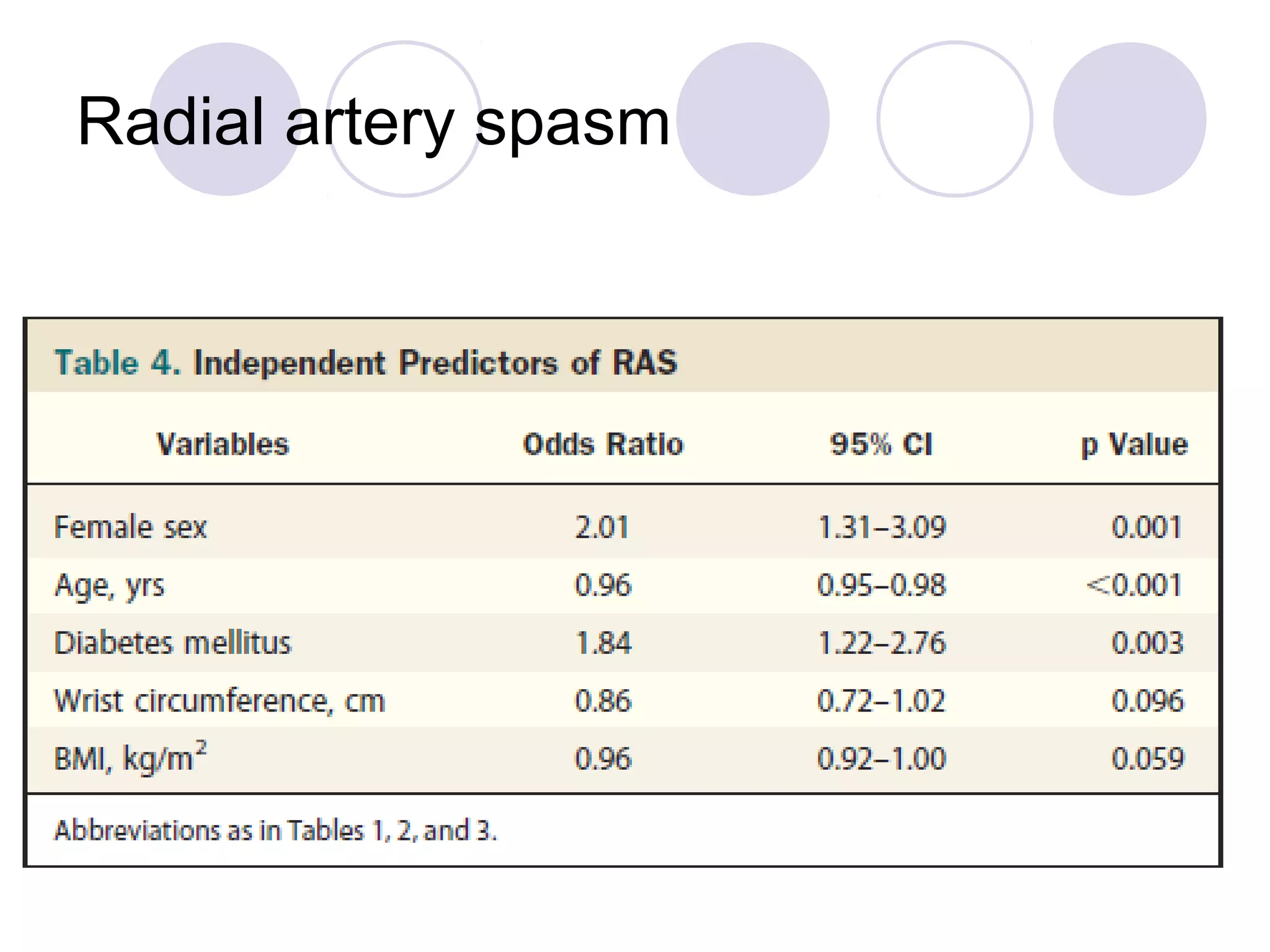
Radial artery spasm
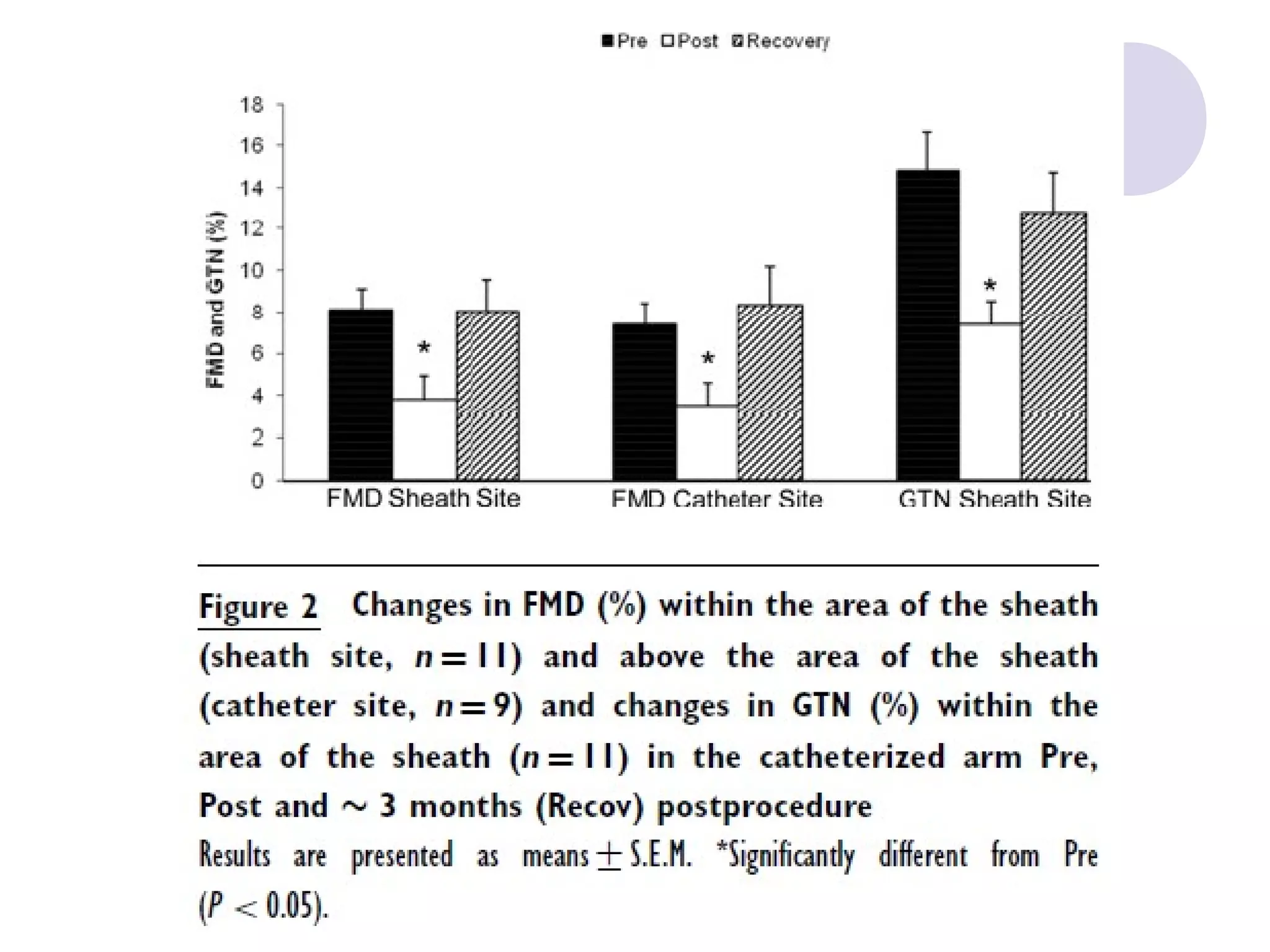
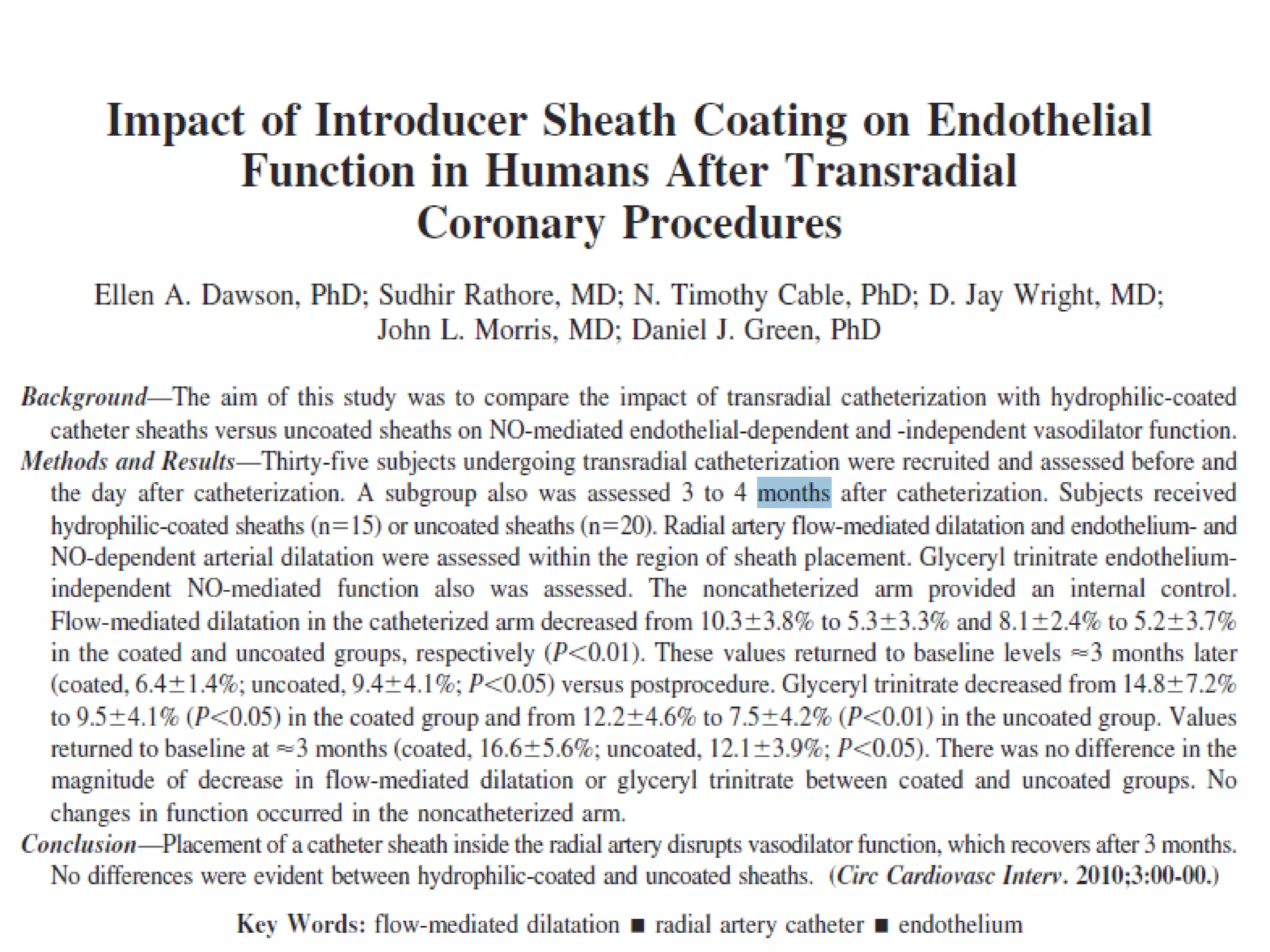
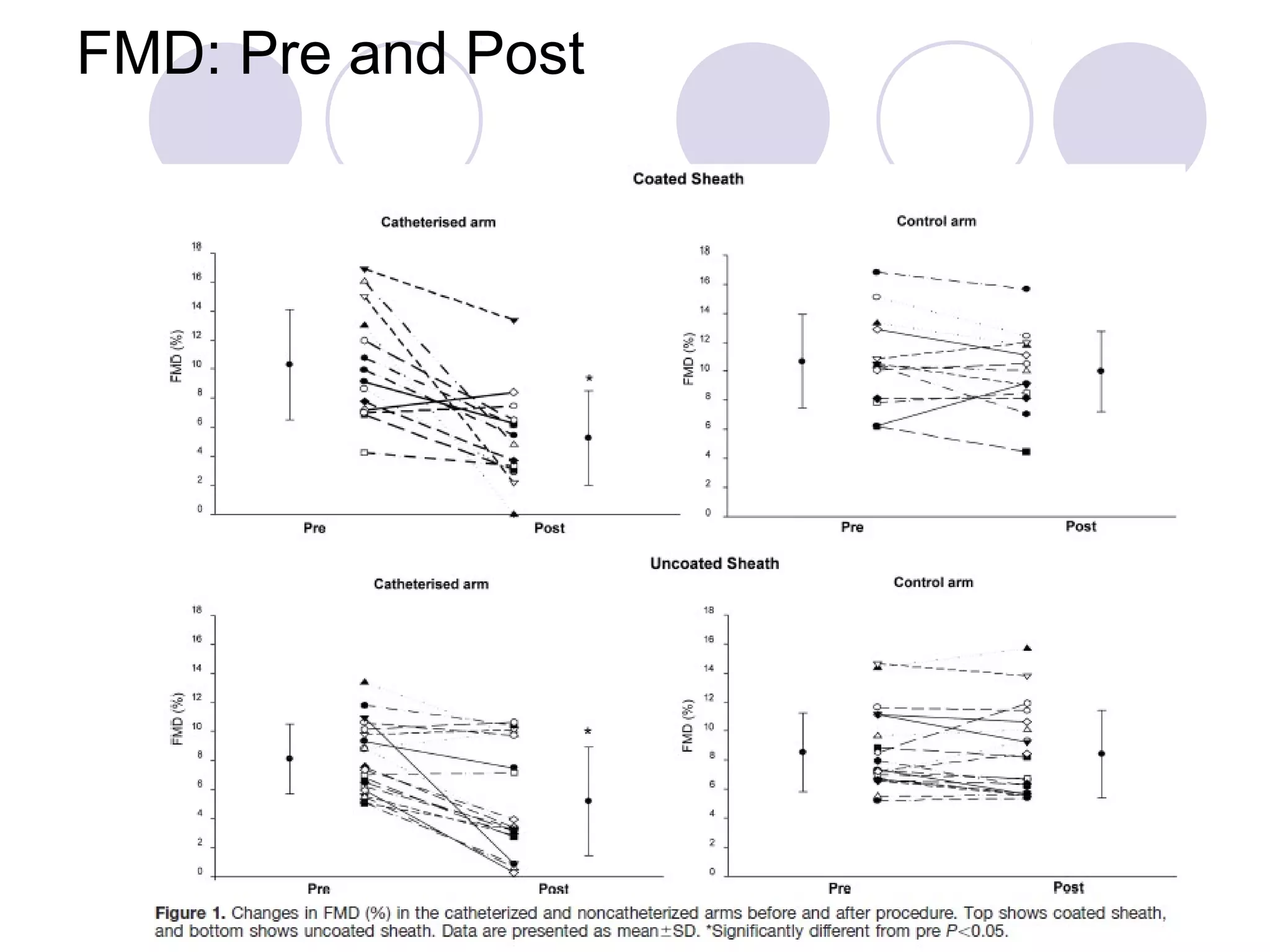
FMD: Pre and Post
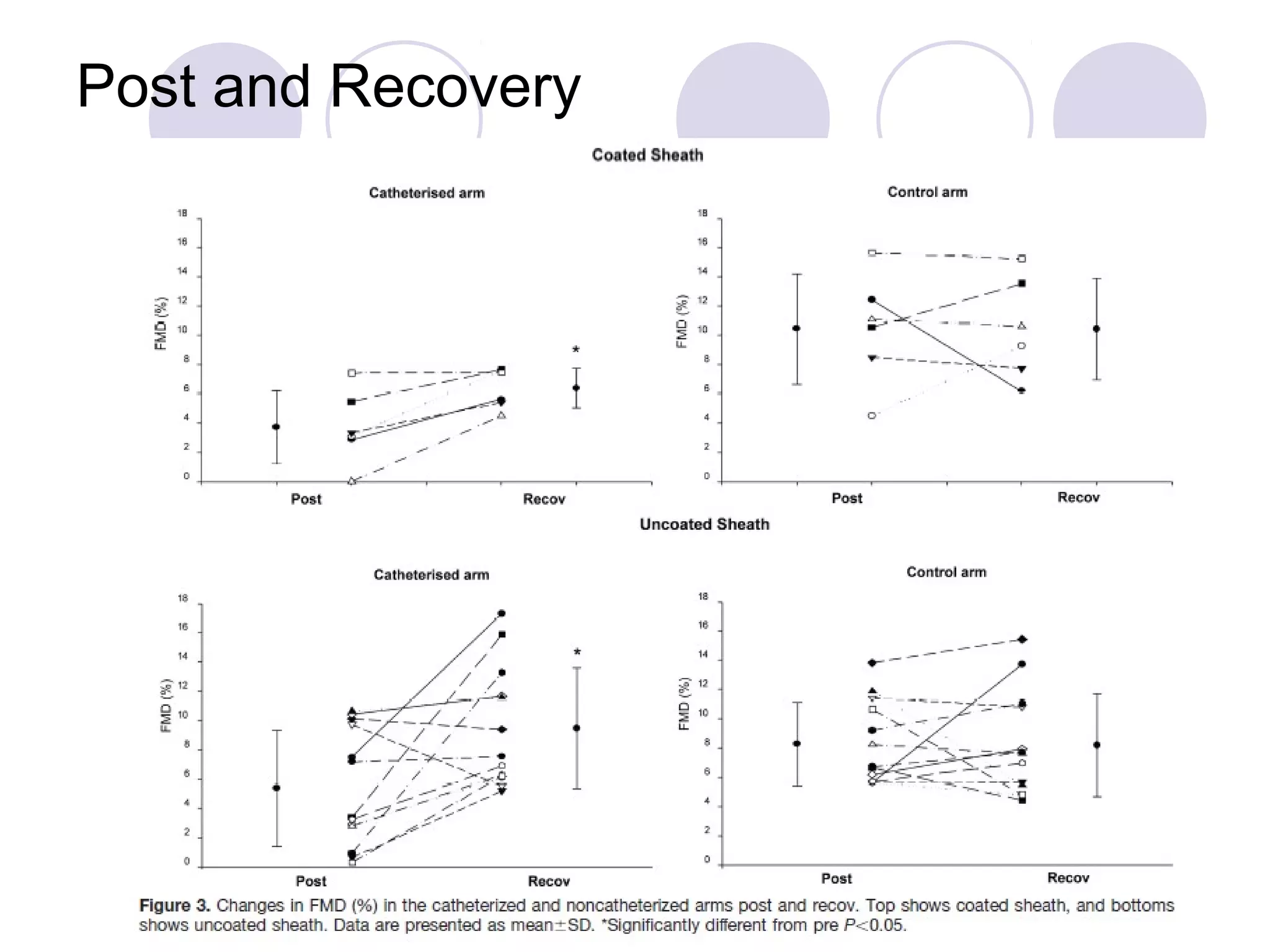
Post and Recovery
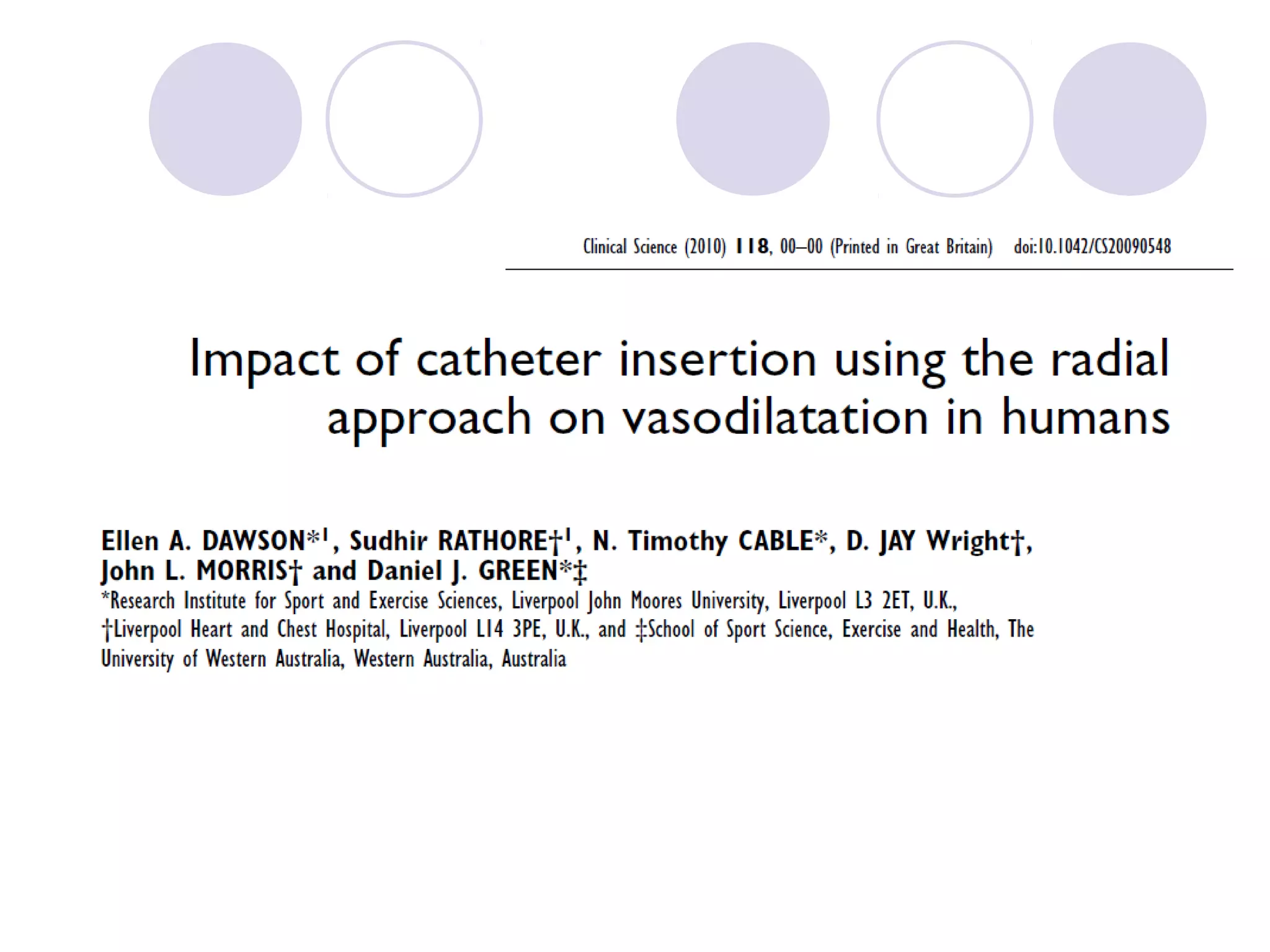
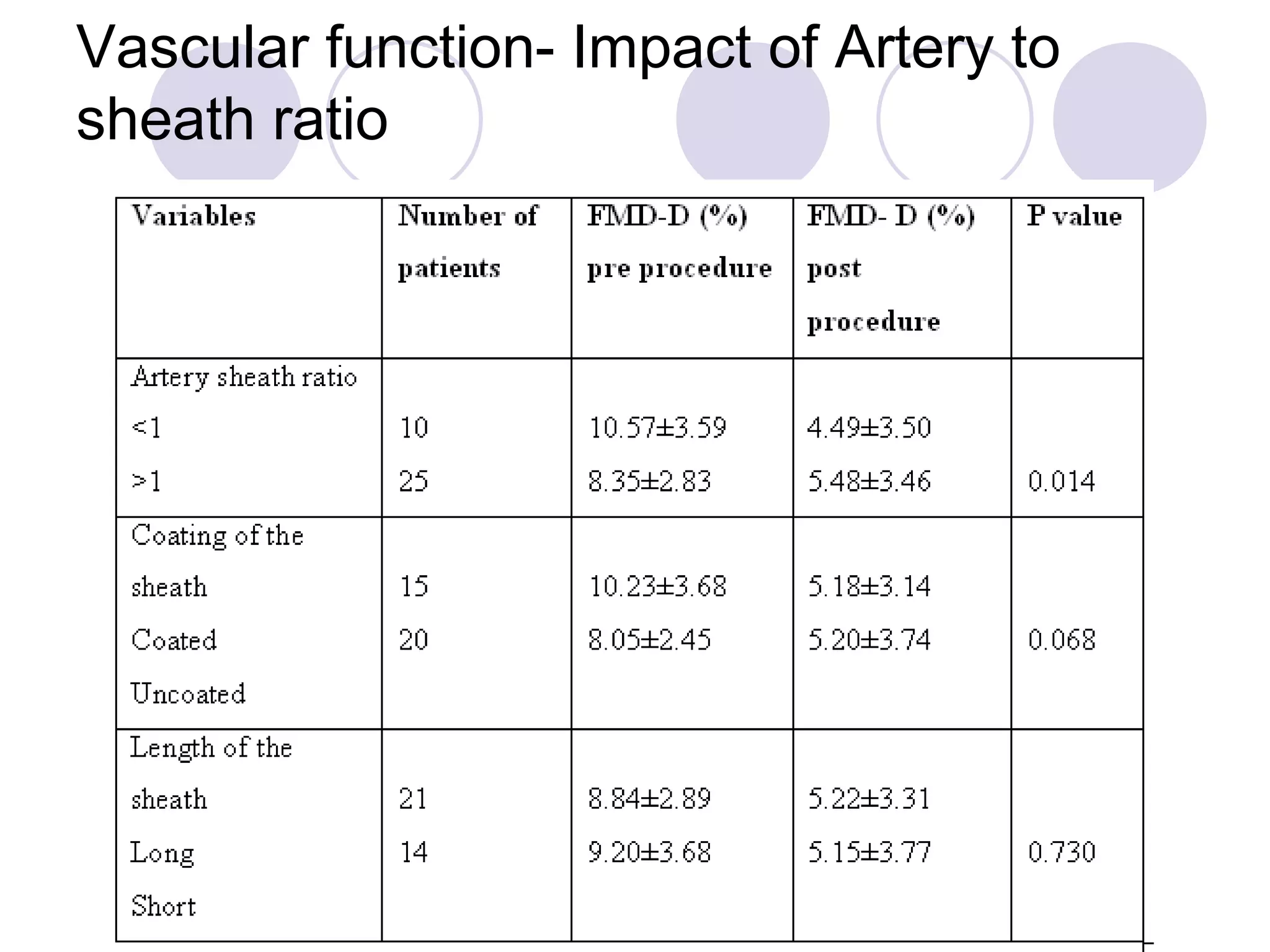
Vascular function- Impact of Artery to
sheath ratio
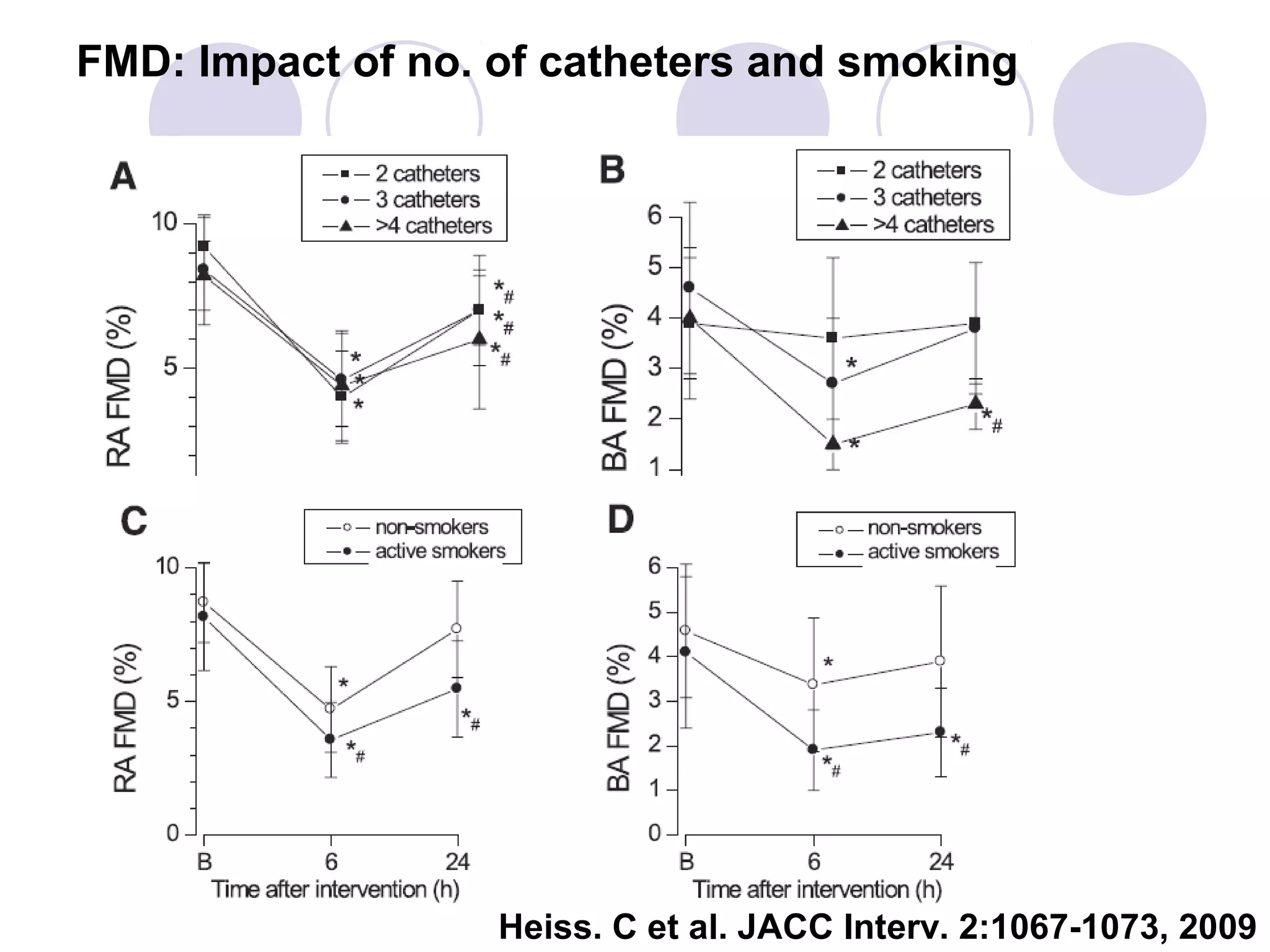
FMD: Impact of no. of catheters and smoking

Heiss. C et al. JACC Interv. 2:1067-1073, 2009
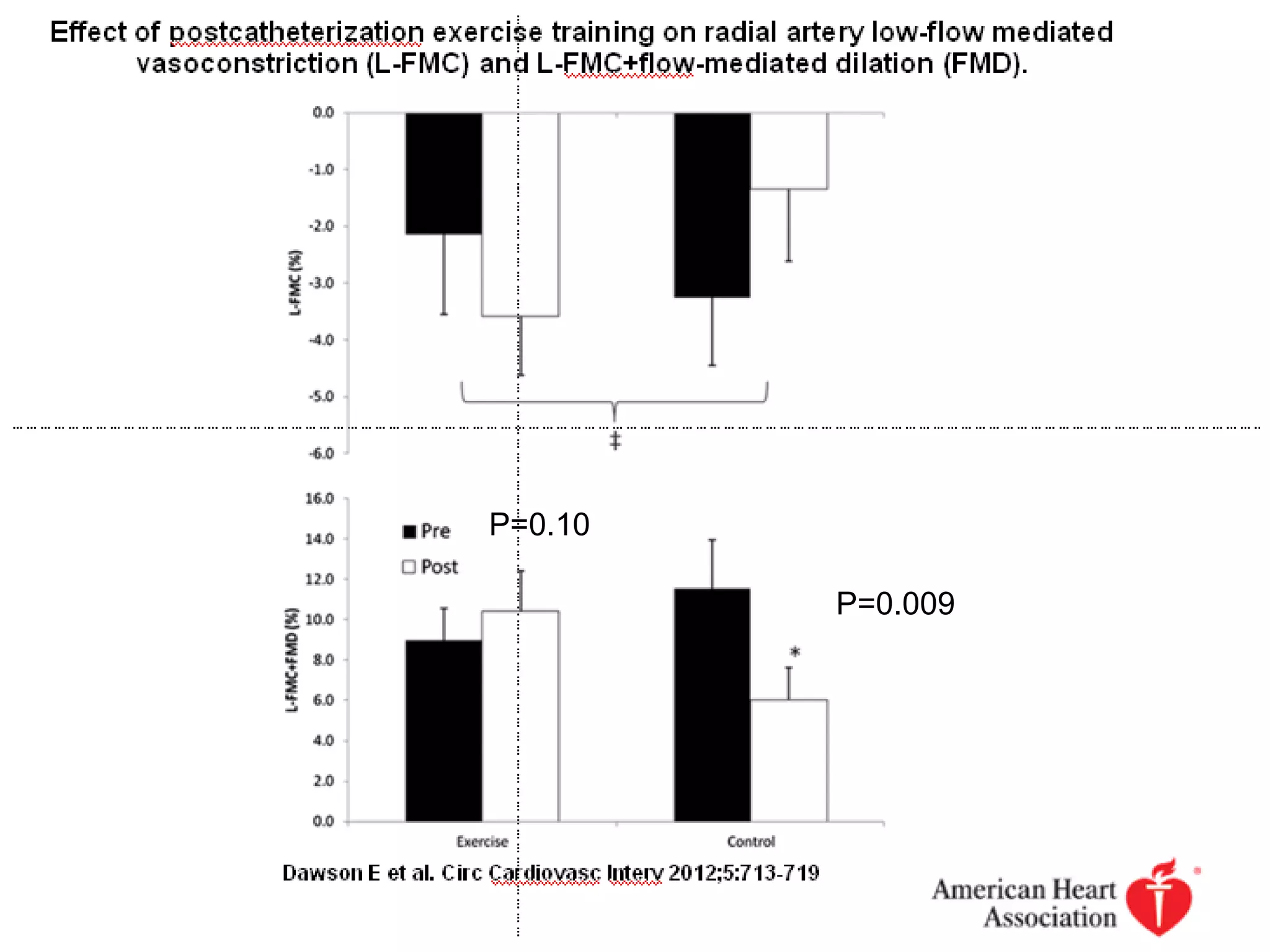
Hypothesis and Exercise protocol
 Localized

exercise training may be beneficial for
post-catheterization recovery of radial artery
endothelial function.
 Patients attended the laboratory twice: before
the catheterization (Pre) and 7 weeks after the
procedure (Post).
 The training consisted of exercise with a
handgrip dynamometer (Stoelting, Wood Dale,
III) with a rhythmic sequence of 30 contractions
per minute timed to a metronome, for 30
minutes in a seated position three times a week.
P=0.10
P=0.009
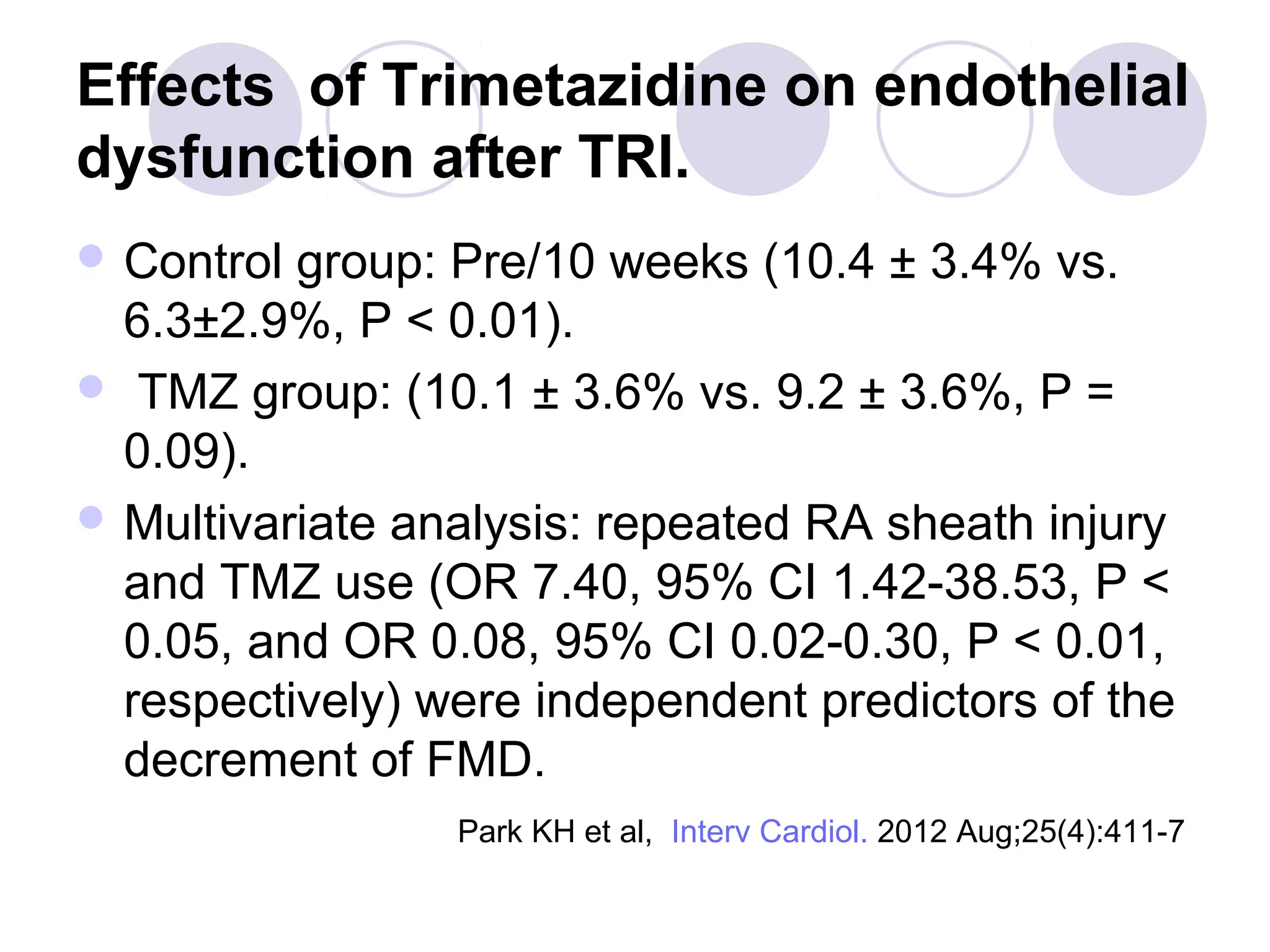
Effects of Trimetazidine on endothelial
dysfunction after TRI.
 Control

group: Pre/10 weeks (10.4 ± 3.4% vs.
6.3±2.9%, P < 0.01).
 TMZ group: (10.1 ± 3.6% vs. 9.2 ± 3.6%, P =
0.09).
 Multivariate analysis: repeated RA sheath injury
and TMZ use (OR 7.40, 95% CI 1.42-38.53, P <
0.05, and OR 0.08, 95% CI 0.02-0.30, P < 0.01,
respectively) were independent predictors of the
decrement of FMD.
Park KH et al, Interv Cardiol. 2012 Aug;25(4):411-7
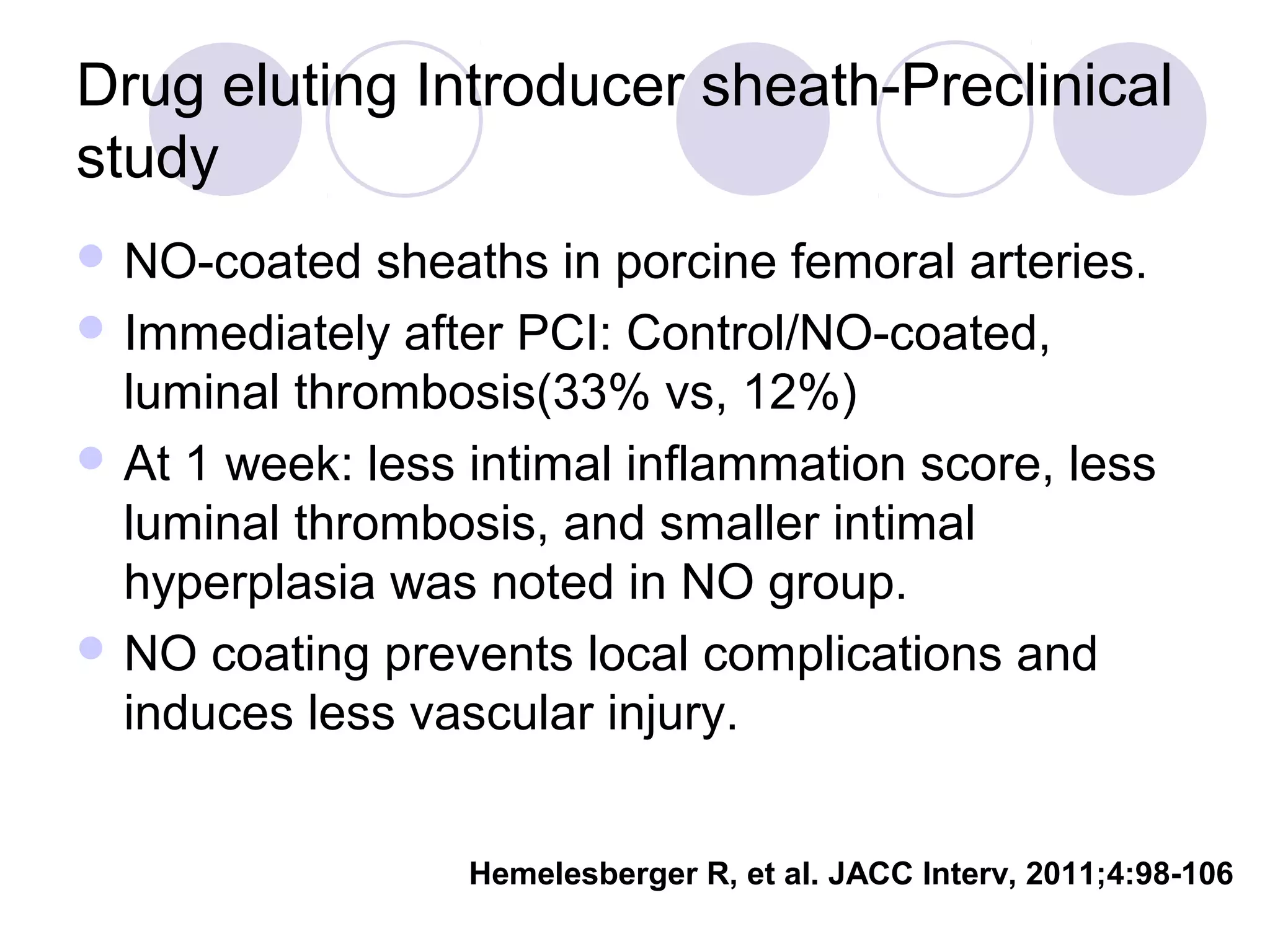
Drug eluting Introducer sheath-Preclinical
study
 NO-coated

sheaths in porcine femoral arteries.
 Immediately after PCI: Control/NO-coated,
luminal thrombosis(33% vs, 12%)
 At 1 week: less intimal inflammation score, less
luminal thrombosis, and smaller intimal
hyperplasia was noted in NO group.
 NO coating prevents local complications and
induces less vascular injury.
Hemelesberger R, et al. JACC Interv, 2011;4:98-106
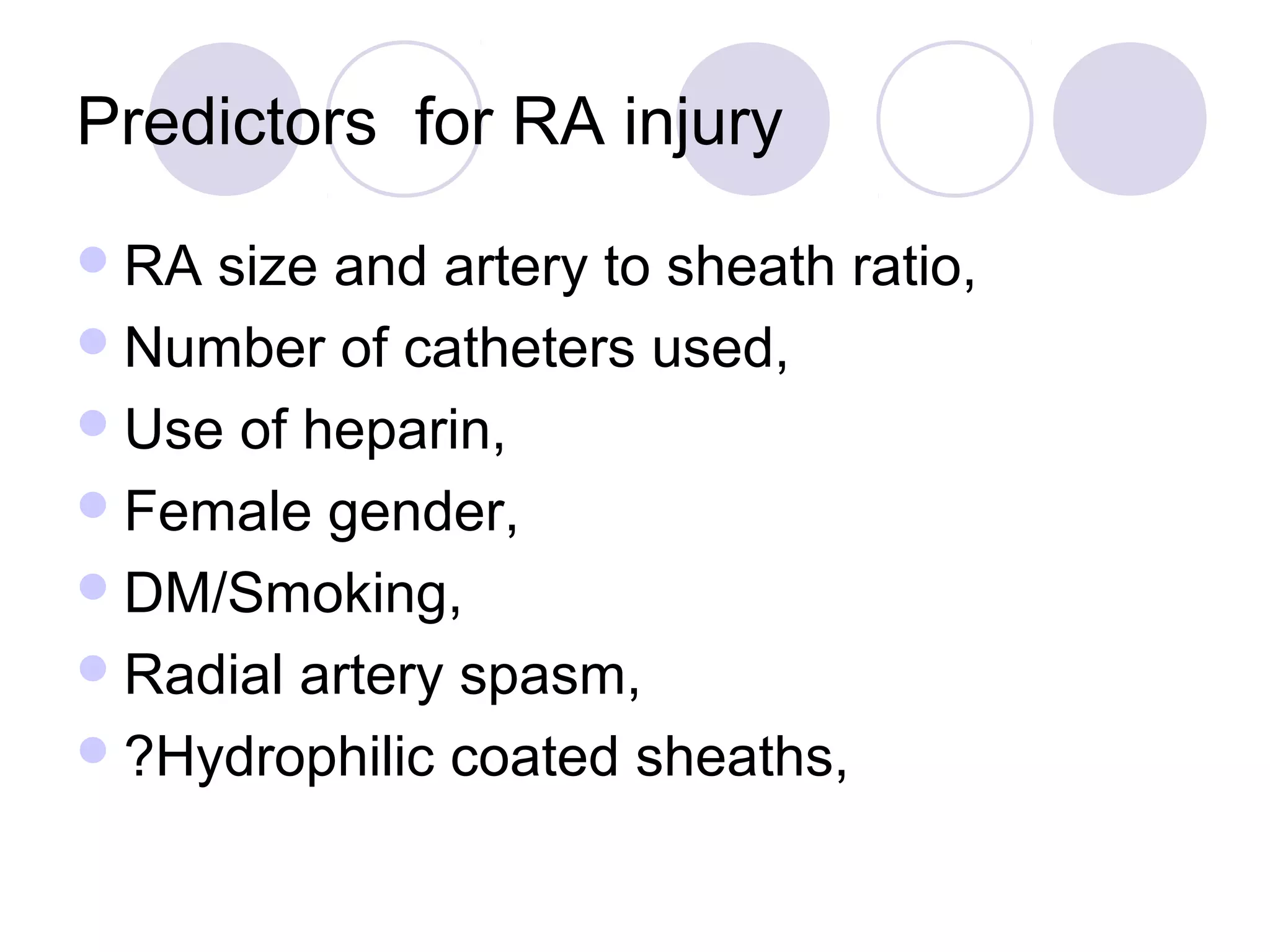
Predictors for RA injury
 RA

size and artery to sheath ratio,
 Number of catheters used,
 Use of heparin,
 Female gender,
 DM/Smoking,
 Radial artery spasm,
 ?Hydrophilic coated sheaths,
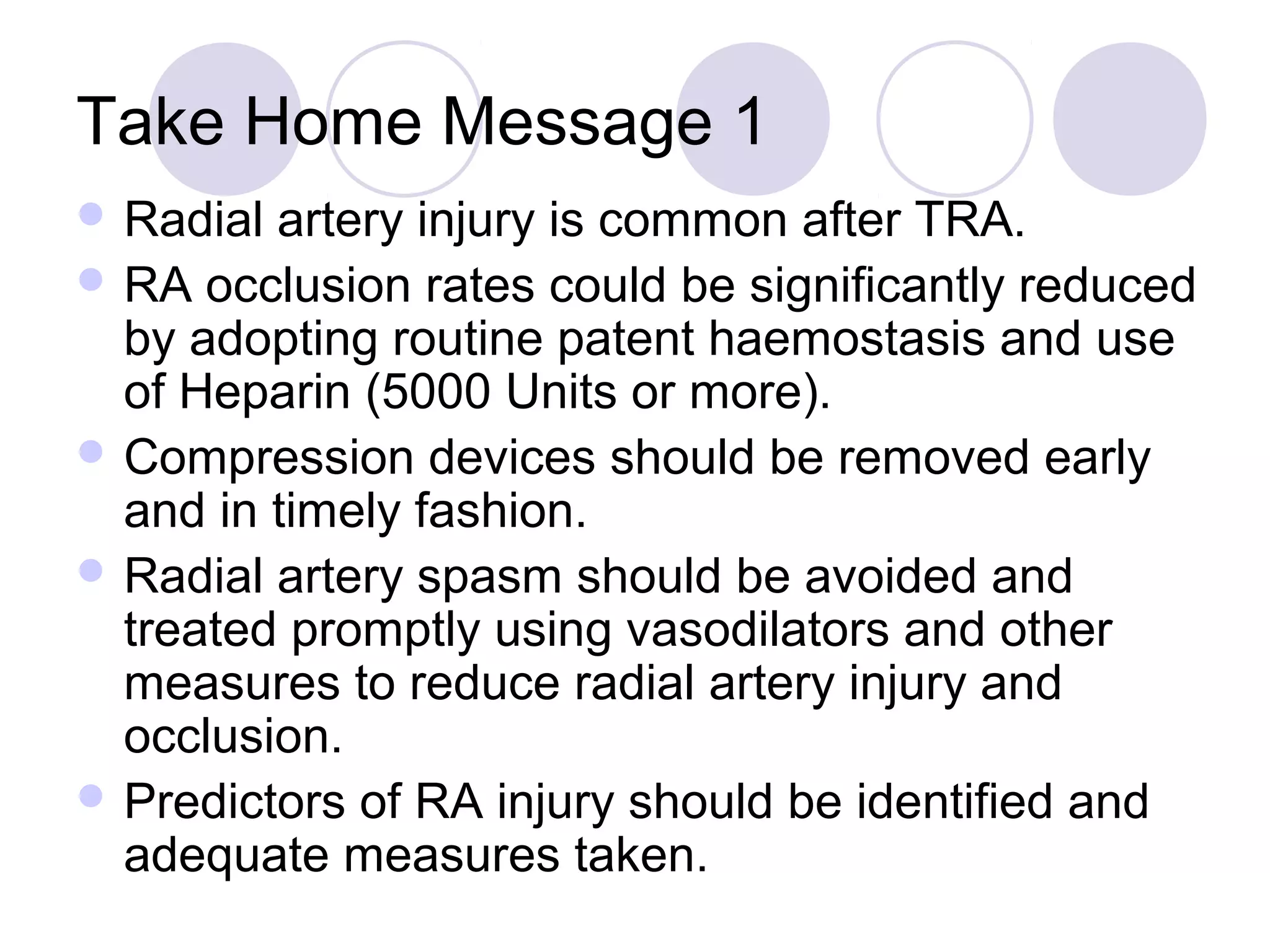
Take Home Message 1
 Radial

artery injury is common after TRA.
 RA occlusion rates could be significantly reduced
by adopting routine patent haemostasis and use
of Heparin (5000 Units or more).
 Compression devices should be removed early
and in timely fashion.
 Radial artery spasm should be avoided and
treated promptly using vasodilators and other
measures to reduce radial artery injury and
occlusion.
 Predictors of RA injury should be identified and
adequate measures taken.
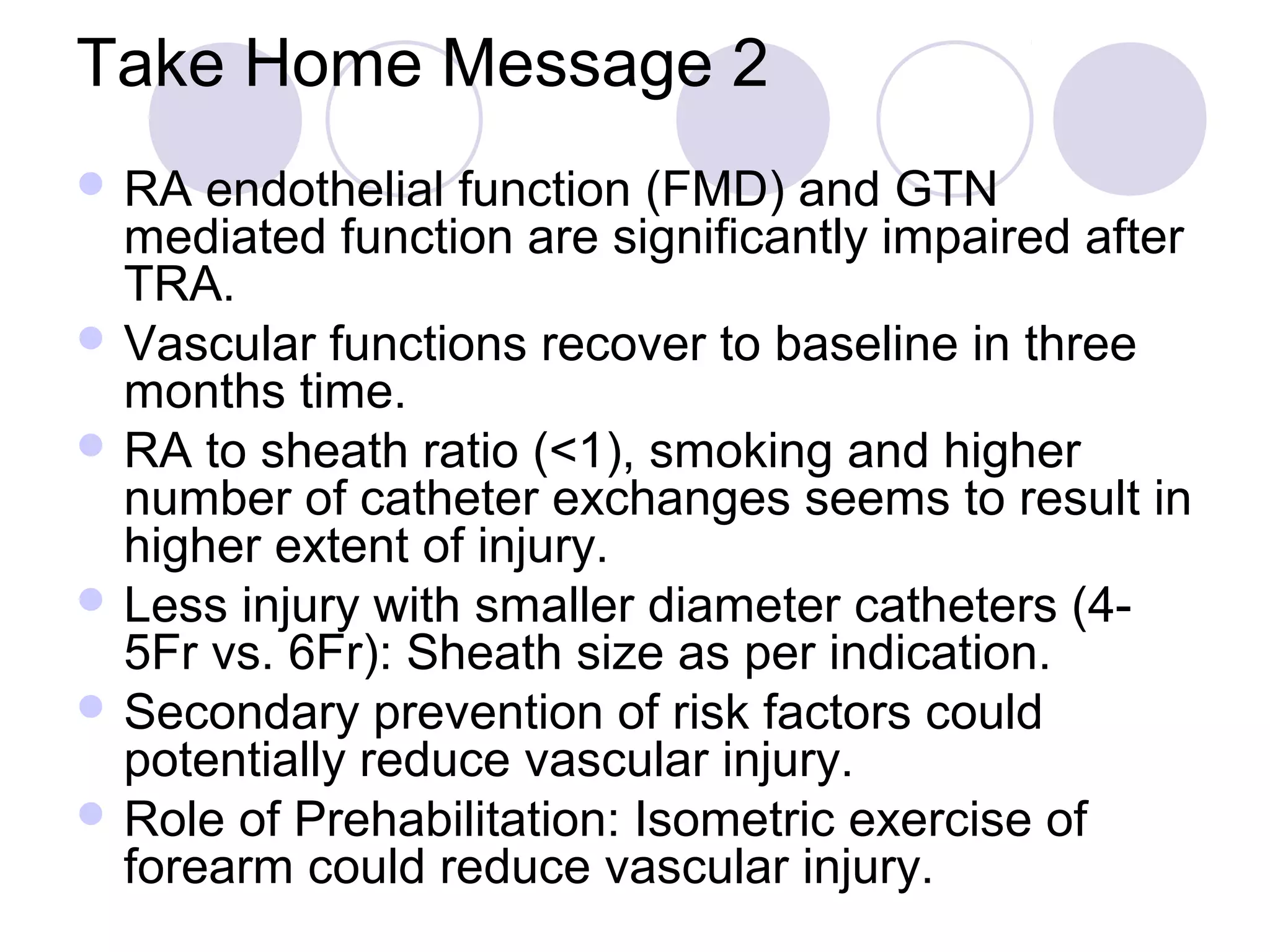
Take Home Message 2
 RA

endothelial function (FMD) and GTN
mediated function are significantly impaired after
TRA.
 Vascular functions recover to baseline in three
months time.
 RA to sheath ratio (<1), smoking and higher
number of catheter exchanges seems to result in
higher extent of injury.
 Less injury with smaller diameter catheters (45Fr vs. 6Fr): Sheath size as per indication.
 Secondary prevention of risk factors could
potentially reduce vascular injury.
 Role of Prehabilitation: Isometric exercise of
forearm could reduce vascular injury.
Future Directions
 Large

studies needed to assess the non
occlusive injury and vascular function.
 Novel radial sheaths and catheter (thin
walled).
 Drug coated sheaths (NO, LNMMA)
 Slender devices.
 Clinical studies involving graft patients.

Rathore S - AIMRADIAL 2013 - Radial injury

  • 1.
    Aim RADIAL 2013 NonOcclusive Radial artery Injury and Long term effects Dr Sudhir Rathore MD, MRCP(UK),FACC, FESC Consultant Interventional Cardiologist Frimley Park Hospital NHS Foundation Trust, Surrey & St George’s Hospital, London, UK
  • 2.
    Conflict of Interest No conflict of interest in relation to this presentation.
  • 3.
    Background: Significance        Transradial accessis rapidly becoming alternative and preferred vascular access site. Radial artery is medium sized muscular artery. Repeated coronary procedures needs patent and healthy radial artery. Radial artery is being used increasingly as a conduit for coronary revascularisation. Creation of arteriovenous fistulae for haemodialysis. Transradial access potentially results in injury to radial artery and can range from endothelial dysfunction to RA occlusion. All efforts must be made to minimise radial artery injury following TRA.
  • 4.
    Non Occlusive RAinjury: Historical  Non-occlusive radial artery injury: Reported in around 50% of the RA in the form of neo-intimal hyperplasia, radial artery stenosis etc.  Nagai et al (1999): Early- segmental stenosis (22%), no flow ( 9%). Late : segmental stenosis (1%), diffuse stenosis ( 22%) and no flow (5%).  Wakeyama et al (2003): IVUS: LA of 5.05±1.26mm² in the repeatTRI group vs. LA of 5.62±1.35mm² in the first-TRI group, p=0.032 and MLD of 2.37±0.31mm in the repeat-TRI group vs. MLD of 2.51±0.33mm in the first-TRI group, p=0.028), whereas the intimamedia cross sectional area (IMcsa) and intima-media thickness (IMT) were significantly greater than those in first-TRI patients.  Edmundson and Mann: Repeat procedure group and control group (6.7±0.8mm2 vs. 5.0±0.7mm2, p<0.01).
  • 5.
    Acute Injury Intimal tears:32% Medial dissect.:16% Thrombi: 20% Chronic Injury Higher neo-intimal thickness in patients with repeated procedures Taishi Yonetsu et al. EHJ, April 22, 2010
  • 7.
    Shen Hua etal, Chin Med J 2012;125:33883392
  • 8.
    Histopathology of RA StaniloeCS, et al. Vasc. Health and management, June 2009
  • 9.
    Histopathological study- Distaland Proximal RA Staniloe CS, et al. Vasc. Health and management, June 2009
  • 10.
    Impact of Sheathsize: 4Fr vs 6Fr Lei H, Dong WY, at al. Chinese Medical Journal, 123: 1373-1376, 2010
  • 12.
  • 13.
  • 17.
  • 18.
  • 19.
    Vascular function- Impactof Artery to sheath ratio
  • 20.
    FMD: Impact ofno. of catheters and smoking Heiss. C et al. JACC Interv. 2:1067-1073, 2009
  • 22.
    Hypothesis and Exerciseprotocol  Localized exercise training may be beneficial for post-catheterization recovery of radial artery endothelial function.  Patients attended the laboratory twice: before the catheterization (Pre) and 7 weeks after the procedure (Post).  The training consisted of exercise with a handgrip dynamometer (Stoelting, Wood Dale, III) with a rhythmic sequence of 30 contractions per minute timed to a metronome, for 30 minutes in a seated position three times a week.
  • 23.
  • 24.
    Effects of Trimetazidineon endothelial dysfunction after TRI.  Control group: Pre/10 weeks (10.4 ± 3.4% vs. 6.3±2.9%, P < 0.01).  TMZ group: (10.1 ± 3.6% vs. 9.2 ± 3.6%, P = 0.09).  Multivariate analysis: repeated RA sheath injury and TMZ use (OR 7.40, 95% CI 1.42-38.53, P < 0.05, and OR 0.08, 95% CI 0.02-0.30, P < 0.01, respectively) were independent predictors of the decrement of FMD. Park KH et al, Interv Cardiol. 2012 Aug;25(4):411-7
  • 25.
    Drug eluting Introducersheath-Preclinical study  NO-coated sheaths in porcine femoral arteries.  Immediately after PCI: Control/NO-coated, luminal thrombosis(33% vs, 12%)  At 1 week: less intimal inflammation score, less luminal thrombosis, and smaller intimal hyperplasia was noted in NO group.  NO coating prevents local complications and induces less vascular injury. Hemelesberger R, et al. JACC Interv, 2011;4:98-106
  • 26.
    Predictors for RAinjury  RA size and artery to sheath ratio,  Number of catheters used,  Use of heparin,  Female gender,  DM/Smoking,  Radial artery spasm,  ?Hydrophilic coated sheaths,
  • 27.
    Take Home Message1  Radial artery injury is common after TRA.  RA occlusion rates could be significantly reduced by adopting routine patent haemostasis and use of Heparin (5000 Units or more).  Compression devices should be removed early and in timely fashion.  Radial artery spasm should be avoided and treated promptly using vasodilators and other measures to reduce radial artery injury and occlusion.  Predictors of RA injury should be identified and adequate measures taken.
  • 28.
    Take Home Message2  RA endothelial function (FMD) and GTN mediated function are significantly impaired after TRA.  Vascular functions recover to baseline in three months time.  RA to sheath ratio (<1), smoking and higher number of catheter exchanges seems to result in higher extent of injury.  Less injury with smaller diameter catheters (45Fr vs. 6Fr): Sheath size as per indication.  Secondary prevention of risk factors could potentially reduce vascular injury.  Role of Prehabilitation: Isometric exercise of forearm could reduce vascular injury.
  • 29.
    Future Directions  Large studiesneeded to assess the non occlusive injury and vascular function.  Novel radial sheaths and catheter (thin walled).  Drug coated sheaths (NO, LNMMA)  Slender devices.  Clinical studies involving graft patients.