
Short sheath benefit in radial artery
injury after PCI – OCT serial study
JAN KANOVSKY, MIKLIK R, NOVAKOVA T, PRYMKOVA L, POLOCZEK M, BOCEK O, JERABEK P,
JARKOVSKÝ J., KALA P
AIM RADIAL 2017
22 SEPTEMBER 2017, STUTTGART
Disclosure
None
Lecture structure
 Available data
 Methodics, patients’ group
 Results
RA injury during coronary PCI evaluated
by OCT
 Yonetsu (2010): 69 patients, TD-OCT
 Intimal tears 67.1%
 Medial dissection 35.6%
 De Vito (2014): 51 patients, FD-OCT
 Intimal tears 37.0%
 Medial dissection 9.8%
Inclusion criteria
 nSTEMI siagnosis
 first transradial cath (TRC) in pts lifetime
 PCI performed as a part of the catheterization
 signed IS
Exclusion criteria
 STEMI
 LM disease
 renal insuffuciency - creat. over 150 umol/l (1.7mg/dl)
 acute heart failure symptoms
Patients’ group
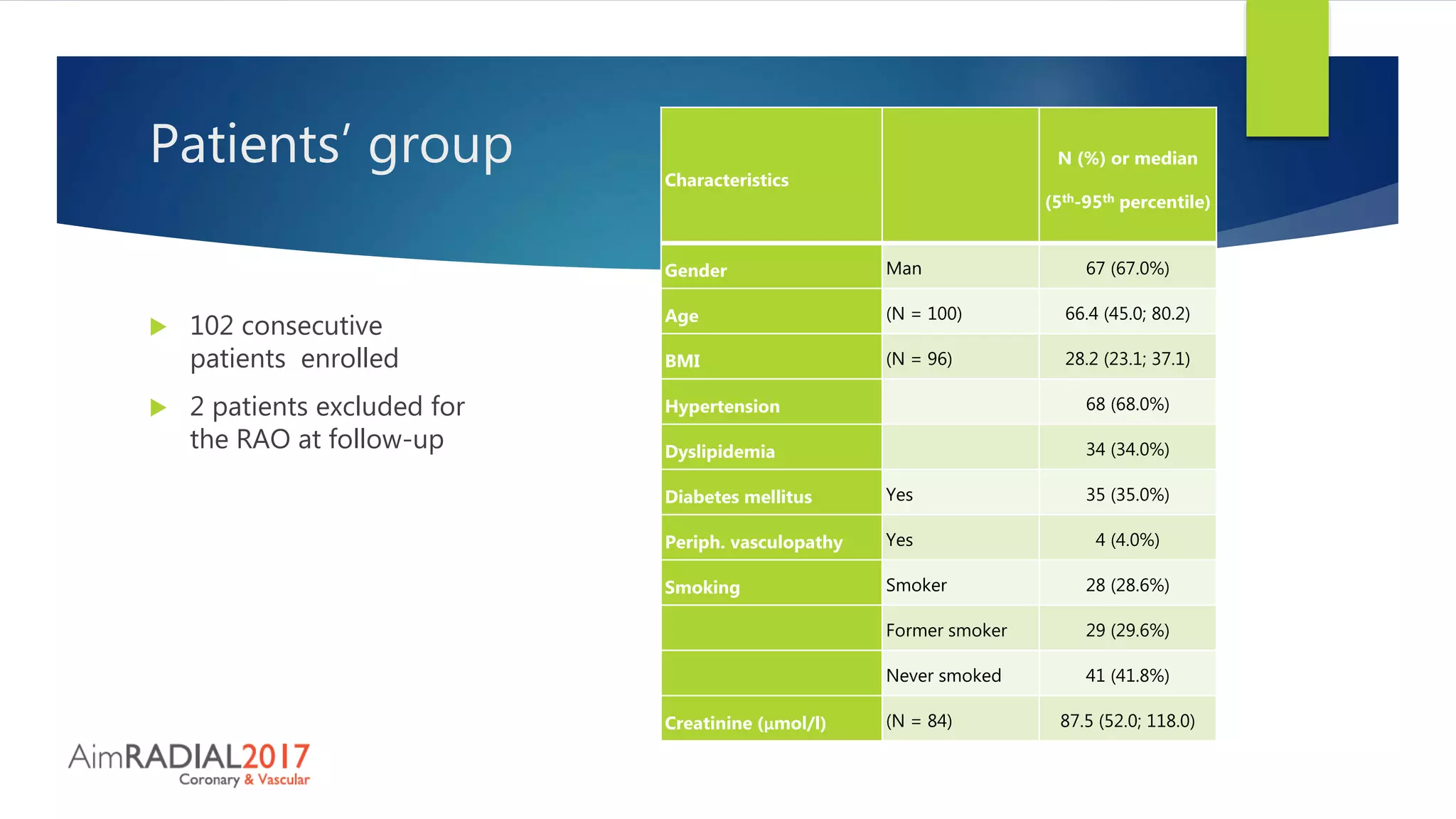
 102 consecutive
patients enrolled
 2 patients excluded for
the RAO at follow-up
Characteristics
N (%) or median
(5th-95th percentile)
Gender Man 67 (67.0%)
Age (N = 100) 66.4 (45.0; 80.2)
BMI (N = 96) 28.2 (23.1; 37.1)
Hypertension 68 (68.0%)
Dyslipidemia 34 (34.0%)
Diabetes mellitus Yes 35 (35.0%)
Periph. vasculopathy Yes 4 (4.0%)
Smoking Smoker 28 (28.6%)
Former smoker 29 (29.6%)
Never smoked 41 (41.8%)
Creatinine (μmol/l) (N = 84) 87.5 (52.0; 118.0)
Methods I.
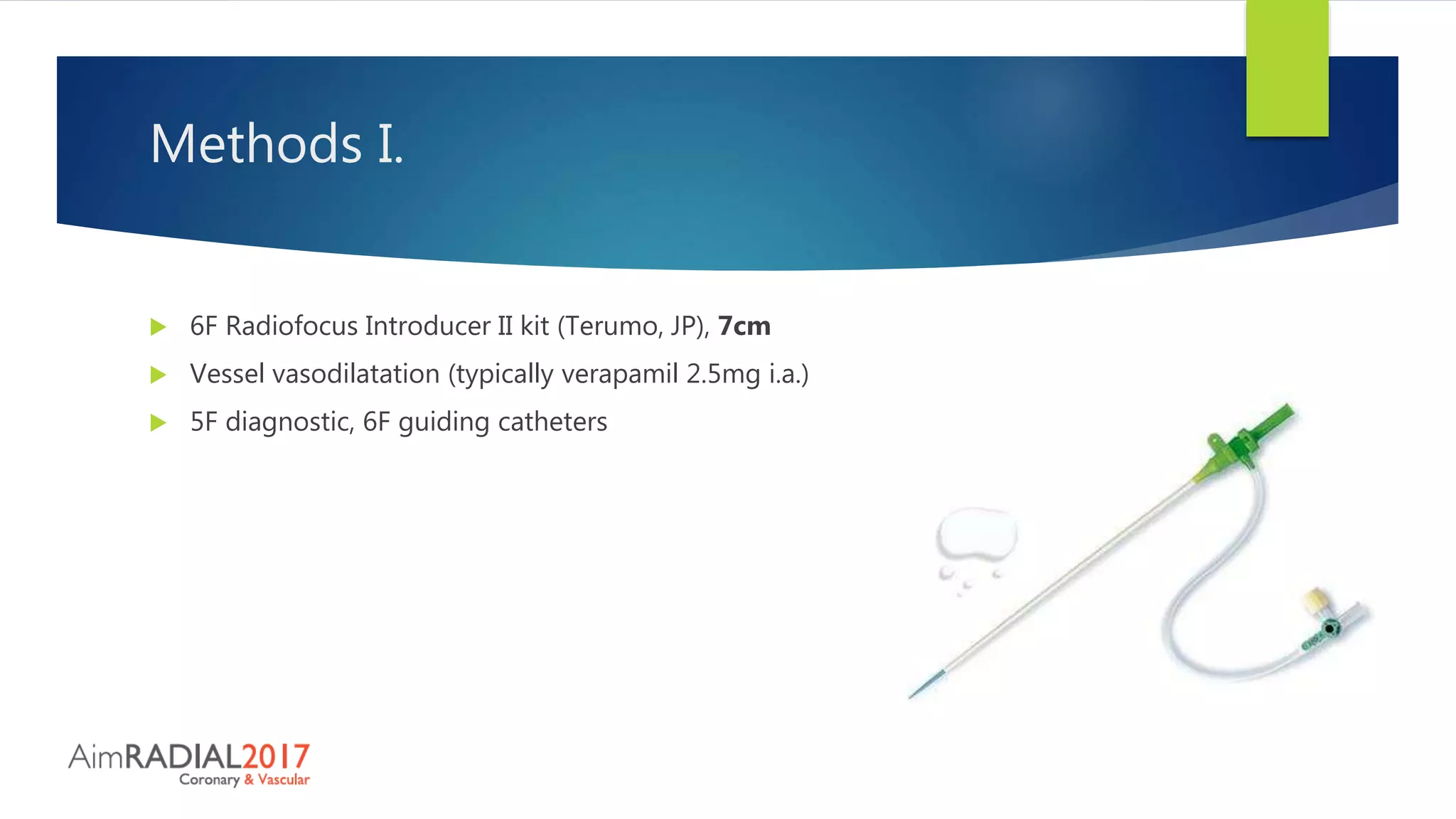
 6F Radiofocus Introducer II kit (Terumo, JP), 7cm
 Vessel vasodilatation (typically verapamil 2.5mg i.a.)
 5F diagnostic, 6F guiding catheters
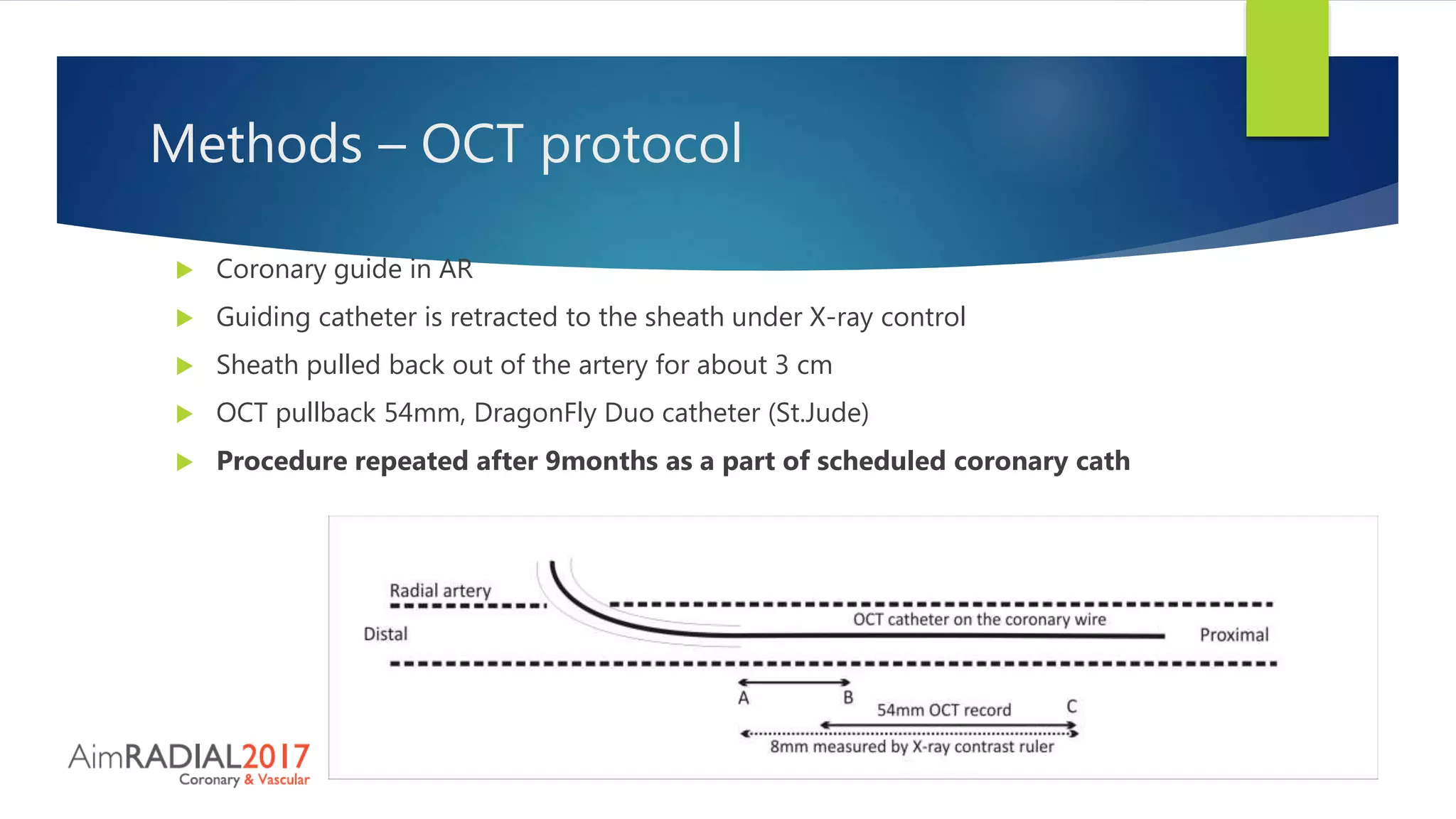
Methods – OCT protocol
 Coronary guide in AR
 Guiding catheter is retracted to the sheath under X-ray control
 Sheath pulled back out of the artery for about 3 cm
 OCT pullback 54mm, DragonFly Duo catheter (St.Jude)
 Procedure repeated after 9months as a part of scheduled coronary cath
OCT analysis
 Offline qualitative analysis
 Two experienced analysts
 Injury classified:
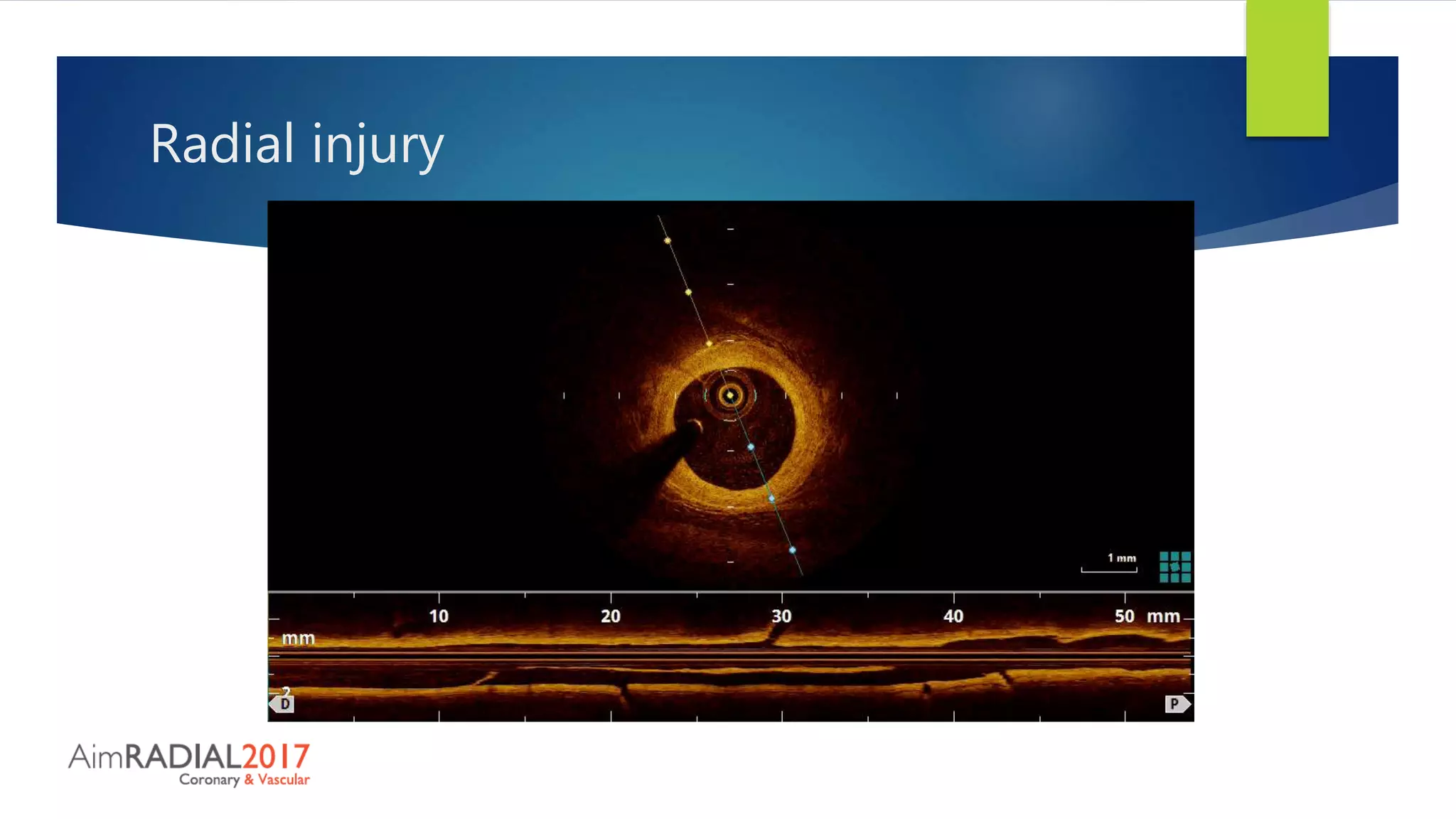
 intimal tear
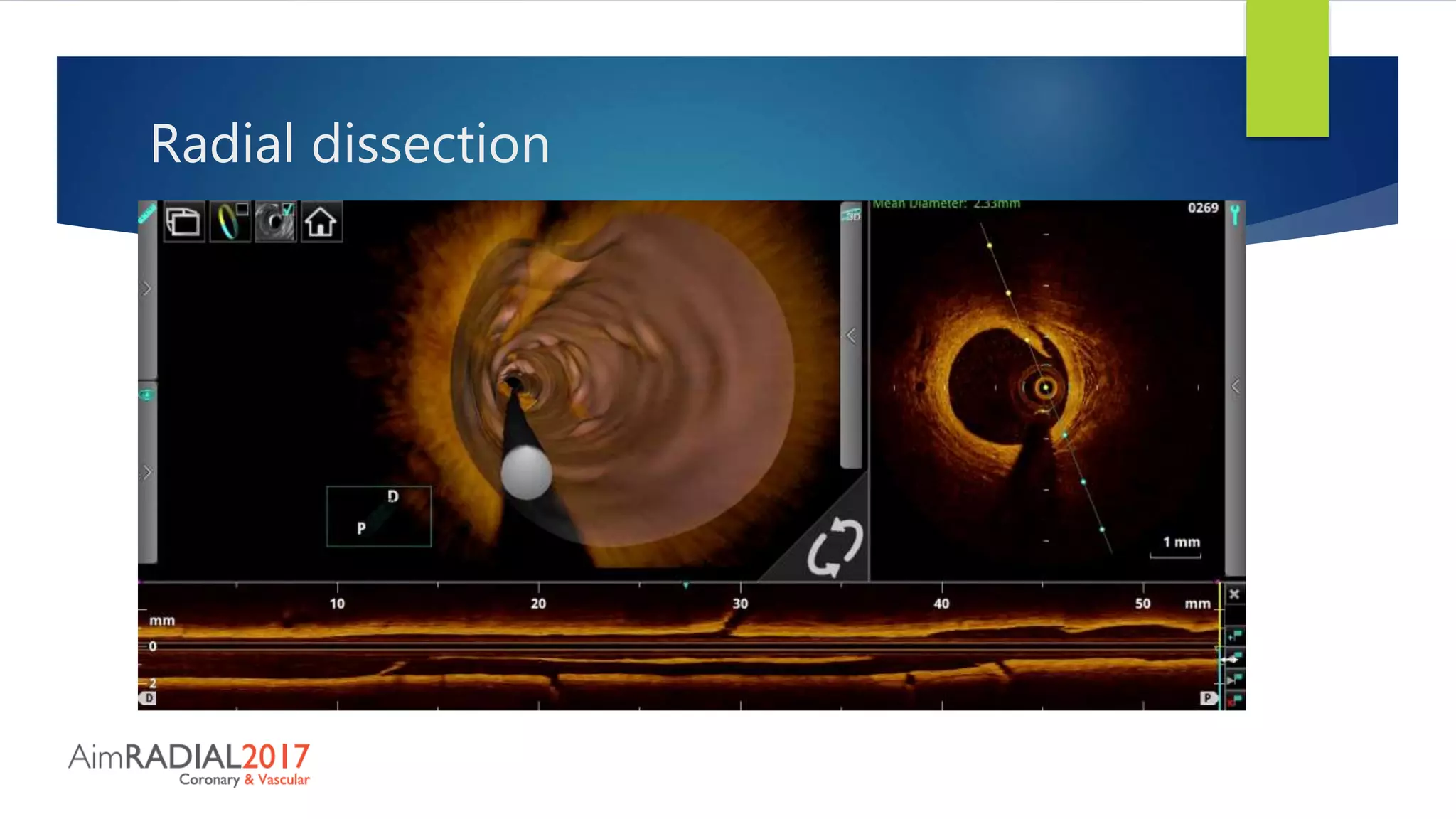
 medial dissection
 perforation
 Serial evaluation
A Intimal tear, B medial dissection, C
perforation
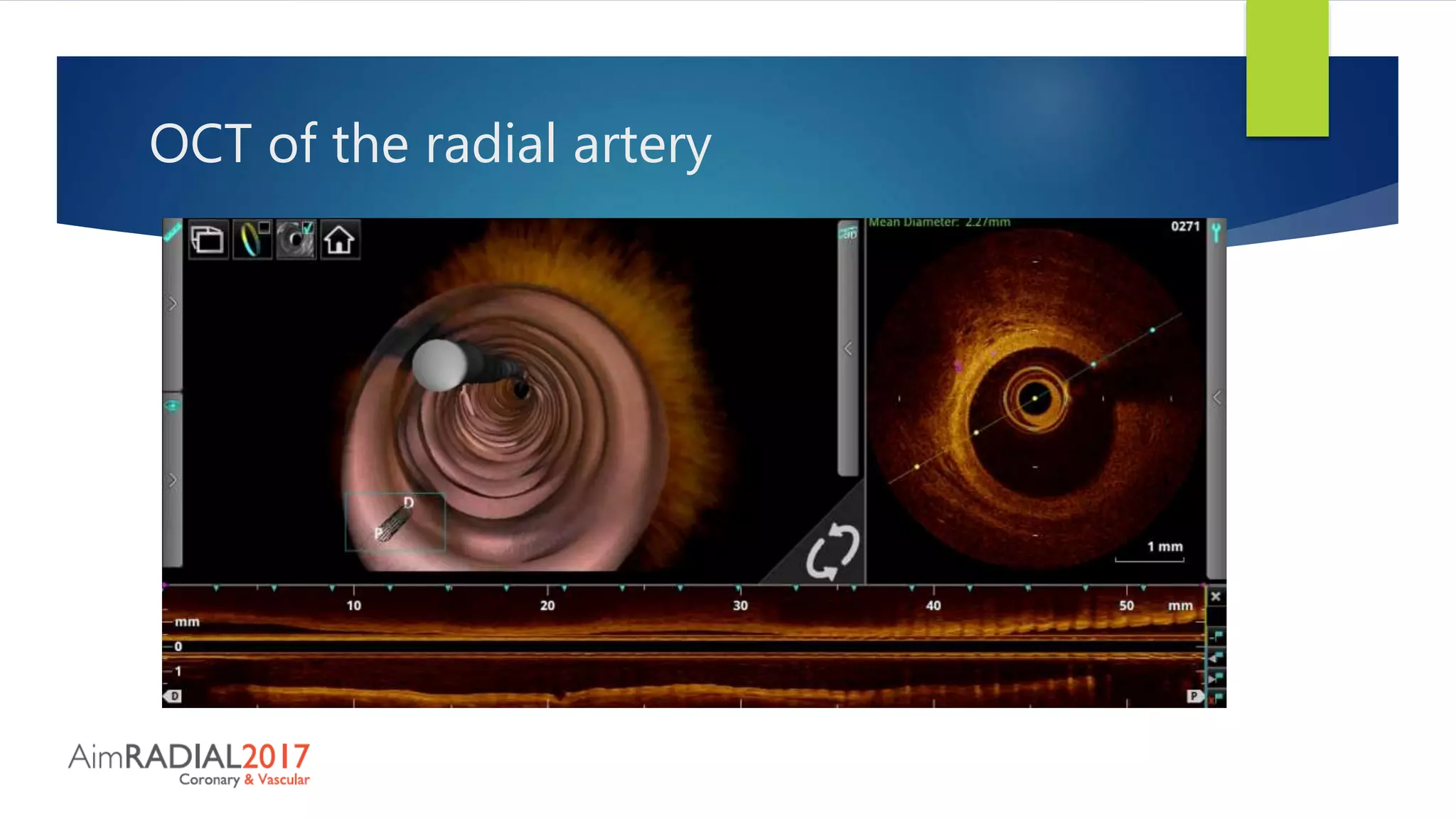
OCT of the radial artery
Radial injury
Radial dissection
Results I.
Novakova T, Kanovsky J et Al, Biomed papers 2016
Results II.
N Baseline Follow-up p
Total 100 11 (11.0%) 10 (10.0%) 0.999
Novakova T, Kanovsky J et Al, Biomed papers 2016
Results III.
Total Follow-up p
No injury Injury
Baseline
No injury 89 (89.0%) 81 (81.0%) 8 (8.0%)
0.302
Injury 11 (11.0%) 9 (9.0%) 2 (2.0%)
Total 100 (100.0%) 90 (90.0%) 10 (10.0%)
 In pts. with AR injury at baseline there was no proof of higher incidence of the
injuries at follow-up examination.
Novakova T, Kanovsky J et Al, Biomed papers 2016
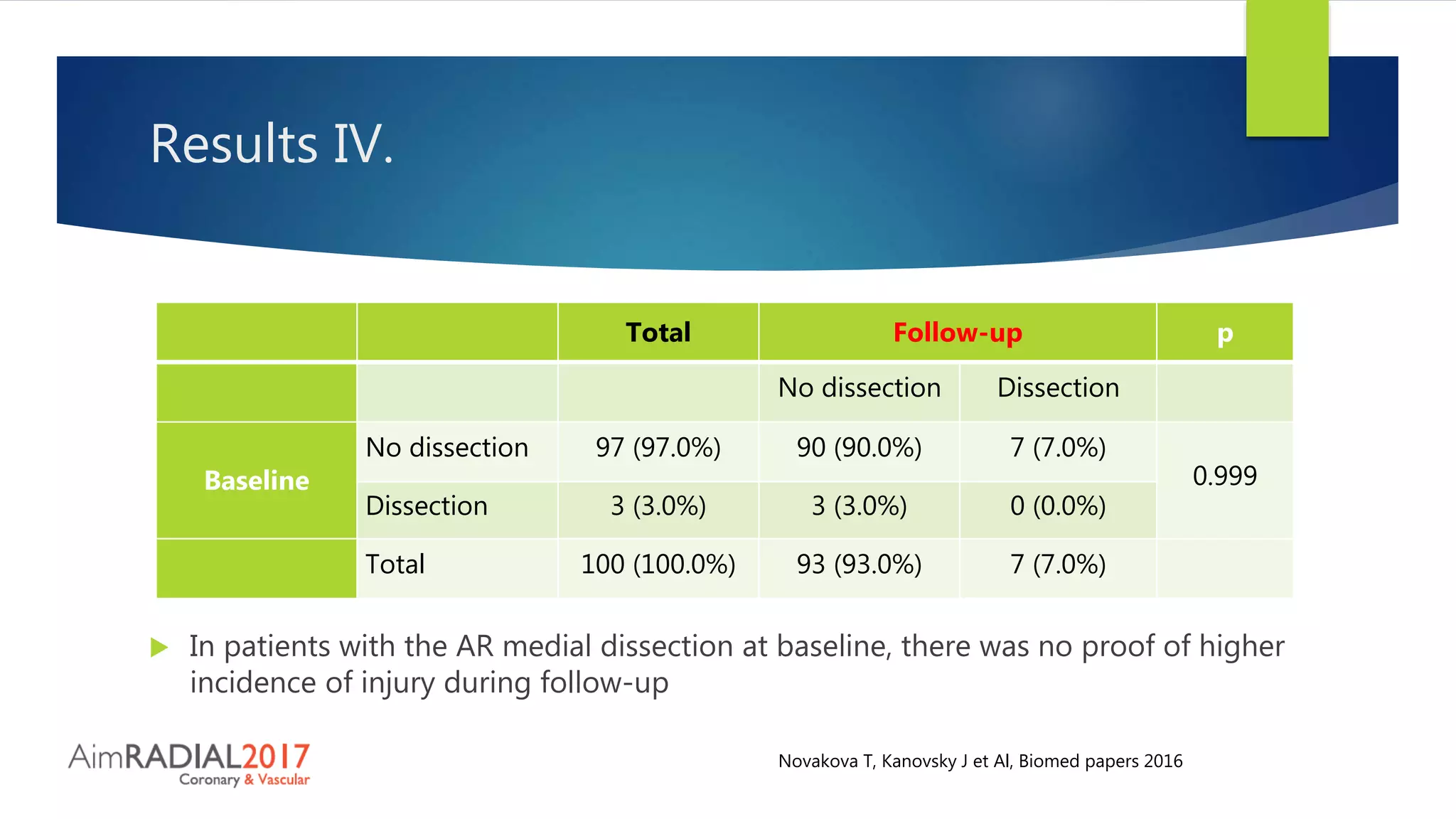
Results IV.
Total Follow-up p
No dissection Dissection
Baseline
No dissection 97 (97.0%) 90 (90.0%) 7 (7.0%)
0.999
Dissection 3 (3.0%) 3 (3.0%) 0 (0.0%)
Total 100 (100.0%) 93 (93.0%) 7 (7.0%)
 In patients with the AR medial dissection at baseline, there was no proof of higher
incidence of injury during follow-up
Novakova T, Kanovsky J et Al, Biomed papers 2016
Results V.
N
Radial artery injury1
pBaseline Follow-up
Total 100 11 (11.0%) 10 (10.0%) 0.999
Gender Man 67 8 (11.9%) 3 (4.5%) 0.227
Woman 33 3 (9.1%) 7 (21.2%) 0.219
p 0.999 0.014
Age < 60 32 3 (9.4%) 2 (6.3%) 0.999
60-69 38 2 (5.3%) 3 (7.9%) 0.999
≥ 70 30 6 (20.0%) 5 (16.7%) 0.999
p 0.158 0.448
BMI < 25 13 0 (0.0%) 4 (30.8%) 0.125
25-29 50 7 (14.0%) 5 (10.0%) 0.727
≥ 30 33 4 (12.1%) 0 (0.0%) 0.125
p 0.501 0.006
Hypertension Yes 68 7 (10.3%) 7 (10.3%) 0.999
No 32 4 (12.5%) 3 (9.4%) 0.999
p 0.741 0.999
Dyslipidemia Yes 34 3 (8.8%) 4 (11.8%) 0.999
No 66 8 (12.1%) 6 (9.1%) 0.774
p 0.745 0.731
Diabetes Yes 35 4 (11.4%) 4 (11.4%) 0.999
mellitus No 65 7 (10.8%) 6 (9.2%) 0.999
p 0.999 0.737
Peripheral Yes 4 1 (25.0%) 0 (0.0%) 0.999
vasculopathy No 96 10 (10.4%) 10 (10.4%) 0.999
p 0.377 0.999
Smoking Smoker 28 4 (14.3%) 3 (10.7%) 0.999
Former smoker 29 5 (17.2%) 1 (3.4%) 0.219
Never smoked 41 2 (4.9%) 6 (14.6%) 0.125
p 0.201 0.344
Alcohol ≥ 1 drink / week 15 2 (13.3%) 1 (6.7%) 0.999
addiction ≥ 1 drink / month 33 3 (9.1%) 3 (9.1%) 0.999
< 1 drink / month 50 6 (12.0%) 6 (12.0%) 0.999
p 0.913 0.999
Creatinine < 100 μmol/l 65 8 (12.3%) 6 (9.2%) 0.754
≥ 100 μmol/l 19 1 (5.3%) 3 (15.8%) 0.625
p 0.677 0.416
Novakova T, Kanovsky J et Al, Biomed papers 2016
Radial artery injury after PCI in literature
 Yonetsu (2010): 69 patients, sheath 16cm
 Intimal tears 67.1%
 Medial dissection 35.6%
 De Vito (2014): 51 patients, sheath 25cm
 Intimal tears 37.0%
 Medial dissection 9.8%
 PIIK IKK Brno 2016, sheath 7cm
 Intimal tears 8.0%
 Medial dissection 3.0%
 Repeated TRC:
 Intimal tears 3.0%
 Medial dissection 7.0%
 No clinical symptoms at all
Conclusions
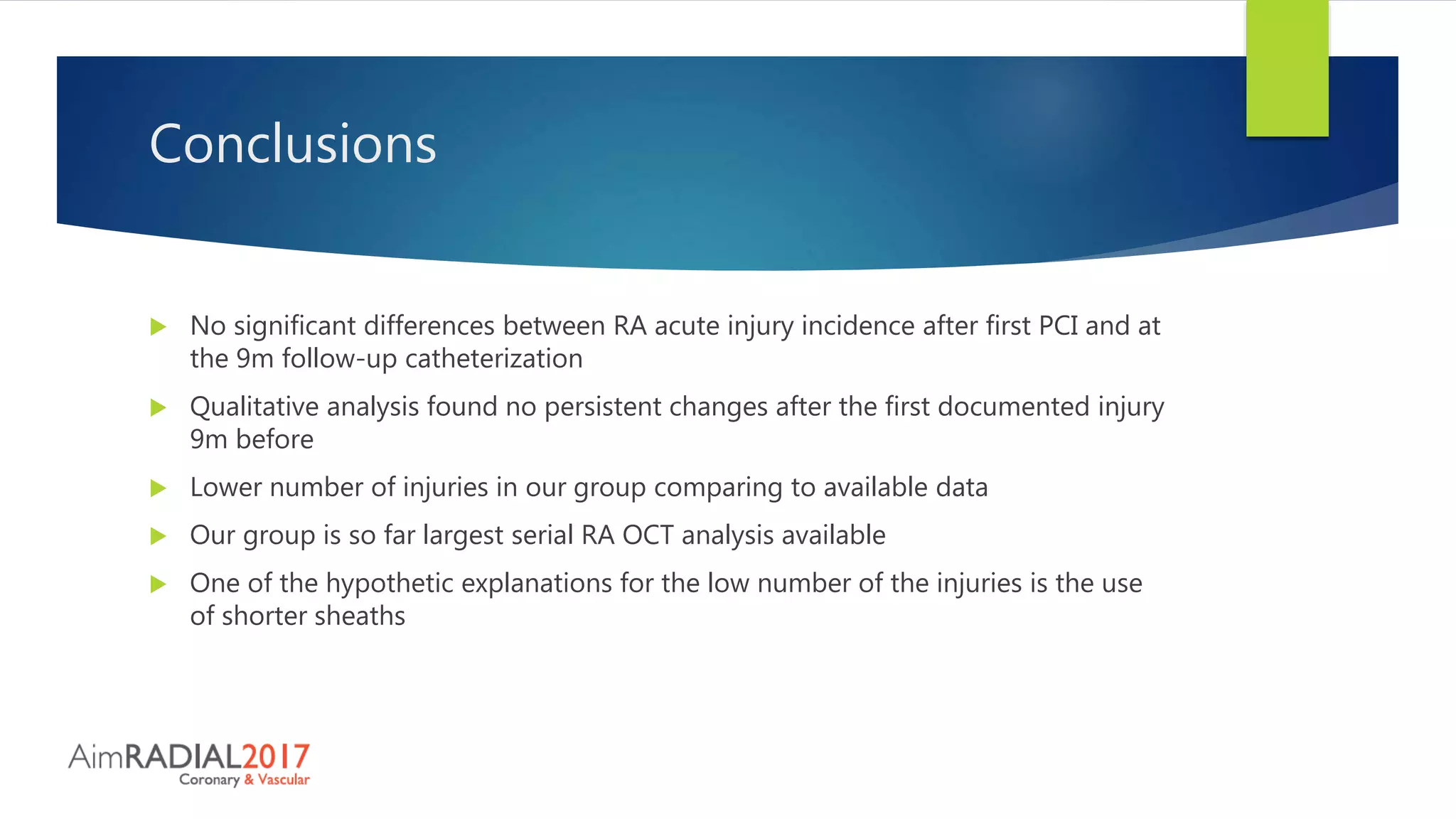
 No significant differences between RA acute injury incidence after first PCI and at
the 9m follow-up catheterization
 Qualitative analysis found no persistent changes after the first documented injury
9m before
 Lower number of injuries in our group comparing to available data
 Our group is so far largest serial RA OCT analysis available
 One of the hypothetic explanations for the low number of the injuries is the use
of shorter sheaths
Limitations
 No randomization trial for the sheath lenghts.
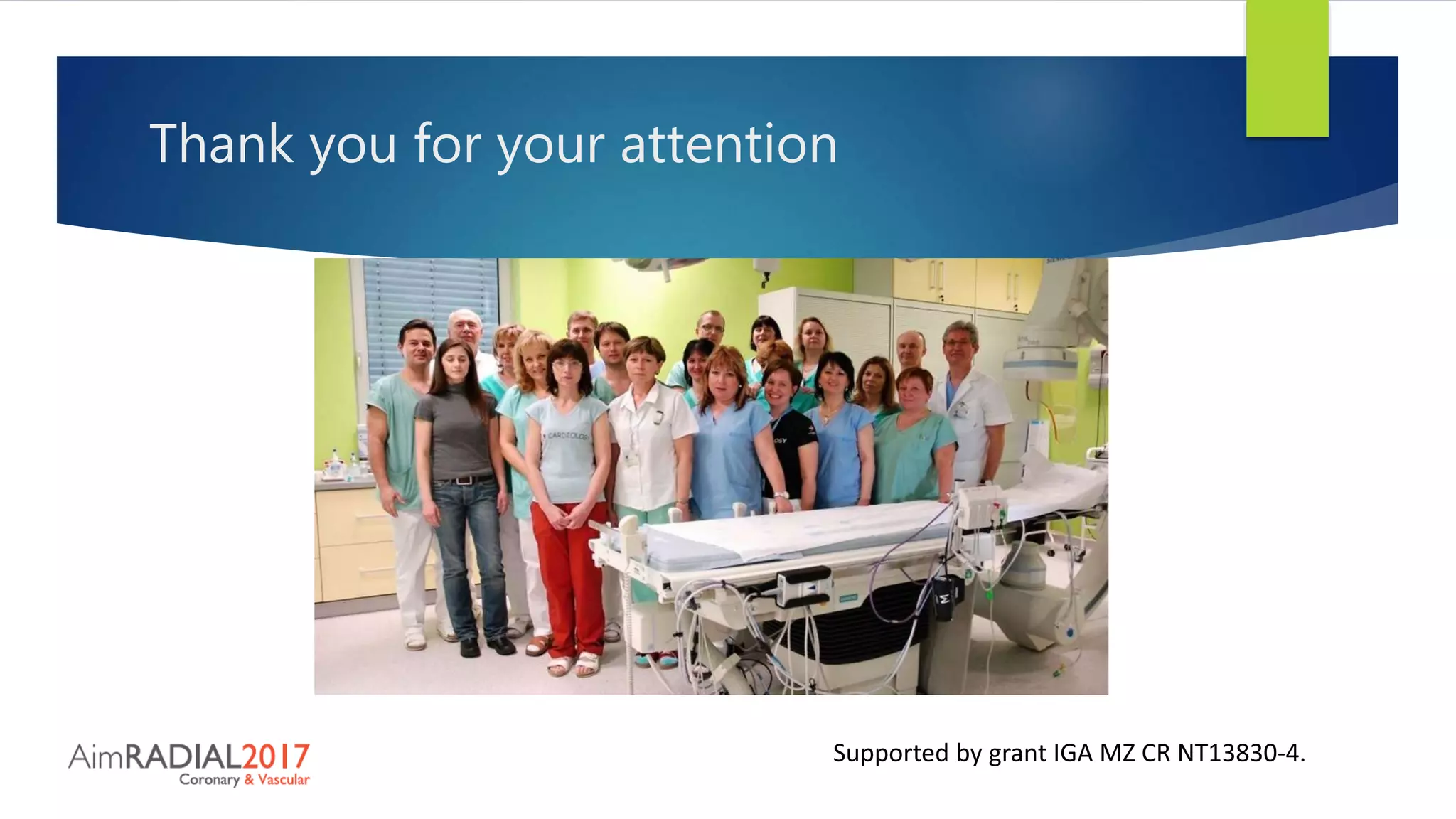
Thank you for your attention
Supported by grant IGA MZ CR NT13830-4.

11 Kanovsky aimradial20170922 OCT Serial study

  • 1.
    Short sheath benefitin radial artery injury after PCI – OCT serial study JAN KANOVSKY, MIKLIK R, NOVAKOVA T, PRYMKOVA L, POLOCZEK M, BOCEK O, JERABEK P, JARKOVSKÝ J., KALA P AIM RADIAL 2017 22 SEPTEMBER 2017, STUTTGART
  • 2.
  • 3.
    Lecture structure  Availabledata  Methodics, patients’ group  Results
  • 4.
    RA injury duringcoronary PCI evaluated by OCT  Yonetsu (2010): 69 patients, TD-OCT  Intimal tears 67.1%  Medial dissection 35.6%  De Vito (2014): 51 patients, FD-OCT  Intimal tears 37.0%  Medial dissection 9.8%
  • 5.
    Inclusion criteria  nSTEMIsiagnosis  first transradial cath (TRC) in pts lifetime  PCI performed as a part of the catheterization  signed IS
  • 6.
    Exclusion criteria  STEMI LM disease  renal insuffuciency - creat. over 150 umol/l (1.7mg/dl)  acute heart failure symptoms
  • 7.
    Patients’ group  102consecutive patients enrolled  2 patients excluded for the RAO at follow-up Characteristics N (%) or median (5th-95th percentile) Gender Man 67 (67.0%) Age (N = 100) 66.4 (45.0; 80.2) BMI (N = 96) 28.2 (23.1; 37.1) Hypertension 68 (68.0%) Dyslipidemia 34 (34.0%) Diabetes mellitus Yes 35 (35.0%) Periph. vasculopathy Yes 4 (4.0%) Smoking Smoker 28 (28.6%) Former smoker 29 (29.6%) Never smoked 41 (41.8%) Creatinine (μmol/l) (N = 84) 87.5 (52.0; 118.0)
  • 8.
    Methods I.  6FRadiofocus Introducer II kit (Terumo, JP), 7cm  Vessel vasodilatation (typically verapamil 2.5mg i.a.)  5F diagnostic, 6F guiding catheters
  • 9.
    Methods – OCTprotocol  Coronary guide in AR  Guiding catheter is retracted to the sheath under X-ray control  Sheath pulled back out of the artery for about 3 cm  OCT pullback 54mm, DragonFly Duo catheter (St.Jude)  Procedure repeated after 9months as a part of scheduled coronary cath
  • 10.
    OCT analysis  Offlinequalitative analysis  Two experienced analysts  Injury classified:  intimal tear  medial dissection  perforation  Serial evaluation
  • 11.
    A Intimal tear,B medial dissection, C perforation
  • 12.
    OCT of theradial artery
  • 13.
  • 14.
  • 15.
    Results I. Novakova T,Kanovsky J et Al, Biomed papers 2016
  • 16.
    Results II. N BaselineFollow-up p Total 100 11 (11.0%) 10 (10.0%) 0.999 Novakova T, Kanovsky J et Al, Biomed papers 2016
  • 17.
    Results III. Total Follow-upp No injury Injury Baseline No injury 89 (89.0%) 81 (81.0%) 8 (8.0%) 0.302 Injury 11 (11.0%) 9 (9.0%) 2 (2.0%) Total 100 (100.0%) 90 (90.0%) 10 (10.0%)  In pts. with AR injury at baseline there was no proof of higher incidence of the injuries at follow-up examination. Novakova T, Kanovsky J et Al, Biomed papers 2016
  • 18.
    Results IV. Total Follow-upp No dissection Dissection Baseline No dissection 97 (97.0%) 90 (90.0%) 7 (7.0%) 0.999 Dissection 3 (3.0%) 3 (3.0%) 0 (0.0%) Total 100 (100.0%) 93 (93.0%) 7 (7.0%)  In patients with the AR medial dissection at baseline, there was no proof of higher incidence of injury during follow-up Novakova T, Kanovsky J et Al, Biomed papers 2016
  • 19.
    Results V. N Radial arteryinjury1 pBaseline Follow-up Total 100 11 (11.0%) 10 (10.0%) 0.999 Gender Man 67 8 (11.9%) 3 (4.5%) 0.227 Woman 33 3 (9.1%) 7 (21.2%) 0.219 p 0.999 0.014 Age < 60 32 3 (9.4%) 2 (6.3%) 0.999 60-69 38 2 (5.3%) 3 (7.9%) 0.999 ≥ 70 30 6 (20.0%) 5 (16.7%) 0.999 p 0.158 0.448 BMI < 25 13 0 (0.0%) 4 (30.8%) 0.125 25-29 50 7 (14.0%) 5 (10.0%) 0.727 ≥ 30 33 4 (12.1%) 0 (0.0%) 0.125 p 0.501 0.006 Hypertension Yes 68 7 (10.3%) 7 (10.3%) 0.999 No 32 4 (12.5%) 3 (9.4%) 0.999 p 0.741 0.999 Dyslipidemia Yes 34 3 (8.8%) 4 (11.8%) 0.999 No 66 8 (12.1%) 6 (9.1%) 0.774 p 0.745 0.731 Diabetes Yes 35 4 (11.4%) 4 (11.4%) 0.999 mellitus No 65 7 (10.8%) 6 (9.2%) 0.999 p 0.999 0.737 Peripheral Yes 4 1 (25.0%) 0 (0.0%) 0.999 vasculopathy No 96 10 (10.4%) 10 (10.4%) 0.999 p 0.377 0.999 Smoking Smoker 28 4 (14.3%) 3 (10.7%) 0.999 Former smoker 29 5 (17.2%) 1 (3.4%) 0.219 Never smoked 41 2 (4.9%) 6 (14.6%) 0.125 p 0.201 0.344 Alcohol ≥ 1 drink / week 15 2 (13.3%) 1 (6.7%) 0.999 addiction ≥ 1 drink / month 33 3 (9.1%) 3 (9.1%) 0.999 < 1 drink / month 50 6 (12.0%) 6 (12.0%) 0.999 p 0.913 0.999 Creatinine < 100 μmol/l 65 8 (12.3%) 6 (9.2%) 0.754 ≥ 100 μmol/l 19 1 (5.3%) 3 (15.8%) 0.625 p 0.677 0.416 Novakova T, Kanovsky J et Al, Biomed papers 2016
  • 20.
    Radial artery injuryafter PCI in literature  Yonetsu (2010): 69 patients, sheath 16cm  Intimal tears 67.1%  Medial dissection 35.6%  De Vito (2014): 51 patients, sheath 25cm  Intimal tears 37.0%  Medial dissection 9.8%  PIIK IKK Brno 2016, sheath 7cm  Intimal tears 8.0%  Medial dissection 3.0%  Repeated TRC:  Intimal tears 3.0%  Medial dissection 7.0%  No clinical symptoms at all
  • 21.
    Conclusions  No significantdifferences between RA acute injury incidence after first PCI and at the 9m follow-up catheterization  Qualitative analysis found no persistent changes after the first documented injury 9m before  Lower number of injuries in our group comparing to available data  Our group is so far largest serial RA OCT analysis available  One of the hypothetic explanations for the low number of the injuries is the use of shorter sheaths
  • 22.
    Limitations  No randomizationtrial for the sheath lenghts.
  • 23.
    Thank you foryour attention Supported by grant IGA MZ CR NT13830-4.