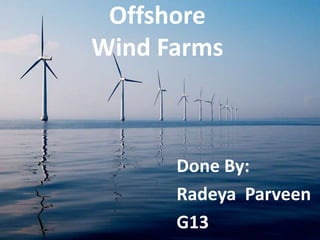
Offshore Wind FarmsDone By: RadeyaParveenG13
Executive Summary Background
Pro’s and Reasons for opposition to Offshore Wind Farms
Quotes from      the articleKey Takeaways
Discussion Time!BackgroundWhat are Offshore Wind Farms?   “Offshore wind power refers to the construction of wind farms in bodies of water to generate electricity from wind.”
Background In 2010, the first U.S. offshore wind farm was finally approved
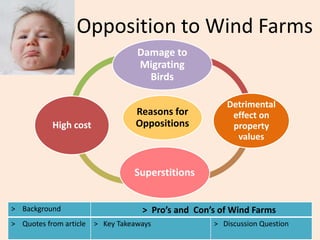
 The article discusses the reasons why there were oppositions  to the wind farms and how it eventually gained approval.Opposition to Wind Farms
Pro’s of Wind Farms
Interesting Quotes from the article“ tribes complained that the giant turbines would disturb spiritual sun greetings and possibly ancestral artifacts and burial grounds on the seabed.”
Key Takeaway Offshore Wind Farms help fight climate change and has a huge potential as it is a renewable energy source New energy trend for countries?

Radeya Parveen

Editor's Notes

  • #4 What are wind mills? A power plant that uses windmills or wind turbines to generate electricity.
  • #5 In 2010,  The first U.S. offshore wind farm, a giant project 5 miles/8 km off the Massachusetts coast was finally approved,  after years of opposition involving everyone from local tribes to the Kennedy family was approved by U.S. Interior Secretary Ken Salazar. Although small in terms of its production -- the facility would produce enough electricity to power 400,000 houses -- its approval was encouraging to other offshore wind projects already proposed for the East Coast and Great Lakes. Construction is expected to begin before the end of the year and Power generation could begin by 2012. The article discusses the reasons why there were oppositions to the windfarms and how it eventually gained approval. Lets now see what were the reasons why there was opposition to the windfarms.
  • #8 Superstitions:A final ruling was near in 2009, but delayed again after two Wampanoag Indian tribes complained that the giant turbines would disturb spiritual sun greetings and possibly ancestral artifacts and burial grounds on the seabed.