CUSTOMER VALUE
OPTIMIZATION
Framework as a Service
UNLOCKING THE VALUE OF
YOUR CUSTOMERS
RADAR
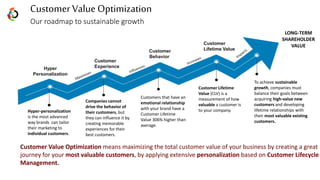
Customer ValueOptimization
Our roadmap to sustainable growth
LONG-TERM
SHAREHOLDER
VALUE
Hyper
Personalization
Customer
Lifetime Value
Customer
Experience
To achieve sustainable
growth, companies must
balance their goals between
acquiring high-value new
customers and developing
lifetime relationships with
their most valuable existing
customers.
Customer Lifetime
Value (CLV) is a
measurement of how
valuable a customer is
to your company.
Companies cannot
drive the behavior of
their customers, but
they can influence it by
creating memorable
experiences for their
best customers.
Hyper-personalization
is the most advanced
way brands can tailor
their marketing to
individual customers.
Customers that have an
emotional relationship
with your brand have a
Customer Lifetime
Value 306% higher than
average.
Customer
Behavior
Customer Value Optimization means maximizing the total customer value of your business by creating a great
journey for your most valuable customers, by applying extensive personalization based on Customer Lifecycle
Management.
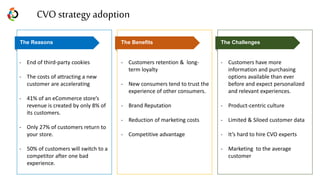
The Reasons The Benefits The Challenges
- End of third-party cookies
- The costs of attracting a new
customer are accelerating
- 41% of an eCommerce store’s
revenue is created by only 8% of
its customers.
- Only 27% of customers return to
your store.
- 50% of customers will switch to a
competitor after one bad
experience.
- Customers retention & long-
term loyalty
- New consumers tend to trust the
experience of other consumers.
- Brand Reputation
- Reduction of marketing costs
- Competitive advantage
CVO strategy adoption
- Customers have more
information and purchasing
options available than ever
before and expect personalized
and relevant experiences.
- Product-centric culture
- Limited & Siloed customer data
- It’s hard to hire CVO experts
- Marketing to the average
customer
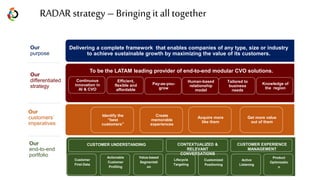
Our
customers’
imperatives
Our
end-to-end
portfolio
Delivering a complete framework that enables companies of any type, size or industry
to achieve sustainable growth by maximizing the value of its customers.
Our
purpose
Our
differentiated
strategy
Human-based
relationship
model
Efficient,
flexible and
affordable
Continuous
innovation in
AI & CVO
To be the LATAM leading provider of end-to-end modular CVO solutions.
RADAR strategy – Bringingit all together
Customer
First-Data
Tailored to
business
needs
Knowledge of
the region
Actionable
Customer
Profiling
Value-based
Segmentati
on
Lifecycle
Targeting
Customized
Positioning
Active
Listening
Product
Optimizatio
n
Identify the
“best
customers”
Create
memorable
experiences
Acquire more
like them
Get more value
out of them
Pay-as-you-
grow
CUSTOMER UNDERSTANDING CONTEXTUALIZED &
RELEVANT
CONVERSATIONS
CUSTOMER EXPERIENCE
MANAGEMENT
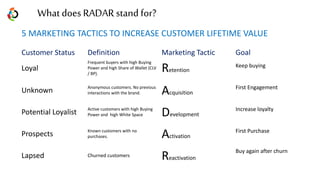
Customer Status Definition Marketing Tactic Goal
Loyal
Frequent buyers with high Buying
Power and high Share of Wallet (CLV
/ BP).
Retention
Keep buying
5 MARKETING TACTICS TO INCREASE CUSTOMER LIFETIME VALUE
What does RADAR stand for?
Unknown Anonymous customers. No previous
interactions with the brand. Acquisition
First Engagement
Potential Loyalist Active customers with high Buying
Power and high White Space Development
Increase loyalty
Prospects Known customers with no
purchases. Activation
First Purchase
Lapsed Churned customers
Reactivation
Buy again after churn
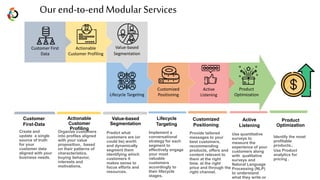
Product
Optimization
Active
Listening
Customized
Positioning
Customer
First-Data
Create and
update a single
source of truth
for your
customer data
aligned with your
business needs.
Actionable
Customer
Profiling
Organize customers
into profiles aligned
with your value
proposition, based
on their patterns of
characteristics,
buying behavior,
interests and
motivations.
Value-based
Segmentation
Predict what
customers are (or
could be) worth
and dynamically
segment them
identifying which
customers it
makes sense to
focus efforts and
resources.
Lifecycle
Targeting
Implement a
conversational
strategy for each
segment to
effectively engage
your most
valuable
customers
accordingly to
their lifecycle
stages.
Customized
Positioning
Provide tailored
messages to your
best customers,
recommending
products, offers and
content relevant to
them at the right
time, at the right
price and through the
right channel.
Active
Listening
Use quantitative
surveys to
measure the
experience of your
customers along
with qualitative
surveys and
Natural Language
Processing (NLP)
to understand
what they write or
Lifecycle Targeting
Value-based
Segmentation
Actionable
Customer Profiling
Customer First
Data
Product
Optimization
Identify the most
profitable
products..
Use Product
analytics for
pricing .
Our end-to-endModularServices
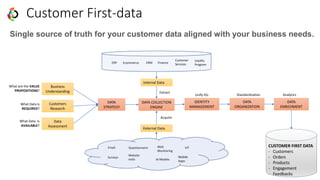
Customer First-data
Business
Understanding
Data
Assessment
Customers
Research
DATA
STRATEGY
DATA COLLECTION
ENGINE
External Data
Internal Data
Extract
Acquire
What are the VALUE
PROPOSITIONS?
What Data is
AVAILABLE?
What Data is
REQUIRED?
IDENTITY
MANAGEMENT
Unify IDs
DATA
ORGANIZATION
Standardization
DATA
ENRICHMENT
Analytics
ERP Ecommerce CRM Finance
Customer
Services
Email
Surveys
Questionnaire Web
Monitoring
Website
visits AI Models
IoT CUSTOMER FIRST DATA
- Customers
- Orders
- Products
- Engagement
- Feedbacks
Mobile
Apps
Loyalty
Program
Single source of truth for your customer data aligned with your business needs.
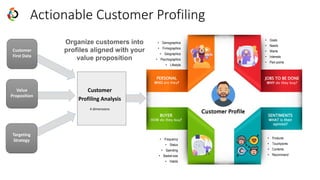
Actionable Customer Profiling
Customer Profile
BUYER
HOW do they buy?
• Frequency
• Status
• Spending
• Basket size
• Habits
• Products
• Touchpoints
• Contents
• Recommend
• Demographics
• Firmographics
• Geographics
• Psychographics
• Lifestyle
PERSONAL
WHO are they?
JOBS TO BE DONE
WHY do they buy?
SENTIMENTS
WHAT is their
opinion?
• Goals
• Needs
• Wants
• Interests
• Pain points
Customer
First Data
Value
Proposition
Targeting
Strategy
Customer
Profiling Analysis
4 dimensions
Organize customers into
profiles aligned with your
value proposition
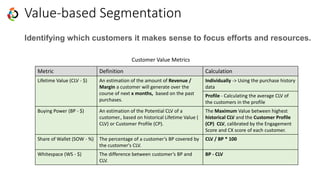
Value-based Segmentation
Metric Definition Calculation
Lifetime Value (CLV - $) An estimation of the amount of Revenue /
Margin a customer will generate over the
course of next x months, based on the past
purchases.
Individually -> Using the purchase history
data
Profile - Calculating the average CLV of
the customers in the profile
Buying Power (BP - $) An estimation of the Potential CLV of a
customer., based on historical Lifetime Value (
CLV) or Customer Profile (CP).
The Maximum Value between highest
historical CLV and the Customer Profile
(CP) CLV, calibrated by the Engagement
Score and CX score of each customer.
Share of Wallet (SOW - %) The percentage of a customer’s BP covered by
the customer's CLV.
CLV / BP * 100
Whitespace (WS - $) The difference between customer’s BP and
CLV.
BP - CLV
Customer Value Metrics
Identifying which customers it makes sense to focus efforts and resources.
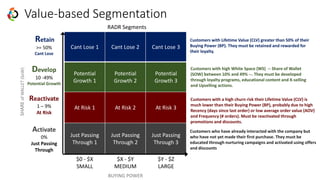
Value-based Segmentation
Retain
>= 50%
Cant Lose
Cant Lose 1 Cant Lose 2 Cant Lose 3
Develop
10 -49%
Potential Growth
Potential
Growth 1
Potential
Growth 2
Potential
Growth 3
Reactivate
1 – 9%
At Risk
At Risk 1 At Risk 2 At Risk 3
Activate
0%
Just Passing
Through
Just Passing
Through 1
Just Passing
Through 2
Just Passing
Through 3
$0 - $X
SMALL
$X - $Y
MEDIUM
$Y - $Z
LARGE
SHARE
of
WALLET
(SoW)
BUYING POWER
RADR Segments
Customers with Lifetime Value (CLV) greater than 50% of their
Buying Power (BP). They must be retained and rewarded for
their loyalty.
Customers with high White Space (WS) -- Share of Wallet
(SOW) between 10% and 49% --. They must be developed
through loyalty programs, educational content and X-selling
and Upselling actions.
Customers with a high churn risk their Lifetime Value (CLV) is
much lower than their Buying Power (BP), probably due to high
Recency (days since last order) or low average order value (AOV)
and Frequency (# orders). Must be reactivated through
promotions and discounts.
Customers who have already interacted with the company but
who have not yet made their first purchase. They must be
educated through nurturing campaigns and activated using offers
and discounts
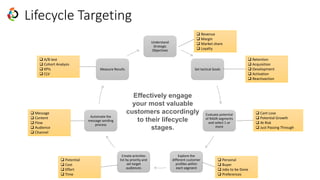
Lifecycle Targeting
Understand
Strategic
Objectives
Set tactical Goals
Evaluate potential
of RADR segments
and select 1 or
more
Explore the
different customer
profiles within
each segment
Create activities
list by priority and
set target
audiences
Automate the
message sending
process
Measure Results
 Revenue
 Margin
 Market share
 Loyalty
 Retention
 Acquisition
 Development
 Activation
 Reactivaction
 Cant Lose
 Potential Growth
 At Risk
 Just Passing Through
 Personal
 Buyer
 Jobs to be Done
 Preferences
 Potential
 Cost
 Effort
 Time
 A/B test
 Cohort Analysis
 KPIs
 CLV
 Message
 Content
 Flow
 Audience
 Channel
Effectively engage
your most valuable
customers accordingly
to their lifecycle
stages.
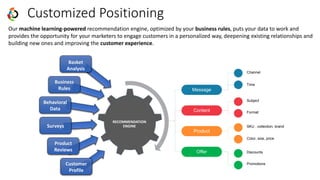
Customized Positioning
Our machine learning-powered recommendation engine, optimized by your business rules, puts your data to work and
provides the opportunity for your marketers to engage customers in a personalized way, deepening existing relationships and
building new ones and improving the customer experience.
Message
Content
Product
Offer
Channel
Subject
Format
SKU , collection, brand
Color, size, price
Promotions
Time
Discounts
RECOMMENDATION
ENGINE
Basket
Analysis
Customer
Profile
Product
Reviews
Surveys
Behavioral
Data
Business
Rules
NPS
CES
CSAT
Product Rating
Closed-ended
Open -ended
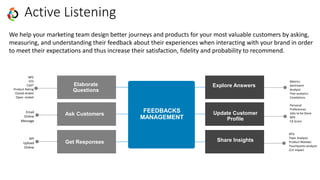
Elaborate
Questions
FEEDBACKS
MANAGEMENT
Active Listening
We help your marketing team design better journeys and products for your most valuable customers by asking,
measuring, and understanding their feedback about their experiences when interacting with your brand in order
to meet their expectations and thus increase their satisfaction, fidelity and probability to recommend.
Ask Customers
Get Responses
Explore Answers
Update Customer
Profile
Share Insights
Email
Online
Message
API
Upload
Online
Metrics
Sentiment
Analysis
Text analytics
Corelations
Personal
Preferences
Jobs to be Done
NPS
CX Score
KPIs
Topic Analysis
Product Reviews
Touchpoints analysis
CLV impact
UNLOCKING THE VALUE
OF YOUR CUSTOMERS
RADAR

RADAR - Customer Value Optimization as a Service v2.pptx

  • 1.
    CUSTOMER VALUE OPTIMIZATION Framework asa Service UNLOCKING THE VALUE OF YOUR CUSTOMERS RADAR
  • 2.
    Customer ValueOptimization Our roadmapto sustainable growth LONG-TERM SHAREHOLDER VALUE Hyper Personalization Customer Lifetime Value Customer Experience To achieve sustainable growth, companies must balance their goals between acquiring high-value new customers and developing lifetime relationships with their most valuable existing customers. Customer Lifetime Value (CLV) is a measurement of how valuable a customer is to your company. Companies cannot drive the behavior of their customers, but they can influence it by creating memorable experiences for their best customers. Hyper-personalization is the most advanced way brands can tailor their marketing to individual customers. Customers that have an emotional relationship with your brand have a Customer Lifetime Value 306% higher than average. Customer Behavior Customer Value Optimization means maximizing the total customer value of your business by creating a great journey for your most valuable customers, by applying extensive personalization based on Customer Lifecycle Management.
  • 3.
    The Reasons TheBenefits The Challenges - End of third-party cookies - The costs of attracting a new customer are accelerating - 41% of an eCommerce store’s revenue is created by only 8% of its customers. - Only 27% of customers return to your store. - 50% of customers will switch to a competitor after one bad experience. - Customers retention & long- term loyalty - New consumers tend to trust the experience of other consumers. - Brand Reputation - Reduction of marketing costs - Competitive advantage CVO strategy adoption - Customers have more information and purchasing options available than ever before and expect personalized and relevant experiences. - Product-centric culture - Limited & Siloed customer data - It’s hard to hire CVO experts - Marketing to the average customer
  • 4.
    Our customers’ imperatives Our end-to-end portfolio Delivering a completeframework that enables companies of any type, size or industry to achieve sustainable growth by maximizing the value of its customers. Our purpose Our differentiated strategy Human-based relationship model Efficient, flexible and affordable Continuous innovation in AI & CVO To be the LATAM leading provider of end-to-end modular CVO solutions. RADAR strategy – Bringingit all together Customer First-Data Tailored to business needs Knowledge of the region Actionable Customer Profiling Value-based Segmentati on Lifecycle Targeting Customized Positioning Active Listening Product Optimizatio n Identify the “best customers” Create memorable experiences Acquire more like them Get more value out of them Pay-as-you- grow CUSTOMER UNDERSTANDING CONTEXTUALIZED & RELEVANT CONVERSATIONS CUSTOMER EXPERIENCE MANAGEMENT
  • 5.
    Customer Status DefinitionMarketing Tactic Goal Loyal Frequent buyers with high Buying Power and high Share of Wallet (CLV / BP). Retention Keep buying 5 MARKETING TACTICS TO INCREASE CUSTOMER LIFETIME VALUE What does RADAR stand for? Unknown Anonymous customers. No previous interactions with the brand. Acquisition First Engagement Potential Loyalist Active customers with high Buying Power and high White Space Development Increase loyalty Prospects Known customers with no purchases. Activation First Purchase Lapsed Churned customers Reactivation Buy again after churn
  • 6.
    Product Optimization Active Listening Customized Positioning Customer First-Data Create and update asingle source of truth for your customer data aligned with your business needs. Actionable Customer Profiling Organize customers into profiles aligned with your value proposition, based on their patterns of characteristics, buying behavior, interests and motivations. Value-based Segmentation Predict what customers are (or could be) worth and dynamically segment them identifying which customers it makes sense to focus efforts and resources. Lifecycle Targeting Implement a conversational strategy for each segment to effectively engage your most valuable customers accordingly to their lifecycle stages. Customized Positioning Provide tailored messages to your best customers, recommending products, offers and content relevant to them at the right time, at the right price and through the right channel. Active Listening Use quantitative surveys to measure the experience of your customers along with qualitative surveys and Natural Language Processing (NLP) to understand what they write or Lifecycle Targeting Value-based Segmentation Actionable Customer Profiling Customer First Data Product Optimization Identify the most profitable products.. Use Product analytics for pricing . Our end-to-endModularServices
  • 7.
    Customer First-data Business Understanding Data Assessment Customers Research DATA STRATEGY DATA COLLECTION ENGINE ExternalData Internal Data Extract Acquire What are the VALUE PROPOSITIONS? What Data is AVAILABLE? What Data is REQUIRED? IDENTITY MANAGEMENT Unify IDs DATA ORGANIZATION Standardization DATA ENRICHMENT Analytics ERP Ecommerce CRM Finance Customer Services Email Surveys Questionnaire Web Monitoring Website visits AI Models IoT CUSTOMER FIRST DATA - Customers - Orders - Products - Engagement - Feedbacks Mobile Apps Loyalty Program Single source of truth for your customer data aligned with your business needs.
  • 8.
    Actionable Customer Profiling CustomerProfile BUYER HOW do they buy? • Frequency • Status • Spending • Basket size • Habits • Products • Touchpoints • Contents • Recommend • Demographics • Firmographics • Geographics • Psychographics • Lifestyle PERSONAL WHO are they? JOBS TO BE DONE WHY do they buy? SENTIMENTS WHAT is their opinion? • Goals • Needs • Wants • Interests • Pain points Customer First Data Value Proposition Targeting Strategy Customer Profiling Analysis 4 dimensions Organize customers into profiles aligned with your value proposition
  • 9.
    Value-based Segmentation Metric DefinitionCalculation Lifetime Value (CLV - $) An estimation of the amount of Revenue / Margin a customer will generate over the course of next x months, based on the past purchases. Individually -> Using the purchase history data Profile - Calculating the average CLV of the customers in the profile Buying Power (BP - $) An estimation of the Potential CLV of a customer., based on historical Lifetime Value ( CLV) or Customer Profile (CP). The Maximum Value between highest historical CLV and the Customer Profile (CP) CLV, calibrated by the Engagement Score and CX score of each customer. Share of Wallet (SOW - %) The percentage of a customer’s BP covered by the customer's CLV. CLV / BP * 100 Whitespace (WS - $) The difference between customer’s BP and CLV. BP - CLV Customer Value Metrics Identifying which customers it makes sense to focus efforts and resources.
  • 10.
    Value-based Segmentation Retain >= 50% CantLose Cant Lose 1 Cant Lose 2 Cant Lose 3 Develop 10 -49% Potential Growth Potential Growth 1 Potential Growth 2 Potential Growth 3 Reactivate 1 – 9% At Risk At Risk 1 At Risk 2 At Risk 3 Activate 0% Just Passing Through Just Passing Through 1 Just Passing Through 2 Just Passing Through 3 $0 - $X SMALL $X - $Y MEDIUM $Y - $Z LARGE SHARE of WALLET (SoW) BUYING POWER RADR Segments Customers with Lifetime Value (CLV) greater than 50% of their Buying Power (BP). They must be retained and rewarded for their loyalty. Customers with high White Space (WS) -- Share of Wallet (SOW) between 10% and 49% --. They must be developed through loyalty programs, educational content and X-selling and Upselling actions. Customers with a high churn risk their Lifetime Value (CLV) is much lower than their Buying Power (BP), probably due to high Recency (days since last order) or low average order value (AOV) and Frequency (# orders). Must be reactivated through promotions and discounts. Customers who have already interacted with the company but who have not yet made their first purchase. They must be educated through nurturing campaigns and activated using offers and discounts
  • 11.
    Lifecycle Targeting Understand Strategic Objectives Set tacticalGoals Evaluate potential of RADR segments and select 1 or more Explore the different customer profiles within each segment Create activities list by priority and set target audiences Automate the message sending process Measure Results  Revenue  Margin  Market share  Loyalty  Retention  Acquisition  Development  Activation  Reactivaction  Cant Lose  Potential Growth  At Risk  Just Passing Through  Personal  Buyer  Jobs to be Done  Preferences  Potential  Cost  Effort  Time  A/B test  Cohort Analysis  KPIs  CLV  Message  Content  Flow  Audience  Channel Effectively engage your most valuable customers accordingly to their lifecycle stages.
  • 12.
    Customized Positioning Our machinelearning-powered recommendation engine, optimized by your business rules, puts your data to work and provides the opportunity for your marketers to engage customers in a personalized way, deepening existing relationships and building new ones and improving the customer experience. Message Content Product Offer Channel Subject Format SKU , collection, brand Color, size, price Promotions Time Discounts RECOMMENDATION ENGINE Basket Analysis Customer Profile Product Reviews Surveys Behavioral Data Business Rules
  • 13.
    NPS CES CSAT Product Rating Closed-ended Open -ended Elaborate Questions FEEDBACKS MANAGEMENT ActiveListening We help your marketing team design better journeys and products for your most valuable customers by asking, measuring, and understanding their feedback about their experiences when interacting with your brand in order to meet their expectations and thus increase their satisfaction, fidelity and probability to recommend. Ask Customers Get Responses Explore Answers Update Customer Profile Share Insights Email Online Message API Upload Online Metrics Sentiment Analysis Text analytics Corelations Personal Preferences Jobs to be Done NPS CX Score KPIs Topic Analysis Product Reviews Touchpoints analysis CLV impact
  • 14.
    UNLOCKING THE VALUE OFYOUR CUSTOMERS RADAR