Radar Basics
- Primary radar is very simple in principle
- However:
- high RF-energy is needed
- useful signals (echo or return) are very small
- interferences are very large
- useful signals contain significant information
- analysis and signal processing is quite complex
Simple in Concept – Complex in Reality
RAdio Detection And Ranging
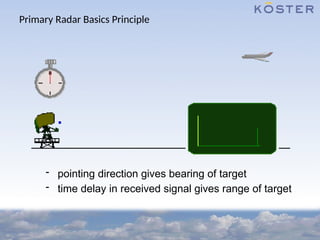
Primary Radar Basics Principle
- pointing direction gives bearing of target
- time delay in received signal gives range of target
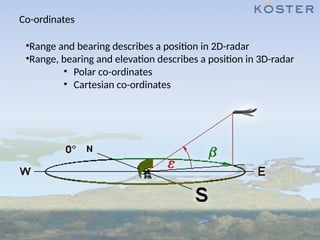
Co-ordinates
•Range and bearing describes a position in 2D-radar
•Range, bearing and elevation describes a position in 3D-radar
• Polar co-ordinates
• Cartesian co-ordinates
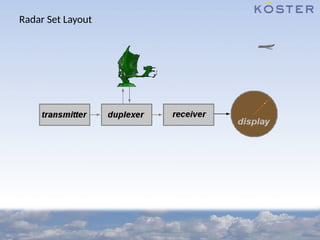
Radar Set Layout
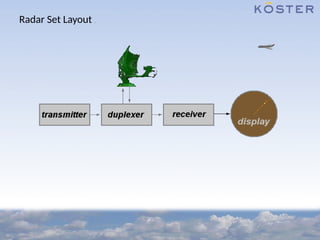
Radar Set Layout (animated)
RADAR types
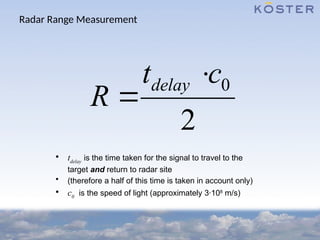
Radar Range Measurement
• tdelay
is the time taken for the signal to travel to the
target and return to radar site
• (therefore a half of this time is taken in account only)
• c0
is the speed of light (approximately 3·108
m/s)
0
2
delay
t c
R


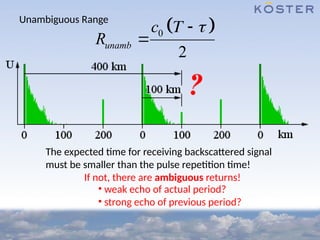
Unambiguous Range
The expected time for receiving backscattered signal
must be smaller than the pulse repetition time!
If not, there are ambiguous returns!
• weak echo of actual period?
• strong echo of previous period?
 
0
2
unamb
c
R
 


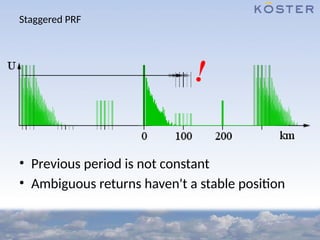
Staggered PRF
• Previous period is not constant
• Ambiguous returns haven't a stable position
Ambiguous return on PPI
• Staggered PRT: ambiguous return is dotted:
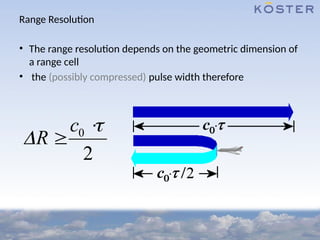
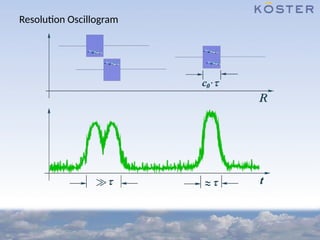
Range Resolution
• The range resolution depends on the geometric dimension of
a range cell
• the (possibly compressed) pulse width therefore
0
2
c
R




Resolution Oscillogram
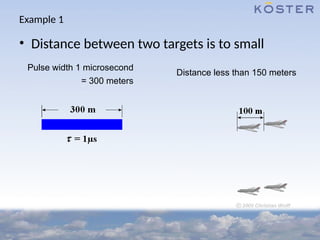
Example 1
• Distance between two targets is to small
Pulse width 1 microsecond
= 300 meters
Distance less than 150 meters
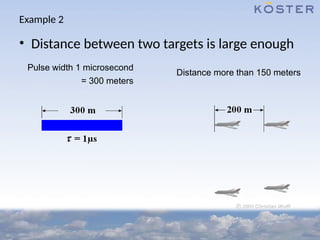
Example 2
• Distance between two targets is large enough
Pulse width 1 microsecond
= 300 meters
Distance more than 150 meters
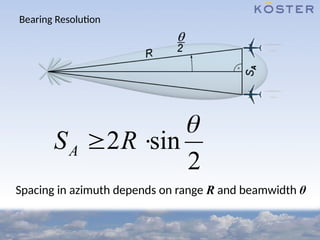
Bearing Resolution
2 sin
2
A
S R

 
Spacing in azimuth depends on range R and beamwidth θ
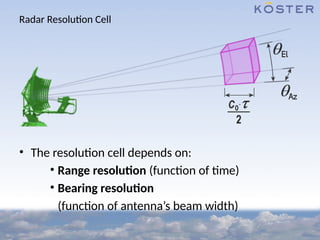
Radar Resolution Cell
• The resolution cell depends on:
• Range resolution (function of time)
• Bearing resolution
(function of antenna’s beam width)
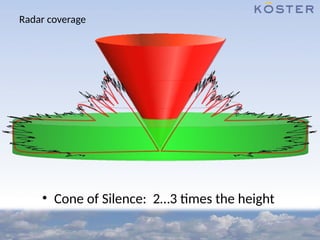
Radar coverage
• Cone of Silence: 2…3 times the height
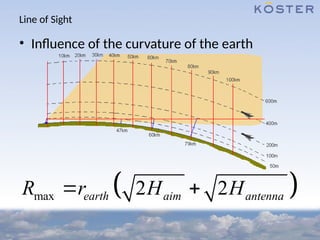
• Influence of the curvature of the earth
Line of Sight
 
max 2 2
earth aim antenna
R r H H
 
• Influence of refraction
Radar Horizon
 
 
max aim antenna
max aim antenna
[km] ( in Meters)
[NM] ( in Feet)
4.12
1.23
H
H
R H H
R H H
 
 
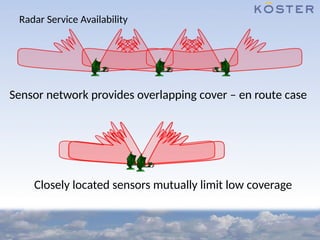
Radar Service Availability
Sensor network provides overlapping cover – en route case
Closely located sensors mutually limit low coverage
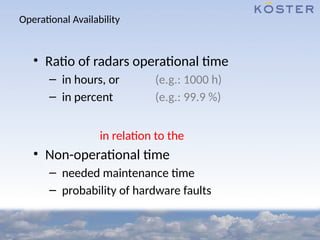
Operational Availability
• Ratio of radars operational time
– in hours, or (e.g.: 1000 h)
– in percent (e.g.: 99.9 %)
in relation to the
• Non-operational time
– needed maintenance time
– probability of hardware faults
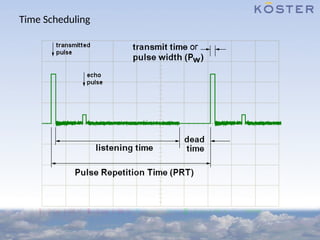
Time Scheduling
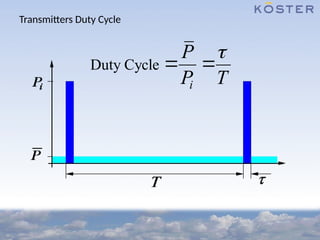
Transmitters Duty Cycle
Duty Cycle
i
P
P T

 
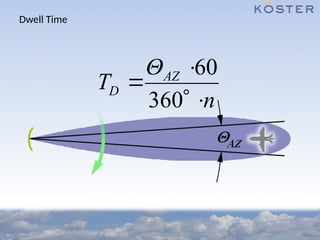
Dwell Time
60
360
AZ
D
T
n
 

 
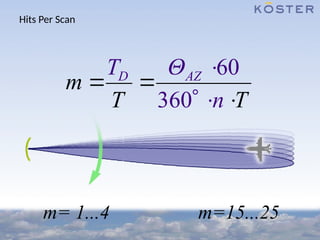
Hits Per Scan
60
360
D AZ
m
T
n
T T
 
 
 

m= 1...4 m=15...25

Radar Basics mainly cfar for target .pptx

  • 1.
    Radar Basics - Primaryradar is very simple in principle - However: - high RF-energy is needed - useful signals (echo or return) are very small - interferences are very large - useful signals contain significant information - analysis and signal processing is quite complex Simple in Concept – Complex in Reality RAdio Detection And Ranging
  • 2.
    Primary Radar BasicsPrinciple - pointing direction gives bearing of target - time delay in received signal gives range of target
  • 3.
    Co-ordinates •Range and bearingdescribes a position in 2D-radar •Range, bearing and elevation describes a position in 3D-radar • Polar co-ordinates • Cartesian co-ordinates
  • 4.
  • 5.
    Radar Set Layout(animated)
  • 6.
  • 7.
    Radar Range Measurement •tdelay is the time taken for the signal to travel to the target and return to radar site • (therefore a half of this time is taken in account only) • c0 is the speed of light (approximately 3·108 m/s) 0 2 delay t c R  
  • 8.
    Unambiguous Range The expectedtime for receiving backscattered signal must be smaller than the pulse repetition time! If not, there are ambiguous returns! • weak echo of actual period? • strong echo of previous period?   0 2 unamb c R    
  • 9.
    Staggered PRF • Previousperiod is not constant • Ambiguous returns haven't a stable position
  • 10.
    Ambiguous return onPPI • Staggered PRT: ambiguous return is dotted:
  • 11.
    Range Resolution • Therange resolution depends on the geometric dimension of a range cell • the (possibly compressed) pulse width therefore 0 2 c R    
  • 12.
  • 13.
    Example 1 • Distancebetween two targets is to small Pulse width 1 microsecond = 300 meters Distance less than 150 meters
  • 14.
    Example 2 • Distancebetween two targets is large enough Pulse width 1 microsecond = 300 meters Distance more than 150 meters
  • 15.
    Bearing Resolution 2 sin 2 A SR    Spacing in azimuth depends on range R and beamwidth θ
  • 16.
    Radar Resolution Cell •The resolution cell depends on: • Range resolution (function of time) • Bearing resolution (function of antenna’s beam width)
  • 17.
    Radar coverage • Coneof Silence: 2…3 times the height
  • 18.
    • Influence ofthe curvature of the earth Line of Sight   max 2 2 earth aim antenna R r H H  
  • 19.
    • Influence ofrefraction Radar Horizon     max aim antenna max aim antenna [km] ( in Meters) [NM] ( in Feet) 4.12 1.23 H H R H H R H H    
  • 20.
    Radar Service Availability Sensornetwork provides overlapping cover – en route case Closely located sensors mutually limit low coverage
  • 21.
    Operational Availability • Ratioof radars operational time – in hours, or (e.g.: 1000 h) – in percent (e.g.: 99.9 %) in relation to the • Non-operational time – needed maintenance time – probability of hardware faults
  • 22.
  • 23.
    Transmitters Duty Cycle DutyCycle i P P T   
  • 24.
  • 25.
    Hits Per Scan 60 360 DAZ m T n T T        m= 1...4 m=15...25

Editor's Notes

  • #1 The emphasis is on primary radars for Air Traffic Control applications although the principles apply to most types of surveillance radar, including basic aspects of secondary radar systems. The time schedule is slightly shortened to get more time for practical exercises on the Didactical Primary Radar. The general objectives and single topics of the course are recommended by EUROCONTROL for personal training of Air Traffic Safety Electronics Personnel (EUROCONTROL Specification for ATSEP CCC Initial Training, annex 4, page 7) Alle Rechte vorbehalten. All rights reserved! Diese Präsentation ist Teil eines Vortrages von Dipl.- Ing. (FH) Christian Wolff im Rahmen der Präsentation des Didactical Primary Radar. Es nutzt als Inhaltsvorgabe die Empfehlungen von EUROCONTROL für die Ausbildung von Flugsicherungspersonal. © 2010 Christian Wolff