Access, Equity &
Integrity:
Reaching students who are
still underserved
2015 National Partnership for Educational Access (NPEA) conference,
Improving Outcomes: 360° Perspectives on Educational Access.
Hess & Rachkoskie
Our time together
• Who we are.
• Who are you?
• Interactive Information
• Current & Standard Best Practices and
Programs
• Innovative Strategies and Programs
Getting to know each other!
What do we mean by “underserved”?
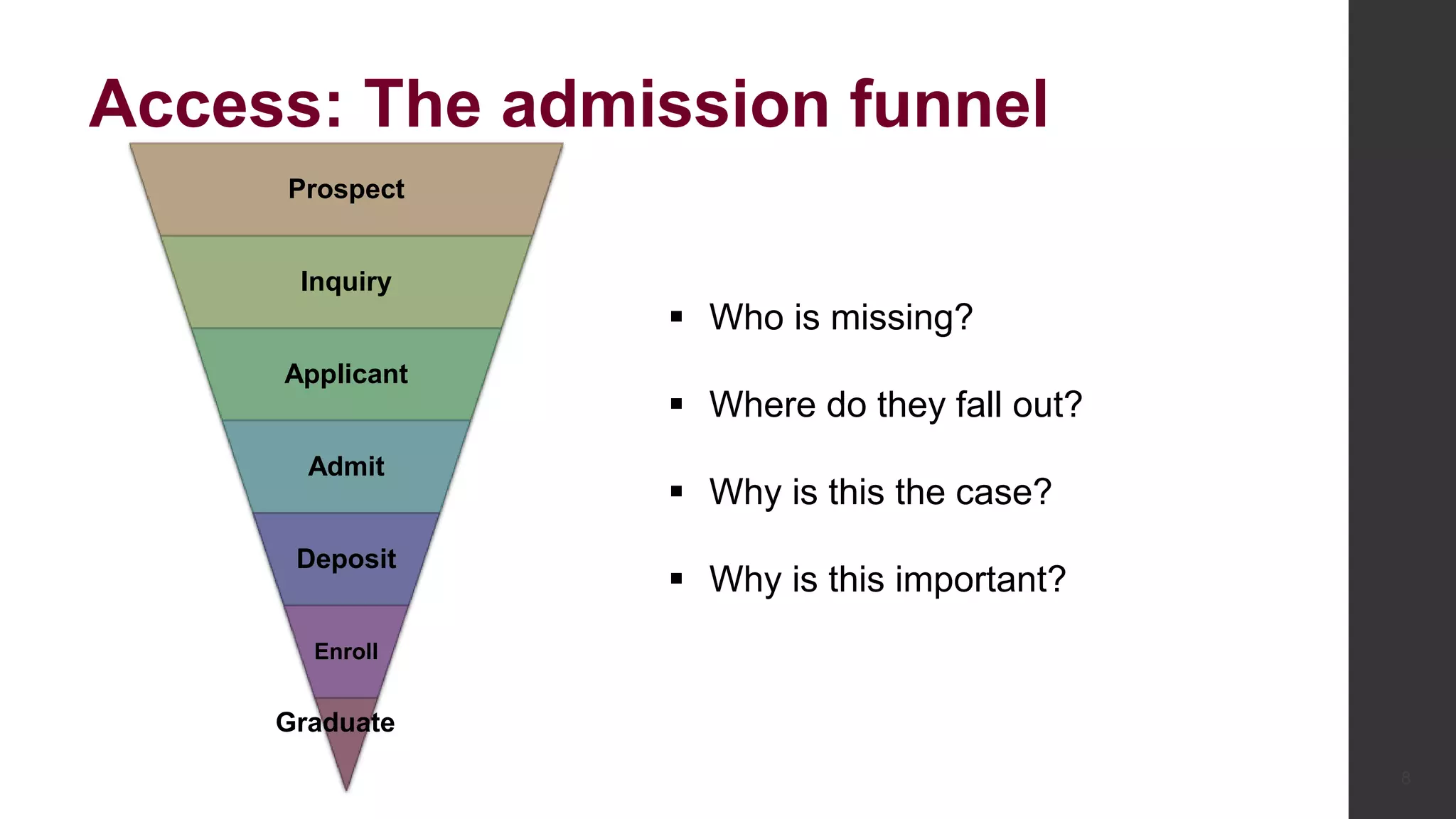
Access: The admission funnel
8
 Who is missing?
 Where do they fall out?
 Why is this the case?
 Why is this important?
Prospect
Inquiry
Applicant
Admit
Deposit
Enroll
Graduate
Why?
• Access & Persistence
• Demographic shifts
• Limited resources
• High School
Counselor Shortage
College Enrollment Rates
Income Comparison
• 82% of high-income high school
graduates enroll in college
• 52% of low-income high school
graduates enroll in college
Race Comparison
• 70% of white high school graduates
enroll in college
• 65% of black high school graduates
enroll in college
http://fivethirtyeight.com/features/race-gap-narrows-in-college-enrollment-
but-not-in-graduation/
http://fivethirtyeight.com/features/race-gap-narrows-in-college-enrollment-but-not-in-graduation/
The College Completion Gap
Source: Department of Education
13
14
Lifetime earnings by education level in 2009 dollars.
Source: Department of Education
High School Counselor Shortage
• Nationwide, one in five high schools lacks a school
counselor (US DOE blog)
• At schools that do have school counselors, the ratio
is 1:463 on average students receive 20 minutes
per year in school counseling. In California the ratio
is twice that number (Farokhi).
Unequal Access to college prep coursework
• Full range of math & science courses
• 81% of Asian-American high school students
• 71% of white high school students
• <50% of American Indian & Native-Alaskan
• 57% of Black high school students
• 67% Latino high school students
• 63% high school students with disabilities
• 65% English learner students
(DOE Blog)
Organizations
 Center for Student Opportunity
 Quest Bridge
 firstgenerationstudent.com
 National Hispanic Scholarship
Fund
 Career Counsel INC.
 I am first
 Heart of Los Angeles -
California
 National Hispanic College Fairs
 College Horizons
 First Generation College Bound
- Maryland
Discussion. Questions. Answers.
References
Casselman, Ben. (2014, April 30). Race Gap Narrows in College Enrollment, But Not in
Graduation. [Web log comment]. Retrieved from http://fivethirtyeight.com/features/race-gap-
narrows-in-college-enrollment-but-not-in-graduation/
Farohki, Amir. (2015, Feb. 3). How to Get More Kids Into and Through College. [Web log
comment]. Retrieved fromhttp://blogs.cfr.org/renewing-america/2015/02/03/how-to-get-more-kids-
into-and-through-college.
Housel, T. (2011). Faculty and First-Generation College Students: Bridging the Classroom
Gap Together: New Directions for Teaching and Learning, Number 127. Jossey-Bass
Saenz, V., Hurtado, S., Barrera, D., Wolf, D. , Yeung, F. (2007). First in My Family: A Profile of
First-Generation College student at Four-year Institutions since 1971. Retrieved
fromhttp://www.heri.ucla.edu/PDFs/pubs/TFS/Special/Monographs/FirstInMyFamily.pdf
US Department of Education. (2012). The Condition of Education 2012. Retrieved from
http://nces.ed.gov/pubs2012/2012045.pdf
US Department of Education. (2014). Five New Facts from the Civil Rights Data Collection. [Web
log comment]. Retrieved from http://www.ed.gov/blog/2014/03/five-new-facts-from-the-civil-rights-
data-collection/
Ward, L. & Siegel, M. (2012). First-Generation College Students: Understanding and Improving
the
Experience from Recruitment to Commencement. Josssey-Bass.
Presenters
Jessica A. Quintana Hess, MSED
Associate Director of Admissions &
Coordinator of Partnerships
Lycoming College
700 College Place
Williamsport, PA 17701
570.321.4318 (o)
hess@lycoming.edu
Tania Rachkoskie, M.A.
Director of Outreach
The Common Application
3003 Washington Blvd, 10th Fl Suite
1000 Arlington, VA 22201
703.236.2715 (o)
trachkoskie@commonapp.org

Access, Equity, and Integrity: Reaching Students Who Are Still Underserved

  • 1.
    Access, Equity & Integrity: Reachingstudents who are still underserved 2015 National Partnership for Educational Access (NPEA) conference, Improving Outcomes: 360° Perspectives on Educational Access. Hess & Rachkoskie
  • 2.
    Our time together •Who we are. • Who are you? • Interactive Information • Current & Standard Best Practices and Programs • Innovative Strategies and Programs
  • 3.
    Getting to knoweach other!
  • 7.
    What do wemean by “underserved”?
  • 8.
    Access: The admissionfunnel 8  Who is missing?  Where do they fall out?  Why is this the case?  Why is this important? Prospect Inquiry Applicant Admit Deposit Enroll Graduate
  • 9.
    Why? • Access &Persistence • Demographic shifts • Limited resources • High School Counselor Shortage
  • 10.
    College Enrollment Rates IncomeComparison • 82% of high-income high school graduates enroll in college • 52% of low-income high school graduates enroll in college Race Comparison • 70% of white high school graduates enroll in college • 65% of black high school graduates enroll in college http://fivethirtyeight.com/features/race-gap-narrows-in-college-enrollment- but-not-in-graduation/
  • 11.
  • 12.
    The College CompletionGap Source: Department of Education
  • 13.
  • 14.
    14 Lifetime earnings byeducation level in 2009 dollars. Source: Department of Education
  • 15.
    High School CounselorShortage • Nationwide, one in five high schools lacks a school counselor (US DOE blog) • At schools that do have school counselors, the ratio is 1:463 on average students receive 20 minutes per year in school counseling. In California the ratio is twice that number (Farokhi).
  • 16.
    Unequal Access tocollege prep coursework • Full range of math & science courses • 81% of Asian-American high school students • 71% of white high school students • <50% of American Indian & Native-Alaskan • 57% of Black high school students • 67% Latino high school students • 63% high school students with disabilities • 65% English learner students (DOE Blog)
  • 17.
    Organizations  Center forStudent Opportunity  Quest Bridge  firstgenerationstudent.com  National Hispanic Scholarship Fund  Career Counsel INC.  I am first  Heart of Los Angeles - California  National Hispanic College Fairs  College Horizons  First Generation College Bound - Maryland
  • 18.
  • 19.
    References Casselman, Ben. (2014,April 30). Race Gap Narrows in College Enrollment, But Not in Graduation. [Web log comment]. Retrieved from http://fivethirtyeight.com/features/race-gap- narrows-in-college-enrollment-but-not-in-graduation/ Farohki, Amir. (2015, Feb. 3). How to Get More Kids Into and Through College. [Web log comment]. Retrieved fromhttp://blogs.cfr.org/renewing-america/2015/02/03/how-to-get-more-kids- into-and-through-college. Housel, T. (2011). Faculty and First-Generation College Students: Bridging the Classroom Gap Together: New Directions for Teaching and Learning, Number 127. Jossey-Bass Saenz, V., Hurtado, S., Barrera, D., Wolf, D. , Yeung, F. (2007). First in My Family: A Profile of First-Generation College student at Four-year Institutions since 1971. Retrieved fromhttp://www.heri.ucla.edu/PDFs/pubs/TFS/Special/Monographs/FirstInMyFamily.pdf US Department of Education. (2012). The Condition of Education 2012. Retrieved from http://nces.ed.gov/pubs2012/2012045.pdf US Department of Education. (2014). Five New Facts from the Civil Rights Data Collection. [Web log comment]. Retrieved from http://www.ed.gov/blog/2014/03/five-new-facts-from-the-civil-rights- data-collection/ Ward, L. & Siegel, M. (2012). First-Generation College Students: Understanding and Improving the Experience from Recruitment to Commencement. Josssey-Bass.
  • 20.
    Presenters Jessica A. QuintanaHess, MSED Associate Director of Admissions & Coordinator of Partnerships Lycoming College 700 College Place Williamsport, PA 17701 570.321.4318 (o) hess@lycoming.edu Tania Rachkoskie, M.A. Director of Outreach The Common Application 3003 Washington Blvd, 10th Fl Suite 1000 Arlington, VA 22201 703.236.2715 (o) trachkoskie@commonapp.org

Editor's Notes

  • #5 What is your current role? https://www.polleverywhere.com/multiple_choice_polls/yjoySDfE0YEf7fN
  • #6 What region do you currently represent? https://www.polleverywhere.com/multiple_choice_polls/zvV8ECMvxFg3lzl
  • #7 Where you a 1st Generation College Student? https://www.polleverywhere.com/multiple_choice_polls/04ouQojjWQ9yyRH
  • #8 Underserved vs. 1st generation vs. student of color Individual differences between college / university approaches Differences between minority group treatment based on school and country of origin Jess and Tania will add notes for discussion
  • #10 Access for underrepresented populations has been a focus since the 90’s, and as Bowen and Bok investigated, specifically exploring race-based admissions, in The Shape of the River, it is not only getting students “in”, but how they fare, what they learn, how they gain their social capitol and what they do to persist and graduate as fully prepared and contributing member of society. For an applicant who is the first in his or her family to attend a four-year college or university, the application process can be especially daunting. Decisions about where to attend college, how to apply to different schools, whether to leave family, and how to afford the cost of a college education are issues that can pose hurdles for first-generation college students. Ask participants to share why this is an issue…..
  • #17 full range of math and science courses = (Algebra I, geometry, Algebra II, calculus, biology, chemistry, physics)
  • #18 Abundant low-income talent exists. Annually, approximately 30,000 low-income students score over 1300 on the combined math and verbal SAT scores, and another 42,000 score over 1220. Moreover, over a third of top low-income performers don't take the SAT. Already in the system, there is abundant raw talent and tens of thousands of academically prepared talented low-income students in America to match top low-income students with every full-need scholarship that top American colleges provide. There need be no academic gap if we can bring our best low-income students into the system. Most top low-income students in America don't apply to top colleges who want them. In one study, only 3% of the students attending the nation's top 146 colleges and universities were drawn from families in the lowest economic quartile.