Summer Starts in September
National Partnership for Educational Access
Conference
April 17, 2015
Dara Murray
Manager of Program Quality and Evaluation
dara@summerlearning.org
On twitter: @summerlearning #summerlearning
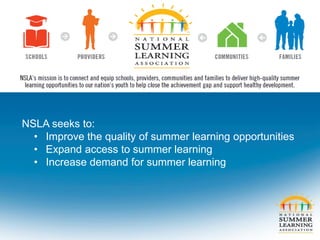
NSLA seeks to:
• Improve the quality of summer learning opportunities
• Expand access to summer learning
• Increase demand for summer learning
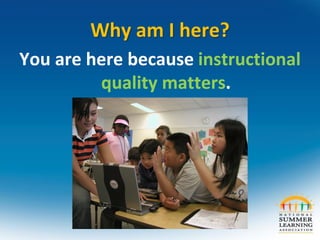
Why am I here?
You are here because instructional
quality matters.
WHY SUMMER MATTERS
Summer Learning Research
Why Summer Learning
What happens to a child when they are not
engaged in positive, supportive activities
in the summer?
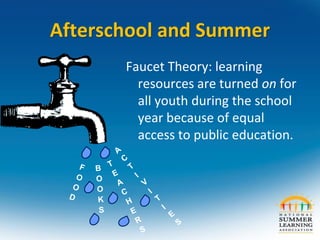
Afterschool and Summer
Faucet Theory: learning
resources are turned on for
all youth during the school
year because of equal
access to public education.
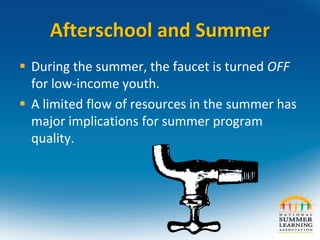
Afterschool and Summer
 During the summer, the faucet is turned OFF
for low-income youth.
 A limited flow of resources in the summer has
major implications for summer program
quality.
The Effects of Summer Learning Loss
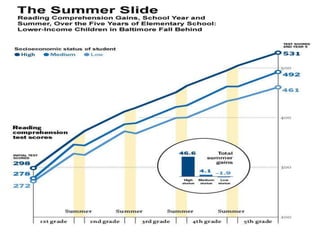
 Since 1906, numerous studies have confirmed that
children experience learning losses in math and
reading without continued opportunities for skill
building over the summer (White, Heyns, Cooper,
Downey, Alexander)
 More than half of the ninth grade achievement gap
in reading can be explained by unequal access to
summer learning opportunities during the
elementary school years (Alexander, Entwisle, &
Olson, 2007)
 Summer learning losses have later life
consequences, including high school curriculum
placement, high school dropout, and college
attendance (ibid.)
“Virtually all of the advantage that
wealthy students have over poor
students is the result of differences in
the way privileged kids learn when they
are not in school….America doesn’t have
a school problem. It has a summer
vacation problem …”
Malcolm Gladwell, Outliers, pp. 258 - 260
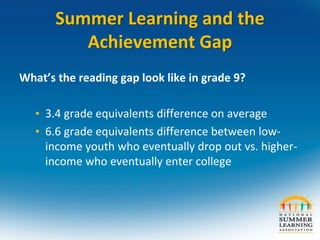
Summer Learning and the
Achievement Gap
What’s the reading gap look like in grade 9?
• 3.4 grade equivalents difference on average
• 6.6 grade equivalents difference between low-
income youth who eventually drop out vs. higher-
income who eventually enter college
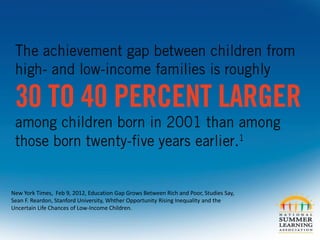
New York Times, Feb 9, 2012, Education Gap Grows Between Rich and Poor, Studies Say,
Sean F. Reardon, Stanford University, Whther Opportunity Rising Inequality and the
Uncertain Life Chances of Low-Income Children.
Summer & College Enrollment
Arnold, Fleming, DeAnda, Castleman, and Wartman (2009)
 Big Picture Longitudinal Study (BPLS)
• Significant support during high school for college application, financial
aid, admissions and selection process (95-100% college acceptance
rate)
 Education pipeline breaks down the summer between HS graduation and
college entrance for low-income youth (70% actually enroll in any college)
 Relationships (parental ambivalence or hostility, peer pressure, thin
college social networks)
 Resources (financial to supplement the aid package)
 Lack of knowledge (how to follow up with college, having the correct
information about the college)
Summer & College Enrollment
During the summer before college, low-income youth need:
 Continuing availability of expert guidance and support re:
college admissions from both the HS and the college
 Continuing assistance for students in finding the best possible
pathway for their skills, interests, and postsecondary goals
 Ongoing social and emotional supports for students and their
families
 Intensive and consistent financial guidance to interpret
documents and make decisions among alternatives
Summer’s Influence on
Teaching and Learning
In a survey of 500 teachers –
• 66% said it takes them at least 3-4 weeks to re-teach skills lost
during the summer at the beginning of the school year
• 77% agreed or strongly agreed that students who participate
in summer learning are better prepared for school in the fall
• 72% agreed or strongly agreed that PD from working in a
summer program helps to improve school year practice
Why Summer Learning?
 Compelling research base
 Laboratory for innovation in teaching & learning
 Support for working families
 Spans transition periods
 Growing importance in the education reform / time
and learning debate
 Significant opportunity for partnerships
The Good News
• High-quality programs can reduce summer learning loss and
lead to achievement gains (McCombs, 2011)
• Gains can endure for two years after participation
• Summer learning programs can contribute significantly to
young people’s health as well as learning
• Some evidence that summer reading programs, when coupled
with supports, can also reduce learning loss and lead to gains.
(Kim, 2004, 2006, 2008; READS Program)
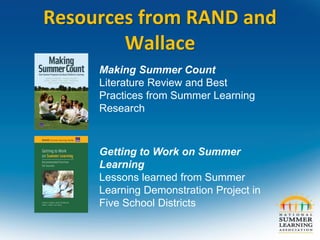
Making Summer Count
Literature Review and Best
Practices from Summer Learning
Research
Getting to Work on Summer
Learning
Lessons learned from Summer
Learning Demonstration Project in
Five School Districts
Resources from RAND and
Wallace
Characteristics of High Quality Programs
• Smaller class sizes (1:5- 1:8)
• Providing individualized instruction
• Involving parents
• ~150 hours per summer, at least two consecutive summers
• High-quality instructors (involve professional educators)
• Aligning school year and summer curricula
• Including content beyond remediation
• Tracking effectiveness
• Remove structural barriers (transportation, full-day
programming)
• Entice students
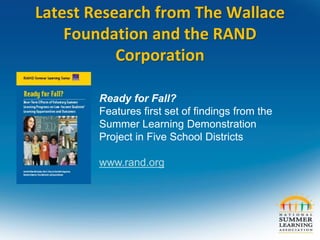
Latest Research from The Wallace
Foundation and the RAND
Corporation
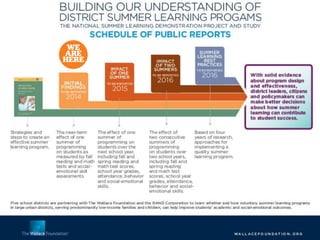
Ready for Fall?
Features first set of findings from the
Summer Learning Demonstration
Project in Five School Districts
www.rand.org
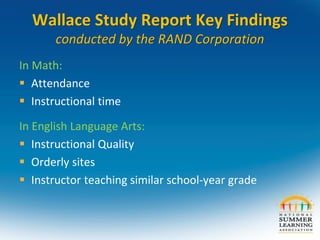
In Math:
 Attendance
 Instructional time
In English Language Arts:
 Instructional Quality
 Orderly sites
 Instructor teaching similar school-year grade
Wallace Study Report Key Findings
conducted by the RAND Corporation
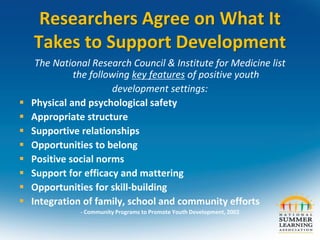
Researchers Agree on What It
Takes to Support Development
The National Research Council & Institute for Medicine list
the following key features of positive youth
development settings:
 Physical and psychological safety
 Appropriate structure
 Supportive relationships
 Opportunities to belong
 Positive social norms
 Support for efficacy and mattering
 Opportunities for skill-building
 Integration of family, school and community efforts
- Community Programs to Promote Youth Development, 2002
QUALITY IMPROVEMENT CYCLE
Focus on Quality
The Basics: At the Program
Level
Continuous Quality Improvement
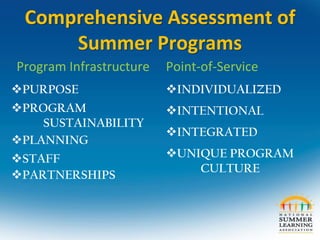
Comprehensive Assessment of
Summer Programs
Program Infrastructure Point-of-Service
PURPOSE
PROGRAM
SUSTAINABILITY
PLANNING
STAFF
PARTNERSHIPS
INDIVIDUALIZED
INTENTIONAL
INTEGRATED
UNIQUE PROGRAM
CULTURE
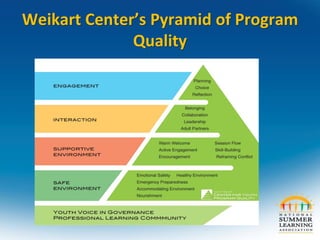
Weikart Center’s Pyramid of Program
Quality
Transition:
CASP SLPQA
 The comprehensive Assessment of Summer
Programs (CASP)
 The Youth Program Quality Assessment
(YPQA)
 The new Summer Learning Program Quality
Assessment (SLPQA)
DEVELOPING THE SUMMER
LEARNING PQA
A partnership between the Weikart Center and the National Summer
Learning Association
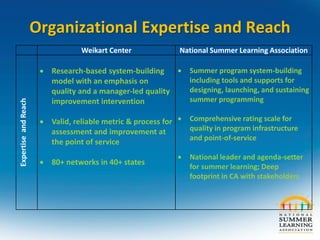
Organizational Expertise and Reach
Weikart Center National Summer Learning Association
ExpertiseandReach
 Research-based system-building
model with an emphasis on
quality and a manager-led quality
improvement intervention
 Valid, reliable metric & process for
assessment and improvement at
the point of service
 80+ networks in 40+ states
 Summer program system-building
including tools and supports for
designing, launching, and sustaining
summer programming
 Comprehensive rating scale for
quality in program infrastructure
and point-of-service
 National leader and agenda-setter
for summer learning; Deep
footprint in CA with stakeholders
Purpose of Summer Learning PQA
 Adapt tools to provide relevant, high-impact support
to summer programs.
• Short schedule (4-8 weeks)
• Staff time shortage
• Youth in programs for longer hours
 Connect summer process to ongoing school-year
process.
Improve youth experience in summer
programs.
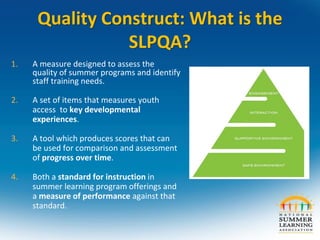
Quality Construct: What is the
SLPQA?
1. A measure designed to assess the
quality of summer programs and identify
staff training needs.
2. A set of items that measures youth
access to key developmental
experiences.
3. A tool which produces scores that can
be used for comparison and assessment
of progress over time.
4. Both a standard for instruction in
summer learning program offerings and
a measure of performance against that
standard.
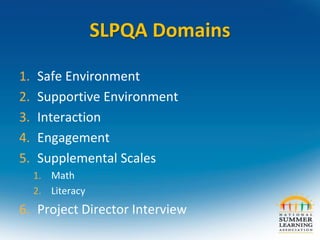
SLPQA Domains
1. Safe Environment
2. Supportive Environment
3. Interaction
4. Engagement
5. Supplemental Scales
1. Math
2. Literacy
6. Project Director Interview
Safe Environment
 Emotional Safety
 Healthy Environment
 Emergency Preparedness
 Health and Nutrition
Supportive Environment
 Warm Welcome
 Program Flow
 Active Learning
 Skill-Building
 Reframing Conflict
 Managing Feelings
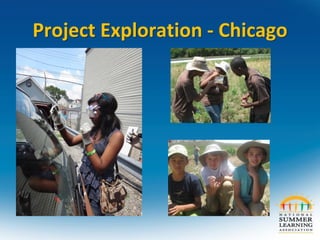
Project Exploration - Chicago
Interaction
 Belonging
 Collaboration and Leadership
 Adult Partners
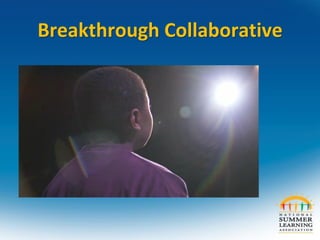
Breakthrough Collaborative
Engagement
 Planning, Choice, Reflection
 Learning How to Learn
 Higher Order Thinking
Supplemental Scales
 Math
 Literacy
Project Director Interview
 Planning
 Staff Training
 Family Connections
 Individualization
Summer Learning PQA – Next Steps
Phase III:
 Development of SLPQA Form B
 Finalization of SLPQI Handbook
 Integration into Online Scores Reporter
 Finalization of Training and Technical Assistance
Offerings
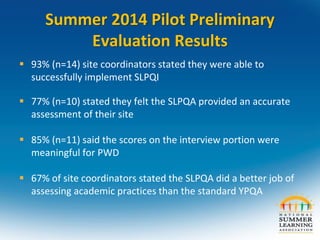
Summer 2014 Pilot Preliminary
Evaluation Results
 93% (n=14) site coordinators stated they were able to
successfully implement SLPQI
 77% (n=10) stated they felt the SLPQA provided an accurate
assessment of their site
 85% (n=11) said the scores on the interview portion were
meaningful for PWD
 67% of site coordinators stated the SLPQA did a better job of
assessing academic practices than the standard YPQA
Summer Program Improvement
Some Steps to Consider After This Session…
 Spend time reviewing materials more carefully!
 Share the report and tool with colleagues!
 Visit Weikart’s website (http://www.cypq.org/)in
May 2015 to download the tool and guidebook!
 Join us as partners as we continue this important
work!
Order your copy at
SummerStartsInSeptember.com
Limited quantities available!
SUMMER STARTS IN SEPTEMBER
Summer Program Planning Guide
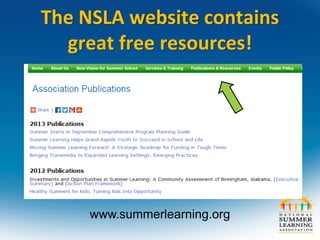
The NSLA website contains
great free resources!
www.summerlearning.org
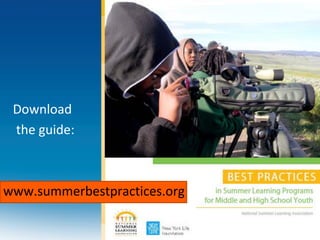
Download
the guide:
www.summerbestpractices.org
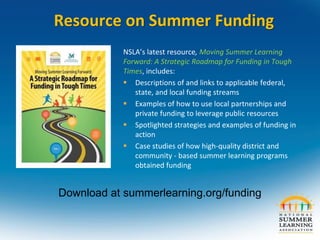
Resource on Summer Funding
Download at summerlearning.org/funding
NSLA’s latest resource, Moving Summer Learning
Forward: A Strategic Roadmap for Funding in Tough
Times, includes:
 Descriptions of and links to applicable federal,
state, and local funding streams
 Examples of how to use local partnerships and
private funding to leverage public resources
 Spotlighted strategies and examples of funding in
action
 Case studies of how high-quality district and
community - based summer learning programs
obtained funding
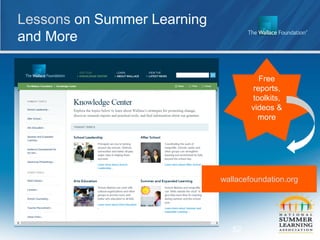
Lessons on Summer Learning
and More
52
Free
reports,
toolkits,
videos &
more
wallacefoundation.org
Follow us at
Twitter.com/
SummerLearning
Like us on
Facebook.com/
SmarterSummers
Subscribe to us at
Youtube.com/
SummerLearning
Find on social media to keep updated
#SummerLearning
NSLA
Thank You!
Dara Murray
Manager of Program Quality
and Evaluation
(410) 856-1370
dara@summerlearning.org
www.summerlearning.org

Stemming the Slide: How Summer Presents Unique Challenges and Opportunities for Underrepresented Students

  • 1.
    Summer Starts inSeptember National Partnership for Educational Access Conference April 17, 2015 Dara Murray Manager of Program Quality and Evaluation dara@summerlearning.org On twitter: @summerlearning #summerlearning
  • 2.
    NSLA seeks to: •Improve the quality of summer learning opportunities • Expand access to summer learning • Increase demand for summer learning
  • 3.
    Why am Ihere? You are here because instructional quality matters.
  • 4.
    WHY SUMMER MATTERS SummerLearning Research
  • 5.
    Why Summer Learning Whathappens to a child when they are not engaged in positive, supportive activities in the summer?
  • 6.
    Afterschool and Summer FaucetTheory: learning resources are turned on for all youth during the school year because of equal access to public education.
  • 7.
    Afterschool and Summer During the summer, the faucet is turned OFF for low-income youth.  A limited flow of resources in the summer has major implications for summer program quality.
  • 8.
    The Effects ofSummer Learning Loss  Since 1906, numerous studies have confirmed that children experience learning losses in math and reading without continued opportunities for skill building over the summer (White, Heyns, Cooper, Downey, Alexander)  More than half of the ninth grade achievement gap in reading can be explained by unequal access to summer learning opportunities during the elementary school years (Alexander, Entwisle, & Olson, 2007)  Summer learning losses have later life consequences, including high school curriculum placement, high school dropout, and college attendance (ibid.)
  • 9.
    “Virtually all ofthe advantage that wealthy students have over poor students is the result of differences in the way privileged kids learn when they are not in school….America doesn’t have a school problem. It has a summer vacation problem …” Malcolm Gladwell, Outliers, pp. 258 - 260
  • 11.
    Summer Learning andthe Achievement Gap What’s the reading gap look like in grade 9? • 3.4 grade equivalents difference on average • 6.6 grade equivalents difference between low- income youth who eventually drop out vs. higher- income who eventually enter college
  • 12.
    New York Times,Feb 9, 2012, Education Gap Grows Between Rich and Poor, Studies Say, Sean F. Reardon, Stanford University, Whther Opportunity Rising Inequality and the Uncertain Life Chances of Low-Income Children.
  • 13.
    Summer & CollegeEnrollment Arnold, Fleming, DeAnda, Castleman, and Wartman (2009)  Big Picture Longitudinal Study (BPLS) • Significant support during high school for college application, financial aid, admissions and selection process (95-100% college acceptance rate)  Education pipeline breaks down the summer between HS graduation and college entrance for low-income youth (70% actually enroll in any college)  Relationships (parental ambivalence or hostility, peer pressure, thin college social networks)  Resources (financial to supplement the aid package)  Lack of knowledge (how to follow up with college, having the correct information about the college)
  • 14.
    Summer & CollegeEnrollment During the summer before college, low-income youth need:  Continuing availability of expert guidance and support re: college admissions from both the HS and the college  Continuing assistance for students in finding the best possible pathway for their skills, interests, and postsecondary goals  Ongoing social and emotional supports for students and their families  Intensive and consistent financial guidance to interpret documents and make decisions among alternatives
  • 15.
    Summer’s Influence on Teachingand Learning In a survey of 500 teachers – • 66% said it takes them at least 3-4 weeks to re-teach skills lost during the summer at the beginning of the school year • 77% agreed or strongly agreed that students who participate in summer learning are better prepared for school in the fall • 72% agreed or strongly agreed that PD from working in a summer program helps to improve school year practice
  • 16.
    Why Summer Learning? Compelling research base  Laboratory for innovation in teaching & learning  Support for working families  Spans transition periods  Growing importance in the education reform / time and learning debate  Significant opportunity for partnerships
  • 17.
    The Good News •High-quality programs can reduce summer learning loss and lead to achievement gains (McCombs, 2011) • Gains can endure for two years after participation • Summer learning programs can contribute significantly to young people’s health as well as learning • Some evidence that summer reading programs, when coupled with supports, can also reduce learning loss and lead to gains. (Kim, 2004, 2006, 2008; READS Program)
  • 18.
    Making Summer Count LiteratureReview and Best Practices from Summer Learning Research Getting to Work on Summer Learning Lessons learned from Summer Learning Demonstration Project in Five School Districts Resources from RAND and Wallace
  • 19.
    Characteristics of HighQuality Programs • Smaller class sizes (1:5- 1:8) • Providing individualized instruction • Involving parents • ~150 hours per summer, at least two consecutive summers • High-quality instructors (involve professional educators) • Aligning school year and summer curricula • Including content beyond remediation • Tracking effectiveness • Remove structural barriers (transportation, full-day programming) • Entice students
  • 20.
    Latest Research fromThe Wallace Foundation and the RAND Corporation Ready for Fall? Features first set of findings from the Summer Learning Demonstration Project in Five School Districts www.rand.org
  • 21.
    In Math:  Attendance Instructional time In English Language Arts:  Instructional Quality  Orderly sites  Instructor teaching similar school-year grade Wallace Study Report Key Findings conducted by the RAND Corporation
  • 23.
    Researchers Agree onWhat It Takes to Support Development The National Research Council & Institute for Medicine list the following key features of positive youth development settings:  Physical and psychological safety  Appropriate structure  Supportive relationships  Opportunities to belong  Positive social norms  Support for efficacy and mattering  Opportunities for skill-building  Integration of family, school and community efforts - Community Programs to Promote Youth Development, 2002
  • 25.
  • 26.
    The Basics: Atthe Program Level Continuous Quality Improvement
  • 27.
    Comprehensive Assessment of SummerPrograms Program Infrastructure Point-of-Service PURPOSE PROGRAM SUSTAINABILITY PLANNING STAFF PARTNERSHIPS INDIVIDUALIZED INTENTIONAL INTEGRATED UNIQUE PROGRAM CULTURE
  • 28.
    Weikart Center’s Pyramidof Program Quality
  • 29.
    Transition: CASP SLPQA  Thecomprehensive Assessment of Summer Programs (CASP)  The Youth Program Quality Assessment (YPQA)  The new Summer Learning Program Quality Assessment (SLPQA)
  • 30.
    DEVELOPING THE SUMMER LEARNINGPQA A partnership between the Weikart Center and the National Summer Learning Association
  • 31.
    Organizational Expertise andReach Weikart Center National Summer Learning Association ExpertiseandReach  Research-based system-building model with an emphasis on quality and a manager-led quality improvement intervention  Valid, reliable metric & process for assessment and improvement at the point of service  80+ networks in 40+ states  Summer program system-building including tools and supports for designing, launching, and sustaining summer programming  Comprehensive rating scale for quality in program infrastructure and point-of-service  National leader and agenda-setter for summer learning; Deep footprint in CA with stakeholders
  • 32.
    Purpose of SummerLearning PQA  Adapt tools to provide relevant, high-impact support to summer programs. • Short schedule (4-8 weeks) • Staff time shortage • Youth in programs for longer hours  Connect summer process to ongoing school-year process. Improve youth experience in summer programs.
  • 33.
    Quality Construct: Whatis the SLPQA? 1. A measure designed to assess the quality of summer programs and identify staff training needs. 2. A set of items that measures youth access to key developmental experiences. 3. A tool which produces scores that can be used for comparison and assessment of progress over time. 4. Both a standard for instruction in summer learning program offerings and a measure of performance against that standard.
  • 34.
    SLPQA Domains 1. SafeEnvironment 2. Supportive Environment 3. Interaction 4. Engagement 5. Supplemental Scales 1. Math 2. Literacy 6. Project Director Interview
  • 35.
    Safe Environment  EmotionalSafety  Healthy Environment  Emergency Preparedness  Health and Nutrition
  • 36.
    Supportive Environment  WarmWelcome  Program Flow  Active Learning  Skill-Building  Reframing Conflict  Managing Feelings
  • 37.
  • 38.
    Interaction  Belonging  Collaborationand Leadership  Adult Partners
  • 39.
  • 40.
    Engagement  Planning, Choice,Reflection  Learning How to Learn  Higher Order Thinking
  • 41.
  • 42.
    Project Director Interview Planning  Staff Training  Family Connections  Individualization
  • 44.
    Summer Learning PQA– Next Steps Phase III:  Development of SLPQA Form B  Finalization of SLPQI Handbook  Integration into Online Scores Reporter  Finalization of Training and Technical Assistance Offerings
  • 45.
    Summer 2014 PilotPreliminary Evaluation Results  93% (n=14) site coordinators stated they were able to successfully implement SLPQI  77% (n=10) stated they felt the SLPQA provided an accurate assessment of their site  85% (n=11) said the scores on the interview portion were meaningful for PWD  67% of site coordinators stated the SLPQA did a better job of assessing academic practices than the standard YPQA
  • 46.
    Summer Program Improvement SomeSteps to Consider After This Session…  Spend time reviewing materials more carefully!  Share the report and tool with colleagues!  Visit Weikart’s website (http://www.cypq.org/)in May 2015 to download the tool and guidebook!  Join us as partners as we continue this important work!
  • 47.
    Order your copyat SummerStartsInSeptember.com Limited quantities available! SUMMER STARTS IN SEPTEMBER Summer Program Planning Guide
  • 48.
    The NSLA websitecontains great free resources! www.summerlearning.org
  • 49.
  • 50.
    Resource on SummerFunding Download at summerlearning.org/funding NSLA’s latest resource, Moving Summer Learning Forward: A Strategic Roadmap for Funding in Tough Times, includes:  Descriptions of and links to applicable federal, state, and local funding streams  Examples of how to use local partnerships and private funding to leverage public resources  Spotlighted strategies and examples of funding in action  Case studies of how high-quality district and community - based summer learning programs obtained funding
  • 52.
    Lessons on SummerLearning and More 52 Free reports, toolkits, videos & more wallacefoundation.org
  • 53.
    Follow us at Twitter.com/ SummerLearning Likeus on Facebook.com/ SmarterSummers Subscribe to us at Youtube.com/ SummerLearning Find on social media to keep updated #SummerLearning NSLA
  • 54.
    Thank You! Dara Murray Managerof Program Quality and Evaluation (410) 856-1370 dara@summerlearning.org www.summerlearning.org