RA 9514
Fire Code of the Philippines of 2008
Authorship+ Disclaimer
This workisthe property ofArch. Pedro Santos Jr.
Always check thevalues given in thisdocument
against theoriginal references. Forquestions or

corrections, contact theauthor at
arch.pedrosantosjr@gmail.com.
CreativeCommons
ThispresentationislicensedundertheCreative
CommonsAttribution-NonCommercial-ShareAlike4.0
InternationalLicense.Toviewacopyofthislicense,visit
http://creativecommons.org/licenses/by-nc-sa/4.0/
REPEALING CLAUSE
▪ RA 9514 repeals PD 1185 (the old Fire Code of
the Philippines).
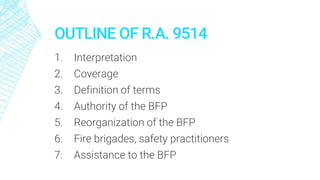
OUTLINE OF R.A. 9514
1. Interpretation
2. Coverage
3. Definition of terms
4. Authority of the BFP
5. Reorganization of the BFP
6. Fire brigades, safety practitioners
7. Assistance to the BFP
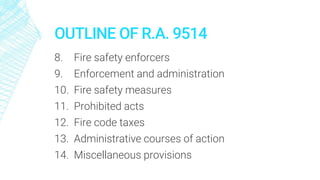
OUTLINE OF R.A. 9514
8. Fire safety enforcers
9. Enforcement and administration
10. Fire safety measures
11. Prohibited acts
12. Fire code taxes
13. Administrative courses of action
14. Miscellaneous provisions
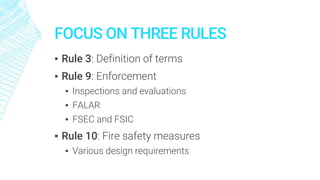
FOCUS ON THREE RULES
▪ Rule 3: Definition of terms
▪ Rule 9: Enforcement
▪ Inspections and evaluations
▪ FALAR
▪ FSEC and FSIC
▪ Rule 10: Fire safety measures
▪ Various design requirements
RULE 3
Terms and definitions
Abatement
Any actthat wouldremoveorneutralizeafirehazard
suppression system
An integratedpiping system connectedtoasourceof
extinguishing agent which suppresses fires when
actuatedby itsautomaticdetectingdevice
Automatic fire
Fire Marshall
TheheadoftheCity Fire StationortheMunicipal Fire
Station
Standpipe system
Asystem ofvertical pipes inabuilding towhich firehoses
can beattachedoneach floor
Firewall
Awall designed toprevent thespread offire, having afire
resistance rating ofnotless than four hours with
sufficient structural stability toremainstanding evenif
construction oneitherside collapses under fire conditions
High-rise building
Buildings 15 meters ormorein height
Means of egress
Acontinuous and unobstructed route of exit from one
pointina building toapublic way
Occupancy
Thepurpose for which abuilding orspaceisused
Occupant load
Themaximum number of persons that may be allowed
to occupy a particular buildingorspace
Fire trap
Abuilding thatis unsafe in caseoffire because itwill burn
easily orbecause itlacks adequate exits
RULE 9
Enforcement
Evaluation
+ inspection
BUILDING PLAN REVIEW
▪ Six sets of plans are sent from the Building
Official to the Fire Marshall for review
▪ A plan evaluator reviews the drawings
▪ Based on findings, the FSEC will either be released
or denied
▪ Note: FALAR 1 is required before plan review
CONSTRUCTION INSPECTION
▪ The Fire Marshall shall conduct inspections during
construction to ensure that plans are being
followed
INSPECTION AFTER COMPLETION
▪ The Fire Marshall needs to conduct another
inspection before the Building Official can issue
an occupancy permit
▪ When the Building Official receives an application
for occupancy permit, the Fire Marshall shall be
notified
INSPECTION AFTER COMPLETION
▪ Fire Marshall conducts inspection
▪ If OK, the Fire Marshall issues the FSIC and
notifies the Building Official
▪ Note: FALAR 2 is required for issuance of FSIC
ROUTINE INSPECTION
▪ Routine inspection
FALAR
WHAT IS FALAR?
▪ FALAR stands for Fire and Life Safety
Assessment Report
▪ There are three kinds:
▪ FALAR 1
▪ FALAR 2
▪ FALAR 3
FALAR APPLICABILITY
▪ For all buildings:
▪ FALAR 1
▪ FALAR 2
▪ For buildings with occupant load of at least 50:
▪ FALAR 3 (annually)
THE THREE FALARS
▪ FALAR 1: Documentation on safety features of
the facility
▪ FALAR 2: Documentation submitted by
contractor/CM certifying that construction was in
accordance with FALAR 1
▪ FALAR 3: Documentation of periodic maintenance
FALAR 1
▪ Documentation on fire and life safety features of
the facility
▪ A written report prepared by the Architect and his
Fire Protection Consultant
▪ A compilation of plans and specs and design
analysis
FALAR 2
▪ Documentation submitted by contractor/CM
certifying that construction was in accordance
with FALAR 1
▪ A compilation report of all approved submittals,
test forms, acceptance forms
▪ Shall be included in the as-built documents given
by contractor to owner
FALAR 3
▪ Documentation of required periodic maintenance
and upkeep of facility
▪ Written report prepared by the building owner and
his fire safety officer
▪ A compilation of the maintenance and testing
records
FSEC + FSIC
FSEC
▪ Fire Safety Evaluation Clearance
▪ Released once building plans and specs are found
to be in accordance with the Fire Code
▪ Required for building permits
FSIC
▪ Fire Safety Inspection Certificate
▪ Certifies that the building was inspected and was
found to be OK
▪ Required for occupancy permits, business
permits, permits to operate, PHILHEALTH
accreditation for hospitals, DOH License to
Operate
Putting things
together
SCENARIO 1: BUILDING PERMIT
1. You need a building permit, so you need an
FSEC.
2. You need an FSEC, so you need your plans to be
reviewed.
3. You need a building plan review so you prepare
FALAR 1 along with other requirements (6 sets
of drawings, etc.).
SCENARIO 2: OCCUPANCY PERMIT
1. You’re done with construction so you need an
occupancy permit.
2. You need an occupancy permit so you need an
FSIC.
3. You need an FSIC so you need an inspection.
4. You want them to release FSIC after inspection
so you prepare FALAR 2.
SCENARIO 3: BUSINESS PERMIT
1. You need to get/renew a business permit so you
need an FSIC.
2. You need an FSIC so you need an inspection.
3. You want them to release the FSIC after
inspection, so you prepare FALAR 3.
RULE 10: SAFETY MEASURES
Fire Code of the Philippines of 2008
Means of egress
MEANS OF EGRESS
▪ A continuous, unobstructed route of exit from any
point in the building to a public way
▪ Shall be integral or permanently affixed to a
building
▪ Minimum width: 915mm
NUMBER OF EXITS
▪ For any storey, mezzanine, balcony, etc.:
▪ 0-499 occupant load: 2 exits
▪ 500-1000 occupant load: 3 exits
▪ 1000 or more: 4 exits
TRAVEL DISTANCE TO EXITS
▪ Depends on occupancy
▪ For individual rooms with max. occupant load of 6:
▪ 15 meters from any point in the room
HEADROOM
▪ Minimum of 2.00 meters
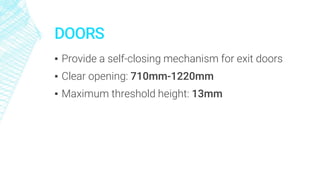
DOORS
▪ Provide a self-closing mechanism for exit doors
▪ Clear opening: 710mm-1220mm
▪ Maximum threshold height: 13mm
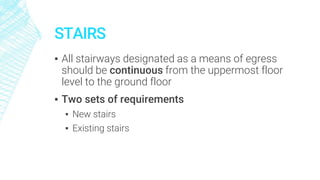
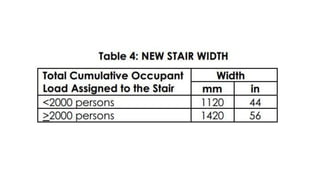
STAIRS
▪ All stairways designated as a means of egress
should be continuous from the uppermost floor
level to the ground floor
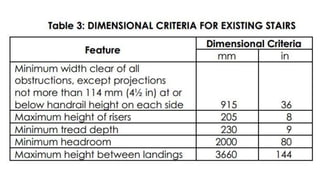
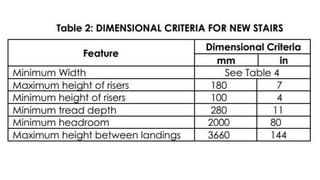
▪ Two sets of requirements
▪ New stairs
▪ Existing stairs
HANDRAILS
▪ 760mm-865mm from upper surface of tread
FIRE ESCAPE STAIRS
▪ Allowed as means of egress only in existing
buildings
▪ Should not constitute more than 50% of required
exit capacity
LADDERS
▪ Not allowed as fire escape or means of egress
Features of fire
protection
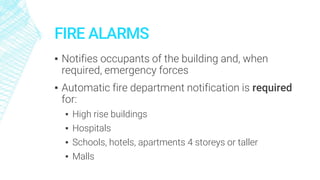
FIRE ALARMS
▪ Notifies occupants of the building and, when
required, emergency forces
▪ Automatic fire department notification is required
for:
▪ High rise buildings
▪ Hospitals
▪ Schools, hotels, apartments 4 storeys or taller
▪ Malls
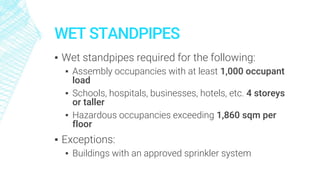
WET STANDPIPES
▪ Wet standpipes required for the following:
▪ Assembly occupancies with at least 1,000 occupant
load
▪ Schools, hospitals, businesses, hotels, etc. 4 storeys
or taller
▪ Hazardous occupancies exceeding 1,860 sqm per
floor
▪ Exceptions:
▪ Buildings with an approved sprinkler system
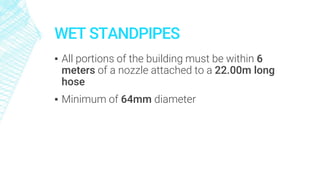
WET STANDPIPES
▪ All portions of the building must be within 6
meters of a nozzle attached to a 22.00m long
hose
▪ Minimum of 64mm diameter
Places of assembly
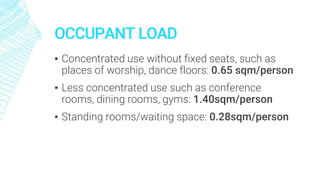
OCCUPANT LOAD
▪ Concentrated use without fixed seats, such as
places of worship, dance floors: 0.65 sqm/person
▪ Less concentrated use such as conference
rooms, dining rooms, gyms: 1.40sqm/person
▪ Standing rooms/waiting space: 0.28sqm/person
MINIMUM CORRIDOR WIDTH
▪ If serving 50 or more persons: 1120mm
TRAVEL DISTANCE TO EXITS
▪ 46 meters if without sprinkler system
▪ 61 meters if with sprinkler system
SEATING
▪ Rows of seats back to back: 830mm
▪ At least 300mm from back of one seat to front of
the next seat
▪ Seats between aisles: 14 maximum
▪ Seats between wall and aisle: 7 maximum
▪ Seats without arms: 600mm/person
END

RA 9514 (BVBVBVBVBVBVBVBVBBVBVBVBBVB)].pdf

  • 1.
    RA 9514 Fire Codeof the Philippines of 2008
  • 2.
    Authorship+ Disclaimer This workistheproperty ofArch. Pedro Santos Jr. Always check thevalues given in thisdocument against theoriginal references. Forquestions or corrections, contact theauthor at arch.pedrosantosjr@gmail.com.
  • 3.
  • 4.
    REPEALING CLAUSE ▪ RA9514 repeals PD 1185 (the old Fire Code of the Philippines).
  • 5.
    OUTLINE OF R.A.9514 1. Interpretation 2. Coverage 3. Definition of terms 4. Authority of the BFP 5. Reorganization of the BFP 6. Fire brigades, safety practitioners 7. Assistance to the BFP
  • 6.
    OUTLINE OF R.A.9514 8. Fire safety enforcers 9. Enforcement and administration 10. Fire safety measures 11. Prohibited acts 12. Fire code taxes 13. Administrative courses of action 14. Miscellaneous provisions
  • 7.
    FOCUS ON THREERULES ▪ Rule 3: Definition of terms ▪ Rule 9: Enforcement ▪ Inspections and evaluations ▪ FALAR ▪ FSEC and FSIC ▪ Rule 10: Fire safety measures ▪ Various design requirements
  • 9.
    RULE 3 Terms anddefinitions
  • 10.
  • 11.
    suppression system An integratedpipingsystem connectedtoasourceof extinguishing agent which suppresses fires when actuatedby itsautomaticdetectingdevice Automatic fire
  • 12.
    Fire Marshall TheheadoftheCity FireStationortheMunicipal Fire Station
  • 13.
    Standpipe system Asystem ofverticalpipes inabuilding towhich firehoses can beattachedoneach floor
  • 14.
    Firewall Awall designed topreventthespread offire, having afire resistance rating ofnotless than four hours with sufficient structural stability toremainstanding evenif construction oneitherside collapses under fire conditions
  • 15.
    High-rise building Buildings 15meters ormorein height
  • 16.
    Means of egress Acontinuousand unobstructed route of exit from one pointina building toapublic way
  • 17.
    Occupancy Thepurpose for whichabuilding orspaceisused
  • 18.
    Occupant load Themaximum numberof persons that may be allowed to occupy a particular buildingorspace
  • 19.
    Fire trap Abuilding thatisunsafe in caseoffire because itwill burn easily orbecause itlacks adequate exits
  • 20.
  • 21.
  • 22.
    BUILDING PLAN REVIEW ▪Six sets of plans are sent from the Building Official to the Fire Marshall for review ▪ A plan evaluator reviews the drawings ▪ Based on findings, the FSEC will either be released or denied ▪ Note: FALAR 1 is required before plan review
  • 23.
    CONSTRUCTION INSPECTION ▪ TheFire Marshall shall conduct inspections during construction to ensure that plans are being followed
  • 24.
    INSPECTION AFTER COMPLETION ▪The Fire Marshall needs to conduct another inspection before the Building Official can issue an occupancy permit ▪ When the Building Official receives an application for occupancy permit, the Fire Marshall shall be notified
  • 25.
    INSPECTION AFTER COMPLETION ▪Fire Marshall conducts inspection ▪ If OK, the Fire Marshall issues the FSIC and notifies the Building Official ▪ Note: FALAR 2 is required for issuance of FSIC
  • 26.
  • 27.
  • 28.
    WHAT IS FALAR? ▪FALAR stands for Fire and Life Safety Assessment Report ▪ There are three kinds: ▪ FALAR 1 ▪ FALAR 2 ▪ FALAR 3
  • 29.
    FALAR APPLICABILITY ▪ Forall buildings: ▪ FALAR 1 ▪ FALAR 2 ▪ For buildings with occupant load of at least 50: ▪ FALAR 3 (annually)
  • 30.
    THE THREE FALARS ▪FALAR 1: Documentation on safety features of the facility ▪ FALAR 2: Documentation submitted by contractor/CM certifying that construction was in accordance with FALAR 1 ▪ FALAR 3: Documentation of periodic maintenance
  • 31.
    FALAR 1 ▪ Documentationon fire and life safety features of the facility ▪ A written report prepared by the Architect and his Fire Protection Consultant ▪ A compilation of plans and specs and design analysis
  • 32.
    FALAR 2 ▪ Documentationsubmitted by contractor/CM certifying that construction was in accordance with FALAR 1 ▪ A compilation report of all approved submittals, test forms, acceptance forms ▪ Shall be included in the as-built documents given by contractor to owner
  • 33.
    FALAR 3 ▪ Documentationof required periodic maintenance and upkeep of facility ▪ Written report prepared by the building owner and his fire safety officer ▪ A compilation of the maintenance and testing records
  • 34.
  • 35.
    FSEC ▪ Fire SafetyEvaluation Clearance ▪ Released once building plans and specs are found to be in accordance with the Fire Code ▪ Required for building permits
  • 36.
    FSIC ▪ Fire SafetyInspection Certificate ▪ Certifies that the building was inspected and was found to be OK ▪ Required for occupancy permits, business permits, permits to operate, PHILHEALTH accreditation for hospitals, DOH License to Operate
  • 37.
  • 38.
    SCENARIO 1: BUILDINGPERMIT 1. You need a building permit, so you need an FSEC. 2. You need an FSEC, so you need your plans to be reviewed. 3. You need a building plan review so you prepare FALAR 1 along with other requirements (6 sets of drawings, etc.).
  • 39.
    SCENARIO 2: OCCUPANCYPERMIT 1. You’re done with construction so you need an occupancy permit. 2. You need an occupancy permit so you need an FSIC. 3. You need an FSIC so you need an inspection. 4. You want them to release FSIC after inspection so you prepare FALAR 2.
  • 40.
    SCENARIO 3: BUSINESSPERMIT 1. You need to get/renew a business permit so you need an FSIC. 2. You need an FSIC so you need an inspection. 3. You want them to release the FSIC after inspection, so you prepare FALAR 3.
  • 41.
    RULE 10: SAFETYMEASURES Fire Code of the Philippines of 2008
  • 42.
  • 43.
    MEANS OF EGRESS ▪A continuous, unobstructed route of exit from any point in the building to a public way ▪ Shall be integral or permanently affixed to a building ▪ Minimum width: 915mm
  • 44.
    NUMBER OF EXITS ▪For any storey, mezzanine, balcony, etc.: ▪ 0-499 occupant load: 2 exits ▪ 500-1000 occupant load: 3 exits ▪ 1000 or more: 4 exits
  • 45.
    TRAVEL DISTANCE TOEXITS ▪ Depends on occupancy ▪ For individual rooms with max. occupant load of 6: ▪ 15 meters from any point in the room
  • 46.
  • 47.
    DOORS ▪ Provide aself-closing mechanism for exit doors ▪ Clear opening: 710mm-1220mm ▪ Maximum threshold height: 13mm
  • 48.
    STAIRS ▪ All stairwaysdesignated as a means of egress should be continuous from the uppermost floor level to the ground floor ▪ Two sets of requirements ▪ New stairs ▪ Existing stairs
  • 52.
    HANDRAILS ▪ 760mm-865mm fromupper surface of tread
  • 53.
    FIRE ESCAPE STAIRS ▪Allowed as means of egress only in existing buildings ▪ Should not constitute more than 50% of required exit capacity
  • 54.
    LADDERS ▪ Not allowedas fire escape or means of egress
  • 55.
  • 56.
    FIRE ALARMS ▪ Notifiesoccupants of the building and, when required, emergency forces ▪ Automatic fire department notification is required for: ▪ High rise buildings ▪ Hospitals ▪ Schools, hotels, apartments 4 storeys or taller ▪ Malls
  • 57.
    WET STANDPIPES ▪ Wetstandpipes required for the following: ▪ Assembly occupancies with at least 1,000 occupant load ▪ Schools, hospitals, businesses, hotels, etc. 4 storeys or taller ▪ Hazardous occupancies exceeding 1,860 sqm per floor ▪ Exceptions: ▪ Buildings with an approved sprinkler system
  • 58.
    WET STANDPIPES ▪ Allportions of the building must be within 6 meters of a nozzle attached to a 22.00m long hose ▪ Minimum of 64mm diameter
  • 59.
  • 60.
    OCCUPANT LOAD ▪ Concentrateduse without fixed seats, such as places of worship, dance floors: 0.65 sqm/person ▪ Less concentrated use such as conference rooms, dining rooms, gyms: 1.40sqm/person ▪ Standing rooms/waiting space: 0.28sqm/person
  • 61.
    MINIMUM CORRIDOR WIDTH ▪If serving 50 or more persons: 1120mm
  • 62.
    TRAVEL DISTANCE TOEXITS ▪ 46 meters if without sprinkler system ▪ 61 meters if with sprinkler system
  • 63.
    SEATING ▪ Rows ofseats back to back: 830mm ▪ At least 300mm from back of one seat to front of the next seat ▪ Seats between aisles: 14 maximum ▪ Seats between wall and aisle: 7 maximum ▪ Seats without arms: 600mm/person
  • 64.