Where do I put this stuff?
How and when to use quotations, paraphrasing,
and summarizing in your research paper.
What is Summarizing?
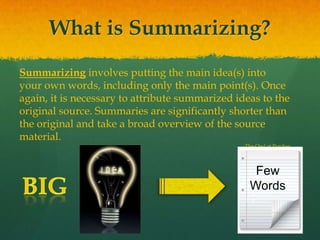
Summarizing involves putting the main idea(s) into
your own words, including only the main point(s). Once
again, it is necessary to attribute summarized ideas to the
original source. Summaries are significantly shorter than
the original and take a broad overview of the source
material.
-The Owl at Purdue
Few
Words
What is Paraphrasing?
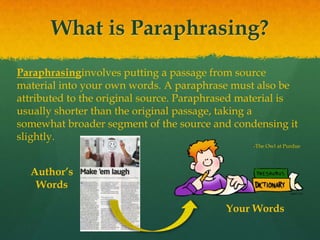
Paraphrasinginvolves putting a passage from source
material into your own words. A paraphrase must also be
attributed to the original source. Paraphrased material is
usually shorter than the original passage, taking a
somewhat broader segment of the source and condensing it
slightly.
-The Owl at Purdue
Author’s
Words
Your Words
What is a Quotation?
Quotationsmust be identical to the original, using a
narrow segment of the source. They must match the
source document word for word and must be
attributed to the original author.
-The Owl at Purdue
Straight from the
horse’s mouth!
How do I find them?
1. Read the entire text, noting the key points and main
ideas.
2. Ask yourself:
• Can I summarize in my own words the single main
idea of the essay?
• Can I paraphrase important points that come up in
the essay?
• Are there any words, phrases, or brief passages that
should be quoted directly?
Why should I use them?
You should use summarizing, paraphrasing, and
quotations to:
• Provide support for claims or add credibility to your
writing
• Give examples of several points of view on a subject
• Call attention to a position that you wish to agree or
disagree with
• Expand the breadth or depth of your writing
When do I use a quotation instead
of paraphrasing or summarizing?
Use quotations instead of paraphrasing or summarizing
when:
•Exact wording is needed for technical accuracy
•It is important to let the debaters of an issue explain their
positions in their own words
•The words of an important authority lend weight to an
argument
•The author’s language is so perfect, you can’t say it any
better.
How do I introduce a
quotation?
Drop quotations into your
text without warming.
Allow quotations to stand
alone in sentences.
Begin a paragraph with a
quotation unless you have
introduced it.
Include quotations within
your sentences using
correct punctuation.
Provide clear signal
phrases which include the
author’s name to introduce
the quotation.
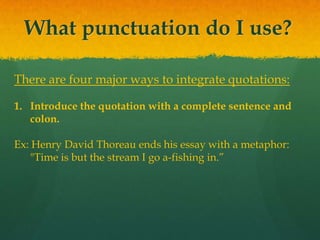
What punctuation do I use?
There are four major ways to integrate quotations:
1. Introduce the quotation with a complete sentence and
colon.
Ex: Henry David Thoreau ends his essay with a metaphor:
"Time is but the stream I go a-fishing in.”
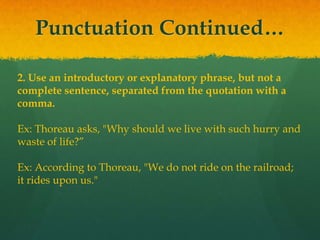
Punctuation Continued…
2. Use an introductory or explanatory phrase, but not a
complete sentence, separated from the quotation with a
comma.
Ex: Thoreau asks, "Why should we live with such hurry and
waste of life?”
Ex: According to Thoreau, "We do not ride on the railroad;
it rides upon us."
Signal Phrases
Is your source arguing a point, making an observation,
reporting a fact, drawing a conclusion, refuting an
argument, or stating a belief?
Use active verbs in signal phrases to indicate the author’s
tone and stance.
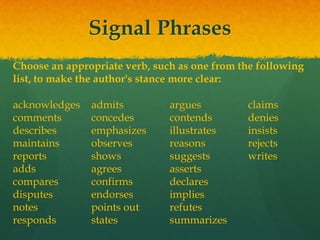
Signal Phrases
acknowledges
comments
describes
maintains
reports
adds
compares
disputes
notes
responds
admits
concedes
emphasizes
observes
shows
agrees
confirms
endorses
points out
states
argues
contends
illustrates
reasons
suggests
asserts
declares
implies
refutes
summarizes
claims
denies
insists
rejects
writes
Choose an appropriate verb, such as one from the following
list, to make the author's stance more clear:
Punctuation Continued…
3. Make the quotation a part of your own sentence without
any punctuation between your own words and the words
you are quoting.
Ex: Thoreau suggests the consequences of making ourselves
slaves to progress when he says that "We do not ride on the
railroad; it rides upon us."
Ex: According to Thoreau, people are too often "thrown off
the track by every nutshell and mosquito's wing that falls
on the rails."
Punctuation Continued…
4. Use short quotations--only a few words--as part of your
own sentence.
Ex: Thoreau argues that people blindly accept "shams and
delusions" as the "soundest truths," while regarding reality
as "fabulous."
Ex: Although Thoreau "drink[s] at” the stream of Time, he
can "detect how shallow it is."

Quotes paraphrases summaries

  • 1.
    Where do Iput this stuff? How and when to use quotations, paraphrasing, and summarizing in your research paper.
  • 2.
    What is Summarizing? Summarizinginvolves putting the main idea(s) into your own words, including only the main point(s). Once again, it is necessary to attribute summarized ideas to the original source. Summaries are significantly shorter than the original and take a broad overview of the source material. -The Owl at Purdue Few Words
  • 3.
    What is Paraphrasing? Paraphrasinginvolvesputting a passage from source material into your own words. A paraphrase must also be attributed to the original source. Paraphrased material is usually shorter than the original passage, taking a somewhat broader segment of the source and condensing it slightly. -The Owl at Purdue Author’s Words Your Words
  • 4.
    What is aQuotation? Quotationsmust be identical to the original, using a narrow segment of the source. They must match the source document word for word and must be attributed to the original author. -The Owl at Purdue Straight from the horse’s mouth!
  • 5.
    How do Ifind them? 1. Read the entire text, noting the key points and main ideas. 2. Ask yourself: • Can I summarize in my own words the single main idea of the essay? • Can I paraphrase important points that come up in the essay? • Are there any words, phrases, or brief passages that should be quoted directly?
  • 6.
    Why should Iuse them? You should use summarizing, paraphrasing, and quotations to: • Provide support for claims or add credibility to your writing • Give examples of several points of view on a subject • Call attention to a position that you wish to agree or disagree with • Expand the breadth or depth of your writing
  • 7.
    When do Iuse a quotation instead of paraphrasing or summarizing? Use quotations instead of paraphrasing or summarizing when: •Exact wording is needed for technical accuracy •It is important to let the debaters of an issue explain their positions in their own words •The words of an important authority lend weight to an argument •The author’s language is so perfect, you can’t say it any better.
  • 8.
    How do Iintroduce a quotation? Drop quotations into your text without warming. Allow quotations to stand alone in sentences. Begin a paragraph with a quotation unless you have introduced it. Include quotations within your sentences using correct punctuation. Provide clear signal phrases which include the author’s name to introduce the quotation.
  • 9.
    What punctuation doI use? There are four major ways to integrate quotations: 1. Introduce the quotation with a complete sentence and colon. Ex: Henry David Thoreau ends his essay with a metaphor: "Time is but the stream I go a-fishing in.”
  • 10.
    Punctuation Continued… 2. Usean introductory or explanatory phrase, but not a complete sentence, separated from the quotation with a comma. Ex: Thoreau asks, "Why should we live with such hurry and waste of life?” Ex: According to Thoreau, "We do not ride on the railroad; it rides upon us."
  • 11.
    Signal Phrases Is yoursource arguing a point, making an observation, reporting a fact, drawing a conclusion, refuting an argument, or stating a belief? Use active verbs in signal phrases to indicate the author’s tone and stance.
  • 12.
  • 13.
    Punctuation Continued… 3. Makethe quotation a part of your own sentence without any punctuation between your own words and the words you are quoting. Ex: Thoreau suggests the consequences of making ourselves slaves to progress when he says that "We do not ride on the railroad; it rides upon us." Ex: According to Thoreau, people are too often "thrown off the track by every nutshell and mosquito's wing that falls on the rails."
  • 14.
    Punctuation Continued… 4. Useshort quotations--only a few words--as part of your own sentence. Ex: Thoreau argues that people blindly accept "shams and delusions" as the "soundest truths," while regarding reality as "fabulous." Ex: Although Thoreau "drink[s] at” the stream of Time, he can "detect how shallow it is."