HE HAD SUCH QUIET EYES
                   by BIBSY SOENHARJO
   SYNOPSIS
    The poem is about a persona, a lady who fell for the
    wrong man. She was fascinated with his ‘quiet eyes’ and
    believed that his eyes showed his true emotion and
    feelings for her. The man’s eyes had the power to
    charm her and made her believe him and be nice to
    him.
           However, the man was actually a ‘pleasure seeking
    man’, a flirt. As the lady was truly fascinated and
    charmed by the man, she did not listen or did not want
    to listen to any advice concerning the man’s true
    behaviour. In the end, she realized her error and was
    broken hearted.
DO YOU KNOW ME?

                     Aims
To enable students to observe and describe features
                   using adjectives

  To encourage students to put their creativity to
                        work
Materials

   Worksheet 1: Do You Know Me?
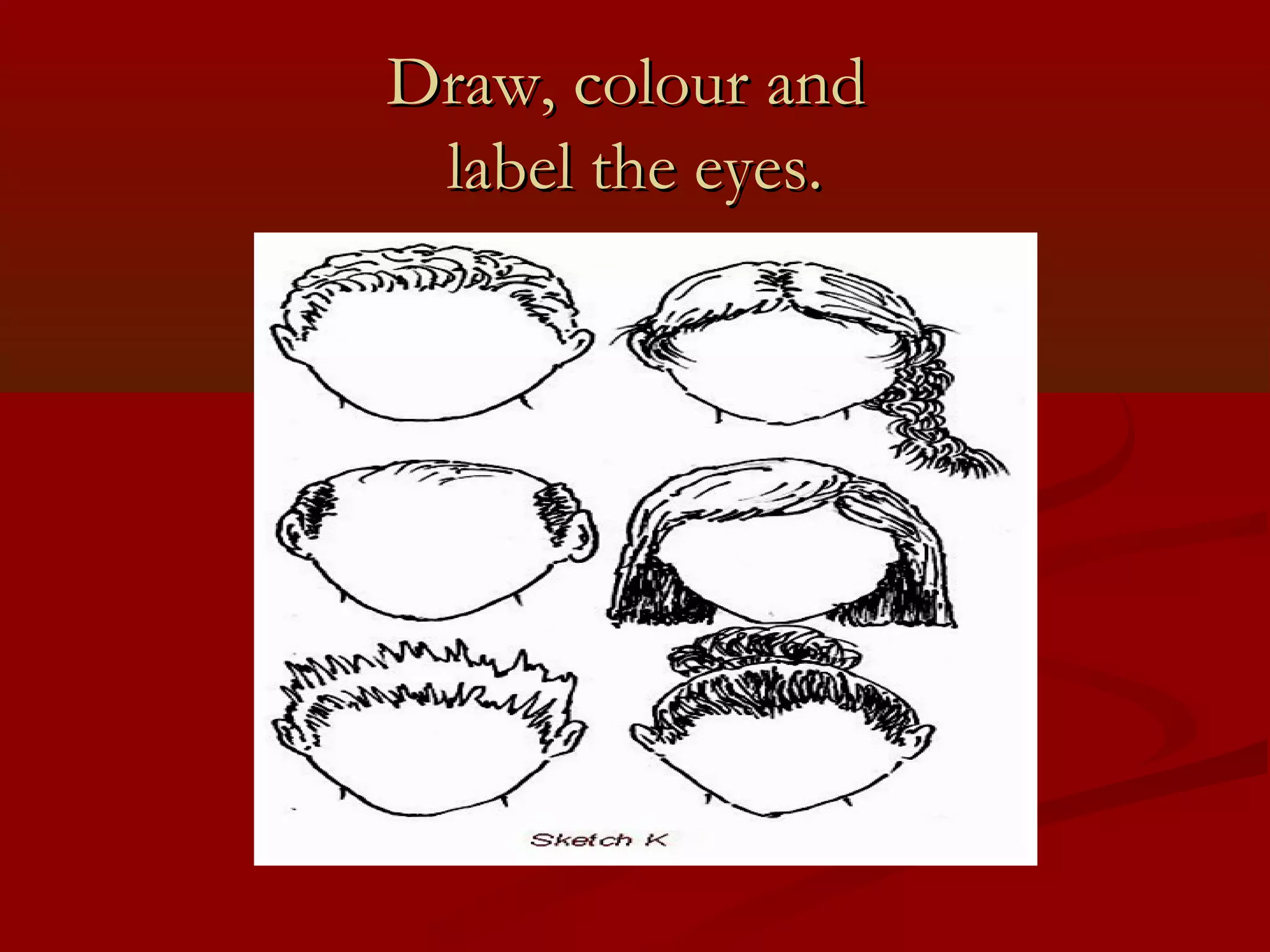
Draw, colour and
 label the eyes.
Steps
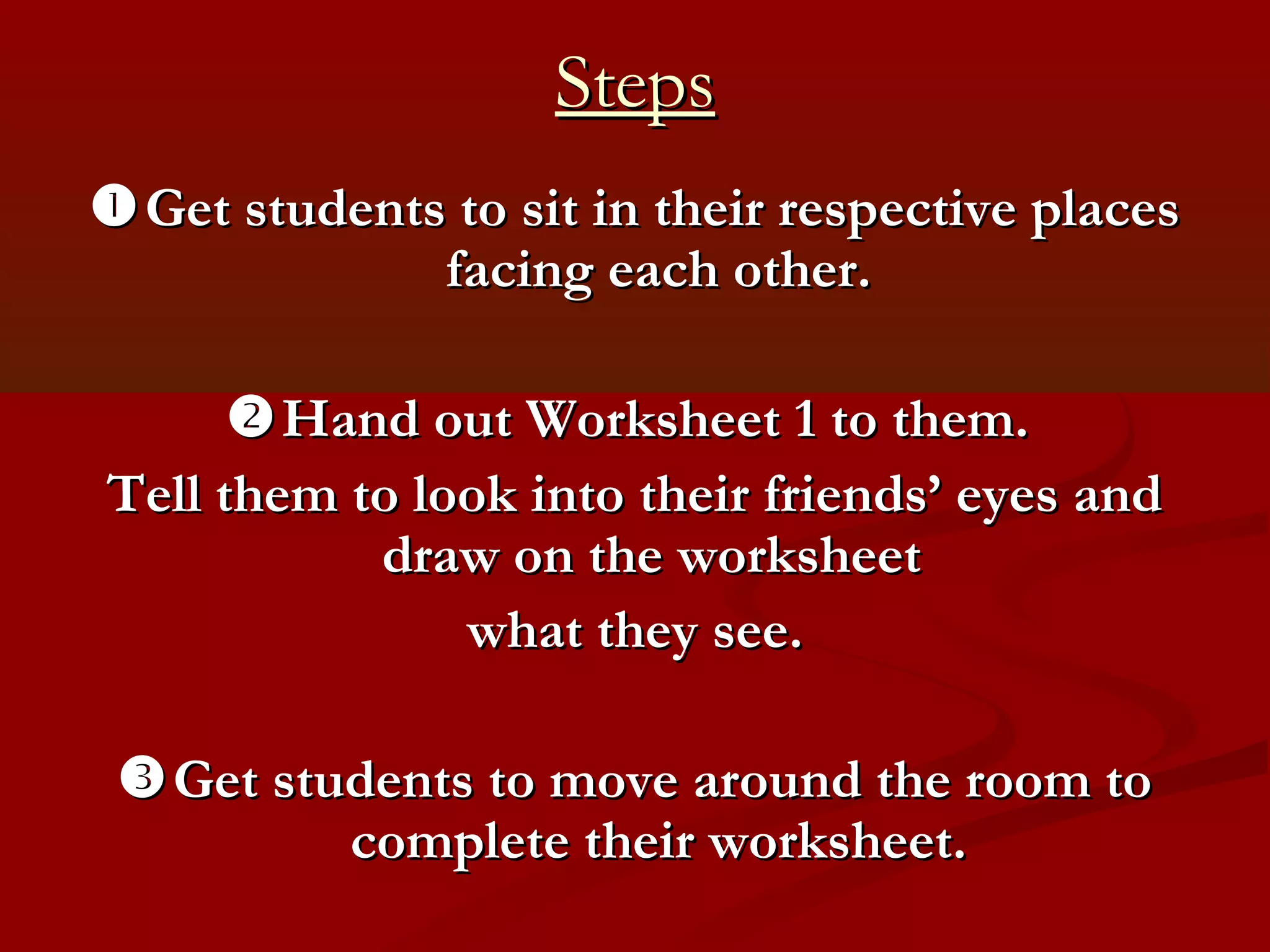
 Get students to sit in their respective places
              facing each other.

       Hand out Worksheet 1 to them.
Tell them to look into their friends’ eyes and
           draw on the worksheet
               what they see.

  Get students to move around the room to
          complete their worksheet.
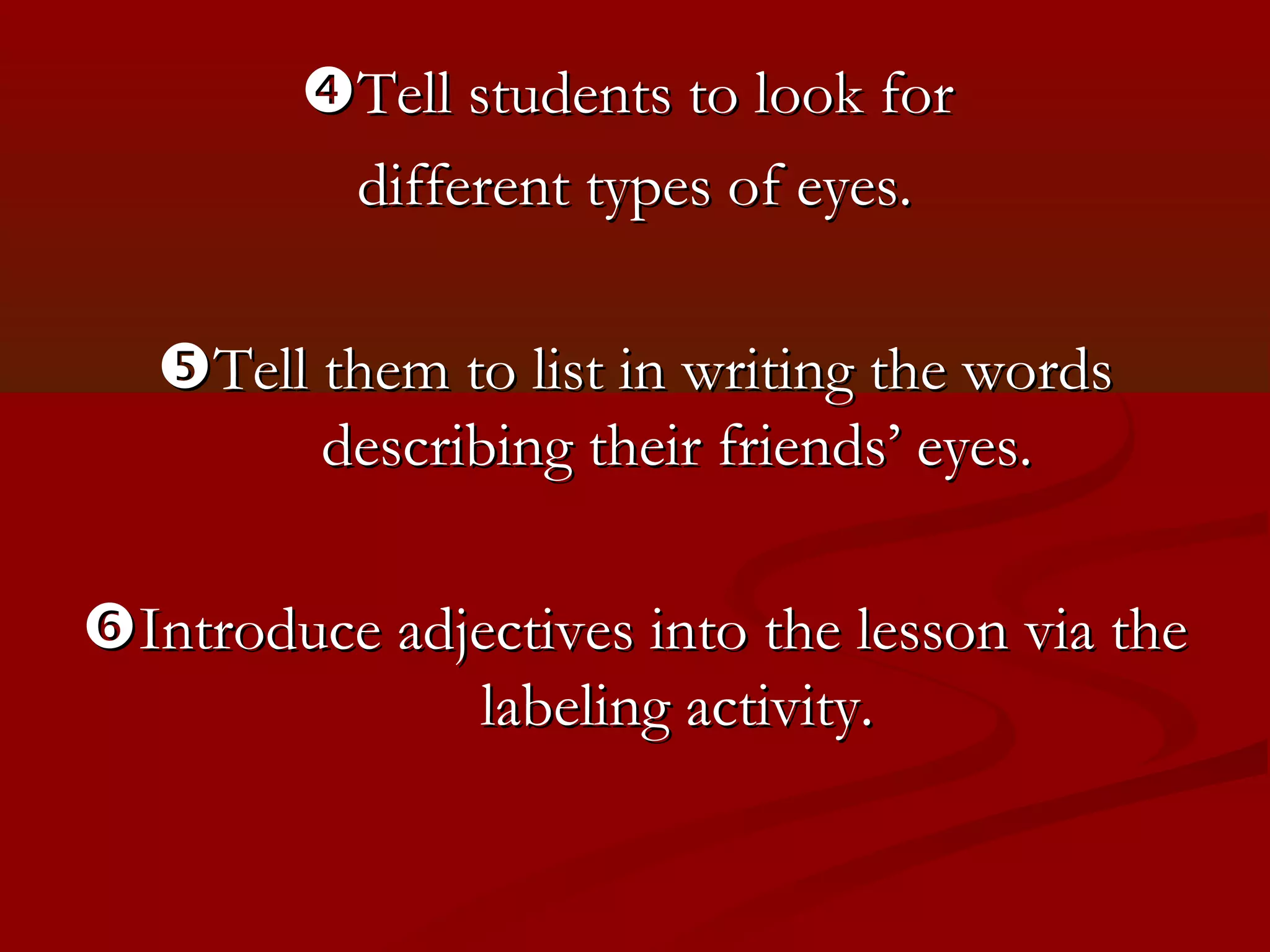
Tell students to look for
         different types of eyes.

   Tell them to list in writing the words
         describing their friends’ eyes.

Introduce adjectives into the lesson via the
              labeling activity.
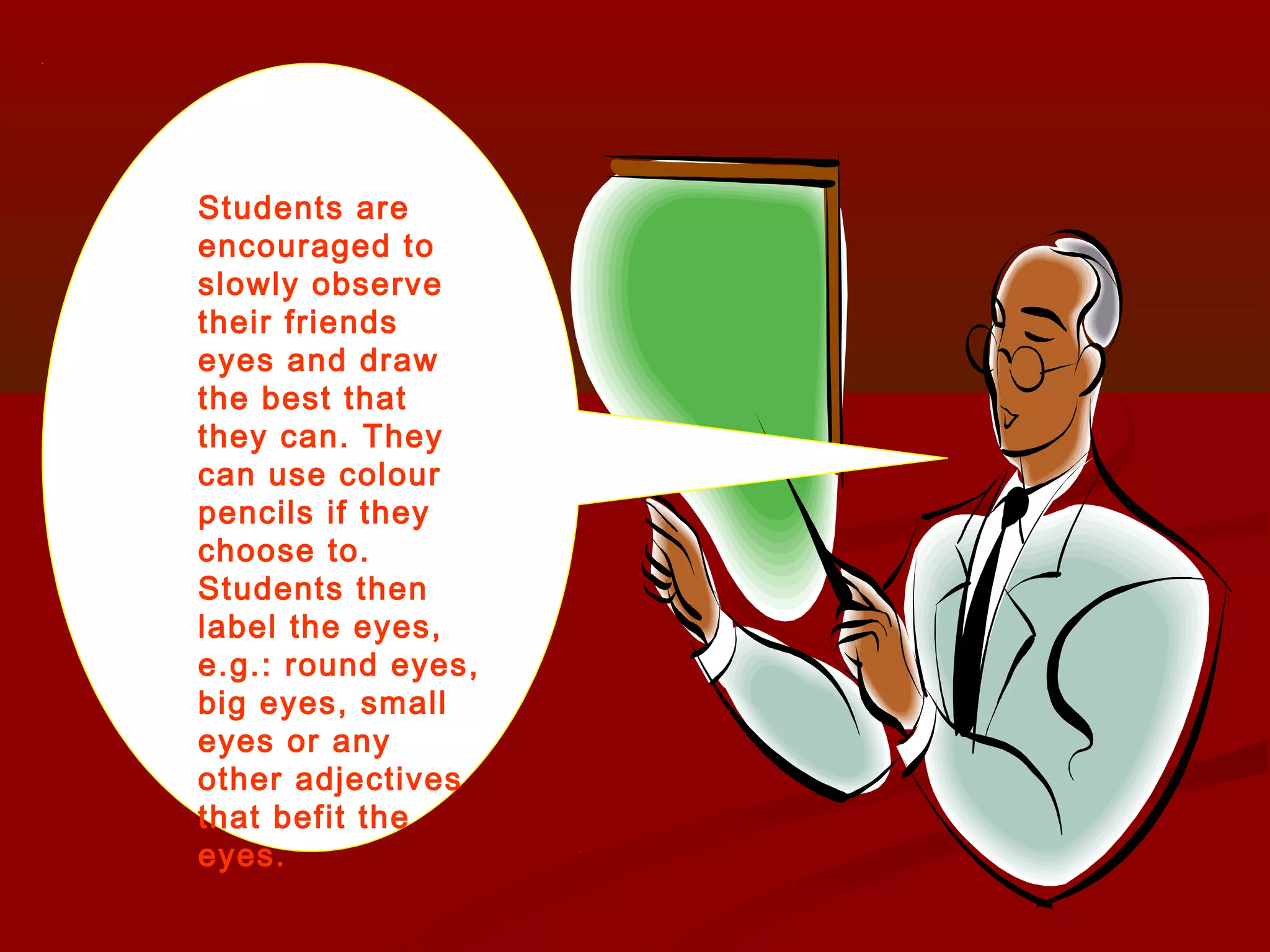
Students are
encouraged to
slowly observe
their friends
eyes and draw
the best that
they can. They
can use colour
pencils if they
choose to.
Students then
label the eyes,
e.g.: round eyes,
big eyes, small
eyes or any
other adjectives
that befit the
eyes.
CHAIN READING

               Aims
 To read poem aloud with correct
 stress, intonation, pronunciation
 and expression
Materials


The Poetry Text
Steps
1. Tell students to make two big circles in
  the classroom. Each group consists of 19
  students.

2. Get a student to read a line, starting from
  the title, followed by the name of the poet
  Bibsy Soenharjo and the seventeen lines of
  the poem.
3. Encourage students to read with
  expression and tell them to try to
  memorise the lines.
4. Once the reading starts, it must be
  continuous so that the chain ( flow )
  will not be broken.
5. Let the students read a few rounds to
  be familiar with the poem.
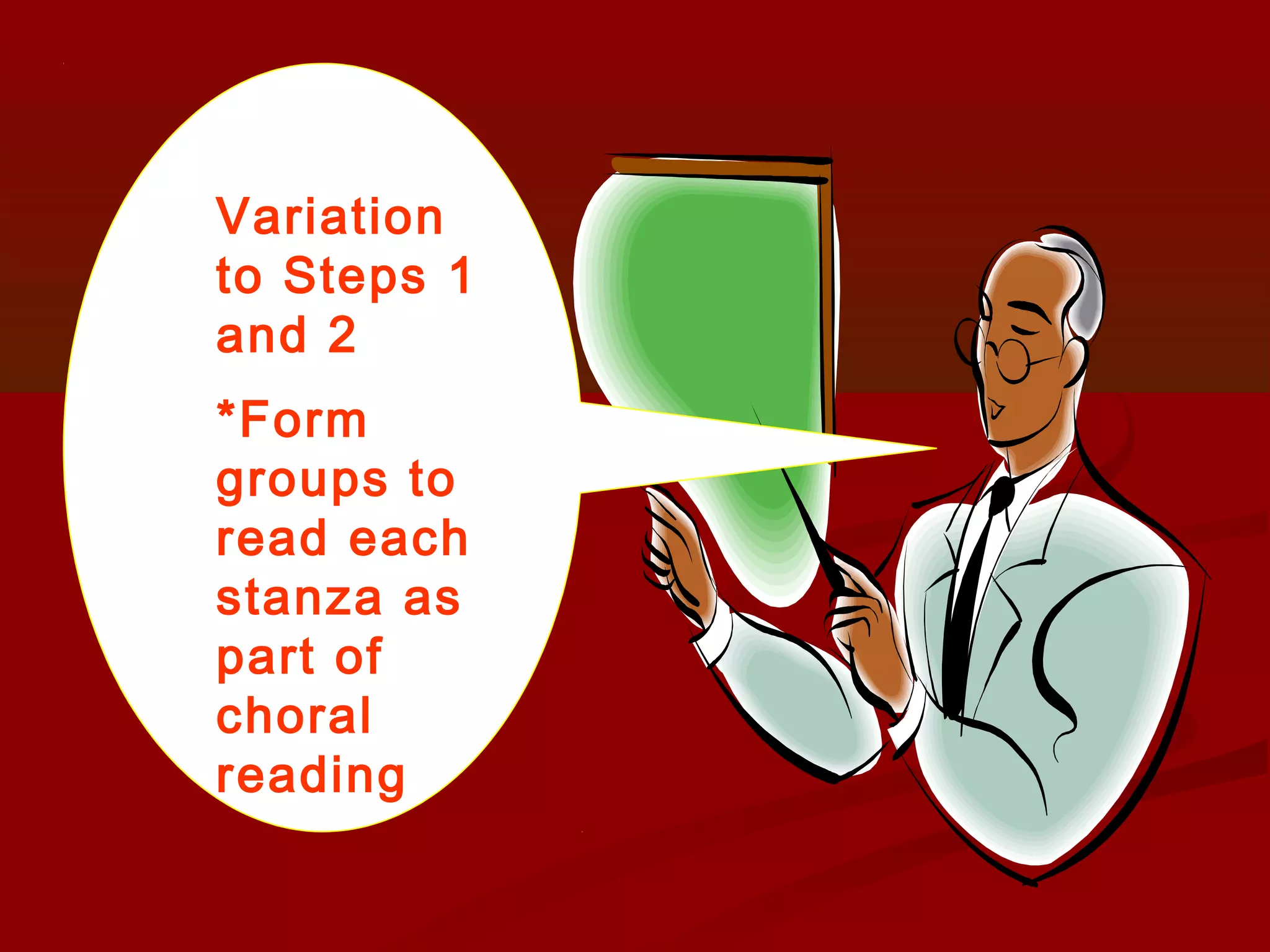
Variation
to Steps 1
and 2
*Form
groups to
read each
stanza as
part of
choral
reading
PUT ME STRAIGHT

                 Aims
 To introduce rhythm in a fun way

 To train students in spelling

 To encourage team work in a fun
 way
Materials
   Worksheet 2: Put Me Straight
Steps
   Get students to sit in groups of 3 – 4.

   Hand out Worksheet 2 to them. Tell
    students to unscramble the letters to form
    words that will in turn form short
    sentences from the poem.

   The group that is able to unscramble all the
    sentences correctly wins.
Materials
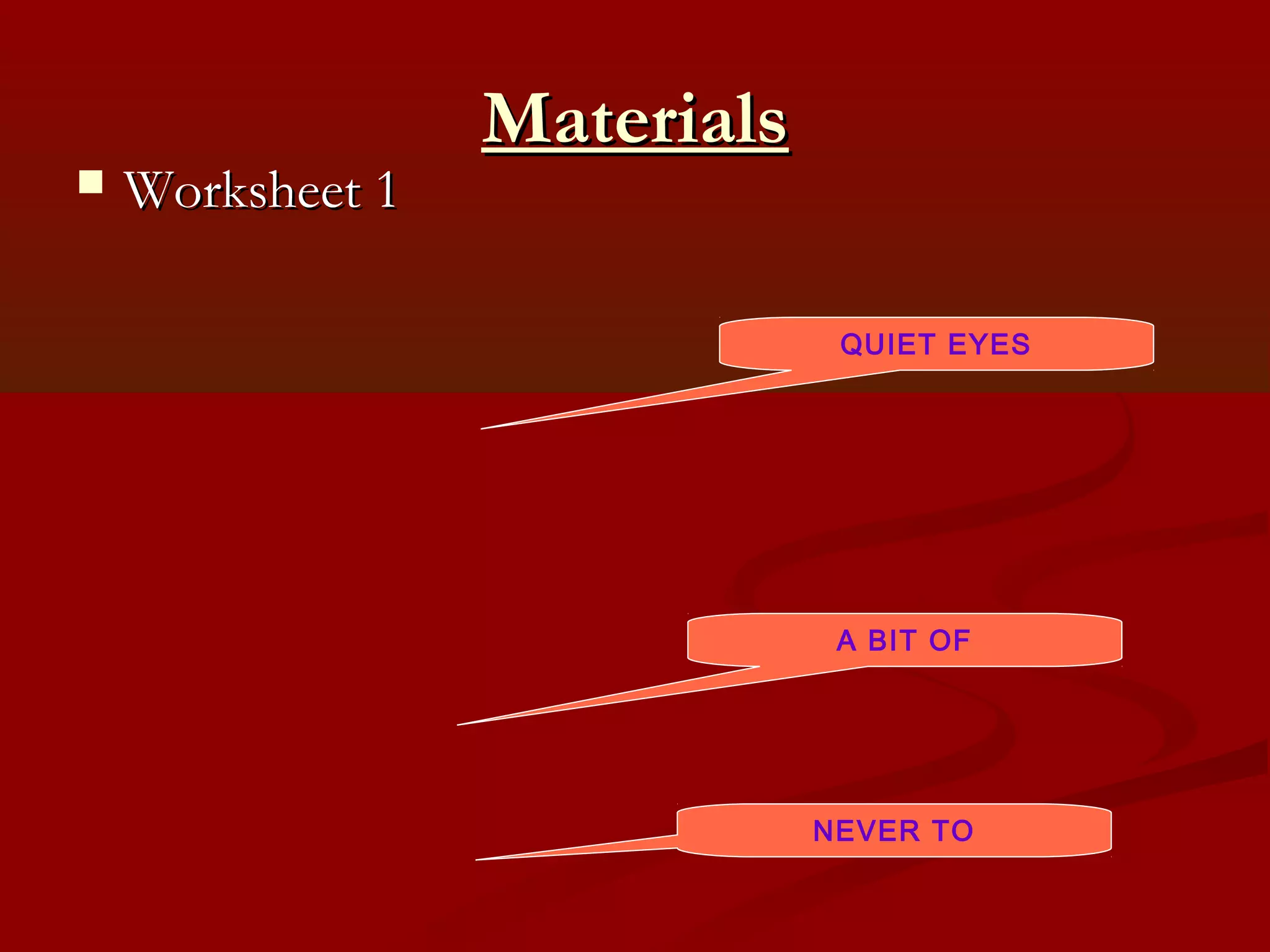
   Worksheet 1

                               QUIET EYES


                               A BIT OF


                              NEVER TO
Students
are not
encouraged
to refer to
their text
books.
The group
that finishes
with all
correct
answers
wins.
BINGO

           AIMS

To identify meanings of
 words
Materials


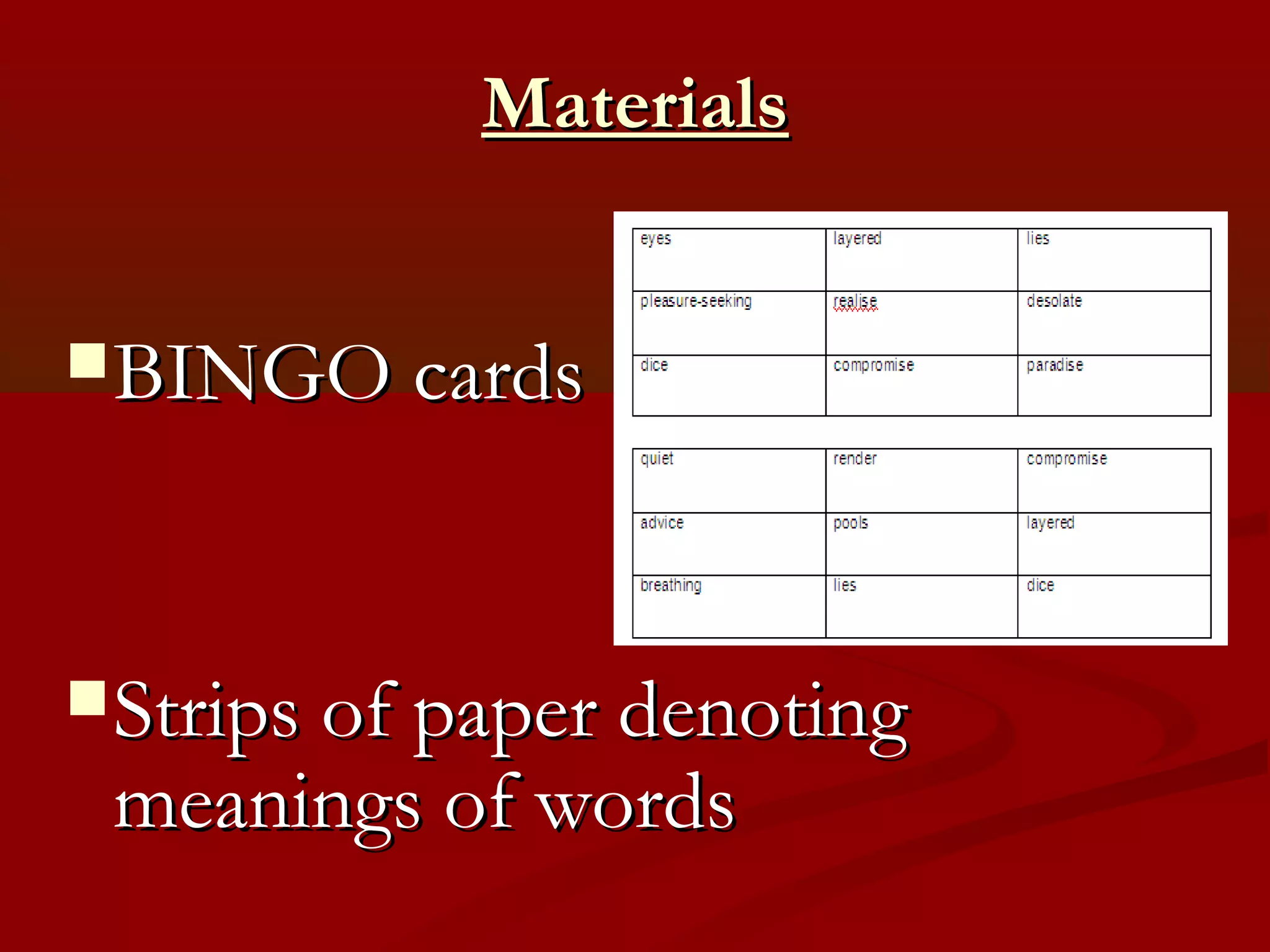
 BINGO cards


 Strips of paper denoting
 meanings of words
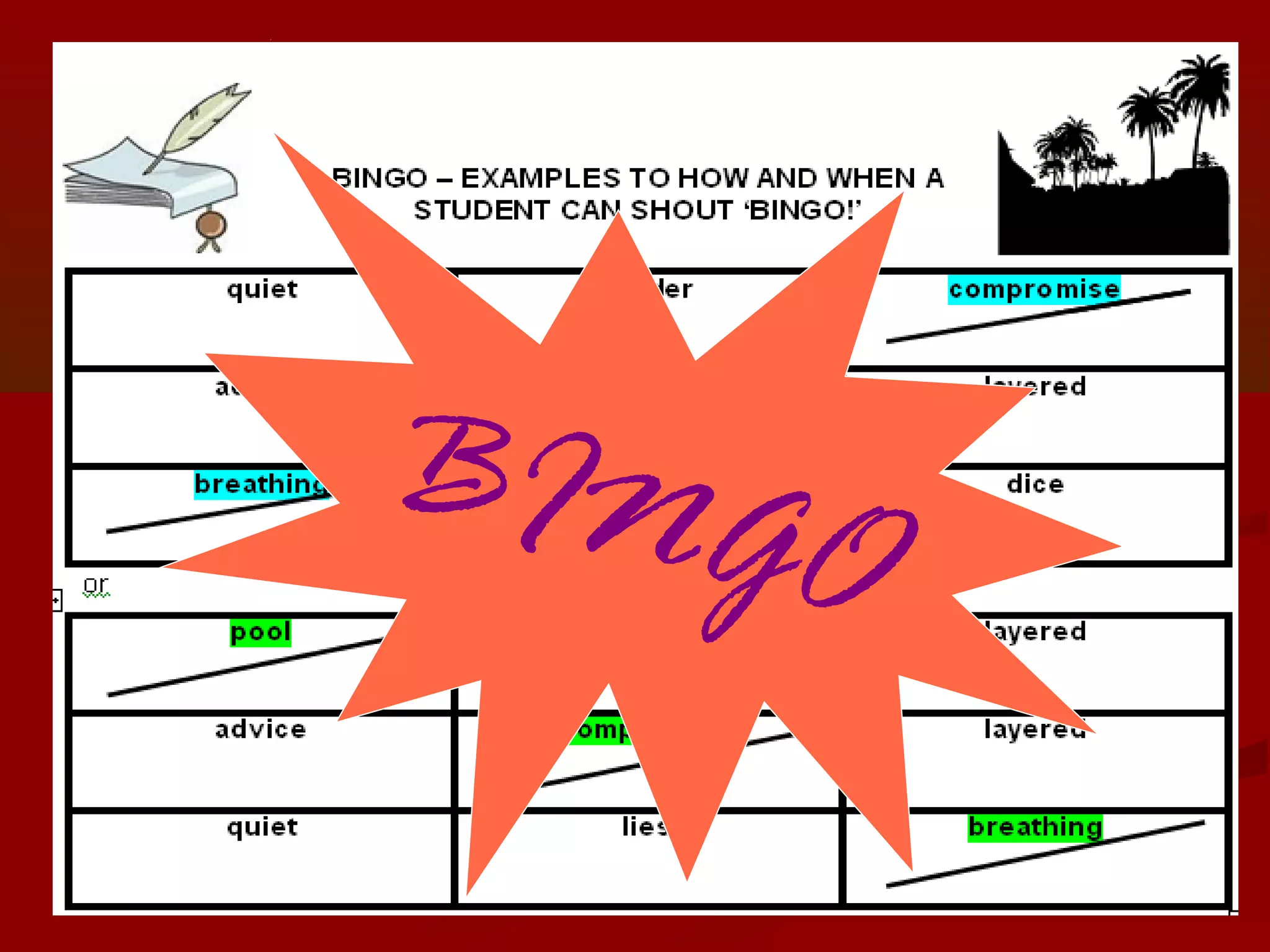
BINGO
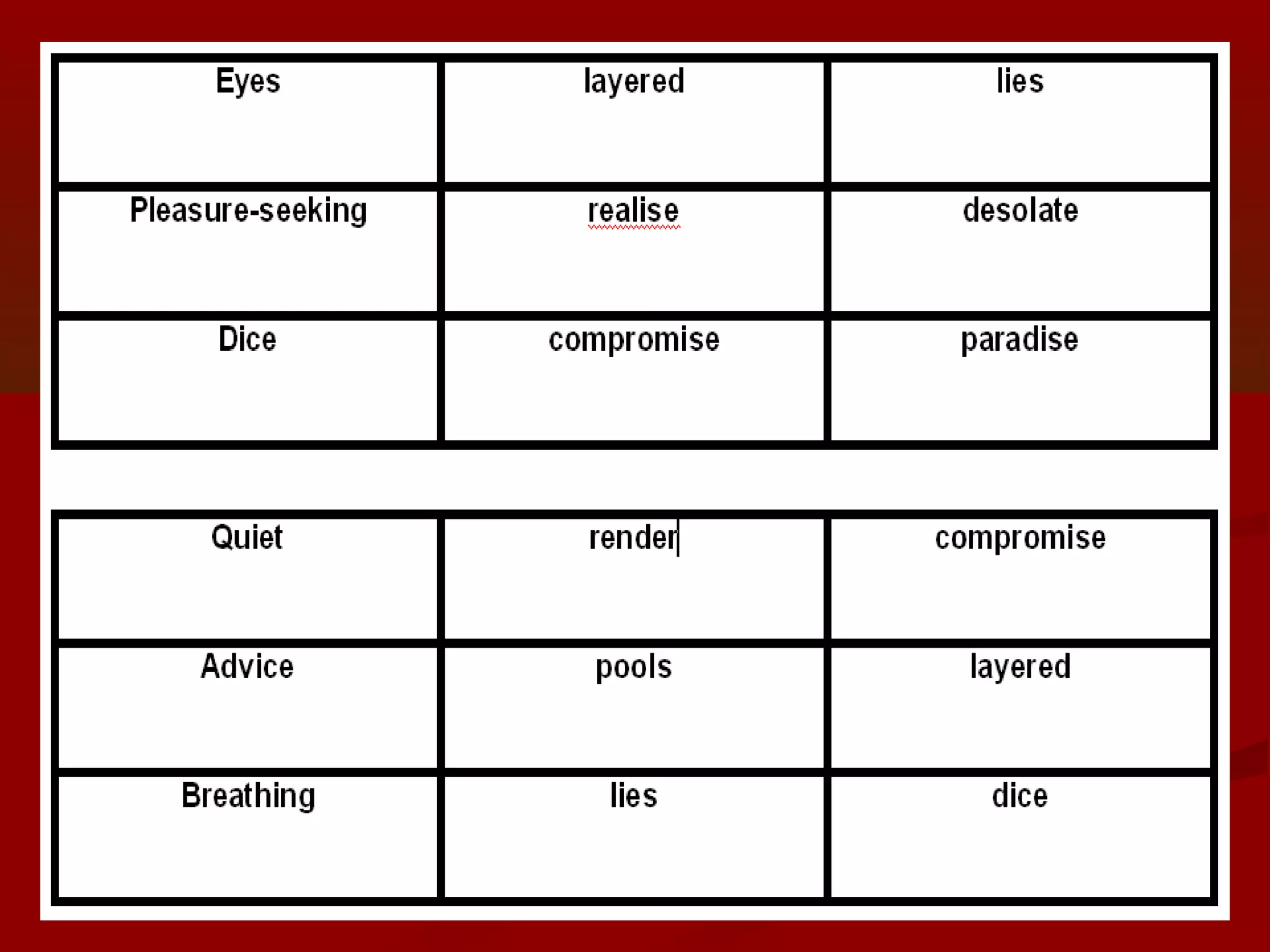
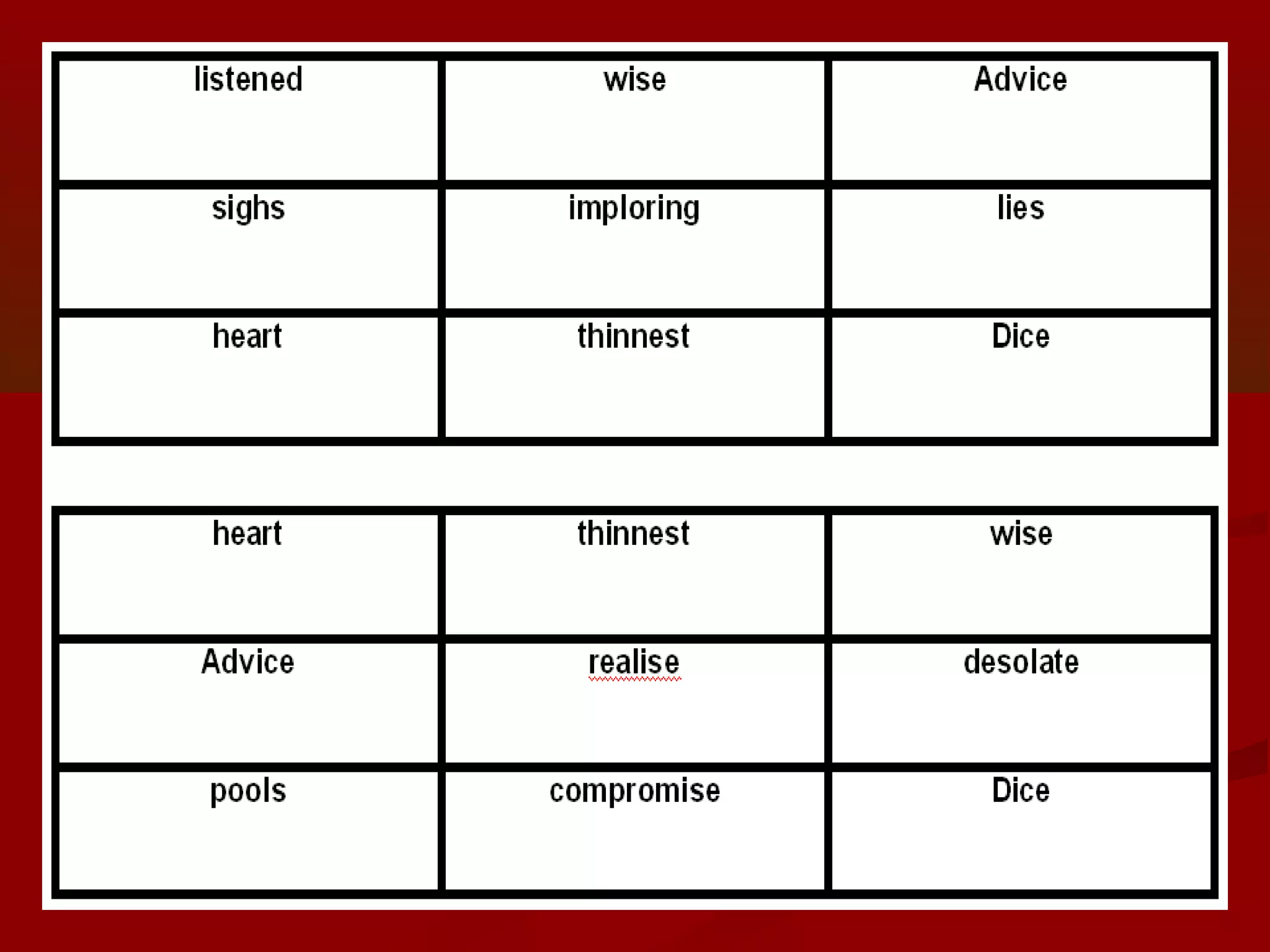
 Teacher prepares the BINGO cards in
  advance. Each student will be given a
   BINGO card / paper ( Hollywood
  Squares ) with different combinations
     of words found in the poem
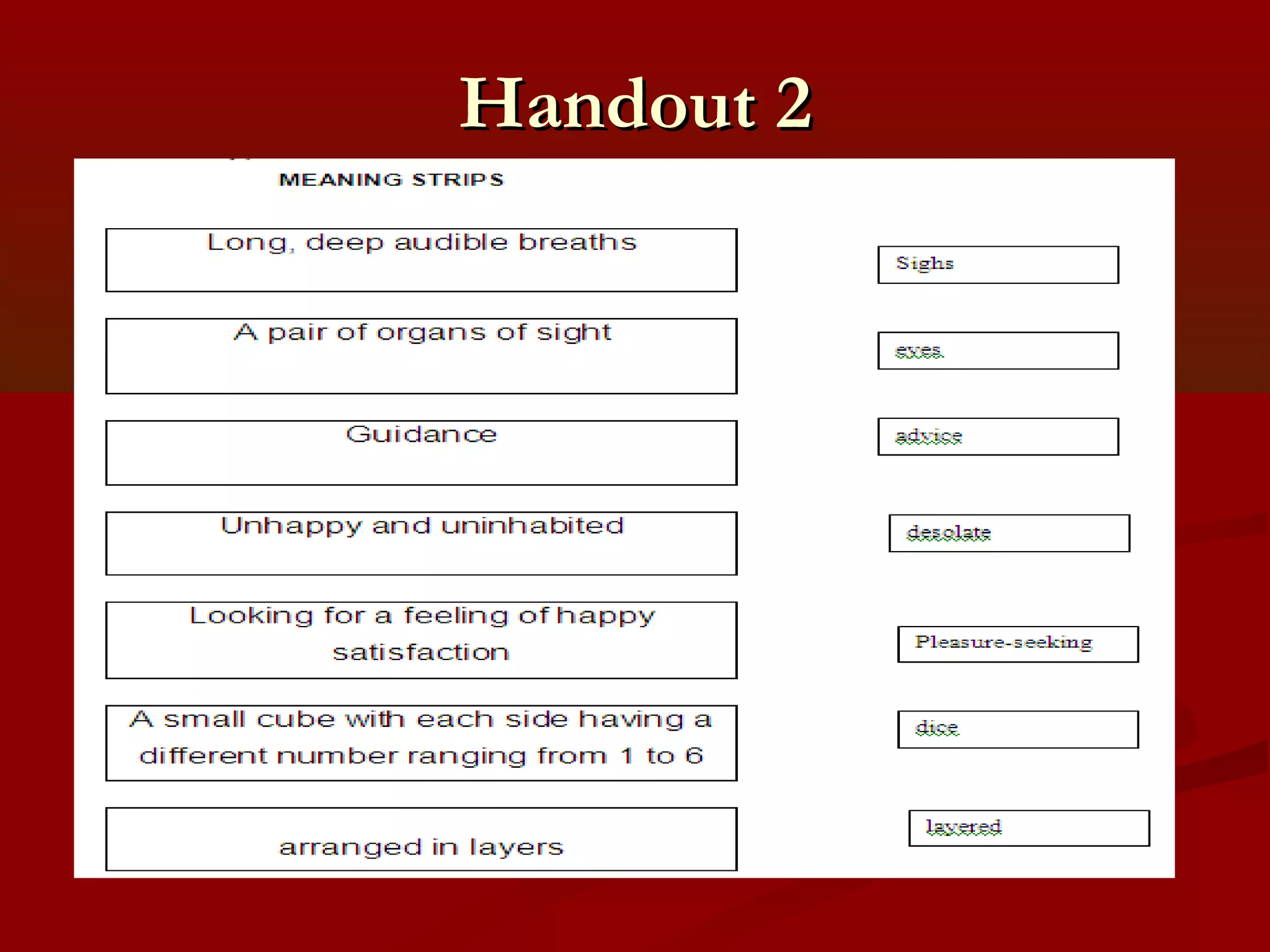
Handout 2
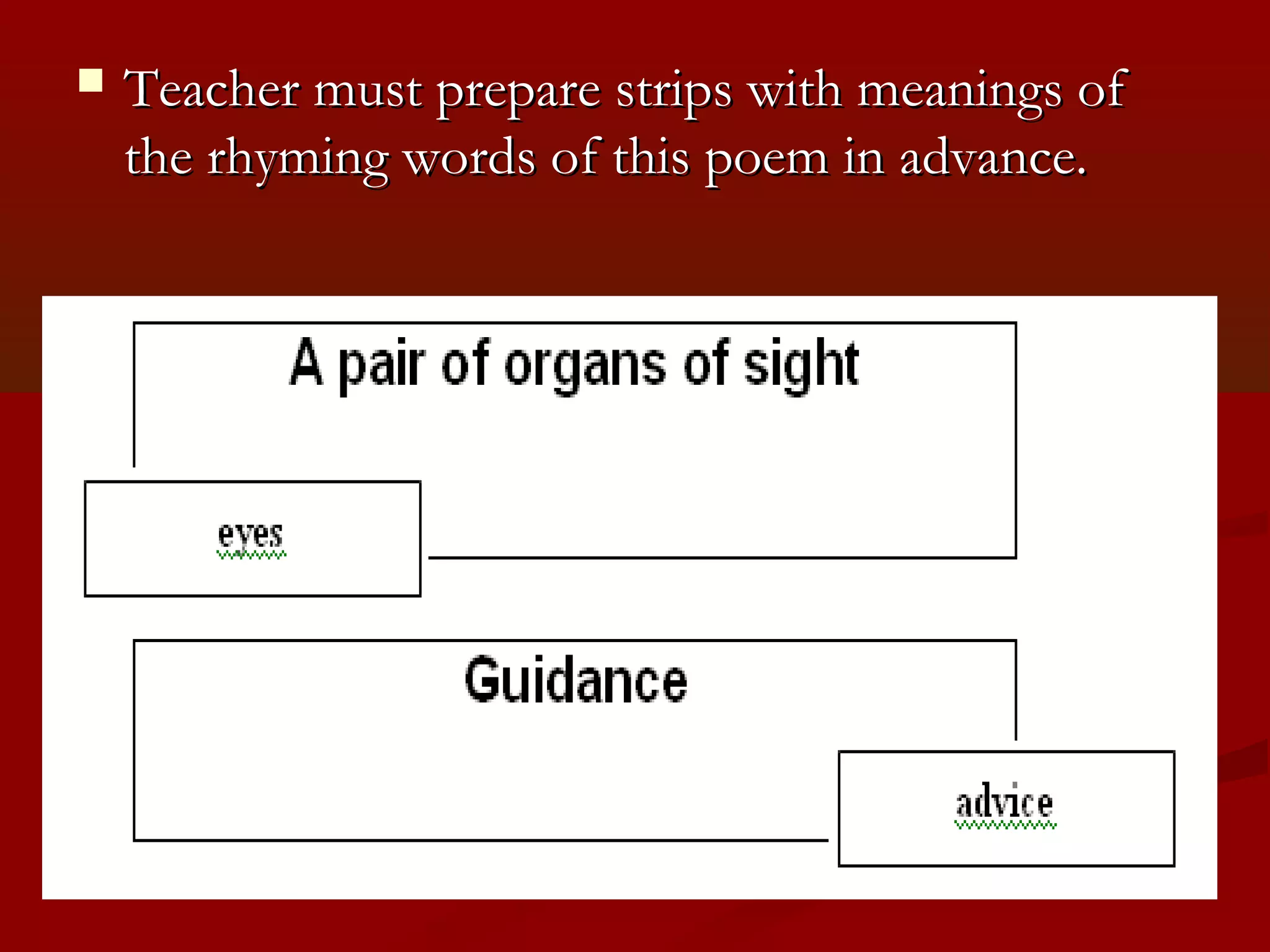
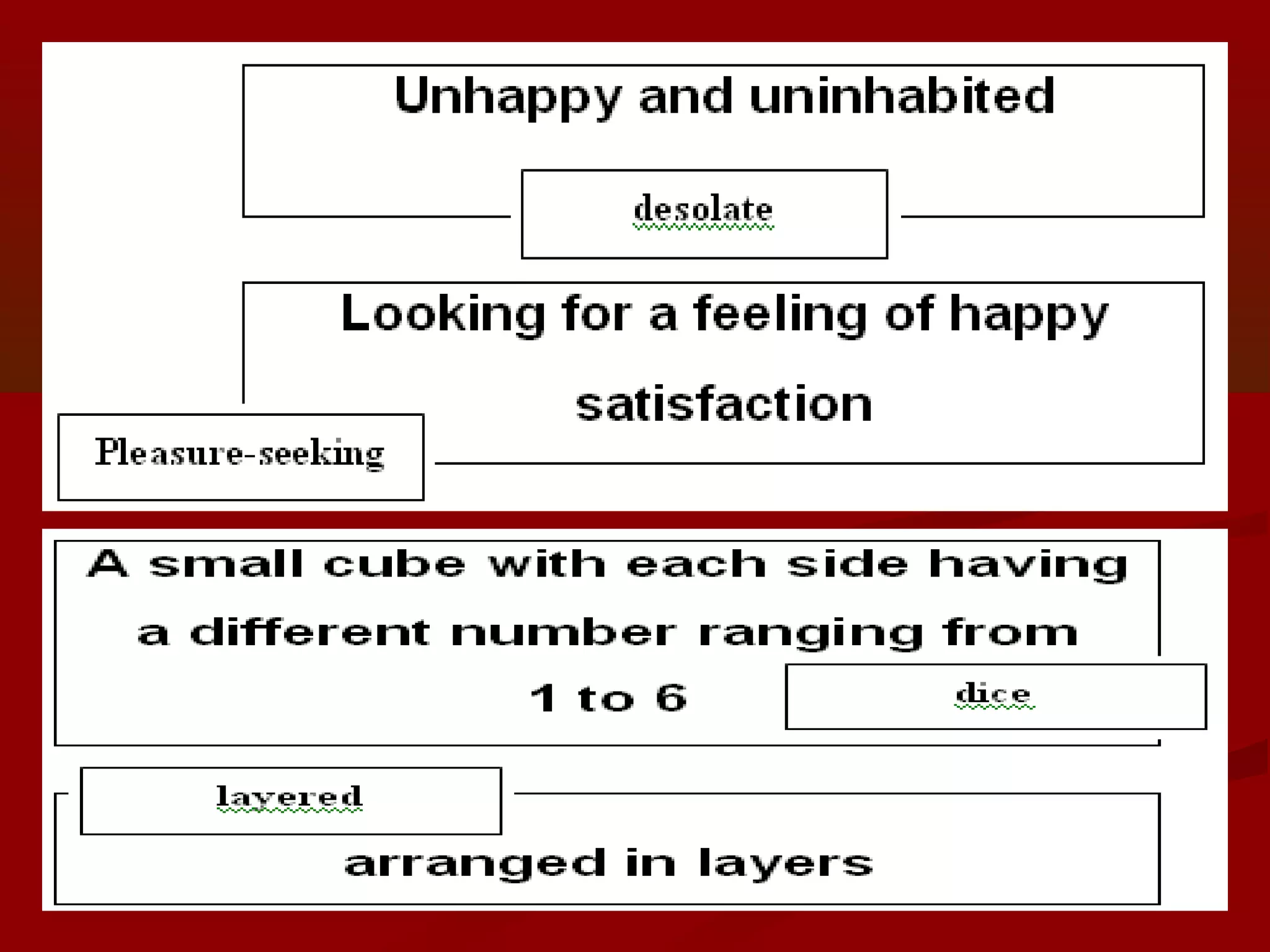
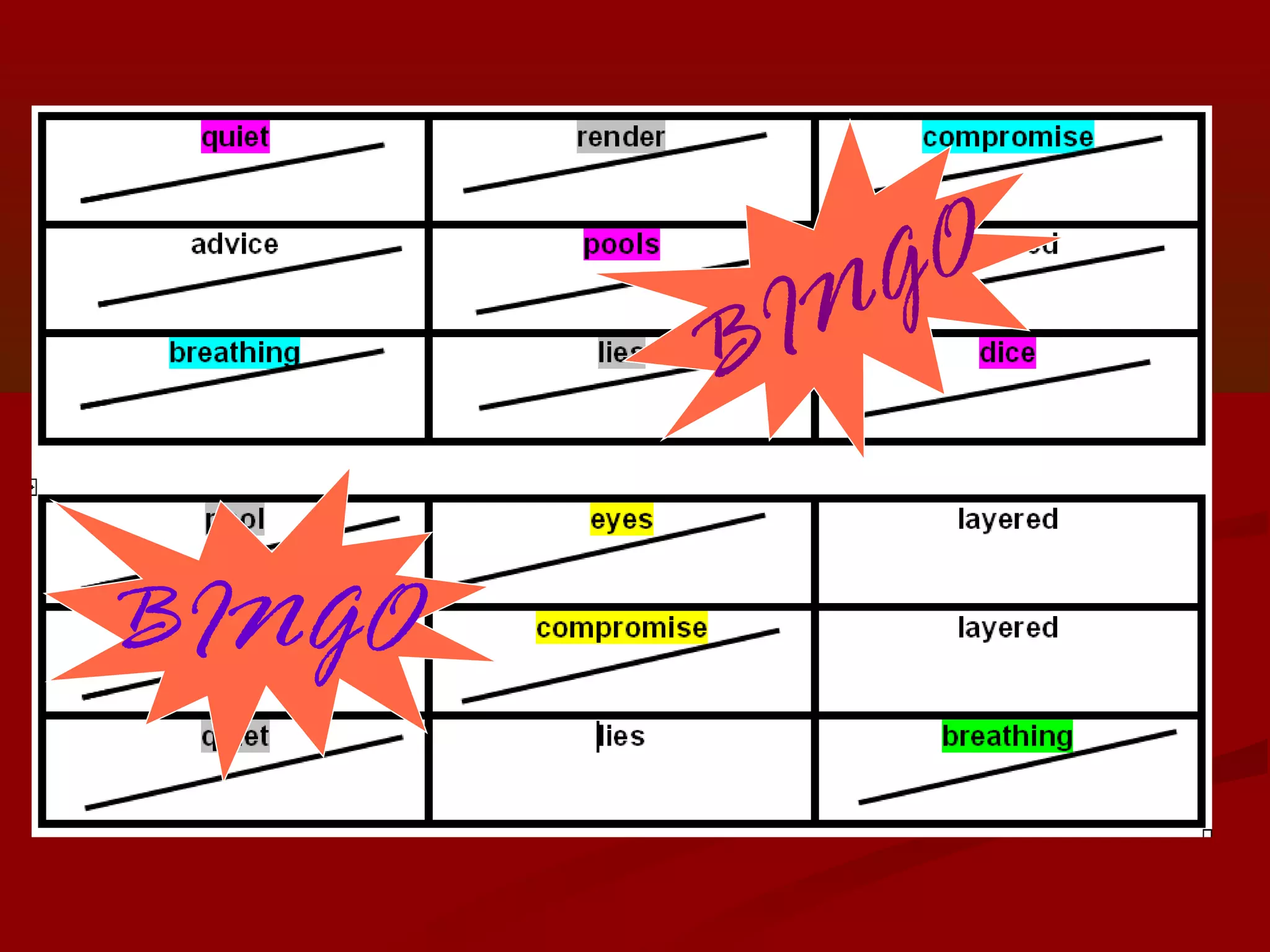
   Teacher must prepare strips with meanings of
    the rhyming words of this poem in advance.
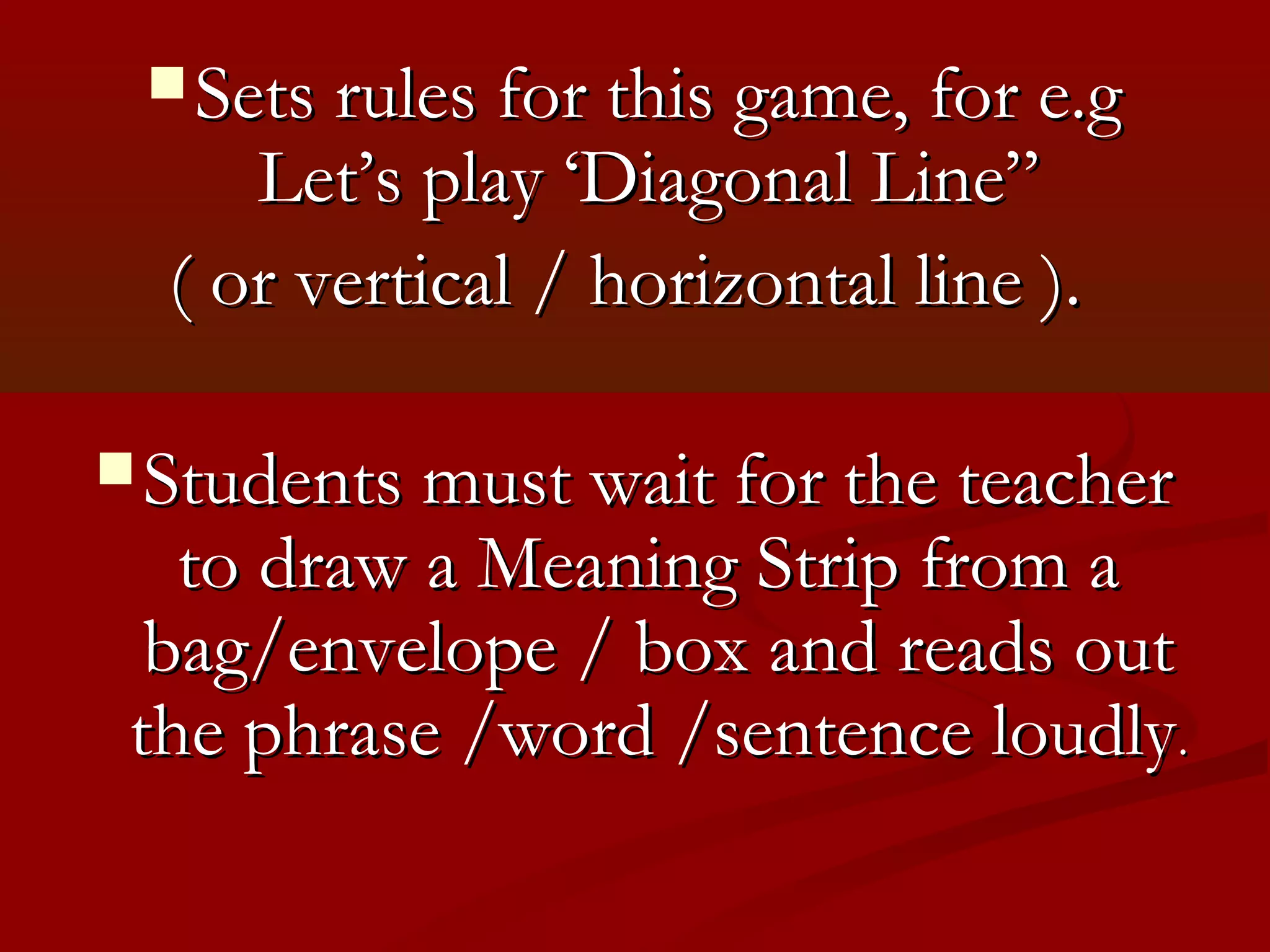
 Sets rules for this game, for e.g
     Let’s play ‘Diagonal Line”
  ( or vertical / horizontal line ).

 Students must wait for the teacher
   to draw a Meaning Strip from a
  bag/envelope / box and reads out
 the phrase /word /sentence loudly.
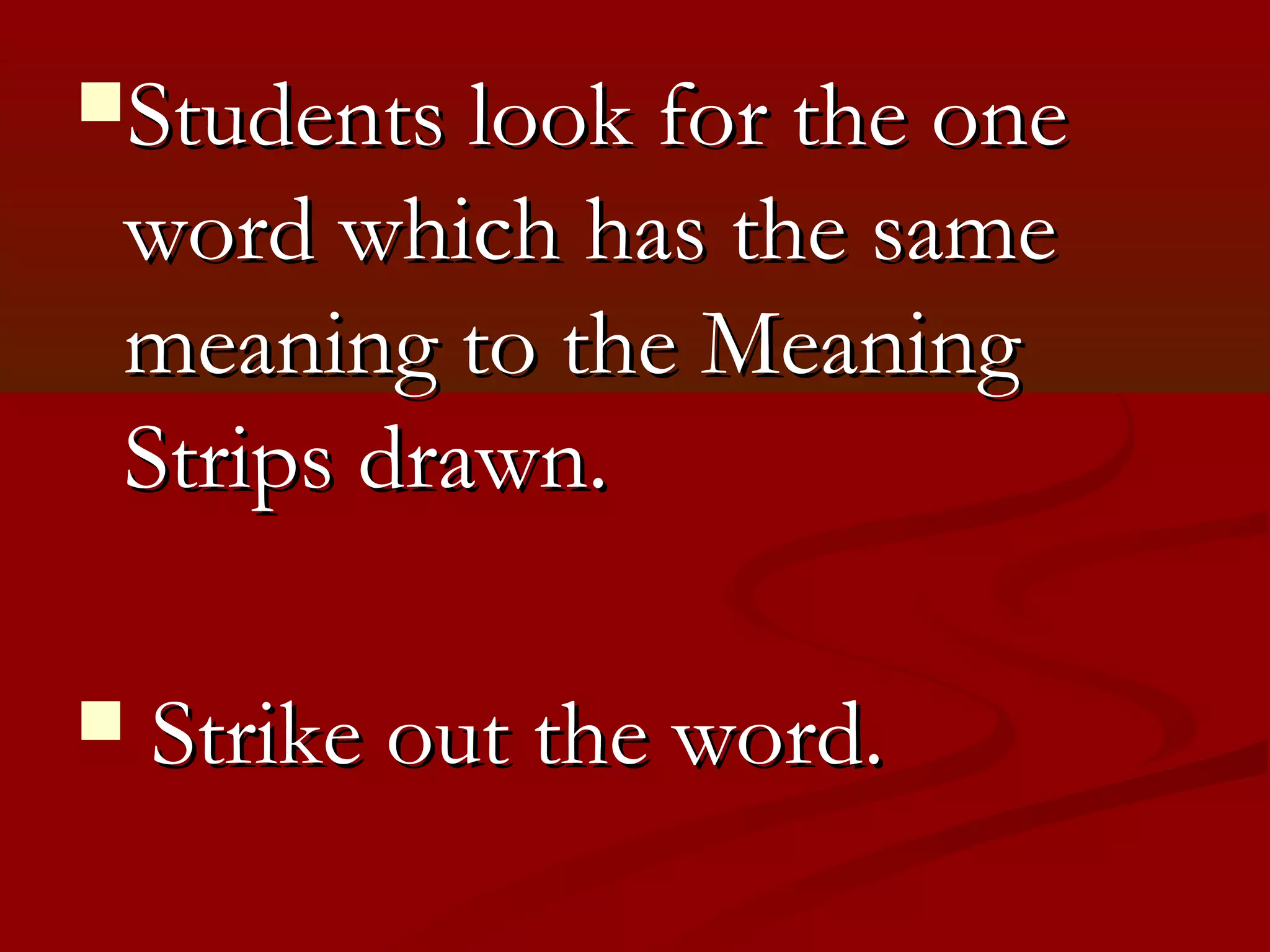
Students look for the one
 word which has the same
 meaning to the Meaning
 Strips drawn.

   Strike out the word.
BING
     O
G O
        BIN

BINGO
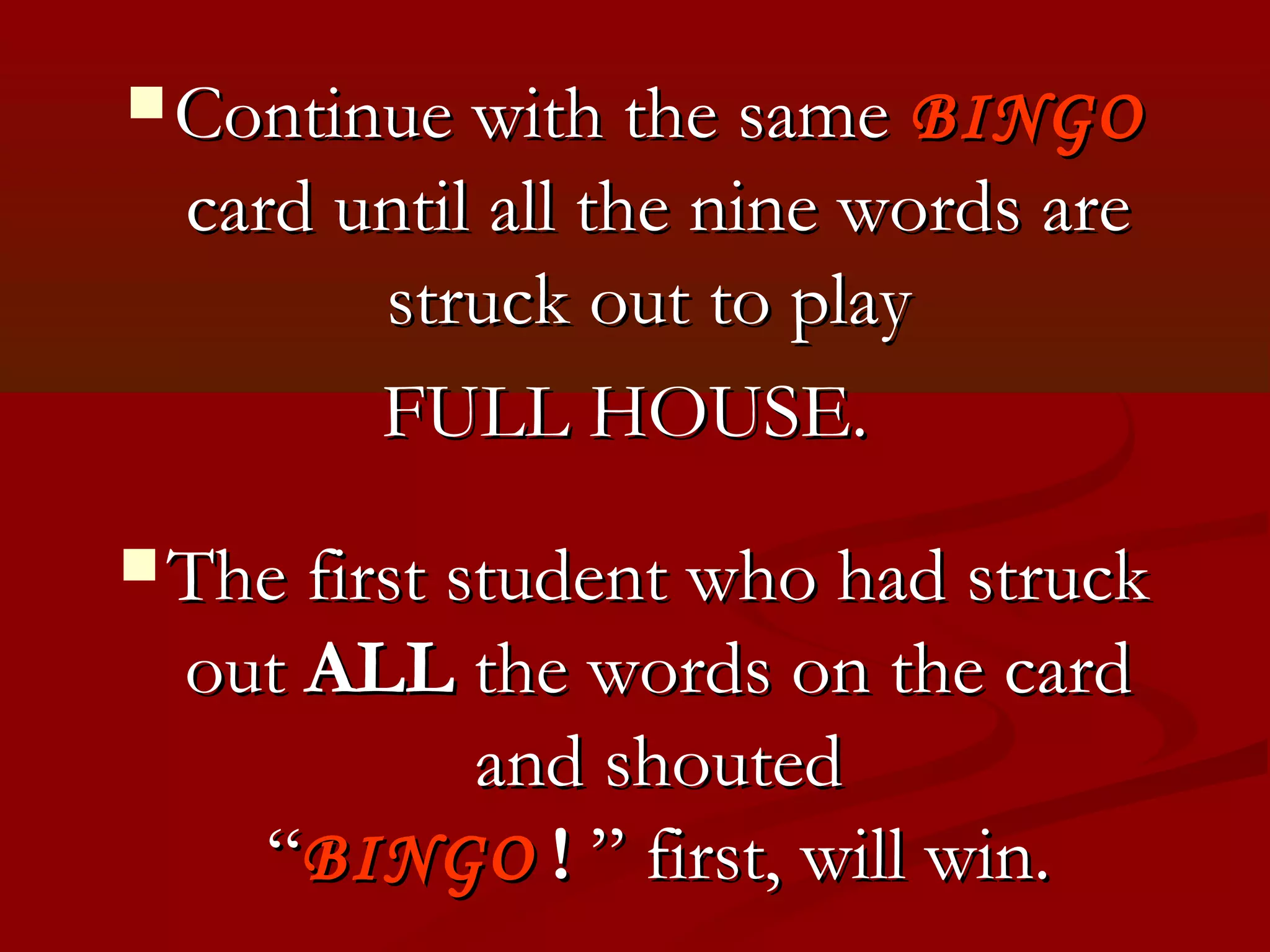
 Continue with the same   BINGO
  card until all the nine words are
        struck out to play
        FULL HOUSE.
 The first student who had struck
  out ALL the words on the card
          and shouted
    “BINGO ! ” first, will win.
VARIATION
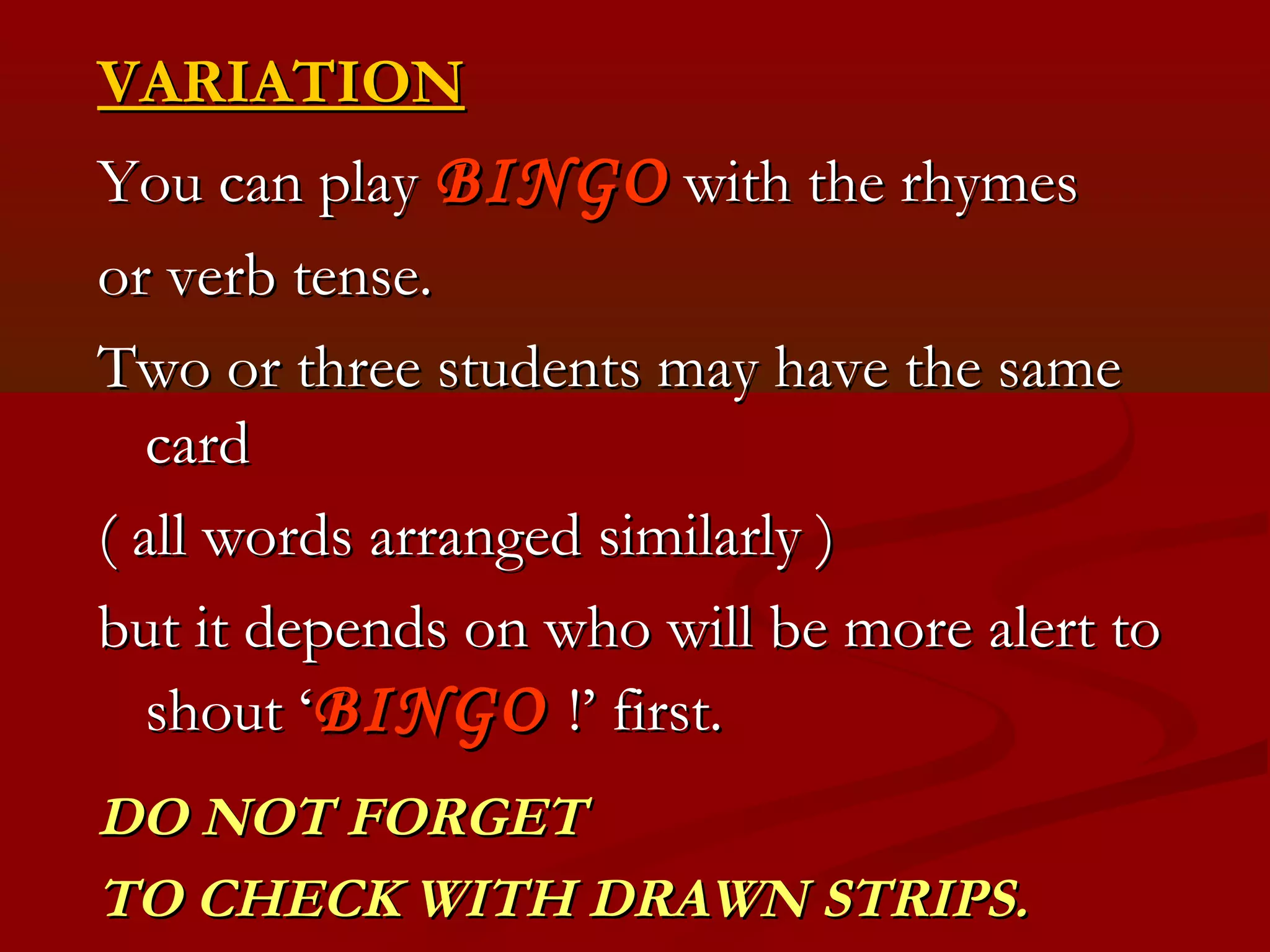
You can play BINGO with the rhymes
or verb tense.
Two or three students may have the same
   card
( all words arranged similarly )
but it depends on who will be more alert to
   shout ‘BINGO !’ first.
DO NOT FORGET
TO CHECK WITH DRAWN STRIPS.
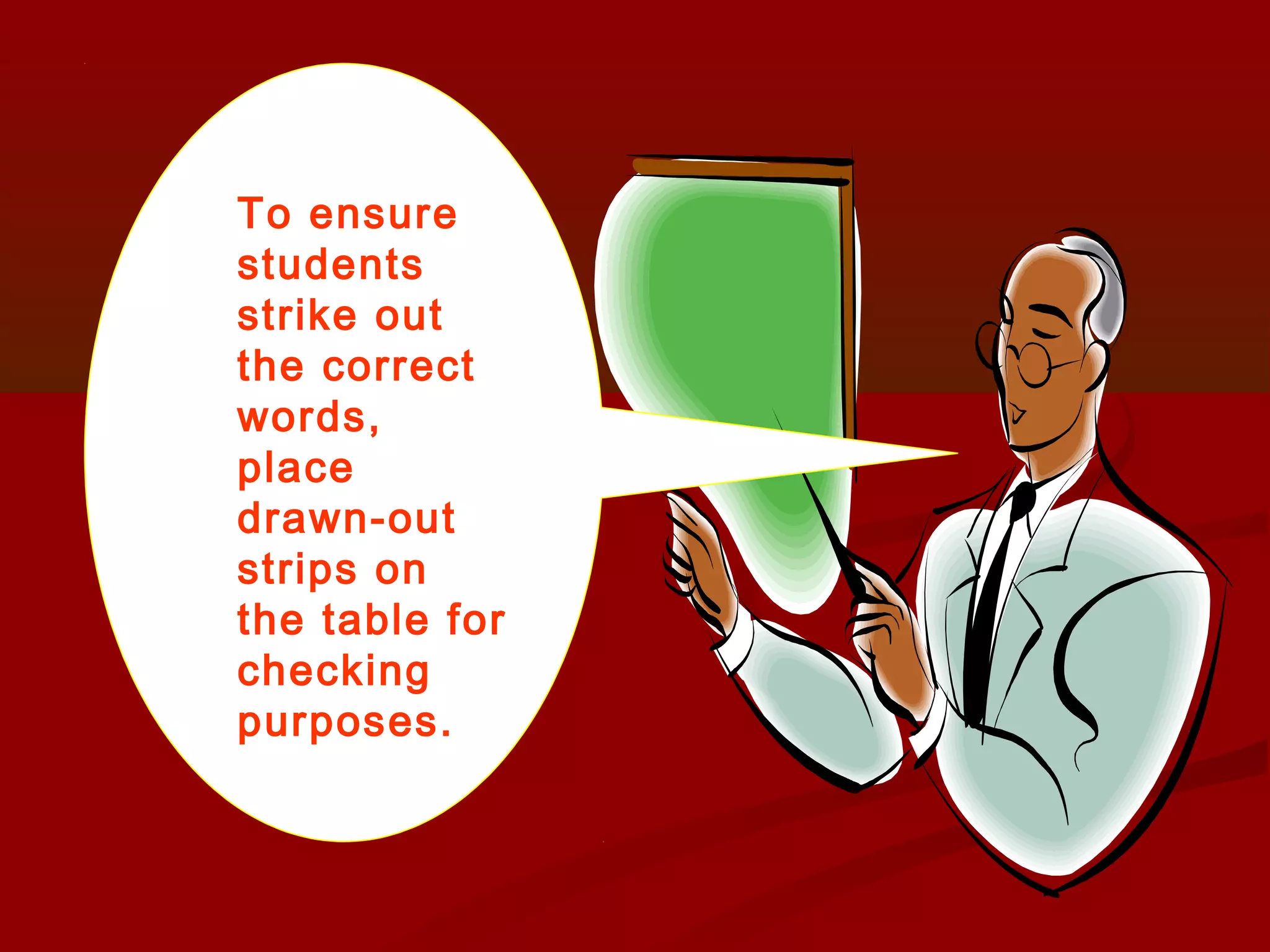
To ensure
students
strike out
the correct
words,
place
drawn-out
strips on
the table for
checking
purposes.
Haiku It!

             AIM
 To enable students to write a
 simple poem
Materials


 The Poem


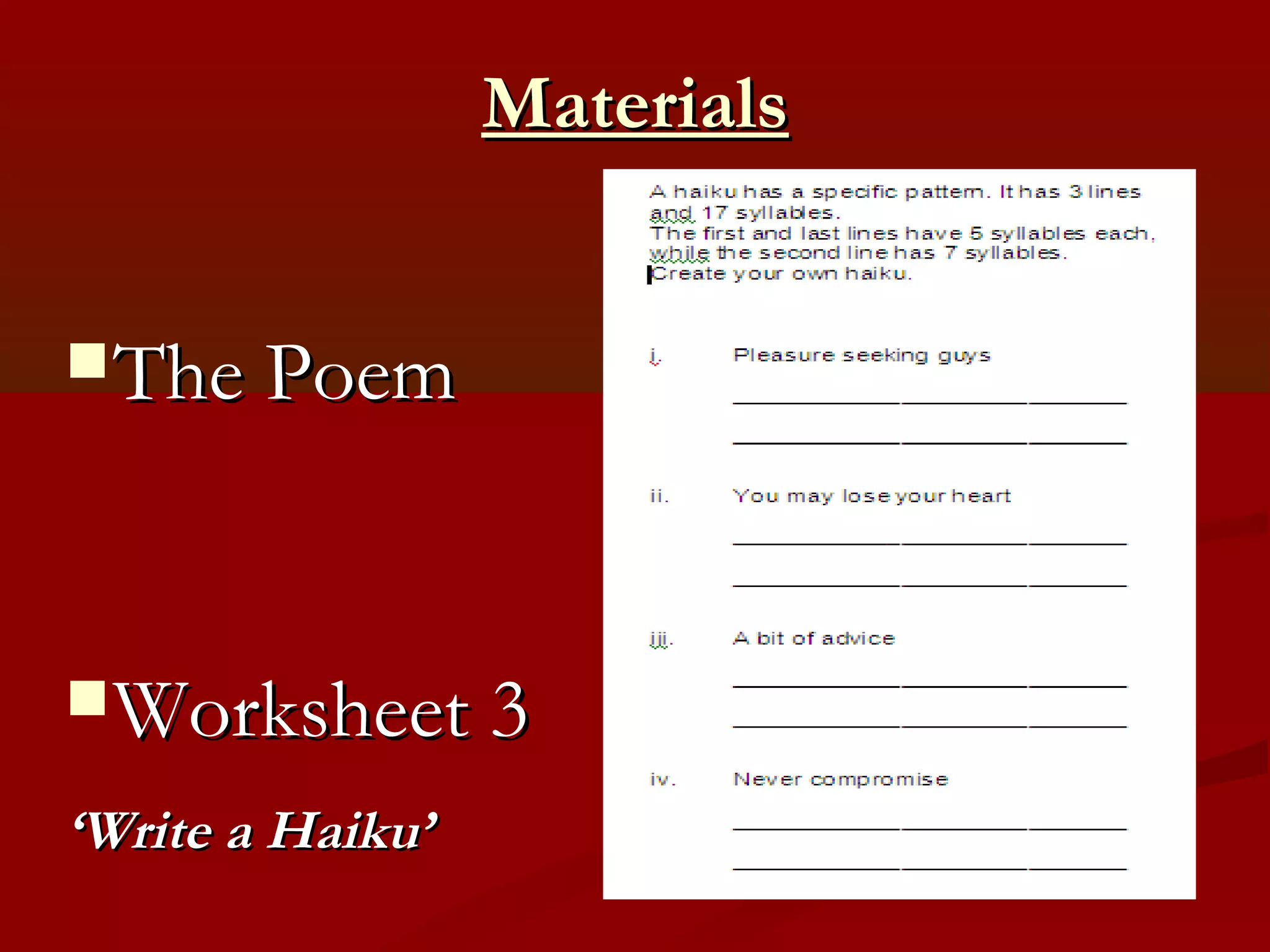
 Worksheet 3

‘Write a Haiku’
Steps
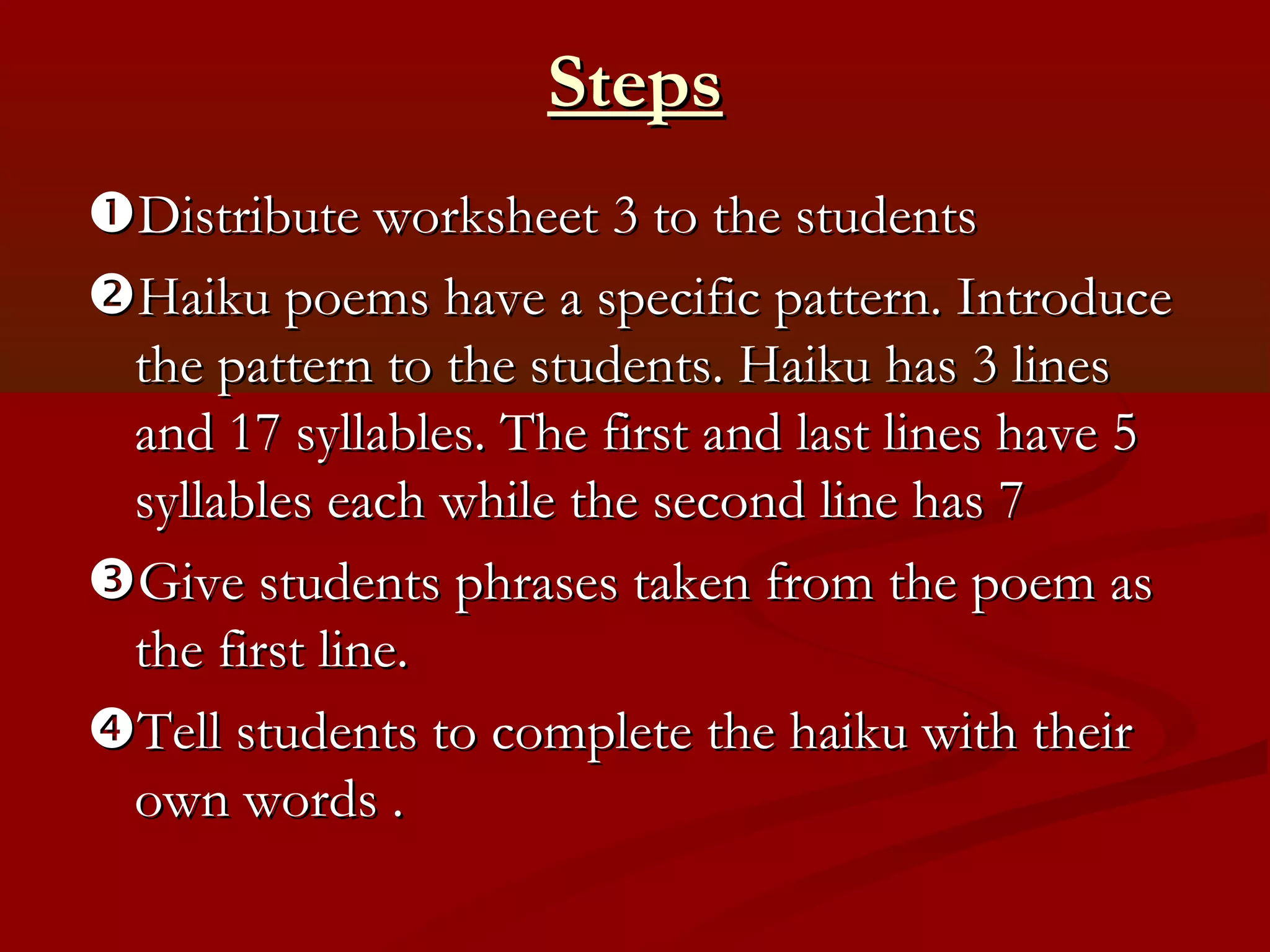
Distribute worksheet 3 to the students
Haiku poems have a specific pattern. Introduce
 the pattern to the students. Haiku has 3 lines
 and 17 syllables. The first and last lines have 5
 syllables each while the second line has 7
Give students phrases taken from the poem as
 the first line.
Tell students to complete the haiku with their
 own words .
 Give them       the following instructions:
   The chair is a hot seat.
   The person sitting on the chair is suspected to be Mr Nobody.
   Students are to ask Mr Nobody questions about what he does. This is
    where the content of the poem comes in useful. This is a perfect
    opportunity to practise ‘wh’ questions.
   Students can also ask about Mr. Nobody’s other wrongdoings (which
    may not be in the poem). Let their imagination run!
   Mr. Nobody has to refute/deny their accusations. His role is to
    convince the group that he is not Mr Nobody. Alternatively, his role
    could be to convince them that he is not guilty of any wrongdoings as
    mentioned in the poem.


 Get other students to try out the HOT SEAT.
HE HAD SUCH
 QUIET EYES

Quiet eyes presentation power point

  • 3.
    HE HAD SUCHQUIET EYES by BIBSY SOENHARJO  SYNOPSIS The poem is about a persona, a lady who fell for the wrong man. She was fascinated with his ‘quiet eyes’ and believed that his eyes showed his true emotion and feelings for her. The man’s eyes had the power to charm her and made her believe him and be nice to him. However, the man was actually a ‘pleasure seeking man’, a flirt. As the lady was truly fascinated and charmed by the man, she did not listen or did not want to listen to any advice concerning the man’s true behaviour. In the end, she realized her error and was broken hearted.
  • 4.
    DO YOU KNOWME? Aims To enable students to observe and describe features using adjectives To encourage students to put their creativity to work
  • 5.
    Materials  Worksheet 1: Do You Know Me?
  • 6.
    Draw, colour and label the eyes.
  • 7.
    Steps  Get studentsto sit in their respective places facing each other.  Hand out Worksheet 1 to them. Tell them to look into their friends’ eyes and draw on the worksheet what they see.  Get students to move around the room to complete their worksheet.
  • 8.

    Tell students tolook for different types of eyes. Tell them to list in writing the words describing their friends’ eyes. Introduce adjectives into the lesson via the labeling activity.
  • 9.
    Students are encouraged to slowlyobserve their friends eyes and draw the best that they can. They can use colour pencils if they choose to. Students then label the eyes, e.g.: round eyes, big eyes, small eyes or any other adjectives that befit the eyes.
  • 10.
    CHAIN READING Aims  To read poem aloud with correct stress, intonation, pronunciation and expression
  • 11.
  • 12.
    Steps 1. Tell studentsto make two big circles in the classroom. Each group consists of 19 students. 2. Get a student to read a line, starting from the title, followed by the name of the poet Bibsy Soenharjo and the seventeen lines of the poem.
  • 13.
    3. Encourage studentsto read with expression and tell them to try to memorise the lines. 4. Once the reading starts, it must be continuous so that the chain ( flow ) will not be broken. 5. Let the students read a few rounds to be familiar with the poem.
  • 14.
    Variation to Steps 1 and2 *Form groups to read each stanza as part of choral reading
  • 15.
    PUT ME STRAIGHT Aims  To introduce rhythm in a fun way  To train students in spelling  To encourage team work in a fun way
  • 16.
    Materials  Worksheet 2: Put Me Straight
  • 17.
    Steps  Get students to sit in groups of 3 – 4.  Hand out Worksheet 2 to them. Tell students to unscramble the letters to form words that will in turn form short sentences from the poem.  The group that is able to unscramble all the sentences correctly wins.
  • 18.
    Materials  Worksheet 1 QUIET EYES A BIT OF NEVER TO
  • 19.
    Students are not encouraged to referto their text books. The group that finishes with all correct answers wins.
  • 20.
    BINGO AIMS To identify meanings of words
  • 21.
    Materials  BINGO cards Strips of paper denoting meanings of words
  • 22.
    BINGO  Teacher preparesthe BINGO cards in advance. Each student will be given a BINGO card / paper ( Hollywood Squares ) with different combinations of words found in the poem
  • 25.
  • 26.
    Teacher must prepare strips with meanings of the rhyming words of this poem in advance.
  • 28.
     Sets rulesfor this game, for e.g Let’s play ‘Diagonal Line” ( or vertical / horizontal line ).  Students must wait for the teacher to draw a Meaning Strip from a bag/envelope / box and reads out the phrase /word /sentence loudly.
  • 29.
    Students look forthe one word which has the same meaning to the Meaning Strips drawn.  Strike out the word.
  • 30.
  • 31.
    G O BIN BINGO
  • 32.
     Continue withthe same BINGO card until all the nine words are struck out to play FULL HOUSE.  The first student who had struck out ALL the words on the card and shouted “BINGO ! ” first, will win.
  • 33.
    VARIATION You can playBINGO with the rhymes or verb tense. Two or three students may have the same card ( all words arranged similarly ) but it depends on who will be more alert to shout ‘BINGO !’ first. DO NOT FORGET TO CHECK WITH DRAWN STRIPS.
  • 34.
    To ensure students strike out thecorrect words, place drawn-out strips on the table for checking purposes.
  • 35.
    Haiku It! AIM  To enable students to write a simple poem
  • 36.
    Materials  The Poem Worksheet 3 ‘Write a Haiku’
  • 37.
    Steps Distribute worksheet 3to the students Haiku poems have a specific pattern. Introduce the pattern to the students. Haiku has 3 lines and 17 syllables. The first and last lines have 5 syllables each while the second line has 7 Give students phrases taken from the poem as the first line. Tell students to complete the haiku with their own words .
  • 38.
     Give them the following instructions:  The chair is a hot seat.  The person sitting on the chair is suspected to be Mr Nobody.  Students are to ask Mr Nobody questions about what he does. This is where the content of the poem comes in useful. This is a perfect opportunity to practise ‘wh’ questions.  Students can also ask about Mr. Nobody’s other wrongdoings (which may not be in the poem). Let their imagination run!  Mr. Nobody has to refute/deny their accusations. His role is to convince the group that he is not Mr Nobody. Alternatively, his role could be to convince them that he is not guilty of any wrongdoings as mentioned in the poem.  Get other students to try out the HOT SEAT.
  • 39.
    HE HAD SUCH QUIET EYES