Quick Sort
• QuickSort uses Divide and Conquer Strategy.
• There are three steps:
1. Divide:
• Splits the array into sub arrays.
• Splitting of array is based on pivot element.
• Each element in left sub array is less than and equal to middle (pivot) element.
• Each element in right sub array is greater than the middle (pivot) element.
2. Conquer: Recursively sort the two sub arrays
3. Combine: Combine all sorted elements in a group to form a list of sorted
elements.
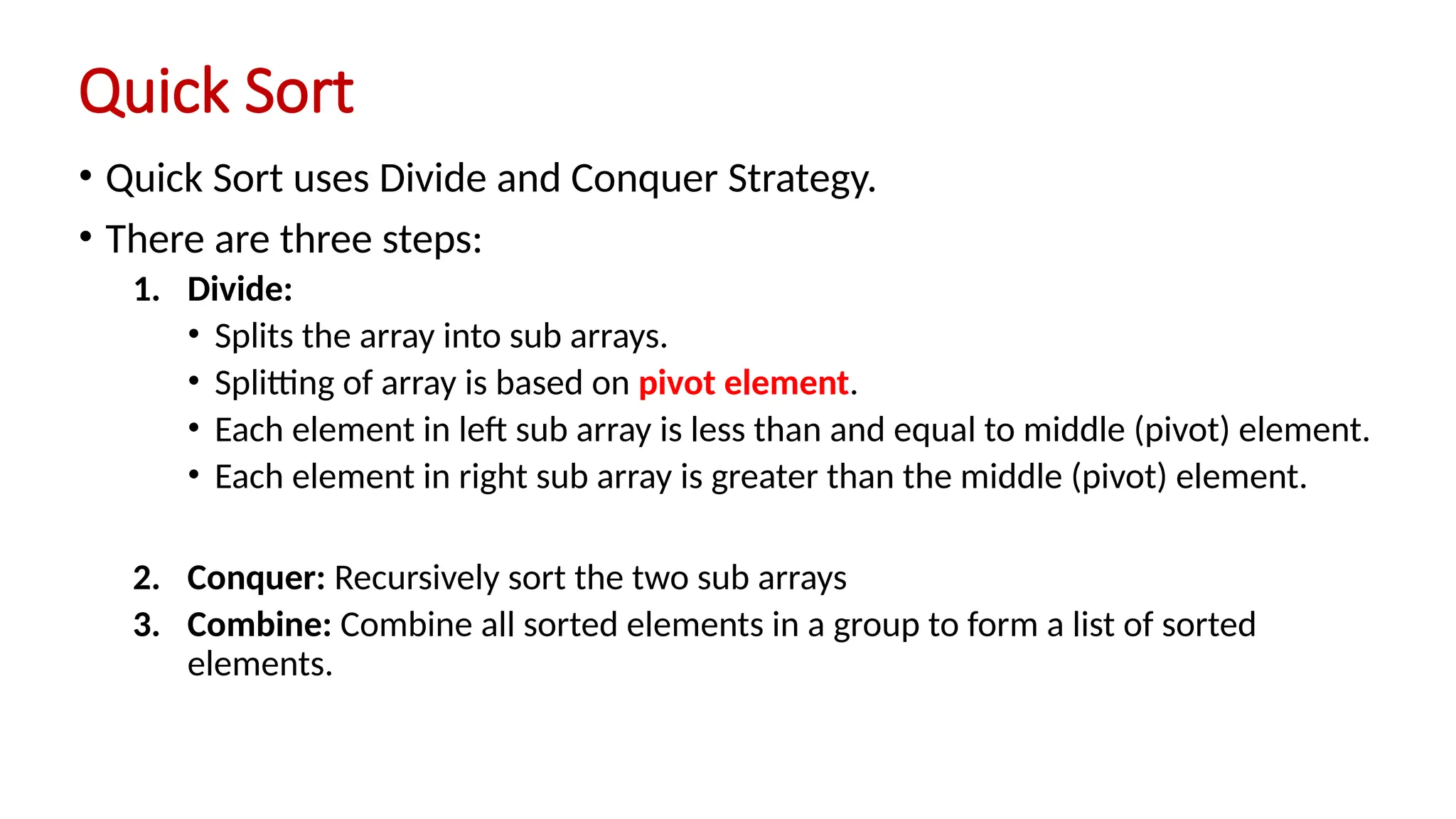
Example
50 30 1090 80 20 40 70
Step 1:
Low High
i / Pivot j
50 30 10 90 80 20 40 70
50 30 10 90 80 20 40 70
Pivot
Pivot
j
j
i
i
Increment i if A[i]<= Pivot and continue to increment it until element pointed by i is greater than A[Low]
Decrement j if A[j]> Pivot and continue to decrement it until element pointed by j is less than
A[High]
Step 2:
Step 3:
High
High
Low
5.
Example
50 30 1090 80 20 40 70
Step 4:
Low High
Pivot j
50 30 10 90 80 20 40 70
50 30 10 90 80 20 40 70
Pivot
Pivot
j
j
i
i
Increment i if A[i]<= Pivot and continue to increment it until element pointed by i is greater than A[Low]
Decrement j if A[j]> Pivot and continue to decrement it until element pointed by j is less than A[Low]
Step 5:
Step 6:
i
As A[i] > A[Low], stop incrementing i
High
High
6.
Example
50 30 1090 80 20 40 70
Step 7:
Low High
Pivot
j
50 30 10 40 80 20 90 70
50 30 10 40 80 20 90 70
Pivot
Pivot
j
j
i
i
Since i and j cannot be further incremented and decremented, we will swap A[i] and A[j]
Step 8:
Step 9:
i
As A[j] > A[Low], stop decrementing j
High
High
Continue incrementing i and decrementing j until false conditions are obtained
Low
Low
7.
Example
50 30 1040 80 20 90 70
Step 7:
Low High
Pivot
j
50 30 10 40 20 80 90 70
50 30 10 40 20 80 90 70
Pivot
Pivot
j
i
i
j
Step 8:
Step 9:
i
High
High
swap A[i] and A[j]
Low
Low
Again, Increment i and decrement j. As soon as i > j, swap A[Low] and A[j]
8.
Example
20 30 1040 50 80 90 70
Step 10:
Low High
Pivot
i
20 30 10 40 50 80 90 70
i j
Step 11:
j
High
Low
Left Sub Array
swap A[Low] and A[j]
Right Sub Array
/ Pivot i/Pivot j
mid
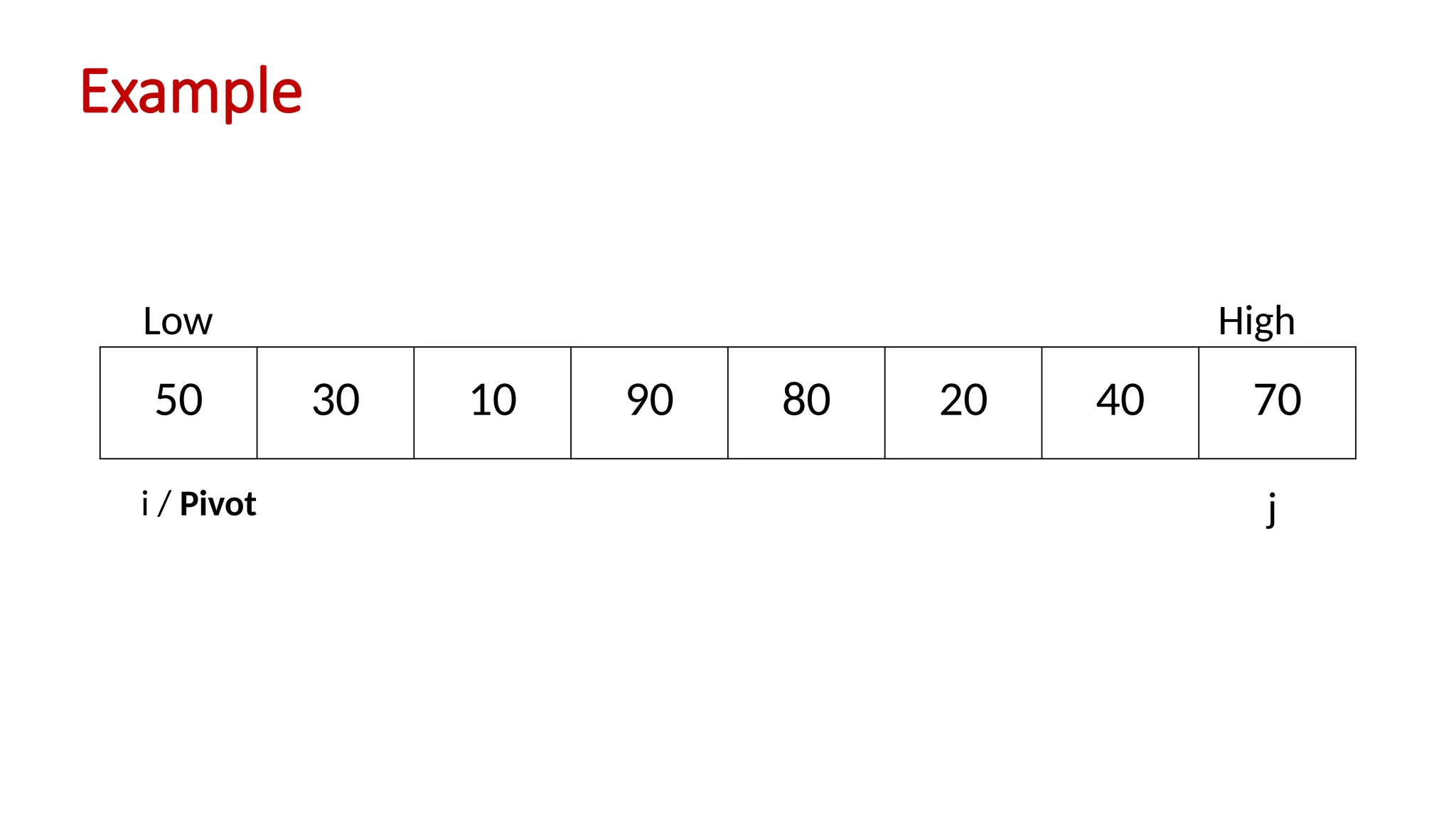
Analysis
1. Best Case:
•If array is partitioned at the mid
• The Recurrence relation for quick sort for obtaining best case time complexity.
for n >1 …………… ①
for n=1 ……………②
Using Master Theorem:
11.
Analysis
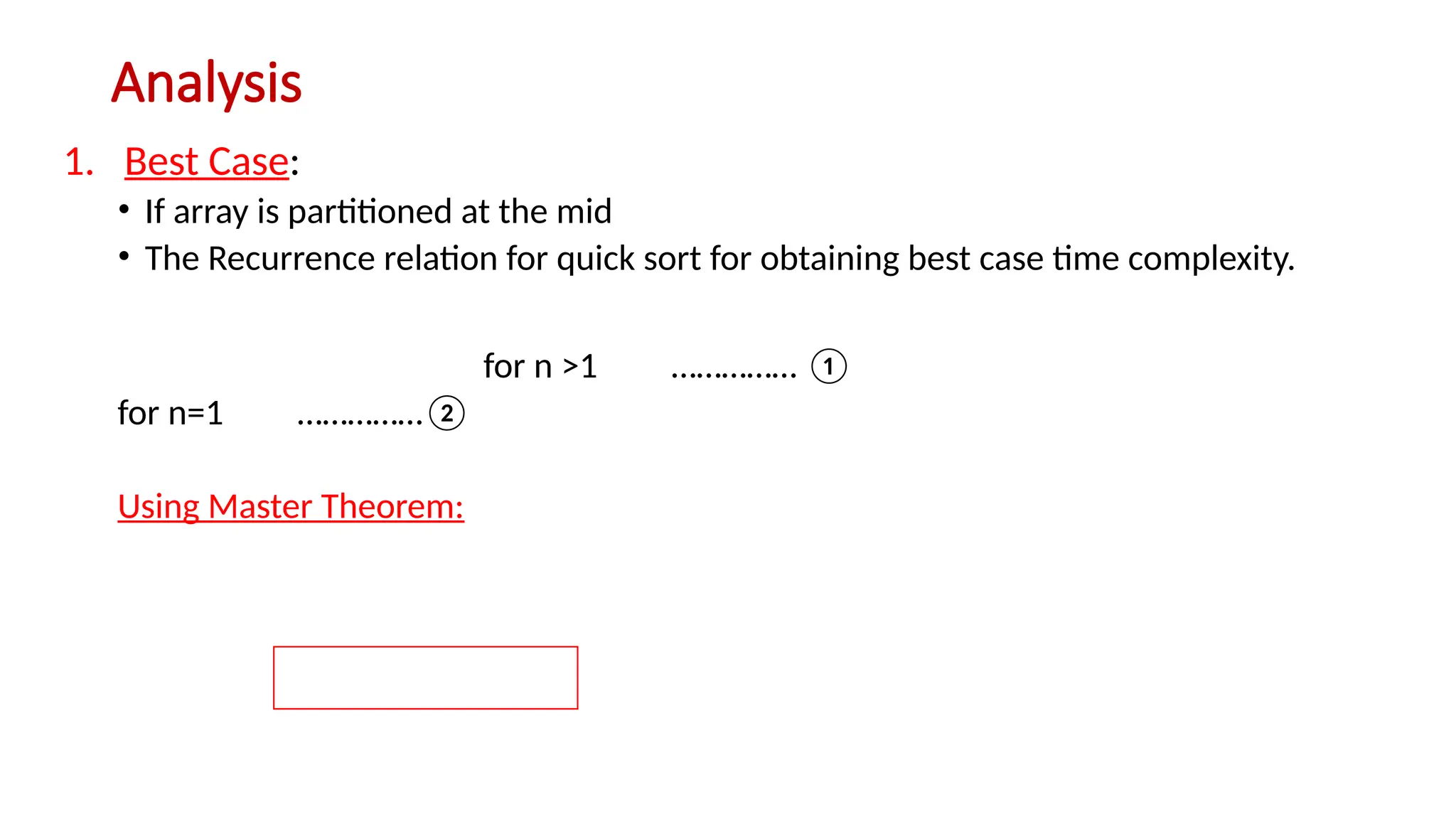
2. Worst Case:
•If pivot is a maximum or minimum of all the elements in the sorted list.
• This can be graphically represented as follows
n items
n-1 items
n-2 items
n-3 items
1
1
1
1 1
Time Required
n
n-1
n-2
…
1
12.
Analysis
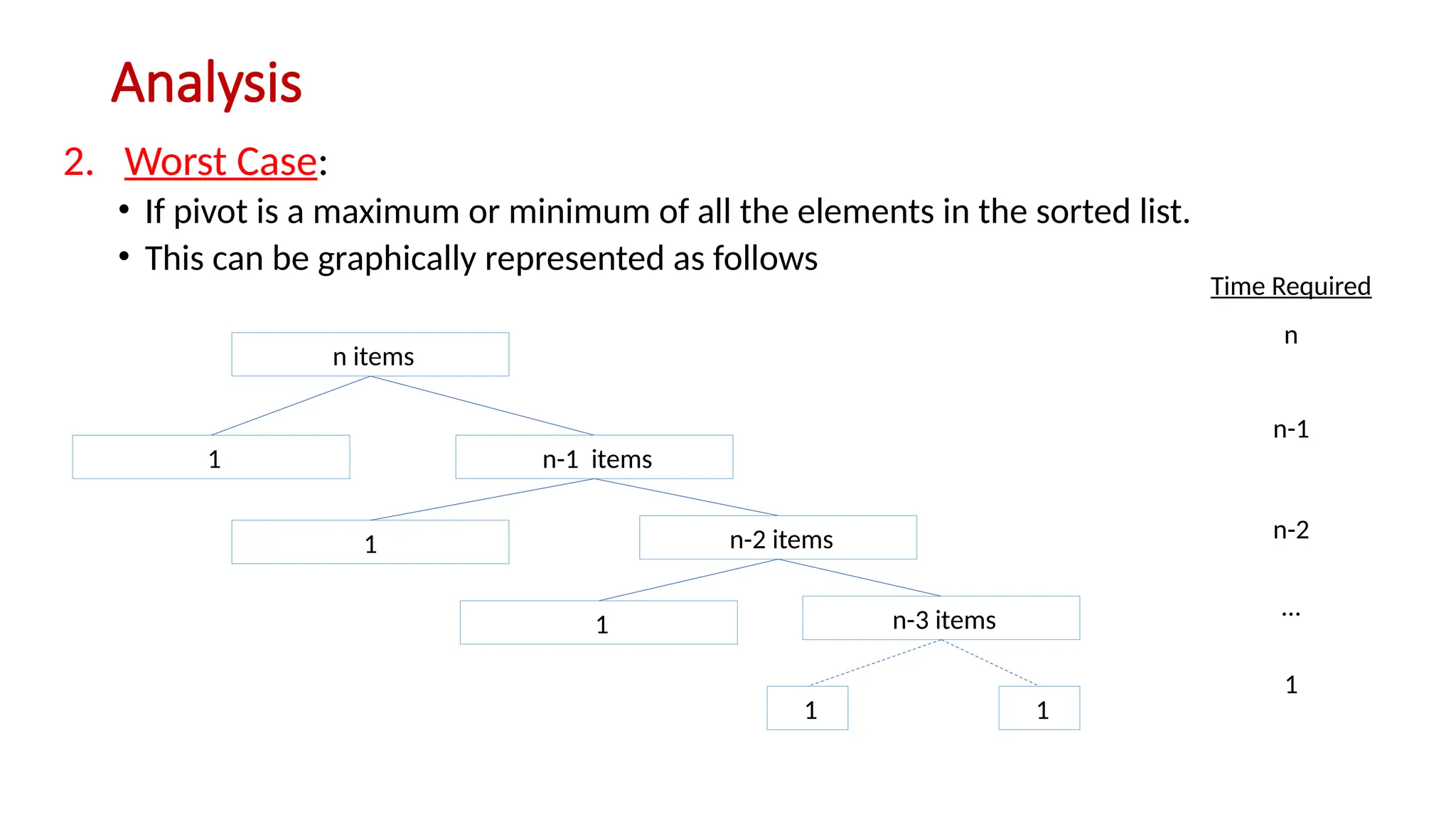
2. Worst Case:
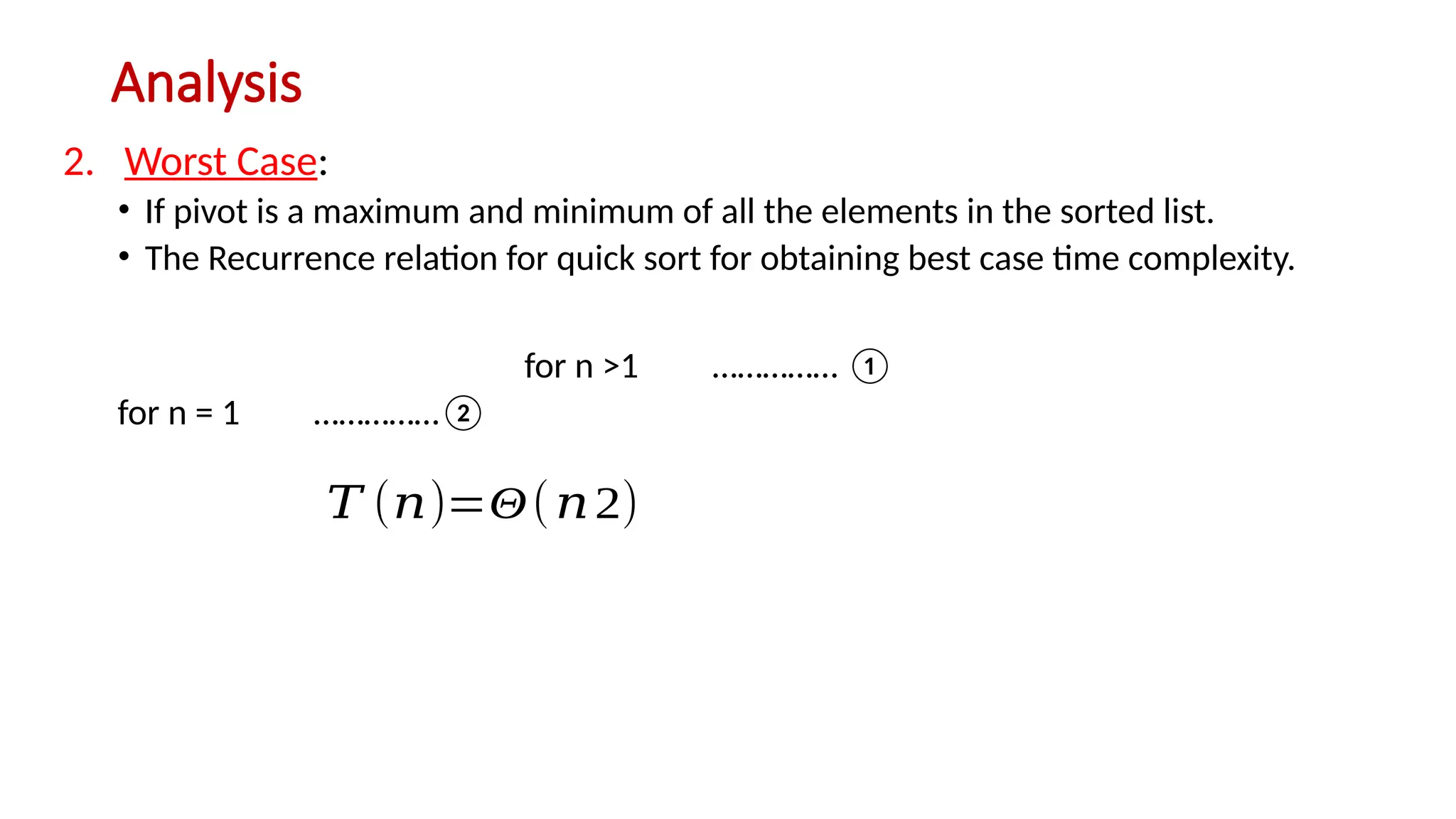
•If pivot is a maximum and minimum of all the elements in the sorted list.
• The Recurrence relation for quick sort for obtaining best case time complexity.
for n >1 …………… ①
for n = 1 ……………②
𝑇 (𝑛)=Θ(𝑛2)
13.
Analysis
3. Average Case:
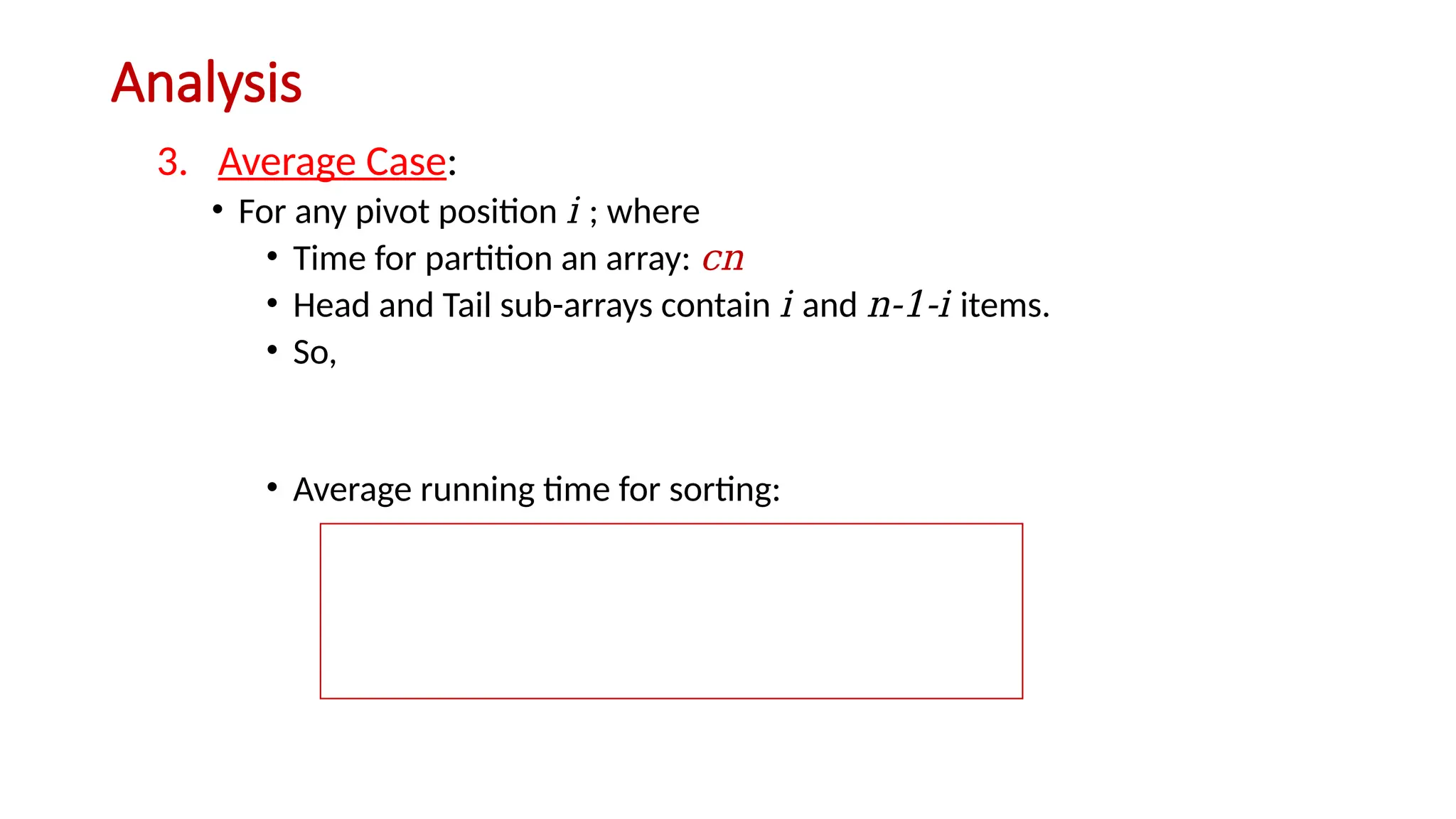
•For any pivot position i ; where
• Time for partition an array: cn
• Head and Tail sub-arrays contain i and n-1-i items.
• So,
• Average running time for sorting:

![Example
50 30 10 90 80 20 40 70
Step 1:
Low High
i / Pivot j
50 30 10 90 80 20 40 70
50 30 10 90 80 20 40 70
Pivot
Pivot
j
j
i
i
Increment i if A[i]<= Pivot and continue to increment it until element pointed by i is greater than A[Low]
Decrement j if A[j]> Pivot and continue to decrement it until element pointed by j is less than
A[High]
Step 2:
Step 3:
High
High
Low](https://image.slidesharecdn.com/module2quicksort-250412055505-9e4f5ea2/75/Module-2-Quick-Sort-algorithm-in-analysis-of-algorithm-pptx-4-2048.jpg)
![Example
50 30 10 90 80 20 40 70
Step 4:
Low High
Pivot j
50 30 10 90 80 20 40 70
50 30 10 90 80 20 40 70
Pivot
Pivot
j
j
i
i
Increment i if A[i]<= Pivot and continue to increment it until element pointed by i is greater than A[Low]
Decrement j if A[j]> Pivot and continue to decrement it until element pointed by j is less than A[Low]
Step 5:
Step 6:
i
As A[i] > A[Low], stop incrementing i
High
High](https://image.slidesharecdn.com/module2quicksort-250412055505-9e4f5ea2/75/Module-2-Quick-Sort-algorithm-in-analysis-of-algorithm-pptx-5-2048.jpg)
![Example
50 30 10 90 80 20 40 70
Step 7:
Low High
Pivot
j
50 30 10 40 80 20 90 70
50 30 10 40 80 20 90 70
Pivot
Pivot
j
j
i
i
Since i and j cannot be further incremented and decremented, we will swap A[i] and A[j]
Step 8:
Step 9:
i
As A[j] > A[Low], stop decrementing j
High
High
Continue incrementing i and decrementing j until false conditions are obtained
Low
Low](https://image.slidesharecdn.com/module2quicksort-250412055505-9e4f5ea2/75/Module-2-Quick-Sort-algorithm-in-analysis-of-algorithm-pptx-6-2048.jpg)
![Example
50 30 10 40 80 20 90 70
Step 7:
Low High
Pivot
j
50 30 10 40 20 80 90 70
50 30 10 40 20 80 90 70
Pivot
Pivot
j
i
i
j
Step 8:
Step 9:
i
High
High
swap A[i] and A[j]
Low
Low
Again, Increment i and decrement j. As soon as i > j, swap A[Low] and A[j]](https://image.slidesharecdn.com/module2quicksort-250412055505-9e4f5ea2/75/Module-2-Quick-Sort-algorithm-in-analysis-of-algorithm-pptx-7-2048.jpg)
![Example
20 30 10 40 50 80 90 70
Step 10:
Low High
Pivot
i
20 30 10 40 50 80 90 70
i j
Step 11:
j
High
Low
Left Sub Array
swap A[Low] and A[j]
Right Sub Array
/ Pivot i/Pivot j
mid](https://image.slidesharecdn.com/module2quicksort-250412055505-9e4f5ea2/75/Module-2-Quick-Sort-algorithm-in-analysis-of-algorithm-pptx-8-2048.jpg)
![Algorithm
Algorithm QuickSort(A[0…n], low, high)
{
if(low<high) then
mid ← partition(A[low…high])
QuickSort(A[low…mid-1])
QuickSort(A[mid+1…high])
}
Algorithm Partition(A[0…n], low, high)
{
pivot←A[low];
i ← low;
j ← high+1;
while(i ≤ j)do
{
while(A[i] ≤ pivot)do
{ i++;}
while(A[j] ≥ pivot)do
{ j--;}
if(i <= j) then
swap(A[i],A[j])
}
swap(A[low],A[j])
return j;
}](https://image.slidesharecdn.com/module2quicksort-250412055505-9e4f5ea2/75/Module-2-Quick-Sort-algorithm-in-analysis-of-algorithm-pptx-9-2048.jpg)


![ppt daaa[1].pptxdaaaaaaaaaaaaaaaaaaaaaaaaaaaaaaaaa](https://cdn.slidesharecdn.com/ss_thumbnails/pptdaaa1-251211161628-1cb28a51-thumbnail.jpg?width=640&height=640&fit=bounds)


