Quick Response 
Kevin Sai Thomas 
Priyanshu Uniyal 
Swati Vohra 
[BFT-V]
Define Quick Response 
• QR is a state of responsiveness and flexibility in 
which an organization seeks to provide a highly 
diverse range of products and services to a 
customer/consumer in the exact quantity, variety 
and quality, and at the right time, place and price 
as dictated by real-time customer/consumer 
demand. 
(Lowson et al., 1999)
• The concept of QR is based on a Japanese 
concept – Time Based Competition (TBC) 
• It was developed by Rajat Suri in Late 1980s.
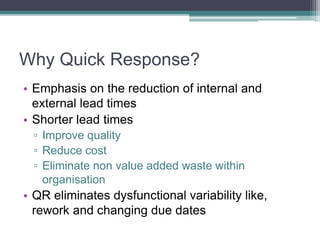
Why Quick Response? 
• Emphasis on the reduction of internal and 
external lead times 
• Shorter lead times 
▫ Improve quality 
▫ Reduce cost 
▫ Eliminate non value added waste within 
organisation 
• QR eliminates dysfunctional variability like, 
rework and changing due dates
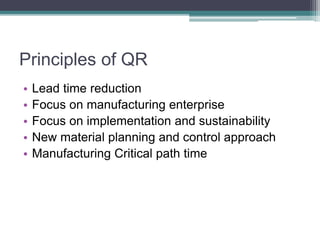
Principles of QR 
• Lead time reduction 
• Focus on manufacturing enterprise 
• Focus on implementation and sustainability 
• New material planning and control approach 
• Manufacturing Critical path time
Causes for QR 
• Increased Competition in market 
• Outsourcing of supply chain processes, like 
production 
• Changes in consumer lifestyle 
• Increased demands
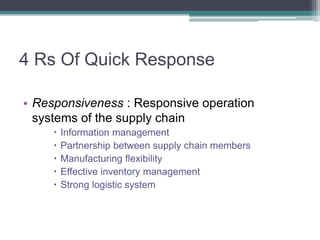
4 Rs Of Quick Response 
• Responsiveness : Responsive operation 
systems of the supply chain 
 Information management 
 Partnership between supply chain members 
 Manufacturing flexibility 
 Effective inventory management 
 Strong logistic system
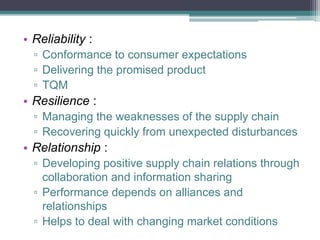
• Reliability : 
▫ Conformance to consumer expectations 
▫ Delivering the promised product 
▫ TQM 
• Resilience : 
▫ Managing the weaknesses of the supply chain 
▫ Recovering quickly from unexpected disturbances 
• Relationship : 
▫ Developing positive supply chain relations through 
collaboration and information sharing 
▫ Performance depends on alliances and 
relationships 
▫ Helps to deal with changing market conditions
Benefits of QR implementation 
• Supplier’s benefits : 
▫ Reduction of buying mistakes 
▫ Minimization of stock holding 
▫ Quick tracking of merchandise 
▫ Higher stock turn 
▫ Improvement of cash flow 
▫ Betterment of customer service 
▫ Very high level of profit 
▫ Enlarged competitive advantages
• Retailer’s Benefits : 
▫ Improvement of planning systems 
▫ Quick access to sales information 
▫ Easy tracking of products 
▫ Security of getting more orders 
▫ Improvement of manufacturing systems 
▫ High volume of production 
▫ Higher sales 
▫ Good profit margin 
▫ Enhanced customer satisfaction & loyalty
QR in apparel supply chain 
• In recent years, consumer demands have diversified 
and the duration of acceptance of the products has 
decreased, and thus, the lifetime of the product has 
considerably reduced. 
• The concept of QR was introduced in textile and 
retail sectors to 
▫ reduce inventories 
▫ shorten cycle times 
▫ respond rapidly to changing consumer demands.
• The primary objective of QR is risk reduction by 
optimising the lead time 
• Factors responsible for the need of QR in fashion : 
▫ Changes in the lifestyle 
▫ Expansion of the intercultural relationships 
▫ Development of technologies 
▫ Changes in economic conditions 
• 3 Cs of Quick Response : 
▫ Control 
▫ Communication 
▫ Collaboration
Necessity of QR in Apparel industry 
• Impossible to accurately forecast volumes and 
product mix 
▫ Results in hike costs of stock out and carrying 
costs 
• The 6 month or yearly forecast may not be able 
to judge (or meet) consumer expectations 
• Individual efficiencies of system do not ensure 
over all efficiency of the supply chain
The main trends in QR strategies 
implementation in the fashion industry 
• Design of specific demand management techniques 
in relation with fashion trends in general, and 
colours 
• Interactive designing customer-retailer offering 
garments structure using CAD 
• The manufacturer/ retailer systems will have to use 
reliable POS data so that the industry can be 
attached into the very complicated up-stream 
systems to support the demand-activated 
production
References 
• WHAT IS VICS-Voluntary Inter-industry 
Commerce Solutions (http://www.vics.org) 
• Quick Response strategies in Fashion Industry; 
Mirela Octavia SÎRBU Andreea Simona 
SASEANU; The Bucharest University of 
Economic Studies

Quick response

  • 1.
    Quick Response KevinSai Thomas Priyanshu Uniyal Swati Vohra [BFT-V]
  • 2.
    Define Quick Response • QR is a state of responsiveness and flexibility in which an organization seeks to provide a highly diverse range of products and services to a customer/consumer in the exact quantity, variety and quality, and at the right time, place and price as dictated by real-time customer/consumer demand. (Lowson et al., 1999)
  • 3.
    • The conceptof QR is based on a Japanese concept – Time Based Competition (TBC) • It was developed by Rajat Suri in Late 1980s.
  • 4.
    Why Quick Response? • Emphasis on the reduction of internal and external lead times • Shorter lead times ▫ Improve quality ▫ Reduce cost ▫ Eliminate non value added waste within organisation • QR eliminates dysfunctional variability like, rework and changing due dates
  • 5.
    Principles of QR • Lead time reduction • Focus on manufacturing enterprise • Focus on implementation and sustainability • New material planning and control approach • Manufacturing Critical path time
  • 6.
    Causes for QR • Increased Competition in market • Outsourcing of supply chain processes, like production • Changes in consumer lifestyle • Increased demands
  • 7.
    4 Rs OfQuick Response • Responsiveness : Responsive operation systems of the supply chain  Information management  Partnership between supply chain members  Manufacturing flexibility  Effective inventory management  Strong logistic system
  • 8.
    • Reliability : ▫ Conformance to consumer expectations ▫ Delivering the promised product ▫ TQM • Resilience : ▫ Managing the weaknesses of the supply chain ▫ Recovering quickly from unexpected disturbances • Relationship : ▫ Developing positive supply chain relations through collaboration and information sharing ▫ Performance depends on alliances and relationships ▫ Helps to deal with changing market conditions
  • 9.
    Benefits of QRimplementation • Supplier’s benefits : ▫ Reduction of buying mistakes ▫ Minimization of stock holding ▫ Quick tracking of merchandise ▫ Higher stock turn ▫ Improvement of cash flow ▫ Betterment of customer service ▫ Very high level of profit ▫ Enlarged competitive advantages
  • 10.
    • Retailer’s Benefits: ▫ Improvement of planning systems ▫ Quick access to sales information ▫ Easy tracking of products ▫ Security of getting more orders ▫ Improvement of manufacturing systems ▫ High volume of production ▫ Higher sales ▫ Good profit margin ▫ Enhanced customer satisfaction & loyalty
  • 11.
    QR in apparelsupply chain • In recent years, consumer demands have diversified and the duration of acceptance of the products has decreased, and thus, the lifetime of the product has considerably reduced. • The concept of QR was introduced in textile and retail sectors to ▫ reduce inventories ▫ shorten cycle times ▫ respond rapidly to changing consumer demands.
  • 12.
    • The primaryobjective of QR is risk reduction by optimising the lead time • Factors responsible for the need of QR in fashion : ▫ Changes in the lifestyle ▫ Expansion of the intercultural relationships ▫ Development of technologies ▫ Changes in economic conditions • 3 Cs of Quick Response : ▫ Control ▫ Communication ▫ Collaboration
  • 13.
    Necessity of QRin Apparel industry • Impossible to accurately forecast volumes and product mix ▫ Results in hike costs of stock out and carrying costs • The 6 month or yearly forecast may not be able to judge (or meet) consumer expectations • Individual efficiencies of system do not ensure over all efficiency of the supply chain
  • 14.
    The main trendsin QR strategies implementation in the fashion industry • Design of specific demand management techniques in relation with fashion trends in general, and colours • Interactive designing customer-retailer offering garments structure using CAD • The manufacturer/ retailer systems will have to use reliable POS data so that the industry can be attached into the very complicated up-stream systems to support the demand-activated production
  • 15.
    References • WHATIS VICS-Voluntary Inter-industry Commerce Solutions (http://www.vics.org) • Quick Response strategies in Fashion Industry; Mirela Octavia SÎRBU Andreea Simona SASEANU; The Bucharest University of Economic Studies