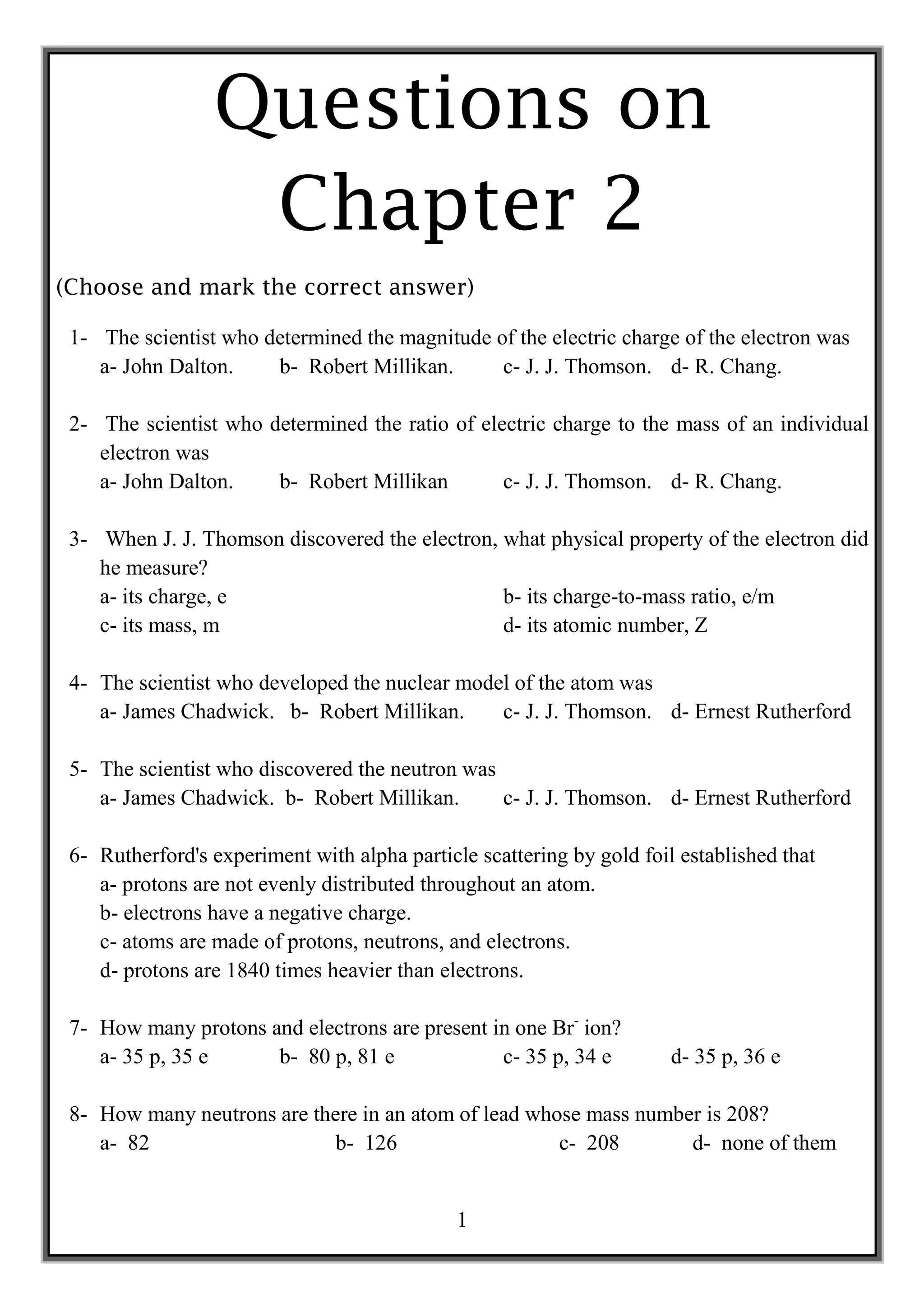
Questions on
                  Chapter 2
(Choose and mark the correct answer)

 1- The scientist who determined the magnitude of the electric charge of the electron was
    a- John Dalton.    b- Robert Millikan.      c- J. J. Thomson. d- R. Chang.

 2- The scientist who determined the ratio of electric charge to the mass of an individual
    electron was
    a- John Dalton.    b- Robert Millikan        c- J. J. Thomson. d- R. Chang.

 3- When J. J. Thomson discovered the electron, what physical property of the electron did
    he measure?
    a- its charge, e                            b- its charge-to-mass ratio, e/m
    c- its mass, m                              d- its atomic number, Z

 4- The scientist who developed the nuclear model of the atom was
    a- James Chadwick. b- Robert Millikan.      c- J. J. Thomson. d- Ernest Rutherford

 5- The scientist who discovered the neutron was
    a- James Chadwick. b- Robert Millikan.       c- J. J. Thomson. d- Ernest Rutherford

 6- Rutherford's experiment with alpha particle scattering by gold foil established that
    a- protons are not evenly distributed throughout an atom.
    b- electrons have a negative charge.
    c- atoms are made of protons, neutrons, and electrons.
    d- protons are 1840 times heavier than electrons.

 7- How many protons and electrons are present in one Br- ion?
    a- 35 p, 35 e     b- 80 p, 81 e             c- 35 p, 34 e          d- 35 p, 36 e

 8- How many neutrons are there in an atom of lead whose mass number is 208?
    a- 82                    b- 126                   c- 208       d- none of them


                                              1
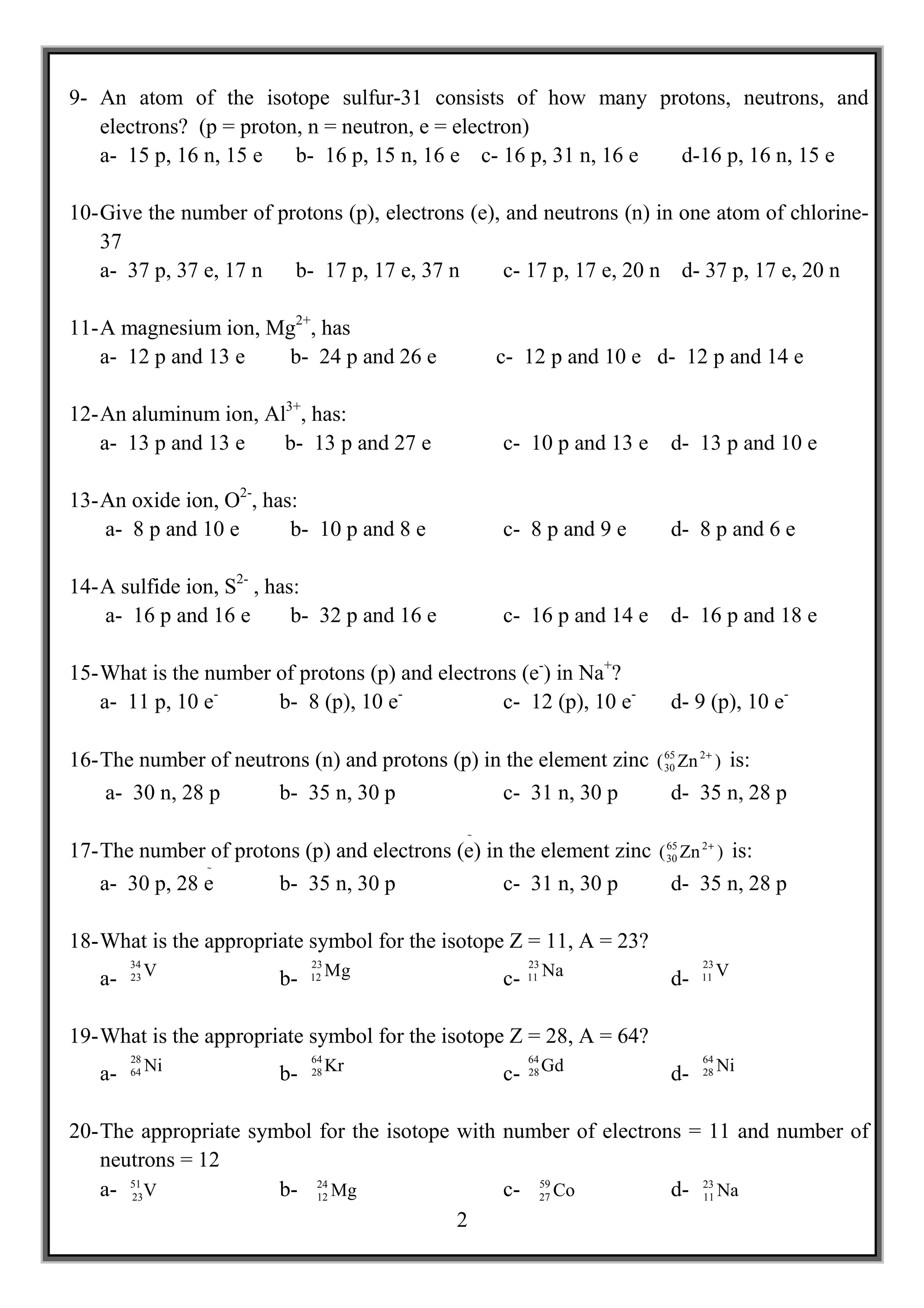
9- An atom of the isotope sulfur-31 consists of how many protons, neutrons, and
   electrons? (p = proton, n = neutron, e = electron)
   a- 15 p, 16 n, 15 e   b- 16 p, 15 n, 16 e c- 16 p, 31 n, 16 e d-16 p, 16 n, 15 e

10- Give the number of protons (p), electrons (e), and neutrons (n) in one atom of chlorine-
    37
    a- 37 p, 37 e, 17 n  b- 17 p, 17 e, 37 n       c- 17 p, 17 e, 20 n d- 37 p, 17 e, 20 n

11- A magnesium ion, Mg2+, has
    a- 12 p and 13 e   b- 24 p and 26 e           c- 12 p and 10 e d- 12 p and 14 e

12- An aluminum ion, Al3+, has:
    a- 13 p and 13 e   b- 13 p and 27 e            c- 10 p and 13 e    d- 13 p and 10 e

13- An oxide ion, O2-, has:
    a- 8 p and 10 e       b- 10 p and 8 e          c- 8 p and 9 e      d- 8 p and 6 e

14- A sulfide ion, S2- , has:
    a- 16 p and 16 e        b- 32 p and 16 e       c- 16 p and 14 e    d- 16 p and 18 e

15- What is the number of protons (p) and electrons (e-) in Na+?
    a- 11 p, 10 e-     b- 8 (p), 10 e-            c- 12 (p), 10 e-     d- 9 (p), 10 e-

16- The number of neutrons (n) and protons (p) in the element zinc ( 30 Zn 2+ ) is:
                                                                     65


    a- 30 n, 28 p      b- 35 n, 30 p             c- 31 n, 30 p        d- 35 n, 28 p

17- The number of protons (p) and electrons (e) in the element zinc ( 30 Zn 2+ ) is:
                                                                       65


    a- 30 p, 28 e     b- 35 n, 30 p               c- 31 n, 30 p        d- 35 n, 28 p

18- What is the appropriate symbol for the isotope Z = 11, A = 23?
        34                    23                        23                  23
   a-   23   V           b-   12   Mg              c-   11   Na        d-   11   V


19- What is the appropriate symbol for the isotope Z = 28, A = 64?
        28                    64                      64                    64
   a-   64   Ni          b-   28   Kr              c- 28 Gd            d-   28   Ni


20- The appropriate symbol for the isotope with number of electrons = 11 and number of
    neutrons = 12
                                                   59
    a- 51 V
       23              b- 24 Mg
                           12                   c- 27 Co          d- 23 Na
                                                                     11

                                           2
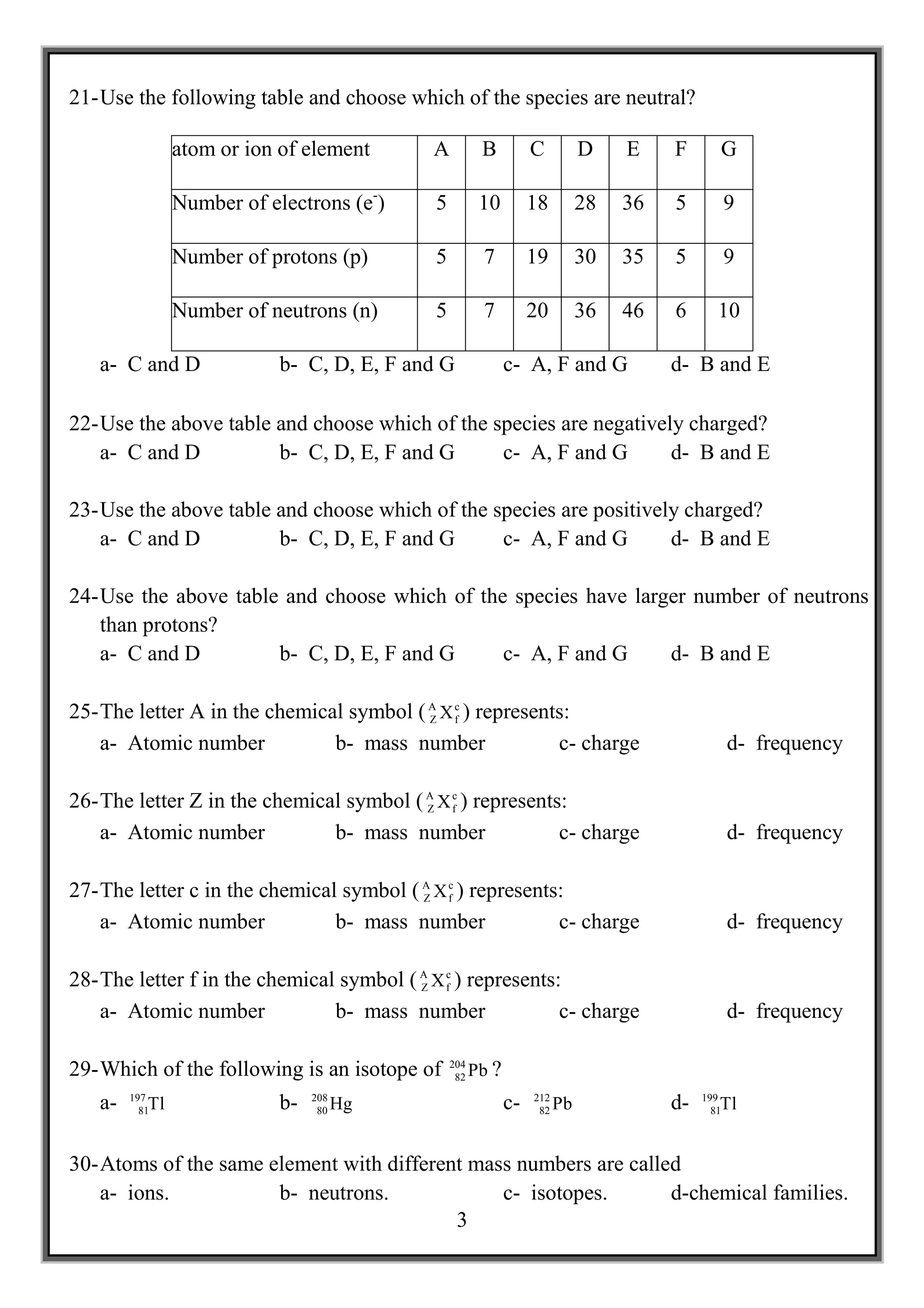
21- Use the following table and choose which of the species are neutral?

                atom or ion of element      A           B          C          D    E    F       G

                Number of electrons (e-)     5          10         18         28   36   5           9

                Number of protons (p)        5          7          19         30   35   5           9

                Number of neutrons (n)       5          7          20         36   46   6       10

   a- C and D               b- C, D, E, F and G               c- A, F and G             d- B and E

22- Use the above table and choose which of the species are negatively charged?
    a- C and D          b- C, D, E, F and G      c- A, F and G       d- B and E

23- Use the above table and choose which of the species are positively charged?
    a- C and D          b- C, D, E, F and G      c- A, F and G       d- B and E

24- Use the above table and choose which of the species have larger number of neutrons
    than protons?
    a- C and D         b- C, D, E, F and G     c- A, F and G     d- B and E

25- The letter A in the chemical symbol ( A X c ) represents:
                                          Z   f

    a- Atomic number           b- mass number              c- charge                                d- frequency

26- The letter Z in the chemical symbol ( A X c ) represents:
                                          Z   f

    a- Atomic number           b- mass number               c- charge                               d- frequency

27- The letter c in the chemical symbol ( A X c ) represents:
                                          Z   f

    a- Atomic number            b- mass number              c- charge                               d- frequency

28- The letter f in the chemical symbol ( A X c ) represents:
                                          Z   f

    a- Atomic number            b- mass number               c- charge                              d- frequency

                                                 204
29- Which of the following is an isotope of       82   Pb ?
        197                      208                               212                       199
   a-      Tl
          81                b-    80   Hg                     c-    82   Pb             d-      Tl
                                                                                               81


30- Atoms of the same element with different mass numbers are called
    a- ions.           b- neutrons.             c- isotopes.       d-chemical families.
                                           3
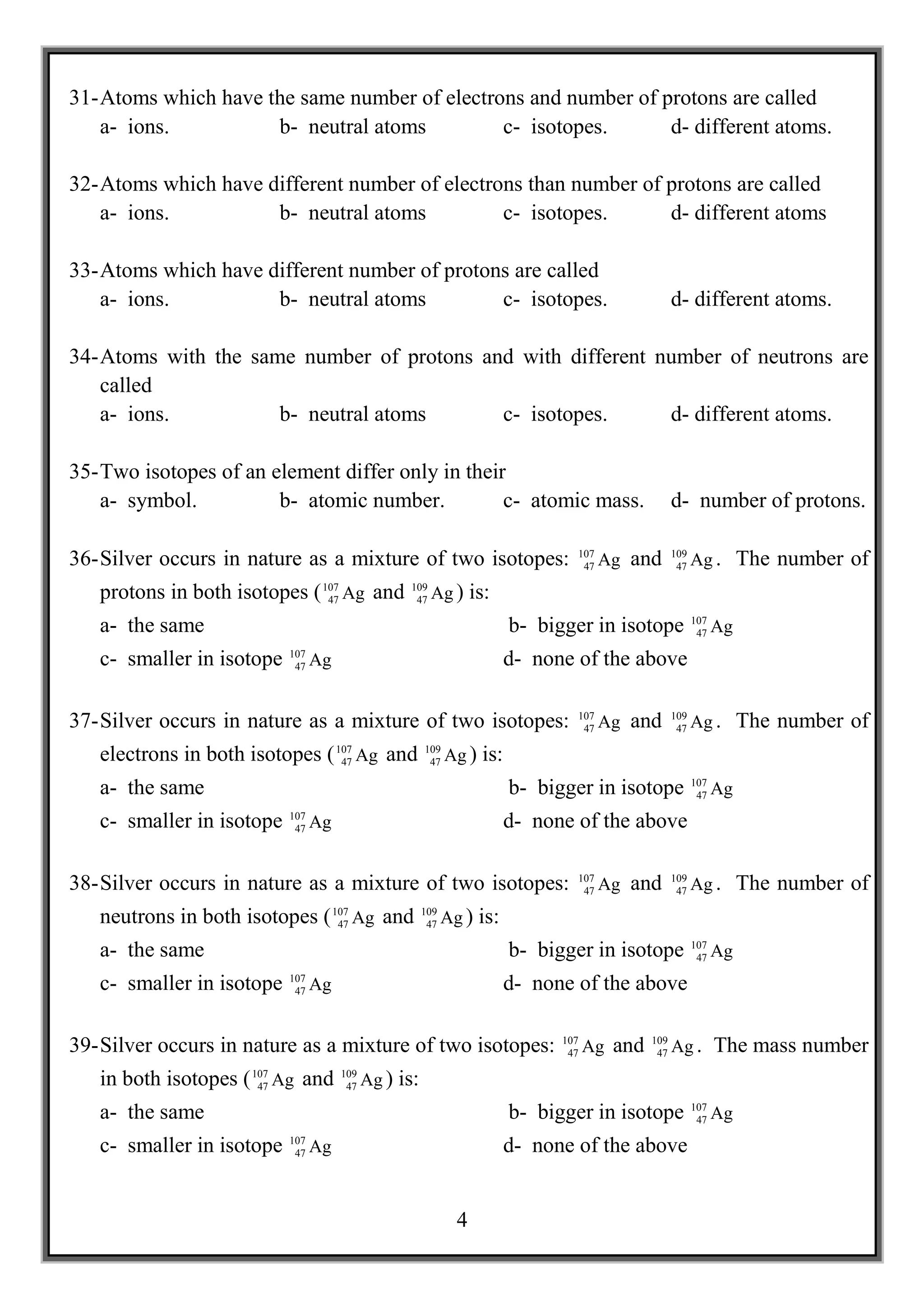
31- Atoms which have the same number of electrons and number of protons are called
    a- ions.          b- neutral atoms         c- isotopes.      d- different atoms.

32- Atoms which have different number of electrons than number of protons are called
    a- ions.          b- neutral atoms          c- isotopes.      d- different atoms

33- Atoms which have different number of protons are called
    a- ions.          b- neutral atoms         c- isotopes.                                        d- different atoms.

34- Atoms with the same number of protons and with different number of neutrons are
    called
    a- ions.          b- neutral atoms      c- isotopes.      d- different atoms.

35- Two isotopes of an element differ only in their
    a- symbol.          b- atomic number.          c- atomic mass.                                 d- number of protons.

                                                                                107                109
36- Silver occurs in nature as a mixture of two isotopes:                        47   Ag and        47   Ag . The number of
   protons in both isotopes ( 107 Ag and
                               47
                                                  109
                                                   47   Ag ) is:
                                                                                                         107
   a- the same                                                          b- bigger in isotope              47   Ag
                           107
   c- smaller in isotope    47   Ag                                     d- none of the above

                                                                                107                109
37- Silver occurs in nature as a mixture of two isotopes:                        47   Ag and        47   Ag . The number of
   electrons in both isotopes ( 107 Ag and
                                 47
                                                       109
                                                        47   Ag ) is:
                                                                                                         107
   a- the same                                                          b- bigger in isotope              47   Ag
                           107
   c- smaller in isotope    47   Ag                                     d- none of the above

                                                                                107                109
38- Silver occurs in nature as a mixture of two isotopes:                        47   Ag and        47   Ag . The number of
   neutrons in both isotopes ( 107 Ag and
                                47
                                                       109
                                                        47   Ag ) is:
                                                                                                         107
   a- the same                                                          b- bigger in isotope              47   Ag
                           107
   c- smaller in isotope    47   Ag                                     d- none of the above

                                                                              107            109
39- Silver occurs in nature as a mixture of two isotopes:                      47   Ag and    47   Ag . The mass number
   in both isotopes ( 107 Ag and
                       47
                                      109
                                       47   Ag ) is:
                                                                                                         107
   a- the same                                                          b- bigger in isotope              47   Ag
                           107
   c- smaller in isotope    47   Ag                                     d- none of the above


                                                               4
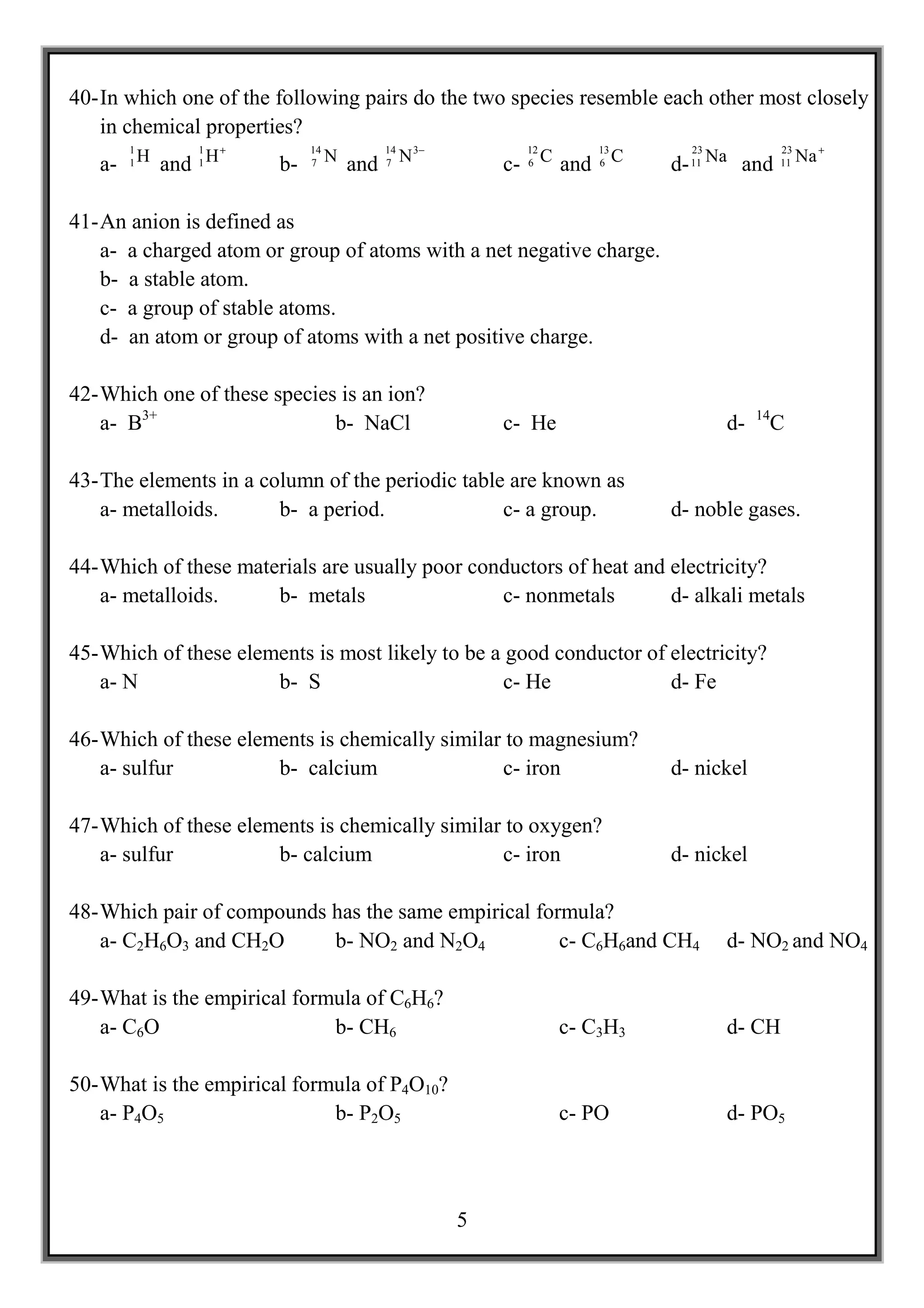
40- In which one of the following pairs do the two species resemble each other most closely
    in chemical properties?
                  +
      1       1
   a- 1 H and 1 H       b-
                             14
                             7    N and   14
                                          7    N 3−          12      13
                                                          c- 6 C and 6 C
                                                                              23
                                                                            d- 11 Na and
                                                                                             23
                                                                                             11   Na +


41- An anion is defined as
    a- a charged atom or group of atoms with a net negative charge.
    b- a stable atom.
    c- a group of stable atoms.
    d- an atom or group of atoms with a net positive charge.

42- Which one of these species is an ion?
    a- B3+                    b- NaCl                     c- He                    d-   14
                                                                                         C

43- The elements in a column of the periodic table are known as
    a- metalloids.      b- a period.              c- a group.               d- noble gases.

44- Which of these materials are usually poor conductors of heat and electricity?
    a- metalloids.     b- metals                 c- nonmetals        d- alkali metals

45- Which of these elements is most likely to be a good conductor of electricity?
    a- N               b- S                        c- He             d- Fe

46- Which of these elements is chemically similar to magnesium?
    a- sulfur          b- calcium                c- iron                    d- nickel

47- Which of these elements is chemically similar to oxygen?
    a- sulfur          b- calcium                c- iron                    d- nickel

48- Which pair of compounds has the same empirical formula?
    a- C2H6O3 and CH2O      b- NO2 and N2O4           c- C6H6and CH4               d- NO2 and NO4

49- What is the empirical formula of C6H6?
    a- C6O                    b- CH6                              c- C3H3          d- CH

50- What is the empirical formula of P4O10?
    a- P4O5                   b- P2O5                             c- PO            d- PO5


                                                      5
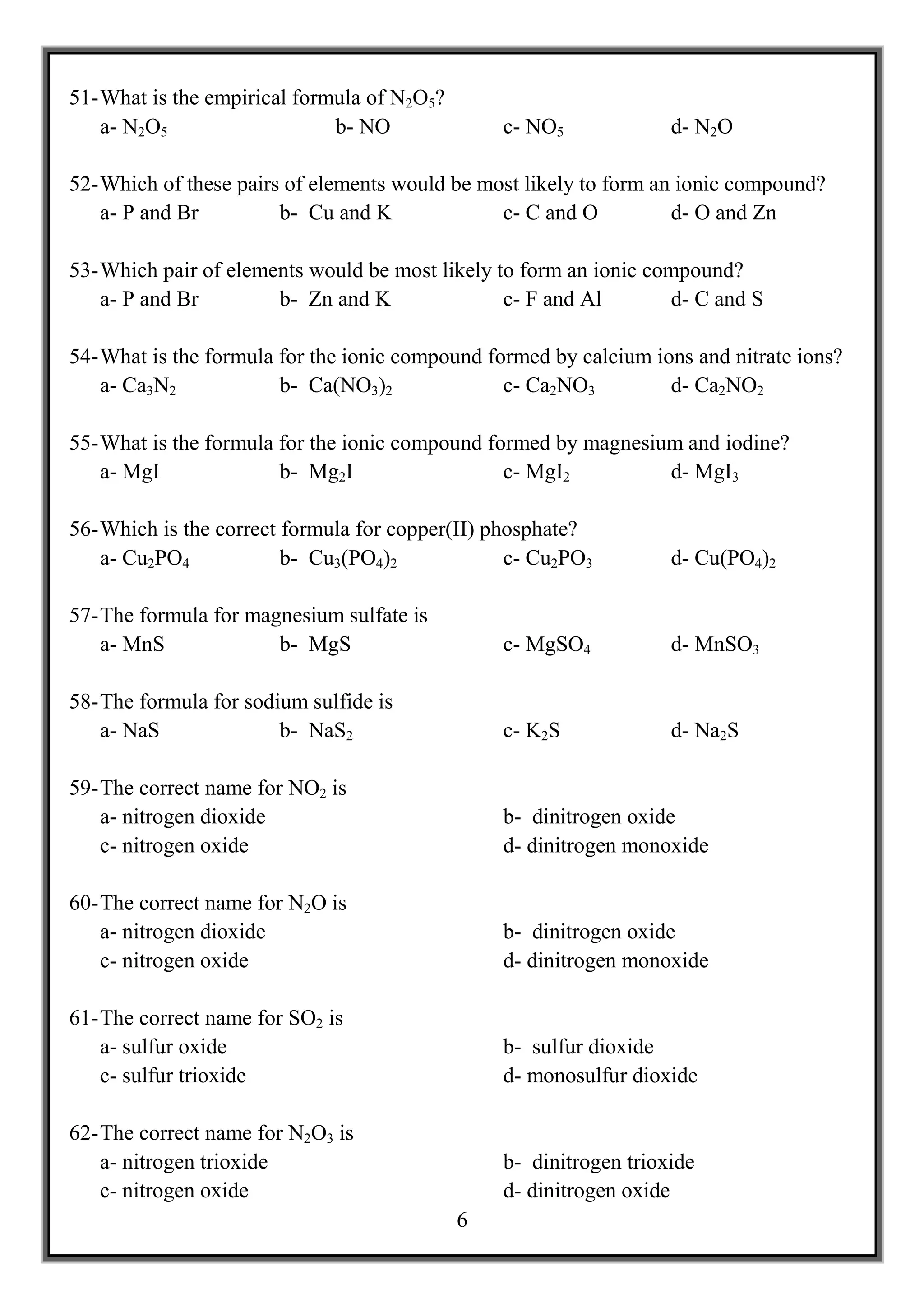
51- What is the empirical formula of N2O5?
    a- N2O5                   b- NO              c- NO5             d- N2O

52- Which of these pairs of elements would be most likely to form an ionic compound?
    a- P and Br         b- Cu and K             c- C and O          d- O and Zn

53- Which pair of elements would be most likely to form an ionic compound?
    a- P and Br        b- Zn and K               c- F and Al       d- C and S

54- What is the formula for the ionic compound formed by calcium ions and nitrate ions?
    a- Ca3N2            b- Ca(NO3)2              c- Ca2NO3         d- Ca2NO2

55- What is the formula for the ionic compound formed by magnesium and iodine?
    a- MgI              b- Mg2I                  c- MgI2         d- MgI3

56- Which is the correct formula for copper(II) phosphate?
    a- Cu2PO4            b- Cu3(PO4)2             c- Cu2PO3         d- Cu(PO4)2

57- The formula for magnesium sulfate is
    a- MnS             b- MgS                    c- MgSO4           d- MnSO3

58- The formula for sodium sulfide is
    a- NaS              b- NaS2                  c- K2S             d- Na2S

59- The correct name for NO2 is
    a- nitrogen dioxide                          b- dinitrogen oxide
    c- nitrogen oxide                            d- dinitrogen monoxide

60- The correct name for N2O is
    a- nitrogen dioxide                          b- dinitrogen oxide
    c- nitrogen oxide                            d- dinitrogen monoxide

61- The correct name for SO2 is
    a- sulfur oxide                              b- sulfur dioxide
    c- sulfur trioxide                           d- monosulfur dioxide

62- The correct name for N2O3 is
    a- nitrogen trioxide                         b- dinitrogen trioxide
    c- nitrogen oxide                            d- dinitrogen oxide
                                             6
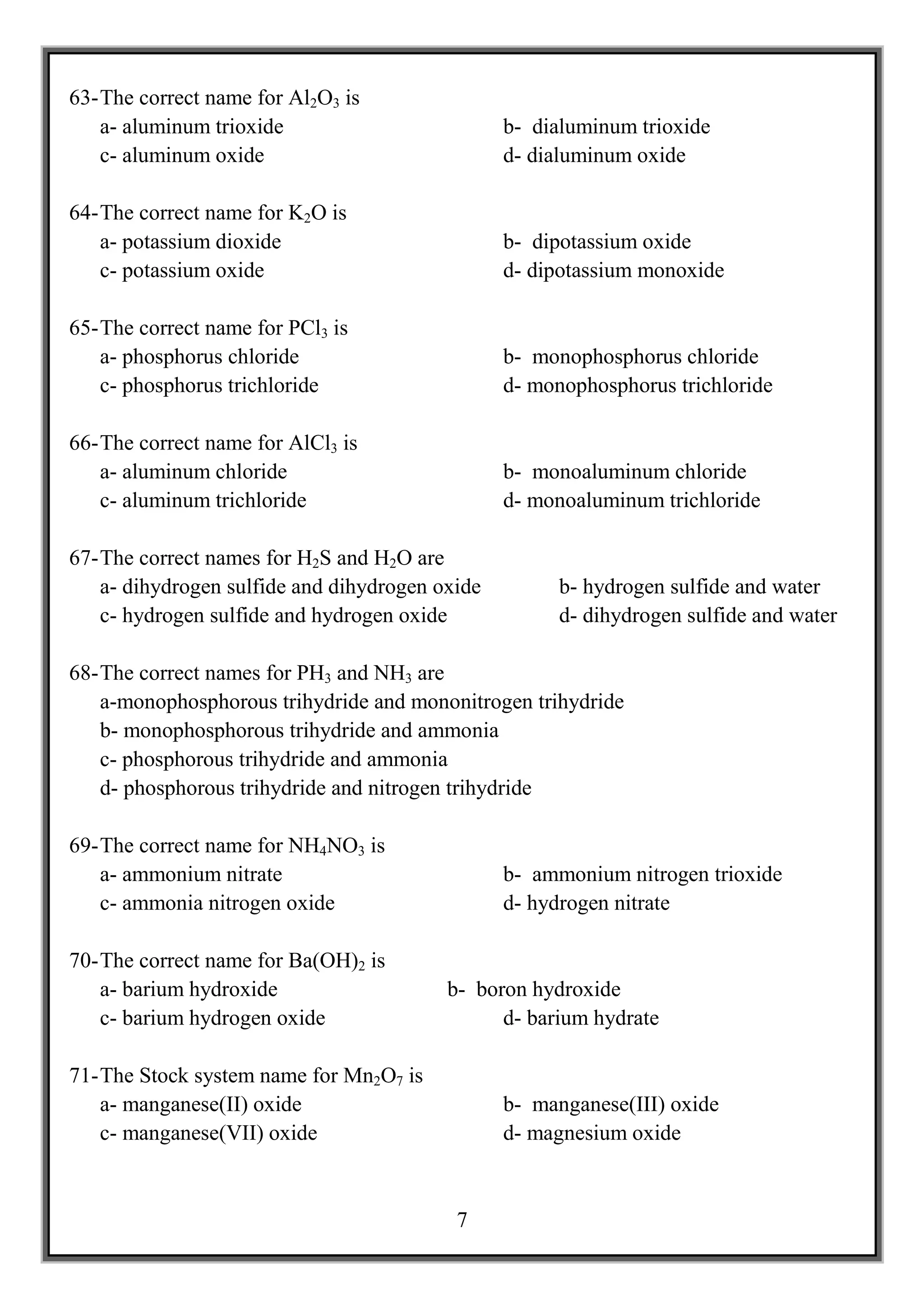
63- The correct name for Al2O3 is
    a- aluminum trioxide                         b- dialuminum trioxide
    c- aluminum oxide                            d- dialuminum oxide

64- The correct name for K2O is
    a- potassium dioxide                         b- dipotassium oxide
    c- potassium oxide                           d- dipotassium monoxide

65- The correct name for PCl3 is
    a- phosphorus chloride                       b- monophosphorus chloride
    c- phosphorus trichloride                    d- monophosphorus trichloride

66- The correct name for AlCl3 is
    a- aluminum chloride                         b- monoaluminum chloride
    c- aluminum trichloride                      d- monoaluminum trichloride

67- The correct names for H2S and H2O are
    a- dihydrogen sulfide and dihydrogen oxide         b- hydrogen sulfide and water
    c- hydrogen sulfide and hydrogen oxide             d- dihydrogen sulfide and water

68- The correct names for PH3 and NH3 are
    a-monophosphorous trihydride and mononitrogen trihydride
    b- monophosphorous trihydride and ammonia
    c- phosphorous trihydride and ammonia
    d- phosphorous trihydride and nitrogen trihydride

69- The correct name for NH4NO3 is
    a- ammonium nitrate                          b- ammonium nitrogen trioxide
    c- ammonia nitrogen oxide                    d- hydrogen nitrate

70- The correct name for Ba(OH)2 is
    a- barium hydroxide                   b- boron hydroxide
    c- barium hydrogen oxide                    d- barium hydrate

71- The Stock system name for Mn2O7 is
    a- manganese(II) oxide                       b- manganese(III) oxide
    c- manganese(VII) oxide                      d- magnesium oxide


                                           7
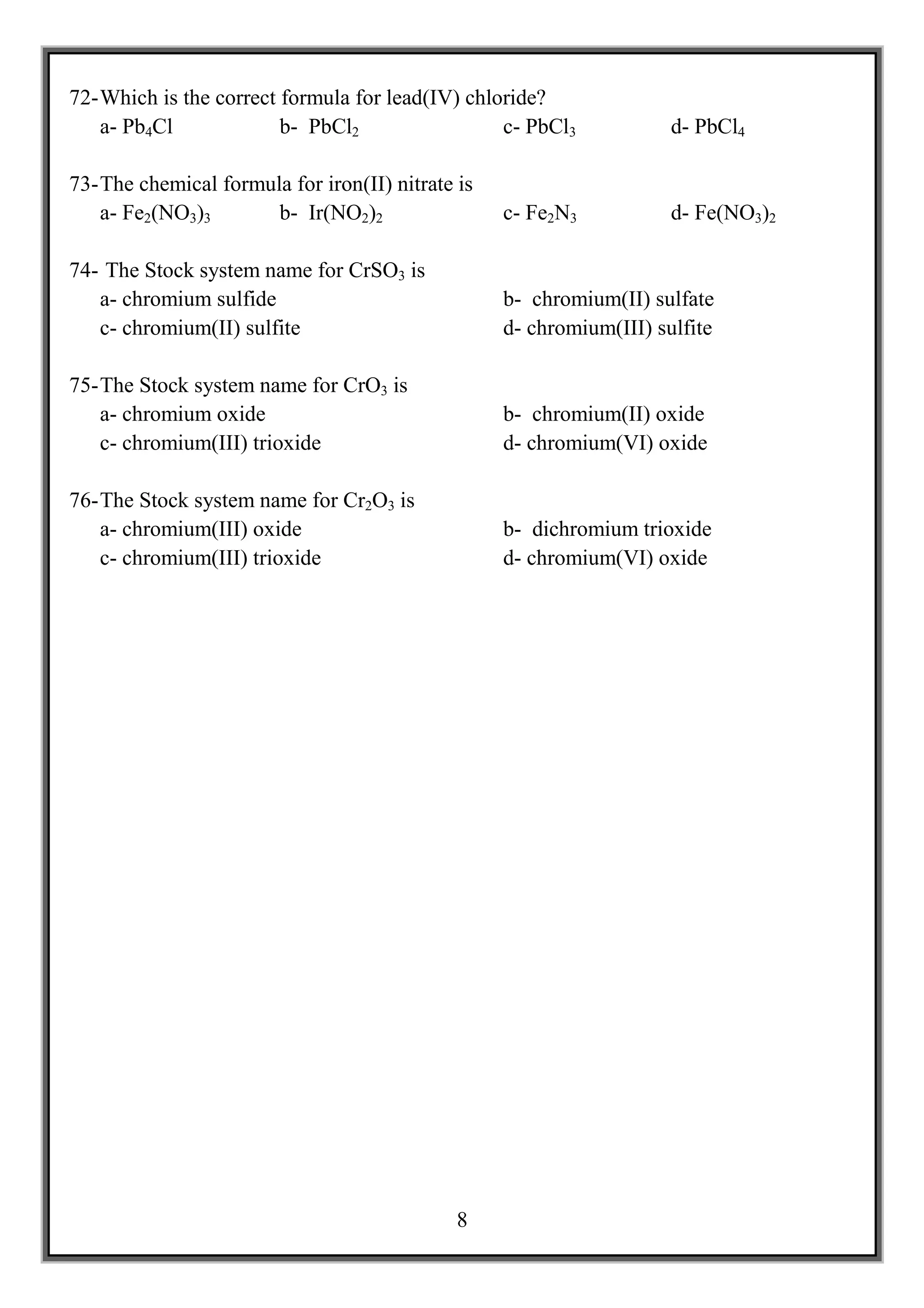
72- Which is the correct formula for lead(IV) chloride?
    a- Pb4Cl             b- PbCl2                 c- PbCl3            d- PbCl4

73- The chemical formula for iron(II) nitrate is
    a- Fe2(NO3)3       b- Ir(NO2)2                 c- Fe2N3           d- Fe(NO3)2

74- The Stock system name for CrSO3 is
   a- chromium sulfide                             b- chromium(II) sulfate
   c- chromium(II) sulfite                         d- chromium(III) sulfite

75- The Stock system name for CrO3 is
    a- chromium oxide                              b- chromium(II) oxide
    c- chromium(III) trioxide                      d- chromium(VI) oxide

76- The Stock system name for Cr2O3 is
    a- chromium(III) oxide                         b- dichromium trioxide
    c- chromium(III) trioxide                      d- chromium(VI) oxide


                                              8

Questions+on+chapter 1

  • 1.
    Questions on Chapter 2 (Choose and mark the correct answer) 1- The scientist who determined the magnitude of the electric charge of the electron was a- John Dalton. b- Robert Millikan. c- J. J. Thomson. d- R. Chang. 2- The scientist who determined the ratio of electric charge to the mass of an individual electron was a- John Dalton. b- Robert Millikan c- J. J. Thomson. d- R. Chang. 3- When J. J. Thomson discovered the electron, what physical property of the electron did he measure? a- its charge, e b- its charge-to-mass ratio, e/m c- its mass, m d- its atomic number, Z 4- The scientist who developed the nuclear model of the atom was a- James Chadwick. b- Robert Millikan. c- J. J. Thomson. d- Ernest Rutherford 5- The scientist who discovered the neutron was a- James Chadwick. b- Robert Millikan. c- J. J. Thomson. d- Ernest Rutherford 6- Rutherford's experiment with alpha particle scattering by gold foil established that a- protons are not evenly distributed throughout an atom. b- electrons have a negative charge. c- atoms are made of protons, neutrons, and electrons. d- protons are 1840 times heavier than electrons. 7- How many protons and electrons are present in one Br- ion? a- 35 p, 35 e b- 80 p, 81 e c- 35 p, 34 e d- 35 p, 36 e 8- How many neutrons are there in an atom of lead whose mass number is 208? a- 82 b- 126 c- 208 d- none of them 1
  • 2.
    9- An atomof the isotope sulfur-31 consists of how many protons, neutrons, and electrons? (p = proton, n = neutron, e = electron) a- 15 p, 16 n, 15 e b- 16 p, 15 n, 16 e c- 16 p, 31 n, 16 e d-16 p, 16 n, 15 e 10- Give the number of protons (p), electrons (e), and neutrons (n) in one atom of chlorine- 37 a- 37 p, 37 e, 17 n b- 17 p, 17 e, 37 n c- 17 p, 17 e, 20 n d- 37 p, 17 e, 20 n 11- A magnesium ion, Mg2+, has a- 12 p and 13 e b- 24 p and 26 e c- 12 p and 10 e d- 12 p and 14 e 12- An aluminum ion, Al3+, has: a- 13 p and 13 e b- 13 p and 27 e c- 10 p and 13 e d- 13 p and 10 e 13- An oxide ion, O2-, has: a- 8 p and 10 e b- 10 p and 8 e c- 8 p and 9 e d- 8 p and 6 e 14- A sulfide ion, S2- , has: a- 16 p and 16 e b- 32 p and 16 e c- 16 p and 14 e d- 16 p and 18 e 15- What is the number of protons (p) and electrons (e-) in Na+? a- 11 p, 10 e- b- 8 (p), 10 e- c- 12 (p), 10 e- d- 9 (p), 10 e- 16- The number of neutrons (n) and protons (p) in the element zinc ( 30 Zn 2+ ) is: 65 a- 30 n, 28 p b- 35 n, 30 p c- 31 n, 30 p d- 35 n, 28 p 17- The number of protons (p) and electrons (e) in the element zinc ( 30 Zn 2+ ) is: 65 a- 30 p, 28 e b- 35 n, 30 p c- 31 n, 30 p d- 35 n, 28 p 18- What is the appropriate symbol for the isotope Z = 11, A = 23? 34 23 23 23 a- 23 V b- 12 Mg c- 11 Na d- 11 V 19- What is the appropriate symbol for the isotope Z = 28, A = 64? 28 64 64 64 a- 64 Ni b- 28 Kr c- 28 Gd d- 28 Ni 20- The appropriate symbol for the isotope with number of electrons = 11 and number of neutrons = 12 59 a- 51 V 23 b- 24 Mg 12 c- 27 Co d- 23 Na 11 2
  • 3.
    21- Use thefollowing table and choose which of the species are neutral? atom or ion of element A B C D E F G Number of electrons (e-) 5 10 18 28 36 5 9 Number of protons (p) 5 7 19 30 35 5 9 Number of neutrons (n) 5 7 20 36 46 6 10 a- C and D b- C, D, E, F and G c- A, F and G d- B and E 22- Use the above table and choose which of the species are negatively charged? a- C and D b- C, D, E, F and G c- A, F and G d- B and E 23- Use the above table and choose which of the species are positively charged? a- C and D b- C, D, E, F and G c- A, F and G d- B and E 24- Use the above table and choose which of the species have larger number of neutrons than protons? a- C and D b- C, D, E, F and G c- A, F and G d- B and E 25- The letter A in the chemical symbol ( A X c ) represents: Z f a- Atomic number b- mass number c- charge d- frequency 26- The letter Z in the chemical symbol ( A X c ) represents: Z f a- Atomic number b- mass number c- charge d- frequency 27- The letter c in the chemical symbol ( A X c ) represents: Z f a- Atomic number b- mass number c- charge d- frequency 28- The letter f in the chemical symbol ( A X c ) represents: Z f a- Atomic number b- mass number c- charge d- frequency 204 29- Which of the following is an isotope of 82 Pb ? 197 208 212 199 a- Tl 81 b- 80 Hg c- 82 Pb d- Tl 81 30- Atoms of the same element with different mass numbers are called a- ions. b- neutrons. c- isotopes. d-chemical families. 3
  • 4.
    31- Atoms whichhave the same number of electrons and number of protons are called a- ions. b- neutral atoms c- isotopes. d- different atoms. 32- Atoms which have different number of electrons than number of protons are called a- ions. b- neutral atoms c- isotopes. d- different atoms 33- Atoms which have different number of protons are called a- ions. b- neutral atoms c- isotopes. d- different atoms. 34- Atoms with the same number of protons and with different number of neutrons are called a- ions. b- neutral atoms c- isotopes. d- different atoms. 35- Two isotopes of an element differ only in their a- symbol. b- atomic number. c- atomic mass. d- number of protons. 107 109 36- Silver occurs in nature as a mixture of two isotopes: 47 Ag and 47 Ag . The number of protons in both isotopes ( 107 Ag and 47 109 47 Ag ) is: 107 a- the same b- bigger in isotope 47 Ag 107 c- smaller in isotope 47 Ag d- none of the above 107 109 37- Silver occurs in nature as a mixture of two isotopes: 47 Ag and 47 Ag . The number of electrons in both isotopes ( 107 Ag and 47 109 47 Ag ) is: 107 a- the same b- bigger in isotope 47 Ag 107 c- smaller in isotope 47 Ag d- none of the above 107 109 38- Silver occurs in nature as a mixture of two isotopes: 47 Ag and 47 Ag . The number of neutrons in both isotopes ( 107 Ag and 47 109 47 Ag ) is: 107 a- the same b- bigger in isotope 47 Ag 107 c- smaller in isotope 47 Ag d- none of the above 107 109 39- Silver occurs in nature as a mixture of two isotopes: 47 Ag and 47 Ag . The mass number in both isotopes ( 107 Ag and 47 109 47 Ag ) is: 107 a- the same b- bigger in isotope 47 Ag 107 c- smaller in isotope 47 Ag d- none of the above 4
  • 5.
    40- In whichone of the following pairs do the two species resemble each other most closely in chemical properties? + 1 1 a- 1 H and 1 H b- 14 7 N and 14 7 N 3− 12 13 c- 6 C and 6 C 23 d- 11 Na and 23 11 Na + 41- An anion is defined as a- a charged atom or group of atoms with a net negative charge. b- a stable atom. c- a group of stable atoms. d- an atom or group of atoms with a net positive charge. 42- Which one of these species is an ion? a- B3+ b- NaCl c- He d- 14 C 43- The elements in a column of the periodic table are known as a- metalloids. b- a period. c- a group. d- noble gases. 44- Which of these materials are usually poor conductors of heat and electricity? a- metalloids. b- metals c- nonmetals d- alkali metals 45- Which of these elements is most likely to be a good conductor of electricity? a- N b- S c- He d- Fe 46- Which of these elements is chemically similar to magnesium? a- sulfur b- calcium c- iron d- nickel 47- Which of these elements is chemically similar to oxygen? a- sulfur b- calcium c- iron d- nickel 48- Which pair of compounds has the same empirical formula? a- C2H6O3 and CH2O b- NO2 and N2O4 c- C6H6and CH4 d- NO2 and NO4 49- What is the empirical formula of C6H6? a- C6O b- CH6 c- C3H3 d- CH 50- What is the empirical formula of P4O10? a- P4O5 b- P2O5 c- PO d- PO5 5
  • 6.
    51- What isthe empirical formula of N2O5? a- N2O5 b- NO c- NO5 d- N2O 52- Which of these pairs of elements would be most likely to form an ionic compound? a- P and Br b- Cu and K c- C and O d- O and Zn 53- Which pair of elements would be most likely to form an ionic compound? a- P and Br b- Zn and K c- F and Al d- C and S 54- What is the formula for the ionic compound formed by calcium ions and nitrate ions? a- Ca3N2 b- Ca(NO3)2 c- Ca2NO3 d- Ca2NO2 55- What is the formula for the ionic compound formed by magnesium and iodine? a- MgI b- Mg2I c- MgI2 d- MgI3 56- Which is the correct formula for copper(II) phosphate? a- Cu2PO4 b- Cu3(PO4)2 c- Cu2PO3 d- Cu(PO4)2 57- The formula for magnesium sulfate is a- MnS b- MgS c- MgSO4 d- MnSO3 58- The formula for sodium sulfide is a- NaS b- NaS2 c- K2S d- Na2S 59- The correct name for NO2 is a- nitrogen dioxide b- dinitrogen oxide c- nitrogen oxide d- dinitrogen monoxide 60- The correct name for N2O is a- nitrogen dioxide b- dinitrogen oxide c- nitrogen oxide d- dinitrogen monoxide 61- The correct name for SO2 is a- sulfur oxide b- sulfur dioxide c- sulfur trioxide d- monosulfur dioxide 62- The correct name for N2O3 is a- nitrogen trioxide b- dinitrogen trioxide c- nitrogen oxide d- dinitrogen oxide 6
  • 7.
    63- The correctname for Al2O3 is a- aluminum trioxide b- dialuminum trioxide c- aluminum oxide d- dialuminum oxide 64- The correct name for K2O is a- potassium dioxide b- dipotassium oxide c- potassium oxide d- dipotassium monoxide 65- The correct name for PCl3 is a- phosphorus chloride b- monophosphorus chloride c- phosphorus trichloride d- monophosphorus trichloride 66- The correct name for AlCl3 is a- aluminum chloride b- monoaluminum chloride c- aluminum trichloride d- monoaluminum trichloride 67- The correct names for H2S and H2O are a- dihydrogen sulfide and dihydrogen oxide b- hydrogen sulfide and water c- hydrogen sulfide and hydrogen oxide d- dihydrogen sulfide and water 68- The correct names for PH3 and NH3 are a-monophosphorous trihydride and mononitrogen trihydride b- monophosphorous trihydride and ammonia c- phosphorous trihydride and ammonia d- phosphorous trihydride and nitrogen trihydride 69- The correct name for NH4NO3 is a- ammonium nitrate b- ammonium nitrogen trioxide c- ammonia nitrogen oxide d- hydrogen nitrate 70- The correct name for Ba(OH)2 is a- barium hydroxide b- boron hydroxide c- barium hydrogen oxide d- barium hydrate 71- The Stock system name for Mn2O7 is a- manganese(II) oxide b- manganese(III) oxide c- manganese(VII) oxide d- magnesium oxide 7
  • 8.
    72- Which isthe correct formula for lead(IV) chloride? a- Pb4Cl b- PbCl2 c- PbCl3 d- PbCl4 73- The chemical formula for iron(II) nitrate is a- Fe2(NO3)3 b- Ir(NO2)2 c- Fe2N3 d- Fe(NO3)2 74- The Stock system name for CrSO3 is a- chromium sulfide b- chromium(II) sulfate c- chromium(II) sulfite d- chromium(III) sulfite 75- The Stock system name for CrO3 is a- chromium oxide b- chromium(II) oxide c- chromium(III) trioxide d- chromium(VI) oxide 76- The Stock system name for Cr2O3 is a- chromium(III) oxide b- dichromium trioxide c- chromium(III) trioxide d- chromium(VI) oxide 8