






Questions in Research: Formulation of
Research Problem – Management Question –
Research Question – Investigation Question
BY
DR. SATYANARAYAN PANDEY
ASSISTANT PROFESSOR
DEPARTMENT OF MANAGEMENT STUDIES BBMKU DHANBAD
Introduction
• Objective of the Presentation:
• Explain the importance of asking the right questions in research.
• Understand the process of formulating a research problem.
• Distinguish between management, research, and investigation questions.
The Importance of Questions in
Research
• Questions guide the research process.
• Help focus on specific issues and determine methodology.
• Aid in achieving clear, actionable, and meaningful results.
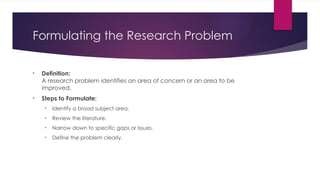
Formulating the Research Problem
• Definition:
A research problem identifies an area of concern or an area to be
improved.
• Steps to Formulate:
• Identify a broad subject area.
• Review the literature.
• Narrow down to specific gaps or issues.
• Define the problem clearly.
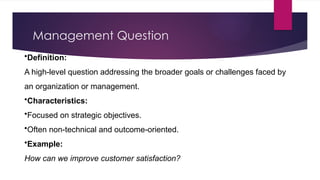
Management Question
•Definition:
A high-level question addressing the broader goals or challenges faced by
an organization or management.
•Characteristics:
•Focused on strategic objectives.
•Often non-technical and outcome-oriented.
•Example:
How can we improve customer satisfaction?
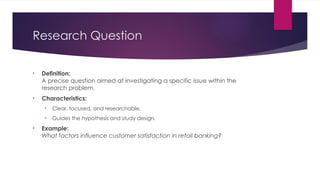
Research Question
• Definition:
A precise question aimed at investigating a specific issue within the
research problem.
• Characteristics:
• Clear, focused, and researchable.
• Guides the hypothesis and study design.
• Example:
What factors influence customer satisfaction in retail banking?
Investigation Question
• Definition:
Detailed, operational questions that break down the research question
into measurable components.
• Characteristics:
• Specific and often quantitative.
• Direct the data collection and analysis.
• Example:
• What percentage of customers rate service quality as excellent?
• How does response time correlate with satisfaction ratings?
Interrelationship Between Questions
• Management Question → Broad strategic direction.
• Research Question → Defines the scope for investigation.
• Investigation Question → Practical, measurable aspects for data
gathering.
• Flowchart Representation (Diagram with arrows showing progression).
Key Considerations in Formulating
Questions
•Clarity and focus.
•Relevance to stakeholders.
•Feasibility within time and resource constraints.
•Ethical considerations.
Case Study
• Scenario: Improving employee retention in an IT firm.
• Management Question: How can we reduce employee turnover?
• Research Question: What are the key factors driving employee turnover?
• Investigation Question:
• What percentage of employees leave within one year?
• What role does salary dissatisfaction play in turnover?
Summary
•Research begins with asking the right questions.
•Management, research, and investigation questions form a hierarchy guiding the research process.
•Effective question formulation leads to actionable and impactful results.

Questions in Research ,formulating research problem.pptx

  • 1.
    Questions in Research:Formulation of Research Problem – Management Question – Research Question – Investigation Question BY DR. SATYANARAYAN PANDEY ASSISTANT PROFESSOR DEPARTMENT OF MANAGEMENT STUDIES BBMKU DHANBAD
  • 2.
    Introduction • Objective ofthe Presentation: • Explain the importance of asking the right questions in research. • Understand the process of formulating a research problem. • Distinguish between management, research, and investigation questions.
  • 3.
    The Importance ofQuestions in Research • Questions guide the research process. • Help focus on specific issues and determine methodology. • Aid in achieving clear, actionable, and meaningful results.
  • 4.
    Formulating the ResearchProblem • Definition: A research problem identifies an area of concern or an area to be improved. • Steps to Formulate: • Identify a broad subject area. • Review the literature. • Narrow down to specific gaps or issues. • Define the problem clearly.
  • 5.
    Management Question •Definition: A high-levelquestion addressing the broader goals or challenges faced by an organization or management. •Characteristics: •Focused on strategic objectives. •Often non-technical and outcome-oriented. •Example: How can we improve customer satisfaction?
  • 6.
    Research Question • Definition: Aprecise question aimed at investigating a specific issue within the research problem. • Characteristics: • Clear, focused, and researchable. • Guides the hypothesis and study design. • Example: What factors influence customer satisfaction in retail banking?
  • 7.
    Investigation Question • Definition: Detailed,operational questions that break down the research question into measurable components. • Characteristics: • Specific and often quantitative. • Direct the data collection and analysis. • Example: • What percentage of customers rate service quality as excellent? • How does response time correlate with satisfaction ratings?
  • 8.
    Interrelationship Between Questions •Management Question → Broad strategic direction. • Research Question → Defines the scope for investigation. • Investigation Question → Practical, measurable aspects for data gathering. • Flowchart Representation (Diagram with arrows showing progression).
  • 9.
    Key Considerations inFormulating Questions •Clarity and focus. •Relevance to stakeholders. •Feasibility within time and resource constraints. •Ethical considerations.
  • 10.
    Case Study • Scenario:Improving employee retention in an IT firm. • Management Question: How can we reduce employee turnover? • Research Question: What are the key factors driving employee turnover? • Investigation Question: • What percentage of employees leave within one year? • What role does salary dissatisfaction play in turnover?
  • 11.
    Summary •Research begins withasking the right questions. •Management, research, and investigation questions form a hierarchy guiding the research process. •Effective question formulation leads to actionable and impactful results.