Title: Understanding Variables and Research Designs
Subtitle: Key Concepts in Research Methodology
PRESENTED BY: DR. SATYANARAYAN
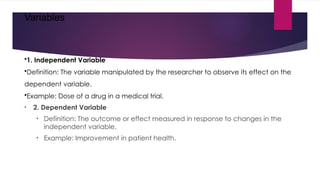
Variables
•1. Independent Variable
•Definition: The variable manipulated by the researcher to observe its effect on the
dependent variable.
•Example: Dose of a drug in a medical trial.
• 2. Dependent Variable
• Definition: The outcome or effect measured in response to changes in the
independent variable.
• Example: Improvement in patient health.
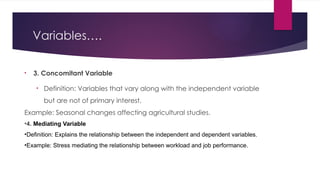
Variables….
• 3. Concomitant Variable
• Definition: Variables that vary along with the independent variable
but are not of primary interest.
Example: Seasonal changes affecting agricultural studies.
•4. Mediating Variable
•Definition: Explains the relationship between the independent and dependent variables.
•Example: Stress mediating the relationship between workload and job performance.
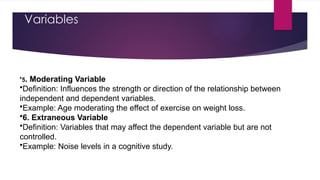
Variables
•5. Moderating Variable
•Definition: Influences the strength or direction of the relationship between
independent and dependent variables.
•Example: Age moderating the effect of exercise on weight loss.
•6. Extraneous Variable
•Definition: Variables that may affect the dependent variable but are not
controlled.
•Example: Noise levels in a cognitive study.
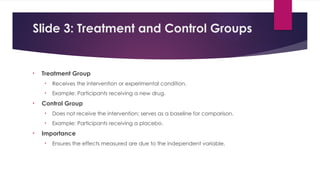
Slide 3: Treatment and Control Groups
• Treatment Group
• Receives the intervention or experimental condition.
• Example: Participants receiving a new drug.
• Control Group
• Does not receive the intervention; serves as a baseline for comparison.
• Example: Participants receiving a placebo.
• Importance
• Ensures the effects measured are due to the independent variable.
Slide 4: Case Study Design
• Definition
• In-depth exploration of a specific case within its real-life context.
• Features
• Focus on a single entity or phenomenon.
• Uses multiple sources of data: interviews, observations, documents.
• Example
• Studying the operational efficiency of a single manufacturing unit.
Slide 5: Research Designs
• Cross-Sectional Design
• Data collected at a single point in time.
• Suitable for identifying prevalence or relationships.
• Example: A survey on customer satisfaction.
• Longitudinal Design
• Data collected over multiple points in time.
• Tracks changes and developments.
• Example: Tracking the progress of students’ academic performance over five
years.
Research Approaches
• Qualitative Research
• Focus: Understanding experiences, behaviors, or cultures.
• Methods: Interviews, focus groups, ethnography.
• Example: Exploring consumer preferences for sustainable products.
• Quantitative Research
• Focus: Measuring and analyzing numerical data.
• Methods: Surveys, experiments, statistical analysis.
• Example: Testing the effectiveness of a marketing campaign.
• Mixed Methods
• Combines qualitative and quantitative approaches.
• Provides a comprehensive perspective.
Summary
• Variables play a critical role in defining and guiding research.
• Treatment and control groups help validate research findings.
• Case study, cross-sectional, and longitudinal designs cater to different
research objectives.
• Qualitative and quantitative approaches provide complementary insights.

Research Variables, research methadology

  • 1.
    Title: Understanding Variablesand Research Designs Subtitle: Key Concepts in Research Methodology PRESENTED BY: DR. SATYANARAYAN
  • 2.
    Variables •1. Independent Variable •Definition:The variable manipulated by the researcher to observe its effect on the dependent variable. •Example: Dose of a drug in a medical trial. • 2. Dependent Variable • Definition: The outcome or effect measured in response to changes in the independent variable. • Example: Improvement in patient health.
  • 3.
    Variables…. • 3. ConcomitantVariable • Definition: Variables that vary along with the independent variable but are not of primary interest. Example: Seasonal changes affecting agricultural studies. •4. Mediating Variable •Definition: Explains the relationship between the independent and dependent variables. •Example: Stress mediating the relationship between workload and job performance.
  • 4.
    Variables •5. Moderating Variable •Definition:Influences the strength or direction of the relationship between independent and dependent variables. •Example: Age moderating the effect of exercise on weight loss. •6. Extraneous Variable •Definition: Variables that may affect the dependent variable but are not controlled. •Example: Noise levels in a cognitive study.
  • 5.
    Slide 3: Treatmentand Control Groups • Treatment Group • Receives the intervention or experimental condition. • Example: Participants receiving a new drug. • Control Group • Does not receive the intervention; serves as a baseline for comparison. • Example: Participants receiving a placebo. • Importance • Ensures the effects measured are due to the independent variable.
  • 6.
    Slide 4: CaseStudy Design • Definition • In-depth exploration of a specific case within its real-life context. • Features • Focus on a single entity or phenomenon. • Uses multiple sources of data: interviews, observations, documents. • Example • Studying the operational efficiency of a single manufacturing unit.
  • 7.
    Slide 5: ResearchDesigns • Cross-Sectional Design • Data collected at a single point in time. • Suitable for identifying prevalence or relationships. • Example: A survey on customer satisfaction. • Longitudinal Design • Data collected over multiple points in time. • Tracks changes and developments. • Example: Tracking the progress of students’ academic performance over five years.
  • 8.
    Research Approaches • QualitativeResearch • Focus: Understanding experiences, behaviors, or cultures. • Methods: Interviews, focus groups, ethnography. • Example: Exploring consumer preferences for sustainable products. • Quantitative Research • Focus: Measuring and analyzing numerical data. • Methods: Surveys, experiments, statistical analysis. • Example: Testing the effectiveness of a marketing campaign. • Mixed Methods • Combines qualitative and quantitative approaches. • Provides a comprehensive perspective.
  • 9.
    Summary • Variables playa critical role in defining and guiding research. • Treatment and control groups help validate research findings. • Case study, cross-sectional, and longitudinal designs cater to different research objectives. • Qualitative and quantitative approaches provide complementary insights.