QUESTIONS AND ANSWERS
1- Can ledger make without journal?
Journal is the source of providing information to ledger
accounts relating to transaction’s date, nature of account,
reference number, applied rubes and amount. The information
in journal comes from vouchers which make base to source
documents.
Ledger is the bunch of accounts requires prescribed
information which may be supplied by journals or from the
source documents to which journal make base for recording.
Then we are in right to say that ledger can be made from
source documents but the importance of maintaining journals
is in its own place. The diary for cash or bank will have to
maintain necessarily if ledger is made without journals or cash
book.
In small business where some transactions occurred in a
month, it can be applied but where transactions’ volume is
huge, the practice of maintaining journals must be adopted.
The good way is to walk step by step.
<THE SYSTEM OF ACCOUNTING < VOLIUMII< SYED AQEEL RAZA<aqeelraza@live.com>
2- What is the difference between cash book and journals?
Cash book is a form of journal mostly used to control receipts
and payments of cash. It works as a ledger of cash and bank
which balance at the end is shown in balance sheet. The cash
book deals with only transactions occurred in cash or by bank
and for small transactions, petty cash book is maintained.
When general journal is the form of mixtures of all transactions
cash, credit, adjustments, discounts and goods returns and
some special journals like cash receipt journal, cash payment
journal, sales journal, sales return and allowances journal and
purchase journal, purchases return and allowance journals
support to general journal.
The cash book is the best replacement of cash receipt and cash
payment journals.
<THE SYSTEM OF ACCOUNTING < VOLIUMII< SYED AQEEL RAZA<aqeelraza@live.com>
3- Does petty cash book link to cash book, explain?
Petty cash book is the part of cash book, it maintains to record
small transactions such as conveyance, cartage, entertainment,
postage, small repairs, etc.
Petty cash fund is issued by cash book debiting petty cash funds
account. The petty cash fund decrease cash from cash book and
increase cash in petty cash book. Petty cash expenses are paid
through petty cash voucher and recorded into petty cash book
in specific column and many other accounts which have no
column is written in other account.
Having been paid expenses, the total of each account is
journalized into ledge as petty cash expenses; head wise debt
and petty cash fund credit. The ledger balance becomes equal
to petty cash book balance and for the same way the fund
issued and spends.
In other words, we can say the petty cash book is the sub book
of cash book.
<THE SYSTEM OF ACCOUNTING < VOLIUMII< SYED AQEEL RAZA<aqeelraza@live.com>
4- What do you mean by journals and journalizing?
Journal is a book or diary columnar designed to make easy record
keeping but journalizing is the method of recording transaction in
general journal or in specified journals but where cash book is used
instead of journals, journal entry affects general ledger or to its
subsidiary ledger accounts.
In business, sale or purchase on credit; the payment of which made
later; is journalized by journal voucher which effect debtor or creditor
accounts.
All adjustments such as sales discount, purchase discount, sale return,
purchase return, transfer of amount from an account to another
account and so on in accounts are made through journalizing.
Journalizing mostly affects general ledger consists on permanent
accounts and sometimes affects temporary accounts for adjustment
purposes.
Because of journalizing, we find the actual balance of debit and credit
fluctuating immediately from the process of journalizing facilities one
to pay or receive the amount payable or receivable.
Journalizing is mostly used for correction the amount of an account or
transfers the balance from an account to another account freely.
<THE SYSTEM OF ACCOUNTING < VOLIUMII< SYED AQEEL RAZA<aqeelraza@live.com>
5- Explain the function of ledger?
The bunch of accounts is called ledger, its main function is to
provide end result of amount as to balance in debit or in credit.
If balance in general ledger which consists on assets, liabilities
and owner’s equity, as asset is debit means to have or to
receive, liabilities is debit means to pay the amount to whom
the debit taken and owner’s equity is credit means to have the
amount of investment. The balances in temporary accounts;
expense and revenue; are ended on calculation of profit and
loss which is transferred to general ledger account.
The main function of maintaining ledger is to provide end
balance of all accounts to next stage as to trial balance.
<THE SYSTEM OF ACCOUNTING < VOLIUMII< SYED AQEEL RAZA<aqeelraza@live.com>
6- What do you mean by purchase merchandise; assets or
expense?
All purchases unsold for doing business are assets for example a
trader purchases items for sale and to get profit over it and a
manufacturer purchases different materials to make goods of
his business. All goods sold help to recover the amount of
purchases as well as profit over it. Therefore, the purchases
which were assets unsold when sold changed the name as sale.
Because of the reason in question, the purchase of
merchandise is treated as expense to make gross profit or loss
and the unsold merchandise will be the part of permanent
account as current asset.
All purchase returns and purchase discounts which are contra
assets but reduce purchases in income summary are temporary
accounts may belong to expense and revenue ledger.
<THE SYSTEM OF ACCOUNTING < VOLIUMII< SYED AQEEL RAZA<aqeelraza@live.com>
7- Subsidiary ledger and the benefit of making it, explain?
Subsidiary ledger is a sub book of general ledger mostly makes
for account receivable and account payable having various
parities or clients to whom the goods sold and purchase are
made on credit.
The subsidiary ledger helps for receiving the amount balance in
party’s account as well as giving discounts on sale or purchases
which sometime seller or purchaser issues on early payment.
The party’s account in subsidiary ledger is increased or
decreased in balance by discounts
The subsidiary ledger helps in doing returns of sale or purchase
to any party due to defect in goods or any reason and is
affected by increase or decrease in balance.
All accounts which have windows or various accounts relating
to specific account may be opened by subsidiary ledger
account.
The main benefit of subsidiary accounts is to make separate
account of any specific account having multiple parties or
clients.
<THE SYSTEM OF ACCOUNTING < VOLIUMII< SYED AQEEL RAZA<aqeelraza@live.com>
8- What do you understand by accounts receivable and
accounts payable and its schedule?
The list of debtors or creditors consists on parties name,
amount etc. is the schedule of accounts receivable or account
payable scratched from subsidiary ledger; sub ledger of general
ledger; especially made for parties.
Creditors are those from whom we purchase merchandise on
credit by crediting their accounts as account payable and
debtors are the parties to whom we sell merchandise on
account by debiting their accounts as account receivable. For
example, we purchase merchandise goods worth Rs.10, 000/=
from A.I. Traders on credit, we shall open A.I. Traders Account
(A/c payable) and on paying some amount or Rs.5000/= from
his account shall debit his account as A.I. Traders (A/c Payable),
the balance will remain in credit Rs.5000/= indicate us to pay
later.
The schedule of debtors and creditors may indicatethe position
of parties altogether or individually for management purposes
that requires with a payment or receiving point of view and for
linking with general ledger control account.
<THE SYSTEM OF ACCOUNTING < VOLIUMII< SYED AQEEL RAZA<aqeelraza@live.com>
9- Is purchase asset or an expense?
All purchases which have no concern with the goods applied in
sale are expenses and the goods sold which consumed in sale
will also be an expense but the goods unsold is current asset.
Hence, purchase for doing business is a temporary asset or may
be considered expense but relates to the ledger of expense and
revenue or income statement accounts.
Further, Purchase for doing business is a temporary account
relates to inventory and inventory is asset until in handbut may
be considered as expense because of its relation to income and
the balance remains unsold will be permanent account as asset
which is transferable to the next accounting cycle.
<THE SYSTEM OF ACCOUNTING < VOLIUMII< SYED AQEEL RAZA<aqeelraza@live.com>
10- Is purchase return asset or an expense?
The purchase returns and allowances have relation to
purchase merchandise which reduce purchases is not
expense directly but may be contra expense.
11- Is purchase discount asset or an expense?
Purchase discount offered by supplier to purchaser on
payment in time is not an expense directly but relates to
goods purchased for business and does contra to the
value of goods purchased. It is reduced by purchases in
income statement may be contra expense account.
12- Describe the net and gross method of purchase
discount.
Purchase discount is given by the supplier to the
purchaser on payment in time and may be recorded
under gross method and net method of accounting.
In gross method, the total cost of purchase is credited to
accounts payable and discount at the time of payment if
realized will be recorded as accounts payable debit; the
total amount of payable against invoice; discount credit;
the amount of discount; cash credit; the payment after
deducting discount and payment after discount period;
accounts payable debit and cash credit.
In net method of accounting, the total net cost of
purchase (gross value less discount) is debited and
account payable credited and on payment account
payable is debited and purchase discount credited.
If the payment is not made in time, an anti-revenue
account named purchase discount lost is debited to
record the loss as accounts payable debit, purchase
discount loss debit and cash credit.
13- How to close an opening and closing inventory
account?
An opening inventory is the balance of closing inventory
at the start of accounting cycle transferred by expense &
revenue summary to general ledger account as opening
inventory debit and income summary credit.
In order to make income statement, the opening
inventory is transferred to expense summary under
journal entry as income summary debit and inventory
opening credit.
The inventory unsold is transferred to general ledger
account under journal entry as inventory ending debit
and income summary credit.
The inventory ending is a current asset shown in balance
sheet.
14- Is the cost of goods sold an expense?
The cost of goods sold is obtained by cost of goods sold
statement under formula cost of goods sold =
merchandise inventory opening + net purchases –
merchandise inventory closing. On selling, the cost of
goods sold is converted into cash and cash is asset, the
sale above than cost of goods will definitely be profit and
profit is the part of capital but the consumption process
of cost of goods is considered as an expense.
<THE SYSTEM OF ACCOUNTING < VOLIUMII< SYED AQEEL RAZA<aqeelraza@live.com>
15. Discuss briefly on asset, liabilities, equities,
revenue and expenses.
The discussion on assets, liabilities, proprietorship,
revenue and expense is like to draw water from sea and
to count stars from sky because of their involvements in
every places entire subject but in shortly we can describe
them;
- Assets represent to resources or things having
economical value equal to liabilities plus
proprietorship under different classifications.
- Liabilities are the claims of suppliers and borrowers
in short term and long term.
- Equities are the sources of providing funds to
business by internal or external ways.
- Expenses help to generate profit.
The result is concluded that assets are resources
obtained by sources or equities which can have liabilities
from internal or external but revenues and expenses are
applied in the process of income.
The assets, liabilities and equities are the member of
accounting cycle but revenues and expenses are expired
on income and loss sate.
16- What do you mean by working capital?
Money invested in business is recognized by capital
which enables business to buy assets and pay for
obligations.
Working capital is a measure to weigh the financial
health of an entity by increasing or decreasing in assets
and liabilities under formula working capital = current
assets – current liabilities. The increase in current assets
means the efficiency in business and decrease in current
assets defines deficiency.
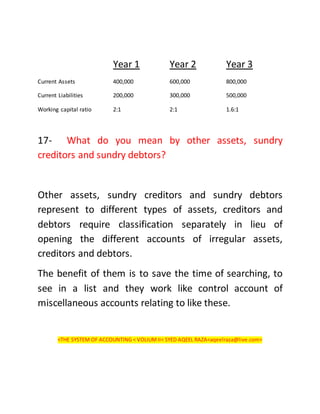
The working capital ratio can be calculated by dividing all
current assets with all current liabilities indicating
increase and decrease in assets comparatively as;
Year 1 Year 2 Year 3
Current Assets 400,000 600,000 800,000
Current Liabilities 200,000 300,000 500,000
Working capital ratio 2:1 2:1 1.6:1
17- What do you mean by other assets, sundry
creditors and sundry debtors?
Other assets, sundry creditors and sundry debtors
represent to different types of assets, creditors and
debtors require classification separately in lieu of
opening the different accounts of irregular assets,
creditors and debtors.
The benefit of them is to save the time of searching, to
see in a list and they work like control account of
miscellaneous accounts relating to like these.
<THE SYSTEM OF ACCOUNTING < VOLIUMII< SYED AQEEL RAZA<aqeelraza@live.com>
18- Described about cash base accounting, accrual
base accounting and cash base and accrual base mix
accounting.
CASH BASE ACCOUNTING
In cash base accounting system, transactions are
recognized on receipt and payment of cash. It is usually
applied or followed by individual or small business
concerns. Revenues and are report in income statement
when the cash is received and expenses occurred.
ACCRUAL BASE ACCOUNTING
In accrual base accounting, transactions are recorded in
ledger under journalizing and as when they transact and
reported in income statement when they earned or
occurred of the period that closes accounting. Now, the
cash received or paid will have no concern with revenues
and expenses but payment and receipt.
As far as usually expenses are concerned, the accrual of
them daily is not in practice. Now, this question can be
arisen that will the profit cover the transaction of the
date? The answer will be no, then the accrual base
accounting need to accrue all transactions on accrual
basis if we require profit and loss and balance sheet on
daily basis.
CASH AND ACCRUAL BASE MIX ACCOUNTING
In cash base accounting cash is received or paid against
transactions as and when they occurred and in accrual
base accounting, the journal entry of the transactions is
recorded as and when it occurred before cash receipt
and payment.
In cash and accrual mix base accounting, usually cash is
received or paid against transactions but the transactions
relate to receivable or payable are journalized and
remaining transactions of the date of accounting period
are recorded at the time of closing accounts.
It is up to entity’s requirement that it adopts the system
among cash, accrual and mix accounting system.
<THE SYSTEM OF ACCOUNTING < VOLIUMII< SYED AQEEL RAZA<aqeelraza@live.com>
19 - What is suspense account?
A suspense account in debit or credit is an account which
is opened in general ledger temporarily to record
doubtful transactions requires proper account
undefined. On meeting the proper account, the amount
recorded in suspense account is transferred to its proper
account from suspense account.
Suppose that on reconciliation of bank statement, an
amount of Rs.50000/= is found in credit in bank
statement may be sent by someone or party. It needs to
store in account temporarily to imbalance cash book till
the party is ascertained, it will kept in suspense account
like; bank debit and suspense account credit and like this
way an amount is found in payment by bank statement,
will be in suspense account debit and bank credit.
Further, a suspense account is used to record the
difference in amount of an account like;
- Machinery repaired at Rs. 900/= has been debited to Machinery
repair account Rs. 800/=.
The difference in account has been noted Rs.100/=
because machinery was repaired Rs.900/= and the
original entry will be machinery repair debited by
Rs.900/= and cash credited by Rs.900/= but difference in
positing in machinery repair account is recorded
Rs.800/= instead of Rs.900/= then the difference will go
in machinery repair account in debit Rs.100/= and
suspense account in credit Rs.100/=.
20- Discuss about the need of internal audit.
Everything which has weight if let it idle will cause faulting, this is the
fact that everyone has no way to deny. Just like this, accounts to which
we say are the characters of accounting need to have checking and
finding mistakes at an early stage will save the difficulty of presenting
true accounting.
Hence, accounts are needed to check daily and to do it an auditor is
required internally who sees every transaction with bird’s eye view and
finds mistakes in source documents and in recording. I think he will be
responsible for;
- Checking indents/purchase orders/inventory/consumables
- Checking invoices/bills/cash memos compare to purchase
order/requests
- Checking and calculation of invoice/bills/cash memo in
compassion to rate
- Getting awareness with rates according to market.
- Raising questions about rates and purchases above than
purchase order.
- Verified payment instrument that has been audited.
- Finding mistakes in wrong postings and make them
corrected.
- Keep an eye on receiving and payments
<THE SYSTEM OF ACCOUNTING < VOLIUMII< SYED AQEEL RAZA<aqeelraza@live.com>

Questions & Answers vol 2

  • 1.
    QUESTIONS AND ANSWERS 1-Can ledger make without journal?
  • 2.
    Journal is thesource of providing information to ledger accounts relating to transaction’s date, nature of account, reference number, applied rubes and amount. The information in journal comes from vouchers which make base to source documents. Ledger is the bunch of accounts requires prescribed information which may be supplied by journals or from the source documents to which journal make base for recording. Then we are in right to say that ledger can be made from source documents but the importance of maintaining journals is in its own place. The diary for cash or bank will have to maintain necessarily if ledger is made without journals or cash book. In small business where some transactions occurred in a month, it can be applied but where transactions’ volume is huge, the practice of maintaining journals must be adopted. The good way is to walk step by step. <THE SYSTEM OF ACCOUNTING < VOLIUMII< SYED AQEEL RAZA<aqeelraza@live.com>
  • 3.
    2- What isthe difference between cash book and journals? Cash book is a form of journal mostly used to control receipts and payments of cash. It works as a ledger of cash and bank which balance at the end is shown in balance sheet. The cash book deals with only transactions occurred in cash or by bank and for small transactions, petty cash book is maintained. When general journal is the form of mixtures of all transactions cash, credit, adjustments, discounts and goods returns and some special journals like cash receipt journal, cash payment journal, sales journal, sales return and allowances journal and purchase journal, purchases return and allowance journals support to general journal. The cash book is the best replacement of cash receipt and cash payment journals. <THE SYSTEM OF ACCOUNTING < VOLIUMII< SYED AQEEL RAZA<aqeelraza@live.com>
  • 4.
    3- Does pettycash book link to cash book, explain? Petty cash book is the part of cash book, it maintains to record small transactions such as conveyance, cartage, entertainment, postage, small repairs, etc. Petty cash fund is issued by cash book debiting petty cash funds account. The petty cash fund decrease cash from cash book and increase cash in petty cash book. Petty cash expenses are paid through petty cash voucher and recorded into petty cash book in specific column and many other accounts which have no column is written in other account. Having been paid expenses, the total of each account is journalized into ledge as petty cash expenses; head wise debt and petty cash fund credit. The ledger balance becomes equal to petty cash book balance and for the same way the fund issued and spends. In other words, we can say the petty cash book is the sub book of cash book. <THE SYSTEM OF ACCOUNTING < VOLIUMII< SYED AQEEL RAZA<aqeelraza@live.com>
  • 5.
    4- What doyou mean by journals and journalizing? Journal is a book or diary columnar designed to make easy record keeping but journalizing is the method of recording transaction in general journal or in specified journals but where cash book is used instead of journals, journal entry affects general ledger or to its subsidiary ledger accounts. In business, sale or purchase on credit; the payment of which made later; is journalized by journal voucher which effect debtor or creditor accounts. All adjustments such as sales discount, purchase discount, sale return, purchase return, transfer of amount from an account to another account and so on in accounts are made through journalizing. Journalizing mostly affects general ledger consists on permanent accounts and sometimes affects temporary accounts for adjustment purposes. Because of journalizing, we find the actual balance of debit and credit fluctuating immediately from the process of journalizing facilities one to pay or receive the amount payable or receivable. Journalizing is mostly used for correction the amount of an account or transfers the balance from an account to another account freely. <THE SYSTEM OF ACCOUNTING < VOLIUMII< SYED AQEEL RAZA<aqeelraza@live.com>
  • 6.
    5- Explain thefunction of ledger? The bunch of accounts is called ledger, its main function is to provide end result of amount as to balance in debit or in credit. If balance in general ledger which consists on assets, liabilities and owner’s equity, as asset is debit means to have or to receive, liabilities is debit means to pay the amount to whom the debit taken and owner’s equity is credit means to have the amount of investment. The balances in temporary accounts; expense and revenue; are ended on calculation of profit and loss which is transferred to general ledger account. The main function of maintaining ledger is to provide end balance of all accounts to next stage as to trial balance. <THE SYSTEM OF ACCOUNTING < VOLIUMII< SYED AQEEL RAZA<aqeelraza@live.com>
  • 7.
    6- What doyou mean by purchase merchandise; assets or expense? All purchases unsold for doing business are assets for example a trader purchases items for sale and to get profit over it and a manufacturer purchases different materials to make goods of his business. All goods sold help to recover the amount of purchases as well as profit over it. Therefore, the purchases which were assets unsold when sold changed the name as sale. Because of the reason in question, the purchase of merchandise is treated as expense to make gross profit or loss and the unsold merchandise will be the part of permanent account as current asset. All purchase returns and purchase discounts which are contra assets but reduce purchases in income summary are temporary accounts may belong to expense and revenue ledger. <THE SYSTEM OF ACCOUNTING < VOLIUMII< SYED AQEEL RAZA<aqeelraza@live.com> 7- Subsidiary ledger and the benefit of making it, explain?
  • 8.
    Subsidiary ledger isa sub book of general ledger mostly makes for account receivable and account payable having various parities or clients to whom the goods sold and purchase are made on credit. The subsidiary ledger helps for receiving the amount balance in party’s account as well as giving discounts on sale or purchases which sometime seller or purchaser issues on early payment. The party’s account in subsidiary ledger is increased or decreased in balance by discounts The subsidiary ledger helps in doing returns of sale or purchase to any party due to defect in goods or any reason and is affected by increase or decrease in balance. All accounts which have windows or various accounts relating to specific account may be opened by subsidiary ledger account. The main benefit of subsidiary accounts is to make separate account of any specific account having multiple parties or clients. <THE SYSTEM OF ACCOUNTING < VOLIUMII< SYED AQEEL RAZA<aqeelraza@live.com>
  • 9.
    8- What doyou understand by accounts receivable and accounts payable and its schedule? The list of debtors or creditors consists on parties name, amount etc. is the schedule of accounts receivable or account payable scratched from subsidiary ledger; sub ledger of general ledger; especially made for parties. Creditors are those from whom we purchase merchandise on credit by crediting their accounts as account payable and debtors are the parties to whom we sell merchandise on account by debiting their accounts as account receivable. For example, we purchase merchandise goods worth Rs.10, 000/= from A.I. Traders on credit, we shall open A.I. Traders Account (A/c payable) and on paying some amount or Rs.5000/= from his account shall debit his account as A.I. Traders (A/c Payable), the balance will remain in credit Rs.5000/= indicate us to pay later. The schedule of debtors and creditors may indicatethe position of parties altogether or individually for management purposes that requires with a payment or receiving point of view and for linking with general ledger control account. <THE SYSTEM OF ACCOUNTING < VOLIUMII< SYED AQEEL RAZA<aqeelraza@live.com>
  • 10.
    9- Is purchaseasset or an expense? All purchases which have no concern with the goods applied in sale are expenses and the goods sold which consumed in sale will also be an expense but the goods unsold is current asset. Hence, purchase for doing business is a temporary asset or may be considered expense but relates to the ledger of expense and revenue or income statement accounts. Further, Purchase for doing business is a temporary account relates to inventory and inventory is asset until in handbut may be considered as expense because of its relation to income and the balance remains unsold will be permanent account as asset which is transferable to the next accounting cycle. <THE SYSTEM OF ACCOUNTING < VOLIUMII< SYED AQEEL RAZA<aqeelraza@live.com>
  • 11.
    10- Is purchasereturn asset or an expense? The purchase returns and allowances have relation to purchase merchandise which reduce purchases is not expense directly but may be contra expense. 11- Is purchase discount asset or an expense? Purchase discount offered by supplier to purchaser on payment in time is not an expense directly but relates to goods purchased for business and does contra to the value of goods purchased. It is reduced by purchases in income statement may be contra expense account. 12- Describe the net and gross method of purchase discount. Purchase discount is given by the supplier to the purchaser on payment in time and may be recorded under gross method and net method of accounting. In gross method, the total cost of purchase is credited to accounts payable and discount at the time of payment if realized will be recorded as accounts payable debit; the total amount of payable against invoice; discount credit;
  • 12.
    the amount ofdiscount; cash credit; the payment after deducting discount and payment after discount period; accounts payable debit and cash credit. In net method of accounting, the total net cost of purchase (gross value less discount) is debited and account payable credited and on payment account payable is debited and purchase discount credited. If the payment is not made in time, an anti-revenue account named purchase discount lost is debited to record the loss as accounts payable debit, purchase discount loss debit and cash credit. 13- How to close an opening and closing inventory account? An opening inventory is the balance of closing inventory at the start of accounting cycle transferred by expense & revenue summary to general ledger account as opening inventory debit and income summary credit. In order to make income statement, the opening inventory is transferred to expense summary under
  • 13.
    journal entry asincome summary debit and inventory opening credit. The inventory unsold is transferred to general ledger account under journal entry as inventory ending debit and income summary credit. The inventory ending is a current asset shown in balance sheet. 14- Is the cost of goods sold an expense? The cost of goods sold is obtained by cost of goods sold statement under formula cost of goods sold = merchandise inventory opening + net purchases – merchandise inventory closing. On selling, the cost of goods sold is converted into cash and cash is asset, the sale above than cost of goods will definitely be profit and profit is the part of capital but the consumption process of cost of goods is considered as an expense. <THE SYSTEM OF ACCOUNTING < VOLIUMII< SYED AQEEL RAZA<aqeelraza@live.com>
  • 14.
    15. Discuss brieflyon asset, liabilities, equities, revenue and expenses. The discussion on assets, liabilities, proprietorship, revenue and expense is like to draw water from sea and to count stars from sky because of their involvements in every places entire subject but in shortly we can describe them; - Assets represent to resources or things having economical value equal to liabilities plus proprietorship under different classifications. - Liabilities are the claims of suppliers and borrowers in short term and long term. - Equities are the sources of providing funds to business by internal or external ways. - Expenses help to generate profit. The result is concluded that assets are resources obtained by sources or equities which can have liabilities from internal or external but revenues and expenses are applied in the process of income.
  • 15.
    The assets, liabilitiesand equities are the member of accounting cycle but revenues and expenses are expired on income and loss sate. 16- What do you mean by working capital? Money invested in business is recognized by capital which enables business to buy assets and pay for obligations. Working capital is a measure to weigh the financial health of an entity by increasing or decreasing in assets and liabilities under formula working capital = current assets – current liabilities. The increase in current assets means the efficiency in business and decrease in current assets defines deficiency. The working capital ratio can be calculated by dividing all current assets with all current liabilities indicating increase and decrease in assets comparatively as;
  • 16.
    Year 1 Year2 Year 3 Current Assets 400,000 600,000 800,000 Current Liabilities 200,000 300,000 500,000 Working capital ratio 2:1 2:1 1.6:1 17- What do you mean by other assets, sundry creditors and sundry debtors? Other assets, sundry creditors and sundry debtors represent to different types of assets, creditors and debtors require classification separately in lieu of opening the different accounts of irregular assets, creditors and debtors. The benefit of them is to save the time of searching, to see in a list and they work like control account of miscellaneous accounts relating to like these. <THE SYSTEM OF ACCOUNTING < VOLIUMII< SYED AQEEL RAZA<aqeelraza@live.com>
  • 17.
    18- Described aboutcash base accounting, accrual base accounting and cash base and accrual base mix accounting. CASH BASE ACCOUNTING In cash base accounting system, transactions are recognized on receipt and payment of cash. It is usually applied or followed by individual or small business concerns. Revenues and are report in income statement when the cash is received and expenses occurred. ACCRUAL BASE ACCOUNTING In accrual base accounting, transactions are recorded in ledger under journalizing and as when they transact and reported in income statement when they earned or occurred of the period that closes accounting. Now, the cash received or paid will have no concern with revenues and expenses but payment and receipt. As far as usually expenses are concerned, the accrual of them daily is not in practice. Now, this question can be arisen that will the profit cover the transaction of the date? The answer will be no, then the accrual base accounting need to accrue all transactions on accrual
  • 18.
    basis if werequire profit and loss and balance sheet on daily basis. CASH AND ACCRUAL BASE MIX ACCOUNTING In cash base accounting cash is received or paid against transactions as and when they occurred and in accrual base accounting, the journal entry of the transactions is recorded as and when it occurred before cash receipt and payment. In cash and accrual mix base accounting, usually cash is received or paid against transactions but the transactions relate to receivable or payable are journalized and remaining transactions of the date of accounting period are recorded at the time of closing accounts. It is up to entity’s requirement that it adopts the system among cash, accrual and mix accounting system. <THE SYSTEM OF ACCOUNTING < VOLIUMII< SYED AQEEL RAZA<aqeelraza@live.com>
  • 19.
    19 - Whatis suspense account? A suspense account in debit or credit is an account which is opened in general ledger temporarily to record doubtful transactions requires proper account undefined. On meeting the proper account, the amount recorded in suspense account is transferred to its proper account from suspense account. Suppose that on reconciliation of bank statement, an amount of Rs.50000/= is found in credit in bank statement may be sent by someone or party. It needs to store in account temporarily to imbalance cash book till the party is ascertained, it will kept in suspense account like; bank debit and suspense account credit and like this way an amount is found in payment by bank statement, will be in suspense account debit and bank credit. Further, a suspense account is used to record the difference in amount of an account like;
  • 20.
    - Machinery repairedat Rs. 900/= has been debited to Machinery repair account Rs. 800/=. The difference in account has been noted Rs.100/= because machinery was repaired Rs.900/= and the original entry will be machinery repair debited by Rs.900/= and cash credited by Rs.900/= but difference in positing in machinery repair account is recorded Rs.800/= instead of Rs.900/= then the difference will go in machinery repair account in debit Rs.100/= and suspense account in credit Rs.100/=. 20- Discuss about the need of internal audit. Everything which has weight if let it idle will cause faulting, this is the fact that everyone has no way to deny. Just like this, accounts to which we say are the characters of accounting need to have checking and finding mistakes at an early stage will save the difficulty of presenting true accounting. Hence, accounts are needed to check daily and to do it an auditor is required internally who sees every transaction with bird’s eye view and finds mistakes in source documents and in recording. I think he will be responsible for;
  • 21.
    - Checking indents/purchaseorders/inventory/consumables - Checking invoices/bills/cash memos compare to purchase order/requests - Checking and calculation of invoice/bills/cash memo in compassion to rate - Getting awareness with rates according to market. - Raising questions about rates and purchases above than purchase order. - Verified payment instrument that has been audited. - Finding mistakes in wrong postings and make them corrected. - Keep an eye on receiving and payments <THE SYSTEM OF ACCOUNTING < VOLIUMII< SYED AQEEL RAZA<aqeelraza@live.com>