Questioned Document
A Comprehensive Review
Rhem Rick N. Corpuz, Ph. D Crim
Oliver G. Salta, MSCJE
Questioned Document Specialist
1
RHEM RICK N. CORPUZ, Ph. D Crim
Order of Presentation
• Preliminaries
• Questioned Document: Timeline and
Personalities
• Examination of Questioned Handwriting
• Standards in Questioned Document
• Examination of Signatures
• Examination of Fraudulent Alteration
2
RHEM RICK N. CORPUZ, Ph. D Crim
Order of Presentation
• Examination of Counterfeiting
• Examination of Inks and Writing Materials
• Examination of Typewritten Notes and
Materials
• Laws on Questioned Documents
• Current Trends in Questioned Documents
3
RHEM RICK N. CORPUZ, Ph. D Crim
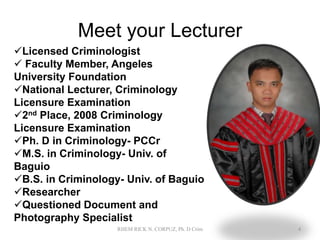
Meet your Lecturer
Licensed Criminologist
 Faculty Member, Angeles
University Foundation
National Lecturer, Criminology
Licensure Examination
2nd Place, 2008 Criminology
Licensure Examination
Ph. D in Criminology- PCCr
M.S. in Criminology- Univ. of
Baguio
B.S. in Criminology- Univ. of Baguio
Researcher
Questioned Document and
Photography Specialist
4
RHEM RICK N. CORPUZ, Ph. D Crim
Preliminaries
• Document
– The term document came from the Latin word
“documentum”, which means lesson, or example.
It may have been derived also from the French
word “docere” means to teach.
– Any material containing marks, symbols, or
signs in which these components may either be
visible or partially visible in conveying message
or meaning to someone.
5
RHEM RICK N. CORPUZ, Ph. D Crim
Kinds of Document
• Public document
– A document created, executed or issued by a public
official in response to the exigencies of the public
service, or in the execution of which a public
official intervened. (U.S. v. Asensi, 34 Phil. 765)
• Official document
– A document which is issued by a public official in
the exercise of the functions of his office. An
official document is also a public document. It falls
within the larger class called public document. (U.S.
v. Asensi)
6
RHEM RICK N. CORPUZ, Ph. D Crim
Kinds of Document
• Private Document
– Every deed or instrument executed by a private
person without the intervention of a notary public or
of any person legally authorized, by which the
documents some disposition or agreement is proved,
evidenced or set forth (US v. Orera,11 Phil. 596).-
• Commercial Document
– Any instrument defined and regulated by the Code of
Commerce (People v. Co Beng, 1913) or any other
commercial law.
7
RHEM RICK N. CORPUZ, Ph. D Crim
What may not constitute as document?
• A draft of municipal payroll which not yet
approved by the proper authority.
• Mere blank forms of official documents.
• Pamphlets or books which do not evidence
any disposition or agreement are not
documents but are mere merchandise.
8
RHEM RICK N. CORPUZ, Ph. D Crim
Questioned Document
• Is a document or paper/s whose contents
have been contested either in whole or in any
part as to their authenticity.
• A document is questioned when there is a
controversy over its preparation, contents and
other circumstances surrounding it.
9
RHEM RICK N. CORPUZ, Ph. D Crim
Questioned Document Examination
• Is a term used to refer to the act of making a
close and critical study of any document
which is questioned, disputed or attacked,
necessary to discover the facts about them.
10
RHEM RICK N. CORPUZ, Ph. D Crim
Two Division of QDE
• Criminalistics Examination. This involves the
detection of forgery, erasure, alteration or obliteration
of documents.
– Dr. Wilson Harrison, a noted British Examiner of
questioned documents said that an intelligent police
investigator can detect almost 75% of all forgeries by
careful inspection of a document with simple magnifiers
and measuring tools.
• Handwriting Investigation/Analysis. This is more
focused in determining the author of writing. It is
more difficult procedure and requires long study and
experience.
11
RHEM RICK N. CORPUZ, Ph. D Crim
Aspects of QDE
• Handwriting Examination (Graphology/Graphoanalysis)
– examination of signatures and initials
– examination of anonymous letters
– hand printing examination
• Examination of Typewritings and typeprints.
• Examination of Inks
• Examination of Erasures, alterations or obliterations, etc.
– Detection of alteration
– Decipherment of erased writings
– Restoration of obliterated writings
• Counterfeiting
– Examination of currency bills and coins and the like
– Examination of fake documents
• Miscellaneous aspects
– Determination of age of documents
– Identification of stamps
– Examinations of seal and other authenticating devices 12
RHEM RICK N. CORPUZ, Ph. D Crim
Purpose of QDE
To reveal/ discover the following:
– Identity of the author.
– True contents of the document.
– Origin of the instrument or paper used in making
the document.
– Alterations or erasures which have been made.
– Authenticity of the document.
13
RHEM RICK N. CORPUZ, Ph. D Crim
Scientific Examination of QDE
• Analysis (Recognition) - properties or characteristics,
observed or measured.
• Comparison - Properties or
characteristics of the unknown
determined thought analysis are
now compared with the familiar or recorded
properties of known items.
• Evaluation- Similarities or dissimilarities in
properties or characteristics will each have a certain
value for identification, determined by its likelihood
of occurrence. The weight or significance of each
must therefore be considered.
14
RHEM RICK N. CORPUZ, Ph. D Crim
Instruments used in QDE
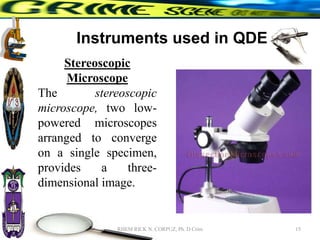
Stereoscopic
Microscope
The stereoscopic
microscope, two low-
powered microscopes
arranged to converge
on a single specimen,
provides a three-
dimensional image.
15
RHEM RICK N. CORPUZ, Ph. D Crim
Instruments used in QDE
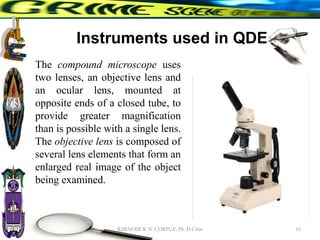
The compound microscope uses
two lenses, an objective lens and
an ocular lens, mounted at
opposite ends of a closed tube, to
provide greater magnification
than is possible with a single lens.
The objective lens is composed of
several lens elements that form an
enlarged real image of the object
being examined.
16
RHEM RICK N. CORPUZ, Ph. D Crim
Instruments used in QDE
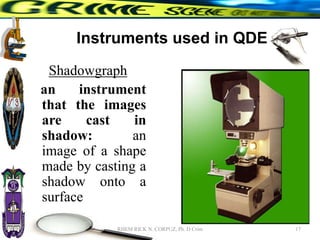
Shadowgraph
an instrument
that the images
are cast in
shadow: an
image of a shape
made by casting a
shadow onto a
surface
17
RHEM RICK N. CORPUZ, Ph. D Crim
Instruments used in QDE
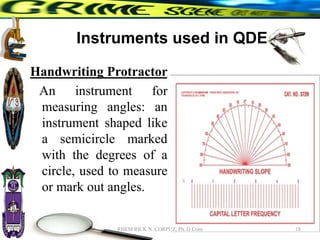
Handwriting Protractor
An instrument for
measuring angles: an
instrument shaped like
a semicircle marked
with the degrees of a
circle, used to measure
or mark out angles.
18
RHEM RICK N. CORPUZ, Ph. D Crim
Instruments used in QDE
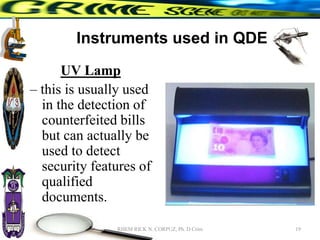
UV Lamp
– this is usually used
in the detection of
counterfeited bills
but can actually be
used to detect
security features of
qualified
documents.
19
RHEM RICK N. CORPUZ, Ph. D Crim
Instruments used in QDE
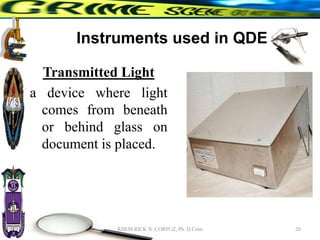
Transmitted Light
a device where light
comes from beneath
or behind glass on
document is placed.
20
RHEM RICK N. CORPUZ, Ph. D Crim
Instruments used in QDE
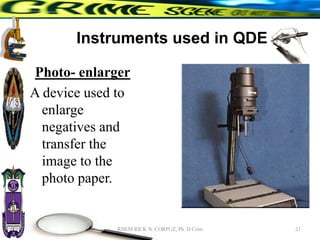
Photo- enlarger
A device used to
enlarge
negatives and
transfer the
image to the
photo paper.
21
RHEM RICK N. CORPUZ, Ph. D Crim
Instruments used in QDE
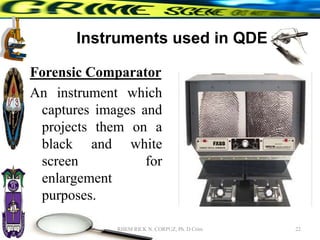
Forensic Comparator
An instrument which
captures images and
projects them on a
black and white
screen for
enlargement
purposes.
22
RHEM RICK N. CORPUZ, Ph. D Crim
Instruments used in QDE
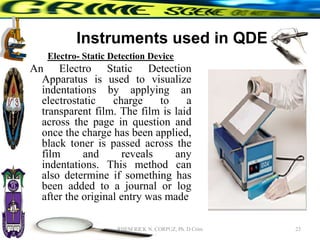
Electro- Static Detection Device
An Electro Static Detection
Apparatus is used to visualize
indentations by applying an
electrostatic charge to a
transparent film. The film is laid
across the page in question and
once the charge has been applied,
black toner is passed across the
film and reveals any
indentations. This method can
also determine if something has
been added to a journal or log
after the original entry was made
23
RHEM RICK N. CORPUZ, Ph. D Crim
Instruments used in QDE
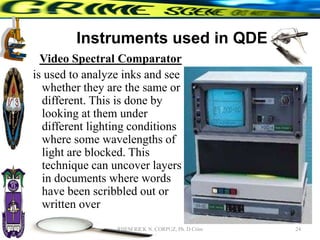
Video Spectral Comparator
is used to analyze inks and see
whether they are the same or
different. This is done by
looking at them under
different lighting conditions
where some wavelengths of
light are blocked. This
technique can uncover layers
in documents where words
have been scribbled out or
written over
24
RHEM RICK N. CORPUZ, Ph. D Crim
Instruments used in QDE
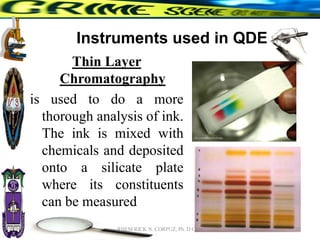
Thin Layer
Chromatography
is used to do a more
thorough analysis of ink.
The ink is mixed with
chemicals and deposited
onto a silicate plate
where its constituents
can be measured
25
RHEM RICK N. CORPUZ, Ph. D Crim
Instruments used in QDE
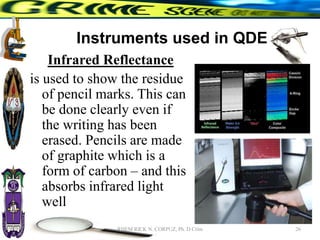
Infrared Reflectance
is used to show the residue
of pencil marks. This can
be done clearly even if
the writing has been
erased. Pencils are made
of graphite which is a
form of carbon – and this
absorbs infrared light
well
26
RHEM RICK N. CORPUZ, Ph. D Crim
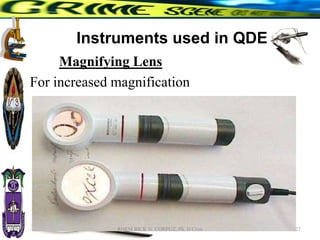
Instruments used in QDE
Magnifying Lens
For increased magnification
27
RHEM RICK N. CORPUZ, Ph. D Crim
Instruments used in QDE
Camera with Macro
Lens
To capture the
handwriting sample
and enlarge the same
for court presentation.
28
RHEM RICK N. CORPUZ, Ph. D Crim
Basic Terminologies
• DISPUTED DOCUMENT. A term suggesting that
there is an argument or controversy over the
document, and strictly speaking this is true meaning.
• STANDARD a.k.a. STANDARD DOCUMENT -
Are condensed and compact set of authentic
specimens which, if adequate and proper, should
contain a cross section of the material from a
known source.
• EXEMPLAR. A term used by some document
examiners and attorneys to characterize known
material. Standard is the older term.
29
RHEM RICK N. CORPUZ, Ph. D Crim
Basic Terminologies
• HOLOGRAPHIC DOCUMENT. Any
document completely written and signed by one
person; also known as a holograph.
• REFERENCE COLLECTION. Material
compiled and organized by the document
examiner to assist him in answering special
questions. Reference collections of typewriting,
check writing specimens, inks, pens, pencils, and
papers are frequently maintained.
30
RHEM RICK N. CORPUZ, Ph. D Crim
Basic Terminologies
• ERASURE - The removal of writings, typewriting or
printing, from a document is an erasure.
– Mechanical
– Chemical
• EXAMINATION - It is the act of making a close and
critical study of any material and with questioned
documents, it is the process necessary to discover the facts
about them.
• EXPERT WITNESS. A legal term used to describe a
witness who by reason of his special training or experience
is permitted to express an opinion regarding the issue, or a
certain aspect of the issue, which is involved in a court
action.
31
RHEM RICK N. CORPUZ, Ph. D Crim
Basic Terminologies
• HANDWRITING IDENTIFICATION EXPERT. A
common name for the document examiner.
• IDENTIFICATION (Identity) – as used in this text it
is the state of being identical or absolutely the same as
in similarity of source or authorship of the questioned
document and the standard document.
• INSERTION OR INTERLINEATION -
The term "insertion" and "interlineations" include
the addition of writing and other
material between lines or paragraphs
or the addition of whole page to a document.
32
RHEM RICK N. CORPUZ, Ph. D Crim
Basic Terminologies
• NON-IDENTITIFICATION (Non-identity) – as used in this text
it means that the source or authorship of the compared questioned
and standard specimens is different.
• OBLITERATION - the blotting out or shearing over the writing
to make the original invisible to as an addition.
• OPINION. In legal language, it refers to the document Examiner's
conclusion. Actually in Court, he not only expresses an opinion but
demonstrates the reasons for arriving at his opinion. Throughout
this text, opinion and conclusion are used synonymously.
• QUALIFICATION. The professional experience, education, and
ability of a document examiner. Before he is permitted to testify as
an expert witness, the court must rule that he is qualified in his
field.
33
RHEM RICK N. CORPUZ, Ph. D Crim
Basic Terminologies
• ADDITION - Any matter made a part of the document after its
original preparation may be referred to as addition.
• CONCLUSION - A scientific conclusion results form relating
observed facts by logical, common-sense reasoning in
accordance with established rules or laws. The document
examiner's conclusion, in legal term is referred to as "opinion".
• DOCUMENT EXAMINER. One who studies scientifically
the details and elements of documents in order to identify their
source or to discover other facts concerning them.
34
RHEM RICK N. CORPUZ, Ph. D Crim
Care and Preservation of Documents
• The improper or careless handling of a disputed
document can lead to serious curtailment of certain
technical examinations.
• DO’s
– Keep documents unfolded in protective envelope.
– The most useful and effective protective covering
of a disputed documents is a transparent plastic
envelop.
35
RHEM RICK N. CORPUZ, Ph. D Crim
Care and Preservation of Documents
• Take disputed papers to the documents examiners
laboratory at the first opportunity.
• If storage is necessary, keep the document in a dry
place away from excessive heat and strong light.
• Once a document is disputed it is seldom stored or
filed for a long, but important documents should be
kept properly for a long period of time.
36
RHEM RICK N. CORPUZ, Ph. D Crim
Care and Preservation of Documents
• Do not handle disputed papers excessively or carry
them in a pocket for along time.
• Do not mark disputed documents (either by
consciously writing or by pointing at them with
writing instrument or dividers).
• Do not mutilate or damage by repeated refolding,
creasing, cutting, tearing or punching for filing
purposes.
• ”
37
RHEM RICK N. CORPUZ, Ph. D Crim
Care and Preservation of Documents
• Do not allow anyone except qualified specialist to
make chemical or other do not treat or dust for latent
fingerprints before consulting a document examiner.
• Do not allow “Amateur Testing
• When possible, the charred documents should be
moved in the container in which they all found.
38
RHEM RICK N. CORPUZ, Ph. D Crim
Historical Developments in QDE
• 1609- The first treatise on systematic document
examination was published by Francis Demelle of
France
• 1622- The first person that carried out systematic
observations on the manner of handwriting was
Camillo Baldi. He published the book entitled
“Treated how, by a letter missive, one recognizes the
writer’s nature and qualities”, which is considered the
first known graphological essay.
• 1810- The first recorded use of questioned document
analysis occurred in Germany. Konigin Hanschritt.
39
RHEM RICK N. CORPUZ, Ph. D Crim
Historical Developments in QDE
• 1810- The first recorded use of questioned document
analysis occurred in Germany. A chemical test for a
particular ink dye was applied to a document known as
Konigin Hanschritt.
• 1882- Gilbert Thompson, railroad builder with the US
Geological survey in New Mexico, put his own thumbprint
on wage chits to safeguard himself from forgeries.
• 1894- Alfred Dreyfus of France was convicted of treason
based on mistaken handwriting identification by Bertillion.
• 1910- Albert S. Osborne- an American and arguably the
most influential document examiner, published Questioned
Documents. 40
RHEM RICK N. CORPUZ, Ph. D Crim
Techniques in Examination
• MICROSCOPIC EXAMINATION - Any examination or
study which is made with the microscope in order to discover
minute physical details.
• With proper angle and intensity or illumination, it aids in
the decipherment of erasures, some minute manipulations not
perfectly pictured to the unaided eye and the sequence of
entries done by different writing instruments.
• TRANSMITTED LIGHT EXAMINATION – In this
examination, the document is viewed with the source of
illumination behind it and the light passing through the paper.
Documents are subjected to this type of examination to
determine the presence of erasures, matching of serrations
and some other types of alterations.
41
RHEM RICK N. CORPUZ, Ph. D Crim
Techniques in Examination
• OBLIQUE LIGHT EXAMINATION - An
examination with the illumination so controlled that
it grazes or strikes the surface of the document from
one side at a very low angle. Decipherment of faded
handwriting, determination of outlines in traced
forgery, embossed impressions, etc. are subjected to
this type of examination.
• PHOTOGRAPHIC EXAMINATION - This type
of examination is very essential in every document
examination. Actual observations are recorded in the
photographs
42
RHEM RICK N. CORPUZ, Ph. D Crim
Techniques in Examination
• ULTRA-VIOLET EXAMINATION - Ultraviolet radiation
is invisible and occurs in the wave lengths just below the
visible blue-violet end of the spectrum (rainbow). These
visible rays react on some substances so that visible light is
reflected, a phenomenon known as FLOURESCENCE.
• This type of examination is done in a darkroom after the lamp
has been warmed up in order to give a maximum output of
the ultra-violet light. Exposure to the ultra-violet light
should be to the minimum duration in order to avoid fading
of some writing ink and typewriter ribbon.
• INFRARED EXAMINATION - This examination of
documents employs invisible radiation beyond the red portion
of the visible spectrum (rainbow) which is usually recorded
on a specially sensitized photographic emulsion.
43
RHEM RICK N. CORPUZ, Ph. D Crim
Classes of QD
• Documents containing questioned signatures.
• Questioned documents alleged to have been containing
fraudulent alterations.
• Questioned or disputed holographic will.
– a. Holographic Will
– b. Notarial Will-
• Documents investigated on the question of typewriting.
• Questioned documents on issues of their age or date.
• Questioned documents on issues of materials used in their
production.
• Documents or writings investigated because it is alleged
that they identify some persons through handwriting.
44
RHEM RICK N. CORPUZ, Ph. D Crim
Principle of QDE
• “When two items contain a combination
of corresponding or similar and
specifically oriented characteristics of
such number and significance as to
preclude the possibility of their
occurrence by mere coincidence and
there are no unaccounted differences, it
may be concluded that they are the same
in their characteristics attributed to the
same cause.” 45
RHEM RICK N. CORPUZ, Ph. D Crim
HANDWRITING ANALYSIS
Examination of Handwriting
Specimen
46
RHEM RICK N. CORPUZ, Ph. D Crim
Handwriting Defined
• It is the result of a very complicated series
of acts, being used as a whole, and
combination of certain forms of visible
mental and muscular habits acquired by
long, continued painstaking effort. Some
defined handwriting as “visible speech”.
47
RHEM RICK N. CORPUZ, Ph. D Crim
Physiological Basis
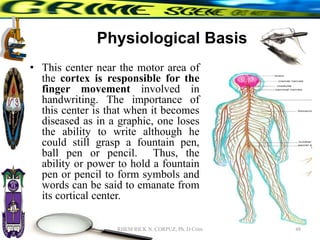
• This center near the motor area of
the cortex is responsible for the
finger movement involved in
handwriting. The importance of
this center is that when it becomes
diseased as in a graphic, one loses
the ability to write although he
could still grasp a fountain pen,
ball pen or pencil. Thus, the
ability or power to hold a fountain
pen or pencil to form symbols and
words can be said to emanate from
its cortical center.
48
RHEM RICK N. CORPUZ, Ph. D Crim
Muscles involved in Handwriting
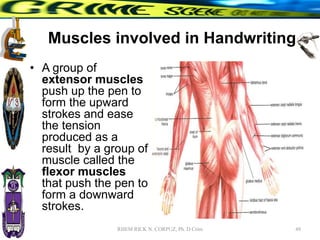
• A group of
extensor muscles
push up the pen to
form the upward
strokes and ease
the tension
produced as a
result by a group of
muscle called the
flexor muscles
that push the pen to
form a downward
strokes.
49
RHEM RICK N. CORPUZ, Ph. D Crim
Development of Handwriting
• Children learn writing by following the school copy or
model.
• After acquiring some degree of skill the children no longer
follow the school model.
• As speed increases, conscious design and regularity begin
to break down.
• In the course of trial and error, modification are made,
simplification and elaborations, addition and omissions
occur.
• The writing pattern of each child embodies unique
combinations of such deviation from the standard letter
forms or school model, and becomes his personal habits.
50
RHEM RICK N. CORPUZ, Ph. D Crim
Kinds of Handwriting
• Cursive – connected; writing in which
one letter is joined to the next.
• Script – separated or printed writing.
• BLOCK – all CAPITAL LETTERS.
51
RHEM RICK N. CORPUZ, Ph. D Crim
Basis of Handwriting Examination
• In Wigmore's Principles of judicial Proof, handwriting is
defined as a visible effect of bodily movement which is an
almost unconscious expression of fixed muscular habits,
reacting from fixed mental impression of certain ideas
associated with script form.
• Environment, education and occupation affect
individuals so variously in the formation of these muscular
habits that finally the act of writing becomes an almost
automatic succession of acts stimulated by these habits.
• The imitation of the style of writing by another person
becomes difficult because the other person cannot by mere
will power reproduce in himself all the muscular
combination from the habit of the first writer.
52
RHEM RICK N. CORPUZ, Ph. D Crim
History of Handwriting
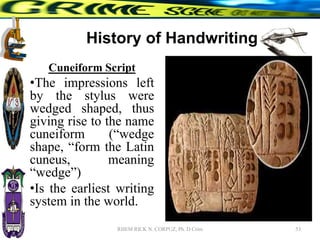
Cuneiform Script
•The impressions left
by the stylus were
wedged shaped, thus
giving rise to the name
cuneiform (“wedge
shape, “form the Latin
cuneus, meaning
“wedge”)
•Is the earliest writing
system in the world.
53
RHEM RICK N. CORPUZ, Ph. D Crim
Handwriting as an Exact Science
• In the hand of a qualified examiner
operating under right conditions:
–Sufficient questioned writing
–Sufficient known writing
–Sufficient time use of scientific
instruments
54
RHEM RICK N. CORPUZ, Ph. D Crim
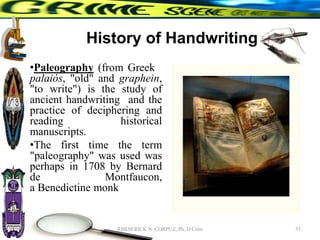
History of Handwriting
•Paleography (from Greek
palaiós, "old" and graphein,
"to write") is the study of
ancient handwriting and the
practice of deciphering and
reading historical
manuscripts.
•The first time the term
"paleography" was used was
perhaps in 1708 by Bernard
de Montfaucon,
a Benedictine monk
55
RHEM RICK N. CORPUZ, Ph. D Crim
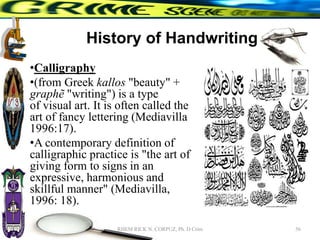
History of Handwriting
•Calligraphy
•(from Greek kallos "beauty" +
graphẽ "writing") is a type
of visual art. It is often called the
art of fancy lettering (Mediavilla
1996:17).
•A contemporary definition of
calligraphic practice is "the art of
giving form to signs in an
expressive, harmonious and
skillful manner" (Mediavilla,
1996: 18).
56
RHEM RICK N. CORPUZ, Ph. D Crim
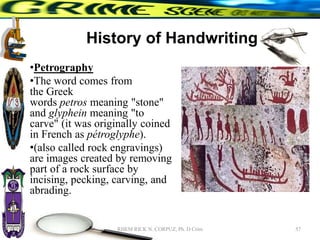
History of Handwriting
•Petrography
•The word comes from
the Greek
words petros meaning "stone"
and glyphein meaning "to
carve" (it was originally coined
in French as pétroglyphe).
•(also called rock engravings)
are images created by removing
part of a rock surface by
incising, pecking, carving, and
abrading.
57
RHEM RICK N. CORPUZ, Ph. D Crim
History of Handwriting
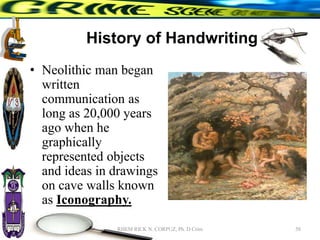
• Neolithic man began
written
communication as
long as 20,000 years
ago when he
graphically
represented objects
and ideas in drawings
on cave walls known
as Iconography.
58
RHEM RICK N. CORPUZ, Ph. D Crim
History of Handwriting
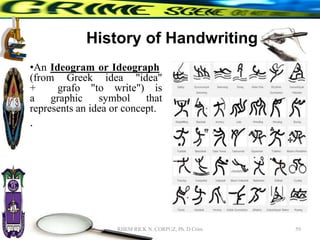
•An Ideogram or Ideograph
(from Greek idea "idea"
+ grafo "to write") is
a graphic symbol that
represents an idea or concept.
.
59
RHEM RICK N. CORPUZ, Ph. D Crim
History of Handwriting
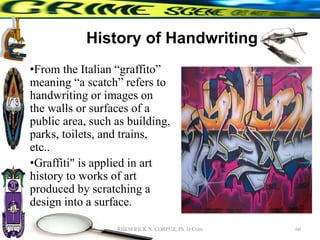
•From the Italian “graffito”
meaning “a scatch” refers to
handwriting or images on
the walls or surfaces of a
public area, such as building,
parks, toilets, and trains,
etc..
•Graffiti" is applied in art
history to works of art
produced by scratching a
design into a surface.
60
RHEM RICK N. CORPUZ, Ph. D Crim
History of Handwriting
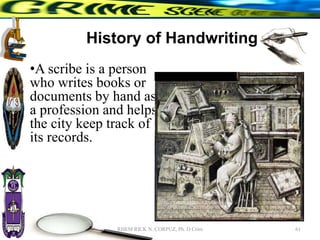
•A scribe is a person
who writes books or
documents by hand as
a profession and helps
the city keep track of
its records.
61
RHEM RICK N. CORPUZ, Ph. D Crim
Principles of Handwriting
• No two writers write exactly alike.
• The physical writing conditions and position
of the person including his writing instrument
may affect the handwriting characteristics but
they do not confine all its identifying
elements.
– Age, sickness, emotional state (transitory state),
position
62
RHEM RICK N. CORPUZ, Ph. D Crim
Principles of Handwriting
• Individuality in handwriting can only be
determined through comparative examination
with the standard written or prepared under
comparable conditions.
– Under similar purpose
• Similarity does not mean identity.
• Complete identity means definite forgery
63
RHEM RICK N. CORPUZ, Ph. D Crim
Variations in Writing
• A more or less definite pattern for each is
stored away in the subjective mind but the
hand does not always produce a stereotyped
duplicate of that pattern.
• The hand ordinarily is not an instrument of
precision and therefore we may not expect
every habitual manual operation to be
absolutely uniform.
64
RHEM RICK N. CORPUZ, Ph. D Crim
Causes of Variation
• Function of some external condition i.e.
influence of the available space.
• Abnormal conditions such as physical injury,
toxic effects, inebriation's, emotion and
deception.
• Position of letter - all the letters are to be found
initially, medially, and finally. The fact of a
different position, especially in combination with
another and particular letter, may modify any
of them in some way or another.
65
RHEM RICK N. CORPUZ, Ph. D Crim
Importance of Variation
• Personal variation encountered under normal writing
conditions is also a highly important element of
identification. The qualities of personal variation include
both its nature and its extent. It becomes necessary to
determine the amount, extent, and exact quality of the
variations.
• With a group of signatures of a particular writer, certain
normal divergence in size, lateral spacing and proportions
actually indicate genuineness. Variation in genuine writing
is ordinarily in superficial parts and in size, proportions,
degree of care given to the act, design, slant, shading,
vigor, angularity, roundness and direction of stroke.
66
RHEM RICK N. CORPUZ, Ph. D Crim
Copybook System
• refers to the standard of handwriting
instruction taught in particular school.
Classes of copybook depend on the standard
school copy adopted by a writer.
67
RHEM RICK N. CORPUZ, Ph. D Crim
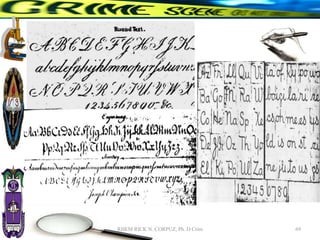
Old Copybook System
• Old English round hand - in fact an Italian
hand popular in 1840.
• Modified round hand - early edition of the
Spencerian, and the Payson, Dunton, and
Scribners copybook - 1840 -1860.
• Spencerian - there is simplification by the
omission of extra strokes and flourishes. And a
general tendency toward plainer letters than the
preceding system, some of which were very
ornate - 1860-1890.
• Modern Vertical writing 1890-1900
68
RHEM RICK N. CORPUZ, Ph. D Crim
69
RHEM RICK N. CORPUZ, Ph. D Crim
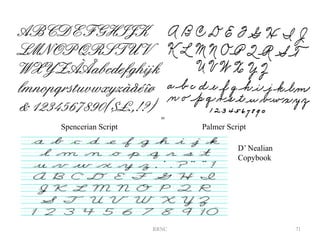
Modern Copybook System
• Spencerian Script (1850- 1895)
– Introduced by Platt Rogers Spencer
• Palmer Copybook (1900- 1980)
– Austin Norman Palmer
• D’ Nealian Copybook (1980)
• British Copybook
• French Copybook
• German Copybook
70
RHEM RICK N. CORPUZ, Ph. D Crim
Spencerian Script Palmer Script
D’ Nealian
Copybook
RRNC 71
Importance of Copybook
• to the nationality of the writer.
• to the system learned
• to the date when the writing was acquired and
• to some of the influences that have
surrounded the writer.
72
RHEM RICK N. CORPUZ, Ph. D Crim
Terminologies in Handwriting
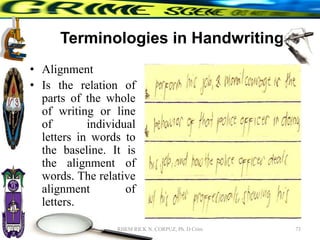
• Alignment
• Is the relation of
parts of the whole
of writing or line
of individual
letters in words to
the baseline. It is
the alignment of
words. The relative
alignment of
letters.
73
RHEM RICK N. CORPUZ, Ph. D Crim
Terminologies in Handwriting
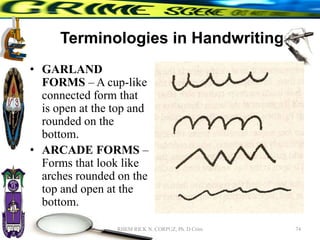
• GARLAND
FORMS – A cup-like
connected form that
is open at the top and
rounded on the
bottom.
• ARCADE FORMS –
Forms that look like
arches rounded on the
top and open at the
bottom.
74
RHEM RICK N. CORPUZ, Ph. D Crim
Terminologies in Handwriting
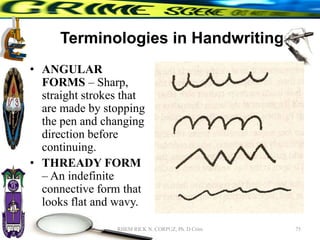
• ANGULAR
FORMS – Sharp,
straight strokes that
are made by stopping
the pen and changing
direction before
continuing.
• THREADY FORM
– An indefinite
connective form that
looks flat and wavy.
75
RHEM RICK N. CORPUZ, Ph. D Crim
Terminologies in Handwriting
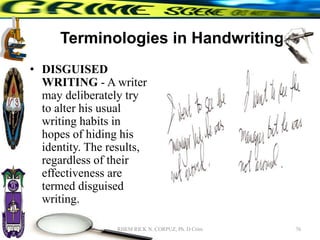
• DISGUISED
WRITING - A writer
may deliberately try
to alter his usual
writing habits in
hopes of hiding his
identity. The results,
regardless of their
effectiveness are
termed disguised
writing.
76
RHEM RICK N. CORPUZ, Ph. D Crim
Terminologies in Handwriting
• COLLATION - side by side comparison;
collation as used in this text means the critical
comparison on side by side examination.
• COMPARISON - the act of setting two or
more items side by side to weigh their
identifying qualities; it refers not only a visual
but also the mental act in which the element
of one item are related to the counterparts of
the other.
77
RHEM RICK N. CORPUZ, Ph. D Crim
Terminologies in Handwriting
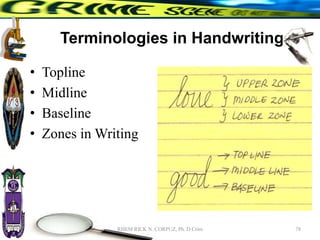
• Topline
• Midline
• Baseline
• Zones in Writing
78
RHEM RICK N. CORPUZ, Ph. D Crim
Terminologies in Handwriting
• GRAPHOANALYSIS - the study of
handwriting based on the two fundamental
strokes, the curve and the straight strokes.
• GRAPHOMETRY - analysis by comparison
and measurement.
• GRAPHOLOGY - the art of determining
character disposition and amplitude of a
person from the study of handwriting. It also
means the scientific study and analysis of
handwriting, especially with reference to
forgeries and questioned documents.
79
RHEM RICK N. CORPUZ, Ph. D Crim
Terminologies in Handwriting
• GESTALT – The German word that means
“complete” or “whole”. A good gestalt needs
nothing added or taken away to make it “look
right”. Also a school of handwriting analysis
that looks at handwriting as a whole picture.
• HANDLETTERING. Any disconnected
style of writing in which each letter is written
separately; also called handprinting
80
RHEM RICK N. CORPUZ, Ph. D Crim
Terminologies in Handwriting
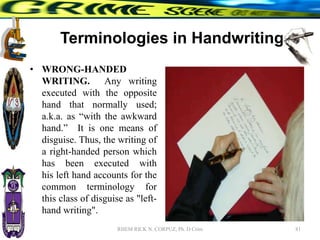
• WRONG-HANDED
WRITING. Any writing
executed with the opposite
hand that normally used;
a.k.a. as “with the awkward
hand.” It is one means of
disguise. Thus, the writing of
a right-handed person which
has been executed with
his left hand accounts for the
common terminology for
this class of disguise as "left-
hand writing".
81
RHEM RICK N. CORPUZ, Ph. D Crim
Terminologies in Handwriting
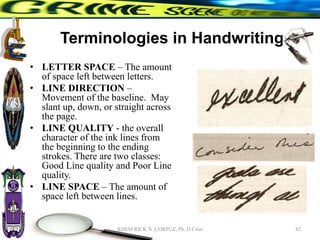
• LETTER SPACE – The amount
of space left between letters.
• LINE DIRECTION –
Movement of the baseline. May
slant up, down, or straight across
the page.
• LINE QUALITY - the overall
character of the ink lines from
the beginning to the ending
strokes. There are two classes:
Good Line quality and Poor Line
quality.
• LINE SPACE – The amount of
space left between lines.
82
RHEM RICK N. CORPUZ, Ph. D Crim
Terminologies in Handwriting
• MANUSCRIPT WRITING. A disconnected form of
script or semi-script writing. This type of writing is
taught in young children in elementary schools as the
first step in learning to write.
• MARGINS – The amount of space left around the
writing on all four sides.
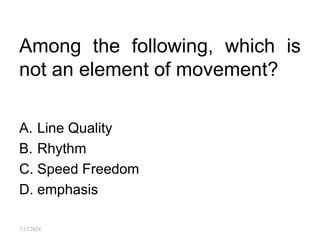
• MOVEMENT – It is an important element in
handwriting. It embraces all the factors which are
related to the motion of the writing instrument skill,
speed freedom, hesitation, rhythm, emphasis, tremors
and the like. The manner in which the writing
instrument is move that is by finger, hand, forearm or
whole arm.
83
RHEM RICK N. CORPUZ, Ph. D Crim
Terminologies in Handwriting
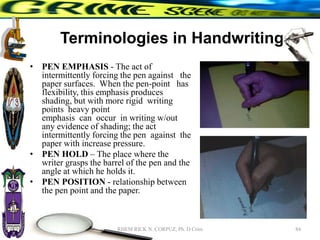
• PEN EMPHASIS - The act of
intermittently forcing the pen against the
paper surfaces. When the pen-point has
flexibility, this emphasis produces
shading, but with more rigid writing
points heavy point
emphasis can occur in writing w/out
any evidence of shading; the act
intermittently forcing the pen against the
paper with increase pressure.
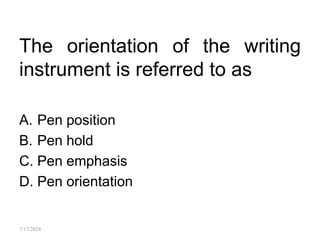
• PEN HOLD – The place where the
writer grasps the barrel of the pen and the
angle at which he holds it.
• PEN POSITION - relationship between
the pen point and the paper.
84
RHEM RICK N. CORPUZ, Ph. D Crim
Terminologies in Handwriting
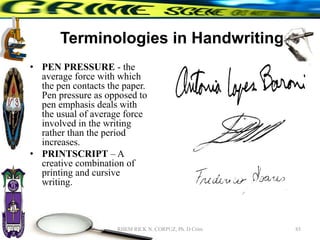
• PEN PRESSURE - the
average force with which
the pen contacts the paper.
Pen pressure as opposed to
pen emphasis deals with
the usual of average force
involved in the writing
rather than the period
increases.
• PRINTSCRIPT – A
creative combination of
printing and cursive
writing.
85
RHEM RICK N. CORPUZ, Ph. D Crim
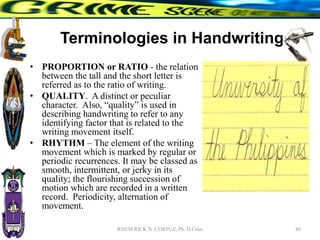
Terminologies in Handwriting
• PROPORTION or RATIO - the relation
between the tall and the short letter is
referred as to the ratio of writing.
• QUALITY. A distinct or peculiar
character. Also, “quality” is used in
describing handwriting to refer to any
identifying factor that is related to the
writing movement itself.
• RHYTHM – The element of the writing
movement which is marked by regular or
periodic recurrences. It may be classed as
smooth, intermittent, or jerky in its
quality; the flourishing succession of
motion which are recorded in a written
record. Periodicity, alternation of
movement.
86
RHEM RICK N. CORPUZ, Ph. D Crim
Terminologies in Handwriting
• SHADING - Is the widening of the ink strokes due to the
added pressure on a flexible pen point or to the use of a stub
pen.
• SIGNIFCANT WRITING HABIT – Any characteristic of
handwriting that is sufficiently uncommon and well fixed to
serve as a fundamental point in the identification.
• SIMPLIFICATION – Eliminating extra or superfluous
strokes from the copybook model.
• SIZE – May refer to the overall size of the writing or the
proportions between zones.
• SKILL - In any set there are relative degrees or ability or
skill and a specimen of handwriting usually contains evi-
dence of the writer's proficiency; degree, ability, or skill of a
write proficiency.
87
RHEM RICK N. CORPUZ, Ph. D Crim
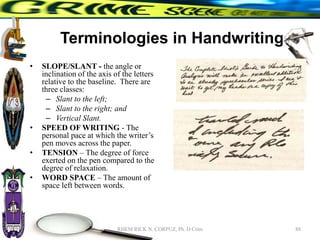
Terminologies in Handwriting
• SLOPE/SLANT - the angle or
inclination of the axis of the letters
relative to the baseline. There are
three classes:
– Slant to the left;
– Slant to the right; and
– Vertical Slant.
• SPEED OF WRITING - The
personal pace at which the writer’s
pen moves across the paper.
• TENSION – The degree of force
exerted on the pen compared to the
degree of relaxation.
• WORD SPACE – The amount of
space left between words.
88
RHEM RICK N. CORPUZ, Ph. D Crim
Kinds of Handwriting
• Finger Movement - the thumb, the first, second and
slightly the third fingers are in actual motion. Most
usually employed by children and illiterates.
• Hand Movement - produced by the movement or
action of the whole hand with the wrist as the center
of attraction.
• Forearm Movement - the movement of the
shoulder, hand and arm with the support of the table.
• Whole Forearm Movement - action of the entire
arm without resting. i.e., blackboard writing.
89
RHEM RICK N. CORPUZ, Ph. D Crim
Strokes in Handwriting
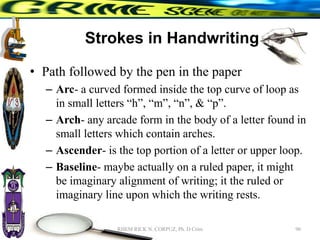
• Path followed by the pen in the paper
– Arc- a curved formed inside the top curve of loop as
in small letters “h”, “m”, “n”, & “p”.
– Arch- any arcade form in the body of a letter found in
small letters which contain arches.
– Ascender- is the top portion of a letter or upper loop.
– Baseline- maybe actually on a ruled paper, it might
be imaginary alignment of writing; it the ruled or
imaginary line upon which the writing rests.
90
RHEM RICK N. CORPUZ, Ph. D Crim
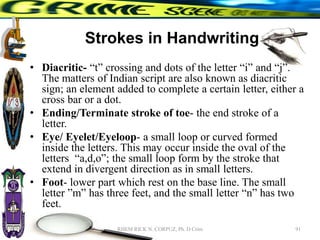
Strokes in Handwriting
• Diacritic- “t” crossing and dots of the letter “i” and “j”.
The matters of Indian script are also known as diacritic
sign; an element added to complete a certain letter, either a
cross bar or a dot.
• Ending/Terminate stroke of toe- the end stroke of a
letter.
• Eye/ Eyelet/Eyeloop- a small loop or curved formed
inside the letters. This may occur inside the oval of the
letters “a,d,o”; the small loop form by the stroke that
extend in divergent direction as in small letters.
• Foot- lower part which rest on the base line. The small
letter ”m” has three feet, and the small letter “n” has two
feet.
91
RHEM RICK N. CORPUZ, Ph. D Crim
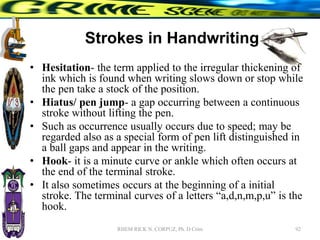
Strokes in Handwriting
• Hesitation- the term applied to the irregular thickening of
ink which is found when writing slows down or stop while
the pen take a stock of the position.
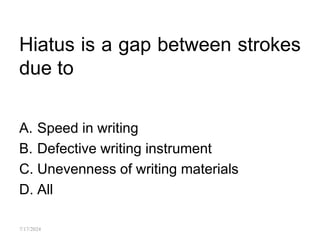
• Hiatus/ pen jump- a gap occurring between a continuous
stroke without lifting the pen.
• Such as occurrence usually occurs due to speed; may be
regarded also as a special form of pen lift distinguished in
a ball gaps and appear in the writing.
• Hook- it is a minute curve or ankle which often occurs at
the end of the terminal stroke.
• It also sometimes occurs at the beginning of a initial
stroke. The terminal curves of a letters “a,d,n,m,p,u” is the
hook.
92
RHEM RICK N. CORPUZ, Ph. D Crim
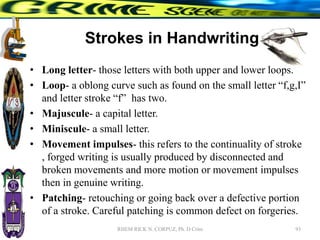
Strokes in Handwriting
• Long letter- those letters with both upper and lower loops.
• Loop- a oblong curve such as found on the small letter “f,g,I”
and letter stroke “f” has two.
• Majuscule- a capital letter.
• Miniscule- a small letter.
• Movement impulses- this refers to the continuality of stroke
, forged writing is usually produced by disconnected and
broken movements and more motion or movement impulses
then in genuine writing.
• Patching- retouching or going back over a defective portion
of a stroke. Careful patching is common defect on forgeries.
93
RHEM RICK N. CORPUZ, Ph. D Crim
Strokes in Handwriting
• Shoulder- outside portion of the top curve, small letter “m” has
three shoulders and the small letter “n” has two, the small letter “h”
has one shoulder.
• Spur- a short initial or terminal stroke.
• Staff- any major long downward stroke of a letter that is the long
downward stroke of the letter “b,g”.
• Stem or shank- the upright long downward stroke that is the trunk
or stalk, normally seen in capital letters.
• Tick/ Hitch- any short stroke, which usually occurs at the top of
the letters.
• Tremor- a writing weakness portrayed by irregular shaky strokes
is described as writing tremor.
• Whirl- the upstroke of looping ascender.
94
RHEM RICK N. CORPUZ, Ph. D Crim
Strokes in Handwriting
• Linear Letters- lower case letters having no
ascending loops or stems, or descending loops or
stems sometimes called minuscule. No capital letters.
• Supralinear- letters that extend a distance vertically
above the linear letters, (b, d,h,k,l and t)
• Infralinear- Letters are those that extend a distance
vertically below the baseline of the writing or of the
linear letters. (g,j,p,q,y,z).
• Double-Length Letters- are those few letters that
extend a distance vertically both above and below the
linear letters. (f, y, z,p)
95
RHEM RICK N. CORPUZ, Ph. D Crim
Characteristics of Handwriting
• GENERAL(CLASS) CHARACTERISTICS -
These characteristics refer to those
habits are part of basic writing system or which
are modifications of the system of
writing found among so large a group of writes
that have only slight identification value.
• INDIVIDUAL CHARACTERISTICS - They
are characteristics which are the result of the
writer's muscular control, coordination, age,
health, and nervous temperament, frequency of
writing, personality and character.
96
RHEM RICK N. CORPUZ, Ph. D Crim
Individual Characteristics
• Writing movement
• Form and design of letters
• Muscular control or motor control -
• Loose writing - this is characterized by too much freedom of
movement and lack of regulation. This is noticed especially in
tall letters forms.
• Restrained writing - there is lack of freedom
and inhibited movements. It gives you the impression that every
stroke was made with great difficulty. This writing is small.
There is distortion of letter forms which may lead to illegibility.
• Motor Coordination
• Shading
• Skill
97
RHEM RICK N. CORPUZ, Ph. D Crim
Individual Characteristics
• Alignment
• Pen pressure
• Connection
• Pen hold
• Rhythm
• Disconnections or pen lifts between letters
• Speed.
• Slant as a writing habit
• Proportion of letters
• Quality of stroke or line quality
• Variation
98
RHEM RICK N. CORPUZ, Ph. D Crim
Standards in Handwriting
• STANDARD. They are known writings which indicate how a
person writes. A writer manifests fixed habits in his writings
that identify him. This fact provides the basis for an opinion of
conclusion regarding any writing identification problem.
• EXEMPLARS - Specimen of the writing of suspects are
commonly known as exemplars. The term standards is a
general term referring to all authenticated writings of the suspects
while exemplars refers more especially to a specimens of
standard writing offered in evidence or obtained or request for
comparison with the questioned writing.
• SAMPLE - A selected representative portion of the whole is
known as a sample. In this text, the term "sample" follows closely
the statistical usage.
99
RHEM RICK N. CORPUZ, Ph. D Crim
Types of Standards
• Collected Standards are KNOWN (genuine) handwriting of
an individual such as signature and endorsements on canceled
checks, legal papers letters, commercial, official, public and
private document and other handwriting such as letters,
memoranda, etc. written in the course of daily life, both business
and socials.
• Request standards are signature or other handwritings (or hand
printings) written by an individual upon request for the purpose of
comparison with other handwriting or for specimen purposes.
• Post Litem Motan Exemplars - writings produced by the subject
after evidential writings have come into dispute and solely for the
purpose of establishing his contentions.
100
RHEM RICK N. CORPUZ, Ph. D Crim
Considerations in Acquiring Standard
• The amount of Standard written
• Similarly of Subject Matter. If the questioned writings are hand
printed, then get hand printed standard or exemplar.
• Relative Dates of the questioned and the standards writing
standard signatures or writing must be those written five (5) years
before or five (5)after the date of the questioned signature or
writing.
• Contemporaneous Standards Condition under which both the
questioned and the standard are prepared. look for standards
prepared under comparable circumstances such as: paper rested on
the knee; standing; sitting; lying down; and/or while on moving
vehicle.
• Writing Instrument and Paper.
101
RHEM RICK N. CORPUZ, Ph. D Crim
Procedures for Examination
• Determine whether all standards are written by
same person.
• Examine the standard handwritings.
• Examine the individual handwriting
characteristics of standards and questioned
exemplar.
• Weigh the points of similarities and points of
dissimilarities.
• Subject the questioned handwriting to a
microscopic examination
102
RHEM RICK N. CORPUZ, Ph. D Crim
Post Litem Motan
• Standard writings witnessed
• Standards writings admitted
• Record Maintained in Regular Course of
Business as Standard Writings
• Government Document as standard
Writings
• Ancient writings
103
RHEM RICK N. CORPUZ, Ph. D Crim
Signature Examination
RHEM RICK N. CORPUZ, Ph. D Crim 104
SIGNATURE
• SIGNATURE defined – It is the name of a
person written by him/her in a document as a
sign of acknowledgement. Or, it is a name or
a mark that a person puts at the end of a
document to attest that he is its author or that
he ratifies its contents.
105
RHEM RICK N. CORPUZ, Ph. D Crim
Terminologies in Signature
• FRAUDULENT SIGNATURE. A forged signature. It
involves the writing of a name as a signature by someone
other.
• CROSS MARK. Historically, many who could not write
signed with a cross mark or crude X. This authenticating mark
is still used today by illiterates, and if properly witnessed, it
can legally stand for a signature.
• EVIDENTIAL SIGNATURE - Is not simply a signature - it
is a signature, signed at a particular time and place, under
particular conditions, while the signer was at particular age, in
a particular physical and mental condition, using particular
implements, and with a particular reason and purpose for
recording his name. 106
RHEM RICK N. CORPUZ, Ph. D Crim
Terminologies in Signature
• FREEHAND SIGNATURE. A fraudulent signature that was
executed purely by simulation rather than by tracing the outline of
a genuine signature.
• GUIDED SIGNATURE. A signature that is executed while the
writer’s hand or arm is steadied in any way. Under the law of most
jurisdictions such a signature authenticates a legal document
provided it is shown that the writer requested the assistance.
Guided signatures are most commonly written during a serious
illness or on a deathbed.
• IMITATED SIGNATURE. Synonymous with freehand forgery.
• MODEL SIGNATURE. A genuine signature that has been used
to prepare an imitated or traced forgery.
107
RHEM RICK N. CORPUZ, Ph. D Crim
Types of Signatures
• FORMAL (a.k.a. CONVENTIONAL or
COPYBOOK FORM) - complete correct
signature for an important document such as
will.
• INFORMAL (CURSORY) - usually for routine
documents and personal correspondence.
1. Personalized
2. Semi-personalized
• CARELESS SCRIBBLE - for the mail carrier,
delivery boy or the autograph collector.
108
RHEM RICK N. CORPUZ, Ph. D Crim
Forgery
• Forgery is, strictly speaking, a legal term
which involves not only a non-genuine
document but also and intent to fraud.
However, it is also used synonymously
with fraudulent signature or spurious
document.
109
RHEM RICK N. CORPUZ, Ph. D Crim
Classes of Forged Signatures
• SIMULATED OR FREEHAND IMITATION
FORGERY – executed purely by simulation rather than
by tracing the outline of a genuine signature can
be referred as freehand imitation or simulated forgery. Or
it refers to the free-hand drawing in imitation of model
signature.
• TRACED FORGERY (TRACED SIGNATURE)
• DIRECT TRACING - tracing is made by transmitted light.
• INDIRECT TRACING - forger uses a carbon paper and
place document on which he will trace the forged signature
under the document bearing the model signature with a
carbon paper between the two.
110
RHEM RICK N. CORPUZ, Ph. D Crim
Classes of Forged Signatures
• TYPES OF TRACED SIGNATURE:
– CARBON PROCESS
– INDENTATION PROCESS
– TRANSMITTED LIGHT PROCESS
• SPURIOUS SIGNATURE (SIMPLE
FORGERY) - Forger does not try to copy a
model but writes something resembling what we
ordinarily call a signature. For this, he uses a
false (spurious) name and makes a rapid stroke,
disturbing his usual writing by adopting a
camouflage called disguise.
111
RHEM RICK N. CORPUZ, Ph. D Crim
Steps in Signature Examination
• STEP 1 - Place the questioned and the standard signatures in the
juxta-position or slide-by-side for simultaneous viewing of the
various elements and characteristics.
• STEP 2 - The first element to be considered is the handwriting
movement or the manner of execution (slow, deliberate, rapid, etc).
The fundamental difference existing between a genuine signature
and an almost perfect forgery is in the manner of execution.
• STEP 3 - Second elements to examine is the quality of the line, the
presence or tremors, smooth, fluent or hesitation. Defect in line
quality is only appreciated when simultaneous viewing is made.
• STEP 4 - Examine the beginning and ending lines, they are very
significant, determine whether the appearance blunt, club-shaped,
tapered or/vanishing.
112
RHEM RICK N. CORPUZ, Ph. D Crim
Steps in Signature Examination
• STEP 5 - Design and structure of the letters -
Determine as to roundness, smoothness, angularity
and direction. Each individual has a different concept
of letter design.
• STEP 6 - Look for the presence of retouching or
patching.
• STEP 7 - Connecting strokes, slant, ratio, size, lateral
spacing.
• STEP 8 - Do not rely so much in the similarity or
difference of the capital letters, for theses are the
often changed according to the whim of the writer.
113
RHEM RICK N. CORPUZ, Ph. D Crim
Proof of Genuineness
• Carelessness
• Spontaneity
• Alternation of thick and thin strokes
• Speed
• Simplification
• Upright letters are interspersed with slanting letters
• The upward strokes to a threadlike tracing
• Rhythm
• Good line quality
• Variation
114
RHEM RICK N. CORPUZ, Ph. D Crim
Indicia of Forgery
• Tremulous and broken connecting strokes between letters,
indicating points at which the writer has temporarily struck.
• no rhythm
• carefulness or unusual care and deliberation
• no contrast between upward and downward strokes
• slow writing- angular writing
• blunt beginning and endings
• placement of diacritical marks just over the stem of letters
• absence of spontaneity - lack of smoothness of letters
• restrained writing - there is lack of freedom or "inhibited"
movements THAT gives the impression that every stroke is made
with great difficulty. This writing is small.
• no variation
115
RHEM RICK N. CORPUZ, Ph. D Crim
COUNTERFEITING
• COUNTERFEITING - It is the crime of making,
circulating or uttering false coins and banknotes.
Literally, it means to make a copy of; or imitate; to
make a spurious semblance of, as money or stamps,
with the intent to deceive or defraud. Counterfeiting is
something made to imitate the real thing used for gain.
• FALSIFICATION – The act/process of making the
content/s of a document not the intended content.
• FORGERY – The act of falsely making or materially
altering, with intent to defraud, any writing which if
genuine, might be of legal efficacy or the foundation
of a legal liability.
116
RHEM RICK N. CORPUZ, Ph. D Crim
Making of Paper Money
• ENGRAVING – It is the process by which the line to be printed
are cut into pieces of metal by hand or with a machine. Ink is
rubbed over the plate to fill the cuts in the metal and the extra ink
wiped-off the top. The pressure of the paper on the plate causes
the ink in the holes to be lifted on the surface of the paper. The ink
lines will be felt to be raised above the surface. The engraving
process is used for the production of all genuine bank notes.
• LETTERPRESS PRINTING – is the most common form of
printing books, magazine, letterheads and the usual printing in
common uses. In the process, the letters are made on raised pieces
of metal which covered with ink and then impressed upon the
paper in the same form as a rubber stamp or cliché. The serial
numbers of a bank note are usually added by this letterpress
process after the note has been produced by an engraving.
117
RHEM RICK N. CORPUZ, Ph. D Crim
Making of Paper Money
• OFFSET PRINTING – is the method a photograph is
taken of the desire material and a print is made on a
specially prepared aluminum plate. The plate is kept
wet with water. When ink is applied, it sticks only
these parts of the plate where printing is desired. The
aluminum plate is then put in contact with rubber
roller which transfers the ink to the papers. The offset
process is quite used in small printing plants. Because
it was photographic process, it is the most common
modern used by counterfeiter to make false paper
money.
118
RHEM RICK N. CORPUZ, Ph. D Crim
Characteristics of Genuine Bills
119
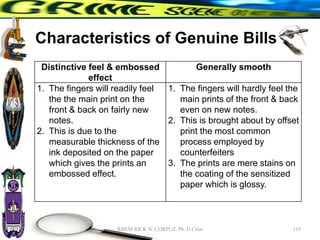
RHEM RICK N. CORPUZ, Ph. D Crim
Distinctive feel & embossed
effect
Generally smooth
1. The fingers will readily feel
the the main print on the
front & back on fairly new
notes.
2. This is due to the
measurable thickness of the
ink deposited on the paper
which gives the prints an
embossed effect.
1. The fingers will hardly feel the
main prints of the front & back
even on new notes.
2. This is brought about by offset
print the most common
process employed by
counterfeiters
3. The prints are mere stains on
the coating of the sensitized
paper which is glossy.
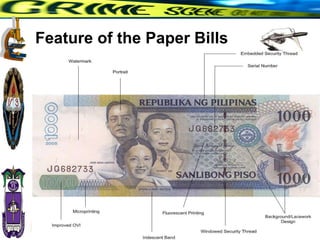
Feature of the Paper Bills
120
RHEM RICK N. CORPUZ, Ph. D Crim
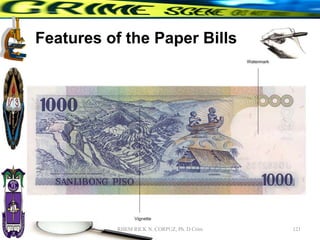
Features of the Paper Bills
121
RHEM RICK N. CORPUZ, Ph. D Crim
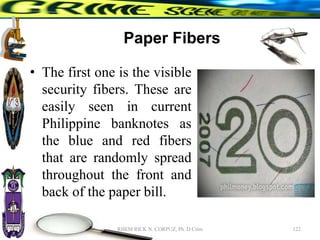
Paper Fibers
• The first one is the visible
security fibers. These are
easily seen in current
Philippine banknotes as
the blue and red fibers
that are randomly spread
throughout the front and
back of the paper bill.
122
RHEM RICK N. CORPUZ, Ph. D Crim
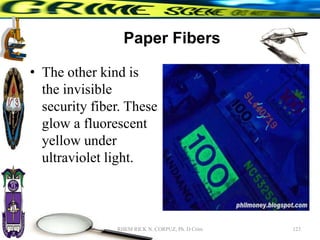
Paper Fibers
• The other kind is
the invisible
security fiber. These
glow a fluorescent
yellow under
ultraviolet light.
123
RHEM RICK N. CORPUZ, Ph. D Crim
Writing Materials and Papers
• ANACHRONISM – It refers to something wrong in time and in
place. This means that the forger has trouble matching the paper,
ink, or writing materials to the exact date it was supposed to have
been written.
• PAPER – These are sheets of interlaced fibers - usually cellulose
fibers from plants, but sometimes from cloth rags or other fibrous
materials, that is formed by pulping the fibers and causing to felt,
or mat, to form a solid surface.
• WATERMARK - Certain papers are marked with a translucent
design, a watermarks impressed in them during the course of their
manufacture.
• WRITING MATERIALS – Any material used primarily for
writing or recording such as papers, cardboard, board papers,
Morocco paper, etc.
124
RHEM RICK N. CORPUZ, Ph. D Crim
Historical Development
• PAPYRUS - This came into use about 3,500 B.C. - people of
Egypt. Palestine, Syria, and Southern Europe used the pith
(soft spongy tissue of the stem) of the sedge (grass-like herb)
CYPERUS PAPYRUS to make a writing material known as
PAPYRUS.
• PARCHMENT - writing material made from skin of
animals primarily of sheep, calves or goats - was probably
developed in the Middle East more or less contemporaneously with
papyrus. It came into wide use only in the 2nd century B.C. in the
city of PERGAMUM in ANATOLIA.
• VELLUM - writing materials from fine skins from young
calves or kids and the term (name) was often used for all kind of
parchment manuscripts, it became the most important writing
material for bookmaking, while parchment continued for special
manuscripts.
125
RHEM RICK N. CORPUZ, Ph. D Crim
Anachronism
• An anachronism (from the Greek "ana",
"against, anti-", and "chronos", "time") is
anything that is temporally incongruous in
the time period it has been placed in—that
is, it appears in a temporal context in
which it seems sufficiently out of place as to
be peculiar, incomprehensible or
impossible.
126
RHEM RICK N. CORPUZ, Ph. D Crim
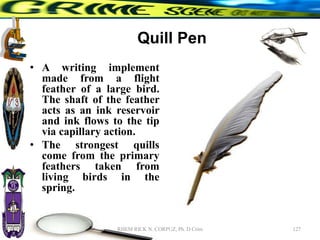
Quill Pen
• A writing implement
made from a flight
feather of a large bird.
The shaft of the feather
acts as an ink reservoir
and ink flows to the tip
via capillary action.
• The strongest quills
come from the primary
feathers taken from
living birds in the
spring.
127
RHEM RICK N. CORPUZ, Ph. D Crim
Steel point pen
• Although pens of bronze may have been known to
Romans, the earliest mention of "BRAZEN PENS" was in
1465. The 16th century Spanish calligrapher JUAN DE
YCIAR mentions brass pens for very large writing in his
1548 writing manual, but the use of metal pens did not
become widespread until the early part of the 19th century.
• The first patented steel pen point was made by the English
engineer BRYAN DONKIN in 1803.
• The leading 19th century English pen manufacturers were
WILLIAM JOSEPH GILLOT, WILLIAM
MITCHELL, AND JAMES STEPHEN PERRY.
128
RHEM RICK N. CORPUZ, Ph. D Crim
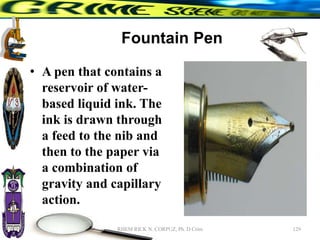
Fountain Pen
• A pen that contains a
reservoir of water-
based liquid ink. The
ink is drawn through
a feed to the nib and
then to the paper via
a combination of
gravity and capillary
action.
129
RHEM RICK N. CORPUZ, Ph. D Crim
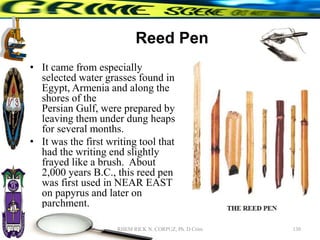
Reed Pen
• It came from especially
selected water grasses found in
Egypt, Armenia and along the
shores of the
Persian Gulf, were prepared by
leaving them under dung heaps
for several months.
• It was the first writing tool that
had the writing end slightly
frayed like a brush. About
2,000 years B.C., this reed pen
was first used in NEAR EAST
on papyrus and later on
parchment.
130
RHEM RICK N. CORPUZ, Ph. D Crim
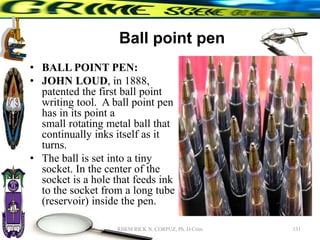
Ball point pen
• BALL POINT PEN:
• JOHN LOUD, in 1888,
patented the first ball point
writing tool. A ball point pen
has in its point a
small rotating metal ball that
continually inks itself as it
turns.
• The ball is set into a tiny
socket. In the center of the
socket is a hole that feeds ink
to the socket from a long tube
(reservoir) inside the pen.
131
RHEM RICK N. CORPUZ, Ph. D Crim
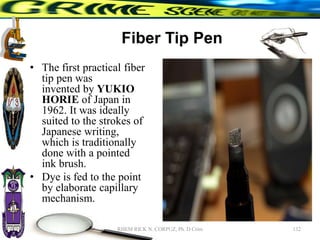
Fiber Tip Pen
• The first practical fiber
tip pen was
invented by YUKIO
HORIE of Japan in
1962. It was ideally
suited to the strokes of
Japanese writing,
which is traditionally
done with a pointed
ink brush.
• Dye is fed to the point
by elaborate capillary
mechanism.
132
RHEM RICK N. CORPUZ, Ph. D Crim
Invisible Ink
Inks developed by heat
• Cola drink (diluted) Milk
• Honey (diluted) Onion Juice
• Semen Urine
• Soap water Vinegar or Wine
• Sugar solution Apple, Orange,
Lemon
133
RHEM RICK N. CORPUZ, Ph. D Crim
TYPEWRITER
EXAMINATION
RHEM RICK N. CORPUZ, Ph. D Crim 134
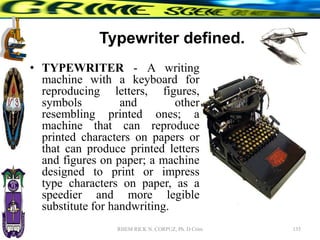
Typewriter defined.
• TYPEWRITER - A writing
machine with a keyboard for
reproducing letters, figures,
symbols and other
resembling printed ones; a
machine that can reproduce
printed characters on papers or
that can produce printed letters
and figures on paper; a machine
designed to print or impress
type characters on paper, as a
speedier and more legible
substitute for handwriting.
135
RHEM RICK N. CORPUZ, Ph. D Crim
Basic Terminologies
• CARBON IMPRESSION- Any typewriting which is
placed on the paper by the action of the
type faces striking thought carbon paper is classed as a carbon
impression. Generally, carbon impressions are "carbon copies", but
sometime original typewriting is made directly through a carbon
ribbon.
• CHARACTER - In connection with typewriting identification, the
term "Character" is used to include letters, symbols, numerals, or
points of punctuation.
• CLOGGED (DIRTY) TYPEFACES - With use the
type faces becomes filled with lint, dirty and ink,
particularly in enclosed letters such as the o,e,p, and g.
• DEFECTS - The term defect describes any abnormality or malad-
justment in a typewriter which is reflected in its works and which
leads to its individualization or identification.
• OFF ITS FEET - The condition of a typeface printing heavier
on one side or corner than over the remainder of its outline.
136
RHEM RICK N. CORPUZ, Ph. D Crim
Basic Terminologies
• PERMANENT DEFECT - Any identifying characteristics of a
type-writer which cannot be corrected by simply cleaning the type
face or replacing the ribbon is classified as a permanent defect.
• PLATEN - The cylinder which serve as the backing of the paper
and which absorbs the blow on the type face is known as a platen.
• REBOUND - A defect in which a character prints a double
impression with the lighter one slightly offset to the right or left.
• RIBBON IMPRESSIONS - Typewriting which is made directly
through a cloth ribbon is called ribbon impression.
• RIBBON CONDITION - Typewriter ribbons
gradually deteriorate with use and the degree of determination is a
measure of the ribbon condition.
137
RHEM RICK N. CORPUZ, Ph. D Crim
Basic Terminologies
• TWISTED LETTER - Each letter and character is designed to print a
certain fixed angle to the base line, due to wear, and damage to the type
bars and the type block, some letters become twisted so that they lean to
the right or left of their correct slant.
• TYPE FACE - The printing surface of the type block is known as the
type face, with most modern typewriter this block is attached at the end
of a movable arm or type bar which propels the type face against the
ribbon and paper to make the typewriter impression.
• TYPE FACE DEFECTS - Any peculiarity of typewriting caused by
actual damage to the type face metal is known as type face defect. These
defect may be actual breaks in the outline of the letter where the metal
has been chipped away sometimes referred to as broken type, or they
may be distorted outlines of the letter where the type face
metal has become bent or smashed, they can only be corrected by
replacing the type block.
138
RHEM RICK N. CORPUZ, Ph. D Crim
Types of Typewriter
• CONVENTIONAL TYPEWRITERS USING TYPE BARS
– Pica Type - 10 letter/inch
– Elite Type - 12 Letters/inch
• TYPEWRITER USING SINGLE ELEMENT OR BALL -
A machine, capable of typing 10 or 12 characters per
inch. Change of horizontal spacing is done easily by the flip of a
switch.
• TYPEWRITER USING A PRINT WHEEL (ELECTRONIC
TYPEWRITER) –This has a disc type device called a print wheel,
The printwheel contains all of characters represented on the
typewriter keyboard. This machine has the capability of typing 10,
12 and 15 letters per inch.
139
RHEM RICK N. CORPUZ, Ph. D Crim
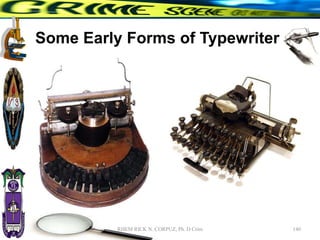
Some Early Forms of Typewriter
140
RHEM RICK N. CORPUZ, Ph. D Crim
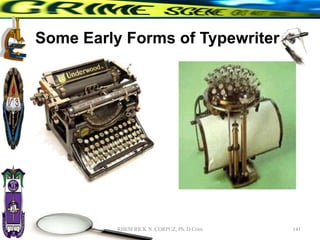
Some Early Forms of Typewriter
141
RHEM RICK N. CORPUZ, Ph. D Crim
TEST OF MEMORY
RHEM RICK N. CORPUZ, Ph. D
OLIVER G. SALTA, MSCJE
QDE SPECIALIST
The thickness of paper
expressed in thousands of inch.
A. Measurement
B. Caliper
C. Buffer
D. Calibre
7/17/2024
Chemical used to whiten paper
pulp.
A. Bleach
B. Alum
C. Sufite
D. Pulp
7/17/2024
A form of printing to produce a
raised impression or pattern on
the surface of a sheet of paper.
A. Lithograph printing
B. Embossing
C. Edge chains
D. Reprographing
7/17/2024
The original inventor of
Fourdrinier paper machine.
A. Fourdrinier Brothers
B. Bryan Donkin
C. Nicholas-Louis Robert
D. Milton Reynolds
7/17/2024
Quality of a paper related to the
amount of light that can be
transmitted through its surface.
A. Thickness
B. Opacity
C. Translucent
D. Texture
7/17/2024
Fundamentally, the grand mission and
objective of document examiner is to
determine and conclude with scientific
basis and technique who
A. Beneficiaries
B. Writer or signatory
C. Master mind
D. Conspirator
7/17/2024
In questioned document, it is
where all characteristics are
grouped.
A. Class characteristics
B. Individual characteristics
C. Both A and B
D. Neither
7/17/2024
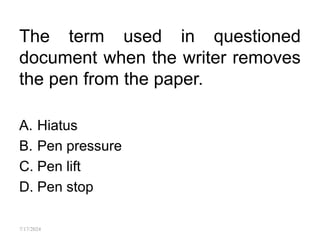
The term used in questioned
document when the writer removes
the pen from the paper.
A. Hiatus
B. Pen pressure
C. Pen lift
D. Pen stop
7/17/2024
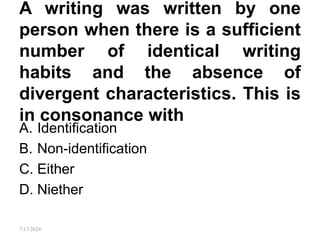
A writing was written by one
person when there is a sufficient
number of identical writing
habits and the absence of
divergent characteristics. This is
in consonance with
A. Identification
B. Non-identification
C. Either
D. Niether
7/17/2024
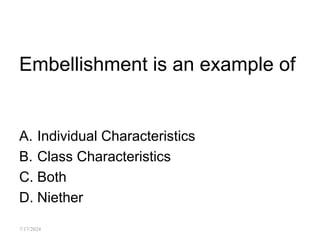
Embellishment is an example of
A. Individual Characteristics
B. Class Characteristics
C. Both
D. Niether
7/17/2024
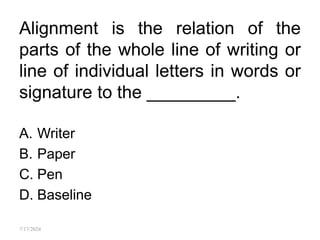
Alignment is the relation of the
parts of the whole line of writing or
line of individual letters in words or
signature to the _________.
A. Writer
B. Paper
C. Pen
D. Baseline
7/17/2024
Hiatus is a gap between strokes
due to
A. Speed in writing
B. Defective writing instrument
C. Unevenness of writing materials
D. All
7/17/2024
Among the following, which is
not an element of movement?
A. Line Quality
B. Rhythm
C. Speed Freedom
D. emphasis
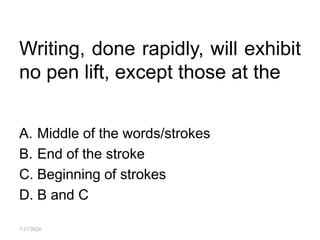
7/17/2024
Writing, done rapidly, will exhibit
no pen lift, except those at the
A. Middle of the words/strokes
B. End of the stroke
C. Beginning of strokes
D. B and C
7/17/2024
The orientation of the writing
instrument is referred to as
A. Pen position
B. Pen hold
C. Pen emphasis
D. Pen orientation
7/17/2024
The relation between the tall
and short letters is referred to
as
A. Ratio
B. Proportion
C. Line quality
D. All
7/17/2024
What will be produced when the
writer concentrate his attention on
what he is writing rather than on
how the pen point is being moved?
A. Poor line quality
B. Good line quality
C. Shading
D. Tremor
7/17/2024
In questioned document
examination, it is referred to as the
flourishing succession of motion
which are recorded in a written
record.
A. Line quality
B. Rhythm
C. Speed in writing
D. Movement
7/17/2024
Slant is the angle or inclination
of the axis of the letters relative
to the
A. Baseline
B. Slope
C. Alignment
D. Staff
7/17/2024
Uncommon and well fixed
characteristic that serve as a
fundamental point of
identification.
A. Slant
B. Habit
C. Movement
D. All
7/17/2024
Baseline is the ruled or
imaginary line upon which the
writing ______
A. Holds
B. Rests
C. Stays
D. Slants
7/17/2024
Among the following, which is a
common defect of forgery?
A. Patching
B. Retracing
C. A and B
D. None
7/17/2024
Letters that extend a distance
vertically above the linear
letters.
A. Infra-linear
B. Supra-linear
C. Linear
D. None
7/17/2024
The only question to tackle in
this kind of signature forgery
is the determination of the
probable writer of the forgery.
A. Simple forgery
B. Simulated forgery
C. Traced forgery
D. A and B
7/17/2024
A kind of signature forgery
where the resemblance of the
questioned signature and
genuine is apparent.
A. Fraudulent
B. Simulated
C. Simple
D. Traced
7/17/2024
To identify whether simple forgery
was committed, which of the
following should be retrieved?
A. Standard signature from the forger
B. Standard of the genuine signature
C. Standard of the person who made the
forgery
D. Identity of the forger
7/17/2024
One of the following statements
best describe what a collected
standard is.
A. It has the advantage of easily finding it.
B. Attempt to disguise is removed.
C. The accused is aware that the specimen
will be used against him.
D. None
7/17/2024
Authenticity of private
documents is not necessary
when
A. It is 30 years old
B. More than 30 years old
C. Less than 30 years old
D. More or less 30 years old
7/17/2024
Counterfeit paper bill glows
under ultra violet light.
A. True
B. Partly true
C. False
D. Partly false
7/17/2024
During paper manufacture, the
following are included except
A. Security fiber
B. Watermarks
C. Iridescent band
D. Serial number
7/17/2024
Which of the following is not a
crime called forgery?
A. Forging the seal of the government
B. Counterfeiting of coins
C. Mutilation of coins
D. Using forged signature or counterfeit seal
or stamp
7/17/2024
The imitation of a legal or
genuine coin.
A. Counterfeit
B. Mutilation
C. Utter
D. Import
7/17/2024
When a spurious coin is made,
there is
A. Counterfeiting
B. Uttering
C. Mutilation
D. Importing
7/17/2024
Mutilation of coins without the
intent to defraud is
A. Not punishable under the revised penal
code
B. Not punishable by any law
C. Punishable under the revised penal code
D. Punishable under Art. 164 of the RPC.
7/17/2024
To make false instrument
intended to be passed for the
genuine one is a form of
A. Falsification
B. Forgery
C. Tracing
D. Fraud
7/17/2024
An instrument payable to
_______ where it is drawn
payable to the order of a
specified person.
A. Order
B. Bearer
C. Obligations
D. Contract
7/17/2024
Which of the following method
should be used in order for the
naked eye to see a charred
document?
A. X-ray
B. Spectrograph
C. Ultra violet
D. Infra red
7/17/2024
In questioned document
examination, what are the
irregularities on strokes, shaking or
wavering of strokes?
A. Shakening
B. Tremor
C. Strokes
D. Variation
7/17/2024
When bank notes or other
documents payable to bearer
are forged, it is called
A. Forgery
B. Falsification
C. Counterfeiting
D. All
7/17/2024
Which of the following security
features of a paper bill does not
react to ultra-violet light?
A. Serial Number
B. Watermark
C. Fluorescent printing
D. Invisible security fibers
7/17/2024
Paper is for china while papyrus
is for
A. Sumer
B. China
C. Sumeria
D. Egypt
7/17/2024
Thank you and GODBLESS!
• IF THE LAW HAS MADE YOU...A
WITNESS, YOU WILL... REMAIN A MAN
OF SCIENCE. YOU HAVE NO VICTIM
TO AVENGE, NO GUILTY OR
INNOCENT TO RUIN OR SAVE. YOU
WILL BEAR WITNESS WITHIN THE
LIMITS OF SCIENCE
RHEM RICK N. CORPUZ, Ph. D Crim 184

Questioned Document. comprehensive review

  • 1.
    Questioned Document A ComprehensiveReview Rhem Rick N. Corpuz, Ph. D Crim Oliver G. Salta, MSCJE Questioned Document Specialist 1 RHEM RICK N. CORPUZ, Ph. D Crim
  • 2.
    Order of Presentation •Preliminaries • Questioned Document: Timeline and Personalities • Examination of Questioned Handwriting • Standards in Questioned Document • Examination of Signatures • Examination of Fraudulent Alteration 2 RHEM RICK N. CORPUZ, Ph. D Crim
  • 3.
    Order of Presentation •Examination of Counterfeiting • Examination of Inks and Writing Materials • Examination of Typewritten Notes and Materials • Laws on Questioned Documents • Current Trends in Questioned Documents 3 RHEM RICK N. CORPUZ, Ph. D Crim
  • 4.
    Meet your Lecturer LicensedCriminologist  Faculty Member, Angeles University Foundation National Lecturer, Criminology Licensure Examination 2nd Place, 2008 Criminology Licensure Examination Ph. D in Criminology- PCCr M.S. in Criminology- Univ. of Baguio B.S. in Criminology- Univ. of Baguio Researcher Questioned Document and Photography Specialist 4 RHEM RICK N. CORPUZ, Ph. D Crim
  • 5.
    Preliminaries • Document – Theterm document came from the Latin word “documentum”, which means lesson, or example. It may have been derived also from the French word “docere” means to teach. – Any material containing marks, symbols, or signs in which these components may either be visible or partially visible in conveying message or meaning to someone. 5 RHEM RICK N. CORPUZ, Ph. D Crim
  • 6.
    Kinds of Document •Public document – A document created, executed or issued by a public official in response to the exigencies of the public service, or in the execution of which a public official intervened. (U.S. v. Asensi, 34 Phil. 765) • Official document – A document which is issued by a public official in the exercise of the functions of his office. An official document is also a public document. It falls within the larger class called public document. (U.S. v. Asensi) 6 RHEM RICK N. CORPUZ, Ph. D Crim
  • 7.
    Kinds of Document •Private Document – Every deed or instrument executed by a private person without the intervention of a notary public or of any person legally authorized, by which the documents some disposition or agreement is proved, evidenced or set forth (US v. Orera,11 Phil. 596).- • Commercial Document – Any instrument defined and regulated by the Code of Commerce (People v. Co Beng, 1913) or any other commercial law. 7 RHEM RICK N. CORPUZ, Ph. D Crim
  • 8.
    What may notconstitute as document? • A draft of municipal payroll which not yet approved by the proper authority. • Mere blank forms of official documents. • Pamphlets or books which do not evidence any disposition or agreement are not documents but are mere merchandise. 8 RHEM RICK N. CORPUZ, Ph. D Crim
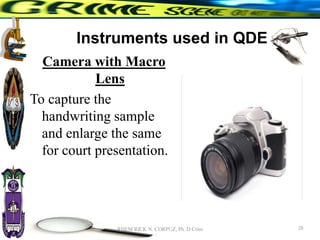
  • 9.
    Questioned Document • Isa document or paper/s whose contents have been contested either in whole or in any part as to their authenticity. • A document is questioned when there is a controversy over its preparation, contents and other circumstances surrounding it. 9 RHEM RICK N. CORPUZ, Ph. D Crim
  • 10.
    Questioned Document Examination •Is a term used to refer to the act of making a close and critical study of any document which is questioned, disputed or attacked, necessary to discover the facts about them. 10 RHEM RICK N. CORPUZ, Ph. D Crim
  • 11.
    Two Division ofQDE • Criminalistics Examination. This involves the detection of forgery, erasure, alteration or obliteration of documents. – Dr. Wilson Harrison, a noted British Examiner of questioned documents said that an intelligent police investigator can detect almost 75% of all forgeries by careful inspection of a document with simple magnifiers and measuring tools. • Handwriting Investigation/Analysis. This is more focused in determining the author of writing. It is more difficult procedure and requires long study and experience. 11 RHEM RICK N. CORPUZ, Ph. D Crim
  • 12.
    Aspects of QDE •Handwriting Examination (Graphology/Graphoanalysis) – examination of signatures and initials – examination of anonymous letters – hand printing examination • Examination of Typewritings and typeprints. • Examination of Inks • Examination of Erasures, alterations or obliterations, etc. – Detection of alteration – Decipherment of erased writings – Restoration of obliterated writings • Counterfeiting – Examination of currency bills and coins and the like – Examination of fake documents • Miscellaneous aspects – Determination of age of documents – Identification of stamps – Examinations of seal and other authenticating devices 12 RHEM RICK N. CORPUZ, Ph. D Crim
  • 13.
    Purpose of QDE Toreveal/ discover the following: – Identity of the author. – True contents of the document. – Origin of the instrument or paper used in making the document. – Alterations or erasures which have been made. – Authenticity of the document. 13 RHEM RICK N. CORPUZ, Ph. D Crim
  • 14.
    Scientific Examination ofQDE • Analysis (Recognition) - properties or characteristics, observed or measured. • Comparison - Properties or characteristics of the unknown determined thought analysis are now compared with the familiar or recorded properties of known items. • Evaluation- Similarities or dissimilarities in properties or characteristics will each have a certain value for identification, determined by its likelihood of occurrence. The weight or significance of each must therefore be considered. 14 RHEM RICK N. CORPUZ, Ph. D Crim
  • 15.
    Instruments used inQDE Stereoscopic Microscope The stereoscopic microscope, two low- powered microscopes arranged to converge on a single specimen, provides a three- dimensional image. 15 RHEM RICK N. CORPUZ, Ph. D Crim
  • 16.
    Instruments used inQDE The compound microscope uses two lenses, an objective lens and an ocular lens, mounted at opposite ends of a closed tube, to provide greater magnification than is possible with a single lens. The objective lens is composed of several lens elements that form an enlarged real image of the object being examined. 16 RHEM RICK N. CORPUZ, Ph. D Crim
  • 17.
    Instruments used inQDE Shadowgraph an instrument that the images are cast in shadow: an image of a shape made by casting a shadow onto a surface 17 RHEM RICK N. CORPUZ, Ph. D Crim
  • 18.
    Instruments used inQDE Handwriting Protractor An instrument for measuring angles: an instrument shaped like a semicircle marked with the degrees of a circle, used to measure or mark out angles. 18 RHEM RICK N. CORPUZ, Ph. D Crim
  • 19.
    Instruments used inQDE UV Lamp – this is usually used in the detection of counterfeited bills but can actually be used to detect security features of qualified documents. 19 RHEM RICK N. CORPUZ, Ph. D Crim
  • 20.
    Instruments used inQDE Transmitted Light a device where light comes from beneath or behind glass on document is placed. 20 RHEM RICK N. CORPUZ, Ph. D Crim
  • 21.
    Instruments used inQDE Photo- enlarger A device used to enlarge negatives and transfer the image to the photo paper. 21 RHEM RICK N. CORPUZ, Ph. D Crim
  • 22.
    Instruments used inQDE Forensic Comparator An instrument which captures images and projects them on a black and white screen for enlargement purposes. 22 RHEM RICK N. CORPUZ, Ph. D Crim
  • 23.
    Instruments used inQDE Electro- Static Detection Device An Electro Static Detection Apparatus is used to visualize indentations by applying an electrostatic charge to a transparent film. The film is laid across the page in question and once the charge has been applied, black toner is passed across the film and reveals any indentations. This method can also determine if something has been added to a journal or log after the original entry was made 23 RHEM RICK N. CORPUZ, Ph. D Crim
  • 24.
    Instruments used inQDE Video Spectral Comparator is used to analyze inks and see whether they are the same or different. This is done by looking at them under different lighting conditions where some wavelengths of light are blocked. This technique can uncover layers in documents where words have been scribbled out or written over 24 RHEM RICK N. CORPUZ, Ph. D Crim
  • 25.
    Instruments used inQDE Thin Layer Chromatography is used to do a more thorough analysis of ink. The ink is mixed with chemicals and deposited onto a silicate plate where its constituents can be measured 25 RHEM RICK N. CORPUZ, Ph. D Crim
  • 26.
    Instruments used inQDE Infrared Reflectance is used to show the residue of pencil marks. This can be done clearly even if the writing has been erased. Pencils are made of graphite which is a form of carbon – and this absorbs infrared light well 26 RHEM RICK N. CORPUZ, Ph. D Crim
  • 27.
    Instruments used inQDE Magnifying Lens For increased magnification 27 RHEM RICK N. CORPUZ, Ph. D Crim
  • 28.
    Instruments used inQDE Camera with Macro Lens To capture the handwriting sample and enlarge the same for court presentation. 28 RHEM RICK N. CORPUZ, Ph. D Crim
  • 29.
    Basic Terminologies • DISPUTEDDOCUMENT. A term suggesting that there is an argument or controversy over the document, and strictly speaking this is true meaning. • STANDARD a.k.a. STANDARD DOCUMENT - Are condensed and compact set of authentic specimens which, if adequate and proper, should contain a cross section of the material from a known source. • EXEMPLAR. A term used by some document examiners and attorneys to characterize known material. Standard is the older term. 29 RHEM RICK N. CORPUZ, Ph. D Crim
  • 30.
    Basic Terminologies • HOLOGRAPHICDOCUMENT. Any document completely written and signed by one person; also known as a holograph. • REFERENCE COLLECTION. Material compiled and organized by the document examiner to assist him in answering special questions. Reference collections of typewriting, check writing specimens, inks, pens, pencils, and papers are frequently maintained. 30 RHEM RICK N. CORPUZ, Ph. D Crim
  • 31.
    Basic Terminologies • ERASURE- The removal of writings, typewriting or printing, from a document is an erasure. – Mechanical – Chemical • EXAMINATION - It is the act of making a close and critical study of any material and with questioned documents, it is the process necessary to discover the facts about them. • EXPERT WITNESS. A legal term used to describe a witness who by reason of his special training or experience is permitted to express an opinion regarding the issue, or a certain aspect of the issue, which is involved in a court action. 31 RHEM RICK N. CORPUZ, Ph. D Crim
  • 32.
    Basic Terminologies • HANDWRITINGIDENTIFICATION EXPERT. A common name for the document examiner. • IDENTIFICATION (Identity) – as used in this text it is the state of being identical or absolutely the same as in similarity of source or authorship of the questioned document and the standard document. • INSERTION OR INTERLINEATION - The term "insertion" and "interlineations" include the addition of writing and other material between lines or paragraphs or the addition of whole page to a document. 32 RHEM RICK N. CORPUZ, Ph. D Crim
  • 33.
    Basic Terminologies • NON-IDENTITIFICATION(Non-identity) – as used in this text it means that the source or authorship of the compared questioned and standard specimens is different. • OBLITERATION - the blotting out or shearing over the writing to make the original invisible to as an addition. • OPINION. In legal language, it refers to the document Examiner's conclusion. Actually in Court, he not only expresses an opinion but demonstrates the reasons for arriving at his opinion. Throughout this text, opinion and conclusion are used synonymously. • QUALIFICATION. The professional experience, education, and ability of a document examiner. Before he is permitted to testify as an expert witness, the court must rule that he is qualified in his field. 33 RHEM RICK N. CORPUZ, Ph. D Crim
  • 34.
    Basic Terminologies • ADDITION- Any matter made a part of the document after its original preparation may be referred to as addition. • CONCLUSION - A scientific conclusion results form relating observed facts by logical, common-sense reasoning in accordance with established rules or laws. The document examiner's conclusion, in legal term is referred to as "opinion". • DOCUMENT EXAMINER. One who studies scientifically the details and elements of documents in order to identify their source or to discover other facts concerning them. 34 RHEM RICK N. CORPUZ, Ph. D Crim
  • 35.
    Care and Preservationof Documents • The improper or careless handling of a disputed document can lead to serious curtailment of certain technical examinations. • DO’s – Keep documents unfolded in protective envelope. – The most useful and effective protective covering of a disputed documents is a transparent plastic envelop. 35 RHEM RICK N. CORPUZ, Ph. D Crim
  • 36.
    Care and Preservationof Documents • Take disputed papers to the documents examiners laboratory at the first opportunity. • If storage is necessary, keep the document in a dry place away from excessive heat and strong light. • Once a document is disputed it is seldom stored or filed for a long, but important documents should be kept properly for a long period of time. 36 RHEM RICK N. CORPUZ, Ph. D Crim
  • 37.
    Care and Preservationof Documents • Do not handle disputed papers excessively or carry them in a pocket for along time. • Do not mark disputed documents (either by consciously writing or by pointing at them with writing instrument or dividers). • Do not mutilate or damage by repeated refolding, creasing, cutting, tearing or punching for filing purposes. • ” 37 RHEM RICK N. CORPUZ, Ph. D Crim
  • 38.
    Care and Preservationof Documents • Do not allow anyone except qualified specialist to make chemical or other do not treat or dust for latent fingerprints before consulting a document examiner. • Do not allow “Amateur Testing • When possible, the charred documents should be moved in the container in which they all found. 38 RHEM RICK N. CORPUZ, Ph. D Crim
  • 39.
    Historical Developments inQDE • 1609- The first treatise on systematic document examination was published by Francis Demelle of France • 1622- The first person that carried out systematic observations on the manner of handwriting was Camillo Baldi. He published the book entitled “Treated how, by a letter missive, one recognizes the writer’s nature and qualities”, which is considered the first known graphological essay. • 1810- The first recorded use of questioned document analysis occurred in Germany. Konigin Hanschritt. 39 RHEM RICK N. CORPUZ, Ph. D Crim
  • 40.
    Historical Developments inQDE • 1810- The first recorded use of questioned document analysis occurred in Germany. A chemical test for a particular ink dye was applied to a document known as Konigin Hanschritt. • 1882- Gilbert Thompson, railroad builder with the US Geological survey in New Mexico, put his own thumbprint on wage chits to safeguard himself from forgeries. • 1894- Alfred Dreyfus of France was convicted of treason based on mistaken handwriting identification by Bertillion. • 1910- Albert S. Osborne- an American and arguably the most influential document examiner, published Questioned Documents. 40 RHEM RICK N. CORPUZ, Ph. D Crim
  • 41.
    Techniques in Examination •MICROSCOPIC EXAMINATION - Any examination or study which is made with the microscope in order to discover minute physical details. • With proper angle and intensity or illumination, it aids in the decipherment of erasures, some minute manipulations not perfectly pictured to the unaided eye and the sequence of entries done by different writing instruments. • TRANSMITTED LIGHT EXAMINATION – In this examination, the document is viewed with the source of illumination behind it and the light passing through the paper. Documents are subjected to this type of examination to determine the presence of erasures, matching of serrations and some other types of alterations. 41 RHEM RICK N. CORPUZ, Ph. D Crim
  • 42.
    Techniques in Examination •OBLIQUE LIGHT EXAMINATION - An examination with the illumination so controlled that it grazes or strikes the surface of the document from one side at a very low angle. Decipherment of faded handwriting, determination of outlines in traced forgery, embossed impressions, etc. are subjected to this type of examination. • PHOTOGRAPHIC EXAMINATION - This type of examination is very essential in every document examination. Actual observations are recorded in the photographs 42 RHEM RICK N. CORPUZ, Ph. D Crim
  • 43.
    Techniques in Examination •ULTRA-VIOLET EXAMINATION - Ultraviolet radiation is invisible and occurs in the wave lengths just below the visible blue-violet end of the spectrum (rainbow). These visible rays react on some substances so that visible light is reflected, a phenomenon known as FLOURESCENCE. • This type of examination is done in a darkroom after the lamp has been warmed up in order to give a maximum output of the ultra-violet light. Exposure to the ultra-violet light should be to the minimum duration in order to avoid fading of some writing ink and typewriter ribbon. • INFRARED EXAMINATION - This examination of documents employs invisible radiation beyond the red portion of the visible spectrum (rainbow) which is usually recorded on a specially sensitized photographic emulsion. 43 RHEM RICK N. CORPUZ, Ph. D Crim
  • 44.
    Classes of QD •Documents containing questioned signatures. • Questioned documents alleged to have been containing fraudulent alterations. • Questioned or disputed holographic will. – a. Holographic Will – b. Notarial Will- • Documents investigated on the question of typewriting. • Questioned documents on issues of their age or date. • Questioned documents on issues of materials used in their production. • Documents or writings investigated because it is alleged that they identify some persons through handwriting. 44 RHEM RICK N. CORPUZ, Ph. D Crim
  • 45.
    Principle of QDE •“When two items contain a combination of corresponding or similar and specifically oriented characteristics of such number and significance as to preclude the possibility of their occurrence by mere coincidence and there are no unaccounted differences, it may be concluded that they are the same in their characteristics attributed to the same cause.” 45 RHEM RICK N. CORPUZ, Ph. D Crim
  • 46.
    HANDWRITING ANALYSIS Examination ofHandwriting Specimen 46 RHEM RICK N. CORPUZ, Ph. D Crim
  • 47.
    Handwriting Defined • Itis the result of a very complicated series of acts, being used as a whole, and combination of certain forms of visible mental and muscular habits acquired by long, continued painstaking effort. Some defined handwriting as “visible speech”. 47 RHEM RICK N. CORPUZ, Ph. D Crim
  • 48.
    Physiological Basis • Thiscenter near the motor area of the cortex is responsible for the finger movement involved in handwriting. The importance of this center is that when it becomes diseased as in a graphic, one loses the ability to write although he could still grasp a fountain pen, ball pen or pencil. Thus, the ability or power to hold a fountain pen or pencil to form symbols and words can be said to emanate from its cortical center. 48 RHEM RICK N. CORPUZ, Ph. D Crim
  • 49.
    Muscles involved inHandwriting • A group of extensor muscles push up the pen to form the upward strokes and ease the tension produced as a result by a group of muscle called the flexor muscles that push the pen to form a downward strokes. 49 RHEM RICK N. CORPUZ, Ph. D Crim
  • 50.
    Development of Handwriting •Children learn writing by following the school copy or model. • After acquiring some degree of skill the children no longer follow the school model. • As speed increases, conscious design and regularity begin to break down. • In the course of trial and error, modification are made, simplification and elaborations, addition and omissions occur. • The writing pattern of each child embodies unique combinations of such deviation from the standard letter forms or school model, and becomes his personal habits. 50 RHEM RICK N. CORPUZ, Ph. D Crim
  • 51.
    Kinds of Handwriting •Cursive – connected; writing in which one letter is joined to the next. • Script – separated or printed writing. • BLOCK – all CAPITAL LETTERS. 51 RHEM RICK N. CORPUZ, Ph. D Crim
  • 52.
    Basis of HandwritingExamination • In Wigmore's Principles of judicial Proof, handwriting is defined as a visible effect of bodily movement which is an almost unconscious expression of fixed muscular habits, reacting from fixed mental impression of certain ideas associated with script form. • Environment, education and occupation affect individuals so variously in the formation of these muscular habits that finally the act of writing becomes an almost automatic succession of acts stimulated by these habits. • The imitation of the style of writing by another person becomes difficult because the other person cannot by mere will power reproduce in himself all the muscular combination from the habit of the first writer. 52 RHEM RICK N. CORPUZ, Ph. D Crim
  • 53.
    History of Handwriting CuneiformScript •The impressions left by the stylus were wedged shaped, thus giving rise to the name cuneiform (“wedge shape, “form the Latin cuneus, meaning “wedge”) •Is the earliest writing system in the world. 53 RHEM RICK N. CORPUZ, Ph. D Crim
  • 54.
    Handwriting as anExact Science • In the hand of a qualified examiner operating under right conditions: –Sufficient questioned writing –Sufficient known writing –Sufficient time use of scientific instruments 54 RHEM RICK N. CORPUZ, Ph. D Crim
  • 55.
    History of Handwriting •Paleography(from Greek palaiós, "old" and graphein, "to write") is the study of ancient handwriting and the practice of deciphering and reading historical manuscripts. •The first time the term "paleography" was used was perhaps in 1708 by Bernard de Montfaucon, a Benedictine monk 55 RHEM RICK N. CORPUZ, Ph. D Crim
  • 56.
    History of Handwriting •Calligraphy •(fromGreek kallos "beauty" + graphẽ "writing") is a type of visual art. It is often called the art of fancy lettering (Mediavilla 1996:17). •A contemporary definition of calligraphic practice is "the art of giving form to signs in an expressive, harmonious and skillful manner" (Mediavilla, 1996: 18). 56 RHEM RICK N. CORPUZ, Ph. D Crim
  • 57.
    History of Handwriting •Petrography •Theword comes from the Greek words petros meaning "stone" and glyphein meaning "to carve" (it was originally coined in French as pétroglyphe). •(also called rock engravings) are images created by removing part of a rock surface by incising, pecking, carving, and abrading. 57 RHEM RICK N. CORPUZ, Ph. D Crim
  • 58.
    History of Handwriting •Neolithic man began written communication as long as 20,000 years ago when he graphically represented objects and ideas in drawings on cave walls known as Iconography. 58 RHEM RICK N. CORPUZ, Ph. D Crim
  • 59.
    History of Handwriting •AnIdeogram or Ideograph (from Greek idea "idea" + grafo "to write") is a graphic symbol that represents an idea or concept. . 59 RHEM RICK N. CORPUZ, Ph. D Crim
  • 60.
    History of Handwriting •Fromthe Italian “graffito” meaning “a scatch” refers to handwriting or images on the walls or surfaces of a public area, such as building, parks, toilets, and trains, etc.. •Graffiti" is applied in art history to works of art produced by scratching a design into a surface. 60 RHEM RICK N. CORPUZ, Ph. D Crim
  • 61.
    History of Handwriting •Ascribe is a person who writes books or documents by hand as a profession and helps the city keep track of its records. 61 RHEM RICK N. CORPUZ, Ph. D Crim
  • 62.
    Principles of Handwriting •No two writers write exactly alike. • The physical writing conditions and position of the person including his writing instrument may affect the handwriting characteristics but they do not confine all its identifying elements. – Age, sickness, emotional state (transitory state), position 62 RHEM RICK N. CORPUZ, Ph. D Crim
  • 63.
    Principles of Handwriting •Individuality in handwriting can only be determined through comparative examination with the standard written or prepared under comparable conditions. – Under similar purpose • Similarity does not mean identity. • Complete identity means definite forgery 63 RHEM RICK N. CORPUZ, Ph. D Crim
  • 64.
    Variations in Writing •A more or less definite pattern for each is stored away in the subjective mind but the hand does not always produce a stereotyped duplicate of that pattern. • The hand ordinarily is not an instrument of precision and therefore we may not expect every habitual manual operation to be absolutely uniform. 64 RHEM RICK N. CORPUZ, Ph. D Crim
  • 65.
    Causes of Variation •Function of some external condition i.e. influence of the available space. • Abnormal conditions such as physical injury, toxic effects, inebriation's, emotion and deception. • Position of letter - all the letters are to be found initially, medially, and finally. The fact of a different position, especially in combination with another and particular letter, may modify any of them in some way or another. 65 RHEM RICK N. CORPUZ, Ph. D Crim
  • 66.
    Importance of Variation •Personal variation encountered under normal writing conditions is also a highly important element of identification. The qualities of personal variation include both its nature and its extent. It becomes necessary to determine the amount, extent, and exact quality of the variations. • With a group of signatures of a particular writer, certain normal divergence in size, lateral spacing and proportions actually indicate genuineness. Variation in genuine writing is ordinarily in superficial parts and in size, proportions, degree of care given to the act, design, slant, shading, vigor, angularity, roundness and direction of stroke. 66 RHEM RICK N. CORPUZ, Ph. D Crim
  • 67.
    Copybook System • refersto the standard of handwriting instruction taught in particular school. Classes of copybook depend on the standard school copy adopted by a writer. 67 RHEM RICK N. CORPUZ, Ph. D Crim
  • 68.
    Old Copybook System •Old English round hand - in fact an Italian hand popular in 1840. • Modified round hand - early edition of the Spencerian, and the Payson, Dunton, and Scribners copybook - 1840 -1860. • Spencerian - there is simplification by the omission of extra strokes and flourishes. And a general tendency toward plainer letters than the preceding system, some of which were very ornate - 1860-1890. • Modern Vertical writing 1890-1900 68 RHEM RICK N. CORPUZ, Ph. D Crim
  • 69.
    69 RHEM RICK N.CORPUZ, Ph. D Crim
  • 70.
    Modern Copybook System •Spencerian Script (1850- 1895) – Introduced by Platt Rogers Spencer • Palmer Copybook (1900- 1980) – Austin Norman Palmer • D’ Nealian Copybook (1980) • British Copybook • French Copybook • German Copybook 70 RHEM RICK N. CORPUZ, Ph. D Crim
  • 71.
    Spencerian Script PalmerScript D’ Nealian Copybook RRNC 71
  • 72.
    Importance of Copybook •to the nationality of the writer. • to the system learned • to the date when the writing was acquired and • to some of the influences that have surrounded the writer. 72 RHEM RICK N. CORPUZ, Ph. D Crim
  • 73.
    Terminologies in Handwriting •Alignment • Is the relation of parts of the whole of writing or line of individual letters in words to the baseline. It is the alignment of words. The relative alignment of letters. 73 RHEM RICK N. CORPUZ, Ph. D Crim
  • 74.
    Terminologies in Handwriting •GARLAND FORMS – A cup-like connected form that is open at the top and rounded on the bottom. • ARCADE FORMS – Forms that look like arches rounded on the top and open at the bottom. 74 RHEM RICK N. CORPUZ, Ph. D Crim
  • 75.
    Terminologies in Handwriting •ANGULAR FORMS – Sharp, straight strokes that are made by stopping the pen and changing direction before continuing. • THREADY FORM – An indefinite connective form that looks flat and wavy. 75 RHEM RICK N. CORPUZ, Ph. D Crim
  • 76.
    Terminologies in Handwriting •DISGUISED WRITING - A writer may deliberately try to alter his usual writing habits in hopes of hiding his identity. The results, regardless of their effectiveness are termed disguised writing. 76 RHEM RICK N. CORPUZ, Ph. D Crim
  • 77.
    Terminologies in Handwriting •COLLATION - side by side comparison; collation as used in this text means the critical comparison on side by side examination. • COMPARISON - the act of setting two or more items side by side to weigh their identifying qualities; it refers not only a visual but also the mental act in which the element of one item are related to the counterparts of the other. 77 RHEM RICK N. CORPUZ, Ph. D Crim
  • 78.
    Terminologies in Handwriting •Topline • Midline • Baseline • Zones in Writing 78 RHEM RICK N. CORPUZ, Ph. D Crim
  • 79.
    Terminologies in Handwriting •GRAPHOANALYSIS - the study of handwriting based on the two fundamental strokes, the curve and the straight strokes. • GRAPHOMETRY - analysis by comparison and measurement. • GRAPHOLOGY - the art of determining character disposition and amplitude of a person from the study of handwriting. It also means the scientific study and analysis of handwriting, especially with reference to forgeries and questioned documents. 79 RHEM RICK N. CORPUZ, Ph. D Crim
  • 80.
    Terminologies in Handwriting •GESTALT – The German word that means “complete” or “whole”. A good gestalt needs nothing added or taken away to make it “look right”. Also a school of handwriting analysis that looks at handwriting as a whole picture. • HANDLETTERING. Any disconnected style of writing in which each letter is written separately; also called handprinting 80 RHEM RICK N. CORPUZ, Ph. D Crim
  • 81.
    Terminologies in Handwriting •WRONG-HANDED WRITING. Any writing executed with the opposite hand that normally used; a.k.a. as “with the awkward hand.” It is one means of disguise. Thus, the writing of a right-handed person which has been executed with his left hand accounts for the common terminology for this class of disguise as "left- hand writing". 81 RHEM RICK N. CORPUZ, Ph. D Crim
  • 82.
    Terminologies in Handwriting •LETTER SPACE – The amount of space left between letters. • LINE DIRECTION – Movement of the baseline. May slant up, down, or straight across the page. • LINE QUALITY - the overall character of the ink lines from the beginning to the ending strokes. There are two classes: Good Line quality and Poor Line quality. • LINE SPACE – The amount of space left between lines. 82 RHEM RICK N. CORPUZ, Ph. D Crim
  • 83.
    Terminologies in Handwriting •MANUSCRIPT WRITING. A disconnected form of script or semi-script writing. This type of writing is taught in young children in elementary schools as the first step in learning to write. • MARGINS – The amount of space left around the writing on all four sides. • MOVEMENT – It is an important element in handwriting. It embraces all the factors which are related to the motion of the writing instrument skill, speed freedom, hesitation, rhythm, emphasis, tremors and the like. The manner in which the writing instrument is move that is by finger, hand, forearm or whole arm. 83 RHEM RICK N. CORPUZ, Ph. D Crim
  • 84.
    Terminologies in Handwriting •PEN EMPHASIS - The act of intermittently forcing the pen against the paper surfaces. When the pen-point has flexibility, this emphasis produces shading, but with more rigid writing points heavy point emphasis can occur in writing w/out any evidence of shading; the act intermittently forcing the pen against the paper with increase pressure. • PEN HOLD – The place where the writer grasps the barrel of the pen and the angle at which he holds it. • PEN POSITION - relationship between the pen point and the paper. 84 RHEM RICK N. CORPUZ, Ph. D Crim
  • 85.
    Terminologies in Handwriting •PEN PRESSURE - the average force with which the pen contacts the paper. Pen pressure as opposed to pen emphasis deals with the usual of average force involved in the writing rather than the period increases. • PRINTSCRIPT – A creative combination of printing and cursive writing. 85 RHEM RICK N. CORPUZ, Ph. D Crim
  • 86.
    Terminologies in Handwriting •PROPORTION or RATIO - the relation between the tall and the short letter is referred as to the ratio of writing. • QUALITY. A distinct or peculiar character. Also, “quality” is used in describing handwriting to refer to any identifying factor that is related to the writing movement itself. • RHYTHM – The element of the writing movement which is marked by regular or periodic recurrences. It may be classed as smooth, intermittent, or jerky in its quality; the flourishing succession of motion which are recorded in a written record. Periodicity, alternation of movement. 86 RHEM RICK N. CORPUZ, Ph. D Crim
  • 87.
    Terminologies in Handwriting •SHADING - Is the widening of the ink strokes due to the added pressure on a flexible pen point or to the use of a stub pen. • SIGNIFCANT WRITING HABIT – Any characteristic of handwriting that is sufficiently uncommon and well fixed to serve as a fundamental point in the identification. • SIMPLIFICATION – Eliminating extra or superfluous strokes from the copybook model. • SIZE – May refer to the overall size of the writing or the proportions between zones. • SKILL - In any set there are relative degrees or ability or skill and a specimen of handwriting usually contains evi- dence of the writer's proficiency; degree, ability, or skill of a write proficiency. 87 RHEM RICK N. CORPUZ, Ph. D Crim
  • 88.
    Terminologies in Handwriting •SLOPE/SLANT - the angle or inclination of the axis of the letters relative to the baseline. There are three classes: – Slant to the left; – Slant to the right; and – Vertical Slant. • SPEED OF WRITING - The personal pace at which the writer’s pen moves across the paper. • TENSION – The degree of force exerted on the pen compared to the degree of relaxation. • WORD SPACE – The amount of space left between words. 88 RHEM RICK N. CORPUZ, Ph. D Crim
  • 89.
    Kinds of Handwriting •Finger Movement - the thumb, the first, second and slightly the third fingers are in actual motion. Most usually employed by children and illiterates. • Hand Movement - produced by the movement or action of the whole hand with the wrist as the center of attraction. • Forearm Movement - the movement of the shoulder, hand and arm with the support of the table. • Whole Forearm Movement - action of the entire arm without resting. i.e., blackboard writing. 89 RHEM RICK N. CORPUZ, Ph. D Crim
  • 90.
    Strokes in Handwriting •Path followed by the pen in the paper – Arc- a curved formed inside the top curve of loop as in small letters “h”, “m”, “n”, & “p”. – Arch- any arcade form in the body of a letter found in small letters which contain arches. – Ascender- is the top portion of a letter or upper loop. – Baseline- maybe actually on a ruled paper, it might be imaginary alignment of writing; it the ruled or imaginary line upon which the writing rests. 90 RHEM RICK N. CORPUZ, Ph. D Crim
  • 91.
    Strokes in Handwriting •Diacritic- “t” crossing and dots of the letter “i” and “j”. The matters of Indian script are also known as diacritic sign; an element added to complete a certain letter, either a cross bar or a dot. • Ending/Terminate stroke of toe- the end stroke of a letter. • Eye/ Eyelet/Eyeloop- a small loop or curved formed inside the letters. This may occur inside the oval of the letters “a,d,o”; the small loop form by the stroke that extend in divergent direction as in small letters. • Foot- lower part which rest on the base line. The small letter ”m” has three feet, and the small letter “n” has two feet. 91 RHEM RICK N. CORPUZ, Ph. D Crim
  • 92.
    Strokes in Handwriting •Hesitation- the term applied to the irregular thickening of ink which is found when writing slows down or stop while the pen take a stock of the position. • Hiatus/ pen jump- a gap occurring between a continuous stroke without lifting the pen. • Such as occurrence usually occurs due to speed; may be regarded also as a special form of pen lift distinguished in a ball gaps and appear in the writing. • Hook- it is a minute curve or ankle which often occurs at the end of the terminal stroke. • It also sometimes occurs at the beginning of a initial stroke. The terminal curves of a letters “a,d,n,m,p,u” is the hook. 92 RHEM RICK N. CORPUZ, Ph. D Crim
  • 93.
    Strokes in Handwriting •Long letter- those letters with both upper and lower loops. • Loop- a oblong curve such as found on the small letter “f,g,I” and letter stroke “f” has two. • Majuscule- a capital letter. • Miniscule- a small letter. • Movement impulses- this refers to the continuality of stroke , forged writing is usually produced by disconnected and broken movements and more motion or movement impulses then in genuine writing. • Patching- retouching or going back over a defective portion of a stroke. Careful patching is common defect on forgeries. 93 RHEM RICK N. CORPUZ, Ph. D Crim
  • 94.
    Strokes in Handwriting •Shoulder- outside portion of the top curve, small letter “m” has three shoulders and the small letter “n” has two, the small letter “h” has one shoulder. • Spur- a short initial or terminal stroke. • Staff- any major long downward stroke of a letter that is the long downward stroke of the letter “b,g”. • Stem or shank- the upright long downward stroke that is the trunk or stalk, normally seen in capital letters. • Tick/ Hitch- any short stroke, which usually occurs at the top of the letters. • Tremor- a writing weakness portrayed by irregular shaky strokes is described as writing tremor. • Whirl- the upstroke of looping ascender. 94 RHEM RICK N. CORPUZ, Ph. D Crim
  • 95.
    Strokes in Handwriting •Linear Letters- lower case letters having no ascending loops or stems, or descending loops or stems sometimes called minuscule. No capital letters. • Supralinear- letters that extend a distance vertically above the linear letters, (b, d,h,k,l and t) • Infralinear- Letters are those that extend a distance vertically below the baseline of the writing or of the linear letters. (g,j,p,q,y,z). • Double-Length Letters- are those few letters that extend a distance vertically both above and below the linear letters. (f, y, z,p) 95 RHEM RICK N. CORPUZ, Ph. D Crim
  • 96.
    Characteristics of Handwriting •GENERAL(CLASS) CHARACTERISTICS - These characteristics refer to those habits are part of basic writing system or which are modifications of the system of writing found among so large a group of writes that have only slight identification value. • INDIVIDUAL CHARACTERISTICS - They are characteristics which are the result of the writer's muscular control, coordination, age, health, and nervous temperament, frequency of writing, personality and character. 96 RHEM RICK N. CORPUZ, Ph. D Crim
  • 97.
    Individual Characteristics • Writingmovement • Form and design of letters • Muscular control or motor control - • Loose writing - this is characterized by too much freedom of movement and lack of regulation. This is noticed especially in tall letters forms. • Restrained writing - there is lack of freedom and inhibited movements. It gives you the impression that every stroke was made with great difficulty. This writing is small. There is distortion of letter forms which may lead to illegibility. • Motor Coordination • Shading • Skill 97 RHEM RICK N. CORPUZ, Ph. D Crim
  • 98.
    Individual Characteristics • Alignment •Pen pressure • Connection • Pen hold • Rhythm • Disconnections or pen lifts between letters • Speed. • Slant as a writing habit • Proportion of letters • Quality of stroke or line quality • Variation 98 RHEM RICK N. CORPUZ, Ph. D Crim
  • 99.
    Standards in Handwriting •STANDARD. They are known writings which indicate how a person writes. A writer manifests fixed habits in his writings that identify him. This fact provides the basis for an opinion of conclusion regarding any writing identification problem. • EXEMPLARS - Specimen of the writing of suspects are commonly known as exemplars. The term standards is a general term referring to all authenticated writings of the suspects while exemplars refers more especially to a specimens of standard writing offered in evidence or obtained or request for comparison with the questioned writing. • SAMPLE - A selected representative portion of the whole is known as a sample. In this text, the term "sample" follows closely the statistical usage. 99 RHEM RICK N. CORPUZ, Ph. D Crim
  • 100.
    Types of Standards •Collected Standards are KNOWN (genuine) handwriting of an individual such as signature and endorsements on canceled checks, legal papers letters, commercial, official, public and private document and other handwriting such as letters, memoranda, etc. written in the course of daily life, both business and socials. • Request standards are signature or other handwritings (or hand printings) written by an individual upon request for the purpose of comparison with other handwriting or for specimen purposes. • Post Litem Motan Exemplars - writings produced by the subject after evidential writings have come into dispute and solely for the purpose of establishing his contentions. 100 RHEM RICK N. CORPUZ, Ph. D Crim
  • 101.
    Considerations in AcquiringStandard • The amount of Standard written • Similarly of Subject Matter. If the questioned writings are hand printed, then get hand printed standard or exemplar. • Relative Dates of the questioned and the standards writing standard signatures or writing must be those written five (5) years before or five (5)after the date of the questioned signature or writing. • Contemporaneous Standards Condition under which both the questioned and the standard are prepared. look for standards prepared under comparable circumstances such as: paper rested on the knee; standing; sitting; lying down; and/or while on moving vehicle. • Writing Instrument and Paper. 101 RHEM RICK N. CORPUZ, Ph. D Crim
  • 102.
    Procedures for Examination •Determine whether all standards are written by same person. • Examine the standard handwritings. • Examine the individual handwriting characteristics of standards and questioned exemplar. • Weigh the points of similarities and points of dissimilarities. • Subject the questioned handwriting to a microscopic examination 102 RHEM RICK N. CORPUZ, Ph. D Crim
  • 103.
    Post Litem Motan •Standard writings witnessed • Standards writings admitted • Record Maintained in Regular Course of Business as Standard Writings • Government Document as standard Writings • Ancient writings 103 RHEM RICK N. CORPUZ, Ph. D Crim
  • 104.
    Signature Examination RHEM RICKN. CORPUZ, Ph. D Crim 104
  • 105.
    SIGNATURE • SIGNATURE defined– It is the name of a person written by him/her in a document as a sign of acknowledgement. Or, it is a name or a mark that a person puts at the end of a document to attest that he is its author or that he ratifies its contents. 105 RHEM RICK N. CORPUZ, Ph. D Crim
  • 106.
    Terminologies in Signature •FRAUDULENT SIGNATURE. A forged signature. It involves the writing of a name as a signature by someone other. • CROSS MARK. Historically, many who could not write signed with a cross mark or crude X. This authenticating mark is still used today by illiterates, and if properly witnessed, it can legally stand for a signature. • EVIDENTIAL SIGNATURE - Is not simply a signature - it is a signature, signed at a particular time and place, under particular conditions, while the signer was at particular age, in a particular physical and mental condition, using particular implements, and with a particular reason and purpose for recording his name. 106 RHEM RICK N. CORPUZ, Ph. D Crim
  • 107.
    Terminologies in Signature •FREEHAND SIGNATURE. A fraudulent signature that was executed purely by simulation rather than by tracing the outline of a genuine signature. • GUIDED SIGNATURE. A signature that is executed while the writer’s hand or arm is steadied in any way. Under the law of most jurisdictions such a signature authenticates a legal document provided it is shown that the writer requested the assistance. Guided signatures are most commonly written during a serious illness or on a deathbed. • IMITATED SIGNATURE. Synonymous with freehand forgery. • MODEL SIGNATURE. A genuine signature that has been used to prepare an imitated or traced forgery. 107 RHEM RICK N. CORPUZ, Ph. D Crim
  • 108.
    Types of Signatures •FORMAL (a.k.a. CONVENTIONAL or COPYBOOK FORM) - complete correct signature for an important document such as will. • INFORMAL (CURSORY) - usually for routine documents and personal correspondence. 1. Personalized 2. Semi-personalized • CARELESS SCRIBBLE - for the mail carrier, delivery boy or the autograph collector. 108 RHEM RICK N. CORPUZ, Ph. D Crim
  • 109.
    Forgery • Forgery is,strictly speaking, a legal term which involves not only a non-genuine document but also and intent to fraud. However, it is also used synonymously with fraudulent signature or spurious document. 109 RHEM RICK N. CORPUZ, Ph. D Crim
  • 110.
    Classes of ForgedSignatures • SIMULATED OR FREEHAND IMITATION FORGERY – executed purely by simulation rather than by tracing the outline of a genuine signature can be referred as freehand imitation or simulated forgery. Or it refers to the free-hand drawing in imitation of model signature. • TRACED FORGERY (TRACED SIGNATURE) • DIRECT TRACING - tracing is made by transmitted light. • INDIRECT TRACING - forger uses a carbon paper and place document on which he will trace the forged signature under the document bearing the model signature with a carbon paper between the two. 110 RHEM RICK N. CORPUZ, Ph. D Crim
  • 111.
    Classes of ForgedSignatures • TYPES OF TRACED SIGNATURE: – CARBON PROCESS – INDENTATION PROCESS – TRANSMITTED LIGHT PROCESS • SPURIOUS SIGNATURE (SIMPLE FORGERY) - Forger does not try to copy a model but writes something resembling what we ordinarily call a signature. For this, he uses a false (spurious) name and makes a rapid stroke, disturbing his usual writing by adopting a camouflage called disguise. 111 RHEM RICK N. CORPUZ, Ph. D Crim
  • 112.
    Steps in SignatureExamination • STEP 1 - Place the questioned and the standard signatures in the juxta-position or slide-by-side for simultaneous viewing of the various elements and characteristics. • STEP 2 - The first element to be considered is the handwriting movement or the manner of execution (slow, deliberate, rapid, etc). The fundamental difference existing between a genuine signature and an almost perfect forgery is in the manner of execution. • STEP 3 - Second elements to examine is the quality of the line, the presence or tremors, smooth, fluent or hesitation. Defect in line quality is only appreciated when simultaneous viewing is made. • STEP 4 - Examine the beginning and ending lines, they are very significant, determine whether the appearance blunt, club-shaped, tapered or/vanishing. 112 RHEM RICK N. CORPUZ, Ph. D Crim
  • 113.
    Steps in SignatureExamination • STEP 5 - Design and structure of the letters - Determine as to roundness, smoothness, angularity and direction. Each individual has a different concept of letter design. • STEP 6 - Look for the presence of retouching or patching. • STEP 7 - Connecting strokes, slant, ratio, size, lateral spacing. • STEP 8 - Do not rely so much in the similarity or difference of the capital letters, for theses are the often changed according to the whim of the writer. 113 RHEM RICK N. CORPUZ, Ph. D Crim
  • 114.
    Proof of Genuineness •Carelessness • Spontaneity • Alternation of thick and thin strokes • Speed • Simplification • Upright letters are interspersed with slanting letters • The upward strokes to a threadlike tracing • Rhythm • Good line quality • Variation 114 RHEM RICK N. CORPUZ, Ph. D Crim
  • 115.
    Indicia of Forgery •Tremulous and broken connecting strokes between letters, indicating points at which the writer has temporarily struck. • no rhythm • carefulness or unusual care and deliberation • no contrast between upward and downward strokes • slow writing- angular writing • blunt beginning and endings • placement of diacritical marks just over the stem of letters • absence of spontaneity - lack of smoothness of letters • restrained writing - there is lack of freedom or "inhibited" movements THAT gives the impression that every stroke is made with great difficulty. This writing is small. • no variation 115 RHEM RICK N. CORPUZ, Ph. D Crim
  • 116.
    COUNTERFEITING • COUNTERFEITING -It is the crime of making, circulating or uttering false coins and banknotes. Literally, it means to make a copy of; or imitate; to make a spurious semblance of, as money or stamps, with the intent to deceive or defraud. Counterfeiting is something made to imitate the real thing used for gain. • FALSIFICATION – The act/process of making the content/s of a document not the intended content. • FORGERY – The act of falsely making or materially altering, with intent to defraud, any writing which if genuine, might be of legal efficacy or the foundation of a legal liability. 116 RHEM RICK N. CORPUZ, Ph. D Crim
  • 117.
    Making of PaperMoney • ENGRAVING – It is the process by which the line to be printed are cut into pieces of metal by hand or with a machine. Ink is rubbed over the plate to fill the cuts in the metal and the extra ink wiped-off the top. The pressure of the paper on the plate causes the ink in the holes to be lifted on the surface of the paper. The ink lines will be felt to be raised above the surface. The engraving process is used for the production of all genuine bank notes. • LETTERPRESS PRINTING – is the most common form of printing books, magazine, letterheads and the usual printing in common uses. In the process, the letters are made on raised pieces of metal which covered with ink and then impressed upon the paper in the same form as a rubber stamp or cliché. The serial numbers of a bank note are usually added by this letterpress process after the note has been produced by an engraving. 117 RHEM RICK N. CORPUZ, Ph. D Crim
  • 118.
    Making of PaperMoney • OFFSET PRINTING – is the method a photograph is taken of the desire material and a print is made on a specially prepared aluminum plate. The plate is kept wet with water. When ink is applied, it sticks only these parts of the plate where printing is desired. The aluminum plate is then put in contact with rubber roller which transfers the ink to the papers. The offset process is quite used in small printing plants. Because it was photographic process, it is the most common modern used by counterfeiter to make false paper money. 118 RHEM RICK N. CORPUZ, Ph. D Crim
  • 119.
    Characteristics of GenuineBills 119 RHEM RICK N. CORPUZ, Ph. D Crim Distinctive feel & embossed effect Generally smooth 1. The fingers will readily feel the the main print on the front & back on fairly new notes. 2. This is due to the measurable thickness of the ink deposited on the paper which gives the prints an embossed effect. 1. The fingers will hardly feel the main prints of the front & back even on new notes. 2. This is brought about by offset print the most common process employed by counterfeiters 3. The prints are mere stains on the coating of the sensitized paper which is glossy.
  • 120.
    Feature of thePaper Bills 120 RHEM RICK N. CORPUZ, Ph. D Crim
  • 121.
    Features of thePaper Bills 121 RHEM RICK N. CORPUZ, Ph. D Crim
  • 122.
    Paper Fibers • Thefirst one is the visible security fibers. These are easily seen in current Philippine banknotes as the blue and red fibers that are randomly spread throughout the front and back of the paper bill. 122 RHEM RICK N. CORPUZ, Ph. D Crim
  • 123.
    Paper Fibers • Theother kind is the invisible security fiber. These glow a fluorescent yellow under ultraviolet light. 123 RHEM RICK N. CORPUZ, Ph. D Crim
  • 124.
    Writing Materials andPapers • ANACHRONISM – It refers to something wrong in time and in place. This means that the forger has trouble matching the paper, ink, or writing materials to the exact date it was supposed to have been written. • PAPER – These are sheets of interlaced fibers - usually cellulose fibers from plants, but sometimes from cloth rags or other fibrous materials, that is formed by pulping the fibers and causing to felt, or mat, to form a solid surface. • WATERMARK - Certain papers are marked with a translucent design, a watermarks impressed in them during the course of their manufacture. • WRITING MATERIALS – Any material used primarily for writing or recording such as papers, cardboard, board papers, Morocco paper, etc. 124 RHEM RICK N. CORPUZ, Ph. D Crim
  • 125.
    Historical Development • PAPYRUS- This came into use about 3,500 B.C. - people of Egypt. Palestine, Syria, and Southern Europe used the pith (soft spongy tissue of the stem) of the sedge (grass-like herb) CYPERUS PAPYRUS to make a writing material known as PAPYRUS. • PARCHMENT - writing material made from skin of animals primarily of sheep, calves or goats - was probably developed in the Middle East more or less contemporaneously with papyrus. It came into wide use only in the 2nd century B.C. in the city of PERGAMUM in ANATOLIA. • VELLUM - writing materials from fine skins from young calves or kids and the term (name) was often used for all kind of parchment manuscripts, it became the most important writing material for bookmaking, while parchment continued for special manuscripts. 125 RHEM RICK N. CORPUZ, Ph. D Crim
  • 126.
    Anachronism • An anachronism(from the Greek "ana", "against, anti-", and "chronos", "time") is anything that is temporally incongruous in the time period it has been placed in—that is, it appears in a temporal context in which it seems sufficiently out of place as to be peculiar, incomprehensible or impossible. 126 RHEM RICK N. CORPUZ, Ph. D Crim
  • 127.
    Quill Pen • Awriting implement made from a flight feather of a large bird. The shaft of the feather acts as an ink reservoir and ink flows to the tip via capillary action. • The strongest quills come from the primary feathers taken from living birds in the spring. 127 RHEM RICK N. CORPUZ, Ph. D Crim
  • 128.
    Steel point pen •Although pens of bronze may have been known to Romans, the earliest mention of "BRAZEN PENS" was in 1465. The 16th century Spanish calligrapher JUAN DE YCIAR mentions brass pens for very large writing in his 1548 writing manual, but the use of metal pens did not become widespread until the early part of the 19th century. • The first patented steel pen point was made by the English engineer BRYAN DONKIN in 1803. • The leading 19th century English pen manufacturers were WILLIAM JOSEPH GILLOT, WILLIAM MITCHELL, AND JAMES STEPHEN PERRY. 128 RHEM RICK N. CORPUZ, Ph. D Crim
  • 129.
    Fountain Pen • Apen that contains a reservoir of water- based liquid ink. The ink is drawn through a feed to the nib and then to the paper via a combination of gravity and capillary action. 129 RHEM RICK N. CORPUZ, Ph. D Crim
  • 130.
    Reed Pen • Itcame from especially selected water grasses found in Egypt, Armenia and along the shores of the Persian Gulf, were prepared by leaving them under dung heaps for several months. • It was the first writing tool that had the writing end slightly frayed like a brush. About 2,000 years B.C., this reed pen was first used in NEAR EAST on papyrus and later on parchment. 130 RHEM RICK N. CORPUZ, Ph. D Crim
  • 131.
    Ball point pen •BALL POINT PEN: • JOHN LOUD, in 1888, patented the first ball point writing tool. A ball point pen has in its point a small rotating metal ball that continually inks itself as it turns. • The ball is set into a tiny socket. In the center of the socket is a hole that feeds ink to the socket from a long tube (reservoir) inside the pen. 131 RHEM RICK N. CORPUZ, Ph. D Crim
  • 132.
    Fiber Tip Pen •The first practical fiber tip pen was invented by YUKIO HORIE of Japan in 1962. It was ideally suited to the strokes of Japanese writing, which is traditionally done with a pointed ink brush. • Dye is fed to the point by elaborate capillary mechanism. 132 RHEM RICK N. CORPUZ, Ph. D Crim
  • 133.
    Invisible Ink Inks developedby heat • Cola drink (diluted) Milk • Honey (diluted) Onion Juice • Semen Urine • Soap water Vinegar or Wine • Sugar solution Apple, Orange, Lemon 133 RHEM RICK N. CORPUZ, Ph. D Crim
  • 134.
  • 135.
    Typewriter defined. • TYPEWRITER- A writing machine with a keyboard for reproducing letters, figures, symbols and other resembling printed ones; a machine that can reproduce printed characters on papers or that can produce printed letters and figures on paper; a machine designed to print or impress type characters on paper, as a speedier and more legible substitute for handwriting. 135 RHEM RICK N. CORPUZ, Ph. D Crim
  • 136.
    Basic Terminologies • CARBONIMPRESSION- Any typewriting which is placed on the paper by the action of the type faces striking thought carbon paper is classed as a carbon impression. Generally, carbon impressions are "carbon copies", but sometime original typewriting is made directly through a carbon ribbon. • CHARACTER - In connection with typewriting identification, the term "Character" is used to include letters, symbols, numerals, or points of punctuation. • CLOGGED (DIRTY) TYPEFACES - With use the type faces becomes filled with lint, dirty and ink, particularly in enclosed letters such as the o,e,p, and g. • DEFECTS - The term defect describes any abnormality or malad- justment in a typewriter which is reflected in its works and which leads to its individualization or identification. • OFF ITS FEET - The condition of a typeface printing heavier on one side or corner than over the remainder of its outline. 136 RHEM RICK N. CORPUZ, Ph. D Crim
  • 137.
    Basic Terminologies • PERMANENTDEFECT - Any identifying characteristics of a type-writer which cannot be corrected by simply cleaning the type face or replacing the ribbon is classified as a permanent defect. • PLATEN - The cylinder which serve as the backing of the paper and which absorbs the blow on the type face is known as a platen. • REBOUND - A defect in which a character prints a double impression with the lighter one slightly offset to the right or left. • RIBBON IMPRESSIONS - Typewriting which is made directly through a cloth ribbon is called ribbon impression. • RIBBON CONDITION - Typewriter ribbons gradually deteriorate with use and the degree of determination is a measure of the ribbon condition. 137 RHEM RICK N. CORPUZ, Ph. D Crim
  • 138.
    Basic Terminologies • TWISTEDLETTER - Each letter and character is designed to print a certain fixed angle to the base line, due to wear, and damage to the type bars and the type block, some letters become twisted so that they lean to the right or left of their correct slant. • TYPE FACE - The printing surface of the type block is known as the type face, with most modern typewriter this block is attached at the end of a movable arm or type bar which propels the type face against the ribbon and paper to make the typewriter impression. • TYPE FACE DEFECTS - Any peculiarity of typewriting caused by actual damage to the type face metal is known as type face defect. These defect may be actual breaks in the outline of the letter where the metal has been chipped away sometimes referred to as broken type, or they may be distorted outlines of the letter where the type face metal has become bent or smashed, they can only be corrected by replacing the type block. 138 RHEM RICK N. CORPUZ, Ph. D Crim
  • 139.
    Types of Typewriter •CONVENTIONAL TYPEWRITERS USING TYPE BARS – Pica Type - 10 letter/inch – Elite Type - 12 Letters/inch • TYPEWRITER USING SINGLE ELEMENT OR BALL - A machine, capable of typing 10 or 12 characters per inch. Change of horizontal spacing is done easily by the flip of a switch. • TYPEWRITER USING A PRINT WHEEL (ELECTRONIC TYPEWRITER) –This has a disc type device called a print wheel, The printwheel contains all of characters represented on the typewriter keyboard. This machine has the capability of typing 10, 12 and 15 letters per inch. 139 RHEM RICK N. CORPUZ, Ph. D Crim
  • 140.
    Some Early Formsof Typewriter 140 RHEM RICK N. CORPUZ, Ph. D Crim
  • 141.
    Some Early Formsof Typewriter 141 RHEM RICK N. CORPUZ, Ph. D Crim
  • 142.
    TEST OF MEMORY RHEMRICK N. CORPUZ, Ph. D OLIVER G. SALTA, MSCJE QDE SPECIALIST
  • 143.
    The thickness ofpaper expressed in thousands of inch. A. Measurement B. Caliper C. Buffer D. Calibre 7/17/2024
  • 144.
    Chemical used towhiten paper pulp. A. Bleach B. Alum C. Sufite D. Pulp 7/17/2024
  • 145.
    A form ofprinting to produce a raised impression or pattern on the surface of a sheet of paper. A. Lithograph printing B. Embossing C. Edge chains D. Reprographing 7/17/2024
  • 146.
    The original inventorof Fourdrinier paper machine. A. Fourdrinier Brothers B. Bryan Donkin C. Nicholas-Louis Robert D. Milton Reynolds 7/17/2024
  • 147.
    Quality of apaper related to the amount of light that can be transmitted through its surface. A. Thickness B. Opacity C. Translucent D. Texture 7/17/2024
  • 148.
    Fundamentally, the grandmission and objective of document examiner is to determine and conclude with scientific basis and technique who A. Beneficiaries B. Writer or signatory C. Master mind D. Conspirator 7/17/2024
  • 149.
    In questioned document,it is where all characteristics are grouped. A. Class characteristics B. Individual characteristics C. Both A and B D. Neither 7/17/2024
  • 150.
    The term usedin questioned document when the writer removes the pen from the paper. A. Hiatus B. Pen pressure C. Pen lift D. Pen stop 7/17/2024
  • 151.
    A writing waswritten by one person when there is a sufficient number of identical writing habits and the absence of divergent characteristics. This is in consonance with A. Identification B. Non-identification C. Either D. Niether 7/17/2024
  • 152.
    Embellishment is anexample of A. Individual Characteristics B. Class Characteristics C. Both D. Niether 7/17/2024
  • 153.
    Alignment is therelation of the parts of the whole line of writing or line of individual letters in words or signature to the _________. A. Writer B. Paper C. Pen D. Baseline 7/17/2024
  • 154.
    Hiatus is agap between strokes due to A. Speed in writing B. Defective writing instrument C. Unevenness of writing materials D. All 7/17/2024
  • 155.
    Among the following,which is not an element of movement? A. Line Quality B. Rhythm C. Speed Freedom D. emphasis 7/17/2024
  • 156.
    Writing, done rapidly,will exhibit no pen lift, except those at the A. Middle of the words/strokes B. End of the stroke C. Beginning of strokes D. B and C 7/17/2024
  • 157.
    The orientation ofthe writing instrument is referred to as A. Pen position B. Pen hold C. Pen emphasis D. Pen orientation 7/17/2024
  • 158.
    The relation betweenthe tall and short letters is referred to as A. Ratio B. Proportion C. Line quality D. All 7/17/2024
  • 159.
    What will beproduced when the writer concentrate his attention on what he is writing rather than on how the pen point is being moved? A. Poor line quality B. Good line quality C. Shading D. Tremor 7/17/2024
  • 160.
    In questioned document examination,it is referred to as the flourishing succession of motion which are recorded in a written record. A. Line quality B. Rhythm C. Speed in writing D. Movement 7/17/2024
  • 161.
    Slant is theangle or inclination of the axis of the letters relative to the A. Baseline B. Slope C. Alignment D. Staff 7/17/2024
  • 162.
    Uncommon and wellfixed characteristic that serve as a fundamental point of identification. A. Slant B. Habit C. Movement D. All 7/17/2024
  • 163.
    Baseline is theruled or imaginary line upon which the writing ______ A. Holds B. Rests C. Stays D. Slants 7/17/2024
  • 164.
    Among the following,which is a common defect of forgery? A. Patching B. Retracing C. A and B D. None 7/17/2024
  • 165.
    Letters that extenda distance vertically above the linear letters. A. Infra-linear B. Supra-linear C. Linear D. None 7/17/2024
  • 166.
    The only questionto tackle in this kind of signature forgery is the determination of the probable writer of the forgery. A. Simple forgery B. Simulated forgery C. Traced forgery D. A and B 7/17/2024
  • 167.
    A kind ofsignature forgery where the resemblance of the questioned signature and genuine is apparent. A. Fraudulent B. Simulated C. Simple D. Traced 7/17/2024
  • 168.
    To identify whethersimple forgery was committed, which of the following should be retrieved? A. Standard signature from the forger B. Standard of the genuine signature C. Standard of the person who made the forgery D. Identity of the forger 7/17/2024
  • 169.
    One of thefollowing statements best describe what a collected standard is. A. It has the advantage of easily finding it. B. Attempt to disguise is removed. C. The accused is aware that the specimen will be used against him. D. None 7/17/2024
  • 170.
    Authenticity of private documentsis not necessary when A. It is 30 years old B. More than 30 years old C. Less than 30 years old D. More or less 30 years old 7/17/2024
  • 171.
    Counterfeit paper billglows under ultra violet light. A. True B. Partly true C. False D. Partly false 7/17/2024
  • 172.
    During paper manufacture,the following are included except A. Security fiber B. Watermarks C. Iridescent band D. Serial number 7/17/2024
  • 173.
    Which of thefollowing is not a crime called forgery? A. Forging the seal of the government B. Counterfeiting of coins C. Mutilation of coins D. Using forged signature or counterfeit seal or stamp 7/17/2024
  • 174.
    The imitation ofa legal or genuine coin. A. Counterfeit B. Mutilation C. Utter D. Import 7/17/2024
  • 175.
    When a spuriouscoin is made, there is A. Counterfeiting B. Uttering C. Mutilation D. Importing 7/17/2024
  • 176.
    Mutilation of coinswithout the intent to defraud is A. Not punishable under the revised penal code B. Not punishable by any law C. Punishable under the revised penal code D. Punishable under Art. 164 of the RPC. 7/17/2024
  • 177.
    To make falseinstrument intended to be passed for the genuine one is a form of A. Falsification B. Forgery C. Tracing D. Fraud 7/17/2024
  • 178.
    An instrument payableto _______ where it is drawn payable to the order of a specified person. A. Order B. Bearer C. Obligations D. Contract 7/17/2024
  • 179.
    Which of thefollowing method should be used in order for the naked eye to see a charred document? A. X-ray B. Spectrograph C. Ultra violet D. Infra red 7/17/2024
  • 180.
    In questioned document examination,what are the irregularities on strokes, shaking or wavering of strokes? A. Shakening B. Tremor C. Strokes D. Variation 7/17/2024
  • 181.
    When bank notesor other documents payable to bearer are forged, it is called A. Forgery B. Falsification C. Counterfeiting D. All 7/17/2024
  • 182.
    Which of thefollowing security features of a paper bill does not react to ultra-violet light? A. Serial Number B. Watermark C. Fluorescent printing D. Invisible security fibers 7/17/2024
  • 183.
    Paper is forchina while papyrus is for A. Sumer B. China C. Sumeria D. Egypt 7/17/2024
  • 184.
    Thank you andGODBLESS! • IF THE LAW HAS MADE YOU...A WITNESS, YOU WILL... REMAIN A MAN OF SCIENCE. YOU HAVE NO VICTIM TO AVENGE, NO GUILTY OR INNOCENT TO RUIN OR SAVE. YOU WILL BEAR WITNESS WITHIN THE LIMITS OF SCIENCE RHEM RICK N. CORPUZ, Ph. D Crim 184