NON-
INSTITUTIONAL
CORRECTIONS
CHAPTER I
INTRODUCTION TO COMMUNITY BASED
CORRECTION PROGRAM
I. THE PRESENT PHILIPPINE
CORRECTIONAL SET-UP
WHAT IS CORRECTION?
Correction is the branch of the administration of CJS
charged with the responsibility for the custody,
supervision and rehabilitation of convicted offenders. It
is also define as the STUDY OF JAIL OR PRISON
MANAGEMENT AND ADMINISTRATION as well
as the rehabilitation and reformation of criminals.
Further, it is define as a GENERIC TERM that includes
all government agencies, facilities, programs,
procedures, personnel, and techniques concerned with
the investigation, intake, custody, confinement,
supervision, or treatment of alleged offenders.
B. DUAL PURPOSE OF CORRECTIONS
1. To punish and
2. To rehabilitate the offender.
C. THE CORRECTIONS AS A COMPONENT OF
CRIMINAL JUSTICE SYSTEM
Correction is the fourth pillar of the PCJS, and identified as the
weakest pillar. As a field of criminal justice administration, it
utilizes the body of knowledge and practices of the government
and the society in general involving the process of handling
individuals who have been convicted of offenses for purposes of
crime prevention and control.
Among the five pillars of the criminal justice system, corrections
is the least heard, known or understood society seems to have
some reluctance to look at it although its role in the reformation
and rehabilitation of offenders cannot be overemphasized.
Furthermore, jail administration and control in our country is
distributed to at least, four agencies:
1. The BUREAU OF CORRECTIONS (BUCOR), under the DOJ; which has
supervision over the national penitentiary and its penal farms;
a. New Bilibid Prison Muntinlupa City 1. The in Muntinlupa Philippines penite
ntiary The New Bilibid Prison in, is the main insular designed to house the pris
on population of the . It is maintained by the (BuCor) under the . As of October
2004, it has an inmate population of 16,747. The penitentiary had an initial lan
d area of 551 hectares. One hundred four hectares of the facility were transferre
d to a housing project of the . The has its headquarters in the NBP Reservation
. Philippines Bureau of Corrections Department of Justice Department of Justic
e Bureau of Corrections
b. Mandaluyong Metro Manila Philippines
The Correctional Institution for Women (CIW) is a women's prison located in
the prison is operated by the Bureau of Corrections CIWM is the most recent
facility organized in the Bureau of Corrections. It was only inaugurated in
September 18, 2007, the second institution which branched out from the first
and only penal establishment dedicated in rehabilitating female offenders. (The
first, which was founded in 1932 is the Correctional Institution for Women
situated in Mandaluyong City, Metro Manila). It was during the incumbency of
Secretary of Justice Agnes VST Devanadera when it was formally opened.
c. Iwahig Prison and Penal Farm Puerto Princesa City
Palawan
Puerto Princesa City Palawan Philippines Bureau
of Corrections Department of Justice Iwahig Prison and
Penal Farm in , , is one of seven operating units of the
under the . The had earlier designated Puerto Princesa,
Palawan as a place where offenders to banishment were ,
but the facility was established only during the American
occupation. authorized the establishment of a penal
colony in the province or on November 16, 1904. This
penal settlement, which originally comprised an area of
22 , served as a depository for prisoners who could not be
accommodated at the in Manila. A prison facility was
created by the American in the of Puerto Princesa.
Lieutenant George Wolfe, a member of the U.S.
expeditionary force was the first Director. Spanish
regime sentenced exiled Governor Luke Wright Palawan
acres Bilibid Prison military rain forest prison's
d. Sablayan Prison and Penal Farm Occidental Mindoro
Nearer to Manila than other penal colonies, the Sablayan
Penal Colony is located in Occidental Mindoro and
relatively new. Established on September26, 1954 by
virtue of Presidential Proclamation No. 72, the penal
colony has a total land area of approximately 16,190
hectares. Prison records show that the first colonists and
employees arrived in Sablayan on January 15,1955. Since
then several buildings have been constructed, including
the colonists’ dormitories, employees’ quarters,
guardhouse, schoolhouse, chapel, recreation hall, and
post exchange.
e. San Ramon Prison and Penal Farm Zamboanga City
Zamboanga City Philippines Muslim Jolo The San Ramon Prison and
Penal Farm is situated in , . It was established to house the rebels and
prisoners opposing the Spanish leadership. The prison is right in front
of the sea and is sprawled within a 1, 414-hectare property.
It was on August 21, 1869 when the San Ramon Prison and Penal Farm
was built. Decades later, when the Americans took over the country, the
Bureau of Prisons was created under the supervision of the Department
of Commerce and Police.
f. Leyte Regional Prison Abuyog Leyte
LEYTE REGIONAL PRISON: The Leyte Regional Prison, situated in
Abuyog, Southern Leyte, was established a year after the declaration of
martial law in 1972 by virtue of Presidential Decree No. 28. While its
plantilla and institutional plan were almost ideal, lack of funds made
the prison unable to realize its full potential and its facilities are often
below par compared with those of other established penal farms.
The LRP has an inmate capacity of 500. It follows the same agricultural
format as the main correctional program in addition to some
rehabilitation activities. The prison admits convicted offenders from
Region VI and from the national penitentiary in Muntinlupa.
g. Davao Prison and Penal Farm Panabo Davao
Norte Philippines Panabo City Davao del Davao Prison and Penal
Farm (formerly Davao Penal Colony (DaPeCol)) , . It has a land
area of 30,000 hectares with a prison was established on
January 21, 1932 in , reservation of 8,000 hectares. During
World War II, the Davao Penal Colony was the biggest prison
establishment in the country which was used by the Japanese
invading army as their imperial garrison.
On October 7, 1931, Governor Dwight Davis signed proclamation
414 which reserved a site for Penal Colony in Davao Province in
Mindanao and on January 21, 1932 by virtue of Act No. 3732, the
Davao Penal Colony was formally established. During World War
II, it was used by the Philippine-American Armed Forces were
more than 1000 Japanese were treated in accordance with the
orders of American commanding officer. The Japanese Imperial
Forces attacked Davao on December 20, 1941 and the colony was
among of the establishments that were taken over by the
imperial army.
2. The BUREAU OF JAIL MANAGEMENT AND
PENOLOGY (BJMP), under the DILG; which has the exclusive
control over all city, municipal and district Jails nationwide;
3. The PROVINCIAL GOVERNMENTS, under DILG; which
supervise and control their respective provincial and sub-
provincial Jails; and
4. the DEPARTMENT OF SOCIAL WELFARE AND
DEVELOPMENT (DSWD), which takes care of, among
others, youthful offenders entered in detention centers for
juveniles, aside from these, Other agencies under this pillar are
the: (Community
Based Correction)
1. The Parole and Probation Administration (PPA) under
the Department of Justice (DOJ); and
2. The Board of Pardons and Parole also under the
Department of Justice.
NOTA BENE: There are also LOCK-UP JAILS under the
Philippine National Police (PNP); this fragmented
administration of jails often creates confusion since many
are not aware of this set-up.
Generally, corrections, as a component of the system are responsible for:
1. The MAINTENANCE of institution such as prisons, jails, halfway houses, and
others.
2. The PROTECTION of law-abiding members of society by keeping convicted
offenders from preying on society.
3. The REFORMATION and rehabilitation of offenders in preparation for their
eventual reintegration to the mainstream of society and helping them lead a
normal life after release.
4. The DETERRENCE of crimes, experience in prison and the fear of isolation
and denial of liberty will influence inmates and potential offenders to lead a life
not in conflict or afoul with the law.
D. DECONGESTION OF JAILS
There are several laws, decrees and circulars which we implement to decongest
our jails. But before we discuss these, allow me to show you how congested our
jails are as far as the national capital region is concerned. Jail congestion is not
a recent phenomenon, nor is it confined in the Philippines alone. Jail
congestion is WORLDWIDE. Some industrialized countries like the United
States, experience it, let me cite a few examples:
Rikkers
Island in New York is actually an island
prison facility. It is overcrowded. To cushion
the effect of congestion, two
floating dormitories were constructed to
confine offenders therein; in 1995 or four
years ago. Director General Keith
Hamburger of the Queensland services
commission of Australia reported that
congestion is also a problem in his country.
In January of 1994, in Manila, Ronald W. Nikkel,
president of prison fellowship international who
had toured some of the jails in the National Capital
Region (NCR) and the New Bilibid Prisons of the
Bureau of corrections in Municipal City observed
and commented that in the 41 countries of the
world he had traveled, most have a problem on
congestion. He added that this problem is
PREVALENT IN THIRD WORLD COUNTRIES.
In our country, jail congestion, particularly in big
cities and municipalities, has been a PERENNIAL
PROBLEM ever since. This problem, to borrow a
parallelism, is a sleeping giant. Unfortunately, for
jail administrators and personnel, the giant has
taken up and is stretching its enormous arms
and legs. OPLAN DECONGESTION must be put in
place to lay this giant back to sleep.
OPLAN DECONGESTION was formalized through the
execution of a memorandum of agreement on February 12,
1993. Among the public attorney’s office, the parole and
probation administration, the Board of Pardons and Parole
which are all under the Department of Justice, and the
Bureau of Jail Management and Penology which is under
the Department of the Interior and local government. The
avowed PURPOSE of said agreement (MOA) was jail
decongestion through collective and cooperative efforts.
Realizing that all helps available must be harnessed to
effectively combat overcrowding or congestion in jails, the
said memorandum of agreement was EXPANDED on
August 17, 1993 with the inclusion of the National
Prosecution service or (NAPROS) as the fifth party thereto.
True to its form, the MOA spreads up its intent through
seminars. These offered opportunities to officials and
personnel of the tasked agencies to familiarize themselves
with the mechanics of the agreement, as well as to offer
avenue to discuss various aspects of how jails are to be
decongested
E. LAW AND DECREES USUALLY
AVAILED OF TO DECONGEST JAILS
1. Presidential Decree No. 603, known as the child and
young welfare code, suspends sentence of minor offenders
whose ages range from nine (9) years to under eighteen
(18) years and place them in rehabilitation centers under
the supervision of the Department of Social Welfare and
Development before they are released to the custody of
their parents or to any responsible person.
2. Batas Pambansa Bilang 85, authorizes the release of a
detainee who has undergone preventive imprisonment
equivalent to the maximum imposable sentence for the
offense he is charged with’
3. Article 96 of the Revised Penal Code, provides that in
meritorious cases, the commutation of the prisoner’s
sentence through presidential action shall be upon
the recommendation of the court which imposed the
same; and ARTICLE 97, which provides that a
prisoner shall be entitled to a deduction from his
prison term for good conduct; and
4. DOJ Memorandum Circular no. 6 which directs all
wardens or anyone in-charge of local jails to effect
the immediate transfer of national prisoners to the
Bureau of corrections.
5. Republic Act No. 9165- Comprehensive Dangerous
Drug Act of 2002 (July 4, 2002) -1st time minor
offender
(probation) for use 2 possession only./deport
6. Republic Act No. 9344 – Juvenile & Justice welfare Act of
2006 (May)
7. Republic Act No. 6036, known as the release on recognizance
law, provides for the release of offenders charged with an offense
whose penalty is not more than six (6) months and/or a fine of
Two Thousand pesos (2,000) or both, to the custody of a
responsible person in the community, instead of a bail bond;
8. Republic Act No. 6127, fully deducts the period of the
offenders’ preventive detention from the sentence imposed by
the courts;
9. Republic Act No. 4103, as amended, creating the Board of
Pardons and Parole tasked to look into the physical, mental and
moral record of prisoners to determine who shall be eligible for
parole or conditional pardon.
10. Presidential Decree No. 968 July 24, 1976 is the Philippine
Probation Law of 1976. Probation is, of course, a very important
legal instrument that contributes to the decongestion of
Philippine jails.
F. APPROACHES OF PHILIPPINE
CORRECTIONAL SYSTEM
The Philippine Correctional System has two approaches, and these are, the
Community based and institution-based systems.
1. The Institution-Based Approach-The rehabilitation of
offenders in jail or prison.
The institution-based approaches has three levels and are manned by three
different government agencies responsible for the supervision and control of
the numerous institutional facilities nationwide which provide safekeeping and
rehabilitation of inmates, namely:
1. The national prison’s and penal farms under the Department of justice;
2. The provincial and sub-provincial jails under the provincial government; and
3. The City, Municipal and District Jails under the Department of Interior and
Local Government.
The Bureau of corrections, headed by a non- uniformed director, under the
department of Justice, supervises and controls the national prisons and penal
farms.
Non-Institutional Correction or Community-
Based Approach-
• It refers to correctional activities that may take place
within the community or the method of correcting
sentenced offenders without having to go to prison.
• Not all convicted offenders have to serve their
sentence behind bars. Some of them are allowed to
stay in the community, subject to the conditions
imposed by the court.
• They are either granted probation, parole, conditional
pardon or recognizance. The parole and probation
Administration under the Department of Justice is the
government agency that supervises the activities of the
probationer, parolee and pardonee and monitors his
compliance with conditions imposed.
What is a Community Correction?
It is a sanction in which offenders serve some
or all their sentence in the community. It is
sometimes referred to as non-institutional
corrections. The subfield of corrections in which
offenders are supervised and provided services
outside jail or prison.
COMMUNITY-BASED
CORRECTION PROGRAMS IN THE
PHILIPPINES
• The Community-Based Treatment Programs are those programs that are
intended to treat criminal offenders within the free community as
alternatives to confinement.
• It includes all correctional activities directly addressed to the offender and
aimed at helping him to become a law abiding citizen.
• Community-based correction programs began in the 1970s, 1980s, and
1990s. The programs offer an alternative to incarceration within the prison
system. Many criminologists believed a significant number of offenders did
not need incarceration in high security prison cells.
• Some inmates, who might otherwise have been ready to turn away from a
life of crime, instead became like the hardened criminals they associated
with in prison. In response, states, counties, and cities established local
correctional facilities and programs that became known as community-
based corrections.
• These facilities, located in neighborhoods, allowed offenders normal family
relationships and friendships as well as rehabilitation services such as
counseling, instruction in basic living skills, how to apply for jobs, and work
training and placement.
ADVANTAGES OF COMMUNITY-
BASED CORRECTION
1.Family members need not be victims also for the
imprisonment of a member because the convict can
still continue to support his family.
2. Rehabilitation will be more effective as the convict
will not be exposed to hardened criminals in prisons
who will only influence him to a life of crime.
3. Rehabilitation can be monitored by the
community thus corrections can be made and be
more effective.
4. It is less costly on the part of the government. Cost
of incarcerations will be eliminated which is
extremely beneficial on the part of the government.
THE ROLE OF COMMUNITY CORRECTIONS IN
THE CRIMINAL JUSTICE SYSTEM
Community sentence seeks to repair the harm the offender
has caused the victim or the Community, provide for public
safety and rehabilitate and promote effective reintegration.
A community correction has traditionally emphasized
REHABILITATION as its goal. The staff of community
correctional programs has two potentially competing roles
that reflect different goals:
a. Seeing that offenders comply with the orders of
community sentences.
b. Helping offenders identify and address their problems
and needs.
BASIC PRINCIPLES UNDERLYING THE PHILOSOPHY OF
COMMUNITY-BASED TREATMENT
PROGRAMS
The following are the basic principles underlying
the philosophy of community-based treatment
programs:
1. Humanitarian Aspect - Imprisonment is not
always advisable. Placing a person to custodial
coercion is to place him in physical jeopardy, thus
drastically narrowing his access to sources of
personal satisfaction and reducing his self-esteem.
2. Restorative Aspect - There are
measures expected to be achieved by the
offender, such as an establishment of a
position in the community in which he does
not violate the laws. These measures may be
directed at changing and controlling the
offender. The failure of the offender to
achieve these can result to recidivism.
3. Managerial Aspect - Managerial skills
are special importance because of the sharp
contrast between the per capital cost of
custody and any kind of community
program. It is easier to manage those
undergoing community based treatment
programs than that of custodial control.
• Probation - One of the most common forms of
community correction is probation. Probation can be
thought of as a type of post-trial diversion from
incarceration.
• A term coined by John Augustus, from the Latin verb
“probare”- to prove, to test. It is a disposition under
which a defendant after conviction of an offense, the
penalty of which does not exceed 6 years of
imprisonment, is released subject to the conditions
imposed by the releasing court and under the
supervision of a probation officer.
• Furthermore, it is define as a sentence in which the
offender, rather than being incarcerated, is retained in
the community under the supervision of a probation
agency and required to abide by certain rules and
conditions to avoid incarceration.
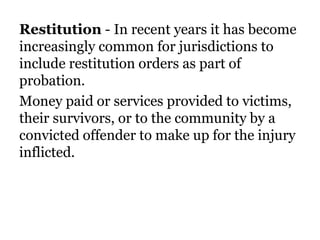
Restitution - In recent years it has become
increasingly common for jurisdictions to
include restitution orders as part of
probation.
Money paid or services provided to victims,
their survivors, or to the community by a
convicted offender to make up for the injury
inflicted.
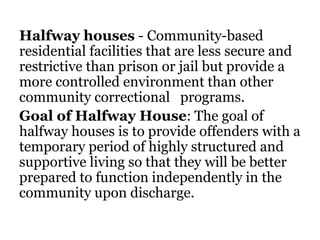
Halfway houses - Community-based
residential facilities that are less secure and
restrictive than prison or jail but provide a
more controlled environment than other
community correctional programs.
Goal of Halfway House: The goal of
halfway houses is to provide offenders with a
temporary period of highly structured and
supportive living so that they will be better
prepared to function independently in the
community upon discharge.
OTHER ASPECTS OF
CORRECTIONS
Parole - It is the process of suspending the
sentence of a convict after having serve the
minimum of his sentence without granting
him pardon, and the prescribing term upon
which the sentence shall be suspended.
Executive Clemency
It shall refer to Absolute Pardon, Conditional Pardon
with or without Parole conditions and Commutation of
Sentence as may be granted by the President of the
Philippines upon the recommendation of the Board of
Pardon and Parole.
Pardon
-It is a form of executive clemency granted by the
President of the Philippines as privilege to a convict as a
discretionary act of grace. It is an act of grace is extended
to prisoners as a matter of right, vested to the Chief
Executive (The President) as a matter of power. Neither
the legislative nor the judiciary branch of the government
has the power to set conditions or establish procedures
for the exercise of this Presidential prerogative. The
following are the two types of pardon:
Absolute Pardon-It refers to the total
extinction of the criminal liability of the
individual to whom it is granted without any
condition whatsoever and restores to the
individual his civil rights and remits the
penalty imposed for the particular offense of
which he was convicted.
Purpose:
a. To right a wrong
b. To normalize a tumultuous political
situation
Conditional Pardon-It refers to the
exemption of an individual, within certain
limits or conditions; from the punishment
that the law inflicts for the offense he has
committed resulting in the partial extinction
of his criminal liability. It is also granted by
the President of the Philippines to release an
inmate who has been reformed.

NON-INSTITUTIONAL-CORRECTIONS-LECTURE (1).pptx

  • 1.
  • 2.
    CHAPTER I INTRODUCTION TOCOMMUNITY BASED CORRECTION PROGRAM I. THE PRESENT PHILIPPINE CORRECTIONAL SET-UP WHAT IS CORRECTION? Correction is the branch of the administration of CJS charged with the responsibility for the custody, supervision and rehabilitation of convicted offenders. It is also define as the STUDY OF JAIL OR PRISON MANAGEMENT AND ADMINISTRATION as well as the rehabilitation and reformation of criminals. Further, it is define as a GENERIC TERM that includes all government agencies, facilities, programs, procedures, personnel, and techniques concerned with the investigation, intake, custody, confinement, supervision, or treatment of alleged offenders.
  • 3.
    B. DUAL PURPOSEOF CORRECTIONS 1. To punish and 2. To rehabilitate the offender. C. THE CORRECTIONS AS A COMPONENT OF CRIMINAL JUSTICE SYSTEM Correction is the fourth pillar of the PCJS, and identified as the weakest pillar. As a field of criminal justice administration, it utilizes the body of knowledge and practices of the government and the society in general involving the process of handling individuals who have been convicted of offenses for purposes of crime prevention and control. Among the five pillars of the criminal justice system, corrections is the least heard, known or understood society seems to have some reluctance to look at it although its role in the reformation and rehabilitation of offenders cannot be overemphasized. Furthermore, jail administration and control in our country is distributed to at least, four agencies:
  • 4.
    1. The BUREAUOF CORRECTIONS (BUCOR), under the DOJ; which has supervision over the national penitentiary and its penal farms; a. New Bilibid Prison Muntinlupa City 1. The in Muntinlupa Philippines penite ntiary The New Bilibid Prison in, is the main insular designed to house the pris on population of the . It is maintained by the (BuCor) under the . As of October 2004, it has an inmate population of 16,747. The penitentiary had an initial lan d area of 551 hectares. One hundred four hectares of the facility were transferre d to a housing project of the . The has its headquarters in the NBP Reservation . Philippines Bureau of Corrections Department of Justice Department of Justic e Bureau of Corrections b. Mandaluyong Metro Manila Philippines The Correctional Institution for Women (CIW) is a women's prison located in the prison is operated by the Bureau of Corrections CIWM is the most recent facility organized in the Bureau of Corrections. It was only inaugurated in September 18, 2007, the second institution which branched out from the first and only penal establishment dedicated in rehabilitating female offenders. (The first, which was founded in 1932 is the Correctional Institution for Women situated in Mandaluyong City, Metro Manila). It was during the incumbency of Secretary of Justice Agnes VST Devanadera when it was formally opened.
  • 5.
    c. Iwahig Prisonand Penal Farm Puerto Princesa City Palawan Puerto Princesa City Palawan Philippines Bureau of Corrections Department of Justice Iwahig Prison and Penal Farm in , , is one of seven operating units of the under the . The had earlier designated Puerto Princesa, Palawan as a place where offenders to banishment were , but the facility was established only during the American occupation. authorized the establishment of a penal colony in the province or on November 16, 1904. This penal settlement, which originally comprised an area of 22 , served as a depository for prisoners who could not be accommodated at the in Manila. A prison facility was created by the American in the of Puerto Princesa. Lieutenant George Wolfe, a member of the U.S. expeditionary force was the first Director. Spanish regime sentenced exiled Governor Luke Wright Palawan acres Bilibid Prison military rain forest prison's
  • 6.
    d. Sablayan Prisonand Penal Farm Occidental Mindoro Nearer to Manila than other penal colonies, the Sablayan Penal Colony is located in Occidental Mindoro and relatively new. Established on September26, 1954 by virtue of Presidential Proclamation No. 72, the penal colony has a total land area of approximately 16,190 hectares. Prison records show that the first colonists and employees arrived in Sablayan on January 15,1955. Since then several buildings have been constructed, including the colonists’ dormitories, employees’ quarters, guardhouse, schoolhouse, chapel, recreation hall, and post exchange.
  • 7.
    e. San RamonPrison and Penal Farm Zamboanga City Zamboanga City Philippines Muslim Jolo The San Ramon Prison and Penal Farm is situated in , . It was established to house the rebels and prisoners opposing the Spanish leadership. The prison is right in front of the sea and is sprawled within a 1, 414-hectare property. It was on August 21, 1869 when the San Ramon Prison and Penal Farm was built. Decades later, when the Americans took over the country, the Bureau of Prisons was created under the supervision of the Department of Commerce and Police. f. Leyte Regional Prison Abuyog Leyte LEYTE REGIONAL PRISON: The Leyte Regional Prison, situated in Abuyog, Southern Leyte, was established a year after the declaration of martial law in 1972 by virtue of Presidential Decree No. 28. While its plantilla and institutional plan were almost ideal, lack of funds made the prison unable to realize its full potential and its facilities are often below par compared with those of other established penal farms. The LRP has an inmate capacity of 500. It follows the same agricultural format as the main correctional program in addition to some rehabilitation activities. The prison admits convicted offenders from Region VI and from the national penitentiary in Muntinlupa.
  • 8.
    g. Davao Prisonand Penal Farm Panabo Davao Norte Philippines Panabo City Davao del Davao Prison and Penal Farm (formerly Davao Penal Colony (DaPeCol)) , . It has a land area of 30,000 hectares with a prison was established on January 21, 1932 in , reservation of 8,000 hectares. During World War II, the Davao Penal Colony was the biggest prison establishment in the country which was used by the Japanese invading army as their imperial garrison. On October 7, 1931, Governor Dwight Davis signed proclamation 414 which reserved a site for Penal Colony in Davao Province in Mindanao and on January 21, 1932 by virtue of Act No. 3732, the Davao Penal Colony was formally established. During World War II, it was used by the Philippine-American Armed Forces were more than 1000 Japanese were treated in accordance with the orders of American commanding officer. The Japanese Imperial Forces attacked Davao on December 20, 1941 and the colony was among of the establishments that were taken over by the imperial army.
  • 9.
    2. The BUREAUOF JAIL MANAGEMENT AND PENOLOGY (BJMP), under the DILG; which has the exclusive control over all city, municipal and district Jails nationwide; 3. The PROVINCIAL GOVERNMENTS, under DILG; which supervise and control their respective provincial and sub- provincial Jails; and 4. the DEPARTMENT OF SOCIAL WELFARE AND DEVELOPMENT (DSWD), which takes care of, among others, youthful offenders entered in detention centers for juveniles, aside from these, Other agencies under this pillar are the: (Community Based Correction) 1. The Parole and Probation Administration (PPA) under the Department of Justice (DOJ); and 2. The Board of Pardons and Parole also under the Department of Justice.
  • 10.
    NOTA BENE: Thereare also LOCK-UP JAILS under the Philippine National Police (PNP); this fragmented administration of jails often creates confusion since many are not aware of this set-up. Generally, corrections, as a component of the system are responsible for: 1. The MAINTENANCE of institution such as prisons, jails, halfway houses, and others. 2. The PROTECTION of law-abiding members of society by keeping convicted offenders from preying on society. 3. The REFORMATION and rehabilitation of offenders in preparation for their eventual reintegration to the mainstream of society and helping them lead a normal life after release. 4. The DETERRENCE of crimes, experience in prison and the fear of isolation and denial of liberty will influence inmates and potential offenders to lead a life not in conflict or afoul with the law. D. DECONGESTION OF JAILS There are several laws, decrees and circulars which we implement to decongest our jails. But before we discuss these, allow me to show you how congested our jails are as far as the national capital region is concerned. Jail congestion is not a recent phenomenon, nor is it confined in the Philippines alone. Jail congestion is WORLDWIDE. Some industrialized countries like the United States, experience it, let me cite a few examples:
  • 11.
    Rikkers Island in NewYork is actually an island prison facility. It is overcrowded. To cushion the effect of congestion, two floating dormitories were constructed to confine offenders therein; in 1995 or four years ago. Director General Keith Hamburger of the Queensland services commission of Australia reported that congestion is also a problem in his country.
  • 12.
    In January of1994, in Manila, Ronald W. Nikkel, president of prison fellowship international who had toured some of the jails in the National Capital Region (NCR) and the New Bilibid Prisons of the Bureau of corrections in Municipal City observed and commented that in the 41 countries of the world he had traveled, most have a problem on congestion. He added that this problem is PREVALENT IN THIRD WORLD COUNTRIES. In our country, jail congestion, particularly in big cities and municipalities, has been a PERENNIAL PROBLEM ever since. This problem, to borrow a parallelism, is a sleeping giant. Unfortunately, for jail administrators and personnel, the giant has taken up and is stretching its enormous arms and legs. OPLAN DECONGESTION must be put in place to lay this giant back to sleep.
  • 13.
    OPLAN DECONGESTION wasformalized through the execution of a memorandum of agreement on February 12, 1993. Among the public attorney’s office, the parole and probation administration, the Board of Pardons and Parole which are all under the Department of Justice, and the Bureau of Jail Management and Penology which is under the Department of the Interior and local government. The avowed PURPOSE of said agreement (MOA) was jail decongestion through collective and cooperative efforts. Realizing that all helps available must be harnessed to effectively combat overcrowding or congestion in jails, the said memorandum of agreement was EXPANDED on August 17, 1993 with the inclusion of the National Prosecution service or (NAPROS) as the fifth party thereto. True to its form, the MOA spreads up its intent through seminars. These offered opportunities to officials and personnel of the tasked agencies to familiarize themselves with the mechanics of the agreement, as well as to offer avenue to discuss various aspects of how jails are to be decongested
  • 14.
    E. LAW ANDDECREES USUALLY AVAILED OF TO DECONGEST JAILS 1. Presidential Decree No. 603, known as the child and young welfare code, suspends sentence of minor offenders whose ages range from nine (9) years to under eighteen (18) years and place them in rehabilitation centers under the supervision of the Department of Social Welfare and Development before they are released to the custody of their parents or to any responsible person. 2. Batas Pambansa Bilang 85, authorizes the release of a detainee who has undergone preventive imprisonment equivalent to the maximum imposable sentence for the offense he is charged with’ 3. Article 96 of the Revised Penal Code, provides that in meritorious cases, the commutation of the prisoner’s
  • 15.
    sentence through presidentialaction shall be upon the recommendation of the court which imposed the same; and ARTICLE 97, which provides that a prisoner shall be entitled to a deduction from his prison term for good conduct; and 4. DOJ Memorandum Circular no. 6 which directs all wardens or anyone in-charge of local jails to effect the immediate transfer of national prisoners to the Bureau of corrections. 5. Republic Act No. 9165- Comprehensive Dangerous Drug Act of 2002 (July 4, 2002) -1st time minor offender (probation) for use 2 possession only./deport
  • 16.
    6. Republic ActNo. 9344 – Juvenile & Justice welfare Act of 2006 (May) 7. Republic Act No. 6036, known as the release on recognizance law, provides for the release of offenders charged with an offense whose penalty is not more than six (6) months and/or a fine of Two Thousand pesos (2,000) or both, to the custody of a responsible person in the community, instead of a bail bond; 8. Republic Act No. 6127, fully deducts the period of the offenders’ preventive detention from the sentence imposed by the courts; 9. Republic Act No. 4103, as amended, creating the Board of Pardons and Parole tasked to look into the physical, mental and moral record of prisoners to determine who shall be eligible for parole or conditional pardon. 10. Presidential Decree No. 968 July 24, 1976 is the Philippine Probation Law of 1976. Probation is, of course, a very important legal instrument that contributes to the decongestion of Philippine jails.
  • 17.
    F. APPROACHES OFPHILIPPINE CORRECTIONAL SYSTEM The Philippine Correctional System has two approaches, and these are, the Community based and institution-based systems. 1. The Institution-Based Approach-The rehabilitation of offenders in jail or prison. The institution-based approaches has three levels and are manned by three different government agencies responsible for the supervision and control of the numerous institutional facilities nationwide which provide safekeeping and rehabilitation of inmates, namely: 1. The national prison’s and penal farms under the Department of justice; 2. The provincial and sub-provincial jails under the provincial government; and 3. The City, Municipal and District Jails under the Department of Interior and Local Government. The Bureau of corrections, headed by a non- uniformed director, under the department of Justice, supervises and controls the national prisons and penal farms.
  • 18.
    Non-Institutional Correction orCommunity- Based Approach- • It refers to correctional activities that may take place within the community or the method of correcting sentenced offenders without having to go to prison. • Not all convicted offenders have to serve their sentence behind bars. Some of them are allowed to stay in the community, subject to the conditions imposed by the court. • They are either granted probation, parole, conditional pardon or recognizance. The parole and probation Administration under the Department of Justice is the government agency that supervises the activities of the probationer, parolee and pardonee and monitors his compliance with conditions imposed.
  • 19.
    What is aCommunity Correction? It is a sanction in which offenders serve some or all their sentence in the community. It is sometimes referred to as non-institutional corrections. The subfield of corrections in which offenders are supervised and provided services outside jail or prison.
  • 20.
    COMMUNITY-BASED CORRECTION PROGRAMS INTHE PHILIPPINES • The Community-Based Treatment Programs are those programs that are intended to treat criminal offenders within the free community as alternatives to confinement. • It includes all correctional activities directly addressed to the offender and aimed at helping him to become a law abiding citizen. • Community-based correction programs began in the 1970s, 1980s, and 1990s. The programs offer an alternative to incarceration within the prison system. Many criminologists believed a significant number of offenders did not need incarceration in high security prison cells. • Some inmates, who might otherwise have been ready to turn away from a life of crime, instead became like the hardened criminals they associated with in prison. In response, states, counties, and cities established local correctional facilities and programs that became known as community- based corrections. • These facilities, located in neighborhoods, allowed offenders normal family relationships and friendships as well as rehabilitation services such as counseling, instruction in basic living skills, how to apply for jobs, and work training and placement.
  • 21.
    ADVANTAGES OF COMMUNITY- BASEDCORRECTION 1.Family members need not be victims also for the imprisonment of a member because the convict can still continue to support his family. 2. Rehabilitation will be more effective as the convict will not be exposed to hardened criminals in prisons who will only influence him to a life of crime. 3. Rehabilitation can be monitored by the community thus corrections can be made and be more effective. 4. It is less costly on the part of the government. Cost of incarcerations will be eliminated which is extremely beneficial on the part of the government.
  • 22.
    THE ROLE OFCOMMUNITY CORRECTIONS IN THE CRIMINAL JUSTICE SYSTEM Community sentence seeks to repair the harm the offender has caused the victim or the Community, provide for public safety and rehabilitate and promote effective reintegration. A community correction has traditionally emphasized REHABILITATION as its goal. The staff of community correctional programs has two potentially competing roles that reflect different goals: a. Seeing that offenders comply with the orders of community sentences. b. Helping offenders identify and address their problems and needs.
  • 23.
    BASIC PRINCIPLES UNDERLYINGTHE PHILOSOPHY OF COMMUNITY-BASED TREATMENT PROGRAMS The following are the basic principles underlying the philosophy of community-based treatment programs: 1. Humanitarian Aspect - Imprisonment is not always advisable. Placing a person to custodial coercion is to place him in physical jeopardy, thus drastically narrowing his access to sources of personal satisfaction and reducing his self-esteem.
  • 24.
    2. Restorative Aspect- There are measures expected to be achieved by the offender, such as an establishment of a position in the community in which he does not violate the laws. These measures may be directed at changing and controlling the offender. The failure of the offender to achieve these can result to recidivism.
  • 25.
    3. Managerial Aspect- Managerial skills are special importance because of the sharp contrast between the per capital cost of custody and any kind of community program. It is easier to manage those undergoing community based treatment programs than that of custodial control.
  • 26.
    • Probation -One of the most common forms of community correction is probation. Probation can be thought of as a type of post-trial diversion from incarceration. • A term coined by John Augustus, from the Latin verb “probare”- to prove, to test. It is a disposition under which a defendant after conviction of an offense, the penalty of which does not exceed 6 years of imprisonment, is released subject to the conditions imposed by the releasing court and under the supervision of a probation officer. • Furthermore, it is define as a sentence in which the offender, rather than being incarcerated, is retained in the community under the supervision of a probation agency and required to abide by certain rules and conditions to avoid incarceration.
  • 27.
    Restitution - Inrecent years it has become increasingly common for jurisdictions to include restitution orders as part of probation. Money paid or services provided to victims, their survivors, or to the community by a convicted offender to make up for the injury inflicted.
  • 28.
    Halfway houses -Community-based residential facilities that are less secure and restrictive than prison or jail but provide a more controlled environment than other community correctional programs. Goal of Halfway House: The goal of halfway houses is to provide offenders with a temporary period of highly structured and supportive living so that they will be better prepared to function independently in the community upon discharge.
  • 29.
    OTHER ASPECTS OF CORRECTIONS Parole- It is the process of suspending the sentence of a convict after having serve the minimum of his sentence without granting him pardon, and the prescribing term upon which the sentence shall be suspended.
  • 30.
    Executive Clemency It shallrefer to Absolute Pardon, Conditional Pardon with or without Parole conditions and Commutation of Sentence as may be granted by the President of the Philippines upon the recommendation of the Board of Pardon and Parole. Pardon -It is a form of executive clemency granted by the President of the Philippines as privilege to a convict as a discretionary act of grace. It is an act of grace is extended to prisoners as a matter of right, vested to the Chief Executive (The President) as a matter of power. Neither the legislative nor the judiciary branch of the government has the power to set conditions or establish procedures for the exercise of this Presidential prerogative. The following are the two types of pardon:
  • 31.
    Absolute Pardon-It refersto the total extinction of the criminal liability of the individual to whom it is granted without any condition whatsoever and restores to the individual his civil rights and remits the penalty imposed for the particular offense of which he was convicted. Purpose: a. To right a wrong b. To normalize a tumultuous political situation
  • 32.
    Conditional Pardon-It refersto the exemption of an individual, within certain limits or conditions; from the punishment that the law inflicts for the offense he has committed resulting in the partial extinction of his criminal liability. It is also granted by the President of the Philippines to release an inmate who has been reformed.