THE
PREPOSITIONS
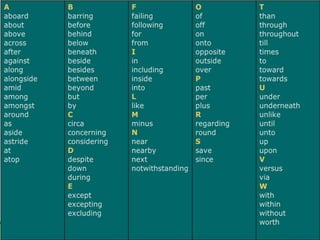
In English, the most used prepositions
are:
of
to
in
for
with
on
A word that shows a relationship
between a noun or pronoun and
some other word in the sentence.
PREPOSITION
The baseball player in the
white shirt
hit a homerun.
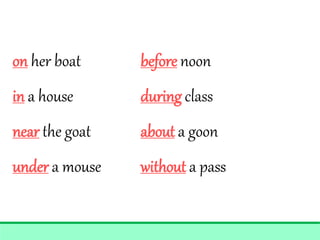
on her boat before noon
in a house during class
near the goat about a goon
under a mouse without a pass
The baseball player in the
white shirt
hit a homerun.
OBJECT OF THE
PREPOSITION
The noun or pronoun that ends a
prepositional phrase.
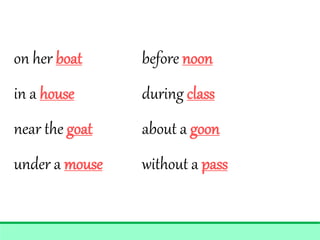
on her boat before noon
in a house during class
near the goat about a goon
under a mouse without a pass
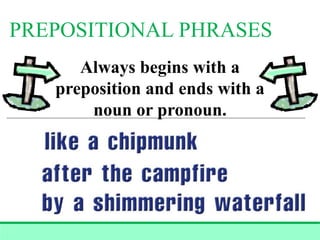
Always begins with a
preposition and ends with a
noun or pronoun.
PREPOSITIONAL PHRASES
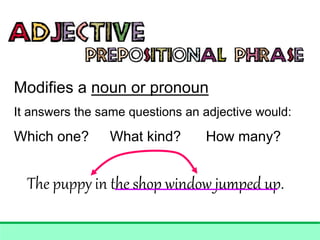
Modifies a noun or pronoun
It answers the same questions an adjective would:
Which one? What kind? How many?
The puppy in the shop window jumped up.
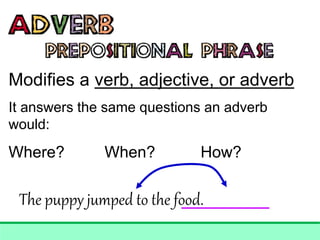
The puppy jumped to the food.
Modifies a verb, adjective, or adverb
It answers the same questions an adverb
would:
Where? When? How?
If there is no object of the
preposition (if the preposition
is not part of a phrase), then it
is not a preposition—it is an
adverb.
They also express spatial and
temporal relationships between
parts of a sentence.
PREPOSITION
1. Location: at, on, in: Prepositions differ
according to the number of dimensions they
refer to. We can group them into three
classes using concepts from geometry:
point, surface, and area/volume.
a. Point: (at) Prepositions in this group indicate
that the noun that follows them is treated as a
point in relation to which another object is
positioned.
b. Surface: (on) Prepositions in this group
indicate that the position of an object is
defined with respect to a surface on which it
rests.
c. Area/Volume: (in) Prepositions in this group
indicate that an object lies within the
boundaries of an area or within the confines
of a volume.
2. Direction: to, on(to), in(to): These
prepositions express movement toward
something. To, into, and onto correspond
respectively to the prepositions of location
at, in, and on. Each pair can be defined by
the same spatial relations of point,
line/surface, or area/volume.
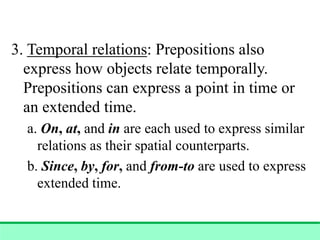
3. Temporal relations: Prepositions also
express how objects relate temporally.
Prepositions can express a point in time or
an extended time.
a. On, at, and in are each used to express similar
relations as their spatial counterparts.
b. Since, by, for, and from-to are used to express
extended time.
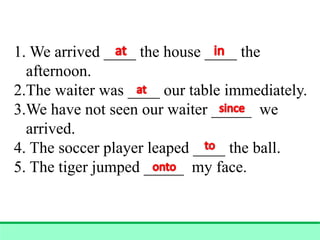
1. We arrived ____ the house ____ the
afternoon.
2.The waiter was ____ our table immediately.
3.We have not seen our waiter _____ we
arrived.
4. The soccer player leaped ____ the ball.
5. The tiger jumped _____ my face.
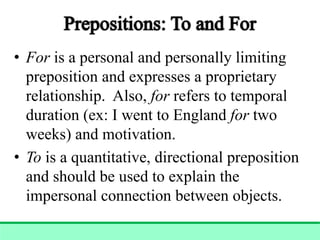
• For is a personal and personally limiting
preposition and expresses a proprietary
relationship. Also, for refers to temporal
duration (ex: I went to England for two
weeks) and motivation.
• To is a quantitative, directional preposition
and should be used to explain the
impersonal connection between objects.
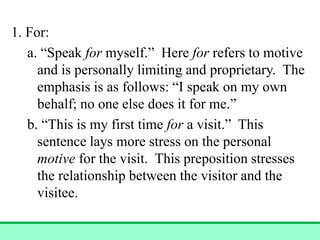
1. For:
a. “Speak for myself.” Here for refers to motive
and is personally limiting and proprietary. The
emphasis is as follows: “I speak on my own
behalf; no one else does it for me.”
b. “This is my first time for a visit.” This
sentence lays more stress on the personal
motive for the visit. This preposition stresses
the relationship between the visitor and the
visitee.
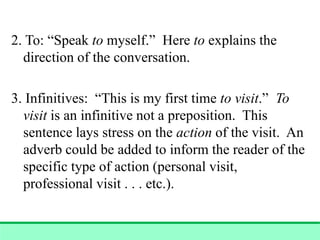
2. To: “Speak to myself.” Here to explains the
direction of the conversation.
3. Infinitives: “This is my first time to visit.” To
visit is an infinitive not a preposition. This
sentence lays stress on the action of the visit. An
adverb could be added to inform the reader of the
specific type of action (personal visit,
professional visit . . . etc.).
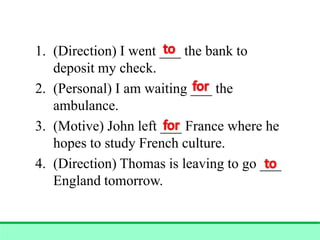
1. (Direction) I went ___ the bank to
deposit my check.
2. (Personal) I am waiting ___ the
ambulance.
3. (Motive) John left ___ France where he
hopes to study French culture.
4. (Direction) Thomas is leaving to go ___
England tomorrow.

Prepositions

  • 1.
  • 2.
    In English, themost used prepositions are: of to in for with on
  • 4.
    A word thatshows a relationship between a noun or pronoun and some other word in the sentence. PREPOSITION The baseball player in the white shirt hit a homerun.
  • 5.
    on her boatbefore noon in a house during class near the goat about a goon under a mouse without a pass
  • 6.
    The baseball playerin the white shirt hit a homerun. OBJECT OF THE PREPOSITION The noun or pronoun that ends a prepositional phrase.
  • 7.
    on her boatbefore noon in a house during class near the goat about a goon under a mouse without a pass
  • 8.
    Always begins witha preposition and ends with a noun or pronoun. PREPOSITIONAL PHRASES
  • 9.
    Modifies a nounor pronoun It answers the same questions an adjective would: Which one? What kind? How many? The puppy in the shop window jumped up.
  • 10.
    The puppy jumpedto the food. Modifies a verb, adjective, or adverb It answers the same questions an adverb would: Where? When? How?
  • 11.
    If there isno object of the preposition (if the preposition is not part of a phrase), then it is not a preposition—it is an adverb.
  • 12.
    They also expressspatial and temporal relationships between parts of a sentence. PREPOSITION
  • 13.
    1. Location: at,on, in: Prepositions differ according to the number of dimensions they refer to. We can group them into three classes using concepts from geometry: point, surface, and area/volume. a. Point: (at) Prepositions in this group indicate that the noun that follows them is treated as a point in relation to which another object is positioned.
  • 14.
    b. Surface: (on)Prepositions in this group indicate that the position of an object is defined with respect to a surface on which it rests. c. Area/Volume: (in) Prepositions in this group indicate that an object lies within the boundaries of an area or within the confines of a volume.
  • 15.
    2. Direction: to,on(to), in(to): These prepositions express movement toward something. To, into, and onto correspond respectively to the prepositions of location at, in, and on. Each pair can be defined by the same spatial relations of point, line/surface, or area/volume.
  • 16.
    3. Temporal relations:Prepositions also express how objects relate temporally. Prepositions can express a point in time or an extended time. a. On, at, and in are each used to express similar relations as their spatial counterparts. b. Since, by, for, and from-to are used to express extended time.
  • 17.
    1. We arrived____ the house ____ the afternoon. 2.The waiter was ____ our table immediately. 3.We have not seen our waiter _____ we arrived. 4. The soccer player leaped ____ the ball. 5. The tiger jumped _____ my face.
  • 18.
    • For isa personal and personally limiting preposition and expresses a proprietary relationship. Also, for refers to temporal duration (ex: I went to England for two weeks) and motivation. • To is a quantitative, directional preposition and should be used to explain the impersonal connection between objects.
  • 19.
    1. For: a. “Speakfor myself.” Here for refers to motive and is personally limiting and proprietary. The emphasis is as follows: “I speak on my own behalf; no one else does it for me.” b. “This is my first time for a visit.” This sentence lays more stress on the personal motive for the visit. This preposition stresses the relationship between the visitor and the visitee.
  • 20.
    2. To: “Speakto myself.” Here to explains the direction of the conversation. 3. Infinitives: “This is my first time to visit.” To visit is an infinitive not a preposition. This sentence lays stress on the action of the visit. An adverb could be added to inform the reader of the specific type of action (personal visit, professional visit . . . etc.).
  • 21.
    1. (Direction) Iwent ___ the bank to deposit my check. 2. (Personal) I am waiting ___ the ambulance. 3. (Motive) John left ___ France where he hopes to study French culture. 4. (Direction) Thomas is leaving to go ___ England tomorrow.