QUESTION OF THE WEEK
HISTORY
• A 40-year-old man presents to the emergency
department with
• Nausea
• fever,
• and arthralgias..
History
• Twelve days ago, he was evaluated by a
physician for epigastric abdominal pain and
was diagnosed with Helicobacter
pylori infection on the basis of a serologic test.
History
• He began a 14-day course of omeprazole,
amoxicillin, and clarithromycin, and his
epigastric pain gradually improved.
• The nausea, fever, and arthralgias began 3
days ago.
• He has no cough, diarrhea, or urinary
symptoms
On examination
• he has a heart rate of 87 beats per minute, a
blood pressure of 155/90 mm Hg, and a
temperature of 38.0°C.
• The abdomen is nontender.
On examination
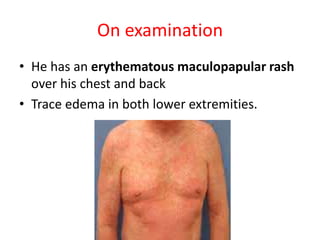
• He has an erythematous maculopapular rash
over his chest and back
• Trace edema in both lower extremities.
Labs
• His serum creatinine level has increased from
0.9 mg/dL 6 months ago to 2.9 mg/dL today
(reference range, 0.8–1.3).
• Other laboratory findings are as follows:
LABS
• Leukocyte count (per mm3) 14,000
• Hemoglobin (g/dL) 13
• Platelet count (per mm3) 250,000
• Sodium (mEq/liter) 136
• Potassium (mEq/liter) 5.5
• Chloride (mEq/liter) 101
• Bicarbonate (mEq/liter) 19
• Blood urea nitrogen (mg/dL) 50
Urinalysis
• 1+ leukocyte esterase
• negative nitrite
• 1+ protein.
Urine microscopy:
• 1 to 3 red cells per high-power field (reference
range, 0–2),
• 21 to 30 white cells per high-power field (0–2),
• white-cell casts.
• Urine Gram's stain is negative for bacteria.
Which one of the following diagnoses is most
likely in this case?
A. Acute interstitial nephritis
B. Immunoglobulin A nephropathy
C. Pyelonephritis
D. Postinfectious glomerulonephritis
E. Acute tubular necrosis
The correct answer
• Acute interstitial nephritis
Key Learning Point
• In a patient with a fever, rash, and acute
kidney injury after starting a new medication,
the most likely diagnosis is drug-induced
acute interstitial nephritis
Acute interstitial nephritis (AIN)
• may be caused by a broad range of disorders
including autoimmune diseases and
infections; however, medications account for
more than 75% of all cases.
• Antibiotics, NSAIDs, and PPIs are relatively
common causes of drug-induced AIN.
• The classic presentation of AIN is fever, rash,
arthralgias, peripheral eosinophilia, and
kidney failure.
Pyelonephritis
• can cause fever and pyuria, but urine microscopy is
usually also notable for bacteriuria,
• The Gram stain would be positive
• positive urine culture.
• Pyelonephritis typically also leads to flank pain and
may feature irritative voiding symptoms if there is
associated cystitis.
• In addition, acute pyelonephritis does not cause a
maculopapular rash or a decline in kidney function
unless there is associated effective circulating
volume depletion.
Acute tubular necrosis
• is typically characterized by a history of either
exposure to a nephrotoxic agent or ischemic
injury from effective volume depletion.
Furthermore, the urine sediment typically has
granular casts rather than white-cell casts.
IgA nephropathy and
postinfectious glomerulonephritis
• are characterized by proteinuria and
hematuria, including red-cell casts.
Reference
• NEJM December 20, 2106
•

Question of the week 1

  • 1.
  • 2.
    HISTORY • A 40-year-oldman presents to the emergency department with • Nausea • fever, • and arthralgias..
  • 3.
    History • Twelve daysago, he was evaluated by a physician for epigastric abdominal pain and was diagnosed with Helicobacter pylori infection on the basis of a serologic test.
  • 4.
    History • He begana 14-day course of omeprazole, amoxicillin, and clarithromycin, and his epigastric pain gradually improved. • The nausea, fever, and arthralgias began 3 days ago. • He has no cough, diarrhea, or urinary symptoms
  • 5.
    On examination • hehas a heart rate of 87 beats per minute, a blood pressure of 155/90 mm Hg, and a temperature of 38.0°C. • The abdomen is nontender.
  • 6.
    On examination • Hehas an erythematous maculopapular rash over his chest and back • Trace edema in both lower extremities.
  • 7.
    Labs • His serumcreatinine level has increased from 0.9 mg/dL 6 months ago to 2.9 mg/dL today (reference range, 0.8–1.3). • Other laboratory findings are as follows:
  • 8.
    LABS • Leukocyte count(per mm3) 14,000 • Hemoglobin (g/dL) 13 • Platelet count (per mm3) 250,000 • Sodium (mEq/liter) 136 • Potassium (mEq/liter) 5.5 • Chloride (mEq/liter) 101 • Bicarbonate (mEq/liter) 19 • Blood urea nitrogen (mg/dL) 50
  • 9.
    Urinalysis • 1+ leukocyteesterase • negative nitrite • 1+ protein. Urine microscopy: • 1 to 3 red cells per high-power field (reference range, 0–2), • 21 to 30 white cells per high-power field (0–2), • white-cell casts. • Urine Gram's stain is negative for bacteria.
  • 10.
    Which one ofthe following diagnoses is most likely in this case? A. Acute interstitial nephritis B. Immunoglobulin A nephropathy C. Pyelonephritis D. Postinfectious glomerulonephritis E. Acute tubular necrosis
  • 11.
    The correct answer •Acute interstitial nephritis
  • 12.
    Key Learning Point •In a patient with a fever, rash, and acute kidney injury after starting a new medication, the most likely diagnosis is drug-induced acute interstitial nephritis
  • 13.
    Acute interstitial nephritis(AIN) • may be caused by a broad range of disorders including autoimmune diseases and infections; however, medications account for more than 75% of all cases. • Antibiotics, NSAIDs, and PPIs are relatively common causes of drug-induced AIN. • The classic presentation of AIN is fever, rash, arthralgias, peripheral eosinophilia, and kidney failure.
  • 14.
    Pyelonephritis • can causefever and pyuria, but urine microscopy is usually also notable for bacteriuria, • The Gram stain would be positive • positive urine culture. • Pyelonephritis typically also leads to flank pain and may feature irritative voiding symptoms if there is associated cystitis. • In addition, acute pyelonephritis does not cause a maculopapular rash or a decline in kidney function unless there is associated effective circulating volume depletion.
  • 15.
    Acute tubular necrosis •is typically characterized by a history of either exposure to a nephrotoxic agent or ischemic injury from effective volume depletion. Furthermore, the urine sediment typically has granular casts rather than white-cell casts.
  • 16.
    IgA nephropathy and postinfectiousglomerulonephritis • are characterized by proteinuria and hematuria, including red-cell casts.
  • 17.