Intermedio 2
QUESTION FORMATION
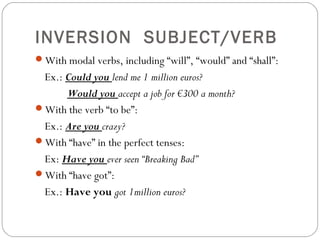
INVERSION SUBJECT/VERB
With modal verbs, including “will”, “would” and “shall”:
Ex.: Could you lend me 1 million euros?
Would you accept a job for €300 a month?
With the verb “to be”:
Ex.: Are you crazy?
With “have” in the perfect tenses:
Ex: Have you ever seen “Breaking Bad”
With “have got”:
Ex.: Have you got 1million euros?
Adding an auxiliary
“Do/does” in the present tense, before the subject:
Ex.: Do you like the English class?
Does he have a million euros?
“Did” in the past simple, before the subject:
Ex: Did she really meet George Clooney at his wedding?
NEGATIVE QUESTIONS
Often express surprise:
Ex: Why didn’t you come to the English class yesterday?
Often used when you expect somebody to agree with you:
Ex.: Isn’t the English teacher simply fantastic?
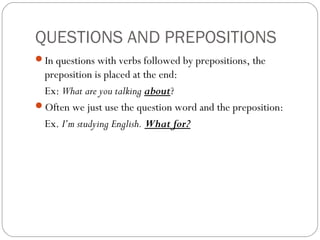
QUESTIONS AND PREPOSITIONS
In questions with verbs followed by prepositions, the
preposition is placed at the end:
Ex: What are you talking about?
Often we just use the question word and the preposition:
Ex. I’m studying English. What for?
QUESTIONS WORDS AS SUBJECTS
No auxiliaries are added in the present simple or past tenses
to make the following distinction:
Question word as subject:
Ex.: Who killed the teacher? A student killed him.
Subject Subject
Question word as direct object:
Ex: Who did the teacher kill? He killed a student.
Object Subject Object
INDIRECT QUESTIONS
Questions within other questions
The order is Subject+Verb (no inversion):
Ex.: Could you tell me where EOI Carabanchel is?
Subject Verb
Auxiliaries “do”, “does” or “did” are not used:
Ex.: Do you know where he works?
Do you remember what the teacher said yesterday?
We use “if” or “whether” in YES/NO questions:
Ex.: Do you know if/whether the English teacher is very
strict?

Question formation

  • 1.
  • 2.
    INVERSION SUBJECT/VERB With modalverbs, including “will”, “would” and “shall”: Ex.: Could you lend me 1 million euros? Would you accept a job for €300 a month? With the verb “to be”: Ex.: Are you crazy? With “have” in the perfect tenses: Ex: Have you ever seen “Breaking Bad” With “have got”: Ex.: Have you got 1million euros?
  • 3.
    Adding an auxiliary “Do/does”in the present tense, before the subject: Ex.: Do you like the English class? Does he have a million euros? “Did” in the past simple, before the subject: Ex: Did she really meet George Clooney at his wedding?
  • 4.
    NEGATIVE QUESTIONS Often expresssurprise: Ex: Why didn’t you come to the English class yesterday? Often used when you expect somebody to agree with you: Ex.: Isn’t the English teacher simply fantastic?
  • 5.
    QUESTIONS AND PREPOSITIONS Inquestions with verbs followed by prepositions, the preposition is placed at the end: Ex: What are you talking about? Often we just use the question word and the preposition: Ex. I’m studying English. What for?
  • 6.
    QUESTIONS WORDS ASSUBJECTS No auxiliaries are added in the present simple or past tenses to make the following distinction: Question word as subject: Ex.: Who killed the teacher? A student killed him. Subject Subject Question word as direct object: Ex: Who did the teacher kill? He killed a student. Object Subject Object
  • 7.
    INDIRECT QUESTIONS Questions withinother questions The order is Subject+Verb (no inversion): Ex.: Could you tell me where EOI Carabanchel is? Subject Verb Auxiliaries “do”, “does” or “did” are not used: Ex.: Do you know where he works? Do you remember what the teacher said yesterday? We use “if” or “whether” in YES/NO questions: Ex.: Do you know if/whether the English teacher is very strict?