How to Speak English
Fluently in 1 Week
S ALBERTUS ASEPMARIYADI
41615110012 / TEKNIK INDUSTRI
UNIVERSITAS MERCU BUANA / 2015
Component s Es s ent i al To Learni n
1. Phonetics
2. Reading fluency
3. Vocabulary development
4. Oral skills
f
Chapter 1:
How to Speak English Fluently
Chapter 2:
Ways to Leverage Your English Listening Habits
The English Language has a lot of slang,
colloquialisms and idioms. The only way to
master these is by listening. Listening will
improve your speaking capabilities hugely.
You will learn the correct pronunciation,
vocabulary, grammar, accent, and
intonation.One can apply what you hear in
your daily life. for example :
you can start from listen radio, music, or
singing.
How to Strengthen English Listening Habits?
Now, in order to strengthen your
English listening
habits for an extra leverage, let us take a look at the
three types of listening one must indulge into
and further ways to improving your skills in each.
Type 1: Passive or Inactive Listening
Type 2: Extensive Listening
Type 3: Responsive Listening
T Chapter 4:
Simple Techniques for Memorizing Extensive
Vocabulary, Phrases and Idioms
Tips for expanding vocabulary:
● One word at a time
● Spend every spare minute reading
● Context skills
● Practice
● Use the dictionary
● Play with words
● Crosswords
● Write a journal
● Listen
● Associations
● Make a list of words
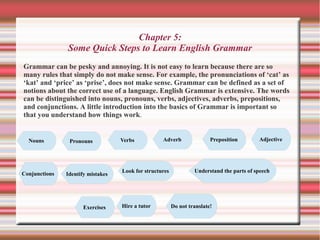
Chapter 5:
Some Quick Steps to Learn English Grammar
Grammar can be pesky and annoying. It is not easy to learn because there are so
many rules that simply do not make sense. For example, the pronunciations of ‘cat’ as
‘kat’ and ‘price’ as ‘prise’, does not make sense. Grammar can be defined as a set of
notions about the correct use of a language. English Grammar is extensive. The words
can be distinguished into nouns, pronouns, verbs, adjectives, adverbs, prepositions,
and conjunctions. A little introduction into the basics of Grammar is important so
that you understand how things work.
Nouns Pronouns Verbs Adverb Preposition Adjective
Conjunctions Identify mistakes
Look for structures Understand the parts of speech
Exercises Hire a tutor Do not translate!
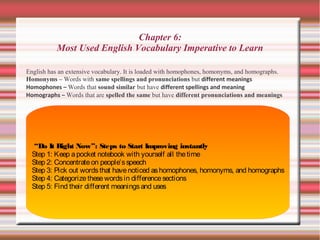
Chapter 6:
Most Used English Vocabulary Imperative to Learn
English has an extensive vocabulary. It is loaded with homophones, homonyms, and homographs.
Homonyms – Words with same spellings and pronunciations but different meanings
Homophones – Words that sound similar but have different spellings and meaning
Homographs – Words that are spelled the same but have different pronunciations and meanings
“Do It Right Now”: Steps to Start Improving instantly
Step 1: Keep apocket notebook with yourself all thetime
Step 2: Concentrateon people’sspeech
Step 3: Pick out wordsthat havenoticed ashomophones, homonyms, and homographs
Step 4: Categorizethesewordsin differencesections
Step 5: Find their different meaningsand uses
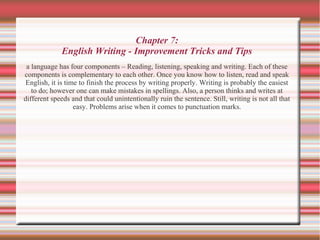
Chapter 7:
English Writing - Improvement Tricks and Tips
a language has four components – Reading, listening, speaking and writing. Each of these
components is complementary to each other. Once you know how to listen, read and speak
English, it is time to finish the process by writing properly. Writing is probably the easiest
to do; however one can make mistakes in spellings. Also, a person thinks and writes at
different speeds and that could unintentionally ruin the sentence. Still, writing is not all that
easy. Problems arise when it comes to punctuation marks.
Speak English daily Learn to listen Goals Be confident
Keep a small notebook with you
Treat yourself Study it Work hard
English movies and songs Thesaurus Group study Spellings
Pay attention to idioms and
colloquialisms
Do not lose confidence Revise
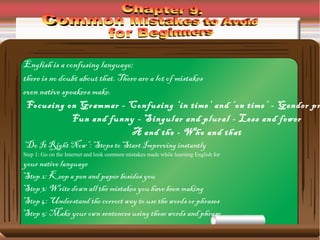
English is a confusing language;
there is no doubt about that. There are a lot of mistakes
even native speakers make.
Focusing on Grammar - Confusing ‘in time’ and ‘on time’ - Gender pr
Fun and funny - Singular and plural - Less and fewer
A and the - Who and that
“Do It Right Now”: Steps to Start Improving instantly
Step 1: Go on the Internet and look common mistakes made while learning English for
your native language
Step 2: Keep a pen and paper besides you
Step 3: Write down all the mistakes you have been making
Step 4: Understand the correct way to use the words or phrases
Step 5: Make your own sentences using these words and phrase
Chapter 10:
SECRET BONUS - 50 Most Commonl
Used English Words
Here are 50 of the most common used words of English language.
● The He At But There Of Was Be● ● ● ● ● ● ●
● Not Use And● ●
● For This An What On A Have● ● ● ● ● ●
● All To●
● Each Are From● ●
● Which Were In As● ● ●
● Or We Is She With● ● ● ●
● Mine When You Do● ● ●
● Had His Your How That● ● ● ●
● By They Can It Their I● ● ● ● ●
● Word If Said● ●
THANK YOU

Presentation english

  • 1.
    How to SpeakEnglish Fluently in 1 Week S ALBERTUS ASEPMARIYADI 41615110012 / TEKNIK INDUSTRI UNIVERSITAS MERCU BUANA / 2015
  • 2.
    Component s Ess ent i al To Learni n 1. Phonetics 2. Reading fluency 3. Vocabulary development 4. Oral skills f
  • 3.
    Chapter 1: How toSpeak English Fluently
  • 4.
    Chapter 2: Ways toLeverage Your English Listening Habits The English Language has a lot of slang, colloquialisms and idioms. The only way to master these is by listening. Listening will improve your speaking capabilities hugely. You will learn the correct pronunciation, vocabulary, grammar, accent, and intonation.One can apply what you hear in your daily life. for example : you can start from listen radio, music, or singing.
  • 5.
    How to StrengthenEnglish Listening Habits? Now, in order to strengthen your English listening habits for an extra leverage, let us take a look at the three types of listening one must indulge into and further ways to improving your skills in each. Type 1: Passive or Inactive Listening Type 2: Extensive Listening Type 3: Responsive Listening
  • 7.
    T Chapter 4: SimpleTechniques for Memorizing Extensive Vocabulary, Phrases and Idioms Tips for expanding vocabulary: ● One word at a time ● Spend every spare minute reading ● Context skills ● Practice ● Use the dictionary ● Play with words ● Crosswords ● Write a journal ● Listen ● Associations ● Make a list of words
  • 8.
    Chapter 5: Some QuickSteps to Learn English Grammar Grammar can be pesky and annoying. It is not easy to learn because there are so many rules that simply do not make sense. For example, the pronunciations of ‘cat’ as ‘kat’ and ‘price’ as ‘prise’, does not make sense. Grammar can be defined as a set of notions about the correct use of a language. English Grammar is extensive. The words can be distinguished into nouns, pronouns, verbs, adjectives, adverbs, prepositions, and conjunctions. A little introduction into the basics of Grammar is important so that you understand how things work. Nouns Pronouns Verbs Adverb Preposition Adjective Conjunctions Identify mistakes Look for structures Understand the parts of speech Exercises Hire a tutor Do not translate!
  • 9.
    Chapter 6: Most UsedEnglish Vocabulary Imperative to Learn English has an extensive vocabulary. It is loaded with homophones, homonyms, and homographs. Homonyms – Words with same spellings and pronunciations but different meanings Homophones – Words that sound similar but have different spellings and meaning Homographs – Words that are spelled the same but have different pronunciations and meanings “Do It Right Now”: Steps to Start Improving instantly Step 1: Keep apocket notebook with yourself all thetime Step 2: Concentrateon people’sspeech Step 3: Pick out wordsthat havenoticed ashomophones, homonyms, and homographs Step 4: Categorizethesewordsin differencesections Step 5: Find their different meaningsand uses
  • 10.
    Chapter 7: English Writing- Improvement Tricks and Tips a language has four components – Reading, listening, speaking and writing. Each of these components is complementary to each other. Once you know how to listen, read and speak English, it is time to finish the process by writing properly. Writing is probably the easiest to do; however one can make mistakes in spellings. Also, a person thinks and writes at different speeds and that could unintentionally ruin the sentence. Still, writing is not all that easy. Problems arise when it comes to punctuation marks.
  • 11.
    Speak English dailyLearn to listen Goals Be confident Keep a small notebook with you Treat yourself Study it Work hard English movies and songs Thesaurus Group study Spellings Pay attention to idioms and colloquialisms Do not lose confidence Revise
  • 12.
    English is aconfusing language; there is no doubt about that. There are a lot of mistakes even native speakers make. Focusing on Grammar - Confusing ‘in time’ and ‘on time’ - Gender pr Fun and funny - Singular and plural - Less and fewer A and the - Who and that “Do It Right Now”: Steps to Start Improving instantly Step 1: Go on the Internet and look common mistakes made while learning English for your native language Step 2: Keep a pen and paper besides you Step 3: Write down all the mistakes you have been making Step 4: Understand the correct way to use the words or phrases Step 5: Make your own sentences using these words and phrase
  • 13.
    Chapter 10: SECRET BONUS- 50 Most Commonl Used English Words Here are 50 of the most common used words of English language. ● The He At But There Of Was Be● ● ● ● ● ● ● ● Not Use And● ● ● For This An What On A Have● ● ● ● ● ● ● All To● ● Each Are From● ● ● Which Were In As● ● ● ● Or We Is She With● ● ● ● ● Mine When You Do● ● ● ● Had His Your How That● ● ● ● ● By They Can It Their I● ● ● ● ● ● Word If Said● ●
  • 14.