Looking back at your preliminary task, what do
you feel you have learnt in the progression to the
full product?
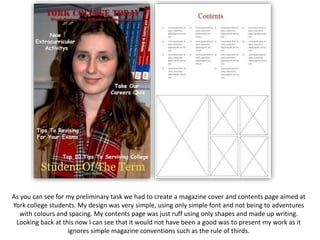
As you can see for my preliminary task we had to create a magazine cover and contents page aimed at
York college students. My design was very simple, using only simple font and not being to adventures
with colours and spacing. My contents page was just ruff using only shapes and made up writing.
Looking back at this now I can see that it would not have been a good was to present my work as it
ignores simple magazine conventions such as the rule of thirds.
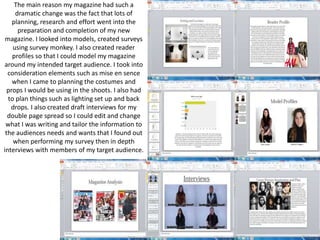
The main reason my magazine had such a
dramatic change was the fact that lots of
planning, research and effort went into the
preparation and completion of my new
magazine. I looked into models, created surveys
using survey monkey. I also created reader
profiles so that I could model my magazine
around my intended target audience. I took into
consideration elements such as mise en sence
when I came to planning the costumes and
props I would be using in the shoots. I also had
to plan things such as lighting set up and back
drops. I also created draft interviews for my
double page spread so I could edit and change
what I was writing and tailor the information to
the audiences needs and wants that I found out
when performing my survey then in depth
interviews with members of my target audience.
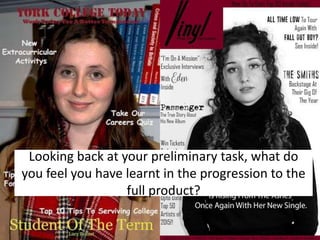
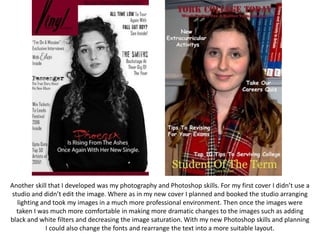
Another skill that I developed was my photography and Photoshop skills. For my first cover I didn’t use a
studio and didn’t edit the image. Where as in my new cover I planned and booked the studio arranging
lighting and took my images in a much more professional environment. Then once the images were
taken I was much more comfortable in making more dramatic changes to the images such as adding
black and white filters and decreasing the image saturation. With my new Photoshop skills and planning
I could also change the fonts and rearrange the text into a more suitable layout.

Question 7

  • 1.
    Looking back atyour preliminary task, what do you feel you have learnt in the progression to the full product?
  • 2.
    As you cansee for my preliminary task we had to create a magazine cover and contents page aimed at York college students. My design was very simple, using only simple font and not being to adventures with colours and spacing. My contents page was just ruff using only shapes and made up writing. Looking back at this now I can see that it would not have been a good was to present my work as it ignores simple magazine conventions such as the rule of thirds.
  • 3.
    The main reasonmy magazine had such a dramatic change was the fact that lots of planning, research and effort went into the preparation and completion of my new magazine. I looked into models, created surveys using survey monkey. I also created reader profiles so that I could model my magazine around my intended target audience. I took into consideration elements such as mise en sence when I came to planning the costumes and props I would be using in the shoots. I also had to plan things such as lighting set up and back drops. I also created draft interviews for my double page spread so I could edit and change what I was writing and tailor the information to the audiences needs and wants that I found out when performing my survey then in depth interviews with members of my target audience.
  • 4.
    Another skill thatI developed was my photography and Photoshop skills. For my first cover I didn’t use a studio and didn’t edit the image. Where as in my new cover I planned and booked the studio arranging lighting and took my images in a much more professional environment. Then once the images were taken I was much more comfortable in making more dramatic changes to the images such as adding black and white filters and decreasing the image saturation. With my new Photoshop skills and planning I could also change the fonts and rearrange the text into a more suitable layout.