QUANTUM
ELECTRODYNAMICS
(QED)
An intelligent work by
S.Sujith somraaj
QUANTUM ELECTRODYNAMICS(QED)
Quantum – Light
Electrodynamics – Interaction between electric charges
and current
It describes how matter and light interacts.
It’s a first proof for relation between quantum
mechanics and special relativity.
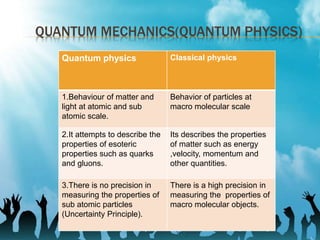
QUANTUM MECHANICS(QUANTUM PHYSICS)
Quantum physics Classical physics
1.Behaviour of matter and
light at atomic and sub
atomic scale.
Behavior of particles at
macro molecular scale
2.It attempts to describe the
properties of esoteric
properties such as quarks
and gluons.
Its describes the properties
of matter such as energy
,velocity, momentum and
other quantities.
3.There is no precision in
measuring the properties of
sub atomic particles
(Uncertainty Principle).
There is a high precision in
measuring the properties of
macro molecular objects.
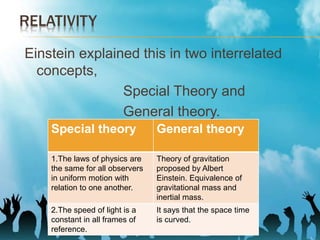
RELATIVITY
Einstein explained this in two interrelated
concepts,
Special Theory and
General theory.
Special theory General theory
1.The laws of physics are
the same for all observers
in uniform motion with
relation to one another.
Theory of gravitation
proposed by Albert
Einstein. Equivalence of
gravitational mass and
inertial mass.
2.The speed of light is a
constant in all frames of
reference.
It says that the space time
is curved.
HISTORY OF QUANTUM ELECTRODYNAMICS
 In 1920s Paul Dirac first described radiation and
matter interaction.
 He directed the creation and annihilation
operators.
 Fermi made it possible to compute the
properties of photons and other sub atomic
particles.
 In Early 1960s & 1970s the structural work by H.
David Politzer, Sidney Coleman, David
Gross and Frank Wilczek gave it a theoritical
background.
THE STRANGE THEORY OF LIGHT AND MATTER
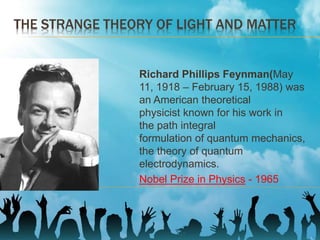
Richard Phillips Feynman(May
11, 1918 – February 15, 1988) was
an American theoretical
physicist known for his work in
the path integral
formulation of quantum mechanics,
the theory of quantum
electrodynamics.
Nobel Prize in Physics - 1965
According to Feynman,
 A photon goes from one place and time to another
place and time.
 An electron goes from one place and time to another
place and time.
 An electron emits or absorbs a photon at a certain
place and time
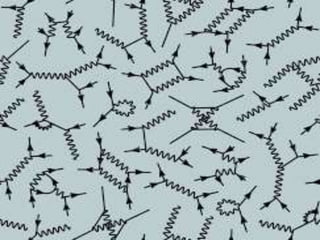
These actions are represented in a form of visual
shorthand by the three basic elements of Feynman
diagrams:
 a wavy line - photon
 a straight line - electron and
 a junction of two straight lines and a wavy one for a
vertex representing emission or absorption of a photon
by an electron.
APPLICATIONS OF QUANTUM MECHANICS
1.The Grand Unified Theory
A Grand Unified Theory (GUT) is
a model in particle physics in which at high
energy, the three gauge interactions of
the Standard Model which define
the electromagnetic, weak,
and strong interactions, or forces, are merged
into one single force. If Grand Unification is
realized in nature, there is the possibility of
a grand unification epoch in the early universe in
which the fundamental forces are not yet
distinct.
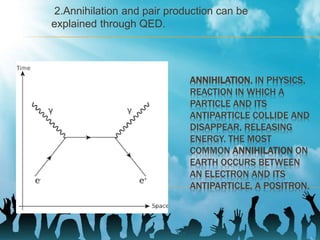
ANNIHILATION, IN PHYSICS,
REACTION IN WHICH A
PARTICLE AND ITS
ANTIPARTICLE COLLIDE AND
DISAPPEAR, RELEASING
ENERGY. THE MOST
COMMON ANNIHILATION ON
EARTH OCCURS BETWEEN
AN ELECTRON AND ITS
ANTIPARTICLE, A POSITRON.
2.Annihilation and pair production can be
explained through QED.
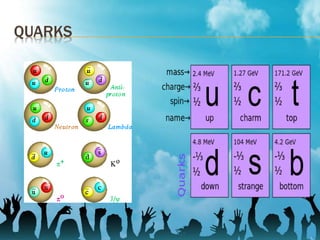
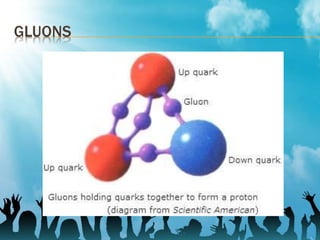
3.QUANTUM CHROMO DYNAMICS
 In theoretical physics, quantum chromo
dynamics (QCD) is the theory of the strong
interaction between quarks and gluons, the
fundamental particles that make up
composite hadrons such as
the proton, neutron and pion. It is generally
developed based on QED.
QUARKS
GLUONS
BIBLIOGRAPHIES AND REFERENCES
 https://en.wikipedia.org/wiki/Quantum_electrody
namics
 http://hyperphysics.phy-
astr.gsu.edu/hbase/Forces/qed.html
 https://en.wikipedia.org/wiki/Quantum_mechanic
s
 https://en.wikipedia.org/wiki/Theory_of_relativity
 http://www.encyclopedia.com/science-and-
technology/physics/physics/quantum-
electrodynamics

Quantum electrodynamics(qed)

  • 1.
  • 2.
    QUANTUM ELECTRODYNAMICS(QED) Quantum –Light Electrodynamics – Interaction between electric charges and current It describes how matter and light interacts. It’s a first proof for relation between quantum mechanics and special relativity.
  • 3.
    QUANTUM MECHANICS(QUANTUM PHYSICS) Quantumphysics Classical physics 1.Behaviour of matter and light at atomic and sub atomic scale. Behavior of particles at macro molecular scale 2.It attempts to describe the properties of esoteric properties such as quarks and gluons. Its describes the properties of matter such as energy ,velocity, momentum and other quantities. 3.There is no precision in measuring the properties of sub atomic particles (Uncertainty Principle). There is a high precision in measuring the properties of macro molecular objects.
  • 4.
    RELATIVITY Einstein explained thisin two interrelated concepts, Special Theory and General theory. Special theory General theory 1.The laws of physics are the same for all observers in uniform motion with relation to one another. Theory of gravitation proposed by Albert Einstein. Equivalence of gravitational mass and inertial mass. 2.The speed of light is a constant in all frames of reference. It says that the space time is curved.
  • 5.
    HISTORY OF QUANTUMELECTRODYNAMICS  In 1920s Paul Dirac first described radiation and matter interaction.  He directed the creation and annihilation operators.  Fermi made it possible to compute the properties of photons and other sub atomic particles.  In Early 1960s & 1970s the structural work by H. David Politzer, Sidney Coleman, David Gross and Frank Wilczek gave it a theoritical background.
  • 6.
    THE STRANGE THEORYOF LIGHT AND MATTER Richard Phillips Feynman(May 11, 1918 – February 15, 1988) was an American theoretical physicist known for his work in the path integral formulation of quantum mechanics, the theory of quantum electrodynamics. Nobel Prize in Physics - 1965
  • 7.
    According to Feynman, A photon goes from one place and time to another place and time.  An electron goes from one place and time to another place and time.  An electron emits or absorbs a photon at a certain place and time These actions are represented in a form of visual shorthand by the three basic elements of Feynman diagrams:  a wavy line - photon  a straight line - electron and  a junction of two straight lines and a wavy one for a vertex representing emission or absorption of a photon by an electron.
  • 10.
    APPLICATIONS OF QUANTUMMECHANICS 1.The Grand Unified Theory A Grand Unified Theory (GUT) is a model in particle physics in which at high energy, the three gauge interactions of the Standard Model which define the electromagnetic, weak, and strong interactions, or forces, are merged into one single force. If Grand Unification is realized in nature, there is the possibility of a grand unification epoch in the early universe in which the fundamental forces are not yet distinct.
  • 11.
    ANNIHILATION, IN PHYSICS, REACTIONIN WHICH A PARTICLE AND ITS ANTIPARTICLE COLLIDE AND DISAPPEAR, RELEASING ENERGY. THE MOST COMMON ANNIHILATION ON EARTH OCCURS BETWEEN AN ELECTRON AND ITS ANTIPARTICLE, A POSITRON. 2.Annihilation and pair production can be explained through QED.
  • 12.
    3.QUANTUM CHROMO DYNAMICS In theoretical physics, quantum chromo dynamics (QCD) is the theory of the strong interaction between quarks and gluons, the fundamental particles that make up composite hadrons such as the proton, neutron and pion. It is generally developed based on QED.
  • 13.
  • 14.
  • 15.
    BIBLIOGRAPHIES AND REFERENCES https://en.wikipedia.org/wiki/Quantum_electrody namics  http://hyperphysics.phy- astr.gsu.edu/hbase/Forces/qed.html  https://en.wikipedia.org/wiki/Quantum_mechanic s  https://en.wikipedia.org/wiki/Theory_of_relativity  http://www.encyclopedia.com/science-and- technology/physics/physics/quantum- electrodynamics

Editor's Notes

  • #2 NOTE: To change the image on this slide, select the picture and delete it. Then click the Pictures icon in the placeholder to insert your own image.