Visit https://ebookultra.com to download the full version and
explore more ebooks or textbooks
Elementary Particle Theory Volume 2 Quantum
Electrodynamics 1st Edition Eugene Stefanovich

_____ Click the link below to download _____
https://ebookultra.com/download/elementary-particle-theory-
volume-2-quantum-electrodynamics-1st-edition-eugene-
stefanovich/
Explore and download more ebooks or textbooks at ebookultra.com
Here are some recommended products that we believe you will be
interested in. You can click the link to download.
Tajiki An Elementary Textbook Volume 2 with ISO Nasrullo
Khojayori
https://ebookultra.com/download/tajiki-an-elementary-textbook-
volume-2-with-iso-nasrullo-khojayori/
The Quantum Theory of Fields Volume III Supersymmetry 1st
Edition Steven Weinberg
https://ebookultra.com/download/the-quantum-theory-of-fields-volume-
iii-supersymmetry-1st-edition-steven-weinberg/
Calculus of Finite Differences in Quantum Electrodynamics
1st Edition Henning F. Harmuth And Beate Meffert (Eds.)
https://ebookultra.com/download/calculus-of-finite-differences-in-
quantum-electrodynamics-1st-edition-henning-f-harmuth-and-beate-
meffert-eds/
The Quantum Theory of Fields Volume II Modern Applications
1st Edition Steven Weinberg
https://ebookultra.com/download/the-quantum-theory-of-fields-volume-
ii-modern-applications-1st-edition-steven-weinberg/
Non Perturbative Methods in 2 Dimensional Quantum Field
Theory Second Edition Elcio Abdalla
https://ebookultra.com/download/non-perturbative-methods-
in-2-dimensional-quantum-field-theory-second-edition-elcio-abdalla/
Schiff s Diseases of the Liver 2 Volume Set 10th ed Tenth
Edition Eugene R Schiff
https://ebookultra.com/download/schiff-s-diseases-of-the-
liver-2-volume-set-10th-ed-tenth-edition-eugene-r-schiff/
Gauge Theories in Particle Physics From Relativistic
Quantum Mechanics to QED Fourth Edition Aitchison
https://ebookultra.com/download/gauge-theories-in-particle-physics-
from-relativistic-quantum-mechanics-to-qed-fourth-edition-aitchison/
Elementary Operator Theory 1st Edition Marat V. Markin
https://ebookultra.com/download/elementary-operator-theory-1st-
edition-marat-v-markin/
Relativistic Quantum Physics From Advanced Quantum
Mechanics to Introductory Quantum Field Theory 1st Edition
Tommy Ohlsson
https://ebookultra.com/download/relativistic-quantum-physics-from-
advanced-quantum-mechanics-to-introductory-quantum-field-theory-1st-
edition-tommy-ohlsson/
Elementary Particle Theory Volume 2 Quantum
Electrodynamics 1st Edition Eugene Stefanovich Digital

Instant Download
Author(s): Eugene Stefanovich
ISBN(s): 9783110493207, 3110493209
Edition: 1
File Details: PDF, 2.92 MB
Year: 2019
Language: english
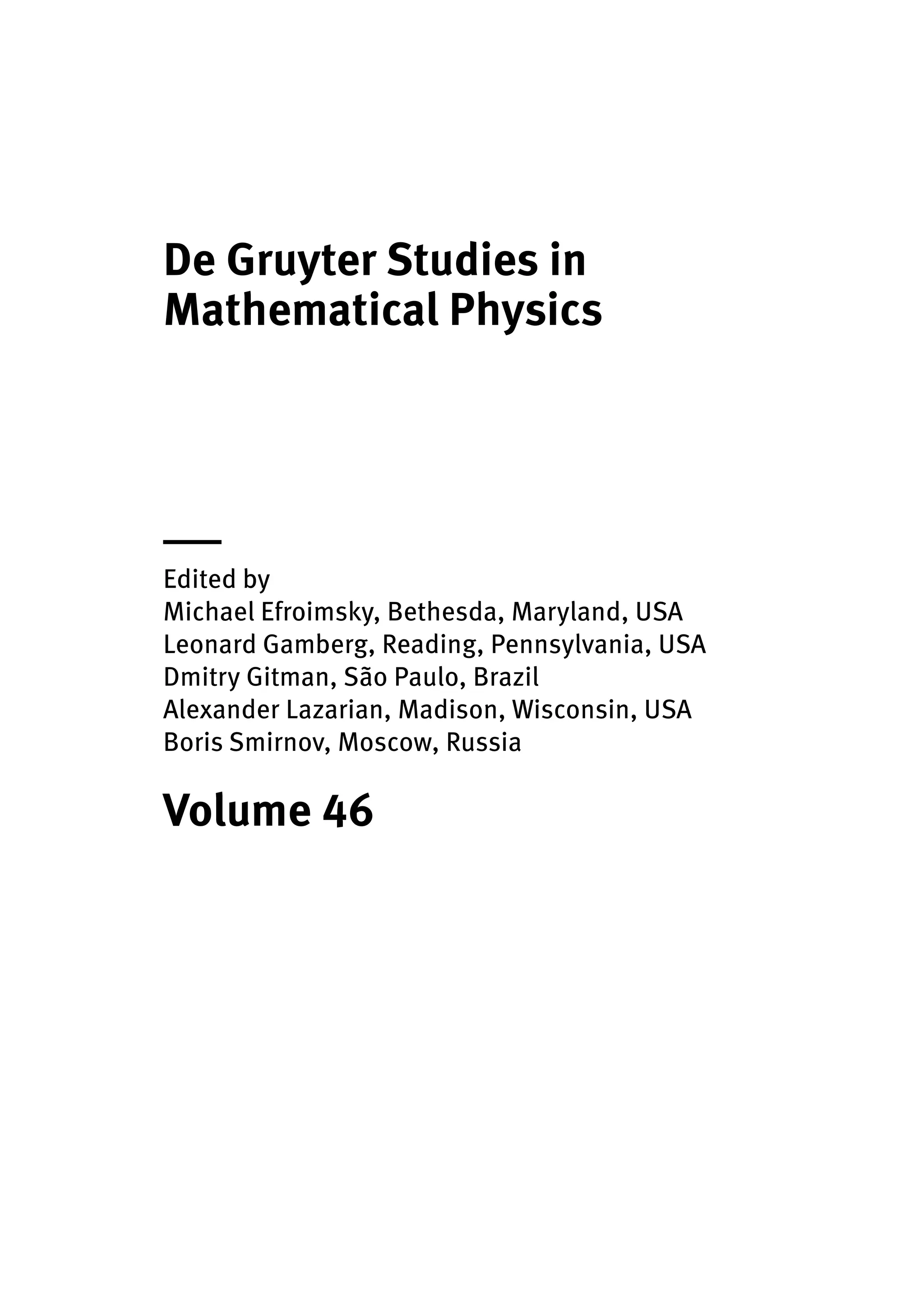
Eugene Stefanovich
Elementary Particle Theory
De Gruyter Studies in
Mathematical Physics
|
Edited by
Michael Efroimsky, Bethesda, Maryland, USA
Leonard Gamberg, Reading, Pennsylvania, USA
Dmitry Gitman, São Paulo, Brazil
Alexander Lazarian, Madison, Wisconsin, USA
Boris Smirnov, Moscow, Russia
Volume 46
Eugene Stefanovich
Elementary
Particle Theory
|
Volume 2: Quantum Electrodynamics
Mathematics Subject Classification 2010
Primary: 81-02, 81V10, 81T15; Secondary: 47A40, 81T18
Author
Dr Eugene Stefanovich
San Jose, California
USA
eugene_stefanovich@usa.net
ISBN 978-3-11-049089-3
e-ISBN (PDF) 978-3-11-049320-7
e-ISBN (EPUB) 978-3-11-049143-2
ISSN 2194-3532
Library of Congress Control Number: 2018016481
Bibliographic information published by the Deutsche Nationalbibliothek
The Deutsche Nationalbibliothek lists this publication in the Deutsche Nationalbibliografie;
detailed bibliographic data are available on the Internet at http://dnb.dnb.de.
© 2019 Walter de Gruyter GmbH, Berlin/Boston
Typesetting: VTeX UAB, Lithuania
Printing and binding: CPI books GmbH, Leck
www.degruyter.com
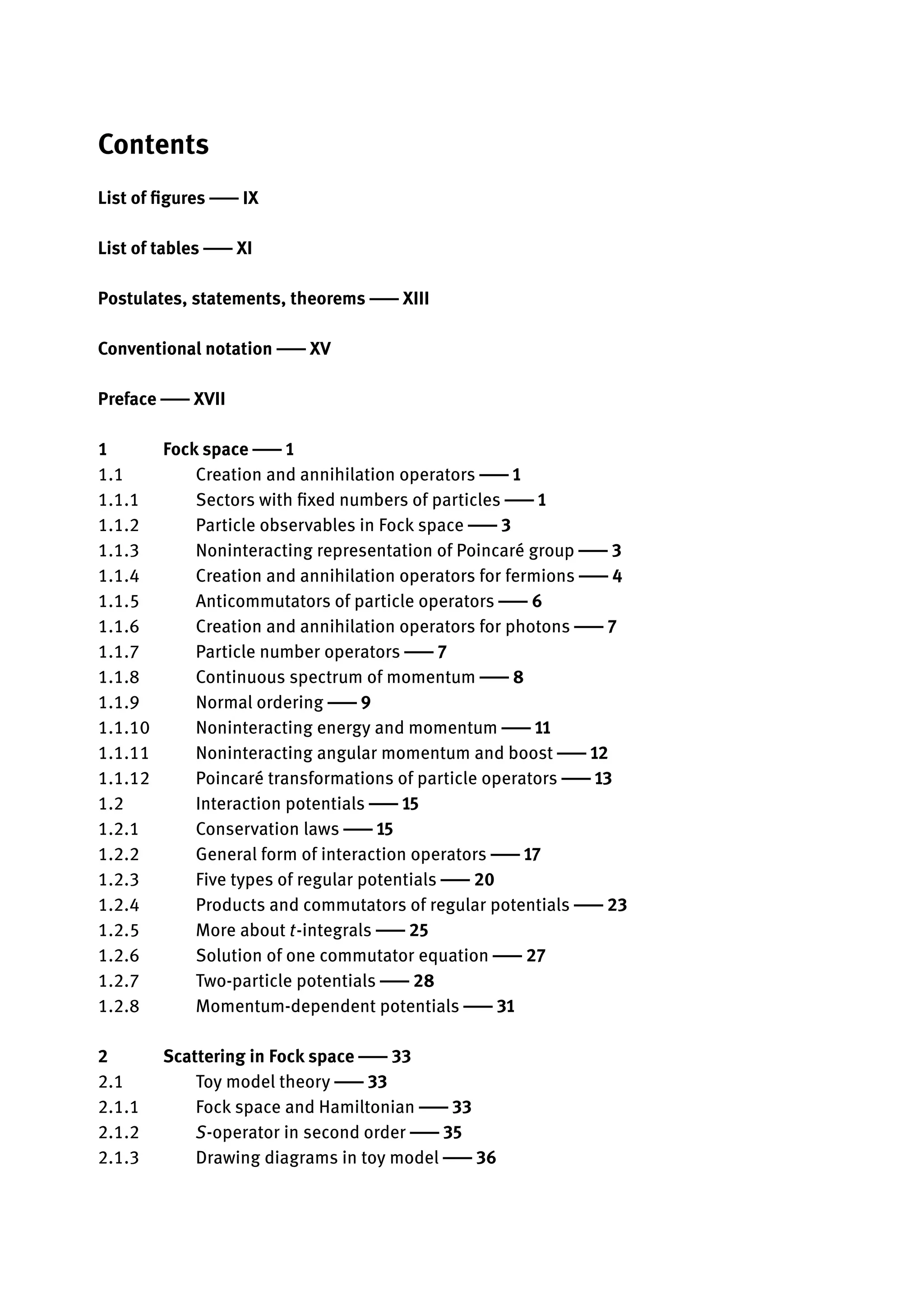
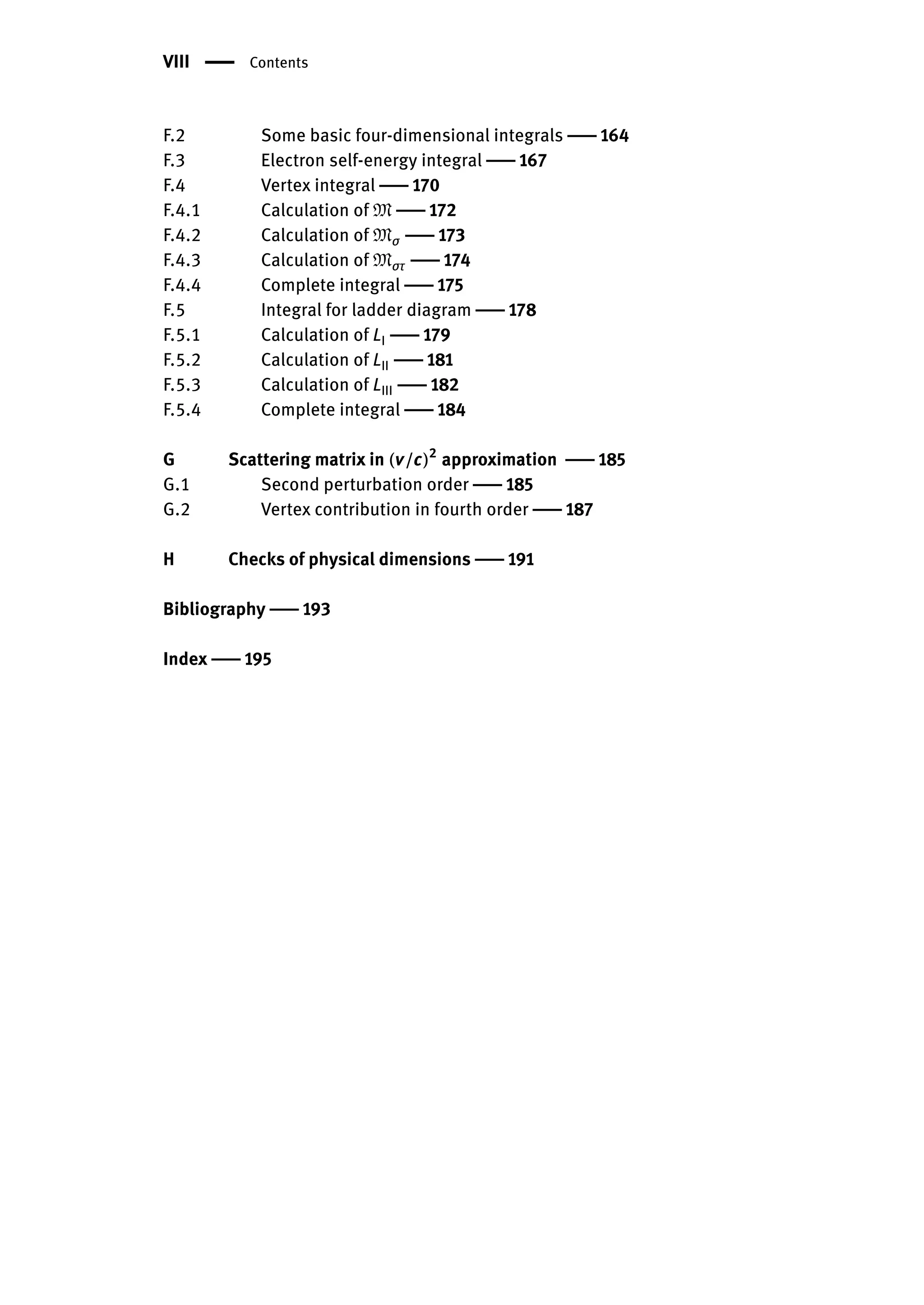
Contents
List of figures | IX
List of tables | XI
Postulates, statements, theorems | XIII
Conventional notation | XV
Preface | XVII
1 Fock space | 1
1.1 Creation and annihilation operators | 1
1.1.1 Sectors with fixed numbers of particles | 1
1.1.2 Particle observables in Fock space | 3
1.1.3 Noninteracting representation of Poincaré group | 3
1.1.4 Creation and annihilation operators for fermions | 4
1.1.5 Anticommutators of particle operators | 6
1.1.6 Creation and annihilation operators for photons | 7
1.1.7 Particle number operators | 7
1.1.8 Continuous spectrum of momentum | 8
1.1.9 Normal ordering | 9
1.1.10 Noninteracting energy and momentum | 11
1.1.11 Noninteracting angular momentum and boost | 12
1.1.12 Poincaré transformations of particle operators | 13
1.2 Interaction potentials | 15
1.2.1 Conservation laws | 15
1.2.2 General form of interaction operators | 17
1.2.3 Five types of regular potentials | 20
1.2.4 Products and commutators of regular potentials | 23
1.2.5 More about t-integrals | 25
1.2.6 Solution of one commutator equation | 27
1.2.7 Two-particle potentials | 28
1.2.8 Momentum-dependent potentials | 31
2 Scattering in Fock space | 33
2.1 Toy model theory | 33
2.1.1 Fock space and Hamiltonian | 33
2.1.2 S-operator in second order | 35
2.1.3 Drawing diagrams in toy model | 36
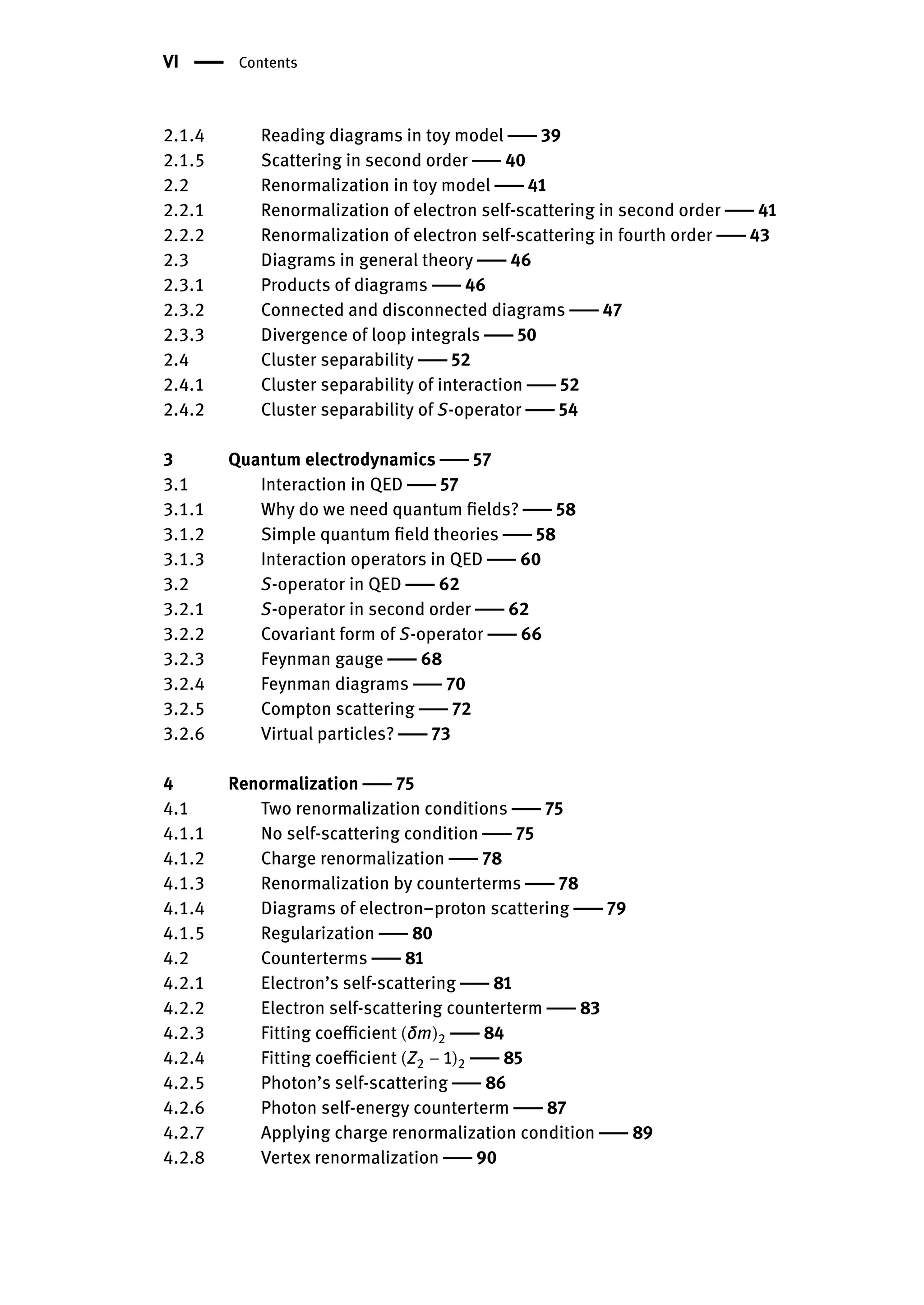
VI | Contents
2.1.4 Reading diagrams in toy model | 39
2.1.5 Scattering in second order | 40
2.2 Renormalization in toy model | 41
2.2.1 Renormalization of electron self-scattering in second order | 41
2.2.2 Renormalization of electron self-scattering in fourth order | 43
2.3 Diagrams in general theory | 46
2.3.1 Products of diagrams | 46
2.3.2 Connected and disconnected diagrams | 47
2.3.3 Divergence of loop integrals | 50
2.4 Cluster separability | 52
2.4.1 Cluster separability of interaction | 52
2.4.2 Cluster separability of S-operator | 54
3 Quantum electrodynamics | 57
3.1 Interaction in QED | 57
3.1.1 Why do we need quantum fields? | 58
3.1.2 Simple quantum field theories | 58
3.1.3 Interaction operators in QED | 60
3.2 S-operator in QED | 62
3.2.1 S-operator in second order | 62
3.2.2 Covariant form of S-operator | 66
3.2.3 Feynman gauge | 68
3.2.4 Feynman diagrams | 70
3.2.5 Compton scattering | 72
3.2.6 Virtual particles? | 73
4 Renormalization | 75
4.1 Two renormalization conditions | 75
4.1.1 No self-scattering condition | 75
4.1.2 Charge renormalization | 78
4.1.3 Renormalization by counterterms | 78
4.1.4 Diagrams of electron–proton scattering | 79
4.1.5 Regularization | 80
4.2 Counterterms | 81
4.2.1 Electron’s self-scattering | 81
4.2.2 Electron self-scattering counterterm | 83
4.2.3 Fitting coefficient (δm)2 | 84
4.2.4 Fitting coefficient (Z2 − 1)2 | 85
4.2.5 Photon’s self-scattering | 86
4.2.6 Photon self-energy counterterm | 87
4.2.7 Applying charge renormalization condition | 89
4.2.8 Vertex renormalization | 90
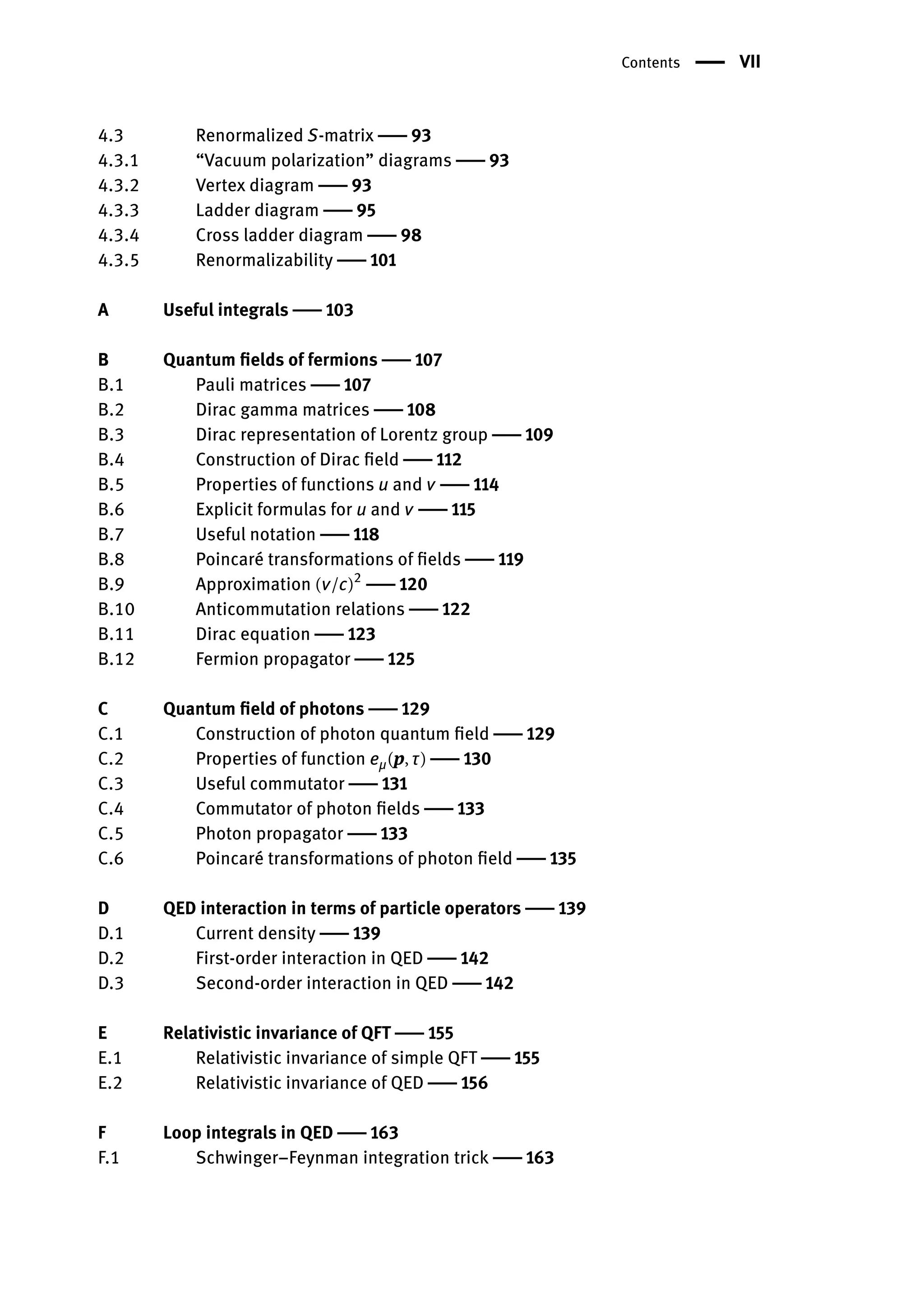
Contents | VII
4.3 Renormalized S-matrix | 93
4.3.1 “Vacuum polarization” diagrams | 93
4.3.2 Vertex diagram | 93
4.3.3 Ladder diagram | 95
4.3.4 Cross ladder diagram | 98
4.3.5 Renormalizability | 101
A Useful integrals | 103
B Quantum fields of fermions | 107
B.1 Pauli matrices | 107
B.2 Dirac gamma matrices | 108
B.3 Dirac representation of Lorentz group | 109
B.4 Construction of Dirac field | 112
B.5 Properties of functions u and v | 114
B.6 Explicit formulas for u and v | 115
B.7 Useful notation | 118
B.8 Poincaré transformations of fields | 119
B.9 Approximation (v/c)2
| 120
B.10 Anticommutation relations | 122
B.11 Dirac equation | 123
B.12 Fermion propagator | 125
C Quantum field of photons | 129
C.1 Construction of photon quantum field | 129
C.2 Properties of function eμ(p, τ) | 130
C.3 Useful commutator | 131
C.4 Commutator of photon fields | 133
C.5 Photon propagator | 133
C.6 Poincaré transformations of photon field | 135
D QED interaction in terms of particle operators | 139
D.1 Current density | 139
D.2 First-order interaction in QED | 142
D.3 Second-order interaction in QED | 142
E Relativistic invariance of QFT | 155
E.1 Relativistic invariance of simple QFT | 155
E.2 Relativistic invariance of QED | 156
F Loop integrals in QED | 163
F.1 Schwinger–Feynman integration trick | 163
VIII | Contents
F.2 Some basic four-dimensional integrals | 164
F.3 Electron self-energy integral | 167
F.4 Vertex integral | 170
F.4.1 Calculation of M | 172
F.4.2 Calculation of Mσ | 173
F.4.3 Calculation of Mστ | 174
F.4.4 Complete integral | 175
F.5 Integral for ladder diagram | 178
F.5.1 Calculation of LI | 179
F.5.2 Calculation of LII | 181
F.5.3 Calculation of LIII | 182
F.5.4 Complete integral | 184
G Scattering matrix in (v/c)2
approximation | 185
G.1 Second perturbation order | 185
G.2 Vertex contribution in fourth order | 187
H Checks of physical dimensions | 191
Bibliography | 193
Index | 195
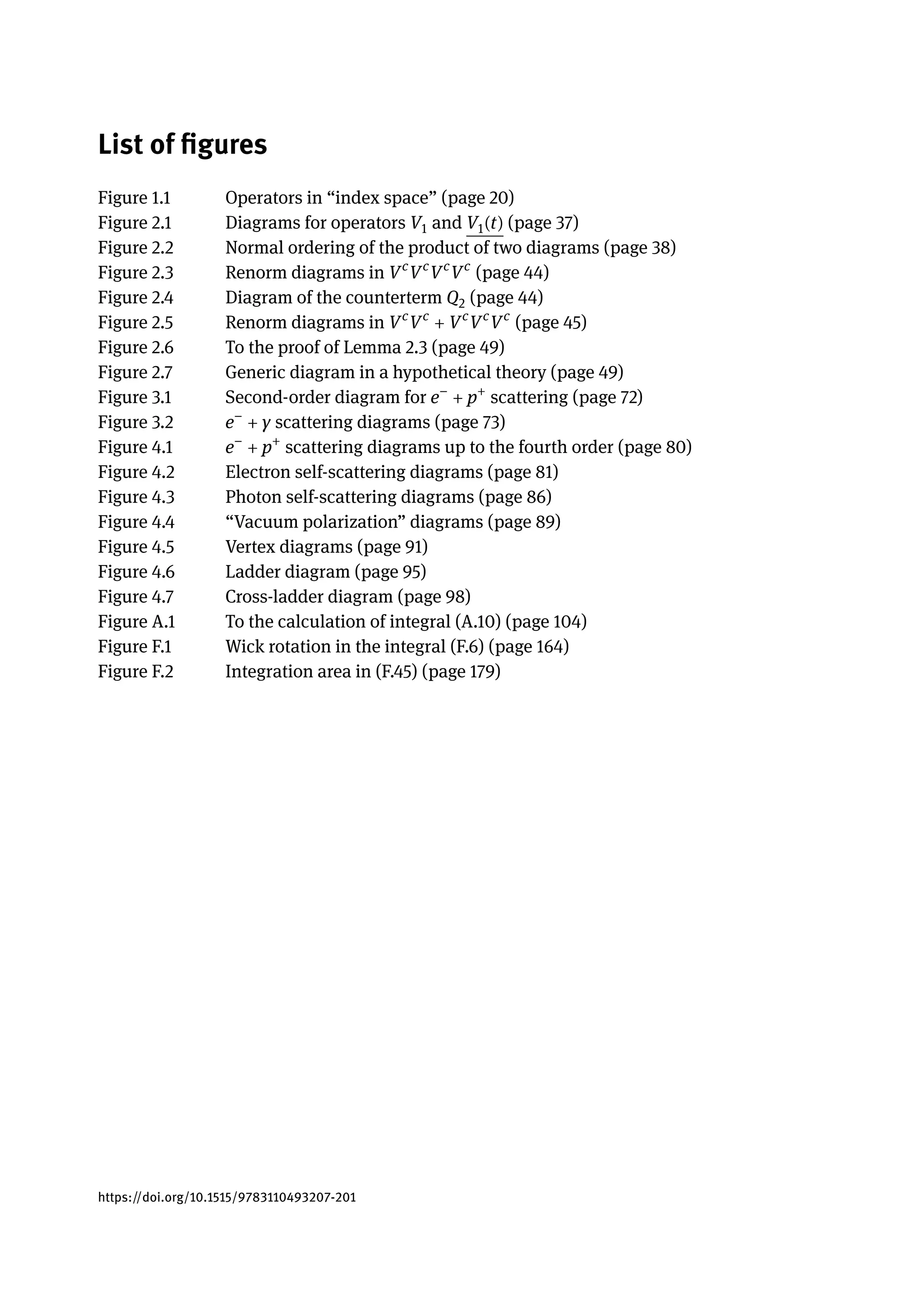
List of figures
Figure 1.1 Operators in “index space” (page 20)
Figure 2.1 Diagrams for operators V1 and V1(t) (page 37)
Figure 2.2 Normal ordering of the product of two diagrams (page 38)
Figure 2.3 Renorm diagrams in Vc
Vc
Vc
Vc
(page 44)
Figure 2.4 Diagram of the counterterm Q2 (page 44)
Figure 2.5 Renorm diagrams in Vc
Vc
+ Vc
Vc
Vc
(page 45)
Figure 2.6 To the proof of Lemma 2.3 (page 49)
Figure 2.7 Generic diagram in a hypothetical theory (page 49)
Figure 3.1 Second-order diagram for e−
+ p+
scattering (page 72)
Figure 3.2 e−
+ γ scattering diagrams (page 73)
Figure 4.1 e−
+ p+
scattering diagrams up to the fourth order (page 80)
Figure 4.2 Electron self-scattering diagrams (page 81)
Figure 4.3 Photon self-scattering diagrams (page 86)
Figure 4.4 “Vacuum polarization” diagrams (page 89)
Figure 4.5 Vertex diagrams (page 91)
Figure 4.6 Ladder diagram (page 95)
Figure 4.7 Cross-ladder diagram (page 98)
Figure A.1 To the calculation of integral (A.10) (page 104)
Figure F.1 Wick rotation in the integral (F.6) (page 164)
Figure F.2 Integration area in (F.45) (page 179)
https://doi.org/10.1515/9783110493207-201
List of tables
Table 1.1 Types of potentials in the Fock space of QED (page 22)
Table 1.2 Commutators, t-derivatives and t-integrals (page 26)
Table 3.1 Components of Feynman diagrams (page 71)
https://doi.org/10.1515/9783110493207-202
Postulates, statements, theorems
Theorem 1.1 Wick theorem (page 10)
Lemma 1.2 Commutator of renorm operators (page 20)
Lemma 1.3 Product of regular operators (page 23)
Theorem 1.4 Properties of phys operators (page 23)
Lemma 1.5 Product of phys operators (page 24)
Lemma 1.6 Commutator [phys,renorm] (page 24)
Lemma 1.7 Commutator [unphys,renorm] (page 24)
Lemma 1.8 Commutator [phys,unphys] (page 25)
Lemma 1.9 t-derivative of operator (page 25)
Lemma 2.1 Disconnected part of product (page 47)
Theorem 2.2 Multiple commutator (page 48)
Lemma 2.3 Number of independent loops (page 49)
Theorem 2.4 Convergence of loop integrals (page 51)
Theorem 2.5 Cluster separability of smooth potentials (page 54)
Theorem 2.6 Smoothness of products of potentials (page 54)
Theorem 2.7 Smoothness of commutators of potentials (page 55)
Statement 4.1 Absence of self-scattering (page 77)
Postulate 4.2 Charge renormalization condition (page 78)
https://doi.org/10.1515/9783110493207-203
Conventional notation
See also Conventional notation of Volume 1.
Fock space
|vac⟩ vacuum state vector (page 2)
a†
, a electron creation/annihilation operators (page 4)
b†
, b positron creation/annihilation operators (page 9)
c†
, c photon creation/annihilation operators (page 7)
d†
, d proton creation/annihilation operators (page 9)
f†
, f antiproton creation/annihilation operators (page 9)
α†
, α creation/annihilation operators of generic particles (page 10)
VNM ∘ ζ product of coefficient functions (page 18)
ℰA energy function of operator A (page 19)
H Fock space (page 1)
H (i, j, k, l, m) sector in the Fock space (page 1)
: abcd : normally ordered product (page 10)
Quantum fields
ψ( ̃
x) electron–positron quantum field (page 112)
ψ( ̃
x) Dirac-conjugated field (page 113)
Ψ( ̃
x) proton–antiproton quantum field (page 113)
𝒜μ( ̃
x) photon quantum field (page 129)
𝒰μ
(p󸀠
s󸀠
z, psz) ≡ u (p󸀠
, s󸀠
z) γμ
u(p, sz) (page 118)
𝒲μ
(p󸀠
s󸀠
z, psz) ≡ w (p󸀠
, s󸀠
z) γμ
w(p, sz) (page 118)
Hn
naïve Hamiltonian of QED (page 61)
Hc
QED Hamiltonian with counterterms (page 42)
j
μ
ep( ̃
x) electron–positron current density operator (page 139)
j
μ
pa( ̃
x) proton–antiproton current density operator (page 139)
jμ
( ̃
x) total current density operator (page 139)
λ infrared cutoff (page 80)
Λ ultraviolet cutoff (page 80)
Miscellaneous
γμ
Dirac gamma matrices (page 108)
a, b, c, . . . Dirac indices (page 112)
https://doi.org/10.1515/9783110493207-204
XVI | Conventional notation
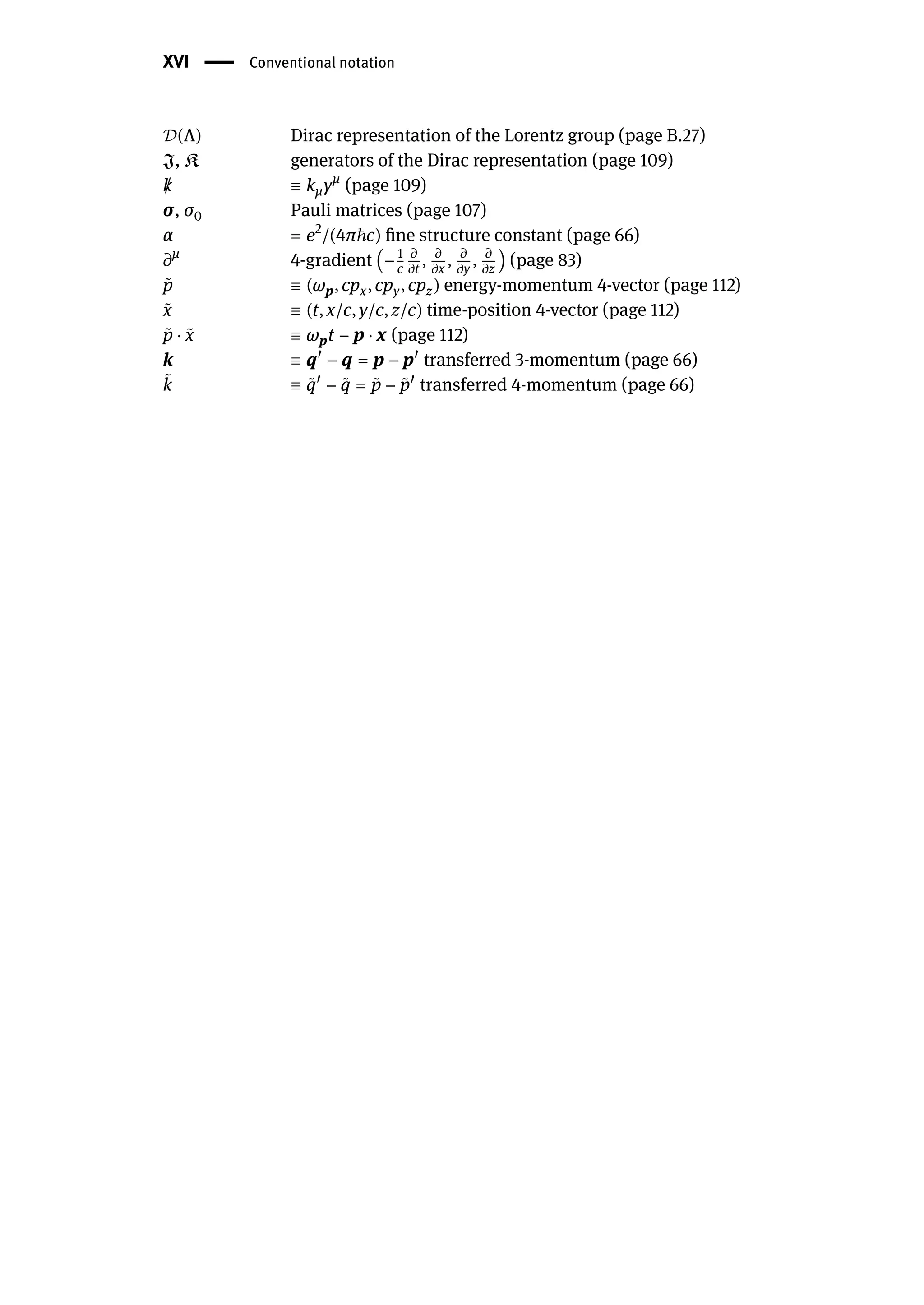
𝒟(Λ) Dirac representation of the Lorentz group (page B.27)
J, K generators of the Dirac representation (page 109)
/
k ≡ kμγμ
(page 109)
σ, σ0 Pauli matrices (page 107)
α = e2
/(4πℏc) fine structure constant (page 66)
𝜕μ
4-gradient (− 1
c
𝜕
𝜕t
, 𝜕
𝜕x
, 𝜕
𝜕y
, 𝜕
𝜕z
) (page 83)
̃
p ≡ (ωp, cpx, cpy, cpz) energy-momentum 4-vector (page 112)
̃
x ≡ (t, x/c, y/c, z/c) time-position 4-vector (page 112)
̃
p ⋅ ̃
x ≡ ωpt − p ⋅ x (page 112)
k ≡ q󸀠
− q = p − p󸀠
transferred 3-momentum (page 66)
̃
k ≡ ̃
q󸀠
− ̃
q = ̃
p − ̃
p󸀠
transferred 4-momentum (page 66)
Preface
In a successful theory of elementary particles, at least three important conditions must
be fulfilled:
(1) relativistic invariance in the instant form of dynamics;
(2) cluster separability of the interaction;
(3) description of processes involving creation and destruction of particles.
In the first volume of our book we discussed interacting quantum theories in Hilbert
spaces with a fixed set of particles. We showed how it is possible to satisfy the first
two requirements (relativistic invariance and cluster separability).1
However, these
theories were fundamentally incomplete, due to their inability to describe physical
processes that change the types and/or number of particles in the system. Thus, con-
dition 3 from our list was not fulfilled.
Familiar examples of the creation and annihilation processes are emission and ab-
sorption of light (photons), decays, neutrino oscillations, etc. Particles are produced
especially intensively at high energies. This is due to the famous Einstein formula
E = mc2
, which says, in particular, that if the system has sufficient energy E of rel-
ative motion, then this energy can be transformed into the mass m of newly created
particles. Even in the simplest two-particle case, the energy of the relative motion of
these reactants is unlimited. Therefore, there is no limit to the number of new particles
that can be created in a collision.
To advance in the study of such processes, the first thing to do is to build a Hilbert
space of states H , which is capable of describing particle creation and annihilation.
Such a space must include states with arbitrary numbers (from zero to infinity) of par-
ticles of all types. It is called the Fock space. This construction is rather simple. How-
ever, the next step – the definition of realistic interaction operators in the Fock space
– is highly nontrivial. A big part of our third volume will be devoted to the solution
of this problem. Here we will prepare ourselves to this task by starting with a more
traditional approach, which is known as the renormalized relativistic quantum field
theory (QFT). Our discussions in this book are limited to electromagnetic phenomena,
so we will be interested in the simplest and most successful type of QFT – quantum
electrodynamics (QED).
In Chapter 1, Fock space, we will describe the basic mathematical machinery of
Fock spaces, including creation and annihilation operators, normal ordering and clas-
sification of interaction potentials.
A simple toy model with variable number of particles will be presented in Chap-
ter 2, Scattering in Fock space. In this example, we will discuss such important in-
gredients of QFT as the S-matrix formalism, renormalization, diagram technique and
1 See, e. g., Subsection 1-6.4.6.
https://doi.org/10.1515/9783110493207-205
XVIII | Preface
cluster separability. Our first two chapters have a mostly technical character. They de-
fine our terminology and notation and prepare us for a more in-depth study of QED in
the two following chapters.
In Chapter 3, Quantum electrodynamics, we introduce the important concept of
the quantum field. This idea will be applied to systems of charged particles and pho-
tons in the formalism of QED. Here we will obtain an interacting theory, which satisfies
the principles of relativistic invariance and cluster separability, where the number of
particles is not fixed. However, the “naïve” version of QED presented here is unsat-
isfactory, since it cannot calculate scattering amplitudes beyond the lowest orders of
perturbation theory.
Chapter 4, Renormalization, completes the second volume of the book. We will dis-
cussthe plagueof ultravioletdivergencesin the “naïve”QED and explain how they can
be eliminated by adding counterterms to the Hamiltonian. As a result, we will get the
traditional “renormalized” QED, which has proven itself in precision calculations of
scattering cross sections and energy levels in systems of charged particles. However,
this theory failed to provide a well-defined interacting Hamiltonian and the interact-
ing time evolution (= dynamics). We will address these issues in the third volume of
our book.
As in the first volume, here we refrain from criticism and unconventional interpre-
tations, trying to keep in line with generally accepted approaches. The main purpose
of this volume is to explain the basic concepts and terminology of QFT. For the most
part, we will adhere to the logic of QFT formulated by Weinberg in the series of articles
[19, 18, 20] and in the excellent textbook [21]. A critical discussion of the traditional
approaches and a new look at the theory of relativity will be presented in Volume 3
[17].
References to Volume 1 [16] of this book will be prefixed with “1-”. For example,
(1-7.14) is formula (7.14) from Volume 1.
1 Fock space
There are more things in Heaven and on earth, dear Horacio, than are dreamed of in your
philosophy.
Hamlet
In this chapter, we construct the Fock space H populated by particles of five types:
electrons e−
, positrons e+
, protons p+
, antiprotons1
p−
and photons γ. We will practice
constructions of simple interaction operators and study their properties. In compar-
ison with Volume 1, the main novelty is in working with operators that change the
number of particles. This will prepare us for mastering a more realistic theory – quan-
tum electrodynamics (QED) – in Chapters 3 and 4.
1.1 Creation and annihilation operators
Here we introduce the concepts of creation and annihilation operators. Though lack-
ing autonomous physical meaning, these operators greatly simplify calculations
in H .
1.1.1 Sectors with fixed numbers of particles
The numbers of particles of each type are easily measurable in experiments, so we
have the right to introduce in our theory five new observables, namely, the numbers
of electrons (Nel), positrons (Npo), protons (Npr), antiprotons (Nan) and photons (Nph).
Unlike in ordinary quantum mechanics from Volume 1, here we will not assume that
the numbers of particles are fixed. We would like to treat these quantities on the same
footing as other quantum observables. In particular, we will also take into account
their quantum uncertainty. Then, in accordance with general quantum rules, these
observables should be represented in the Hilbert space (= Fock space) H by five Her-
mitian operators. Obviously, their allowed values (spectra) are nonnegative integers
(0, 1, 2, . . .). From part (II) of Postulate 1-6.1, it follows that these observables are mea-
surable simultaneously, so that the particle number operators commute with each
other and have common eigensubspaces. Hence, the Fock space H splits into a di-
rect sum of orthogonal subspaces, or sectors, H (i, j, k, l, m) containing i electrons,
1 In this book, protons and antiprotons are regarded as simple point charges. Their internal structure
is ignored, as well as their participation in strong nuclear interactions.
https://doi.org/10.1515/9783110493207-001
Other documents randomly have
different content
reside, and commence his journey to it immediately after leaving the
castle. At the same time, the commission would seriously warn him,
under threats of the royal displeasure, not to speak or to write about
public affairs, as his Majesty, through special clemency, granted him
a pension of 500 dollars, and the same to his wife.
The commission would demand of Colonel von Falckenskjold the
chamberlain's key and the Russian order, and announce to him that,
in consequence of his audacious and detrimental behaviour, he
would be conveyed to the fortress of Munkholm, and be imprisoned
there for life, half a dollar a day being allowed him from the treasury
for his support.
Lastly, the commission would announce to Justiz-rath Struensee
that, as he had caused his arrest by his own suspicious behaviour, he
was now released from it, but he must leave the country at once,
after making a promise, on oath, to reveal neither in writing nor
verbally anything he knew about the Danish state affairs, and
neither to write nor to speak about the events which had lately
occurred in Copenhagen, and he would also begin his journey
immediately he was released from the castle.
The fate of the three men was very different. Poor Von Gähler died
in exile; Justiz-rath Struensee became Minister of State in Prussia,
where he acquired a considerable fortune; he was ennobled in 1789
by the same court of Copenhagen which had his brother's
escutcheon broken by the executioner.[31]
As for the third person, he shall tell us his story himself, as it throws
such an extraordinary light on the treatment of state prisoners at a
period within a hundred years of our own.
FALCKENSKJOLD'S ABODE AT MUNKHOLM.
On June 12, 1772, Sevel, accompanied by the commandant of the
marines and several officers, entered my prison and told me that the
king stripped me of all my offices and the military order of Russia,
and that I should be transported to a rock and be detained there for
the rest of my days.
The crowd of people who entered with Sevel had so deafened me,
that a portion of what he said escaped me.
I begged him to repeat how long I was to remain in detention.
For your whole life, he replied, with a grin which I fancy I can still
see.
The commission had doubtless made a report. I requested the
communication of it—it was refused me. I was promised a copy of
my examination, but was unable to obtain it.
Thus I was deprived of every document that might one day be
useful in proving my innocence.
On June 26, I was taken on board a merchant vessel the Admiralty
had freighted in order to go to Munkholm, my place of destination; a
sergeant and four grenadiers of Prince Frederick's regiment, chosen
by Eickstedt, were ordered to guard me on board the vessel; two
grenadiers with drawn sabres were to watch me and prevent me
from speaking.
I have since learned that the sergeant commanding this guard, had
a promise of being made lieutenant if he could induce me to take
any step which would cause me to be landed at Munkholm in chains.
But the skipper had declared to the Admiralty that he would not
allow any one but himself to give orders, and that if he required the
guard, he would summon it.
This worthy man contrived to make himself respected, and to
protect me from ill treatment.
The vessel touched at Christiansund, where a part of its cargo was
to be delivered. A custom-house clerk came on board and wanted to
speak with me. He wished to insult me, as he had been dismissed in
1763 from his rank of lieutenant; observe, that I had no part in
military affairs till 1771. I heard his conversation on this subject with
the master, who saved me this annoyance.
The vessel arrived at Munkholm on August 4th, and I parted, not
without regret, from this honest skipper, who had so generously
protected me.
The fort of Munkholm is situated on a barren rock four hundred
paces in circumference, in the middle of the sea, half a league from
Trondhjem,[32] toward the 64° of northern latitude. During the
winter it is covered with an almost continual fog; the snow hardly
remains there eight days in succession; but it freezes there from the
beginning of September, and snow falls in the month of June.
The only inhabitants of this place consisted of a detachment of the
garrison of Trondhjem, the fort commandant, the officers under him,
and the prisoners guarded there.
I was lodged in a low room a little above the ground-floor. Its planks
and walls were damp, and the snow fell into it in a fine rain when it
thawed. Under the window was a cistern of stagnant water; this
lodging, which was also surrounded by the quarters of the soldiers
and the prisoners, whose cries stunned me, was assuredly not good;
but I was alone in it, had plenty of books, enjoyed the liberty of
walking on the ramparts when I pleased, and I felt much less
unhappy than in Copenhagen; everything is relative.
I had been warned that the water of the fort was unhealthy, and
produced gravel. I asked if I could have any other, and they offered
me spirits, the beverage par excellence at this spot, but it was worse
for me than bad water.
I could not procure good bread; old bread, partly spoiled, was
purchased for the prisoners, which cost 12 per cent. less than the
ordinary bread. Though the government had confiscated 8,000
crowns belonging to me, it only allowed me half-a-crown a day for
my subsistence.
A battalion of the Delmenhorst regiment was in garrison at
Trondhjem; I had served in this regiment, and found at Munkholm
soldiers of a company I had formerly commanded. They formed a
plan for carrying me off and deserting, but not having been able to
communicate their plan to me, they deserted without me, and tried
to reach Sweden overland; a detachment, sent in pursuit, caught
them and brought them back.
The solders, generally, were in a profound state of wretchedness and
demoralisation; the spirits and herrings on which they lived diffused
a frightful stench, and I had a difficulty in protecting myself against
their uncleanliness.
Everything here depended on Lieut.-General von der Osten, grand
bailiff and governor of Trondhjem: he was said to be fond of
presents, and did not hesitate to ask them, and I had none to offer
him. The commandant of Munkholm, on my arrival, had been a
servant and woodcutter to a Copenhagen tradesman. He was first a
gunner, then non-commissioned officer in the militia, afterwards a
spy, captain of a company of guides, inspector of an hospital, and,
lastly, commandant of Munkholm. This man, who was extremely
brutal and coarse, was frequently intoxicated; he called himself an
atheist, believed himself an engineer, astronomer, tactician, and
decided on everything without allowing an answer; he declaimed a
great deal, though I could not learn why, against Counts von
Bernstorff and St. Germain.
A poor author, a very pious man, who was placed here because he
had the simplicity to believe in the freedom of the press, had
become, on account of his devotion, odious to the commandant,
who used to beat him. He also treated very badly another person
who had held a post at court, although the latter made him
presents.
The other officers were given up to the most disgusting intoxication.
I took great care to avoid these gentlemen, and only spoke to them
when I could not help it. I do not believe it would have been very
difficult for me to escape from this fortress, and, perhaps, Guldberg
offered me the means by proposing to me a retreat at Vardohuus,
[33] under the polar circle. But, I said to myself, what should I go so
far to seek? more injustice and persecution!
What had been done to me gave me a sort of disgust for human
society. I had wished to render myself illustrious by arms—the
perusal of the lives of celebrated warriors had inflamed my
imagination at an early age. I aspired to become one day the rival of
the Löwendahls and the Münnichs. My studies, my reflections, were
all directed to this object. On emerging from childhood I took up
arms and sought combats—I followed this career successfully. I was
summoned to aid in the reformation of my country and the
amelioration of its condition. I quit with regret the mode of life I had
chosen and loved; I arrive, I consecrate my efforts, all my thoughts
to this new task, and persecution, exile and contumely are my
reward! No, I will not take a single step to return to society; I was
never a man of pleasures, though not at all insensible to the
enjoyments designated by that name; I shall, doubtless, learn to
forget them. Society has rejected me; they refuse to allow me any
part in its joys and honours, and I have been relegated to this rock.
Well, then, let us perform our task apart, let us work to render this
state supportable, and to depend on others as little as possible.
I daily confirmed myself in these thoughts—a favourite and habitual
subject of my reveries—and this has decided the rest of my life.
I should be satisfied if I had a healthy lodging, good water, and if I
were not obliged to speak to the people who surround me.
The taste for study is a great resource for me. I read a great deal
with a pen in my hand; on the margin of my books I note my
souvenirs, my reflections, and trace the details of the campaigns I
have been through, and develope the considerations I had sketched
about the military condition of Denmark. I still like to occupy myself
with society as a simple spectator, though I have no desire to act a
part in it. I like to dream awake while walking. The ramparts are the
ordinary scene of my promenades.
Thence, when the weather is fine, I perceive the mountainous coasts
of the mainland, the rocks, the valleys, the forests, the habitations,
which form varied scenes, the islets and shoals with which the coast
is studded. Sometimes I discern in the distance a vessel which is,
perhaps, bringing me books; more frequently I watch the departure
of the fishermen's boats, or else see them return, uttering shouts of
joy and triumph, with the booty they have gained by so much
fatigue and boldness in the dangerous Northern Seas.
I also take pleasure in contemplating the fury of the waves raised by
storms, and which break against the rock on which I am a captive.
In the months of July and August the coast of Norway offers an
aspect of magnificent vegetation; the navigation is active; clouds of
birds appear to animate the rocks that border the shore; the sky is
pure, and the view enjoyed from Munkholm is enchanting. The
nights, especially, have a peculiar charm; the air has something
unctuous and suave, which seems to soften my melancholy reveries;
the nights at this period are a species of twilight, for at midnight it is
clear enough to read even the finest type.
I have found in an external staircase a spot which has grown my
favourite asylum, even when winter has commenced. There I am
sheltered against the north winds; there, and in the company of my
books, wrapped up in an old bearskin coat, I feel less a prisoner
than elsewhere; though the eyes of the sentry plunge into the spot,
my presence in it could not be suspected.
Since the commencement of my stay on the island, I have regulated
the employment of my time. I rise in summer at daybreak, and in
winter at eight o'clock. I employ the first hour of the day in pious
meditations; I then occupy myself with readings that require some
mental effort; a short walk precedes my dinner; I take a longer walk
after the meal. Reading the newspapers, romances, or theatrical
pieces, generally ends my evenings. The days on which the public
papers arrive are holidays with me. The fort chaplain pays me a visit
now and then: the one who held this office on my arrival has been
removed to Bergen. His conversation caused me pleasure, and that
of his successor pleases me no less; I have found them both
enlightened, charitable, disposed to relieve me by consolatory
discourses, and by procuring me books. The Danish clergy, generally,
are distinguished from the rest of the nation by their virtues and
information.
When the weather is bad, I walk in a large room in the tower of the
fortress; this room served as a lodging for Count von Griffenfeldt. He
was the son of a wine-merchant, and rose by his merit to the place
of grand chancellor of the kingdom and the dignity of count. He
governed the state wisely; if he had retained the power, he would
have prevented the wars that ruined Denmark under Christian V. His
enemies had him condemned to the punishment which the unhappy
Struensee underwent; but on the scaffold itself the penalty of death,
which had been too hasty, was commuted, as if by mercy, into a
confinement on this rock, where he prolonged his wretchedness for
nineteen years, and died of the gravel.
"Such," I said to myself, "is the fate which menaces me; but I shall
not wait so long for it, for I believe that I can already feel the same
malady."
In October, 1774, the marriage festival of Prince Frederick was
celebrated, and at this very period a despatch arrived for the
commandant of Munkholm. He was recommended greater severity
with his prisoners, and especially with me. This letter of General
Hauch's was certainly not written with the intention of my seeing it,
but it was shown me by the commandant. His attentions to me did
not escape my notice; he, doubtless, wished to make me feel them;
what did he expect from me?
On March 1, 1775, a lodging was assigned me in another house,
which had just been finished. I was given two rooms, but did not
gain by the change. The other buildings of the fort, and in particular
the one I had inhabited, were sheltered by the ramparts, while the
new house, built in the angle of a lofty rock, was exposed to the
north, east, and west winds. The beams that formed the walls did
not join, any more than the planks of the floor; under my lodging a
cellar seemed to breathe an icy blast through the openings in the
flooring. The stove intended to heat the room could not protect me
from the cold; yet its effect was sufficient when the snow fell to
dissolve it into rain in the apartment; and it is in such a habitation,
under the 64° of northern latitude, that I write this description,
which is not exaggerated.
In November, 1775, I was attacked by an hemorrhoidal colic, which
caused me such pain as to draw shrieks from me. The surgeon who
attended me evidently thought my condition desperate. The pain
grew less, however; I needed rest, and begged the sentry not to let
any one enter. I was beginning to sleep, when the commandant
arrived; he entered in defiance of my orders, woke me, and said that
as I was on the point of death, I ought to make haste, and leave a
will in his favour; I evaded this by answering him that I did not
intend dying yet. He assured me again that I must believe him,
because he was commandant: I made no answer, and he went off
growling, and soon after made a frightful disturbance, alleging that
an attempt was going to be made to carry me off, and that a boat
had been noticed in the neighbourhood.
Early in 1776, the commandant of Munkholm was removed, and
Major Colin took his place.
This new commandant, two days after his arrival, sent me a bottle of
good water, bread, and fresh butter; this procured me the best meal
I had yet had. Under this commandant I enjoyed great tranquility
and greater ease. I relieved myself by writing these memoirs, and I
fancied that I felt less resentment at the evil that had been done
me, in proportion as I wrote the narrative of it.
It is certain that fate has been very contrary to me. I joined to the
passion of arms a taste for meditation, study, and retirement. I
eagerly desired to acquire glory, but an independence would have
been sufficient for me: I could not hope for either now.
Some one once said to Count de St. Germain, that it was surprising
he should resolve to quit the service of France, when he had 60,000
livres a year from the king's bounty; he answered, that 100 crowns a
year composed his whole patrimony, but he would sooner live on
that than endure affronts.
This answer struck me, and I resolved to save all I could, so as to
acquire an independence. I possessed, in 1771, 8,000 crowns, which
I had entrusted to Schimmelmann, while awaiting the opportunity to
sink them in an annuity. If I did not succeed in a military career, I
hoped with this resource to procure a retreat in an agreeable
country, and in a warm climate.
Now, my money is lost, I have no longer a career to follow, and I am
a prisoner for life on a rock in 64° of northern latitude: but how
great was my folly in leaving the service of Russia to come to
Denmark!
I was making these sad reflections when, on September 25, 1776, I
was informed by a note from Lieutenant-General von der Osten,
grand bailiff and commandant of Trondhjem, that I should receive a
visit from him. I had not recovered from the surprise this note
caused me, when Von der Osten himself appeared, followed by the
commandant, a surgeon, and his valet. He hurriedly entered my
room, shouting, Pardon, pardon, in the king's name! He held in his
hand a portfolio full of papers, among which were—
1. An order for my release, addressed to General Hauch, in his
quality of first deputy of the College of War: this order was signed by
the king, and countersigned by Guldberg, under date, Frederiksborg,
August 21, 1776.
2. An order to the same effect, addressed to the commandant of
Munkholm.
3. An instruction referring to the engagement I was to sign and seal
before obtaining my release.
These three documents were to the effect that his Majesty, on the
intercession of his Royal Highness Prince Frederick, his beloved
brother, consented to pardon me by liberating me from the captivity
in which I was at Munkholm, upon the following conditions:—
I. That I should leave Trondhjem by sea, to proceed to the northern
coast of France, and thence directly and immediately either to
Provence or Languedoc, at my choice.
II. That I would pledge myself never to return to Copenhagen, or
the king's states.
III. That I would not leave the country to which I was sent without
the king's permission, and that I would not make frequent journeys.
IV. That I would not approach the town of Orange (where Rantzau
had taken up his abode).
V. That I would not enter the service of any foreign power.
VI. That I would not act, write, or speak in any way against the king
or the royal family.
VII. That I would take no part in affairs of state.
If there was no vessel ready for me to embark, I was allowed to
remain at Trondhjem; but I must not leave the town without the
governor's permission, or go further than a league from it. The king
granted me for my journey 800 crowns of the money which had
belonged to me, and hopes were held out of a pension.
The instruction concerning my engagement was very long. Guldberg,
who had drawn it up, had interlarded it with a good many religious
motives: he even alluded to the efficaciousness of Christ's blood;
but, after all, it was probably to him that I owed the amelioration in
my fate.
General von der Osten added to the conditions various articles, by
which he hoped to pay court to the minister.
I signed what was asked, and though I felt perfectly well the value
of an engagement imposed on a man who had not been legally
convicted of any crime, I resolved to observe it. When this act was
regularly drawn up, the general, in order to give the circumstance
greater éclat, had me bled by his surgeon-major, after which he
proposed to me a bottle of red wine to restore my senses.
I excused myself by observing that I did not drink, and offered him a
liqueur, of which I possessed two bottles.
"I could carry them off," he said, after examining them; "but this
commission must be worth more than that."
This was giving me to understand that he reckoned on a goodly
portion of my 800 crowns. It may be supposed that my intentions on
this point did not at all accord with his.
There was no vessel at Trondhjem destined for France, and I could
not expect one for a long time, as from the beginning of September
till the end of April the sea is very stormy in these latitudes, and
hence I should have to wait eight full months before I could depart.
In this situation I wrote to the court to offer my thanks for the
mercy shown me, and to obtain permission to proceed to my
destination by land. In the meanwhile I remained at Munkholm,
hoping to be less exposed there to the importunities of the general.
The court of Copenhagen rejected my request, but allowed me to
take ship for Holland.
Three vessels were preparing to sail for Amsterdam, one of which
belonged to Trondhjem, and General von der Osten wished me to
take passage in it; but I gave the preference to a Danish ship.
The general offered me the services of his valet, to prepare a gold-
laced coat; but this offer did not tempt me. I set out with my
bearskin pelisse, which composed my wardrobe. I also carried off my
800 crowns, without leaving one for the general.
The three vessels bound for Amsterdam set sail from Trondhjem on
October 16; two perished: the one I was on board reached
Christiansund, where we remained till February 16. After a stormy
navigation, we reached Amsterdam on March 10.
On April 12, 1777, I arrived at Montpellier, where I fixed my domicile.
In 1780, Falckenskjold received permission to retire to the Pays de
Vaud, where his friend Reverdil invited him, and he established his
home at Lausanne. In 1787, the court of Petersburg proposed to him
to re-enter its service; he was offered the post of chief of the staff in
the army intended to act against the Turks. But, finding himself
bound by the engagements he had made, he replied, that he could
not accept the offer without the formal consent of the court of
Copenhagen; and this court refused its assent, under the pretext
that it needed his services. At the same time, it permitted
Falckenskjold to return to Copenhagen, and seemed disposed to
revoke his order of banishment.
In the spring of 1788 he went to Copenhagen, but his reception
there was such that he longed to return to his retreat at Lausanne.
He obtained permission to go back, and, having recovered a portion
of his property, which the state had seized, he invested it in
annuities in the French funds. In the same year, war having broken
out between Denmark and Sweden, the Danish government recalled
Falckenskjold, conferring on him the rank and pay of a major-
general; but when he was going to set out he learned that peace
was signed, and he was saved the journey.
His pay and savings enabled him to live comfortably, with such
friends as Gibbon and Reverdil; and he kept his health till the last
two years of his life, when he was attacked by a gouty rheumatism,
the seeds of which he had contracted in his Munkholm prison. He
died on September 30, 1820, at the age of eighty-two years and a
few months.
CHAPTER V.
DEPARTURE OF THE QUEEN.
THE BRITISH FLEET—SPIRITED CONDUCT OF KEITH—THE ORDER OF
RELEASE—THE PRINCESS LOUISA AUGUSTA—THE DEPARTURE—THE
LANDING AT STADE—THE STAY AT GOHRDE—ARRIVAL IN CELLE—THE
QUEEN'S COURT—A HAPPY FAMILY—KEITH'S MISSION—LITERARY PIRATES
—REVERDIL TO THE RESCUE.
We have seen that the sentence of the court, decreeing a dissolution
of the marriage, was announced to Caroline Matilda. From this
moment she was no longer regarded as queen, and all her ties with
Denmark were broken off with her marriage. After her
condemnation, the ambassadors of the foreign powers were
convoked at the Christiansborg Palace. They proceeded thither in
mourning, and heard from the grand-master that, as the king no
longer had a consort, there was no longer a queen. The name of
Caroline Matilda was from this moment effaced from the public
prayers. She became a stranger to the country over which she had
reigned.[34]
As was the case with the other prisoners, whose position was
considerably mitigated so soon as they had made satisfactory
confessions in their examination before the Commission of Inquiry,
the queen, after the separation, was granted better apartments in
the first-floor of the fortress, and was allowed to take the air on the
ramparts. That Colonel Keith was permitted to visit the queen was
looked on as a further concession, and that the envoy frequently
took advantage of this permission, may surely be regarded as a
further and important proof how greatly he was convinced of her
innocence.
When her Majesty was informed of the circumstances connected
with the tragical death of the two prisoners, she said to Fräulein
Mösting, her maid of honour,
"Unhappy men! they have paid dearly for their attachment to the
king, and their zeal for my service."
No thought of self, it will be noticed: Caroline Matilda entirely forgot
the humiliation to which she had been exposed by Struensee's
dastardly confession, and only evinced sincere compassion for his
undeserved and barbarous fate. But she was ever thus: from the
first moment to the last, she sacrificed herself for others. Of this, the
following anecdote will serve as an affecting proof:—
The queen, having so fatally experienced the vicissitudes of human
grandeur, was not so deeply affected by her own disasters as to
overlook the sufferings and misery of some state prisoners, doomed
to perpetual exile in the Castle of Kronborg. Her Majesty's liberal
beneficence was never more conspicuous than in this period of
affliction and distress. She sent daily from her table two dishes to
these forsaken objects of compassion, and out of a scanty
allowance, she sent, weekly, a small sum to be distributed among
them. The governor having requested her Majesty to withdraw her
bounty from an officer who had been closely confined for some
years past in a remote turret, debarred from all human intercourse,
on suspicion of a treasonable correspondence with the agent of a
northern power, who had enlisted, with the assistance of the
prisoner, several Danish subjects for his master's service, the queen
merely replied with the following line of Voltaire:—
"Il suffit qu'il soit homme et qu'il soit malheureux."[35]
On one occasion, Caroline Matilda, conversing on the early
commencement of her misfortunes, observed that, since she was
born to suffer, she found some consolation in being marked out so
soon by the hand of adversity. "I may possibly live," said her
Majesty, "to see Denmark disabused with respect to my conduct:
whereas my poor mother, one of the best women that ever existed,
died while the load of obloquy lay heavy upon her, and went to the
grave without the pleasure of a vindicated character."[36]
Early in March, the charges against Caroline Matilda had been
forwarded to London, and were there submitted to the opinions of
the first lawyers, who, though consulted separately, all declared that
the evidence brought forward was so far from being legal conviction,
that it scarce amounted to a bare presumption of guilt: and they
affirmed that they did not give credit to any of the facts as lawyers,
but even found themselves obliged to disbelieve them as men. Upon
this the court of St. James insisted that no sentence should be
passed on her Danish Majesty, as the evidence against her was only
presumptive, and very inconclusive.
A strong fleet was now fitted out, and universally supposed to be
destined for the Baltic; still the most prudent thought, or at least
hoped, that the fleet was only intended to intimidate the Danes, but
would not sail, as the king of Prussia would certainly march an army
immediately to Hanover, and then a new war would be kindled in the
north. On the 22nd, counter orders, for suspending the preparations,
were sent to Portsmouth. Horace Walpole, the omniscient, shall tell
us what was the generally accepted version of the affair:—
"The king, as Lord Hertford told me, had certainly ordered the fleet
to sail; and a near relation of Lord North told me that the latter had
not been acquainted with that intention. Lord Mansfield, therefore,
who had now got the king's ear, or Lord Sandwich, First Lord of the
Admiralty, must have been consulted. The latter, though I should
think he would not approve it, was capable of flattering the king's
wishes: Lord Mansfield assuredly would. The destination was
changed on the arrival of a courier from Denmark, who brought
word that the queen was repudiated, and, I suppose, a promise that
her life should be spared: for, though the Danes had thirty ships and
the best seamen, next to ours, and though we were sending but ten
against them, the governing party were alarmed, probably from not
being sure their nation was with them. The queen had confessed her
intrigue with Struensee, and signed that confession. When the
counsellor, who was to defend her, went to receive her orders, she
laughed, and told him the story was true."
In this we have a favourable specimen of Walpole's talent as an
embroiderer of history. It is very evident that he had heard the facts
floating about society; but his additions to them were evidently pure
inventions. He shall give us one bit more of gossip, which may or
may not have been true, although there appears to be evidence in
its favour in the strange conduct of George III. toward his sister:—
"They gave her (Caroline Matilda) the title of Countess of Aalborg,
and condemned her to be shut up in the castle of that name. The
King of England had certainly known her story two years before. A
clerk in the secretary's office having opened a letter that came with
the account, told me that he had seen it before the secretaries gave
it to the king. It was now believed that this intelligence had
occasioned the Princess of Wales to make her extraordinary journey
to Germany, where she saw her daughter, though to no purpose.
Princess Amelia told Lord Hertford, on the 26th, that when the King
of Denmark was in England, observing how coldly he spoke of his
wife, she asked him why he did not like her. He answered, 'Mais elle
est si blonde!' The princess added, that Queen Matilda had a very
high spirit, and that she believed the Danes would consent to let her
go to Hanover. 'But she will not be let go thither,' added the princess,
meaning that the queen's brother, Prince Charles of Mecklenburg,
commanded there, 'or to Zell, but she will not go thither (another of
the queen's brothers was there); perhaps she may go to Lüneburg."
[37]
It is very probable, too, that the temper of the British nation, which
had undergone a complete revulsion on the announcement of the
fleet sailing, had something to do with its suspension. At any rate,
we read in the General Evening Post for April 30, the following
painful account:—
"Nothing, surely, is a greater impeachment of our laws, and more, of
our lawgivers and magistrates, than the unrestrained licentiousness
daily exhibited by the common people in this metropolis. Yesterday,
in some parts of the city, men were crying about printed papers
containing the most scandalous, ruinous, and impudent reflections
on the Queen of Denmark. The worst prostitute that ever Covent
Garden produced could not have had more gross abuse bestowed on
her."
But Sir R. M. Keith had been working hard in the meanwhile, and on
the receipt of his letters of recall and news of the menaces of
England in equipping a fleet, the regency gave in at once, promised
to repay the queen's dowry, allow her five thousand a-year, and let
her go to Hanover, beyond Jordan, anywhere, so long as they could
only be rid of her. In reply to the despatch in which Sir R. M. Keith
announced his success, he received the following official letter:—
LORD SUFFOLK TO SIR R. M. KEITH.
St. James's, May 1, 1772.
SIR,
Your despatches by King the messenger have been already
acknowledged; those by Pearson were received on Wednesday
afternoon, and I now answer both together.
His Majesty's entire approbation of your conduct continues to the
last moment of your success, and his satisfaction has in no part of it
been more complete than in the manner in which you have stated,
urged, and obtained the liberty of his sister. The care you have taken
to distinguish between a claim of right and the subjects of
negotiation, and to prevent the mixture of stipulations with a
demand, is perfectly agreeable to your instructions.
The national object of procuring the liberty of a daughter of England
confined in Denmark, after her connection with Denmark was
dissolved, is now obtained. For this alone an armament was
prepared, and therefore, as soon as the acquiescence of the court of
Copenhagen was known, the preparations were suspended, that the
mercantile and marine interests of this kingdom might be affected
no longer than was necessary by the expectation of a war.
Instead of a hostile armament, two frigates and a sloop of war are
now ordered to Elsinore. One of these is already in the Downs—the
others will repair thither immediately; and, so soon as the wind
permits, they will proceed to their destination. I enclose to you an
account of them, which you may transmit to Monsieur Ostein (Von
der Osten) ministerially, referring at the same time to the assurance
of these pacific proceedings.
The compliance of the Danish court with his Majesty's demand is still
a compliance. Their continuing, unasked, the title of queen, and
other concessions, and the attainment of the national object
accompanying each other, his Majesty would think it improper to
interrupt the national intercourse from any personal or domestic
consideration. You will therefore inform Mr. Ostein that his Majesty
intends to leave a minister at the court of Copenhagen, the
explanation you may give of this suspension of former directions,
and his determination, being left to your own discretion.[38]
It was with feelings of pride that the British envoy passed through
the vaulted entrance of "Hamlet's Castle," to carry to an afflicted and
injured princess the welcome proofs of fraternal affection and liberty
restored. The feeling was reciprocal, for when Keith brought the
order for Caroline Matilda's enlargement, which he had obtained by
his spirited conduct, she was so surprised by the unexpected
intelligence, that she burst into a flood of tears, embraced him in a
transport of joy, and called him her deliverer.[39]
The queen from this time forth was more constantly than ever on
the ramparts watching for the arrival of the British flotilla. The
squadron, consisting of the Southampton, Captain McBride, the
Seaford, Captain Davis, and the Cruizer, Captain Cummings, left
England on May 22, and anchored off Elsinore on the 27th. In the
meanwhile Caroline Matilda wrote her brother a most affecting letter,
asserting her innocence of all the criminal accusations against her in
the strongest manner, and declaring that the strictness of her future
life should fully refute the slander of her enemies. She at the same
time expressed a wish to be allowed to return to England, but left
her fate in his Majesty's hands. A consultation had been held at
Buckingham House on the subject, but it was found too expensive,
and it was finally settled that Caroline Matilda was to take up her
residence at Celle, in Hanover, George III. allowing her £8,000 a
year for the support of her dignity.
Very touching, too, is it to read that the queen at this time wore
nothing but deep mourning; and one of her ladies asking her why
she affected such a semblance of sorrow, she replied—
"It is a debt I owe to my murdered reputation."
Sir Robert Murray Keith supplies an interesting anecdote of the
queen in a letter to his sister:—
"Here I am, thank my stars, upon the utmost verge of Denmark. My
ships are not yet arrived, but a few days may conclude the whole
affair; and the weather is mild and agreeable. I return to
Copenhagen this evening, but only for a day or two, to wind up my
affairs, and give my parting advice to the little secretary, in whose
success as chargé d'affaires I take a particular interest. I am just
returned from her Majesty, who is, Heaven be praised, in perfect
health, notwithstanding the danger she has run of catching the
measles from the young princess, whom she never quitted during
her illness. A more tender mother than this queen has never been
born in the world."
Caroline Matilda was at dinner when the imperial salute of the
English frigate and the castle guns informed her Majesty of Captain
McBride's arrival. This gallant officer met Sir R. Keith on shore, who,
after a mutual exchange of compliments, introduced the captain to
her Majesty, by whom he was most graciously received as a man
destined to convey her safe to her brother's electoral dominions; far
from the reach of the personal shafts of her enemies, and that land
which had been the dismal scene of her unparalleled misfortunes
and humiliations. When the captain had notified his commission, and
said that he should await her Majesty's time and pleasure, she
exclaimed in the anguish of her heart, "Ah! my dear children," and
immediately retired. It was not for an insensible monarch on a
throne, on which she seemed to have been seated merely to be the
butt of envy, malice, and perfidy, that her Majesty grieved: the
excruciating idea of being parted from her dear children, and the
uncertainty of their fate, summoned up all the feelings of a tender
mother. She begged to see her son before he was torn for ever from
her bosom: but all her Majesty's entreaties were unsuccessful.
Juliana Maria envied her the comfort of the most wretched—that of
a parent sympathising in mutual grief and fondness with children
snatched from her embrace by unnatural authority.
A deputation of noblemen having been appointed by the queen
dowager to observe the queen after her enlargement till her
departure, under the fallacious show of respect for the royal
personage so lately injured and degraded—when they were admitted
to Caroline Matilda's presence, and wished her in her Majesty's name
a happy voyage, she answered—
"The time will come when the king will know that he has been
deceived and betrayed; calumny may impose for a time on weak and
credulous minds, but truth always prevails in the end. All my care
and anxiety are now for the royal infants, my children."[40]
On May 30, a lady belonging to the court went to Kronborg in one of
the king's coaches to remove the young Princess Louisa Augusta,
and conduct her royal highness to Christiansborg Palace. Hence the
last moments which the feeling queen spent in Denmark were the
most painful of all: she was obliged to part from her only
consolation, her only blessing, her beloved daughter: she was forced
to leave her dear child among her enemies. For a long time she
bedewed the infant with hot tears—for a long time she pressed it to
her heart. She strove to tear herself away; but the looks, the smiles,
the endearing movements of the infant, were so many fetters to
hold the affectionate mother back. At last she called up all her
resolution, took her once more in her arms, with the impetuous
ardour of distracted love imprinted on the lips of the child the
farewell kiss, and, delivering it to the lady-in-waiting, shrieked,
"Away, away, I now possess nothing here!"[41]
As the governor had behaved to the queen so as to merit her
Majesty's confidence and esteem, she entrusted him with a letter for
the king, which he promised faithfully to deliver into his Majesty's
own hands. It must have been very moving, as the king was
observed to shed tears on reading it.[42]
At six in the evening of May 30, Caroline Matilda proceeded in a
royal Danish boat on board the English frigate. Her suite consisted of
Colonel Keith, who would accompany her to Göhrde, and of Count
Holstein zu Ledreborg, his wife, Lady-in-waiting von Mösting, and
Page of the Chamber von Raben, who were ordered to convey her
Majesty as far as Stade, and then return by land. When the anchor
was apeak, the fortress, and the Danish guardship in the Sound,
gave a salute of twenty-seven guns.
The queen remained on deck, her eyes immovably directed toward
the fortress of Kronborg, which contained her child, who had so long
been her only source of comfort, until darkness intercepted the view.
The vessel having made but little way during the night, at daybreak
she observed with fond satisfaction that the fortress was still visible,
and could not be persuaded to enter the cabin so long as she could
obtain the faintest glimpse of the battlements.
Among Sir R. M. Keith's papers was found the following copy of
verses, whose title speaks for itself. Unfortunately, there is no
positive proof that they were written by the queen herself, beyond
the care that Sir Robert took of them:—
WRITTEN AT SEA BY THE QUEEN OF
DENMARK,
ON HER PASSAGE TO STADE, 1772.
At length, from sceptred care and deadly state,
From galling censure and ill-omened hate,
From the vain grandeur where I lately shone,
From Cronsberg's prison and from Denmark's throne,
I go!
Here, fatal greatness! thy delusion ends!
A humbler lot thy closing scene attends.
Denmark, farewell! a long, a last adieu!
Thy lessening prospect now recedes from view;
No lingering look an ill-starred crown deplores,
Well pleased, I quit thy sanguinary shores!
Thy shores, where victims doomed to state and me,
Fell helpless Brandt and murdered Struensee!
Thy shores where—ah! in adverse hour I came,
To me the grave of happiness and fame!
Alas! how different then my vessel lay;
What crowds of flatterers hastened to obey!
What numbers flew to hail the rising sun,
How few now bend to that whose course is run!
By fate deprived of fortune's fleeting train,
Now, "all the oblig'd desert and all the vain."
But conscious worth, that censure can control,
Shall 'gainst the charges arm my steady soul—
Shall teach the guiltless mind alike to bear
The smiles of pleasure or the frowns of care.
Denmark, farewell; for thee no sighs depart,
But love maternal rends my bleeding heart.
Oh! Cronsberg's tower, where my poor infant lies,
Why, why, so soon recede you from my eyes?
Yet, stay—ah! me, nor hope nor prayer prevails—
For ever exiled hence, Matilda sails.
Keith! formed to smooth the path affection treads,
And dry the tears that friendless sorrow sheds,
Oh! generous Keith, protect their helpless state,
And save my infants from impending fate!
Far, far from deadly pomp each thought remove,
And, as to me, their guardian angel prove!
Yes, Julia, now superior force prevails,
And all my boasted resolution fails!
Before taking leave of Kronborg, I may be permitted to insert an
anecdote related by my grandfather in his "Travels in the North."
When he visited Kronborg, in 1774, a poor fettered slave came up
and addressed him in French. Mr. Wraxall then commenced a
conversation with him, and asked him if he were here when Queen
Matilda was in confinement.
"Ah! Monsieur," the prisoner replied, "I saw her every day. I had the
honour to turn the spit for her Majesty's dinner. She even promised
to endeavour to obtain me my liberty. I assure you," he added
warmly, "that she was the most amiable princess in the world."
Whether the man said this because he believed it would please an
Englishman, or whether it was the genuine effusion of respectful
gratitude, my grandfather was unable to say, but could not resist the
compliment to an English and injured queen.
By a royal resolution of March 18, 1773, all the documents
connected with the dissolution of the marriage of Queen Caroline
Matilda were made into four separate packets, and one of them,
which contained the orders, protocols, and examinations, was
deposited in the secret archives: the second, containing the perfect
acts with the votes of all the commissioners, and a copy of the
examination of the witnesses, was entrusted for safe keeping to the
governor of Glückstadt: the third, consisting of a copy of the original
articles and the examinations, was kept at the Norwegian fortress of
Bergenhuus, in an iron chest, in a room the keys of which were held
by the commandant and the viceroy: and the fourth packet, which
only contained a copy of the articles, but not of the depositions, was
placed in the archives of the Danish Chancery. This division of the
documents also serves as a proof, how every possible care was
taken that the queen's posterity should not hereafter find the whole
of the documents at any one place.
The queen did not reach Stade till June 5, where she was received
with all the respect due to crowned heads. The Hanoverian Privy
Councillor von Bodenhausen, and the Land Marshal Chamberlain von
Bülow, pulled on board the flag-ship to welcome the queen. At the
landing-place, where the ladies and gentlemen selected to attend on
her Majesty were awaiting her, the Danish escort took leave. The
queen gave Count Holstein a diamond solitaire as a souvenir, and
entrusted him with a gold snuff-box for the wife of General von
Hauch, commandant of Kronborg.
The new suite of the queen was composed of a grand lady, two
ladies-in-waiting, one chief chamberlain, a chamberlain, one page of
the bed-chamber, two pages and a number of servants. After
remaining for two days at Stade, she travelled with her suite, viâ
Harburg, to the Château of Göhrde, thirty miles from Stade, where
she intended to remain till the palace at Celle was restored for her
reception. At Göhrde, Sir R. Keith took leave of her, and she received
a visit from her eldest sister, the Hereditary Princess of Brunswick
Wolfenbüttel and her husband.[43] These near relations, however,
also belonged to the princely family from which Juliana Maria was
descended, and in consequence, were rather suspicious friends for
Caroline Matilda.
On October 20, the queen made her entrance into Celle, and took up
her abode in the royal château. This old residence of the former
Dukes of Lüneburg was at this time a fortified castle surrounded by
moats and walls. Although the apartments were spacious and
habitable, and well furnished, the exterior of the castle resembled a
prison rather than a palace. But the queen soon gained the hearts of
all the inhabitants by her amiability and resignation, and thus
converted the unfriendly asylum into an abode of peace and
consolation. She frequently attended at church, was fond of
conversing on religious topics, and gave rich gifts to the poor, both
with her own hands and through the clergy of the town. Treating all
gracefully who approached her presence, she more especially gave
children an opportunity of telling their parents, with delight, that
they had been spoken to by the queen. If, at night, she fancied she
had not been so friendly as usual to any one during the day, she
reproached herself for it. Judging all persons indulgently, she could
not endure that absent persons should be harshly condemned in her
presence, and, in truth, she ruled her court, not alone by her rank,
but even more through the lovingness of her noble heart. But,
whenever she was obliged to act the queen, she did so, on the other
hand, with a dignified demeanour and with majesty.
Although Caroline Matilda excelled in all the exercises befitting her
sex, birth, and station, and danced the first minuet in the Danish
court, she never again indulged in this polite amusement, of which
she had been extremely fond, after the masked ball the conclusion
of which had been so fatal and disgraceful to her Majesty. As one of
her pretended crimes had been the delight she took in riding, and
the uncommon address and spirit with which she managed her
horse, she also renounced this innocent recreation, for fear of giving
the least occasion to the blame and malice of the censorious and the
ignorant. Her Majesty had an exquisite taste for music, and devoted
much of her time to the harpsichord, accompanied by the melodious
voice of a lady of her court.
There was in the queen's dress a noble simplicity which exhibited
more taste than magnificence. As her mind had been cultivated by
reading the most eminent writers of modern times, she read
regularly for two hours before dinner with Fräulein Schülenburg,
whatever her Majesty thought most conducive to her instruction or
entertainment, in poetry and history, the ladies communicating their
observations to each other with equal freedom and ingenuity. The
queen improved the knowledge she had acquired of the German
language, and had a selection of the best authors of that learned
nation. As her manners were the most polished, graceful, and
endearing, her court became the resort of persons of both sexes,
celebrated for their love of the fine arts. The contracted state of her
finances could not restrain the princely magnificence and liberal
disposition which made her purse ever open to indigent merit and
distressed virtue. Naturally cheerful and happy in the consciousness
of her innocence, adored and revered by the circle of a court free
from cabals and intrigues, even the dark cloud of adversity could not
alter the sweetness and serenity of her temper. She was surrounded
by faithful servants, who attended her, not from sordid motives of
ambition, but from attachment and unfeigned regard.
Peace, content, and harmony dwelt under her Majesty's auspices,
and her household was like a well-regulated family, superintended by
a mistress who made her happiness consist in doing good to all
those who implored her Majesty's compassion and benevolence.
Banished with every circumstance of indignity from the throne of
Denmark, her noble soul retained no sentiment of revenge or
resentment against the wicked authors of her fall, or against the
Danish people. Ambition, a passion from which she was singularly
exempt, never disturbed her peace of mind; and she looked back to
the diadem which had been torn from her brow with wondrous
calmness and magnanimity.
It was not the crown Caroline Matilda regretted, for her children
alone occupied all her care and solicitude; the feelings of the queen
were absorbed in those of the mother; and if she ever manifested by
tears her inward grief and perplexity, maternal fondness caused all
these fears and agitations.[44]
In October of this year Sir R. Keith was requested by Lord Suffolk to
visit Caroline Matilda, and send in a minute account of her position
and feelings. How well the ambassador performed his task will be
seen from his letter.
SIR R. M. KEITH TO LORD SUFFOLK.
Zell, November 2, 1772.
MY LORD,—
I arrived here on the 31st October, late in the evening, and the next
day had the honour of delivering the king's letter to her Danish
Majesty, whom I found in perfect health, and without any remains of
pain from her late accident. In two very long audiences, which her
Majesty was pleased to grant me, I endeavoured to execute, with
the utmost punctuality, his Majesty's command, and shall now lay
before your lordship all the lights those audiences afforded me,
relative to the queen's wishes and intentions. I cannot enter upon
that subject without previously assuring your lordship that the queen
received those repeated proofs of his Majesty's fraternal affection
and friendship, which my orders contained, with the warmest
expressions of gratitude and sensibility; and that nothing could be
more frank or explicit than her answers to a great number of
questions, which she permitted me to ask upon any subject that
arose.
In regard to Denmark, the queen declares that, in the present
situation of the court, she has not a wish for any correspondence or
connection there, beyond what immediately concerns the welfare
and education of her children. That she has never written a single
letter to Denmark since she left it, or received one thence. That the
only person belonging to that kingdom from whom she hears lives in
Holstein, and is not connected with the court.
The queen having expressed great anxiety with respect to the false
impressions which may be instilled into the minds of her children,
particularly regarding herself, I thought it my duty to say that such
impressions, however cruelly intended, could not, at the tender age
of her Majesty's children, nor for some years to come, take so deep
a root as not to be entirely effaced by more candid instructions, and
the dictates of filial duty, when reason and reflection shall break in
upon their minds. The queen seemed willing to lay hold of that
hope, yet could not help bursting into tears, when she mentioned
the danger of losing the affections of her children.
Her Majesty appears very desirous to communicate directly to her
royal brother all her views and wishes in the most confidential
manner, hoping to obtain in return his Majesty's advice and
directions, which she intends implicitly to follow. She said that, in
matters of so private and domestic a nature, it would give her much
greater pleasure to learn his Majesty's intentions upon every point
from his own pen, than through the channel of any of his electoral
servants.
It gave me great satisfaction to find her Majesty in very good spirits,
and so much pleased with the palace at Zell, the apartments of
which are very spacious, and handsomely furnished. She wishes to
have an apartment fitted up in the palace for her sister, the Princess
of Brunswick, as she thinks that the etiquette of this country does
not permit that princess, in her visits to Zell, to be lodged out of the
palace, without great impropriety. Her Majesty said that she
intended to write herself to the king on this head.
The queen told me that the very enterprising and dangerous part
which Queen Juliana has acted in Denmark, has created greater
astonishment in Brunswick (where the abilities and character of that
princess are known) than, perhaps, in any other city of Europe.
Her Majesty talked to me of several late incidents at the court of
Denmark, but without appearing to take much concern in them. She
mentioned, with a smile, some of the paltry things which had been
sent as a part of her baggage from Denmark, adding, that this new
instance of their meanness had not surprised her. But the Princess of
Brunswick, who happened to be present when the baggage was
opened, expressed her indignation at the treatment in such strong
terms, that she (the queen) could not help taking notice of it in her
letters to the king.
She let me understand that a small collection of English books would
be very agreeable to her, leaving the choice of them entirely to his
Majesty.
Her Majesty more than once expressed how much she considered
herself obliged to the king's ministers, for the zeal they had shown in
the whole of the late unhappy transactions relating to Denmark and
to herself. She is particularly sensible to the great share your
lordship had in all those affairs, and has commanded me to convey
to your lordship her acknowledgments for that constant attention to
her honour and interests, which she is persuaded the king will look
upon as an additional mark of your lordship's dutiful attachment to
his royal person and family.
It only remains that I should beg your forgiveness for the great
length to which I have swelled this letter. The only excuse I can offer
arises from my ardent desire to excuse the king's orders with the
utmost possible precision.
I am, &c., &c.,
R. M. KEITH.[45]
At home, Caroline Matilda appeared to have dropped out of memory
with her landing at Stade. Her name is never found in the journals of
the time. Grub-street alone took possession of her memory. In those
days many literary scoundrels earned a precarious livelihood by
deliberately forging pamphlets on topics of interest at the moment,
and thought nothing of trying to enhance their veracity by assuming
names and titles to which they had not the slightest claim. One of
these hungry gentry received a severe discomfiture, and must have
felt ashamed, if he could feel shame, from honest Reverdil, in the
July number of the Monthly Review. Reverdil's letter, written in
English, is tremendously to the point. The lie, with a circumstance,
bore the title of—"The real Views and Political System of the late
Revolution of Copenhagen. By Christian Adolphus Rothes, formerly
Councillor of Conference, Secretary of the Cabinet to his Majesty
Christiern (sic) VII., and Great Assessor of the Supreme Council at
Altona."
To which Reverdil quietly makes answer:—
1. As I am pretty well acquainted with the Danish service, I can
assure you that there is not in Denmark, Norway, or any of the
Danish dominions, such a man as Mr. Christian Adolphus Rothes, in
any employment whatever.
2. The dignity of Councillor of Conference being merely titular, there
is no formerly Councillor.
3. The present king, Christian VII., has had three secretaries of the
cabinet: the first is now in London (himself); the second, who
followed his master on his voyage, is in the Court of Chancery at
Copenhagen; the third was beheaded on April 28.
4. There is no supreme council at Altona; that town, being no
capital, hath but a corporation, and no other council. In that
corporation there is no assessor, great or little.
To this crushing reply Reverdil adds that every circumstance in the
book is absolutely false, and grounded on facts and a state of things
that never existed. For instance, the conduct of the queen dowager
in the king's council is very circumstantially described; but she never
sat in the king's council.[46]
Welcome to our website – the ideal destination for book lovers and
knowledge seekers. With a mission to inspire endlessly, we offer a
vast collection of books, ranging from classic literary works to
specialized publications, self-development books, and children's
literature. Each book is a new journey of discovery, expanding
knowledge and enriching the soul of the reade
Our website is not just a platform for buying books, but a bridge
connecting readers to the timeless values of culture and wisdom. With
an elegant, user-friendly interface and an intelligent search system,
we are committed to providing a quick and convenient shopping
experience. Additionally, our special promotions and home delivery
services ensure that you save time and fully enjoy the joy of reading.
Let us accompany you on the journey of exploring knowledge and
personal growth!
ebookultra.com

Elementary Particle Theory Volume 2 Quantum Electrodynamics 1st Edition Eugene Stefanovich

  • 1.
    Visit https://ebookultra.com todownload the full version and explore more ebooks or textbooks Elementary Particle Theory Volume 2 Quantum Electrodynamics 1st Edition Eugene Stefanovich _____ Click the link below to download _____ https://ebookultra.com/download/elementary-particle-theory- volume-2-quantum-electrodynamics-1st-edition-eugene- stefanovich/ Explore and download more ebooks or textbooks at ebookultra.com

  • 2.
    Here are somerecommended products that we believe you will be interested in. You can click the link to download. Tajiki An Elementary Textbook Volume 2 with ISO Nasrullo Khojayori https://ebookultra.com/download/tajiki-an-elementary-textbook- volume-2-with-iso-nasrullo-khojayori/ The Quantum Theory of Fields Volume III Supersymmetry 1st Edition Steven Weinberg https://ebookultra.com/download/the-quantum-theory-of-fields-volume- iii-supersymmetry-1st-edition-steven-weinberg/ Calculus of Finite Differences in Quantum Electrodynamics 1st Edition Henning F. Harmuth And Beate Meffert (Eds.) https://ebookultra.com/download/calculus-of-finite-differences-in- quantum-electrodynamics-1st-edition-henning-f-harmuth-and-beate- meffert-eds/ The Quantum Theory of Fields Volume II Modern Applications 1st Edition Steven Weinberg https://ebookultra.com/download/the-quantum-theory-of-fields-volume- ii-modern-applications-1st-edition-steven-weinberg/
  • 3.
    Non Perturbative Methodsin 2 Dimensional Quantum Field Theory Second Edition Elcio Abdalla https://ebookultra.com/download/non-perturbative-methods- in-2-dimensional-quantum-field-theory-second-edition-elcio-abdalla/ Schiff s Diseases of the Liver 2 Volume Set 10th ed Tenth Edition Eugene R Schiff https://ebookultra.com/download/schiff-s-diseases-of-the- liver-2-volume-set-10th-ed-tenth-edition-eugene-r-schiff/ Gauge Theories in Particle Physics From Relativistic Quantum Mechanics to QED Fourth Edition Aitchison https://ebookultra.com/download/gauge-theories-in-particle-physics- from-relativistic-quantum-mechanics-to-qed-fourth-edition-aitchison/ Elementary Operator Theory 1st Edition Marat V. Markin https://ebookultra.com/download/elementary-operator-theory-1st- edition-marat-v-markin/ Relativistic Quantum Physics From Advanced Quantum Mechanics to Introductory Quantum Field Theory 1st Edition Tommy Ohlsson https://ebookultra.com/download/relativistic-quantum-physics-from- advanced-quantum-mechanics-to-introductory-quantum-field-theory-1st- edition-tommy-ohlsson/
  • 5.
    Elementary Particle TheoryVolume 2 Quantum Electrodynamics 1st Edition Eugene Stefanovich Digital Instant Download Author(s): Eugene Stefanovich ISBN(s): 9783110493207, 3110493209 Edition: 1 File Details: PDF, 2.92 MB Year: 2019 Language: english

  • 7.
  • 8.
    De Gruyter Studiesin Mathematical Physics | Edited by Michael Efroimsky, Bethesda, Maryland, USA Leonard Gamberg, Reading, Pennsylvania, USA Dmitry Gitman, São Paulo, Brazil Alexander Lazarian, Madison, Wisconsin, USA Boris Smirnov, Moscow, Russia Volume 46
  • 9.
  • 10.
    Mathematics Subject Classification2010 Primary: 81-02, 81V10, 81T15; Secondary: 47A40, 81T18 Author Dr Eugene Stefanovich San Jose, California USA eugene_stefanovich@usa.net ISBN 978-3-11-049089-3 e-ISBN (PDF) 978-3-11-049320-7 e-ISBN (EPUB) 978-3-11-049143-2 ISSN 2194-3532 Library of Congress Control Number: 2018016481 Bibliographic information published by the Deutsche Nationalbibliothek The Deutsche Nationalbibliothek lists this publication in the Deutsche Nationalbibliografie; detailed bibliographic data are available on the Internet at http://dnb.dnb.de. © 2019 Walter de Gruyter GmbH, Berlin/Boston Typesetting: VTeX UAB, Lithuania Printing and binding: CPI books GmbH, Leck www.degruyter.com
  • 11.
    Contents List of figures| IX List of tables | XI Postulates, statements, theorems | XIII Conventional notation | XV Preface | XVII 1 Fock space | 1 1.1 Creation and annihilation operators | 1 1.1.1 Sectors with fixed numbers of particles | 1 1.1.2 Particle observables in Fock space | 3 1.1.3 Noninteracting representation of Poincaré group | 3 1.1.4 Creation and annihilation operators for fermions | 4 1.1.5 Anticommutators of particle operators | 6 1.1.6 Creation and annihilation operators for photons | 7 1.1.7 Particle number operators | 7 1.1.8 Continuous spectrum of momentum | 8 1.1.9 Normal ordering | 9 1.1.10 Noninteracting energy and momentum | 11 1.1.11 Noninteracting angular momentum and boost | 12 1.1.12 Poincaré transformations of particle operators | 13 1.2 Interaction potentials | 15 1.2.1 Conservation laws | 15 1.2.2 General form of interaction operators | 17 1.2.3 Five types of regular potentials | 20 1.2.4 Products and commutators of regular potentials | 23 1.2.5 More about t-integrals | 25 1.2.6 Solution of one commutator equation | 27 1.2.7 Two-particle potentials | 28 1.2.8 Momentum-dependent potentials | 31 2 Scattering in Fock space | 33 2.1 Toy model theory | 33 2.1.1 Fock space and Hamiltonian | 33 2.1.2 S-operator in second order | 35 2.1.3 Drawing diagrams in toy model | 36
  • 12.
    VI | Contents 2.1.4Reading diagrams in toy model | 39 2.1.5 Scattering in second order | 40 2.2 Renormalization in toy model | 41 2.2.1 Renormalization of electron self-scattering in second order | 41 2.2.2 Renormalization of electron self-scattering in fourth order | 43 2.3 Diagrams in general theory | 46 2.3.1 Products of diagrams | 46 2.3.2 Connected and disconnected diagrams | 47 2.3.3 Divergence of loop integrals | 50 2.4 Cluster separability | 52 2.4.1 Cluster separability of interaction | 52 2.4.2 Cluster separability of S-operator | 54 3 Quantum electrodynamics | 57 3.1 Interaction in QED | 57 3.1.1 Why do we need quantum fields? | 58 3.1.2 Simple quantum field theories | 58 3.1.3 Interaction operators in QED | 60 3.2 S-operator in QED | 62 3.2.1 S-operator in second order | 62 3.2.2 Covariant form of S-operator | 66 3.2.3 Feynman gauge | 68 3.2.4 Feynman diagrams | 70 3.2.5 Compton scattering | 72 3.2.6 Virtual particles? | 73 4 Renormalization | 75 4.1 Two renormalization conditions | 75 4.1.1 No self-scattering condition | 75 4.1.2 Charge renormalization | 78 4.1.3 Renormalization by counterterms | 78 4.1.4 Diagrams of electron–proton scattering | 79 4.1.5 Regularization | 80 4.2 Counterterms | 81 4.2.1 Electron’s self-scattering | 81 4.2.2 Electron self-scattering counterterm | 83 4.2.3 Fitting coefficient (δm)2 | 84 4.2.4 Fitting coefficient (Z2 − 1)2 | 85 4.2.5 Photon’s self-scattering | 86 4.2.6 Photon self-energy counterterm | 87 4.2.7 Applying charge renormalization condition | 89 4.2.8 Vertex renormalization | 90
  • 13.
    Contents | VII 4.3Renormalized S-matrix | 93 4.3.1 “Vacuum polarization” diagrams | 93 4.3.2 Vertex diagram | 93 4.3.3 Ladder diagram | 95 4.3.4 Cross ladder diagram | 98 4.3.5 Renormalizability | 101 A Useful integrals | 103 B Quantum fields of fermions | 107 B.1 Pauli matrices | 107 B.2 Dirac gamma matrices | 108 B.3 Dirac representation of Lorentz group | 109 B.4 Construction of Dirac field | 112 B.5 Properties of functions u and v | 114 B.6 Explicit formulas for u and v | 115 B.7 Useful notation | 118 B.8 Poincaré transformations of fields | 119 B.9 Approximation (v/c)2 | 120 B.10 Anticommutation relations | 122 B.11 Dirac equation | 123 B.12 Fermion propagator | 125 C Quantum field of photons | 129 C.1 Construction of photon quantum field | 129 C.2 Properties of function eμ(p, τ) | 130 C.3 Useful commutator | 131 C.4 Commutator of photon fields | 133 C.5 Photon propagator | 133 C.6 Poincaré transformations of photon field | 135 D QED interaction in terms of particle operators | 139 D.1 Current density | 139 D.2 First-order interaction in QED | 142 D.3 Second-order interaction in QED | 142 E Relativistic invariance of QFT | 155 E.1 Relativistic invariance of simple QFT | 155 E.2 Relativistic invariance of QED | 156 F Loop integrals in QED | 163 F.1 Schwinger–Feynman integration trick | 163
  • 14.
    VIII | Contents F.2Some basic four-dimensional integrals | 164 F.3 Electron self-energy integral | 167 F.4 Vertex integral | 170 F.4.1 Calculation of M | 172 F.4.2 Calculation of Mσ | 173 F.4.3 Calculation of Mστ | 174 F.4.4 Complete integral | 175 F.5 Integral for ladder diagram | 178 F.5.1 Calculation of LI | 179 F.5.2 Calculation of LII | 181 F.5.3 Calculation of LIII | 182 F.5.4 Complete integral | 184 G Scattering matrix in (v/c)2 approximation | 185 G.1 Second perturbation order | 185 G.2 Vertex contribution in fourth order | 187 H Checks of physical dimensions | 191 Bibliography | 193 Index | 195
  • 15.
    List of figures Figure1.1 Operators in “index space” (page 20) Figure 2.1 Diagrams for operators V1 and V1(t) (page 37) Figure 2.2 Normal ordering of the product of two diagrams (page 38) Figure 2.3 Renorm diagrams in Vc Vc Vc Vc (page 44) Figure 2.4 Diagram of the counterterm Q2 (page 44) Figure 2.5 Renorm diagrams in Vc Vc + Vc Vc Vc (page 45) Figure 2.6 To the proof of Lemma 2.3 (page 49) Figure 2.7 Generic diagram in a hypothetical theory (page 49) Figure 3.1 Second-order diagram for e− + p+ scattering (page 72) Figure 3.2 e− + γ scattering diagrams (page 73) Figure 4.1 e− + p+ scattering diagrams up to the fourth order (page 80) Figure 4.2 Electron self-scattering diagrams (page 81) Figure 4.3 Photon self-scattering diagrams (page 86) Figure 4.4 “Vacuum polarization” diagrams (page 89) Figure 4.5 Vertex diagrams (page 91) Figure 4.6 Ladder diagram (page 95) Figure 4.7 Cross-ladder diagram (page 98) Figure A.1 To the calculation of integral (A.10) (page 104) Figure F.1 Wick rotation in the integral (F.6) (page 164) Figure F.2 Integration area in (F.45) (page 179) https://doi.org/10.1515/9783110493207-201
  • 17.
    List of tables Table1.1 Types of potentials in the Fock space of QED (page 22) Table 1.2 Commutators, t-derivatives and t-integrals (page 26) Table 3.1 Components of Feynman diagrams (page 71) https://doi.org/10.1515/9783110493207-202
  • 19.
    Postulates, statements, theorems Theorem1.1 Wick theorem (page 10) Lemma 1.2 Commutator of renorm operators (page 20) Lemma 1.3 Product of regular operators (page 23) Theorem 1.4 Properties of phys operators (page 23) Lemma 1.5 Product of phys operators (page 24) Lemma 1.6 Commutator [phys,renorm] (page 24) Lemma 1.7 Commutator [unphys,renorm] (page 24) Lemma 1.8 Commutator [phys,unphys] (page 25) Lemma 1.9 t-derivative of operator (page 25) Lemma 2.1 Disconnected part of product (page 47) Theorem 2.2 Multiple commutator (page 48) Lemma 2.3 Number of independent loops (page 49) Theorem 2.4 Convergence of loop integrals (page 51) Theorem 2.5 Cluster separability of smooth potentials (page 54) Theorem 2.6 Smoothness of products of potentials (page 54) Theorem 2.7 Smoothness of commutators of potentials (page 55) Statement 4.1 Absence of self-scattering (page 77) Postulate 4.2 Charge renormalization condition (page 78) https://doi.org/10.1515/9783110493207-203
  • 21.
    Conventional notation See alsoConventional notation of Volume 1. Fock space |vac⟩ vacuum state vector (page 2) a† , a electron creation/annihilation operators (page 4) b† , b positron creation/annihilation operators (page 9) c† , c photon creation/annihilation operators (page 7) d† , d proton creation/annihilation operators (page 9) f† , f antiproton creation/annihilation operators (page 9) α† , α creation/annihilation operators of generic particles (page 10) VNM ∘ ζ product of coefficient functions (page 18) ℰA energy function of operator A (page 19) H Fock space (page 1) H (i, j, k, l, m) sector in the Fock space (page 1) : abcd : normally ordered product (page 10) Quantum fields ψ( ̃ x) electron–positron quantum field (page 112) ψ( ̃ x) Dirac-conjugated field (page 113) Ψ( ̃ x) proton–antiproton quantum field (page 113) 𝒜μ( ̃ x) photon quantum field (page 129) 𝒰μ (p󸀠 s󸀠 z, psz) ≡ u (p󸀠 , s󸀠 z) γμ u(p, sz) (page 118) 𝒲μ (p󸀠 s󸀠 z, psz) ≡ w (p󸀠 , s󸀠 z) γμ w(p, sz) (page 118) Hn naïve Hamiltonian of QED (page 61) Hc QED Hamiltonian with counterterms (page 42) j μ ep( ̃ x) electron–positron current density operator (page 139) j μ pa( ̃ x) proton–antiproton current density operator (page 139) jμ ( ̃ x) total current density operator (page 139) λ infrared cutoff (page 80) Λ ultraviolet cutoff (page 80) Miscellaneous γμ Dirac gamma matrices (page 108) a, b, c, . . . Dirac indices (page 112) https://doi.org/10.1515/9783110493207-204
  • 22.
    XVI | Conventionalnotation 𝒟(Λ) Dirac representation of the Lorentz group (page B.27) J, K generators of the Dirac representation (page 109) / k ≡ kμγμ (page 109) σ, σ0 Pauli matrices (page 107) α = e2 /(4πℏc) fine structure constant (page 66) 𝜕μ 4-gradient (− 1 c 𝜕 𝜕t , 𝜕 𝜕x , 𝜕 𝜕y , 𝜕 𝜕z ) (page 83) ̃ p ≡ (ωp, cpx, cpy, cpz) energy-momentum 4-vector (page 112) ̃ x ≡ (t, x/c, y/c, z/c) time-position 4-vector (page 112) ̃ p ⋅ ̃ x ≡ ωpt − p ⋅ x (page 112) k ≡ q󸀠 − q = p − p󸀠 transferred 3-momentum (page 66) ̃ k ≡ ̃ q󸀠 − ̃ q = ̃ p − ̃ p󸀠 transferred 4-momentum (page 66)
  • 23.
    Preface In a successfultheory of elementary particles, at least three important conditions must be fulfilled: (1) relativistic invariance in the instant form of dynamics; (2) cluster separability of the interaction; (3) description of processes involving creation and destruction of particles. In the first volume of our book we discussed interacting quantum theories in Hilbert spaces with a fixed set of particles. We showed how it is possible to satisfy the first two requirements (relativistic invariance and cluster separability).1 However, these theories were fundamentally incomplete, due to their inability to describe physical processes that change the types and/or number of particles in the system. Thus, con- dition 3 from our list was not fulfilled. Familiar examples of the creation and annihilation processes are emission and ab- sorption of light (photons), decays, neutrino oscillations, etc. Particles are produced especially intensively at high energies. This is due to the famous Einstein formula E = mc2 , which says, in particular, that if the system has sufficient energy E of rel- ative motion, then this energy can be transformed into the mass m of newly created particles. Even in the simplest two-particle case, the energy of the relative motion of these reactants is unlimited. Therefore, there is no limit to the number of new particles that can be created in a collision. To advance in the study of such processes, the first thing to do is to build a Hilbert space of states H , which is capable of describing particle creation and annihilation. Such a space must include states with arbitrary numbers (from zero to infinity) of par- ticles of all types. It is called the Fock space. This construction is rather simple. How- ever, the next step – the definition of realistic interaction operators in the Fock space – is highly nontrivial. A big part of our third volume will be devoted to the solution of this problem. Here we will prepare ourselves to this task by starting with a more traditional approach, which is known as the renormalized relativistic quantum field theory (QFT). Our discussions in this book are limited to electromagnetic phenomena, so we will be interested in the simplest and most successful type of QFT – quantum electrodynamics (QED). In Chapter 1, Fock space, we will describe the basic mathematical machinery of Fock spaces, including creation and annihilation operators, normal ordering and clas- sification of interaction potentials. A simple toy model with variable number of particles will be presented in Chap- ter 2, Scattering in Fock space. In this example, we will discuss such important in- gredients of QFT as the S-matrix formalism, renormalization, diagram technique and 1 See, e. g., Subsection 1-6.4.6. https://doi.org/10.1515/9783110493207-205
  • 24.
    XVIII | Preface clusterseparability. Our first two chapters have a mostly technical character. They de- fine our terminology and notation and prepare us for a more in-depth study of QED in the two following chapters. In Chapter 3, Quantum electrodynamics, we introduce the important concept of the quantum field. This idea will be applied to systems of charged particles and pho- tons in the formalism of QED. Here we will obtain an interacting theory, which satisfies the principles of relativistic invariance and cluster separability, where the number of particles is not fixed. However, the “naïve” version of QED presented here is unsat- isfactory, since it cannot calculate scattering amplitudes beyond the lowest orders of perturbation theory. Chapter 4, Renormalization, completes the second volume of the book. We will dis- cussthe plagueof ultravioletdivergencesin the “naïve”QED and explain how they can be eliminated by adding counterterms to the Hamiltonian. As a result, we will get the traditional “renormalized” QED, which has proven itself in precision calculations of scattering cross sections and energy levels in systems of charged particles. However, this theory failed to provide a well-defined interacting Hamiltonian and the interact- ing time evolution (= dynamics). We will address these issues in the third volume of our book. As in the first volume, here we refrain from criticism and unconventional interpre- tations, trying to keep in line with generally accepted approaches. The main purpose of this volume is to explain the basic concepts and terminology of QFT. For the most part, we will adhere to the logic of QFT formulated by Weinberg in the series of articles [19, 18, 20] and in the excellent textbook [21]. A critical discussion of the traditional approaches and a new look at the theory of relativity will be presented in Volume 3 [17]. References to Volume 1 [16] of this book will be prefixed with “1-”. For example, (1-7.14) is formula (7.14) from Volume 1.
  • 25.
    1 Fock space Thereare more things in Heaven and on earth, dear Horacio, than are dreamed of in your philosophy. Hamlet In this chapter, we construct the Fock space H populated by particles of five types: electrons e− , positrons e+ , protons p+ , antiprotons1 p− and photons γ. We will practice constructions of simple interaction operators and study their properties. In compar- ison with Volume 1, the main novelty is in working with operators that change the number of particles. This will prepare us for mastering a more realistic theory – quan- tum electrodynamics (QED) – in Chapters 3 and 4. 1.1 Creation and annihilation operators Here we introduce the concepts of creation and annihilation operators. Though lack- ing autonomous physical meaning, these operators greatly simplify calculations in H . 1.1.1 Sectors with fixed numbers of particles The numbers of particles of each type are easily measurable in experiments, so we have the right to introduce in our theory five new observables, namely, the numbers of electrons (Nel), positrons (Npo), protons (Npr), antiprotons (Nan) and photons (Nph). Unlike in ordinary quantum mechanics from Volume 1, here we will not assume that the numbers of particles are fixed. We would like to treat these quantities on the same footing as other quantum observables. In particular, we will also take into account their quantum uncertainty. Then, in accordance with general quantum rules, these observables should be represented in the Hilbert space (= Fock space) H by five Her- mitian operators. Obviously, their allowed values (spectra) are nonnegative integers (0, 1, 2, . . .). From part (II) of Postulate 1-6.1, it follows that these observables are mea- surable simultaneously, so that the particle number operators commute with each other and have common eigensubspaces. Hence, the Fock space H splits into a di- rect sum of orthogonal subspaces, or sectors, H (i, j, k, l, m) containing i electrons, 1 In this book, protons and antiprotons are regarded as simple point charges. Their internal structure is ignored, as well as their participation in strong nuclear interactions. https://doi.org/10.1515/9783110493207-001
  • 26.
    Other documents randomlyhave different content
  • 27.
    reside, and commencehis journey to it immediately after leaving the castle. At the same time, the commission would seriously warn him, under threats of the royal displeasure, not to speak or to write about public affairs, as his Majesty, through special clemency, granted him a pension of 500 dollars, and the same to his wife. The commission would demand of Colonel von Falckenskjold the chamberlain's key and the Russian order, and announce to him that, in consequence of his audacious and detrimental behaviour, he would be conveyed to the fortress of Munkholm, and be imprisoned there for life, half a dollar a day being allowed him from the treasury for his support. Lastly, the commission would announce to Justiz-rath Struensee that, as he had caused his arrest by his own suspicious behaviour, he was now released from it, but he must leave the country at once, after making a promise, on oath, to reveal neither in writing nor verbally anything he knew about the Danish state affairs, and neither to write nor to speak about the events which had lately occurred in Copenhagen, and he would also begin his journey immediately he was released from the castle. The fate of the three men was very different. Poor Von Gähler died in exile; Justiz-rath Struensee became Minister of State in Prussia, where he acquired a considerable fortune; he was ennobled in 1789 by the same court of Copenhagen which had his brother's escutcheon broken by the executioner.[31] As for the third person, he shall tell us his story himself, as it throws such an extraordinary light on the treatment of state prisoners at a period within a hundred years of our own. FALCKENSKJOLD'S ABODE AT MUNKHOLM. On June 12, 1772, Sevel, accompanied by the commandant of the marines and several officers, entered my prison and told me that the king stripped me of all my offices and the military order of Russia,
  • 28.
    and that Ishould be transported to a rock and be detained there for the rest of my days. The crowd of people who entered with Sevel had so deafened me, that a portion of what he said escaped me. I begged him to repeat how long I was to remain in detention. For your whole life, he replied, with a grin which I fancy I can still see. The commission had doubtless made a report. I requested the communication of it—it was refused me. I was promised a copy of my examination, but was unable to obtain it. Thus I was deprived of every document that might one day be useful in proving my innocence. On June 26, I was taken on board a merchant vessel the Admiralty had freighted in order to go to Munkholm, my place of destination; a sergeant and four grenadiers of Prince Frederick's regiment, chosen by Eickstedt, were ordered to guard me on board the vessel; two grenadiers with drawn sabres were to watch me and prevent me from speaking. I have since learned that the sergeant commanding this guard, had a promise of being made lieutenant if he could induce me to take any step which would cause me to be landed at Munkholm in chains. But the skipper had declared to the Admiralty that he would not allow any one but himself to give orders, and that if he required the guard, he would summon it. This worthy man contrived to make himself respected, and to protect me from ill treatment. The vessel touched at Christiansund, where a part of its cargo was to be delivered. A custom-house clerk came on board and wanted to speak with me. He wished to insult me, as he had been dismissed in 1763 from his rank of lieutenant; observe, that I had no part in military affairs till 1771. I heard his conversation on this subject with the master, who saved me this annoyance.
  • 29.
    The vessel arrivedat Munkholm on August 4th, and I parted, not without regret, from this honest skipper, who had so generously protected me. The fort of Munkholm is situated on a barren rock four hundred paces in circumference, in the middle of the sea, half a league from Trondhjem,[32] toward the 64° of northern latitude. During the winter it is covered with an almost continual fog; the snow hardly remains there eight days in succession; but it freezes there from the beginning of September, and snow falls in the month of June. The only inhabitants of this place consisted of a detachment of the garrison of Trondhjem, the fort commandant, the officers under him, and the prisoners guarded there. I was lodged in a low room a little above the ground-floor. Its planks and walls were damp, and the snow fell into it in a fine rain when it thawed. Under the window was a cistern of stagnant water; this lodging, which was also surrounded by the quarters of the soldiers and the prisoners, whose cries stunned me, was assuredly not good; but I was alone in it, had plenty of books, enjoyed the liberty of walking on the ramparts when I pleased, and I felt much less unhappy than in Copenhagen; everything is relative. I had been warned that the water of the fort was unhealthy, and produced gravel. I asked if I could have any other, and they offered me spirits, the beverage par excellence at this spot, but it was worse for me than bad water. I could not procure good bread; old bread, partly spoiled, was purchased for the prisoners, which cost 12 per cent. less than the ordinary bread. Though the government had confiscated 8,000 crowns belonging to me, it only allowed me half-a-crown a day for my subsistence. A battalion of the Delmenhorst regiment was in garrison at Trondhjem; I had served in this regiment, and found at Munkholm soldiers of a company I had formerly commanded. They formed a plan for carrying me off and deserting, but not having been able to
  • 30.
    communicate their planto me, they deserted without me, and tried to reach Sweden overland; a detachment, sent in pursuit, caught them and brought them back. The solders, generally, were in a profound state of wretchedness and demoralisation; the spirits and herrings on which they lived diffused a frightful stench, and I had a difficulty in protecting myself against their uncleanliness. Everything here depended on Lieut.-General von der Osten, grand bailiff and governor of Trondhjem: he was said to be fond of presents, and did not hesitate to ask them, and I had none to offer him. The commandant of Munkholm, on my arrival, had been a servant and woodcutter to a Copenhagen tradesman. He was first a gunner, then non-commissioned officer in the militia, afterwards a spy, captain of a company of guides, inspector of an hospital, and, lastly, commandant of Munkholm. This man, who was extremely brutal and coarse, was frequently intoxicated; he called himself an atheist, believed himself an engineer, astronomer, tactician, and decided on everything without allowing an answer; he declaimed a great deal, though I could not learn why, against Counts von Bernstorff and St. Germain. A poor author, a very pious man, who was placed here because he had the simplicity to believe in the freedom of the press, had become, on account of his devotion, odious to the commandant, who used to beat him. He also treated very badly another person who had held a post at court, although the latter made him presents. The other officers were given up to the most disgusting intoxication. I took great care to avoid these gentlemen, and only spoke to them when I could not help it. I do not believe it would have been very difficult for me to escape from this fortress, and, perhaps, Guldberg offered me the means by proposing to me a retreat at Vardohuus, [33] under the polar circle. But, I said to myself, what should I go so far to seek? more injustice and persecution!
  • 31.
    What had beendone to me gave me a sort of disgust for human society. I had wished to render myself illustrious by arms—the perusal of the lives of celebrated warriors had inflamed my imagination at an early age. I aspired to become one day the rival of the Löwendahls and the Münnichs. My studies, my reflections, were all directed to this object. On emerging from childhood I took up arms and sought combats—I followed this career successfully. I was summoned to aid in the reformation of my country and the amelioration of its condition. I quit with regret the mode of life I had chosen and loved; I arrive, I consecrate my efforts, all my thoughts to this new task, and persecution, exile and contumely are my reward! No, I will not take a single step to return to society; I was never a man of pleasures, though not at all insensible to the enjoyments designated by that name; I shall, doubtless, learn to forget them. Society has rejected me; they refuse to allow me any part in its joys and honours, and I have been relegated to this rock. Well, then, let us perform our task apart, let us work to render this state supportable, and to depend on others as little as possible. I daily confirmed myself in these thoughts—a favourite and habitual subject of my reveries—and this has decided the rest of my life. I should be satisfied if I had a healthy lodging, good water, and if I were not obliged to speak to the people who surround me. The taste for study is a great resource for me. I read a great deal with a pen in my hand; on the margin of my books I note my souvenirs, my reflections, and trace the details of the campaigns I have been through, and develope the considerations I had sketched about the military condition of Denmark. I still like to occupy myself with society as a simple spectator, though I have no desire to act a part in it. I like to dream awake while walking. The ramparts are the ordinary scene of my promenades. Thence, when the weather is fine, I perceive the mountainous coasts of the mainland, the rocks, the valleys, the forests, the habitations, which form varied scenes, the islets and shoals with which the coast is studded. Sometimes I discern in the distance a vessel which is,
  • 32.
    perhaps, bringing mebooks; more frequently I watch the departure of the fishermen's boats, or else see them return, uttering shouts of joy and triumph, with the booty they have gained by so much fatigue and boldness in the dangerous Northern Seas. I also take pleasure in contemplating the fury of the waves raised by storms, and which break against the rock on which I am a captive. In the months of July and August the coast of Norway offers an aspect of magnificent vegetation; the navigation is active; clouds of birds appear to animate the rocks that border the shore; the sky is pure, and the view enjoyed from Munkholm is enchanting. The nights, especially, have a peculiar charm; the air has something unctuous and suave, which seems to soften my melancholy reveries; the nights at this period are a species of twilight, for at midnight it is clear enough to read even the finest type. I have found in an external staircase a spot which has grown my favourite asylum, even when winter has commenced. There I am sheltered against the north winds; there, and in the company of my books, wrapped up in an old bearskin coat, I feel less a prisoner than elsewhere; though the eyes of the sentry plunge into the spot, my presence in it could not be suspected. Since the commencement of my stay on the island, I have regulated the employment of my time. I rise in summer at daybreak, and in winter at eight o'clock. I employ the first hour of the day in pious meditations; I then occupy myself with readings that require some mental effort; a short walk precedes my dinner; I take a longer walk after the meal. Reading the newspapers, romances, or theatrical pieces, generally ends my evenings. The days on which the public papers arrive are holidays with me. The fort chaplain pays me a visit now and then: the one who held this office on my arrival has been removed to Bergen. His conversation caused me pleasure, and that of his successor pleases me no less; I have found them both enlightened, charitable, disposed to relieve me by consolatory discourses, and by procuring me books. The Danish clergy, generally,
  • 33.
    are distinguished fromthe rest of the nation by their virtues and information. When the weather is bad, I walk in a large room in the tower of the fortress; this room served as a lodging for Count von Griffenfeldt. He was the son of a wine-merchant, and rose by his merit to the place of grand chancellor of the kingdom and the dignity of count. He governed the state wisely; if he had retained the power, he would have prevented the wars that ruined Denmark under Christian V. His enemies had him condemned to the punishment which the unhappy Struensee underwent; but on the scaffold itself the penalty of death, which had been too hasty, was commuted, as if by mercy, into a confinement on this rock, where he prolonged his wretchedness for nineteen years, and died of the gravel. "Such," I said to myself, "is the fate which menaces me; but I shall not wait so long for it, for I believe that I can already feel the same malady." In October, 1774, the marriage festival of Prince Frederick was celebrated, and at this very period a despatch arrived for the commandant of Munkholm. He was recommended greater severity with his prisoners, and especially with me. This letter of General Hauch's was certainly not written with the intention of my seeing it, but it was shown me by the commandant. His attentions to me did not escape my notice; he, doubtless, wished to make me feel them; what did he expect from me? On March 1, 1775, a lodging was assigned me in another house, which had just been finished. I was given two rooms, but did not gain by the change. The other buildings of the fort, and in particular the one I had inhabited, were sheltered by the ramparts, while the new house, built in the angle of a lofty rock, was exposed to the north, east, and west winds. The beams that formed the walls did not join, any more than the planks of the floor; under my lodging a cellar seemed to breathe an icy blast through the openings in the flooring. The stove intended to heat the room could not protect me from the cold; yet its effect was sufficient when the snow fell to
  • 34.
    dissolve it intorain in the apartment; and it is in such a habitation, under the 64° of northern latitude, that I write this description, which is not exaggerated. In November, 1775, I was attacked by an hemorrhoidal colic, which caused me such pain as to draw shrieks from me. The surgeon who attended me evidently thought my condition desperate. The pain grew less, however; I needed rest, and begged the sentry not to let any one enter. I was beginning to sleep, when the commandant arrived; he entered in defiance of my orders, woke me, and said that as I was on the point of death, I ought to make haste, and leave a will in his favour; I evaded this by answering him that I did not intend dying yet. He assured me again that I must believe him, because he was commandant: I made no answer, and he went off growling, and soon after made a frightful disturbance, alleging that an attempt was going to be made to carry me off, and that a boat had been noticed in the neighbourhood. Early in 1776, the commandant of Munkholm was removed, and Major Colin took his place. This new commandant, two days after his arrival, sent me a bottle of good water, bread, and fresh butter; this procured me the best meal I had yet had. Under this commandant I enjoyed great tranquility and greater ease. I relieved myself by writing these memoirs, and I fancied that I felt less resentment at the evil that had been done me, in proportion as I wrote the narrative of it. It is certain that fate has been very contrary to me. I joined to the passion of arms a taste for meditation, study, and retirement. I eagerly desired to acquire glory, but an independence would have been sufficient for me: I could not hope for either now. Some one once said to Count de St. Germain, that it was surprising he should resolve to quit the service of France, when he had 60,000 livres a year from the king's bounty; he answered, that 100 crowns a year composed his whole patrimony, but he would sooner live on that than endure affronts.
  • 35.
    This answer struckme, and I resolved to save all I could, so as to acquire an independence. I possessed, in 1771, 8,000 crowns, which I had entrusted to Schimmelmann, while awaiting the opportunity to sink them in an annuity. If I did not succeed in a military career, I hoped with this resource to procure a retreat in an agreeable country, and in a warm climate. Now, my money is lost, I have no longer a career to follow, and I am a prisoner for life on a rock in 64° of northern latitude: but how great was my folly in leaving the service of Russia to come to Denmark! I was making these sad reflections when, on September 25, 1776, I was informed by a note from Lieutenant-General von der Osten, grand bailiff and commandant of Trondhjem, that I should receive a visit from him. I had not recovered from the surprise this note caused me, when Von der Osten himself appeared, followed by the commandant, a surgeon, and his valet. He hurriedly entered my room, shouting, Pardon, pardon, in the king's name! He held in his hand a portfolio full of papers, among which were— 1. An order for my release, addressed to General Hauch, in his quality of first deputy of the College of War: this order was signed by the king, and countersigned by Guldberg, under date, Frederiksborg, August 21, 1776. 2. An order to the same effect, addressed to the commandant of Munkholm. 3. An instruction referring to the engagement I was to sign and seal before obtaining my release. These three documents were to the effect that his Majesty, on the intercession of his Royal Highness Prince Frederick, his beloved brother, consented to pardon me by liberating me from the captivity in which I was at Munkholm, upon the following conditions:— I. That I should leave Trondhjem by sea, to proceed to the northern coast of France, and thence directly and immediately either to Provence or Languedoc, at my choice.
  • 36.
    II. That Iwould pledge myself never to return to Copenhagen, or the king's states. III. That I would not leave the country to which I was sent without the king's permission, and that I would not make frequent journeys. IV. That I would not approach the town of Orange (where Rantzau had taken up his abode). V. That I would not enter the service of any foreign power. VI. That I would not act, write, or speak in any way against the king or the royal family. VII. That I would take no part in affairs of state. If there was no vessel ready for me to embark, I was allowed to remain at Trondhjem; but I must not leave the town without the governor's permission, or go further than a league from it. The king granted me for my journey 800 crowns of the money which had belonged to me, and hopes were held out of a pension. The instruction concerning my engagement was very long. Guldberg, who had drawn it up, had interlarded it with a good many religious motives: he even alluded to the efficaciousness of Christ's blood; but, after all, it was probably to him that I owed the amelioration in my fate. General von der Osten added to the conditions various articles, by which he hoped to pay court to the minister. I signed what was asked, and though I felt perfectly well the value of an engagement imposed on a man who had not been legally convicted of any crime, I resolved to observe it. When this act was regularly drawn up, the general, in order to give the circumstance greater éclat, had me bled by his surgeon-major, after which he proposed to me a bottle of red wine to restore my senses. I excused myself by observing that I did not drink, and offered him a liqueur, of which I possessed two bottles.
  • 37.
    "I could carrythem off," he said, after examining them; "but this commission must be worth more than that." This was giving me to understand that he reckoned on a goodly portion of my 800 crowns. It may be supposed that my intentions on this point did not at all accord with his. There was no vessel at Trondhjem destined for France, and I could not expect one for a long time, as from the beginning of September till the end of April the sea is very stormy in these latitudes, and hence I should have to wait eight full months before I could depart. In this situation I wrote to the court to offer my thanks for the mercy shown me, and to obtain permission to proceed to my destination by land. In the meanwhile I remained at Munkholm, hoping to be less exposed there to the importunities of the general. The court of Copenhagen rejected my request, but allowed me to take ship for Holland. Three vessels were preparing to sail for Amsterdam, one of which belonged to Trondhjem, and General von der Osten wished me to take passage in it; but I gave the preference to a Danish ship. The general offered me the services of his valet, to prepare a gold- laced coat; but this offer did not tempt me. I set out with my bearskin pelisse, which composed my wardrobe. I also carried off my 800 crowns, without leaving one for the general. The three vessels bound for Amsterdam set sail from Trondhjem on October 16; two perished: the one I was on board reached Christiansund, where we remained till February 16. After a stormy navigation, we reached Amsterdam on March 10. On April 12, 1777, I arrived at Montpellier, where I fixed my domicile. In 1780, Falckenskjold received permission to retire to the Pays de Vaud, where his friend Reverdil invited him, and he established his home at Lausanne. In 1787, the court of Petersburg proposed to him to re-enter its service; he was offered the post of chief of the staff in
  • 38.
    the army intendedto act against the Turks. But, finding himself bound by the engagements he had made, he replied, that he could not accept the offer without the formal consent of the court of Copenhagen; and this court refused its assent, under the pretext that it needed his services. At the same time, it permitted Falckenskjold to return to Copenhagen, and seemed disposed to revoke his order of banishment. In the spring of 1788 he went to Copenhagen, but his reception there was such that he longed to return to his retreat at Lausanne. He obtained permission to go back, and, having recovered a portion of his property, which the state had seized, he invested it in annuities in the French funds. In the same year, war having broken out between Denmark and Sweden, the Danish government recalled Falckenskjold, conferring on him the rank and pay of a major- general; but when he was going to set out he learned that peace was signed, and he was saved the journey. His pay and savings enabled him to live comfortably, with such friends as Gibbon and Reverdil; and he kept his health till the last two years of his life, when he was attacked by a gouty rheumatism, the seeds of which he had contracted in his Munkholm prison. He died on September 30, 1820, at the age of eighty-two years and a few months.
  • 39.
    CHAPTER V. DEPARTURE OFTHE QUEEN. THE BRITISH FLEET—SPIRITED CONDUCT OF KEITH—THE ORDER OF RELEASE—THE PRINCESS LOUISA AUGUSTA—THE DEPARTURE—THE LANDING AT STADE—THE STAY AT GOHRDE—ARRIVAL IN CELLE—THE QUEEN'S COURT—A HAPPY FAMILY—KEITH'S MISSION—LITERARY PIRATES —REVERDIL TO THE RESCUE. We have seen that the sentence of the court, decreeing a dissolution of the marriage, was announced to Caroline Matilda. From this moment she was no longer regarded as queen, and all her ties with Denmark were broken off with her marriage. After her condemnation, the ambassadors of the foreign powers were convoked at the Christiansborg Palace. They proceeded thither in mourning, and heard from the grand-master that, as the king no longer had a consort, there was no longer a queen. The name of Caroline Matilda was from this moment effaced from the public prayers. She became a stranger to the country over which she had reigned.[34] As was the case with the other prisoners, whose position was considerably mitigated so soon as they had made satisfactory confessions in their examination before the Commission of Inquiry, the queen, after the separation, was granted better apartments in the first-floor of the fortress, and was allowed to take the air on the ramparts. That Colonel Keith was permitted to visit the queen was looked on as a further concession, and that the envoy frequently took advantage of this permission, may surely be regarded as a further and important proof how greatly he was convinced of her innocence.
  • 40.
    When her Majestywas informed of the circumstances connected with the tragical death of the two prisoners, she said to Fräulein Mösting, her maid of honour, "Unhappy men! they have paid dearly for their attachment to the king, and their zeal for my service." No thought of self, it will be noticed: Caroline Matilda entirely forgot the humiliation to which she had been exposed by Struensee's dastardly confession, and only evinced sincere compassion for his undeserved and barbarous fate. But she was ever thus: from the first moment to the last, she sacrificed herself for others. Of this, the following anecdote will serve as an affecting proof:— The queen, having so fatally experienced the vicissitudes of human grandeur, was not so deeply affected by her own disasters as to overlook the sufferings and misery of some state prisoners, doomed to perpetual exile in the Castle of Kronborg. Her Majesty's liberal beneficence was never more conspicuous than in this period of affliction and distress. She sent daily from her table two dishes to these forsaken objects of compassion, and out of a scanty allowance, she sent, weekly, a small sum to be distributed among them. The governor having requested her Majesty to withdraw her bounty from an officer who had been closely confined for some years past in a remote turret, debarred from all human intercourse, on suspicion of a treasonable correspondence with the agent of a northern power, who had enlisted, with the assistance of the prisoner, several Danish subjects for his master's service, the queen merely replied with the following line of Voltaire:— "Il suffit qu'il soit homme et qu'il soit malheureux."[35] On one occasion, Caroline Matilda, conversing on the early commencement of her misfortunes, observed that, since she was born to suffer, she found some consolation in being marked out so soon by the hand of adversity. "I may possibly live," said her Majesty, "to see Denmark disabused with respect to my conduct: whereas my poor mother, one of the best women that ever existed,
  • 41.
    died while theload of obloquy lay heavy upon her, and went to the grave without the pleasure of a vindicated character."[36] Early in March, the charges against Caroline Matilda had been forwarded to London, and were there submitted to the opinions of the first lawyers, who, though consulted separately, all declared that the evidence brought forward was so far from being legal conviction, that it scarce amounted to a bare presumption of guilt: and they affirmed that they did not give credit to any of the facts as lawyers, but even found themselves obliged to disbelieve them as men. Upon this the court of St. James insisted that no sentence should be passed on her Danish Majesty, as the evidence against her was only presumptive, and very inconclusive. A strong fleet was now fitted out, and universally supposed to be destined for the Baltic; still the most prudent thought, or at least hoped, that the fleet was only intended to intimidate the Danes, but would not sail, as the king of Prussia would certainly march an army immediately to Hanover, and then a new war would be kindled in the north. On the 22nd, counter orders, for suspending the preparations, were sent to Portsmouth. Horace Walpole, the omniscient, shall tell us what was the generally accepted version of the affair:— "The king, as Lord Hertford told me, had certainly ordered the fleet to sail; and a near relation of Lord North told me that the latter had not been acquainted with that intention. Lord Mansfield, therefore, who had now got the king's ear, or Lord Sandwich, First Lord of the Admiralty, must have been consulted. The latter, though I should think he would not approve it, was capable of flattering the king's wishes: Lord Mansfield assuredly would. The destination was changed on the arrival of a courier from Denmark, who brought word that the queen was repudiated, and, I suppose, a promise that her life should be spared: for, though the Danes had thirty ships and the best seamen, next to ours, and though we were sending but ten against them, the governing party were alarmed, probably from not being sure their nation was with them. The queen had confessed her intrigue with Struensee, and signed that confession. When the
  • 42.
    counsellor, who wasto defend her, went to receive her orders, she laughed, and told him the story was true." In this we have a favourable specimen of Walpole's talent as an embroiderer of history. It is very evident that he had heard the facts floating about society; but his additions to them were evidently pure inventions. He shall give us one bit more of gossip, which may or may not have been true, although there appears to be evidence in its favour in the strange conduct of George III. toward his sister:— "They gave her (Caroline Matilda) the title of Countess of Aalborg, and condemned her to be shut up in the castle of that name. The King of England had certainly known her story two years before. A clerk in the secretary's office having opened a letter that came with the account, told me that he had seen it before the secretaries gave it to the king. It was now believed that this intelligence had occasioned the Princess of Wales to make her extraordinary journey to Germany, where she saw her daughter, though to no purpose. Princess Amelia told Lord Hertford, on the 26th, that when the King of Denmark was in England, observing how coldly he spoke of his wife, she asked him why he did not like her. He answered, 'Mais elle est si blonde!' The princess added, that Queen Matilda had a very high spirit, and that she believed the Danes would consent to let her go to Hanover. 'But she will not be let go thither,' added the princess, meaning that the queen's brother, Prince Charles of Mecklenburg, commanded there, 'or to Zell, but she will not go thither (another of the queen's brothers was there); perhaps she may go to Lüneburg." [37] It is very probable, too, that the temper of the British nation, which had undergone a complete revulsion on the announcement of the fleet sailing, had something to do with its suspension. At any rate, we read in the General Evening Post for April 30, the following painful account:— "Nothing, surely, is a greater impeachment of our laws, and more, of our lawgivers and magistrates, than the unrestrained licentiousness daily exhibited by the common people in this metropolis. Yesterday,
  • 43.
    in some partsof the city, men were crying about printed papers containing the most scandalous, ruinous, and impudent reflections on the Queen of Denmark. The worst prostitute that ever Covent Garden produced could not have had more gross abuse bestowed on her." But Sir R. M. Keith had been working hard in the meanwhile, and on the receipt of his letters of recall and news of the menaces of England in equipping a fleet, the regency gave in at once, promised to repay the queen's dowry, allow her five thousand a-year, and let her go to Hanover, beyond Jordan, anywhere, so long as they could only be rid of her. In reply to the despatch in which Sir R. M. Keith announced his success, he received the following official letter:— LORD SUFFOLK TO SIR R. M. KEITH. St. James's, May 1, 1772. SIR, Your despatches by King the messenger have been already acknowledged; those by Pearson were received on Wednesday afternoon, and I now answer both together. His Majesty's entire approbation of your conduct continues to the last moment of your success, and his satisfaction has in no part of it been more complete than in the manner in which you have stated, urged, and obtained the liberty of his sister. The care you have taken to distinguish between a claim of right and the subjects of negotiation, and to prevent the mixture of stipulations with a demand, is perfectly agreeable to your instructions. The national object of procuring the liberty of a daughter of England confined in Denmark, after her connection with Denmark was dissolved, is now obtained. For this alone an armament was prepared, and therefore, as soon as the acquiescence of the court of Copenhagen was known, the preparations were suspended, that the mercantile and marine interests of this kingdom might be affected no longer than was necessary by the expectation of a war.
  • 44.
    Instead of ahostile armament, two frigates and a sloop of war are now ordered to Elsinore. One of these is already in the Downs—the others will repair thither immediately; and, so soon as the wind permits, they will proceed to their destination. I enclose to you an account of them, which you may transmit to Monsieur Ostein (Von der Osten) ministerially, referring at the same time to the assurance of these pacific proceedings. The compliance of the Danish court with his Majesty's demand is still a compliance. Their continuing, unasked, the title of queen, and other concessions, and the attainment of the national object accompanying each other, his Majesty would think it improper to interrupt the national intercourse from any personal or domestic consideration. You will therefore inform Mr. Ostein that his Majesty intends to leave a minister at the court of Copenhagen, the explanation you may give of this suspension of former directions, and his determination, being left to your own discretion.[38] It was with feelings of pride that the British envoy passed through the vaulted entrance of "Hamlet's Castle," to carry to an afflicted and injured princess the welcome proofs of fraternal affection and liberty restored. The feeling was reciprocal, for when Keith brought the order for Caroline Matilda's enlargement, which he had obtained by his spirited conduct, she was so surprised by the unexpected intelligence, that she burst into a flood of tears, embraced him in a transport of joy, and called him her deliverer.[39] The queen from this time forth was more constantly than ever on the ramparts watching for the arrival of the British flotilla. The squadron, consisting of the Southampton, Captain McBride, the Seaford, Captain Davis, and the Cruizer, Captain Cummings, left England on May 22, and anchored off Elsinore on the 27th. In the meanwhile Caroline Matilda wrote her brother a most affecting letter, asserting her innocence of all the criminal accusations against her in the strongest manner, and declaring that the strictness of her future life should fully refute the slander of her enemies. She at the same time expressed a wish to be allowed to return to England, but left
  • 45.
    her fate inhis Majesty's hands. A consultation had been held at Buckingham House on the subject, but it was found too expensive, and it was finally settled that Caroline Matilda was to take up her residence at Celle, in Hanover, George III. allowing her £8,000 a year for the support of her dignity. Very touching, too, is it to read that the queen at this time wore nothing but deep mourning; and one of her ladies asking her why she affected such a semblance of sorrow, she replied— "It is a debt I owe to my murdered reputation." Sir Robert Murray Keith supplies an interesting anecdote of the queen in a letter to his sister:— "Here I am, thank my stars, upon the utmost verge of Denmark. My ships are not yet arrived, but a few days may conclude the whole affair; and the weather is mild and agreeable. I return to Copenhagen this evening, but only for a day or two, to wind up my affairs, and give my parting advice to the little secretary, in whose success as chargé d'affaires I take a particular interest. I am just returned from her Majesty, who is, Heaven be praised, in perfect health, notwithstanding the danger she has run of catching the measles from the young princess, whom she never quitted during her illness. A more tender mother than this queen has never been born in the world." Caroline Matilda was at dinner when the imperial salute of the English frigate and the castle guns informed her Majesty of Captain McBride's arrival. This gallant officer met Sir R. Keith on shore, who, after a mutual exchange of compliments, introduced the captain to her Majesty, by whom he was most graciously received as a man destined to convey her safe to her brother's electoral dominions; far from the reach of the personal shafts of her enemies, and that land which had been the dismal scene of her unparalleled misfortunes and humiliations. When the captain had notified his commission, and said that he should await her Majesty's time and pleasure, she exclaimed in the anguish of her heart, "Ah! my dear children," and
  • 46.
    immediately retired. Itwas not for an insensible monarch on a throne, on which she seemed to have been seated merely to be the butt of envy, malice, and perfidy, that her Majesty grieved: the excruciating idea of being parted from her dear children, and the uncertainty of their fate, summoned up all the feelings of a tender mother. She begged to see her son before he was torn for ever from her bosom: but all her Majesty's entreaties were unsuccessful. Juliana Maria envied her the comfort of the most wretched—that of a parent sympathising in mutual grief and fondness with children snatched from her embrace by unnatural authority. A deputation of noblemen having been appointed by the queen dowager to observe the queen after her enlargement till her departure, under the fallacious show of respect for the royal personage so lately injured and degraded—when they were admitted to Caroline Matilda's presence, and wished her in her Majesty's name a happy voyage, she answered— "The time will come when the king will know that he has been deceived and betrayed; calumny may impose for a time on weak and credulous minds, but truth always prevails in the end. All my care and anxiety are now for the royal infants, my children."[40] On May 30, a lady belonging to the court went to Kronborg in one of the king's coaches to remove the young Princess Louisa Augusta, and conduct her royal highness to Christiansborg Palace. Hence the last moments which the feeling queen spent in Denmark were the most painful of all: she was obliged to part from her only consolation, her only blessing, her beloved daughter: she was forced to leave her dear child among her enemies. For a long time she bedewed the infant with hot tears—for a long time she pressed it to her heart. She strove to tear herself away; but the looks, the smiles, the endearing movements of the infant, were so many fetters to hold the affectionate mother back. At last she called up all her resolution, took her once more in her arms, with the impetuous ardour of distracted love imprinted on the lips of the child the
  • 47.
    farewell kiss, and,delivering it to the lady-in-waiting, shrieked, "Away, away, I now possess nothing here!"[41] As the governor had behaved to the queen so as to merit her Majesty's confidence and esteem, she entrusted him with a letter for the king, which he promised faithfully to deliver into his Majesty's own hands. It must have been very moving, as the king was observed to shed tears on reading it.[42] At six in the evening of May 30, Caroline Matilda proceeded in a royal Danish boat on board the English frigate. Her suite consisted of Colonel Keith, who would accompany her to Göhrde, and of Count Holstein zu Ledreborg, his wife, Lady-in-waiting von Mösting, and Page of the Chamber von Raben, who were ordered to convey her Majesty as far as Stade, and then return by land. When the anchor was apeak, the fortress, and the Danish guardship in the Sound, gave a salute of twenty-seven guns. The queen remained on deck, her eyes immovably directed toward the fortress of Kronborg, which contained her child, who had so long been her only source of comfort, until darkness intercepted the view. The vessel having made but little way during the night, at daybreak she observed with fond satisfaction that the fortress was still visible, and could not be persuaded to enter the cabin so long as she could obtain the faintest glimpse of the battlements. Among Sir R. M. Keith's papers was found the following copy of verses, whose title speaks for itself. Unfortunately, there is no positive proof that they were written by the queen herself, beyond the care that Sir Robert took of them:— WRITTEN AT SEA BY THE QUEEN OF DENMARK, ON HER PASSAGE TO STADE, 1772.
  • 48.
    At length, fromsceptred care and deadly state, From galling censure and ill-omened hate, From the vain grandeur where I lately shone, From Cronsberg's prison and from Denmark's throne, I go! Here, fatal greatness! thy delusion ends! A humbler lot thy closing scene attends. Denmark, farewell! a long, a last adieu! Thy lessening prospect now recedes from view; No lingering look an ill-starred crown deplores, Well pleased, I quit thy sanguinary shores! Thy shores, where victims doomed to state and me, Fell helpless Brandt and murdered Struensee! Thy shores where—ah! in adverse hour I came, To me the grave of happiness and fame! Alas! how different then my vessel lay; What crowds of flatterers hastened to obey! What numbers flew to hail the rising sun, How few now bend to that whose course is run! By fate deprived of fortune's fleeting train, Now, "all the oblig'd desert and all the vain." But conscious worth, that censure can control, Shall 'gainst the charges arm my steady soul— Shall teach the guiltless mind alike to bear The smiles of pleasure or the frowns of care. Denmark, farewell; for thee no sighs depart, But love maternal rends my bleeding heart. Oh! Cronsberg's tower, where my poor infant lies, Why, why, so soon recede you from my eyes? Yet, stay—ah! me, nor hope nor prayer prevails— For ever exiled hence, Matilda sails. Keith! formed to smooth the path affection treads, And dry the tears that friendless sorrow sheds, Oh! generous Keith, protect their helpless state, And save my infants from impending fate!
  • 49.
    Far, far fromdeadly pomp each thought remove, And, as to me, their guardian angel prove! Yes, Julia, now superior force prevails, And all my boasted resolution fails! Before taking leave of Kronborg, I may be permitted to insert an anecdote related by my grandfather in his "Travels in the North." When he visited Kronborg, in 1774, a poor fettered slave came up and addressed him in French. Mr. Wraxall then commenced a conversation with him, and asked him if he were here when Queen Matilda was in confinement. "Ah! Monsieur," the prisoner replied, "I saw her every day. I had the honour to turn the spit for her Majesty's dinner. She even promised to endeavour to obtain me my liberty. I assure you," he added warmly, "that she was the most amiable princess in the world." Whether the man said this because he believed it would please an Englishman, or whether it was the genuine effusion of respectful gratitude, my grandfather was unable to say, but could not resist the compliment to an English and injured queen. By a royal resolution of March 18, 1773, all the documents connected with the dissolution of the marriage of Queen Caroline Matilda were made into four separate packets, and one of them, which contained the orders, protocols, and examinations, was deposited in the secret archives: the second, containing the perfect acts with the votes of all the commissioners, and a copy of the examination of the witnesses, was entrusted for safe keeping to the governor of Glückstadt: the third, consisting of a copy of the original articles and the examinations, was kept at the Norwegian fortress of Bergenhuus, in an iron chest, in a room the keys of which were held by the commandant and the viceroy: and the fourth packet, which only contained a copy of the articles, but not of the depositions, was placed in the archives of the Danish Chancery. This division of the documents also serves as a proof, how every possible care was taken that the queen's posterity should not hereafter find the whole of the documents at any one place.
  • 50.
    The queen didnot reach Stade till June 5, where she was received with all the respect due to crowned heads. The Hanoverian Privy Councillor von Bodenhausen, and the Land Marshal Chamberlain von Bülow, pulled on board the flag-ship to welcome the queen. At the landing-place, where the ladies and gentlemen selected to attend on her Majesty were awaiting her, the Danish escort took leave. The queen gave Count Holstein a diamond solitaire as a souvenir, and entrusted him with a gold snuff-box for the wife of General von Hauch, commandant of Kronborg. The new suite of the queen was composed of a grand lady, two ladies-in-waiting, one chief chamberlain, a chamberlain, one page of the bed-chamber, two pages and a number of servants. After remaining for two days at Stade, she travelled with her suite, viâ Harburg, to the Château of Göhrde, thirty miles from Stade, where she intended to remain till the palace at Celle was restored for her reception. At Göhrde, Sir R. Keith took leave of her, and she received a visit from her eldest sister, the Hereditary Princess of Brunswick Wolfenbüttel and her husband.[43] These near relations, however, also belonged to the princely family from which Juliana Maria was descended, and in consequence, were rather suspicious friends for Caroline Matilda. On October 20, the queen made her entrance into Celle, and took up her abode in the royal château. This old residence of the former Dukes of Lüneburg was at this time a fortified castle surrounded by moats and walls. Although the apartments were spacious and habitable, and well furnished, the exterior of the castle resembled a prison rather than a palace. But the queen soon gained the hearts of all the inhabitants by her amiability and resignation, and thus converted the unfriendly asylum into an abode of peace and consolation. She frequently attended at church, was fond of conversing on religious topics, and gave rich gifts to the poor, both with her own hands and through the clergy of the town. Treating all gracefully who approached her presence, she more especially gave children an opportunity of telling their parents, with delight, that
  • 51.
    they had beenspoken to by the queen. If, at night, she fancied she had not been so friendly as usual to any one during the day, she reproached herself for it. Judging all persons indulgently, she could not endure that absent persons should be harshly condemned in her presence, and, in truth, she ruled her court, not alone by her rank, but even more through the lovingness of her noble heart. But, whenever she was obliged to act the queen, she did so, on the other hand, with a dignified demeanour and with majesty. Although Caroline Matilda excelled in all the exercises befitting her sex, birth, and station, and danced the first minuet in the Danish court, she never again indulged in this polite amusement, of which she had been extremely fond, after the masked ball the conclusion of which had been so fatal and disgraceful to her Majesty. As one of her pretended crimes had been the delight she took in riding, and the uncommon address and spirit with which she managed her horse, she also renounced this innocent recreation, for fear of giving the least occasion to the blame and malice of the censorious and the ignorant. Her Majesty had an exquisite taste for music, and devoted much of her time to the harpsichord, accompanied by the melodious voice of a lady of her court. There was in the queen's dress a noble simplicity which exhibited more taste than magnificence. As her mind had been cultivated by reading the most eminent writers of modern times, she read regularly for two hours before dinner with Fräulein Schülenburg, whatever her Majesty thought most conducive to her instruction or entertainment, in poetry and history, the ladies communicating their observations to each other with equal freedom and ingenuity. The queen improved the knowledge she had acquired of the German language, and had a selection of the best authors of that learned nation. As her manners were the most polished, graceful, and endearing, her court became the resort of persons of both sexes, celebrated for their love of the fine arts. The contracted state of her finances could not restrain the princely magnificence and liberal disposition which made her purse ever open to indigent merit and distressed virtue. Naturally cheerful and happy in the consciousness
  • 52.
    of her innocence,adored and revered by the circle of a court free from cabals and intrigues, even the dark cloud of adversity could not alter the sweetness and serenity of her temper. She was surrounded by faithful servants, who attended her, not from sordid motives of ambition, but from attachment and unfeigned regard. Peace, content, and harmony dwelt under her Majesty's auspices, and her household was like a well-regulated family, superintended by a mistress who made her happiness consist in doing good to all those who implored her Majesty's compassion and benevolence. Banished with every circumstance of indignity from the throne of Denmark, her noble soul retained no sentiment of revenge or resentment against the wicked authors of her fall, or against the Danish people. Ambition, a passion from which she was singularly exempt, never disturbed her peace of mind; and she looked back to the diadem which had been torn from her brow with wondrous calmness and magnanimity. It was not the crown Caroline Matilda regretted, for her children alone occupied all her care and solicitude; the feelings of the queen were absorbed in those of the mother; and if she ever manifested by tears her inward grief and perplexity, maternal fondness caused all these fears and agitations.[44] In October of this year Sir R. Keith was requested by Lord Suffolk to visit Caroline Matilda, and send in a minute account of her position and feelings. How well the ambassador performed his task will be seen from his letter. SIR R. M. KEITH TO LORD SUFFOLK. Zell, November 2, 1772. MY LORD,— I arrived here on the 31st October, late in the evening, and the next day had the honour of delivering the king's letter to her Danish Majesty, whom I found in perfect health, and without any remains of pain from her late accident. In two very long audiences, which her Majesty was pleased to grant me, I endeavoured to execute, with
  • 53.
    the utmost punctuality,his Majesty's command, and shall now lay before your lordship all the lights those audiences afforded me, relative to the queen's wishes and intentions. I cannot enter upon that subject without previously assuring your lordship that the queen received those repeated proofs of his Majesty's fraternal affection and friendship, which my orders contained, with the warmest expressions of gratitude and sensibility; and that nothing could be more frank or explicit than her answers to a great number of questions, which she permitted me to ask upon any subject that arose. In regard to Denmark, the queen declares that, in the present situation of the court, she has not a wish for any correspondence or connection there, beyond what immediately concerns the welfare and education of her children. That she has never written a single letter to Denmark since she left it, or received one thence. That the only person belonging to that kingdom from whom she hears lives in Holstein, and is not connected with the court. The queen having expressed great anxiety with respect to the false impressions which may be instilled into the minds of her children, particularly regarding herself, I thought it my duty to say that such impressions, however cruelly intended, could not, at the tender age of her Majesty's children, nor for some years to come, take so deep a root as not to be entirely effaced by more candid instructions, and the dictates of filial duty, when reason and reflection shall break in upon their minds. The queen seemed willing to lay hold of that hope, yet could not help bursting into tears, when she mentioned the danger of losing the affections of her children. Her Majesty appears very desirous to communicate directly to her royal brother all her views and wishes in the most confidential manner, hoping to obtain in return his Majesty's advice and directions, which she intends implicitly to follow. She said that, in matters of so private and domestic a nature, it would give her much greater pleasure to learn his Majesty's intentions upon every point
  • 54.
    from his ownpen, than through the channel of any of his electoral servants. It gave me great satisfaction to find her Majesty in very good spirits, and so much pleased with the palace at Zell, the apartments of which are very spacious, and handsomely furnished. She wishes to have an apartment fitted up in the palace for her sister, the Princess of Brunswick, as she thinks that the etiquette of this country does not permit that princess, in her visits to Zell, to be lodged out of the palace, without great impropriety. Her Majesty said that she intended to write herself to the king on this head. The queen told me that the very enterprising and dangerous part which Queen Juliana has acted in Denmark, has created greater astonishment in Brunswick (where the abilities and character of that princess are known) than, perhaps, in any other city of Europe. Her Majesty talked to me of several late incidents at the court of Denmark, but without appearing to take much concern in them. She mentioned, with a smile, some of the paltry things which had been sent as a part of her baggage from Denmark, adding, that this new instance of their meanness had not surprised her. But the Princess of Brunswick, who happened to be present when the baggage was opened, expressed her indignation at the treatment in such strong terms, that she (the queen) could not help taking notice of it in her letters to the king. She let me understand that a small collection of English books would be very agreeable to her, leaving the choice of them entirely to his Majesty. Her Majesty more than once expressed how much she considered herself obliged to the king's ministers, for the zeal they had shown in the whole of the late unhappy transactions relating to Denmark and to herself. She is particularly sensible to the great share your lordship had in all those affairs, and has commanded me to convey to your lordship her acknowledgments for that constant attention to her honour and interests, which she is persuaded the king will look
  • 55.
    upon as anadditional mark of your lordship's dutiful attachment to his royal person and family. It only remains that I should beg your forgiveness for the great length to which I have swelled this letter. The only excuse I can offer arises from my ardent desire to excuse the king's orders with the utmost possible precision. I am, &c., &c., R. M. KEITH.[45] At home, Caroline Matilda appeared to have dropped out of memory with her landing at Stade. Her name is never found in the journals of the time. Grub-street alone took possession of her memory. In those days many literary scoundrels earned a precarious livelihood by deliberately forging pamphlets on topics of interest at the moment, and thought nothing of trying to enhance their veracity by assuming names and titles to which they had not the slightest claim. One of these hungry gentry received a severe discomfiture, and must have felt ashamed, if he could feel shame, from honest Reverdil, in the July number of the Monthly Review. Reverdil's letter, written in English, is tremendously to the point. The lie, with a circumstance, bore the title of—"The real Views and Political System of the late Revolution of Copenhagen. By Christian Adolphus Rothes, formerly Councillor of Conference, Secretary of the Cabinet to his Majesty Christiern (sic) VII., and Great Assessor of the Supreme Council at Altona." To which Reverdil quietly makes answer:— 1. As I am pretty well acquainted with the Danish service, I can assure you that there is not in Denmark, Norway, or any of the Danish dominions, such a man as Mr. Christian Adolphus Rothes, in any employment whatever. 2. The dignity of Councillor of Conference being merely titular, there is no formerly Councillor.
  • 56.
    3. The presentking, Christian VII., has had three secretaries of the cabinet: the first is now in London (himself); the second, who followed his master on his voyage, is in the Court of Chancery at Copenhagen; the third was beheaded on April 28. 4. There is no supreme council at Altona; that town, being no capital, hath but a corporation, and no other council. In that corporation there is no assessor, great or little. To this crushing reply Reverdil adds that every circumstance in the book is absolutely false, and grounded on facts and a state of things that never existed. For instance, the conduct of the queen dowager in the king's council is very circumstantially described; but she never sat in the king's council.[46]
  • 57.
    Welcome to ourwebsite – the ideal destination for book lovers and knowledge seekers. With a mission to inspire endlessly, we offer a vast collection of books, ranging from classic literary works to specialized publications, self-development books, and children's literature. Each book is a new journey of discovery, expanding knowledge and enriching the soul of the reade Our website is not just a platform for buying books, but a bridge connecting readers to the timeless values of culture and wisdom. With an elegant, user-friendly interface and an intelligent search system, we are committed to providing a quick and convenient shopping experience. Additionally, our special promotions and home delivery services ensure that you save time and fully enjoy the joy of reading. Let us accompany you on the journey of exploring knowledge and personal growth! ebookultra.com