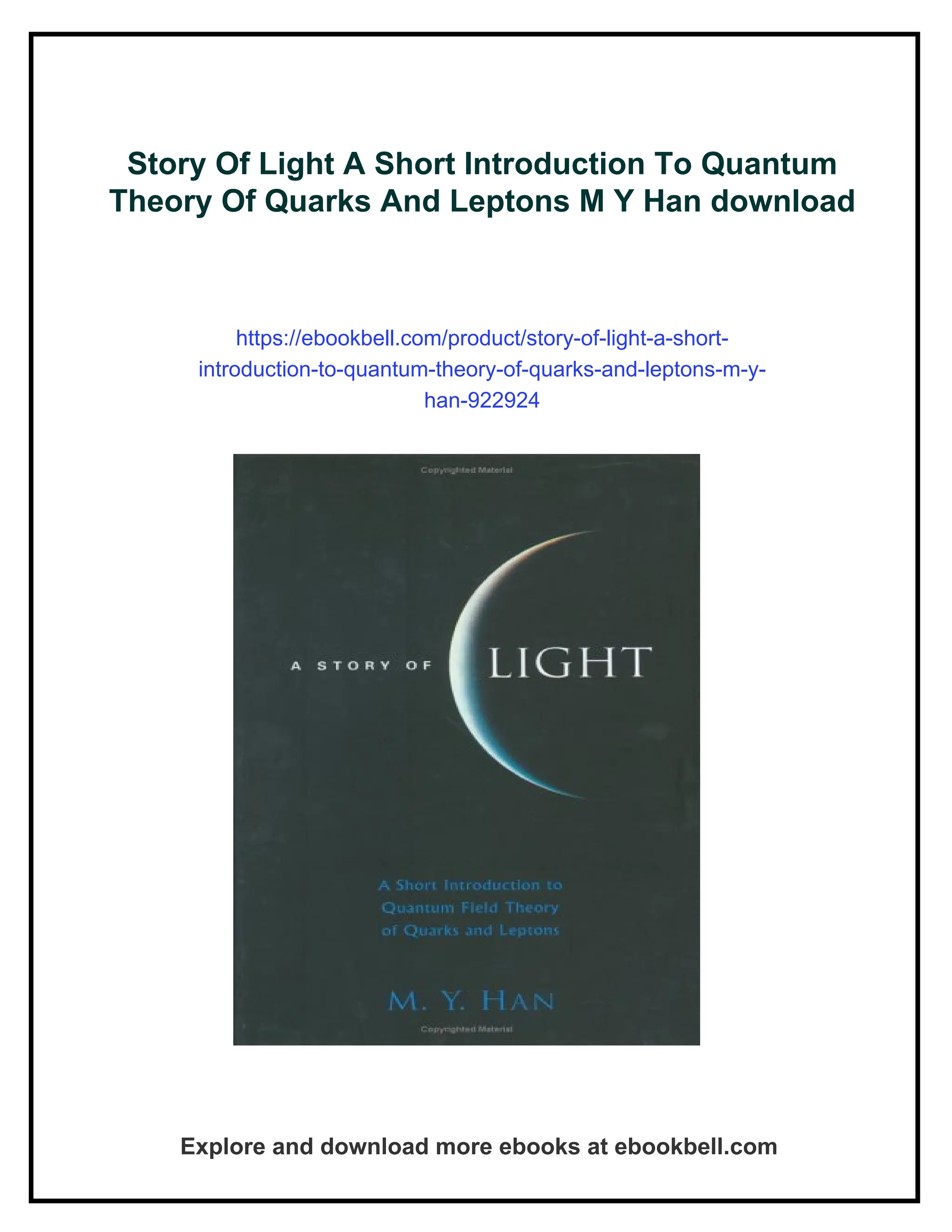
Story Of Light A Short Introduction To Quantum
Theory Of Quarks And Leptons M Y Han download
https://ebookbell.com/product/story-of-light-a-short-
introduction-to-quantum-theory-of-quarks-and-leptons-m-y-
han-922924
Explore and download more ebooks at ebookbell.com
Here are some recommended products that we believe you will be
interested in. You can click the link to download.
On A Beam Of Light A Story Of Albert Einstein Unabridged Berne
https://ebookbell.com/product/on-a-beam-of-light-a-story-of-albert-
einstein-unabridged-berne-11334866
On A Beam Of Light A Story Of Albert Einstein Jennifer Berne
https://ebookbell.com/product/on-a-beam-of-light-a-story-of-albert-
einstein-jennifer-berne-11384446
Little Demon In The City Of Light A True Story Of Murder And Mesmerism
In Belle Epoque Paris 1st Steven Levingston
https://ebookbell.com/product/little-demon-in-the-city-of-light-a-
true-story-of-murder-and-mesmerism-in-belle-epoque-paris-1st-steven-
levingston-5035114
Little Demon In The City Of Light A True Story Of Murder And Mesmerism
In Belle Epoque Paris Levingston
https://ebookbell.com/product/little-demon-in-the-city-of-light-a-
true-story-of-murder-and-mesmerism-in-belle-epoque-paris-
levingston-61641370
Chase Away Cancer A Powerful True Story Of Finding Light In A Dark
Diagnosis 1st Edition Ellie Poole Ewoldt
https://ebookbell.com/product/chase-away-cancer-a-powerful-true-story-
of-finding-light-in-a-dark-diagnosis-1st-edition-ellie-poole-
ewoldt-51630922
Pagoda Of Light A Falun Gong Story From Todays China Yuan Meng
https://ebookbell.com/product/pagoda-of-light-a-falun-gong-story-from-
todays-china-yuan-meng-4418022
Light A Candle A Story Of Chinese American Pioneers On Gold Mountain
Jean Kuo Lee
https://ebookbell.com/product/light-a-candle-a-story-of-chinese-
american-pioneers-on-gold-mountain-jean-kuo-lee-51220824
The Physics Of Invisibility A Story Of Light And Deception 1st Edition
Martin Beech Auth
https://ebookbell.com/product/the-physics-of-invisibility-a-story-of-
light-and-deception-1st-edition-martin-beech-auth-2394788
At First Light A True World War Ii Story Of A Hero His Bravery And An
Amazing Horse Walt Larimore Mike Yorkey
https://ebookbell.com/product/at-first-light-a-true-world-war-ii-
story-of-a-hero-his-bravery-and-an-amazing-horse-walt-larimore-mike-
yorkey-48894790
A STORY OF LIGHT
A Short Introduction to
Quatum Field Theory of Quarks and Leptons
This page intentionally left blank
A S T O R Y O F L I G H T
A sHORT iNTRODUCTION TO
qUANTUM fIELD tHEORY
OF qUARKS AND lEPTONS
m. Y. HAN
Duke University, USA
World Scientific
NEW JERSEY • LONDON • SINGAPORE • BEIJING • SHANGHAI • HONG KONG • TAIPEI • CHENNAI
British Library Cataloguing-in-Publication Data
A catalogue record for this book is available from the British Library.
For photocopying of material in this volume, please pay a copying fee through the Copyright
Clearance Center, Inc., 222 Rosewood Drive, Danvers, MA 01923, USA. In this case permission to
photocopy is not required from the publisher.
ISBN 981-256-034-3
Typeset by Stallion Press
Email: enquiries@stallionpress.com
All rights reserved. This book, or parts thereof, may not be reproduced in any form or by any means,
electronic or mechanical, including photocopying, recording or any information storage and retrieval
system now known or to be invented, without written permission from the Publisher.
Copyright © 2004 by World Scientific Publishing Co. Pte. Ltd.
Published by
World Scientific Publishing Co. Pte. Ltd.
5 Toh Tuck Link, Singapore 596224
USA office: 27 Warren Street, Suite 401-402, Hackensack, NJ 07601
UK office: 57 Shelton Street, Covent Garden, London WC2H 9HE
Printed in Singapore.
A STORY OF LIGHT
An Introduction to Quantum Field Theory of Quarks and Leptons
For Eema, Grace and Leilani
Acknowledgments
I would like to thank my students who insisted that I write this
book after my lectures on the developments in quantum field the-
ory. I would also like to thank Dr. Jaebeom Yoo, a postdoctoral
research associate, and Mr. Chang-Won Lee, a graduate student in
the Physics Department of Duke University, for valuable discussions
and technical help in the preparation of the manuscript. As with
my previous book, Quarks and Gluons, the constant encouragement
from Dr. K.K. Phua, Chairman of World Scientific Publishing Co.
is gratefully acknowledged. Thanks are also due to the dedicated
help of Ms. Lakshmi Narayan, a Senior Editor of World Scientific,
who provided steady and patient guidance toward the completion of
this book.
vi
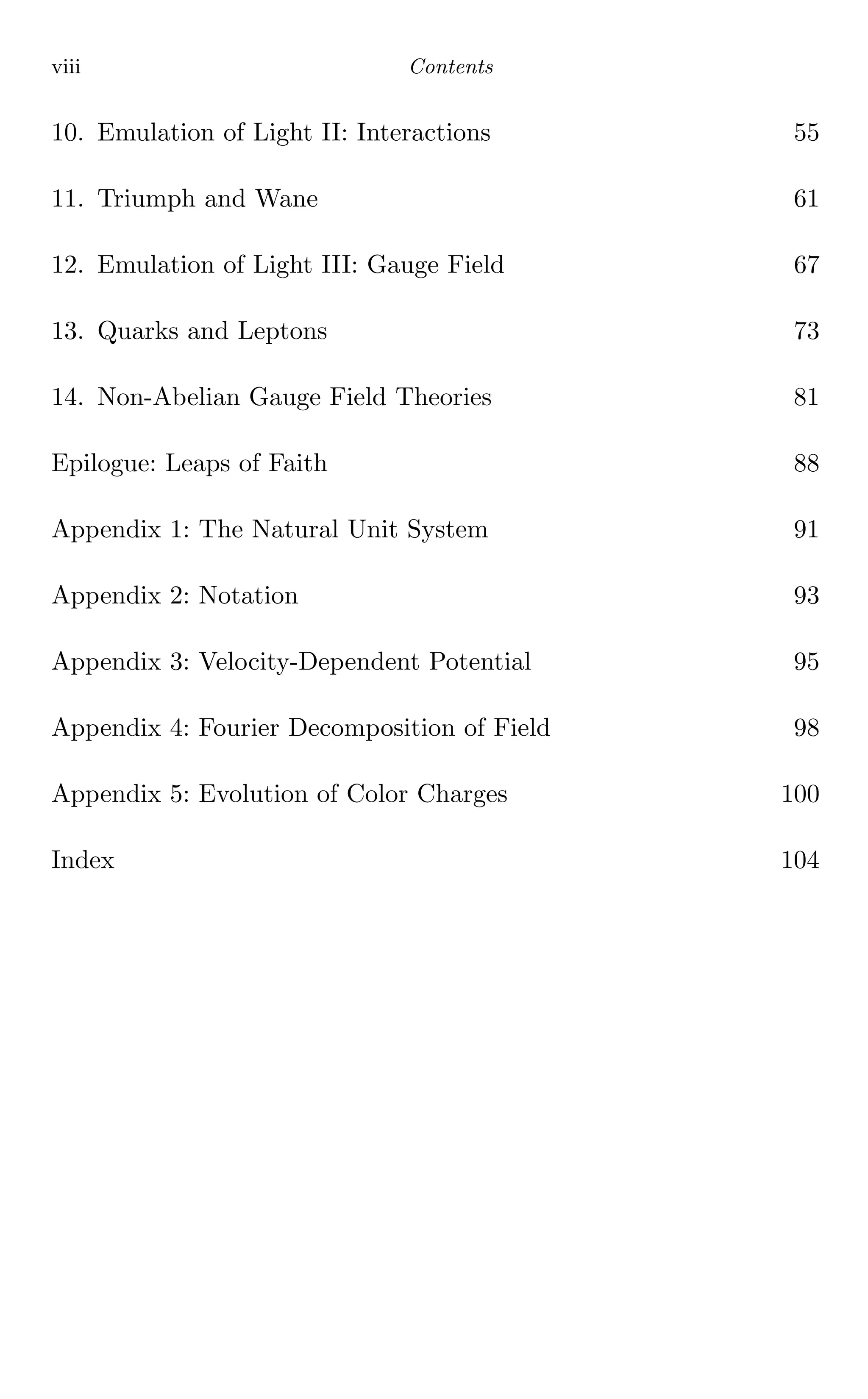
Contents
Prologue 1
1. Particles and Fields I: Dichotomy 5
2. Lagrangian and Hamiltonian Dynamics 10
3. Canonical Quantization 17
4. Particles and Fields II: Duality 22
5. Equations for Duality 26
6. Electromagnetic Field 34
7. Emulation of Light I: Matter Fields 37
8. Road Map for Field Quantization 41
9. Particles and Fields III: Particles as Quanta of Fields 47
vii
viii Contents
10. Emulation of Light II: Interactions 55
11. Triumph and Wane 61
12. Emulation of Light III: Gauge Field 67
13. Quarks and Leptons 73
14. Non-Abelian Gauge Field Theories 81
Epilogue: Leaps of Faith 88
Appendix 1: The Natural Unit System 91
Appendix 2: Notation 93
Appendix 3: Velocity-Dependent Potential 95
Appendix 4: Fourier Decomposition of Field 98
Appendix 5: Evolution of Color Charges 100
Index 104
Prologue
The relativistic quantum field theory, or quantum field theory (QFT)
for short, is the theoretical edifice of the standard model of elemen-
tary particle physics. One might go so far as to say that the standard
model is the quantum field theory. Having said that as the opening
statement of this book, we must be mindful that both quantum field
theory and the standard model of elementary particle physics are
topics that are not necessarily familiar to many individuals. They
are subject areas that are certainly not familiar to those outside the
specialty of elementary particle physics, and in some cases not too
well grasped even by those in the specialty.
The Standard Model of elementary particle physics is a term that
has come into prominence as it became the paradigm of particle
physics for the last three decades. In brief, the standard model aims
to understand and explain three of the four fundamental forces —
the electromagnetic, strong nuclear and weak nuclear — that define
the dynamics of the basic constituents of all known matter in the
universe.1 As such, it consists of two interrelated parts: the part
1
The fourth force of nature, gravity, does not come into play in the scale of the
mass of elementary particles and is not included in the standard model. Attempts
1
2 A Story of Light
that deals with the question of what are the basic building blocks
of matter and the second part concerned with the question of what
is the theoretical framework for describing the interactions among
these fundamental constituents of matter.
A century after the original discovery of quantum of light by
Max Planck in 1900 and its subsequent metamorphosis into photon,
the zero-mass particle of light, by Albert Einstein in 1905, we have
come to identify the basic constituents of matter to be quarks and
leptons — the up, down, strange, charm, top and bottom, for quarks,
and the electron, muon, tauon, electron-type neutrino, muon-type
neutrino, and tauon-type neutrino, for leptons. The three forces are
understood as the exchange of “quanta” of each force — photons for
the electromagnetic force, weak bosons for the weak nuclear force,
and gluons for the strong nuclear force. These particles, some old,
such as photons and electrons and some relatively new, such as the
top and bottom quarks or the tauons and their associated neutrinos,
represent our latest understanding of what are the basic constituents
of known matter in the universe.
There are scores of books available which discuss the basic parti-
cles of matter, at every level of expertise. For a general readership, we
can mention two books that contain no or very little mathematics,
Quarks and Gluons by myself and Facts and Mysteries in Elementary
Particle Physics by Martinus Veltman.2
The theoretical framework for the three forces or interactions is
quantum field theory, that is, the relativistic quantum field theory.
Each force has its own form, and again, some old and some new.
Quantum electrodynamics, QED for short, was fully developed by
the end of the 1940s and is the oldest — and more significantly, the
only truly successful quantum field theory to date — of the family.
Quantum chromodynamics, QCD, is the framework for the strong
nuclear force that is mediated by exchanges of gluons. It was initiated
to merge gravity with the standard model have spawned such ideas as the grand
unified theory, supersymmetry, and supersting, the so-called theory of everything.
These topics are not discussed in this book.
2
Quarks and Gluons by M. Y. Han, World Scientific (1999); Facts and Mysteries
in Elementary Particle Physics by Martinus Veltman, World Scientific (2003).
Prologue 3
in the 1960s and has been continually developed since, but it is far
from becoming a completely successful quantum field theory yet. The
theory for the weak nuclear force, in its modern form, was also started
in the 1960s, and in the 1970s and 1980s, it was merged with quantum
electrodynamics to form a unified quantum field theory in which the
two forces — the electromagnetic and weak nuclear — were “unified”
into a single force referred to as the electroweak force. Often this new
unified theory is referred to as the quantum flavor dynamics, QFD.
Thus, the quantum field theory of the standard model consists of two
independent components — quantum chromodynamics and quantum
flavor dynamics, the latter subsuming quantum electrodynamics.
Despite the abundant availability of books, at all levels, on basic
building blocks of matter, when it comes to the subject of relativistic
quantum field theory, while there are several excellent textbooks at
the graduate level, few resources are available at an undergraduate
level. The reason for this paucity is not difficult to understand. The
subject of quantum field theory is a rather difficult one even for
graduate students in physics. Unless a graduate student is interested
in specializing into elementary particle physics, in fact, most graduate
students are not required to take a course in quantum field theory. It
is definitely a highly specialized course. Quantum field theory thus
remains, while a familiar term, a distant topic. Many have not had the
opportunity to grasp what the subject is all about, and for those with
some rudimentary knowledge of physics at an undergraduate level
beyond the general physics, the subject lies well beyond their reach.
The main purpose of this book is to try to fill this gap by bringing
out the conceptual understanding of the relativistic quantum field
theory, with minimum of mathematical complexities. This book is
not at all intended to be a graduate level textbook, but represents
my attempt to discuss the essential aspects of quantum field theory
requiring only some rudimentary knowledge of the Lagrangian and
Hamiltonian formulation of Newtonian mechanics, special theory of
relativity and quantum mechanics.
There is another theme in this book and it is this. Throughout
the course of development of quantum field theory, from the origi-
nal quantum electrodynamics in which the Planck–Einstein photon
Exploring the Variety of Random
Documents with Different Content
Contents.
Chemical Composition of Bones—Arrangement of Factory—Properties
of Glue—Glutin and Chondrin—Skin Glue—Liming of Skins—Washing
—Boiling of Skins—Clarification of Glue Liquors—Glue-Boiling and
Clarifying-House—Specification of a Glue—Size—Uses and
Preparation and Composition of Size—Concentrated Size—Properties
of Gelatine—Preparation of Skin Gelatine—Drying—Bone Gelatine—
Selecting Bones—Crushing—Dissolving—Bleaching—Boiling—
Properties of Glutin and Chondrin—Testing of Glues and Gelatines—
The Uses of Glue, Gelatine and Size in Various Trades—Soluble and
Liquid Glues—Steam and Waterproof Glues—Manures—Importation
of Food Stuffs—Soils—Germination—Plant Life—Natural Manures—
Water and Nitrogen in Farmyard Manure—Full Analysis of Farmyard
Manure—Action on Crops—Water-Closet System—Sewage Manure—
Green Manures—Artificial Manures—Mineral Manures—
Nitrogenous Matters—Shoddy—Hoofs and Horns—Leather Waste—
Dried Meat—Dried Blood—Superphosphates—Composition—
Manufacture—Common Raw Bones—Degreased Bones—Crude Fat—
Refined Fat—Degelatinised Bones—Animal Charcoal—Bone
Superphosphates—Guanos—Dried Animal Products—Potash
Compounds—Sulphate of Ammonia—Extraction in Vacuo—French
and British Gelatines compared—Index.
Chemicals, Waste Products and
Agricultural Chemistry.
REISSUE OF CHEMICAL ESSAYS OF C. W. SCHEELE. First
Published in English in 1786. Translated from the Academy of
Sciences at Stockholm, with Additions. 300 pp. Demy 8vo. 1901.
Price 5s.; India and Colonies, 5s. 6d.; Other Countries, 6s.;
strictly net.
Contents.
Memoir: C. W. Scheele and his work (written for this edition by J. G.
McIntosh)—On Fluor Mineral and its Acid—On Fluor Mineral—
Chemical Investigation of Fluor Acid, with a View to the Earth which
it Yields, by Mr. Wiegler—Additional Information Concerning Fluor
Minerals—On Manganese, Magnesium, or Magnesia Vitrariorum—On
Arsenic and its Acid—Remarks upon Salts of Benzoin—On Silex, Clay
and Alum—Analysis of the Calculus Vesical—Method of Preparing
Mercurius Dulcis Via Humida—Cheaper and more Convenient Method
of Preparing Pulvis Algarothi—Experiments upon Molybdæna—
Experiments on Plumbago—Method of Preparing a New Green
Colour—Of the Decomposition of Neutral Salts by Unslaked Lime and
Iron—On the Quantity of Pure Air which is Daily Present in our
Atmosphere—On Milk and its Acid—On the Acid of Saccharum Lactis
—On the Constituent Parts of Lapis Ponderosus or Tungsten—
Experiments and Observations on Ether—Index.
THE MANUFACTURE OF ALUM AND THE SULPHATES AND
OTHER SALTS OF ALUMINA AND IRON. Their Uses and
Applications as Mordants in Dyeing and Calico Printing, and their
other Applications in the Arts, Manufactures, Sanitary
Engineering, Agriculture and Horticulture. Translated from the
French of Lucien Geschwind. 195 Illustrations. 400 pp. Royal 8vo.
1901. Price 12s. 6d.; India and Colonies, 13s. 6d.; Other
Countries, 15s.; strictly net.
Contents.
Theoretical Study of Aluminium, Iron, and Compounds of
these Metals—Aluminium and its Compounds—Iron and Iron
Compounds.
Manufacture of Aluminium Sulphates and Sulphates of Iron
—Manufacture of Aluminium Sulphate and the Alums—Manufacture
of Sulphates of Iron.
Uses of the Sulphates of Aluminium and Iron—Uses of
Aluminium Sulphate and Alums—Application to Wool and Silk—
Preparing and using Aluminium Acetates—Employment of Aluminium
Sulphate in Carbonising Wool—The Manufacture of Lake Pigments—
Manufacture of Prussian Blue—Hide and Leather Industry—Paper
Making—Hardening Plaster—Lime Washes—Preparation of Non-
inflammable Wood, etc.—Purification of Waste Waters—Uses and
Applications of Ferrous Sulphate and Ferric Sulphates—
Dyeing—Manufacture of Pigments—Writing Inks—Purification of
Lighting Gas—Agriculture—Cotton Dyeing—Disinfectant—Purifying
Waste Liquors—Manufacture of Nordhausen Sulphuric Acid—
Fertilising.
Chemical Characteristics of Iron and Aluminium—Analysis of
Various Aluminous or Ferruginous Products—Aluminium—
Analysing Aluminium Products—Alunite Alumina—Sodium
Aluminate—Aluminium Sulphate—Iron—Analytical Characteristics of
Iron Salts—Analysis of Pyritic Lignite—Ferrous and Ferric Sulphates—
Rouil Mordant—Index.
AMMONIA AND ITS COMPOUNDS: Their Manufacture and Uses.
By Camille Vincent, Professor at the Central School of Arts and
Manufactures, Paris. Translated from the French by M. J. Salter.
Royal 8vo. 114 pp. 1901. Thirty-two Illustrations. Price 5s.;
India and Colonies, 5s. 6d.; Other Countries, 6s.; strictly net.
Contents.
General Considerations: Various Sources of Ammoniacal
Products; Human Urine as a Source of Ammonia—Extraction of
Ammoniacal Products from Sewage—Extraction of Ammonia
from Gas Liquor—Manufacture of Ammoniacal Compounds
from Bones, Nitrogenous Waste, Beetroot Wash and Peat—
Manufacture of Caustic Ammonia, and Ammonium Chloride,
Phosphate and Carbonate—Recovery of Ammonia from the
Ammonia-Soda Mother Liquors—Index.
ANALYSIS OF RESINS AND BALSAMS. Translated from the
German of Dr. Karl Dieterich. Demy 8vo. 340 pp. 1901. Price 7s.
6d.; India and Colonies, 8s.; Other Countries, 8s. 6d.; strictly
net.
Contents.
Definition of Resins in General—Definition of Balsams, and especially
the Gum Resins—External and Superficial Characteristics of Resinous
Bodies—Distinction between Resinous Bodies and Fats and Oils—
Origin, Occurrence and Collection of Resinous Substances—
Classification—Chemical Constituents of Resinous Substances—
Resinols—Resinot Annols—Behaviour of Resin Constituents towards
the Cholesterine Reactions—Uses and Identification of Resins—
Melting-point—Solvents—Acid Value—Saponification Value—Resin
Value—Ester and Ether Values—Acetyl and Corbonyl Value—Methyl
Value—Resin Acid—Systematic Résumé of the Performance of the
Acid and Saponification Value Tests.
Balsams—Introduction—Definitions—Canada Balsam—Copaiba
Balsam—Angostura Copaiba Balsam—Babia Copaiba Balsam—
Carthagena Copaiba Balsam—Maracaibo Copaiba Balsam—Maturin
Copaiba Balsam—Gurjum Copaiba Balsam—Para Copaiba Balsam—
Surinam Copaiba Balsam—West African Copaiba Balsam—Mecca
Balsam—Peruvian Balsam—Tolu Balsam—Acaroid Resin—Amine—
Amber—African and West Indian Kino—Bengal Kino—Labdanum—
Mastic—Pine Resin—Sandarach—Scammonium—Shellac—Storax—
Adulteration of Styrax Liquidus Crudus—Purified Storax—Styrax
Crudus Colatus—Tacamahac—Thapsia Resin—Turpentine—Chios
Turpentine—Strassburg Turpentine—Turpeth Turpentine. Gum
Resins—Ammoniacum—Bdellium—Euphorbium—Galbanum—
Gamboge—Lactucarium—Myrrh—Opopanax—Sagapenum—Olibanum
or Incense—Acaroid Resin—Amber—Thapsia Resin—Index.
MANUAL OF AGRICULTURAL CHEMISTRY. By Herbert Ingle,
F.I.C., Lecturer on Agricultural Chemistry, the Yorkshire College;
Lecturer in the Victoria University. 388 pp. 11 Illustrations. 1902.
Demy 8vo. Price 7s. 6d.; India and Colonies, 8s.; Other
Countries, 8s. 6d. net.
Contents.
Introduction—The Atmosphere—The Soil—The Reactions occurring in
Soils—The Analysis of Soils—Manures, Natural—Manures (continued)
—The Analysis of Manures—The Constituents of Plants—The Plant—
Crops—The Animal—Foods and Feeding—Milk and Milk Products—
The Analysis of Milk and Milk Products—Miscellaneous Products used
in Agriculture—Appendix—Index.
THE UTILISATION OF WASTE PRODUCTS. A Treatise on the
Rational Utilisation, Recovery and Treatment of Waste Products
of all kinds. By Dr. Theodor Koller. Translated from the Second
Revised German Edition. Twenty-two Illustrations. Demy 8vo.
280 pp. 1902. Price 7s. 6d.; India and Colonies, 8s.; Other
Countries, 8s. 6d.; strictly net.
Contents.
The Waste of Towns—Ammonia and Sal-Ammoniac—Rational
Processes for Obtaining these Substances by Treating Residues and
Waste—Residues in the Manufacture of Aniline Dyes—Amber Waste
—Brewers’ Waste—Blood and Slaughter-House Refuse—
Manufactured Fuels—Waste Paper and Bookbinders’ Waste—Iron
Slags—Excrement—Colouring Matters from Waste—Dyers’ Waste
Waters—Fat from Waste—Fish Waste—Calamine Sludge—Tannery
Waste—Gold and Silver Waste—India-rubber and Caoutchouc Waste
—Residues in the Manufacture of Rosin Oil—Wood Waste—Horn
Waste—Infusorial Earth—Iridium from Goldsmiths’ Sweepings—Jute
Waste—Cork Waste—Leather Waste—Glue Makers’ Waste—
Illuminating Gas from Waste and the By-Products of the Manufacture
of Coal Gas—Meerschum—Molasses—Metal Waste—By-Products in
the Manufacture of Mineral Waters—Fruit—The By-Products of Paper
and Paper Pulp Works—By-Products in the Treatment of Coal Tar Oils
—Fur Waste—The Waste Matter in the Manufacture of Parchment
Paper—Mother of Pearl Waste—Petroleum Residues—Platinum
Residues—Broken Porcelain. Earthenware and Glass—Salt Waste—
Slate Waste—Sulphur—Burnt Pyrites—Silk Waste—Soap Makers’
Waste—Alkali Waste and the Recovery of Soda—Waste Produced in
Grinding Mirrors—Waste Products in the Manufacture of Starch—
Stearic Acid—Vegetable Ivory Waste—Turf—Waste Waters of Cloth
Factories—Wine Residues—Tinplate Waste—Wool Waste—Wool
Sweat—The Waste Liquids from Sugar Works—Index.
Writing Inks and Sealing Waxes.
INK MANUFACTURE: Including Writing, Copying, Lithographic,
Marking, Stamping, and Laundry Inks. By Sigmund Lehner. Three
Illustrations. Crown 8vo. 162 pp. 1902. Translated from the
German of the Fifth Edition. Price 5s.; India and Colonies, 5s.
6d.; Other Countries, 6s.; net.
Contents.
Varieties of Ink—Writing Inks—Raw Materials of Tannin Inks—The
Chemical Constitution of the Tannin Inks—Recipes for Tannin Inks—
Logwood Tannin Inks—Ferric Inks—Alizarine Inks—Extract Inks—
Logwood Inks—Copying Inks—Hektographs—Hektograph Inks—
Safety Inks—Ink Extracts and Powders—Preserving Inks—Changes in
Ink and the Restoration of Faded Writing—Coloured Inks—Red Inks
—Blue Inks—Violet Inks—Yellow Inks—Green Inks—Metallic Inks—
Indian Ink—Lithographic Inks and Pencils—Ink Pencils—Marking Inks
—Ink Specialities—Sympathetic Inks—Stamping Inks—Laundry or
Washing Blue—Index.
SEALING-WAXES, WAFERS AND OTHER ADHESIVES FOR
THE HOUSEHOLD, OFFICE, WORKSHOP AND FACTORY.
By H. C. Standage. Crown 8vo. 96 pp. 1902. Price 5s.; India and
Colonies, 5s. 6d.; Other Countries, 6s.; strictly net.
Contents.
Materials Used for Making Sealing-Waxes—The Manufacture of
Sealing-Waxes—Wafers—Notes on the Nature of the Materials Used
in Making Adhesive Compounds—Cements for Use in the Household
—Office Gums, Pastes and Mucilages—Adhesive Compounds for
Factory and Workshop Use.
Lead Ores and Compounds.
LEAD AND ITS COMPOUNDS. By Thos. Lambert, Technical and
Consulting Chemist. Demy 8vo. 226 pp. Forty Illustrations.
1902. Price 7s. 6d.; India and Colonies, 8s.; Other Countries, 8s.
6d.; net. Plans and Diagrams.
Contents.
History—Ores of Lead—Geographical Distribution of the Lead
Industry—Chemical and Physical Properties of Lead—Alloys of Lead—
Compounds of Lead—Dressing of Lead Ores—Smelting of Lead Ores
—Smelting in the Scotch or American Ore-hearth—Smelting in the
Shaft or Blast Furnace—Condensation of Lead Fume—
Desilverisation, or the Separation of Silver from Argentiferous Lead—
Cupellation—The Manufacture of Lead Pipes and Sheets—Protoxide
of Lead—Litharge and Massicot—Red Lead or Minium—Lead
Poisoning—Lead Substitutes—Zinc and its Compounds—Pumice
Stone—Drying Oils and Siccatives—Oil of Turpentine Resin—
Classification of Mineral Pigments—Analysis of Raw and Finished
Products—Tables—Index.
NOTES ON LEAD ORES: Their Distribution and Properties. By Jas.
Fairie, F.G.S. Crown 8vo. 1901. 64 pages. Price 2s. 6d.; Abroad,
3s.; strictly net.
Industrial Hygiene.
THE RISKS AND DANGERS TO HEALTH OF VARIOUS
OCCUPATIONS AND THEIR PREVENTION. By Leonard A.
Parry, M.D., B.S. (Lond.). 196 pp. Demy 8vo. 1900. Price 7s.
6d.; India and Colonies, 8s.; Other Countries, 8s. 6d.; strictly
net.
Contents.
Occupations which are Accompanied by the Generation and
Scattering of Abnormal Quantities of Dust—Trades in which there is
Danger of Metallic Poisoning—Certain Chemical Trades—Some
Miscellaneous Occupations—Trades in which Various Poisonous
Vapours are Inhaled—General Hygienic Considerations—Index.
Industrial Uses of Air, Steam and
Water.
DRYING BY MEANS OF AIR AND STEAM. Explanations,
Formulæ, and Tables for Use in Practice. Translated from the
German of E. Hausbrand. Two folding Diagrams and Thirteen
Tables. Crown 8vo. 1901. 72 pp. Price 5s.; India and Colonies,
5s. 6d.; Other Countries, 6s.; strictly net.
Contents.
British and Metric Systems Compared—Centigrade and Fahr.
Thermometers—Estimation of the Maximum Weight of Saturated
Aqueous Vapour which can be contained in 1 kilo. of Air at Different
Pressure and Temperatures—Calculation of the Necessary Weight
and Volume of Air, and of the Least Expenditure of Heat, per Drying
Apparatus with Heated Air, at the Atmospheric Pressure: A, With the
Assumption that the Air is Completely Saturated with Vapour both
before Entry and after Exit from the Apparatus—B, When the
Atmospheric Air is Completely Saturated before entry, but at its exit
is only ¾, ½ or ¼ Saturated—C, When the Atmospheric Air is not
Saturated with Moisture before Entering the Drying Apparatus—
Drying Apparatus, in which, in the Drying Chamber, a Pressure is
Artificially Created, Higher or Lower than that of the Atmosphere—
Drying by Means of Superheated Steam, without Air—Heating
Surface, Velocity of the Air Current, Dimensions of the Drying Room,
Surface of the Drying Material, Losses of Heat—Index.
(See also “Evaporating, Condensing and Cooling Apparatus,” p. 27.)
PURE AIR, OZONE AND WATER. A Practical Treatise of their
Utilisation and Value in Oil, Grease, Soap, Paint, Glue and other
Industries. By W. B. Cowell. Twelve Illustrations. Crown 8vo. 85
pp. 1900. Price 5s.; India and Colonies, 5s. 6d.; Other
Countries, 6s.; strictly net.
Contents.
Atmospheric Air; Lifting of Liquids; Suction Process; Preparing Blown
Oils; Preparing Siccative Drying Oils—Compressed Air; Whitewash—
Liquid Air; Retrocession—Purification of Water; Water Hardness—
Fleshings and Bones—Ozonised Air in the Bleaching and Deodorising
of Fats, Glues, etc.; Bleaching Textile Fibres—Appendix: Air and
Gases; Pressure of Air at Various Temperatures; Fuel; Table of
Combustibles; Saving of Fuel by Heating Feed Water; Table of
Solubilities of Scale Making Minerals; British Thermal Units Tables;
Volume of the Flow of Steam into the Atmosphere; Temperature of
Steam—Index.
THE INDUSTRIAL USES OF WATER. COMPOSITION—
EFFECTS—TROUBLES—REMEDIES-RESIDUARY WATERS
—PURIFICATION—ANALYSIS. By H. de la Coux. Royal 8vo.
Translated from the French and Revised by Arthur Morris. 364
pp. 135 Illustrations. 1903. Price 10s. 6d.; Colonies, 11s.; Other
Countries, 12s.; strictly net.
Contents.
Chemical Action of Water in Nature and in Industrial Use—
Composition of Waters—Solubility of Certain Salts in Water
Considered from the Industrial Point of View—Effects on the Boiling
of Water—Effects of Water in the Industries—Difficulties with Water
—Feed Water for Boilers—Water in Dyeworks, Print Works, and
Bleach Works—Water in the Textile Industries and in Conditioning—
Water in Soap Works—Water in Laundries and Washhouses—Water
in Tanning—Water in Preparing Tannin and Dyewood Extracts—Water
in Papermaking—Water in Photography—Water in Sugar Refining—
Water in Making Ices and Beverages—Water in Cider Making—Water
in Brewing—Water in Distilling—Preliminary Treatment and
Apparatus—Substances Used for Preliminary Chemical Purification—
Commercial Specialities and their Employment—Precipitation of
Matters in Suspension in Water—Apparatus for the Preliminary
Chemical Purification of Water—Industrial Filters—Industrial
Sterilisation of Water—Residuary Waters and their Purification—Soil
Filtration—Purification by Chemical Processes—Analyses—Index.
(See Books on Smoke Prevention, Engineering and Metallurgy, p. 26,
etc.)
X Rays.
PRACTICAL X RAY WORK. By Frank T. Addyman, B.Sc. (Lond.),
F.I.C., Member of the Roentgen Society of London;
Radiographer to St. George’s Hospital; Demonstrator of Physics
and Chemistry, and Teacher of Radiography in St. George’s
Hospital Medical School. Demy 8vo. Twelve Plates from
Photographs of X Ray Work. Fifty-two Illustrations. 200 pp.
1901. Price 10s. 6d.; India and Colonies, 11s.; Other Countries,
12s.; strictly net.
Contents.
Historical—Work leading up to the Discovery of the X Rays—The
Discovery—Apparatus and its Management—Electrical Terms—
Sources of Electricity—Induction Coils—Electrostatic Machines—
Tubes—Air Pumps—Tube Holders and Stereoscopic Apparatus—
Fluorescent Screens—Practical X Ray Work—Installations—
Radioscopy—Radiography—X Rays in Dentistry—X Rays in Chemistry
—X Rays in War—Index.
List of Plates.
Frontispiece—Congenital Dislocation of Hip-Joint.—I., Needle in
Finger.—II., Needle in Foot.—III., Revolver Bullet in Calf and Leg.—
IV., A Method of Localisation.—V., Stellate Fracture of Patella showing
shadow of “Strapping”.—VI., Sarcoma.—VII., Six-weeks-old Injury to
Elbow showing new Growth of Bone.—VIII., Old Fracture of Tibia
and Fibula badly set.—IX., Heart Shadow.—X., Fractured Femur
showing Grain of Splint.—XI., Barrell’s Method of Localisation.
India-Rubber and Gutta Percha.
INDIA-RUBBER AND GUTTA PERCHA. Translated from the
French of T. Seeligmann, G. Lamy Torvilhon and H. Falconnet by
John Geddes Mcintosh. Royal 8vo. Eighty-six Illustrations. Three
Plates. 412 pages. 1903. Price 12s. 6d.; India and Colonies, 13s.
6d.; Other Countries, 15s.; strictly net.
Contents.
India-Rubber—Botanical Origin—Climatology—Soil—Rational
Culture and Acclimation of the Different Species of India-Rubber
Plants—Methods of Obtaining the Latex—Methods of Preparing Raw
or Crude India-Rubber—Classification of the Commercial Species of
Raw Rubber—Physical and Chemical Properties of the Latex and of
India-Rubber—Mechanical Transformation of Natural Caoutchouc into
Washed or Normal Caoutchouc (Purification) and Normal Rubber into
Masticated Rubber—Softening, Cutting, Washing, Drying—
Preliminary Observations—Vulcanisation of Normal Rubber—
Chemical and Physical Properties of Vulcanised Rubber—General
Considerations—Hardened Rubber or Ebonite—Considerations on
Mineralisation and other Mixtures—Coloration and Dyeing—Analysis
of Natural or Normal Rubber and Vulcanised Rubber—Rubber
Substitutes—Imitation Rubber.
Gutta Percha—Botanical Origin—Climatology—Soil—Rational
Culture—Methods of Collection—Classification of the Different
Species of Commercial Gutta Percha—Physical and Chemical
Properties—Mechanical Transformation—Methods of Analysing—
Gutta Percha Substitutes—Index.
Leather Trades.
PRACTICAL TREATISE ON THE LEATHER INDUSTRY. By A. M.
Villon. Translated by Frank T. Addyman, B.Sc. (Lond.), F.I.C.,
F.C.S.; and Corrected by an Eminent Member of the Trade. 500
pp., royal 8vo. 1901. 123 Illustrations. Price 21s.; India and
Colonies, 22s.; Other Countries, 23s. 6d.; strictly net.
Contents.
Preface—Translator’s Preface—List of Illustrations.
Part I., Materials used in Tanning—Skins: Skin and its Structure;
Skins used in Tanning; Various Skins and their Uses—Tannin and
Tanning Substances: Tannin; Barks (Oak); Barks other than Oak;
Tanning Woods; Tannin-bearing Leaves; Excrescences; Tan-bearing
Fruits; Tan-bearing Roots and Bulbs; Tanning Juices; Tanning
Substances used in Various Countries; Tannin Extracts; Estimation of
Tannin and Tannin Principles.
Part II., Tanning—The Installation of a Tannery: Tan Furnaces;
Chimneys, Boilers, etc.; Steam Engines—Grinding and Trituration of
Tanning Substances: Cutting up Bark; Grinding Bark; The Grinding of
Tan Woods; Powdering Fruit, Galls and Grains; Notes on the Grinding
of Bark—Manufacture of Sole Leather: Soaking; Sweating and
Unhairing; Plumping and Colouring; Handling; Tanning; Tanning
Elephants’ Hides; Drying; Striking or Pinning—Manufacture of
Dressing Leather: Soaking; Depilation; New Processes for the
Depilation of Skins; Tanning; Cow Hides; Horse Hides; Goat Skins;
Manufacture of Split Hides—On Various Methods of Tanning:
Mechanical Methods; Physical Methods; Chemical Methods; Tanning
with Extracts—Quantity and Quality; Quantity; Net Cost; Quality of
Leather—Various Manipulations of Tanned Leather: Second Tanning;
Grease Stains; Bleaching Leather; Waterproofing Leather; Weighting
Tanned Leather; Preservation of Leather—Tanning Various Skins.
Part III., Currying—Waxed Calf: Preparation; Shaving; Stretching or
Slicking; Oiling the Grain; Oiling the Flesh Side; Whitening and
Graining; Waxing; Finishing; Dry Finishing; Finishing in Colour; Cost
—White Calf: Finishing in White—Cow Hide for Upper Leathers:
Black Cow Hide; White Cow Hide; Coloured Cow Hide—Smooth Cow
Hide—Black Leather—Miscellaneous Hides: Horse; Goat; Waxed Goat
Skin; Matt Goat Skin—Russia Leather: Russia Leather; Artificial
Russia Leather.
Part IV., Enamelled, Hungary and Chamoy Leather, Morocco,
Parchment, Furs and Artificial Leather—Enamelled Leather:
Varnish Manufacture; Application of the Enamel; Enamelling in
Colour—Hungary Leather: Preliminary; Wet Work or Preparation;
Aluming; Dressing or Loft Work; Tallowing; Hungary Leather from
Various Hides—Tawing: Preparatory Operations; Dressing; Dyeing
Tawed Skins; Rugs—Chamoy Leather—Morocco: Preliminary
Operations; Morocco Tanning; Mordants used in Morocco
Manufacture; Natural Colours used in Morocco Dyeing; Artificial
Colours; Different Methods of Dyeing; Dyeing with Natural Colours;
Dyeing with Aniline Colours; Dyeing with Metallic Salts; Leather
Printing; Finishing Morocco; Shagreen; Bronzed Leather—Gilding and
Silvering: Gilding; Silvering; Nickel and Cobalt—Parchment—Furs and
Furriery: Preliminary Remarks; Indigenous Furs; Foreign Furs from
Hot Countries; Foreign Furs from Cold Countries; Furs from Birds’
Skins; Preparation of Furs; Dressing; Colouring; Preparation of Birds’
Skins; Preservation of Furs—Artificial Leather: Leather made from
Scraps; Compressed Leather; American Cloth; Papier Mâché;
Linoleum; Artificial Leather.
Part V., Leather Testing and the Theory of Tanning—Testing
and Analysis of Leather: Physical Testing of Tanned Leather;
Chemical Analysis—The Theory of Tanning and the other Operations
of the Leather and Skin Industry: Theory of Soaking; Theory of
Unhairing; Theory of Swelling; Theory of Handling; Theory of
Tanning; Theory of the Action of Tannin on the Skin; Theory of
Hungary Leather Making; Theory of Tawing; Theory of Chamoy
Leather Making; Theory of Mineral Tanning.
Part VI., Uses of Leather—Machine Belts: Manufacture of Belting;
Leather Chain Belts; Various Belts; Use of Belts—Boot and Shoe-
making: Boots and Shoes; Laces—Saddlery: Composition of a
Saddle; Construction of a Saddle—Harness: The Pack Saddle;
Harness—Military Equipment-Glove Making—Carriage Building—
Mechanical Uses.
Appendix, The World’s Commerce in Leather—Europe; America;
Asia; Africa; Australasia—Index.
THE LEATHER WORKER’S MANUAL. Being a Compendium of
Practical Recipes and Working Formulæ for Curriers,
Bootmakers, Leather Dressers, Blacking Manufacturers,
Saddlers, Fancy Leather Workers. By H. C. Standage. 165 pp.
1900. Price 7s. 6d.; India and Colonies, 8s.; Other Countries, 8s.
6d.; strictly net.
Contents.
Blackings, Polishes, Glosses, Dressings, Renovators, etc., for Boot
and Shoe Leather—Harness Blackings, Dressings, Greases,
Compositions, Soaps, and Boot-top Powders and Liquids, etc., etc.—
Leather Grinders’ Sundries—Currier’s Seasonings, Blacking
Compounds, Dressings, Finishes, Glosses, etc.—Dyes and Stains for
Leather—Miscellaneous Information—Chrome Tannage—Index.
Books on Pottery, Bricks, Tiles,
Glass, etc.
THE MANUAL OF PRACTICAL POTTING. Compiled by Experts,
and Edited by Chas. F. Binns. Revised Third Edition and Enlarged.
200 pp. 1901. Price 17s. 6d.; India and Colonies, 18s. 6d.;
Other Countries, 20s.; strictly net.
Contents.
Introduction. The Rise and Progress of the Potter’s Art—Bodies.
China and Porcelain Bodies, Parian Bodies, Semi-porcelain and
Vitreous Bodies, Mortar Bodies, Earthenwares Granite and C.C.
Bodies, Miscellaneous Bodies, Sagger and Crucible Clays, Coloured
Bodies, Jasper Bodies, Coloured Bodies for Mosaic Painting,
Encaustic Tile Bodies, Body Stains, Coloured Dips—Glazes. China
Glazes, Ironstone Glazes, Earthenware Glazes, Glazes without Lead,
Miscellaneous Glazes, Coloured Glazes, Majolica Colours—Gold and
Gold Colours. Gold, Purple of Cassius, Marone and Ruby, Enamel
Coloured Bases, Enamel Colour Fluxes, Enamel Colours, Mixed
Enamel Colours, Antique and Vellum Enamel Colours, Underglaze
Colours, Underglaze Colour Fluxes, Mixed Underglaze Colours, Flow
Powders, Oils and Varnishes—Means and Methods. Reclamation of
Waste Gold, The Use of Cobalt, Notes on Enamel Colours, Liquid or
Bright Gold—Classification and Analysis. Classification of Clay
Ware, Lord Playfair’s Analysis of Clays, The Markets of the World,
Time and Scale of Firing, Weights of Potter’s Material, Decorated
Goods Count—Comparative Loss of Weight of Clays—Ground Felspar
Calculations—The Conversion of Slop Body Recipes into Dry Weight—
The Cost of Prepared Earthenware Clay—Forms and Tables.
Articles of Apprenticeship, Manufacturer’s Guide to Stocktaking,
Table of Relative Values of Potter’s Materials, Hourly Wages Table,
Workman’s Settling Table, Comparative Guide for Earthenware and
China Manufacturers in the use of Slop Flint and Slop Stone, Foreign
Terms applied to Earthenware and China Goods, Table for the
Conversion of Metrical Weights and Measures on the Continent and
South America—Index.
CERAMIC TECHNOLOGY: Being some Aspects of Technical
Science as Applied to Pottery Manufacture. Edited by Charles F.
Binns. 100 pp. Demy 8vo. 1897. Price 12s. 6d.; India and
Colonies, 13s. 6d.; Other Countries, 15s.; strictly net.
Contents.
Preface—The Chemistry of Pottery—Analysis and Synthesis—Clays
and their Components—The Biscuit Oven—Pyrometry—Glazes and
their Composition—Colours and Colour-making—Index.
A TREATISE ON THE CERAMIC INDUSTRIES. A Complete
Manual for Pottery, Tile and Brick Works. By Emile Bourry.
Translated from the French by Wilton P. Rix, Examiner in Pottery
and Porcelain to the City and Guilds of London Technical
Institute, Pottery Instructor to the Hanley School Board. Royal
8vo. 1901. 760 pp. 323 Illustrations. Price 21s.; India and
Colonies, 22s.; Other Countries, 23s. 6d.; strictly net.
Contents.
Part I., General Pottery Methods. Definition and History.
Definitions and Classification of Ceramic Products—Historic Summary
of the Ceramic Art—Raw Materials of Bodies. Clays: Pure Clay and
Natural Clays—Various Raw Materials: Analogous to Clay—
Agglomerative and Agglutinative—Opening—Fusible—Refractory—
Trials of Raw Materials—Plastic Bodies. Properties and Composition—
Preparation of Raw Materials: Disaggregation—Purification—
Preparation of Bodies: By Plastic Method—By Dry Method—By Liquid
Method—Formation. Processes of Formation: Throwing—Expression
—Moulding by Hand, on the Jolley, by Compression, by Slip Casting
—Slapping—Slipping—Drying. Drying of Bodies—Processes of
Drying: By Evaporation—By Aeration—By Heating—By Ventilation—
By Absorption—Glazes. Composition and Properties—Raw Materials—
Manufacture and Application—Firing. Properties of the Bodies and
Glazes during Firing—Description of the Kilns—Working of the Kilns—
Decoration. Colouring Materials—Processes of Decoration.
Part II., Special Pottery Methods. Terra Cottas. Classification:
Plain Ordinary, Hollow, Ornamental, Vitrified, and Light Bricks—
Ordinary and Black Tiles—Paving Tiles—Pipes—Architectural Terra
Cottas—Vases, Statues and Decorative Objects—Common Pottery—
Pottery for Water and Filters—Tobacco Pipes—Lustre Ware—
Properties and Tests for Terra Cottas—Fireclay Goods. Classification:
Argillaceous, Aluminous, Carboniferous, Silicious and Basic Fireclay
Goods—Fireclay Mortar (Pug)—Tests for Fireclay Goods—Faiences.
Varnished Faiences—Enamelled Faiences—Silicious Faiences—
Pipeclay Faiences—Pebble Work—Feldspathic Faiences—Composition,
Processes of Manufacture and General Arrangements of Faience
Potteries—Stoneware. Stoneware Properly So-called: Paving Tiles—
Pipes—Sanitary Ware—Stoneware for Food Purposes and Chemical
Productions—Architectural Stoneware—Vases, Statues and other
Decorative Objects—Fine Stoneware—Porcelain. Hard Porcelain for
Table Ware and Decoration, for the Fire, for Electrical Conduits, for
Mechanical Purposes; Architectural Porcelain, and Dull or Biscuit
Porcelain—Soft Phosphated or English Porcelain—Soft Vitreous
Porcelain, French and New Sèvres—Argillaceous Soft or Seger’s
Porcelain—Dull Soft or Parian Porcelain—Dull Feldspathic Soft
Porcelain—Index.
ARCHITECTURAL POTTERY. Bricks, Tiles, Pipes, Enamelled Terra-
cottas, Ordinary and Incrusted Quarries, Stoneware Mosaics,
Faïences and Architectural Stoneware. By Leon Lefêvre. With Five
Plates. 950 Illustrations in the Text, and numerous estimates.
500 pp., royal 8vo. 1900. Translated from the French by K. H.
Bird, M.A., and W. Moore Binns. Price 15s.; India and Colonies,
16s.; Other Countries, 17s. 6d.; strictly net.
Contents.
Part I. Plain Undecorated Pottery.—Clays, Bricks, Tiles, Pipes,
Chimney Flues, Terra-cotta.
Part II. Made-up or Decorated Pottery.
THE ART OF RIVETING GLASS, CHINA AND EARTHENWARE.
By J. Howarth. Second Edition. 1900. Paper Cover. Price 1s. net;
by post, home or abroad, 1s. 1d.
HOW TO ANALYSE CLAY. Practical Methods for Practical Men. By
Holden M. Ashby, Professor of Organic Chemistry, Harvey Medical
College, U.S.A. 74 pp. Twenty Illus. 1901. Price 2s. 6d.; Abroad,
3s.; strictly net.
NOTES ON POTTERY CLAYS. Their Distribution, Properties, Uses
and Analyses of Ball Clays, China Clays and China Stone. By Jas.
Fairie, F.G.S. 1901. 132 pp. Crown 8vo. Price 3s. 6d.; India and
Colonies, 4s.; Other Countries, 4s. 6d.; strictly net.
A Reissue of THE HISTORY OF THE STAFFORDSHIRE
POTTERIES; AND THE RISE AND PROGRESS OF THE
MANUFACTURE OF POTTERY AND PORCELAIN. With
References to Genuine Specimens, and Notices of Eminent
Potters. By Simeon Shaw. (Originally Published in 1829.) 265 pp.
1900. Demy 8vo. Price 7s. 6d.; India and Colonies, 8s.; Other
Countries, 8s. 6d.; strictly net.
Contents.
Introductory Chapter showing the position of the Pottery Trade at
the present time (1899)—Preliminary Remarks—The Potteries,
comprising Tunstall, Brownhills, Greenfield and New Field, Golden
Hill, Latebrook, Green Lane, Burslem, Longport and Dale Hall, Hot
Lane and Cobridge, Hanley and Shelton, Etruria, Stoke, Penkhull,
Fenton, Lane Delph, Foley, Lane End—On the Origin of the Art,
and its Practice among the early Nations—Manufacture of
Pottery, prior to 1700—The Introduction of Red Porcelain by
Messrs. Elers, of Bradwell, 1690—Progress of the Manufacture
from 1700 to Mr. Wedgwood’s commencement in 1760—
Introduction of Fluid Glaze—Extension of the Manufacture of
Cream Colour—Mr. Wedgwood’s Queen’s Ware—Jasper, and
Appointment of Potter to Her Majesty—Black Printing—
Introduction of Porcelain. Mr. W. Littler’s Porcelain—Mr.
Cookworthy’s Discovery of Kaolin and Petuntse, and Patent—Sold to
Mr. Champion—resold to the New Hall Com.—Extension of Term—
Blue Printed Pottery. Mr. Turner, Mr. Spode (1), Mr. Baddeley, Mr.
Spode (2), Messrs. Turner, Mr. Wood, Mr. Wilson, Mr. Minton—Great
Change in Patterns of Blue Printed—Introduction of Lustre
Pottery. Improvements in Pottery and Porcelain subsequent to
1800.
A Reissue of THE CHEMISTRY OF THE SEVERAL NATURAL AND
ARTIFICIAL HETEROGENEOUS COMPOUNDS USED IN
MANUFACTURING PORCELAIN, GLASS AND POTTERY. By
Simeon Shaw. (Originally published in 1837.) 750 pp. 1900. Royal
8vo. Price 14s.; India and Colonies, 15s.; Other Countries, 16s.
6d.; strictly net.
Contents.
PART I., ANALYSIS AND MATERIALS.—Introduction: Laboratory
and Apparatus Elements—Temperature—Acids and Alkalies—
The Earths—Metals.
PART II., SYNTHESIS AND COMPOUNDS.—Science of Mixing—
Bodies: Porcelain—Hard, Porcelain—Fritted Bodies, Porcelain—Raw
Bodies, Porcelain—Soft, Fritted Bodies, Raw Bodies, Stone Bodies,
Ironstone, Dry Bodies, Chemical Utensils, Fritted Jasper, Fritted
Pearl, Fritted Drab, Raw Chemical Utensils, Raw Stone, Raw Jasper,
Raw Pearl, Raw Mortar, Raw Drab, Raw Brown, Raw Fawn, Raw
Cane, Raw Red Porous, Raw Egyptian, Earthenware, Queen’s Ware,
Cream Colour, Blue and Fancy Printed, Dipped and Mocha, Chalky,
Rings, Stilts, etc.—Glazes: Porcelain—Hard Fritted Porcelain—Soft
Fritted Porcelain—Soft Raw, Cream Colour Porcelain, Blue Printed
Porcelain, Fritted Glazes, Analysis of Fritt, Analysis of Glaze, Coloured
Glazes, Dips, Smears and Washes; Glasses: Flint Glass, Coloured
Glasses, Artificial Garnet, Artificial Emerald, Artificial Amethyst,
Artificial Sapphire, Artificial Opal, Plate Glass, Crown Glass, Broad
Glass, Bottle Glass, Phosphoric Glass, British Steel Glass, Glass-
Staining and Painting, Engraving on Glass, Dr. Faraday’s Experiments
—Colours: Colour Making, Fluxes or Solvents, Components of the
Colours; Reds, etc., from Gold, Carmine or Rose Colour, Purple,
Reds, etc., from Iron, Blues, Yellows, Greens, Blacks, White, Silver
for Burnishing, Gold for Burnishing, Printer’s Oil, Lustres.
TABLES OF THE CHARACTERISTICS OF CHEMICAL SUBSTANCES.
Glassware, Glass Staining and
Painting.
RECIPES FOR FLINT GLASS MAKING. By a British Glass Master
and Mixer. Sixty Recipes. Being Leaves from the Mixing Book of
several experts in the Flint Glass Trade, containing up-to-date
recipes and valuable information as to Crystal, Demi-crystal and
Coloured Glass in its many varieties. It contains the recipes for
cheap metal suited to pressing, blowing, etc., as well as the
most costly crystal and ruby. Crown 8vo. 1900. Price for United
Kingdom, 10s. 6d.; Abroad, 15s.; United States, $4; strictly net.
Contents.
Ruby—Ruby from Copper—Flint for using with the Ruby for Coating
—A German Metal—Cornelian, or Alabaster—Sapphire Blue—
Crysophis—Opal—Turquoise Blue—Gold Colour—Dark Green—Green
(common)—Green for Malachite—Blue for Malachite—Black for
Malachite—Black—Common Canary Batch—Canary—White Opaque
Glass—Sealing-wax Red—Flint—Flint Glass (Crystal and Demi)—
Achromatic Glass—Paste Glass—White Enamel—Firestone—Dead
White (for moons)—White Agate—Canary—Canary Enamel—Index.
A TREATISE ON THE ART OF GLASS PAINTING. Prefaced with
a Review of Ancient Glass. By Ernest R. Suffling. With One
Coloured Plate and Thirty-seven Illustrations. Demy 8vo. 140
pp. 1902. Price 7s. 6d.; India and Colonies, 8s.; Other
Countries, 8s. 6d. net.
Contents.
A Short History of Stained Glass—Designing Scale Drawings—
Cartoons and the Cut Line—Various Kinds of Glass Cutting for
Windows—The Colours and Brushes used in Glass Painting—Painting
on Glass, Dispersed Patterns—Diapered Patterns—Aciding—Firing—
Fret Lead Glazing—Index.
PAINTING ON GLASS AND PORCELAIN AND ENAMEL
PAINTING. A Complete Introduction to the Preparation of all
the Colours and Fluxes used for Painting on Porcelain, Enamel,
Faïence and Stoneware, the Coloured Pastes and Coloured
Glasses, together with a Minute Description of the Firing of
Colours and Enamels. By Felix Hermann, Technical Chemist. With
Eighteen Illustrations. 300 pp. Translated from the German
second and enlarged Edition. 1897. Price 10s. 6d.; India and
Colonies, 11s.; Other Countries, 12s.; strictly net.
Contents.
History of Glass Painting—The Articles to be Painted: Glass,
Porcelain, Enamel, Stoneware, Faïence—Pigments: Metallic
Pigments: Antimony Oxide, Naples Yellow, Barium Chromate, Lead
Chromate, Silver Chloride, Chromic Oxide—Fluxes: Fluxes, Felspar,
Quartz, Purifying Quartz, Sedimentation, Quenching, Borax, Boracic
Acid, Potassium and Sodium Carbonates, Rocaille Flux—Preparation
of the Colours for Glass Painting—The Colour Pastes—The Coloured
Glasses—Composition of the Porcelain Colours—The Enamel Colours:
Enamels for Artistic Work—Metallic Ornamentation: Porcelain Gilding,
Glass Gilding—Firing the Colours: Remarks on Firing: Firing Colours
on Glass, Firing Colours on Porcelain; The Muffle—Accidents
occasionally Supervening during the Process of Firing—Remarks on
the Different Methods of Painting on Glass, Porcelain, etc.—
Appendix: Cleaning Old Glass Paintings.
Paper Staining.
THE DYEING OF PAPER PULP. A Practical Treatise for the use of
Papermakers, Paperstainers, Students and others. By Julius
Erfurt, Manager of a Paper Mill. Translated into English and
Edited with Additions by Julius Hübner, F.C.S., Lecturer on
Papermaking at the Manchester Municipal Technical School.
With Illustrations and 157 patterns of paper dyed in the
pulp. Royal 8vo, 180 pp. 1901. Price 15s.; India and Colonies.
16s.; Other Countries, 20s.; strictly net. Limited edition.
Contents.
Behaviour of the Paper Fibres during the Process of Dyeing,
Theory of the Mordant—Colour Fixing Mediums (Mordants)—
Influence of the Quality of the Water Used—Inorganic
Colours—Organic Colours—Practical Application of the Coal
Tar Colours according to their Properties and their
Behaviour towards the Different Paper Fibres—Dyed
Patterns on Various Pulp Mixtures—Dyeing to Shade—Index.
Enamelling on Metal.
ENAMELS AND ENAMELLING. For Enamel Makers, Workers in
Gold and Silver, and Manufacturers of Objects of Art. By Paul
Randau. Translated from the German. With Sixteen Illustrations.
Demy 8vo. 180 pp. 1900. Price 10s. 6d.; India and Colonies,
11s.; Other Countries, 12s.; strictly net.
Contents.
Composition and Properties of Glass—Raw Materials for the
Manufacture of Enamels—Substances Added to Produce Opacity—
Fluxes—Pigments—Decolorising Agents—Testing the Raw Materials
with the Blow-pipe Flame—Subsidiary Materials—Preparing the
Materials for Enamel Making—Mixing the Materials—The Preparation
of Technical Enamels, The Enamel Mass—Appliances for Smelting the
Enamel Mass—Smelting the Charge—Composition of Enamel Masses
—Composition of Masses for Ground Enamels—Composition of Cover
Enamels—Preparing the Articles for Enamelling—Applying the
Enamel—Firing the Ground Enamel—Applying and Firing the Cover
Enamel or Glaze—Repairing Defects in Enamelled Ware—Enamelling
Articles of Sheet Metal—Decorating Enamelled Ware—Specialities in
Enamelling—Dial-plate Enamelling—Enamels for Artistic Purposes,
Recipes for Enamels of Various Colours—Index.
THE ART OF ENAMELLING ON METAL. By W. Norman Brown.
Twenty-eight Illustrations. Crown 8vo. 60 pp. 1900. Price 2s.
6d.; Abroad, 3s.; strictly net.
Silk Manufacture.
SILK THROWING AND WASTE SILK SPINNING. By Hollins
Rayner. Demy 8vo. 170 pp. 117 Illus. 1903. Price 5s.; Colonies,
5s. 6d.; Other Countries, 6s.; strictly net.
Contents.
The Silkworm—Cocoon Reeling and Qualities of Silk—Silk Throwing—
Silk Wastes—The Preparation of Silk Waste for Degumming—Silk
Waste Degumming, Schapping and Discharging—The Opening and
Dressing of Wastes—Silk Waste “Drawing” or “Preparing” Machinery
—Long Spinning—Short Spinning—Spinning and Finishing Processes
—Utilisation of Waste Products—Noil Spinning—Exhaust Noil
Spinning.
Books on Textile and Dyeing
Subjects.
THE CHEMICAL TECHNOLOGY OF TEXTILE FIBRES: Their
Origin, Structure, Preparation, Washing, Bleaching, Dyeing,
Printing and Dressing. By Dr. Georg von Georgievics. Translated
from the German by Charles Salter. 320 pp. Forty-seven
Illustrations. Royal 8vo. 1902. Price 10s. 6d.; India and
Colonies, 11s.; Other Countries, 12s. net.
Contents.
The Textile Fibres—Washing, Bleaching, Carbonising—
Mordants and Mordanting—Dyeing—Printing—Dressing and
Finishing.
POWER-LOOM WEAVING AND YARN NUMBERING, According
to Various Systems, with Conversion Tables. Translated from the
German of Anthon Gruner. With Twenty-six Diagrams in
Colours. 150 pp. 1900. Crown 8vo. Price 7s. 6d.; India and
Colonies, 8s.; Other Countries, 8s. 6d.; strictly net.
Contents.
Power-Loom Weaving in General. Various Systems of Looms—
Mounting and Starting the Power-Loom. English Looms—
Tappet or Treadle Looms—Dobbies—General Remarks on the
Numbering, Reeling and Packing of Yarn—Appendix—Useful
Hints. Calculating Warps—Weft Calculations—Calculations of Cost
Price in Hanks.
TEXTILE RAW MATERIALS AND THEIR CONVERSION INTO
YARNS. (The Study of the Raw Materials and the Technology of
the Spinning Process.) By Julius Zipser. Translated from German
by Charles Salter. 302 Illustrations. 500 pp. Demy 8vo. 1901.
Price 10s. 6d.; India and Colonies, 11s.; Other Countries, 12s.;
strictly net.
Contents.
PART I.—The Raw Materials Used in the Textile Industry.
Mineral Raw Materials. Vegetable Raw Materials. Animal Raw Materials.
PART II.—The Technology of Spinning or the Conversion of
Textile Raw Materials into Yarn.
Spinning Vegetable Raw Materials. Cotton Spinning—Installation of a
Cotton Mill—Spinning Waste Cotton and Waste Cotton Yarns—Flax
Spinning—Fine Spinning—Tow Spinning—Hemp Spinning—Spinning
Hemp Tow String—Jute Spinning—Spinning Jute Line Yarn—Utilising
Jute Waste.
PART III.—Spinning Animal Raw Materials.
Spinning Carded Woollen Yarn—Finishing Yarn—Worsted Spinning—
Finishing Worsted Yarn—Artificial Wool or Shoddy Spinning—Shoddy
and Mungo Manufacture—Spinning Shoddy and other Wool
Substitutes—Spinning Waste Silk—Chappe Silk—Fine Spinning—
Index.
THE TECHNICAL TESTING OF YARNS AND TEXTILE FABRICS.
With Reference to Official Specifications. Translated from the
German of Dr. J. Herzfeld. Second Edition. Sixty-nine
Illustrations. 200 pp. Demy 8vo. 1902. Price 10s. 6d.; India and
Colonies, 11s.; Other Countries, 12s.; strictly net.
Contents.
Yarn Testing. Determining the Yarn Number—Testing the
Length of Yarns—Examination of the External Appearance of
Yarn—Determining the Twist of Yarn and Twist—
Determination of Tensile Strength and Elasticity—Estimating
the Percentage of Fat in Yarn—Determination of Moisture
(Conditioning)—Appendix.
DECORATIVE AND FANCY TEXTILE FABRICS. By R. T. Lord.
Manufacturers and Designers of Carpets, Damask Dress and all
Textile Fabrics. 200 pp. 1898. Demy 8vo. 132 Designs and
Illustrations. Price 7s. 6d.; India and Colonies, 8s.; Other
Countries, 8s. 6d.; strictly net.
Contents.
A Few Hints on Designing Ornamental Textile Fabrics—A Few Hints
on Designing Ornamental Textile Fabrics (continued)—A Few Hints
on Designing Ornamental Textile Fabrics (continued)—Hints for
Ruled-paper Draughtsmen—The Jacquard Machine—Brussels and
Wilton Carpets—Tapestry Carpets—Ingrain Carpets—Axminster
Carpets—Damask and Tapestry Fabrics—Scarf Silks and Ribbons—
Silk Handkerchiefs—Dress Fabrics—Mantle Cloths—Figured Plush—
Bed Quilts—Calico Printing.
THEORY AND PRACTICE OF DAMASK WEAVING. By H. Kinzer
and K. Walter. Royal 8vo. Eighteen Folding Plates. Six
Illustrations. Translated from the German. 110 pp. 1903. Price
8s. 6d.; Colonies, 9s.; Other Countries, 9s. 6d.; strictly net.
Contents.
The Various Sorts of Damask Fabrics—Drill (Ticking, Handloom-
made)—Whole Damask for Tablecloths—Damask with Ground- and
Connecting-warp Threads—Furniture Damask—Lampas or Hangings
—Church Damasks—The Manufacture of Whole Damask—
Damask Arrangement with and without Cross-Shedding—The Altered
Cone-arrangement—The Principle of the Corner Lifting Cord—The
Welcome to our website – the perfect destination for book lovers and
knowledge seekers. We believe that every book holds a new world,
offering opportunities for learning, discovery, and personal growth.
That’s why we are dedicated to bringing you a diverse collection of
books, ranging from classic literature and specialized publications to
self-development guides and children's books.
More than just a book-buying platform, we strive to be a bridge
connecting you with timeless cultural and intellectual values. With an
elegant, user-friendly interface and a smart search system, you can
quickly find the books that best suit your interests. Additionally,
our special promotions and home delivery services help you save time
and fully enjoy the joy of reading.
Join us on a journey of knowledge exploration, passion nurturing, and
personal growth every day!
ebookbell.com

Story Of Light A Short Introduction To Quantum Theory Of Quarks And Leptons M Y Han
  • 1.
    Story Of LightA Short Introduction To Quantum Theory Of Quarks And Leptons M Y Han download https://ebookbell.com/product/story-of-light-a-short- introduction-to-quantum-theory-of-quarks-and-leptons-m-y- han-922924 Explore and download more ebooks at ebookbell.com
  • 2.
    Here are somerecommended products that we believe you will be interested in. You can click the link to download. On A Beam Of Light A Story Of Albert Einstein Unabridged Berne https://ebookbell.com/product/on-a-beam-of-light-a-story-of-albert- einstein-unabridged-berne-11334866 On A Beam Of Light A Story Of Albert Einstein Jennifer Berne https://ebookbell.com/product/on-a-beam-of-light-a-story-of-albert- einstein-jennifer-berne-11384446 Little Demon In The City Of Light A True Story Of Murder And Mesmerism In Belle Epoque Paris 1st Steven Levingston https://ebookbell.com/product/little-demon-in-the-city-of-light-a- true-story-of-murder-and-mesmerism-in-belle-epoque-paris-1st-steven- levingston-5035114 Little Demon In The City Of Light A True Story Of Murder And Mesmerism In Belle Epoque Paris Levingston https://ebookbell.com/product/little-demon-in-the-city-of-light-a- true-story-of-murder-and-mesmerism-in-belle-epoque-paris- levingston-61641370
  • 3.
    Chase Away CancerA Powerful True Story Of Finding Light In A Dark Diagnosis 1st Edition Ellie Poole Ewoldt https://ebookbell.com/product/chase-away-cancer-a-powerful-true-story- of-finding-light-in-a-dark-diagnosis-1st-edition-ellie-poole- ewoldt-51630922 Pagoda Of Light A Falun Gong Story From Todays China Yuan Meng https://ebookbell.com/product/pagoda-of-light-a-falun-gong-story-from- todays-china-yuan-meng-4418022 Light A Candle A Story Of Chinese American Pioneers On Gold Mountain Jean Kuo Lee https://ebookbell.com/product/light-a-candle-a-story-of-chinese- american-pioneers-on-gold-mountain-jean-kuo-lee-51220824 The Physics Of Invisibility A Story Of Light And Deception 1st Edition Martin Beech Auth https://ebookbell.com/product/the-physics-of-invisibility-a-story-of- light-and-deception-1st-edition-martin-beech-auth-2394788 At First Light A True World War Ii Story Of A Hero His Bravery And An Amazing Horse Walt Larimore Mike Yorkey https://ebookbell.com/product/at-first-light-a-true-world-war-ii- story-of-a-hero-his-bravery-and-an-amazing-horse-walt-larimore-mike- yorkey-48894790
  • 6.
    A STORY OFLIGHT A Short Introduction to Quatum Field Theory of Quarks and Leptons
  • 7.
  • 8.
    A S TO R Y O F L I G H T A sHORT iNTRODUCTION TO qUANTUM fIELD tHEORY OF qUARKS AND lEPTONS m. Y. HAN Duke University, USA World Scientific NEW JERSEY • LONDON • SINGAPORE • BEIJING • SHANGHAI • HONG KONG • TAIPEI • CHENNAI
  • 9.
    British Library Cataloguing-in-PublicationData A catalogue record for this book is available from the British Library. For photocopying of material in this volume, please pay a copying fee through the Copyright Clearance Center, Inc., 222 Rosewood Drive, Danvers, MA 01923, USA. In this case permission to photocopy is not required from the publisher. ISBN 981-256-034-3 Typeset by Stallion Press Email: enquiries@stallionpress.com All rights reserved. This book, or parts thereof, may not be reproduced in any form or by any means, electronic or mechanical, including photocopying, recording or any information storage and retrieval system now known or to be invented, without written permission from the Publisher. Copyright © 2004 by World Scientific Publishing Co. Pte. Ltd. Published by World Scientific Publishing Co. Pte. Ltd. 5 Toh Tuck Link, Singapore 596224 USA office: 27 Warren Street, Suite 401-402, Hackensack, NJ 07601 UK office: 57 Shelton Street, Covent Garden, London WC2H 9HE Printed in Singapore. A STORY OF LIGHT An Introduction to Quantum Field Theory of Quarks and Leptons
  • 10.
    For Eema, Graceand Leilani
  • 11.
    Acknowledgments I would liketo thank my students who insisted that I write this book after my lectures on the developments in quantum field the- ory. I would also like to thank Dr. Jaebeom Yoo, a postdoctoral research associate, and Mr. Chang-Won Lee, a graduate student in the Physics Department of Duke University, for valuable discussions and technical help in the preparation of the manuscript. As with my previous book, Quarks and Gluons, the constant encouragement from Dr. K.K. Phua, Chairman of World Scientific Publishing Co. is gratefully acknowledged. Thanks are also due to the dedicated help of Ms. Lakshmi Narayan, a Senior Editor of World Scientific, who provided steady and patient guidance toward the completion of this book. vi
  • 12.
    Contents Prologue 1 1. Particlesand Fields I: Dichotomy 5 2. Lagrangian and Hamiltonian Dynamics 10 3. Canonical Quantization 17 4. Particles and Fields II: Duality 22 5. Equations for Duality 26 6. Electromagnetic Field 34 7. Emulation of Light I: Matter Fields 37 8. Road Map for Field Quantization 41 9. Particles and Fields III: Particles as Quanta of Fields 47 vii
  • 13.
    viii Contents 10. Emulationof Light II: Interactions 55 11. Triumph and Wane 61 12. Emulation of Light III: Gauge Field 67 13. Quarks and Leptons 73 14. Non-Abelian Gauge Field Theories 81 Epilogue: Leaps of Faith 88 Appendix 1: The Natural Unit System 91 Appendix 2: Notation 93 Appendix 3: Velocity-Dependent Potential 95 Appendix 4: Fourier Decomposition of Field 98 Appendix 5: Evolution of Color Charges 100 Index 104
  • 14.
    Prologue The relativistic quantumfield theory, or quantum field theory (QFT) for short, is the theoretical edifice of the standard model of elemen- tary particle physics. One might go so far as to say that the standard model is the quantum field theory. Having said that as the opening statement of this book, we must be mindful that both quantum field theory and the standard model of elementary particle physics are topics that are not necessarily familiar to many individuals. They are subject areas that are certainly not familiar to those outside the specialty of elementary particle physics, and in some cases not too well grasped even by those in the specialty. The Standard Model of elementary particle physics is a term that has come into prominence as it became the paradigm of particle physics for the last three decades. In brief, the standard model aims to understand and explain three of the four fundamental forces — the electromagnetic, strong nuclear and weak nuclear — that define the dynamics of the basic constituents of all known matter in the universe.1 As such, it consists of two interrelated parts: the part 1 The fourth force of nature, gravity, does not come into play in the scale of the mass of elementary particles and is not included in the standard model. Attempts 1
  • 15.
    2 A Storyof Light that deals with the question of what are the basic building blocks of matter and the second part concerned with the question of what is the theoretical framework for describing the interactions among these fundamental constituents of matter. A century after the original discovery of quantum of light by Max Planck in 1900 and its subsequent metamorphosis into photon, the zero-mass particle of light, by Albert Einstein in 1905, we have come to identify the basic constituents of matter to be quarks and leptons — the up, down, strange, charm, top and bottom, for quarks, and the electron, muon, tauon, electron-type neutrino, muon-type neutrino, and tauon-type neutrino, for leptons. The three forces are understood as the exchange of “quanta” of each force — photons for the electromagnetic force, weak bosons for the weak nuclear force, and gluons for the strong nuclear force. These particles, some old, such as photons and electrons and some relatively new, such as the top and bottom quarks or the tauons and their associated neutrinos, represent our latest understanding of what are the basic constituents of known matter in the universe. There are scores of books available which discuss the basic parti- cles of matter, at every level of expertise. For a general readership, we can mention two books that contain no or very little mathematics, Quarks and Gluons by myself and Facts and Mysteries in Elementary Particle Physics by Martinus Veltman.2 The theoretical framework for the three forces or interactions is quantum field theory, that is, the relativistic quantum field theory. Each force has its own form, and again, some old and some new. Quantum electrodynamics, QED for short, was fully developed by the end of the 1940s and is the oldest — and more significantly, the only truly successful quantum field theory to date — of the family. Quantum chromodynamics, QCD, is the framework for the strong nuclear force that is mediated by exchanges of gluons. It was initiated to merge gravity with the standard model have spawned such ideas as the grand unified theory, supersymmetry, and supersting, the so-called theory of everything. These topics are not discussed in this book. 2 Quarks and Gluons by M. Y. Han, World Scientific (1999); Facts and Mysteries in Elementary Particle Physics by Martinus Veltman, World Scientific (2003).
  • 16.
    Prologue 3 in the1960s and has been continually developed since, but it is far from becoming a completely successful quantum field theory yet. The theory for the weak nuclear force, in its modern form, was also started in the 1960s, and in the 1970s and 1980s, it was merged with quantum electrodynamics to form a unified quantum field theory in which the two forces — the electromagnetic and weak nuclear — were “unified” into a single force referred to as the electroweak force. Often this new unified theory is referred to as the quantum flavor dynamics, QFD. Thus, the quantum field theory of the standard model consists of two independent components — quantum chromodynamics and quantum flavor dynamics, the latter subsuming quantum electrodynamics. Despite the abundant availability of books, at all levels, on basic building blocks of matter, when it comes to the subject of relativistic quantum field theory, while there are several excellent textbooks at the graduate level, few resources are available at an undergraduate level. The reason for this paucity is not difficult to understand. The subject of quantum field theory is a rather difficult one even for graduate students in physics. Unless a graduate student is interested in specializing into elementary particle physics, in fact, most graduate students are not required to take a course in quantum field theory. It is definitely a highly specialized course. Quantum field theory thus remains, while a familiar term, a distant topic. Many have not had the opportunity to grasp what the subject is all about, and for those with some rudimentary knowledge of physics at an undergraduate level beyond the general physics, the subject lies well beyond their reach. The main purpose of this book is to try to fill this gap by bringing out the conceptual understanding of the relativistic quantum field theory, with minimum of mathematical complexities. This book is not at all intended to be a graduate level textbook, but represents my attempt to discuss the essential aspects of quantum field theory requiring only some rudimentary knowledge of the Lagrangian and Hamiltonian formulation of Newtonian mechanics, special theory of relativity and quantum mechanics. There is another theme in this book and it is this. Throughout the course of development of quantum field theory, from the origi- nal quantum electrodynamics in which the Planck–Einstein photon
  • 17.
    Exploring the Varietyof Random Documents with Different Content
  • 18.
    Contents. Chemical Composition ofBones—Arrangement of Factory—Properties of Glue—Glutin and Chondrin—Skin Glue—Liming of Skins—Washing —Boiling of Skins—Clarification of Glue Liquors—Glue-Boiling and Clarifying-House—Specification of a Glue—Size—Uses and Preparation and Composition of Size—Concentrated Size—Properties of Gelatine—Preparation of Skin Gelatine—Drying—Bone Gelatine— Selecting Bones—Crushing—Dissolving—Bleaching—Boiling— Properties of Glutin and Chondrin—Testing of Glues and Gelatines— The Uses of Glue, Gelatine and Size in Various Trades—Soluble and Liquid Glues—Steam and Waterproof Glues—Manures—Importation of Food Stuffs—Soils—Germination—Plant Life—Natural Manures— Water and Nitrogen in Farmyard Manure—Full Analysis of Farmyard Manure—Action on Crops—Water-Closet System—Sewage Manure— Green Manures—Artificial Manures—Mineral Manures— Nitrogenous Matters—Shoddy—Hoofs and Horns—Leather Waste— Dried Meat—Dried Blood—Superphosphates—Composition— Manufacture—Common Raw Bones—Degreased Bones—Crude Fat— Refined Fat—Degelatinised Bones—Animal Charcoal—Bone Superphosphates—Guanos—Dried Animal Products—Potash Compounds—Sulphate of Ammonia—Extraction in Vacuo—French and British Gelatines compared—Index.
  • 19.
    Chemicals, Waste Productsand Agricultural Chemistry. REISSUE OF CHEMICAL ESSAYS OF C. W. SCHEELE. First Published in English in 1786. Translated from the Academy of Sciences at Stockholm, with Additions. 300 pp. Demy 8vo. 1901. Price 5s.; India and Colonies, 5s. 6d.; Other Countries, 6s.; strictly net. Contents. Memoir: C. W. Scheele and his work (written for this edition by J. G. McIntosh)—On Fluor Mineral and its Acid—On Fluor Mineral— Chemical Investigation of Fluor Acid, with a View to the Earth which it Yields, by Mr. Wiegler—Additional Information Concerning Fluor Minerals—On Manganese, Magnesium, or Magnesia Vitrariorum—On Arsenic and its Acid—Remarks upon Salts of Benzoin—On Silex, Clay and Alum—Analysis of the Calculus Vesical—Method of Preparing Mercurius Dulcis Via Humida—Cheaper and more Convenient Method of Preparing Pulvis Algarothi—Experiments upon Molybdæna— Experiments on Plumbago—Method of Preparing a New Green Colour—Of the Decomposition of Neutral Salts by Unslaked Lime and Iron—On the Quantity of Pure Air which is Daily Present in our Atmosphere—On Milk and its Acid—On the Acid of Saccharum Lactis —On the Constituent Parts of Lapis Ponderosus or Tungsten— Experiments and Observations on Ether—Index. THE MANUFACTURE OF ALUM AND THE SULPHATES AND OTHER SALTS OF ALUMINA AND IRON. Their Uses and Applications as Mordants in Dyeing and Calico Printing, and their other Applications in the Arts, Manufactures, Sanitary
  • 20.
    Engineering, Agriculture andHorticulture. Translated from the French of Lucien Geschwind. 195 Illustrations. 400 pp. Royal 8vo. 1901. Price 12s. 6d.; India and Colonies, 13s. 6d.; Other Countries, 15s.; strictly net. Contents. Theoretical Study of Aluminium, Iron, and Compounds of these Metals—Aluminium and its Compounds—Iron and Iron Compounds. Manufacture of Aluminium Sulphates and Sulphates of Iron —Manufacture of Aluminium Sulphate and the Alums—Manufacture of Sulphates of Iron. Uses of the Sulphates of Aluminium and Iron—Uses of Aluminium Sulphate and Alums—Application to Wool and Silk— Preparing and using Aluminium Acetates—Employment of Aluminium Sulphate in Carbonising Wool—The Manufacture of Lake Pigments— Manufacture of Prussian Blue—Hide and Leather Industry—Paper Making—Hardening Plaster—Lime Washes—Preparation of Non- inflammable Wood, etc.—Purification of Waste Waters—Uses and Applications of Ferrous Sulphate and Ferric Sulphates— Dyeing—Manufacture of Pigments—Writing Inks—Purification of Lighting Gas—Agriculture—Cotton Dyeing—Disinfectant—Purifying Waste Liquors—Manufacture of Nordhausen Sulphuric Acid— Fertilising. Chemical Characteristics of Iron and Aluminium—Analysis of Various Aluminous or Ferruginous Products—Aluminium— Analysing Aluminium Products—Alunite Alumina—Sodium Aluminate—Aluminium Sulphate—Iron—Analytical Characteristics of Iron Salts—Analysis of Pyritic Lignite—Ferrous and Ferric Sulphates— Rouil Mordant—Index. AMMONIA AND ITS COMPOUNDS: Their Manufacture and Uses. By Camille Vincent, Professor at the Central School of Arts and Manufactures, Paris. Translated from the French by M. J. Salter.
  • 21.
    Royal 8vo. 114pp. 1901. Thirty-two Illustrations. Price 5s.; India and Colonies, 5s. 6d.; Other Countries, 6s.; strictly net. Contents. General Considerations: Various Sources of Ammoniacal Products; Human Urine as a Source of Ammonia—Extraction of Ammoniacal Products from Sewage—Extraction of Ammonia from Gas Liquor—Manufacture of Ammoniacal Compounds from Bones, Nitrogenous Waste, Beetroot Wash and Peat— Manufacture of Caustic Ammonia, and Ammonium Chloride, Phosphate and Carbonate—Recovery of Ammonia from the Ammonia-Soda Mother Liquors—Index. ANALYSIS OF RESINS AND BALSAMS. Translated from the German of Dr. Karl Dieterich. Demy 8vo. 340 pp. 1901. Price 7s. 6d.; India and Colonies, 8s.; Other Countries, 8s. 6d.; strictly net. Contents. Definition of Resins in General—Definition of Balsams, and especially the Gum Resins—External and Superficial Characteristics of Resinous Bodies—Distinction between Resinous Bodies and Fats and Oils— Origin, Occurrence and Collection of Resinous Substances— Classification—Chemical Constituents of Resinous Substances— Resinols—Resinot Annols—Behaviour of Resin Constituents towards the Cholesterine Reactions—Uses and Identification of Resins— Melting-point—Solvents—Acid Value—Saponification Value—Resin Value—Ester and Ether Values—Acetyl and Corbonyl Value—Methyl Value—Resin Acid—Systematic Résumé of the Performance of the Acid and Saponification Value Tests. Balsams—Introduction—Definitions—Canada Balsam—Copaiba Balsam—Angostura Copaiba Balsam—Babia Copaiba Balsam— Carthagena Copaiba Balsam—Maracaibo Copaiba Balsam—Maturin Copaiba Balsam—Gurjum Copaiba Balsam—Para Copaiba Balsam— Surinam Copaiba Balsam—West African Copaiba Balsam—Mecca
  • 22.
    Balsam—Peruvian Balsam—Tolu Balsam—AcaroidResin—Amine— Amber—African and West Indian Kino—Bengal Kino—Labdanum— Mastic—Pine Resin—Sandarach—Scammonium—Shellac—Storax— Adulteration of Styrax Liquidus Crudus—Purified Storax—Styrax Crudus Colatus—Tacamahac—Thapsia Resin—Turpentine—Chios Turpentine—Strassburg Turpentine—Turpeth Turpentine. Gum Resins—Ammoniacum—Bdellium—Euphorbium—Galbanum— Gamboge—Lactucarium—Myrrh—Opopanax—Sagapenum—Olibanum or Incense—Acaroid Resin—Amber—Thapsia Resin—Index. MANUAL OF AGRICULTURAL CHEMISTRY. By Herbert Ingle, F.I.C., Lecturer on Agricultural Chemistry, the Yorkshire College; Lecturer in the Victoria University. 388 pp. 11 Illustrations. 1902. Demy 8vo. Price 7s. 6d.; India and Colonies, 8s.; Other Countries, 8s. 6d. net. Contents. Introduction—The Atmosphere—The Soil—The Reactions occurring in Soils—The Analysis of Soils—Manures, Natural—Manures (continued) —The Analysis of Manures—The Constituents of Plants—The Plant— Crops—The Animal—Foods and Feeding—Milk and Milk Products— The Analysis of Milk and Milk Products—Miscellaneous Products used in Agriculture—Appendix—Index. THE UTILISATION OF WASTE PRODUCTS. A Treatise on the Rational Utilisation, Recovery and Treatment of Waste Products of all kinds. By Dr. Theodor Koller. Translated from the Second Revised German Edition. Twenty-two Illustrations. Demy 8vo. 280 pp. 1902. Price 7s. 6d.; India and Colonies, 8s.; Other Countries, 8s. 6d.; strictly net. Contents. The Waste of Towns—Ammonia and Sal-Ammoniac—Rational Processes for Obtaining these Substances by Treating Residues and Waste—Residues in the Manufacture of Aniline Dyes—Amber Waste —Brewers’ Waste—Blood and Slaughter-House Refuse—
  • 23.
    Manufactured Fuels—Waste Paperand Bookbinders’ Waste—Iron Slags—Excrement—Colouring Matters from Waste—Dyers’ Waste Waters—Fat from Waste—Fish Waste—Calamine Sludge—Tannery Waste—Gold and Silver Waste—India-rubber and Caoutchouc Waste —Residues in the Manufacture of Rosin Oil—Wood Waste—Horn Waste—Infusorial Earth—Iridium from Goldsmiths’ Sweepings—Jute Waste—Cork Waste—Leather Waste—Glue Makers’ Waste— Illuminating Gas from Waste and the By-Products of the Manufacture of Coal Gas—Meerschum—Molasses—Metal Waste—By-Products in the Manufacture of Mineral Waters—Fruit—The By-Products of Paper and Paper Pulp Works—By-Products in the Treatment of Coal Tar Oils —Fur Waste—The Waste Matter in the Manufacture of Parchment Paper—Mother of Pearl Waste—Petroleum Residues—Platinum Residues—Broken Porcelain. Earthenware and Glass—Salt Waste— Slate Waste—Sulphur—Burnt Pyrites—Silk Waste—Soap Makers’ Waste—Alkali Waste and the Recovery of Soda—Waste Produced in Grinding Mirrors—Waste Products in the Manufacture of Starch— Stearic Acid—Vegetable Ivory Waste—Turf—Waste Waters of Cloth Factories—Wine Residues—Tinplate Waste—Wool Waste—Wool Sweat—The Waste Liquids from Sugar Works—Index.
  • 24.
    Writing Inks andSealing Waxes. INK MANUFACTURE: Including Writing, Copying, Lithographic, Marking, Stamping, and Laundry Inks. By Sigmund Lehner. Three Illustrations. Crown 8vo. 162 pp. 1902. Translated from the German of the Fifth Edition. Price 5s.; India and Colonies, 5s. 6d.; Other Countries, 6s.; net. Contents. Varieties of Ink—Writing Inks—Raw Materials of Tannin Inks—The Chemical Constitution of the Tannin Inks—Recipes for Tannin Inks— Logwood Tannin Inks—Ferric Inks—Alizarine Inks—Extract Inks— Logwood Inks—Copying Inks—Hektographs—Hektograph Inks— Safety Inks—Ink Extracts and Powders—Preserving Inks—Changes in Ink and the Restoration of Faded Writing—Coloured Inks—Red Inks —Blue Inks—Violet Inks—Yellow Inks—Green Inks—Metallic Inks— Indian Ink—Lithographic Inks and Pencils—Ink Pencils—Marking Inks —Ink Specialities—Sympathetic Inks—Stamping Inks—Laundry or Washing Blue—Index. SEALING-WAXES, WAFERS AND OTHER ADHESIVES FOR THE HOUSEHOLD, OFFICE, WORKSHOP AND FACTORY. By H. C. Standage. Crown 8vo. 96 pp. 1902. Price 5s.; India and Colonies, 5s. 6d.; Other Countries, 6s.; strictly net. Contents. Materials Used for Making Sealing-Waxes—The Manufacture of Sealing-Waxes—Wafers—Notes on the Nature of the Materials Used in Making Adhesive Compounds—Cements for Use in the Household
  • 25.
    —Office Gums, Pastesand Mucilages—Adhesive Compounds for Factory and Workshop Use.
  • 26.
    Lead Ores andCompounds. LEAD AND ITS COMPOUNDS. By Thos. Lambert, Technical and Consulting Chemist. Demy 8vo. 226 pp. Forty Illustrations. 1902. Price 7s. 6d.; India and Colonies, 8s.; Other Countries, 8s. 6d.; net. Plans and Diagrams. Contents. History—Ores of Lead—Geographical Distribution of the Lead Industry—Chemical and Physical Properties of Lead—Alloys of Lead— Compounds of Lead—Dressing of Lead Ores—Smelting of Lead Ores —Smelting in the Scotch or American Ore-hearth—Smelting in the Shaft or Blast Furnace—Condensation of Lead Fume— Desilverisation, or the Separation of Silver from Argentiferous Lead— Cupellation—The Manufacture of Lead Pipes and Sheets—Protoxide of Lead—Litharge and Massicot—Red Lead or Minium—Lead Poisoning—Lead Substitutes—Zinc and its Compounds—Pumice Stone—Drying Oils and Siccatives—Oil of Turpentine Resin— Classification of Mineral Pigments—Analysis of Raw and Finished Products—Tables—Index. NOTES ON LEAD ORES: Their Distribution and Properties. By Jas. Fairie, F.G.S. Crown 8vo. 1901. 64 pages. Price 2s. 6d.; Abroad, 3s.; strictly net.
  • 27.
    Industrial Hygiene. THE RISKSAND DANGERS TO HEALTH OF VARIOUS OCCUPATIONS AND THEIR PREVENTION. By Leonard A. Parry, M.D., B.S. (Lond.). 196 pp. Demy 8vo. 1900. Price 7s. 6d.; India and Colonies, 8s.; Other Countries, 8s. 6d.; strictly net. Contents. Occupations which are Accompanied by the Generation and Scattering of Abnormal Quantities of Dust—Trades in which there is Danger of Metallic Poisoning—Certain Chemical Trades—Some Miscellaneous Occupations—Trades in which Various Poisonous Vapours are Inhaled—General Hygienic Considerations—Index.
  • 28.
    Industrial Uses ofAir, Steam and Water. DRYING BY MEANS OF AIR AND STEAM. Explanations, Formulæ, and Tables for Use in Practice. Translated from the German of E. Hausbrand. Two folding Diagrams and Thirteen Tables. Crown 8vo. 1901. 72 pp. Price 5s.; India and Colonies, 5s. 6d.; Other Countries, 6s.; strictly net. Contents. British and Metric Systems Compared—Centigrade and Fahr. Thermometers—Estimation of the Maximum Weight of Saturated Aqueous Vapour which can be contained in 1 kilo. of Air at Different Pressure and Temperatures—Calculation of the Necessary Weight and Volume of Air, and of the Least Expenditure of Heat, per Drying Apparatus with Heated Air, at the Atmospheric Pressure: A, With the Assumption that the Air is Completely Saturated with Vapour both before Entry and after Exit from the Apparatus—B, When the Atmospheric Air is Completely Saturated before entry, but at its exit is only ¾, ½ or ¼ Saturated—C, When the Atmospheric Air is not Saturated with Moisture before Entering the Drying Apparatus— Drying Apparatus, in which, in the Drying Chamber, a Pressure is Artificially Created, Higher or Lower than that of the Atmosphere— Drying by Means of Superheated Steam, without Air—Heating Surface, Velocity of the Air Current, Dimensions of the Drying Room, Surface of the Drying Material, Losses of Heat—Index. (See also “Evaporating, Condensing and Cooling Apparatus,” p. 27.)
  • 29.
    PURE AIR, OZONEAND WATER. A Practical Treatise of their Utilisation and Value in Oil, Grease, Soap, Paint, Glue and other Industries. By W. B. Cowell. Twelve Illustrations. Crown 8vo. 85 pp. 1900. Price 5s.; India and Colonies, 5s. 6d.; Other Countries, 6s.; strictly net. Contents. Atmospheric Air; Lifting of Liquids; Suction Process; Preparing Blown Oils; Preparing Siccative Drying Oils—Compressed Air; Whitewash— Liquid Air; Retrocession—Purification of Water; Water Hardness— Fleshings and Bones—Ozonised Air in the Bleaching and Deodorising of Fats, Glues, etc.; Bleaching Textile Fibres—Appendix: Air and Gases; Pressure of Air at Various Temperatures; Fuel; Table of Combustibles; Saving of Fuel by Heating Feed Water; Table of Solubilities of Scale Making Minerals; British Thermal Units Tables; Volume of the Flow of Steam into the Atmosphere; Temperature of Steam—Index. THE INDUSTRIAL USES OF WATER. COMPOSITION— EFFECTS—TROUBLES—REMEDIES-RESIDUARY WATERS —PURIFICATION—ANALYSIS. By H. de la Coux. Royal 8vo. Translated from the French and Revised by Arthur Morris. 364 pp. 135 Illustrations. 1903. Price 10s. 6d.; Colonies, 11s.; Other Countries, 12s.; strictly net. Contents. Chemical Action of Water in Nature and in Industrial Use— Composition of Waters—Solubility of Certain Salts in Water Considered from the Industrial Point of View—Effects on the Boiling of Water—Effects of Water in the Industries—Difficulties with Water —Feed Water for Boilers—Water in Dyeworks, Print Works, and Bleach Works—Water in the Textile Industries and in Conditioning— Water in Soap Works—Water in Laundries and Washhouses—Water in Tanning—Water in Preparing Tannin and Dyewood Extracts—Water in Papermaking—Water in Photography—Water in Sugar Refining—
  • 30.
    Water in MakingIces and Beverages—Water in Cider Making—Water in Brewing—Water in Distilling—Preliminary Treatment and Apparatus—Substances Used for Preliminary Chemical Purification— Commercial Specialities and their Employment—Precipitation of Matters in Suspension in Water—Apparatus for the Preliminary Chemical Purification of Water—Industrial Filters—Industrial Sterilisation of Water—Residuary Waters and their Purification—Soil Filtration—Purification by Chemical Processes—Analyses—Index. (See Books on Smoke Prevention, Engineering and Metallurgy, p. 26, etc.)
  • 31.
    X Rays. PRACTICAL XRAY WORK. By Frank T. Addyman, B.Sc. (Lond.), F.I.C., Member of the Roentgen Society of London; Radiographer to St. George’s Hospital; Demonstrator of Physics and Chemistry, and Teacher of Radiography in St. George’s Hospital Medical School. Demy 8vo. Twelve Plates from Photographs of X Ray Work. Fifty-two Illustrations. 200 pp. 1901. Price 10s. 6d.; India and Colonies, 11s.; Other Countries, 12s.; strictly net. Contents. Historical—Work leading up to the Discovery of the X Rays—The Discovery—Apparatus and its Management—Electrical Terms— Sources of Electricity—Induction Coils—Electrostatic Machines— Tubes—Air Pumps—Tube Holders and Stereoscopic Apparatus— Fluorescent Screens—Practical X Ray Work—Installations— Radioscopy—Radiography—X Rays in Dentistry—X Rays in Chemistry —X Rays in War—Index. List of Plates. Frontispiece—Congenital Dislocation of Hip-Joint.—I., Needle in Finger.—II., Needle in Foot.—III., Revolver Bullet in Calf and Leg.— IV., A Method of Localisation.—V., Stellate Fracture of Patella showing shadow of “Strapping”.—VI., Sarcoma.—VII., Six-weeks-old Injury to Elbow showing new Growth of Bone.—VIII., Old Fracture of Tibia and Fibula badly set.—IX., Heart Shadow.—X., Fractured Femur showing Grain of Splint.—XI., Barrell’s Method of Localisation.
  • 33.
    India-Rubber and GuttaPercha. INDIA-RUBBER AND GUTTA PERCHA. Translated from the French of T. Seeligmann, G. Lamy Torvilhon and H. Falconnet by John Geddes Mcintosh. Royal 8vo. Eighty-six Illustrations. Three Plates. 412 pages. 1903. Price 12s. 6d.; India and Colonies, 13s. 6d.; Other Countries, 15s.; strictly net. Contents. India-Rubber—Botanical Origin—Climatology—Soil—Rational Culture and Acclimation of the Different Species of India-Rubber Plants—Methods of Obtaining the Latex—Methods of Preparing Raw or Crude India-Rubber—Classification of the Commercial Species of Raw Rubber—Physical and Chemical Properties of the Latex and of India-Rubber—Mechanical Transformation of Natural Caoutchouc into Washed or Normal Caoutchouc (Purification) and Normal Rubber into Masticated Rubber—Softening, Cutting, Washing, Drying— Preliminary Observations—Vulcanisation of Normal Rubber— Chemical and Physical Properties of Vulcanised Rubber—General Considerations—Hardened Rubber or Ebonite—Considerations on Mineralisation and other Mixtures—Coloration and Dyeing—Analysis of Natural or Normal Rubber and Vulcanised Rubber—Rubber Substitutes—Imitation Rubber. Gutta Percha—Botanical Origin—Climatology—Soil—Rational Culture—Methods of Collection—Classification of the Different Species of Commercial Gutta Percha—Physical and Chemical Properties—Mechanical Transformation—Methods of Analysing— Gutta Percha Substitutes—Index.
  • 35.
    Leather Trades. PRACTICAL TREATISEON THE LEATHER INDUSTRY. By A. M. Villon. Translated by Frank T. Addyman, B.Sc. (Lond.), F.I.C., F.C.S.; and Corrected by an Eminent Member of the Trade. 500 pp., royal 8vo. 1901. 123 Illustrations. Price 21s.; India and Colonies, 22s.; Other Countries, 23s. 6d.; strictly net. Contents. Preface—Translator’s Preface—List of Illustrations. Part I., Materials used in Tanning—Skins: Skin and its Structure; Skins used in Tanning; Various Skins and their Uses—Tannin and Tanning Substances: Tannin; Barks (Oak); Barks other than Oak; Tanning Woods; Tannin-bearing Leaves; Excrescences; Tan-bearing Fruits; Tan-bearing Roots and Bulbs; Tanning Juices; Tanning Substances used in Various Countries; Tannin Extracts; Estimation of Tannin and Tannin Principles. Part II., Tanning—The Installation of a Tannery: Tan Furnaces; Chimneys, Boilers, etc.; Steam Engines—Grinding and Trituration of Tanning Substances: Cutting up Bark; Grinding Bark; The Grinding of Tan Woods; Powdering Fruit, Galls and Grains; Notes on the Grinding of Bark—Manufacture of Sole Leather: Soaking; Sweating and Unhairing; Plumping and Colouring; Handling; Tanning; Tanning Elephants’ Hides; Drying; Striking or Pinning—Manufacture of Dressing Leather: Soaking; Depilation; New Processes for the Depilation of Skins; Tanning; Cow Hides; Horse Hides; Goat Skins; Manufacture of Split Hides—On Various Methods of Tanning: Mechanical Methods; Physical Methods; Chemical Methods; Tanning with Extracts—Quantity and Quality; Quantity; Net Cost; Quality of
  • 36.
    Leather—Various Manipulations ofTanned Leather: Second Tanning; Grease Stains; Bleaching Leather; Waterproofing Leather; Weighting Tanned Leather; Preservation of Leather—Tanning Various Skins. Part III., Currying—Waxed Calf: Preparation; Shaving; Stretching or Slicking; Oiling the Grain; Oiling the Flesh Side; Whitening and Graining; Waxing; Finishing; Dry Finishing; Finishing in Colour; Cost —White Calf: Finishing in White—Cow Hide for Upper Leathers: Black Cow Hide; White Cow Hide; Coloured Cow Hide—Smooth Cow Hide—Black Leather—Miscellaneous Hides: Horse; Goat; Waxed Goat Skin; Matt Goat Skin—Russia Leather: Russia Leather; Artificial Russia Leather. Part IV., Enamelled, Hungary and Chamoy Leather, Morocco, Parchment, Furs and Artificial Leather—Enamelled Leather: Varnish Manufacture; Application of the Enamel; Enamelling in Colour—Hungary Leather: Preliminary; Wet Work or Preparation; Aluming; Dressing or Loft Work; Tallowing; Hungary Leather from Various Hides—Tawing: Preparatory Operations; Dressing; Dyeing Tawed Skins; Rugs—Chamoy Leather—Morocco: Preliminary Operations; Morocco Tanning; Mordants used in Morocco Manufacture; Natural Colours used in Morocco Dyeing; Artificial Colours; Different Methods of Dyeing; Dyeing with Natural Colours; Dyeing with Aniline Colours; Dyeing with Metallic Salts; Leather Printing; Finishing Morocco; Shagreen; Bronzed Leather—Gilding and Silvering: Gilding; Silvering; Nickel and Cobalt—Parchment—Furs and Furriery: Preliminary Remarks; Indigenous Furs; Foreign Furs from Hot Countries; Foreign Furs from Cold Countries; Furs from Birds’ Skins; Preparation of Furs; Dressing; Colouring; Preparation of Birds’ Skins; Preservation of Furs—Artificial Leather: Leather made from Scraps; Compressed Leather; American Cloth; Papier Mâché; Linoleum; Artificial Leather. Part V., Leather Testing and the Theory of Tanning—Testing and Analysis of Leather: Physical Testing of Tanned Leather; Chemical Analysis—The Theory of Tanning and the other Operations of the Leather and Skin Industry: Theory of Soaking; Theory of
  • 37.
    Unhairing; Theory ofSwelling; Theory of Handling; Theory of Tanning; Theory of the Action of Tannin on the Skin; Theory of Hungary Leather Making; Theory of Tawing; Theory of Chamoy Leather Making; Theory of Mineral Tanning. Part VI., Uses of Leather—Machine Belts: Manufacture of Belting; Leather Chain Belts; Various Belts; Use of Belts—Boot and Shoe- making: Boots and Shoes; Laces—Saddlery: Composition of a Saddle; Construction of a Saddle—Harness: The Pack Saddle; Harness—Military Equipment-Glove Making—Carriage Building— Mechanical Uses. Appendix, The World’s Commerce in Leather—Europe; America; Asia; Africa; Australasia—Index. THE LEATHER WORKER’S MANUAL. Being a Compendium of Practical Recipes and Working Formulæ for Curriers, Bootmakers, Leather Dressers, Blacking Manufacturers, Saddlers, Fancy Leather Workers. By H. C. Standage. 165 pp. 1900. Price 7s. 6d.; India and Colonies, 8s.; Other Countries, 8s. 6d.; strictly net. Contents. Blackings, Polishes, Glosses, Dressings, Renovators, etc., for Boot and Shoe Leather—Harness Blackings, Dressings, Greases, Compositions, Soaps, and Boot-top Powders and Liquids, etc., etc.— Leather Grinders’ Sundries—Currier’s Seasonings, Blacking Compounds, Dressings, Finishes, Glosses, etc.—Dyes and Stains for Leather—Miscellaneous Information—Chrome Tannage—Index.
  • 38.
    Books on Pottery,Bricks, Tiles, Glass, etc. THE MANUAL OF PRACTICAL POTTING. Compiled by Experts, and Edited by Chas. F. Binns. Revised Third Edition and Enlarged. 200 pp. 1901. Price 17s. 6d.; India and Colonies, 18s. 6d.; Other Countries, 20s.; strictly net. Contents. Introduction. The Rise and Progress of the Potter’s Art—Bodies. China and Porcelain Bodies, Parian Bodies, Semi-porcelain and Vitreous Bodies, Mortar Bodies, Earthenwares Granite and C.C. Bodies, Miscellaneous Bodies, Sagger and Crucible Clays, Coloured Bodies, Jasper Bodies, Coloured Bodies for Mosaic Painting, Encaustic Tile Bodies, Body Stains, Coloured Dips—Glazes. China Glazes, Ironstone Glazes, Earthenware Glazes, Glazes without Lead, Miscellaneous Glazes, Coloured Glazes, Majolica Colours—Gold and Gold Colours. Gold, Purple of Cassius, Marone and Ruby, Enamel Coloured Bases, Enamel Colour Fluxes, Enamel Colours, Mixed Enamel Colours, Antique and Vellum Enamel Colours, Underglaze Colours, Underglaze Colour Fluxes, Mixed Underglaze Colours, Flow Powders, Oils and Varnishes—Means and Methods. Reclamation of Waste Gold, The Use of Cobalt, Notes on Enamel Colours, Liquid or Bright Gold—Classification and Analysis. Classification of Clay Ware, Lord Playfair’s Analysis of Clays, The Markets of the World, Time and Scale of Firing, Weights of Potter’s Material, Decorated Goods Count—Comparative Loss of Weight of Clays—Ground Felspar Calculations—The Conversion of Slop Body Recipes into Dry Weight— The Cost of Prepared Earthenware Clay—Forms and Tables. Articles of Apprenticeship, Manufacturer’s Guide to Stocktaking,
  • 39.
    Table of RelativeValues of Potter’s Materials, Hourly Wages Table, Workman’s Settling Table, Comparative Guide for Earthenware and China Manufacturers in the use of Slop Flint and Slop Stone, Foreign Terms applied to Earthenware and China Goods, Table for the Conversion of Metrical Weights and Measures on the Continent and South America—Index. CERAMIC TECHNOLOGY: Being some Aspects of Technical Science as Applied to Pottery Manufacture. Edited by Charles F. Binns. 100 pp. Demy 8vo. 1897. Price 12s. 6d.; India and Colonies, 13s. 6d.; Other Countries, 15s.; strictly net. Contents. Preface—The Chemistry of Pottery—Analysis and Synthesis—Clays and their Components—The Biscuit Oven—Pyrometry—Glazes and their Composition—Colours and Colour-making—Index. A TREATISE ON THE CERAMIC INDUSTRIES. A Complete Manual for Pottery, Tile and Brick Works. By Emile Bourry. Translated from the French by Wilton P. Rix, Examiner in Pottery and Porcelain to the City and Guilds of London Technical Institute, Pottery Instructor to the Hanley School Board. Royal 8vo. 1901. 760 pp. 323 Illustrations. Price 21s.; India and Colonies, 22s.; Other Countries, 23s. 6d.; strictly net. Contents. Part I., General Pottery Methods. Definition and History. Definitions and Classification of Ceramic Products—Historic Summary of the Ceramic Art—Raw Materials of Bodies. Clays: Pure Clay and Natural Clays—Various Raw Materials: Analogous to Clay— Agglomerative and Agglutinative—Opening—Fusible—Refractory— Trials of Raw Materials—Plastic Bodies. Properties and Composition— Preparation of Raw Materials: Disaggregation—Purification— Preparation of Bodies: By Plastic Method—By Dry Method—By Liquid Method—Formation. Processes of Formation: Throwing—Expression —Moulding by Hand, on the Jolley, by Compression, by Slip Casting
  • 40.
    —Slapping—Slipping—Drying. Drying ofBodies—Processes of Drying: By Evaporation—By Aeration—By Heating—By Ventilation— By Absorption—Glazes. Composition and Properties—Raw Materials— Manufacture and Application—Firing. Properties of the Bodies and Glazes during Firing—Description of the Kilns—Working of the Kilns— Decoration. Colouring Materials—Processes of Decoration. Part II., Special Pottery Methods. Terra Cottas. Classification: Plain Ordinary, Hollow, Ornamental, Vitrified, and Light Bricks— Ordinary and Black Tiles—Paving Tiles—Pipes—Architectural Terra Cottas—Vases, Statues and Decorative Objects—Common Pottery— Pottery for Water and Filters—Tobacco Pipes—Lustre Ware— Properties and Tests for Terra Cottas—Fireclay Goods. Classification: Argillaceous, Aluminous, Carboniferous, Silicious and Basic Fireclay Goods—Fireclay Mortar (Pug)—Tests for Fireclay Goods—Faiences. Varnished Faiences—Enamelled Faiences—Silicious Faiences— Pipeclay Faiences—Pebble Work—Feldspathic Faiences—Composition, Processes of Manufacture and General Arrangements of Faience Potteries—Stoneware. Stoneware Properly So-called: Paving Tiles— Pipes—Sanitary Ware—Stoneware for Food Purposes and Chemical Productions—Architectural Stoneware—Vases, Statues and other Decorative Objects—Fine Stoneware—Porcelain. Hard Porcelain for Table Ware and Decoration, for the Fire, for Electrical Conduits, for Mechanical Purposes; Architectural Porcelain, and Dull or Biscuit Porcelain—Soft Phosphated or English Porcelain—Soft Vitreous Porcelain, French and New Sèvres—Argillaceous Soft or Seger’s Porcelain—Dull Soft or Parian Porcelain—Dull Feldspathic Soft Porcelain—Index. ARCHITECTURAL POTTERY. Bricks, Tiles, Pipes, Enamelled Terra- cottas, Ordinary and Incrusted Quarries, Stoneware Mosaics, Faïences and Architectural Stoneware. By Leon Lefêvre. With Five Plates. 950 Illustrations in the Text, and numerous estimates. 500 pp., royal 8vo. 1900. Translated from the French by K. H. Bird, M.A., and W. Moore Binns. Price 15s.; India and Colonies, 16s.; Other Countries, 17s. 6d.; strictly net.
  • 41.
    Contents. Part I. PlainUndecorated Pottery.—Clays, Bricks, Tiles, Pipes, Chimney Flues, Terra-cotta. Part II. Made-up or Decorated Pottery. THE ART OF RIVETING GLASS, CHINA AND EARTHENWARE. By J. Howarth. Second Edition. 1900. Paper Cover. Price 1s. net; by post, home or abroad, 1s. 1d. HOW TO ANALYSE CLAY. Practical Methods for Practical Men. By Holden M. Ashby, Professor of Organic Chemistry, Harvey Medical College, U.S.A. 74 pp. Twenty Illus. 1901. Price 2s. 6d.; Abroad, 3s.; strictly net. NOTES ON POTTERY CLAYS. Their Distribution, Properties, Uses and Analyses of Ball Clays, China Clays and China Stone. By Jas. Fairie, F.G.S. 1901. 132 pp. Crown 8vo. Price 3s. 6d.; India and Colonies, 4s.; Other Countries, 4s. 6d.; strictly net. A Reissue of THE HISTORY OF THE STAFFORDSHIRE POTTERIES; AND THE RISE AND PROGRESS OF THE MANUFACTURE OF POTTERY AND PORCELAIN. With References to Genuine Specimens, and Notices of Eminent Potters. By Simeon Shaw. (Originally Published in 1829.) 265 pp. 1900. Demy 8vo. Price 7s. 6d.; India and Colonies, 8s.; Other Countries, 8s. 6d.; strictly net. Contents. Introductory Chapter showing the position of the Pottery Trade at the present time (1899)—Preliminary Remarks—The Potteries, comprising Tunstall, Brownhills, Greenfield and New Field, Golden Hill, Latebrook, Green Lane, Burslem, Longport and Dale Hall, Hot Lane and Cobridge, Hanley and Shelton, Etruria, Stoke, Penkhull, Fenton, Lane Delph, Foley, Lane End—On the Origin of the Art, and its Practice among the early Nations—Manufacture of Pottery, prior to 1700—The Introduction of Red Porcelain by
  • 42.
    Messrs. Elers, ofBradwell, 1690—Progress of the Manufacture from 1700 to Mr. Wedgwood’s commencement in 1760— Introduction of Fluid Glaze—Extension of the Manufacture of Cream Colour—Mr. Wedgwood’s Queen’s Ware—Jasper, and Appointment of Potter to Her Majesty—Black Printing— Introduction of Porcelain. Mr. W. Littler’s Porcelain—Mr. Cookworthy’s Discovery of Kaolin and Petuntse, and Patent—Sold to Mr. Champion—resold to the New Hall Com.—Extension of Term— Blue Printed Pottery. Mr. Turner, Mr. Spode (1), Mr. Baddeley, Mr. Spode (2), Messrs. Turner, Mr. Wood, Mr. Wilson, Mr. Minton—Great Change in Patterns of Blue Printed—Introduction of Lustre Pottery. Improvements in Pottery and Porcelain subsequent to 1800. A Reissue of THE CHEMISTRY OF THE SEVERAL NATURAL AND ARTIFICIAL HETEROGENEOUS COMPOUNDS USED IN MANUFACTURING PORCELAIN, GLASS AND POTTERY. By Simeon Shaw. (Originally published in 1837.) 750 pp. 1900. Royal 8vo. Price 14s.; India and Colonies, 15s.; Other Countries, 16s. 6d.; strictly net. Contents. PART I., ANALYSIS AND MATERIALS.—Introduction: Laboratory and Apparatus Elements—Temperature—Acids and Alkalies— The Earths—Metals. PART II., SYNTHESIS AND COMPOUNDS.—Science of Mixing— Bodies: Porcelain—Hard, Porcelain—Fritted Bodies, Porcelain—Raw Bodies, Porcelain—Soft, Fritted Bodies, Raw Bodies, Stone Bodies, Ironstone, Dry Bodies, Chemical Utensils, Fritted Jasper, Fritted Pearl, Fritted Drab, Raw Chemical Utensils, Raw Stone, Raw Jasper, Raw Pearl, Raw Mortar, Raw Drab, Raw Brown, Raw Fawn, Raw Cane, Raw Red Porous, Raw Egyptian, Earthenware, Queen’s Ware, Cream Colour, Blue and Fancy Printed, Dipped and Mocha, Chalky, Rings, Stilts, etc.—Glazes: Porcelain—Hard Fritted Porcelain—Soft Fritted Porcelain—Soft Raw, Cream Colour Porcelain, Blue Printed
  • 43.
    Porcelain, Fritted Glazes,Analysis of Fritt, Analysis of Glaze, Coloured Glazes, Dips, Smears and Washes; Glasses: Flint Glass, Coloured Glasses, Artificial Garnet, Artificial Emerald, Artificial Amethyst, Artificial Sapphire, Artificial Opal, Plate Glass, Crown Glass, Broad Glass, Bottle Glass, Phosphoric Glass, British Steel Glass, Glass- Staining and Painting, Engraving on Glass, Dr. Faraday’s Experiments —Colours: Colour Making, Fluxes or Solvents, Components of the Colours; Reds, etc., from Gold, Carmine or Rose Colour, Purple, Reds, etc., from Iron, Blues, Yellows, Greens, Blacks, White, Silver for Burnishing, Gold for Burnishing, Printer’s Oil, Lustres. TABLES OF THE CHARACTERISTICS OF CHEMICAL SUBSTANCES.
  • 44.
    Glassware, Glass Stainingand Painting. RECIPES FOR FLINT GLASS MAKING. By a British Glass Master and Mixer. Sixty Recipes. Being Leaves from the Mixing Book of several experts in the Flint Glass Trade, containing up-to-date recipes and valuable information as to Crystal, Demi-crystal and Coloured Glass in its many varieties. It contains the recipes for cheap metal suited to pressing, blowing, etc., as well as the most costly crystal and ruby. Crown 8vo. 1900. Price for United Kingdom, 10s. 6d.; Abroad, 15s.; United States, $4; strictly net. Contents. Ruby—Ruby from Copper—Flint for using with the Ruby for Coating —A German Metal—Cornelian, or Alabaster—Sapphire Blue— Crysophis—Opal—Turquoise Blue—Gold Colour—Dark Green—Green (common)—Green for Malachite—Blue for Malachite—Black for Malachite—Black—Common Canary Batch—Canary—White Opaque Glass—Sealing-wax Red—Flint—Flint Glass (Crystal and Demi)— Achromatic Glass—Paste Glass—White Enamel—Firestone—Dead White (for moons)—White Agate—Canary—Canary Enamel—Index. A TREATISE ON THE ART OF GLASS PAINTING. Prefaced with a Review of Ancient Glass. By Ernest R. Suffling. With One Coloured Plate and Thirty-seven Illustrations. Demy 8vo. 140 pp. 1902. Price 7s. 6d.; India and Colonies, 8s.; Other Countries, 8s. 6d. net. Contents.
  • 45.
    A Short Historyof Stained Glass—Designing Scale Drawings— Cartoons and the Cut Line—Various Kinds of Glass Cutting for Windows—The Colours and Brushes used in Glass Painting—Painting on Glass, Dispersed Patterns—Diapered Patterns—Aciding—Firing— Fret Lead Glazing—Index. PAINTING ON GLASS AND PORCELAIN AND ENAMEL PAINTING. A Complete Introduction to the Preparation of all the Colours and Fluxes used for Painting on Porcelain, Enamel, Faïence and Stoneware, the Coloured Pastes and Coloured Glasses, together with a Minute Description of the Firing of Colours and Enamels. By Felix Hermann, Technical Chemist. With Eighteen Illustrations. 300 pp. Translated from the German second and enlarged Edition. 1897. Price 10s. 6d.; India and Colonies, 11s.; Other Countries, 12s.; strictly net. Contents. History of Glass Painting—The Articles to be Painted: Glass, Porcelain, Enamel, Stoneware, Faïence—Pigments: Metallic Pigments: Antimony Oxide, Naples Yellow, Barium Chromate, Lead Chromate, Silver Chloride, Chromic Oxide—Fluxes: Fluxes, Felspar, Quartz, Purifying Quartz, Sedimentation, Quenching, Borax, Boracic Acid, Potassium and Sodium Carbonates, Rocaille Flux—Preparation of the Colours for Glass Painting—The Colour Pastes—The Coloured Glasses—Composition of the Porcelain Colours—The Enamel Colours: Enamels for Artistic Work—Metallic Ornamentation: Porcelain Gilding, Glass Gilding—Firing the Colours: Remarks on Firing: Firing Colours on Glass, Firing Colours on Porcelain; The Muffle—Accidents occasionally Supervening during the Process of Firing—Remarks on the Different Methods of Painting on Glass, Porcelain, etc.— Appendix: Cleaning Old Glass Paintings.
  • 46.
    Paper Staining. THE DYEINGOF PAPER PULP. A Practical Treatise for the use of Papermakers, Paperstainers, Students and others. By Julius Erfurt, Manager of a Paper Mill. Translated into English and Edited with Additions by Julius Hübner, F.C.S., Lecturer on Papermaking at the Manchester Municipal Technical School. With Illustrations and 157 patterns of paper dyed in the pulp. Royal 8vo, 180 pp. 1901. Price 15s.; India and Colonies. 16s.; Other Countries, 20s.; strictly net. Limited edition. Contents. Behaviour of the Paper Fibres during the Process of Dyeing, Theory of the Mordant—Colour Fixing Mediums (Mordants)— Influence of the Quality of the Water Used—Inorganic Colours—Organic Colours—Practical Application of the Coal Tar Colours according to their Properties and their Behaviour towards the Different Paper Fibres—Dyed Patterns on Various Pulp Mixtures—Dyeing to Shade—Index.
  • 47.
    Enamelling on Metal. ENAMELSAND ENAMELLING. For Enamel Makers, Workers in Gold and Silver, and Manufacturers of Objects of Art. By Paul Randau. Translated from the German. With Sixteen Illustrations. Demy 8vo. 180 pp. 1900. Price 10s. 6d.; India and Colonies, 11s.; Other Countries, 12s.; strictly net. Contents. Composition and Properties of Glass—Raw Materials for the Manufacture of Enamels—Substances Added to Produce Opacity— Fluxes—Pigments—Decolorising Agents—Testing the Raw Materials with the Blow-pipe Flame—Subsidiary Materials—Preparing the Materials for Enamel Making—Mixing the Materials—The Preparation of Technical Enamels, The Enamel Mass—Appliances for Smelting the Enamel Mass—Smelting the Charge—Composition of Enamel Masses —Composition of Masses for Ground Enamels—Composition of Cover Enamels—Preparing the Articles for Enamelling—Applying the Enamel—Firing the Ground Enamel—Applying and Firing the Cover Enamel or Glaze—Repairing Defects in Enamelled Ware—Enamelling Articles of Sheet Metal—Decorating Enamelled Ware—Specialities in Enamelling—Dial-plate Enamelling—Enamels for Artistic Purposes, Recipes for Enamels of Various Colours—Index. THE ART OF ENAMELLING ON METAL. By W. Norman Brown. Twenty-eight Illustrations. Crown 8vo. 60 pp. 1900. Price 2s. 6d.; Abroad, 3s.; strictly net.
  • 49.
    Silk Manufacture. SILK THROWINGAND WASTE SILK SPINNING. By Hollins Rayner. Demy 8vo. 170 pp. 117 Illus. 1903. Price 5s.; Colonies, 5s. 6d.; Other Countries, 6s.; strictly net. Contents. The Silkworm—Cocoon Reeling and Qualities of Silk—Silk Throwing— Silk Wastes—The Preparation of Silk Waste for Degumming—Silk Waste Degumming, Schapping and Discharging—The Opening and Dressing of Wastes—Silk Waste “Drawing” or “Preparing” Machinery —Long Spinning—Short Spinning—Spinning and Finishing Processes —Utilisation of Waste Products—Noil Spinning—Exhaust Noil Spinning.
  • 50.
    Books on Textileand Dyeing Subjects. THE CHEMICAL TECHNOLOGY OF TEXTILE FIBRES: Their Origin, Structure, Preparation, Washing, Bleaching, Dyeing, Printing and Dressing. By Dr. Georg von Georgievics. Translated from the German by Charles Salter. 320 pp. Forty-seven Illustrations. Royal 8vo. 1902. Price 10s. 6d.; India and Colonies, 11s.; Other Countries, 12s. net. Contents. The Textile Fibres—Washing, Bleaching, Carbonising— Mordants and Mordanting—Dyeing—Printing—Dressing and Finishing. POWER-LOOM WEAVING AND YARN NUMBERING, According to Various Systems, with Conversion Tables. Translated from the German of Anthon Gruner. With Twenty-six Diagrams in Colours. 150 pp. 1900. Crown 8vo. Price 7s. 6d.; India and Colonies, 8s.; Other Countries, 8s. 6d.; strictly net. Contents. Power-Loom Weaving in General. Various Systems of Looms— Mounting and Starting the Power-Loom. English Looms— Tappet or Treadle Looms—Dobbies—General Remarks on the Numbering, Reeling and Packing of Yarn—Appendix—Useful Hints. Calculating Warps—Weft Calculations—Calculations of Cost Price in Hanks.
  • 51.
    TEXTILE RAW MATERIALSAND THEIR CONVERSION INTO YARNS. (The Study of the Raw Materials and the Technology of the Spinning Process.) By Julius Zipser. Translated from German by Charles Salter. 302 Illustrations. 500 pp. Demy 8vo. 1901. Price 10s. 6d.; India and Colonies, 11s.; Other Countries, 12s.; strictly net. Contents. PART I.—The Raw Materials Used in the Textile Industry. Mineral Raw Materials. Vegetable Raw Materials. Animal Raw Materials. PART II.—The Technology of Spinning or the Conversion of Textile Raw Materials into Yarn. Spinning Vegetable Raw Materials. Cotton Spinning—Installation of a Cotton Mill—Spinning Waste Cotton and Waste Cotton Yarns—Flax Spinning—Fine Spinning—Tow Spinning—Hemp Spinning—Spinning Hemp Tow String—Jute Spinning—Spinning Jute Line Yarn—Utilising Jute Waste. PART III.—Spinning Animal Raw Materials. Spinning Carded Woollen Yarn—Finishing Yarn—Worsted Spinning— Finishing Worsted Yarn—Artificial Wool or Shoddy Spinning—Shoddy and Mungo Manufacture—Spinning Shoddy and other Wool Substitutes—Spinning Waste Silk—Chappe Silk—Fine Spinning— Index. THE TECHNICAL TESTING OF YARNS AND TEXTILE FABRICS. With Reference to Official Specifications. Translated from the German of Dr. J. Herzfeld. Second Edition. Sixty-nine Illustrations. 200 pp. Demy 8vo. 1902. Price 10s. 6d.; India and Colonies, 11s.; Other Countries, 12s.; strictly net. Contents.
  • 52.
    Yarn Testing. Determiningthe Yarn Number—Testing the Length of Yarns—Examination of the External Appearance of Yarn—Determining the Twist of Yarn and Twist— Determination of Tensile Strength and Elasticity—Estimating the Percentage of Fat in Yarn—Determination of Moisture (Conditioning)—Appendix. DECORATIVE AND FANCY TEXTILE FABRICS. By R. T. Lord. Manufacturers and Designers of Carpets, Damask Dress and all Textile Fabrics. 200 pp. 1898. Demy 8vo. 132 Designs and Illustrations. Price 7s. 6d.; India and Colonies, 8s.; Other Countries, 8s. 6d.; strictly net. Contents. A Few Hints on Designing Ornamental Textile Fabrics—A Few Hints on Designing Ornamental Textile Fabrics (continued)—A Few Hints on Designing Ornamental Textile Fabrics (continued)—A Few Hints on Designing Ornamental Textile Fabrics (continued)—Hints for Ruled-paper Draughtsmen—The Jacquard Machine—Brussels and Wilton Carpets—Tapestry Carpets—Ingrain Carpets—Axminster Carpets—Damask and Tapestry Fabrics—Scarf Silks and Ribbons— Silk Handkerchiefs—Dress Fabrics—Mantle Cloths—Figured Plush— Bed Quilts—Calico Printing. THEORY AND PRACTICE OF DAMASK WEAVING. By H. Kinzer and K. Walter. Royal 8vo. Eighteen Folding Plates. Six Illustrations. Translated from the German. 110 pp. 1903. Price 8s. 6d.; Colonies, 9s.; Other Countries, 9s. 6d.; strictly net. Contents. The Various Sorts of Damask Fabrics—Drill (Ticking, Handloom- made)—Whole Damask for Tablecloths—Damask with Ground- and Connecting-warp Threads—Furniture Damask—Lampas or Hangings —Church Damasks—The Manufacture of Whole Damask— Damask Arrangement with and without Cross-Shedding—The Altered Cone-arrangement—The Principle of the Corner Lifting Cord—The
  • 53.
    Welcome to ourwebsite – the perfect destination for book lovers and knowledge seekers. We believe that every book holds a new world, offering opportunities for learning, discovery, and personal growth. That’s why we are dedicated to bringing you a diverse collection of books, ranging from classic literature and specialized publications to self-development guides and children's books. More than just a book-buying platform, we strive to be a bridge connecting you with timeless cultural and intellectual values. With an elegant, user-friendly interface and a smart search system, you can quickly find the books that best suit your interests. Additionally, our special promotions and home delivery services help you save time and fully enjoy the joy of reading. Join us on a journey of knowledge exploration, passion nurturing, and personal growth every day! ebookbell.com