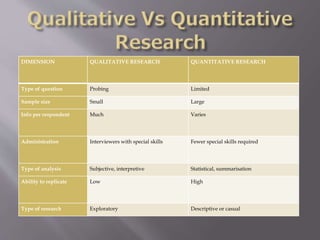
DIMENSION QUALITATIVE RESEARCH QUANTITATIVE RESEARCH
Type of question Probing Limited
Sample size Small Large
Info per respondent Much Varies
Administration Interviewers with special skills Fewer special skills required
Type of analysis Subjective, interpretive Statistical, summarisation
Ability to replicate Low High
Type of research Exploratory Descriptive or casual
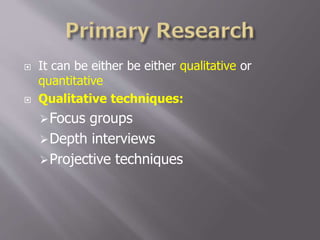
 It can be either be either qualitative or
quantitative
 Qualitative techniques:
Focus groups
Depth interviews
Projective techniques
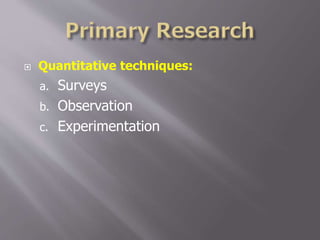
 Quantitative techniques:
a. Surveys
b. Observation
c. Experimentation
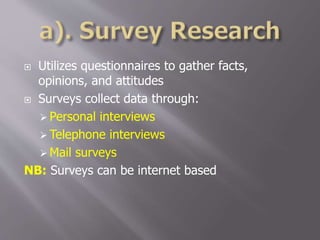
 Utilizes questionnaires to gather facts,
opinions, and attitudes
 Surveys collect data through:
 Personal interviews
 Telephone interviews
 Mail surveys
NB: Surveys can be internet based
Typical errors in assessing quality of info in survey
research:
 Random sampling errors- occurs when the
sample selected is not reflective of the general
population
 Systematic errors- occurs when there are
errors in the design of the sampling procedure
 A systematic process of recording the
behavioural patterns of people, objects, and
occurrences without questioning or
communicating with them
 Necessary when:
 Only method available to collect data
 Consumers reluctant to reveal correct facts
 Financial constraints of the firm
 When data to be collected can be easily observed
 Human Vs machine observation- presence or non
presence of human during observation
 Natural Vs contrived observation- observation from
a natural or artificially designed environment
 Disguised Vs undisguised observation- see the case
of mystery shoppers
 Structured Vs unstructured- involves systematic or
non systematic ways of recording observed items
 Direct Vs indirect observation- observing behaviour
as it occurs or past behaviour
 Exploits two variables namely dependent and
independent variable
 Independent variable is referred to as
experimental variable e.g. price
 Total sales can be a dependent variable
 Experimental research captures the cause-and-
effect relationships amongst the variables
understudy
 The experimental setting- research in a
controlled environment (laboratory), and
research in an uncontrolled setting (natural
setting), results generalised to outside people
and markets
 Manipulation of variables- have precise
knowledge about the variables to be
manipulated
 Selection and measurement of dependent
variables- critically establish the which is the
dependent variable
 Selection and assignment of test units-
experimental subjects must be representative
of the population being studied
 Control over extraneous and other variables-
uttermost care to be taken on those variables
that might affect the outcome of the
experiment e.g. weather, political forces
 Qualitative research is unstructured but does have
guidelines in order to explore the research
question.
 It centres on words, narratives, images and
concepts rather than numerical values.
 Qualitative analysis begins during data collection
and original ways are found to communicate
results.
 There is an emphasis on understanding rather
than measurement.
a) Focus groups discussions
b) Depth Interviews
c) Delphi techniques
d) Grounded Theory
e) Ethnography
f) Action Research
g) Semiotics
 A conversation between several
people sitting together, usually in a
circle.
 One person acts as a moderator,
starts the debate and intervenes
periodically to keep on-topic
 Depths are usually face to face
 But sometimes by phone or video
conference
 They extend to paired interviews
(friendship pairs)
 A forecasting method
 Unusually for qualitative research it uses a
questionnaire
 This is circulated to selected experts
 Over several rounds the questionnaire becomes
more structured as ideas are fine-tuned
 Finally the forecast is complete
 The researcher has a broad area of
investigation and will collect a great deal of
information
 This is then analysed very systematically
 The procedure means that the researcher will
base an explanation on the findings, so the
theory is “grounded” in the data
 Describes behaviour in a natural
setting
 The researcher becomes part of the
community under study, the
ethnographer enters into the
respondent’s world.
 The researcher participates in the "observed
event” to affect the course of events
 This approach has been used for new product
development. The researcher becomes a user
or users can be recruited to become
researchers
 Semiotics is the study of communication by
careful analysis of signs
 It uses any materials available
All qualitative projects fill gaps with likely meaning
Depths - allow probing without pressure
Groups - provide rich data
Grounded theory – has no preconceived
ideas
Semiotics – can uncover “emergent signs”
so may predict
Delphi - is powerful in forecasting
innovations
All techniques can lead responses in one direction
Depths – no-one to trigger questions
Groups need skilled researchers
Grounded theory - is time consuming and
intensive. Nothing may come from the data
Semiotics – relies on what material researchers
select so can be subjective
 Awareness of body language also helps inquiry
 The researcher must examine:
 Proxemics-The use of space, the proximity
 Kinesics- Movement and body posture
 Oculesics-Eye behaviour, gaze, eye
movements
 Vocalics.-Tone, intonation & other features of
the voice
o Shadowing-observe people using product
within a setting
o Behavior mapping- photograph people within a
space and observe behavior
o Consumer journey- keep track of consumer
interaction with product
o Camera journals- photo diaries of people using
the product
o Extreme user interviews- dialogue with people
either knowledgeable or absolute ignorant
about product
o Story telling- prompt people to tell personal
stories about their interaction with product
o Unfocus groups- general interviews with a
diverse range of people
THE END
THANK YOU

Quantitative Research Techniques ppt 4.pptx

  • 2.
    DIMENSION QUALITATIVE RESEARCHQUANTITATIVE RESEARCH Type of question Probing Limited Sample size Small Large Info per respondent Much Varies Administration Interviewers with special skills Fewer special skills required Type of analysis Subjective, interpretive Statistical, summarisation Ability to replicate Low High Type of research Exploratory Descriptive or casual
  • 3.
     It canbe either be either qualitative or quantitative  Qualitative techniques: Focus groups Depth interviews Projective techniques
  • 4.
     Quantitative techniques: a.Surveys b. Observation c. Experimentation
  • 5.
     Utilizes questionnairesto gather facts, opinions, and attitudes  Surveys collect data through:  Personal interviews  Telephone interviews  Mail surveys NB: Surveys can be internet based
  • 6.
    Typical errors inassessing quality of info in survey research:  Random sampling errors- occurs when the sample selected is not reflective of the general population  Systematic errors- occurs when there are errors in the design of the sampling procedure
  • 7.
     A systematicprocess of recording the behavioural patterns of people, objects, and occurrences without questioning or communicating with them  Necessary when:  Only method available to collect data  Consumers reluctant to reveal correct facts  Financial constraints of the firm  When data to be collected can be easily observed
  • 8.
     Human Vsmachine observation- presence or non presence of human during observation  Natural Vs contrived observation- observation from a natural or artificially designed environment  Disguised Vs undisguised observation- see the case of mystery shoppers  Structured Vs unstructured- involves systematic or non systematic ways of recording observed items  Direct Vs indirect observation- observing behaviour as it occurs or past behaviour
  • 9.
     Exploits twovariables namely dependent and independent variable  Independent variable is referred to as experimental variable e.g. price  Total sales can be a dependent variable  Experimental research captures the cause-and- effect relationships amongst the variables understudy
  • 10.
     The experimentalsetting- research in a controlled environment (laboratory), and research in an uncontrolled setting (natural setting), results generalised to outside people and markets  Manipulation of variables- have precise knowledge about the variables to be manipulated
  • 11.
     Selection andmeasurement of dependent variables- critically establish the which is the dependent variable  Selection and assignment of test units- experimental subjects must be representative of the population being studied  Control over extraneous and other variables- uttermost care to be taken on those variables that might affect the outcome of the experiment e.g. weather, political forces
  • 12.
     Qualitative researchis unstructured but does have guidelines in order to explore the research question.  It centres on words, narratives, images and concepts rather than numerical values.  Qualitative analysis begins during data collection and original ways are found to communicate results.  There is an emphasis on understanding rather than measurement.
  • 13.
    a) Focus groupsdiscussions b) Depth Interviews c) Delphi techniques d) Grounded Theory e) Ethnography f) Action Research g) Semiotics
  • 14.
     A conversationbetween several people sitting together, usually in a circle.  One person acts as a moderator, starts the debate and intervenes periodically to keep on-topic
  • 15.
     Depths areusually face to face  But sometimes by phone or video conference  They extend to paired interviews (friendship pairs)
  • 16.
     A forecastingmethod  Unusually for qualitative research it uses a questionnaire  This is circulated to selected experts  Over several rounds the questionnaire becomes more structured as ideas are fine-tuned  Finally the forecast is complete
  • 17.
     The researcherhas a broad area of investigation and will collect a great deal of information  This is then analysed very systematically  The procedure means that the researcher will base an explanation on the findings, so the theory is “grounded” in the data
  • 18.
     Describes behaviourin a natural setting  The researcher becomes part of the community under study, the ethnographer enters into the respondent’s world.
  • 19.
     The researcherparticipates in the "observed event” to affect the course of events  This approach has been used for new product development. The researcher becomes a user or users can be recruited to become researchers
  • 20.
     Semiotics isthe study of communication by careful analysis of signs  It uses any materials available
  • 21.
    All qualitative projectsfill gaps with likely meaning Depths - allow probing without pressure Groups - provide rich data Grounded theory – has no preconceived ideas Semiotics – can uncover “emergent signs” so may predict Delphi - is powerful in forecasting innovations
  • 22.
    All techniques canlead responses in one direction Depths – no-one to trigger questions Groups need skilled researchers Grounded theory - is time consuming and intensive. Nothing may come from the data Semiotics – relies on what material researchers select so can be subjective
  • 23.
     Awareness ofbody language also helps inquiry  The researcher must examine:  Proxemics-The use of space, the proximity  Kinesics- Movement and body posture  Oculesics-Eye behaviour, gaze, eye movements  Vocalics.-Tone, intonation & other features of the voice
  • 24.
    o Shadowing-observe peopleusing product within a setting o Behavior mapping- photograph people within a space and observe behavior o Consumer journey- keep track of consumer interaction with product o Camera journals- photo diaries of people using the product
  • 25.
    o Extreme userinterviews- dialogue with people either knowledgeable or absolute ignorant about product o Story telling- prompt people to tell personal stories about their interaction with product o Unfocus groups- general interviews with a diverse range of people
  • 26.