What is forecasting
Forecasting is a tool used for predicting future
demand based on a past demand information.
A forecast is only a good as the information included
in the forecast. ( past data )
Forecasting is based on the assumptions that the
past predicts the future.
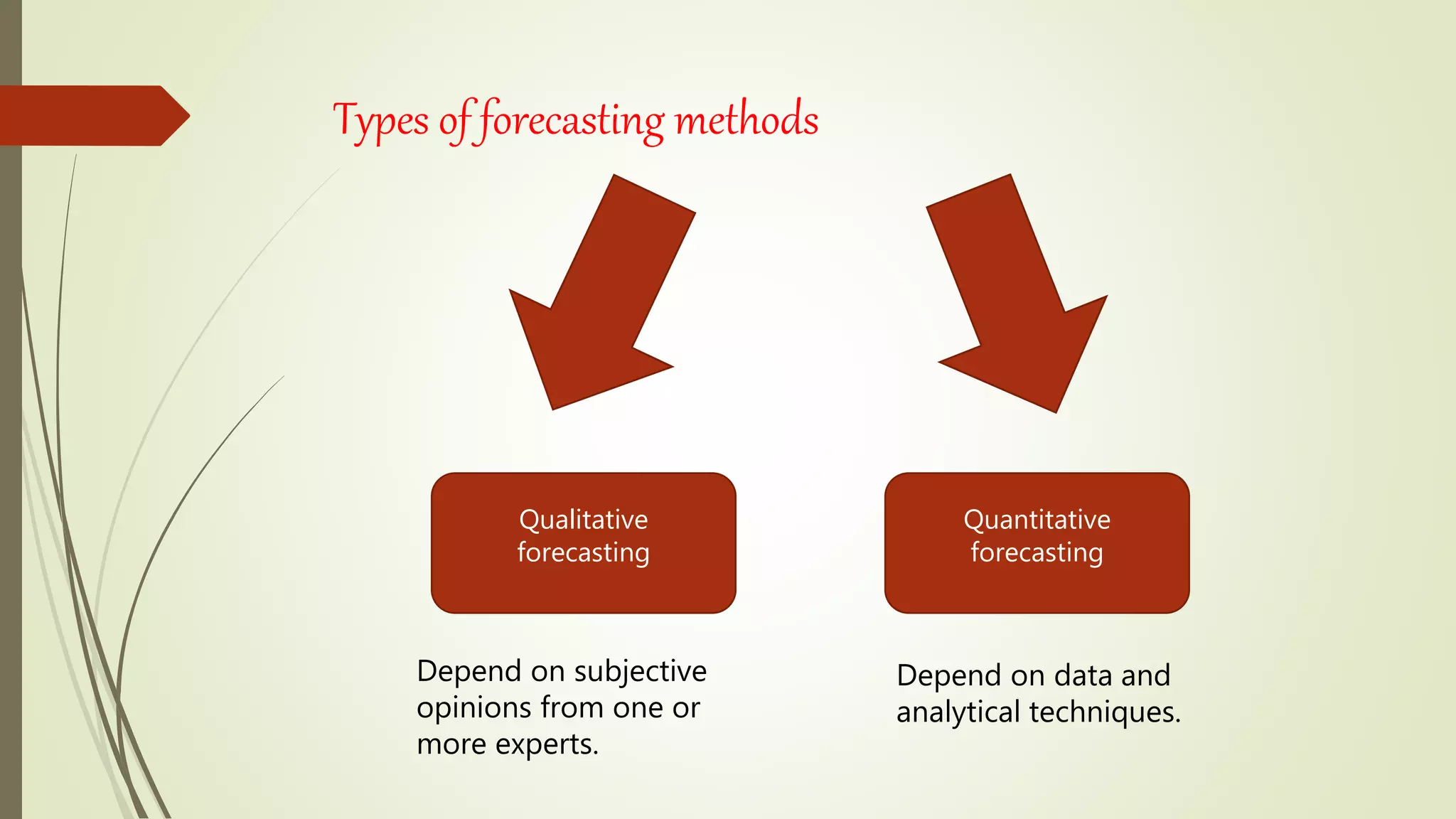
Types of forecasting methods
Qualitative
forecasting
Quantitative
forecasting
Depend on subjective
opinions from one or
more experts.
Depend on data and
analytical techniques.
It is a statistical technique to make predictions about the future
which uses numerical measures and prior effects to predict future
events.
These techniques are based on models of mathematics and in
nature are mostly objective. They are highly dependent on
mathematical calculations.
Quantitative forecasting methods are very easy to predict based on
the underlying information. The data can be used to forecast
automatically without many complications. Any person can easily
forecast on the basis of available data.
Quantitative forecasting method
Methods for quantitative forecasting
There are two types of quantitative forecasting method which are listed
below:
Time series model
Time series looks at past patterns of data and attempt to predict the
future based upon the underlying patterns contained within the data.
Time series contains several models which are helpful to forecast.
A time series is a series of data points indexed in time order. Most
commonly, a time series is a sequence taken at successive equally
spaced points in time. Thus it is a sequence of discrete-time data.
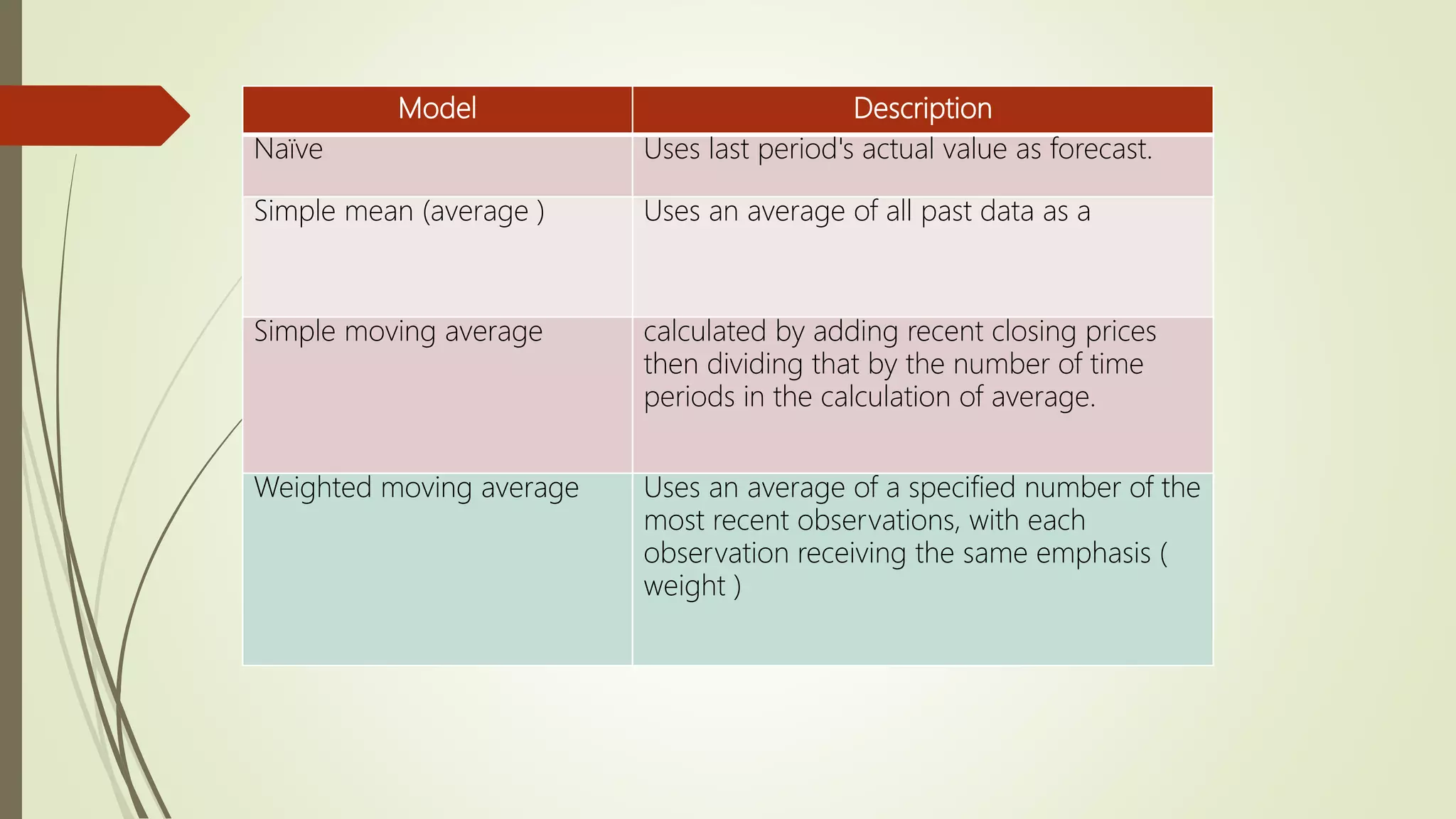
Model Description
Naïve Uses last period's actual value as forecast.
Simple mean (average ) Uses an average of all past data as a
Simple moving average calculated by adding recent closing prices
then dividing that by the number of time
periods in the calculation of average.
Weighted moving average Uses an average of a specified number of the
most recent observations, with each
observation receiving the same emphasis (
weight )
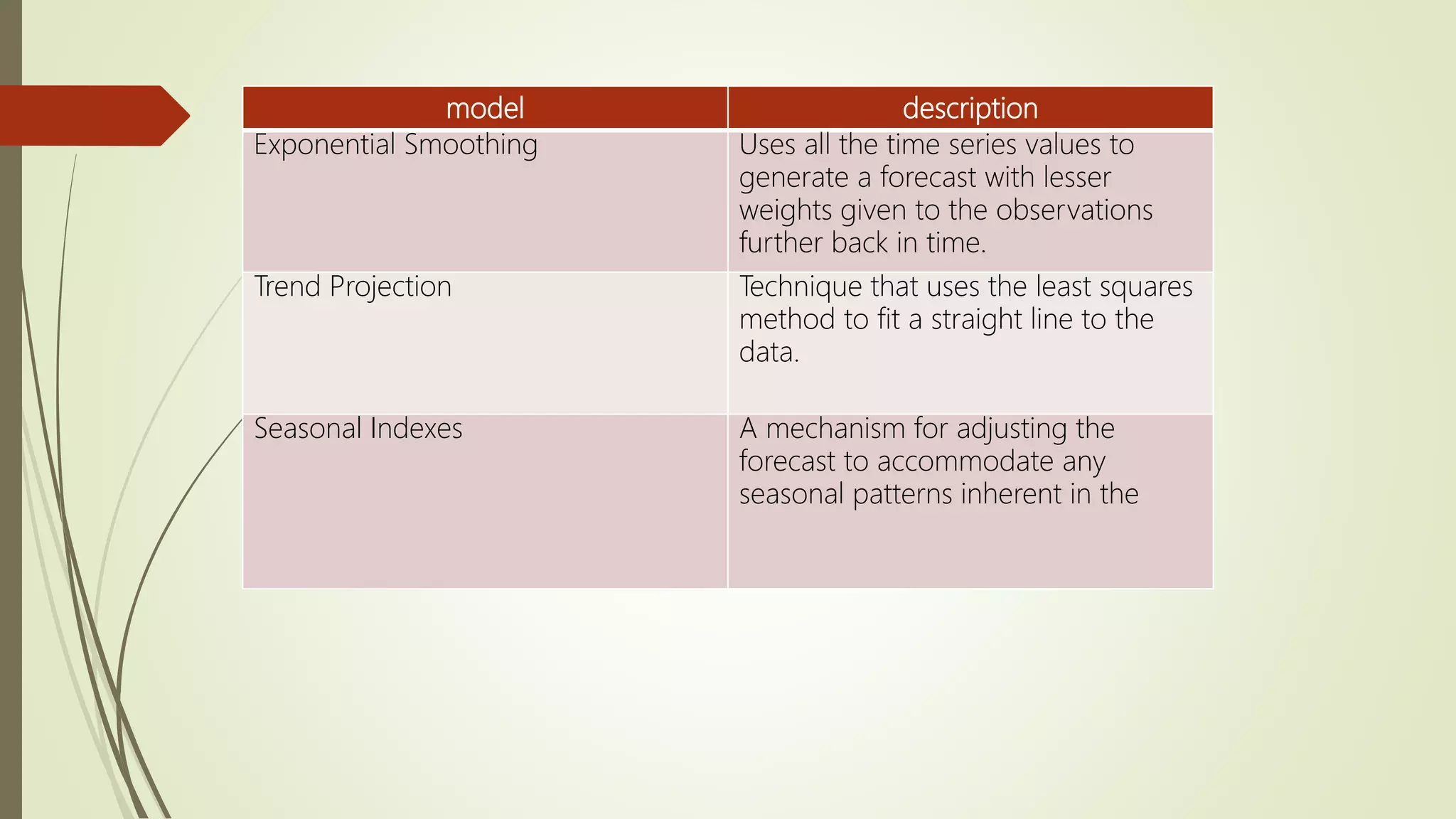
model description
Exponential Smoothing Uses all the time series values to
generate a forecast with lesser
weights given to the observations
further back in time.
Trend Projection Technique that uses the least squares
method to fit a straight line to the
data.
Seasonal Indexes A mechanism for adjusting the
forecast to accommodate any
seasonal patterns inherent in the
Associative forecasting method
 Associative forecasting models assume that the variable being forecasted (the
dependent variable) is related to other variables (independent variables) in the
environment.
 This approach tries to project demand based upon those associations. In its simplest
form, linear regression is used to fit a line to the data.
 That line is then used to forecast the dependent variable for some selected value of the
independent variable
 Associative techniques rely on identification of related variables that can be used to
predict the variable of interest (dependent variable)
quantitative marketing techniques

quantitative marketing techniques

  • 2.
    What is forecasting Forecastingis a tool used for predicting future demand based on a past demand information. A forecast is only a good as the information included in the forecast. ( past data ) Forecasting is based on the assumptions that the past predicts the future.
  • 3.
    Types of forecastingmethods Qualitative forecasting Quantitative forecasting Depend on subjective opinions from one or more experts. Depend on data and analytical techniques.
  • 4.
    It is astatistical technique to make predictions about the future which uses numerical measures and prior effects to predict future events. These techniques are based on models of mathematics and in nature are mostly objective. They are highly dependent on mathematical calculations. Quantitative forecasting methods are very easy to predict based on the underlying information. The data can be used to forecast automatically without many complications. Any person can easily forecast on the basis of available data. Quantitative forecasting method
  • 5.
    Methods for quantitativeforecasting There are two types of quantitative forecasting method which are listed below:
  • 6.
    Time series model Timeseries looks at past patterns of data and attempt to predict the future based upon the underlying patterns contained within the data. Time series contains several models which are helpful to forecast. A time series is a series of data points indexed in time order. Most commonly, a time series is a sequence taken at successive equally spaced points in time. Thus it is a sequence of discrete-time data.
  • 7.
    Model Description Naïve Useslast period's actual value as forecast. Simple mean (average ) Uses an average of all past data as a Simple moving average calculated by adding recent closing prices then dividing that by the number of time periods in the calculation of average. Weighted moving average Uses an average of a specified number of the most recent observations, with each observation receiving the same emphasis ( weight )
  • 8.
    model description Exponential SmoothingUses all the time series values to generate a forecast with lesser weights given to the observations further back in time. Trend Projection Technique that uses the least squares method to fit a straight line to the data. Seasonal Indexes A mechanism for adjusting the forecast to accommodate any seasonal patterns inherent in the
  • 9.
    Associative forecasting method Associative forecasting models assume that the variable being forecasted (the dependent variable) is related to other variables (independent variables) in the environment.  This approach tries to project demand based upon those associations. In its simplest form, linear regression is used to fit a line to the data.  That line is then used to forecast the dependent variable for some selected value of the independent variable  Associative techniques rely on identification of related variables that can be used to predict the variable of interest (dependent variable)