Linköping University Medical Dissertations No. 1050 
 
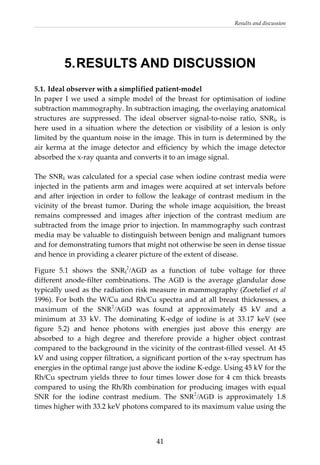
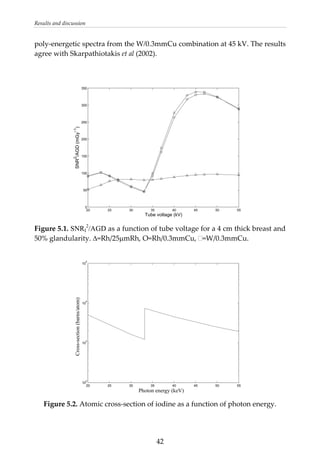
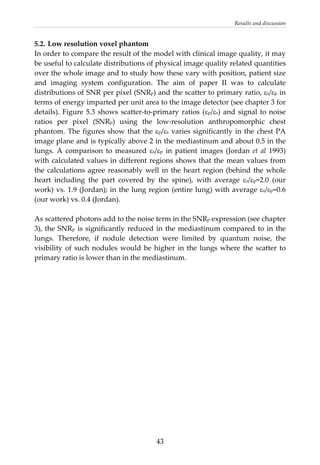
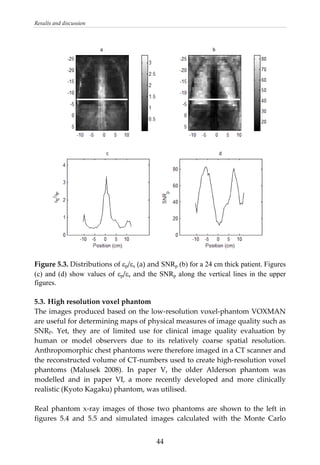
Quantifying image quality in 
diagnostic radiology using 
simulation of the imaging 
system and model observers 
 
 
Gustaf Ullman 


Radiation Physics, Department of Medicine and Health 
Faculty of Health Sciences 
Linköping University, Sweden 
 
 
Linköping 2008 


  ii


©Gustaf Ullman, 2008  
 
Cover  picture/illustration:  An  oil  painting  by  Gustaf  Ullman  representing  a 
chest radiograph 
 
 
Published articles and figures have been reprinted with the permission of the 
copyright holder. 
 
Printed in Sweden by LiU‐Tryck, Linköping, Sweden, 2008  
 
 
ISBN 978‐91‐7393‐952‐2 
ISSN 0345‐0082 


Don’t worry about saving these songs! 
And if one of our instruments breaks, 
it doesn’t matter 
 
We have fallen into the place 
where everything is Music. 
 
The strumming and the flute notes 
rise into the atmosphere, 
and even if the whole world’s harp 
should burn up, there would still be 
hidden instruments playing. 
 
So the candle flickers and goes out. 
We have a piece of flint and a spark. 
 
This singing art is sea foam. 
The graceful movements come from a pearl 
somewhere on the ocean floor. 
 
Poems reach up like spindrift and the edge 
of driftwood along the beach, wanting! 
 
They derive 
from a slow and powerful root 
that we can’t see 
 
Stop the words now. 
Open the window in the center of your chest, 
and let the spirits fly in and out. 
 
Jalal al‐Din Rumi 


  iii


  iv
  v
CONTENTS
1. INTRODUCTION................................................................................................ 1
1.1. Radiation protection in diagnostic radiology..................................... 1
1.2. Optimisation of diagnostic radiology .................................................. 2
1.3. Optimisation using a Monte Carlo based computational model ... 2
2. OBJECTIVE ........................................................................................................... 5
3. MONTE CARLO BASED COMPUTATIONAL MODEL OF THE 
IMAGING SYSTEM................................................................................................... 7
3.1. Introduction............................................................................................... 7
3.2. Computational model of the x‐ray imaging systems ........................ 9
3.2.1. Model of the imaging system........................................................... 9
3.2.2. Monte Carlo simulation of photon transport............................... 14
3.2.3. Scoring quantities............................................................................. 18
3.2.4. Calculated quantities....................................................................... 19
3.3. Calculation of images from the high‐resolution phantom ............ 20
3.4. Uncertainties............................................................................................ 22
3.4.1. Stochastic uncertainties................................................................... 22
3.4.2. Systematic uncertainties.................................................................. 22
4. ASSESSMENT OF IMAGE QUALITY .......................................................... 25
4.1. Introduction............................................................................................. 25
4.2. Image quality assessment as developed in this work..................... 26
4.2.1. The task.............................................................................................. 26
4.2.2. Model of the imaging system and patient.................................... 27
4.2.3. Observers........................................................................................... 29
4.2.4. Figures of merit ................................................................................ 30
5. RESULTS AND DISCUSSION ....................................................................... 41
5.1. Ideal observer with a simplified patient‐model .............................. 41
Contents 
5.2. Low resolution voxel phantom............................................................ 43
5.3. High resolution voxel phantom........................................................... 44
5.4. Ideal observer with simple anatomical background....................... 46
5.5. Correlation to human observers.......................................................... 49
5.6. Model observers with complex anatomical background ............... 52
6. SUMMARY AND CONCLUSIONS............................................................... 59
7. FUTURE WORK ................................................................................................. 61
8. ACKNOWLEDGEMENTS ............................................................................... 63
9. REFERENCES...................................................................................................... 65


  vi
Abstract 
  vii
ABSTRACT 
Accurate measures of both clinical image quality and patient radiation risk are 
needed for successful optimisation of medical imaging with ionising radiation. 
Optimisation  in  diagnostic  radiology  means  finding  the  image  acquisition 
technique  that  maximises  the  perceived  information  content  and  minimises 
the  radiation  risk  or  keeps  it  at  a  reasonably  low  level.  The  assessment  of 
image quality depends on the diagnostic task and may in addition to system 
and quantum noise also be hampered by overlying projected anatomy. 
 
The  main  objective  of  this  thesis  is  to  develop  methods  for  assessment  of 
image quality in simulations of projection radiography. In this thesis, image 
quality is quantified by modelling the whole x‐ray imaging system including 
the  x‐ray  tube,  patient,  anti‐scatter  device,  image  detector  and  the  observer. 
This  is  accomplished  by  using  Monte  Carlo  (MC)  simulation  methods  that 
allow simultaneous estimates of measures of image quality and patient dose. 
Measures of image quality include the signal‐to‐noise‐ratio, SNR, of pathologic 
lesions and radiation risk is estimated by using organ doses to calculate the 
effective  dose.  Based  on  high‐resolution  anthropomorphic  phantoms, 
synthetic  radiographs  were  calculated  and  used  for  assessing  image  quality 
with  model‐observers  (Laguerre‐Gauss  (LG)  Hotelling  observer)  that  mimic 
real, human observers. Breast and particularly chest imaging were selected as 
study cases as these are particularly challenging for the radiologists. 
 
In  chest  imaging  the  optimal  tube  voltage  in  detecting  lung  lesions  was 
investigated in terms of their SNR and the contrast of the lesions relative to the 
ribs. It was found that the choice of tube voltage depends on whether SNR of 
the lesion or the interfering projected anatomy (i.e. the ribs) is most important 
for detection. The Laguerre‐Gauss (LG) Hotelling observer is influenced by the 
projected  anatomical  background  and  includes  this  into  its  figure‐of‐merit, 
SNRhot,LG. The LG‐observer was found to be a better model of the radiologist 
than the ideal observer that only includes the quantum noise in its analysis. 
The measures of image quality derived from our model are found to correlate 
relatively  well  with  the  radiologist’s  assessment  of  image  quality.  Therefore 
MC simulations can be a valuable and an efficient tool in the search for dose‐
efficient imaging systems and image acquisition schemes. 
List of papers 
  ix
LIST OF PAPERS 
This thesis is based on the following papers 
   
I.  Gustaf  Ullman,  Michael  Sandborg,  David  R  Dance,  Martin  Yaffe, 
Gudrun  Alm  Carlsson.  A  search  for  optimal  x‐ray  spectra  in  iodine 
contrast media mammography. Phys. Med. Biol. 50, 3143–3152 (2005)*  
II.  Gustaf  Ullman,  Michael  Sandborg,  David  R  Dance,  Roger  Hunt,  and 
Gudrun  Alm  Carlsson.  Distributions  of  scatter  to  primary  ratios  and 
signal  to  noise  ratios  per  pixel  in  digital  chest  imaging.  Radiat  Prot 
Dosim, 114, no 1‐3, 355‐358 (2005)*  
III.  Gustaf Ullman, Michael Sandborg, David R Dance, Roger A Hunt and 
Gudrun  Alm  Carlsson.  Towards  optimization  in  digital  chest 
radiography  using  Monte  Carlo  modelling.  Phys  Med  Biol  51,  2729‐
2743 (2006)*  
IV.  Michael  Sandborg,  Anders  Tingberg,  Gustaf  Ullman,  David  R  Dance 
and  Gudrun  Alm  Carlsson.  Comparison  of  clinical  and  physical 
measures of image quality in chest and pelvis computed radiography at 
different tube voltages. Med. Phys. 33(11) 4169‐4175 (2006)*  
V.  Gustaf Ullman, Alexandr Malusek, Michael Sandborg, David R. Dance 
and  Gudrun  Alm  Carlsson.  Calculation  of  images  from  an 
anthropomorphic chest phantom using Monte Carlo methods. Proc of 
SPIE 6142, (2006)*  
VI.  Gustaf Ullman, Magnus Båth, Gudrun Alm Carlsson, David R Dance, 
Markku Tapiovaara, and Michael Sandborg. Development of a Monte 
Carlo  based  model  for  optimization  using  the  Laguerre‐Gauss 
Hotelling observer. (To be submitted to Med Phys) 
 
*Reprints have been included with the permission from the publisher 
List of papers 
 
Other peer reviewed papers by the author not included in the thesis 
 
1.  Gustaf  Ullman,  Michael  Sandborg,  David  R  Dance,  Roger  Hunt,  and 
Gudrun Alm Carlsson. The influence of patient thickness, tube voltage 
and  image  detector  on  patient  dose  and  detail  signal  to noise ratio in 
digital chest imaging. Radiat Prot Dosim, 114, no 1‐3, 294‐297, 2005  
2.  Markus Håkansson, Magnus Båth, Sara Börjesson, Susanne Kheddache, 
Gustaf Ullman, Lars Gunnar Månsson. Nodule detection in digital chest 
radiography:  effect  of  nodule location. Radiat Prot Dosim 114, no 1‐3, 
92‐96, 2005  
3.  R  A  Hunt,  D  R  Dance,  P  R  Bakic,  A  D  A  Maidment,  M  Sandborg,  G 
Ullman  and  G  Alm  Carlsson.  Calculation  of  the  properties  of  digital 
mammograms using a computer simulation. Radiat Prot Dosim 114, no 
1‐3, 395‐398, 2005  
4.  D  R  Dance,  R  A  Hunt,  P  R  Bakic,  A  D  A  Maidment,  M  Sandborg,  G 
Ullman and G Alm Carlsson. Breast dosimetry using a high‐resolution 
voxel phantom. Radiat Prot Dosim 114, no 1‐3, 359‐363, 2005 
5.  Roger A Hunt, David R Dance, Marc Pachoud, Gudrun Alm Carlsson, 
Michael Sandborg, Gustaf Ullman and Francis R Verdun. Monte Carlo 
simulation of a mammographic test phantom. Radiat Prot Dosim, 114, 
no 1‐3, 432‐435, 2005. 
 
Conference presentations 
 
1.  Ullman G, Sandborg M, Dance D R, Skarpathiotakis M, Yaffe MJ, Alm 
Carlsson G. (2002) A search for optimal x‐ray energy spectra in digital 
iodine subtraction mammography using Monte Carlo simulation of the 
imaging chain. Digital Mammography IWDM 2002: Proceedings of the 
Workshop,  Bremen,  Germany,  June  2002.  Ed.  Peitgen  H‐O  (Springer‐
Verlag, Berlin) pp152‐154, 2002  
2.  M.  Båth,  M.  Håkansson,  S.  Börjesson,  S.  Kheddache,  C.  Hoeschen,  O. 
Tischenko,  F.  O.  Bochud,  F.  R.  Verdun,  G.  Ullman,  L.  G.  Månsson. 
Investigation of components affecting the detection of lung nodules in 
digital  chest  radiography.  Accepted  for  presentation  at  Medical 
Imaging, 12‐17 February 2005, San Diego, USA. Proc. SPIE 5749, 231‐242, 
2005. 
  x
List of papers 
 
Internal reports (not reviewed) 
 
1.  Gustaf Ullman, Michael Sandborg, Roger Hunt and David R Dance. 
Implementation of simulation of pathologies in chest and breast 
imaging Report no 94, ISRN ULI‐RAD‐R‐‐94—SE, 2003 
2.  Gustaf  Ullman,  Michael  Sandborg  and  Gudrun  Alm  Carlsson. 
Validation  of  a  voxel‐phantom  based  Monte  Carlo  model  and 
calibration of digital systems. Report no 95, ISRN ULI‐RAD‐R‐‐95—SE, 
2003 
3.  Gustaf Ullman, M Sandborg, D R Dance, R Hunt and G Alm Carlsson 
Optimisation  of  chest  radiology  by  computer  modelling  of  image 
quality  measures  and  patient  effective  dose  Report  no  97,  ISRN  ULI‐
RAD‐R‐‐97—SE, 2004 
4.  Gustaf Ullman, M Sandborg, Anders Tingberg, D R Dance, Roger Hunt 
and G Alm Carlsson Comparison of clinical and physical measures of 
image quality in chest PA and pelvis AP views at varying tube voltages 
Report no 98, ISRN ULI‐RAD‐R‐‐98—SE, 2004  
5.  Gustaf  Ullman,  M  Sandborg,  D  R  Dance,  M  Båth,  M  Håkansson,  S 
Börjesson, R Hunt and G Alm Carlsson On the extent of quantum noise 
limitation in digital chest radiography Report no 99, ISRN ULI‐RAD‐R‐‐
99—SE, 2004 
6.  Gustaf  Ullman,  Michael  Sandborg,  David  R  Dance,  Roger  Hunt  and 
Gudrun Alm Carlsson Distributions of scatter‐to‐primary and signal‐to‐
noise ratios per pixel in digital chest imaging Report no 100, ISRN ULI‐
RAD‐R‐‐100—SE, 2004 
 
 
  xi
Abbreviations 
  xiii
ABBREVIATIONS 
 
AGD  Average glandular dose 
ALARA  As low as reasonable achievable 
APR  Apical pulmonary region 
AUC   Area under the ROC curve 
BKE  Background known exactly 
BV    Background varying 
C    Contrast 
CC   Cranio‐caudal 
C/CB  Nodule‐to‐bone contrast 
Crel   Relative contrast 
DQE  Detective quantum efficiency 
E    Effective dose 
FN   False negative 
FOM  Figure of merit 
FP    False positive 
Ht    Equivalent dose 
HIL  Hilar region 
Kc, air  Collision air kerma 
LG   Laguerre‐Gauss 
LAT  Lateral pulmonary region 
LME  Lower mediastinal region 
LNT  Linear non‐threshold hypothesis 
MC   Monte Carlo 
MTF  Modulation transfer function 
NPS  Noise power spectrum 
PA   Posterior Anterior 
RET  Retrocardial region 
ROC  Receiver operating characteristics 
SKE  Signal known exactly 
SNR   Signal‐to‐noise ratio 
SNRhot, LG  Laguerre‐Gauss Hotelling observer signal‐to‐noise ratio 
SNRI  Ideal observer signal‐to‐noise ratio 
SNRp  Signal‐to‐noise ratio per pixel 
TN   True negative 
List of papers 
TP    True positive 
UME  Upper mediastinal region 
VGA  Visual grading analysis 
VGAS  VGA score 
 
    Energy imparted per unit area from primary photons p
Aε
s
Aε
p
    Energy imparted per unit area from scattered photons 
    Mean energy imparted per primary photon λ
    Mean squared energy imparted per primary photon 2
pλ
s     Mean energy imparted per scattered photon λ
    Mean squared energy imparted per scattered photon 2
sλ
  xiv
Introduction 
  1
1. INTRODUCTION
1.1. Radiation protection in diagnostic radiology 
Diagnostic  x‐ray  examinations  can  support  the  radiologist  with  valuable 
information that can be utilised to give a patient an accurate diagnosis, and 
subsequently  a  successful  treatment.  However,  imaging  with  ionising 
radiation is also associated with a small risk for cancer induction or genetic 
detriment. When x‐ray photons are scattered or absorbed inside the cells of the 
human  body,  ionisations  occur  that  can  alter  molecular  structures  and  thus 
make harm to the cell. The most important damage to the cell is damage in the 
DNA since this may induce mutations. Ultimately, the damage may lead to 
that the cell is killed, and if enough cells are killed, the function of the tissue or 
organ  will  be  deteriorated.  This  type  of  acute  harm  due  to  large  radiation 
exposures is referred to as a deterministic effect. However, at the relatively low 
radiation exposures in diagnostic radiology, the damages caused by ionising 
radiation are often rather easily repaired. Yet, sometimes the damage on the 
DNA is more complex. This can cause mutations or chromosome aberrations, 
which  in  turn  may  lead  to  a  modified  cell  but  with  retained  reproduction 
capacity. In some cases, such modified cells can result in a cancer. In the case 
where the harmful effects of ionising radiation are only known statistically, it 
is  referred  to  as  a  stochastic  effect.  The  risk  related  to  stochastic  effects  to  a 
human  from  exposure  from  ionising  radiation  is  often  quantified  with  the 
effective dose, E (ICRP 1991, ICRP 2007).  
 
According  to  the  linear  non‐threshold  (LNT)  hypothesis,  there  is  a  linear 
relation between the effective dose and risk for cancer induction (ICRP 2005) 
and means that the collective dose can be used as a measure of the harm to the 
population. The collective dose from medical radiography is according to the 
Swedish radiation protection authority (Andersson et al 2007) 8000 manSv per 
year or 0.9 mSv on average per capita, and contributes the largest fraction of 
the total dose to the population from man‐made sources.  
 
Diagnostic radiology is invaluable for the health care but due to the radiation 
risks,  radiation  protection  of  the  patient  becomes  an  important  issue.  Three 
different  principles  are  used  for  radiation  protection  (ICRP  2007).  The  first 
principle  is  justification.  Ionising  radiation  should  only  be  used  in  those 
situations  where  it  brings  more  good  than  harm.  The  second  principle  is 
Introduction 
optimisation. It means that, in those cases where the use of ionising radiation is 
justified, doses should be kept as low as reasonable achievable. This is often 
referred to as the ALARA (As Low As Reasonably Achievable) principle. The 
third principle is dose limits to the individual. However, this principle is more 
applicable for personnel rather than for patients in diagnostic radiology. 
 
1.2. Optimisation of diagnostic radiology 
Optimisation means to balance the diagnostic information (image quality) and 
patient dose so as to maximize the ratio between the two; either to keep the 
information  constant  and  minimize  the  dose  or  to  increase  information  at 
constant dose. The dose to the patient undergoing an x‐ray examination has, in 
digital  systems,  a  close  relation  to  the  quantum  noise  in  the  image.  The 
quantum  noise  depends  on  the  number  of  photons  incident  on  the  image 
detector  and  is  approximately  described  with  a  compound  poisson 
distribution, which takes the energy absorption properties of the detector into 
account. If we use too few photons, the image will be noisy and it will make it 
difficult or even impossible for the radiologist to give a correct diagnosis. It 
may also take longer time for the radiologist to give a diagnosis using a noisy 
image.  Yet,  above  a  certain  dose  level,  the  quantum  noise  may  become 
negligible  in  comparison  to  the  noise  naturally  present  in  the  projected 
anatomy  (Hoeschen  et  al  2005).  There  will  therefore  be  limited  benefit  to 
increase the dose above this level.  
 
How  to  make  the  trade  off  between  the  dose  to  the  patient  and  the  image 
quality is a complex subject. A key aspect for the optimisation of diagnostic 
radiology is to understand the relative importance of the quantum noise in the 
image and the structures in the projected anatomy that act as noise. Several 
authors including Kundel et al (1985), Samei et al (1999), Burgess et al (2001) 
and Håkansson et al (2005b) have acknowledged the importance of projected 
anatomy  in  relation  to  quantum  noise.  The  consensus  from  these  studies  is 
that at normal exposures, the projected anatomy is the most important factor 
in  hampering  the  detection  of  subtle  nodules  in  chest  radiographs  and 
mammograms. 
 
1.3. Optimisation using a Monte Carlo based computational model  
One  method  that  has  been  utilised  to  search  in  a  systematic  way  for  the 
optimal imaging parameters in diagnostic radiology is to use a model of the 
imaging  system,  including  the  patient  and  observer,  and  to  simulate  the 
photon transport through the imaging system using the Monte Carlo method. 
  2
Introduction 
With  this  method  it  is  possible  to  simultaneously  calculate  the  dose  to  the 
patient and measures of image quality.  
 
However,  the  physical  measures  of  image  quality  derived  from  simulations 
must in some sense give us information on the usefulness of the image for a 
radiologist  to  solve  a  specific  clinical  task.  Our  physical  measures  of  image 
quality  must  therefore  correlate  to  clinical  measures  of  image  quality.  Two 
methods  for  assessment  of  clinical  image  quality  are  given  attention  in  this 
work, receiver operating characteristics (ROC) (Metz 1986) and visual grading 
analysis (VGA) (Tingberg 2000). A challenge in this work has been to develop 
a  model,  which  includes  realistic  measures  of  image  quality  that  takes  the 
projected anatomy into account. 


  3
Objective 
  5
2. OBJECTIVE
While patient doses are relatively straightforward to calculate, image quality 
assessment is a more complex task and crucial for the optimisation process. 
The main objective of this thesis is therefore to further develop methods for 
assessment  of  image  quality  in  x‐ray  projection  radiography.  The  main 
method  is  Monte  Carlo  photon  transport  simulation    (Monte  Carlo  model) 
through  the  whole  x‐ray  imaging  system  including  a  model  of  the  image 
observer.  As  study  cases,  chest  posterior‐anterior  (PA)  and  mammography 
cranio‐caudal (CC) projections are used as these are particularly challenging 
for the radiologist. 
 
The specific objectives are: 
 
• To study how physical measures influencing image quality are 
distributed over the image plane (paper II) 
 
• To develop methods for calculating physical image quality measures 
from simulated radiographs and search for correlations between these 
measures and measures of clinical image quality (papers III and IV) 
 
• To develop patient models of higher realism and finer anatomical 
structures for calculation of synthetic x‐ray images to be used for image 
quality analysis (papers V and VI) 
 
• To  complete  our  model  of  the  imaging  system  by  including  a  more 
realistic  model  observer  that  can  be  used  to  directly  make  any  task‐
related  clinical  image  quality  assessment  from  synthetic  images 
calculated by the model (papers V and VI) 
 
• To use our model of the imaging system towards optimisation of image 
quality and patient dose (paper I and III) 
 
 
Monte Carlo model 
  7
3. MONTE CARLO BASED
COMPUTATIONAL MODEL OF THE
IMAGING SYSTEM
3.1. Introduction 
The  Monte  Carlo  method  relies  on  taking  random  samples  from  known 
distributions  and  is  particularly  useful  for  studying  complex  problems  with 
many degrees of freedom. One of the first applications of the method was in 
Los  Alamos,  USA,  during  the  Second  World  War  where  it  was  used  to 
simulate  neutron  diffusion.  Today,  Monte  Carlo  methods  are  employed  in 
widely  diverse  fields,  from  the  evaluation  of  shares  on  the  stock  market 
(Glasserman  2003)  to  the  calculation  of  energy  levels  of  molecules  with 
quantum Monte Carlo (Ceperley and Alder 1986).  
 
In  radiation  physics,  the  Monte  Carlo  method  is  employed  for  simulating 
radiation  transport,  mathematically  described  by  the  Bolzmann  equation.  
There are several general‐purpose computer codes available for the study of 
radiation  transport,  for  example,  MCNP  (Monte  Carlo  N‐Particle  transport) 
(Briesmeister  2000)  developed  in  Los  Alamos  and  designed  to  transport 
neutrons,  electrons  and  photons;  EGSnrc  (Electron  Gamma  Shower) 
(Kawrakow  and  Rogers  2003,  Nelson  et  al  1985),  initially  developed  in 
Stanford,  which  transports  photons  and  electrons;  PENELOPE  (PENetration 
and  Energy  Loss  Of  Positrons  and  Electrons)  (Baro  et  al  1995)  developed  at 
University  of  Barcelona,  and  used  to  transports  electrons,  positrons  and 
photons. 
 
In diagnostic radiology, one of the most common applications of the Monte 
Carlo method is in patient dosimetry. There are several Monte Carlo computer 
codes that are used to estimate the effective dose. Jones and Wall (1985) used 
the  Monte  Carlo  method  to  compute  organ  doses  using  a  mathematical 
representation (Cristy 1980) of a human anatomy. Zankl and Wittman (2001) 
have developed a family of more realistic, segmented anthropomorphic voxel 
phantoms for organ dosimetry for external photon beams. Zankl and Petoussi‐
Henss (2002) calculated conversion factors based on the VIP man (Spitzer and 
Whitlock  1998)  anthropomorphic  model.  The  user‐friendly  Monte  Carlo 
computer  program  PCXMC  by  Servomaa  and  Tapiovaara  (1998)  calculates 
Monte Carlo model 
organ and effective doses based on either measured air kerma‐area product or 
entrance air kerma values.  
 
There  are  also  Monte  Carlo  codes  developed  for  optimisation  in  diagnostic 
radiology. Such codes rely on the fact that they are able to estimate both organ 
or effective doses and measures of image quality. The main application of the 
Monte Carlo method is for estimating the negative effect of scattered photons 
reaching  the  image  detector.  Chan  and  Doi  (1985)  used  the  Monte  Carlo 
method to characterise scattered radiation in x‐ray imaging. Chan et al (1985) 
also investigated the performance of anti‐scatter grids in screen‐film imaging 
whereas  Sandborg  et  al  (1994a)  did  task‐dependent,  anti‐scatter  grid 
optimisation  for  digital  imaging.  More  recently  McVey  et  al  (2003)  did  an 
optimisation study of lumbar spine radiography and Lazos et al (2003) have 
developed  a  software  package  for  mammography.  The  Lazos  model  also 
includes a realistic model of the breast (Bliznakova et al 2003). Son et al (2006) 
have developed software that calculates images from the visual human (VIP 
man)(Xu et al 2000). They have used the EGSnrc code as a basis of the model, 
used model observers and calculated effective dose. 
 
In this work we have used an in‐house Monte Carlo code VOXMAN adapted 
for conditions usually encountered in diagnostic radiology. It originates from 
Dance  and  Day  (1984)  and  Persliden  (1986)  who  independently  developed 
computer  programs  to  estimate  scattered  radiation  in  the  image  plane  in 
mammography and conventional radiography, respectively. A few years later, 
Dance et al (1992) and Sandborg et al (1994b) merged the codes and did further 
validation of the computer programs. McVey et al (2003) replaced the simple 
homogeneous  water  or  tissue  phantoms,  used  in  the  earlier  versions  of  the 
code, by a voxelised anthropomorphic male phantom developed by Zubal et al 
(1994). This step enabled more realistic organ dosimetry and made it possible 
to describe how measures of physical image quality vary in the image plane 
behind the patient.  
 
The main focus of this thesis is on chest imaging. Therefore we have mainly 
used the VOXMAN model, adapted to simulate chest radiography. In paper I 
we used the version of the computer program dedicated for mammography. 
This  computer  program  was  further  developed  by  Hunt  et  al  (2005)  to 
incorporate an anthropomorphic model of the breast developed by Bakic et al 
(2002). A brief description of the VOXMAN model is presented below. 
 
  8
Monte Carlo model 
3.2. Computational model of the x‐ray imaging systems 
The Monte Carlo based computational method used in this thesis models the 
x‐ray imaging system and simulates photon transport from the source through 
patient,  anti‐scatter  grid  and  into  the  image  detector.  The  computational 
method consists of the following components: 
 
A  model  of  the  imaging  system.  This  comprises  different  sources  of 
input  data  and  the  imaging  geometry.  Input  data  includes  x‐ray 
spectrum, patient‐based voxel phantom, anti‐scatter grid, table or chest 
support couch and image detector. 
 
Monte  Carlo  simulation  of  photon  transport  through  the  imaging 
system. The model uses different variance reduction techniques, briefly 
described below, to increase the efficiency of the model. 
 
Scoring variables such as organ and effective doses and calculation of 
different measures of image quality such as contrast and signal‐to‐noise 
ratio  of  nodule  lesions  or  anatomical  structures  within  the  patient 
model. 
 
3.2.1. Model of the imaging system  
The  input  data  files  are  described  below  including  geometry,  x‐ray  spectra, 
voxel phantom, anti‐scatter grid and image detector. 
 
3.2.1.1  Imaging geometry  
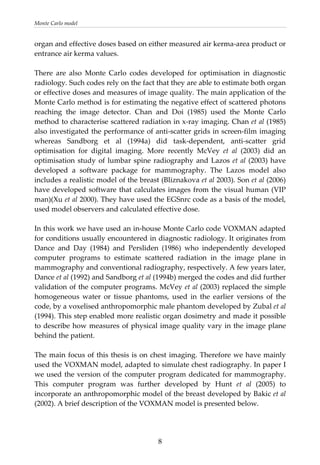
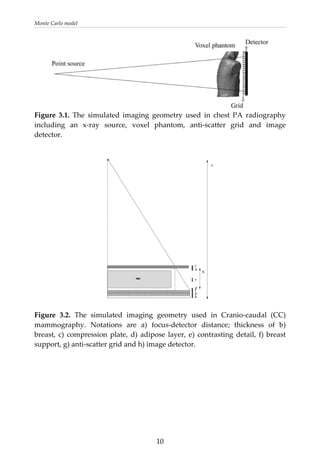
The imaging geometries for the chest and mammography models are shown in 
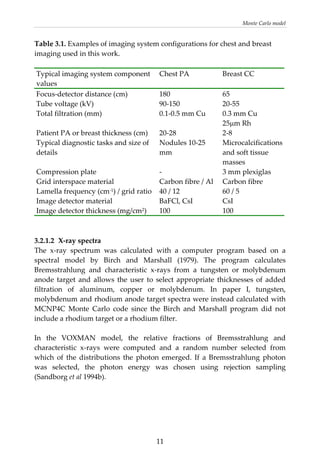
figures 3.1 and 3.2, respectively. Examples of specific imaging configurations 
are  listed  in  table  3.1.  Substantial  variations  of  the  imaging  system 
configuration were employed particularly in papers I, III and IV and to some 
extent also in papers II, V and VI.  


  9
Monte Carlo model 
 
Figure  3.1.  The  simulated  imaging  geometry  used  in  chest  PA  radiography 
including  an  x‐ray  source,  voxel  phantom,  anti‐scatter  grid  and  image 
detector. 


Figure  3.2.  The  simulated  imaging  geometry  used  in  Cranio‐caudal  (CC) 
mammography.  Notations  are  a)  focus‐detector  distance;  thickness  of  b) 
breast, c) compression plate, d) adipose layer, e) contrasting detail, f) breast 
support, g) anti‐scatter grid and h) image detector. 


  10
Monte Carlo model 
Table 3.1. Examples of imaging system configurations for chest and breast 
 imaging system component  Chest PA  Breast CC 
imaging used in this work.  
 
Typical
values 
Focus‐detector distance (cm)  180   65 
Tube voltage (kV)  90‐150   
)   Cu   Cu  
Patient PA or breast thickness (cm)  0‐28 
es 10‐25  ocalcifications 
Compression plate  ‐  exiglas 
erial  arbon fibre / Al 
/ grid ratio 
 
 (mg/cm2) 
20‐55
Total filtration (mm 0.1‐0.5 mm
 
0.3 mm
25μm Rh 
2 2‐8 
Typical diagnostic tasks and size of 
details 
Nodul
mm 
Micr
and soft tissue 
masses 
3 mm pl
Grid interspace mat C Carbon fibre 
Lamella frequency (cm‐1)  40 / 12  60 / 5 
Image detector material  BaFCl, CsI CsI 
Image detector thickness 100  100 
 
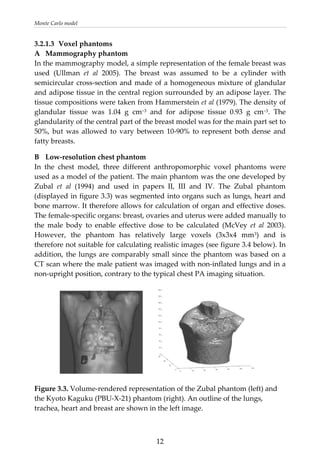
.2.1.2  X‐ray spectra 
was  calculated  with  a  computer  program  based  on  a 
  t
 
  the  VOXMAN  model,  the  relative  fractions  of  Bremsstrahlung  and 
 
3
The  x‐ray  spectrum 
spectral  model  by  Birch  and  Marshall  (1979).  The  program  calculates 
Bremsstrahlung  and characteristic  x‐rays  from  a  tungs en  or  molybdenum 
anode  target  and  allows  the  user  to  select  appropriate  thicknesses of added 
filtration  of  aluminum,  copper  or  molybdenum.  In  paper  I,  tungsten, 
molybdenum and rhodium anode target spectra were instead calculated with 
MCNP4C  Monte  Carlo  code  since  the  Birch  and  Marshall  program  did  not 
include a rhodium target or a rhodium filter. 
 
In
characteristic  x‐rays  were  computed  and  a  random  number  selected  from 
which  of  the  distributions  the  photon  emerged.  If  a  Bremsstrahlung  photon 
was  selected,  the  photon  energy  was  chosen  using  rejection  sampling 
(Sandborg et al 1994b). 


  11
Monte Carlo model 
3.2.1.3 
 was 
  Low‐resolution chest phantom 
  anthropomorphic  voxel  phantoms  were 
Voxel phantoms 
tom 
a 
A  Mammography phan
In the mammography model,  simple representation of the female breast
used  (Ullman  et  al  2005).  The  breast  was  assumed  to  be  a  cylinder  with 
semicircular cross‐section and made of a homogeneous mixture of glandular 
and adipose tissue in the central region surrounded by an adipose layer. The 
tissue compositions were taken from Hammerstein et al (1979). The density of 
glandular  tissue  was  1.04  g  cm−3  and  for  adipose  tissue  0.93  g  cm−3.  The 
glandularity of the central part of the breast model was for the main part set to 
50%,  but  was  allowed  to  vary  between  10‐90%  to  represent  both  dense  and 
fatty breasts. 
B
In  the  chest  model,  three  different
used as a model of the patient. The main phantom was the one developed by 
Zubal  et  al  (1994)  and  used  in  papers  II,  III  and  IV.  The  Zubal  phantom 
(displayed in figure 3.3) was segmented into organs such as lungs, heart and 
bone marrow. It therefore allows for calculation of organ and effective doses. 
The female‐specific organs: breast, ovaries and uterus were added manually to 
the  male  body  to  enable  effective  dose  to  be  calculated  (McVey  et  al  2003). 
However,  the  phantom  has  relatively  large  voxels  (3x3x4  mm3)  and  is 
therefore not suitable for calculating realistic images (see figure 3.4 below). In 
addition, the lungs are comparably small since the phantom was based on a 
CT scan where the male patient was imaged with non‐inflated lungs and in a 
non‐upright position, contrary to the typical chest PA imaging situation. 


igure 3.3. Volume‐rendered representation of the Zubal phantom (left) and F
the Kyoto Kaguku (PBU‐X‐21) phantom (right). An outline of the lungs, 
trachea, heart and breast are shown in the left image. 
 
  12
Monte Carlo model 
C  High‐resolution chest phantoms 
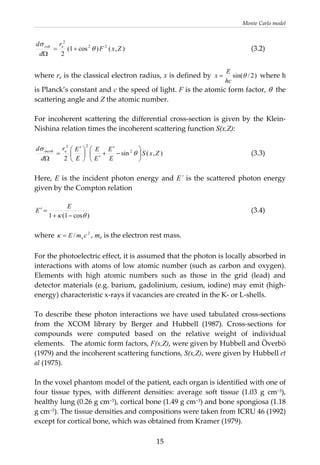
s  (voxel  sizeTwo  high‐resolution  voxel  phantom   0.97x0.97x0.6  mm)  were 
he manufacturer of the Kyoto Kagaku phantom claims that it is composed of 
created from CT scans of two different anthropomorphic thorax phantoms: the 
Alderson phantom and the Kyoto Kagaku PBU‐X‐21 phantom. The Alderson 
phantom was used in paper V and did not include smaller vessels. The more 
recent  Kyoto  Kagaku  phantom  was  more  realistic  since  it  contained  a  more 
human‐like distribution of small and medium‐sized vessels. Simulated x‐ray 
images  of  the  Zubal,  Alderson  and  Kyoto  Kagaku  phantoms  are  shown  in 
figure 3.4 demonstrating an increasing realism from left to right. 
 
T
materials  with  linear  attenuation  coefficients  (μ values)  resembling  those  of 
human tissues. However, they failed to provide us with details of the atomic 
compositions  of  the  tissue  substitute  materials,  which  complicate  a  more 
rigorous comparison with real x‐ray images of their chest phantom (see paper 
VI).  A  more  detailed  description  of  the  segmentation  of  the  Kyoto  Kagaku 
phantom  is  given  in  Malusek  (2008).  The  Alderson  and  Kyoto  Kagaku 
phantoms  are  used  mainly  for  simulation  of  synthetic  images  with  high 
resolution  but  are  not  yet  segmented  into  organs  and  tissue  types  and  can 
therefore not be used for direct calculation of effective dose. 


Figure 3.4. Projection images of the three chest voxel‐phantoms used in this 
 
.2.1.4  Anti‐scatter grid 
as  simulated  by  specifying  the  lamella  thickness, 
thesis. To the left the low‐resolution Zubal phantom, central the Alderson 
phantom and to the right the Kyoto Kagaku phantom. 
3
The  anti‐scatter  grid  w
interspace  material  and  thickness  as  well  as  cover  thickness  and  grid  ratio. 
Typical grids are listed in table 3.1. In the Monte Carlo program the focused 
grid was simulated by an analytical transmission formula developed by Day 
  13
Monte Carlo model 
and Dance (1983). Scattered photons generated in the grid itself was simulated 
by a separate Monte Carlo simulation in a parallel grid (Sandborg et al 1994b). 
 
3.2.1.5  Image detector 
ge detector was simulated in a separate Monte Carlo 
he image detector thickness was specified in terms of a surface density in mg
.2.2. Monte Carlo simulation of photon transport 
tion is described by 
( )nnnnn wE ,,, Ωr=
The response of the ima
model  of  a  semi‐infinite  layer  of  the  image  detector  material.  This  model  is 
included as a sub‐routine to the main VOXMAN program. Energy imparted 
per  unit  area  was  assumed  proportional  to  the  image  detector  signal.  The 
image detector model does not include the transport of secondary electrons as 
the  kerma  approximation  was  assumed.  The  transport  of  light  photons  was 
also  neglected.  In  papers  V  and  VI,  the  detector  response  was  calculated 
separately  with  MCNP4C  and  was  used  for  the  calculation  of  primary 
projections (Malusek 2008). 
 
T
cm-2
 (see table 3.1). In paper I, the detector material was needle crystals of CsI; 
in paper II, III and IV an unstructured mixture of BaFCl grains simulating a 
computed  radiography  (CR)  fluorescent  screen  and  finally  in  paper  VI,  a 
Gd2O2S indirect flat panel (DR) fluorescent screen was employed.  
 
3
The physical state of the photon after the n:th interac
 
α           (3.1) 
 
here rn is the position, En is the energy, Ωn is the solid angle and wn is the 
.2.2.1  Photon interaction, cross‐sections and material compositions 
w
statistical weight of the photon. Photon interaction types in the energy range 
of  diagnostic  radiology  (10‐150  keV)  are:  coherent  scattering,  incoherent 
scattering  and  photoelectric  effect.  The  photon  interactions  are  described  by 
the differential cross sections for these events based on the atomic composition 
of the materials and tissue types in the geometry.  A flow chart of the main 
steps in the Monte Carlo program is given in figure 3.6. A central part of the 
Monte Carlo method is the utilisation of a random number generator. In this 
work  we  have  used  the  random  number  generators  embedded  in  UNIX  or 
LINUX operating systems. 
 
3
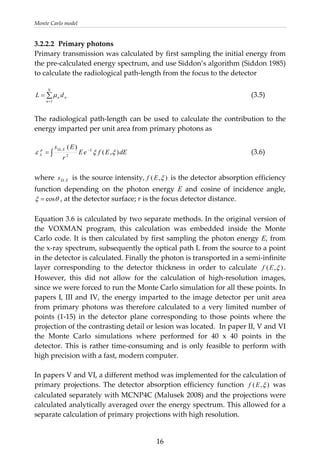
The differential cross‐section for coherent scattering is given by 
  14
Monte Carlo model 
),()cos1(
2
22
2
ZxF
r
d
d ecoh
θ
σ
+=
Ω
        (3.2) 
 
where re is the classical electron radius, x is defined by  )2/sin(θ
hc
E
x =  where h 
is Planck’s constant and c the speed of light. F is the atomic form factor, θ  the 
scattering angle and Z the atomic number. 
 
For  incoherent  scattering the differential cross‐section is given by the Klein‐
Nishina relation times the incoherent scattering function S(x,Z): 
 
),(sin
2
2
22
ZxS
E
E
E
E
E
Er
d
d eincoh
⎟
⎠
⎞
⎜
⎝
⎛
−
′
+
′
⎟
⎠
⎞
⎜
⎝
⎛ ′
=
Ω
θ
σ
      (3.3) 
 
Here, E is the incident photon energy and E´ is the scattered photon energy 
given by the Compton relation 
 
)cos1(1 θκ −+
=′
E
E
2
/ cmE e=κ
          (3.4) 
 
where  , me is the electron rest mass. 
 
For the photoelectric effect, it is assumed that the photon is locally absorbed in 
interactions with atoms of low atomic number (such as carbon and oxygen). 
Elements  with  high  atomic  numbers  such  as  those  in  the  grid  (lead)  and 
detector materials (e.g. barium, gadolinium, cesium, iodine) may emit (high‐
energy) characteristic x‐rays if vacancies are created in the K‐ or L‐shells.  
 
To describe these photon interactions we have used tabulated cross‐sections 
from  the  XCOM  library  by  Berger  and  Hubbell  (1987).  Cross‐sections  for 
compounds  were  computed  based  on  the  relative  weight  of  individual 
elements.   The atomic form factors, F(x,Z), were given by Hubbell and Överbö 
(1979) and the incoherent scattering functions, S(x,Z), were given by Hubbell et 
al (1975).  
 
In the voxel phantom model of the patient, each organ is identified with one of 
four  tissue  types,  with  different  densities:  average  soft  tissue  (1.03  g  cm−3), 
healthy lung (0.26 g cm−3), cortical bone (1.49 g cm−3) and bone spongiosa (1.18 
g cm−3). The tissue densities and compositions were taken from ICRU 46 (1992) 
except for cortical bone, which was obtained from Kramer (1979).  
  15
Monte Carlo model 
3.2.2.2  Primary photons 
Primary transmission was calculated by first sampling the initial energy from 
the pre‐calculated energy spectrum, and use Siddon’s algorithm (Siddon 1985) 
to calculate the radiological path‐length from the focus to the detector 
 
n
N
n
n dL ∑
=
=
1
μ             (3.5) 
 
The radiological path‐length can be used to calculate the contribution to the 
energy imparted per unit area from primary photons as 
 
dEEfeE
r
Es LEp
A ),(
)(
2
,
ξξε −Ω
∫=
Es ,Ω ),(
        (3.6) 
 
where   is the source intensity, ξEf  is the detector absorption efficiency 
function  depending  on  the  photon  energy  E  and  cosine  of  incidence  angle, 
θcos=
),(
, at the detector surface; r is the focus detector distance.  ξ
 
Equation 3.6 is calculated by two separate methods. In the original version of 
the  VOXMAN  program,  this  calculation  was  embedded  inside  the  Monte 
Carlo code. It is then calculated by first sampling the photon energy E, from 
the x‐ray spectrum, subsequently the optical path L from the source to a point 
in the detector is calculated. Finally the photon is transported in a semi‐infinite 
layer  corresponding  to  the  detector  thickness  in  order  to  calculate  ξEf
),(
. 
However,  this  did  not  allow  for  the  calculation  of  high‐resolution  images, 
since we were forced to run the Monte Carlo simulation for all these points. In 
papers I, III and IV, the energy imparted to the image detector per unit area 
from primary photons was therefore calculated to a very limited number of 
points  (1‐15)  in  the  detector  plane  corresponding  to  those  points  where  the 
projection of the contrasting detail or lesion was located.  In paper II, V and VI 
the  Monte  Carlo  simulations  where  performed  for  40  x  40  points  in  the 
detector. This is rather time‐consuming and is only feasible to perform with 
high precision with a fast, modern computer. 
 
In papers V and VI, a different method was implemented for the calculation of 
primary projections. The detector absorption efficiency function  ξEf  was 
calculated separately with MCNP4C (Malusek 2008) and the projections were 
calculated analytically averaged over the energy spectrum. This allowed for a 
separate calculation of primary projections with high resolution. 
  16
Monte Carlo model 
3.2.2.3  Scattered photons and variance reduction techniques 
The  simulation  of  scattered  photons  is  time  consuming.  Therefore,  different 
variance reduction techniques, described briefly below, were used to increase 
the efficiency. Monte Carlo methods that do not employ any variance reducing 
techniques  are  often  referred  to  as  analogue  Monte  Carlo  methods.  An 
algorithm for sampling the free path of the scattered photon, referred to as the 
Coleman’s algorithm is also briefly described below. 
 
A  Coleman’s algorithm  
The free path of the scattered photon is sampled using an algorithm described 
by  Coleman  (1968).  The  sampling  of  the  free  path  consists  of  several  steps.  
First, the distance to the first interaction point is sampled for a homogeneous 
medium  with  the  linear  attenuation  coefficient,  μmax,  corresponding  to  the 
material with highest attenuation (e.g. bone). The sampling is performed by 
testing whether a sampled random number from a uniform distribution in the 
interval  [0,1]  is  less  than  the  quotient  μ/μmax,  where  μ  is  the  attenuation 
coefficient of the material at the interaction point. If yes then the new point is 
accepted and the algorithm ends. If no then the sampling of the distance to the 
first  interaction  in  the  homogenous  medium  is  repeated  until  the  sampled 
random number is less than μ/μmax. 
 
B  Collision density estimator 
Analogue Monte Carlo methods are inefficient in estimating scattered photons 
in the image plane due to the low probability that a scattered photon will pass 
a  given  small  target  area  in  the  image  detector.  Therefore  in  the  VOXMAN 
code,  the  collision  density  estimator  (Persliden  and  Alm  Carlsson  1986)  is 
used. The contribution to the energy imparted per unit area at a given point of 
interest  in  the  image  detector  is  obtained  from  each  interaction  point  in  the 
phantom. The contribution   is derived through ∗
sε
sn
N
n
nns Tw ,
1
)( λαε ∑
=
∗
=
 
          (3.7) 
 
where  λn,s  is  the  contribution  from  the  n:th  interaction  and  T(α)  is  the 
probability for the photon of state αn to be scattered to the point of interest; wn 
is  the  photon  weight.  In  the  collision  density  estimator,  incoherent  and 
coherent scattering are treated separately. The radiological path‐length from 
the interaction point to the point of interest in the detector is calculated with 
Siddon’s algorithm as in the case of primary photons. 
 
  17
Monte Carlo model 
C  Analytical averaging of survival and Russian roulette 
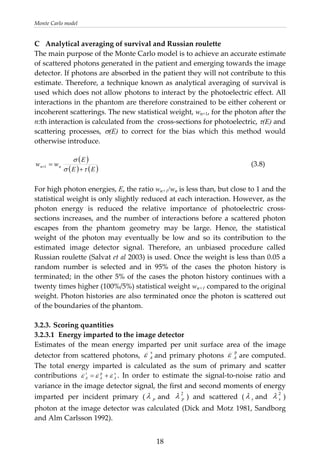
The main purpose of the Monte Carlo model is to achieve an accurate estimate 
of scattered photons generated in the patient and emerging towards the image 
detector. If photons are absorbed in the patient they will not contribute to this 
estimate. Therefore, a technique known as analytical averaging of survival is 
used which does not allow photons to interact by the photoelectric effect. All 
interactions in the phantom are therefore constrained to be either coherent or 
incoherent scatterings. The new statistical weight, wn+1, for the photon after the 
n:th interaction is calculated from the  cross‐sections for photoelectric, τ(E) and 
scattering  processes,  σ(E)  to  correct  for  the  bias  which  this  method  would 
otherwise introduce. 
 
( )
( ) ( )EE
E
ww nn
τσ
σ
          (3.8) 
+
=+1
 
For high photon energies, E, the ratio wn+1/wn is less than, but close to 1 and the 
statistical weight is only slightly reduced at each interaction. However, as the 
photon  energy  is  reduced  the  relative  importance  of  photoelectric  cross‐
sections increases, and the number of interactions before a scattered photon 
escapes  from  the  phantom  geometry  may  be  large.  Hence,  the  statistical 
weight  of  the  photon  may  eventually  be  low  and  so  its  contribution  to  the 
estimated  image  detector  signal.  Therefore,  an  unbiased  procedure  called 
Russian roulette (Salvat et al 2003) is used. Once the weight is less than 0.05 a 
random  number  is  selected  and  in  95%  of  the  cases  the  photon  history  is 
terminated; in the other 5% of the cases the photon history continues with a 
twenty times higher (100%/5%) statistical weight wn+1 compared to the original 
weight. Photon histories are also terminated once the photon is scattered out 
of the boundaries of the phantom. 
 
3.2.3. Scoring quantities 
3.2.3.1  Energy imparted to the image detector 
Estimates  of  the  mean  energy  imparted  per  unit  surface  area  of  the  image 
detector from scattered photons, 
s
Aε and primary photons 
p
Aε are computed. 
The  total  energy  imparted  is  calculated  as  the  sum  of  primary  and  scatter 
contributions  sp
AA
t
A εεε +=
p
.  In  order  to  estimate  the  signal‐to‐noise  ratio  and 
variance in the image detector signal, the first and second moments of energy 
imparted  per  incident  primary  ( λ and  )  and  scattered  (
2
pλ sλ and  ) 
photon at the image detector was calculated (Dick and Motz 1981, Sandborg 
and Alm Carlsson 1992).  
2
sλ
  18
Monte Carlo model 
3.2.4. Calculated quantities 
3.2.4.1. Contrast 
A contrasting detail (e.g. corresponding to a lesion) is added to the model with 
a  thickness  and  location  specified  by  the  user.  The  contrasting  detail  is  not 
added directly into the voxel phantom but in an artificial way in a subroutine 
inside the VOXMAN model. The contrast of this detail is calculated as 
11
21
1
1
psp
pp
C
εεε
ε ε
+
⋅
−
= (3.9)
 
where  εp1  is  the  mean  energy  imparted  to  the  detector  per  unit  area  from 
primary photons with the nodule present, εp2 the mean energy imparted per 
unit  area  from  primary  photons  with  the  nodule  absent  and  εs  is  the  mean 
energy imparted per unit area from scattered photons.  
 
3.2.4.2. Signal‐to‐noise ratios 
The program calculates two types of signal‐to‐noise ratios. The signal‐to‐noise 
ratio per pixel, SNRp is calculated as 
22
sspp
p
A
p
NN
SNR
λλ
ε
⋅+⋅
=                (3.10) 
 
where  N  is  the  number  of  photons  incident  on  a  pixel.  The indices p and s 
stands for contributions from primary and scattered photons, respectively. The 
quantities λ and λ2 are mean and mean squared values of the energy imparted 
to a specified pixel per incident photon.  
 
Given  the  location  and  thickness  of  a  specified  lesion  (detail),  the  computer 
program  calculates  the  signal‐to‐noise  ratio  for  this  detail  with  a  projection 
area corresponding to one pixel. It is here called the SNRMC and is given by 
22
11
2211
sspp
pppp
MC
NN
NN
SNR
λλ
λλ
⋅+⋅
⋅−⋅
= (3.11)
 
where the index n=1 refers to a pixel in the image behind the nodule, and n=2 
refers to the same pixel with the nodule absent. 
 
  19
Monte Carlo model 
3.2.4.1  Air collision kerma 
The air collision kerma, Kc,air is given by 
 
( ) ( )( )∫ ⋅⋅= dE/ρEμEΦEK airenEc,air
airen )/(
, (3.12) 
where  ρμ  is the mass energy absorption coefficient for air and  is 
the differential photon fluence with respect to energy. 
)(EEΦ
tt HwE ∑=
 
3.2.4.2  Effective dose 
The  effective  dose  is  the  tissue‐weighted  sum  of  the  equivalent  doses  in  all 
specified tissues or organs of the body calculated according to ICRP 60 (ICRP 
1991). 
 
           (3.13) 
 
where wt is the tissue or organ weighting factor and Ht the equivalent dose for 
that tissue or organ. It is recognized that a new ICRP publication 103 (ICRP 
2007) has recently been adopted and uses slightly different values of the tissue 
weighting factors in the calculation of effective dose. A detailed analysis of the 
effect on the figures of merit due to this change, for example signal‐to‐noise 
ratio  per  effective  dose,  SNR2
/E,  has  not  been  performed  here.  The  absolute 
values  of SNR2
/E may change, but the main conclusions on for example the 
appropriate tube voltage for chest PA radiography is unlikely to be affected by 
the change of weighting factors, particularly since the weighting factors for the 
lungs are the same in ICRP 60 as in ICRP 103. 
 
3.3. Calculation of images from the high‐resolution phantom 
The  scatter  projection,  SNRp  and  other  quantities  calculated  with  the  MC 
method are rescaled (i.e. from 40 x 40 points) to fit the number of pixels in the 
primary image. In paper V this number is 1760 x 1760, and in paper VI the 
number of pixels is 2688 x 2688. The rescaling is performed using a bilinear 
interpolation  function  in  MATLAB.  The  interpolated  scatter  projections  are 
added to the primary image to give the estimate of the mean energy imparted 
per  unit  area  of  the  detector  for  the  i:th  pixel,  s
,
p
,
t
, iAiAiA εεε += .  Noise  is 
subsequently added to the image. In paper V, white gaussian noise is added 
with the standard deviation 
  20
Monte Carlo model 
ip,
p
,
SNR
iA
i
ε
σ = .
The  white  noise  is  generated  by  adding  sampled  random  numbers  for  each 
pixel i from the appropriate distribution to the calculated image. In paper VI, 
correlated noise is added with a method similar to the one used in Båth et al 
(2005c).  In  order  to  add  correlated  noise,  knowledge  of  the  noise  power 
spectrum (NPS) for the clinical system is needed. The NPS is then normalized 
to correspond to unit variance. A random phase is added to the square root of 
the normalized NPS with the constraint that the random phase image  ),( vuφ  
should  have  the  symmetry  ),(),( vuvu = −φ − −φ .  By  taking  an  inverse  Fourier 
transform of this spectrum a real and correlated noise image   is created. The 
vector δ  is a multivariate random variable with mean corresponding to a null 
vector and covariance matrix corresponding to the measured NPS. The noise 
fluctuation  for  each  pixel  is  rescaled  with  the  relation 
εˆδ
εˆ
iAiiA σ ,,
ˆδε εδ⋅= .  It  is 
assumed that the NPS was invariant under a logarithmic transformation. The 
total energy imparted to the detector per unit area including noise fluctuations 
becomes iA
t
iAiA ,,
t
, δεεε +=
t
,iAε
cbag iAi += )ln( t
,ε
. The pixel value in the i:th pixel is calculated by taking 
a logarithmic transformation of   using the relation  
 
          (3.14)  
 
where the parameters a, b and c are calculated with non‐linear regression to 
make  the  best  fit  to  the  real  phantom  images.  The  method  to  add  primary, 
scattered and noise images is illustrated in figure 3.5.  
 
+ =+
 
Figure  3.5.  The  method  for  calculating  images  illustrated  in  a  cutout  in  the 
retrocardial region (see further figure 4.1.). From the left: primary projection, 
scatter projection, noise image and total image (to the right).  
 
  21
Monte Carlo model 
3.4. Uncertainties 
3.4.1. Stochastic uncertainties 
The choice of the number of photon histories used in the simulation is a trade 
off between computer time and statistical precision. If the statistical precision 
of the simulation is doubled, the computer time is increased by a factor of 4. 
For  instance,  the  computer  time  for  a  typical  simulation  (for  calculating  the 
scatter  contribution  to  a  synthetic  image)  on  the  computer  Alpha  (AMD 
Opteron processor 250, 2.4 GHz; 6.26 GB RAM) in 40 x 40 points of interest, at 
the tube voltage 141 kV, with a precision of 1% (one standard deviation) takes 
approximately 17 hours. The statistical uncertainty has to be kept low when 
we are calculating images, since if the statistical uncertainty is too high, the 
scatter  projection  often  contains  artifacts  when  it  is  interpolated  to  a  higher 
resolution. 
 
3.4.2. Systematic uncertainties 
There are several sources of uncertainty that affect the results. These include 
uncertainties in the cross sections, but also uncertainties in estimation of the 
different parameters in the input files. In an internal report, Ullman et al (2003) 
studied the effects of uncertainties in x‐ray spectrum half value layer (HVL), 
field size, grid lamella thickness and detector thickness. The conclusion from 
this  study  is  that  the  systematic  uncertainty  due  to  these  factors  in  the 
estimated  εs/εp  behind  the  grid  is  approximately  11%.  Later,  analysis  of 
variance  (ANOVA)  and  regression  analysis  was  used  to  analyse  similar 
uncertainties  and  the  systematic  uncertainty  in  εs/εp  behind  the  grid  was 
estimated  to  be  approximately  9%.  However,  these  relatively  large 
uncertainties only apply in those cases where we attempt to mimic a real x‐ray 
imaging system and compare measured quantities from that system with our 
calculated  quantities.  In  the  cases  where  we  only  use  simulations  to  study 
relative  differences  between  alternative  acquisition  schemes  for  an  imaging 
system, the stochastic uncertainty is more relevant. 
  22
Monte Carlo model 
 
  23


Figure 3.6. Flow chart describing the most important steps in the Monte Carlo 
program 
Yes
Set-up geometry, voxel phantom, cross-
sections, image detector and grid
Select photon energy
Calculate contributions from primary
photons analytically to point of interest
(Siddon’s algorithm)
Start calculating contributions
from scattered photons
Select direction of motion
of incident photon
Calculate free path with Coleman’s
algorithm.
Calculate the contribution to collision density
estimator from scattered photons.
Select type of interaction
and assign weight
Store energy imparted to the
phantom
Sample new direction of motion and
continue photon history
Terminate
by Russian
roulette?
Select new path length
(Coleman’s algorithm)
YesIs the next
interaction within
the phantom?
No
Was this the
last history?
Calculate scoring
quantities
Monte Carlo model 
 
  24
Assessment of image quality 
  25
4. ASSESSMENT OF IMAGE QUALITY
4.1. Introduction 
Image  quality  assessment  means  quantifying  the  usefulness  of  an  image  to 
solve a specific diagnostic task. It is preferred if this image quality assessment 
is  objective.  There  are,  according  to  Barrett  (1990),  four  criteria  that  are 
essential for objective assessment of image quality. 
 
A. The task 
Image  quality  can  only  be  described  in  relation  to  a  well‐defined  task.  This 
often  means  detection  of  an  object  in  a  structured  or  homogeneous 
background. A summary of different tasks to be solved in chest radiography is 
given in ICRU 70 (ICRU 2003). Among those, the search for malignant nodules 
at  different  positions  in  the  lung  is  a  common  case  treated  in  the  literature 
(Samei et al 1999). In mammography it is common to search for calcifications 
or masses (Burgess et al 2001). Several different types of tasks are discussed in 
the literature (Barrett and Myers 2004). 
 
B. Image and object properties  
We need to understand the physical and statistical properties of the imaging 
system as well as the object being imaged. For example, the radiologist has an 
internal model of both the human anatomy as well as a large “data bank” of 
common pathologies in order be able to distinguish a malignant nodule from 
normal anatomy. The radiologist also needs to understand some of the physics 
behind the imaging technology in order to recognize some of the artefacts that 
may be present in the image. 
 
C. Observer 
An observer that can perform the task is needed. This can be a human or a 
model observer. It is the human observer (radiologist) that is the final decision 
maker. Therefore, measures of image quality should always take the human 
observer into account. Yet, clinical trials involving human observers are costly 
and time demanding. Model observers may then be used to give insights into 
how image quality depends on the physical and technical image acquisition 
parameters.  
 
 
Assessment of image quality 
D. Figure of merit 
The  figure  of  merit  (FOM)  is  a  number  that  tells  us  how  well  the  observer 
performs the task. The FOM depends on the detection task; a commonly used 
FOM is the signal to noise ratio (SNR) or AUC, the area under the receiver 
operating characteristic curve (ROC). In some cases, image quality is described 
by physical properties derived from the image rather than by the performance 
of an observer on a specific task, for example, the modulation transfer function 
(MTF)  or  the  noise  power  spectrum  (NPS).  We  will  refer  to  this  as  physical 
image quality. 
 
4.2. Image quality assessment as developed in this work 
In  this  work,  different  tasks  and  figures  of  merit  have  been  used,  changing 
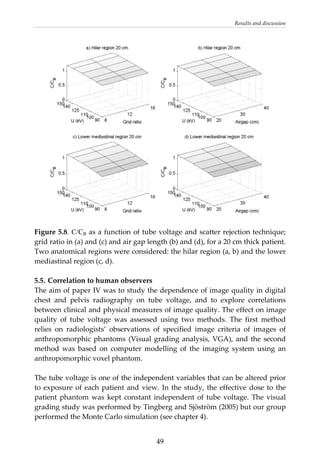
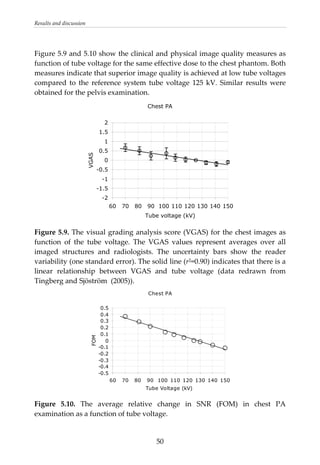
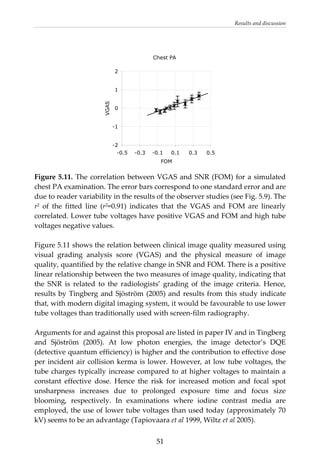
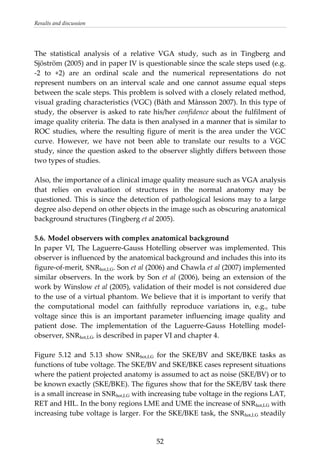
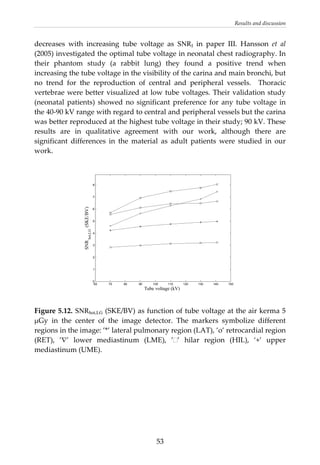
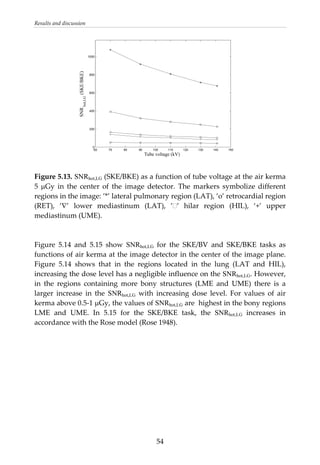
along with an improved modeling of the imaging system including the patient 
and improved model observers. In some cases, figures of merit based on pure 
physical measures of image quality were used and correlated to measures of 
the  performance  of  human  observers  in  clinical  trials.  A  summary  of  the 
development is given below. 
 
4.2.1. The task 
Two main types of tasks are used in this work. The first task is to search for a 
known  signal  (e.g.  a  nodule)  in  a  known  background,  referred  to  as  the 
SKE/BKE (signal known exactly/background known exactly) task. The second 
task is to search for a known signal (e.g. a nodule) in a varying background, 
referred to as the SKE/BV (signal known exactly/background varying) task. 
 
The  SKE/BKE  task  was  addressed  in  paper  I,  which  was  devoted  to  the 
optimization  of  tube  voltage  and  filtration  in  iodine  subtraction 
mammography.  The  task  was  to  detect  a  blood  vessel  filled  with  iodine 
contrast of thickness 6 mg cm‐2 against a homogeneous background. 
 
In paper IV the task was to compare two images from an x‐ray chest phantom 
and  see  in  which  image  the  structures  corresponding  to  the  image  criteria 
were most clearly visible (the VGA study). In some sense, the background can 
be  considered  as  known  in  this  study  since  the  same  anthropomorphic 
phantom (the Alderson chest phantom) is used for all comparisons. Thus, the 
observer may be able to remember the background. In addition, the phantom 
used in this study does not contain as fine and complex structural details as 
are present in real phantoms (see further figure 5.4). 
 
  26
Assessment of image quality 
The  SKE/BV  task  was  addressed  in  papers  III  and  VI  were  the  task  was 
detection of nodules at various positions in the lungs. In paper III, the size and 
shape of the nodules corresponded to those used in the trial by Håkansson et 
al  (2005b).  The  anatomical  structures  vary  at  different  positions  in  a  chest 
image and differ from patient to patient. When the background is unknown 
for the observer it hampers the detection of subtle details (Samei et al 2000). 
 
The  two  papers  II  and  V  were  dedicated  to  describe  the  physical 
characteristics of the simulated image rather than to solve a specific detection 
task. Paper II was dedicated to calculate the variation of the scatter‐to‐primary 
ratio εs/εp in the image plane in a chest examination as well the variation in the 
signal‐to‐noise ratio per pixel (SNRp). These quantities influence contrast and 
noise  and  thus  detectability  of  lesions  varies  with  position  in  the  imaged 
anatomy.  
 
4.2.2. Model of the imaging system and patient 
Knowledge of the imaging system is in this work translated into a model of 
the  system  including  the  patient.  This  model  is  used  together  with  Monte 
Carlo  techniques  to  calculate  dosimetric  and  image  quality  parameters, 
needed  for  optimising  the  imaging  system.  The  realism  of  the  system,  in 
particular  the  model  of  the  patient,  has  been  increased  during  the  work. 
Details of the model and Monte Carlo calculations are given in Chapter 3. The 
development of the model of the patient can be summarised as follows. 
 
In paper I the breast was modeled using a slab phantom with homogeneous 
materials and the detail (blood vessel) was modeled as a layer of iodine, see 
Figure 3.2.  
 
To  allow  for  more  realistic  calculations  of  how  the  scatter‐to‐primary  ratios 
varies at various positions in the anatomy behind large anatomical structures 
like the spine, heart and lungs, a low‐resolution anthropomorphic phantom, 
the Zubal phantom, was used in papers II‐IV. In paper III the anatomy was 
divided into several regions corresponding to different anatomical properties, 
see figure 4.1. This approach was also used in paper VI.  
 
In order to simulate images with realistic anatomical background variations,  
(see  section  3.3)  a  high‐resolution  anthropomorphic  phantom  was  created 
from CT images of an anthropomorphic (Alderson) phantom in paper V. This 
is  an  important  step  in  the  model  development,  since  it  has  been  shown  in 
  27
Assessment of image quality 
clinical trials that the fine details (such as small and medium sized vessels) of 
the projected anatomical background strongly influence detectability (Kundel 
et al 1985, Samei et al 1999, Håkansson et al 2005b) and thus act as noise besides 
system  (quantum)  noise.  In  Paper  VI  a  new  and  still  more  realistic  high‐
resolution  anthropomorphic  phantom  (Kyoto  Kagaku)  was  implemented  in 
the model. A mathematical model of a lesion, referred to as a designer nodule 
(Burgess et al 1997) was inserted in the projection radiographs for studies of 
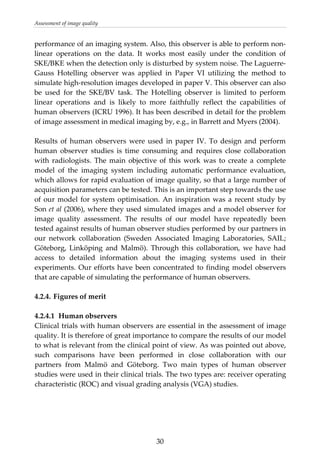
detectability using model observers. Figure 4.2 shows cut outs of a chest image 
from the hilar region without lesion (4.2a) and with an added designer nodule 
(4.2b). Figures 4.2c and 4.2d show corresponding images against a background 
of  quantum/system  noise  only.  The  figures  clearly  demonstrate  the  large 
difference  in  difficulty  between  detecting  a  nodule  in  an  image  containing 
anatomical structures and in a pure quantum noise image, respectively. 


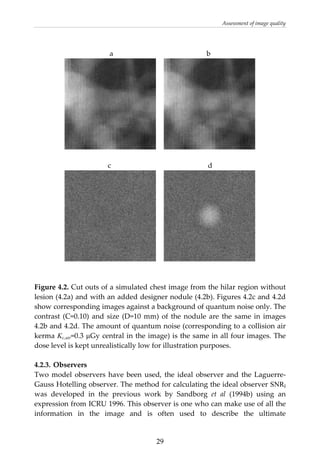
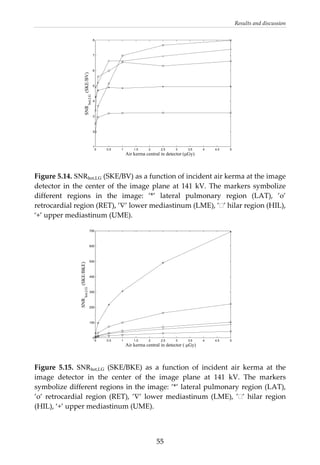
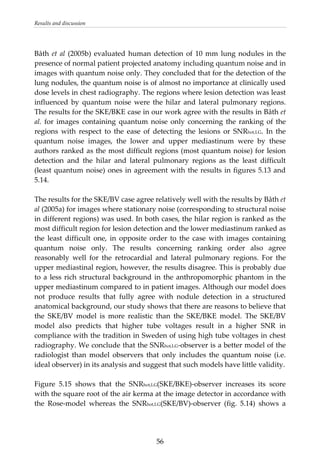
Figure 4.1. The six anatomical regions of the chest PA image used in papers III 
and VI: APR: Apical pulmonary region, LAT: Lateral pulmonary region, RET: 
Retrocardial  region,  LME:  Lower  mediastinal  region,  HIL:  Hilar  region  and 
UME: Upper mediastinal region.  


  28
Assessment of image quality 
 
a                                                    b 
      
 
c                                                      d 


Figure 4.2. Cut outs of a simulated chest image from the hilar region without 
lesion (4.2a) and with an added designer nodule (4.2b). Figures 4.2c and 4.2d 
show corresponding images against a background of quantum noise only. The 
contrast (C=0.10) and size (D=10 mm) of the nodule are the same in images 
4.2b and 4.2d. The amount of quantum noise (corresponding to a collision air 
kerma Kc,air=0.3 μGy central in the image) is the same in all four images. The 
dose level is kept unrealistically low for illustration purposes. 
 
4.2.3. Observers 
Two model observers have been used, the ideal observer and the Laguerre‐
Gauss Hotelling observer. The method for calculating the ideal observer SNRI 
was  developed  in  the  previous  work  by  Sandborg  et  al  (1994b)  using  an 
expression from ICRU 1996. This observer is one who can make use of all the 
information  in  the  image  and  is  often  used  to  describe  the  ultimate 
  29
Assessment of image quality 
performance of an imaging system. Also, this observer is able to perform non‐
linear  operations  on  the  data.  It  works  most  easily  under  the  condition  of 
SKE/BKE when the detection only is disturbed by system noise. The Laguerre‐
Gauss  Hotelling  observer  was  applied  in  Paper  VI  utilizing  the  method  to 
simulate high‐resolution images developed in paper V. This observer can also 
be  used  for  the  SKE/BV  task.  The  Hotelling  observer  is  limited  to  perform 
linear  operations  and  is  likely  to  more  faithfully  reflect  the  capabilities  of 
human observers (ICRU 1996). It has been described in detail for the problem 
of image assessment in medical imaging by, e.g., in Barrett and Myers (2004).  
 
Results  of  human  observers  were  used  in  paper  IV.  To  design  and  perform 
human  observer  studies  is  time  consuming  and  requires  close  collaboration 
with  radiologists.  The  main  objective  of  this  work  was  to  create  a  complete 
model  of  the  imaging  system  including  automatic  performance  evaluation, 
which allows for rapid evaluation of image quality, so that a large number of 
acquisition parameters can be tested. This is an important step towards the use 
of our model for system optimisation. An inspiration was a recent study by 
Son et al (2006), where they used simulated images and a model observer for 
image  quality  assessment.  The  results  of  our  model  have  repeatedly  been 
tested against results of human observer studies performed by our partners in 
our  network  collaboration  (Sweden  Associated  Imaging  Laboratories,  SAIL; 
Göteborg,  Linköping  and  Malmö).  Through  this  collaboration,  we  have  had 
access  to  detailed  information  about  the  imaging  systems  used  in  their 
experiments. Our efforts have been concentrated to finding model observers 
that are capable of simulating the performance of human observers. 
 
4.2.4. Figures of merit 
 
4.2.4.1  Human observers 
Clinical trials with human observers are essential in the assessment of image 
quality. It is therefore of great importance to compare the results of our model 
to what is relevant from the clinical point of view. As was pointed out above, 
such  comparisons  have  been  performed  in  close  collaboration  with  our 
partners  from  Malmö  and  Göteborg.  Two  main  types  of  human  observer 
studies were used in their clinical trials. The two types are: receiver operating 
characteristic (ROC) and visual grading analysis (VGA) studies.  


  30
Assessment of image quality 
A  ROC studies 
Receiver operating characteristics (ROC) (Metz 1986, Metz 2000, ICRU 1996) 
studies with human observers form the gold standard for assessment of image 
quality.  
 
When  a  human  observer  performs  a  specific  task,  for  instance,  decides 
whether a signal is present or not present, there are four possible outcomes:  
(1)  False Positive (FP): signal is absent – observer decides signal present 
(2)  True Positive (TP): signal is present – observer decides signal present 
(3)  False Negative (FN): signal is present – observer decides signal absent 
(4)  True Negative (TN): signal is absent – observer decides signal absent 
 
The decision maker also strives to minimize the cost. A false positive decision 
may mean that the patient has to undergo extra examinations. A false negative 
decision may mean that, for instance, a tumour is missed and the patient has 
less  probability  for  recovery  if  the  tumour  is  discovered  later.  The  strategy 
used by the observer therefore depends on which kind of error (FP of FN) that 
is  most  costly.  The  relation  between  the  false  positive  fraction  and  the  true 
positive  fraction  is  illustrated  in  the  receiver  operating  characteristic  (ROC) 
curve, see figure 4.3. Each point on this curve corresponds to a threshold level 
(observer  strategy).  The  area  under  the  ROC  curve,  AUC  (also  commonly 
denoted  Az  in  the  literature),  is  a  common  figure  of  merit  used  in 
discrimination  tasks  and  can  be  translated  to  a  value  for  the  signal‐to‐noise 
ratio SNR (Barrett and Myers 2004) using 
 
          (4.1) )12(2)( 1
−= −
AUCerfAUCSNR
 
where  erf−1
  is  the  inverse  error  function.  The  quantity  SNR(AUC)  is  often 
referred  to  as  the  detectability  index  dA.  A  short  description  of  the 
methodology is given below. 
 
A recent review of ROC and related methods is given by Krupinsky and Jiang 
(2008). To reach sufficient statistical power many images and several observers 
are needed. Another problem in ROC studies is that the true answer has to be 
known.  This  can  be  accomplished  by  using  so  called  hybrid  images  where 
lesions are simulated and paste into real images (Metz 2000). 
 
 
  31
Assessment of image quality 
0 0.1 0.2 0.3 0.4 0.5 0.6 0.7 0.8 0.9 1
0
0.1
0.2
0.3
0.4
0.5
0.6
0.7
0.8
0.9
1
False positive fraction
Truepositivefraction
 
 
Figure 4.3. Illustration of an ROC curve. The area under the curve (AUC) is 
used as a figure of merit and can be related to the SNR. In this figure: AUC=0.8 
(SNR=1.19). The dotted line corresponds to AUC=0.5 (SNR=0), which means 
that the observer is guessing. 


B  VGA studies 
In  a  visual  grading  analysis  (VGA)  study,  the  observer  is  presented  to  two 
images. One image is a reference image and used in every comparison. The 
observer has to decide if the quality of the image compared to the reference 
image is similar, better or worse.    
 
In paper IV, results from a VGA study by Tingberg and Sjöström (2005) were 
used to search for correlations between physical image quality parameters and 
clinical image quality. In the VGA study, slightly modified CEC (Carmichael et 
al 1996) image criteria were used. The criteria were based on structures in the 
normal  anatomy  that  are  described  in  table  4.1  for  chest  PA  and  Pelvis  AP 
examinations.  The  radiologists  were  asked  to  give  a  graded  response  of the 
fulfilment  (=visibility  of  the  structures)  of  the  criteria  compared  to  the 
fulfilment  of  the  criteria  in  the  reference  image.  The  grading  was  given  in 
quantitative  terms  as:  clearly  inferior  (VGA=‐2),  inferior  (‐1),  equal  to  (0), 
superior (+1) or clearly superior (+2). The score was averaged over all criteria 
and all radiologists to form an average score, VGAS.   
 
  32
Assessment of image quality 
Table 4.1. Structures used in the VGA evaluation 
(Tingberg and Sjöström 2005) 
Chest PA  Pelvis AP 
1  Vessels seen 3 cm from the pleural margin  Sacrum (spongiosa) 
2  Thoratic vertebra behind the heart  Sacral foramina 
3  Retrocardiac vessels  Pubic and ishial rami 
4  Pleural margin  Sacroiliac joints 
5  Vessels seen an face in the central area  Femoral bilateral 
6  Hilar region  ‐ 
 
4.2.4.2  The ideal observer 
For the Ideal observer used in this work, the background and the signal are 
assumed  to  be  known  exactly,  corresponding  to  a  SKE/BKE  task.  From  the 
SNRMC (see section 3.2.4.2), the ideal observer signal‐to‐noise ratio, SNRI for a 
given nodule is calculated from equation 4.2 as 
222
DF
p
MI r
a
A
SNRSNR ⋅⋅= (4.2)
where A is the projected area of the nodule in the image plane, ap is the pixel 
area  and  r2
DF  is  the  signal  to  noise  ratio  degradation  factor  caused  by  the 
system unsharpness. The quantity r2
DF includes effects on SNR of the imaging 
system unsharpness (modulation transfer function, MTF) and correlated noise 
(noise power spectrum (NPS)) as determined from experiments with the actual 
detector type and additional detector noise. It is derived separately for each 
nodule  at  its  actual  position  in  the  anatomy,  and  depends  on  the  nodule 
projected  area  and  the  air  kerma  at  the  image  detector.  Geometrical  (focal 
spot‐ and magnification) unsharpness and motion unsharpness are taken into 
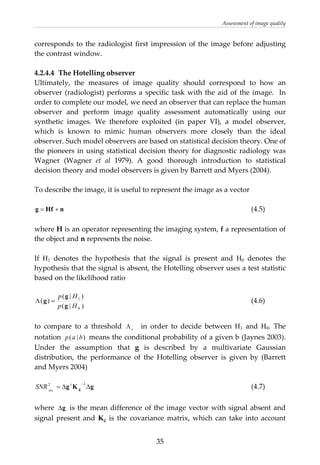
account in addition to detector unsharpness. The latter is expressed in terms of 
the pre‐sampled MTF (Sandborg et al 2003). 
 
A  Figure of merit corresponding to the VGAS in a VGA study 
In paper IV we calculated a figure of merit that is intended to correspond to 
the VGAS obtained in the VGA study (Tingberg and Sjöström 2005). For each 
contrasting detail, denoted with index q, the SNRI,q relative to its value at the 
reference  tube  voltage,  SNRI,q(Uref),  was  computed  (SNRI,q(U)/  SNRI,q(Uref)). 
These  ratios  were  then  averaged  for  all  the  structures  and  a  figure  of  merit 
(FOM)  was  computed  as  given  in  equation  4.3.  Here,  unity  was  subtracted 
from the average value in order to obtain the value zero for the reference tube 
  33
Assessment of image quality 
voltage and allow negative values when the image quality is inferior to that of 
the reference system (corresponding to the ordinate scale of the VGAS) 
 
( ) 1
)(1
)(
,
,
−∑=
q refqI
qI
USNR
USNR
N
UFOM , (4.3)
 
where N is the number of details. 
 
4.2.4.3  Figures of merit using physical image quality measures 
 
A  Nodule to bone contrast 
In Paper III we attempted to perform optimization using the Zubal phantom. 
Since the SNRI as calculated in this work does not take into account anatomical 
details  and  these  are  known  to  influence  detectability,  alternative  figures  of 
merit were also used. The ribs obscure large parts of the lungs but are also 
needed  for  the  radiologist  to  orient  himself  in  the  image  (Sven‐Göran 
Fransson, personal communication). The contrast of the nodule relative to the 
contrast of the ribs may indicate the disturbing influence of the ribs. We have 
therefore defined a ‘nodule‐to‐bone’ contrast‐ratio by computing the quotient 
C/CB. The C/CB is the nodule’s contrast divided by the contrast of a bone detail 
of  a  thickness  corresponding  to  a  rib  or  transverse  processes  at  the  same 
position  in  the  image.  The  use  of  the  nodule‐to‐bone  contrast  as  a 
complementary figure of merit was inspired from the work by Dobbins et al 
(2003) and Samei et al (2005). 
 
B  Relative contrast  
The  radiologist  often  wants  to  adjust  the  contrast  window.  This  choice  of 
contrast  window  affects  the  contrast  of  other  objects in the image. We have 
defined a relative contrast, Crel, as the signal difference in the image detector 
divided by the dynamic range of the whole image of the chest 
%5%95
21
εε
ε ε
−
−
=
pp
relC ,          (4.4) 
 
where εp1 is the energy imparted to the detector per unit area in the presence of 
the  nodule,  εp2  is  the  energy  imparted  in  the  absence  of  the  nodule,  and 
ε95%−ε5%  is  the  dynamic  range  in  the  chest  image,  here  defined  by  the  95th 
percentile  minus  the  5th    percentile  of  the  energies  imparted  to  the  image 
detector in the whole chest image. The relative contrast is thus a measure of 
the  nodule’s  contrast  as  a  percentage  of  the  dynamic  range  in  the  image.  It 
  34
Assessment of image quality 
corresponds to the radiologist first impression of the image before adjusting 
the contrast window.  
 
4.2.4.4  The Hotelling observer 
Ultimately,  the  measures  of  image  quality  should  correspond  to  how  an 
observer (radiologist) performs a specific task with the aid of the image.  In 
order to complete our model, we need an observer that can replace the human 
observer  and  perform  image  quality  assessment  automatically  using  our 
synthetic  images.  We  therefore  exploited  (in  paper  VI),  a  model  observer, 
which  is  known  to  mimic  human  observers  more  closely  than  the  ideal 
observer. Such model observers are based on statistical decision theory. One of 
the pioneers in using statistical decision theory for diagnostic radiology was 
Wagner  (Wagner  et  al  1979).  A  good  thorough  introduction  to  statistical 
decision theory and model observers is given by Barrett and Myers (2004). 
 
To describe the image, it is useful to represent the image as a vector 
 
            (4.5) nHfg +=
 
where H is an operator representing the imaging system, f a representation of 
the object and n represents the noise. 
 
If  H1  denotes  the  hypothesis  that  the  signal  is  present  and  H0  denotes  the 
hypothesis that the signal is absent, the Hotelling observer uses a test statistic 
based on the likelihood ratio  
 
)|(
)|(
)(
0
1
Hp
Hp
g
g
g =Λ
cΛ
)|( bap
          (4.6) 
 
to  compare  to  a  threshold      in  order  to  decide  between  H1  and  H0.  The 
notation   means the conditional probability of a given b (Jaynes 2003). 
Under  the  assumption  that  g  is  described  by  a  multivariate  Gaussian 
distribution,  the  performance  of  the  Hotelling  observer  is  given  by  (Barrett 
and Myers 2004) 
 
          (4.7) gKg g ΔΔ=
−12 t
Hot
SNR
 
where  gΔ  is the mean difference of the image vector with signal absent and 
signal  present  and  Kg  is  the  covariance matrix, which can take into account 
  35
Assessment of image quality 
both quantum noise and variations in anatomy. The superscript t means the 
transpose of the vector. In the case where the signal s is known exactly (SKE) 
this simplifies to 
 
          (4.8) sKs g
12 −
= t
Hot
SNR
 
The  covariance  matrix  can  be  estimated  from  a  set  of  images  g.  In  the  case 
where g is real, the covariance matrix is defined by 
 
          (4.9) t
))(( ggggK −−=
 
where  g   is  the  mean  image  vector.  If  g  is  M  dimensional,  the  resulting 
covariance matrix will be M x M dimensional. The number of images g used to 
estimate  the  covariance  matrix  must  be  larger  than  the  number  of  pixels; 
otherwise  the  covariance  matrix  is  singular  and  non‐invertible.  Even  for  a 
relatively  small  region  of  interest  of  100  x  100  pixels  this  would  make  the 
covariance  matrix  virtually  impossible  to  calculate  since  we  would  need  at 
least 104 images to perform the estimation. For a more accurate estimation of 
the covariance matrix it would require an even larger set of images. Also, a 
matrix of the size 104 x 104 is difficult to manage in the computer memory. 
 
A  Channelized Laguerre‐Gauss Hotelling observer 
One solution to the problem mentioned above is to use channels to reduce the 
size of the matrix (Myers and Barrett 1987). 
 
gUν T
=
νKν ch ΔΔ=
−12
,
t
chHot
SNR
            (4.10) 
 
where U is a M x N matrix containing N channel profiles up as column vectors. 
The  vector  v  can  be  interpreted  as  the  image  seen  through  the  channels.  A 
diagram of the channelized observer is shown in figure 4.4. The signal to noise 
ratio for the channelized Hotelling observer is 
 
          (4.11) 
 
where Kch is the N x N covariance matrix of the channelized images. In this 
case  the  size  of  the  covariance  reduces  significantly  since  often  only  6‐50 
channels are needed, depending on the type of task. Because of this dimension 
reduction,  the  channelized  covariance  matrix  can  be  estimated  from  a 
relatively  small  number  of  images.  Another  advantage  of  the  channelized 
  36
Assessment of image quality 
approach is that the channelized observer better models human performance 
(Myers  and  Barrett  1987).  To  further  increase  the  realism  in  simulating  the 
human observer, internal noise corresponding to neural noise and fluctuations 
in  observer  decision  criterion  can  be  added  (Burgess  et  al  1981,  Zhang  et  al 
2007). 
 
u ν1
1
u2
u3
un
Image
vector
g
ν2
ν3
νn
Observer
Test statistic
λ(ν)
 
 
Figure  4.4.  Diagram  illustrating  the  channelized  observer.  The  channelized 
observer does not interpret the image vector g directly, but though a series (u1,
u2, …, un) of channels. 
 
 
In paper VI we used Laguerre‐Gauss channels. Laguerre‐Gauss function is a 
product between a Laguerre polynomial and a Gauss function. The Laguerre‐
Gauss channels are given by 
 
)
2
()exp(
2
),( 2
2
2
2
a
r
L
a
r
a
arU nn
ππ−
=         (4.12) 
 
where a is a scaling factor that can be chosen iteratively to maximise the SNR, r 
is the radial distance and Ln is the n:th Laguerre polynomial. The Laguerre‐
Gauss model assumes rotational symmetry. The LG channels of order 0, 3, 6 
and  9  are  shown  in  figure  4.5.  Other  authors  have used the LG observer in 
diagnostic radiography. Chawla et al (2007) studied observer performance in 
mammography  for  normal  and  reduced  doses.  Pineda  et  al  (2006)  studied 
tomosynthesis  and  compared  with  planar  radiography.  Son  et  al  used  the 
Hotelling  and  LG  Hotelling  observer  to  search  for  calcifications  in  Monte 
Carlo  simulated  images.  Gabor  channels  (Chawla  et  al  2007)  are  sometimes 
used. The Gabor channels are more accurate in modelling the human observer 
since they do not assume rotational symmetry. 


  37
Assessment of image quality 
                a                                 b                                c                                  d 
       
 
Figure 4.5. Laguerre‐Gauss channels in different orders: a) 0:th, b) 3:rd, c) 6:th 
and d) 9:th order LG channel. 
 
B  Laguerre‐Gauss Hotelling observer using a template 
Instead of calculating SNR directly, it is also possible to simulate the observer 
by using a template. In earlier versions of paper VI this method was used as a 
compliment  to  the  direct  calculation.  The  direct  calculation  is  used  for  the 
reason that it is faster. The channelized Hotelling observer uses the template 
 
sKw g
1−
=Hot
νwt
Hot=λ
t
           (4.13) 
 
and compares is to the (channelized) image vector with the scalar product 
 
            (4.14) 
 
in order to calculate the decision variable λ. The model observer compares the 
decision variable to a threshold λt in order to choose between the hypothesis 
H1  (lesion  absent)  or  H2  (lesion  present).  For  instance,  if  λ λ≥   the  model 
observer may choose that the lesion is present. In this way, the model observer 
can be used for ROC studies similar to those performed by human observers. 
Two  ROC  curves  for  the  channelized  LG  Hotelling  observer  are  shown  in 
figure 4.6. 


  38
Assessment of image quality 
 
                                                                         a  
0 0.1 0.2 0.3 0.4 0.5 0.6 0.7 0.8 0.9
0
0.1
0.2
0.3
0.4
0.5
0.6
0.7
0.8
0.9
1
1
False positive fraction
Truepositivefraction
 
 
                                                                         b 
1
0 0.1 0.2 0.3 0.4 0.5 0.6 0.7 0.8 0.9 1
0
0.1
0.2
0.3
0.4
0.5
0.6
0.7
0.8
0.9
False positive fraction
Truepositivefraction
 
 
Figure 4.6. ROC curves calculated for the Laguerre‐Gauss Hotelling observer. 
Figure 4.6a corresponds to figure 4.2b in the Hilar region with a lesion of the 
same contrast (C=0.10) and diameter (D=10 mm). The AUC is approximately 
0.99 (SNR=3.2). In figure 4.6b the situation is similar but with reduced contrast 
(C=0.05).  The  AUC  is  approximately  0.87  (SNR=1.6).  The  dotted  line 
corresponds to the case when there is no signal. 


  39
Assessment of image quality 
 
 
  40
Results and discussion 
  41
5.RESULTS AND DISCUSSION
5.1. Ideal observer with a simplified patient‐model 
In  paper  I  we  used  a  simple  model  of  the  breast  for  optimisation  of  iodine 
subtraction mammography. In subtraction imaging, the overlaying anatomical 
structures  are  suppressed.  The  ideal  observer  signal‐to‐noise  ratio,  SNRI,  is 
here  used  in  a  situation  where  the  detection  or  visibility  of  a  lesion  is  only 
limited by the quantum noise in the image. This in turn is determined by the 
air  kerma  at  the  image  detector  and  efficiency  by  which  the  image  detector 
absorbed the x‐ray quanta and converts it to an image signal. 
 
The SNRI was calculated for a special case when iodine contrast media were 
injected in the patients arm and images were acquired at set intervals before 
and after injection in order to follow the leakage of contrast medium in the 
vicinity of the breast tumor. During the whole image acquisition, the breast 
remains  compressed  and  images  after  injection  of  the  contrast  medium  are 
subtracted from the image prior to injection. In mammography such contrast 
media may be valuable to distinguish between benign and malignant tumors 
and for demonstrating tumors that might not otherwise be seen in dense tissue 
and hence in providing a clearer picture of the extent of disease.  
Figure  5.1  shows  the  SNRI
2
/AGD  as  a  function  of  tube  voltage  for  three 
different  anode‐filter  combinations.  The  AGD  is  the  average  glandular  dose 
typically used as the radiation risk measure in mammography (Zoetelief et al 
1996). For both the W/Cu and Rh/Cu spectra and at all breast thicknesses, a 
maximum  of  the  SNR2
/AGD  was  found  at  approximately  45  kV  and  a 
minimum  at  33  kV.  The  dominating  K‐edge  of  iodine  is  at  33.17  keV  (see 
figure  5.2)  and  hence  photons  with  energies  just  above  this  energy  are 
absorbed  to  a  high  degree  and  therefore  provide  a  higher  object  contrast 
compared to the background in the vicinity of the contrast‐filled vessel. At 45 
kV and using copper filtration, a significant portion of the x‐ray spectrum has 
energies in the optimal range just above the iodine K‐edge. Using 45 kV for the 
Rh/Cu spectrum yields three to four times lower dose for 4 cm thick breasts 
compared to using the Rh/Rh combination for producing images with equal 
SNR  for  the  iodine  contrast  medium.  The  SNR2
/AGD  is  approximately  1.8 
times higher with 33.2 keV photons compared to its maximum value using the 
Results and discussion 
poly‐energetic spectra from the W/0.3mmCu combination at 45 kV. The results 
agree with Skarpathiotakis et al (2002).  
 
 
20 25 30 35 40 45 50
50
0
100
150
200
250
300
350
55
Tube voltage (kV)
SNR
2
/AGD(mGy
−1
)
 
Figure 5.1. SNRI
2
/AGD as a function of tube voltage for a 4 cm thick breast and 
50% glandularity. Δ=Rh/25μmRh, O=Rh/0.3mmCu,  =W/0.3mmCu. 
 
10
5
20 25 30 35 40 45 50 55
10
2
10
3
10
4
Photon energy (keV)
Cross-section(barns/atom)
 
Figure 5.2. Atomic cross‐section of iodine as a function of photon energy. 
 
  42
Results and discussion 
5.2. Low resolution voxel phantom 
In order to compare the result of the model with clinical image quality, it may 
be useful to calculate distributions of physical image quality related quantities 
over the whole image and to study how these vary with position, patient size 
and  imaging  system  configuration.  The  aim  of  paper  II  was  to  calculate 
distributions of SNR per pixel (SNRp) and the scatter to primary ratio, εs/εp in 
terms of energy imparted per unit area to the image detector (see chapter 3 for 
details). Figure 5.3 shows scatter‐to‐primary ratios (εp/εs) and signal to noise 
ratios  per  pixel  (SNRp)  using  the  low‐resolution  anthropomorphic  chest 
phantom. The figures show that the εp/εs varies significantly in the chest PA 
image plane and is typically above 2 in the mediastinum and about 0.5 in the 
lungs.  A  comparison  to  measured  εs/εp  in  patient  images  (Jordan  et  al  1993) 
with calculated values in different regions shows that the mean values from 
the calculations agree reasonably well in the heart region (behind the whole 
heart  including  the  part  covered  by  the  spine),  with  average  εs/εp=2.0  (our 
work) vs. 1.9 (Jordan); in the lung region (entire lung) with average εs/εp=0.6 
(our work) vs. 0.4 (Jordan). 
 
As scattered photons add to the noise term in the SNRp expression (see chapter 
3), the SNRp is significantly reduced in the mediastinum compared to in the 
lungs.  Therefore,  if  nodule  detection  were  limited  by  quantum  noise,  the 
visibility of such nodules would be higher in the lungs where the scatter to 
primary ratio is lower than in the mediastinum. 
  43
Results and discussion 
 
Figure 5.3. Distributions of εp/εs (a) and SNRp (b) for a 24 cm thick patient. Figures
(c) and (d) show values of εp/εs and the SNRp along the vertical lines in the upper
figures. 
 
5.3. High resolution voxel phantom 
The images produced based on the low‐resolution voxel‐phantom VOXMAN 
are useful for determining maps of physical measures of image quality such as 
SNRp.  Yet,  they  are  of  limited  use  for  clinical  image  quality  evaluation  by 
human  or  model  observers  due  to  its  relatively  coarse  spatial  resolution. 
Anthropomorphic chest phantoms were therefore imaged in a CT scanner and 
the reconstructed volume of CT‐numbers used to create high‐resolution voxel 
phantoms  (Malusek  2008).  In  paper  V,  the  older  Alderson  phantom  was 
modelled  and  in  paper  VI,  a  more  recently  developed  and  more  clinically 
realistic (Kyoto Kagaku) phantom, was utilised.  
 
Real  phantom x‐ray images of those two phantoms are shown to the left in 
figures  5.4  and  5.5  and  simulated  images  calculated  with  the  Monte  Carlo 
  44
Results and discussion 
model are shown to the right. The parameters in the Monte Carlo simulations 
were adjusted to fit the imaging conditions used in the real acquisition. 
 
        
Figure  5.4.  A  real  phantom  image  of  the  Alderson  chest  phantom (a) and a 
calculated image including scatter and statistical noise (b). An anti‐scatter grid 
was used at the tube voltage 141 kV.  
 
Figure 5.5. A real phantom image of the Kyoto Kagaku chest phantom (a) and 
a  calculated  image  including  scatter  and  statistical  noise  (b).  An  anti‐scatter 
grid and 141 kV were used. 
 
  45
Results and discussion 


Figure 5.6. Calculated primary projection (a) and scatter projection (b) of the 
Alderson  phantom.  The  intensity  values  are  given  in  logarithmic  scale  in 
μJ/m2. The average air kerma at the image detector was 5 μGy corresponding 
to a sensitivity class of approximately 200. 
 
The images of the scattered photons were computed in a coarse grid of points 
40 x 40 whereas the image of the primary photons was computed in the same 
number  of  pixels  as  the  original  real  image  (Alderson:  1760  x  1760  Kyoto 
Kagaku 2688 x 2688). The primary projection and the scatter projection were 
combined to create a total image. Noise was added to the images. In paper V 
gaussian noise was added with the aid of the calculated SNRp values. In paper 
VI we added correlated noise. However, at the point of writing this thesis, the 
correct noise power spectrum (NPS) for the system used in the clinical system 
used  for  acquiring  the  real  phantom  images  was  not  available.  Instead,  a 
provisory NPS measured from a Fuji FCR 9501 CR Thorax system in Göteborg 
was used. The simulated images were used in paper VI to assess image quality 
using  the  Laguerre‐Gauss  Hotelling  observer  SNRhot,LG  (see  section  5.6).  We 
argue that the increased realism provided by the Kyoto Kagaku phantom is 
useful for a more clinically realistic assessment of image quality. 
 
5.4. Ideal observer with simple anatomical background 
In paper III the optimal tube voltage in detecting lung lesions with diameter 10 
mm  but  of  varying  thickness  according  to  Håkansson  et  al  (2005a)  was 
investigated in terms of the ideal observer SNRI in six anatomical regions of 
the  chest  PA  image.  In  addition  to  this  figure‐of‐merit,  the  contrast  of  the 
  46
Results and discussion 
lesion  in  relation  to  structures  in  the  normal  anatomy  such  as  ribs  and 
transverse  processes,  C/CB  was  derived,  since  these  structures  may  interfere 
with  the  radiologist’s  detection  of  the  lesion.  The  optimal  tube  voltage  and 
scatter rejection technique were sought. 
 
Figure  5.7  shows  the  figure‐of‐merit  SNRI
2
/E,  or  the  dose‐to‐information 
conversion efficiency (Tapiovaara 1993) for a 25 mm thick lesion in the hilar 
region and a 15 mm thick lesion in the lower mediastinal region. In both these 
regions  a  low  tube  voltage  results  in  a  higher  SNRI
2
/E  indicating  superior 
performance. In the lower mediastinal region, a higher SNRI
2
/E is found when 
larger  grid  ratios  or  longer  air  gaps  are  used.  In  the  hilar  region,  with 
significantly lower scatter‐to‐primary ratio compared to the lower mediastinal 
region (see paper II), the SNRI
2
/E is independent of grid ratio or air gap length. 
The  air  gap  results  in  significantly  higher  SNRI
2
/E  than  with  the  grid, 
suggesting that the air gap is the superior scatter rejection technique for digital 
chest PA radiography. The absorption of primary radiation in the grid reduces 
the image quality and increases the bucky factor; this is avoided using the air 
gap technique. 
 
Figure  5.7.  SNRI
2
/E  as  a  function  of  tube  voltage  and  scatter  rejection 
technique; grid ratio in (a) and (c) and air gap length (b) and (d), for a 20 cm 
thick patient. Two anatomical regions were considered: the hilar region (a, b) 
and the lower mediastinal region (c, d). 
  47
Results and discussion 
 
Figure 5.8 shows the ratio between the contrast of the lesion divided by the 
contrast of a bone structure, C/CB in the same region. Contrary to the SNRI
2
/E, 
the C/CB increases with increasing tube voltage, indicating relatively superior 
contrast of the lesion in comparison to the projected anatomical background 
structure such as rib or transverse process, at high tube voltages. Hence we 
have two conflicting arguments for selecting the appropriate tube voltage. 
 
In a similar study, Dobbins et al (2003) made both experiments and computer 
spectrum  modelling  to  search  for  the  optimum  x‐ray  spectrum  for  chest 
radiography  for  a  CsI‐aSi  flat  panel  image  detector.  They  studied  the  SNR 
squared per exposure, SNR2/X, and a contrast ratio similar to our, C/CB, as a 
function of tube voltage and added filtration. The experimental results from 
their  study  are  essentially  in  agreement  with  our  results.  SNR2/X  decreases 
and C/CB increases with increasing tube voltage, and the tube voltage 120 kV 
was  considered  to  be  optimal.  We  use  SNR2/E  instead  of  SNR2/X  since  the 
effective dose is a better measure of radiation risk than exposure or incident 
air collision kerma. However, conversion factors published by Hart et al (1994) 
can be used to convert SNR2/X to SNR2/E. Such data shows that the optimal 
tube  voltage  is  reduced  when  the  effective  dose  is  used  as  a  measure  of 
radiation risk instead of incident air collision kerma. 
We conclude that the choice of tube voltage depends on whether SNRI of the 
lesion  or  the  interfering  projected  anatomy  (i.e.  ribs)  is  more  important  for 
lesion  detection.  The  simple  model  of  the  patient  used  here  is  incapable  of 
making  this  selection  and  therefore  alternative  model  observers  and  more 
complex  anatomical  background  are  needed  for  a  proper  treatment  of  this 
task. 
 
  48
Results and discussion 
 
Figure 5.8. C/CB as a function of tube voltage and scatter rejection technique; 
grid ratio in (a) and (c) and air gap length (b) and (d), for a 20 cm thick patient.  
Two anatomical regions were considered: the hilar region (a, b) and the lower 
mediastinal region (c, d). 
 
5.5. Correlation to human observers 
The aim of paper IV was to study the dependence of image quality in digital 
chest  and  pelvis  radiography  on  tube  voltage,  and  to  explore  correlations 
between clinical and physical measures of image quality. The effect on image 
quality  of  tube  voltage  was  assessed  using  two  methods.  The  first  method 
relies  on  radiologists’  observations  of  specified  image  criteria  of  images  of 
anthropomorphic phantoms (Visual grading analysis, VGA), and the second 
method  was  based  on  computer  modelling  of  the  imaging  system  using  an 
anthropomorphic voxel phantom.  
 
The tube voltage is one of the independent variables that can be altered prior 
to exposure of each patient and view. In the study, the effective dose to the 
patient phantom was kept constant independent of tube voltage. The visual 
grading study was performed by Tingberg and Sjöström (2005) but our group 
performed the Monte Carlo simulation (see chapter 4). 
  49
Results and discussion 
 
Figure 5.9 and 5.10 show the clinical and physical image quality measures as 
function of tube voltage for the same effective dose to the chest phantom. Both 
measures indicate that superior image quality is achieved at low tube voltages 
compared  to  the  reference system tube voltage 125 kV. Similar results were 
obtained for the pelvis examination. 
Chest PA
-0.5
0
0.5
1
1.5
2
VGAS
-2
-1.5
-1
60 70 80 90 100 110 120 130 140 150
Tube voltage (kV)
 
Figure 5.9. The visual grading analysis score (VGAS) for the chest images as 
function  of  the  tube  voltage.  The  VGAS  values  represent  averages  over  all 
imaged  structures  and  radiologists.  The  uncertainty  bars  show  the  reader 
variability (one standard error). The solid line (r2=0.90) indicates that there is a 
linear  relationship  between  VGAS  and  tube  voltage  (data  redrawn  from 
Tingberg and Sjöström  (2005)). 
Chest PA
-0.5
-0.4
-0.3
-0.2
-0.1
0
0.1
0.2
0.3
0.4
0.5
60 70 80 90 100 110 120 130 140 150
Tube Voltage (kV)
FOM
 
Figure  5.10.  The  average  relative  change  in  SNR  (FOM)  in  chest  PA 
examination as a function of tube voltage. 
  50
Results and discussion 
 
Chest PA
-2
-1
0
1
2
-0.5 -0.3 -0.1 0.1 0.3 0.5
FOM
VGAS
 
Figure 5.11. The correlation between VGAS and SNR (FOM) for a simulated 
chest PA examination. The error bars correspond to one standard error and are 
due to reader variability in the results of the observer studies (see Fig. 5.9). The 
r2  of  the  fitted  line  (r2=0.91)  indicates  that  the  VGAS  and  FOM  are  linearly 
correlated. Lower tube voltages have positive VGAS and FOM and high tube 
voltages negative values. 
 
Figure 5.11 shows the relation between clinical image quality measured using 
visual  grading  analysis  score  (VGAS)  and  the  physical  measure  of  image 
quality, quantified by the relative change in SNR and FOM. There is a positive 
linear relationship between the two measures of image quality, indicating that 
the  SNR  is  related  to  the  radiologists’  grading  of  the  image  criteria.  Hence, 
results by Tingberg and Sjöström (2005) and results from this study indicate 
that, with modern digital imaging system, it would be favourable to use lower 
tube voltages than traditionally used with screen‐film radiography.  
 
Arguments for and against this proposal are listed in paper IV and in Tingberg 
and  Sjöström  (2005).  At  low  photon  energies,  the  image  detector’s  DQE 
(detective quantum efficiency) is higher and the contribution to effective dose 
per incident air collision kerma is lower. However, at low tube voltages, the 
tube charges typically increase compared to at higher voltages to maintain a 
constant  effective  dose.  Hence  the  risk  for  increased  motion  and  focal  spot 
unsharpness  increases  due  to  prolonged  exposure  time  and  focus  size 
blooming,  respectively.  In  examinations  where  iodine  contrast  media  are 
employed, the use of lower tube voltages than used today (approximately 70 
kV) seems to be an advantage (Tapiovaara et al 1999, Wiltz et al 2005). 
  51
Results and discussion 
 
The  statistical  analysis  of  a  relative  VGA  study,  such  as  in  Tingberg  and 
Sjöström (2005) and in paper IV is questionable since the scale steps used (e.g. 
‐2  to  +2)  are  an  ordinal  scale  and  the  numerical  representations  do  not 
represent  numbers  on  an  interval  scale  and  one  cannot  assume  equal  steps 
between the scale steps. This problem is solved with a closely related method, 
visual grading characteristics (VGC) (Båth and Månsson 2007). In this type of 
study, the observer is asked to rate his/her confidence about the fulfilment of 
image quality criteria. The data is then analysed in a manner that is similar to 
ROC studies, where the resulting figure of merit is the area under the VGC 
curve.  However,  we  have  not  been  able  to  translate  our  results  to  a  VGC 
study, since the question asked to the observer slightly differs between those 
two types of studies. 
 
Also, the importance of a clinical image quality measure such as VGA analysis 
that  relies  on  evaluation  of  structures  in  the  normal  anatomy  may  be 
questioned. This is since the detection of pathological lesions may to a large 
degree also depend on other objects in the image such as obscuring anatomical 
background structures (Tingberg et al 2005). 
 
5.6. Model observers with complex anatomical background 
In paper VI, The Laguerre‐Gauss Hotelling observer was implemented. This 
observer is influenced by the anatomical background and includes this into its 
figure‐of‐merit, SNRhot,LG. Son et al (2006) and Chawla et al (2007) implemented 
similar observers. In the work by Son et al (2006), being an extension of the 
work by Winslow et al (2005), validation of their model is not considered due 
to the use of a virtual phantom. We believe that it is important to verify that 
the  computational  model  can  faithfully  reproduce  variations  in,  e.g.,  tube 
voltage  since  this  is  an  important  parameter  influencing  image  quality  and 
patient  dose.  The  implementation  of  the  Laguerre‐Gauss  Hotelling  model‐
observer, SNRhot,LG, is described in paper VI and chapter 4. 
 
Figure  5.12  and  5.13  show  SNRhot,LG  for  the  SKE/BV  and  SKE/BKE  tasks  as 
functions of tube voltage. The SKE/BV and SKE/BKE cases represent situations 
where the patient projected anatomy is assumed to act as noise (SKE/BV) or to 
be known exactly (SKE/BKE). The figures show that for the SKE/BV task there 
is a small increase in SNRhot,LG with increasing tube voltage in the regions LAT, 
RET and HIL. In the bony regions LME and UME the increase of SNRhot,LG with 
increasing tube voltage is larger. For the SKE/BKE task, the SNRhot,LG steadily 
  52
Results and discussion 
decreases  with  increasing  tube  voltage  as  SNRI  in  paper  III.  Hansson  et  al 
(2005) investigated the optimal tube voltage in neonatal chest radiography. In 
their  phantom  study  (a  rabbit  lung)  they  found  a  positive  trend  when 
increasing the tube voltage in the visibility of the carina and main bronchi, but 
no  trend  for  the  reproduction  of  central  and  peripheral  vessels.    Thoracic 
vertebrae were better visualized at low tube voltages. Their validation study 
(neonatal patients) showed no significant preference for any tube voltage in 
the 40‐90 kV range with regard to central and peripheral vessels but the carina 
was better reproduced at the highest tube voltage in their study; 90 kV. These 
results  are  in  qualitative  agreement  with  our  work,  although  there  are 
significant  differences  in  the  material  as  adult  patients  were  studied  in  our 
work. 
 
60 70 80 90 100 110 120 130 140 150
0
1
2
3
4
5
6
7
8
Tube voltage (kV)
SNR
hot,LG
(SKE/BV)
 
 
Figure 5.12. SNRhot,LG (SKE/BV) as function of tube voltage at the air kerma 5 
μGy  in  the  center  of  the  image  detector.  The  markers  symbolize  different 
regions in the image: ’*’ lateral pulmonary region (LAT), ’o’ retrocardial region 
(RET),  ’∇’  lower  mediastinum  (LME),  ’ ’  hilar  region  (HIL),  ‘+’  upper 
mediastinum (UME). 
 
 
  53
Results and discussion 
60 70 80 90 100 110 120 130 140 150
0
200
400
600
800
1000
Tube voltage (kV)
SNR
hot,LG
(SKE/BKE)
 
 
Figure 5.13. SNRhot,LG (SKE/BKE) as a function of tube voltage at the air kerma 
5  μGy  in  the  center  of  the  image  detector.  The  markers  symbolize  different 
regions in the image: ’*’ lateral pulmonary region (LAT), ’o’ retrocardial region 
(RET),  ’∇’  lower  mediastinum  (LAT),  ’ ’  hilar  region  (HIL),  ‘+’  upper 
mediastinum (UME). 
 
 
Figure  5.14  and  5.15  show  SNRhot,LG  for  the  SKE/BV  and  SKE/BKE  tasks  as 
functions of air kerma at the image detector in the center of the image plane. 
Figure  5.14  shows  that  in  the  regions  located  in  the  lung  (LAT  and  HIL), 
increasing the dose level has a negligible influence on the SNRhot,LG. However, 
in  the  regions  containing  more  bony  structures  (LME  and  UME)  there  is  a 
larger  increase  in  the  SNRhot,LG  with  increasing  dose  level.  For  values  of  air 
kerma above 0.5‐1 μGy, the values of SNRhot,LG are  highest in the bony regions 
LME  and  UME.  In  5.15  for  the  SKE/BKE  task,  the  SNRhot,LG  increases  in 
accordance with the Rose model (Rose 1948). 
 
  54
Results and discussion 
0 0.5 1 1.5 2 2.5 3 3.5 4 4.5 5
1
2
3
4
5
6
7
8
Air kerma central in detector (μGy)
SNR
hot,LG
(SKE/BV)
 
 
Figure 5.14. SNRhot,LG (SKE/BV) as a function of incident air kerma at the image 
detector in the center of the image plane at 141 kV. The markers symbolize 
different  regions  in  the  image:  ’*’  lateral  pulmonary  region  (LAT),  ’o’ 
retrocardial region (RET), ’∇’ lower mediastinum (LME), ’ ’ hilar region (HIL), 
‘+’ upper mediastinum (UME). 
 
700
600
500
400
300
200
100
0
0 0.5 1 1.5 2 2.5 3 3.5 4 4.5 5
Air kerma central in detector ( μGy)
SNR
hot,LG
(SKE/BKE)
 
 
Figure  5.15.  SNRhot,LG  (SKE/BKE)  as  a  function  of  incident  air  kerma  at  the 
image  detector  in  the  center  of  the  image  plane  at  141  kV.  The  markers 
symbolize different regions in the image: ’*’ lateral pulmonary region (LAT), 
’o’  retrocardial  region  (RET),  ’∇’  lower  mediastinum  (LME),  ’ ’  hilar  region 
(HIL), ‘+’ upper mediastinum (UME). 
 
  55
Results and discussion 
 
Båth et al (2005b) evaluated human detection of 10 mm lung nodules in the 
presence of normal patient projected anatomy including quantum noise and in 
images with quantum noise only. They concluded that for the detection of the 
lung nodules, the quantum noise is of almost no importance at clinically used 
dose levels in chest radiography. The regions where lesion detection was least 
influenced  by  quantum  noise  were  the  hilar  and  lateral  pulmonary  regions. 
The results for the SKE/BKE case in our work agree with the results in Båth et 
al.  for  images  containing  quantum  noise  only  concerning  the ranking of the 
regions  with  respect  to  the  ease  of  detecting  the  lesions  or  SNRhot,LG.  In  the 
quantum  noise  images,  the  lower  and  upper  mediastinum  were  by  these 
authors ranked as the most difficult regions (most quantum noise) for lesion 
detection  and  the  hilar  and  lateral  pulmonary  regions  as  the  least  difficult 
(least quantum noise) ones in agreement with the results in figures 5.13 and 
5.14.  
 
The results for the SKE/BV case agree relatively well with the results by Båth et 
al (2005a) for images where stationary noise (corresponding to structural noise 
in different regions) was used. In both cases, the hilar region is ranked as the 
most difficult region for lesion detection and the lower mediastinum ranked as 
the  least  difficult  one,  in  opposite  order  to  the  case  with  images  containing 
quantum  noise  only.  The  results  concerning  ranking  order  also  agree 
reasonably  well  for  the  retrocardial  and  lateral  pulmonary  regions.  For  the 
upper mediastinal region, however, the results disagree. This is probably due 
to a less rich structural background in the anthropomorphic phantom in the 
upper mediastinum compared to in patient images. Although our model does 
not  produce  results  that  fully  agree  with  nodule  detection  in  a  structured 
anatomical background, our study shows that there are reasons to believe that 
the  SKE/BV  model  is  more  realistic  than  the  SKE/BKE  model.  The  SKE/BV 
model  also  predicts  that  higher  tube  voltages  result  in  a  higher  SNR  in 
compliance with the tradition in Sweden of using high tube voltages in chest 
radiography. We conclude that the SNRhot,LG‐observer is a better model of the 
radiologist  than  model  observers  that  only  includes  the  quantum  noise  (i.e. 
ideal observer) in its analysis and suggest that such models have little validity. 
 
Figure  5.15  shows  that  the  SNRhot,LG(SKE/BKE)‐observer  increases  its  score 
with the square root of the air kerma at the image detector in accordance with 
the  Rose‐model  whereas  the  SNRhot,LG(SKE/BV)‐observer  (fig.  5.14)  shows  a 
  56
Results and discussion 
score, that in the hilar and lateral pulmonary regions, is independent of the air 
kerma at the image detector. 
 
  57
Summary and conclusions 
  59
6.SUMMARY AND CONCLUSIONS
We  have  developed  patient  models  of  high  realism  and  fine  anatomical 
structures for calculation of synthetic x‐ray images that can be used for image 
quality  analysis.  The  projection  images  from  these  images  contain  fine 
structure details such as small and medium sized vessels. This has allowed for 
image quality assessment with increased realism. 
 
A study was also performed to investigate how physical measures influencing 
image  quality  are  distributed  over  the  radiographic  image.  These  physical 
measures of image quality show a large variation in the chest PA image. The 
scatter to primary ratio between spine and in the lung differs with a factor of 4. 
 
Correlations  between  clinical  and  physical  image  quality  measures  were 
sought.  In  Paper  IV  we  found  a  correlation  between  the  VGA  score  and  a 
figure  of  merit  based  on  the  quantum  noise  (ideal  observer)  signal  to  noise 
ratio,  SNRI.  In  paper  VI  we  implemented  the  Laguerre‐Gauss  Hotelling 
observer  for  the  assessment  of  image  quality  in  simulated  high‐resolution 
images. A relatively good correlation was found between the Laguerre‐Gauss 
Hotelling  observer  figure  of  merit,  SNRhot,LG for  the  SKE/BV  task,  and  the 
clinical  study  by  Båth  et  al  (2005a)  for  images  where  stationary  noise 
corresponding  to  the  structural  noise  in  different  regions  was  used.  The 
conclusion  is  therefore  that  the  LG  Hotelling  observer  mimics  human 
detection  performance  better  than  the  ideal  observer  for  tasks  were  the 
anatomical background varies. 
 
In the special case of iodine subtraction mammography (Paper I) the optimal 
tube voltage was found to be significantly higher (45 kV) compared to what is 
standard  in  conventional  mammography.  The  optimisation  of  chest 
radiography with regard to tube voltage is more complex and depends on the 
task.  For  tasks  limited  by  quantum  noise,  or  in  those  cases  where  the  clear 
visualisation of bone structures are essential, then low tube voltages (90‐120) 
should be preferred. If we believe that the detection of soft tissue details (such 
as nodules) is hampered by bone details such as ribs, then high tube voltages 
(120‐150) should be preferred. 
 
Future work 
  61
7.FUTURE WORK
The  ultimate  purpose  for  the  model  presented  here  is  to  serve  as  a  tool  to 
perform  optimisation  of  diagnostic  radiology  given  a  specific  task.  As 
mentioned,  a  reliable  and  objective  method  for  image  quality  assessment  is 
needed  for  this  purpose.  Our  method  using  the  Laguerre‐Gauss  Hotelling 
observer is in a rather early stage of development. An important future project 
is  therefore  to  further  develop  and  validate  this  method  against  human 
observers.  For  instance,  the  Laguerre‐Gauss  method  assumes  rotational 
symmetry, yet the anatomy is not rotationally symmetric. The Gabor Hotelling 
observer does not assume rotational symmetry and would therefore, if it were 
implemented,  provide  a  more  accurate  model  of  the  human  observer.  In 
addition, another improvement is to add internal noise to the model observer 
to  give  a  better  agreement  with  human  observers.  One  possible  way  to 
validate the model is to perform an ROC study where human observers and 
model  observers  are  evaluating  the  same  images,  searching  for  the  same 
pathologies.  The  methods  for  objective  image  quality  assessment  based  on 
statistical decision theory are also applicable in many other fields of radiation 
physics, such as nuclear medicine and MR. Therefore; the work presented here 
could serve as inspiration for future work for researchers in those fields. 
 
Another  possible  future  prospect  is  to  develop  a  model  for  optimisation  of 
chest and breast tomosynthesis. It that case, the VOXMAN model needs to be 
improved  to  calculate  several  projections  for  different  angles.  In  the  case  of 
breast tomosynthesis, a realistic anthropomorphic breast model is also needed. 
Another  improvement  of  the  model  is  to  segment  the  high‐resolution 
anthropomorphic  phantoms  so  that  organ  and  effective  doses  can  be 
calculated. 
 
If  a  user‐friendly  version  of  the  Monte  Carlo  model  together  with  model 
observers is created, it could be distributed to medical physicists who could 
use it for study and optimisation purposes. 
 
Acknowledgements 
  63
8.ACKNOWLEDGEMENTS
A common question from the opponent at the dissertation is, why did you choose to 
make research in this specific field? My answer to that question is that I would have 
studied  every  field  of  Science  simultaneously  if  that  had  been  possible. 
Unfortunately, it is not possible. I would like to use a poem by the English poet and 
artist William Blake as an illustration 
 
To see a World in a grain of sand, 
and a Heaven in a wild flower. 
Hold Infinity in the palm of your hand, 
and Eternity in an hour. 
 
My  belief  is  that  any  grain  of  sand,  when  studied  in  the  depth,  always  contains 
something  interesting.  I  stood  at  the  seashore  and  picked  up  one  grain  of  sand.  I 
studied this grain of sand in every detail and every aspect, and actually, it gave me a 
deeper understanding of the World. And even if I sometimes doubted, I found that 
some things inside were really interesting. So I thank this grain of sand, and return it 
to the seashore. 
 
I want to express my gratitude to 
 
My supervisors Michael Sandborg and Gudrun Alm Carlsson for introducing me to 
this  field  and  for  all  the  support  during  these  years  I  have  been  working  on  this 
thesis. The time as a PhD student has been a process, from which I have learned a lot, 
and it has made me develop as a person. I especially want to thank Micke for helping 
me  to  attain  a  rather  large  production  as  a  PhD  student,  and  Gudrun  for  her 
enthusiasm. She obviously loves her research, and that inspires others. 
 
David  Dance.  As  a  co‐author  of  all  my  papers  he  has  helped  me  greatly  in  my 
research.  Especially  during  my  visits  in  London  where  he  taught  me  about  the 
VOXMAN  program.  I  also  want  to  thank  David  for  his  hospitality  during  these 
visits. 
 
Magnus Båth. Magnus part in this thesis should not be underestimated. In the initial 
stage of my PhD studies, being a Monte Carlo theorist, I was rather ignorant about 
the clinical aspects of image quality. Largely due to Magnus, I was put out of this 
ignorance. Nowadays we almost speak the same language and get similar results. 
 
Acknowledgements 
Alexandr Malusek. For all your support with LINUX and UNIX. You have shown 
much  patience  with  the  “LINUX‐lamer”  next  door,  who  has  asked  many  trivial 
questions  about  even  more  trivial  LINUX‐commands.  Also  for  all  interesting 
discussions  during  lunch  about  everything  from  TV  programs  on  the  discovery 
channel to world politics. 
 
Other co‐authors: Martin Yaffe, Anders Tingberg, Markus Håkansson, Roger Hunt 
and Markku Tapiovaara for their valuable contributions to the papers they have co‐
authored. 
 
My colleagues at the Radiation Physics Department 
 
Jalil Bahar. For being a true friend, and for our discussions about Rumi (see the poem 
at the first page of this thesis) and our talks about beauty of different kinds. 
 
Eva Lund. I think that you deeply understood my feelings during the final stages of 
preparing this thesis. Our talks when I was feeling stressed really helped me. 
 
Håkan Gustafsson, for our squash games. They helped me not to get too unfit during 
my PhD studies. Håkan Pettersson, for our common interest in music and for your 
good sense of humour that enriched my time as a PhD student. Anna Olsson for the 
times you made me laugh. Pernilla Norberg for your kindness. 
 
Magnus Gårdestig, Peter Larsson, Axel Israelsson, Sara Olsson, Agnetha Gustafsson, 
Eilert  Viking,  Dan  Olsson,  Ebba  Helmrot,  Henrik  Karlsson,  Marie  Karlsson,  Jonas 
Nilsson Althén, Peter Lundberg, Dan Josefsson, Muhammed Sultan, Håkan Hedtjärn, 
Lotta Jonsson, Laura Antonovic, Kristian Seiron. Etc. 
 
My friends 
 
Gunnar Cedersund for all our discussions about religion and science, and for reading 
and responding to the loads of emails about my successes and adversities as a PhD 
student.  Lena  Malmberg  for  your  inspiration.  Evelina  Jansson,  you  have  also 
inspired  me,  especially  about  art.  All  other  friends,  no  one  mentioned,  no  one 
forgotten. 
 
My family 
 
Everyone in my family, my parents, siblings, uncles, cousins and (deceased) 
grand parents. My grandmother Ebba Ullman who recently departed.  
 
Finally, my precious, beloved Karin Wermelin. 
  64
References 
  65
9.REFERENCES
Andersson P, Carlsson M, Falk R, Hubbard L, Leitz W, Mjönes L, Möre H, 
Nyblom H, Söderman A L, Yuen Lasson K, Åkerblom G and Öhlén E 
2007 Strålmiljön i Sverige. SSI rapport: 2007:02 januari 2007 ISSN 0282‐
4434. 
Bakic P R, Albert M, Brzakovic D and Maidment A D 2002 Mammogram 
synthesis using a 3D simulation. I. Breast tissue model and image 
acquisition simulation Med Phys, 29, 2131‐9. 
Baro J, Sempau J, M. F‐V J and Salvat F 1995 PENELOPE: An algorithm for 
Monte Carlo simulation of the penetration and energy loss of electrons 
and positrons in matter Nuclear Instruments and Methods in Physics 
Research B, 100, 31‐46. 
Barrett H H 1990 Objective assessment of image quality: effects of quantum 
noise and object variability J Opt Soc Am A, 7, 1266‐78. 
Barrett H H and Myers K J 2004 Foundations of Image Science, John Wiley & 
Sons. 
Berger M J and Hubbell J H 1987 XCOM: Photon cross section on a personal 
computer. NBSIR 87‐3597. U.S. Dep. of Commerce. Natl. Bureau of 
Standards. Office of Standard Reference Data (Gaithersburg MD 20899. 
U.S.A.). 
Birch R and Marshall M 1979 Computation of bremsstrahlung X‐ray spectra 
and comparison with spectra measured with a Ge(Li) detector Phys Med 
Biol, 24, 505‐17. 
Bliznakova K, Bliznakov Z, Bravou V, Kolitsi Z and Pallikarakis N 2003 A 
three‐dimensional breast software phantom for mammography 
simulation Phys Med Biol, 48, 3699‐719. 
Briesmeister J F 2000 In Los Alamos National Laboratory Report LA‐13703‐M. 
Burgess A E, Jacobson F L and Judy P F 2001 Human observer detection 
experiments with mammograms and power‐law noise Med Phys, 28, 
419‐37. 
Burgess A E, Li X and Abbey C K 1997 Nodule detection in two component 
noise: toward patient structure, SPIE, Vol. 3036, pp. 2‐13. 
Burgess A E, Wagner R F, Jennings R J and Barlow H B 1981 Efficiency of 
human visual signal discrimination Science, 214, 93‐4. 
Båth M, Håkansson M, Börjesson S, Kheddache S, Grahn A, Bochud F O, 
Verdun F R and Månsson L G 2005a Nodule detection in digital chest 
References 
radiography: part of image background acting as pure noise Radiat Prot 
Dosimetry, 114, 102‐8. 
Båth M, Håkansson M, Börjesson S, Kheddache S, Grahn A, Ruschin M, 
Tingberg A, Mattsson S and Månsson L G 2005b Nodule detection in 
digital chest radiography: introduction to the RADIUS chest trial Radiat 
Prot Dosimetry, 114, 85‐91. 
Båth M, Håkansson M, Tingberg A and Månsson L G 2005c Method of 
simulating dose reduction for digital radiographic systems Radiat Prot 
Dosimetry, 114, 253‐9. 
Båth M and Månsson L G 2007 Visual grading characteristics (VGC) analysis: a 
non‐parametric rank‐invariant statistical method for image quality 
evaluation Br J Radiol, 80, 169‐76. 
Carmichael J H, Maccia C, Moores B M, Oestmann J W, Schibilla H, Van 
Tiggelen R and Wall B 1996 European Guidelines on Quality Criteria for 
Diagnostic Radiographic Images. Report EUR 16260 EN European 
Commission, Luxembourg. 
Ceperley D and Alder B 1986 Quantum Monte Carlo Science, 231, 555‐560. 
Chan H P and Doi K 1985 Physical characteristics of scattered radiation in 
diagnostic radiology: Monte Carlo simulation studies Med Phys, 12, 152‐
65. 
Chan H P, Higashida Y and Doi K 1985 Performance of antiscatter grids in 
diagnostic radiology: experimental measurements and Monte Carlo 
simulation studies Med Phys, 12, 449‐54. 
Chawla A S, Samei E, Saunders R, Abbey C and Delong D 2007 Effect of dose 
reduction on the detection of mammographic lesions: a mathematical 
observer model analysis Med Phys, 34, 3385‐98. 
Coleman W A 1968 Mathematical verification of a certain Monte Carlo 
sampling technique and applications of the technique to ratiation 
transport problems Nuclear Science and Engineering, 32, 76‐81. 
Cristy M 1980 Mathematical phantoms representing children of various ages for use 
in estimates of internal dose. Oak Ridge National Laboratory, NUREG/CR‐
1159, ORNL/NUREG/TM‐367. 
Dance D R and Day G J 1984 The computation of scatter in mammography by 
Monte Carlo methods Phys Med Biol, 29, 237‐47. 
Dance D R, Persliden J and Alm Carlsson G 1992 Calculation of dose and 
contrast for two mammographic grids Phys Med Biol, 37, 235‐48. 
Day G J and Dance D R 1983 X‐ray transmission formula for antiscatter grids 
Phys Med Biol, 28, 1429‐33. 
  66
References 
Dick C E and Motz J W 1981 Image information transfer properties of x‐ray 
fluorescent screens Med Phys, 8, 337‐46. 
Dobbins J T, 3rd, Samei E, Chotas H G, Warp R J, Baydush A H, Floyd C E, Jr. 
and Ravin C E 2003 Chest radiography: optimization of X‐ray spectrum 
for cesium iodide‐amorphous silicon flat‐panel detector Radiology, 226, 
221‐30. 
Glasserman P 2003 Monte Carlo Methods in Financial Engineering, Springer. 
Hansson J, Båth M, Håkansson M, Grundin H, Bjurklint E, Orvestad P, 
Kjellström A, Boström H, Jönsson M, Jonsson K and Månsson L G 2005 
An optimisation strategy in a digital environment applied to neonatal 
chest imaging Radiat Prot Dosimetry, 114, 278‐85. 
Hart D, Jones D G and Wall B 1994 Estimation of effective dose in diagnostic 
radiology from entrance surface dose and dose‐area product measurments. 
NRPB Report R262 Chilton, UK: NRBP National Radiological Protection 
Board. 
Hoeschen C, Tischenko O, Buhr E and Illers H 2005 Comparison of technical 
and anatomical noise in digital thorax X‐ray images Radiat Prot 
Dosimetry, 114, 75‐80. 
Hubbell J H, Veigele W J, Briggs E A, Brown R T, Cromer D T and Howerton R 
J 1975 Atomic form factors, incoherent scattering functions and photon 
scattering cross sections J. Phys. Chem. Ref. Data., 4, 471‐538. 
Hubbell J H and Överbö I 1979 Relativistic atomic form factors and photon 
coherent scattering cross sections J. Phys. Chem. Ref. Data, 8, 69‐105. 
Hunt R A, Dance D R, Pachoud M, Alm Carlsson G, Sandborg M, Ullman G 
and Verdun F R 2005 Monte Carlo simulation of a mammographic test 
phantom Radiat Prot Dosimetry, 114, 432‐5. 
Håkansson M, Båth M, Börjesson S, Kheddache S, Flinck A, Ullman G and 
Månsson L G 2005a Nodule detection in digital chest radiography: effect 
of nodule location Radiat Prot Dosimetry, 114, 92‐6. 
Håkansson M, Båth M, Börjesson S, Kheddache S, Grahn A, Ruschin M, 
Tingberg A, Mattsson S and Månsson L G 2005b Nodule detection in 
digital chest radiography: summary of the RADIUS chest trial Radiat 
Prot Dosimetry, 114, 114‐20. 
ICRP 1991 1990 Recomendations of the International Commision on Radiological 
Protection. ICRP publication 60 Pergamon Press, Oxford. 
ICRP 2005 Low‐dose Extrapolation of Radiation related Cancer Risk. ICRP 
publication 99 Pergamon Press, Oxford. 
ICRP 2007 The 2007 Recomendations of the International Commision on Radiological 
Protection. ICRP publication 103 Pergamon Press, Oxford. 
  67
References 
ICRU 1992 Photon, electron, proton, and neutron interaction data for body tissues. 
ICRU Report 46 International Comission on Radiation Units and 
Measurements, Bethesda, Maryland. 
ICRU 1996 Medical Imaging ‐ The Assessment of Image Quality. ICRU Report 54 
International Comission on Radiation Units and Measurements, 
Bethesda, Maryland. 
ICRU 2003 Image quality in chest radiography. ICRU Report 70 International 
Comission on Radiation Units and Measurements, Bethesda, Maryland. 
Jaynes E T 2003 Probability theory: The Logic of Science, Camebridge University 
Press. 
Jones D G and Wall B F 1985 Organ Doses from Medical X‐ray Examinations 
Calculated Using Monte Carlo Techniques. NRPB Report R186 Chilton, UK: 
NRBP National Radiological Protection Board. 
Jordan L K, 3rd, Floyd C E, Jr., Lo J Y and Ravin C E 1993 Measurement of 
scatter fractions in erect posteroanterior and lateral chest radiography 
Radiology, 188, 215‐8. 
Kawrakow I and Rogers D W O 2003 The EGSNRC Code System: Monte Carlo 
Simulation of Electron and Photon Transport. National Research Council of 
Canada pp 1‐289. 
Kramer R 1979 Determination of conversion factors between body dose and relevant 
radiation quantities for external x‐and g radiation. GSF Bericht‐S‐556 GSF, 
Neuherberg, Germany. 
Krupinski E A and Jiang Y 2008 Anniversary Paper: Evaluation of medical 
imaging systems Med Phys, 35, 645‐59. 
Kundel H L, Nodine C F, Thickman D, Carmody D and Toto L 1985 Nodule 
detection with and without a chest image Invest Radiol, 20, 94‐9. 
Lazos D, Bliznakova K, Kolitsi Z and Pallikarakis N 2003 An integrated 
research tool for X‐ray imaging simulation Comput Methods Programs 
Biomed, 70, 241‐51. 
Malusek A 2008 Calculation of scatter in cone beam CT Steps towards a virtual 
tomograph (Linköping University Medical Dissertations No. 1051) ISBN 
978‐91‐7393‐951‐5, ISSN 0345‐0082 Linköping University 
McVey G, Sandborg M, Dance D R and Alm Carlsson G 2003 A study and 
optimization of lumbar spine X‐ray imaging systems Br J Radiol, 76, 177‐
88. 
Metz C E 1986 ROC methodology in radiologic imaging Invest Radiol, 21, 720‐
33. 
  68
References 
Metz C E (2000) Fundamental ROC analysis. In Handbook of Medical Imaging 
Vol. 1 Physics and Psychophysics (Eds, Beautel, J, Kundel, H L and Van 
Metter, R L) Bellingham: SPIE press, pp. 751‐769. 
Myers K J and Barrett H H 1987 Addition of a channel mechanism to the ideal‐
observer model J Opt Soc Am A, 4, 2447‐57. 
Nelson W R, Hirayama H and Rogers D W O 1985 The EGS4 code system. 
SLAC‐report‐265 Stanford. 
Persliden J and Alm Carlsson G 1986 Calculation of the small‐angle 
distribution of scattered photons in diagnostic radiology using a Monte 
Carlo collision density estimator Med Phys, 13, 19‐24. 
Pineda A R, Yoon S, Paik D S and Fahrig R 2006 Optimization of a 
tomosynthesis system for the detection of lung nodules Med Phys, 33, 
1372‐9. 
Rose A 1948 The sensitivity performance of the human eye on an absolute 
scale J Opt Soc Am, 38, 196‐208. 
Salvat F, Fernándes‐Varea J M and Sempau J 2003 PENELOPE ‐ A Code 
System for Monte Carlo Simulation of Electron and Photon Transport, 
Nuclear Energy Agency OECD NEA, Issy‐les‐Moulineaux, France. 
Samei E, Dobbins J T, 3rd, Lo J Y and Tornai M P 2005 A framework for 
optimising the radiographic technique in digital X‐ray imaging Radiat 
Prot Dosimetry, 114, 220‐9. 
Samei E, Eyler W R and Baron L (2000) Effects of anatomical structure on 
signal detection. In Handbook of Medical Imaging Vol. 1 Physics and 
Psychophysics (Eds, Beautel, J, Kundel, H L and Van Metter, R L) 
Bellingham: SPIE press, pp. 655‐682. 
Samei E, Flynn M J and Eyler W R 1999 Detection of subtle lung nodules: 
relative influence of quantum and anatomic noise on chest radiographs 
Radiology, 213, 727‐34. 
Sandborg M and Alm Carlsson G 1992 Influence of x‐ray energy spectrum, 
contrasting detail and detector on the signal‐to‐noise ratio (SNR) and 
detective quantum efficiency (DQE) in projection radiography Phys Med 
Biol, 37, 1245‐63. 
Sandborg M, Dance D R and Alm Carlsson G 2003 Calculation of contrast and 
signal‐to‐noise degradation factors for digital detectors in chest and breast 
imaging. ISRN ULI‐RAD‐R‐‐93‐SE. 
Sandborg M, Dance D R, Carlsson G A, Persliden J and Tapiovaara M J 1994a 
A Monte Carlo study of grid performance in diagnostic radiology: task‐
dependent optimization for digital imaging Phys Med Biol, 39, 1659‐76. 
  69
References 
Sandborg M, Dance D R, Persliden J and Carlsson G A 1994b A Monte Carlo 
program for the calculation of contrast, noise and absorbed dose in 
diagnostic radiology Comput Methods Programs Biomed, 42, 167‐80. 
Servomaa A and Tapiovaara M 1998 Organ dose calculation in medical x ray 
examinations by the program PCXMC Radiat Prot Dosimetry, 80, 213‐19. 
Siddon R L 1985 Fast calculation of the exact radiological path for a three‐
dimensional CT array Med Phys, 12, 252‐5. 
Skarpathiotakis M, Yaffe M J, Bloomquist A K, Rico D, Muller S, Rick A and 
Jeunehomme F 2002 Development of contrast digital mammography 
Med Phys, 29, 2419‐26. 
Son I Y, Winslow M, Yazici B and Xu X G 2006 X‐ray imaging optimization 
using virtual phantoms and computerized observer modelling Phys Med 
Biol, 51, 4289‐310. 
Tapiovaara M J 1993 SNR and noise measurement for medical imaging: II. 
Application to fluoroscopy x‐ray equipment. Phys Med Biol, 38, 1761‐
1788. 
Tapiovaara M J, Sandborg M and Dance D R 1999 A search for improved 
technique factors in paediatric fluoroscopy Phys Med Biol, 44, 537‐59. 
Tingberg A 2000 Quantifying the quality of medical X‐ray images: An 
evaluation based on normal anatomy for lumbar spine and chest 
images. (Thesis) Lund University 
Tingberg A, Båth M, Håkansson M, Medin J, Besjakov J, Sandborg M, Alm‐
Carlsson G, Mattsson S and Månsson L G 2005 Evaluation of image 
quality of lumbar spine images: a comparison between FFE and VGA 
Radiat Prot Dosimetry, 114, 53‐61. 
Tingberg A and Sjöström D 2005 Optimisation of image plate radiography 
with respect to tube voltage Radiat Prot Dosimetry, 114, 286‐93. 
Ullman G, Sandborg M and Alm Carlsson G 2003 Validation of a voxel‐phantom 
based Monte Carlo model and calibration of digital systems. ISRN ULI‐RAD‐
R‐‐95‐SE. 
Ullman G, Sandborg M, Dance D R, Yaffe M and Alm Carlsson G 2005 A 
search for optimal x‐ray spectra in iodine contrast media mammography 
Phys Med Biol, 50, 3143‐52. 
Wagner R F, Brown D G and Pastel M S 1979 Application of information 
theory to the assessment of computed tomography Med Phys, 6, 83‐94. 
Wiltz H J, Petersen U and Axelsson B 2005 Reduction of absorbed dose in 
storage phosphor urography by significant lowering of tube voltage and 
adjustment of image display parameters Acta Radiol, 46, 391‐5. 
  70
References 
  71
Winslow M, Xu X G and Yazici B 2005 Development of a simulator for 
radiographic image optimization Comput Methods Programs Biomed, 78, 
179‐90. 
Xu X G, Chao T C and Bozkurt A 2000 VIP‐Man: an image‐based whole‐body 
adult male model constructed from color photographs of the Visible 
Human Project for multi‐particle Monte Carlo calculations Health Phys, 
78, 476‐86. 
Zankl M and Petoussi‐Henss N 2002 Conversion coefficients based on the VIP‐
Man anatomical model for photons Health Phys, 82, 254‐6. 
Zankl M and Wittmann A 2001 The adult male voxel model ʺGolemʺ 
segmented from whole‐body CT patient data Radiat Environ Biophys, 40, 
153‐62. 
Zhang Y, Pham B T and Eckstein M P 2007 Evaluation of internal noise 
methods for Hotelling observer models Med Phys, 34, 3312‐22. 
Zoetelief J, Frizgerald M, Leitz W and Säbel M 1996 European protocol on 
dosimetry in mammography. EUR 16263 EN Luxembourg. 
Zubal I G, Harrell C R, Smith E O, Rattner Z, Gindi G and Hoffer P B 1994 
Computerized three‐dimensional segmented human anatomy Med Phys, 
21, 299‐302. 
 

Quantifying image quality