AI in Finance
MDSSB-DSAI-02 Artificial Intelligence in Business and Society
Suraj Karakulath
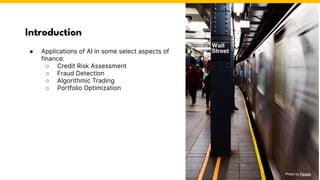
Introduction
● Applications of AI in some select aspects of
finance:
○ Credit Risk Assessment
○ Fraud Detection
○ Algorithmic Trading
○ Portfolio Optimization
Photo by Pexels
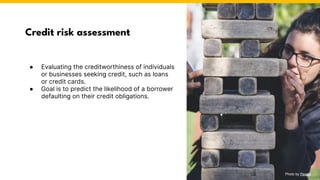
Credit risk assessment
● Evaluating the creditworthiness of individuals
or businesses seeking credit, such as loans
or credit cards.
● Goal is to predict the likelihood of a borrower
defaulting on their credit obligations.
Photo by Pexels
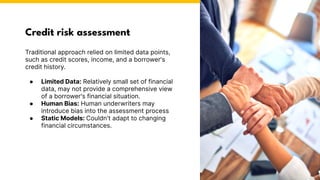
Credit risk assessment
Traditional approach relied on limited data points,
such as credit scores, income, and a borrower's
credit history.
● Limited Data: Relatively small set of financial
data, may not provide a comprehensive view
of a borrower's financial situation.
● Human Bias: Human underwriters may
introduce bias into the assessment process
● Static Models: Couldn't adapt to changing
financial circumstances.
Photo by Pexels
Credit risk assessment
How AI Enhances Credit Risk Assessment:
● Rich Data Sources: Not only traditional financial data but also non-traditional sources
like social media activity, transaction history, and more = More comprehensive
understanding of a borrower's financial behavior.
● Machine Learning Models: Predictions based on historical data.
● Alternative Data: Rental payment history, utility bill payments, and even data on a
borrower's smartphone usage.
● Predictive Analytics: Estimate the likelihood of default or late payments. They can
assign a credit score that more accurately reflects a borrower's risk profile.
● Automation: Streamlines the process, reduces human error, and increases efficiency,
enabling faster lending decisions.
● Reduced Bias: More objective and less prone to bias, resulting in fairer lending
decisions.
Photo by Pexels
Fraud detection and prevention
Photo by Pexels
● Identify and mitigate various forms of
fraudulent activities – unauthorized
transactions, identity theft, account takeover
etc.
● Goal is to detect fraudulent activities as
quickly and accurately as possible to prevent
financial losses and protect customers.
Fraud detection and prevention
Traditional methods relied on rule-based systems
and manual review processes. These had some
limitations:
● Effective for known fraud patterns but could
not easily adapt to emerging fraud schemes.
● Human analysts reviewed flagged
transactions – time-consuming and prone to
errors.
● Limited capacity to analyze large volumes of
data in real time – less effective in identifying
complex fraud patterns.
Photo by Pexels
Fraud detection and prevention
Photo by Pexels
How AI Enhances Fraud Detection and Prevention:
● Real-time monitoring, analyze vast amounts of data to identify suspicious patterns
● Learn and establish a baseline of normal user behavior - and then quickly detect
deviations from this baseline
● ML models can uncover complex, multi-dimensional fraud schemes that may go
unnoticed by rule-based systems.
● Predictive analytics and automated response – assess the likelihood of a transaction
being fraudulent, automated response such as blocking a suspicious transaction
● Reduced false positives – more accurate in identifying true fraud cases
● Scalability – handle large volumes of data, suitable for rapid processing
● Continuous learning: AI systems adapt and evolve over time as they learn from new
data, improving their detection capabilities.
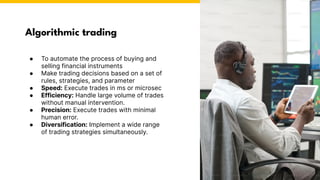
Algorithmic trading
● To automate the process of buying and
selling financial instruments
● Make trading decisions based on a set of
rules, strategies, and parameter
● Speed: Execute trades in ms or microsec
● Efficiency: Handle large volume of trades
without manual intervention.
● Precision: Execute trades with minimal
human error.
● Diversification: Implement a wide range
of trading strategies simultaneously.
Photo by Pexels
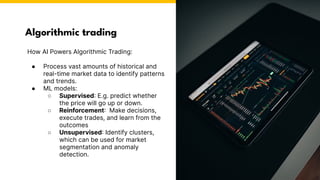
How AI Powers Algorithmic Trading:
● Process vast amounts of historical and
real-time market data to identify patterns
and trends.
● ML models:
○ Supervised: E.g. predict whether
the price will go up or down.
○ Reinforcement: Make decisions,
execute trades, and learn from the
outcomes
○ Unsupervised: Identify clusters,
which can be used for market
segmentation and anomaly
detection.
Algorithmic trading
Photo by Pexels
Portfolio optimization
Photo by Pexels
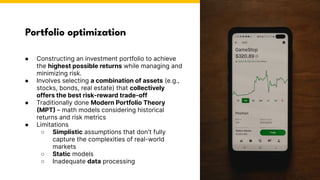
● Constructing an investment portfolio to achieve
the highest possible returns while managing and
minimizing risk.
● Involves selecting a combination of assets (e.g.,
stocks, bonds, real estate) that collectively
offers the best risk-reward trade-off
● Traditionally done Modern Portfolio Theory
(MPT) – math models considering historical
returns and risk metrics
● Limitations
○ Simplistic assumptions that don't fully
capture the complexities of real-world
markets
○ Static models
○ Inadequate data processing
Trading and Investment
Photo by Pexels
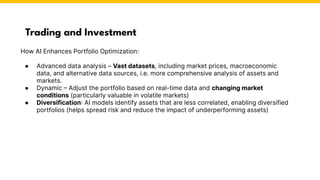
How AI Enhances Portfolio Optimization:
● Advanced data analysis – Vast datasets, including market prices, macroeconomic
data, and alternative data sources, i.e. more comprehensive analysis of assets and
markets.
● Dynamic – Adjust the portfolio based on real-time data and changing market
conditions (particularly valuable in volatile markets)
● Diversification: AI models identify assets that are less correlated, enabling diversified
portfolios (helps spread risk and reduce the impact of underperforming assets)
Trading and Investment
Photo by Pexels
Challenges and Risks
● Data Privacy and Security - since AI systems handle sensitive financial data
● Transparency and Explainability: AI models, especially complex ones, can be hard to
explain, making it challenging to understand how they arrive at decisions.
● Algorithmic Bias: AI algorithms can inherit biases from historical data, potentially leading
to unfair or discriminatory outcomes, especially in lending or hiring decisions.
● Fair Lending: There's a need to ensure AI-driven lending models don't unfairly
discriminate against certain groups, as this could violate anti-discrimination laws.
● Overreliance on AI: Risk of overreliance on AI, neglecting the valuable expertise of
human financial analysts.
● Black Swan Events: AI models may not predict rare, unpredictable events, leading to
significant financial losses.
Photo by Pexels
Future Trends
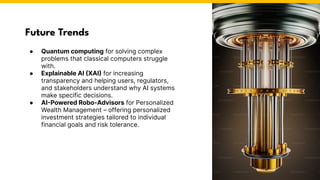
● Quantum computing for solving complex
problems that classical computers struggle
with.
● Explainable AI (XAI) for increasing
transparency and helping users, regulators,
and stakeholders understand why AI systems
make specific decisions.
● AI-Powered Robo-Advisors for Personalized
Wealth Management – offering personalized
investment strategies tailored to individual
financial goals and risk tolerance.
Artificial Intelligence applications in the Finance sector

Artificial Intelligence applications in the Finance sector

  • 1.
    AI in Finance MDSSB-DSAI-02Artificial Intelligence in Business and Society Suraj Karakulath
  • 2.
    Introduction ● Applications ofAI in some select aspects of finance: ○ Credit Risk Assessment ○ Fraud Detection ○ Algorithmic Trading ○ Portfolio Optimization Photo by Pexels
  • 3.
    Credit risk assessment ●Evaluating the creditworthiness of individuals or businesses seeking credit, such as loans or credit cards. ● Goal is to predict the likelihood of a borrower defaulting on their credit obligations. Photo by Pexels
  • 4.
    Credit risk assessment Traditionalapproach relied on limited data points, such as credit scores, income, and a borrower's credit history. ● Limited Data: Relatively small set of financial data, may not provide a comprehensive view of a borrower's financial situation. ● Human Bias: Human underwriters may introduce bias into the assessment process ● Static Models: Couldn't adapt to changing financial circumstances. Photo by Pexels
  • 5.
    Credit risk assessment HowAI Enhances Credit Risk Assessment: ● Rich Data Sources: Not only traditional financial data but also non-traditional sources like social media activity, transaction history, and more = More comprehensive understanding of a borrower's financial behavior. ● Machine Learning Models: Predictions based on historical data. ● Alternative Data: Rental payment history, utility bill payments, and even data on a borrower's smartphone usage. ● Predictive Analytics: Estimate the likelihood of default or late payments. They can assign a credit score that more accurately reflects a borrower's risk profile. ● Automation: Streamlines the process, reduces human error, and increases efficiency, enabling faster lending decisions. ● Reduced Bias: More objective and less prone to bias, resulting in fairer lending decisions. Photo by Pexels
  • 6.
    Fraud detection andprevention Photo by Pexels ● Identify and mitigate various forms of fraudulent activities – unauthorized transactions, identity theft, account takeover etc. ● Goal is to detect fraudulent activities as quickly and accurately as possible to prevent financial losses and protect customers.
  • 7.
    Fraud detection andprevention Traditional methods relied on rule-based systems and manual review processes. These had some limitations: ● Effective for known fraud patterns but could not easily adapt to emerging fraud schemes. ● Human analysts reviewed flagged transactions – time-consuming and prone to errors. ● Limited capacity to analyze large volumes of data in real time – less effective in identifying complex fraud patterns. Photo by Pexels
  • 9.
    Fraud detection andprevention Photo by Pexels How AI Enhances Fraud Detection and Prevention: ● Real-time monitoring, analyze vast amounts of data to identify suspicious patterns ● Learn and establish a baseline of normal user behavior - and then quickly detect deviations from this baseline ● ML models can uncover complex, multi-dimensional fraud schemes that may go unnoticed by rule-based systems. ● Predictive analytics and automated response – assess the likelihood of a transaction being fraudulent, automated response such as blocking a suspicious transaction ● Reduced false positives – more accurate in identifying true fraud cases ● Scalability – handle large volumes of data, suitable for rapid processing ● Continuous learning: AI systems adapt and evolve over time as they learn from new data, improving their detection capabilities.
  • 10.
    Algorithmic trading ● Toautomate the process of buying and selling financial instruments ● Make trading decisions based on a set of rules, strategies, and parameter ● Speed: Execute trades in ms or microsec ● Efficiency: Handle large volume of trades without manual intervention. ● Precision: Execute trades with minimal human error. ● Diversification: Implement a wide range of trading strategies simultaneously. Photo by Pexels
  • 11.
    How AI PowersAlgorithmic Trading: ● Process vast amounts of historical and real-time market data to identify patterns and trends. ● ML models: ○ Supervised: E.g. predict whether the price will go up or down. ○ Reinforcement: Make decisions, execute trades, and learn from the outcomes ○ Unsupervised: Identify clusters, which can be used for market segmentation and anomaly detection. Algorithmic trading Photo by Pexels
  • 13.
    Portfolio optimization Photo byPexels ● Constructing an investment portfolio to achieve the highest possible returns while managing and minimizing risk. ● Involves selecting a combination of assets (e.g., stocks, bonds, real estate) that collectively offers the best risk-reward trade-off ● Traditionally done Modern Portfolio Theory (MPT) – math models considering historical returns and risk metrics ● Limitations ○ Simplistic assumptions that don't fully capture the complexities of real-world markets ○ Static models ○ Inadequate data processing
  • 14.
    Trading and Investment Photoby Pexels How AI Enhances Portfolio Optimization: ● Advanced data analysis – Vast datasets, including market prices, macroeconomic data, and alternative data sources, i.e. more comprehensive analysis of assets and markets. ● Dynamic – Adjust the portfolio based on real-time data and changing market conditions (particularly valuable in volatile markets) ● Diversification: AI models identify assets that are less correlated, enabling diversified portfolios (helps spread risk and reduce the impact of underperforming assets)
  • 15.
  • 16.
    Challenges and Risks ●Data Privacy and Security - since AI systems handle sensitive financial data ● Transparency and Explainability: AI models, especially complex ones, can be hard to explain, making it challenging to understand how they arrive at decisions. ● Algorithmic Bias: AI algorithms can inherit biases from historical data, potentially leading to unfair or discriminatory outcomes, especially in lending or hiring decisions. ● Fair Lending: There's a need to ensure AI-driven lending models don't unfairly discriminate against certain groups, as this could violate anti-discrimination laws. ● Overreliance on AI: Risk of overreliance on AI, neglecting the valuable expertise of human financial analysts. ● Black Swan Events: AI models may not predict rare, unpredictable events, leading to significant financial losses. Photo by Pexels
  • 17.
    Future Trends ● Quantumcomputing for solving complex problems that classical computers struggle with. ● Explainable AI (XAI) for increasing transparency and helping users, regulators, and stakeholders understand why AI systems make specific decisions. ● AI-Powered Robo-Advisors for Personalized Wealth Management – offering personalized investment strategies tailored to individual financial goals and risk tolerance.