BellringerBellringer
Which of the following goods do you think theWhich of the following goods do you think the
government would be most likely to be concernedgovernment would be most likely to be concerned
its price and why?its price and why?
Mankiw Chapter 5 - Elasticity
Reminder: Article nextReminder: Article next
weekweek
start of class, topics: ???start of class, topics: ???
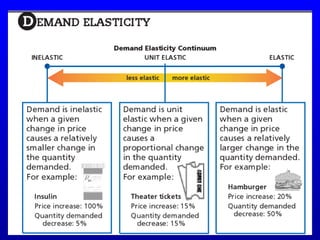
ElasticElastic
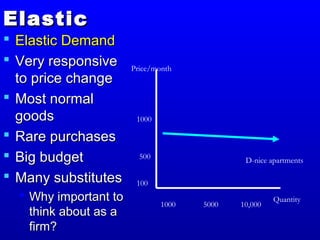
๏‚ง Elastic DemandElastic Demand
๏‚ง Very responsiveVery responsive
to price changeto price change
๏‚ง Most normalMost normal
goodsgoods
๏‚ง Rare purchasesRare purchases
๏‚ง Big budgetBig budget
๏‚ง Many substitutesMany substitutes
๏‚ง Why important toWhy important to
think about as athink about as a
firm?firm?
Price/month
Quantity
D-nice apartments
1000
500
100
1000 5000 10,000
InelasticInelastic
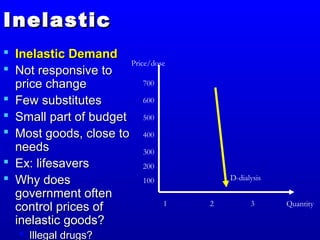
๏‚ง Inelastic DemandInelastic Demand
๏‚ง Not responsive toNot responsive to
price changeprice change
๏‚ง Few substitutesFew substitutes
๏‚ง Small part of budgetSmall part of budget
๏‚ง Most goods, close toMost goods, close to
needsneeds
๏‚ง Ex: lifesaversEx: lifesavers
๏‚ง Why doesWhy does
government oftengovernment often
control prices ofcontrol prices of
inelastic goods?inelastic goods?
๏‚ง Illegal drugs?Illegal drugs?
Price/dose
Quantity
D-dialysis100
1 2 3
200
300
400
500
600
700
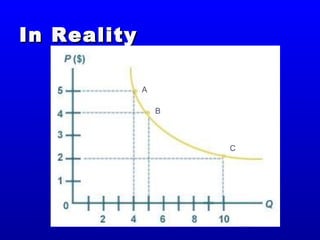
In RealityIn Reality
A
B
C
7
EXAMPLE 1:EXAMPLE 1:
Breakfast cereal vs. SunscreenBreakfast cereal vs. Sunscreen
๏‚ง The prices of both of these goods rise by 20%.The prices of both of these goods rise by 20%.
For which good doesFor which good does QQdd
drop the most? Why?drop the most? Why?
๏‚ง Breakfast cereal has close substitutesBreakfast cereal has close substitutes
((e.ge.g., pancakes, waffles, leftover pizza),., pancakes, waffles, leftover pizza),
so buyers can easily switch if the price rises.so buyers can easily switch if the price rises.
๏‚ง Sunscreen has no close substitutes,Sunscreen has no close substitutes,
so consumers would probably notso consumers would probably not
buy much less if its price rises.buy much less if its price rises.
๏‚ง Lesson:Lesson: Price elasticity is higher when
close substitutes are available.
8
EXAMPLE 2:EXAMPLE 2:
โ€œBlue Jeansโ€ vs.โ€œBlue Jeansโ€ vs.
โ€œClothingโ€โ€œClothingโ€๏‚ง The prices of both goods rise by 20%.The prices of both goods rise by 20%.
For which good doesFor which good does QQdd
drop the most? Why?drop the most? Why?
๏‚ง For a narrowly defined good such asFor a narrowly defined good such as
blue jeans, there are many substitutesblue jeans, there are many substitutes
(khakis, shorts, Speedos).(khakis, shorts, Speedos).
๏‚ง There are fewer substitutes available forThere are fewer substitutes available for
broadly defined goods.broadly defined goods.
(There arenโ€™t too many substitutes for clothing,(There arenโ€™t too many substitutes for clothing,
other than living in a nudist colony.)other than living in a nudist colony.)
๏‚ง Lesson:Lesson: Price elasticity is higher for narrowlyPrice elasticity is higher for narrowly
defined goods than broadly defined ones.defined goods than broadly defined ones.
9
EXAMPLE 3:EXAMPLE 3:
Insulin vs. CaribbeanInsulin vs. Caribbean
CruisesCruises๏‚ง The prices of both of these goods rise by 20%.The prices of both of these goods rise by 20%.
For which good doesFor which good does QQdd
drop the most? Why?drop the most? Why?
๏‚ง To millions of diabetics, insulin is a necessity.To millions of diabetics, insulin is a necessity.
A rise in its price would cause little or noA rise in its price would cause little or no
decrease in demand.decrease in demand.
๏‚ง A cruise is a luxury. If the price rises,A cruise is a luxury. If the price rises,
some people will forego it.some people will forego it.
๏‚ง Lesson:Lesson: Price elasticity is higher forPrice elasticity is higher for
luxuries than for necessities.luxuries than for necessities.
10
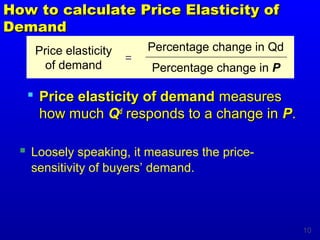
How to calculate Price Elasticity ofHow to calculate Price Elasticity of
DemandDemand
๏‚ง Price elasticity of demandPrice elasticity of demand measuresmeasures
how muchhow much QQdd
responds to a change inresponds to a change in PP..
Price elasticity
of demand
=
Percentage change in Qd
Percentage change in P
๏‚ง Loosely speaking, it measures the price-
sensitivity of buyersโ€™ demand.
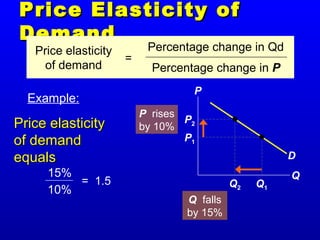
Price Elasticity ofPrice Elasticity of
DemandDemand
Price elasticityPrice elasticity
of demandof demand
equalsequals
P
Q
D
Q2
P2
P1
Q1
P rises
by 10%
Q falls
by 15%
15%
10%
= 1.5
Price elasticity
of demand
=
Percentage change in Qd
Percentage change in P
Example:
Price Elasticity ofPrice Elasticity of
DemandDemand
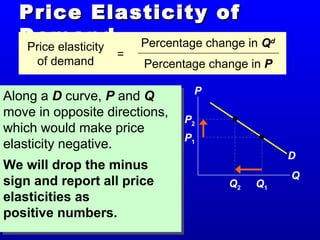
Along a D curve, P and Q
move in opposite directions,
which would make price
elasticity negative.
We will drop the minus
sign and report all price
elasticities as
positive numbers.
Along a D curve, P and Q
move in opposite directions,
which would make price
elasticity negative.
We will drop the minus
sign and report all price
elasticities as
positive numbers.
P
Q
D
Q2
P2
P1
Q1
Price elasticity
of demand
=
Percentage change in Qd
Percentage change in P
Calculating PercentageCalculating Percentage
Changes %Changes %
P
Q
D
$250
8
B
$200
12
A
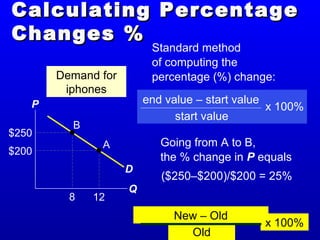
Demand for
iphones
Standard method
of computing the
percentage (%) change:
end value โ€“ start value
start value
x 100%
Going from A to B,
the % change in P equals
($250โ€“$200)/$200 = 25%
New โ€“ Old
Old
x 100%
Calculating PercentageCalculating Percentage
ChangesChanges
D
$250
8
B
$200
12
A
Demand for
iphones
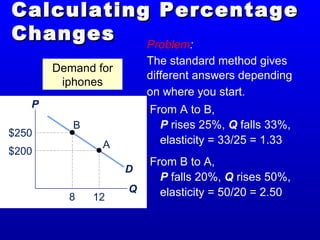
Problem:
The standard method gives
different answers depending
on where you start.
From A to B,
P rises 25%, Q falls 33%,
elasticity = 33/25 = 1.33
From B to A,
P falls 20%, Q rises 50%,
elasticity = 50/20 = 2.50
P
Q
Calculating PercentageCalculating Percentage
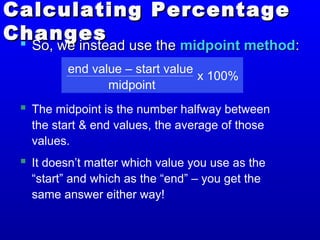
ChangesChanges๏‚ง So, we instead use theSo, we instead use the midpoint methodmidpoint method::
end value โ€“ start value
midpoint
x 100%
๏‚ง The midpoint is the number halfway between
the start & end values, the average of those
values.
๏‚ง It doesnโ€™t matter which value you use as the
โ€œstartโ€ and which as the โ€œendโ€ โ€“ you get the
same answer either way!
Calculating Percentage
Changes
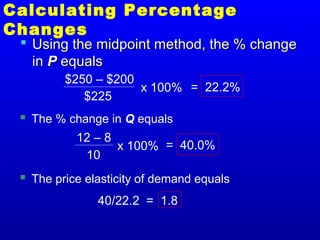
๏‚ง Using the midpoint method, the % changeUsing the midpoint method, the % change
inin PP equalsequals
$250 โ€“ $200
$225
x 100% = 22.2%
๏‚ง The % change in Q equals
12 โ€“ 8
10
x 100% = 40.0%
๏‚ง The price elasticity of demand equals
40/22.2 = 1.8
A C T I V E L E A R N I N GA C T I V E L E A R N I N G 11
Calculate an elasticityCalculate an elasticity
Use the following
information to
calculate the
price elasticity
of demand
for hotel rooms:
if P = $70, Qd
= 5000
if P = $90, Qd
= 3000
A C T I V E L E A R N I N GA C T I V E L E A R N I N G 11
AnswersAnswers
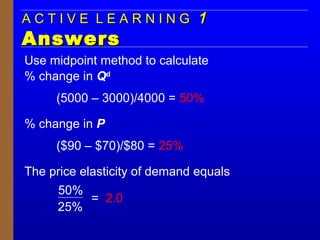
Use midpoint method to calculate
% change in Qd
(5000 โ€“ 3000)/4000 = 50%
% change in P
($90 โ€“ $70)/$80 = 25%
The price elasticity of demand equals
50%
25%
= 2.0
SummarySummary
Q1
P1
D
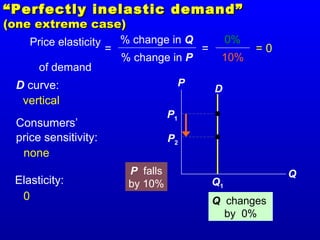
โ€œโ€œPerfectly inelastic demandโ€Perfectly inelastic demandโ€
(one extreme case)(one extreme case)
P
Q
P2
P falls
by 10%
Q changes
by 0%
0%
10%
= 0
Price elasticity
of demand
=
% change in Q
% change in P
=
Consumersโ€™
price sensitivity:
D curve:
Elasticity:
vertical
none
0
D
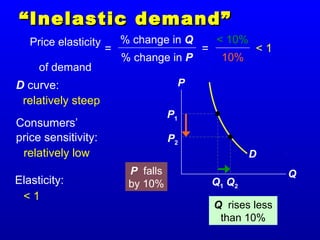
โ€œโ€œInelastic demandโ€Inelastic demandโ€
P
Q
Q1
P1
Q2
P2
Q rises less
than 10%
< 10%
10%
< 1
Price elasticity
of demand
=
% change in Q
% change in P
=
P falls
by 10%
Consumersโ€™
price sensitivity:
D curve:
Elasticity:
relatively steep
relatively low
< 1
D
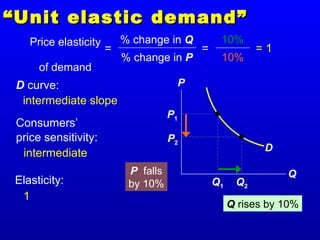
โ€œโ€œUnit elastic demandโ€Unit elastic demandโ€
P
Q
Q1
P1
Q2
P2
Q rises by 10%
10%
10%
= 1
Price elasticity
of demand
=
% change in Q
% change in P
=
P falls
by 10%
Consumersโ€™
price sensitivity:
Elasticity:
intermediate
1
D curve:
intermediate slope
D
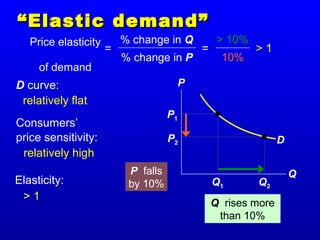
โ€œโ€œElastic demandโ€Elastic demandโ€
P
Q
Q1
P1
Q2
P2
Q rises more
than 10%
> 10%
10%
> 1
Price elasticity
of demand
=
% change in Q
% change in P
=
P falls
by 10%
Consumersโ€™
price sensitivity:
D curve:
Elasticity:
relatively flat
relatively high
> 1
D
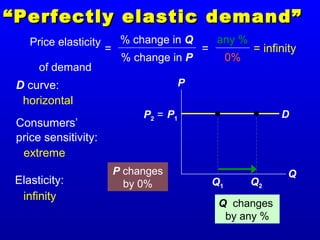
โ€œโ€œPerfectly elastic demandโ€Perfectly elastic demandโ€
P
Q
P1
Q1
P changes
by 0%
Q changes
by any %
any %
0%
= infinity
Q2
P2 =
Consumersโ€™
price sensitivity:
D curve:
Elasticity:
infinity
horizontal
extreme
Price elasticity
of demand
=
% change in Q
% change in P
=
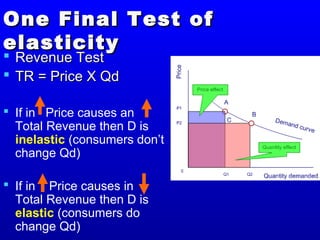
One Final Test ofOne Final Test of
elasticityelasticity
๏‚ง Revenue TestRevenue Test
๏‚ง TR = Price X QdTR = Price X Qd
๏‚ง If in Price causes an
Total Revenue then D is
inelastic (consumers donโ€™t
change Qd)
๏‚ง If in Price causes in
Total Revenue then D is
elastic (consumers do
change Qd)
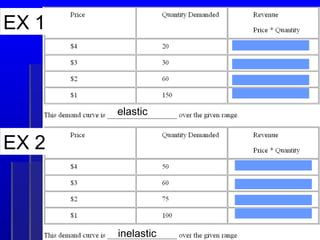
elastic
inelastic
EX 1
EX 2
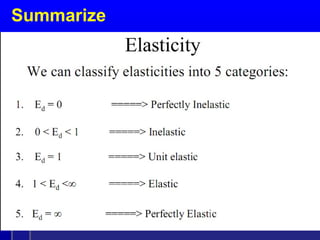
Summarize

03 elasticity

  • 1.
    BellringerBellringer Which of thefollowing goods do you think theWhich of the following goods do you think the government would be most likely to be concernedgovernment would be most likely to be concerned its price and why?its price and why? Mankiw Chapter 5 - Elasticity
  • 2.
    Reminder: Article nextReminder:Article next weekweek start of class, topics: ???start of class, topics: ???
  • 3.
    ElasticElastic ๏‚ง Elastic DemandElasticDemand ๏‚ง Very responsiveVery responsive to price changeto price change ๏‚ง Most normalMost normal goodsgoods ๏‚ง Rare purchasesRare purchases ๏‚ง Big budgetBig budget ๏‚ง Many substitutesMany substitutes ๏‚ง Why important toWhy important to think about as athink about as a firm?firm? Price/month Quantity D-nice apartments 1000 500 100 1000 5000 10,000
  • 5.
    InelasticInelastic ๏‚ง Inelastic DemandInelasticDemand ๏‚ง Not responsive toNot responsive to price changeprice change ๏‚ง Few substitutesFew substitutes ๏‚ง Small part of budgetSmall part of budget ๏‚ง Most goods, close toMost goods, close to needsneeds ๏‚ง Ex: lifesaversEx: lifesavers ๏‚ง Why doesWhy does government oftengovernment often control prices ofcontrol prices of inelastic goods?inelastic goods? ๏‚ง Illegal drugs?Illegal drugs? Price/dose Quantity D-dialysis100 1 2 3 200 300 400 500 600 700
  • 6.
  • 7.
    7 EXAMPLE 1:EXAMPLE 1: Breakfastcereal vs. SunscreenBreakfast cereal vs. Sunscreen ๏‚ง The prices of both of these goods rise by 20%.The prices of both of these goods rise by 20%. For which good doesFor which good does QQdd drop the most? Why?drop the most? Why? ๏‚ง Breakfast cereal has close substitutesBreakfast cereal has close substitutes ((e.ge.g., pancakes, waffles, leftover pizza),., pancakes, waffles, leftover pizza), so buyers can easily switch if the price rises.so buyers can easily switch if the price rises. ๏‚ง Sunscreen has no close substitutes,Sunscreen has no close substitutes, so consumers would probably notso consumers would probably not buy much less if its price rises.buy much less if its price rises. ๏‚ง Lesson:Lesson: Price elasticity is higher when close substitutes are available.
  • 8.
    8 EXAMPLE 2:EXAMPLE 2: โ€œBlueJeansโ€ vs.โ€œBlue Jeansโ€ vs. โ€œClothingโ€โ€œClothingโ€๏‚ง The prices of both goods rise by 20%.The prices of both goods rise by 20%. For which good doesFor which good does QQdd drop the most? Why?drop the most? Why? ๏‚ง For a narrowly defined good such asFor a narrowly defined good such as blue jeans, there are many substitutesblue jeans, there are many substitutes (khakis, shorts, Speedos).(khakis, shorts, Speedos). ๏‚ง There are fewer substitutes available forThere are fewer substitutes available for broadly defined goods.broadly defined goods. (There arenโ€™t too many substitutes for clothing,(There arenโ€™t too many substitutes for clothing, other than living in a nudist colony.)other than living in a nudist colony.) ๏‚ง Lesson:Lesson: Price elasticity is higher for narrowlyPrice elasticity is higher for narrowly defined goods than broadly defined ones.defined goods than broadly defined ones.
  • 9.
    9 EXAMPLE 3:EXAMPLE 3: Insulinvs. CaribbeanInsulin vs. Caribbean CruisesCruises๏‚ง The prices of both of these goods rise by 20%.The prices of both of these goods rise by 20%. For which good doesFor which good does QQdd drop the most? Why?drop the most? Why? ๏‚ง To millions of diabetics, insulin is a necessity.To millions of diabetics, insulin is a necessity. A rise in its price would cause little or noA rise in its price would cause little or no decrease in demand.decrease in demand. ๏‚ง A cruise is a luxury. If the price rises,A cruise is a luxury. If the price rises, some people will forego it.some people will forego it. ๏‚ง Lesson:Lesson: Price elasticity is higher forPrice elasticity is higher for luxuries than for necessities.luxuries than for necessities.
  • 10.
    10 How to calculatePrice Elasticity ofHow to calculate Price Elasticity of DemandDemand ๏‚ง Price elasticity of demandPrice elasticity of demand measuresmeasures how muchhow much QQdd responds to a change inresponds to a change in PP.. Price elasticity of demand = Percentage change in Qd Percentage change in P ๏‚ง Loosely speaking, it measures the price- sensitivity of buyersโ€™ demand.
  • 11.
    Price Elasticity ofPriceElasticity of DemandDemand Price elasticityPrice elasticity of demandof demand equalsequals P Q D Q2 P2 P1 Q1 P rises by 10% Q falls by 15% 15% 10% = 1.5 Price elasticity of demand = Percentage change in Qd Percentage change in P Example:
  • 12.
    Price Elasticity ofPriceElasticity of DemandDemand Along a D curve, P and Q move in opposite directions, which would make price elasticity negative. We will drop the minus sign and report all price elasticities as positive numbers. Along a D curve, P and Q move in opposite directions, which would make price elasticity negative. We will drop the minus sign and report all price elasticities as positive numbers. P Q D Q2 P2 P1 Q1 Price elasticity of demand = Percentage change in Qd Percentage change in P
  • 13.
    Calculating PercentageCalculating Percentage Changes%Changes % P Q D $250 8 B $200 12 A Demand for iphones Standard method of computing the percentage (%) change: end value โ€“ start value start value x 100% Going from A to B, the % change in P equals ($250โ€“$200)/$200 = 25% New โ€“ Old Old x 100%
  • 14.
    Calculating PercentageCalculating Percentage ChangesChanges D $250 8 B $200 12 A Demandfor iphones Problem: The standard method gives different answers depending on where you start. From A to B, P rises 25%, Q falls 33%, elasticity = 33/25 = 1.33 From B to A, P falls 20%, Q rises 50%, elasticity = 50/20 = 2.50 P Q
  • 15.
    Calculating PercentageCalculating Percentage ChangesChanges๏‚งSo, we instead use theSo, we instead use the midpoint methodmidpoint method:: end value โ€“ start value midpoint x 100% ๏‚ง The midpoint is the number halfway between the start & end values, the average of those values. ๏‚ง It doesnโ€™t matter which value you use as the โ€œstartโ€ and which as the โ€œendโ€ โ€“ you get the same answer either way!
  • 16.
    Calculating Percentage Changes ๏‚ง Usingthe midpoint method, the % changeUsing the midpoint method, the % change inin PP equalsequals $250 โ€“ $200 $225 x 100% = 22.2% ๏‚ง The % change in Q equals 12 โ€“ 8 10 x 100% = 40.0% ๏‚ง The price elasticity of demand equals 40/22.2 = 1.8
  • 17.
    A C TI V E L E A R N I N GA C T I V E L E A R N I N G 11 Calculate an elasticityCalculate an elasticity Use the following information to calculate the price elasticity of demand for hotel rooms: if P = $70, Qd = 5000 if P = $90, Qd = 3000
  • 18.
    A C TI V E L E A R N I N GA C T I V E L E A R N I N G 11 AnswersAnswers Use midpoint method to calculate % change in Qd (5000 โ€“ 3000)/4000 = 50% % change in P ($90 โ€“ $70)/$80 = 25% The price elasticity of demand equals 50% 25% = 2.0
  • 19.
  • 20.
    Q1 P1 D โ€œโ€œPerfectly inelastic demandโ€Perfectlyinelastic demandโ€ (one extreme case)(one extreme case) P Q P2 P falls by 10% Q changes by 0% 0% 10% = 0 Price elasticity of demand = % change in Q % change in P = Consumersโ€™ price sensitivity: D curve: Elasticity: vertical none 0
  • 21.
    D โ€œโ€œInelastic demandโ€Inelastic demandโ€ P Q Q1 P1 Q2 P2 Qrises less than 10% < 10% 10% < 1 Price elasticity of demand = % change in Q % change in P = P falls by 10% Consumersโ€™ price sensitivity: D curve: Elasticity: relatively steep relatively low < 1
  • 22.
    D โ€œโ€œUnit elastic demandโ€Unitelastic demandโ€ P Q Q1 P1 Q2 P2 Q rises by 10% 10% 10% = 1 Price elasticity of demand = % change in Q % change in P = P falls by 10% Consumersโ€™ price sensitivity: Elasticity: intermediate 1 D curve: intermediate slope
  • 23.
    D โ€œโ€œElastic demandโ€Elastic demandโ€ P Q Q1 P1 Q2 P2 Qrises more than 10% > 10% 10% > 1 Price elasticity of demand = % change in Q % change in P = P falls by 10% Consumersโ€™ price sensitivity: D curve: Elasticity: relatively flat relatively high > 1
  • 24.
    D โ€œโ€œPerfectly elastic demandโ€Perfectlyelastic demandโ€ P Q P1 Q1 P changes by 0% Q changes by any % any % 0% = infinity Q2 P2 = Consumersโ€™ price sensitivity: D curve: Elasticity: infinity horizontal extreme Price elasticity of demand = % change in Q % change in P =
  • 25.
    One Final TestofOne Final Test of elasticityelasticity ๏‚ง Revenue TestRevenue Test ๏‚ง TR = Price X QdTR = Price X Qd ๏‚ง If in Price causes an Total Revenue then D is inelastic (consumers donโ€™t change Qd) ๏‚ง If in Price causes in Total Revenue then D is elastic (consumers do change Qd)
  • 26.
  • 27.

Editor's Notes

  • #8ย Suggestion: For each of these examples, display the slide title (which lists the two goods) and the first two lines of text (which ask which good experiences the biggest drop in demand in response to a 20% price increase). Give your students a quiet minute to formulate their answers. Then, ask for volunteers.
  • #9ย You might need to clarify the nature of this thought experiment. Here, we look at two alternate scenarios. In the first, the price of blue jeans (and no other clothing) rises by 20%, and we observe the percentage decrease in quantity of blue jeans demanded. In the second scenario, the price of all clothing rises by 20%, and we observe the percentage decrease in demand for all clothing.
  • #13ย It might be worth explaining to your students that โ€œP and Q move in opposite directionsโ€ means that the percentage change in Q and the percentage change in P will have opposite signs, thus implying a negative price elasticity. To be consistent with the text, the last statement in the green box says that we will report all price elasticities as positive numbers. It might be slightly more accurate to say that we will report all elasticities as non-negative numbers: we want to allow for the (admittedly rare) case of zero elasticity.
  • #17ย These calculations are based on the example shown a few slides back: points A and B on the website demand curve.
  • #21ย If Q doesnโ€™t change, then the percentage change in Q equals zero, and thus elasticity equals zero. It is hard to think of a good for which the price elasticity of demand is literally zero. Take insulin, for example. A sufficiently large price increase would probably reduce demand for insulin a little, particularly among people with very low incomes and no health insurance. However, if elasticity is very close to zero, then the demand curve is almost vertical. In such cases, the convenience of modeling demand as perfectly inelastic probably outweighs the cost of being slightly inaccurate.
  • #22ย An example: Student demand for textbooks that their professors have required for their courses. Here, itโ€™s a little more clear that elasticity would be small, but not zero. At a high enough price, some students will not buy their books, but instead will share with a friend, or try to find them in the library, or just take copious notes in class. Another example: Gasoline in the short run.
  • #23ย This is the intermediate case: the demand curve is neither relatively steep nor relatively flat. Buyers are neither relatively price-sensitive nor relatively insensitive to price. (This is also the case where price changes have no effect on revenue.)
  • #24ย A good example here would be breakfast cereal, or nearly anything with readily available substitutes. An elastic demand curve is flatter than a unit elastic demand curve (which itself is flatter than an inelastic demand curve).
  • #25ย โ€œ Extreme price sensitivityโ€ means the tiniest price increase causes demand to fall to zero. โ€œ Q changes by any %โ€ โ€“ when the D curve is horizontal, quantity cannot be determined from price. Consumers might demand Q1 units one month, Q2 units another month, and some other quantity later. Q can change by any amount, but P always โ€œchanges by 0%โ€ (i.e., doesnโ€™t change). If perfectly inelastic is one extreme, this case (perfectly elastic) is the other. Hereโ€™s a good real-world example of a perfectly elastic demand curve, which foreshadows an upcoming chapter on firms in competitive markets. Suppose you run a small family farm in Iowa. Your main crop is wheat. The demand curve in this market is downward-sloping, and the market demand and supply curves determine the price of wheat. Suppose that price is $5/bushel. Now consider the demand curve facing you, the individual wheat farmer. If you charge a price of $5, you can sell as much or as little as you want. If you charge a price even just a little higher than $5, demand for YOUR wheat will fall to zero: Buyers would not be willing to pay you more than $5 when they could get the same wheat elsewhere for $5. Similarly, if you drop your price below $5, then demand for YOUR wheat will become enormous (not literally infinite, but โ€œalmost infiniteโ€): if other wheat farmers are charging $5 and you charge less, then EVERY buyer will want to buy wheat from you. Why is the demand curve facing an individual producer perfectly elastic? Recall that elasticity is greater when lots of close substitutes are available. In this case, you are selling a product that has many perfect substitutes: the wheat sold by every other farmer is a perfect substitute for the wheat you sell.