Renee Pyburn, RN, MS
Guillaume Alinier MPhys, PGCert,
MIPEM, MInstP, NTF, SFHEA
Sidra Medical & Research Center
Qatar Interprofessional Health
CouncilSSH-NLN Interprofessional Education and
Healthcare Simulation Symposium
January, 2012
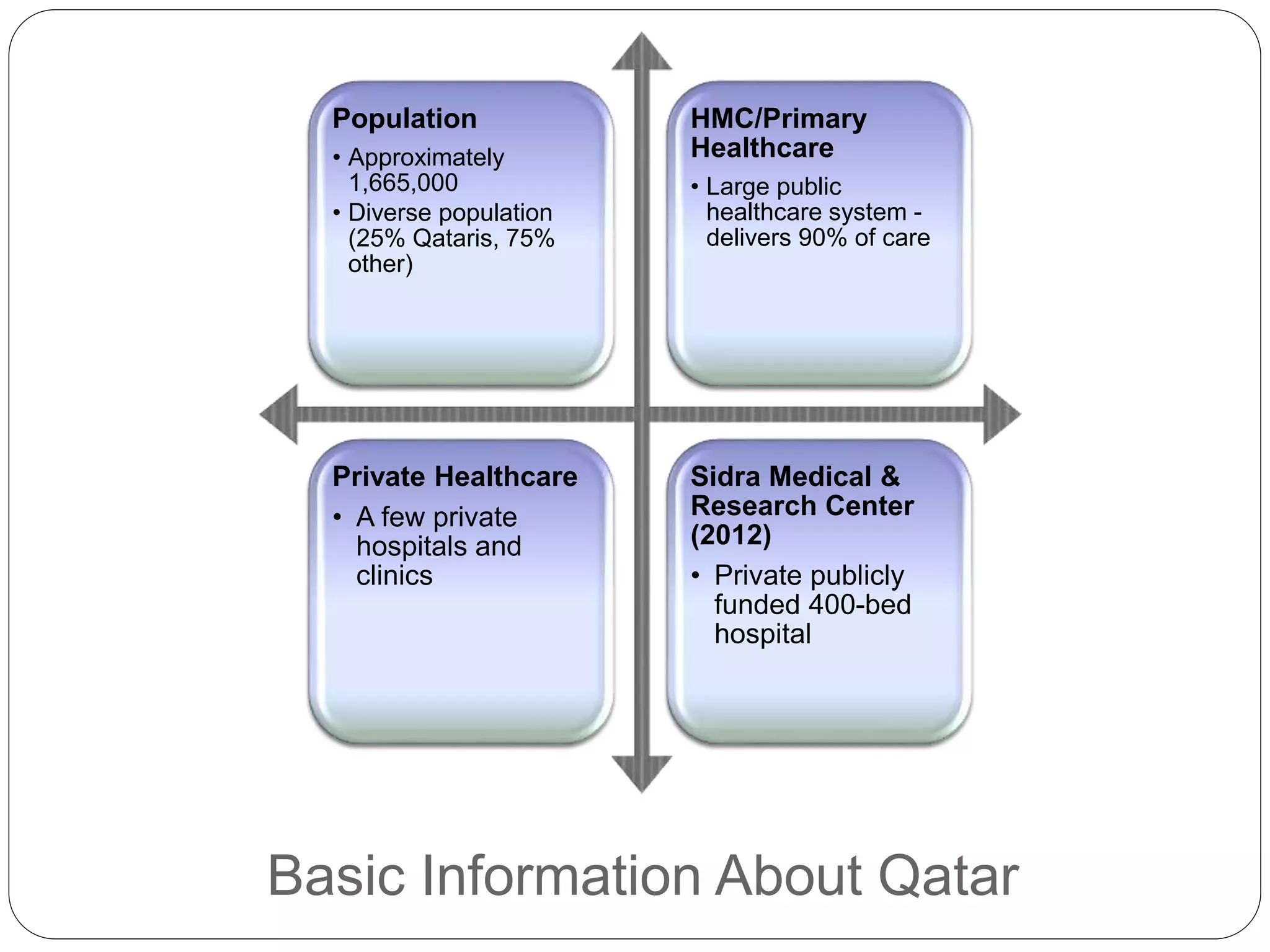
Basic Information About Qatar
Population
• Approximately
1,665,000
• Diverse population
(25% Qataris, 75%
other)
HMC/Primary
Healthcare
• Large public
healthcare system -
delivers 90% of care
Private Healthcare
• A few private
hospitals and
clinics
Sidra Medical &
Research Center
(2012)
• Private publicly
funded 400-bed
hospital
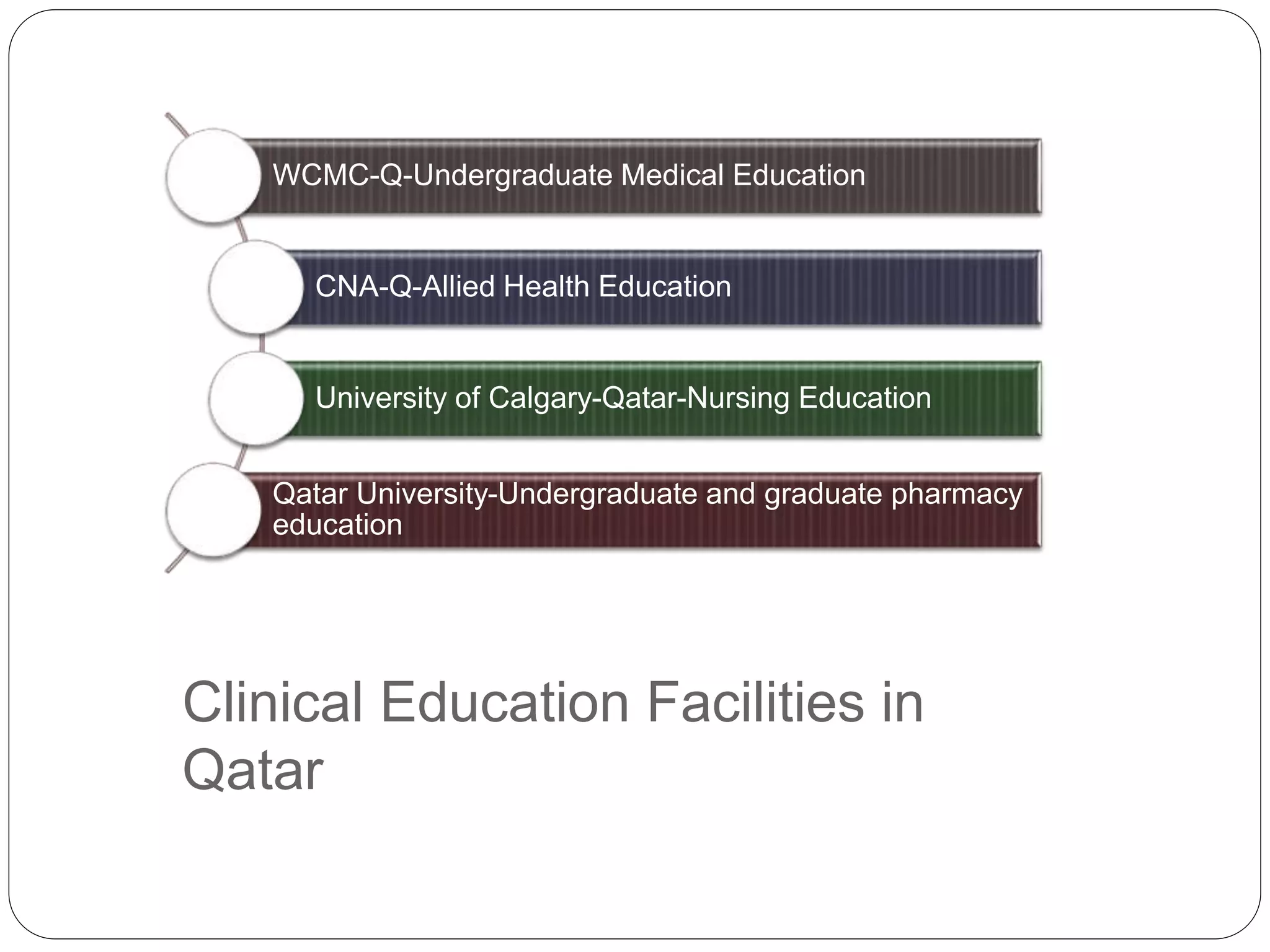
Clinical Education Facilities in
Qatar
WCMC-Q-Undergraduate Medical Education
CNA-Q-Allied Health Education
University of Calgary-Qatar-Nursing Education
Qatar University-Undergraduate and graduate pharmacy
education
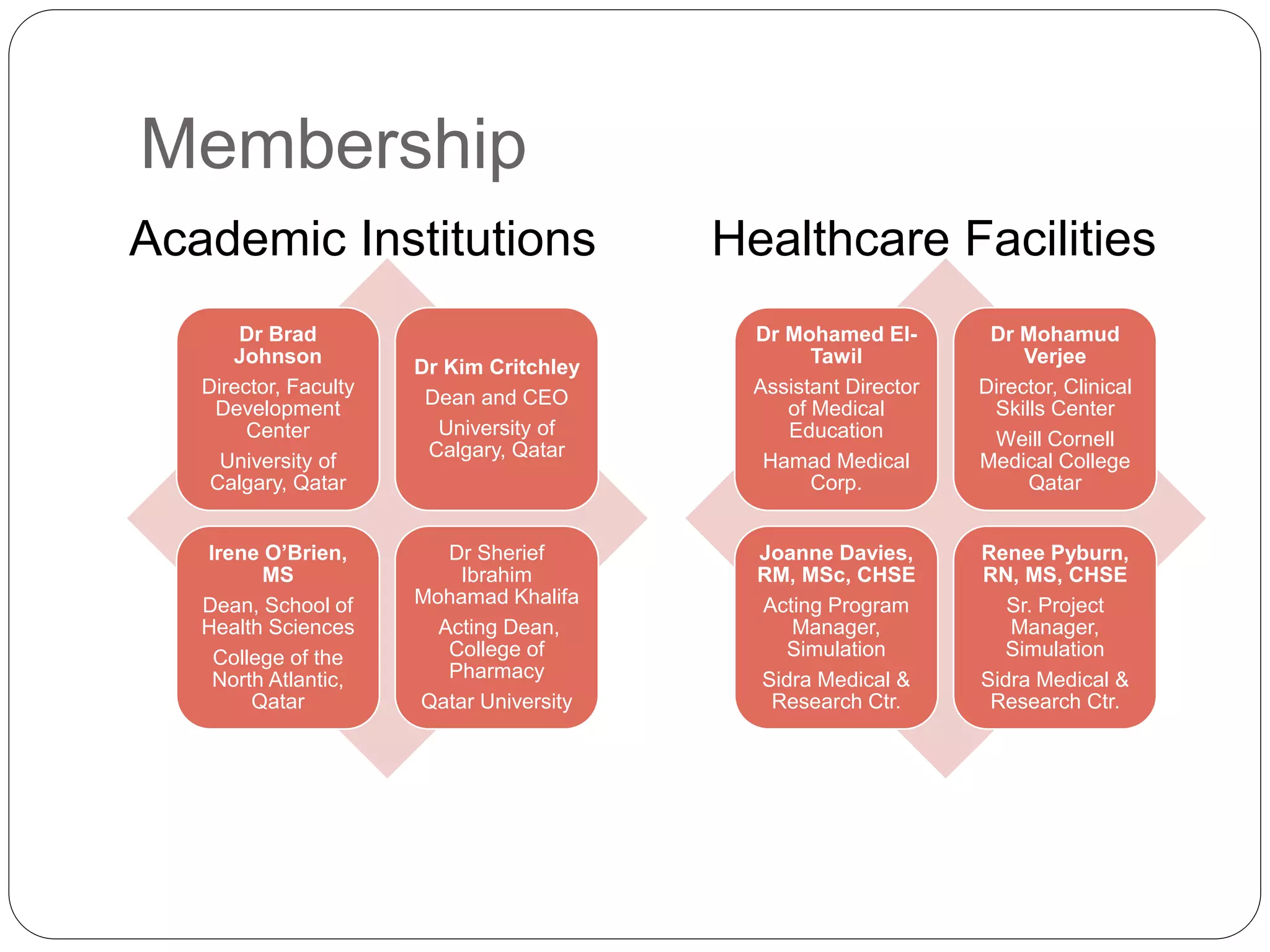
Membership
Dr Brad
Johnson
Director, Faculty
Development
Center
University of
Calgary, Qatar
Dr Kim Critchley
Dean and CEO
University of
Calgary, Qatar
Irene O’Brien,
MS
Dean, School of
Health Sciences
College of the
North Atlantic,
Qatar
Dr Sherief
Ibrahim
Mohamad Khalifa
Acting Dean,
College of
Pharmacy
Qatar University
Dr Mohamed El-
Tawil
Assistant Director
of Medical
Education
Hamad Medical
Corp.
Dr Mohamud
Verjee
Director, Clinical
Skills Center
Weill Cornell
Medical College
Qatar
Joanne Davies,
RM, MSc, CHSE
Acting Program
Manager,
Simulation
Sidra Medical &
Research Ctr.
Renee Pyburn,
RN, MS, CHSE
Sr. Project
Manager,
Simulation
Sidra Medical &
Research Ctr.
Academic Institutions Healthcare Facilities
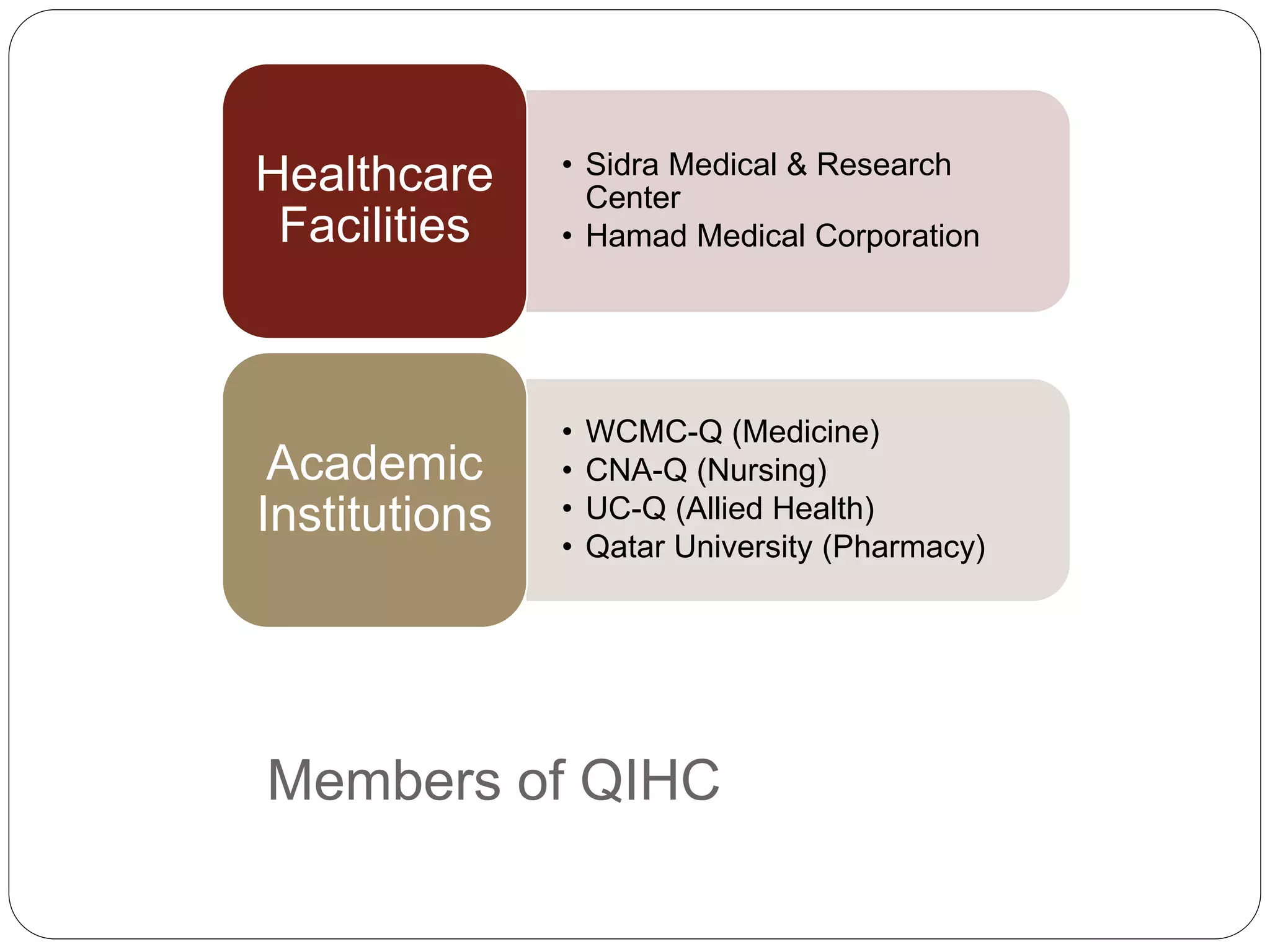
Members of QIHC
• Sidra Medical & Research
Center
• Hamad Medical Corporation
Healthcare
Facilities
• WCMC-Q (Medicine)
• CNA-Q (Nursing)
• UC-Q (Allied Health)
• Qatar University (Pharmacy)
Academic
Institutions
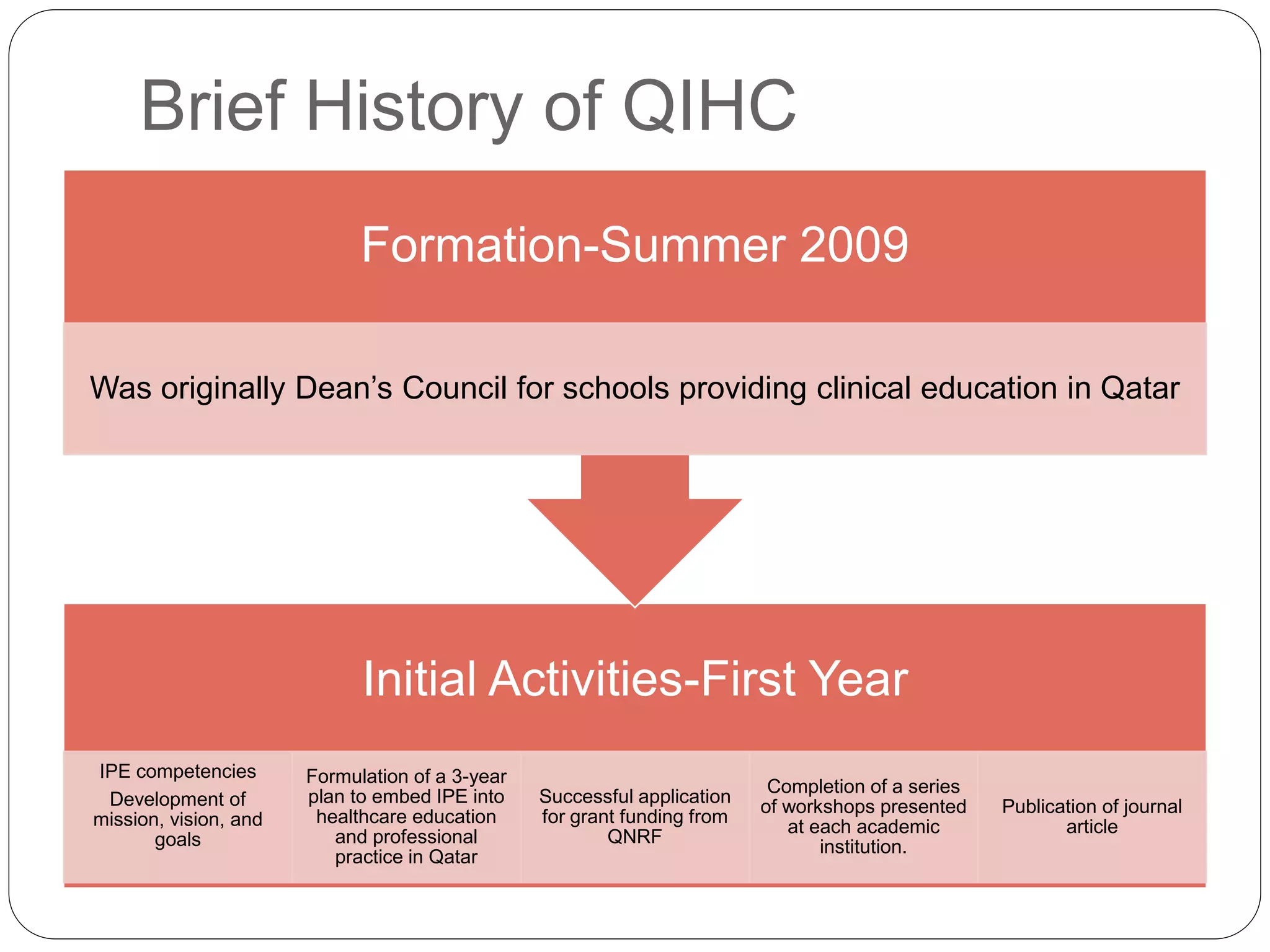
Brief History of QIHC
Initial Activities-First Year
IPE competencies
Development of
mission, vision, and
goals
Formulation of a 3-year
plan to embed IPE into
healthcare education
and professional
practice in Qatar
Successful application
for grant funding from
QNRF
Completion of a series
of workshops presented
at each academic
institution.
Publication of journal
article
Formation-Summer 2009
Was originally Dean’s Council for schools providing clinical education in Qatar
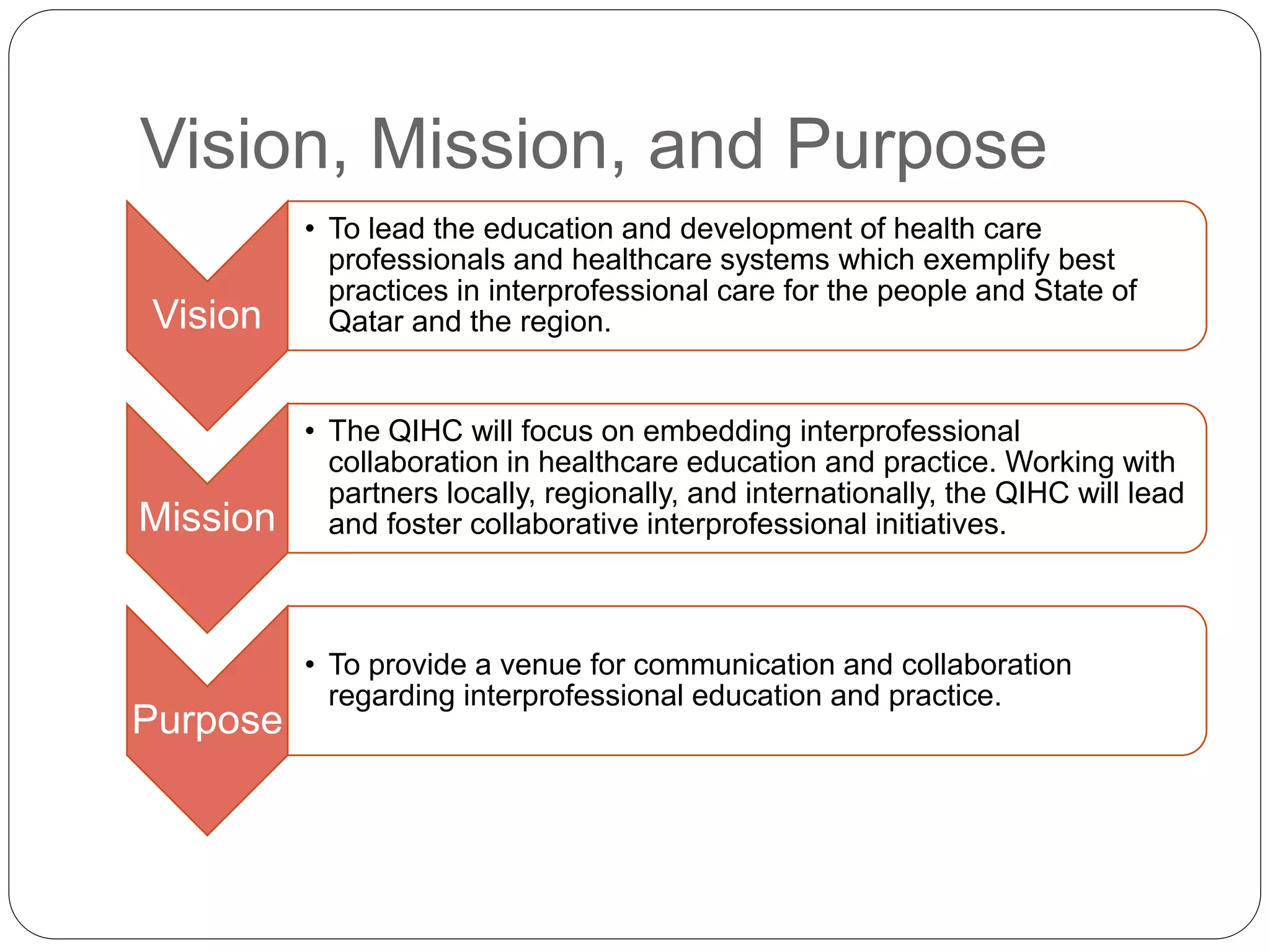
Vision, Mission, and Purpose
Vision
• To lead the education and development of health care
professionals and healthcare systems which exemplify best
practices in interprofessional care for the people and State of
Qatar and the region.
Mission
• The QIHC will focus on embedding interprofessional
collaboration in healthcare education and practice. Working with
partners locally, regionally, and internationally, the QIHC will lead
and foster collaborative interprofessional initiatives.
Purpose
• To provide a venue for communication and collaboration
regarding interprofessional education and practice.
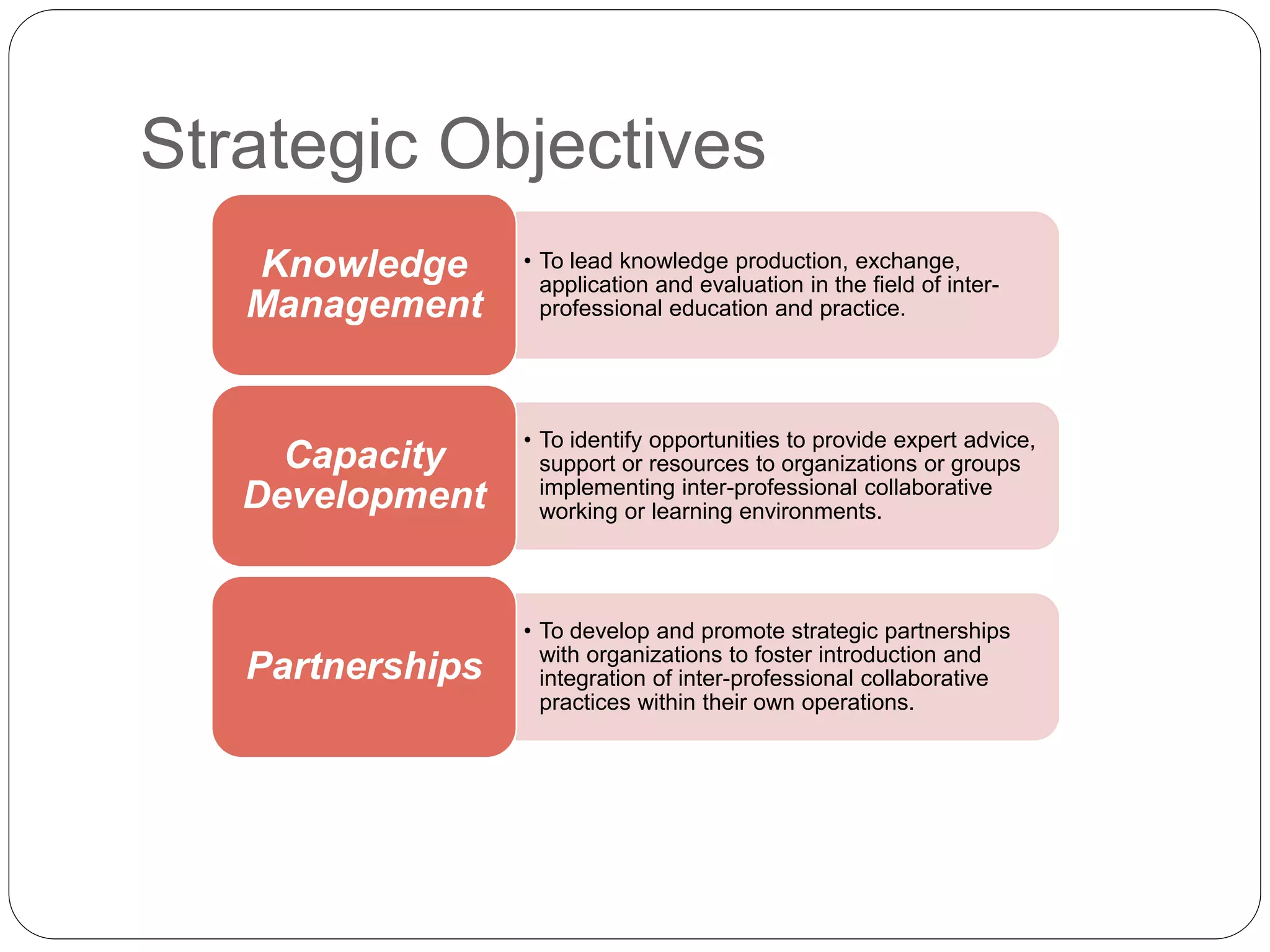
Strategic Objectives
• To lead knowledge production, exchange,
application and evaluation in the field of inter-
professional education and practice.
Knowledge
Management
• To identify opportunities to provide expert advice,
support or resources to organizations or groups
implementing inter-professional collaborative
working or learning environments.
Capacity
Development
• To develop and promote strategic partnerships
with organizations to foster introduction and
integration of inter-professional collaborative
practices within their own operations.
Partnerships
Strategic Objectives
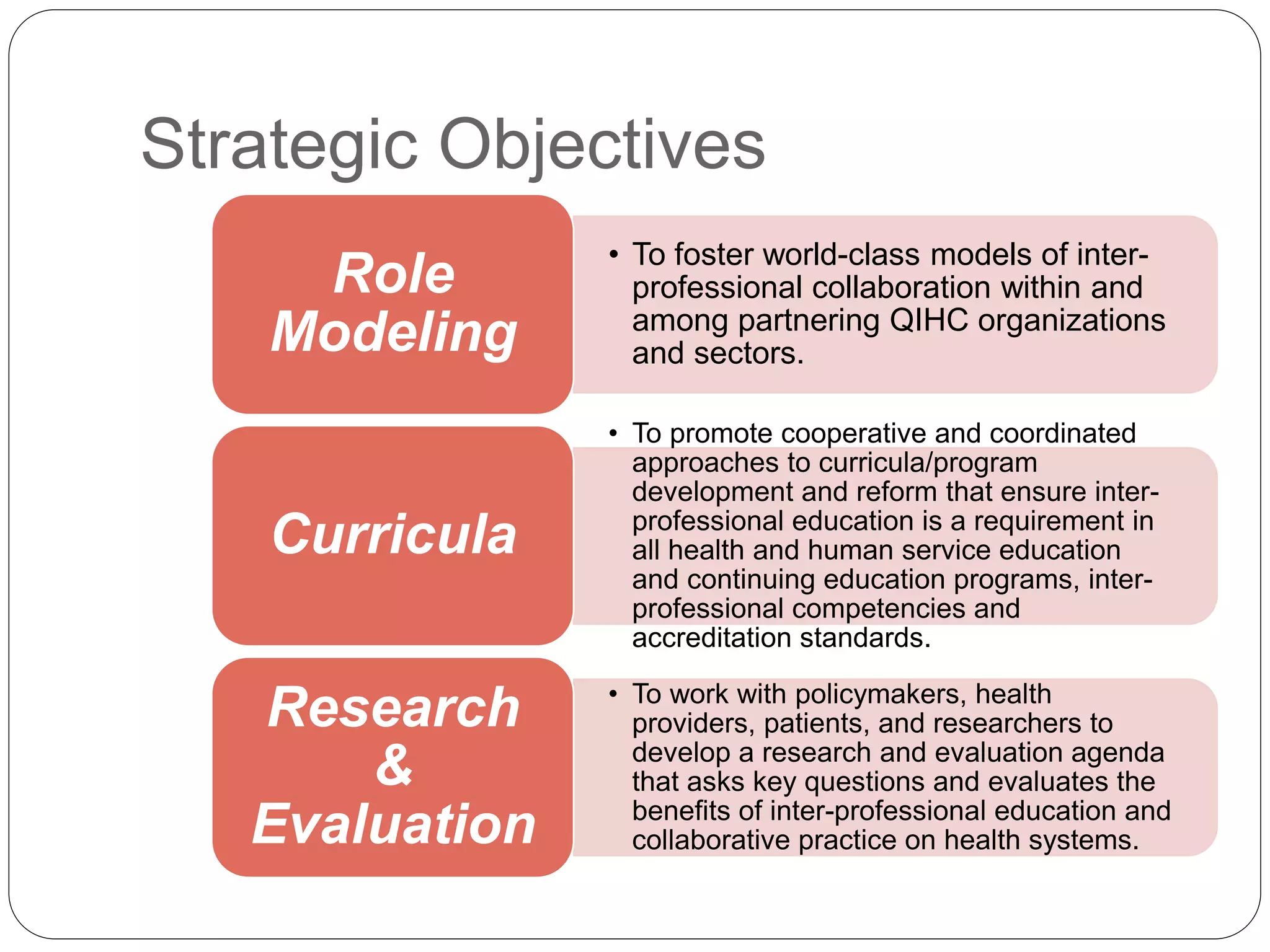
• To foster world-class models of inter-
professional collaboration within and
among partnering QIHC organizations
and sectors.
Role
Modeling
• To promote cooperative and coordinated
approaches to curricula/program
development and reform that ensure inter-
professional education is a requirement in
all health and human service education
and continuing education programs, inter-
professional competencies and
accreditation standards.
Curricula
• To work with policymakers, health
providers, patients, and researchers to
develop a research and evaluation agenda
that asks key questions and evaluates the
benefits of inter-professional education and
collaborative practice on health systems.
Research
&
Evaluation
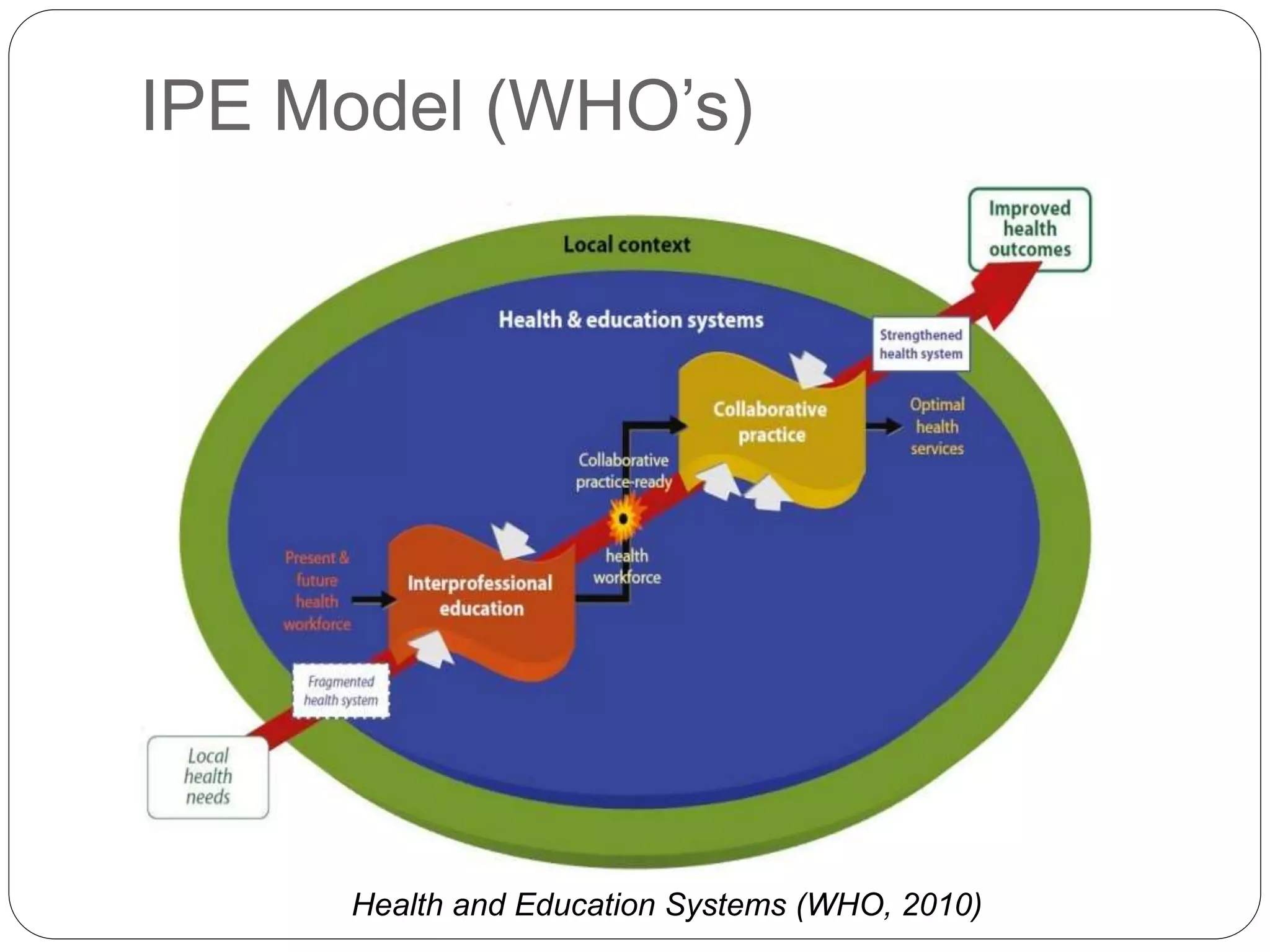
IPE Model (WHO’s)
Health and Education Systems (WHO, 2010)
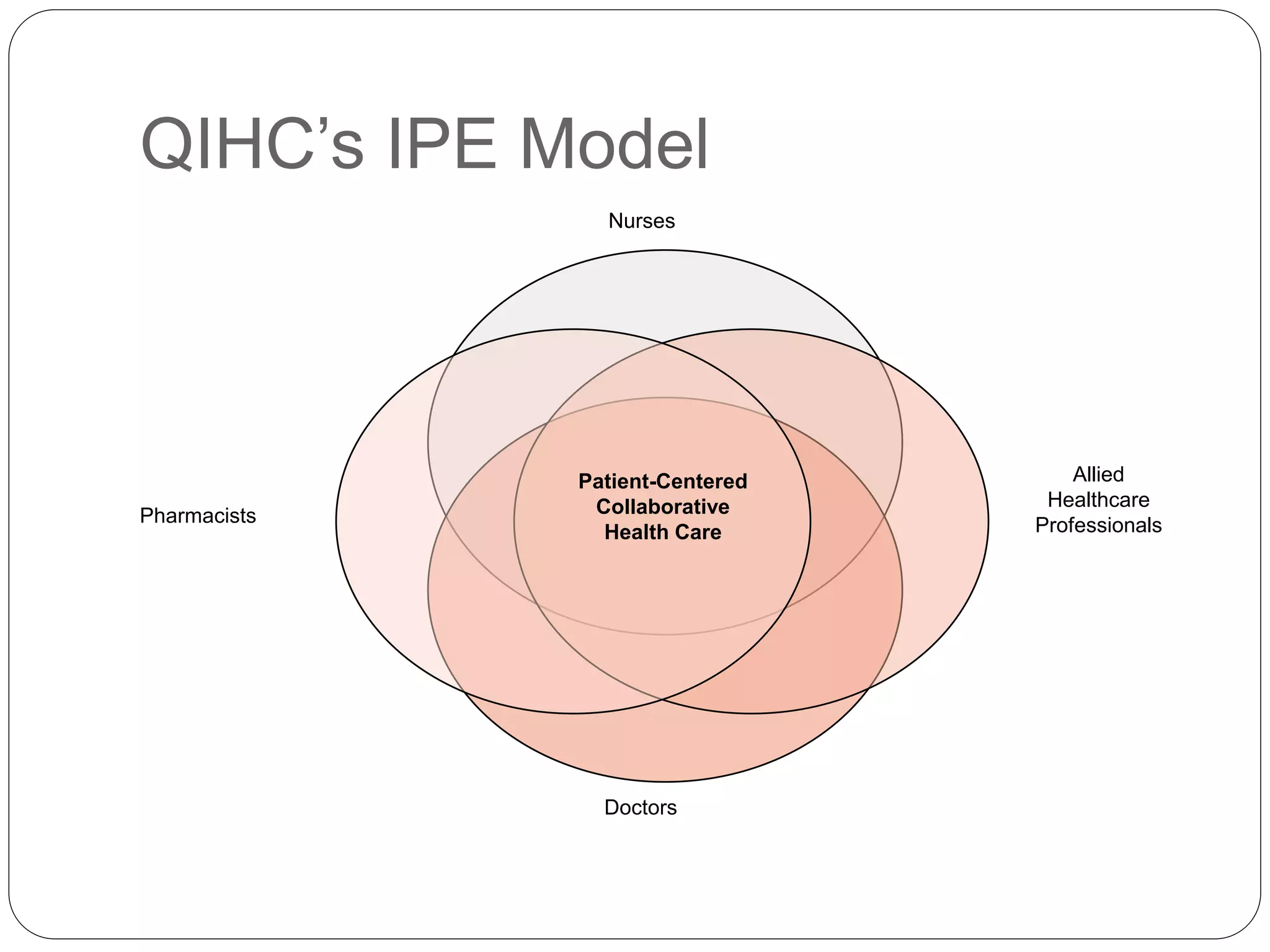
QIHC’s IPE Model
Doctors
Nurses
Pharmacists
Allied
Healthcare
Professionals
Patient-Centered
Collaborative
Health Care
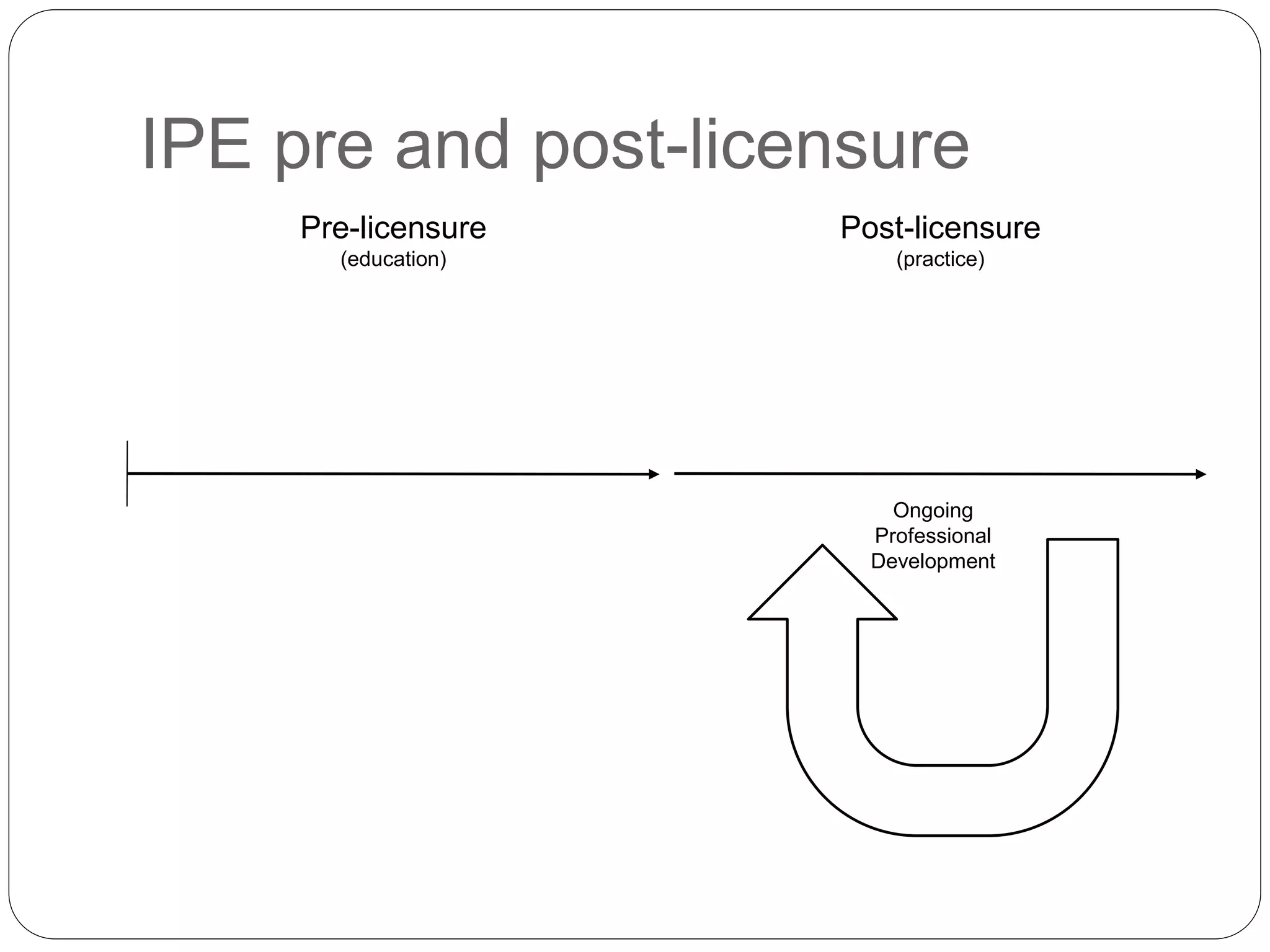
IPE pre and post-licensure
Pre-licensure
(education)
Post-licensure
(practice)
Ongoing
Professional
Development
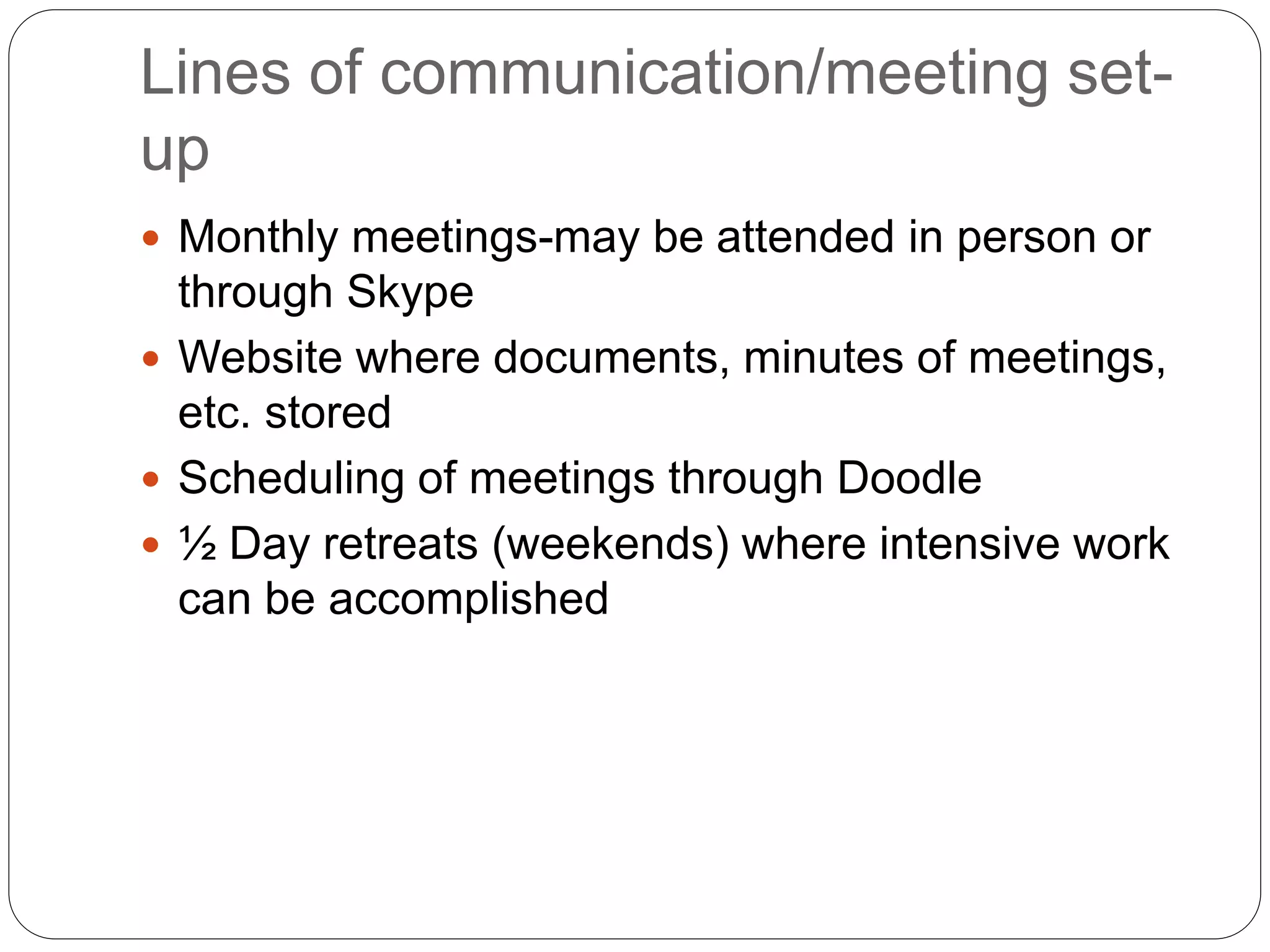
Lines of communication/meeting set-
up
 Monthly meetings-may be attended in person or
through Skype
 Website where documents, minutes of meetings,
etc. stored
 Scheduling of meetings through Doodle
 ½ Day retreats (weekends) where intensive work
can be accomplished
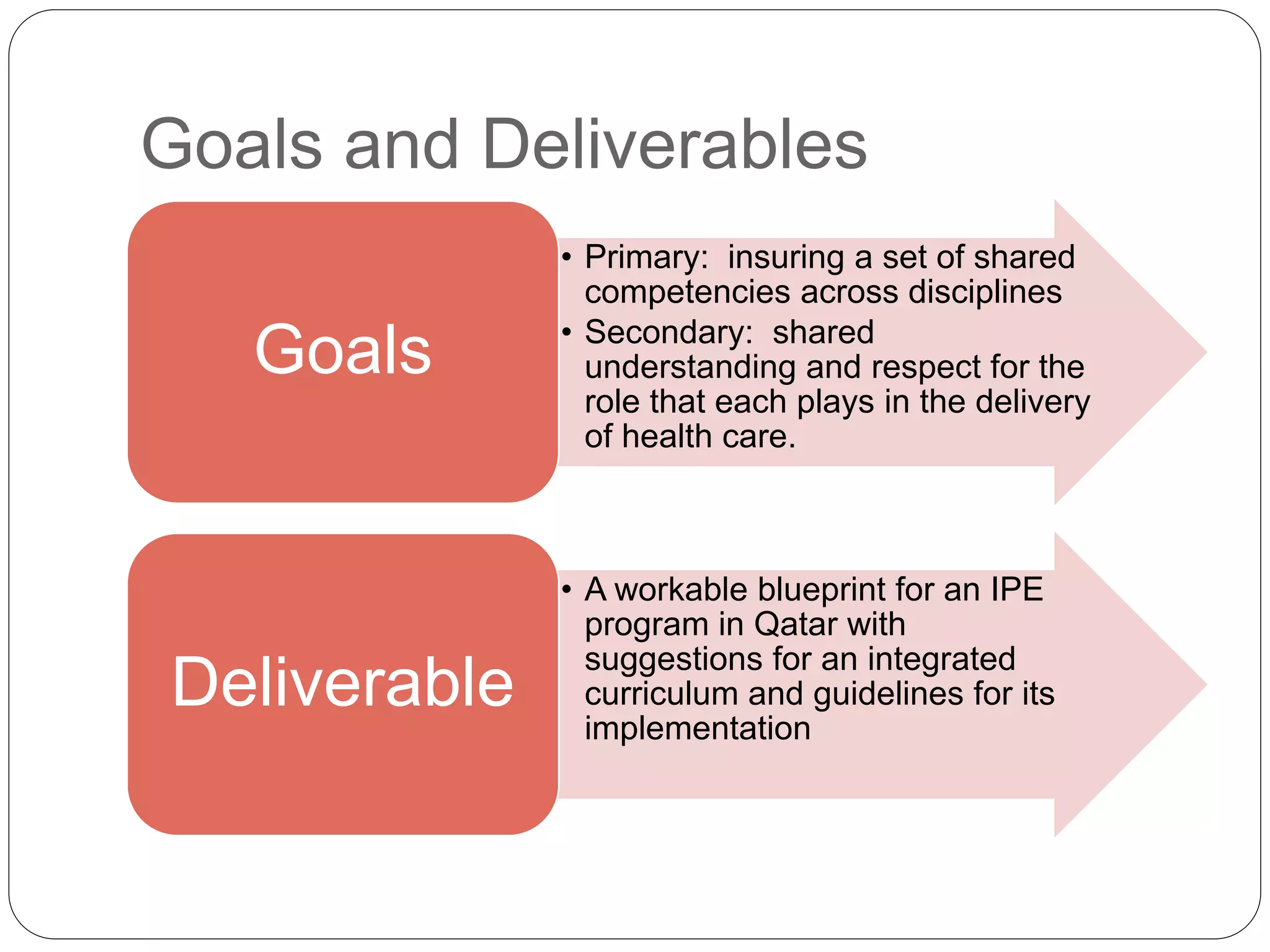
Goals and Deliverables
• Primary: insuring a set of shared
competencies across disciplines
• Secondary: shared
understanding and respect for the
role that each plays in the delivery
of health care.
Goals
• A workable blueprint for an IPE
program in Qatar with
suggestions for an integrated
curriculum and guidelines for its
implementation
Deliverable
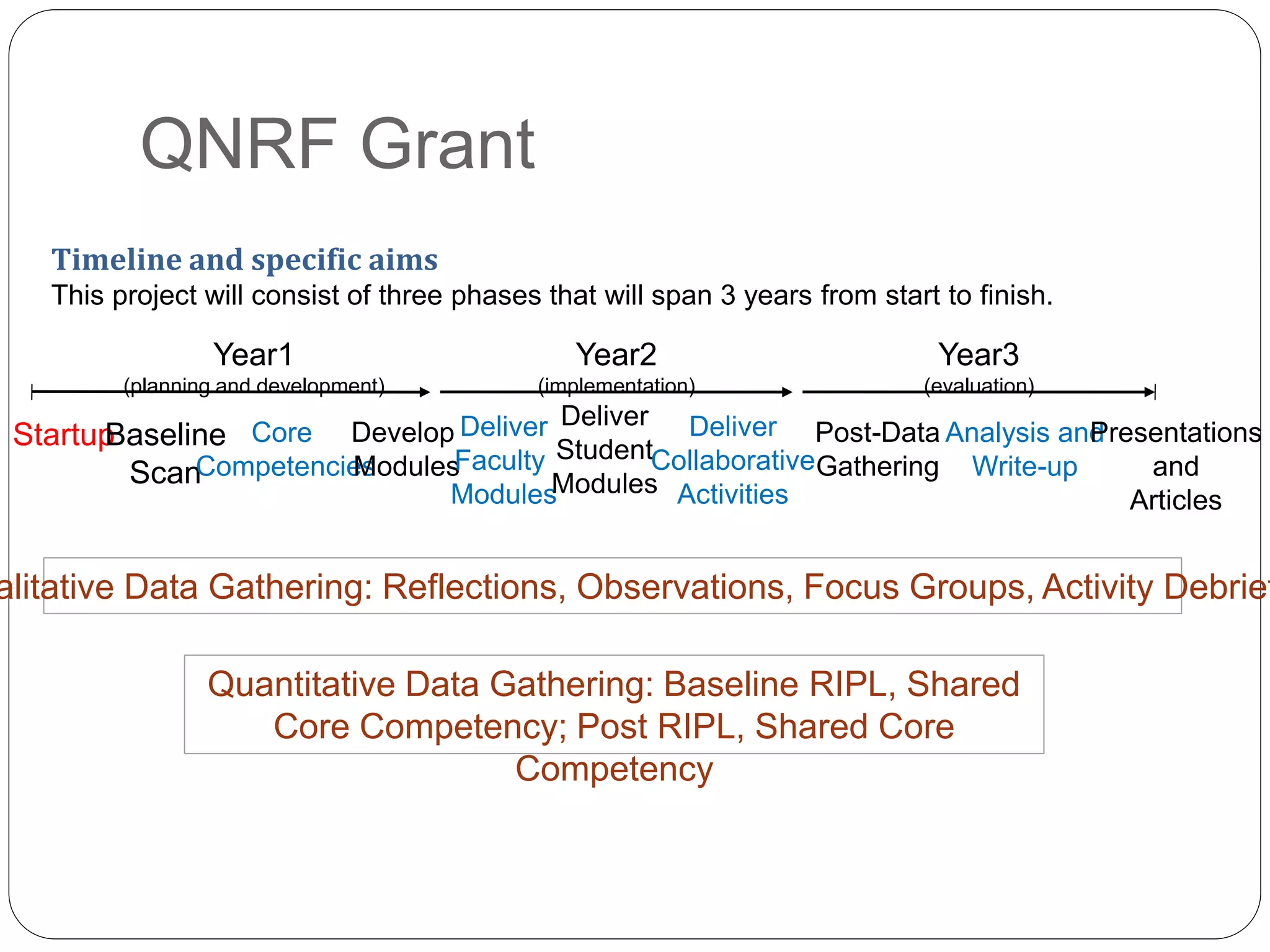
QNRF Grant
Timeline and specific aims
This project will consist of three phases that will span 3 years from start to finish.
Year1
(planning and development)
Year2
(implementation)
Year3
(evaluation)
StartupBaseline
Scan
Core
Competencies
Develop
Modules
Deliver
Faculty
Modules
Deliver
Student
Modules
Deliver
Collaborative
Activities
Post-Data
Gathering
Analysis and
Write-up
Presentations
and
Articles
alitative Data Gathering: Reflections, Observations, Focus Groups, Activity Debrief
Quantitative Data Gathering: Baseline RIPL, Shared
Core Competency; Post RIPL, Shared Core
Competency
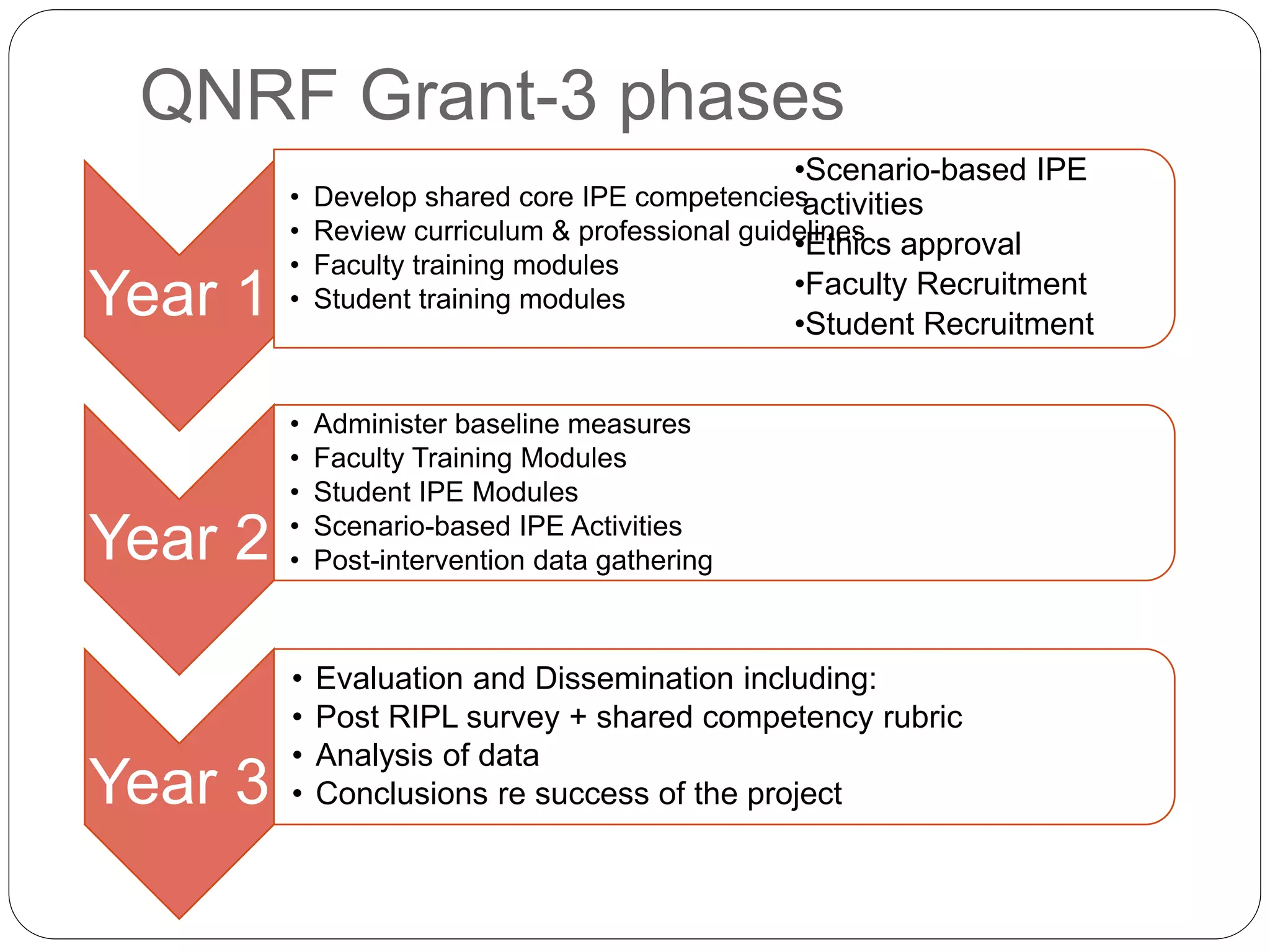
QNRF Grant-3 phases
Year 1
• Develop shared core IPE competencies
• Review curriculum & professional guidelines
• Faculty training modules
• Student training modules
Year 2
• Administer baseline measures
• Faculty Training Modules
• Student IPE Modules
• Scenario-based IPE Activities
• Post-intervention data gathering
Year 3
• Evaluation and Dissemination including:
• Post RIPL survey + shared competency rubric
• Analysis of data
• Conclusions re success of the project
•Scenario-based IPE
activities
•Ethics approval
•Faculty Recruitment
•Student Recruitment
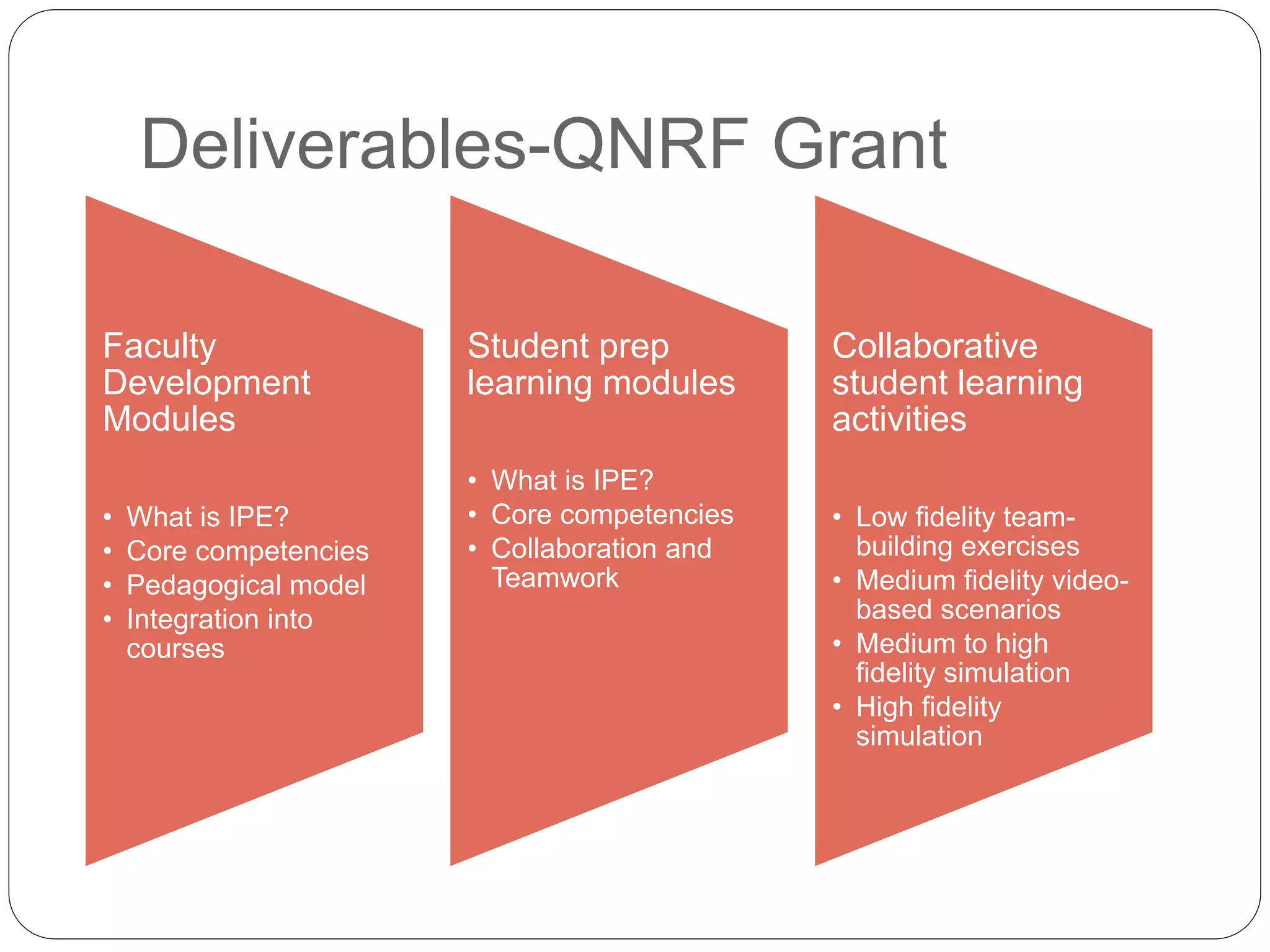
Deliverables-QNRF Grant
Faculty
Development
Modules
• What is IPE?
• Core competencies
• Pedagogical model
• Integration into
courses
Student prep
learning modules
• What is IPE?
• Core competencies
• Collaboration and
Teamwork
Collaborative
student learning
activities
• Low fidelity team-
building exercises
• Medium fidelity video-
based scenarios
• Medium to high
fidelity simulation
• High fidelity
simulation
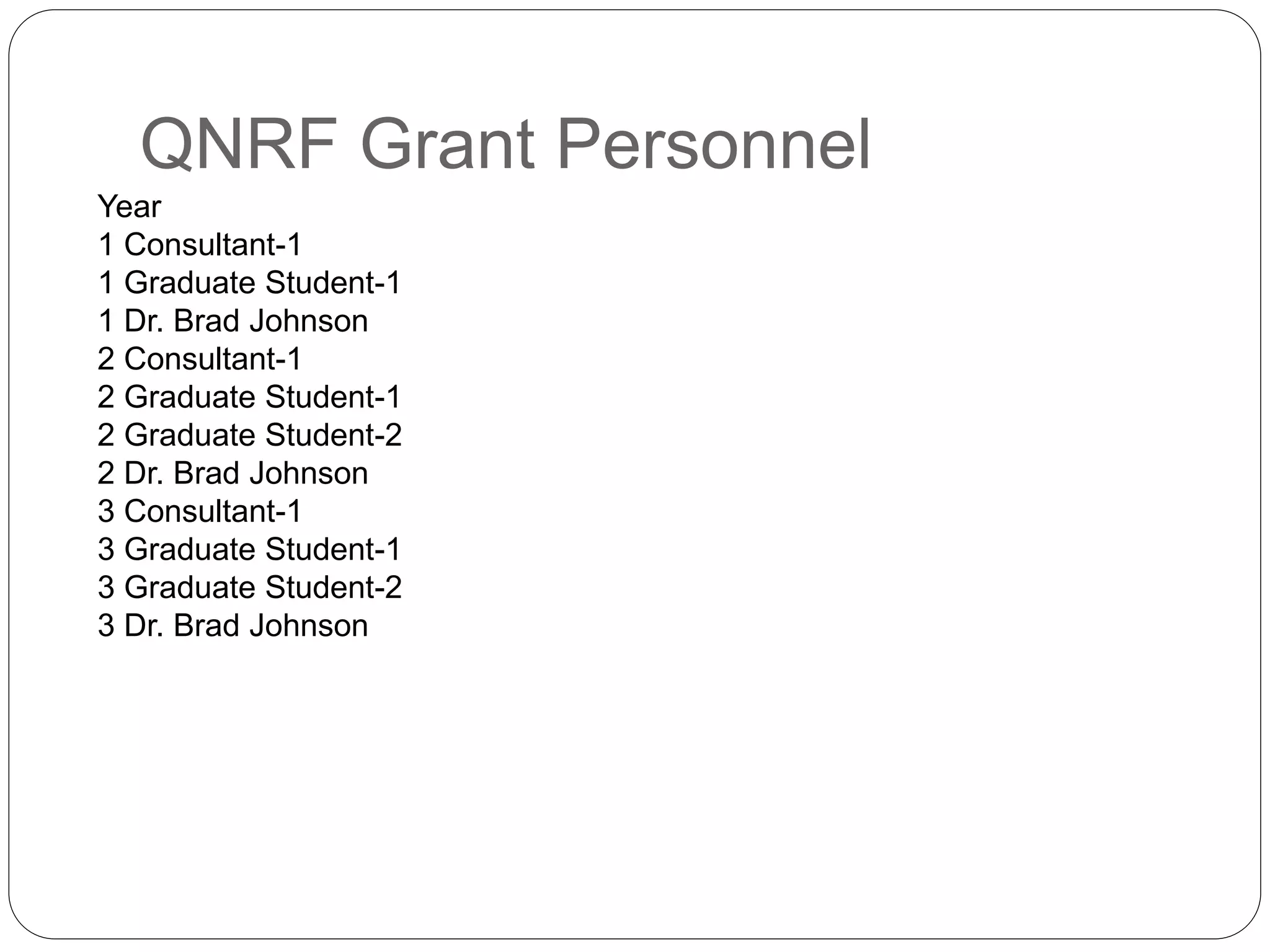
QNRF Grant Personnel
Year
1 Consultant-1
1 Graduate Student-1
1 Dr. Brad Johnson
2 Consultant-1
2 Graduate Student-1
2 Graduate Student-2
2 Dr. Brad Johnson
3 Consultant-1
3 Graduate Student-1
3 Graduate Student-2
3 Dr. Brad Johnson
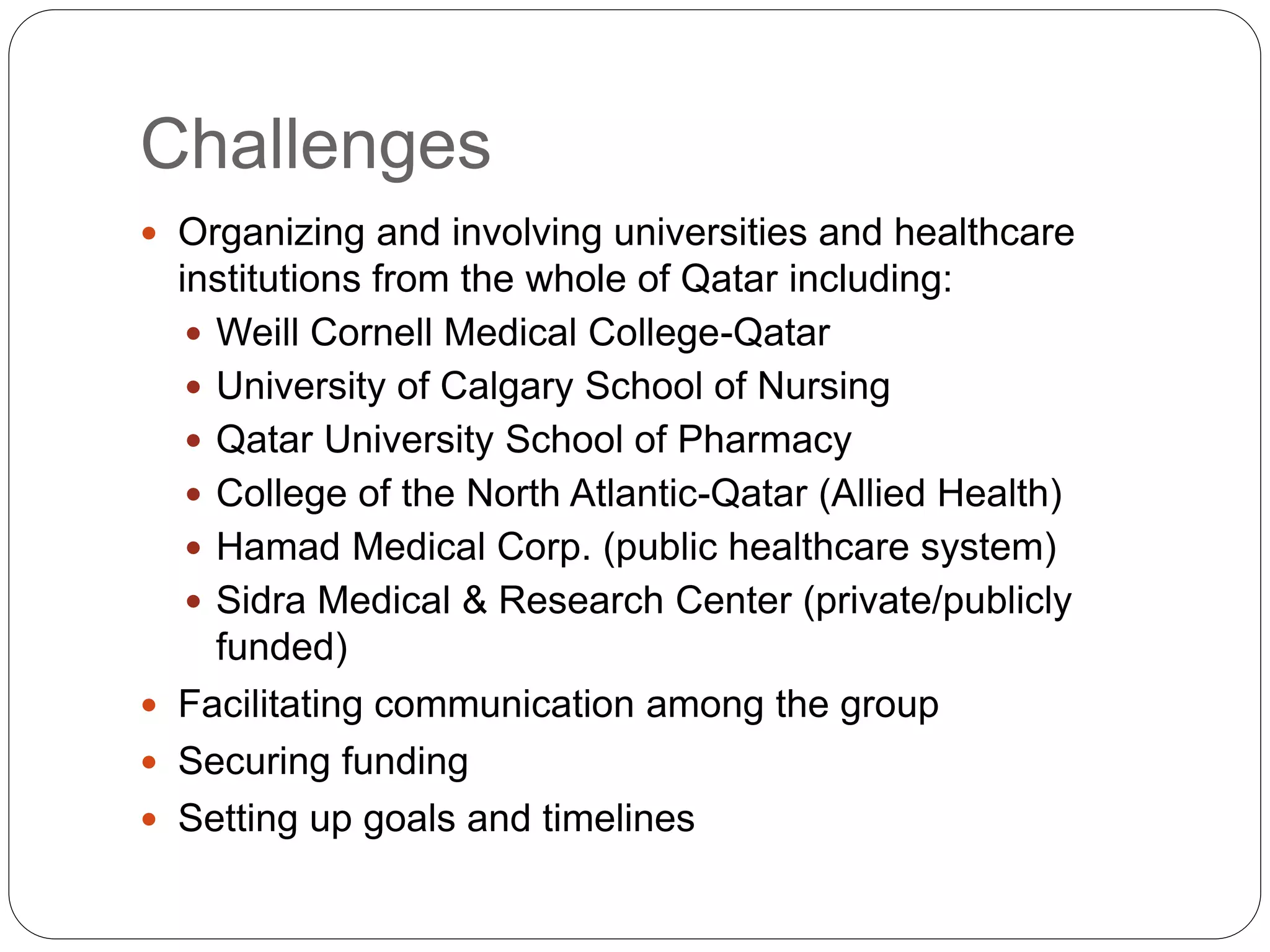
Challenges
 Organizing and involving universities and healthcare
institutions from the whole of Qatar including:
 Weill Cornell Medical College-Qatar
 University of Calgary School of Nursing
 Qatar University School of Pharmacy
 College of the North Atlantic-Qatar (Allied Health)
 Hamad Medical Corp. (public healthcare system)
 Sidra Medical & Research Center (private/publicly
funded)
 Facilitating communication among the group
 Securing funding
 Setting up goals and timelines
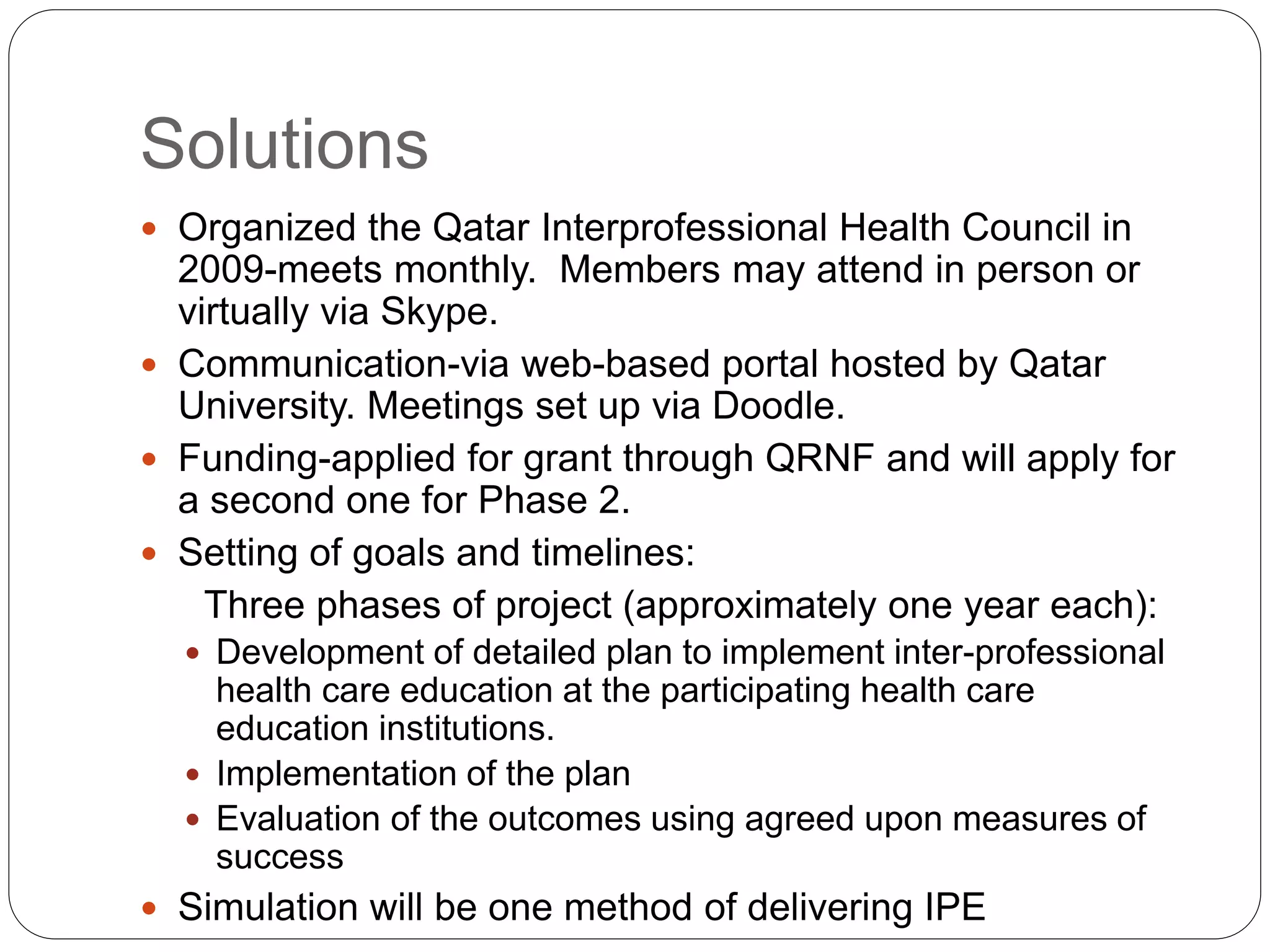
Solutions
 Organized the Qatar Interprofessional Health Council in
2009-meets monthly. Members may attend in person or
virtually via Skype.
 Communication-via web-based portal hosted by Qatar
University. Meetings set up via Doodle.
 Funding-applied for grant through QRNF and will apply for
a second one for Phase 2.
 Setting of goals and timelines:
Three phases of project (approximately one year each):
 Development of detailed plan to implement inter-professional
health care education at the participating health care
education institutions.
 Implementation of the plan
 Evaluation of the outcomes using agreed upon measures of
success
 Simulation will be one method of delivering IPE

QIHC presentation Jan 2012

  • 1.
    Renee Pyburn, RN,MS Guillaume Alinier MPhys, PGCert, MIPEM, MInstP, NTF, SFHEA Sidra Medical & Research Center Qatar Interprofessional Health CouncilSSH-NLN Interprofessional Education and Healthcare Simulation Symposium January, 2012
  • 2.
    Basic Information AboutQatar Population • Approximately 1,665,000 • Diverse population (25% Qataris, 75% other) HMC/Primary Healthcare • Large public healthcare system - delivers 90% of care Private Healthcare • A few private hospitals and clinics Sidra Medical & Research Center (2012) • Private publicly funded 400-bed hospital
  • 3.
    Clinical Education Facilitiesin Qatar WCMC-Q-Undergraduate Medical Education CNA-Q-Allied Health Education University of Calgary-Qatar-Nursing Education Qatar University-Undergraduate and graduate pharmacy education
  • 4.
    Membership Dr Brad Johnson Director, Faculty Development Center Universityof Calgary, Qatar Dr Kim Critchley Dean and CEO University of Calgary, Qatar Irene O’Brien, MS Dean, School of Health Sciences College of the North Atlantic, Qatar Dr Sherief Ibrahim Mohamad Khalifa Acting Dean, College of Pharmacy Qatar University Dr Mohamed El- Tawil Assistant Director of Medical Education Hamad Medical Corp. Dr Mohamud Verjee Director, Clinical Skills Center Weill Cornell Medical College Qatar Joanne Davies, RM, MSc, CHSE Acting Program Manager, Simulation Sidra Medical & Research Ctr. Renee Pyburn, RN, MS, CHSE Sr. Project Manager, Simulation Sidra Medical & Research Ctr. Academic Institutions Healthcare Facilities
  • 5.
    Members of QIHC •Sidra Medical & Research Center • Hamad Medical Corporation Healthcare Facilities • WCMC-Q (Medicine) • CNA-Q (Nursing) • UC-Q (Allied Health) • Qatar University (Pharmacy) Academic Institutions
  • 6.
    Brief History ofQIHC Initial Activities-First Year IPE competencies Development of mission, vision, and goals Formulation of a 3-year plan to embed IPE into healthcare education and professional practice in Qatar Successful application for grant funding from QNRF Completion of a series of workshops presented at each academic institution. Publication of journal article Formation-Summer 2009 Was originally Dean’s Council for schools providing clinical education in Qatar
  • 7.
    Vision, Mission, andPurpose Vision • To lead the education and development of health care professionals and healthcare systems which exemplify best practices in interprofessional care for the people and State of Qatar and the region. Mission • The QIHC will focus on embedding interprofessional collaboration in healthcare education and practice. Working with partners locally, regionally, and internationally, the QIHC will lead and foster collaborative interprofessional initiatives. Purpose • To provide a venue for communication and collaboration regarding interprofessional education and practice.
  • 8.
    Strategic Objectives • Tolead knowledge production, exchange, application and evaluation in the field of inter- professional education and practice. Knowledge Management • To identify opportunities to provide expert advice, support or resources to organizations or groups implementing inter-professional collaborative working or learning environments. Capacity Development • To develop and promote strategic partnerships with organizations to foster introduction and integration of inter-professional collaborative practices within their own operations. Partnerships
  • 9.
    Strategic Objectives • Tofoster world-class models of inter- professional collaboration within and among partnering QIHC organizations and sectors. Role Modeling • To promote cooperative and coordinated approaches to curricula/program development and reform that ensure inter- professional education is a requirement in all health and human service education and continuing education programs, inter- professional competencies and accreditation standards. Curricula • To work with policymakers, health providers, patients, and researchers to develop a research and evaluation agenda that asks key questions and evaluates the benefits of inter-professional education and collaborative practice on health systems. Research & Evaluation
  • 10.
    IPE Model (WHO’s) Healthand Education Systems (WHO, 2010)
  • 11.
  • 12.
    IPE pre andpost-licensure Pre-licensure (education) Post-licensure (practice) Ongoing Professional Development
  • 13.
    Lines of communication/meetingset- up  Monthly meetings-may be attended in person or through Skype  Website where documents, minutes of meetings, etc. stored  Scheduling of meetings through Doodle  ½ Day retreats (weekends) where intensive work can be accomplished
  • 14.
    Goals and Deliverables •Primary: insuring a set of shared competencies across disciplines • Secondary: shared understanding and respect for the role that each plays in the delivery of health care. Goals • A workable blueprint for an IPE program in Qatar with suggestions for an integrated curriculum and guidelines for its implementation Deliverable
  • 15.
    QNRF Grant Timeline andspecific aims This project will consist of three phases that will span 3 years from start to finish. Year1 (planning and development) Year2 (implementation) Year3 (evaluation) StartupBaseline Scan Core Competencies Develop Modules Deliver Faculty Modules Deliver Student Modules Deliver Collaborative Activities Post-Data Gathering Analysis and Write-up Presentations and Articles alitative Data Gathering: Reflections, Observations, Focus Groups, Activity Debrief Quantitative Data Gathering: Baseline RIPL, Shared Core Competency; Post RIPL, Shared Core Competency
  • 16.
    QNRF Grant-3 phases Year1 • Develop shared core IPE competencies • Review curriculum & professional guidelines • Faculty training modules • Student training modules Year 2 • Administer baseline measures • Faculty Training Modules • Student IPE Modules • Scenario-based IPE Activities • Post-intervention data gathering Year 3 • Evaluation and Dissemination including: • Post RIPL survey + shared competency rubric • Analysis of data • Conclusions re success of the project •Scenario-based IPE activities •Ethics approval •Faculty Recruitment •Student Recruitment
  • 17.
    Deliverables-QNRF Grant Faculty Development Modules • Whatis IPE? • Core competencies • Pedagogical model • Integration into courses Student prep learning modules • What is IPE? • Core competencies • Collaboration and Teamwork Collaborative student learning activities • Low fidelity team- building exercises • Medium fidelity video- based scenarios • Medium to high fidelity simulation • High fidelity simulation
  • 18.
    QNRF Grant Personnel Year 1Consultant-1 1 Graduate Student-1 1 Dr. Brad Johnson 2 Consultant-1 2 Graduate Student-1 2 Graduate Student-2 2 Dr. Brad Johnson 3 Consultant-1 3 Graduate Student-1 3 Graduate Student-2 3 Dr. Brad Johnson
  • 19.
    Challenges  Organizing andinvolving universities and healthcare institutions from the whole of Qatar including:  Weill Cornell Medical College-Qatar  University of Calgary School of Nursing  Qatar University School of Pharmacy  College of the North Atlantic-Qatar (Allied Health)  Hamad Medical Corp. (public healthcare system)  Sidra Medical & Research Center (private/publicly funded)  Facilitating communication among the group  Securing funding  Setting up goals and timelines
  • 20.
    Solutions  Organized theQatar Interprofessional Health Council in 2009-meets monthly. Members may attend in person or virtually via Skype.  Communication-via web-based portal hosted by Qatar University. Meetings set up via Doodle.  Funding-applied for grant through QRNF and will apply for a second one for Phase 2.  Setting of goals and timelines: Three phases of project (approximately one year each):  Development of detailed plan to implement inter-professional health care education at the participating health care education institutions.  Implementation of the plan  Evaluation of the outcomes using agreed upon measures of success  Simulation will be one method of delivering IPE

Editor's Notes

  • #3 Dr. Nabila or Dr. Abdullatif Population: Approximately 1,665,000 (Qatar Statistics Authority) Diverse population (only about 25% Qataris, 75% mix of wide variety of nationalities) Healthcare system overview: Large public healthcare system (HMC) that delivers ___% of care Primary healthcare system A few private hospitals and clinics Sidra Medical & Research Center- private, publicly funded 400-bed academic medical center planned to open in late 2012
  • #4 Renee WCMC-Q-Clinical Skills Center primarily focused on use of SPs and undergraduate medical education Qatar Robotic Surgery Center-DaVinci Robotic Surgery Training Facility with plans to expand programs to wider range of surgical/perioperative training programs through collaborative efforts between QRSC, Sidra, WCMC-Q, and HMC. Currently doing Da Vinci robot and basic laparoscopy skills training. Qatar University-limited simulation program for Pharmacy students Small simulation facility in Al Khor (north of Qatar); primarily focused on Urology simulation for physicians
  • #6 Renee