GRADE 10 ARTS
(1st Quarter)
MODERN ART
Q1 TOPIC:
•MODERN ART (20th
Century Art Movements)
In all human history, ART
has mirrored life in the
community, society and
the world in all its colors,
lines, shapes and forms
Technological Breakthroughs
=humans went from hand-cracked
telephones to hands-free mobile
phones, from first automobiles to
interplanetary space vehicles,
from local radio broadcasting to
international news and etc.
Migration
= allowed different
cultures, languages, skills,
and even physical
characteristics of different
races to intermingle.
• Impressionism
• Expressionism
• Abstractionism
• Abstract Expressionism
• Contemporary Art Forms
20th Century Art Movements:
IMPRESSIONISM
Distinct Characteristics:
• - Short broken strokes
• - Pure unmixed colors side by side
• - Freely brushed colors (convey visual
effect)
1. Color and Light
IMPRESSIONISM
•- Scenes of life
•- Household objects
•- Landscapes and Seascapes
•- Houses, Cafes, Buildings
2. Everyday Subjects
IMPRESSIONISM
• Previously, still lifes, portraits, and
landscapes were painted inside the
studio. The impressionists found that
they could best capture the ever-
changing effects of light on color by
painting outdoors in natural light.
3. Painting Outdoors
IMPRESSIONISM
•Impressionist painting also
moved away from the formal,
structured approach to
placing and positioning their
subjects.
4. Open Composition
IMPRESSIONISM
•Gained popularity, and
inspired impressionist to
capture fleeting moments of
action, true-to –life images.
5. The Influence of Photography
CLAUDE MONET( 1840-1926)
=Founder of the impressionist
movement along with his friends
Auguste Renoir, Alfred Sisley and
Frederic Bazille.
=the most influential figure in the
movement.
=best known for his landscape
paintings depicting his flower
gardens and water lily ponds.
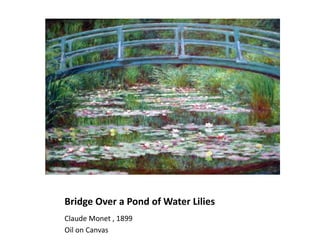
Bridge Over a Pond of Water Lilies
Claude Monet , 1899
Oil on Canvas
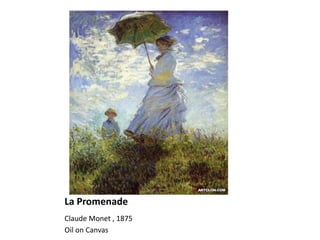
La Promenade
Claude Monet , 1875
Oil on Canvas
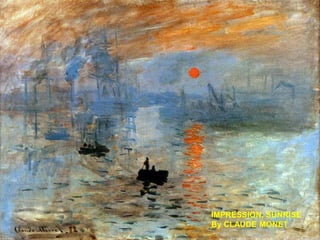
IMPRESSION, SUNRISE
By CLAUDE MONET
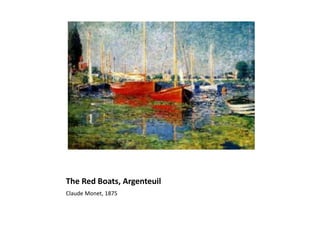
The Red Boats, Argenteuil
Claude Monet, 1875
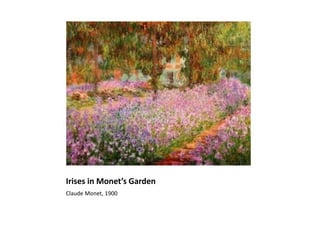
Irises in Monet’s Garden
Claude Monet, 1900
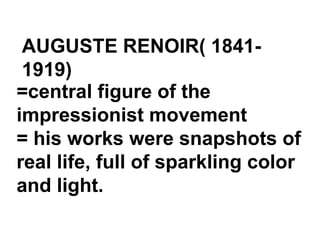
AUGUSTE RENOIR( 1841-
1919)
=central figure of the
impressionist movement
= his works were snapshots of
real life, full of sparkling color
and light.
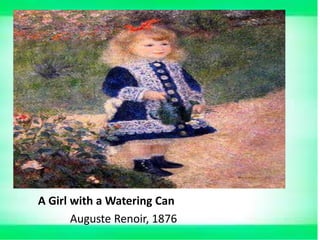
A Girl with a Watering Can
Auguste Renoir, 1876
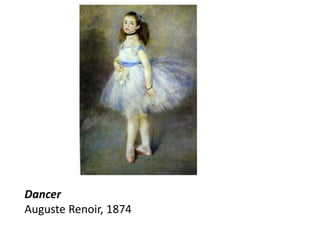
Dancer
Auguste Renoir, 1874
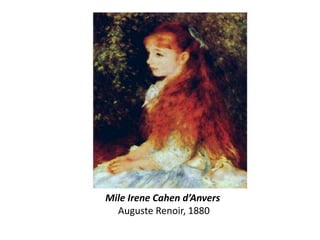
Mile Irene Cahen d’Anvers
Auguste Renoir, 1880
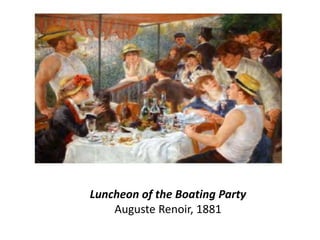
Luncheon of the Boating Party
Auguste Renoir, 1881
EDOUARD MANET (1832-1883)
=an artist that depicts modern-
life subjects.
= the key figure in the
transition from realism to
impressionism.
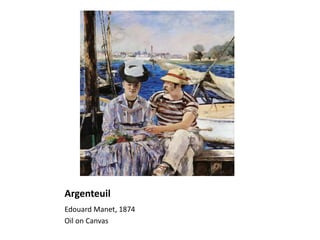
Argenteuil
Edouard Manet, 1874
Oil on Canvas
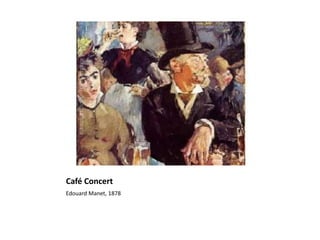
Café Concert
Edouard Manet, 1878
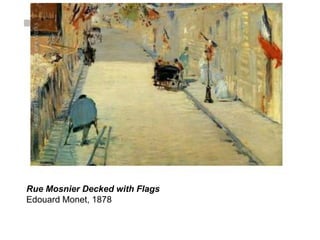
Rue Mosnier Decked with Flags
Edouard Monet, 1878
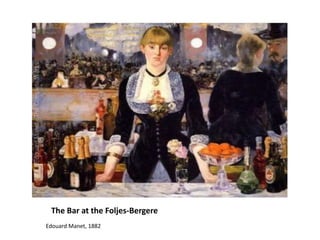
The Bar at the Foljes-Bergere
Edouard Manet, 1882
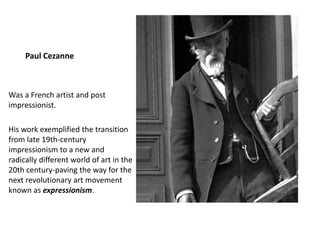
Paul Cezanne
Was a French artist and post
impressionist.
His work exemplified the transition
from late 19th-century
impressionism to a new and
radically different world of art in the
20th century-paving the way for the
next revolutionary art movement
known as expressionism.
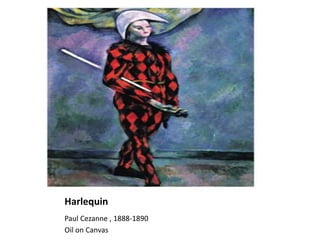
Harlequin
Paul Cezanne , 1888-1890
Oil on Canvas
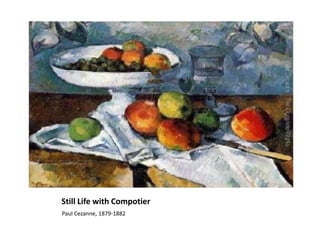
Still Life with Compotier
Paul Cezanne, 1879-1882
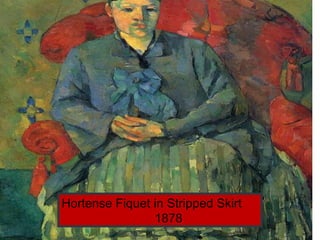
Hortense Fiquet in Stripped Skirt
1878
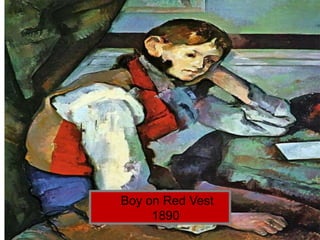
Boy on Red Vest
1890
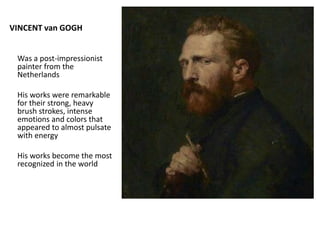
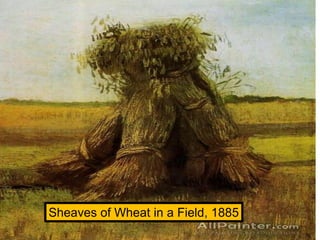
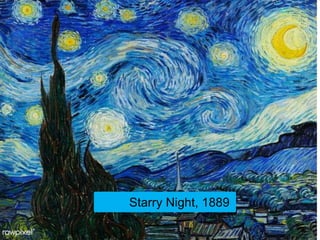
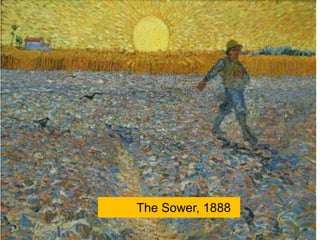
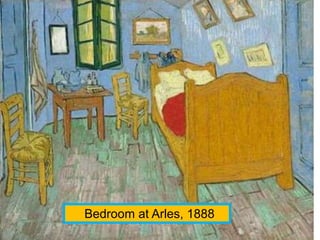
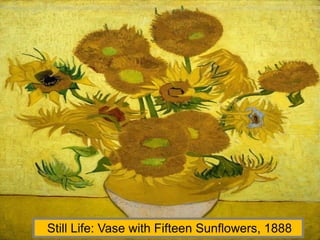
VINCENT van GOGH
Was a post-impressionist
painter from the
Netherlands
His works were remarkable
for their strong, heavy
brush strokes, intense
emotions and colors that
appeared to almost pulsate
with energy
His works become the most
recognized in the world
Sheaves of Wheat in a Field, 1885
Starry Night, 1889
The Sower, 1888
Bedroom at Arles, 1888
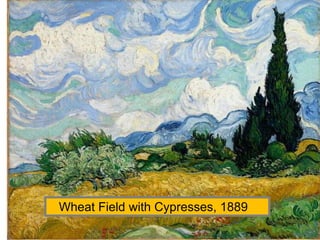
Wheat Field with Cypresses, 1889
Still Life: Vase with Fifteen Sunflowers, 1888
EXPRESSIONISM
(A Bold New Movement)
Sub-Movements:
1. Neoprimitivism
• An art style that incorporated elements from the native arts
of the South Sea Islanders and the wood carvings of African
tribes that surged in popularity at that time.
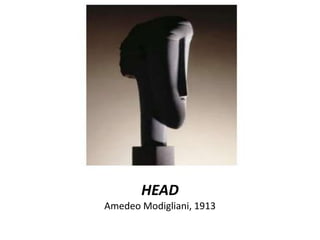
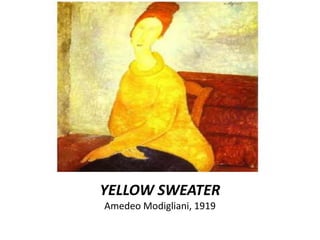
• Amedeo Modigliani, used the oval faces and elongated
shapes of African art in both his sculptures and paintings.
EXPRESSIONISM
(A Bold New Movement)
Sub-Movements:
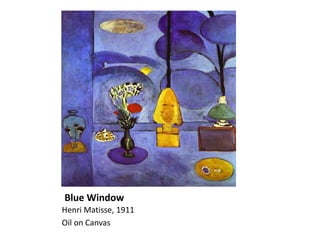
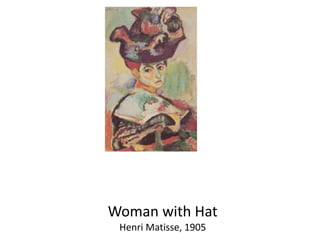
2. Fauvism =derived from the word “les
fauves” meaning wild beast
• Uses bold, vibrant colors and visual distortions.
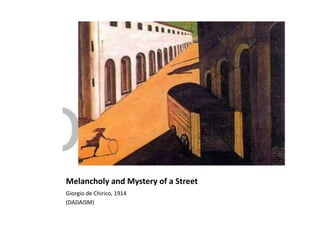
3. Dadaism
• Characterized by dream fantasies, memory images, and
visual tricks and fantasies They use the child’s term for
hobbyhorse, dada, to refer to their new “nonstyle”..
EXPRESSIONISM
(A Bold New Movement)
4. Surrealism
• Depicts an illogical subconscious dream
world beyond the logical, conscious,
physical one.
5. Social Realism
• Expresses the artist’s role in social reform.
NEOPRIMITIVISM
HEAD
Amedeo Modigliani, 1913
YELLOW SWEATER
Amedeo Modigliani, 1919
FAUVISM
Blue Window
Henri Matisse, 1911
Oil on Canvas
Woman with Hat
Henri Matisse, 1905
DADAISM
Melancholy and Mystery of a Street
Giorgio de Chirico, 1914
(DADAISM)
SURREALISM
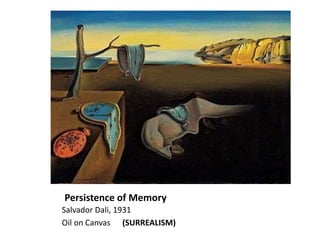
Persistence of Memory
Salvador Dali, 1931
Oil on Canvas (SURREALISM)
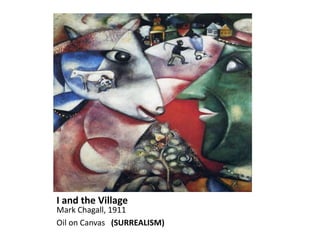
I and the Village
Mark Chagall, 1911
Oil on Canvas (SURREALISM)
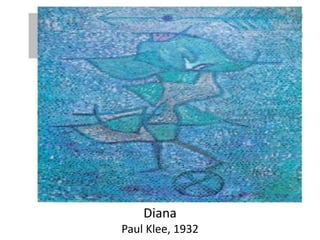
Diana
Paul Klee, 1932
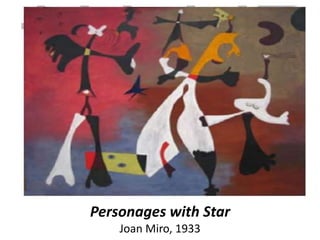
Personages with Star
Joan Miro, 1933
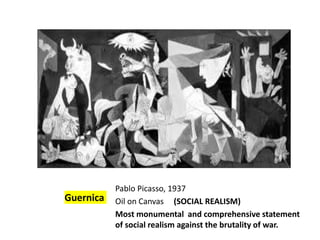
SOCIAL REALISM
Guernica
Pablo Picasso, 1937
Oil on Canvas (SOCIAL REALISM)
Most monumental and comprehensive statement
of social realism against the brutality of war.
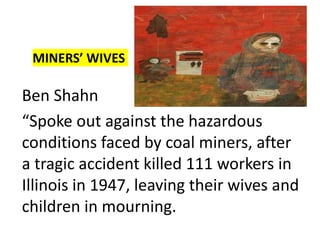
MINERS’ WIVES
Ben Shahn
“Spoke out against the hazardous
conditions faced by coal miners, after
a tragic accident killed 111 workers in
Illinois in 1947, leaving their wives and
children in mourning.
ABSTRACTIONISM
Sub-Movements:
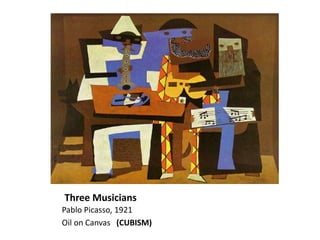
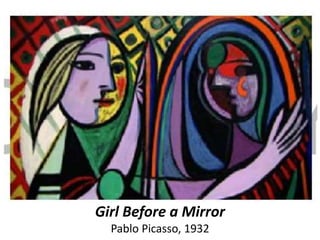
1. Cubism
• Artworks were a play of planes and angles on a
flat surface.
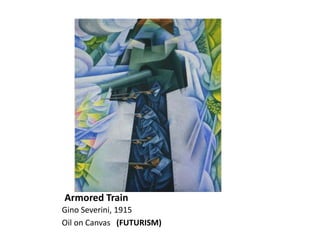
2. Futurism
• Arts were created for a fast-paced, machine-
propelled age.
ABSTRACTIONISM
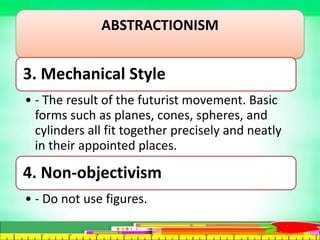
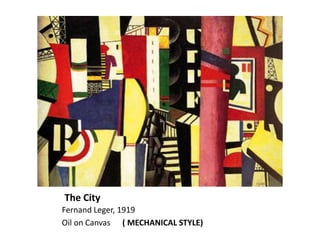
3. Mechanical Style
• - The result of the futurist movement. Basic
forms such as planes, cones, spheres, and
cylinders all fit together precisely and neatly
in their appointed places.
4. Non-objectivism
• - Do not use figures.
CUBISM
Three Musicians
Pablo Picasso, 1921
Oil on Canvas (CUBISM)
Girl Before a Mirror
Pablo Picasso, 1932
FUTURISM
Armored Train
Gino Severini, 1915
Oil on Canvas (FUTURISM)
MECHANICAL STYLE
The City
Fernand Leger, 1919
Oil on Canvas ( MECHANICAL STYLE)
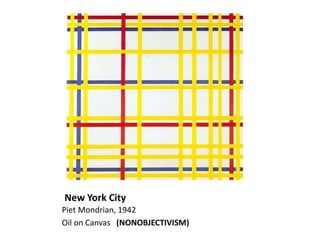
NONOBJECTIVISM
New York City
Piet Mondrian, 1942
Oil on Canvas (NONOBJECTIVISM)
ABSTRACT EXPRESSIONISM
Sub-Movements:
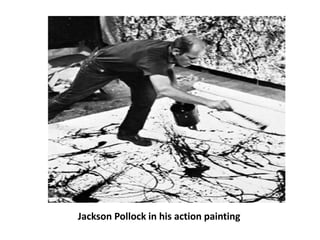
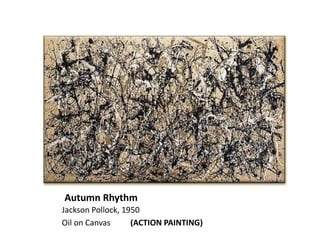
1. Action Painting
• - The techniques could be splattering, squirting,
and dribbling paint with no pre-planned design.
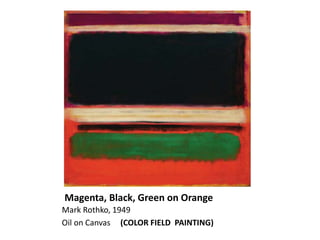
2. Color Field Painting
• - Uses different color saturations to create
desired effects.
ACTION PAINTING
Jackson Pollock in his action painting
Autumn Rhythm
Jackson Pollock, 1950
Oil on Canvas (ACTION PAINTING)
COLOR FIELD PAINTING
Magenta, Black, Green on Orange
Mark Rothko, 1949
Oil on Canvas (COLOR FIELD PAINTING)
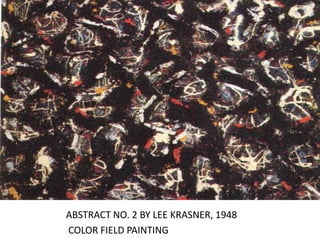
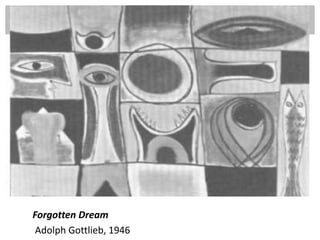
COLOR FIELD PAINTING
*others took intimate “pictograph” approach filling the
canvas with repeating picture fragments or symbols
ABSTRACT NO. 2 BY LEE KRASNER, 1948
COLOR FIELD PAINTING
Forgotten Dream
Adolph Gottlieb, 1946
POP ART
Distinct Characteristics:
1. Range of Work
• From painting, to posters, collages, 3D
assemblages, and installations.
2. Inspirations/Subjects
• Advertisements, celebrities, billboards, and comic
strips.
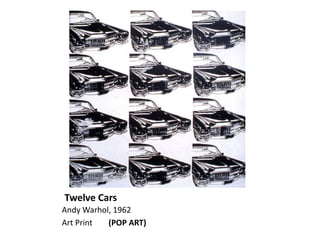
Twelve Cars
Andy Warhol, 1962
Art Print (POP ART)
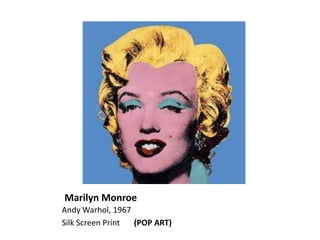
Marilyn Monroe
Andy Warhol, 1967
Silk Screen Print (POP ART)
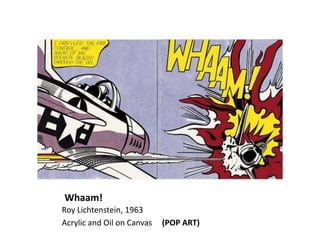
Whaam!
Roy Lichtenstein, 1963
Acrylic and Oil on Canvas (POP ART)
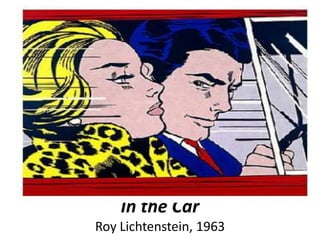
In the Car
Roy Lichtenstein, 1963
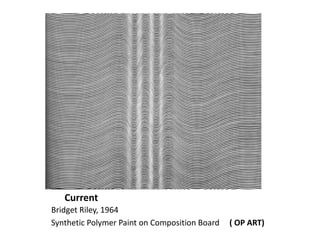
OP ART
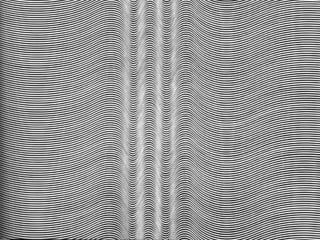
1. A form of action painting with the action
taking place in the viewer’s eye.
2. As the eye moved over a different
segments of the image, perfectly stable
components appeared to shift back and forth.
Current
Bridget Riley, 1964
Synthetic Polymer Paint on Composition Board ( OP ART)
CONCEPTUAL ART
=An art form that arose in the mind of the
artist, took concrete form for a time, and then
disappeared (unless it was captured in photo
or film documentation)
=often requires little or no physical
craftsmanship.
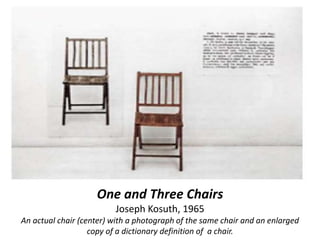
One and Three Chairs
Joseph Kosuth, 1965
An actual chair (center) with a photograph of the same chair and an enlarged
copy of a dictionary definition of a chair.
CONTEMPORARY ART FORMS
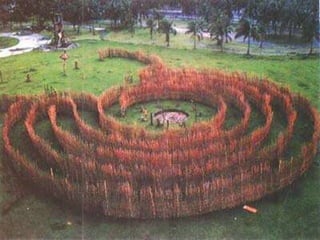
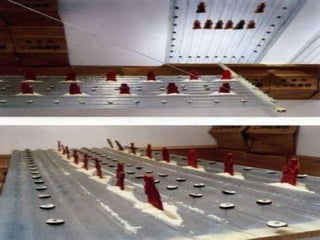
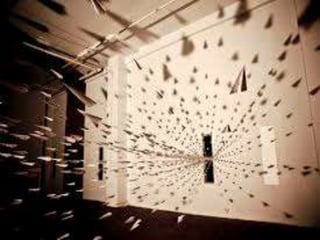
1. Installation Art
• Uses sculptural materials and other
media to modify the viewer’s experience
in a particular space.
• Usually lifesize or even larger. Installation
can be constructed in everyday public or
private spaces both indoor and outdoor.
2. Performance Art
•The actions of the performers may
constitute work. It can happen any
time at any place for any length of
time.
•In performance art, the performer
himself or herself is the artist.
Four basic elements of
Performance Art
•Time
•Space
•The performer’s body
•A relationship between performer
and audience.

Q1 ART MOVEMENTS.pptx