MUSIC 10
FIRST GRADING
GUESS THE SONG
REVIEW!
Concepts on previous lessons on
Romantic Music
M
O
T
I
V
A
T
I
O
N
Do you know what helps you make your point clear?
Lists like this one:
● They’re simple
● You can organize your ideas clearly
● You’ll never forget to buy milk!
And the most important thing: the audience won’t
miss the point of your presentation
ART MUSEUM TOUR
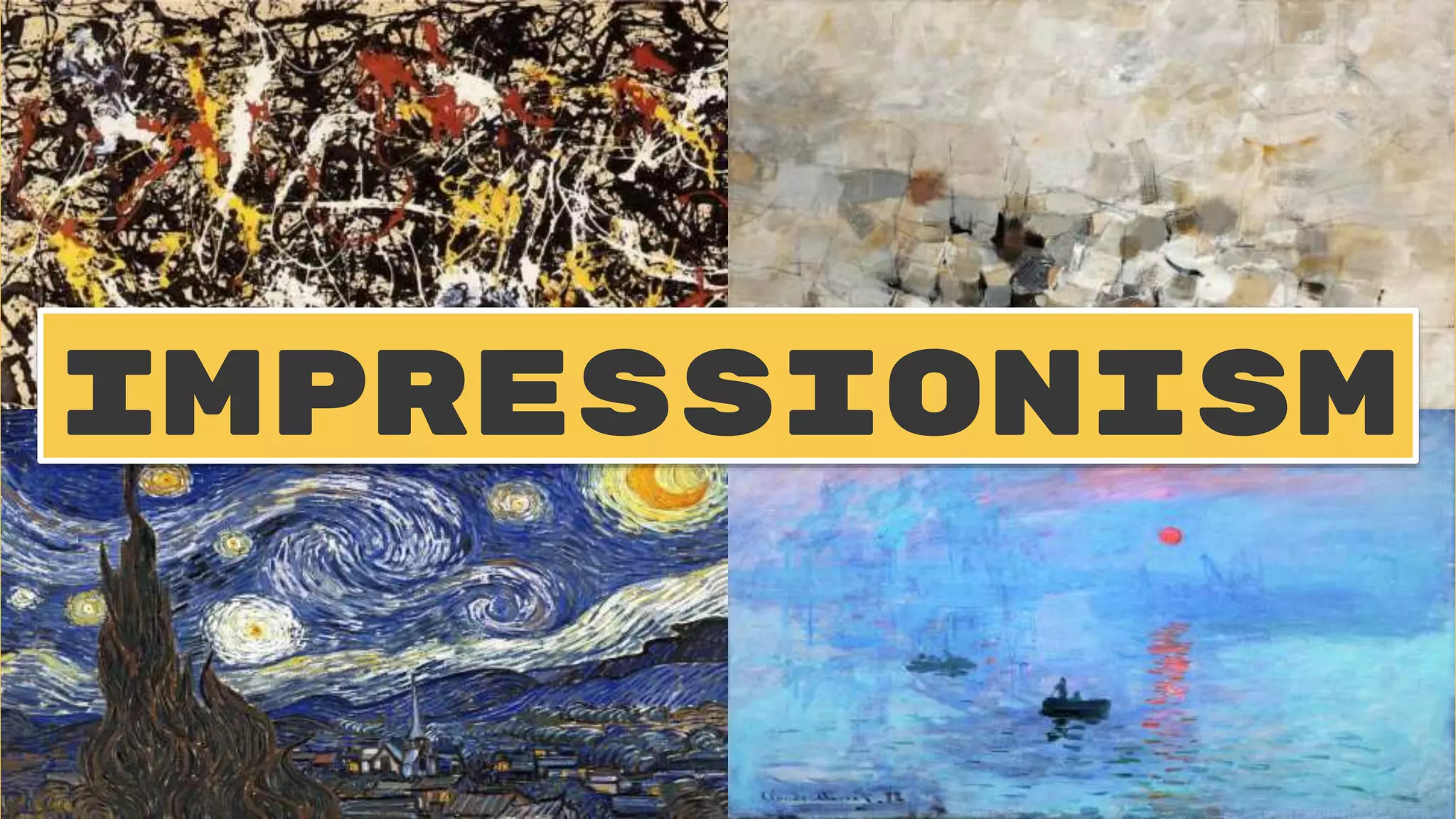
1. What do you know about the
paintings you’ve just seen? Can
you cite some title of the painting?
2. Do you have an idea on what
do we call these kind of paintings?
impressionism
What is
impressionism?
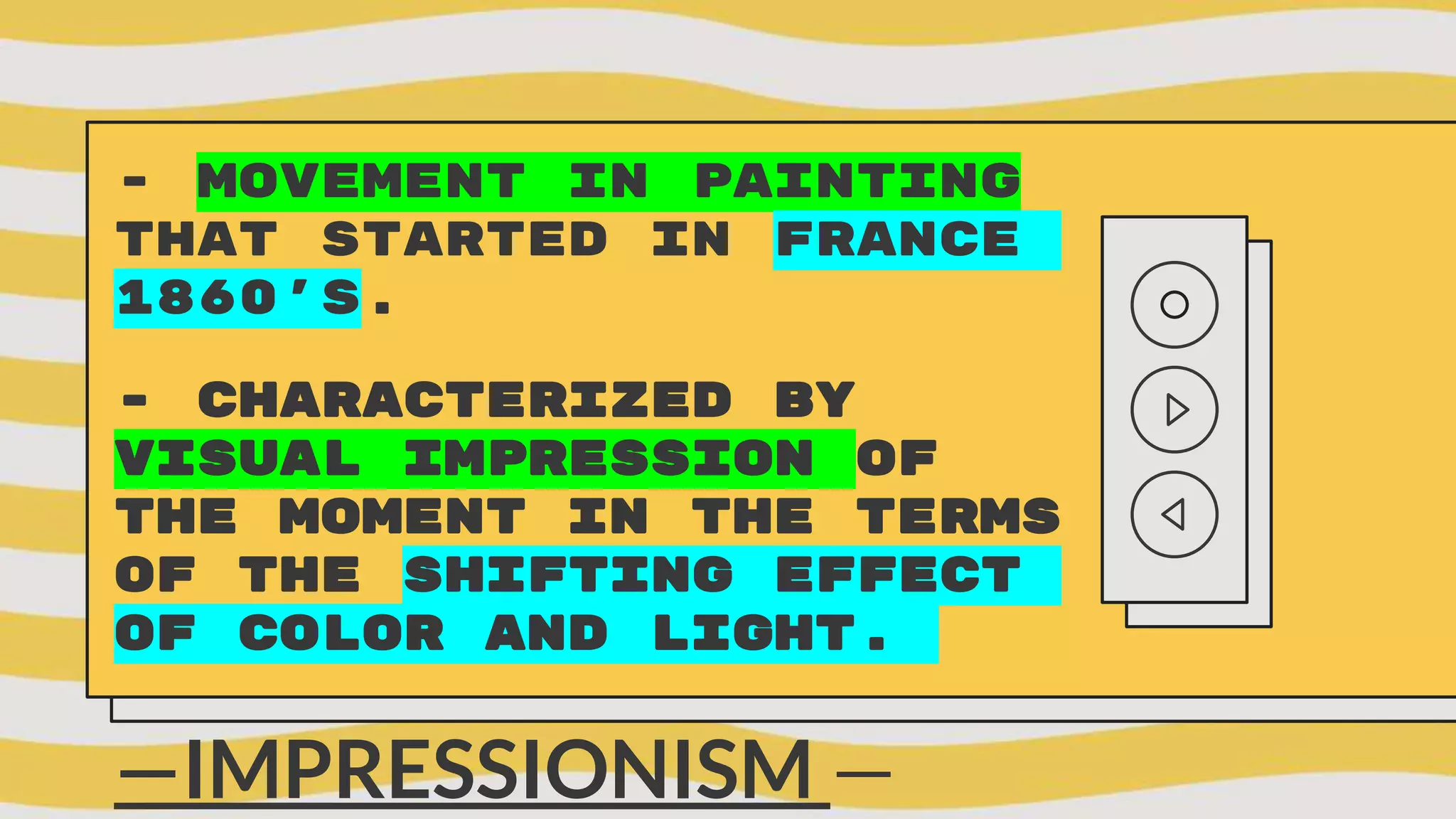
—IMPRESSIONISM —
- MOVEMENT IN PAINTING
THAT STARTED IN FRANCE
1860’S.
- characterized by
visual impression of
the moment in the terms
of the Shifting effect
of color and light.
20TH CENTURY MUSIC
One of the earlier but concrete forms declaring the
entry of 20th century and adapted from impressionism
art was known as impressionism music. It is a French
movement in the late 19th and early 20th century.
The sentimental melodies and dramatic emotionalism
of the preceding Romantic Period were being replaced
in favor of moods and impressions.
Guess the
thing
FIRST TO RAISE HAND
20TH CENTURY
-marked the invention of the gramophone records
where elites or rich could listen to live concerts in
theaters.
- Phonograph was invented produced both middle and
lower class could have the chance to listen to less
expensive record concerts.
20TH CENTURY
-Radio broadcasting allowed many people to listen
to classical music and opera music.
question
Do you still have this kind of musical gadgets
before? How do you take care of them? What
makes other people collect this old kind of
musical gadgets or antiques?
MUSIC OF THE 20TH CENTURY
Quarter I:
IMPRESSIONISM MUSIC
● The impressionistic movement in music had
its foremost proponents. Both had
developed a particular style of composing
adopted by many 20th century composers
CLAUDE DEBUSSY
(1862–1918)
• The primary exponent
of the impressionist movement
• Debussy was born in St.
Germain-en-Laye in France
on August 22, 1862
• He entered the Paris
Conservatory in 1873.
CLAUDE DEBUSSY
(1862–1918)
• He gained a reputation as an
erratic pianist and a rebel in
theory and harmony
• In 1884, he won the top prize at
the Prix de Rome competition
with his composition L’ Enfant
Prodigue (The Prodigal Son).
where he got exposed to the music of Richard Wagner
Claude Debussy (Impressionism) Richard Wagner (Romantic Period)
MAURICE RAVEL
(1875–1937)
• born in Ciboure, France to a
Basque mother and a Swiss
father.
• He entered the Paris
Conservatory at the age of 14
where he studied with the
eminent French composer
Gabriel Faure.
MAURICE RAVEL
(1875–1937)
• He also admired the music of
Chopin, Liszt, Schubert, and
Mendelssohn.
• He died in Paris in 1937.
Music Interpretation
Answer the following questions while
listening to the music of Debussy and
Ravel.
CLAUDE
DEBUSSY CLAIR DE LUNE
BOLERO
MAURICE RAVEL
CHARACTERISTICS OF IMPRESSIONISM MUSIC
● The rhythm of impressionism music is irregular in
terms of phrases
● It avoids the traditional harmonic progression.
(chord patterns)
● It has unresolved dissonance
● Frequently uses modality
CHARACTERISTICS OF IMPRESSIONISM MUSIC
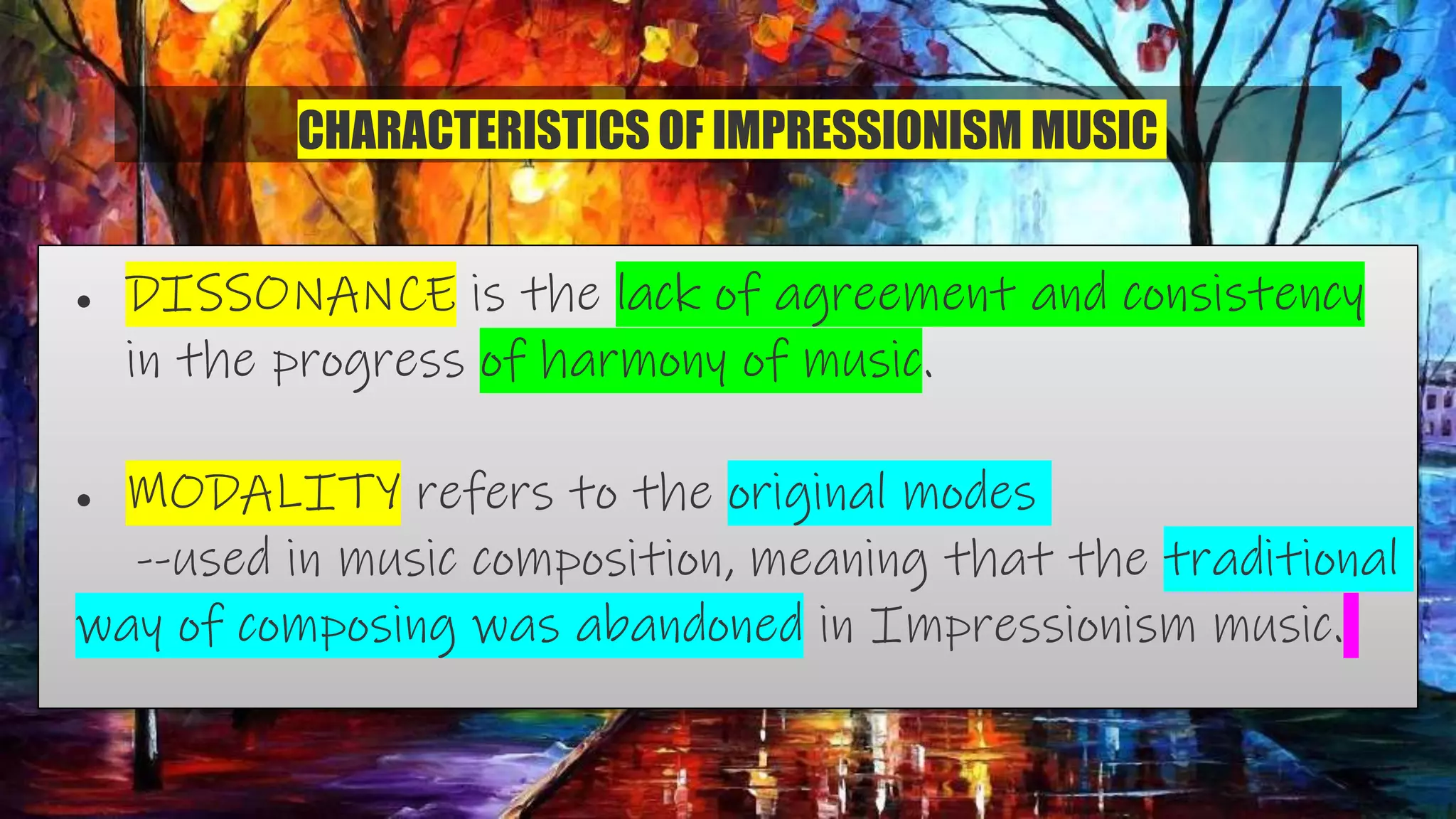
● DISSONANCE is the lack of agreement and consistency
in the progress of harmony of music.
● MODALITY refers to the original modes
--used in music composition, meaning that the traditional
way of composing was abandoned in Impressionism music.
IMPRESSIONISM MUSIC
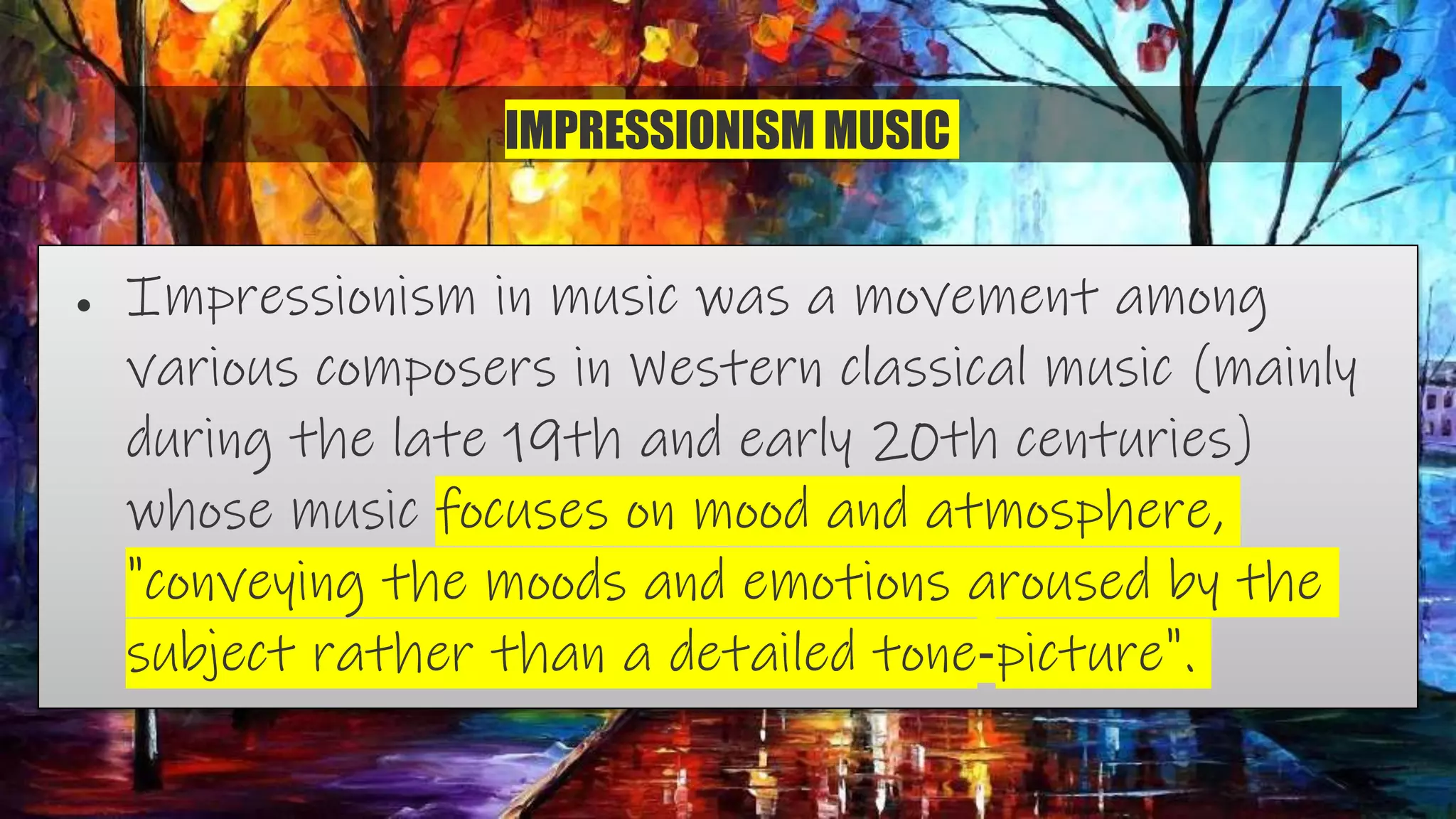
● Impressionism in music was a movement among
various composers in Western classical music (mainly
during the late 19th and early 20th centuries)
whose music focuses on mood and atmosphere,
"conveying the moods and emotions aroused by the
subject rather than a detailed tone‐picture".
pollev.com/cedricvincegometer415
Impressionism music

Impressionism music

  • 1.
  • 2.
  • 3.
    REVIEW! Concepts on previouslessons on Romantic Music
  • 4.
    M O T I V A T I O N Do you knowwhat helps you make your point clear? Lists like this one: ● They’re simple ● You can organize your ideas clearly ● You’ll never forget to buy milk! And the most important thing: the audience won’t miss the point of your presentation ART MUSEUM TOUR
  • 5.
    1. What doyou know about the paintings you’ve just seen? Can you cite some title of the painting? 2. Do you have an idea on what do we call these kind of paintings?
  • 6.
  • 7.
  • 8.
    —IMPRESSIONISM — - MOVEMENTIN PAINTING THAT STARTED IN FRANCE 1860’S. - characterized by visual impression of the moment in the terms of the Shifting effect of color and light.
  • 9.
    20TH CENTURY MUSIC Oneof the earlier but concrete forms declaring the entry of 20th century and adapted from impressionism art was known as impressionism music. It is a French movement in the late 19th and early 20th century. The sentimental melodies and dramatic emotionalism of the preceding Romantic Period were being replaced in favor of moods and impressions.
  • 10.
  • 16.
    20TH CENTURY -marked theinvention of the gramophone records where elites or rich could listen to live concerts in theaters. - Phonograph was invented produced both middle and lower class could have the chance to listen to less expensive record concerts.
  • 17.
    20TH CENTURY -Radio broadcastingallowed many people to listen to classical music and opera music.
  • 18.
    question Do you stillhave this kind of musical gadgets before? How do you take care of them? What makes other people collect this old kind of musical gadgets or antiques?
  • 19.
    MUSIC OF THE20TH CENTURY Quarter I:
  • 20.
    IMPRESSIONISM MUSIC ● Theimpressionistic movement in music had its foremost proponents. Both had developed a particular style of composing adopted by many 20th century composers
  • 21.
    CLAUDE DEBUSSY (1862–1918) • Theprimary exponent of the impressionist movement • Debussy was born in St. Germain-en-Laye in France on August 22, 1862 • He entered the Paris Conservatory in 1873.
  • 22.
    CLAUDE DEBUSSY (1862–1918) • Hegained a reputation as an erratic pianist and a rebel in theory and harmony • In 1884, he won the top prize at the Prix de Rome competition with his composition L’ Enfant Prodigue (The Prodigal Son).
  • 23.
    where he gotexposed to the music of Richard Wagner Claude Debussy (Impressionism) Richard Wagner (Romantic Period)
  • 24.
    MAURICE RAVEL (1875–1937) • bornin Ciboure, France to a Basque mother and a Swiss father. • He entered the Paris Conservatory at the age of 14 where he studied with the eminent French composer Gabriel Faure.
  • 25.
    MAURICE RAVEL (1875–1937) • Healso admired the music of Chopin, Liszt, Schubert, and Mendelssohn. • He died in Paris in 1937.
  • 26.
    Music Interpretation Answer thefollowing questions while listening to the music of Debussy and Ravel.
  • 27.
  • 28.
  • 29.
    CHARACTERISTICS OF IMPRESSIONISMMUSIC ● The rhythm of impressionism music is irregular in terms of phrases ● It avoids the traditional harmonic progression. (chord patterns) ● It has unresolved dissonance ● Frequently uses modality
  • 30.
    CHARACTERISTICS OF IMPRESSIONISMMUSIC ● DISSONANCE is the lack of agreement and consistency in the progress of harmony of music. ● MODALITY refers to the original modes --used in music composition, meaning that the traditional way of composing was abandoned in Impressionism music.
  • 31.
    IMPRESSIONISM MUSIC ● Impressionismin music was a movement among various composers in Western classical music (mainly during the late 19th and early 20th centuries) whose music focuses on mood and atmosphere, "conveying the moods and emotions aroused by the subject rather than a detailed tone‐picture".
  • 32.