MUSIC 10
Mr. Ted Dancel
BURGOS AGRO-INDUSTRIAL SCHOOL
01 Impressionism
03 20th Century Musical Styles
02 Expressionism
The module is divided into three lessons, namely:
IMPRESSIONISM
1
Orange Musical
IMPRESSIONISM
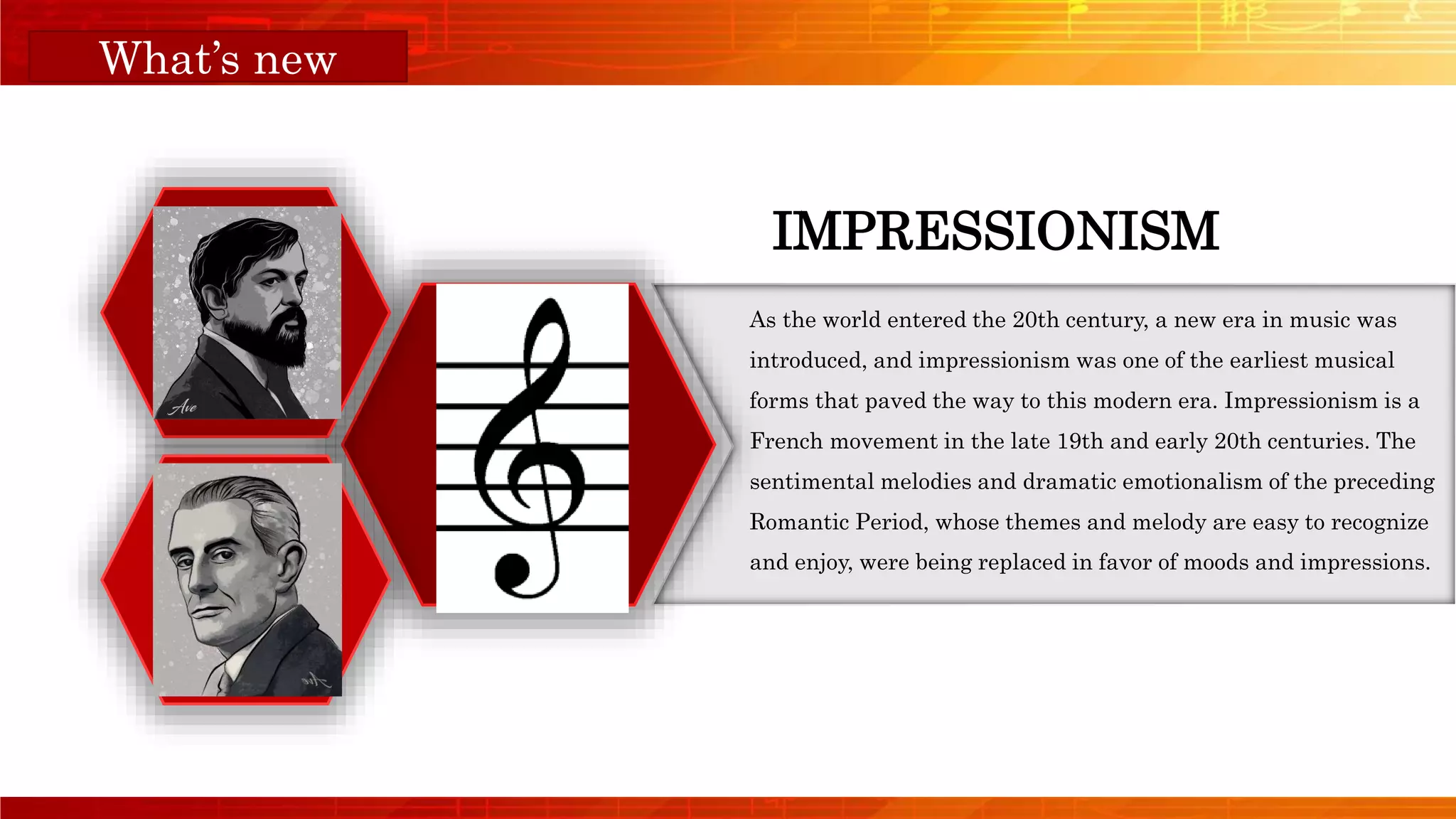
As the world entered the 20th century, a new era in music was
introduced, and impressionism was one of the earliest musical
forms that paved the way to this modern era. Impressionism is a
French movement in the late 19th and early 20th centuries. The
sentimental melodies and dramatic emotionalism of the preceding
Romantic Period, whose themes and melody are easy to recognize
and enjoy, were being replaced in favor of moods and impressions.
What’s new
Orange Musical
CLAUDE DEBUSSY (1862–1918)
What’s new
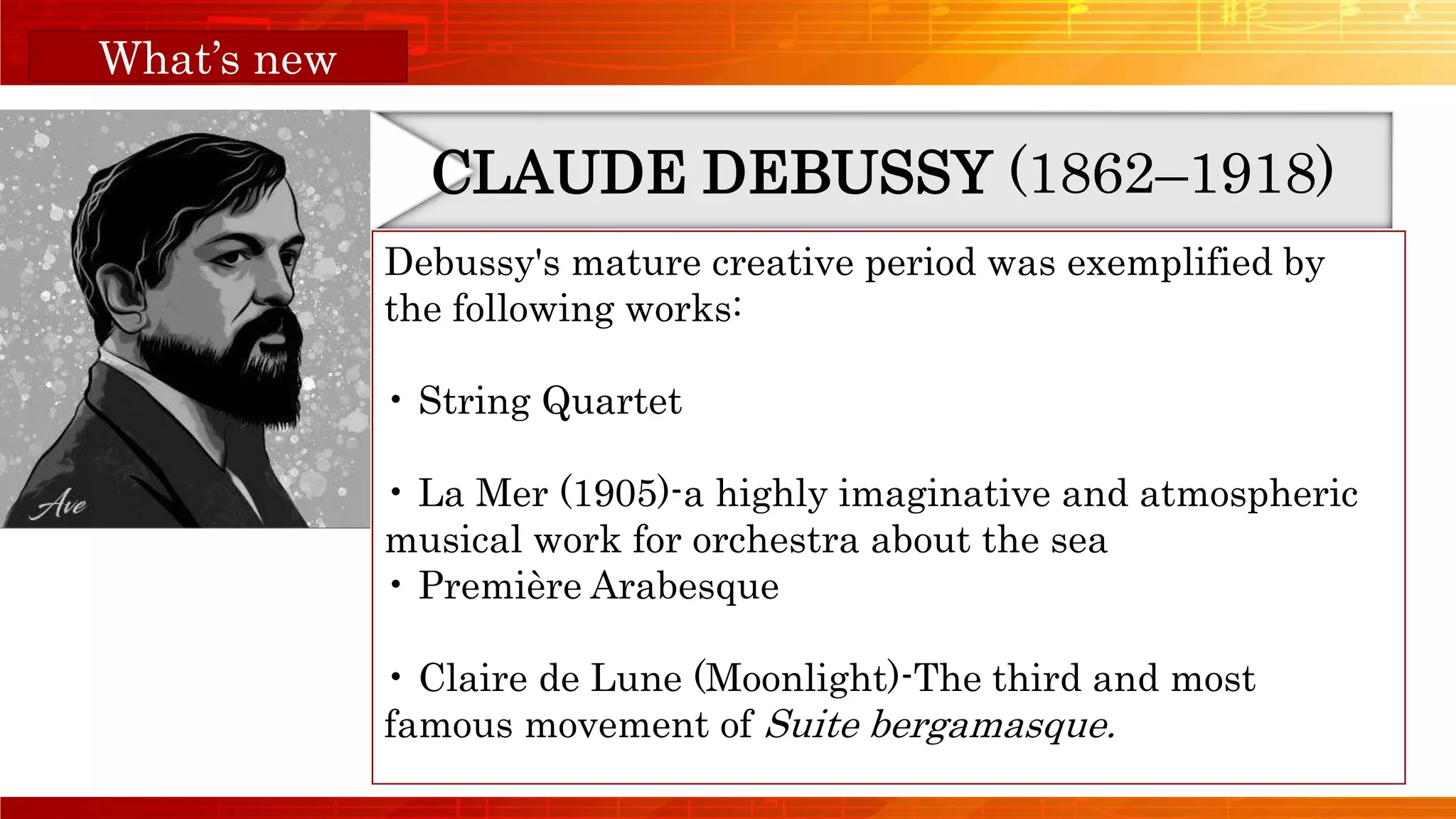
Claude Debussy was one of the most influential and
leading composers of the 20th century. He was the
principal exponent of the impressionist movement and
the inspiration for other impressionist composers. He
reformed the course of musical development by
eradicating traditional rules and conventions into a new
language of possibilities in harmony, rhythm, form,
texture, and color.
Orange Musical
CLAUDE DEBUSSY (1862–1918)
What’s new
Debussy's mature creative period was exemplified by
the following works:
• String Quartet
• La Mer (1905)-a highly imaginative and atmospheric
musical work for orchestra about the sea
• Première Arabesque
• Claire de Lune (Moonlight)-The third and most
famous movement of Suite bergamasque.
Orange Musical
MAURICE RAVEL (1875–1937)
What’s new
Joseph Maurice Ravel was born in Ciboure,
France, to a Basque mother and a Swiss father.
At age 14, he entered the Paris Conservatory,
where he was musically nurtured by a
prominent French composer, Gabriel Faure. The
compositional style of Ravel is mainly
characterized by its distinctively innovative but
not atonal style (music that is written in a way
that is not based on any particular key) of
harmonic treatment.
Orange Musical
MAURICE RAVEL (1875–1937)
What’s new
Ravel's works include the following:
• Pavane for a Dead Princess (1899)
• String Quartet (1903)
• Sonatine for Piano (c.1904)
• Rhapsodie Espagnole
• Bolero
Orange Musical
Features of Impressionism music are as follows:
What it is
• The use of "color," or in musical terms, timbre, which
can be achieved through orchestration, harmonic usage,
texture, etc. (Timbre is known as the tone color or tone
quality)
• New combinations of extended chords, harmonies,
whole tone, chromatic scales, and pentatonic scales
emerged.
• Impressionism was an attempt not to depict reality,
but merely to suggest it.
Orange Musical
What's More
The most remarkable composition of Debussy is Claire
De Lune. Have you watched the Hollywood movie hit
Twilight Saga? Try to recall its sentimental soundtracks.
One of them is Claire De Lune! Would you like to listen
to it once again? Play from the accompanying CD Track 1
(Claire de Lune), or you can access it at
https://www.youtube.com/watch?v=CvFH_6DNRCY.
Orange Musical
What's More
Ravel's defining composition is "Bolero." Bolero is a one-
movement orchestral piece which was premiered in 1928.
Play from the accompanying CD Track 2 (Bolero) or you
can access it at
https://www.youtube.com/watch?v=b5V31O8ll14
Orange Musical
What's More
While listening, answer the following guide questions on
a separate sheet of paper:
• What specific dance form can be performed with Bolero
as music?
• What feelings or emotions does the music evoke?
Orange Musical
What I Have Learned
Orange Musical
Writing Activity
Which among the compositions of Impressionism
inspired you most? Why?
Expressionism
2
Orange Musical
EXPRESSIONISM
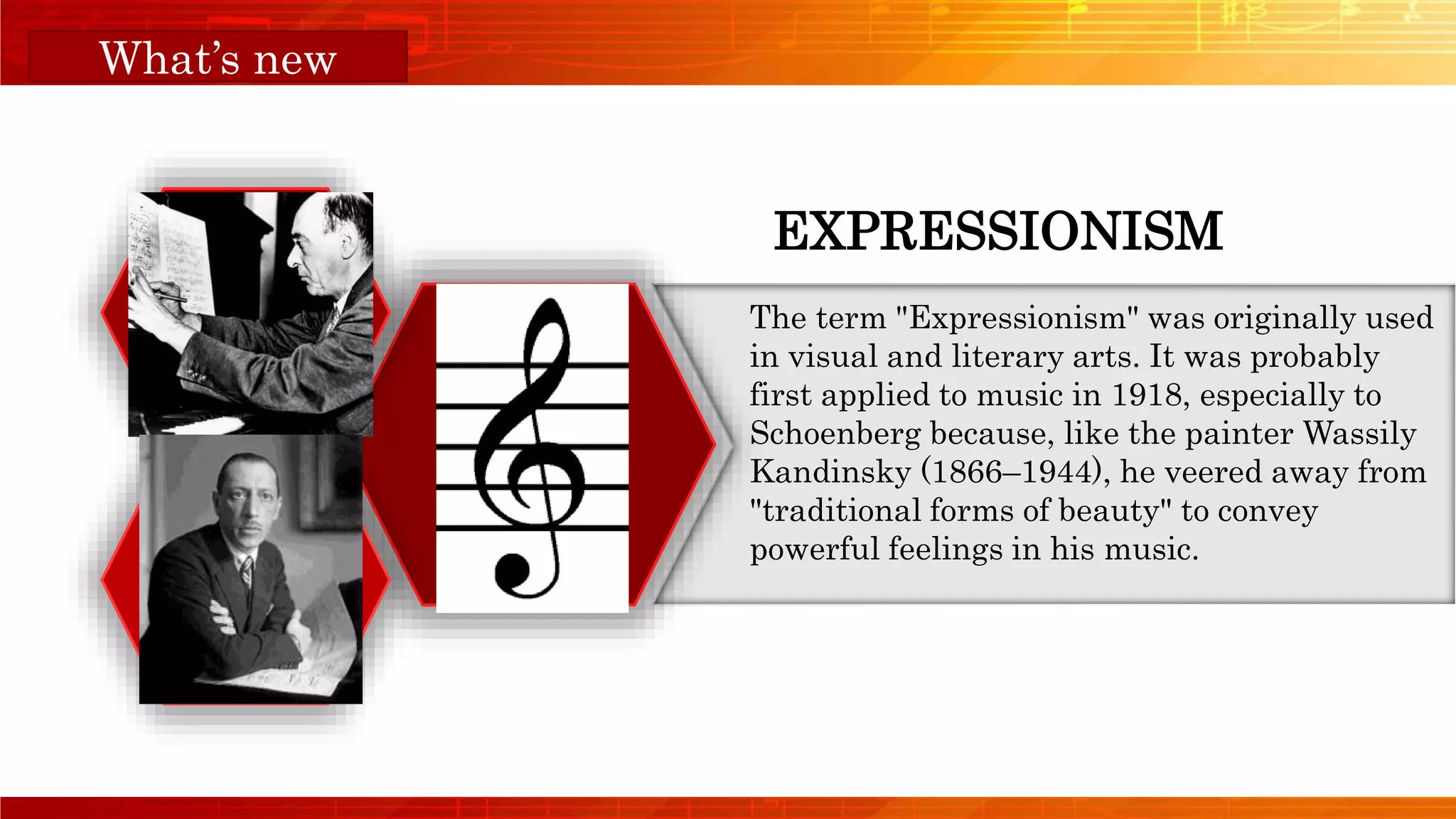
The term "Expressionism" was originally used
in visual and literary arts. It was probably
first applied to music in 1918, especially to
Schoenberg because, like the painter Wassily
Kandinsky (1866–1944), he veered away from
"traditional forms of beauty" to convey
powerful feelings in his music.
What’s new
Orange Musical
What’s New
Features of expressionism music are as follows:
• a high degree of dissonance (dissonance is the quality
of sounds that seems unstable)
• extreme contrasts of dynamics (from pianissimo to
fortissimo, very soft to very loud)
• constant changing of textures
• "distorted" melodies and harmonies
• angular melodies with wide leaps
Orange Musical
ARNOLD SCHOENBERG (1874–1951)
What’s new
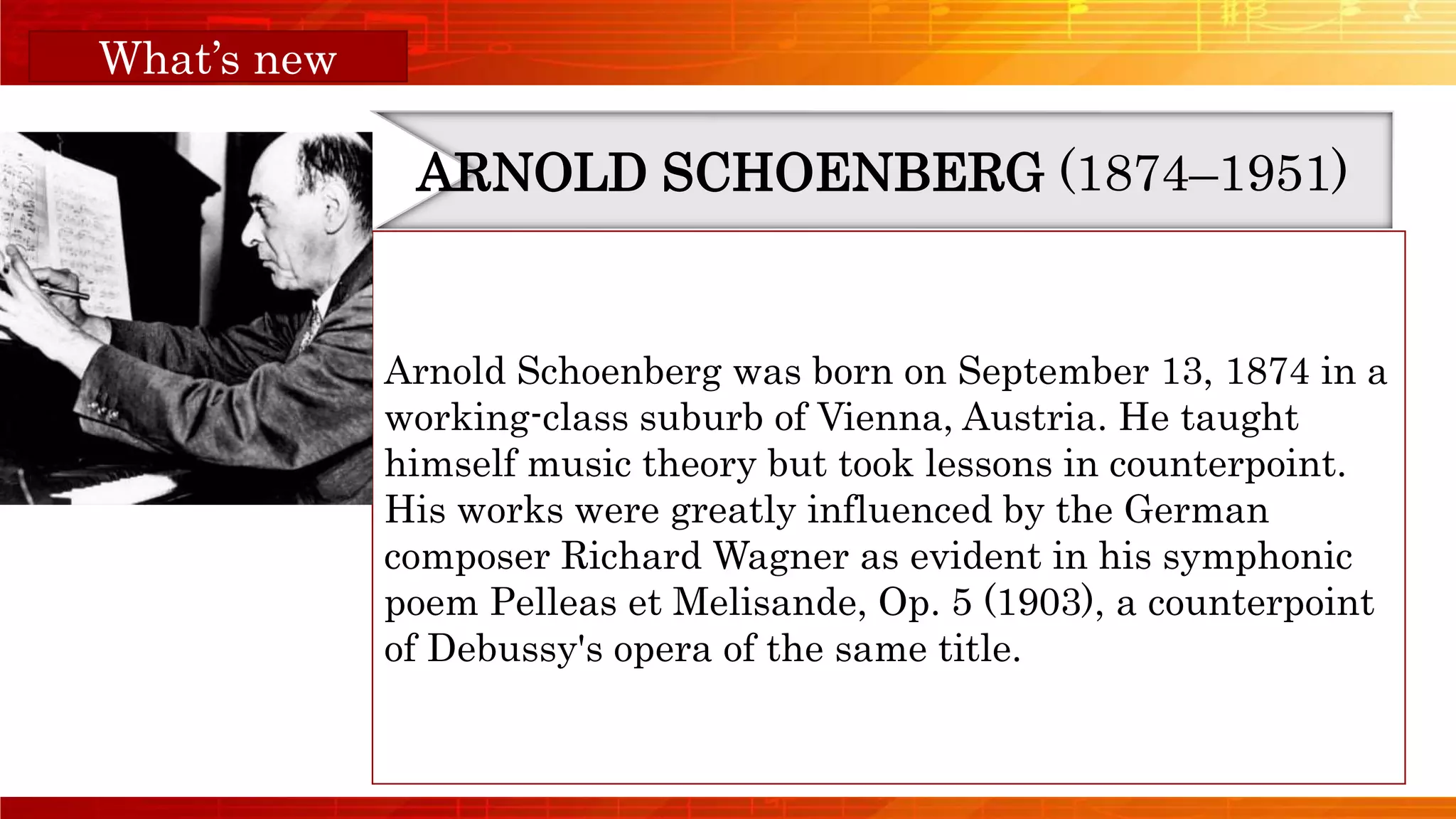
Arnold Schoenberg was born on September 13, 1874 in a
working-class suburb of Vienna, Austria. He taught
himself music theory but took lessons in counterpoint.
His works were greatly influenced by the German
composer Richard Wagner as evident in his symphonic
poem Pelleas et Melisande, Op. 5 (1903), a counterpoint
of Debussy's opera of the same title.
Orange Musical
ARNOLD SCHOENBERG (1874–1951)
What’s new
His works include the following:
• Verklarte Nacht
• Three Pieces for Piano, op. 11
• Pierrot Lunaire
• Violin Concerto
• Skandalkonzert, a concert of the Wiener
Konzertverein.
Orange Musical
IGOR STRAVINSKY (1882–1971)
What’s new
Stravinsky was born in Lomonosov, Russia on June 17,
1882. In his early music, he reflected the influence of his
teacher, the Russian composer Nikolai Rimsky-
Korsakov. But in his first notable composition, "The
Firebird Suite (1910)," his skillful handling of material
and rhythmic inventiveness went beyond anything
written by his Russian predecessors. His musical style
added a new flavor to his nationalistic musical style.
The Rite of Spring (1913) was another superb work
showcasing his new technique.
Orange Musical
IGOR STRAVINSKY (1882–1971)
What’s new
Acclaimed works by Stravinsky includes:
• Ballet Petrouchka (1911)
• The Nightingale (1914)
• Three Tales for Children (1917)
• Pulcinella (1920)
• Duo Concertant (1932)
• The Rake's Progress (1951)
Orange Musical
IGOR STRAVINSKY (1882–1971)
What’s new
The technique is a means of ensuring that all 12 notes of
the chromatic scale are sounded as often as one another
in a piece of music while preventing the emphasis of any
one note through the use of tone rows, orderings of the
12 pitch classes.
Orange Musical
What I Have Learned
One of the most significant compositions of Schoenberg is
Three Piano Pieces, Op. 11. This musical piece was the
first composition ever to dispense completely with "tonal"
(counterpart of atonal) means of organization. Play from
the accompanying CD Track 3 (Three Piano Pieces).
Alternatively, you can access it at
https://www.youtube.com/watch?v=xrjg3jzP2uI.
Orange Musical
What I Have Learned
While listening, answer the following guide questions on
a separate sheet of paper:
• What genre of a movie can this music be used?
• What particular moment in your life does this music
remind you of?
Orange Musical
What I Can Do
From the CD, play track 4 (Petrouchka by Stravinsky) or
access it at
https://www.youtube.com/watch?v=OJRfImhtjq4.
After listening to the track, create an artwork inspired
by Petrouchka using any contemporary medium of arts.
Use any paper available for your artwork.
20th Century
Musical Styles
3
Orange Musical
What’s New
Technology has been a game-changer in music. It has
produced electronic music devices such as cassette tape
recorders, compact discs and their variants, the video
compact disc (VCD), and the digital video disc (DVD),
MP3, MP4, digital music players, smartphones, karaoke
players, and synthesizers. These devices are used for
creating and recording music to add to or to replace
acoustical sounds.
Orange Musical
ELECTRONIC MUSIC
The ability of electronic machines such as synthesizers,
amplifiers, tape recorders, and loudspeakers to produce
different sounds was popularized by 20th-century
notable composers.
Orange Musical
Musique concrete
Musique concrete, or concrete music is a music that uses
the tape recorder. Any sound that the composer will hear
in his surroundings will be recorded. These sounds are
arranged by the composer in different ways, like playing
the tape recorder in its fastest mode or reverse.
In musique concrete, the composer can experiment with
different sounds that cannot be produced by regular
musical instruments such as the piano or the violin.
Orange Musical
ELECTRONIC MUSIC
Electronic music is music that
employs electronic musical instruments,
digital instruments, or circuitry-based music
technology in its creation. It includes both
music made using electronic and
electromechanical means (electroacoustic
music).
What’s new
Orange Musical
EDGARD VARÈSE (1883–1965)
What’s new
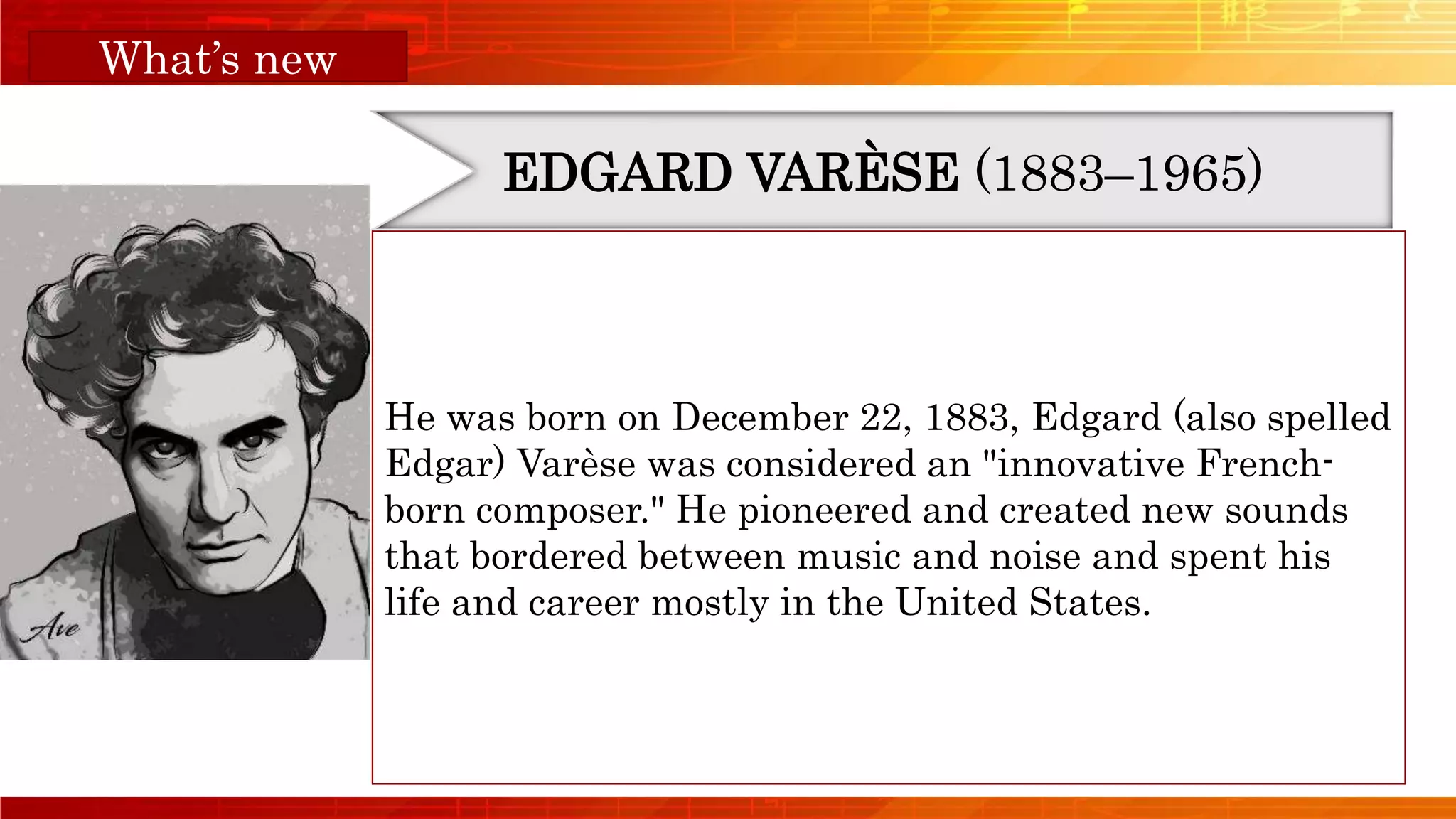
He was born on December 22, 1883, Edgard (also spelled
Edgar) Varèse was considered an "innovative French-
born composer." He pioneered and created new sounds
that bordered between music and noise and spent his
life and career mostly in the United States.
Orange Musical
EDGARD VARÈSE (1883–1965)
What’s new
His musical compositions are characterized by:
• an emphasis on timbre and rhythm; and
• "organized sound" (certain timbres and rhythms can
be grouped together in order to capture a whole new
definition
of sound).
Orange Musical
EDGARD VARÈSE (1883–1965)
What’s new
Varèse's is considered as the "Father of Electronic
Music," and use of new instruments and electronic
resources. He was also dubbed as the "Stratospheric
Colossus of Sound."
Orange Musical
KARLHEINZ STOCKHAUSEN (1928– 2007)
What’s new
Karlheinz Stockhausen is a central figure in the realm
of electronic music. He was born in Cologne, Germany.
He had the opportunity to work with Messiaen,
Schoenberg, and Webern.
Orange Musical
KARLHEINZ STOCKHAUSEN (1928– 2007)
What’s new
Some of his works include:
• Gruppen (1957)
• Kontakte (1960)
• Hymnen (1965) and
• Licht (Light)
Orange Musical
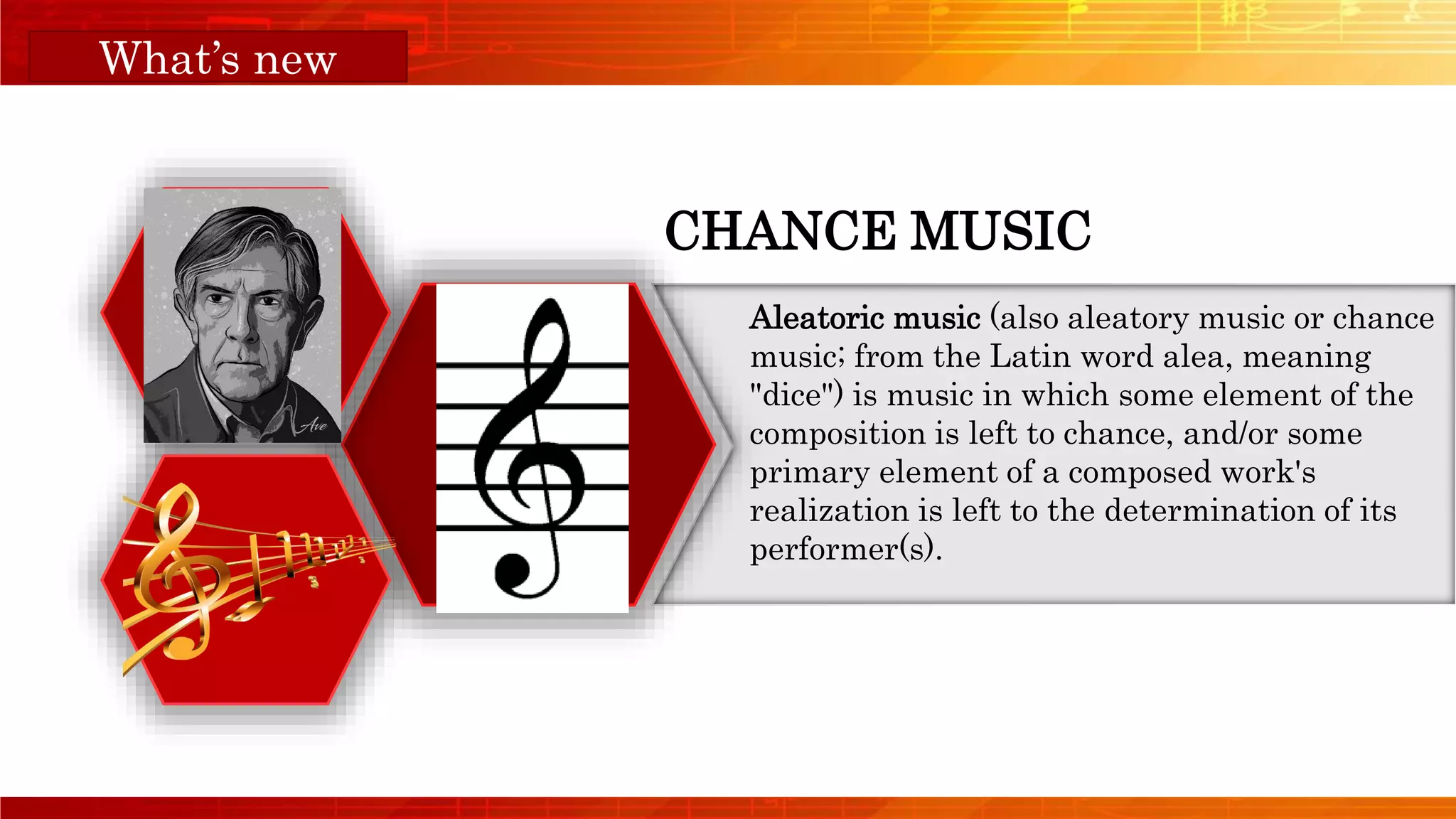
CHANCE MUSIC
Aleatoric music (also aleatory music or chance
music; from the Latin word alea, meaning
"dice") is music in which some element of the
composition is left to chance, and/or some
primary element of a composed work's
realization is left to the determination of its
performer(s).
What’s new
Orange Musical
JOHN CAGE (1912–1992)
What’s new
John Cage was known as one of the 20th-century
composers with the broadest array of sounds in his
works. Cage was born in Los Angeles, California, USA,
on September 5, 1912 and became one of the most
original composers in the history of western music.
Orange Musical
JOHN CAGE (1912–1992)
What’s new
He challenged the very idea of music by manipulating
musical instruments to attain new sounds and became
the "chance music."
Orange Musical
JOHN CAGE (1912–1992)
What’s new
Cage became notable for his work The Four Minutes
and 33 Seconds (4'33"), a chance musical work that
instructed the pianist to merely open the piano lid and
remain silent for the length of time indicated by the
title.
Orange Musical
Whar It Is
The new musical styles created by 20th-century classical
composers were truly notable, experimental, and
innovative. They played with the elements of rhythm,
melody, harmony, tempo, and timbre in adventurous
ways that were never did before. Musicians even used
electronic devices such as synthesizers, tape recorders,
amplifiers, and the like to introduce and enhance sounds
created by traditional instruments.
Orange Musical
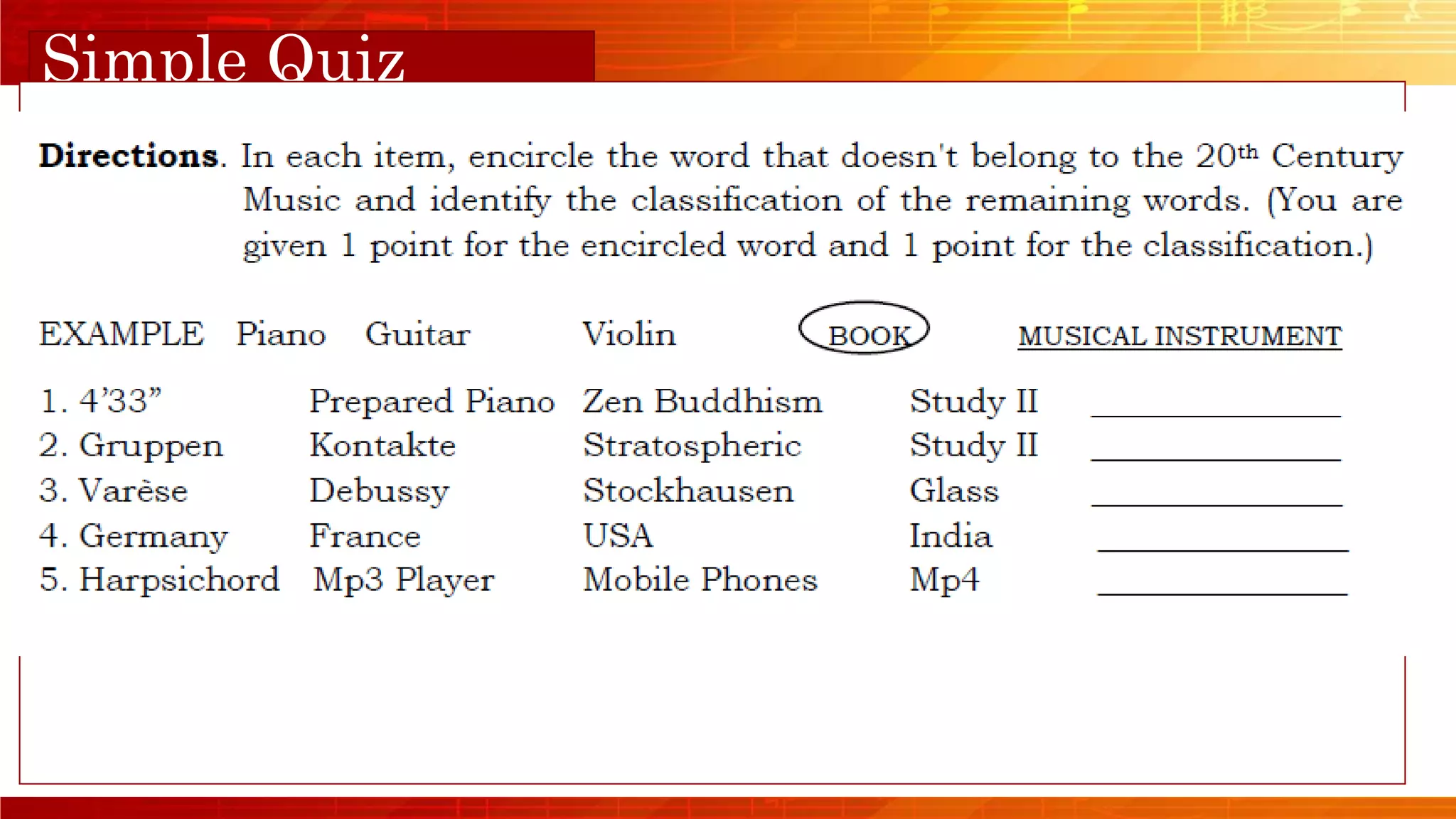
Simple Quiz
Orange Musical
Simple Quiz
Another popular electronic music composition is
Studie II by Karlheinz Stockhausen.
Play from the accompanying CD Track 6 (Studie II) or
access
https://www.youtube.com/watch?v=_qi4hgT_d0o
Orange Musical
What I Have Learned
While listening, answer the following guide questions on
a separate sheet of paper:
• Where do you imagine yourself to be in while listening
to music? Why?
• What makes this track distinct from the other musical
excerpts which you have heard so far?
Orange Musical
What I Have Learned
The popularity of televisions started during the 20th
Century. TV shows became a huge part of the lives of the
people, and music played a vital role in its flourishment.
Water Walk by John Cage was one of the compositions
used in TV shows. Watch a video clip #1 (Water Walk) at
https://youtu.be/gXOIkT1-QWY
Orange Musical
What I Have Learned
After watching, answer the following guide questions on
a separate sheet of paper:
• What characteristics of Chance music can be deduced
from the video clip?
• Aside from the objects used in the video, what other
objects can you use to create sounds which are similar to
the piece?
Orange Musical
Performance Task
ACTIVITY 1 - Perform an experiment creating 20th
Century Music System. Choose one from the activities
below.
a. Chance Music – Ask three family members to join you
in this activity and do the following: a. Prepare a dice or
draw lots with six numbers.
b. Roll the dice four times or draw a number 4 times and
record the numbers that will appear. Out of these
numbers, prepare a rhythmic pattern in each number.
Orange Musical
Performance Task
c. From the rhythmic pattern, randomly choose any
materials available in your house like plastic bottles,
books, paper, pen, etc.
d. Assign a number to every material. Organize all the
materials with the corresponding rhythmic pattern.
e. Record your performance on your cellphone.
Orange Musical
Performance Task
Orange Musical
Performance Task
Holistic Rubric for the Essay (5 points)
5 points– The main idea is well-focused and properly
developed by relevant, accurate, and substantial
evidence.
4 points – The main idea is clearly presented with
relevant and accurate supporting evidences.
3 points – The main idea is understandable but with
minimal supporting evidence
2 points – The main idea is present but not well
expressed with slightly inconsistent evidence
1 point – There is no clear main idea which the essay
revolves on, and the supporting ideas are inconsistent.
THANK YOU!

Music 10 Q1 Lesson 1-3 ppt

  • 1.
    MUSIC 10 Mr. TedDancel BURGOS AGRO-INDUSTRIAL SCHOOL
  • 2.
    01 Impressionism 03 20thCentury Musical Styles 02 Expressionism The module is divided into three lessons, namely:
  • 3.
  • 4.
    Orange Musical IMPRESSIONISM As theworld entered the 20th century, a new era in music was introduced, and impressionism was one of the earliest musical forms that paved the way to this modern era. Impressionism is a French movement in the late 19th and early 20th centuries. The sentimental melodies and dramatic emotionalism of the preceding Romantic Period, whose themes and melody are easy to recognize and enjoy, were being replaced in favor of moods and impressions. What’s new
  • 5.
    Orange Musical CLAUDE DEBUSSY(1862–1918) What’s new Claude Debussy was one of the most influential and leading composers of the 20th century. He was the principal exponent of the impressionist movement and the inspiration for other impressionist composers. He reformed the course of musical development by eradicating traditional rules and conventions into a new language of possibilities in harmony, rhythm, form, texture, and color.
  • 6.
    Orange Musical CLAUDE DEBUSSY(1862–1918) What’s new Debussy's mature creative period was exemplified by the following works: • String Quartet • La Mer (1905)-a highly imaginative and atmospheric musical work for orchestra about the sea • Première Arabesque • Claire de Lune (Moonlight)-The third and most famous movement of Suite bergamasque.
  • 7.
    Orange Musical MAURICE RAVEL(1875–1937) What’s new Joseph Maurice Ravel was born in Ciboure, France, to a Basque mother and a Swiss father. At age 14, he entered the Paris Conservatory, where he was musically nurtured by a prominent French composer, Gabriel Faure. The compositional style of Ravel is mainly characterized by its distinctively innovative but not atonal style (music that is written in a way that is not based on any particular key) of harmonic treatment.
  • 8.
    Orange Musical MAURICE RAVEL(1875–1937) What’s new Ravel's works include the following: • Pavane for a Dead Princess (1899) • String Quartet (1903) • Sonatine for Piano (c.1904) • Rhapsodie Espagnole • Bolero
  • 9.
    Orange Musical Features ofImpressionism music are as follows: What it is • The use of "color," or in musical terms, timbre, which can be achieved through orchestration, harmonic usage, texture, etc. (Timbre is known as the tone color or tone quality) • New combinations of extended chords, harmonies, whole tone, chromatic scales, and pentatonic scales emerged. • Impressionism was an attempt not to depict reality, but merely to suggest it.
  • 10.
    Orange Musical What's More Themost remarkable composition of Debussy is Claire De Lune. Have you watched the Hollywood movie hit Twilight Saga? Try to recall its sentimental soundtracks. One of them is Claire De Lune! Would you like to listen to it once again? Play from the accompanying CD Track 1 (Claire de Lune), or you can access it at https://www.youtube.com/watch?v=CvFH_6DNRCY.
  • 11.
    Orange Musical What's More Ravel'sdefining composition is "Bolero." Bolero is a one- movement orchestral piece which was premiered in 1928. Play from the accompanying CD Track 2 (Bolero) or you can access it at https://www.youtube.com/watch?v=b5V31O8ll14
  • 12.
    Orange Musical What's More Whilelistening, answer the following guide questions on a separate sheet of paper: • What specific dance form can be performed with Bolero as music? • What feelings or emotions does the music evoke?
  • 13.
  • 14.
    Orange Musical Writing Activity Whichamong the compositions of Impressionism inspired you most? Why?
  • 15.
  • 16.
    Orange Musical EXPRESSIONISM The term"Expressionism" was originally used in visual and literary arts. It was probably first applied to music in 1918, especially to Schoenberg because, like the painter Wassily Kandinsky (1866–1944), he veered away from "traditional forms of beauty" to convey powerful feelings in his music. What’s new
  • 17.
    Orange Musical What’s New Featuresof expressionism music are as follows: • a high degree of dissonance (dissonance is the quality of sounds that seems unstable) • extreme contrasts of dynamics (from pianissimo to fortissimo, very soft to very loud) • constant changing of textures • "distorted" melodies and harmonies • angular melodies with wide leaps
  • 18.
    Orange Musical ARNOLD SCHOENBERG(1874–1951) What’s new Arnold Schoenberg was born on September 13, 1874 in a working-class suburb of Vienna, Austria. He taught himself music theory but took lessons in counterpoint. His works were greatly influenced by the German composer Richard Wagner as evident in his symphonic poem Pelleas et Melisande, Op. 5 (1903), a counterpoint of Debussy's opera of the same title.
  • 19.
    Orange Musical ARNOLD SCHOENBERG(1874–1951) What’s new His works include the following: • Verklarte Nacht • Three Pieces for Piano, op. 11 • Pierrot Lunaire • Violin Concerto • Skandalkonzert, a concert of the Wiener Konzertverein.
  • 20.
    Orange Musical IGOR STRAVINSKY(1882–1971) What’s new Stravinsky was born in Lomonosov, Russia on June 17, 1882. In his early music, he reflected the influence of his teacher, the Russian composer Nikolai Rimsky- Korsakov. But in his first notable composition, "The Firebird Suite (1910)," his skillful handling of material and rhythmic inventiveness went beyond anything written by his Russian predecessors. His musical style added a new flavor to his nationalistic musical style. The Rite of Spring (1913) was another superb work showcasing his new technique.
  • 21.
    Orange Musical IGOR STRAVINSKY(1882–1971) What’s new Acclaimed works by Stravinsky includes: • Ballet Petrouchka (1911) • The Nightingale (1914) • Three Tales for Children (1917) • Pulcinella (1920) • Duo Concertant (1932) • The Rake's Progress (1951)
  • 22.
    Orange Musical IGOR STRAVINSKY(1882–1971) What’s new The technique is a means of ensuring that all 12 notes of the chromatic scale are sounded as often as one another in a piece of music while preventing the emphasis of any one note through the use of tone rows, orderings of the 12 pitch classes.
  • 23.
    Orange Musical What IHave Learned One of the most significant compositions of Schoenberg is Three Piano Pieces, Op. 11. This musical piece was the first composition ever to dispense completely with "tonal" (counterpart of atonal) means of organization. Play from the accompanying CD Track 3 (Three Piano Pieces). Alternatively, you can access it at https://www.youtube.com/watch?v=xrjg3jzP2uI.
  • 24.
    Orange Musical What IHave Learned While listening, answer the following guide questions on a separate sheet of paper: • What genre of a movie can this music be used? • What particular moment in your life does this music remind you of?
  • 25.
    Orange Musical What ICan Do From the CD, play track 4 (Petrouchka by Stravinsky) or access it at https://www.youtube.com/watch?v=OJRfImhtjq4. After listening to the track, create an artwork inspired by Petrouchka using any contemporary medium of arts. Use any paper available for your artwork.
  • 26.
  • 27.
    Orange Musical What’s New Technologyhas been a game-changer in music. It has produced electronic music devices such as cassette tape recorders, compact discs and their variants, the video compact disc (VCD), and the digital video disc (DVD), MP3, MP4, digital music players, smartphones, karaoke players, and synthesizers. These devices are used for creating and recording music to add to or to replace acoustical sounds.
  • 28.
    Orange Musical ELECTRONIC MUSIC Theability of electronic machines such as synthesizers, amplifiers, tape recorders, and loudspeakers to produce different sounds was popularized by 20th-century notable composers.
  • 29.
    Orange Musical Musique concrete Musiqueconcrete, or concrete music is a music that uses the tape recorder. Any sound that the composer will hear in his surroundings will be recorded. These sounds are arranged by the composer in different ways, like playing the tape recorder in its fastest mode or reverse. In musique concrete, the composer can experiment with different sounds that cannot be produced by regular musical instruments such as the piano or the violin.
  • 30.
    Orange Musical ELECTRONIC MUSIC Electronicmusic is music that employs electronic musical instruments, digital instruments, or circuitry-based music technology in its creation. It includes both music made using electronic and electromechanical means (electroacoustic music). What’s new
  • 31.
    Orange Musical EDGARD VARÈSE(1883–1965) What’s new He was born on December 22, 1883, Edgard (also spelled Edgar) Varèse was considered an "innovative French- born composer." He pioneered and created new sounds that bordered between music and noise and spent his life and career mostly in the United States.
  • 32.
    Orange Musical EDGARD VARÈSE(1883–1965) What’s new His musical compositions are characterized by: • an emphasis on timbre and rhythm; and • "organized sound" (certain timbres and rhythms can be grouped together in order to capture a whole new definition of sound).
  • 33.
    Orange Musical EDGARD VARÈSE(1883–1965) What’s new Varèse's is considered as the "Father of Electronic Music," and use of new instruments and electronic resources. He was also dubbed as the "Stratospheric Colossus of Sound."
  • 34.
    Orange Musical KARLHEINZ STOCKHAUSEN(1928– 2007) What’s new Karlheinz Stockhausen is a central figure in the realm of electronic music. He was born in Cologne, Germany. He had the opportunity to work with Messiaen, Schoenberg, and Webern.
  • 35.
    Orange Musical KARLHEINZ STOCKHAUSEN(1928– 2007) What’s new Some of his works include: • Gruppen (1957) • Kontakte (1960) • Hymnen (1965) and • Licht (Light)
  • 36.
    Orange Musical CHANCE MUSIC Aleatoricmusic (also aleatory music or chance music; from the Latin word alea, meaning "dice") is music in which some element of the composition is left to chance, and/or some primary element of a composed work's realization is left to the determination of its performer(s). What’s new
  • 37.
    Orange Musical JOHN CAGE(1912–1992) What’s new John Cage was known as one of the 20th-century composers with the broadest array of sounds in his works. Cage was born in Los Angeles, California, USA, on September 5, 1912 and became one of the most original composers in the history of western music.
  • 38.
    Orange Musical JOHN CAGE(1912–1992) What’s new He challenged the very idea of music by manipulating musical instruments to attain new sounds and became the "chance music."
  • 39.
    Orange Musical JOHN CAGE(1912–1992) What’s new Cage became notable for his work The Four Minutes and 33 Seconds (4'33"), a chance musical work that instructed the pianist to merely open the piano lid and remain silent for the length of time indicated by the title.
  • 40.
    Orange Musical Whar ItIs The new musical styles created by 20th-century classical composers were truly notable, experimental, and innovative. They played with the elements of rhythm, melody, harmony, tempo, and timbre in adventurous ways that were never did before. Musicians even used electronic devices such as synthesizers, tape recorders, amplifiers, and the like to introduce and enhance sounds created by traditional instruments.
  • 41.
  • 42.
    Orange Musical Simple Quiz Anotherpopular electronic music composition is Studie II by Karlheinz Stockhausen. Play from the accompanying CD Track 6 (Studie II) or access https://www.youtube.com/watch?v=_qi4hgT_d0o
  • 43.
    Orange Musical What IHave Learned While listening, answer the following guide questions on a separate sheet of paper: • Where do you imagine yourself to be in while listening to music? Why? • What makes this track distinct from the other musical excerpts which you have heard so far?
  • 44.
    Orange Musical What IHave Learned The popularity of televisions started during the 20th Century. TV shows became a huge part of the lives of the people, and music played a vital role in its flourishment. Water Walk by John Cage was one of the compositions used in TV shows. Watch a video clip #1 (Water Walk) at https://youtu.be/gXOIkT1-QWY
  • 45.
    Orange Musical What IHave Learned After watching, answer the following guide questions on a separate sheet of paper: • What characteristics of Chance music can be deduced from the video clip? • Aside from the objects used in the video, what other objects can you use to create sounds which are similar to the piece?
  • 46.
    Orange Musical Performance Task ACTIVITY1 - Perform an experiment creating 20th Century Music System. Choose one from the activities below. a. Chance Music – Ask three family members to join you in this activity and do the following: a. Prepare a dice or draw lots with six numbers. b. Roll the dice four times or draw a number 4 times and record the numbers that will appear. Out of these numbers, prepare a rhythmic pattern in each number.
  • 47.
    Orange Musical Performance Task c.From the rhythmic pattern, randomly choose any materials available in your house like plastic bottles, books, paper, pen, etc. d. Assign a number to every material. Organize all the materials with the corresponding rhythmic pattern. e. Record your performance on your cellphone.
  • 48.
  • 49.
    Orange Musical Performance Task HolisticRubric for the Essay (5 points) 5 points– The main idea is well-focused and properly developed by relevant, accurate, and substantial evidence. 4 points – The main idea is clearly presented with relevant and accurate supporting evidences. 3 points – The main idea is understandable but with minimal supporting evidence 2 points – The main idea is present but not well expressed with slightly inconsistent evidence 1 point – There is no clear main idea which the essay revolves on, and the supporting ideas are inconsistent.
  • 50.