HPC
1
Deep Learning
2
• Libraries
Tenser-flow
3
• Why tenser-flow
• What is tensor flow
• Tensors
• Architecture
• Pros and cons.
• Applications
Pytorch
4
• Uses
• How does it work
• Features , adv disadv
pytorch vs tensor flow
5
CONTENTS
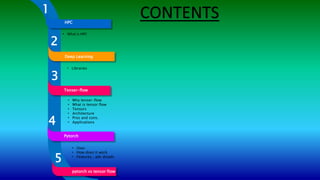
• What is HPC
• High-performance computing (HPC) is the ability to process data
and perform complex calculations at high speeds.
• To put it into perspective, a laptop or desktop with a 3 GHz
processor can perform around 3 billion calculations per second.
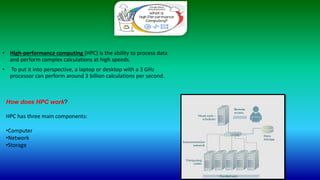
How does HPC work?
HPC has three main components:
•Computer
•Network
•Storage
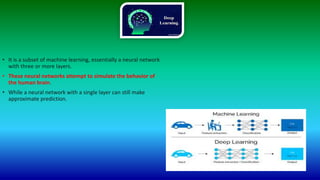
• It is a subset of machine learning, essentially a neural network
with three or more layers.
• These neural networks attempt to simulate the behavior of
the human brain.
• While a neural network with a single layer can still make
approximate prediction.
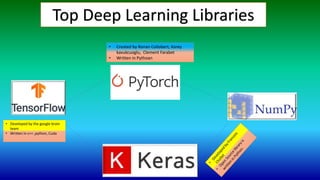
Top Deep Learning Libraries
• Developed by the google brain
team
• Written in c++ ,python, Cuda
• Created by Ronan Collobert, Korey
kavukcuoglu, Clement Farabet
• Written in Pythoan
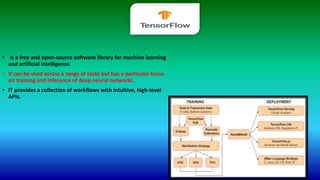
• Is a free and open-source software library for machine learning
and artificial intelligence.
• It can be used across a range of tasks but has a particular focus
on training and inference of deep neural networks.
• IT provides a collection of workflows with intuitive, high-level
APIs.
Why Tensor Flow?
Has a Faster compilation time
than other Deep Learning
libraries like Keras and Torch
Tensor Flow supports both
CPUs and GPUs computing
devices
• Open source library developed by
google
• Developed originally to run large numerical
computations
• Accept data in the form of multidimensional arrays of higher dimensions called
Tensors
• Works on the basis of Data Flow graphs that have nodes and
edges
What Is Tensor Flow?
What are Tensors?
TENSORS
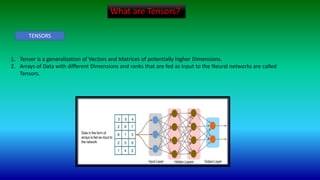
1. Tenser is a generalization of Vectors and Matrices of potentially higher Dimensions.
2. Arrays of Data with different Dimensions and ranks that are fed as input to the Neural networks are called
Tensors.
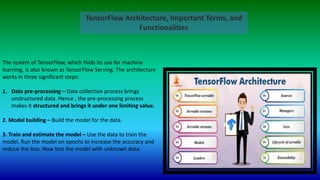
TensorFlow Architecture, Important Terms, and
Functionalities
The system of TensorFlow, which finds its use for machine
learning, is also known as TensorFlow Serving. The architecture
works in three significant steps:
1. Data pre-processing – Data collection process brings
unstructured data. Hence , the pre-processing process
makes it structured and brings it under one limiting value.
2. Model building – Build the model for the data.
3. Train and estimate the model – Use the data to train the
model. Run the model on epochs to increase the accuracy and
reduce the loss. Now test the model with unknown data.
Advantages and Disadvantages of TensorFlow
ADVANTAGES
1. Open-source platform
It is an open-source platform that makes it available to all the users around and ready for the development of any
system on it.
2. Data visualization
TensorFlow provides a better way of visualizing data with its graphical approach. It also allows easy debugging of
nodes with the help of the Tensor Board. This reduces the effort of visiting the whole code and effectively resolves
the neural network.
DISADVANTAGES
1. Frequent updates
2. Inconsistent
Best Uses of TensorFlow – TensorFlow Applications
• Image Recognition
• Voice Recognition
• Video Detection
• Text-based applications
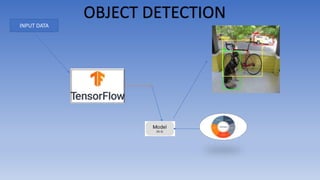
INPUT DATA
OBJECT DETECTION
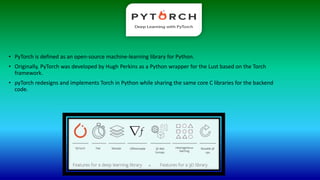
• PyTorch is defined as an open-source machine-learning library for Python.
• Originally, PyTorch was developed by Hugh Perkins as a Python wrapper for the Lust based on the Torch
framework.
• pyTorch redesigns and implements Torch in Python while sharing the same core C libraries for the backend
code.
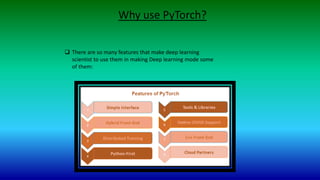
Why use PyTorch?
 There are so many features that make deep learning
scientist to use them in making Deep learning mode some
of them:
How does PyTorch work?
• PyTorch is pythonic in nature, which means it follows the coding style that uses Python's unique
features to write readable code.
• Python is also popular for its use of dynamic computation graphs.
• It enables developers, scientists and neural network debuggers to run and test a portion of code in
real time instead of waiting for the entire program to be written.
key features:
• Tensor computation
• Torch-Script
• Dynamic graph computation
• Automatic differentiation
• Variable
NumPy For PyTorch
Is a library for the Python programming language, adding support for large, multi-
dimensional arrays and matrices.
• Along with a large collection of high-level mathematical functions to operate on these
arrays.
• Library providing tools for integrating C/C++ and FORTRAN code.
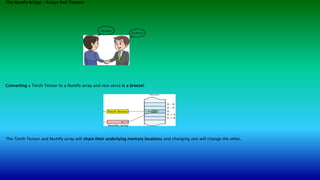
The NumPy Bridge – Arrays And Tensors
Converting a Torch Tensor to a NumPy array and vice versa is a breeze!
The Torch Tensor and NumPy array will share their underlying memory locations and changing one will change the other.
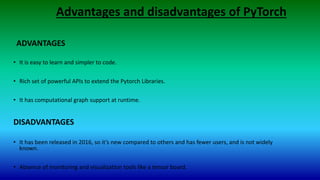
Advantages and disadvantages of PyTorch
• It is easy to learn and simpler to code.
• Rich set of powerful APIs to extend the Pytorch Libraries.
• It has computational graph support at runtime.
DISADVANTAGES
• It has been released in 2016, so it’s new compared to others and has fewer users, and is not widely
known.
• Absence of monitoring and visualization tools like a tensor board.
ADVANTAGES
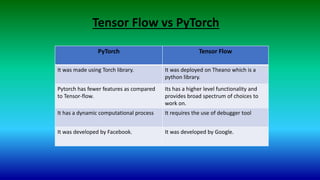
Tensor Flow vs PyTorch
PyTorch Tensor Flow
It was made using Torch library. It was deployed on Theano which is a
python library.
Pytorch has fewer features as compared
to Tensor-flow.
Its has a higher level functionality and
provides broad spectrum of choices to
work on.
It has a dynamic computational process It requires the use of debugger tool
It was developed by Facebook. It was developed by Google.
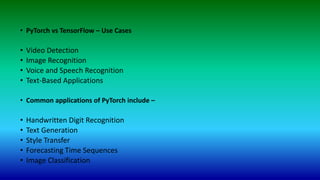
• PyTorch vs TensorFlow – Use Cases
• Video Detection
• Image Recognition
• Voice and Speech Recognition
• Text-Based Applications
• Common applications of PyTorch include –
• Handwritten Digit Recognition
• Text Generation
• Style Transfer
• Forecasting Time Sequences
• Image Classification
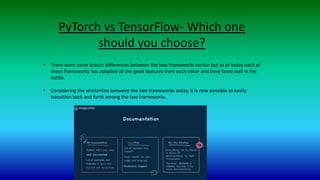
PyTorch vs TensorFlow- Which one
should you choose?
• There were some drastic differences between the two frameworks earlier but as of today each of
these frameworks has adopted all the good features from each other and have fared well in the
battle.
• Considering the similarities between the two frameworks today, it is now possible to easily
transition back and forth among the two frameworks.
hpcpp.pptx

hpcpp.pptx

  • 2.
    HPC 1 Deep Learning 2 • Libraries Tenser-flow 3 •Why tenser-flow • What is tensor flow • Tensors • Architecture • Pros and cons. • Applications Pytorch 4 • Uses • How does it work • Features , adv disadv pytorch vs tensor flow 5 CONTENTS • What is HPC
  • 3.
    • High-performance computing(HPC) is the ability to process data and perform complex calculations at high speeds. • To put it into perspective, a laptop or desktop with a 3 GHz processor can perform around 3 billion calculations per second. How does HPC work? HPC has three main components: •Computer •Network •Storage
  • 4.
    • It isa subset of machine learning, essentially a neural network with three or more layers. • These neural networks attempt to simulate the behavior of the human brain. • While a neural network with a single layer can still make approximate prediction.
  • 5.
    Top Deep LearningLibraries • Developed by the google brain team • Written in c++ ,python, Cuda • Created by Ronan Collobert, Korey kavukcuoglu, Clement Farabet • Written in Pythoan
  • 6.
    • Is afree and open-source software library for machine learning and artificial intelligence. • It can be used across a range of tasks but has a particular focus on training and inference of deep neural networks. • IT provides a collection of workflows with intuitive, high-level APIs.
  • 7.
    Why Tensor Flow? Hasa Faster compilation time than other Deep Learning libraries like Keras and Torch Tensor Flow supports both CPUs and GPUs computing devices
  • 8.
    • Open sourcelibrary developed by google • Developed originally to run large numerical computations • Accept data in the form of multidimensional arrays of higher dimensions called Tensors • Works on the basis of Data Flow graphs that have nodes and edges What Is Tensor Flow?
  • 9.
    What are Tensors? TENSORS 1.Tenser is a generalization of Vectors and Matrices of potentially higher Dimensions. 2. Arrays of Data with different Dimensions and ranks that are fed as input to the Neural networks are called Tensors.
  • 10.
    TensorFlow Architecture, ImportantTerms, and Functionalities The system of TensorFlow, which finds its use for machine learning, is also known as TensorFlow Serving. The architecture works in three significant steps: 1. Data pre-processing – Data collection process brings unstructured data. Hence , the pre-processing process makes it structured and brings it under one limiting value. 2. Model building – Build the model for the data. 3. Train and estimate the model – Use the data to train the model. Run the model on epochs to increase the accuracy and reduce the loss. Now test the model with unknown data.
  • 12.
    Advantages and Disadvantagesof TensorFlow ADVANTAGES 1. Open-source platform It is an open-source platform that makes it available to all the users around and ready for the development of any system on it. 2. Data visualization TensorFlow provides a better way of visualizing data with its graphical approach. It also allows easy debugging of nodes with the help of the Tensor Board. This reduces the effort of visiting the whole code and effectively resolves the neural network. DISADVANTAGES 1. Frequent updates 2. Inconsistent
  • 13.
    Best Uses ofTensorFlow – TensorFlow Applications • Image Recognition • Voice Recognition • Video Detection • Text-based applications
  • 14.
  • 15.
    • PyTorch isdefined as an open-source machine-learning library for Python. • Originally, PyTorch was developed by Hugh Perkins as a Python wrapper for the Lust based on the Torch framework. • pyTorch redesigns and implements Torch in Python while sharing the same core C libraries for the backend code.
  • 16.
    Why use PyTorch? There are so many features that make deep learning scientist to use them in making Deep learning mode some of them:
  • 17.
    How does PyTorchwork? • PyTorch is pythonic in nature, which means it follows the coding style that uses Python's unique features to write readable code. • Python is also popular for its use of dynamic computation graphs. • It enables developers, scientists and neural network debuggers to run and test a portion of code in real time instead of waiting for the entire program to be written.
  • 18.
    key features: • Tensorcomputation • Torch-Script • Dynamic graph computation • Automatic differentiation • Variable
  • 19.
    NumPy For PyTorch Isa library for the Python programming language, adding support for large, multi- dimensional arrays and matrices. • Along with a large collection of high-level mathematical functions to operate on these arrays. • Library providing tools for integrating C/C++ and FORTRAN code.
  • 20.
    The NumPy Bridge– Arrays And Tensors Converting a Torch Tensor to a NumPy array and vice versa is a breeze! The Torch Tensor and NumPy array will share their underlying memory locations and changing one will change the other.
  • 21.
    Advantages and disadvantagesof PyTorch • It is easy to learn and simpler to code. • Rich set of powerful APIs to extend the Pytorch Libraries. • It has computational graph support at runtime. DISADVANTAGES • It has been released in 2016, so it’s new compared to others and has fewer users, and is not widely known. • Absence of monitoring and visualization tools like a tensor board. ADVANTAGES
  • 22.
    Tensor Flow vsPyTorch PyTorch Tensor Flow It was made using Torch library. It was deployed on Theano which is a python library. Pytorch has fewer features as compared to Tensor-flow. Its has a higher level functionality and provides broad spectrum of choices to work on. It has a dynamic computational process It requires the use of debugger tool It was developed by Facebook. It was developed by Google.
  • 23.
    • PyTorch vsTensorFlow – Use Cases • Video Detection • Image Recognition • Voice and Speech Recognition • Text-Based Applications • Common applications of PyTorch include – • Handwritten Digit Recognition • Text Generation • Style Transfer • Forecasting Time Sequences • Image Classification
  • 24.
    PyTorch vs TensorFlow-Which one should you choose? • There were some drastic differences between the two frameworks earlier but as of today each of these frameworks has adopted all the good features from each other and have fared well in the battle. • Considering the similarities between the two frameworks today, it is now possible to easily transition back and forth among the two frameworks.