Python Data Types
❮ Previous
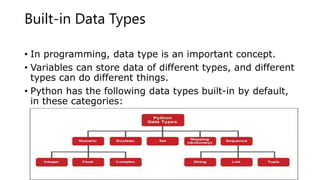
Built-in Data Types
• In programming, data type is an important concept.
• Variables can store data of different types, and different
types can do different things.
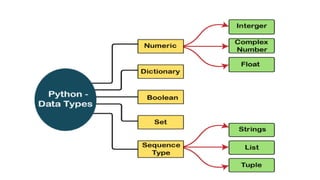
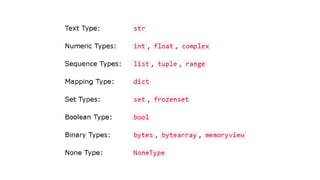
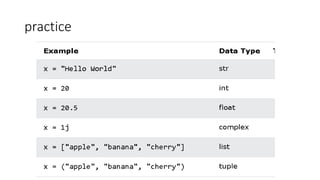
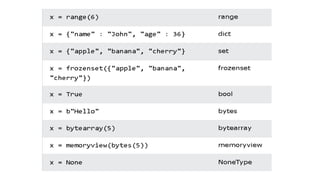
• Python has the following data types built-in by default,
in these categories:
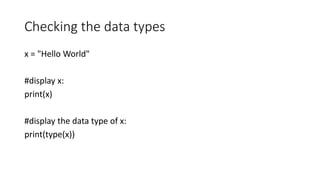
Checking the data types
x = "Hello World"
#display x:
print(x)
#display the data type of x:
print(type(x))
practice
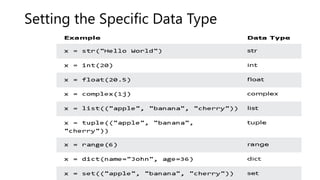
Setting the Specific Data Type
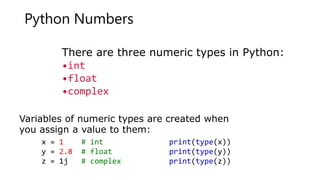
Python Numbers
There are three numeric types in Python:
•int
•float
•complex
Variables of numeric types are created when
you assign a value to them:
x = 1 # int
y = 2.8 # float
z = 1j # complex
print(type(x))
print(type(y))
print(type(z))
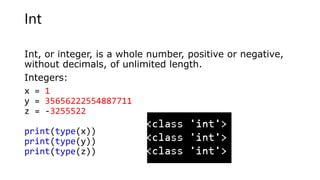
Int
Int, or integer, is a whole number, positive or negative,
without decimals, of unlimited length.
Integers:
x = 1
y = 35656222554887711
z = -3255522
print(type(x))
print(type(y))
print(type(z))
<class 'int'> <class 'int'> <class 'int'>
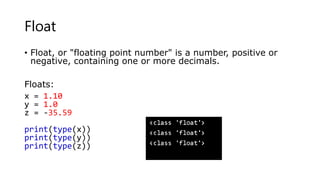
Float
• Float, or "floating point number" is a number, positive or
negative, containing one or more decimals.
Floats:
x = 1.10
y = 1.0
z = -35.59
print(type(x))
print(type(y))
print(type(z))
• Try it Yourself
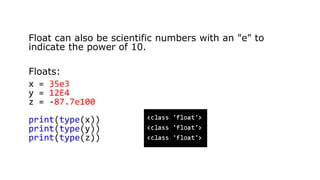
Float can also be scientific numbers with an "e" to
indicate the power of 10.
Floats:
x = 35e3
y = 12E4
z = -87.7e100
print(type(x))
print(type(y))
print(type(z))
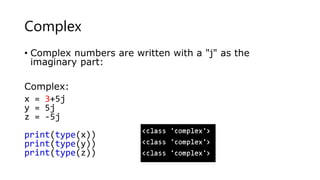
Complex
• Complex numbers are written with a "j" as the
imaginary part:
Complex:
x = 3+5j
y = 5j
z = -5j
print(type(x))
print(type(y))
print(type(z))
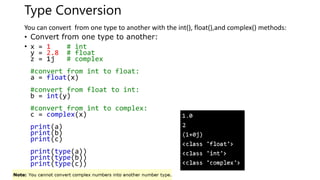
Type Conversion
You can convert from one type to another with the int(), float(),and complex() methods:
• Convert from one type to another:
• x = 1 # int
y = 2.8 # float
z = 1j # complex
#convert from int to float:
a = float(x)
#convert from float to int:
b = int(y)
#convert from int to complex:
c = complex(x)
print(a)
print(b)
print(c)
print(type(a))
print(type(b))
print(type(c))
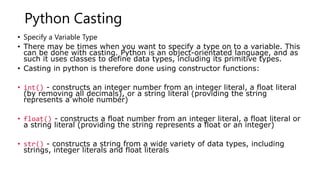
Python Casting
• Specify a Variable Type
• There may be times when you want to specify a type on to a variable. This
can be done with casting. Python is an object-orientated language, and as
such it uses classes to define data types, including its primitive types.
• Casting in python is therefore done using constructor functions:
• int() - constructs an integer number from an integer literal, a float literal
(by removing all decimals), or a string literal (providing the string
represents a whole number)
• float() - constructs a float number from an integer literal, a float literal or
a string literal (providing the string represents a float or an integer)
• str() - constructs a string from a wide variety of data types, including
strings, integer literals and float literals
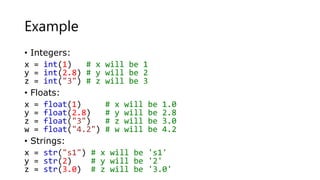
Example
• Integers:
x = int(1) # x will be 1
y = int(2.8) # y will be 2
z = int("3") # z will be 3
• Floats:
x = float(1) # x will be 1.0
y = float(2.8) # y will be 2.8
z = float("3") # z will be 3.0
w = float("4.2") # w will be 4.2
• Strings:
x = str("s1") # x will be 's1'
y = str(2) # y will be '2'
z = str(3.0) # z will be '3.0'
To Be Continued ……
Next topic: Python strings

Python Data Types,numbers.pptx

  • 1.
  • 2.
    Built-in Data Types •In programming, data type is an important concept. • Variables can store data of different types, and different types can do different things. • Python has the following data types built-in by default, in these categories:
  • 5.
    Checking the datatypes x = "Hello World" #display x: print(x) #display the data type of x: print(type(x))
  • 6.
  • 8.
  • 10.
    Python Numbers There arethree numeric types in Python: •int •float •complex Variables of numeric types are created when you assign a value to them: x = 1 # int y = 2.8 # float z = 1j # complex print(type(x)) print(type(y)) print(type(z))
  • 11.
    Int Int, or integer,is a whole number, positive or negative, without decimals, of unlimited length. Integers: x = 1 y = 35656222554887711 z = -3255522 print(type(x)) print(type(y)) print(type(z)) <class 'int'> <class 'int'> <class 'int'>
  • 12.
    Float • Float, or"floating point number" is a number, positive or negative, containing one or more decimals. Floats: x = 1.10 y = 1.0 z = -35.59 print(type(x)) print(type(y)) print(type(z)) • Try it Yourself
  • 13.
    Float can alsobe scientific numbers with an "e" to indicate the power of 10. Floats: x = 35e3 y = 12E4 z = -87.7e100 print(type(x)) print(type(y)) print(type(z))
  • 14.
    Complex • Complex numbersare written with a "j" as the imaginary part: Complex: x = 3+5j y = 5j z = -5j print(type(x)) print(type(y)) print(type(z))
  • 15.
    Type Conversion You canconvert from one type to another with the int(), float(),and complex() methods: • Convert from one type to another: • x = 1 # int y = 2.8 # float z = 1j # complex #convert from int to float: a = float(x) #convert from float to int: b = int(y) #convert from int to complex: c = complex(x) print(a) print(b) print(c) print(type(a)) print(type(b)) print(type(c))
  • 16.
    Python Casting • Specifya Variable Type • There may be times when you want to specify a type on to a variable. This can be done with casting. Python is an object-orientated language, and as such it uses classes to define data types, including its primitive types. • Casting in python is therefore done using constructor functions: • int() - constructs an integer number from an integer literal, a float literal (by removing all decimals), or a string literal (providing the string represents a whole number) • float() - constructs a float number from an integer literal, a float literal or a string literal (providing the string represents a float or an integer) • str() - constructs a string from a wide variety of data types, including strings, integer literals and float literals
  • 17.
    Example • Integers: x =int(1) # x will be 1 y = int(2.8) # y will be 2 z = int("3") # z will be 3 • Floats: x = float(1) # x will be 1.0 y = float(2.8) # y will be 2.8 z = float("3") # z will be 3.0 w = float("4.2") # w will be 4.2 • Strings: x = str("s1") # x will be 's1' y = str(2) # y will be '2' z = str(3.0) # z will be '3.0'
  • 18.
    To Be Continued…… Next topic: Python strings