Swipe
Python - Decision Making
Decision making is anticipation of conditions
occurring while execution of the program and
specifying actions taken according to the
conditions.
Decision structures evaluate multiple expressions
which produce TRUE or FALSE as outcome.
You need to determine which action to take and
which statements to execute if outcome is TRUE
or FALSE otherwise.
Python - Decision Making
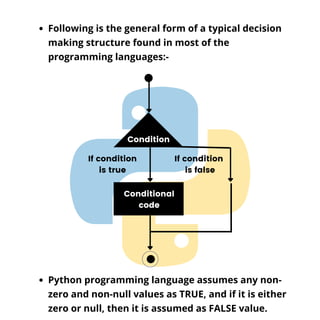
Following is the general form of a typical decision
making structure found in most of the
programming languages:-
Condition
Conditional
code
If condition
is true
If condition
is false
Python programming language assumes any non-
zero and non-null values as TRUE, and if it is either
zero or null, then it is assumed as FALSE value.
Decision-making statements
if statements
if-else statements
if-elif ladder
Nested statements
Python if statement
if statement is the most simple form of decision-
making statement.
It takes an expression and checks if the
expression evaluates to True then the block of
code in if statement will be executed.
If the expression evaluates to False, then the
block of code is skipped.
syntax
if ( expression ):
Statement 1
Statement 2
.
Statement n
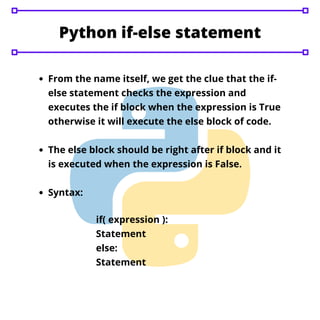
Python if-else statement
From the name itself, we get the clue that the if-
else statement checks the expression and
executes the if block when the expression is True
otherwise it will execute the else block of code.
The else block should be right after if block and it
is executed when the expression is False.
Syntax:
if( expression ):
Statement
else:
Statement
Python if-elif ladder
You might have heard of the else-if statements in
other languages like C/C++ or Java.
In Python, we have an elif keyword to chain
multiple conditions one after another.
With elif ladder, we can make complex decision-
making statements.
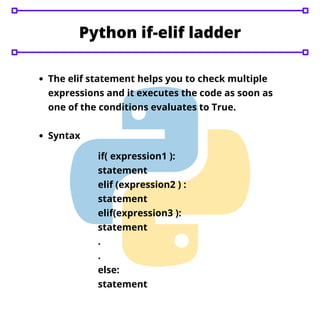
Python if-elif ladder
The elif statement helps you to check multiple
expressions and it executes the code as soon as
one of the conditions evaluates to True.
Syntax
if( expression1 ):
statement
elif (expression2 ) :
statement
elif(expression3 ):
statement
.
.
else:
statement
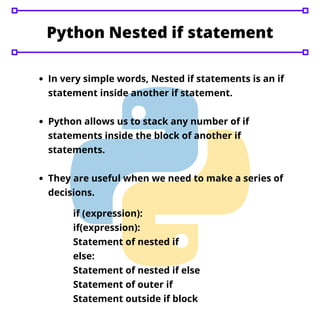
Python Nested if statement
In very simple words, Nested if statements is an if
statement inside another if statement.
Python allows us to stack any number of if
statements inside the block of another if
statements.
They are useful when we need to make a series of
decisions.
if (expression):
if(expression):
Statement of nested if
else:
Statement of nested if else
Statement of outer if
Statement outside if block
Python - Functions
Python - Modules
Python - Object Oriented
Stay Tuned with
Topics for next Post

Python decision making

  • 1.
  • 2.
    Decision making isanticipation of conditions occurring while execution of the program and specifying actions taken according to the conditions. Decision structures evaluate multiple expressions which produce TRUE or FALSE as outcome. You need to determine which action to take and which statements to execute if outcome is TRUE or FALSE otherwise. Python - Decision Making
  • 3.
    Following is thegeneral form of a typical decision making structure found in most of the programming languages:- Condition Conditional code If condition is true If condition is false Python programming language assumes any non- zero and non-null values as TRUE, and if it is either zero or null, then it is assumed as FALSE value.
  • 4.
    Decision-making statements if statements if-elsestatements if-elif ladder Nested statements
  • 5.
    Python if statement ifstatement is the most simple form of decision- making statement. It takes an expression and checks if the expression evaluates to True then the block of code in if statement will be executed. If the expression evaluates to False, then the block of code is skipped. syntax if ( expression ): Statement 1 Statement 2 . Statement n
  • 6.
    Python if-else statement Fromthe name itself, we get the clue that the if- else statement checks the expression and executes the if block when the expression is True otherwise it will execute the else block of code. The else block should be right after if block and it is executed when the expression is False. Syntax: if( expression ): Statement else: Statement
  • 7.
    Python if-elif ladder Youmight have heard of the else-if statements in other languages like C/C++ or Java. In Python, we have an elif keyword to chain multiple conditions one after another. With elif ladder, we can make complex decision- making statements.
  • 8.
    Python if-elif ladder Theelif statement helps you to check multiple expressions and it executes the code as soon as one of the conditions evaluates to True. Syntax if( expression1 ): statement elif (expression2 ) : statement elif(expression3 ): statement . . else: statement
  • 9.
    Python Nested ifstatement In very simple words, Nested if statements is an if statement inside another if statement. Python allows us to stack any number of if statements inside the block of another if statements. They are useful when we need to make a series of decisions. if (expression): if(expression): Statement of nested if else: Statement of nested if else Statement of outer if Statement outside if block
  • 10.
    Python - Functions Python- Modules Python - Object Oriented Stay Tuned with Topics for next Post