PYRAMIDING
PYRAMIDING
SUBJECT: SECURITY ANALYSIS
PRESENTED BY:

HIRA SHAHID KHAN
SAHAR KHAN
SAMREEN LODHI
SHAHZADI NEELOFAR

PRESENTED TO:

MS. SOBIA SHEIKH
Pyramiding is a method of increasing margin by using
  unrealized returns from successful trades. In other
  words , it is a business terminology of PONZI
  TECHNIQUE.


                                              SHAHZADI
                                              NEELOFAR
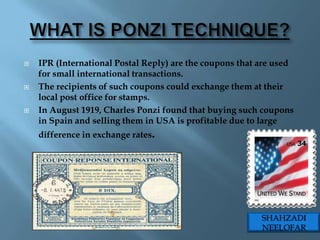
   IPR (International Postal Reply) are the coupons that are used
    for small international transactions.
   The recipients of such coupons could exchange them at their
    local post office for stamps.
   In August 1919, Charles Ponzi found that buying such coupons
    in Spain and selling them in USA is profitable due to large
    difference in exchange rates.


                                                          SHAHZADI
                                                          NEELOFAR
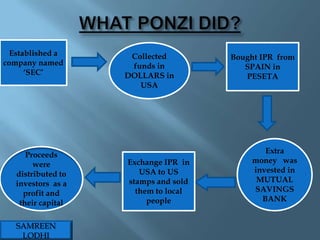
Established a      Collected        Bought IPR from
company named        funds in            SPAIN in
      „SEC‟         DOLLARS in           PESETA
                       USA


                                              Extra
      Proceeds
                    Exchange IPR in        money was
        were
                       USA to US           invested in
   distributed to
                    stamps and sold         MUTUAL
   investors as a
     profit and       them to local        SAVINGS
                         people              BANK
    their capital

   SAMREEN
    LODHI
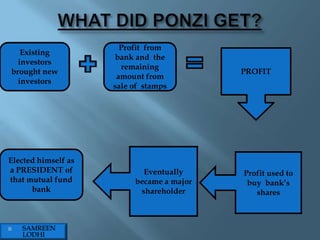
Profit from
   Existing
                     bank and the
  investors
                       remaining
brought new                                PROFIT
                      amount from
  investors
                     sale of stamps


Elected himself as
a PRESIDENT of              Eventually     Profit used to
that mutual fund          became a major    buy bank‟s
      bank                 shareholder        shares


   SAMREEN
    LODHI
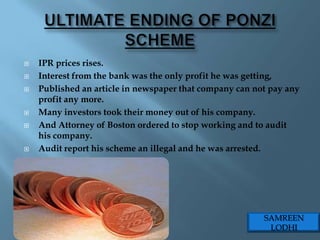
   IPR prices rises.
   Interest from the bank was the only profit he was getting,
   Published an article in newspaper that company can not pay any
    profit any more.
   Many investors took their money out of his company.
   And Attorney of Boston ordered to stop working and to audit
    his company.
   Audit report his scheme an illegal and he was arrested.


                                                         SAMREEN
                                                          LODHI
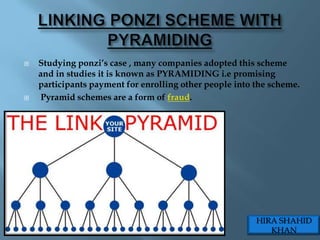
   Studying ponzi‟s case , many companies adopted this scheme
    and in studies it is known as PYRAMIDING i.e promising
    participants payment for enrolling other people into the scheme.
   Pyramid schemes are a form of fraud.


                                                         HIRA SHAHID
                                                            KHAN
    it revolves around continuous recruiting,
    the promoter collects payments from a stream of people,
    promising them all the same high rate of return on a short-term
    investment.
    In the typical Pyramiding scheme, there is no real investment
    opportunity, and the promoter just uses the money from new
    recruits to pay obligations owed to longer-standing members of
    the program.
   In English, there is an expression that nicely summarizes this
    scheme: It's called "stealing from Peter to pay Paul."


                                                         HIRA SHAHID
                                                            KHAN
    They offer Rs 30 key chain and Rs 10 sports card,
     that will be used for promoting sports activities,
     and buyer will win trips to foreign, cars, mobile phones
     and jewellery through lucky draw.
    However, it was banned on the ground that
    “Earning millions of rupees in this head by selling Hero
     Cards is useless and this should be stopped
     immediately until they are able to produce players of
     international quality to compete such mega events.”


                                                      HIRA SHAHID
                                                         KHAN
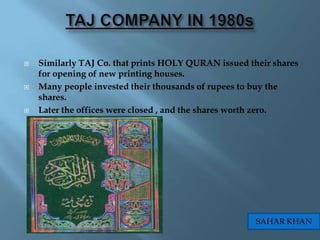
   Similarly TAJ Co. that prints HOLY QURAN issued their shares
    for opening of new printing houses.
   Many people invested their thousands of rupees to buy the
    shares.
   Later the offices were closed , and the shares worth zero.


                                                      SAHAR KHAN
   In 2003, the United States Federal Trade Commission (FTC)
    disclosed what it called an internet-based "pyramid scam.“
    Its complaint states that customers would pay a registration fee
    to join a program that called itself an "internet mall" and
    purchase a package of goods and services such as internet mail,
    and that the company offered "significant commissions" to
    consumers who purchased and resold the package.
    The FTC alleged that the company's program was instead and
    in reality a pyramid scheme that did not disclose that most
    consumers' money would be kept, and that it gave affiliates
    material that allowed them to scam others.


                                                          SAHAR KHAN
Pyramiding is an illegal activity and to avoid to be a prey of such
   trick, follow these 8 steps:
  Find — and study — the company‟s track record.
  Learn about the product
  Ask questions
  Understand any restrictions
  Talk to other distributors
  Consider using a friend or adviser as a neutral sounding board
   or for a gut check.
  Take your time.
  Think about whether this plan suits your talents and goals


                                                         SAHAR KHAN
THANKYOU

Pyramiding

  • 1.
  • 2.
    PYRAMIDING SUBJECT: SECURITY ANALYSIS PRESENTEDBY: HIRA SHAHID KHAN SAHAR KHAN SAMREEN LODHI SHAHZADI NEELOFAR PRESENTED TO: MS. SOBIA SHEIKH
  • 3.
    Pyramiding is amethod of increasing margin by using unrealized returns from successful trades. In other words , it is a business terminology of PONZI TECHNIQUE. SHAHZADI NEELOFAR
  • 4.
    IPR (International Postal Reply) are the coupons that are used for small international transactions.  The recipients of such coupons could exchange them at their local post office for stamps.  In August 1919, Charles Ponzi found that buying such coupons in Spain and selling them in USA is profitable due to large difference in exchange rates. SHAHZADI NEELOFAR
  • 5.
    Established a Collected Bought IPR from company named funds in SPAIN in „SEC‟ DOLLARS in PESETA USA Extra Proceeds Exchange IPR in money was were USA to US invested in distributed to stamps and sold MUTUAL investors as a profit and them to local SAVINGS people BANK their capital SAMREEN LODHI
  • 6.
    Profit from Existing bank and the investors remaining brought new PROFIT amount from investors sale of stamps Elected himself as a PRESIDENT of Eventually Profit used to that mutual fund became a major buy bank‟s bank shareholder shares  SAMREEN LODHI
  • 7.
    IPR prices rises.  Interest from the bank was the only profit he was getting,  Published an article in newspaper that company can not pay any profit any more.  Many investors took their money out of his company.  And Attorney of Boston ordered to stop working and to audit his company.  Audit report his scheme an illegal and he was arrested. SAMREEN LODHI
  • 8.
    Studying ponzi‟s case , many companies adopted this scheme and in studies it is known as PYRAMIDING i.e promising participants payment for enrolling other people into the scheme.  Pyramid schemes are a form of fraud. HIRA SHAHID KHAN
  • 9.
    it revolves around continuous recruiting,  the promoter collects payments from a stream of people,  promising them all the same high rate of return on a short-term investment.  In the typical Pyramiding scheme, there is no real investment opportunity, and the promoter just uses the money from new recruits to pay obligations owed to longer-standing members of the program.  In English, there is an expression that nicely summarizes this scheme: It's called "stealing from Peter to pay Paul." HIRA SHAHID KHAN
  • 10.
    They offer Rs 30 key chain and Rs 10 sports card,  that will be used for promoting sports activities,  and buyer will win trips to foreign, cars, mobile phones and jewellery through lucky draw.  However, it was banned on the ground that “Earning millions of rupees in this head by selling Hero Cards is useless and this should be stopped immediately until they are able to produce players of international quality to compete such mega events.” HIRA SHAHID KHAN
  • 11.
    Similarly TAJ Co. that prints HOLY QURAN issued their shares for opening of new printing houses.  Many people invested their thousands of rupees to buy the shares.  Later the offices were closed , and the shares worth zero. SAHAR KHAN
  • 12.
    In 2003, the United States Federal Trade Commission (FTC) disclosed what it called an internet-based "pyramid scam.“  Its complaint states that customers would pay a registration fee to join a program that called itself an "internet mall" and purchase a package of goods and services such as internet mail, and that the company offered "significant commissions" to consumers who purchased and resold the package.  The FTC alleged that the company's program was instead and in reality a pyramid scheme that did not disclose that most consumers' money would be kept, and that it gave affiliates material that allowed them to scam others. SAHAR KHAN
  • 13.
    Pyramiding is anillegal activity and to avoid to be a prey of such trick, follow these 8 steps:  Find — and study — the company‟s track record.  Learn about the product  Ask questions  Understand any restrictions  Talk to other distributors  Consider using a friend or adviser as a neutral sounding board or for a gut check.  Take your time.  Think about whether this plan suits your talents and goals SAHAR KHAN
  • 14.