Joint Health

LOOK, FEEL AND LIVE BET TER
Pycnogenol® for Joint Health
Our joints are subject to wear and tear and with increasing age the lining of joints, the cushioning cartilage,
gradually degenerates. When cartilage has reached significant abrasion articular tissue will be affected and
tissue trauma initiates a local inflammation. The consequence is a reduced flexibility of joints and predominantly pain. Inflammatory cells accelerate degeneration of joints by secreting reactive oxygen species (“oxidative burst”), pro-inflammatory cytokines and degenerative enzymes matrix metalloproteinases (MMPs).
This process is paralleled by increasing pain which, left untreated, may reach excruciating levels.
A majority of people over the age of 65 years show
signs of osteoarthritis. Essentially all joints may be
affected, but the most commonly affected are hips,
knees, fingers and the spine. There are specific risk
factors for developing osteoarthritis, such as obesity
as it increases mechanical destruction of joints. According to statistics women are more frequently affected than men. It is now understood that mechanical rupture triggers inflammatory mechanisms which,
in concert with repetitive injury to joints, causes a
progressive degradation of cartilage.
Osteoarthritis is the leading medical condition for
which people use alternative therapies. The primary
goal is the relief from joint pain and stiffness and
with time the restoration of mobility.

Pycnogenol® potently inhibits inflammation in arthritis
The pharmacologic activities of Pycnogenol® in humans allow to address several pathologic processes
of osteoarthritis simultaneously. Consumption of
Pycnogenol® was shown to inhibit the activation of
the pro-inflammatory “master switch” NF-kB by 15.8%
[Grimm et al., 2006]. The activated NF-kB protein commands the mobilization of essentially all proinflammatory molecules which play a destructive role in arthritis.
As a consequence of NF-kB inhibition immune cells of
Pycnogenol® consumers generate less MMP enzymes
which are responsible for degenerating cartilage collagen in osteoarthritis [Grimm et al., 2006]. Pycnogenol®
consumption was found to naturally inhibit COX-en-

zymes in humans, which are predominantly responsible for joint pain [Schäfer et al., 2006].

Pycnogenol® potently inhibits inflammation
in arthritis

Inflammatory
«master-switch»

Source of pain
in joints

Cartilage
degradation

NF-kB
-15.5%

COX
-15%

MMPs
-25%

I Horphag Research-Geneva, Switzerland I Horphag Research Asia-Shanghai, China I Natural Health Science-Hoboken NJ, USA I www.pycnogenol.com I ©HORPHAG I

2
Joint Health

Experiments with leukocytes from blood of human
Pycnogenol® consumers revealed further anti-inflammatory mechanisms. Pycnogenol® significantly inhibited the synthesis of COX-2 enzyme as well as 5-LOX
and FLAP enzymes [Canali et al., 2008]. Particularly the
gene expression of COX-2 is controlled by NF-kB and
after Pycnogenol® consumption for 5 days the COX-2
production was decreased by 78%. The gene expression of 5-LOX is inhibited by 75.5% in leukocytes after 5 days of Pycnogenol® consumption.

Pycnogenol® lowers inflammatory marker
CRP in osteoarthritis patients
Pycnogenol® was demonstrated in a study with 55
osteoarthritis patients to significantly lower the inflammatory marker C-reative protein (CRP) by 72%. Moreover, this study found a significant reduction of reactive oxygen species in arthritis patients by 30% [Belcaro
et al., 2008]. This finding proves that the anti-inflammatory activity of Pycnogenol® is effective in arthritis patients.
Pycnogenol® lowers inflammatory marker CRP in
osteoarthritis patients

Systemic
Inflammation

Oxidative
stress

CRP
-72%

ROS
-30%

Three clinical trials with Pycnogenol® for
osteoarthritis
To date the improvement of osteoarthritis symptoms
was validated in three double-blind, placebo-controlled studies. All three studies utilized the well established WOMAC score for evaluation of joint pain,
joint stiffness and function for primary osteoarthritis
(grade I or II) of the knee.

First pilot trial with Pycnogenol® for
osteoarthritis
Pycnogenol® was shown in a first clinical pilot trial to
improve pain and symptoms in osteoarthritis at the
University of Arizona Tucson [Farid et al., 2007]. In this
trial 37 patients received Pycnogenol® or placebo in
addition to their standard NSAID of selective COX-2
inhibitor medication over a period of three months.
With Pycnogenol® the pain gradually decreased from
one month to another reaching a significant change
to placebo after two months. After three months
a significant reduction of 43%, 35%, and 52% in
self-reported pain, stiffness and physical function, respectively, were reported in the Pycnogenol® group
whereas the placebo group showed no significant
changes. Subjects required significantly less NSAID or
selective COX-2 inhibitors when taking Pycnogenol®
and the number of days during which they required
analgesics decreased as well. In contrast, the placebo
group required increased pain medication during the
3 months trial.

Second clinical trial with Pycnogenol® in
100 osteoarthritis patients
A larger study was carried out in Europe with 100
patients [Cisar et al., 2008]. The results of this study
are in accordance with the previous study. Again the
pain is gradually decreasing during the course of three
months treatment with Pycnogenol®. An improvement
is found after the first month and a further improvement is seen after 2 months, were values are significantly different to the placebo group. This study had
a follow-up investigation period two weeks after discontinuation of treatment. Interestingly, no sudden relapse of pain sensation and symptoms occurred. This
study again showed that patients required significantly
less analgesic medication while supplementing with
Pycnogenol®, whereas this was not the case with the
placebo-treated control group.

I Horphag Research-Geneva, Switzerland I Horphag Research Asia-Shanghai, China I Natural Health Science-Hoboken NJ, USA I www.pycnogenol.com I ©HORPHAG I

3
Joint Health

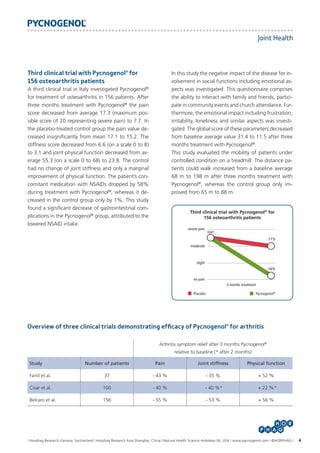
Third clinical trial with Pycnogenol® for
156 osteoarthritis patients

In this study the negative impact of the disease for involvement in social functions including emotional aspects was investigated. This questionnaire comprises
the ability to interact with family and friends, participate in community events and church attendance. Furthermore, the emotional impact including frustration,
irritability, loneliness and similar aspects was investigated. The global score of these parameters decreased
from baseline average value 31.4 to 11.5 after three
months treatment with Pycnogenol®.
This study evaluated the mobility of patients under
controlled condition on a treadmill. The distance patients could walk increased from a baseline average
68 m to 198 m after three months treatment with
Pycnogenol®, whereas the control group only improved from 65 m to 88 m.

A third clinical trial in Italy investigated Pycnogenol®
for treatment of osteoarthritis in 156 patients. After
three months treatment with Pycnogenol® the pain
score decreased from average 17.3 (maximum possible score of 20 representing severe pain) to 7.7. In
the placebo-treated control group the pain value decreased insignificantly from mean 17.1 to 15.2. The
stiffness score decreased from 6.6 (on a scale 0 to 8)
to 3.1 and joint physical function decreased from average 55.3 (on a scale 0 to 68) to 23.8. The control
had no change of joint stiffness and only a marginal
improvement of physical function. The patient’s concomitant medication with NSAIDs dropped by 58%
during treatment with Pycnogenol®, whereas it decreased in the control group only by 1%. This study
found a significant decrease of gastrointestinal complications in the Pycnogenol® group, attributed to the
lowered NSAID intake.

Third clinical trial with Pycnogenol® for
156 osteoarthritis patients
severe pain

start
-11%

moderate

slight
-56%
no pain

3 months treatment
Placebo

Pycnogenol®

Overview of three clinical trials demonstrating efficacy of Pycnogenol® for arthritis
Arthritis symptom relief after 3 months Pycnogenol®
relative to baseline (* after 2 months)
Study

Number of patients

Pain

Joint stiffness

Physical function

Farid et al.

37

- 43 %

- 35 %

+ 52 %

Cisar et al.

100

- 40 %

Belcaro et al.

156

- 55 %


- 40 %*
- 53 %


+ 22 %*
+ 56 %

I Horphag Research-Geneva, Switzerland I Horphag Research Asia-Shanghai, China I Natural Health Science-Hoboken NJ, USA I www.pycnogenol.com I ©HORPHAG I

4
Joint Health

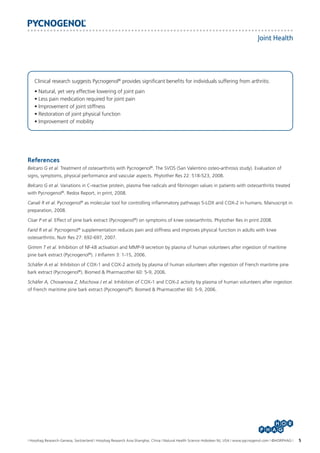
Clinical research suggests Pycnogenol® provides significant benefits for individuals suffering from arthritis:
• Natural, yet very effective lowering of joint pain
• Less pain medication required for joint pain
• Improvement of joint stiffness
• Restoration of joint physical function
• Improvement of mobility

References
Belcaro G et al. Treatment of osteoarthritis with Pycnogenol®. The SVOS (San Valentino osteo-arthrosis study). Evaluation of
signs, symptoms, physical performance and vascular aspects. Phytother Res 22: 518-523, 2008.
Belcaro G et al. Variations in C-reactive protein, plasma free radicals and fibrinogen values in patients with osteoarthritis treated
with Pycnogenol®. Redox Report, in print, 2008.
Canali R et al. Pycnogenol® as molecular tool for controlling inflammatory pathways 5-LOX and COX-2 in humans. Manuscript in
preparation, 2008.
Cisar P et al. Effect of pine bark extract (Pycnogenol®) on symptoms of knee osteoarthritis. Phytother Res in print 2008.
Farid R et al. Pycnogenol® supplementation reduces pain and stiffness and improves physical function in adults with knee
osteoarthritis. Nutr Res 27: 692-697, 2007.
Grimm T et al. Inhibition of NF-kB activation and MMP-9 secretion by plasma of human volunteers after ingestion of maritime
pine bark extract (Pycnogenol®). J Inflamm 3: 1-15, 2006.
Schäfer A et al. Inhibition of COX-1 and COX-2 activity by plasma of human volunteers after ingestion of French maritime pine
bark extract (Pycnogenol®). Biomed & Pharmacother 60: 5-9, 2006.
Schäfer A, Chovanova Z, Muchova J et al. Inhibition of COX-1 and COX-2 activity by plasma of human volunteers after ingestion
of French maritime pine bark extract (Pycnogenol®). Biomed & Pharmacother 60: 5-9, 2006.

I Horphag Research-Geneva, Switzerland I Horphag Research Asia-Shanghai, China I Natural Health Science-Hoboken NJ, USA I www.pycnogenol.com I ©HORPHAG I

5

Pycnogenol For Joint Health

  • 1.
    Joint Health LOOK, FEELAND LIVE BET TER
  • 2.
    Pycnogenol® for JointHealth Our joints are subject to wear and tear and with increasing age the lining of joints, the cushioning cartilage, gradually degenerates. When cartilage has reached significant abrasion articular tissue will be affected and tissue trauma initiates a local inflammation. The consequence is a reduced flexibility of joints and predominantly pain. Inflammatory cells accelerate degeneration of joints by secreting reactive oxygen species (“oxidative burst”), pro-inflammatory cytokines and degenerative enzymes matrix metalloproteinases (MMPs). This process is paralleled by increasing pain which, left untreated, may reach excruciating levels. A majority of people over the age of 65 years show signs of osteoarthritis. Essentially all joints may be affected, but the most commonly affected are hips, knees, fingers and the spine. There are specific risk factors for developing osteoarthritis, such as obesity as it increases mechanical destruction of joints. According to statistics women are more frequently affected than men. It is now understood that mechanical rupture triggers inflammatory mechanisms which, in concert with repetitive injury to joints, causes a progressive degradation of cartilage. Osteoarthritis is the leading medical condition for which people use alternative therapies. The primary goal is the relief from joint pain and stiffness and with time the restoration of mobility. Pycnogenol® potently inhibits inflammation in arthritis The pharmacologic activities of Pycnogenol® in humans allow to address several pathologic processes of osteoarthritis simultaneously. Consumption of Pycnogenol® was shown to inhibit the activation of the pro-inflammatory “master switch” NF-kB by 15.8% [Grimm et al., 2006]. The activated NF-kB protein commands the mobilization of essentially all proinflammatory molecules which play a destructive role in arthritis. As a consequence of NF-kB inhibition immune cells of Pycnogenol® consumers generate less MMP enzymes which are responsible for degenerating cartilage collagen in osteoarthritis [Grimm et al., 2006]. Pycnogenol® consumption was found to naturally inhibit COX-en- zymes in humans, which are predominantly responsible for joint pain [Schäfer et al., 2006]. Pycnogenol® potently inhibits inflammation in arthritis Inflammatory «master-switch» Source of pain in joints Cartilage degradation NF-kB -15.5% COX -15% MMPs -25% I Horphag Research-Geneva, Switzerland I Horphag Research Asia-Shanghai, China I Natural Health Science-Hoboken NJ, USA I www.pycnogenol.com I ©HORPHAG I 2
  • 3.
    Joint Health Experiments withleukocytes from blood of human Pycnogenol® consumers revealed further anti-inflammatory mechanisms. Pycnogenol® significantly inhibited the synthesis of COX-2 enzyme as well as 5-LOX and FLAP enzymes [Canali et al., 2008]. Particularly the gene expression of COX-2 is controlled by NF-kB and after Pycnogenol® consumption for 5 days the COX-2 production was decreased by 78%. The gene expression of 5-LOX is inhibited by 75.5% in leukocytes after 5 days of Pycnogenol® consumption. Pycnogenol® lowers inflammatory marker CRP in osteoarthritis patients Pycnogenol® was demonstrated in a study with 55 osteoarthritis patients to significantly lower the inflammatory marker C-reative protein (CRP) by 72%. Moreover, this study found a significant reduction of reactive oxygen species in arthritis patients by 30% [Belcaro et al., 2008]. This finding proves that the anti-inflammatory activity of Pycnogenol® is effective in arthritis patients. Pycnogenol® lowers inflammatory marker CRP in osteoarthritis patients Systemic Inflammation Oxidative stress CRP -72% ROS -30% Three clinical trials with Pycnogenol® for osteoarthritis To date the improvement of osteoarthritis symptoms was validated in three double-blind, placebo-controlled studies. All three studies utilized the well established WOMAC score for evaluation of joint pain, joint stiffness and function for primary osteoarthritis (grade I or II) of the knee. First pilot trial with Pycnogenol® for osteoarthritis Pycnogenol® was shown in a first clinical pilot trial to improve pain and symptoms in osteoarthritis at the University of Arizona Tucson [Farid et al., 2007]. In this trial 37 patients received Pycnogenol® or placebo in addition to their standard NSAID of selective COX-2 inhibitor medication over a period of three months. With Pycnogenol® the pain gradually decreased from one month to another reaching a significant change to placebo after two months. After three months a significant reduction of 43%, 35%, and 52% in self-reported pain, stiffness and physical function, respectively, were reported in the Pycnogenol® group whereas the placebo group showed no significant changes. Subjects required significantly less NSAID or selective COX-2 inhibitors when taking Pycnogenol® and the number of days during which they required analgesics decreased as well. In contrast, the placebo group required increased pain medication during the 3 months trial. Second clinical trial with Pycnogenol® in 100 osteoarthritis patients A larger study was carried out in Europe with 100 patients [Cisar et al., 2008]. The results of this study are in accordance with the previous study. Again the pain is gradually decreasing during the course of three months treatment with Pycnogenol®. An improvement is found after the first month and a further improvement is seen after 2 months, were values are significantly different to the placebo group. This study had a follow-up investigation period two weeks after discontinuation of treatment. Interestingly, no sudden relapse of pain sensation and symptoms occurred. This study again showed that patients required significantly less analgesic medication while supplementing with Pycnogenol®, whereas this was not the case with the placebo-treated control group. I Horphag Research-Geneva, Switzerland I Horphag Research Asia-Shanghai, China I Natural Health Science-Hoboken NJ, USA I www.pycnogenol.com I ©HORPHAG I 3
  • 4.
    Joint Health Third clinicaltrial with Pycnogenol® for 156 osteoarthritis patients In this study the negative impact of the disease for involvement in social functions including emotional aspects was investigated. This questionnaire comprises the ability to interact with family and friends, participate in community events and church attendance. Furthermore, the emotional impact including frustration, irritability, loneliness and similar aspects was investigated. The global score of these parameters decreased from baseline average value 31.4 to 11.5 after three months treatment with Pycnogenol®. This study evaluated the mobility of patients under controlled condition on a treadmill. The distance patients could walk increased from a baseline average 68 m to 198 m after three months treatment with Pycnogenol®, whereas the control group only improved from 65 m to 88 m. A third clinical trial in Italy investigated Pycnogenol® for treatment of osteoarthritis in 156 patients. After three months treatment with Pycnogenol® the pain score decreased from average 17.3 (maximum possible score of 20 representing severe pain) to 7.7. In the placebo-treated control group the pain value decreased insignificantly from mean 17.1 to 15.2. The stiffness score decreased from 6.6 (on a scale 0 to 8) to 3.1 and joint physical function decreased from average 55.3 (on a scale 0 to 68) to 23.8. The control had no change of joint stiffness and only a marginal improvement of physical function. The patient’s concomitant medication with NSAIDs dropped by 58% during treatment with Pycnogenol®, whereas it decreased in the control group only by 1%. This study found a significant decrease of gastrointestinal complications in the Pycnogenol® group, attributed to the lowered NSAID intake. Third clinical trial with Pycnogenol® for 156 osteoarthritis patients severe pain start -11% moderate slight -56% no pain 3 months treatment Placebo Pycnogenol® Overview of three clinical trials demonstrating efficacy of Pycnogenol® for arthritis Arthritis symptom relief after 3 months Pycnogenol® relative to baseline (* after 2 months) Study Number of patients Pain Joint stiffness Physical function Farid et al. 37 - 43 % - 35 % + 52 % Cisar et al. 100 - 40 % Belcaro et al. 156 - 55 % - 40 %* - 53 % + 22 %* + 56 % I Horphag Research-Geneva, Switzerland I Horphag Research Asia-Shanghai, China I Natural Health Science-Hoboken NJ, USA I www.pycnogenol.com I ©HORPHAG I 4
  • 5.
    Joint Health Clinical researchsuggests Pycnogenol® provides significant benefits for individuals suffering from arthritis: • Natural, yet very effective lowering of joint pain • Less pain medication required for joint pain • Improvement of joint stiffness • Restoration of joint physical function • Improvement of mobility References Belcaro G et al. Treatment of osteoarthritis with Pycnogenol®. The SVOS (San Valentino osteo-arthrosis study). Evaluation of signs, symptoms, physical performance and vascular aspects. Phytother Res 22: 518-523, 2008. Belcaro G et al. Variations in C-reactive protein, plasma free radicals and fibrinogen values in patients with osteoarthritis treated with Pycnogenol®. Redox Report, in print, 2008. Canali R et al. Pycnogenol® as molecular tool for controlling inflammatory pathways 5-LOX and COX-2 in humans. Manuscript in preparation, 2008. Cisar P et al. Effect of pine bark extract (Pycnogenol®) on symptoms of knee osteoarthritis. Phytother Res in print 2008. Farid R et al. Pycnogenol® supplementation reduces pain and stiffness and improves physical function in adults with knee osteoarthritis. Nutr Res 27: 692-697, 2007. Grimm T et al. Inhibition of NF-kB activation and MMP-9 secretion by plasma of human volunteers after ingestion of maritime pine bark extract (Pycnogenol®). J Inflamm 3: 1-15, 2006. Schäfer A et al. Inhibition of COX-1 and COX-2 activity by plasma of human volunteers after ingestion of French maritime pine bark extract (Pycnogenol®). Biomed & Pharmacother 60: 5-9, 2006. Schäfer A, Chovanova Z, Muchova J et al. Inhibition of COX-1 and COX-2 activity by plasma of human volunteers after ingestion of French maritime pine bark extract (Pycnogenol®). Biomed & Pharmacother 60: 5-9, 2006. I Horphag Research-Geneva, Switzerland I Horphag Research Asia-Shanghai, China I Natural Health Science-Hoboken NJ, USA I www.pycnogenol.com I ©HORPHAG I 5